THE INFLUENCE OF SELECTED TECHNICAL PARAMETERS ON DISCUS THROWING PERFORMANCE
Steve Leigh
A thesis submitted to the faculty of the University of North Carolina at Chapel Hill in partial fulfillment of the requirements for the degree of Master of Science in the Department of Allied Health Sciences, Division of Physical Therapy.
Chapel Hill 2006
Approved by
Advisor: Bing Yu
Reader: Michael T. Gross
ii ABSTRACT
Steve Leigh: The Influence of Selected Technical Parameters on Discus Throwing Performance
(Under the direction of Bing Yu)
The purpose of this study was to determine the effects of the technical parameters: throwing phase time, hip-shoulder and shoulder-arm separation, trunk tilt, and throwing-arm elevation on discus throwing performance. Videographic data of male and female discus throwers’ competitive performances were captured during major meets. Real-life, three-dimensional coordinates of 21 body landmarks and the discus were obtained for 283 trials using direct linear transformation. The technical parameters were reduced at six critical instants during the throwing procedure. Canonical correlation and hierarchical stepwise multiple regression analyses were performed to determine the relative influence of linear combinations of the technical parameters on release characteristics and performance. Specific techniques
ACKNOWLEDGEMENTS
iv
TABLE OF CONTENTS
Page
List of Tables...………...………...………...…….vi
List of Figures………..vii
Chapter I. Introduction...1
1.1 - Purpose...10
II. Review of the Literature...13
III. Methods...21
3.1 - Subjects...21
3.2 - Data Collection...21
3.3 - Data Reduction...22
3.4 - Technical Parameters...25
3.5 - Data Analysis...29
IV. Results...35
4.1 - Inter-digitizer Reliability...35
4.2 - Data Screening...36
4.3 - Hierarchical Stepwise Multiple Regression...37
V. Discussion...45
5.1 - Female Regression Equation...48
5.2 - Male Regression Equation ...51
5.3 - Female Canonical Correlations...55
5.4 - Male Canonical Correlations...57
5.5 - Limitations...59
5.6 - Conclusions...60
LIST OF TABLES
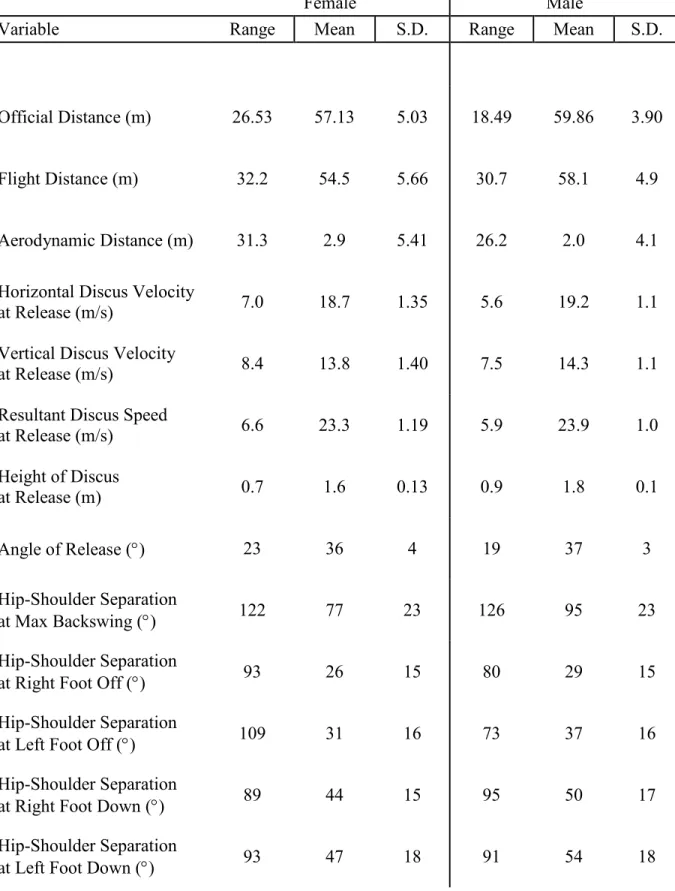
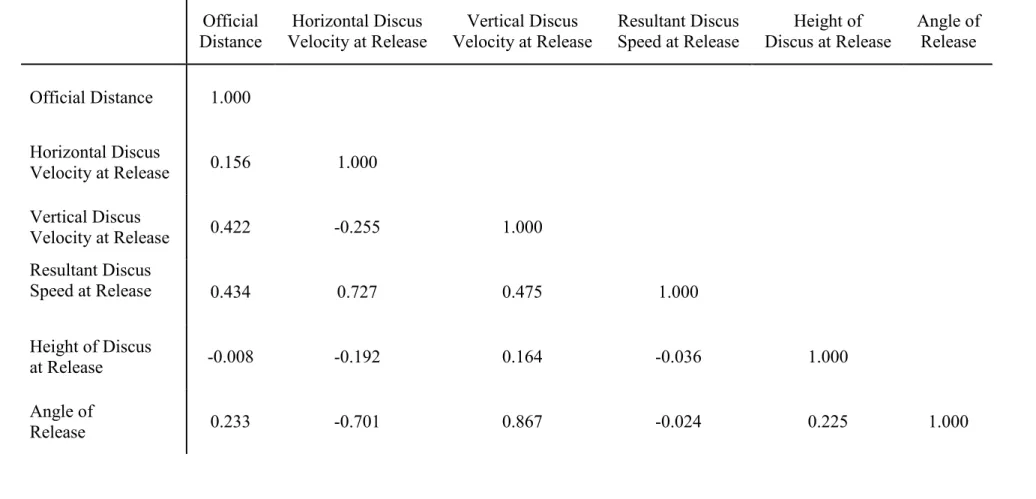
Page Table 1: Reliability Statistics...61 Table 2: Discus Throwing Descriptive Statistics...64 Table 3: Female Discus Thrower’s Official Distance and Release Characteristics
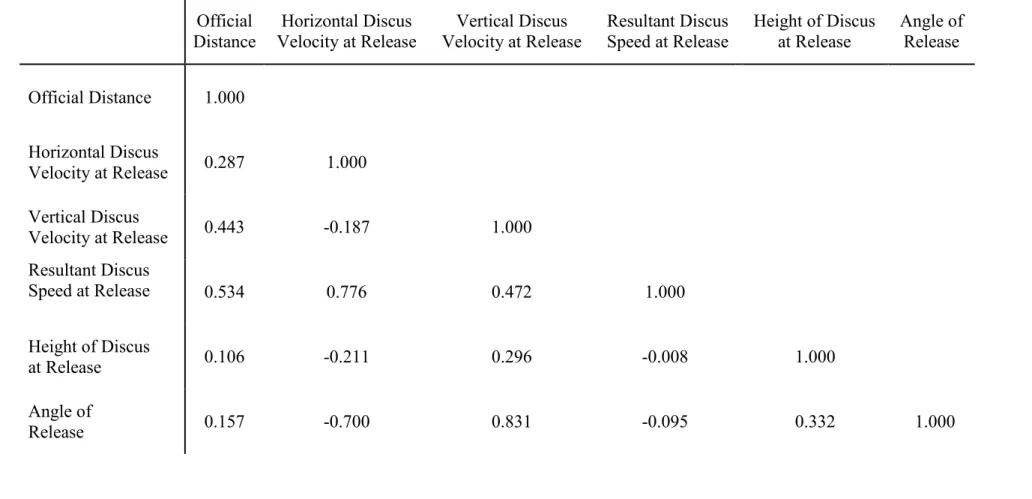
Correlation Matrix...67 Table 4: Male Discus Thrower’s Official Distance and Release Characteristics
Correlation Matrix...68 Table 5: Official Distance and Technical Parameters Bivariate Correlations...69 Table 6: Female Discus Thrower’s Performance Prediction Equation...70 Table 7: Female Discus Thrower’s Performance Prediction Equation Zero-Order,
Bivariate Correlation Matrix...71 Table 8: Male Discus Thrower’s Performance Prediction Equation...72 Table 9: Male Discus Thrower’s Performance Prediction Equation Zero-Order,
Bivariate Correlation Matrix...73 Table 10: Canonical Correlations for Release Characteristic Set One with Technical
Parameters...74 Table 11: Canonical Correlations for Release Characteristic Set Two with Technical
LIST OF FIGURES
Page
Figure 1: Discus Throwing Distances...78
Figure 2: Angle of Attack...79
Figure 3: Discus in Cross-Section...80
Figure 4: Definition of Hip-Shoulder Separation Angle...81
Figure 5: Definition of Shoulder-Arm Separation Angle...82
Figure 6: Definition of Throwing Arm Elevation Angle...83
Figure 7: Definition of Trunk Tilt Angle...84
Figure 8: Deterministic Discus Throwing Performance Model...85
Figure 9: Positioning of Camcorders...86
Figure 10: Calibration Frame...87
CHAPTER I INTRODUCTION
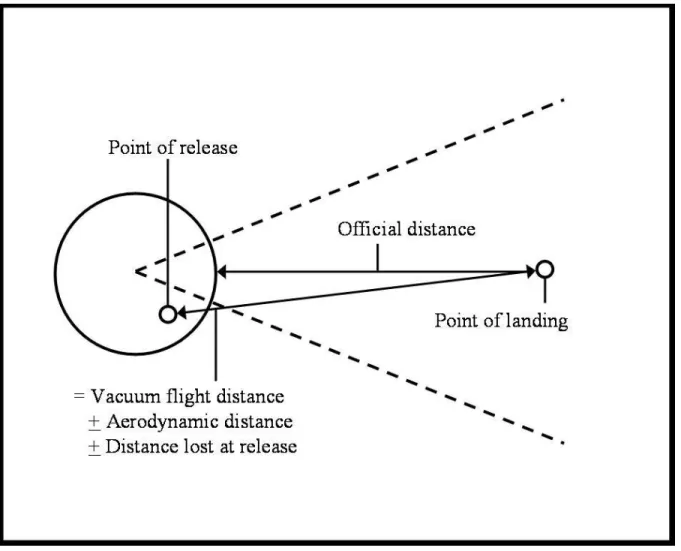
The official distance thrown by each athlete during a discus throwing competition determines the winner. The longest throw achieved during any round in the final wins. The official distance is defined as that distance measured by the officials. The true distance thrown can be decomposed into three components: vacuum flight distance, aerodynamic distance and distance lost at release. The true distance thrown is related to, but not equal to the official distance measured (Figure 1). The sum of the vacuum flight distance and the aerodynamic distance is the flight distance. The most important component of official distance is the vacuum flight distance (Hay and Yu, 1995). The vacuum flight distance is the theoretical distance calculated using the range equation. The discus is treated as a point mass traveling through a vacuum. The range is then calculated using discus release characteristics: the speed of release, the angle of release, and the height of release; as well as the acceleration due to gravity:
g
gh v
v v
R cos sin sin 2
2 2
+ ×
= (Equation 1)
To achieve the longest vacuum flight distance, and therefore the longest throw, athletes must carefully control their releases so the discus is thrown at the maximum height possible, combined with an optimal release angle, and the maximum possible speed.
Secondary release characteristics include the angle between the relative wind velocity and the discus’s longitudinal-lateral plane – known as the angle of attack (Taylor, 1932) (Figure 2), as well as other aerodynamic factors.
The aerodynamic flight of the discus influences the official distance. The range equation neglects the effects of aerodynamic lift and air resistance, or drag, forces which are an important consideration for any thrown implement. The upper and lower surfaces of the discus have the same shape, therefore, in cross section the discus can be considered a symmetric aerofoil (wing-shaped) (Ganslen, 1964) (Figure 3). If thrown oriented at an optimal angle of attack, then the discus will produce lift and fly further. This can be
explained by the Bernoulli Principle. The stagnation point of the air flow moves to the lower surface of the discus when it is inclined. Air then travels over the upper surface faster than the lower surface. This creates a pressure difference in the air flow around the discus and causes lift. The wind’s velocity may increase or decrease the speed of the air traveling over the discus’s surfaces, which is why the angle of attack must be relative to the wind
3
The distance lost at release is the horizontal distance traveled by the discus for which the athlete does not get credit. The official distance is measured as the distance “from the nearest mark made by the fall of the discus, to the inside of the circumference of the circle along a line to the centre of the circle” (IAAF, 2006) (Figure 1). If an athlete releases the discus while still within the confines of the circle, then the distance traveled by the discus before it reaches the inside circumference of the circle is not included in the official distance measurement. This is a relatively small loss of distance, and can be minimized by careful control of the position of release.
The discus’s speed at release is the single most important factor contributing to long throws. Release speed has the greatest effect on the vacuum flight distance, which is the largest factor contributing to the official distance. A larger release speed will increase the vacuum flight distance, since the two are directly proportional. Therefore, the athlete will throw further. A larger release speed may also cause greater lift of the discus, if an efficient angle of attack is maintained, since the air passing across the discus’s surfaces will travel faster and create a greater pressure differential.
The flight of the discus may be considered in two orthogonal planes: horizontal and vertical. The horizontal range is the most important, since this is the official distance. The vertical distance traveled during flight is essentially irrelevant, however, the vertical velocity is still important, since this determines the time of flight:
g gh v
v
T v v 2
2 +
+
Where T = time of flight, vv= vertical component of discus release velocity, g = constant acceleration due to gravity, and h = height of release. The range of the discus is dependent on both the time of flight and the horizontal component of velocity:
g gh v
v v
R v v
h
2 2+
+ ×
= (Equation 3)
Where R = vacuum flight distance, vh= horizontal component of discus release velocity, vv= vertical component of discus release velocity, g = constant acceleration due to gravity, and h = height of release. Therefore, the athlete should strive to maximize the horizontal release velocity, the vertical release velocity, and the height of release simultaneously.
The angle of release should be maximized as long as the maximum horizontal velocity can be maintained. The angle between the horizontal and vertical components of velocity is the angle of release:
= h v v v 1
sin (Equation 4)
Where = angle of release, vv= vertical component of discus release velocity, and vh= horizontal component of discus release velocity. This angle is different than the angle of attack, and is independent of the orientation of the discus. A relatively large vertical velocity at release will be associated with a large angle of release. If a large horizontal velocity is maintained, the discus will fly for a long time at a high horizontal velocity and a long distance will be achieved.
5
surface. The orbit of the discus should be oriented in such a way as to optimize the angle it makes with the ground so that the angle of release is large. Referenced to the direction of throw, the orbit should be low at the back of the circle and high at the front of the circle.
The height of release should also be maximized, since a greater height of release will prolong the flight time, because the discus has longer to fall before it reaches the ground. If the height of release is large the time of flight, calculated using equation 2, is increased. This increase in the time of flight will also have the effect of increasing the horizontal range, calculated using equation 3.
Athlete’s techniques can determine the release characteristics of speed, angle, and height. The discus’s release speed is increased throughout the throwing procedure by force applied to it by the athletes. The path traveled by the discus determines the time for which the force is applied. A longer path means force is applied to the discus for a longer time, thereby increasing discus release velocity (Bartlett, 1992). The magnitude of the force applied to the discus is primarily dependant on the strength of the athlete. Any technique employed by athletes should increase the horizontal and vertical distances traveled by the discus during the throwing procedure, as well as maximize the force applied. This will allow for large
magnitude velocities to be developed before release.
maximal velocity in the intended throwing direction. An angle between the imaginary lines joining the hip joint centers and the shoulder joint centers is defined as the hip-shoulder separation angle (Figure 4). An angle between the imaginary lines joining the shoulder joint centers and the line of the throwing arm is defined as the shoulder-arm separation (Figure 5). Increasing these separations early in the throwing procedure, then reducing them later in the throwing procedure should have the effect of increasing the path traveled by the discus, increase the time for which force is applied, and allow for a tangential release. All these positive outcomes should increase the distance thrown by maximizing the release speed.
For athletes to throw maximum distances, the discus should be released at a steep inclination and as high as possible. The angle of attack should also be considered.
7
be large. The distance thrown will be maximized as long as the release speed is maintained. Therefore, optimizing technique to achieve the largest release speed at optimal release angles and heights is vital in discus throwing.
The hip-shoulder separation angle, shoulder-arm separation angle, trunk tilt angle and throwing arm elevation angle are technical parameters which can describe an athlete’s
technique throughout the throwing procedure. The parameters may be especially important at certain specific times during the throwing procedure. Six critical instants during the discus throwing procedure have been identified as: maximum backswing, right foot takeoff, left foot takeoff, right foot touchdown, left foot touchdown, and release (Bartlett, 1992; Hay and Yu, 1995). The hip-shoulder and shoulder-arm separation, and trunk tilt and throwing arm elevation angle can be reduced at each critical instant to provide a method of standardizing and comparing techniques across different athletes. The six critical instants divide the discus throw into five phases: first double support phase, first single support phase, flight phase, second single support phase, second double support phase (Hay and Yu, 1995). The absolute and relative times spent in each phase may be important technical considerations. Contact with the ground is needed to aid with force and velocity generation, but friction resists the athlete’s motion across the circle. This suggests there may be an optimal time for each phase.
separations, trunk tilt, throwing arm elevation, and absolute and relative phase time are related to the release characteristics and performance. Therefore, it is of benefit to both athlete and coach to investigate in which way technical parameters influence real life performances.
It is possible to describe a theoretical, deterministic model linking the technical parameters, the release characteristics and performance. This model will assist with the testing of any hypotheses generated to investigate the effects of the technical parameters on discus throwing performance. The top level of the deterministic model is performance as described by official distance. This is determined by the release characteristics of the speed of release, the angle of release and the height of release (equation 1). An optimum
9
velocity in the vertical plane and the orientation of the orbit, although when combined with the separations it will also influence the horizontal release velocity. The technical parameter of throwing arm elevation affects the vertical speed of release, the angle of release and the height of release most strongly. This is due to the same reason as trunk tilt, as well as its large effect on the vertical position of the discus, especially at release. Its relatively greater importance is also due to the greater distance of the discus from the center of rotation of the discus thrower than either hip or shoulder joint center. The absolute and relative phase times are likely to affect all release characteristics, directly from the time portion of the impulse momentum equation, as well as indirectly by allowing for less or more separation, elevation or tilt during the throwing procedure. The technical parameters make up the third level of the deterministic model. The technical parameters will be correlated with each other and with themselves at sequential critical instants, making it important to identify any
inter-relationships involved in the model. A graphical depiction of this deterministic model can be seen in Figure 8.
performance of technical variables, such as hip-shoulder and shoulder separations, trunk tilts, throwing arm elevations, and absolute and relative phase times, which can be easily
interpreted into body positions and then incorporated into training by athletes and coaches, would also be beneficial.
Canonical correlations have been performed between theoretically linked sets of variables in the social sciences to analyze the underlying relationships between sets of variables (Wingard, et al., 1979; Cohen, et al., 1979; Fornell, 1979). Canonical analyses generate pairs of linear combinations of variables, one linear combination from each set, with maximum correlation between the two linear combinations. More pairs may be generated if they are uncorrelated with the first pair, but still with significant correlation between linear combinations from the two sets, after variance due to the first pair has been partialed out. Canonical correlation should be a descriptive analytical procedure, not a hypothesis testing procedure. Its role in this analysis is to identify the different dimensions along which technique is related to performance, and is only useful if those dimensions are interpretable (Tabachnik and Fidell, 1983). Since this technique investigates the relationship between linear composites of sets of variables, and human performance is often non-linear, any results should be regarded as exploratory and interpreted with care.
Purpose
The primary purpose of this study is to determine which combination of hip-shoulder and shoulder-arm separation angles, trunk tilt and throwing arm elevation angles, and
11
account for the most variation in performance. This will be achieved through use of a
hierarchically ordered stepwise multiple regression, based on the deterministic model, of the technical parameters on discus throwing performance. Performance will be assessed with the criterion of official distance, and differentiated by gender. A value of each technical
parameter will be reduced at each of the six critical instants for every trial included in the analysis. This will make four sets of six similar technical parameters for hip-shoulder and shoulder-arm separation, trunk tilt and throwing arm elevation, and two sets of five similar technical parameters for absolute phase time and relative phase time. The total time taken for each throw will be grouped in the absolute phase time set. The relative importance of each of the 35 technical parameters on discus throwing performance will be assessed through the deterministic model by inspecting the correlations of the release characteristics with official distance and the relationships of the 6 sets of technical parameters with the release
The secondary purpose of this study is to identify which aspects of technique are related to the different aspects of performance. This will be achieved through use of canonical correlation between the technical parameters and the release characteristics to identify interpretable dimensions. Technique will be assessed with the technical parameters, performance will be assessed with the release characteristics and each relationship will be differentiated by gender. Combinations of technical parameters which correlate with
combinations of release characteristics will be inspected for the relative contribution of each variable to the relationship. A linkage between specific aspects of technique which determine specific aspects of performance will be determined and interpreted so the relationships usefulness is increased. This will allow recommendations to be provided for individually improving certain aspects of technique.
The research questions this study will attempt to answer are as follows:
1. Which simple combination of technical parameters accounts for maximum variation in discus throwing performance?
2. Which of the technical parameters are correlated with each other, and which make a unique contribution to explaining variation in discus throwing performance? 3. Which technical parameters can be combined into one or more technique factors
CHAPTER II
REVIEW OF THE LITERATURE
Discus throwing is one of the only track and field events that has been a part of the Olympic Games from ancient times. Changes to the rules of competition have occurred, thereby altering the nature of the event. Before 1896 competitors were restricted to throwing ‘Greek style’ from a pedestal, where the thrower only moved their arms (Jarver, 1985). Athletes depended on physical strength rather than technique to achieve long throws. In 1896, the throwing circle was introduced, which allowed athletes to move across the circle before releasing the discus. Movements prior to release increase the importance of effective throwing techniques, because from complex, high speed movements made within the confined space of the throwing circle, an athlete may be able to increase the release speed above that possible with a standing throw, alone (Hay, 1985; Hay and Yu, 1995). In 1910 the throwing circle was enlarged (Jarver, 1985). Advancements in the aerodynamic
characteristics of the discus, the composition of the circle, and footwear have also influenced throwing technique. These changes have made discus throwing both a technically, as well as a physically demanding event.
the discus after release and those investigating how movements made by the athlete during the throwing procedure affect performance. Studies investigating how throwing technique influences performance are particularly important to coaches and athletes. Research into the technical aspects of discus throwing can scientifically evaluate the techniques suggested in coaching literature which have been designed to improve performance. Scientific support for the coaching literature is lacking and this line of enquiry is limited. Not enough relevant and reliable biomechanical data exists to answer questions about the technical aspects of discus throwing. Three dimensional cross sectional and longitudinal studies are necessary to identify important elements of technique, those which most influence performance.
15
The flight phase of the discus throw describes the motion of the discus after release by the athlete (Hubbard, 1989). This phase has been thoroughly examined. The forces acting on the discus attributable to air have been investigated using of a wind tunnel. This allowed the gravitational and aerodynamic forces acting on the discus during flight, as well as the aerodynamic properties of the discus itself, to be estimated (Taylor, 1932; Cooper et al., 1959; Ganslen, 1964; Terauds, 1978b; Frohlich, 1981;). These studies have shown that the
aerodynamic effects on the flight of the discus may be an important consideration for throwers. If the angle of attack is too high, lift will be lost as the air flow separates, and the discus stalls (Tipler, 1998). For a discus, this loss of lift occurs at approximately 27 to 29 degrees (Ganslen, 1964). Lift forces may counterbalance the drag forces to allow distance to be maintained. Soong (1976, 1982) and Frohlich (1981) have shown this does tend to
happen. This may explain why the theoretical vacuum flight distance is so close to the recorded official distance. However, only Terauds (1978) and Hay and Yu (1995) have assessed the magnitude of the contribution made by aerodynamic forces to actual throws. Their data confirm the importance of aerodynamic considerations and that the distance gained or lost is significant in terms of several meters of performance.
optimisable quantities, since any increase will increase the distance thrown. Release speed is the most important factor contributing to the vacuum flight distance. Release speed is also the principal determinant of the difference in vacuum flight distance among athletes (Bartlett, 1992; Hay and Yu, 1995). The angles of release relative to the wind velocity and a global reference frame are optimisable. The suggested ranges of values for the angle of release are 35 to 37 degrees, and -9 to -10 degrees for the angle of attack. These simulated optimal values agree well with values measured during real competition. All other release
characteristics lie within a limited range of values, and may only be important in the manner in which they affect release speed (Hubbard et al., 2001). To achieve the longest vacuum flight distance, and therefore the longest throw, the athletes must carefully control their releases so the discus is thrown at the maximum height possible, combined with optimal release angles, and most importantly with the maximum possible speed.
The relevance to coaches and athletes from studies into the flight of the discus alone is limited. Athletes cannot influence the discus unless they are in physical contact with it, and they are unable to control environmental conditions. Studying the flight of the discus in isolation to the athletes’ throwing technique does not allow for a cause and effect relationship between technique and discus flight to be determined. However, the optimal release
characteristics determined from simulations of discus flight give the athletes and coaches optimal values to achieve and may be compared with those release characteristics calculated from real life throws to evaluate the efficiency and effectiveness of individual trials. None of the effects of technique on any release characteristic may be determined if this is not
real-17
life techniques and the influence their technique has on the release characteristics are necessary to determine how different techniques affect performance.
Kinetic analyses of discus throwing during competition are difficult because instrumentation of the circle with force plates during competition is not often allowed. Therefore, the extrapolation of kinetic data obtained in a lab setting, such as that from Yu et al. (2002), is most practical. The relationships between official distance and ground
reactions, and ground reactions and lower extremity kinetics was investigated. Conclusions drawn from this study suggest that driving forwards and vertically during the first single support phase of the throwing procedure increases the forward and vertical velocity of the thrower. The results also suggest that a hard right foot landing after the flight phase increases the forward velocity of the thrower. Forward and vertical thrust can be achieved with hip and knee actions of the lower extremities and leads to greater official distances.
Kinematic analysis is best suited to use during competition, since it causes minimal interference to the athletes. Few kinematic analyses of discus throwing technique have been made, and three-dimensional investigations are especially rare. While discus release
the analysis techniques used, often two-dimensional (2-D) instead of three-dimensional (3-D) videographic analyses were performed. Hence, limited information about the effects of technique on performance was provided.
Temporal parameters, as well as foot contact and placement data have been studied. Six critical instants during discus throwing have been identified as: maximum backswing, right foot takeoff, left foot takeoff, right foot touchdown, left foot touchdown and release (Bartlett, 1992; Hay and Yu, 1995). These six critical instants divide the discus throw into five phases: first double support phase, first single support phase, flight phase, second single support phase, second double support phase (Hay and Yu, 1995). The relative time spent in each phase has been examined with the conclusion drawn that throwers should start slow and finish fast.
19
separations were of greatest importance in the later stages of the throwing procedure. Up to 73% (reported in Bartlett, 1992) of the discus’s horizontal release velocity is obtained immediately before release of the discus. Data from Sušanka et al. (1988) demonstrates the possible greater importance of a shoulder-arm leading angle to the generation of release speed, since this angle correlated with official distance more frequently than the separation between the hips and the shoulders. The optimum hip-shoulder and shoulder-arm separations at release are reported to be 0degrees (Sušanka et al., 1988; Knicker, 1990; Lindsay, 1991). Release of the discus when the throwing arm has traveled past parallel may be both a sign of flawed technique, and a reliance on arm strength (Knicker, 1990; Lindsay, 1991). A trend between trunk tilt at release and release angle was reported by Gregor et al. (1985). A trend between throwing arm elevation and height of release was reported by Gregor et al. (1985) and McCoy et al. (1985). Gregor et al. (1985) also suggested that the discus should be released from shoulder height to maximize the height of release, while still maintaining control of the discus. Hip, shoulder and arm separations, trunk tilt, and arm elevation are the only technical parameters reported in the literature and their influence on performance has not been thoroughly investigated.
Critical technical parameters related to variations in performance have been identified in other events in track and field. For example, triple jumping (Yu and Hay, 1996), sprinting (Mann and Herman, 1985) and shot-putting (Young and Li, 2005). Any reported
This method was used by Hay and Yu (1995) to investigate discus throwing;
however, the independent variables chosen for the regression analysis were indirectly related to the athlete’s techniques. The conclusions drawn by this study determined the main factors influencing official distance, namely the vacuum flight distance, the speed of release, the angle of release, the height of release and the aerodynamic distance. Information was also provided on changes in speed of the discus at different instants during the throwing procedure. This is related to performance, since discus release speed is a major factor influencing official distance. The change in speed of the discus during the throwing procedure, especially during the second double support phase, was an important factor differentiating between good and poor performances for both male and female discus throwers. However the different correlations between the change in speed of the discus during the second double support phase and official distance highlight the need to consider both genders separately.
An analysis of technical parameters, such as hip-shoulder and shoulder separations, trunk tilts and throwing arm elevations, and absolute and relative phase time and their relative effects on performance would also be beneficial. Technical parameters which can be easily interpreted into body positioning during the throwing procedure provide useful
CHAPTER III METHODS
Subjects
Two-hundred and eighty-three legal discus throwing trials by 48 male and 42 female discus throwers were included in this study. The trials were collected during the men’s and women’s discus throw finals of the 1990 Goodwill Games, the 1990 US Olympic Festival, the 2000 New Zealand Open, and the US National Outdoor Championships and Olympic Team Trials from 1997 to 2005. All throwers were right handed. Every trial was entered into the Centre for Human Movement Science at the University of North Carolina at Chapel Hill (CHMS) Discus Throwing Database for reduction and analysis.
Data Collection
Two Super Video Home System (S-VHS) video camcorders were used to record data of all throwers’ performances at a sampling frequency of 60 frames per second. Focus and shutter speed were manually adjusted for each competition for the purposes of reducing camera noise, and setting optimal resolution and contrast. One of the camcorders was placed behind the discus-throwing circle, while the other camera was placed at the right side of the circle (Figure 9). The angle between the optical axes of the two camcorders was
Englewood, Colorado, USA) was placed in the throwing circle. This was used to calibrate camcorder positions and orientations. The calibration frame consisted of 8 rods radiating outwards from a central core with 3 control points, each mm in diameter fixed to the rods at set distances from the core, for a total of 24 control points (Figure 10). Twenty-four points is greater than the minimum number of 16 points necessary for acceptable accuracy (Chen et al, 1994). The calibration frame covered a calibration volume of 2.5 m long ×2 m wide ×2.5 m high above the discus throwing circle. The volume covered by the calibration volume was large enough to limit extrapolation to the extreme corners of the volume. Five global
reference markers were also placed in the discus-throwing circle at this time for establishing a global reference frame during data reduction.
Data Reduction
Two-dimensional (2-D) coordinate data of throwers’ performances were obtained from the video clips. The video clips from both camcorders of every trial, as well as the calibration frame and global reference markers specific to each meet, were digitized using a Motus videographic data acquisition system (Peak Performance Technology, Inc.,
Englewood, CO) with a 21-inch computer monitor. For the throws, 21 critical body
23
metacarpal, 12) right hip joint center, 13) right knee joint center, 14) right ankle joint center, 15) right calcaneus, 16) head of the 3rd right metatarsal, 17) left hip joint center, 18) left knee joint center, 19) left ankle joint center, 20) left calcaneus, 21) head of the 3rd left metatarsal, 22) center of the discus (Figure 11). For any landmark that was obscured in any frame, the best qualitative estimate of its position was digitized. The 2-D landmark coordinates were conditioned to correct any poorly digitized 2-D coordinates. For the calibration data, every control point on the calibration frame and the 5 global reference markers were digitized in order for one frame (Figure 10) from a clip of approximately 25 seconds in duration.
The 2-D coordinates were mathematically synchronized. The critical instants of right foot takeoff, left foot takeoff, right foot touchdown, left foot touchdown and release of the discus were identified from each camcorder for every trial. The identification was made qualitatively by visual inspection of the video clip. The frame numbers of these five critical instants were used for mathematical synchronization of the digitized 2-D coordinates of corresponding video clips. The use of 5 critical events for mathematical synchronization increased the accuracy of the synchronization; however, errors of up to 0.2 seconds could still be present. The real-life 3-D coordinates of the critical body landmarks and the centre of the discus were estimated from the synchronized, digitized 2-D coordinates and the 11 DLT parameters of the two camcorders. The estimated real-life 3-D coordinates were filtered through a Butterworth low-pass digital filter at an estimated optimum cut-off frequency of 7.14 Hz (Yu and Andrews, 1998). The synchronization of the digitized 2-D coordinates, direct linear transformation of the digitized 2-D coordinates to real-life 3-D coordinates, and data smoothing were performed using software which was custom written for the task in visual basic by MotionSoft, Chapel Hill, NC. The MSDLT computer program package version 5.5 was used.
25
elevation angle were reduced at these critical instants for each trial, again using software which was custom written for the task in visual basic by MotionSoft, Chapel Hill, NC. The DiscAnz computer program package, version 2.0 was used. The absolute and relative times spent in each phase of the discus throw were also reduced using the same computer program package.
Technical Parameters
A trunk reference frame was established at each critical instant to calculate the hip-shoulder and hip-shoulder-arm separation angles. The trunk reference frame was established in such a way that the X-axis was pointing toward the thrower’s anterior direction relative to the line joining their hip joint centers, the Y-axis was pointing from their right hip joint center to their left hip joint center, and the Z-axis was pointing toward the superior direction from the midpoint of the right and left hips to the midpoint of the right and left shoulders. The 3-D coordinates of the right and left hips and shoulders and the centre of the discus in the global reference frame were transferred to the trunk reference frame using a directional cosine matrix at each critical instant.
product of the vector joining the right shoulder joint center and the center of the discus with the vector joining the shoulder joint centers. Both angles are calculated in the trunk reference frame as follows:
• = h s h s arccos v v v v • = s d s d arccos v v v v
Where vh,vs, and vdare location vectors of the right hip relative to the left hip, right shoulder relative to the left shoulder, and centre of the discus relative to the right shoulder, respectively, in the XY (horizontal) plane of the trunk reference frame (Figures 4 and 5 respectively).
The value of was positive if the vector cross product of vswith vhwas pointing toward the superior direction, which meant that the right hip was leading the right shoulder. The value of was negative if the vector cross product of vswith vhwas pointing toward the inferior direction, which meant that the right shoulder was leading the right hip. The value of
was positive if the vector cross product of vdwith vswas pointing toward the superior direction, which meant that the right shoulder was leading the right arm. The value of was negative if the vector product of vdwith vswas pointing toward the inferior direction, which meant that the right arm was leading the right shoulder.
27
the trunk tilt angles. The hip reference frame was established in such a way that the X-axis was pointing toward the thrower’s anterior direction relative to the line joining their hip joint centers, the Y-axis was pointing to from their right hip joint center to their left hip joint center, and the Z-axis was pointing along the true vertical from the right hip joint center to a point one meter directly above the right hip joint center. The 3-D coordinates of the right and left hips and shoulders in the global reference frame were transferred to the hip reference frame using a directional cosine matrix at each critical instant.
The throwing arm elevation angle ( ) was calculated as the inverse tangent of the distance between the global Z coordinates of the discus and the right shoulder joint center, divided by the hypotenuse of the right triangle, whose sides were the distance between the global X coordinates of the discus and the right shoulder joint center and the global Y coordinates of the discus and the right shoulder joint center. This was calculated in the true vertical plane of the global reference frame as follows:
(
) (
+)
= 2 r , s d 2 r , s d r , s d y y x x z z arctanWhere: xs,r , ys,r , and zs,r were 3-D coordinates of the right shoulder; and xd,yd, and zdwere 3-D coordinates of the centre of the discus (Figure 6).
respectively. A ground and a trunk reference frame were defined at each critical instant. The ground reference frame (iG,jG,kG) was defined as:
(
) (
)
2, , 2 , , , , , , ) ( ) ( l h r h l h r h l h r h l h r h G y y x x y y x x + +
= i j
j
k kG =
G G
G k j
i = ×
Where i,j, and kwere the unit vectors of the x, y, and z axes of the global reference frame. The trunk reference frame (iT,jT,kT) was defined as:
(
)
(
) (
) (
)
2, , 2 , , 2 , , , , , , , , ) ( ) ( l h r h l h r h l h r h l h r h l h r h l h r h T z z y y x x z z y y x x + + + +
= i j k
j
(
)
(
)
2, , , , 2 , , , , 2 , , , , , , , , , , , , , , , , ) ( ) ( ) ( ) ( l h r h l s r s l h r h l s r s l h r h l s r s l h r h l s r s l h r h l s r s l h r h l s r s T z z z z y y y y x x x x z z z z y y y y x x x x + + + + + + + + + +
= i j k
k
T T
T k j
i = ×
T T
T i k
j = ×
Where iT,jT, and kTwere unit vectors of axes about which the rotations of trunk lateral flexion, flexion-extension, and left-right rotation, respectively, were assumed to be made. Trunk angles were defined as the Euler angles between the trunk reference frame and the ground reference frame. The order of rotation was: first rotation = anterior-posterior flexion-extension, second rotation = left-right lateral flexion, and third rotation = left-right rotation. The first rotation was chosen to be the trunk tilt angle (Figure 7).
29
lower than that of the right shoulder. A positive value of indicated an anterior, or forward, trunk tilt, which meant that the midpoint of the line between the right and left shoulders was in front of the midpoint of the line between the right and left hips. A negative value of indicated a posterior, or backward, trunk tilt, which meant that the midpoint of the line between the right and left shoulders was behind the midpoint of the line between the right and left hips. This can be thought of as pure anterior-posterior trunk tilt. Lateral trunk tilt was not calculated, but is incorporated in the calculation of the throwing-arm elevation angle since this is calculated in the global reference frame.
The absolute time spent in each phase was calculated from the number of frames from one critical instant to the next critical instant divided by the sampling frequency. The relative time spent in each phase was calculated from the number of frames between critical instants compared with the number of frames from maximum backswing to release of the discus. The relative time spent in each phase was calculated as a percentage of the total time for the throwing procedure as:
[
( 1)]
×100 n i iF F F
Where Fiand F(i-1) are the frame numbers at two consecutive critical instants and Fnis the total number of frames between maximum backswing and release of the discus.
Data Analysis
two different digitizers. Reliability was assessed by qualitative inspection of the mean absolute and relative differences between every variable reduced by the different digitizers. The mean absolute difference for each of the variables was defined as the absolute
differences between the two values of each technical parameter reduced by the two digitizers for the same trial, which were then averaged over all five trials. The mean relative difference was defined as the absolute differences between the two values of each technical parameter reduced by the two digitizers for the same trial, divided by the mean value for that technical parameter, which were then averaged over all five trials. Intra-digitizer reliability has previously been assessed (Hay and Yu, 1995).
For all statistical analyses, male and female discus throwers were analyzed separately to reduce the possible influences of gender and strength. An a priori, type I error rate of alpha = 0.05 was chosen to indicate statistical significance. All statistical analyses were performed with SPSS version 11.5 statistical software (SPSS Inc., Chicago, IL.).
The entire dataset was screened for the presence of outliers and to check the assumptions of univariate normality and homogeneity of variance were not violated. The presence of outliers was checked by qualitatively comparing the extreme values of any variable. Any case with a value significantly greater or smaller than the next closest value was considered a possible outlier which required further inspection and possible exclusion from the dataset. Each case’s Mahalanobis distance on a combination of all 45 variables (technical parameters plus release characteristics) was compared with a criterion value of
31
distribution with degrees of freedom equal to the number of dependent variables (Tabachnick & Fidell, 1983). Values greater than 89.07 were considered for removal from the dataset. The univariate normality of each variable was checked by inspecting its standard deviation, skewness, and kurtosis. A distribution was considered significantly skewed if the value of skewness divided by its standard error was greater than +3, since a normal distribution has no skewness (Howell, 2004). A distribution was considered significantly leptokurtic if the value of kurtosis was greater than 3, since a normal distribution has kurtosis = 3. A distribution was considered significantly platykurtic if its kurtosis divided by its standard error was less than -3 (Howell, 2004). Significant departures from normality will be considered when interpreting any results.
Hierarchical, stepwise multiple regression analyses were conducted to investigate if any linear relationship existed between combinations of technical parameters and discus throwing performance. A power analysis was performed to investigate if the size of the database was adequate to detect variation in performance. The criterion values used in the equation to compute the number of cases necessary to have 80% probability of rejecting the null hypothesis at the a priori level of alpha = 0.05, were: ten independent variables, since more independent variables increase the risk of redundancies, and ten was qualitatively determined as enough for the purpose of describing technique, power = 0.8, alpha = 0.05, and variance explained = 10%, since these are the most common values used in statistical
Discus throwing performance, assessed by official distance thrown, was used as the dependent variable for the multiple regression, the release characteristics were used as intermediate variables, and the technical parameters were used as the independent variables. Zero-order bivariate correlations between the release characteristics and official distance were inspected to determine the magnitude of the relationship between them. Using the deterministic model and the correlations, an order of entry into the stepwise multiple regression equation was qualitatively determined by the researcher for the six sets of independent variables: hip-shoulder separations, shoulder-arm separations, trunk tilts, throwing-arm elevations, absolute phase times, and relative phase times. Each set of variables was entered in the order determined according to the performance model and the final model used the technical parameters to account for variation in discus throwing
performance. An individual technical parameter’s inclusion or removal from the final model was determined in a stepwise fashion according to the R2change of official distance brought about by its inclusion. The possible inclusion of any variable from a set was determined for the entire set before inspecting a subsequent set and variables were not reconsidered after the next set were entered (Meyers, et al., 2006).
33
developed. Part and partial correlations were used to determine the percentage of unique variance in performance explained by each independent variable. It has been suggested that multi-colinearity may be considered problematical with bivariate correlations of r = 0.6 or higher between independent variables, and bivariate correlations of r = 0.3 or higher between independent variables indicating possible multi-colinearity (Tacq, 1997; Meyers, et al., 2006).
The presence of outlying cases unduly influencing any model was checked by comparing each case’s Mahalanobis distance on the linear composite of the independent variables with a criterion value according to a 2distribution, with values greater than this considered as possible outliers.
Canonical correlation analyses (Tacq, 1997; Tabachnick & Fidell, 1983) were conducted to determine the relationships between linear combinations of the technical parameters and linear combinations of the release characteristics. All technical parameters were examined simultaneously and compared with two different sets of release
characteristics. The release characteristics of the speed of release, the angle of release, and the height of release were entered as the first set of release characteristics, and the horizontal and vertical components of the speed of release and the height of release were entered as the second set of release characteristics. Custom written syntax was used to modify SPSS’s MANOVA procedure and produce three canonical variates for each set of release characteristics (Green and Salkind, 2004). Each variate was rotated to maximize the
Any variates found were uncorrelated with any other variates, but needed to be interpreted for any functional use. Correlations of the technical parameters and release characteristics with the canonical variates were calculated. Any correlation of 0.3 or greater (Tabachnik & Fidell, 1983) of a technical parameter or release characteristic with a canonical variable was determined to be statistically significant, and its canonical weighting subsequently inspected for interpretation of the relationship between the related technical parameters and release characteristics. Any variable with a correlation with the variate of less than 0.3 was not considered as important to describe the relationship between the release characteristics and technical parameters.
Any model revealed by the multiple regression or canonical correlation was
CHAPTER IV RESULTS
Inter-Digitizer Reliability
The release characteristics and technical parameters reduced by two different
digitizers were inconsistent across the 5 trials, and different values were reported. The release characteristics showed relatively good inter-digitizer agreement and exhibited mean relative differences of less than 10%, except aerodynamic distance which was 234%. The
Data Screening
The CHMS Discus Throwing Database contains 138 legal discus throwing trials by 42 female discus throwers and 144 legal discus throwing trials by 48 male discus throwers. One trial met the criteria to be considered an outlying case on 9 of the 45 variables. This case was deleted from the database. No other cases exceeded the Mahalanobis distance to be considered multivariate outliers.
37
Hierarchical Stepwise Multiple Regression
A power analysis for the multiple regression with 10 IVs, power = 0.8, and alpha = 0.05 showed that 157 cases were required to detect a population R2= 0.1. The sample size of the current database may not be large enough, when split by gender, to detect the criterion R2 with 80% probability.
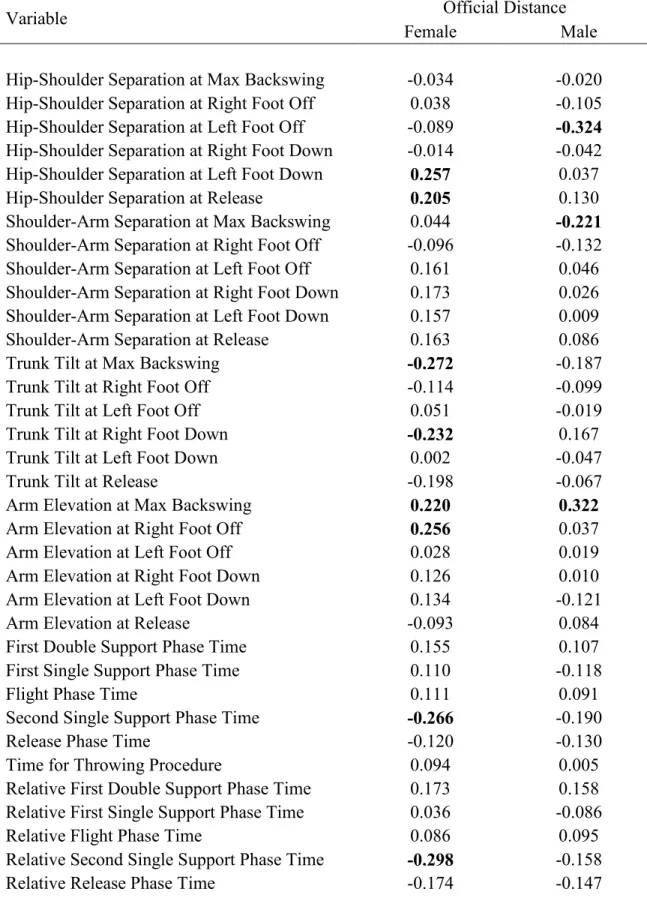
A correlation matrix for official distance and the release characteristics for female discus throwers is displayed in Table 3. A correlation matrix for official distance and the release characteristics for male discus throwers is displayed in Table 4. The correlations of official distance with each technical parameter for both male and female discus throwers are shown in Table 5. These correlations, as well as theoretical links between the release
characteristics and the technical parameters, were used to determine the order of entry of the different blocks of the technical parameters into the stepwise multiple regression equation for explaining variation in performance. The shoulder-arm separations were entered first,
followed by the hip-shoulder separations second, followed by the throwing arm elevations third, followed by the trunk tilts fourth, followed by the absolute phase times fifth, followed by the relative phase times sixth.
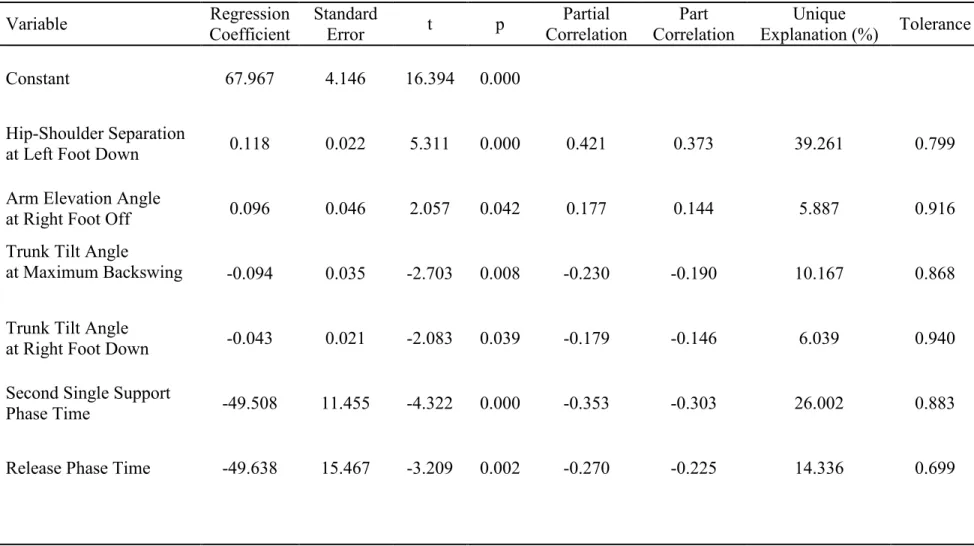
support phase time accounted for 41.2% of the variance in official distance for female discus throwers.
39
proportion of the official distance variance after controlling for the effects of shoulder-arm separation at right foot down, hip-shoulder separation at left foot down, hip-shoulder
The shoulder-arm separation at right foot down (t137 = 1.504, p = 0.135), hip-shoulder separation at left foot off (t134 = 1.784, p = 0.077), and trunk tilt at right foot down (t131 = -1.825, p = 0.070) did not make significant individual contributions to the final regression equation. The decision was made to remove these independent variables and perform the multiple regression again, with the remaining predictor variables only. This new linear combination of: hip-shoulder separation at left foot down, throwing arm elevation at maximum backswing, trunk tilt at maximum backswing, trunk tilt at right foot down, the absolute second single support phase time, and the absolute release phase time accounted for 35.4% of the variance in official distance for female discus throwers. The hip-shoulder separation at left foot down and throwing arm elevation at maximum backswing were positively weighted. The trunk tilt at maximum backswing, trunk tilt at right foot down, the absolute second single support phase time, and the absolute release phase time were
negatively weighted.
hip-41
shoulder separation at left foot down, throwing-arm elevation at right foot off, and trunk tilt at maximum backswing (R2change = 0.029, F1,133 = 5.059, p= 0.026). The absolute second single support phase time accounted for a significant proportion of the official distance variance after controlling for the effects of hip-shoulder separation at left foot down, throwing-arm elevation at right foot off, trunk tilt at maximum backswing, and trunk tilt at right foot down (R2change = 0.059, F1,132 = 11.273, p= 0.001). The absolute release phase time accounted for a significant proportion of the official distance variance after controlling for the effects of hip-shoulder separation at left foot down, throwing-arm elevation at right foot off, trunk tilt at maximum backswing, trunk tilt at right foot down, and absolute second single support phase time (R2change = 0.051, F1,131 = 10.299, p= 0.002). Each independent variable now made a significant individual contribution to the final regression equation. A summary of the final predictive equation for female discus throwers is presented in Table 6.
Bivariate correlations between the independent variables are displayed in the correlation matrix in Table 7. Two correlations between predictor variables were deemed suggestive of slight multi-colinearity. The zero-order bivariate correlation between hip-shoulder separation at left foot down and release phase time (-0.409) and the zero-order bivariate correlation between second single support phase time and release phase time (r = 0.322). However, both are below the criterion of r = 0.6, so were considered
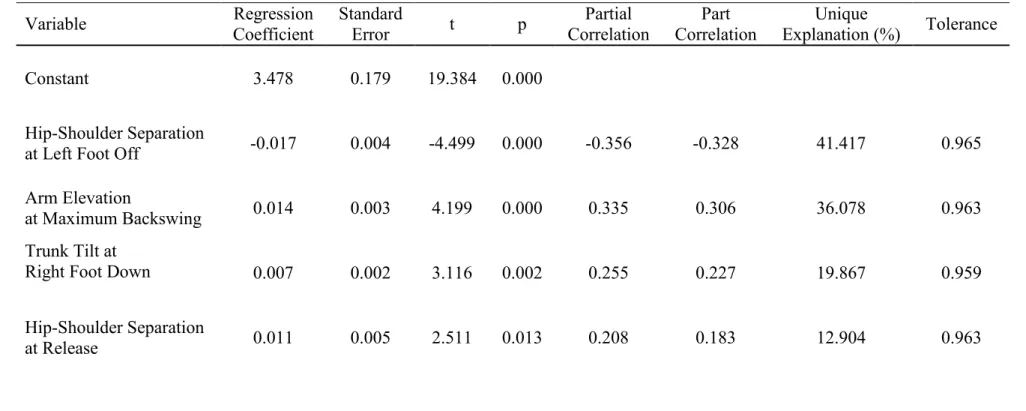
A linear combination of: hip-shoulder separation at left foot off, hip-shoulder separation at release, throwing arm elevation at maximum backswing, and trunk tilt at right foot down accounted for 26.0% of the variance in official distance for male discus throwers. The hip-shoulder separation at release, throwing arm elevation at maximum backswing, and trunk tilt at right foot down were positively weighted. The hip-shoulder separation at left foot off was negatively weighted. The hip-shoulder separation at left foot off accounted for a significant amount of the official distance variability (R2= 0.099, F1,142 = 15.665, p< 0.001). The throwing-arm elevation at maximum backswing accounted for a significant proportion of the official distance variance after controlling for the effects of hip-shoulder separation at left foot off (R2change = 0.070, F1,141 = 11.812, p= 0.001). The trunk tilt at right foot down accounted for a significant proportion of the official distance variance after controlling for the effects of hip-shoulder separation at left foot off and throwing-arm elevation at maximum backswing (R2change = 0.058, F1,140 = 10.471, p= 0.002). The hip-shoulder separation at release accounted for a significant proportion of the official distance variance after
43
variables was greater than 2(0.0001, 4) = 23.51. No cases exerting undue influence on the model were identified.
Canonical Correlation
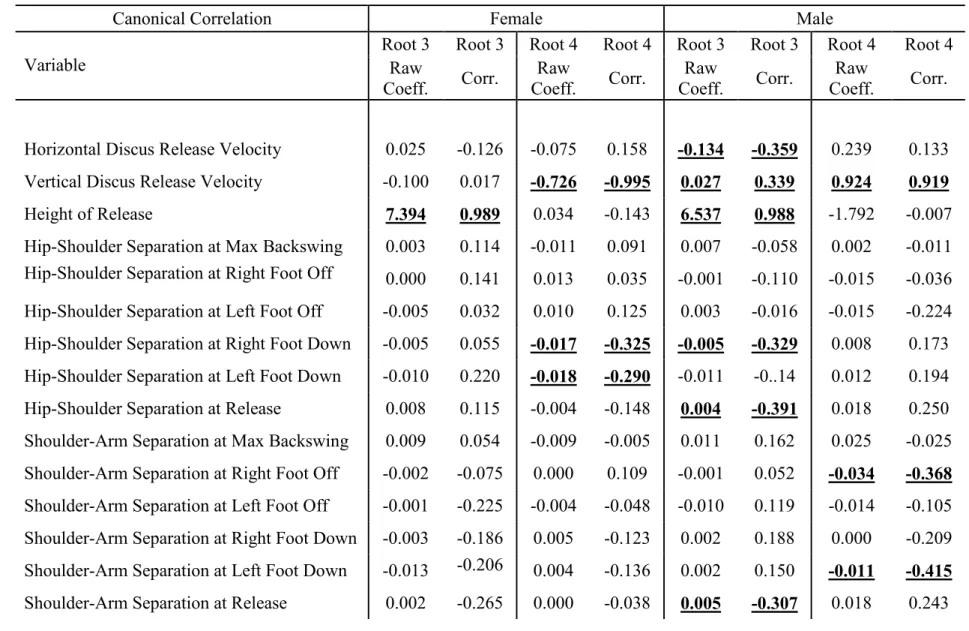
Two distinct correlations (Pillai’s trace = 1.545, p< 0.001 for females; Pillai’s trace = 1.528, p< 0.001 for males) of linear composites of the first group of release characteristics with linear composites of the technical parameters were found for both male and female discus throwers. The first canonical correlation was 0.920 (F87,318 = 5.550, p< 0.001) for females; and 0.912 (F87,336 = 5.540, p< 0.001) for males. The second canonical correlation was 0.675 (F56,214 = 2.130, p< 0.001) for females; and 0.669 (F56,226 = 2.230, p< 0.001) for males. The first canonical correlation was primarily between the height of release and a linear combination of: the throwing arm elevation at release and absolute release phase time (33.012% of variance) for females; and: the hip-shoulder separation at right foot touchdown, hip-shoulder separation at release, shoulder-arm separation at release, and throwing-arm elevation at release (39.558% of variance) for males. The second canonical correlation was primarily between a linear combination of the speed and angle of release and a linear
combination of: the hip-shoulder separation at right foot down, hip-shoulder separation at left foot down, trunk tilt at right foot down, throwing-arm elevation at maximum backswing, and throwing-arm elevation at left foot down (33.247% of variance) for females; and: the
CHAPTER V DISCUSSION
The results of the inter-digitizer reliability analysis indicates acceptable reliability when comparing two different digitizers, and that the selection of the critical instants is key when evaluating discus throwing performance at isolated times. The visual, qualitative determination of the critical instants seems to be significantly different for the two different digitizers. The largest differences in technical parameter values occur at the first and last critical instants which are qualitatively determined by visual inspection of the discus - that is maximum backswing and release. Large differences are also observed at right foot down, which is based on foot contact, but the foot is often occluded by the body in both camera views at this point.
aerodynamic distance is due to its small numeric value (mean of 1.6 m) and its changeable nature based on the formula used in its calculation.
The greater discrepancies observed in the technical parameters highlight the difficulty of needing to twice select an exact critical instant at which to calculate a technical parameter. One determination is made during the synchronization process and one determination is made during the reduction process. The actual critical instant can vary by up to 0.2 seconds due to the sampling rate of 60 Hz. There are difficulties involved in selecting the exact body landmark necessary for digitization, since joint centers, and not points on the surface, were digitized. The absolute mean differences are similar in numeric value to the standard deviations. The greatest differences are found in the shoulder-arm separations. This is probably because the discus is furthest from the center of rotation and has a high velocity of movement, so any discrepancy in frame selection means the discus has traveled further than any other digitized landmark. The differences may be due to errors made during digitizing of the shoulder joint center and discus, which used in the technical parameter calculation. This is unlikely because the throwing-arm elevations have very low absolute differences and the same digitized landmarks were used for calculation of this technical parameter.
These relatively low absolute and relative differences suggest that there is acceptable agreement between the digitizing of two different researchers, and that the comparison of athlete’s techniques across different databases should not lead to any performance
47
of athletes in competition. The two digitizers who participated in this analysis were both using the same equipment for the digitizing and had the same digitizing training. It would be informative to compare the reliability of two digitizers using different equipment, and who had received different training before drawing any firm conclusions about justification. A method of comparing the entire digitizing procedure of two digitizers, possibly by comparing the CMC values of two characteristic curves of discus 3-D coordinates from the same trial, may better reveal any inherent differences.
The screening of the dataset indicated that there was a normal range of values for each technical parameter. The removal of a potentially outlying case raises a question about whether it truly deserved to be deleted, or whether it was in fact a special case the model did not predict well for. In this instance, the outlying values on certain technical parameters are most likely incorrect and not just special cases, since the outlier was often six times as large as the next largest value. It is also physically unlikely to be able to achieve a shoulder-arm separation of 170 degrees at maximum backswing. The deletion of one case in a set of 282 should not cause significant changes to any of the analyses.
this, since the technical parameters influence the release characteristics. A non-normal technical parameter distribution leading to a more normal release characteristic distribution suggests the range of values for the technical parameter is limited if the necessary release characteristic is to be achieved. The negatively skewed distribution of the speed of release for male discus throwers supports the assertion that the speed of release is critical to their
performance. The positively skewed distribution of the speed of release for female discus throwers suggests they utilize other mechanisms to achieve long throws.
Female Regression Equation
The results of the multiple regression show that a linear combination of six key technical parameters can describe female discus throwing performance. Greater performance was associated with greater lead of the hips over the shoulders at left foot down, less
49
Each independent variable in the regression equation makes a unique contribution to the explanation of the variation in discus throwing performance. The most powerful
independent variables are: hip-shoulder separation at left foot down, which uniquely explains about 40% of the total variation in performance explained by the model, and second single support phase time, which uniquely explains about 26% of the total variation in performance explained by the model. No variable artificially inflates the proportion of variance explained by the model, and no independent variable correlates significantly highly with any other independent variable for multi-colinearity to be a cause for concern. The strongest correlations are between the absolute release phase time, and the absolute second single support phase time and the hip-shoulder separation at left foot down, both of which occur immediately before the release phase, so the correlation is not surprising. The original regression equation included ten independent variables. More independent variables leads to greater redundancies in a model, and in the first model there were four incidents of multi-colinearity. This was reduced to two possible incidents in the second model, and shows that a decrease in the variance accounted for by the model was associated with a gain in parsimony and uniqueness.
from the athlete to the discus, and allows for large magnitude horizontal release velocities to be developed.The force applied to the discus by the athlete is due to the muscular strength of the individual athlete. The applied force can be increased by taking advantage of the elastic properties of muscles by generating pre-delivery torsion (Bartlett, 1992). An initially large hip-shoulder separation may be important to stretch the trunk rotators dynamically (Hay, 1985). Energy stored in the non-contractile element of these muscles can supplement the force applied to the discus and longer throws will be achieved. The critical instant of left foot down being important is indicative of the intuitive greater importance of technique closer to release of the discus.
51
Our data further suggest that female discus throwers who orient their bodies so that the discus is initially held low at the back of the circle, and who have a more anterior trunk lean just before the flight phase and just before the power phase tend to throw further. The regression coefficient for throwing-arm elevation at right foot off is positively weighted, and the regression coefficients for the trunk tilts at maximum backswing and right foot down are negatively weighted. However, the mean values for the angles at these critical instants are all negative. This means that the athletes who throw furthest tend to hold the discus low at the back of the circle, and have a more anterior trunk lean when facing the back of the circle. This allows the discus to travel from low to high as it is moved from the back to the front of the circle, and for the athletes to progress from forward trunk lean as they face the back of the circle to backwards when they face the intended throwing direction. By doing this, the discus moves through a greater vertical distance during the flight phase and the power phase and will thereby gain greater vertical velocity and height at release. When this technique to increase the vertical release velocity is coupled with the technique to increase the horizontal release velocity, it is possible for elite female discus throwers to simultaneously increase the speed, angle and height of release through effective and efficient technique.
Male Regression Equation
angle at left foot off is consistent with Lindsay (1991) and Sušanka et al. (1988). These studies show large variations in hip-shoulder and shoulder-arm separation between athletes during the first double and single support phases, but that most athletes decreased separation during the first single support phase. Our data support the view of Johnson (1985) that large hip-shoulder and shoulder-arm separation is not necessary at this stage because it can be developed during the flight phase and second single support phase, which are closer to the instant of release and, therefore, more important to performance. A more parallel release is in agreement with conclusions drawn by Sušanka et al. (1988), Lindsay (1991), and Knicker (1990) who consider optimal technique to be a parallel release. Releases with positive hip-shoulder and hip-shoulder-arm separations were considered to display insufficient utilization of trunk rotation, and releases past parallel to be a technical fault.
Each variable in the regression equation makes a unique contribution to the
53
Our data show that male discus throwers who achieve a more neutral position before the flight phase, i.e. minimal rotation of the torso with the discus held straight out to the side, tend to throw further. This may be to allow them to achieve greater separation between the line of their hips and their throwing arm during the flight phase, which then subsequently decreases at release. The other alternative is that a neutral position during the flight phase is more advantageous to the generation of large release velocities for male discus throwers. By inspecting the mean values for the hip-shoulder and shoulder-arm separations at right foot down, left foot down, and release, the former supposition appears to be the case. This would enable them to supplement the force applied to the discus in the same manner as female discus throwers – by generating pre-delivery torsion. The strong influence of a small hip-shoulder angle at release confirms the importance of a parallel release to maximize the horizontal release velocity.
sophisticated progression of sequentially alternating the discus from low at the back of the circle to high at the front of the circle as demonstrated by the female discus throwers data does not seem to be as important for male discus throwers. In contrast to females, male discus throwers appear to have a much simpler technique to achieve the longest throws. This may be an indication of their greater reliance on strength than efficient technique to achieve high release speeds, with those males who are able to also incorporate effective body positions able to throw furthest. The fewer key independent variables in the regression equation for male discus throwers is also an indication of a much more standardized technique with small and inconsistent variations between performers.
55
Female Canonical Correlation
The results of the canonical correlation show that a linear combination of two specific technical parameters are associated with the height of release, and a linear combination of five different technical parameters are associated with a linear combination of the speed and angle of release in general, and the vertical component of velocity specifically.
The linear combination of the throwing-arm elevation angle at release and the release phase time explain about 33% of the variation in the height of release for female discus throwers. The canonical weighting of the release characteristic is positive indicating an increase in this variable. The canonical weightings for the technical parameters are both positive with positive means, demonstrating that increasing either the throwing-arm elevation at release, or the time spent in the release phase of the throwing procedure, or a combination of both will allow females discus throwers to release the discus from a greater height. This makes intuitive sense, because the higher ones arm is and the longer you allow it to increase in elevation must increase the release height. This result is directly applicable, and the recommendation can be made that any athlete can achieve longer throws by increasing the height of release, since this is linearly related to the vacuum flight distance.