. . . .
. . . .
Research article
Blood gases, biochemistry and haematology
of Galápagos hawksbill turtles (
Eretmochelys
imbricata
)
Juan Pablo Muñoz-Pérez
1,†, Gregory A. Lewbart
2,*
,†, Maximilian Hirschfeld
1,†, Daniela Alarcón-Ruales
1,
Judith Denkinger
1, Jason Guillermo Castan
̃
eda
1, Juan García
3and Kenneth J. Lohmann
4,†1
Galapagos Science Center, University San Francisco de Quito, Puerto Baquerizo Moreno, Galapagos, Ecuador 2
College of Veterinary Medicine, North Carolina State University, 1060 William Moore Drive, Raleigh, NC 27601, USA 3Galapagos National Park Service, San Cristóbal, Galapagos, Ecuador
4Department of Biology, University of North Carolina, Coker Hall, Chapel Hill, NC 27599, NC, USA *Corresponding author: Email: [email protected]
The hawksbill turtle,Eretmochelys imbricata, is a marine chelonian with a circum-global distribution, but the species is crit-ically endangered and has nearly vanished from the eastern Pacific. Although reference blood parameter intervals have been published for many chelonian species and populations, including nesting Atlantic hawksbills, no such baseline bio-chemical and blood gas values have been reported for wild Pacific hawksbill turtles. Blood samples were drawn from eight hawksbill turtles captured in near shore foraging locations within the Galápagos archipelago over a period of four sequen-tial years; three of these turtles were recaptured and sampled on multiple occasions. Of the eight sea turtles sampled,five were immature and of unknown sex, and the other three were females. A portable blood analyzer was used to obtain near immediatefield results for a suite of blood gas and chemistry parameters. Values affected by temperature were corrected in two ways: (i) with standard formulas and (ii) with auto-corrections made by the portable analyzer. A bench top blood chemistry analyzer was used to measure a series of biochemistry parameters from plasma. Standard laboratory haematol-ogy techniques were employed for red and white blood cell counts and to determine haematocrit manually, which was compared to the haematocrit values generated by the portable analyzer. The values reported in this study provide refer-ence data that may be useful in comparisons among populations and in detecting changes in health status among Galápagos sea turtles. Thefindings might also be helpful in future efforts to demonstrate associations between specific biochemical parameters and disease or environmental disasters.
Key words:Biochemistry, blood gas, chelonians,Eretmochelys imbricata, Hawksbill turtle, health, haematology, reptiles
Editor:Steven Cooke
Received 2 December 2016; Revised 27 March 2017; Editorial Decision 17 April 2017; accepted 21 April 2017
Cite as:Muñoz-Pérez JP, Lewbart GA, Hirschfeld M, Alarcón-Ruales D, Denkinger J, Castañeda JG, García J, Lohmann KJ (2017) Blood gases, biochemistry and haematology of Galápagos hawksbill turtles (Eretmochelys imbricata).Conserv Physiol5(1): cox028; doi:10.1093/conphys/ cox028.
Introduction
The hawksbill turtle, Eretmochelys imbricata, is a marine chelonian listed as critically endangered on the IUCN Red List (IUCN, 2015). Within the eastern Pacific, the status of hawksbills is particularly dire, with sightings so rare that populations have often been considered non-viable (Mortimer and Donnelly, 2008). The recent discovery of pre-viously unknown nesting rookeries, along with thefinding of adults in unexpected habitats, suggest that hawksbills might be somewhat more abundant than previously thought (Gaos
et al., 2010,2016). Nevertheless, the species is jeopardized by low population numbers, fisheries interactions, illegal hunting, fishing gear entanglement, boat strikes, and con-sumption of plastics and other anthropogenic materials (Koch et al., 2006; Innis et al., 2010; Parra et al., 2013;
Denkingeret al., 2013;Hardestyet al., 2014;Schuyleret al., 2016;Gaoset al., 2016).
Although numerous studies on the ecology and behaviour of hawksbills have been carried out in the Pacific Ocean (e.g.
Pérez-Castañedaet al., 2007;Liles et al., 2011;Scaleset al., 2011; Van Houtan et al., 2012) little is known about the health status of hawksbill turtles in different geographic areas. Peripheral blood chemistry and haematology para-meters are useful diagnostic tools in health assessment and management (Geffre et al., 2009; Zhang et al., 2011;
Gibbonset al., 2013). To detect and monitor changes in the health of individuals and populations, it is paramount to determine species-specific normal values for blood para-meters of interest. Reference intervals for juvenile Pacific hawksbills (Caliendo et al., 2010), juvenile Middle East hawksbills (Hampelet al., 2009) and nesting Atlantic hawks-bills (Goldberget al., 2013) have been reported. Our results add to and enrich this database.
In this study, we evaluated selected blood gas, blood bio-chemical and haematology parameters from eight hawksbill turtles captured in the Galápagos Islands of Ecuador. The current study provides novel health assessment information on wild Pacific hawksbill turtles.
Materials and methods
Ethics statement
This study was performed as part of a population health assessment authorized by the Galápagos National Park Service (permit No. PC-20-14 and permit No. PC-05-15 to J.P. Muñoz-Pérez) and approved by the Universidad San Francisco de Quito ethics and animal handling protocol. All handling and sampling procedures were consistent with standard vertebrate protocols and veterinary practices.
Study area
We studied hawksbill turtles in San Cristóbal and Española, two islands located in the southeast area of the Galápagos
archipelago. Most of the captures and all recaptures occurred close to the urban area at Puerto Baquerizo Moreno in south San Cristóbal at one of two locations: Punta Carola (n =2 turtles) or La Lobería (n=4). In addition, one turtle was cap-tured at Punta Pitt on the northern end of San Cristobal and one at Punta Suaréz, located in the western part of Española Island. A brief description of each location follows.
Punta Carola (0°21′26″S, 89°34′46″W) and la Lobería (0°55′40″S, 89°36′43″W) are shallow bays (1–5 m) charac-terized by rocky substrate although a few patches of sand also exist. Both bays are dominated by green, red and brown algae. La Lobería faces more to the south and typically has a stronger swell with cooler waters; just beyond the breaker zone depths quickly reach 100 m.
Punta Pitt (0°42′58″S, 89°14′44″W) is a shallow sandy bay (0–8 m depth) located in the northern end of San Cristóbal. The bay has a rocky reef and coral patches.
Punta Suaréz (1°22′02″S, 89°44′21″W) is located in the northwest part of Española, an island lacking human settle-ments. The bay is 1–18 m in depth with a sandy bottom and rocky patches.
Turtle capture and sampling
All sampling was done between 2013 and 2016. Turtles were hand captured by swimmers using snorkel, mask and fins. To help with blood collection, captured turtles were positioned on the beach with their heads facing down the slope toward the water, a position that facilitated blood pooling in the head and neck.
After a blood sample was obtained from each turtle (see below), morphometric measurements were taken and the body temperature was measured (see below). To assist with future identification (Reisser et al., 2008; Schofield et al., 2008; Jean et al., 2010), digital images were taken of the carapace and of each side of the head. In addition, standard, coded, metallic, Inconel self-piercing sea turtle tags (National Band and Tag Company STYLE 681IC) were affixed to the backflippers of each turtle.
Blood sample collection and handling
analysis. The longest interval from freezing to analysis was 14 months.
Blood gas and biochemistry parameters
An iSTAT portable clinical analyzer (Abbot Point of Care Inc., Princeton, NJ, USA) was used to obtain biochemistry, blood gas and electrolyte results using CG4+and CG8+ car-tridges (Abbot Point of Care Inc., Princeton, NJ, USA). The following parameters were measured and recorded: glucose, Hb, HCO3–, Hct, K, Na, iCa, lactate, pCO2, pH and pO2.
Prior work suggests no effect of the type of iSTAT cartridge on the blood parameters and thus the values obtained from the first cartridge (CG8+) were used, except for lactate, which is only measured by the CG4+ cartridge (Lewbart
et al., 2014).
The iSTAT analysed the blood at 37°C then corrected pH, pO2and pCO2 for body temperature once this information
was entered. The validity of the iSTAT temperature correc-tions has been questioned by some authors (Chittick et al., 2002;Harmset al., 2003). Therefore, an independent set of corrections was calculated for pH, pO2, pCO2, following
pro-cedures previously described in detail (Lewbart et al., 2014). Briefly, these corrections depended on the turtle cloacal tem-perature (Ti), in addition to iCa and HCO3–values that were
derived from corrected pH and pCO2 values, all in accord-ance with the equations of Kraus and Jackson (1980),
Andersonet al.(2011a),Fogh-Anderson (1981)andStabenau and Heming (1993).
Both sets of values (i.e. those derived from auto-corrections from the iSTAT and those derived from independent calcula-tions) are reported. Values that were manually corrected for temperature as described above are denoted by‘M’subscript (Table2).
Blood urea nitrogen (BUN), creatine kinase (CK), aspar-tate aminotransferase (AST), alanine aminotransferase (ALT), total protein (TP), alkaline phosphatase (ALKP), cre-atinine and amylase were assayed from thawed plasma using an IDEXX VetTest 8008 analyzer (IDEXX Laboratories, Westbrook, Maine 04092). Total solids were determined in five cases using a refractometer.
Haematology
Heparinized whole blood was stored on ice immediately after collection and refrigerated. Total erythrocyte and leuco-cyte counts were obtained within 24 h of blood collection using Natt Herick’s stain and a Neubaeuer hemocytometer (Campbell, 1995). The blood was kept at 4°C prior to stain-ing in the hemocytometer. Manual haematocrit was deter-mined using high-speed centrifugation of blood-filled micro haematocrit tubes. Differential white blood cell counts were conducted by examining 100 white blood cells on a periph-eral smear stained with Wright-Giemsa stain.
Morphometric measures and body
temperature
For each turtle captured morphometric measurements were taken using a flexible 100 cm measuring tape and Mini Vernier plastic Calipers (precision: 0.05 mm). These included head width (HW), curved carapace length (CCL), curved carapace width (CCW), tail to carapace length and tail to plastron length, as per standard meth-ods. In addition, each turtle was weighed with a precision of ±0.5 kg. The sex of an immature sea turtle cannot be determined with confidence on the basis of an external examination but adults were sexed based on the external sexual dimorphism of mature hawksbill turtles (Avens and Stover, 2013). An EBRO®Compact J/K/T/E thermo-couple thermometer was used to obtain all temperature readings (model EW-91219-40; Cole-Parmer, Vernon Hills, IL, USA). Core body temperatures were recorded from the cloaca using the probe EBRO®T PVC epoxy tip 24GA×1 m in length, which was inserted approximately 10 cm into the cloaca.
Respiratory rates per minute were measured by visualiza-tion and the heart rate with a Doppler ultrasound probe (Parks Medical Electronics, Inc., Aloha, OR, USA) in the area of the carotid artery. Two heart rates were recorded, one as soon as possible after capture, and the second just prior to release.
Statistical analysis
The iSTAT results for haematocrit were compared (Wilcoxon signed rank test) to the results of manually determined haem-atocrit. A standard alpha level ofP= 0.05 was used for all statistical tests using R statistical software, version 3.0.2 (R Development Core Team).
Results
Turtle demographics and health status
Blood biochemical analysis
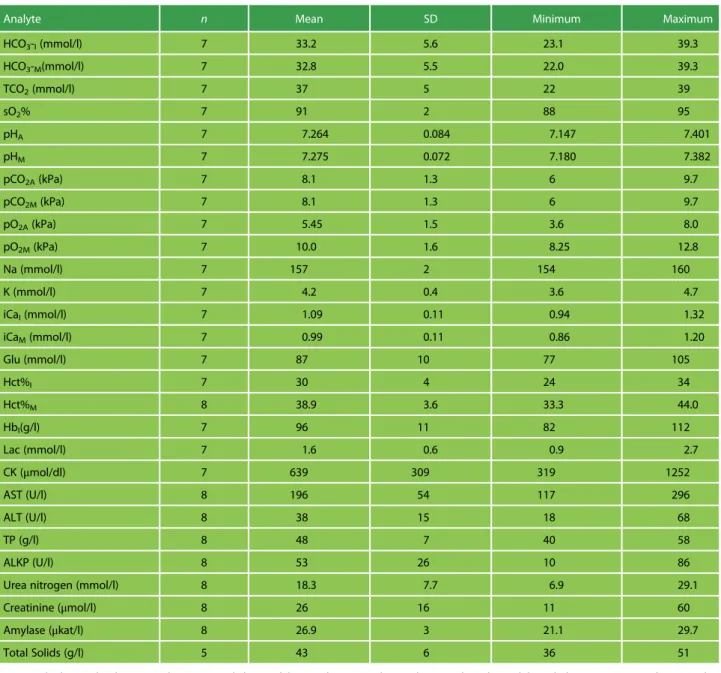
Tables2–4report the biochemistry, blood gas and haematol-ogy results. Manually determined haematocrit values were significantly different from iSTAT haematocrit values (Wilcoxon signed rank test:W=1,P=0.016).
Discussion
Although many studies have reported baseline biochemical, blood gas and haematology values for sea turtles and other chelonian species, only a few have involved hawksbills (Hampelet al., 2009;Caliendoet al., 2010;Goldberget al., 2013). This study reports a set of blood values and other health parameters in wild Galápagos hawksbill turtles. Hawksbills are rare in the eastern Pacific; indeed, until recently, the species was considered essentially extinct in the region (Gaos et al., 2016). The relatively small sample size (n =8 plus three recaptures) represents a considerable sam-pling effort (56 hours in water search over a period of four sequential years).
The small sample size precluded the calculation of formal ref-erence intervals, a process that would require a minimum of 120 individuals (Campbell, 1995; Geffre et al., 2009). In addition, due to logistical constraints, all of the samples were obtained between June and September; thus, the possibility exists that sampling at different times of the year would yield somewhat dif-ferent results (Lutz and Dunbar-Cooper; 1987;Casal and Orós., 2009;Fonget al., 2010;Kimble and Williams, 2012).
We judged the turtles we examined to be clinically healthy and the haematology (total white cell/differential counts) and blood chemistry values were generally consistent with those reported for other healthy sea turtles (Aguirre et al., 1995;
Aguirre and Lutz, 2004;Flintet al., 2010a,2010b;Anderson
et al., 2011b;Gibbonset al., 2013;Flint, 2013;Goldberget al., 2013). Minor exceptions existed, inasmuch as the pH values
were slightly lower and the CO2 levels slightly higher than
reported for loggerheads,Caretta caretta(Harmset al., 2003), green turtles, Chelonia mydas (Moon et al., 1997; Lewbart
et al., 2014) and Kemp’s ridleys,Lepidochelys kempii(Moon
et al., 1997). Another study reported higher pH values and low-er CO2in Kemp’s ridley turtles (Inniset al., 2007). This trend
of lower pH values might be due to a mild to moderate respira-tory acidosis or, alternatively or additionally, be attributable to the warmer body temperatures of the Galápagos hawksbills relative to more temperate species and sampling areas. Sea tur-tles at cooler temperatures are known to have higher pH values (Lutzet al., 1989;Moonet al., 1997). It is important to note that no published blood gas values exist for wild hawksbills.
The mean hawksbill BUN value of 18.3 mmol/l is com-parable to loggerheads, 23.6 mmol/l (Kellyet al., 2015) and Kemp’s ridleys, 26.4 mmol/l (Carminati et al., 1994), but higher than green turtles, 2.5 mmol/l (Bolten and Bjorndal, 1992) and leatherback turtles (Dermochelys coriacea), 1.07 mmol/l (Deemet al., 2006). This might be due in part to the diet of hawksbills, which consists largely of animal protein from sponges, corals and other invertebrates (Bjorndal, 1985). Interestingly, the only other study to include hawksbill BUN values listed 7.3 mmol/l (Goldberg et al., 2013), but turtles sampled in that study were nesting females. Because female hawksbills, like other marine turtles, often migrate long dis-tances to nest in areas with limited food resources (Bjorndal, 1996;Milleret al., 1998), it is likely that nesting turtles have a different nutritional status than the Galápagos hawksbills that we studied, which were captured in locations that pre-sumably serve as foraging grounds.
The TP values in our study were higher than for juvenile hawksbills undergoing rehabilitation (Hampel et al., 2009;
Caliendo et al., 2010) but were similar to those of nesting females (Goldberget al., 2013). This is likely due to the nutri-tional status of wild healthy, and reproductively sound indivi-duals compared to younger, nutritionally challenged animals. Table 1: Standard measurements and vital data for wild Galápagos hawksbill turtles
Parameter n Mean SD Minimum Maximum
CCL (cm) 8 56.8 14.3 41 82
CCW (cm) 8 50 12.9 34.5 71
HW (cm) 8 7.7 1.9 5.6 10
Tail-Carapace (cm) 8 7.3 1.3 5 9
Tail-Plastron (cm) 8 9.9 2.9 5.5 14
Weight (kg) 8 23.6 18.5 6.4 60.9
Body temperature (°C) 7 25 2.0 22.1 27.2
Heart1 (bpm) 6 42 7.6 36 54
Heart2 (bpm) 6 39 8.3 24 48
Respirations/min 7 3.6 1 2 5
A number of factors are known to influence chelonian bio-chemistry values, including age, size and sex. For example, juvenile loggerhead turtles reportedly have lower values of albumin, calcium, globulins, haematocrit, TP and triglycer-ides than do adult animals, a difference probably at least partly attributable to egg production in adult females (Casale
et al., 2009). In green turtles, albumin, TP and triglyceride levels were found to increase with body size while calcium, glucose, potassium and sodium did not (Labrada-Martagón
et al., 2010). Nesting Atlantic hawksbills undergoing vitello-genesis displayed generally lower haematology and blood
biochemistry values with each successive nesting event (Goldberget al., 2013). Interestingly, for the values assessed both in the Atlantic study and in our own (PCV, TP, glucose, calcium, sodium, potassium and urea), only sodium was high-er in the Pacific turtles. There were some overlapping values for ALP, ALT, AST and PCV between the two populations. The small sample size in the present study, combined with the difficulty of determining the sex of immature animals in the field (Aguirre and Balazs, 2000), precluded attempts to iden-tify possible factors contributing to variation among indivi-duals and between populations.
Table 2: Mean, SD and range for blood gas and blood biochemical values for wild Galápagos hawksbill turtles
Analyte n Mean SD Minimum Maximum
HCO3-I(mmol/l) 7 33.2 5.6 23.1 39.3
HCO3-M(mmol/l) 7 32.8 5.5 22.0 39.3
TCO2(mmol/l) 7 37 5 22 39
sO2% 7 91 2 88 95
pHA 7 7.264 0.084 7.147 7.401
pHM 7 7.275 0.072 7.180 7.382
pCO2A(kPa) 7 8.1 1.3 6 9.7
pCO2M(kPa) 7 8.1 1.3 6 9.7
pO2A(kPa) 7 5.45 1.5 3.6 8.0
pO2M(kPa) 7 10.0 1.6 8.25 12.8
Na (mmol/l) 7 157 2 154 160
K (mmol/l) 7 4.2 0.4 3.6 4.7
iCaI(mmol/l) 7 1.09 0.11 0.94 1.32
iCaM(mmol/l) 7 0.99 0.11 0.86 1.20
Glu (mmol/l) 7 87 10 77 105
Hct%I 7 30 4 24 34
Hct%M 8 38.9 3.6 33.3 44.0
HbI(g/l) 7 96 11 82 112
Lac (mmol/l) 7 1.6 0.6 0.9 2.7
CK (μmol/dl) 7 639 309 319 1252
AST (U/l) 8 196 54 117 296
ALT (U/l) 8 38 15 18 68
TP (g/l) 8 48 7 40 58
ALKP (U/l) 8 53 26 10 86
Urea nitrogen (mmol/l) 8 18.3 7.7 6.9 29.1
Creatinine (μmol/l) 8 26 16 11 60
Amylase (μkat/l) 8 26.9 3 21.1 29.7
Total Solids (g/l) 5 43 6 36 51
A finding relevant to future methodologies is that the iSTAT proved inaccurate in determining PCV in hawksbill turtles; results were approximately 30% lower than values determined manually. A similar though smaller discrepancy has been reported in other species including loggerhead sea turtles (Wolf et al., 2008), rainbow trout (Harter et al., 2014), marine iguanas (Lewbart et al., 2015) and Quaker parrots (Rettenmundet al., 2014). Thus, manual calculation of PCV via high-speed centrifugation is recommended. Furthermore, iSTAT haemoglobin and sO2% values should
not be considered reliable in hawksbills, because these para-meters are calculated from an algorithm based on PCV.
A comparison between blood values calculated with man-ual corrections and with the iStat auto-corrected values suggest that the latter are usually sufficient for clinical applications in the field. Nevertheless, the findings also suggest that when accuracy is paramount, investigators studying animals with body temperatures below 37°C should be cautious about rely-ing on auto-corrected iSTAT values for parameters that are influenced by temperature.
For the three turtles captured and sampled more than once, the CCL values for recaptures provide evidence for growth when measurements made more than one year apart are compared (Table 4). Small differences in CCL values were also recorded for sampling events just a few months apart, but these differences probably fall within the range of measurement error.
Finally, comparison of heart rates measured shortly after capture and just prior to release (an interval usually less than than 30 min) revealed that heart rate was typically lower on the second occasion (Table 1). A likely explanation is that turtles experienced a period of exertion during and immedi-ately after capture, but recovered quickly during the period of relative inactivity that ensued.
In summary, data reported in this study represent an import-ant step toward determining the normal range of values against which future blood gas and biochemistry results in hawksbill turtles can be compared. Such assessments are important for health monitoring and disease diagnostics. Future research Table 4: Comparative blood values for three wild Galápagos hawksbill turtles over several time points
Turtle ID JC268/269 JA260/261 JC236/238
Capture dates 01/07/13 24/06/14 21/09/14 23/06/14 21/09/14 27/06/16 27/06/14 18/09/14 29/06/16
Parameters
CCL (cm) 67.5 68 68.5 60 62 67 45 44 51.4
Body temperature (°C) 19.8 26 23.4 24.7 23.1 21.1 26 22.9 21.3
pHM 7.382 7.285 7.371 7.348 7.214 7.328 7.25 7.154 7.382
NaI(mmol/l) 155 153 149 158 155 159 158 160 160
iCaM(mmol/l) 0.88 1 0.96 1.20 1.01 1.05 1 0.96 0.81
GluI(mmol/l) 83 82 70 105 103 89 84 81 85
Hct%M 30 35 32 27 34 41 25 27 27
HbI(g/dl) 10.2 11.9 10.9 9.2 11.6 13.9 8.5 9.2 9.2
LacI(mmol/l) 8.35 17.9 10.5 10.4 16.7 7.2 18.3 18.9 6.5
Table 3: Mean, SD and range for manually analysed differential white cell values of wild Galápagos hawksbill turtles
Cell type n Mean SD Minimum Maximum
RBC (x1012/l) 8 0.35 0.09 0.17 0.48
WBC (x109/l) 8 5.31 3.86 1.76 12.76
Heterophil % 8 32.3 6.9 24.0 43.0
Monocyte % 8 3.6 1.9 1.5 7.5
Eosinophil % 8 18.5 4.5 10.5 24.0
Lymphocyte % 8 45.9 6.1 34.5 50.5
should work toward establishing reference values in this spe-cies, as well as expanding sampling to facilitate comparisons of blood values across age groups and disease states.
Acknowledgements
We wish to thank the following people for their support and assistance: Ernesto Briones, Danilo Silva, Diane Deresienski, Eduardo Espinoza, Alexander Gaos, Nataly Guevara, Tillie Laws, Carlos Mena, Philip Page, Kent Passingham, Galo Quezada, Cristina Regalado, Carlos Valle-Castillo, Sylvia Sotamba, Catalina Ulloa and Stephen Walsh. In addition, we thank the Galápagos National Park (GNP), Galápagos Science Center (GSC), Ecofondo Foundation (EF), Eastern Pacific Hawksbill initiative (ICAPO) and Ecuador Secretary of Higher Education Science Technology and Innovation (SENESCYT).
References
Aguirre AA, Balazs GH, Spraker TR, Gross TS (1995) Adrenal and hema-tological responses to stress in juvenile green turtles (Chelonia mydas) with and withoutfibropapillomas.Physiol Zool68:831–854. Aguirre AA, Balazs GH (2000) Plasma biochemistry values of green
tur-tles (Chelonia mydas) with and without fibropapillomas in the Hawaiian Islands.Comp Haematol Int10:132–137.
Aguirre AA, Lutz P (2004) Sea turtles as sentinels of marine ecosystem health: isfibropapillomatosis an indicator?Eco Health1:275–283. Anderson ET, Harms CA, Stringer EM, Cluse WM (2011a) Evaluation of
hematology and serum biochemistry of cold-stunned green sea turtles (Chelonia mydas) in North Carolina, USA.J Zoo Wild Med42:247–255. Anderson ET, Minter LJ, Clarke III EO, Mroch III RM, Beasley JF, Harms CA
(2011b) The effects of feeding on hematological and plasma bio-chemical profiles in green (Chelonia mydas) and Kemp’s Ridley (Lepidochelys kempii) sea turtle.Vet Med Internat.doi:10.4061/2011/ 890829.
Avens L, Stover ML (2013) Age and age estimation in sea turtles. In Wyneken J, Lohmann KJ, Musick JA, eds,The Biology of Sea Turtles, Vol III. CRC Press, Boca Raton, FL, pp 97–134.
Bjorndal KA (1985) Nutritional ecology of sea turtles.Copeia3:736–751. Bjorndal, KA (1996). Foraging ecology and nutrition of sea turtles. In
Lutz PL, Musick JA, eds,The Biology of Sea Turtles, Vol I. CRC Press, Boca Raton, FL, pp 199–231.
Bolten AB, Bjorndal KA (1992) Blood profiles for a wild population of green turtles (Chelonia mydas) in the southern Bahamas: Size-spe-cific and sex-specific relationships.J Wild Dis28(3):407–413. Caliendo V, McKinney P, Robinson D, Baverstock W, Hyland K (2010).
Plasma biochemistry and hematology values in juvenile hawksbill turtles (Eretmochelys imbricata) undergoing rehabilitation. J Herp Med Surg20:117–121.
Campbell TW (1995)Avian Hematology and Cytology, 2nd ed. Iowa State University Press, Ames, IA, pp 7–11.
Carminati C, Gerle E, Kiehn L, Pisciotta R (1994) Blood chemistry com-parison of healthy vs hypothermic juvenile Kemp’s ridley sea tur-tles (Lepidochelys kempi) in the New York Bight. In: Bjorndal KA, Bolten AB, Johnson DA, Eliazar PJ (Compilers). Proc. 14th Annu. Workshop Sea Turtle Cons. Biol. N.M.F.S. Tech Memo NOAA-TM-NMFS-SEFSC-351: 203–207
Casal AB, Orós J (2009) Plasma biochemistry and haematology values in juvenile loggerhead sea turtles undergoing rehabilitation.Vet Rec164:663–665.
Casale AB, Camacho M, López-Jurado LF, Juste C, Orós J (2009) Comparative study of hematologic and plasma biochemical vari-ables in Eastern Atlantic juvenile and adult nesting loggerhead sea turtles (Caretta caretta).Vet Clin Path38:213–218.
Chittick EJ, Stamper MA, Beasley JF, Lewbart GA, Horne WA (2002) Medetomidine, ketamine, and sevoflurane for anesthesia of injured loggerhead sea turtles: 13 cases (1996–2000). J Am Vet Med Assoc221(7):1019–1025.
Deem SL, Dierenfeld ES, Sounguet GP, Alleman AR, Cray C, Poppenga RH, Norton TM, Karesh WB (2006) Blood values in free-ranging nesting leatherback sea turtles (Dermochelys coriacea) on the coast of the republic of Gabon.J Zoo Wild Med37:464–471.
Denkinger J, Parra M, Muñoz-Peréz JP, Carrasco C, Murillo JC, Espinosa E, & Koch V (2013) Are boat strikes a threat to sea turtles in the Galapagos Marine Reserve?Ocean Coast Manage, 80:29–35. Flint M (2013) Free ranging sea turtle health. In Wyneken J, Lohmann
KJ, Musick JA, eds, The Biology of Sea Turtles, Vol III. CRC Press, Boca Raton, FL, pp 379–397.
Flint M, Morton JM, Limpus CJ, Patterson-Kane JC, Murray PJ, Mills PC (2010a) Development and application of biochemical and haem-atological reference intervals to identify unhealthy green sea tur-tles (Chelonia mydas).Vet J185:299–304.
Flint M, Morton JM, Limpus CJ, Patterson-Kane JC, Mills PC (2010b) Reference intervals for plasma biochemical and hematologic mea-sures in loggerhead sea turtles (Caretta caretta) from Moreton Bay,
Aust J Wild Dis46:731–741.
Fogh-Anderson N (1981) Ionized calcium analyzer with a built-in pH correction.Clin Chem27:1264–1267.
Fong C, Chen H, Cheng I (2010) Blood profiles from wild populations of green sea turtles in Taiwan.J Vet Med Anim Health2:8–10. Gaos AR, Abreu-Grobois FA, Alfaro-Shigueto J, Amorocho D, Arauz R,
Baquero A, Mariona G, Muccio C, Muñoz JP, Nichols WJ,et al. 2010. Signs of hope in the eastern Pacific: international collaboration reveals encouraging status for severely depleted populations of hawksbill turtleEretmochelys imbricata.Oryx44:595–601.
Gaos AR, Lewison RL, Liles MJ, Gadea V, Vallejo F, Baquero A, Lemarie C, Muñoz-Pérez J-P, Chaves JA, Catherine E,et al. (2016) Hawksbill turtle terra incognita: conservation genetics of eastern Pacific rookeries.Ecol Evol. doi: 10.1002/ece3.1897.
Gibbons PM, Klaphake E, Carpenter JW (2013) Reptiles. In Carpenter J, Marion C, eds,Exotic Animal Formulary, Ed 4. Elsevier Saunders, St. Louis, MO, pp. 84–170.
Goldberg DW, Leitao SAT, Godfrey MH, Lopez GG, Santos AJB, Neves FA, de Souza EPG, Moura AS, da Cunha Bastos J, da Cunha Bastos VLF (2013) Ghrelin and leptin modulate the feeding behaviour of the hawksbill turtleEretmochelys imbricataduring nesting season.Cons Physiol1.doi:10.1093/conphys/cot016.
Hampel MR, Robinson D, Baverstock W, Hyland K (2009) Haematology and biochemistry blood parameters of juvenile hawksbill turtles (Eretmochelys imbricata).Wildlife Middle East4:6.
Hardesty BD, Wilcox C, Lawson TJ, van der Velde T, Lansdell M (2014) Understanding the effects of marine debris on wildlife. A Final report to Earthwatch Australia.
Harms CA, Mallo KM, Ross PM, Segars AI (2003) Venous blood gases and lactates of wild loggerhead sea turtles (Caretta caretta) follow-ing two capture techniques.J Wild Dis39:366–374.
Harter TS, Shartau RB, Brauner CJ, Farrell AP (2014) Validation of the i-STAT system for the analysis of blood parameters infish.Cons Physiol2:cou037.doi:10.1093/conphys/cou037.
Innis CJ, Tlusty M, Merigo C, Weber ES (2007) Metabolic and respira-tory status of cold-stunned Kemp’s ridley sea turtles (Lepidochelys kempii).J Comp Physiol B177:623–630.
IUCN (2015) The IUCN Red List of Threatened Species. IUCN 2015. Jean C, Ciccione S, Talma E, Ballorain K, Bourjea J (2010)
Photo-identification method for green and hawksbill turtles- First results from Reunion.Indian Ocean Turt News11:8–13.
Kelly TR, McNeill JB, Avens L, Goodman Hall A, Goshe LR, Godfrey MH, Nihnovets AN, Cluse WM, Harms CA (2015) Clinical pathology ref-erence intervals for an in-water population of juvenile loggerhead sea turtles (Caretta caretta) in Core Sound, North Carolina, USA.
PLoS One.doi:10.1371/journal.pone.0115739.
Kimble JA, Williams RB (2012) Temporal variance in hematologic and plasma biochemical reference intervals for free-ranging eastern box turtles (Terrapene carolina carolina).J Wild Dis48:799–802. Koch V, Nichols WJ, Peckham H, De La Toba V (2006) Estimates of sea
turtle mortality from poaching and bycatch in Bahia Magalena, Baja California Sur, Mexico.Biol Conserv128:327–334.
Kraus DR, Jackson DC (1980) Temperature effects on ventilation and acid-base balance of the green turtle.Am J Physiol239:R254–R258. Labrada-Martagón V, Méndez-Rodriguez LC, Gardner SC,
López-Castro M, Zenteno-Savin T (2010) Health indices of the green turtle (Chelonia mydas) along the Pacific coast of Baja California Sur, Mexico. I. Blood biochemistry values. Chel Conserv Biol9: 162–172.
Lewbart GA, Hirschfeld M, Denkinger J, Vasco K, Guevara N, García J, Muñoz J, Lohmann KJ (2014) Blood gases, biochemistry, and hematology of Galápagos green turtles (Chelonia mydas).PLoS One
9:e96487.doi:10.1371/journal.pone.0096487.
Lewbart GA, Hirschfeld M, Muñoz J, Denkinger J, Vinueza L, Brothers JR, García J, Lohmann. KJ (2015) Blood gases, biochemistry, and hematology of marine iguanas (Amblyrhynchus cristatus).Conserv Physiol3(1): cov034;doi:10.1093/conphys/cov034
Liles M, Jandres M, López W, Mariona G, Hasbún C, SeminoffJ (2011) Hawksbill turtlesEretmochelys imbricata in El Salvador: nesting distribution and mortality at the largest remaining nesting aggre-gation in the eastern Pacific Ocean. Endanger Species Res 14: 23–30.
Lutz PL, Dunbar-Cooper A (1987) Variations in the blood chemistry of the loggerhead sea turtle,Caretta caretta.Fish Bull85:37–43. Lutz PL, Bergey A, Bergey M (1989) Effects of temperature on gas
exchange and acid-base balance in the sea turtleCaretta caretta
at rest and during routine activity.J Exp Biol144:155–169. Miller JD, Dobbs KA, Limpus CL, Mattocks N, Landry AMJr (1998)
Long-distance migrations by the hawksbill turtle, Eretmochelys imbricata, from north-eastern Australia.Wildlife Res25:89–95. Moon D, Mackenzie DS, Owens DW (1997) Simulated hibernation of
sea turtles in the laboratory: I. Feeding, breathing frequency, blood pH, and blood gases.J Exp Zool278:372–380.
Mortimer JA, Donnelly M (2008) Hawksbill turtle (Eretmochelys imbricata): Marine Turtle Specialist Group 2008 IUCN Red List status assessment. IUCN 2008, 14 pp.
Parra M, Andres M, Jimenez J, Banks S, Keith I, Suarez J, Flores D, Munoz JP (2013) Assessing vehicle strike incidence and its spatial distribution in green turtles (Chelonia mydas) in the Galapagos Islands. Final tech-nical report from the CDF to the WWF.www.darwinfoundation.org. Pérez-Castañeda R, Salum-fares A, Defeo O (2007) Reproductive
patterns of the hawksbill turtleEretmochelys imbricatain sandy beaches of the Yucatan Peninsula. J Mar Biol Assoc UK 87: 815–824.
Reisser J, Proietti M, Kinas P, Sazima I (2008) Photographic identifi ca-tion of sea turtles: method descripca-tion and validaca-tion, with an esti-mation of tag loss.End Sp Res5:73–82.
Rettenmund CL, Heatley JJ, Russell KE (2014) Comparison of two ana-lyzers to determine selected venous blood analytes of Quaker par-rots (Myiopsitta monachus).J Zoo Wild Med45:256–262.
Scales KL, Lewis JA, Lewis JP, Castellanos D, Godley BJ, Graham RT (2011) Insights into habitat utilisation of the hawksbill turtle,
Eretmochelys imbricata(Linnaeus, 1766), using acoustic telemetry.
J Exp Mar Bio Ecol407:122–129.
Schofield G, Katselidis KA, Dimopoulos P, Pants JD (2008) Investigating the viability of photo-identification as an objective tool to study endangered sea turtle populations.J Exp Mar Bio Ecol360:103–108.
Stabenau EK, Heming TA (1993) Determination of the constants of the Henderson-Hasselbalch equation, (alpha) CO2 and pKa, in sea tur-tle plasma.J Exp Bio180:311–314.
Tlusty M, Dodge M, Sharp B, Myers A, McIntosh A, Wunn D, Perkins C,et al. (2010) Health evaluations of leatherback turtles (Dermochelys coriacea) in the Northwestern Atlantic during direct capture andfisheries gear disentanglement.Chelon Conserv Biol9: 205–222.
Van Houtan KS, Kittinger JN, Lawrence AL, Yoshinaga C, Born VR, Fox A (2012) Hawksbill sea turtles in the Northwestern Hawaiian Islands.Chelonian Conserv Biol11:117–121.
Wolf KN, Harms CA, Beasley JF (2008) Evaluation offive clinical chem-istry analyzers for use in health assessment in sea turtles.J Am Vet Med Assoc233:470–475.