B
RIEF
R
EPORT
Development and Pilot of the Caregiver Strategies Inventory
Anne V. Kirby, Lauren M. Little, Beth Schultz, Linda R. Watson,
Wanqing Zhang, Grace T. Baranek
MeSH TERMS
adaptation, psychological autism spectrum disorder caregivers
perception
Children with autism spectrum disorder often demonstrate unusual behavioral responses to sensory stimuli (i.e., sensory features). To manage everyday activities, caregivers may implement strategies to address these features during family routines. However, investigation of specific strategies used by caregivers is limited by the lack of empirically developed measures. In this study, we describe the development and pilot results of the Caregiver Strategies Inventory (CSI), a supplement to the Sensory Experiences Questionnaire Version 3.0 (SEQ 3.0; Baranek, 2009) that measures caregivers’ strategies in response to their children’s sensory features. Three conceptually derived and empirically grounded strategy types were tested: cognitive–behavioral, sensory–perceptual, and avoidance. Results indicated that the CSI demonstrated good internal consistency and that strategy use was related to child age and cognition. Moreover, parent feedback after completing the CSI supported its utility and social validity. The CSI may be used alongside the SEQ 3.0 to facilitate a family-centered approach to assessment and intervention planning.
Kirby, A. V., Little, L. M., Schultz, B., Watson, L. R., Zhang, W., & Baranek, G. T. (2016). Brief Report—Development and pilot of the Caregiver Strategies Inventory.American Journal of Occupational Therapy, 70,7004360010. http://dx.doi.org/10.5014/ ajot.2016.019901
Anne V. Kirby, PhD, OTR/L,was Doctoral Candidate, Division of Occupational Science and Occupational Therapy, Department of Allied Health Sciences, University of North Carolina at Chapel Hill, at the time of the study. She is now Assistant Professor, Division of Occupational Therapy, University of Utah, Salt Lake City; [email protected]
Lauren M. Little, PhD, OTR/L,was Postdoctoral Fellow, Department of Allied Health Sciences, University of North Carolina at Chapel Hill, at the time of the study. She is now Assistant Professor, Department of Occupational Therapy Education, University of Kansas Medical Center, Kansas City.
Beth Schultz, MS, OTR/L,was Project Coordinator, Department of Allied Health Sciences, University of North Carolina at Chapel Hill, at the time of the study.
Linda R. Watson, EdD, CCC-SLP,is Professor, Division of Speech and Hearing Sciences, Department of Allied Health Sciences, University of North Carolina at Chapel Hill.
Wanqing Zhang, PhD, MD,is Assistant Professor and Research Methodologist, Department of Allied Health Sciences, University of North Carolina at Chapel Hill.
Grace T. Baranek, PhD, OTR/L, FAOTA,is Professor, Division of Occupational Science and Occupational Therapy, and Associate Chair for Research, Department of Allied Health Sciences, University of North Carolina at Chapel Hill.
C
hildren with autism spectrum disorder (ASD) often demonstrate unusual re-sponses to sensory stimuli (i.e., sensory features; Baranek, Little, Parham, Ausderau, & Sabatos-DeVito, 2014; Ben-Sasson et al., 2009; Schaaf & Lane, 2015), which can present challenges for families in daily life (Bagby, Dickie, & Baranek, 2012; Lane, Young, Baker, & Angley, 2010; Schaaf, Toth-Cohen, Johnson, Outten, & Benevides, 2011). Sensory features in children with ASD have been classified into four sen-sory response patterns in a recent factor analytic study (Ausderau et al., 2014): hyper-responsiveness (i.e., an exaggerated response to sensory stimuli); hyporesponsiveness (i.e., a delayed or lack of response to sensory stimuli); enhanced perception (i.e., superior acuity of sensory stimuli); and sensory interests, repeti-tions, and seeking behaviors (i.e., fascination with or craving for intense sensory stimuli).Previous studies have shown that during daily routines, caregivers implement strategies matched to child characteristics for children with acquired brain injury (Bedell, Cohn, & Dumas, 2005), attention deficit hyperactivity disorder (Segal, 2000), and developmental delays (Bernheimer & Weisner, 2007).
features in children with ASD are highly prevalent and known to affect daily life, de-velopment of such a tool would be useful for research and clinical purposes.
Caregivers work to support their children’s engagement in activities and routines within the family (e.g., Bagatell, 2016; Boyd, McCarty, & Sethi, 2014). When sensory challenges present obstacles to the child’s engagement, caregivers may respond with one or more types of strategies (Dunstan & Griffiths, 2008; Little et al., 2016; Schaaf et al., 2011). Some strategies are rooted insensory–perceptualapproaches that involve the parent enhancing, re-moving, or altering a sensory experience. Clinically, these types of strategies are thought to take advantage of more auto-matic bottom-up neural processing (Hill & Frith, 2003) to address the problem at the level of the stimuli. For example, caregivers may give a tight hug to provide pro-prioceptive input, turn down the lights or provide sunglasses to lessen a negative re-action to visual input, or raise their voices or incorporate other sensory cues (e.g., tap-ping the child on the shoulder) to get their child’s attention (Benen Demchick, Goldrich Eskow, & Crabtree, 2014; Schaaf et al., 2011; for a review of sensory-based interventions, see Case-Smith & Arbesman, 2008).
In contrast, other strategies are more aligned withcognitive–behavioralapproaches, which involve conscious appeals to the child’s control over his or her responses to sensory experiences. These strategies take advantage of top-down neural processing (Rothbart, Ellis, Rueda, & Posner, 2003) to optimize effortful control, self-regulation, and reward value. For example, caregivers may teach calming strategies (e.g., “take deep breaths and count to 10”) to cope with an overwhelming sensory experience (e.g., alarm ringing), or they may offer and pro-vide rewards for tolerating a challenging sensory activity, such as tooth brushing.
A third approach type involves avoid-ance of challenging sensory experiences on the basis of the child’s past experiences and the parent’s expectation of a child’s (often negative) response (Bagby et al., 2012). Thus, these three strategy categories have distinct conceptual targets. Specifically, sen-sory–perceptual strategies aim to change the child’s sensory experience, cognitive–
behavioral strategies aim to change the child’s behavior associated with a sensory experience, and avoidance strategies aim to escape the sensory experience altogether. Yet, all three strategy types, individually or in combination, are presumably enacted to support the child’s performance or partic-ipation in specific activities or routines.
The purpose of this article is to de-scribe the development and pilot results of the Caregiver Strategies Inventory (CSI), a questionnaire supplement to the Sensory Experiences Questionnaire Version 3.0 (SEQ 3.0; Baranek, 2009). The CSI pro-vides a systematic way to measure strategies that parents may use in response to children’s sensory features within three conceptually distinct strategy types: cognitive–behavioral, sensory–perceptual, and avoidance. Three research questions were addressed:
1. What is the internal consistency of the three CSI subscales?
2. Does parents’ endorsement of particu-lar CSI strategy types differ as a function of the children’s age or cognitive level? 3. What is the perceived utility and social
validity for parents?
Method
Caregiver Strategies Inventory Item and Format Development
The CSI is used to measure caregiver strategies implemented in response to sensory fea-tures of children with ASD. Specifically, the CSI is used to tap three conceptually distinct strategy types (i.e., sensory–perceptual, cognitive–behavioral, avoidance) that par-ents have previously reported using to support their children’s participation in everyday activities in response to their unusual sensory experiences. The CSI was developed as a supplement to the SEQ 3.0—a 105-item, parent-report measure of the frequency of sensory responses across four dimensional patterns: (1) hyperresponsiveness; (2) hy-poresponsiveness; (3) enhanced perception; and (4) sensory interests, repetitions, and seeking behaviors.
The CSI was designed to be admin-istered in tandem with the SEQ 3.0 to simultaneously obtain frequency ratings of children’s sensory features and parents’ strategy use. CSI follow-up questions are
targeted to a subset of SEQ 3.0 questions across the four sensory response patterns to reduce time demands on caregivers. To empirically ground the development of the CSI, we used two sources of extant data from our research laboratory collected from more than 1,000 parents of children with ASD over the span of about a decade. The first dataset included the SEQ Version 2.1 (Baranek, 1999), which was completed by 77 parents of children with ASD at an earlier time point (see Little et al., 2016, for complete study details). The SEQ Version 2.1 included a binary question of whether caregivers try to change their child’s sen-sory responses, followed by an open-ended question about how they do so, if endorsed. This source of data allowed the research team to determine which sensory behaviors parents most commonly attempted to change, and we aimed to include items on the CSI that were endorsed by >70% of parents. The second source of data was a national online survey of 1,407 parents of children with ASD (see Ausderau et al., 2014, for complete study details) in which the SEQ 3.0 was used. From this source, we reviewed the confirmatory factor analysis (CFA) item factor loadings (105 items), and we chose a reduced subset of items on the CSI that had a loading>.40. Thus, CSI items met one or both criteria, were purposefully selected to represent each sensory response pat-tern (i.e., factor) in both social and non-social contexts, and were distributed across a variety of sensory modalities. See Table 1 for the SEQ 3.0 items along with their percentage of parent endorsement (from the first data source) and CFA factor loadings (from the second data source).
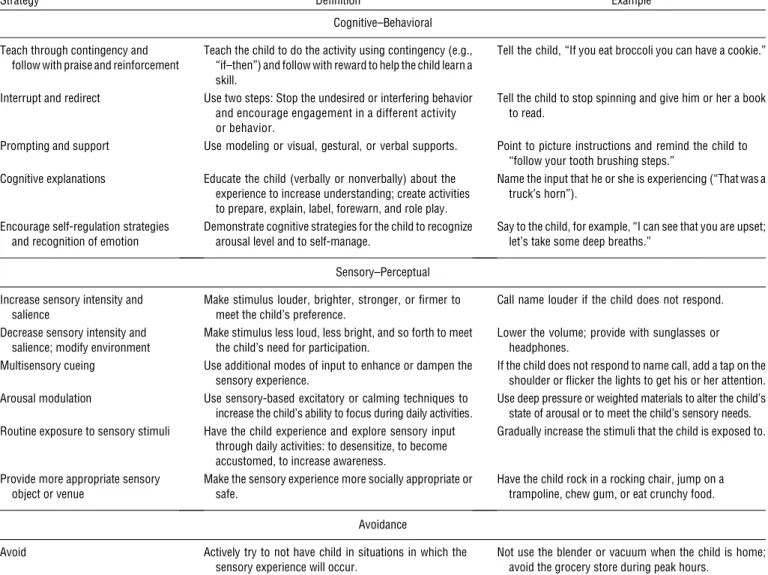
creation). See Table 2 for strategies, opera-tional definitions, and examples. Maintain-ing alignment with the categorizations and operational definitions, CSI items were then written to reflect the nature of the parent-generated responses from the two extant studies to maximize social validity of the measure. Reliability checks were used to ensure that all items aligned with oper-ational definitions.
The development process resulted in 22 CSI prompts to supplement the SEQ 3.0. CSI prompts are worded as “When your child . . . how often do you . . . ?” (e.g., “When your child puts objects, toys, or other nonfood items in his or her mouth to suck or chew, how often do you . . . ?”). Each prompt is followed by five items representing (1) two cognitive–behavioral, (2) two sensory–perceptual, and (3) one avoidance strategy. For each item, care-givers were asked to rate how often in the past month they used the stated strategy on a 6-point scale ranging from 0 (not at all) to 5 (every time). Thus, the CSI was
designed to allow caregivers to endorse the use of multiple strategies at varying rates within and across their children’s many sensory experiences.
Caregiver Strategies Inventory Pilot Study
A subsample of caregivers of children with ASD was randomly selected from the existing participant pool of the national online survey study described previously. The university institutional review board approved recontacting participants and using extant data (i.e., SEQ 3.0 scores, age, cognitive functioning, demographics) in conjunction with this study. Of the 350 participants emailed, caregivers of 186 children with ASD (ages 4–14 yr; mean [M]510.11, standard deviation [SD]5 2.79; 85% male) completed the CSI pilot. The CSI pilot (CSI questionnaire1 feed-back form) was conducted with Qualtrics survey software (Qualtrics, Provo, UT), and data were subsequently exported into
Microsoft Excel (Microsoft Corporation, Redmond, WA) and analyzed with SAS software (Version 9.3; SAS Institute, Cary, NC) for the following analyses: (1) stan-dardized avalues for internal consistency of CSI items by strategy type subscale, (2) linear regressions to determine contribu-tions of age and cognitive level to each strategy type subscale score, and (3) de-scriptive analyses to summarize respondent feedback on the utility and social validity of the CSI.
Results
The CSI demonstrated strong internal consistency across strategy type subscales (Cognitive–Behavioral,a5.95; Sensory– Perceptual,a5.95; Avoidance,a5.85). Cognitive–behavioral strategies were the most commonly endorsed by caregivers (M52.24,SD50.71), followed by sensory– perceptual strategies (M 5 1.91, SD 5 0.71), and, last, avoidance strategies (M5 1.22,SD50.61). Age and cognition had Table 1. Rationale for Selection of SEQ 3.0 Items for CSI Item Development
Selected SEQ 3.0 Questions (excerpted wording) Factor (Social) Modality Factor Loading Behavior Change,a%
Trouble differentiating touch stimuli HYPO Touch .69 —
Mouths nonfood items SIRS Taste and
smell
.46 62.30
Tastes subtle differences in food EP Taste and
smell
.40 —
Jumps, rocks, spins SIRS Movement .51 29.90
Overwhelmed with too much activity HYPER Multiple .64 —
Trouble focusing on people talking in a noisy room HYPER (social) Multiple .54 —
Avoids certain foods HYPER Taste and
smell
.25 85.70
Does not respond to name HYPO (social) Sound .37 84.40
Hyperacuity to specific sounds outside EP Sound .54 5.20
Bothered by everyday sounds HYPER Sound .63 —
Stares at lights or spinning objects SIRS Vision .55 28.60
Avoids eye contact HYPER (social) Vision .36 75.30
Notices minor changes in a room EP Vision .57 —
Slow to look at things HYPO Vision .53 29.90
Odd visual inspection of object SIRS Vision .67 —
Visually distracted EP Vision .48 —
Trouble differentiating visual stimuli HYPO Vision .66 —
Seeks deep touch pressure SIRS (social) Touch .41 —
Avoids specific textures HYPER Touch .42 36.40
Does not respond to touch HYPO (social) Touch .49 40.30
Distress during hygiene activities HYPER Touch .38 71.40
Rubs surfaces SIRS Touch .68 —
Note.Numbers inboldrepresent a factor loading³.40 or parent behavior change endorsement³70%. CSI5Caregiver Strategies Inventory; EP5enhanced perception; HYPER5hyperresponsiveness; HYPO5hyporesponsiveness; SEQ 3.05Sensory Experiences Questionnaire Version 3.0; SIRS5sensory interests, repetitions, and seeking behaviors.
differential significant contributions by strat-egy type, although these variables alone con-tributed minimally to the overall variance (5%–7%); see Table 3 for linear regression results. The contribution of age was significant and negative for reported use of cognitive– behavioral (p5.005) and sensory–perceptual
(p5.03) strategies; that is, parents of older children endorsed these strategies less of-ten. The contribution of cognition was significant and negative for reported use of sensory–perceptual (p5.007) and avoid-ance (p5.02) strategies; that is, parents of children with higher cognitive levels en-dorsed these strategies less often.
After completing the CSI question-naire, parents were asked to rate how strongly they agreed or disagreed (on a 4-point scale) with five questions about the user friendliness of the CSI. Of the re-spondents, 96% agreed (i.e., rated asagree orstrongly agree) that the items were easy to understand, 87% agreed that the questions tapped sensory issues that affected their child, 100% agreed that the strategy ex-amples were easy to understand, 88% agreed that the strategies listed things that they actually do with their child, and 100% agreed that they would be willing to take
the CSI again in future studies. Participants took, on average, 26 min to complete the CSI and follow-up questions.
Discussion
Our findings lend preliminary support for the design and utility of the CSI, a measure of caregiver strategies, as a supplement to the SEQ 3.0 for children with ASD. Using the CSI, we distinguished various strate-gies implemented by caregivers to address sensory features during everyday activities, and we measured the frequency of use across the three strategy types (i.e., cognitive– behavioral, sensory–perceptual, avoidance). The strategies included those that parents actually reported using in open-ended re-sponses in previous studies, thus lending social validity to the items. The results showed that the CSI demonstrated strong internal consistency for measuring three Table 2. Specific Strategies With Definitions and Examples
Strategy Definition Example
Cognitive–Behavioral
Teach through contingency and follow with praise and reinforcement
Teach the child to do the activity using contingency (e.g., “if–then”) and follow with reward to help the child learn a skill.
Tell the child, “If you eat broccoli you can have a cookie.”
Interrupt and redirect Use two steps: Stop the undesired or interfering behavior and encourage engagement in a different activity or behavior.
Tell the child to stop spinning and give him or her a book to read.
Prompting and support Use modeling or visual, gestural, or verbal supports. Point to picture instructions and remind the child to “follow your tooth brushing steps.”
Cognitive explanations Educate the child (verbally or nonverbally) about the experience to increase understanding; create activities to prepare, explain, label, forewarn, and role play.
Name the input that he or she is experiencing (“That was a truck’s horn”).
Encourage self-regulation strategies and recognition of emotion
Demonstrate cognitive strategies for the child to recognize arousal level and to self-manage.
Say to the child, for example, “I can see that you are upset; let’s take some deep breaths.”
Sensory–Perceptual
Increase sensory intensity and salience
Make stimulus louder, brighter, stronger, or firmer to meet the child’s preference.
Call name louder if the child does not respond.
Decrease sensory intensity and salience; modify environment
Make stimulus less loud, less bright, and so forth to meet the child’s need for participation.
Lower the volume; provide with sunglasses or headphones.
Multisensory cueing Use additional modes of input to enhance or dampen the sensory experience.
If the child does not respond to name call, add a tap on the shoulder or flicker the lights to get his or her attention. Arousal modulation Use sensory-based excitatory or calming techniques to
increase the child’s ability to focus during daily activities.
Use deep pressure or weighted materials to alter the child’s state of arousal or to meet the child’s sensory needs. Routine exposure to sensory stimuli Have the child experience and explore sensory input
through daily activities: to desensitize, to become accustomed, to increase awareness.
Gradually increase the stimuli that the child is exposed to.
Provide more appropriate sensory object or venue
Make the sensory experience more socially appropriate or safe.
Have the child rock in a rocking chair, jump on a trampoline, chew gum, or eat crunchy food.
Avoidance
Avoid Actively try to not have child in situations in which the sensory experience will occur.
Not use the blender or vacuum when the child is home; avoid the grocery store during peak hours.
Table 3. Linear Regression Results by Strategy Type
Strategy
Regression Coefficient
Standard Error r2
Cognitive–behavioral .06
Age 2.058** .020
Cognition 2.002 .002
Sensory–perceptual .07
Age 2.044* .020
Cognition 2.005** .002
Avoidance .05
Age .017 .016
Cognition 2.004* .002
conceptually distinct strategy types (i.e., cognitive–behavioral, sensory–perceptual, avoidance).
Parents were found to endorse varying frequencies of strategy types, with cognitive– behavioral strategies most commonly en-dorsed and avoidance strategies enen-dorsed the least. Of note, parents often reported using multiple types of strategies to address the same specific sensory behaviors. Child’s age and cognitive level made considerable, but modest, contributions to differences in caregiver strategy use. Specifically, parents of older children reported less use of sen-sory–perceptual and cognitive–behavioral strategies, and parents of children with higher cognitive levels reported less use of sensory– perceptual and avoidance strategies.
We recommend narrowing the age range in future use because parents of older children reported less strategy use in general; thus, the strategies provided may be more relevant for younger children. To expand use for older children and adoles-cents, researchers could develop questions for older youths targeting more age-appropriate parent strategies or self-strategies within the same conceptual framework. Future research is needed to explore additional child characteristics and parental factors (e.g., parental beliefs, intervention history) that may influence choice of strategies as well as the degree to which these strategies effectively support children’s participation in the context of sensory challenges. Utility and social validity of the tool were supported by (1) participants’ overall ratings regarding its ease of use, (2) participants’ overall ratings regarding the clarity and relevance of the items, and (3) participants’ willingness to complete the CSI in future studies. Future research is needed to address predictive asso-ciations between caregiver strategy use as well as meaningful child and family outcomes.
Implications for Occupational
Therapy Practice
It is critical for occupational therapy practitioners to understand the strategies that parents use to address sensory features of children with ASD during the course of their everyday activities. Sometimes these strategies may have been suggested by a practitioner; however, parents may also
have altered recommended strategies or developed their own strategies on the basis of a myriad of experiences with their children in real-world contexts. The fol-lowing recommendations for practitioners are based on the current study:
• Practitioners are encouraged to work collaboratively with families of children with ASD to assess the implications of the strategies being used and to make ad-justments when interventions are not op-timizing participation and quality of life. • The CSI offers a systematic way to mea-sure caregivers’ strategies concurrently with assessment of sensory features in children with ASD, which has implica-tions for future practice and research on effective interventions for children’s sen-sory processing challenges in naturalistic contexts. Within a family-centered ap-proach, practitioners may use the instru-ment as a way to discuss the strategies that families have found to be effective in the context of their daily lives. After comple-tion, practitioners may decide whether fur-ther evaluation of caregiver strategies is warranted with semistructured interview-ing or observation of parent strategy use. • Practitioners should consider the
tar-geted mechanism for change (e.g., alter a child’s sensory experience, change a child’s behavior, avoid an experience) when making intervention recommen-dations and interpreting the effective-ness of strategies used. s
Acknowledgments
We thank the families who participated in this study, as well as the staff, students, and other researchers from the Sensory Expe-riences Project who contributed to the item development and data collection process. This research was supported by National Institute of Child Health and Human Development (NICHD) Grant No. R01– HD42168 and by American Recovery and Reinvestment Act Supplement A10-0589. Recruitment was assisted by the Interactive Autism Network Research Database at the Kennedy Krieger Institute and Johns Hopkins Medicine (sponsored by Autism Speaks), the Research Participant Registries at the Carolina Institute for Developmental Disabilities (supported by NICHD Grant
U54HD079124–02), the University of North Carolina at Chapel Hill Research Registry, the Intellectual and Developmental Disabilities Research Center (Grant No. P3HD03110), and multiple other autism organizations.
References
Ausderau, K., Sideris, J., Furlong, M., Little, L. M., Bulluck, J., & Baranek, G. T. (2014). National survey of sensory features in children with ASD: Factor structure of the Sensory Experience Questionnaire (3.0).Journal of Autism and Developmental Disorders, 44,915–925. http://dx.doi.org/ 10.1007/s10803-013-1945-1
Bagatell, N. (2016). The routines and occu-pations of families with adolescents with autism spectrum disorders. Focus on Autism and Other Developmental Disabil-ities, 31,49–59. http://dx.doi.org/10.1177/ 1088357615587503
Bagby, M. S., Dickie, V. A., & Baranek, G. T. (2012). How sensory experiences of chil-dren with and without autism affect family occupations.American Journal of Occupa-tional Therapy, 66,78–86. http://dx.doi. org/10.5014/ajot.2012.000604
Baranek, G. T. (1999).Sensory Experiences Question-naire(Version 2.1). Unpublished manuscript, University of North Carolina at Chapel Hill. Baranek, G. T. (2009).Sensory Experiences Question-naire(Version 3.0). Unpublished manuscript, University of North Carolina at Chapel Hill. Baranek, G. T., Little, L. M., Parham, L. D., Ausderau, K. K., & Sabatos-DeVito, M. (2014). Sensory features in autism spec-trum disorders. In F. Volkmar, R. Paul, K. Pelphrey, & S. Rogers (Eds.), Hand-book of autism and pervasive developmental disorders(4th ed., pp. 378–408). Hoboken, NJ: Wiley.
Bedell, G. M., Cohn, E. S., & Dumas, H. M. (2005). Exploring parents’ use of strategies to promote social participation of school-age children with acquired brain injuries.
American Journal of Occupational Therapy, 59,273–284. http://dx.doi.org/10.5014/ ajot.59.3.273
Benen Demchick, B., Goldrich Eskow, K., & Crabtree, L. A. (2014). Autism and tran-sitioning youth: A pilot study of sensory processing and family quality of life. Jour-nal of OccupatioJour-nal Therapy,Schools, and Early Intervention, 7,54–69. http://dx.doi. org/10.1080/19411243.2014.898492 Ben-Sasson, A., Hen, L., Fluss, R., Cermack,
A meta-analysis of sensory modulation symptoms in individuals with autism spec-trum disorders.Journal of Autism and De-velopmental Disorders, 39,1–11. http:/dx. doi.org/10.1007/s10803-008-0593-3 Bernheimer, L., & Weisner, T. (2007). “Let me
just tell you what I do all day . . .”: The family story at the Center of Intervention Research and Practice.Infants and Young Children, 20,192–201. http://dx.doi.org/ 10.1097/01.IYC.0000277751.62819.9b Boyd, B. A., McCarty, C. H., & Sethi, C.
(2014). Families of children with autism: A synthesis of family routines literature.Journal of Occupational Science, 21,322–333. http:// dx.doi.org/10.1080/14427591.2014.908816 Case-Smith, J., & Arbesman, M. (2008). Evidence-based review of interventions for autism used in or of relevance to occupational therapy.
American Journal of Occupational Therapy, 62,416–429. http://dx.doi.org/10.5014/ ajot.62.4.416
Dunn, W. (2014).Sensory Profile–2: User’s man-ual. Minneapolis: NCS Pearson.
Dunstan, E., & Griffiths, S. (2008). Sensory strategies: Practical support to empower
families.New Zealand Journal of Occupa-tional Therapy, 55,5–13.
Hill, E. L., & Frith, U. (2003). Understanding autism: Insights from mind and brain. Philo-sophical Transactions of the Royal Society of Lon-don, Series B: Biological Sciences, 358,281–289. http://dx.doi.org/10.1098/rstb.2002.1209 Koegel, R. L., Openden, D., & Koegel, L. K.
(2004). A systematic desensitization para-digm to treat hypersensitivity to auditory stimuli in children with autism in family contexts.Research and Practice for Persons With Severe Disabilities, 29, 122–134. http://dx.doi.org/10.2511/rpsd.29.2.122 Lane, A. E., Young, R. L., Baker, A. E. Z., &
Angley, M. T. (2010). Sensory processing subtypes in autism: Association with adap-tive behavior.Journal of Autism and Devel-opmental Disorders, 40,112–122. http:// dx.doi.org/10.1007/s10803-009-0840-2 Little, L. M., Ausderau, K., Freuler, A. C., &
Baranek, G. T. (2016).Caregiver strategies to children’s sensory features. Manuscript submitted for publication.
Parham, L. D., Ecker, C., Miller Kuhaneck, H., Henry, D. A., & Glennon, T. J. (2007).
Sensory Processing Measure (SPM): Manual. Los Angeles: Western Psychological Services. Rothbart, M. K., Ellis, L. K., Rueda, M. R., & Posner, M. I. (2003). Developing mecha-nisms of temperamental effortful control.
Journal of Personality, 71,1113–1144. http://dx.doi.org/10.1111/1467-6494. 7106009
Schaaf, R. C., & Lane, A. E. (2015). Toward a best-practice protocol for assessment of sensory features in ASD.Journal of Autism and Devel-opmental Disorders, 45,1380–1395. http://dx. doi.org/10.1007/s10803-014-2299-z Schaaf, R. C., Toth-Cohen, S., Johnson, S. L.,
Outten, G., & Benevides, T. W. (2011). The everyday routines of families of chil-dren with autism: Examining the impact of sensory processing difficulties on the fam-ily. Autism, 15,373–389. http://dx.doi. org/10.1177/1362361310386505 Segal, R. (2000). Adaptive strategies of mothers