HEALTH CARE SYSTEM CHARACTERISTICS ASSOCIATED WITH POSTPARTUM CONTRACEPTIVE UTILIZATION, BIRTH SPACING AND SHORT INTERPREGNANCY
INTERVALS AMONG PRIVATELY INSURED WOMEN IN NORTH CAROLINA
Regina Irene Rutledge
A dissertation submitted to the faculty at the University of North Carolina at Chapel Hill in partial fulfillment of the requirements for the degree of Doctor of Philosophy in the Department
of Health Policy and Management in the Gillings School of Global Public Health.
Chapel Hill 2016
Approved by:
Marisa Elena Domino Amy Bryant
© 2016
ABSTRACT
Regina Irene Rutledge: Health Care System Characteristics Associated with Postpartum Contraceptive Utilization, Birth Spacing and Short Interpregnancy Intervals Among Privately
Insured Women in North Carolina (Under the direction of Marisa Domino)
Objective: To determine if provider characteristics or rural geography affect the timing of postpartum contraceptive, method of postpartum contraceptive, or incidence of short interpregnancy intervals among privately insured women in North Carolina.
Methods: Using administrative claims data from a large, private insurer, we used two-stage residual inclusion and logit modeling to determine when a woman began a contraceptive, the likelihood that the contraceptive she began was a long-acting reversible contraceptive, and how these behaviors affected the probability of a subsequent live birth within 27 months of delivery. Our key independent variables were whether a woman received maternity care from a provider affiliated with an obstetrics/gynecology residency program, the provider’s specialty, and whether or not a woman lived in a rural area.
contraceptive, type of postpartum contraceptive or probability of having a short interpregnancy interval to subsequent live birth.
Conclusions: While we hypothesized OB/GYN providers and providers associated with an OB/GYN residency program would increase the probability of a woman initiating contraceptives within 12 months and use LARC more often than other providers, our findings did not support this. Among women with consistent insurance coverage during the postpartum period, short interpregnancy intervals were common. Controlling for characteristics associated with her provider, the facility where she received care, and the demographics of the area in which she lives, the strongest predictor of whether a woman would have a short birth interval is the type of contraceptive she uses in the postpartum period. Women using a long-acting method versus a short-acting method were significantly less likely to have a short interpregnancy interval to their next birth.
To my parents, Roy and Rhonda Rutledge, for a lifetime of compassionate parenting and relentless encouragement.
ACKNOWLEDGEMENTS
This work was made possible by the support of numerous people, none more so than my advisor and Chair Marisa Domino. Thank you for your constant encouragement, guidance, mentorship and most importantly belief in the value of this work. I consider myself
immeasurably fortunate to have had the opportunity to learn from you and look forward to calling you colleague in the coming years.
The other members of my committee were also paramount to the success of this project. Amy Bryant, thank you for being a tireless advocate of women’s health and reproductive justice. Your clinical eye kept this work grounded in practice and focused on work that can produce meaningful change for women. Stacie Dusetzina, your wisdom, investment in this area of research and wit were critical to my successes. Kristen Hasmiller-Lich, thank you for providing thoughtful feedback, technical guidance and a new way to think about data. Finally, thank you Pam Silberman for putting it all in perspective and encouraging me to produce research with the intent of making meaningful change for our communities.
I am thankful for the collaboration of Blue Cross and Blue Shield of North Carolina during this project. I was particularly fortunate to have had Alice Fortune-Britt as a mentor and liaison during this project.
peers, and my fun-loving personality all at once. Morris Weinberger, you are the heart and soul of this program. You provided a space for me to not only become a strong researcher but also a better version of myself. Thank you for seeing the potential in me and fostering it though these years.
I am grateful to have progressed through the doctoral program surrounded by wonderful classmates and future colleagues. I am confident each of you will go on to do incredible things in all areas of health services research. I am thankful to have shared your laughter through these years and look forward to working with you in the coming years.
I was privileged to work as a member of the North Carolina Rural Health Research team during my time at UNC. First and foremost, I want to thank Mark Holmes for offering me such an opportunity to work amongst a talented group of people who believe in having fun. To the faculty and staff, I have had the joy of working with-- George Pink, Kristin Reiter, Kristie Thompson, Sharita Thomas, Julie Perry, Steve Rutledge, Randy Randolph, and Denise Kirk-- thank you for fostering an environment of great work filled with plenty of laughter. Finally, and with the most affection possible, I want to acknowledge my bunkermates. Rebecca Whitaker, Brystana Kaufman, and Dunc Williams- you made coming to work fun. Rebecca, the five-foot dinosaur on my desk was the highlight of my year. Thank you for becoming my kindred soul by challenging me intellectually while speckling in just enough random pop culture references to keep me intrigued. Please take care of Ron. Brystana, you are among the most talented
and dignity inspires me to a be better. Your ability to smoke meat perfectly also make me certain our friendship will be long-lasting.
I want to extend my most heartfelt gratitude to my chosen family and friends. Thank you, Drew Ulrich, for being my best friend though all of my adult life and loving me through all these years. Your support has never waivered. Ben Kirkley, you keep me humble and remind me that life is meant to be enjoyed. To my oldest friends, Tiffany Brogan Pressley, Tiffany Krenz, and Blair and James Weddington, thank you for keeping me grounded and in touch with the real world; Kari Keziah Helms, your snarky humor was poured all over this work from above. Joshua Evans, our lives are forever intertwined and I would not want it any other way. You remind me to live by kindness and compassion while pursuing adventure above all else.
To my friends who have endured the day in and day out of this process, your patience and encouragement has meant the world to me. To Amanda and Todd BenDor, Greg Boyer, Alison and Jason Brenner, Molly and Matt Calabria, Sarah Davis, Chris Dibble, Rebecca Dineen and Gena O’Keefe, Lauren Dunnington, Jenny Epstein, Rose Feinberg, Shoshana Goldberg, Dan Goulet, Bryna Harrington, Miriam Hartmann, Kelly Heath, Jenny and Josh Jones, Dio
Kavaliertatos, Nikhil Kaza, Brandon Lewis, Rachel Machta, Derrick Matthews, Stefanie Murray, Suba Narisimhan, Nathan Nickel, Ashley Tyndall and Bill Lester, Emily Vander Schaff and Jim Baker, Laura and Aaron Winn, and Andra Wilkinson-- to each of you, I have unending affection and gratitude. This work has been conducted holding tight to the memory of Jamie Kirk Hahn, whose life and friendship continues to encourage me to have fun, eat good food and pursue justice every day.
I never knew how full life could be with a dog in it. RosDog, thanks for being he most neurotic and clingy writing partner possible.
Finally, to my family. Uncle Al, you were the first person I met with a graduate education and taught me to love school. I loved sparring with you over politics, health reform, or whether or not a movie was any good. Your heart and finger wagging is thoroughly wound into this project. Because of you, I have always embraced being weird. Aunt Pat, you are the second mother every person needs in life. Thank you for always showing up to every major event, teaching me that there is nothing better than a handwritten note, and providing so much support during these many years. I also, somewhat poorly, know how to properly set a table because of you.
Ryan, you are the most amazing, brilliant and witty big brother. My life has been made all the better having you in it. You were and remain just the perfect amount of heckler and protector to a sister. You have turned into an incredible friend, husband and father and given the chance to go back, I suppose I would choose to Vote Rutledge. I am very proud of you.
Laura, you are the sister I did not get by birth but thankfully received by marriage. Your sense of fashion is truly among the best I’ve ever seen. Bradley and Henry, you’ll always be my favorites. (Note to any future nieces and nephews: you too will become my favorites upon arrival.)
To my mother, Chief Petty Officer Rhonda Rutledge, USN (R): you have spent your life emulating what it means to be successful, strong, loving and fierce. You were a badass woman before it was socially acceptable. Thank you for raising me to be fearless.
To my father, Chief Petty Office Roy Rutledge, USN (R): you are the father every little girl in this world needs. You taught me to be brave, adventurous, but above all else,
compassionate. Thank you for giving me the strongest foundation possible to call home when venturing out into this world.
To both of you, I owe every ounce of my success. Thank you for letting me quit ballet after
a couple months, buying me a dangerous chemistry set that would lead to minor flesh
wounds, showing up to every softball game and concert, and moving me in the rain every
time I asked. You fostered my curiosity for science, learning, travel and public health
always. You sacrificed a lot for me to be here and none of that has been lost on me.
TABLE OF CONTENTS
LIST OF TABLES ... xiv
LIST OF FIGURES ... xv
LIST OF ABBREVIATIONS ... xvi
CHAPTER 1: INTRODUCTION ... 1
Specific Aims ... 1
Significance ... 3
Innovation ... 14
Tables and Figures ... 16
CHAPTER 2: PROPOSED APPROACH ... 20
Overview and Rational ... 20
Conceptual Model ... 20
Data Sources and Population ... 23
Proposed Analyses ... 23
Aim 1 Hypotheses 1.1 ... 23
Aim 1 Hypothesis 1.2 ... 24
Aim 2 Hypothesis 2.1 ... 26
CHAPTER 3: THE EFFECT OF MATERNITY CARE PROVIDER SPECIALTY, RESIDENCY AFFILIATION AND PATIENT RURALITY ON POSTPARTUM CONTRACEPTIVE INITIATION PATTERNS ... 31
Overview ... 31
Methods... 35
Data... 35
Key Measures and Definitions ... 36
Sample ... 37
Analysis ... 38
Results ... 41
Discussion ... 45
Limitations ... 47
Conclusion ... 48
Tables and Figures ... 49
CHAPTER 4: THE EFFECT OF MATERNITY CARE PROVIDER SPECIALTY, RESIDENCY AFFILIATION, PATIENT RURALITY AND POSTPARTUM CONTRACEPTIVE METHOD ON SHORT INTERPREGNANCY INTERVALS ... 58
Overview ... 58
Introduction/Background ... 59
Methods... 61
Data... 61
Key Measures and Definitions ... 62
Sample ... 64
Analysis ... 64
Sensitivity Analysis ... 67
Results ... 67
Conclusions ... 74
Tables and Figures ... 75
CHAPTER 5: DISCUSSION ... 81
Findings ... 81
Policy Implications ... 83
Limitations ... 85
Areas for Future Research ... 87
LIST OF TABLES
Table 1.1 Adjusted Relative Risk and 95% Confidence Intervals of
Adverse Maternal Events by Interpartum Spacing Interval ... 16
Table 1.2 Adjusted Odds Ratio and 95% Confidence Intervals of Adverse Infant Events by Interpartum Spacing Interval ... 16
Table 1.3 Summary of recommendations and risk classifications* for hormonal contraceptive methods and intrauterine devices during the postpartum period ... 17
Table 2.1 Key Measures and Definitions ... 28
Table 3.1 Key Measures and Definitions ... 49
Table 3.2 Attributes of women in sample ... 50
Table 3.3 Attributes of live births in sample ... 51
Table 3.4 Standardized differences in means of IPTW covariates ... 52
Table 3.5 Method of postpartum contraceptive initiated ... 52
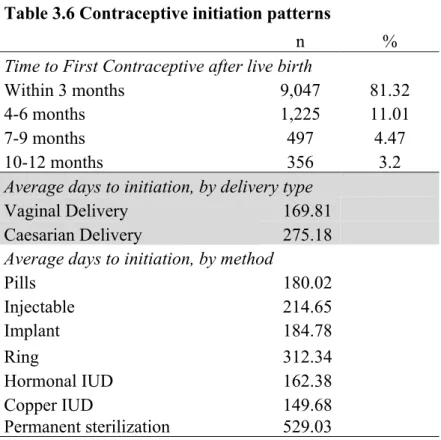
Table 3.6 Contraceptive initiation patterns ... 53
Table 3.7 Average marginal effect of initiating contraceptive within 3, 6 and 12 months postpartum ... 54
Table 3.8 Average marginal effect of initiating type of contraceptive (multinomial) ... 55
Table 3.9 Average marginal effect of initiating a LARC given initiation of any non-permanent method within 12 months postpartum ... 56
Table 4.1 Key Measures and Definitions ... 75
Table 4.2 Attributes of women in sample ... 76
Table 4.3 Attributes of live births in sample ... 76
Table 4.4 Provider, Residency and Facility Characteristics of Births ... 77
Table 4.5 Interpregnancy Interval Characteristics ... 77
LIST OF FIGURES
Figure 1.1 Perinatal Risk Factors and Outcomes in North Carolina and the
United States, 2013 ... 18
Figure 1.3 Twelve Month Contraceptive Failure Rates, by Method ... 19
Figure 2.1 Anderson Model of Postpartum Contraceptive Initiation and Short
Interpregnancy Intervals ... 30
Figure 2.2 Nested multinomial model structure ... 30
Figure 3.1 Sample Design ... 56
Figure 3.2 Instrumental Variable for Receiving Care from an OB/GYN
residency affiliated provider ... 57
Figure 4.1 Instrumental Variable for Receiving Care from an OB/GYN
residency affiliated provider ... 80
Figure 4.2 Instrumental Variable for Contraceptive Choice in Postpartum Period ... 80
LIST OF ABBREVIATIONS
2SRI Two-stage residual inclusion
ACOG American Congress of Obstetricians and Gynecologists AIC Akaike information criterion
ANC Antenatal Care
BIC Bayesian information criterion COC Combined oral contraceptive
CDC Centers for Disease Control and Prevention CPT Current Procedural Terminology
Cu-IUD Copper intrauterine device (e.g. ParaGard)
DMPA Depot medroxyprogesterone acetate (e.g. Depo-Provera) FDA Food and Drug Administration
IIA Independence of irrelevant Alternatives IPI Interpregnancy interval
IPTW Inverse probability of treatment weights IRB Institutional Review Board
IUD Intrauterine device (can refer to both hormonal and non-hormonal methods) IUS Intrauterine System (hormonal intrauterine device)
LARC Long-acting reversible contraception
Lng-IUD Levonorgestral intrauterine Device (e.g. Mirena, Skyla) NCHA North Carolina Hospital Association
PNC Prenatal care, perinatal care POP Progestin only pill
PRAMS Pregnancy Risk Assessment Monitoring System RRP Short interpregnancy interval
SARC Short-acting reversible contraception VBAC Vaginal birth after caesarian
CHAPTER 1: INTRODUCTION
Specific Aims
Modern contraceptives have led to a dramatic reduction in unintended pregnancies, teen birth rates, and poor infant outcomes since their introduction (1). Despite highly effective contraceptive interventions, half of all births in the United States are unintended and almost half of these are unwanted(2). Postpartum contraceptive initiation is a critical component of family planning and healthy birth spacing. However, in a recent study in California among women with contraceptive coverage, only 41% of women had a contraceptive claim within 90 days
postpartum(3). Short birth intervals are associated with numerous poor outcomes for both women and infants(4). While there are multiple definitions of short birth spacing, this study will use the most common indicator of any higher order pregnancy that is conceived within 18 months of the end of a previous pregnancy. The Centers for Disease Control and Prevention identified the reduction of short interpregnancy birth intervals as a priority area by proposing a national reduction of 10% as a Healthy People 2020 objective(5). Prior studies have investigated the relationship between maternal characteristics, postpartum contraceptive practices and short birth intervals but little evidence exists regarding the relationship between these factors and health system characteristics.
factors and barriers of health systems that affect women’s timely initiation of postpartum contraceptive services. These findings will be used to develop institutional and health insurance policy revisions that could lead to reduced unintended pregnancies, short interpregnancy
intervals, premature and low birth weight among women and children in North Carolina. I hypothesize that women who receive perinatal care in an urban setting or in a setting with a residency program in obstetrics and gynecology will be more likely to initiate contraceptives within 12 weeks of delivery. These women will also be more likely to initiate long-acting reversible contraceptives (LARC) rather than short-acting reversible contraceptives (SARC) and subsequently less likely to experience short interpregnancy intervals. The amount of insurance copayment for LARC insertion will be associated with any initiation. Rapid repeat pregnancies will have higher direct healthcare expenditures compared with adequately spaced births. I will use propensity score matching as well as an instrumental variable to address selection bias of both provider choice as well as contraceptive choice. The rationale of this study is to provide evidence to support revisions to existing institutional and insurance policies that may hinder the timely initiation of postpartum contraceptives.
Aim 1: Determine if perinatal health setting characteristics are associated with the timeliness and method of postpartum contraception initiation.
Hypothesis 1.2: Among women who initiate any contraceptive, women receive perinatal care in an urban setting or within a setting that has an OB/GYN residency program are more likely to initiate a long-acting reversible contraceptive.
This aim will use instrumental variables, 2SRI logistic regression analysis and nested multinomial logistic regression.
Aim 2: Assess if timely initiation and method of postpartum contraception are associated with timing of subsequent pregnancy and rate of short interpregnancy interval.
Hypothesis 2.1: Women who do not initiate contraceptives within 12 weeks of delivery are more likely to have a short interpregnancy interval compared with women who initiate any
contraceptive.
Hypothesis 2.2. Among women who initiate any contraceptive within 12 weeks, those who initiate a SARC are more likely to have a short interpregnancy interval compared with women who initiate a LARC.
This aim will use instrumental variables, 2SRI logistic regression to measure incidence and timing of rapid repeat pregnancies.
Significance
This study will provide stakeholders with contemporary evidence that can be applied to policies and practices targeting improvements in family planning service provision and health outcomes while reducing healthcare expenditures. It will provide evidence describing the relationship between women, the settings in which they receive perinatal, postpartum
demonstrate that a private insurance company can reduce poor health outcomes as well as costs to both the company and its members by increasing the proportion of women receiving both timely and long-acting postpartum contraceptive.
North Carolina’s pregnancy related outcomes are often worse than the national average
and show marked disparities across geographic regions. Many of the key indicators of pregnancy outcome are recorded by offices of vital statistics at the county, state and national level via certificates of live birth and fetal death certificates. The US Standard Birth Certificate includes demographic information on the mother and father of the child (a third partner can be identified for same-sex couples in some states) including place of residence, nativity, education, insurance coverage, maternal risk factors such as obesity and smoking, previous pregnancy outcomes, parity, gravidity. Labor and delivery indicators include location of delivery, attendant information, and, indications of facility transfer, indications of labor complications, and type of delivery. Birth outcomes information includes gestational age, birth weight, NICU admission, respiratory complications, congenital anomalies and proposed breastfeeding practices.(6) North Carolina has higher rates of very low birthweight, low birthweight, smoking during pregnancy, and infant mortality as well as lower maternal educational attainment as compared with the nation (Figure 1.1).
In North Carolina, women who live in micropolitan and rural areas are more likely to experience preterm birth and have low birthweight infants as compared with women in
While birth certificates offer a wealth of information about the facts regarding births, they do not provide critical information such as the intention or wantedness of pregnancies. Birth certificates do not provide information about the preconceptive contraceptive practices or assess if a potential contraceptive failure occurred. However, in 1987 the Centers for Disease Control and Prevention launched PRAMS, the Pregnancy Risk Assessment Monitoring System, to collect information systematically about aspects of pregnancy not typically included in standardized birth certificates or health records. PRAMS is conducted at the state level; state participation is not mandatory. The states that choose to participate select a sample the birth records for a year as potential participants. Some populations are oversampled so that higher risk groups are appropriate represented. Topics women are surveyed on are demographics, delivery
characteristics, influenza vaccination practice, family planning, maternal health history and experiences, prenatal care and insurance coverage(8).
PRAMS remains the most generalizable and comparable dataset for comparing
pregnancy intention, wantedness, and postpartum contraceptive initiation. Among postpartum women of North Carolina surveyed in 2008, they were more likely to to report their last pregnancy to be unintended and unwanted pregnancy yet also were not using contraception despite not wanting to become pregnant again. Additionally, North Carolina women who were not using contraceptives in the postpartum period were more likely than the US sample to report their reason for not using contraceptives were already being pregnant (indicating a short
Short birth intervals are associated with poor health outcomes and higher costs to
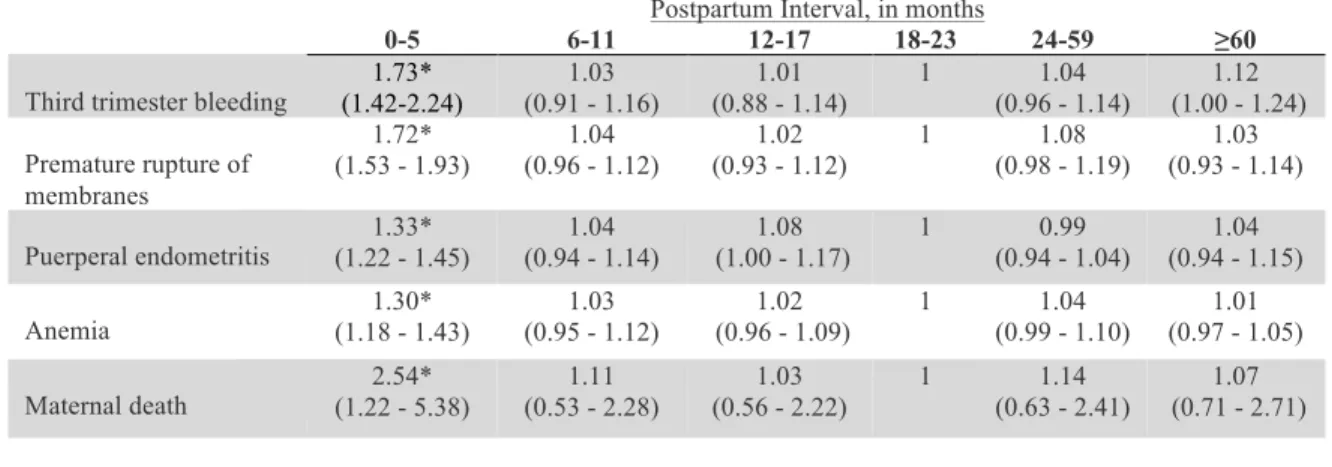
the health care system. The evidence regarding the relationship between short birth intervals and poor maternal and child health outcomes is expansive. The most commonly cited poor health outcomes for women associated with short birth spacing are eclampsia (10,11), anemia (12–14), uterine rupture (15–17), third trimester bleeding (12), premature membrane rupture (10,18), puerperal endometriosis (12,18), placental previa (19), and maternal death (12,20,21). Conde and colleagues conducted one of the largest cross-sectional studies of interpregnancy spacing and maternal health outcomes with 456,889 parous women between 1985 and 1987. Their study suggests uterine rupture was present in 4.8% of women who conceived within 12 months of previous pregnancy but only.9% among women with an interpregnancy interval of
more than 24 months(4). Compared with women who had an interpregnancy interval between
18-23 months, women who conceived within 6 months of delivery had an increased risk of mortality (adjusted OR 2.5; 95% CI 1.2-5.4)(4). Table 1.1 below shows the adjusted relative risk of women with adverse maternal outcomes by their interpregnancy spacing interval. Adjustments were made for maternal age, parity, demographics, and health characteristics.
conceived within six months of previous delivery and those with birth spacing between 18-23 months.
In 2005, the World Health Organization (WHO) released a comprehensive technical report detailing the poor outcomes associated with short birth intervals. After reviewing the seminal literature and congregating thirty of the world’s leading experts on interpregnancy spacing, guidance was introduced recommending an interpregnancy period of no less than 24 months(43). The American Congress of Obstetricians and Gynecologists recommends women in the United States have an interpregnancy period no less than 18 months citing increased risks of preterm birth, low birth weight and small-for-gestational age(44). Evidence suggests that there is a dose-response phenomenon to postpartum spacing and secondary conception. While
conception is contraindicated for up to 24 months postpartum, conception within with the first six months postpartum has the highest risk for perinatal mortality, preterm birth, low birthweight, and fetal death is highest(43). The risk for these outcomes remains significantly elevated through months 7-18. According to ACOG, in month 18 postpartum, secondary conception is considered healthy. However, the World Health Organization maintains a more conservative estimate using 24 months postpartum(43,45,46).
within a short interval from 35% to 23%(47). Low educational attainment and use of less effective contraceptive during the postpartum period are associated with increased risk of
unintended short interpregnancy interval(48). A study of women in California found that 47% of pregnancies in the postpartum period were unintended. There are significant variations in
unintended pregnancy in the postpartum period across racial and ethnic groups. Unintended rapid repeat pregnancies were significantly associated with being African-American, US-born Latina, unmarried, adolescent, high parity (greater than five live births) and history of recent abuse. Women who were uninsured before pregnancy also had increased odds of having an unintended pregnancy(49).
It is estimated that half of all women leave labor and delivery without any plan for
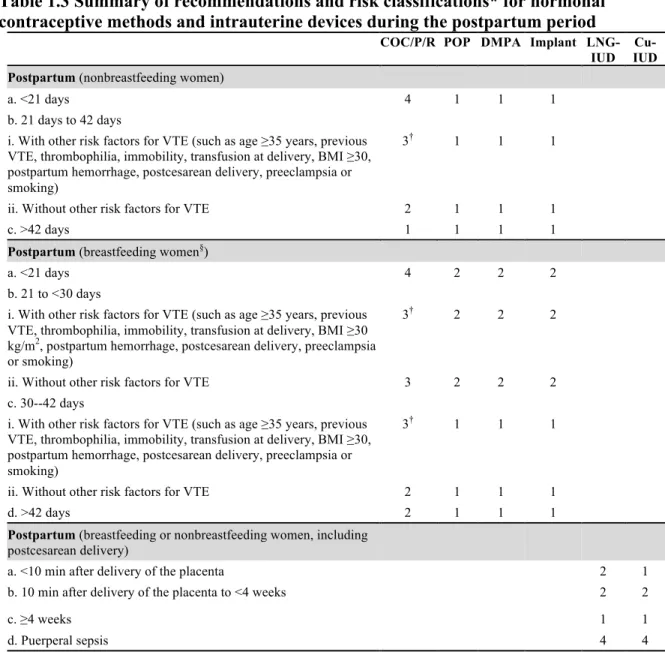
postpartum contraception(46) and that early postpartum contraceptive initiation is key to long-term use and prevention of unintended pregnancy(50). The Centers for Disease Control and Prevention has considered the risks of postpartum contraceptive initiation and established recommendations detailed below in Table 1.3. In this table, it is clear that intrauterine contraceptives, subdermal implants, progestin only pills, and injectable contraceptives are recommended in the postpartum period as the advantages and benefits of initiating the method outweigh the theoretical or proven risk for both breastfeeding and non-breastfeeding women (exceptions in the event of puerperal sepsis). It is not advised for women, both breastfeeding and not, to initiate estrogen-containing contraceptives such as the combined oral pill, the patch or the ring in the early postpartum period due to risks associated with the circulatory system(51).
A 2005 study using New Mexico’s Pregnancy Risk Assessment Monitoring Survey
women who expressed desire for immediate postpartum sterilization, 46% never received it. The most commonly cited factors associated with not receiving requested permanent contraception were young age, being African American or having a vaginal delivery(53). In light of this, the need for timely non-permanent contraceptive options is critical. The traditional timing of the first postpartum visit is considered six weeks however recent research has suggested it should be shortened to three weeks to allow for early initiation of postpartum contraception(54). Receipt of contraception at the first postpartum visit is significantly associated with increased birth interval spacing after controlling for demographic factors(3). As such the same researchers proposed a new paradigm they call the Rules of 3 that suggest i) If a woman is exclusively breastfeeding her infant, a contraceptive method should be used within 3 months postpartum ii) If a woman is
partially or not breastfeed at all, a contraceptive method should be used within 3 weeks
postpartum. The additional third suggestion is similar but addresses women who have elective or
spontaneous abortions and are therefore beyond the scope of this proposal(54).
Short-acting reversible contraceptives have high failure rates, poor adherence and low
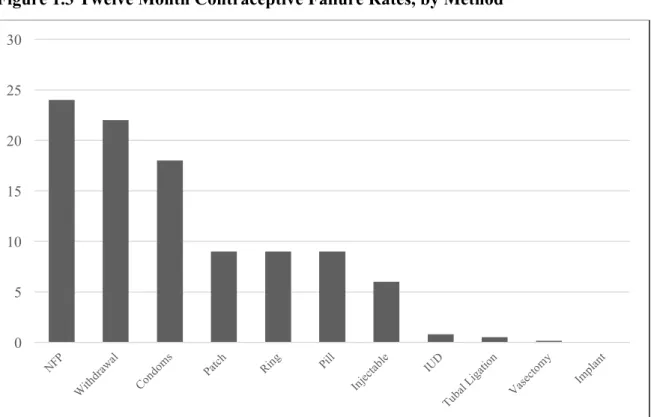
satisfaction rates. Short-acting reversible contraceptives (SARCs) that require consistent user intervention such as the pill, patch or ring, all have failure rates of at least 9% in the first year of use. While effectiveness rates of 91% are high, these methods account for more than 30% of all contraceptive users in the United States. In any given month, 38% of women using oral
being satisfied with their method; dissatisfaction is highly correlated with misuse and
discontinuation with adequate replacement(55). Among women studied in 2011 for the North Carolina Pregnancy Risk Assessment Monitoring System, 29.3% of women in the postpartum period rely on pills to prevent pregnancy.
Long acting reversible contraceptives are highly effective, cost effective and
once again in October 2012 with additional explicit supports for adolescents and women in the postpartum and postabortion period(59).
Possibly the most influential reason that LARCs are the most highly effective contraceptive methods is the lack of effort required by users to continue near perfect protection; a number of professionals call LARCs “Forgettable Contraceptives”. A recent study conducted at Washington University in St. Louis, The Contraceptive Choice Project, has shed great light on contraceptive satisfaction and continuation rates across both long and short-acting methods. Among 5,000 sexually active women who were given adequate education of all available methods and for whom all expenses were covered, 69.9% of women chose to use a LARC. Women using the LARCs had the highest continuation rates among reversible methods at 87% and were more likely to report being satisfied with their method compared with OCP users(57). Long-acting reversible contraceptives have been specifically identified as the most promising intervention to prevent short interpregnancy interval(60). Figure 1.3 shows the failure rates for each method(61). In 2008, 30% of women in the postpartum period relied on a contraceptive method with a failure rate of greater than 20% within the first year of use(9).
Most research has focused on maternal characteristics and insurance status as the
primary factors associated with postpartum contraceptive initiation. Previous research has focused only on maternal characteristics such as age, race, education attainment, religious affiliation, previous pregnancy, previous abortion and insurance status(2,50,63–65). In a study using New Mexico’s PRAMS data, postpartum contraceptive initiation was significantly associated with being between the ages of 20-34, being married, having at least a high school education, being white, and having a postpartum visit(52). However, in a small telephone survey of postpartum women in the United States, being black, not having a college education and a household income of less that $40,000 was significantly associated with increased probability of receiving antepartum contraceptive counseling(50). These differences produced within the same year highlight the need for more rigorous, comprehensive analysis of postpartum contraceptive initiation behaviors as is possible through a large insurance claims dataset. This analysis will include many of the previously examined maternal covariates among a privately insured population while also introducing attributes of providers and health care settings to further explain the relationship between women and the postpartum contraceptive practices.
This study expands upon the limited existing literature that demonstrates contraceptive
updated contraceptive practice and more likely to provide long-acting methods (66–68). Small, qualitative studies have also found that many family medicine practitioners are not adequately trained in family planning; there are currently multiple national initiatives underway to improve family medicine practitioners’ knowledge and skills related to all contraceptives with an
emphasis on long-acting methods(69,70). Patient-provider miscommunication about
contraceptive effectiveness is believed to be strongly associated with misuse, discontinuation and subsequent unintended pregnancies(67). This research will be among the first large, quantitative projects to assess the role of provider characteristics with respect to postpartum contraceptive initiation and short interpregnancy interval among privately insured women throughout an entire state.
Additionally, there is evidence that characteristics of the facility where women receive perinatal care are also associated with postpartum contraceptive initiation practices. Women who receive perinatal care in rural areas of the United States lack comparable reproductive health services as compared to urban women; factors such as poverty, geographic isolation, insufficient numbers of appropriately trained providers, lack of transportation and lower rates of insurance are all thought to be contributors. Rural women are less likely to receive prenatal and postpartum care(71). Women in rural communities are also more likely to face the inability to acquire
prescription contraceptives if local pharmacists refuse to dispense due to their own moral objections(72,73). Women in rural areas are less likely to rely upon reversible contraceptive methods yet more likely to rely on permanent sterilization as compared with women in
For these reasons, there is an established gap in the literature describing the relationship between perinatal care provider, care setting, timely association of postpartum contraceptive initiation and short interpregnancy interval. There is clear evidence that in North Carolina, postpartum contraceptive initiation and birth spacing are problematic and may be contributing to poor birth outcomes described in the literature.
Innovation
The novelty of this study is that the key factors of interest are characteristics of the providers and settings in which women receive perinatal and delivery care. This research will look at women as active participants within health systems and examine the role between health care setting characteristics and postpartum contraceptive initiation while controlling for common demographic factors such as age, education, marital status and parity - all traits associated with contraceptive utilization. Much of the contemporary research regarding postpartum contraceptive initiation has exclusively studied maternal characteristics, insurance coverage and pregnancy intentions. The proposed study uses only insured women, controls for personal and social characteristic, and views short interpregnancy interval as a poor health outcome for both women and children, regardless of intention. This allows analyses to be tailored to the perinatal health care setting and provider characteristics that may be instrumental in a woman’s timely initiation of postpartum contraceptive. Furthermore, this analysis will provide a foundation upon which a major insurance network can explore the factors that may support or inhibit timely postpartum contraception and build evidence that may be used in future quality improvement efforts.
August 1, 2012. Under the new legislation, insurance plans are required to cover all FDA approved contraceptive methods with no copayment (this includes pills, patches, rings,
injectables, diaphragms, cervical caps and permanent sterilization)(76). This legislation has been contested across the country by employers and insurance plans citing religious and moral
objection; the U.S. Supreme Court ruled that some religious employers and closely-held for-profit companies can withhold contraceptive benefits from their employers(76). One caveat and often described as a “loophole” to this legislation that has been seen in practice from insurance plans across the country is a large out-of-pocket copayment for long-acting reversible
contraceptive “insertion fees”. Copayment information for various plans and methods are available within this dataset and can be examined for discontinuity trends that may be the result of changing legislation. In particular, there may be obvious shifts in contraceptive practices after the legislation on August 1, 2012 such as increased utilization of any method or methods that previously has higher out-of-pocket expenses. I will need to consider and adjust for this potential discontinuity pattern should the data show significant shifts via a fixed effect model.
Tables and Figures
Table 1.1 Adjusted Relative Risk and 95% Confidence Intervals of Adverse Maternal Events by Interpartum Spacing Interval
Postpartum Interval, in months
0-5 6-11 12-17 18-23 24-59 ≥60
Third trimester bleeding (1.42-2.24) 1.73*
1.03 (0.91 - 1.16)
1.01 (0.88 - 1.14)
1 1.04 (0.96 - 1.14)
1.12 (1.00 - 1.24)
Premature rupture of membranes
1.72* (1.53 - 1.93)
1.04 (0.96 - 1.12)
1.02 (0.93 - 1.12)
1 1.08 (0.98 - 1.19)
1.03 (0.93 - 1.14)
Puerperal endometritis (1.22 - 1.45) 1.33*
1.04 (0.94 - 1.14)
1.08 (1.00 - 1.17)
1 0.99 (0.94 - 1.04)
1.04 (0.94 - 1.15)
Anemia (1.18 - 1.43) 1.30*
1.03 (0.95 - 1.12)
1.02 (0.96 - 1.09)
1 1.04 (0.99 - 1.10)
1.01 (0.97 - 1.05)
Maternal death (1.22 - 5.38) 2.54* (0.53 - 2.28) 1.11 (0.56 - 2.22) 1.03 1 (0.63 - 2.41) 1.14 (0.71 - 2.71) 1.07
Source: Conde et al. (21)
Table 1.2 Adjusted Odds Ratio and 95% Confidence Intervals of Adverse Infant Events by Interpartum Spacing Interval
Table 3. Adjusted Odds Ratio and 95% Confidence Intervals of Adverse Infant Events by Interpartum Spacing Interval
Postpartum Interval, in months
0-6 18-23
Low birthweight (<2501 grams) (1.24-1.58) 1.4
1
Preterm birth (<37 weeks gestation) (1.39-1.86) 1.61
1
Small for gestational age (1.18-1.33) 1.26
1
Table 1.3 Summary of recommendations and risk classifications* for hormonal contraceptive methods and intrauterine devices during the postpartum period
COC/P/R POP DMPA Implant
LNG-IUD Cu-IUD Postpartum (nonbreastfeeding women)
a. <21 days 4 1 1 1
b. 21 days to 42 days
i. With other risk factors for VTE (such as age ≥35 years, previous VTE, thrombophilia, immobility, transfusion at delivery, BMI ≥30, postpartum hemorrhage, postcesarean delivery, preeclampsia or smoking)
3† 1 1 1
ii. Without other risk factors for VTE 2 1 1 1
c. >42 days 1 1 1 1
Postpartum (breastfeeding women§)
a. <21 days 4 2 2 2
b. 21 to <30 days
i. With other risk factors for VTE (such as age ≥35 years, previous VTE, thrombophilia, immobility, transfusion at delivery, BMI ≥30
kg/m2, postpartum hemorrhage, postcesarean delivery, preeclampsia
or smoking)
3† 2 2 2
ii. Without other risk factors for VTE 3 2 2 2
c. 30--42 days
i. With other risk factors for VTE (such as age ≥35 years, previous VTE, thrombophilia, immobility, transfusion at delivery, BMI ≥30, postpartum hemorrhage, postcesarean delivery, preeclampsia or smoking)
3† 1 1 1
ii. Without other risk factors for VTE 2 1 1 1
d. >42 days 2 1 1 1
Postpartum (breastfeeding or nonbreastfeeding women, including postcesarean delivery)
a. <10 min after delivery of the placenta 2 1
b. 10 min after delivery of the placenta to <4 weeks 2 2
c. ≥4 weeks 1 1
d. Puerperal sepsis 4 4
Abbreviations: COC = combined oral contraceptives; P = combined hormonal patch; R = combined vaginal ring; POP = progestin-only pill; DMPA = depot medroxyprogesterone acetate; IUD = intrauterine device; LNG-IUD =
levonorgestrel-releasing IUD; Cu-IUD = copper-bearing IUD; VTE = venous thromboembolism; CHC = combined
hormonal contraceptive; BMI = body mass index (weight [kg] / height [m2]).
*Categories: 1 = a condition for which there is no restriction for the use of the contraceptive method, 2 = a condition for
which the advantages of using the method generally outweigh the theoretical or proven risks, 3 = a condition for which the theoretical or proven risks usually outweigh the advantages of using the method, 4 = a condition that represents an unacceptable health risk if the contraceptive method is used.
†Clarification: For women with other risk factors for VTE, these risk factors might increase the classification to a "4";
for example, smoking, deep venous thrombosis/pulmonary embolism, known thrombogenic mutations, and peripartum cardiomyopathy.
§The breastfeeding recommendations are divided by month in U.S. Medical Eligibility Criteria for Contraceptive Use,
2010. They have been divided by days for purposes of integration with the postpartum recommendations.
Figure 1.1 Perinatal Risk Factors and Outcomes in North Carolina and the United States, 2013
Figure 1.2 Pregnancy Risk Factors and Outcomes in North Carolina by Urbanicity, 2013
0 5 10 15 20 25 30 35
Preterm Birth (<37
weeks) (all below 2501 g)Low Birthweight Smoking During Pregnancy Overweight or Preconceptive Obese
Grandmultiparity Previous poor
birthoutcome Previous preterm birth
Pe rc en t of L iv e B ir th s
Metropolitan Micropolitan Rural
0 2 4 6 8 10 12 14 16 18 20
Preterm birth Very Low Birthweight
(<1500g)
Low birthweight
(1501-2500g) No Prenatal Care Smoking During Pregnancy Less than 12 Years of Education
Repeat Teen Birth
Rate* Infant Mortality Rate**
Figure 1.3 Twelve Month Contraceptive Failure Rates, by Method
Source: Contraceptive Technology (61)
CHAPTER 2: PROPOSED APPROACH
Overview and Rational
This research will address how key health system characteristics are associated with postpartum contraceptive initiation, initiation of highly effective contraceptive methods and the incidence of short interpregnancy interval among privately insured women in North Carolina. Prior literature has emphasized the role of individual characteristics as the key predictors of postpartum contraception initiation; this study will explore if health setting characteristics are strong predictors of postpartum contraceptive initiation and method of initiation after controlling for individual characteristics.
Conceptual Model
This project will utilize an adaptation to the Anderson Health Services Research Model. The model, originally developed in the 1960’s, explores health care utilization by examining the interactive relationships between environmental, population, and behavioral factors and health outcomes(77). The author expanded upon this model again in 1995 describing how each of the predetermining factors were associated with potential, realized, equitable and inequitable access to health services(78). For this study, I will primarily examine how environment (urbanicity) and enabling resources (perinatal care facility and provider) affect health behaviors (initiating
education, partnership status, and employment status; these individual level predisposing characteristics described in the model have already been thoroughly researched and shown associations with contraceptive initiation and birth outcomes as described above as described previously.
Environment: Women live and receive healthcare within an environmental context. In
accordance with the literature, women in rural communities are less likely to receive adequate reproductive health care(71,75). I will model how a woman’s geographic environment, though distal to her postpartum contraceptive practices, may play a significant role in her perinatal care. I predict women who enter thee conceptual pathway from a rural community will have poorer outcomes, even while holding all other factors constant.
Predisposing Characteristics: Previous research has demonstrated strong relationships between maternal characteristics and contraceptive initiation and rapid repeat pregnancies. The most commonly cited predisposing characteristics in literature are maternal age, parity, education status, income and employment status.(2,50,63,64). Given the abundance of literature and the health services focus of this research, I propose to use women’s predisposing characteristics as control variables on the conceptual pathway. I accept their great importance in predicting a woman’s contraception practices but will use them
analysis will consider each component of the facility and provider individually and together to assess what types of perinatal care experiences best support timely initiation of postpartum contraceptives.
Need: Postpartum contraceptive needs, both real and perceived, play a role in women’s decision to initiate a contraceptive method. Individual need is a factor determined by natural return to fertility, sexual activity, and breastfeeding practices. It has been estimated that among non-breastfeeding women, fertility returns on average within six weeks, though some women may ovulate within 3 weeks(79). While breastfeeding may reduce fertility, there is not clear evidence as to the degree and length of natural protection against pregnancy due to highly variable
breastfeeding practice(80). Periodic abstinence is also a means of contraception though the duration of use is highly variable and often unpredictable(81). Given such variation, I will view need to initiate postpartum contraception as determined by the current ACOG standards of Health Behaviors: This analysis will explore three health behaviors known to influence short interpregnancy interval. I will explore how perinatal care setting and providers are associated with return for postpartum care as well as any initiation of a contraceptive and its adherence. Usually, these three behaviors are considered to progress in a linear fashion; encountering a health provider, initiating a contraceptive method, and adhering or discontinuing that method. This model will explore how perinatal care characteristics are associated with these behaviors. Outcomes: The primary outcomes of interest in this study are the incidence of short
Figure 2.1 shows the the proposed pathways using the Anderson model.
Data Sources and Population
This study used professional, facility and pharmaceutical administrative claims from a large, private insurer in North Carolina. The professional and facility claims contained
information on diagnoses and procedures as well as information on providers such as their name, specialty, place of business, and National Provider Identifier (NPI). Provider specialty was denoted as the primary specialty associated with a provider’s NPI. Table 2.1 defines the provider specialty groups used in analysis that primarily included Obstetricians/Gynecologists and Family Medicine providers. The pharmaceutical claims provided the name of the drug filled, dosage and refill status. In addition to claims, we also used a membership file that provided information on the insured person including date of birth, ZIP code of residence, employment status and insurance coverage information. Due to the limited individual level characteristics included in the membership file, we also used ZIP code level demographics from the 2010-2014 5-Year Census’ American Community Survey such as race/ethnicity proportion, poverty indicators and educational information. Finally, we determined each ZIP code’s rurality status using the Rural Urban Commuting Area (RUCA) codes (82).The RUCA classifications include four groups: urban, large rural, small rural and isolated rural.
Proposed Analyses
This hypothesis will be tested using a 2SRI logistic regression model to predict the probability of timely initiation of any modern contraceptives given urban perinatal care site, presence of an OB/GYN residency program and the interaction of the two together. The first stage, described above when addressing selection bias, uses instrumental variables to address potential selection bias of perinatal care site and contraceptive method. The second stage uses a logit model with the endogenous variables and residuals from the first stage to estimate the probability of a woman initiating any contraceptive method within 12 weeks of delivery. Goodness of fit and specification tests will be included to ensure the model is appropriate constructed to the data; these include but are not limited to a Wald test to determine if coefficients are not equal to zero in the model (such as urban or OB/GYN practice), the LaGrange Multiplier tests to determine if adding variable jointly (such as urban and OB/GYN practice) significantly improves the model, and an AIC/BIC test to assess if higher ordered terms (such as quadratic age) or interaction terms (such as age*urban) would improve model fit.
Equation 1.1
𝑃 𝐶𝑜𝑛𝑡𝑟𝑎𝑐𝑒𝑝𝑡𝑖𝑣𝑒 𝐼𝑛𝑖𝑡𝑖𝑎𝑡𝑖𝑜𝑛 = 1 1 + 𝑒234
𝑤ℎ𝑒𝑟𝑒 𝑥𝛽 = 𝛽9+ 𝛽: 𝑈𝑟𝑏𝑎𝑛 𝐹𝑎𝑐𝑖𝑙𝑖𝑡𝑦 + 𝛽@ 𝑂𝑏𝐺𝑦𝑛 𝑅𝑒𝑠𝑖𝑑𝑒𝑛𝑐𝑦
+ 𝛽F 𝑈𝑟𝑏𝑎𝑛 ∗ 𝑂𝑏𝐺𝑦𝑛 𝑅𝑒𝑠𝑖𝑑𝑒𝑛𝑐𝑦 + 𝛽H 𝑀𝑎𝑡𝑒𝑟𝑛𝑎𝑙 𝐶ℎ𝑎𝑟𝑎𝑐𝑡𝑒𝑟𝑖𝑠𝑡𝑖𝑐𝑠 + 𝛽J 𝑆𝑜𝑐𝑖𝑎𝑙 𝐶ℎ𝑎𝑟𝑎𝑐𝑡𝑒𝑟𝑖𝑠𝑡𝑖𝑐𝑠 𝑜𝑓 𝑍𝑖𝑝 𝐶𝑜𝑑𝑒
+ 𝛽N 𝐷𝑒𝑙𝑖𝑣𝑒𝑟𝑦 𝐹𝑎𝑐𝑖𝑙𝑖𝑡𝑦 𝐶ℎ𝑎𝑟𝑎𝑐𝑡𝑒𝑟𝑖𝑠𝑡𝑖𝑐𝑠 + 𝛽P(𝑃𝑟𝑜𝑣𝑖𝑑𝑒𝑟 𝐶ℎ𝑎𝑟𝑎𝑐𝑡𝑒𝑟𝑖𝑠𝑡𝑖𝑐𝑠)) + 𝛽S 𝐶𝑜𝑛𝑡𝑟𝑎𝑐𝑒𝑝𝑡𝑖𝑣𝑒 𝐶ℎ𝑜𝑖𝑐𝑒 + 𝛽T 𝑃𝑒𝑟𝑖𝑛𝑎𝑡𝑎𝑙 𝐶𝑎𝑟𝑒 𝑆𝑖𝑡𝑒 𝐶ℎ𝑜𝑖𝑐𝑒
Aim 1 Hypothesis 1.2: Among women who initiate any contraceptive, women receiving
The test of this hypothesis will use a 2SRI nested multinomial logistic regression model, which accounts for choice in a sequential manner. The first stage, described above when
addressing selection bias, uses instrumental variables to address potential selection bias of perinatal care site and contraceptive method. The second stage uses a nested multinomial model with the endogenous variables and residuals from the first stage to estimate the probability of a woman initiating a particular method of contraceptive within 12 weeks. The first nest of the model assesses whether a woman initiates a long-acting or short-acting reversible contraceptive. The second nest beneath this decision and determines which contraceptive method was initiated (pill, patch, ring, injectable, subdermal implant, intrauterine device). The nested multinomial model allows for multiple categorical outcomes while relaxing some of the parameters of the Independence of Irrelevant Alternatives (IIA), allowing nested outcomes to be correlated. This model can be used to estimate the probability of a woman initiating any postpartum
contraception as well the type. In the multinomial model, j indicates the category and I indicates the individuals. Only characteristics of the individual, not the choices, are determinant in the model. Figure 2.2 shows the proposed nested structure of the multinomial model.
Equation 1.2
𝑝UV = 𝑒 3W4X
1 + ΣZ[@\ 𝑒3W4X
𝑤ℎ𝑒𝑟𝑒 𝑥𝛽 = 𝛽9+ 𝛽: 𝑀𝑎𝑡𝑒𝑟𝑛𝑎𝑙 𝐶ℎ𝑎𝑟𝑎𝑐𝑡𝑒𝑟𝑖𝑠𝑡𝑖𝑐𝑠
+ 𝛽@ 𝑆𝑜𝑐𝑖𝑎𝑙 𝐶ℎ𝑎𝑟𝑎𝑐𝑡𝑒𝑟𝑖𝑠𝑡𝑖𝑐𝑠 𝑜𝑓 𝑍𝑖𝑝 𝐶𝑜𝑑𝑒 + 𝛽F 𝑃𝑟𝑒𝑛𝑎𝑡𝑎𝑙 𝐶𝑎𝑟𝑒 𝐹𝑎𝑐𝑖𝑙𝑖𝑡𝑦 𝐶ℎ𝑎𝑟𝑎𝑐𝑡𝑒𝑟𝑖𝑠𝑡𝑖𝑐𝑠
In the first stage of the model, j represents the dichotomous variable of LARC or SARC (1=LARC, 0=SARC). In the second level, the nested level, the j categories represent the various modern methods available (Lng-IUD, Cu-IUD, Implant, COC/POP, patch, ring, DMPA). For this study, the methods of interest (k) include the LARCs, both intrauterine device options and
subdermal implant and the SARCS, oral contraceptive pills (COC/POP), hormonal patch, hormonal ring, or injectable (DMPA). The referent category will be oral contraceptive pills as they are the most commonly used modern contraceptive. This nested multinomial method will be used to generate predicted probabilities and the most precise standard errors possible through 1,000 bootstrapping repetitions. Bootstrapping is imperative in multinomial models to measure the precision of a differential effect as the model does not account for any coefficient variation. Various tests will be conducted to determine if this model appropriately fits the dataset. The first priority will be to test for Independence of Irrelevant Alternatives (IIA) which requires that the ratio of probabilities is constant even if a category is dropped; the standard Haussmann test is an appropriate test for IIA. If the IIA test fails, I will reconsider how variables are nested and explore alternatives that pass the IIA test and are able to answer the research question. In particular, if the nested model fails with the six contraceptive methods, I will regroup the methods dichotomously to SARC and LARC.
Aim 2 Hypothesis 2.1: Among women who initiate any modern contraceptive within the first 12 weeks postpartum, women who initiate a SARC within 12 weeks of delivery are more likely to have a short interpregnancy interval compared with women who initiate a LARC.
address potential selection bias of perinatal care site and contraceptive method. The second stage uses a logit model with the endogenous variables and residuals from the first stage and estimates the probability of short interpregnancy interval. Goodness of fit and specification tests will be included to ensure the model is appropriate constructed to the data; these include but are not limited to a Wald test to determine if coefficients are not equal to zero in the model, the LaGrange Multiplier tests to determine if adding variables jointly significantly improves the model, and an AIC/BIC test to assess if higher ordered terms or interaction terms would improve model fit.
Equation 2.1
𝑃 𝑅𝑅𝑃 = 1 𝐶𝑜𝑛𝑟𝑎𝑐𝑒𝑝𝑡𝑖𝑣𝑒 𝑀𝑒𝑡ℎ𝑜𝑑 = 1 1 + 𝑒234 𝑤ℎ𝑒𝑟𝑒 𝑥𝛽 = 𝛽9+ 𝛽: 𝑀𝑎𝑡𝑒𝑟𝑛𝑎𝑙 𝐶ℎ𝑎𝑟𝑎𝑐𝑡𝑒𝑟𝑖𝑠𝑡𝑖𝑐𝑠 +
𝛽@ 𝑆𝑜𝑐𝑖𝑎𝑙 𝐶ℎ𝑎𝑟𝑎𝑐𝑡𝑒𝑟𝑖𝑠𝑡𝑖𝑐𝑠 𝑜𝑓 𝑍𝑖𝑝 𝐶𝑜𝑑𝑒 + 𝛽F 𝑃𝑟𝑒𝑛𝑎𝑡𝑎𝑙 𝐶𝑎𝑟𝑒 𝐹𝑎𝑐𝑖𝑙𝑖𝑡𝑦 𝐶ℎ𝑎𝑟𝑎𝑐𝑡𝑒𝑟𝑖𝑠𝑡𝑖𝑐𝑠 + 𝛽H(𝑃𝑟𝑜𝑣𝑖𝑑𝑒𝑟 𝐶ℎ𝑎𝑟𝑎𝑐𝑡𝑒𝑟𝑖𝑠𝑡𝑖𝑐𝑠) + 𝛽J 𝐶𝑜𝑛𝑡𝑟𝑎𝑐𝑒𝑝𝑡𝑖𝑣𝑒 𝐶ℎ𝑜𝑖𝑐𝑒 +
Tables and Figures
Table 2.1 Key Measures and Definitions
Interpregnancy Intervals Interpregnancy
interval The time (months) between two live births Short interpregnancy
interval An interpregnancy interval of <27 months Contraceptive Use
Contraceptive initiation
The first postpartum medical or pharmaceutical claim associated with beginning contraceptives; e.g. CPT code 58300- Insertion of an intrauterine device or prescription filled for oral contraceptive method
Contraceptive non-use
No recoded claim for any contraceptive method within 24 months of delivery
Short-acting reversible
contraception Includes hormonal pills, patch, vaginal ring and injectable Long-acting
reversible contraceptive
Includes both the hormonal and copper intrauterine devices as well as the subdermal implant
Permanent
sterilization Includes both tubal ligation and occlusion
Contraceptive type Mutually exclusive categories of non-use, SARC, LARC, permanent
Provider Characteristics Provider Specialty Designation
The specialty code of the provider who received the payment for the maternity care
Provider Specialty
For this study, we categorized providers into the five largest groups: Obstetricians and Gynecologists, Family Medicine, Certified Nurse Midwives (CNM), Pediatrics and Multispecialty Practice. During analysis, we did not interpret the findings associated with women seen by CNMs due to a very small sample. Additionally, Multispecialty Practice designation did not provide sufficient information for comparison with our referent group, OB/GYNs; it remained in the model as a covariate however could not be meaningfully interpreted given the lack of detailed information.
Residency Affiliation
Distance to nearest OB/GYN residency program
The distance (miles) from a woman's ZIP code centroid to the nearest accredited OB/GYN residency program; for multi-clinic practices, the central hospital was used as the end point
Provider's LARC prescribing preference
Among all non-permanent contraceptive prescriptions attributed to a provider, the proportion that are for a long-acting reversible contraceptive
Demographic Characteristics
Maternal age A woman's age on the day of delivery (years)
Group health plan Binary indictor of whether a woman was enrolled in a group based insurance plan or individual plan Rural Residential zip code with RUCA classification of large rural,
small rural or isolated rural
Relative parity The number of live births a woman has within the data time frame White % The percent of a zip code identifying as White per Census estimates Black % The percent of a zip code identifying as Black per Census estimates Native
American/American Indian %
The percent of a zip code identifying as Native American/American Indian per Census estimates
Asian % The percent of a zip code identifying as Asian per Census estimates Native
Hawaiian/Pacific Islander %
The percent of a zip code identifying as Native Hawaiian/Pacific Islander per Census estimates
Hispanic % The percent of a zip code identifying as Hispanic per Census estimates; includes ALL races Females over 25
without high school degree/GED %
Figure 2.1 Anderson Model of Postpartum Contraceptive Initiation and Short Interpregnancy Intervals
Figure 2.2 Nested multinomial model structure
PNC:%Perinatal%care PP:%Postpartum
Outcomes
Population Characteristics Health
Behaviors Environment Urbanicity Guidance regarding interpartum spacing
Maternal age Parity
Education Partnership Income
Employment
Receipt of PNC
Location of PNC
Specialty of PNC provider
OB/GYN residency program
Age of PNC provider
Delivery method
PP resumption of coitus
PP return to fertility
Breastfeeding practices Non-permanent sterilization Birth intervals Short interpregnancy interval Birth outcomes Healthcare expenditures Need Enabling Resources Predisposing Characteristics
Return for PP visit
Initiation of PP contraception
Adherence to PP contraception
Contraceptive initiation within 12 months postpartum
LARC
Hormonal
IUD Copper IUD Subdermal Implant
SARC
CHAPTER 3: THE EFFECT OF MATERNITY CARE PROVIDER SPECIALTY, RESIDENCY AFFILIATION AND PATIENT RURALITY ON POSTPARTUM
CONTRACEPTIVE INITIATION PATTERNS
Overview
Objective: To determine if provider and healthcare setting characteristics effect the timing and type of postpartum contraception initiation.
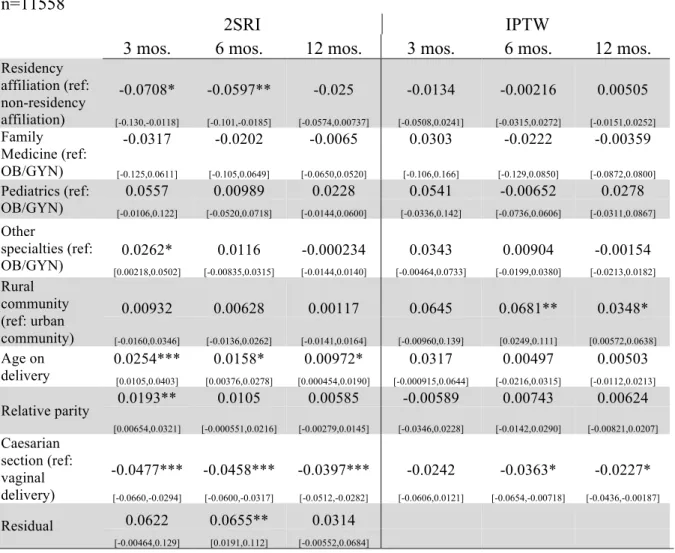
Methods: Using administrative claims from a large, private insurance company, we assessed how provider specialty, provider association with an obstetrics and gynecology residency program and living in a rural area affected the time to and method of postpartum contraceptive initiation. The sample included 14,426 women with a live birth who were continuously insured for 60 months after their first delivery claim. We used both a two-stage residual inclusion model and inverse probability of treatment weighted logistic regression to determine the probability a woman would begin a contraceptive over time and whether she would use long-acting versus short-acting reversible contraceptives.
increased utilization of long-acting reversible contraceptives within 12 months postpartum by 13.6% and 25.3% in the 2SRI and IPTW models, respectively (p<.05), as compared with receiving care from an obstetrician/gynecologist.
Conclusions: Provider specialty or affiliation with an OB/GYN residency program did not effect a woman’s time to contraceptive initiation; however, Family Medicine providers were linked to higher rates of LARC initiation as compared with OB/GYN specialists. These findings suggest that while OB/GYN providers may have the most formal training in contraception, the continuity of care a woman receives from a primary care provider before, during and after her pregnancy may play an important role in selecting a highly-effective contraceptive.
Key words: contraception, postpartum care, postpartum contraception, birth spacing, long-acting reversible contraceptive
Introduction/Background
Modern contraceptives have led to a dramatic reduction in unintended pregnancies, teen birth rates, and poor infant outcomes since their introduction (1). Despite highly effective
(12,18), placental previa (19), maternal death (12,20,21), low birthweight, preterm birth (18,20– 27), small for gestational age (18,22,24,26,27), intrauterine growth restriction (28), stunting (29– 33), underweight, low height for age, low weight for height (30,33–37), miscarriage (20,38), fetal death (21,38–40), and neonatal, infant and early childhood mortality (20,21,33,38–40). Given these findings, the American Congress of Obstetricians and Gynecologists recommends women in the United States have an interpregnancy period of no less than 18 months citing increased risks of preterm birth, low birth weight and small-for-gestational age (44).
However, it is estimated that half of all women leave labor and delivery without any plan for postpartum contraception (46). Early postpartum contraceptive initiation is key to long-term contraceptive use and prevention of unintended pregnancy (38). The Centers for Disease Control and Prevention have established recommendations indicating that intrauterine contraceptives, subdermal implants, progestin only pills, and injectable contraceptives are recommended in the postpartum period as the advantages and benefits of initiating the method outweigh the risk for both breastfeeding and non-breastfeeding women (exceptions in the event of puerperal sepsis).
Use of less effective contraceptives during the postpartum period are associated with
increased risk of unintended short interpregnancy interval (48). Short-acting reversible methods include all types of oral pills, hormonal patch, hormonal vaginal ring and injectable
Women who receive perinatal care in rural areas of the United States lack comparable reproductive health services as compared to urban women; factors such as poverty, geographic isolation, insufficient numbers of appropriately trained providers, lack of transportation and lower rates of insurance are all thought to be contributors. Rural women are less likely to receive prenatal and postpartum care (71). Women in rural communities are also more likely to face the inability to acquire prescription contraceptives if local pharmacists refuse to dispense due to their own moral objections (72,73). Women in rural areas are less likely to rely upon any reversible contraceptive methods yet more likely to rely on permanent sterilization as compared with women in metropolitan areas (74,75). This may be related to challenges women in rural areas face in reliably accessing highly-effective reversible contraceptives.
Much of the existing research on postpartum contraceptive initiation has focused only on maternal characteristics such as age, race, education attainment, religious affiliation, previous pregnancy, previous abortion and insurance status (2,50,63–65) . Thus far, evidence suggests younger providers, female providers and providers with training in obstetrics and gynecology are most likely to be knowledgeable about updated contraceptive practice and more likely to provide long-acting methods (66–68). Small, qualitative studies have also found that many family
medicine practitioners are not adequately trained in family planning; there are currently multiple national initiatives underway to improve family medicine practitioners’ knowledge and skills related to all contraceptives with an emphasis on long-acting methods (69,70). Patient-provider miscommunication about contraceptive effectiveness is believed to be strongly associated with misuse, discontinuation and subsequent unintended pregnancies (67).
method of postpartum contraception. Given the existing literature, we hypothesized that women who received maternity care from an OB/GYN provider or a provider affiliated with an
OB/GYN residency program would be more likely to initiate postpartum contraceptives within 3 and 6 months as compared with women receiving care from other provider types. We
hypothesized women who lived in rural areas would be less likely to use any contraceptive within 12 months postpartum. Finally, we hypothesized women who received maternity care from an OB/GYN provider or a provider affiliated with an OB/GYN residency program would be more likely to initiate a long-acting reversible contraceptive as compared with with women who received care from other provider types. We hypothesized women who lived in rural areas would be less likely to initiate a long-acting reversible contraceptive.
Methods Data
This study used administrative claims data (professional, facility, and pharmaceutical) from a large, private insurance company in North Carolina. The professional and facility claims data included information on diagnoses, procedures completed, provider and facility
of women, their communities and their service providers. Due to the limited demographic indicators available within the membership data, zip code level characteristics such as race/ethnicity proportions, median income, and educational attainment were added from the 2010-2014 American Community Survey. Additionally, urbanicity was determined by Rural Urban Commuting Area codes for a subscriber’s residential zip code (82). RUCA codes are often divided into four groups: urban, large rural, small rural, and isolated rural. For analytic purposes, we collapsed these categories into binary urban and rural designations.
This study used the Multi-Level Clinical Classification Software (CCS) for ICD-9-CM to standardize classification of both diagnoses and procedures (84). The CCS aggregates codes into useful groups for analysis such as combining all variations of a caesarian delivery (caesarian-twins, caesarian without complications, caesarian with hemorrhage, etc.) into a single category labeled “Caesarian delivery”.
Key Measures and Definitions
The key measures for this study included time to contraceptive, type of contraceptive, provider specialty and OB/GYN residency site affiliation. Time to contraceptive was measured as the number of days after a live birth until the first indication of a contraceptive in claims. Contraceptive type is defined as non-use, short-acting reversible contraceptive (pills, patch, ring, injectable), long-acting reversible contraceptive (intrauterine device or subdermal implant), or permanent (tubal ligation or occlusion). In this study, we classified specialty into the five most common groups: OB/GYN, family medicine, certified nurse midwife, pediatrics and
services rendered. Global billing allows us to observe in claims which provider or practice provider prenatal, labor and delivery, and postpartum care to women. For our analysis, we used the provider associated with prenatal care maternity services as the designated provider for that pregnancy event. A woman’s provider type was recorded based upon the provider who received payment for maternity care services (prenatal and postpartum care always, sometimes delivery care). We also denoted physicians as affiliated with an OB/GYN residency site if they practiced at a facility associated with one of Graduate Medical Education accredited residency programs in Obstetrics and Gynecology. Finally, we used ZIP code demographic indicators as controls in our model including the percent of a ZIP code population identifying with the major racial groups, Hispanic ethnicity, and women over 25 years of age without a high school diploma or equivalent degree. Table 3.1 below provides additional definitions and explanations for how we developed our key measures.
Sample