A New
Lecture-Tutorial
for Teaching about Molecular Excitations and
Synchrotron Radiation
Colin S. Wallace, University of North Carolina at Chapel Hill, Chapel Hill, NC Edward E. Prather, University of Arizona, Tucson, AZ
Seth D. Hornstein, University of Colorado Boulder, Boulder, CO Wayne M. Schlingman, The Ohio State University, Columbus, OH Timothy G. Chambers, University of Michigan, Ann Arbor, MI Jack O. Burns, University of Colorado Boulder, Boulder, CO
Light and spectroscopy are among the most important and frequently taught topics in introductory, college-level, general education astronomy courses (hereafter Astro 101).1 This is due to the fact that the vast majority of observational data studied by astronomers arrives at Earth in the form of light. While there are many processes by which matter can emit and absorb light, Astro 101 courses typically limit their instruction to the Bohr model of the atom and electron energy level transitions. In this paper, we report on the development of a new Lecture-Tutorial to help students learn about other processes that are responsible for the emission and absorption of light, namely molecular rotations, molecular vibrations, and the acceleration of charged particles by magnetic fields. Note that this paper primarily focuses on describing the variety of representations and reasoning tasks designed for this Lecture-Tutorial; while the end of this paper highlights some data that is suggestive of the Lecture-Tutorial’s effectiveness, our more comprehensive analysis of its efficacy will be presented in a future publication.
The design and development process for this new Lecture-Tutorial followed the principles and methodology that guided the development of the original Lecture-Tutorials for Introductory Astronomy.2 Each of the forty-four previously-developed, evidence-based Lecture-Tutorials is a two- to six-page worksheet containing carefully sequenced and conceptually-scaffolded Socratic-style questions, utilizing multiple representations of scientific information, that actively engage collaborative student learning groups in constructing more expert-like understandings of a small number of closely-related astrophysical topics. Several prior research studies show that the implementation of
Lecture-Tutorials can help students significantly increase their understandings of difficult physics and astronomy concepts beyond what they typically achieve during traditional lecture-based instruction.3
The development of this Lecture-Tutorial was one of the initial projects of a new collaboration between scientists and science education researchers from Associated Universities, Inc. (AUI), the Center for Astronomy Education (CAE) at the University of Arizona (UA), the University of Colorado Boulder (CU-Boulder), and the University of North Carolina at Chapel Hill (UNC). One of the goals of this collaboration is to create the tools STEM instructors need to transform their college classes into active-engagement, collaborative learning environments using foundational and cutting-edge radio astronomy topics. For this particular Lecture-Tutorial, our goals were to help students understand:
2) the wavelengths of light and types of spectra that are produced by these different processes;
3) the connection between these processes and real astrophysical phenomena; and
4) the telescopes whose wavelength sensitivities are best suited for observing each particular type of matter-energy interaction.
A New Lecture-Tutorial on Molecular Vibrations, Molecular Rotations, and Synchrotron Radiation
During the prior research and development on the Lecture-Tutorial that focused on the Bohr model of the atom, we found that many students leave a traditional lecture unable to consistently and coherently reason about whether an electron moving from a higher to lower energy level (and vice versa) results in the emission or absorption of light, and how the wavelength of the emitted/absorbed light is related to the energy difference between the electron’s initial and final states. We were therefore not surprised to find that students exhibit similar difficulties when asked to reason about how changes in the rotational or vibrational energy state of a molecule are related to the emission or absorption of light. As a result, we begin the new Lecture-Tutorial with questions that help students develop their conceptual understandings of, and abilities to reason about, the emission and absorption of different wavelengths of light via molecular vibrations and rotations.
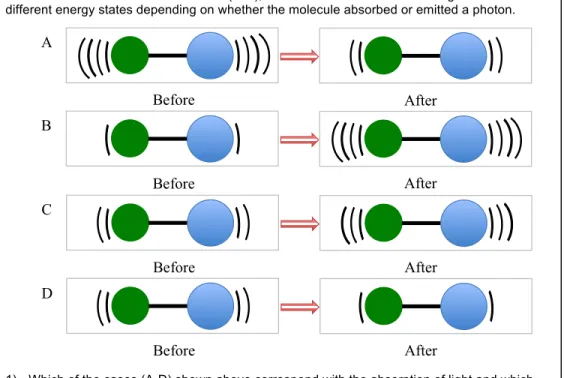
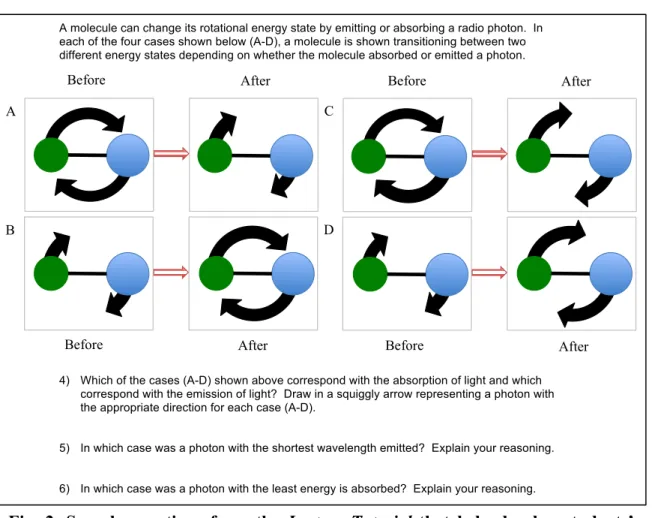
Note that throughout this new Lecture-Tutorial we explicitly use many different representations. We hereafter use the term “pedagogical discipline representations” (PDRs) to refer to the body of representations that are useful for teaching and learning about a given discipline, such as astronomy, even though those representations may not be typically used in textbooks or by two experts in a field that are communicating with one another. Different PDRs may have complementary abilities to deepen students’ understandings due to the fact that these representations have different scientific and educational affordances.4 Consequently, when we develop a new Lecture-Tutorial, we use the widest variety of PDRs possible, including graphs, equations, pictures, and tables of data, so that we may engage the critical thinking skills of the largest possible range of students and help them become more fluent in the science content they are studying. For example, in the Lecture-Tutorial that focuses on the Bohr model of the atom, students reason about a combination of pictorial and word-based representations of photon and atom interactions, electron energy levels, and the relationship between energy level transitions and the wavelength and energy of emitted/absorbed light. The new Lecture-Tutorial uses carefully chosen PDRs designed to help students envision the physical behavior of molecules that change energy states due to the emission and absorption of photons, and how these matter energy interactions relate to different representations of spectra. Figures 1-5 show excerpts from the Lecture-Tutorial that highlight the range of question types, reasoning tasks, and representations used; the full Lecture-Tutorial
rotational state of greater energy. Through field tests with over 1000 students, we found that these arrows and arcs facilitate students’ discourse about changes in rotational and vibrational energy states, and, as a result, students are able, post-instruction, to incorporate these pictorial representations into explanations that are more scientifically coherent than those provided after traditional lecture-based instruction.
[Figure 1 about here.] [Figure 2 about here.]
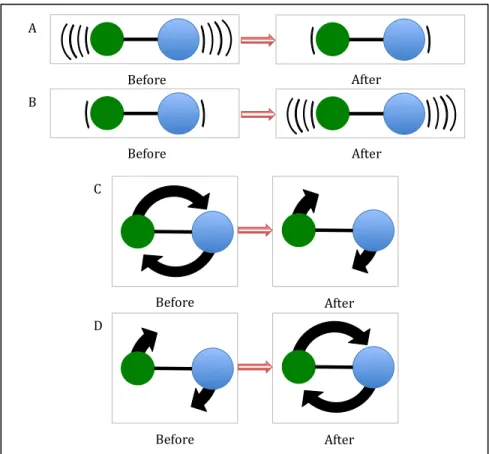
Figures 1 and 2 also show a sequence of questions used in the new Lecture-Tutorial to engage students about how changes in a molecule’s vibrational or rotational energy state corresponds to the emission or absorption of a photon. The new Lecture-Tutorial requires students to reason about how the energy/wavelength/frequency of a photon that is emitted or absorbed as a result of one molecular energy state transition compares to the energy/wavelength/frequency of a photon emitted or absorbed due to a different energy state transition. For example, students are expected to realize that both Case B and C in Figure 1 correspond to the absorption of a photon, although the photon absorbed in Case C must have a longer wavelength (or lower energy) than the photon absorbed in Case B. Reasoning tasks associated with the energy/wavelength/frequency of an emitted/absorbed photon target and reinforce conceptual ideas and reasoning pathways that have been developed in other Lecture-Tutorials.
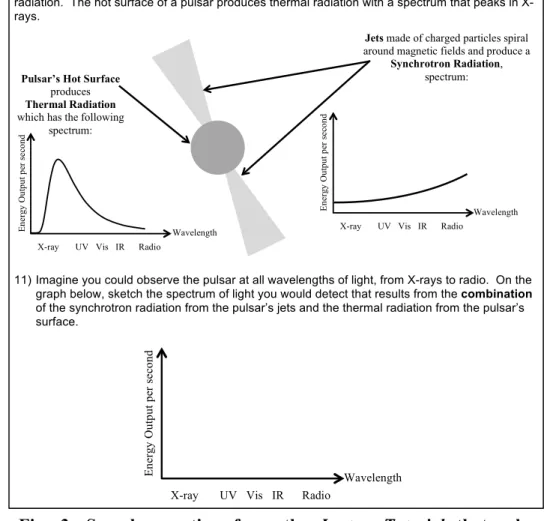
Section II of the new Lecture-Tutorial is devoted to synchrotron radiation. It focuses on helping students understand that synchrotron radiation has a continuous spectrum that is not dependent on temperature (i.e., it is non-thermal). Figure 3 shows a question from this section asking students to sketch a qualitatively correct spectrum for the light produced by a pulsar, whose surface emits a thermal radiation and whose jets emit synchrotron radiation.
[Figure 3 about here.]
[Figure 4 about here.] [Figure 5 about here.]
Assessment
In order to gain insight into the effectiveness of this new Lecture-Tutorial, we created a survey of twelve conceptually challenging questions. These questions probe the same content as the Lecture-Tutorial, although they differ in their context and/or format from the questions asked on the Lecture-Tutorial itself. Figure 6 shows a subset of these questions. The assessment’s face validity and content accuracy were established by the review of content experts in radio astronomy.
[Figure 6 about here.]
We pilot tested this new Lecture-Tutorial with over 1000 students over three semesters at UA and CU-Boulder. Over these three semesters, we designed many different assessment methodologies in order to measure the effects of different implementations of this Lecture-Tutorial.
For this publication, we report the data we gathered from only one of the many methodologies for assessing the efficacy of the Lecture-Tutorial; results from our larger dataset will appear in a future publication. In the spring of 2014, we tested the implementation of Lecture-Tutorial by examining the understandings of a population of students enrolled in two sections of Astro 101 at CU-Boulder. Both sections had similar demographics and distributions of overall grades. The two sections each received a carefully crafted lecture from the same instructor on the relevant astrophysics of each concept before doing the Lecture-Tutorial. One section of this Astro 101 course took the twelve-question assessment before any instruction on the topics of the Lecture-Tutorial
(pre-test). This section of the course also took the twelve-question assessment after the lecture (post-lecture) but before they worked through the Lecture-Tutorial activity
(pre-Lecture-Tutorial). The other section did not take a pre-test but did take the assessment after completing the Lecture-Tutorial activity (post-Lecture-Tutorial); note that the students in this section were also asked two low-level Think-Pair-Share questions during lecture. The pre-Lecture-Tutorial and post-Lecture-Tutorial results from these two Astro 101 sections were each compared to the pre-test results. This research design allows us to isolate the improvement in understanding achieved from lecture alone and compare this result with the amount of gain in understanding achieved when the active engagement Lecture-Tutorial is done in classimmediately following lecture.
conceptual questions used in this study (this is not true for the post-lecture section in our comparison below).
The average correct score for the students post-lecture was 49% (n = 73). The average correct score for the students post-Lecture-Tutorial was 57% (n = 50). These results suggest that a well-focused lecture may indeed help students improve their understanding of these topics (pre- to post-lecture gain of 27%). Additionally, through the implementation of this new Lecture-Tutorial, which takes only fifteen minutes (approximately) of class time, a class may experience an additional increase in understanding of nearly an entire letter grade (post-lecture to post-Lecture-Tutorial gain of 8%). This result is consistent with the gains in students’ understandings on other astrophysics topics achieved by incorporating other Lecture-Tutorials into Astro 101 courses.3 A z-test comparing the post-lecture and post-Lecture-Tutorial means, and a Student’s t-test comparing the post-lecture and post-Lecture-Tutorial distributions both result in p-values of p = 0.06. This suggests that the differences between the post-lecture and post-Lecture-Tutorial populations would be produced by chance only 6% of the time.
Further evidence for the effectiveness of the Lecture-Tutorial can be seen in Figure 7, which shows the percentage of students in both populations in bins based on the percentage correct on the post-test. Note that the post-lecture distribution has a greater concentration of scores at the lower end of the distribution (a range of scores that also happens to include the pre-instruction average) than does the post-Lecture-Tutorial
group. Overall, this analysis suggests that the new Lecture-Tutorial may be effective at moving a subset of students to a higher-level of understanding, which they may not have achieved after lecture alone. This result is consistent with the levels of understanding students have been shown to achieve after completing other Lecture-Tutorials; as noted above, we will continue to investigate the effectiveness of different implementations of this Lecture-Tutorial in future publications.
Availability of the Lecture-Tutorial
Instructors who wish to obtain a copy of the current version of the Lecture-Tutorial, as well as the accompanying lecture slides and Think-Pair-Share (“clicker”) questions that have been developed to support this Lecture-Tutorial, should contact the authors. A copy of the Lecture-Tutorial is also included as an on-line appendix.
Acknowledgements
This work was made possible by the generous support of Associated Universities, Inc. (AUI). We would particularly like to thank Ethan Schreier, John Mester, John Stoke, and Timothy Spuck for their guidance and support. Additionally, we would like to thank Johanna Teske and Jeffrey Eckenrode for their help with the pilot testing and data collection of this curriculum.
References
1T. F. Slater, J. P. Adams, G. Brissenden, and D. Duncan, “What Topics Are Taught in
Introductory Astronomy Courses?” Phys. Teach. 39, 52-55 (Jan. 2001).
2E. E. Prather, T. F. Slater, J. P. Adams, and G. Brissenden, Lecture-Tutorials for
3E. E. Prather, T. F. Slater, J. P. Adams, J. M. Bailey, L. V. Jones, and J. A. Dostal,
“Research on a Lecture-Tutorial Approach to Teaching Introductory Astronomy for Non– Science Majors,” Astron. Educ. Rev. 3, 122-136 (2004); E. E. Prather, and G. Brissenden, “Clickers as Data Gathering Tools and Students’ Attitudes, Motivations, and Beliefs on Their Use in this Application,” Astron. Educ. Rev. 8, 010103 (2009); C. S. Wallace, E. E. Prather, and D. K. Duncan, “A Study of General Education Astronomy Students’ Understandings of Cosmology. Part V. The Effects of a New Suite of Cosmology
Lecture-Tutorials on Students’ Conceptual Knowledge,” Int. J. Sci. Educ. 34, 1297-1314 (2012); M. C. LoPresto, and S. R. Murrell, S.R., “Using the Star Properties Concept Inventory to Compare Instruction with Lecture Tutorials to Traditional Lectures,” Astron. Educ. Rev., 8, 010105 (2009).
4C. Linder, “Disciplinary discourse, representation, and apprensentation in the teaching
Fig. 1. Sample questions from the Lecture-Tutorial that help develop students’ understandings of the emission and absorption of light by molecular vibrations.
Light and Matter
©CENTER FOR ASTRONOMY EDUCATION LECTURE-TUTORIALS FOR INTRODUCTORY ASTRONOMY
1
Part I: Light and Molecules
A molecule can change its vibrational energy state by emitting or absorbing an infrared photon. In each of the four cases shown below (A-D), a molecule is shown transitioning between two different energy states depending on whether the molecule absorbed or emitted a photon.
1) Which of the cases (A-D) shown above correspond with the absorption of light and which correspond with the emission of light? Draw in a squiggly arrow representing a photon with the appropriate direction for each case (A-D).
2) In which case was a photon with the longest wavelength absorbed? Explain your reasoning.
3) In which case was a photon with the greatest energy emitted? Explain your reasoning.
Before A
After
Before B
After
Before C
After
Before D
Fig. 2. Sample questions from the Lecture-Tutorial that help develop students’ understandings of the emission and absorption of light by molecular rotations.
Light and Matter
©CENTER FOR ASTRONOMY EDUCATION LECTURE-TUTORIALS FOR INTRODUCTORY ASTRONOMY
2
A molecule can change its rotational energy state by emitting or absorbing a radio photon. In each of the four cases shown below (A-D), a molecule is shown transitioning between two different energy states depending on whether the molecule absorbed or emitted a photon.
4) Which of the cases (A-D) shown above correspond with the absorption of light and which correspond with the emission of light? Draw in a squiggly arrow representing a photon with the appropriate direction for each case (A-D).
5) In which case was a photon with the shortest wavelength emitted? Explain your reasoning.
6) In which case was a photon with the least energy is absorbed? Explain your reasoning.
7) Complete the sentences in the following paragraph by using the following words/phrases (note that each word/phrase is only used once):
radio visible and ultraviolet
infrared
Because only a small amount of energy is needed to change a molecule’s rotational energy state, the emission and absorption lines produced by rotating molecules are typically at ____________ wavelengths. Making a molecule change vibrational energy states requires slightly more energy, so the emission and absorption lines produced by vibrating molecules are typically at ____________ wavelengths. Making an electron change orbital energy levels in an atom requires even more energy, so the emission and absorption lines produced by electron transitions are typically found at ____________ wavelengths.
Part II: Synchrotron Radiation
When a charged particle (an electron or proton) is forced to spiral around a magnetic filed, the charged particle undergoes an acceleration (because it is constantly changing the direction of its motion) that causes light to be emitted by the charged particle. We call the light that is emitted by
D C
B A
After
Before Before After
After
Fig. 3. Sample question from the Lecture-Tutorial that asks students to reason about a combined thermal and synchrotron spectrum.
Light and Matter
©CENTER FOR ASTRONOMY EDUCATION LECTURE-TUTORIALS FOR INTRODUCTORY ASTRONOMY 4
The figure below shows a pulsar, which is the remnant of a dead massive star. A pulsar has a strong magnetic field, around which jets of charged particles spiral, producing synchrotron radiation. The hot surface of a pulsar produces thermal radiation with a spectrum that peaks in X-rays.
11) Imagine you could observe the pulsar at all wavelengths of light, from X-rays to radio. On the graph below, sketch the spectrum of light you would detect that results from the combination
of the synchrotron radiation from the pulsar’s jets and the thermal radiation from the pulsar’s surface.
12) On the graph you made in Question 11, circle the wavelengths at which you receive more light from the synchrotron radiation from the pulsar’s jets than thermal radiation from the pulsar’s surface. Put a box around the wavelengths at which you receive more light from the thermal radiation from the pulsar’s surface than synchrotron radiation from the pulsar’s jets.
13) Which one type of light is best for observing the pulsar’s synchrotron radiation? Explain your reasoning. ! ! ! ! ! ! ! ! ! ! ! ! ! ! ! ! ! ! ! ! ! ! ! ! ! ! ! ! ! ! ! ! ! ! ! ! ! ! ! ! ! ! ! "#$%&#! '! '$(#&! "#$%&#! "! '$(#&! '$(#&! "#$%&#! )! '$(#&! "#$%&#! *! Hot Surface Thermal Radiation Wavelength En er gy O ut pu t p er se co nd
X-ray UV Vis IR Radio
Jets Synchrotron Radiation Wavelength En er gy O ut pu t p er se co nd
X-ray UV Vis IR Radio ! ! ! ! ! ! ! ! ! ! ! ! ! ! ! ! ! ! ! ! ! ! ! ! ! ! ! ! ! ! ! ! ! ! ! ! ! Before! A! After! Before! B! After! After! Before! C! After! Before! D!
Pulsar’s Hot Surface
produces
Thermal Radiation
which has the following spectrum: Wavelength En er gy O ut pu t p er se co nd
X-ray UV Vis IR Radio
Wavelength En er gy O ut pu t p er se co nd
X-ray UV Vis IR Radio
Jets made of charged particles spiral around magnetic fields and produce a
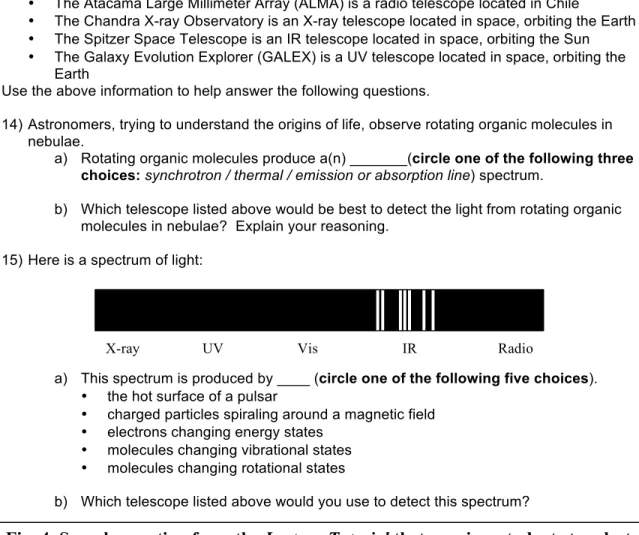
Fig. 4. Sample question from the Lecture-Tutorial that requires students to select the appropriate telescope based on what they have learned from earlier sections of the Lecture-Tutorial.
Light and Matter
©CENTER FOR ASTRONOMY EDUCATION LECTURE-TUTORIALS FOR INTRODUCTORY ASTRONOMY
5
Part III: Real Telescopes and Observations
Here are four real telescopes:
• The Atacama Large Millimeter Array (ALMA) is a radio telescope located in Chile
• The Chandra X-ray Observatory is an X-ray telescope located in space, orbiting the Earth • The Spitzer Space Telescope is an IR telescope located in space, orbiting the Sun • The Galaxy Evolution Explorer (GALEX) is a UV telescope located in space, orbiting the
Earth
Use the above information to help answer the following questions.
14) Astronomers, trying to understand the origins of life, observe rotating organic molecules in nebulae.
a) Rotating organic molecules produce a(n) _______(circle one of the following three choices: synchrotron / thermal / emission or absorption line) spectrum.
b) Which telescope listed above would be best to detect the light from rotating organic molecules in nebulae? Explain your reasoning.
15) Here is a spectrum of light:
a) This spectrum is produced by ____ (circle one of the following five choices).
• the hot surface of a pulsar
• charged particles spiraling around a magnetic field • electrons changing energy states
• molecules changing vibrational states • molecules changing rotational states
b) Which telescope listed above would you use to detect this spectrum?
! ! ! ! ! ! ! ! ! ! ! ! ! ! ! ! ! ! ! ! ! ! ! ! ! ! ! ! ! ! ! ! ! ! ! ! ! ! ! ! ! ! ! ! ! !
3000 K Star
Wavelength
En
er
gy
O
ut
pu
t p
er
s
ec
on
d
X-ray UV Vis IR Radio
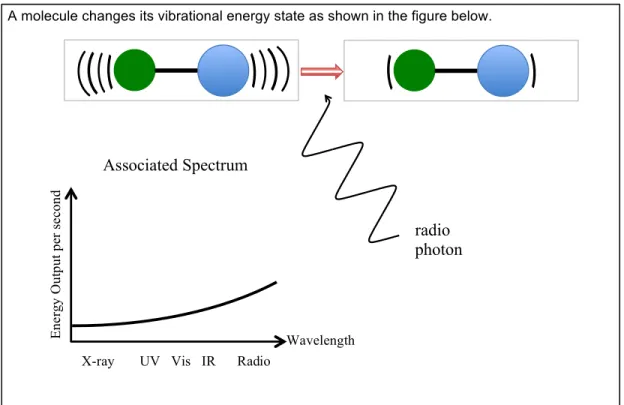
Fig. 5. Sample question from the Lecture-Tutorial that requires students to identify each problem with the above picture.
Light and Matter
©CENTER FOR ASTRONOMY EDUCATION LECTURE-TUTORIALS FOR INTRODUCTORY ASTRONOMY
6
A molecule changes its vibrational energy state as shown in the figure below.
17) Which of the following are represented incorrectly: the direction of the photon, the energy of the photon, and/or the associated spectrum of light? Explain your reasoning.
18) Correct the graphs and drawings in Question 17 to fix all of the errors you identified with the direction of the photon, the energy of the photon, and/or the associated spectrum of light.
! ! ! ! ! ! ! ! ! ! ! ! ! ! ! ! ! ! ! ! ! ! ! ! !! ! ! ! ! ! ! ! ! ! ! ! ! ! ! ! ! ! ! ! ! ! ! ! ! ! ! ! ! ! ! ! ! ! ! ! ! ! ! ! ! ! ! ! ! ! ! ! ! ! ! ! ! ! ! radio photon
Hot Accretion Disk Thermal Radiation Wavelength En er gy O ut pu t p er se co nd
X-ray UV Vis IR Radio
Jets Synchrotron Radiation Wavelength En er gy O ut pu t p er se co nd
X-ray UV Vis IR Radio
! ! ! ! ! ! ! ! ! ! ! ! ! ! ! ! ! ! ! ! ! ! ! ! ! ! ! ! ! ! ! ! ! ! ! ! ! ! ! ! ! ! "#$%&#! '! '$(#&! "#$%&#! "! '$(#&! '$(#&! "#$%&#! )! '$(#&! "#$%&#! *! Hot Surface Thermal Radiation Wavelength En er gy O ut pu t p er se co nd
X-ray UV Vis IR Radio
Jets Synchrotron Radiation Wavelength En er gy O ut pu t p er se co nd
X-ray UV Vis IR Radio
Associated Spectrum ! ! ! ! ! ! ! ! ! ! ! ! ! ! ! ! ! ! ! ! ! ! ! ! ! ! ! ! ! ! ! ! ! ! ! ! ! ! ! ! ! ! "#$%&#! '! '$(#&! "#$%&#! "! '$(#&! '$(#&! "#$%&#! )! '$(#&! "#$%&#! *! Hot Surface Thermal Radiation Wavelength En er gy O ut pu t p er se co nd
X-ray UV Vis IR Radio
Jets Synchrotron Radiation Wavelength En er gy O ut pu t p er se co nd
Fig. 6. Sample questions assessment used to measure the efficacy of the Lecture-Tutorial.
1) Which drawing corresponds to the emission of a photon with the least energy? a. A
b. B c. C d. D
e. There’s not enough information to tell.
2) Which one of the following telescopes would you use if you wanted to detect the greatest amount of radiation by charged particles spiraling around the magnetic field of a black hole?
a. the infrared Spitzer Space Telescope b. the Very Large Array radio telescope c. the Chandra X-ray Observatory d. the GALEX ultraviolet telescope
3) Which of the following describes the most likely change a molecule experiences after it absorbed an infrared photon?
a. The molecule rotates faster b. The molecule rotates slower c. The molecule vibrates faster d. The molecule vibrates slower
Before& A&
After&
Before& B&
After&
After& Before&
C&
After& Before&
Fig. 7. Histograms of the post-lecture and post-Lecture-Tutorial
populations binned by percentage correct on the post-test. 0
5 10 15 20 25 30
0-16% 17-32% 33-49% 50-66% 67-82% 83-100%
P
erc
ent
age
of s
tude
nt
s
Percentage correct