Analysis and Visualization of Local Phylogenetic Structure
within Species
Jeremy R. Wang
A dissertation submitted to the faculty of the University of North Carolina at Chapel Hill in partial fulfillment of the requirements for the degree of Doctor of Philosophy in the Depart-ment of Computer Science.
Chapel Hill 2013
Approved by:
Leonard McMillan
Wei Wang
Fernando Pardo-Manuel de Villena
Gary Churchill
Vladimir Jojic
c
Abstract
JEREMY R. WANG. Analysis and Visualization of Local Phylogenetic Structure within Species.
(Under the direction of Leonard McMillan.)
While it is interesting to examine the evolutionary history and phylogenetic relationship
between species, for example, in a sort of “tree of life”, there is also a great deal to be learned
from examining population structure and relationships within species. A careful
descrip-tion of phylogenetic reladescrip-tionships within species provides insights into causes of phenotypic
variation, including disease susceptibility. The better we are able to understand the patterns
of genotypic variation within species, the better these populations may be used as models to
identify causative variants and possible therapies, for example through targeted genome-wide
association studies (GWAS). My thesis describes a model of local phylogenetic structure,
how it can be effectively derived under various circumstances, and useful applications and
visualizations of this model to aid genetic studies.
I introduce a method for discovering phylogenetic structure among individuals of a
pop-ulation by partitioning the genome into a minimal set of intervals within which there is no
evidence of recombination. I describe two extensions of this basic method. The first allows it
to be applied to heterozygous, in addition to homozygous, genotypes and the second makes
it more robust to errors in the source genotypes.
I demonstrate the predictive power of my local phylogeny model using a novel method
for genome-wide genotype imputation. This imputation method achieves very high accuracy
- on the order of the accuracy rate in the sequencing technology - by imputing genotypes in
Comparative genomic analysis within species can be greatly aided by appropriate
visual-ization and analysis tools. I developed a framework for web-based visualvisual-ization and analysis
of multiple individuals within a species, with my model of local phylogeny providing the
underlying structure. I will describe the utility of these tools and the applications for which
Acknowledgments
I would like to thank my advisor, Leonard McMillan, for his constant support and advice, my
parents for encouraging me in my love and pursuit of computers and education, my brilliant
wife for her love and support, and my twin brother for talking about any and every geeky
thing I came up with, and for reading and helping me revise this document. He hates that
Table of Contents
Abstract. . . iii
List of Figures . . . x
List of Tables . . . xii
1 Introduction . . . 1
1.1 Phylogenetics . . . 1
1.1.1 Thesis Statement . . . 5
1.2 Genetic Structure and Inheritance . . . 6
1.2.1 Genomic Nomenclature . . . 6
1.2.2 Genetic Variation . . . 7
1.3 Compatible Intervals . . . 9
1.4 Imputation using Local Phylogeny . . . 11
1.5 Visualization of genomic structure . . . 12
1.6 Conclusions . . . 13
2 Compatible Intervals . . . 15
2.1 Introduction . . . 15
2.2 Related Work . . . 18
2.3 Definitions . . . 20
2.4 A Lower Bound . . . 26
2.4.1 LR and RL Covers . . . 26
2.4.2 Properties ofCLRandCRL . . . 30
2.5 Max-k Interval Set . . . 33
2.5.1 Finding the Maximal-k-cover . . . 36
2.5.2 Critical SNPs . . . 37
2.6 Genotypes . . . 38
2.6.1 Relating Genotype and Haplotype Covers . . . 39
2.6.2 Achieving Genotype Covers by Phasing . . . 40
2.7 Experiments and Results . . . 41
2.7.1 Run-times . . . 44
2.7.2 Interval and Core Statistics . . . 44
2.8 Conclusion . . . 47
3 Imputation using Local Phylogeny . . . 49
3.1 Genome Imputation . . . 50
3.2 Materials and Methods . . . 52
3.2.1 MDA genotype data . . . 52
3.2.2 C57BL/6J reference genome . . . 53
3.2.3 Wellcome Trust/Sanger Institute genotype data . . . 53
3.2.4 LG/J and SM/J validation genotypes . . . 54
3.3 Imputation Method . . . 55
3.3.1 Validation . . . 59
3.4 Results and Discussion . . . 59
3.5 Conclusion . . . 66
4.1 Classical Genome Browsers . . . 72
4.2 Browser Design . . . 76
4.2.1 Navigation . . . 78
4.2.2 Multiscale Visualization . . . 82
4.2.3 Use of Color . . . 82
4.3 Browser Implementation . . . 84
4.4 Browser Usage . . . 86
4.5 Conclusion . . . 92
5 More Robust Compatible Intervals . . . 94
5.1 Introduction . . . 94
5.2 Effects of Genotyping Error and Homoplasy . . . 96
5.3 Background . . . 100
5.4 Method . . . 101
5.4.1 Minimum Vertex Cover Solution . . . 102
5.4.2 RrCovers . . . 102
5.4.3 Complexity . . . 104
5.5 Results . . . 105
5.5.1 Simulation . . . 105
5.5.2 Imputation of real data . . . 107
5.5.3 Implications about Genotyping Error and Homoplasy . . . 112
5.6 Discussion and Conclusion . . . 115
6 Discussion and Conclusion . . . 117
6.1 Applications of Local Phylogeny . . . 118
6.1.1 Improving Imputation . . . 120
6.3 Conclusion . . . 124
Appendix A Compatible Intervals Code . . . 125
List of Figures
1.1 Tree of life . . . 2
1.2 Murinae phylogenetic tree . . . 3
1.3 Neighbor-joining tree of laboratory mice . . . 4
1.4 Genomic chromosome structure . . . 7
1.5 Reduction of DNA sequences to binary SNPs . . . 8
2.1 CU ber covers . . . 22
2.2 CU ber cores and flagging SNPs . . . 24
2.3 Construction of perfect phylogeny and neighbor-joining trees. . . 27
2.4 Relationship betweenCLR,CRL, andCM ax . . . 29
2.5 Illustration of proofs . . . 34
2.6 Construction ofCM ax . . . 35
2.7 Distribution of cover sizes over genotypes . . . 40
2.8 Interval cover run times . . . 43
2.9 Interval sizes for the CEU population . . . 45
2.10 Max-k run times and statistics . . . 46
3.1 Imputation strain sets . . . 54
3.2 Imputation workflow . . . 56
3.3 Phylogenetic tree construction . . . 57
3.4 Examples of imputation confidence . . . 58
3.5 Leaf/haplotype sharing matrix . . . 64
4.1 Visualization overview . . . 77
4.3 Subspecific origin and haplotype diversity . . . 80
4.4 Highlight and zoom functionality . . . 80
4.5 Closeup feature selection . . . 81
4.6 Closeup of SNPs and genotypes . . . 83
4.7 Haplotype block mosaic . . . 84
4.8 Haplotype sorting . . . 85
4.9 Subspecific origin with diagnostic SNPs . . . 88
4.10 Heterozygosity track . . . 89
4.11 Compatible interval tracks . . . 90
4.12 Identity by descent track . . . 90
4.13 Intervals, haplotypes, and a tree . . . 92
5.1 Interval detection growth . . . 97
5.2 Simulated interval detection growth . . . 98
5.3 Interval detection by error rate . . . 98
5.4 Multiple least-squares fit of Sanger intervals . . . 99
5.5 SimulatedR5 CM ax−k relaxation . . . 104
5.6 Interval Set Overlap . . . 107
5.7 Rrconcordance results . . . 108
5.8 Accuracy ofRrCM ax in simulation . . . 109
5.9 Real Example ofR5CM ax−krelaxation . . . 110
5.10 Transitions and Transversions . . . 113
5.11 Interval growth rate for transitions and transversions . . . 114
List of Tables
1.1 Definition of terms . . . 6
3.1 Imputation confidence in 88 strains . . . 69
3.2 Error in leave-one-out imputation . . . 69
3.3 Imputation accuracy of LG/J and SM/J . . . 69
3.4 Imputation method comparison . . . 70
3.5 Strains contributing unrepresented haplotypes . . . 70
3.6 Strains with the highest variation . . . 70
5.1 Imputation results usingRrCM ax−k . . . 111
Chapter 1
Introduction
Phylogenies describe the genetic relationships between species or individuals. Inferring these
relationships helps us better understand genetic similarities and differences which may drive
phenotypic variation and describe the organism’s history. Inter-species phylogenies -
evo-lutionary trees - describe the derivation of genomes between species. Intra-species
phy-logenetic structure describes the more complex multiple-inheritance relationships between
individuals in an interbreeding population.
Genomic structure can be represented, at a high level, as a mosaic of ancestral genomes.
This representation simplifies genome-wide analyses and is more robust than typical analyses
based on point markers. Relationships between individuals can be used to assess
genome-wide associations. I will first discuss phylogenetics and how my approach is related to
higher-level genomic structure. I will then define the genomic features and events forming the basis
for my model of local phylogenetic structure.
1.1
Phylogenetics
The study of phylogenetics aims to describe the relationships between phyla, species, or
individuals by their shared genetic material. Phylogenetics has been a major area of study
evolutionary tree of life, with branches implying division between entire groups of organisms.
In a phylogeny among species, these branches indicate “speciation” events where a species
diverged to evolve into two or more different species. Species do not interbreed, so there is
no recombination between their genomes. Figure 1.1 shows an evolutionary tree describing
the phylogenetic structure of a large portion of life on earth.
Figure 1.1: A phylogenetic tree indicating the evolutionary descent of organisms, including the top two taxonomic levels: Domain, including Eukaryotes (red), Bacteria (green), and Archaea (blue), and Kingdom, the most familiar of which will be Animals, Plants, and Fungi. This type of phylogenetic tree is rooted in the center with time progressing outward. Branches indicate the point at which groups diverged, those closer to the outside of the circle indicating more recent developments (on an evolutionary time scale). Viridae not shown. Credit Wikimedia Commons (http://commons.wikimedia.org).
Although there is considerable disagreement among biologists about the appropriate
tax-onomic levels and classifications, the schema for representing phylogenetic structure as an
evolutionary tree down to the level of species or subspecies is widely agreed-upon [93].
The input data used initially were macroscopic or microscopic characteristics (e.g.,
DNA-based phylogenies became feasible beginning with one or a few genetic markers, and
currently based on hundreds of thousands of genetic markers or full genome sequence.
Al-though the methods I will describe are general, the applications and experimental results have
focused on the laboratory mouse. Figure 1.2 shows a phylogenetic tree of a subset of the
sub-family Murinae (sub-family Muridae) including the speciesMus musculus(the house mouse) and
five known subspecies. It is at this point that we start to see a breakdown of the standard form
of evolutionary trees. Mus musculus molossinusis generally considered a hybrid of M. m.
castaneusandM. m. musculus, and thus not the result of a simple speciation event. As we
begin to consider the phylogenetic structure within species, subspecies, and populations, this
global depiction of phylogeny breaks down.
Figure 1.2: Phylogenetic tree of a subset of the subfamily Murinae (family Muridae) including the species
Phylogenetic analyses among closely related species or individuals are often determined
by some measure of global genetic similarity. For example, we can line up the genetic
se-quence of two individuals and compare them base-by-base, computing percent identity.
Us-ing a sample (individual) from each of several strains (for our purposes right now, consider
these isolated subpopulations) of common laboratory mice, we can do this kind of
compari-son then construct a phylogenetic tree by recursively merging the “nearest neighbor” - the two
strains with the highest percent identity (this is called neighbor-joining). Figure 1.3 depicts
this type of tree. While this kind and construction of tree is not strictly an evolutionary tree, it
somehow represents a phylogenetic relationship [66]. This is especially true of the placement
of SPRET, CAST, and PWK. These strains are known to predominantly representMus
spre-tus(a different but closely related species), Mus musculus castaneus, andM. m. musculus,
respectively, while the remainder of the strains are predominantly M. m. domesticus. The
tree in Figure 1.3 accurately reflects these species and subspecific divisions.
In the case of species, this general approach to phylogenetics is appropriate and effective,
mainly based on the constraint that individuals of different species cannot typically interbreed
to produce fertile offspring. The first violation can be seen at the subspecies level. Mus
musculus molossinus introduces an atypical feature into our tree because it is thought to
be a hybrid ofM. m. musculusandM. m. castaneus. In order to consider the phylogenetic
relationships within a species, subspecies, or population, one must allow for the possibility of
interbreeding. Within an interbreeding population, an individual inherits from both parents.
When we attempt to model this, we cannot construct a simple bifurcating tree as we have
done so far. What we end up with is a web of inheritance relationships. I will discuss the
factors affecting genomic inheritance within species and how I derive the local phylogeny
structure under these conditions.
1.1.1
Thesis Statement
I introduce methods for efficiently and accurately identifying compatible genomic intervals
describing local phylogenetic structure within species. These intervals represent unique local
phylogenetic trees. I show how these intervals can be used to perform accurate
genome-wide imputation and to inform genome-genome-wide association studies. I describe the design and
utility of visualization tools using local phylogenetic structure to allow effective and novel
comparative analyses between individuals. Lastly, I introduce an extension of my model of
Allele One of two or more alternative forms of a gene that arise by mu-tation and are found at the same place on a chromosome
Base-pair (bp) A pair of complementary bases in a double-stranded nucleic acid molecule
Chromosome The distinct molecular units containing all or most of the genetic material of cellular organisms
Diploid Having two sets of homologous chromosomes
Genome The genetic material of an organism
Genotype The genetic constitution of an individual organism
Haploid Having one set of distinct chromosomes, often one of each pair of homologous chromosomes
Haplotype A group of alleles of different genes on a single chromosome Heterozygous Having dissimilar alleles at corresponding chromosomal loci Homozygous Having identical alleles at corresponding chromosomal loci Phylogenetics The study of evolutionary relatedness among groups of
organ-isms
Recombination The rearrangement of genetic material, esp. by crossing over in chromosomes
Single-Nucleotide Polymorphism (SNP)
Genetic variation in DNA where a single nucleotide is altered
Table 1.1: Definition of terms
1.2
Genetic Structure and Inheritance
1.2.1
Genomic Nomenclature
I will introduce a general notion of genetic structure, inheritance, and phenomena which
affect them as it pertains to intraspecific phylogenetic structure. The mouse genome is
ap-proximately 2.5 billion base-pairs long. Each base on the primary strand consists of a single
nucleotide, of which there are four possible choices, adenine (A), cytosine (C), guanine (G),
or thymine (T). Within a species, only a very small fraction of base-pairs vary between
in-dividuals. We call these single-nucleotide polymorphisms, or SNPs. These and other
com-monly used genomic terms are defined in Table 1.1.
Genetic information is broken into separate functional units called chromosomes. Every
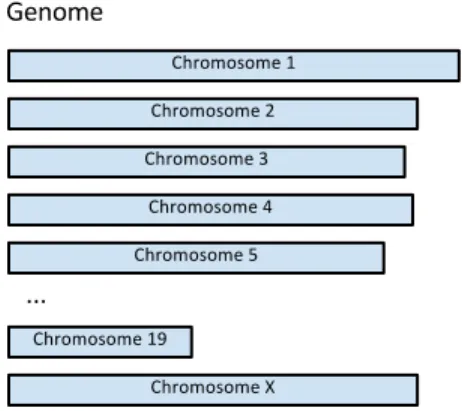
Figure 1.4:The genome is broken into blocks called chromosomes, each of which has two copies.
inherited from each parent. In mice, there are 20 pairs of chromosomes; 19 of them,
num-bered 1-19, are called autosomes and the last pair are the sex chromosomes, labeled X and Y
(see Figure 1.4). As with humans, females have an XX pair and males have an XY pair. The
collection of chromosomes makes up the genome of an individual. In naturally occurring
sexually-reproducing populations, the two copies of each chromosome are different. One is
transmitted from the mother and the other from the father.
1.2.2
Genetic Variation
One of the primary sources of genetic variation in sexually-reproducing species is mutation
(see Table 1.1). Because mutation is very rare [53], I will make a common simplifying
assumption known as the infinite-sites model [48]. This model states that mutation is
suffi-ciently rare and the genome suffisuffi-ciently long that no single position is likely to ever mutate
more than once. I will evaluate the impact of this assumption and propose a relaxation in
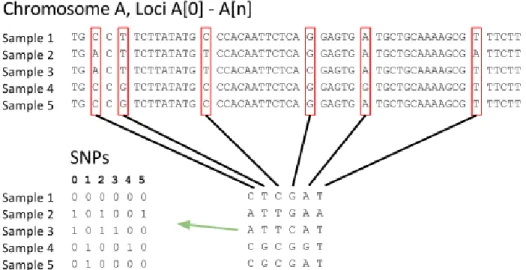
Chapter 5. Under this assumption, no SNP may include more than two alleles. As a result,
I will frequently simplify the representation of a haplotype to include binary alleles, ‘0’ and
‘1’, ‘0’ indicating the majority allele and ‘1’ representing the minority allele or nucleic acid
(see Figure 1.5). The infinite-sites model does not preclude the existence of heterozygosity,
‘1’. Violations of the infinite-sites model, where there have been multiple mutations at a
single base position, are called homoplasy events. In Chapter 2, I will take further advantage
of the infinite-sites model to make inferences about phylogenetic structure. We also often
ignore everything but SNPs - that is, ignore all non-variable base-pairs - when comparing
individuals.
Figure 1.5:Reduction of genome sequences to binary single-nucleotide polymorphisms (SNPs). Most loci in the genome do not vary among individuals of the same species. Those which vary (are polymorphic), are called SNPs. Under the infinite-sites model, each SNP in a haplotype may have only two states, so we represent the majority allele with a ‘0’ and the minority with a ‘1’.
A much more common event introducing genetic variation is recombination.
Recom-bination is often the result of crossing-over during the formation of haploid reproductive
cells. If we have two chromosomes A and B, with nucleotides[A0. . . An]and[B0. . . Bn], a
recombination at locusrwould result in [A0. . . ArBr+1. . . Bn]and[B0. . . BrAr+1. . . An].
Recombinations are the major driving force for mixing heterozygous genotypes during
in-heritance. Recombination events cannot be represented in a simple bifurcating evolutionary
tree since the resulting individual consists, in some part, of both parents’ genotypes.
regions of the genome show no evidence of historical recombination among a set of
indi-viduals in a species. A set of genotypes admits a ”perfect” phylogeny if a binary tree can
be unambiguously constructed such that each branch represents a single SDP without
ho-moplays. Since we can construct a perfect phylogenetic tree within these intervals, we can
accurately describe the inheritance relationships within small segments of the genome, if not
genome-wide. I demonstrate the utility and biological significance of these intervals along
with useful visualization and analysis tools.
1.3
Compatible Intervals
In Chapter 2, I describe a method by which a set of genomes can be partitioned such that
there is no evidence of historical recombination within each block, that is, they admit a
perfect phylogeny. Although the discovery of perfect phylogenies is not new [71], I introduce
an efficient method which defines an interval set with several desirable properties. This
algorithm constructs an unambiguous set of intervals which is the smallest set necessary to
cover the genome while each interval is maximal in size, called a Maximal-k-cover, or
Max-k intervals. This set provides us with greater power to describe the phylogenetic structure
within these intervals and identify likely inheritance relationships.
To identify regions with no evidence of recombination, I use a method call the
four-gamete test (FGT) [40]. The four-four-gamete test states that, under the infinite-sites model, a pair
of SNPs which are not separated by a recombination breakpoint should exhibit no more than
three of the four possible allele pairs (gametes) among all samples. For example, if we have
two SNP lociA and B, some number of samplesn, where Ai andBi represent the binary
them “compatible” with the same phylogeny. We can compute a pairwise matrix of
four-gamete compatibility among all SNPs. Violations of the four-four-gamete rule imply a
recombi-nation or homoplasy event.
I describe the basic method - and computational complexity - for computing
compati-ble intervals that can be applied to haplotype data. Haplotypes may be derived either from
homozygous genotypes or heterozygous genotypes in which the component haplotypes are
separated into distinct sequences - a procedure known as phasing. Many genotyping
tech-nologies, like the probe-hybridization microarrays used to generate the SNP data on which
I demonstrate my method, cannot of themselves distinguish between the two copies of a
chromosome. This results in heterozygous loci, ‘H’, where the two copies do not have the
same allele, and it is unknown which haplotype (mother’s copy or father’s copy) contains
which allele. Phasing methods attempt to infer the correct assignment of alleles to the
ap-propriate haplotype, often by evaluating the co-occurrence statistics of nearby alleles within
a population. Phasing methods may result in the two chromosome copies which are likely
contributing to the genotype. In inbred mouse strains, this is often not a problem because
the inbreeding has led to chromosomes which are nearly identical and there is no ambiguity.
In other populations and species of interest, most notably humans, inbred genotypes are not
available. To sidestep the often inaccurate process of phasing, I developed an extension of the
four-gamete test which takes into account heterozygous ‘H’ calls. Due to the inherent
ambi-guity, I construct two sets of intervals depending on whether we take the optimistic view that
all possibly compatible SNP pairs are probably compatible, or the pessimistic view where we
consider all potentially compatible pairs incompatible.
Chapter 5 further extends this model to include a relaxation of the four-gamete rule which
helps reduce the effect of the real-world complication of erroneous input genotypes. An
ap-plication of my compatible intervals model used a probe-hybridization microarray, the Mouse
represent much of the diversity among classical laboratory mice [97]. This data allows us to
distinguish differences in this mouse population and predict the local phylogenetic structure.
However, with only half a million SNPs, there is an average genotype resolution of only one
SNP every 5,000 bases (5 kb). I can harness a large collection of additional genotype data
representing different technologies and analyses to improve the precision and accuracy of
my phylogeny model. Specifically, I discuss the inclusion of SNPs derived from paired-end
high-throughput short-read sequencing, or next-generation sequencing. These data provide a
far greater density of genotype data than do microarrays. However, misalignments of short
reads, homologous sequences, contamination, and sequencing error can all contribute to
inac-curacies in these data. To include high-throughput sequence and other genotype information
into my model, I introduce a relaxation of the four-gamete rule and the compatible intervals
model that allows for a small fraction of violations (incompatibilities) to be overlooked as
probable errors. Recombination produces an incompatibility signature distinctly different
from other types of error, which my relaxed model is tuned to ignore.
1.4
Imputation using Local Phylogeny
DNA microarrays are an established technology for querying a genome for specific
subse-quences. They are especially effective for detecting the alleles of known single-nucleotide
polymorphisms (SNPs). I describe a method to impute missing SNPs or other features using
the inferred local phylogeny structure derived from microarray-based SNP data over a large
set of individuals of a species. One can treat compatible intervals as regions of shared
ances-tral haplotypes, and their observed variants as alleles. I identified haplotype regions shared
among classical laboratory mouse strains. The collection of haplotypes within an identified
degree than is possible with individual SNPs. Others have previously used blocks of
contigu-ous SNPs as haplotypes to group samples locally [70]. The strength of our partitioning into
haplotypes is that it is always consistent with a phylogenetic tree.
Haplotype structure can be used to accurately impute missing genotypes among closely
related laboratory mouse strains [86]. I can confidently identify shared haplotype blocks
among related individuals using a relatively low-density set of loci. This allows us to reliably
predict that all intervening features are shared. I imputed 88 classical laboratory strains using
this method and have shown that these imputed genotypes are more accurate than alternative
imputation methods and exhibit an error rate approaching that of the sequencing technology
itself.
1.5
Visualization of genomic structure
Visualization is essential to understanding of the structure and function of genomes.
Genome-wide association relies on comparative analysis of closely related strains or individuals to
determine the relationship between genotype and phenotype. Such analyses are informed
by local haplotypes and phylogenetic structure. I have developed interactive visualization
tools particularly well-suited for comparative analysis of genomic structure [87, 88]. These
tools display SNPs, shared haplotype blocks, and subspecific origin over multiple collinear
genomes, highlighting similarities and differences across the genome.
While existing genome browsers provide an effective interface to analyze genotype
infor-mation and annotation for individuals, they lack the ability to visualize and analyze collinear
genomes in an informative way. The framework I have developed supports the
simultane-ous visualization of multiple collinear genomes (for example, a variety of laboratory msimultane-ouse
strains). I introduce tools to support dynamic interaction and automatic comparison tools
such that we can use regions of local phylogeny to compare samples based on their local
inheritance structure. This type of interaction makes the phylogeny browser an excellent tool
for analyses such as GWAS in which one would like to discover the relationship between
regions of shared inherited genotypes and the phenotypes of a study sample.
My genome browser is provided as a web-based service, taking advantage of client-side
as well as server-side computation to provide an interactive and widely accessible interface
to this tool. Two instances of my browser have been deployed, one exposing the subspecific
and phylogenetic structure of a large set of classical laboratory mice, the other describing
the structure of the emerging Collaborative Cross [12] population including how the
popula-tion has been derived from eight “founder” strains. These resources have seen effective and
widespread use since their introduction.
1.6
Conclusions
In this thesis, I will describe my development of effective methods for decomposing genomes
into meaningful blocks, referred to as compatible intervals, and placing them within the
context of a local phylogeny. The point at which my approach departs from the classical
model of evolution is that it attempts to infer the history for genomic segments rather than
for an entire organism. The advantage of this approach is that it decouples genomic changes
brought on by recombination from those originating from mutations. In Chapter 2, I describe
my method for efficiently computing compatible intervals which are maximally informative
over both haplotype and genotype data. In Chapter 3, I describe a method for genome-wide
imputation using local phylogenetic structure and show that this method achieves a very high
accuracy. I introduce a visualization tool in Chapter 4 which allows comparative analysis of
multiple individuals within a species based on their local phylogenetic structure. Chapter 5
data with a higher rate of error. Finally, Chapter 6 discusses additional applications of my
Chapter 2
Compatible Intervals
I present methods for partitioning a genome into blocks within which there are no apparent
recombinations. This provides parsimonious sets of compatible genome intervals based on
the four-gamete test. My contribution is a thorough analysis of the problem of dividing a
genome into compatible intervals, its computational complexity, and an achievable
lower-bound on the number of intervals required to cover an entire genome [85]. In general, such
minimal interval sets are not unique. However, I identify properties that are common to every
possible solution. I also define the notion of an interval set that achieves the interval
lower-bound, yet maximizes interval overlap. I demonstrate algorithms for partitioning haploid
data, such as that derived from inbred mice. I will then describe how I extend this method to
outbred, heterozygous genotype data using a modification of the standard four-gamete test.
These methods allow our algorithms to be applied to a wide range of genomic data sets.
2.1
Introduction
The local block structure of genotypes within a population sheds light on many biological
questions [19]. Genotype blocks are central to quantifying and localizing recombinations
(both recent and historical) [76, 75, 89], are widely used to identify informative marker sets
also underlies many genome-wide association methods [100], provides evidence for selection
[32], and offers a tool for ascertaining ancestral origins [18].
The task of decomposing a genome into meaningful blocks, however, has proven to be
ill-defined, inconsistent, and often ambiguous [64, 70]. In part, the problem is due to the ad
hoc definition of what constitutes a genotype block. Genotype blocks are often defined to
serve a specific purpose. Examples include the minimum number of tagging SNPs sufficient
to capture informative genotypes [65, 101], intervals of SNPs that exceed a given threshold
of Linkage Disequilibrium (LD) [68], and maximal regions whose genotype diversity falls
below a threshold [19]. Partitioning genotypes into blocks supporting perfect phylogenies
[76, 31] and, similarly, the selection of blocks lacking evidence for recombination [91] are
also used to construct Ancestral Recombination Graphs (ARGs).
I propose unambiguous definitions for haplotype and genotype blocks and efficient
meth-ods for computing them. Where ambiguity is unavoidable, I provide properties common to
all solutions. My haplotype-block definition directly supports, and has been used for,
asso-ciation mapping [63], construction of genetic maps [103], and determining ancestral origins
within local genomic regions [104]. My proposed genotype blocks can be used in much the
same way.
Dense genotype data sets that are homozygous at every allele are readily available for
many inbred mammal [28] and plant [13, 60] models commonly used for association
map-ping. However, haplotype data is not directly available for use in human studies. Using my
approach, it is unnecessary to phase such data sets. I show how, using heterozygous
geno-types, blocks can be identified for exploring the local phylogenetic structures [8, 46, 59, 61]
and ancestral origins [99]. Like others [31, 91, 89], my blocks are chosen for their lack of
historical recombination evidence.
My methods can be used as an alternative to other block methods such as those in
phasing [47] and feasibly extend these methods to be applicable to unphased genotype data.
Block association methods such as Blossoc [57] and QBlossoc [6], which utilize small
re-gions that admit perfect phylogenies, could potentially benefit from my methods to compute
regional perfect phylogenies rather than single-marker phylogenies. These tools could also
be extended to unphased genotype data rather than exclusively haplotype data.
I define blocks in terms of SNP compatibility according to the four-gamete test (FGT)
[40]. The FGT is of interest because of its close relation to perfect phylogeny [44].
Specif-ically, a necessary and sufficient condition for a perfect phylogeny is that all pairs of SNPs
satisfy the FGT [37]. For unphased genotype data, I further define the notion of optimistic
and pessimistic compatibility based on if a region ispossiblyornecessarilypasses the FGT. I
partition the genome into a set of potentially overlapping maximal compatible intervals, each
of which admits a perfect phylogeny, and whose union covers the full data set. I address the
question of what is the fewest number of such intervals required and identify suspect SNPs
whose removal reduces the overall complexity of the block structure (perhaps indicating
genotyping errors, homoplasy, or gene conversions).
My contribution is an analysis of the problem of dividing a genome into compatible
intervals based on genotypes and its complexity. I provide an achievable lower-bound on the
number of such intervals. While in general there are numerous ways of dividing a genome
into a minimum number of compatible intervals (a fact overlooked by others [57, 89, 92]),
I also identify non-overlapping core subintervals common to all valid solutions. I define
an interval set that achieves the interval lower-bound, yet maximizes the overlap between
adjacent intervals, thus minimizing the number of perfect phylogeny trees, while providing
2.2
Related Work
There are three common approaches for partitioning haplotypes into blocks. The first
em-ploys LD measures [30, 68] and assigns blocks to regions with high pairwise LD within,
and low LD between, blocks. A second class assigns blocks to regions of low sequence
di-versity [65]. Lastly, there are approaches that look for direct evidence of recombination, by
either applying the FGT [40] and defining blocks as regions free of apparent recombination
or homoplasy, or during the construction of ARGs, denoting supporting regions’ component
subtrees [76]. Schwartz et al. [70] performed an analysis of approaches and concluded that
the block assignments of various methods differed markedly. Of these methods, the block
boundaries of the FGT were better correlated to both the LD and diversity-based methods
than these two methods were to each other.
My approach partitions the genome into blocks satisfying the FGT. This is not new. The
seminal work of Hudson and Kaplan [40] provides a sketch of a greedy algorithm that
pro-cesses SNPs in sequence order looking for runs of compatible intervals that are broken at
points of incompatibility. This method is widely used [57, 70, 89, 92]. A disconcerting
fea-ture of this approach is that one arrives at a different interval set if the genome is scanned
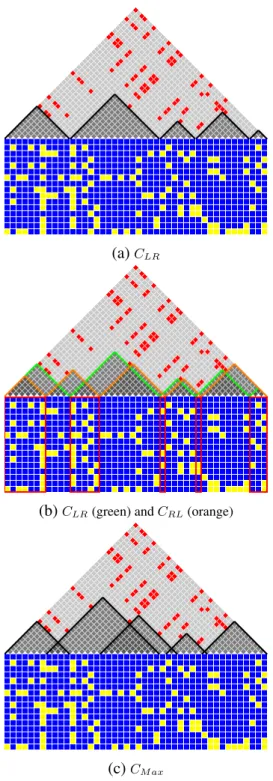
in the reverse order (Figure 2.4b). Alternative sets of compatibility intervals arise when the
region is grown maximally around each SNP [57]. Moreover, there appear to be many other
possible partitions, begging the question of which block sets have the fewest intervals, and,
of these sets, which minimizes haplotype diversity. In my model, each block is compatible
with a perfect phylogeny (a side effect of the FGT) and overlaps between adjacent intervals
are allowed.
I extend these basic methods to unphased genotype data. Modern genotyping
technolo-gies often cannot distinguish between alleles in the genotypes of diploid individuals. There
these methods introduce significant inaccuracy [47]. Little work has been done on
partition-ing genotype data without first phaspartition-ing; however, there has been considerable work on the
related topic of phasing by perfect phylogeny [3, 10, 26, 34, 22]. Such methods determine
if a given genotype block admits a perfect phylogeny. My contribution is to apply the basic
insights of these methods to extend the notion of a haplotype “scan” to the genotype case.
Similar work has been done [23] in which local phylogenies are built over unphased
geno-type data to inform association mapping; however, this work does not take full advantage of
compatible blocks, employing a single-marker approach rather than a global block structure.
Past attempts at using perfect phylogeny to analyze genotypes assume they are given a
region which admits a perfect phylogeny or does so within an error model. Most previous
work ([22, 34, 26, 77, 3]) determines if the given set of genotypes does in fact admit a perfect
phylogeny, and then solves the Perfect Phylogeny Haplotyping problem (PPH) [34]. In this
context, “haplotyping” refers to phasing - determining the component haplotypes from a
genotype. Recent extensions allow data to fall within some error model and handle cases
where the data does not fit a perfect phylogeny. Error models include Missing Data (MD)
and Character-Removal (CR), and the algorithms attain a global perfect phylogeny while
dealing with erroneous point cases ([37, 35]).
No previous approach considers the possibility of different PPH solutions as determined
by the choice of block partition. While I do not propose haplotyping by perfect phylogeny,
I use related techniques to partition the genome into blocks which satisfy a perfect
phy-logeny that could, in practice, then be haplotyped using any one of several previous
algo-rithms. Introducing a genome-wide approach to perfect phylogeny rather than filtering out
data as in [37, 35] considers many biological factors previously overlooked. The notion of
recombination-free blocks in the genome is well-documented in humans and mice, as well
of a recombination point should realistically admit different phylogenies based on
hybridiza-tion between subspecies. Simply removing presumed erroneous data and forcing regions
separated by historical recombination into a global phylogeny ignores their biological
rele-vance and produces a misleading solution. My method of partitioning allows for biologically
meaningful, though limited, regions with which to perform further analyses.
2.3
Definitions
Throughout this discussion, we assume a data set of M SNPs spanning N haplotypes (or
genotypes) that are represented as either a binary data matrixS or a ternary matrixSgwhere
each column corresponds to a SNP, and each row is a haplotype or genotype (Figure 2.1).
Alleles 0 and 1 represent alternative homozygous alleles and 2 represents heterozygous
alle-les.
A compatible interval over a set of haplotypes is a sequence of contiguous SNPs over
S for which there are no violations of the FGT between any SNP pair. A compatible
inter-val, Ix = [bx, ex], includes all SNPs between the beginning SNP sbx and ending SNP, sex.
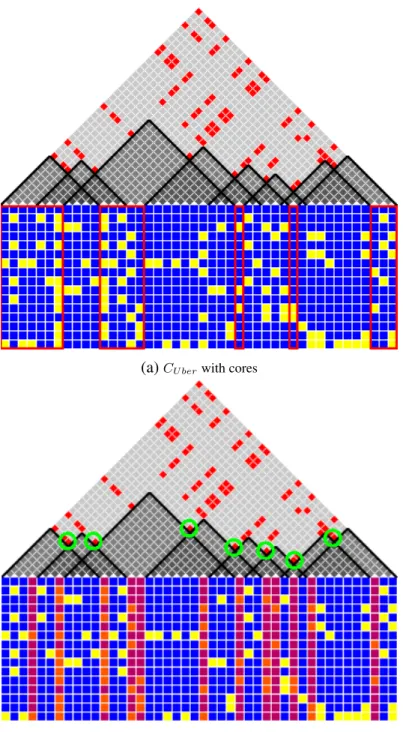
Figure 2.1a shows a data set of 16 haplotypes and 44 SNPs, together with eight compatible
intervals,{I1. . . I8}. Each interval covers a consecutive set of SNPs. For example,I3covers
from s8 to s26. The triangular matrix above the SNP matrix is the pairwise compatibility
matrix. If two SNPs exhibit four gametes, the corresponding matrix element is marked
in-compatible (red). Darkened triangles indicate sub-matrices corresponding to SNP pairs in
the compatible intervals{I1. . . I8}. Note that no triangles enclose red elements.
Compatible intervals over genotypesSgare less straightforward due to ambiguities caused
by heterozygous alleles. I define the notion of optimistic and pessimistic compatibility,
whether genotypes are possibly or necessarily compatible, respectively. Resolving genotype
to determine which gametes phasing could produce. In cases of homozygous-homozygous
and homozygous-heterozygous pairs, the possible gametes are trivially determined. For
ex-ample, the 0-0 produces the 0-0 gamete and 0-2 produces the 0-0 and 0-1 gametes. Ambiguity
is caused only by the 2-2 case - when there exist heterozygous alleles in the same sample at
two different loci. These cases can produce two different sets of gametes, either 0-0 and 1-1,
which we callconsistentgametes, or 0-1 and 1-0, which we callinconsistent gametes. The
compatibility between 2-2 pairings can be categorized in three ways according to the
restric-tions necessary to make them compatible. If one of the 0-1 or 1-0 gametes are not present, all
pairs must beconsistent. If one of the 0-0 or 1-1 gametes are not present, all pairs must be
in-consistent. If there are no other gametes present, all 2-2 pairs must simply produce the same
set of gametes since it is always possible to produce four gametes with opposite phasings of
two 2-2 pairs. These three states are indicated by green, orange, and blue, respectively, in the
compatibility matrix (Figure 2.1b).
The optimistic algorithm forms a graph with a vertex representing each locus and an edge
representing the relative phasing (consistent, inconsistent, or ambiguous) between two
ver-tices. An interval is optimistically compatible iff there exists a bipartition of the graph into
two sets A and B such that no edge within A isinconsistent, no edge within B isinconsistent,
no edge between sets A and B isconsistent, and all ambiguous edges are uniquely resolvable
to as either in phase or out of phase. We use an algorithm similar to [26] to partition the
genome into blocks of genotypes which admit a perfect phylogeny. Similar to the haplotype
“scan”, we introduce SNPs one-by-one and test whether the resulting interval is internally
compatible. For haplotypes, this is accomplished by pairwise comparisons of previous SNPs
with every newly introduced SNP. For the genotype case, we define two interval types. For
optimisticintervals, we use the idea of what Eskin et al. [26] refer to asequalandunequal
resolution to create a bipartite graph for each proposed interval. We “scan” SNPs as
(a)CU bercover over haplotypes
(b)CU bercover over diploid genotypes
longer realizable, thus ending an interval. Pessimisticintervals are unambiguously
compati-ble regardless of the choice of haplotype phasing. When the scan is performed, an interval is
ended as soon as it reaches a SNP which is possibly incompatible with any previous SNP in
the interval. This is equivalent to considering all non-gray points as incompatible (red) and
performing a haplotype scan to produce the pessimistic genotype intervals.
Figure 2.1b shows a data set of eight genotypes and 44 SNPs, together with four of its
optimistic compatible intervals. It remains true that no interval may enclose an incompatible
SNP pair. However, unlike the haplotype case, intervals are not necessarily bounded by red
elements. As described, SNPs may be implicitly incompatible with a given interval if their
addition forms an unrealizable graph.
A compatible interval is maximal if it cannot be extended in either direction. All intervals
in Figure 2.1a (I1,I2,I3,I4,I5,I6,I7, andI8) are maximal, since further extension includes
one or more incompatible SNP pairs. We denote the set of all maximal compatible intervals
asCU ber. Throughout, we will denote a cover over a genome generically byC. A cover of
a set of haplotypes will be represented byC(h). An optimistic cover of a set of genotypes
will be represented by C(g) and a pessimistic cover by C(p). The darkened triangles in
Figure 2.1a depictC(h)U ber. The two SNPs adjacent to a maximal compatible interval,sbx−1
andsex+1, are the flagging SNPs of the interval (Figure 2.2b). Note that flagging SNPs are
incompatible with at least one SNP of the maximal compatible interval that it flanks.
Acover, Cx,y, is an ordered set of intervals,Cx,y = I1, I2, . . . , Ic, wherebi ≤ bi+1, and
every SNP in the range [x, y] is covered by some interval in C but no SNP outside [x, y]
is covered by any interval in Cx,y. Cx,y also satisfies ei ≤ ei+1, since otherwise Ii+1 is a
fully contained subset of Ii. We call C1,m acomplete cover ofS, and|C| is its cardinality.
I will frequently refer to a cover, C, where |C| = c, as a c-interval cover, or simply as a
c-cover. In addition, I will refer to special instances of complete covers by using descriptive
(a)CU berwith cores
(b)Flagging SNPs
Figure 2.2: This figure shows the CU ber intervals. (a) includes the cores, highlighted in red. (b) shows
I4 is aC(h)1,29cover,{I1, I3, I4, I6, I8}is a complete5-cover. We are particularly interested
in completek-covers, wherek is a reachable lower bound on the number of intervals for the
given SNP set.
In the following sections we provide an effective method for finding minimum-length
complete covers for a given SNP set. This establishesk as a tight lower bound. In general,
the k-cover for a given data set may not be unique. I provide several simple linear-time
algorithms that generate variousk-covers. In addition, we examine features which are
com-mon to allk-covers of a given data set. I then present a linear-time algorithm for finding a
cover composed entirely of maximal compatible intervals from CU ber, where |CU ber| ≥ k.
Finally, I present an algorithm for finding the k-cover with maximal overlap, the
Maximal-k-Cover (CM ax). The coverCM axis of particular interest since it leads to the construction of
a parsimonious set of perfect phylogeny trees where each incorporates maximal information
(i.e. the maximum number of SNPs per tree). Finally, I present an algorithm for finding
critical SNPs inS whose removal reduces|CM ax| fromk to k−1or smaller. This can be
accomplished using a number of tests proportional to|CU ber|rather thanm.
2.3.1
Constructing Phylogenetic Trees from Compatible Intervals
Every compatible interval admits an unambiguous phylogenetic tree, by definition [33].
While we are often concerned only with the haplotypes represented within an interval, we
also often interested in constructing the actual phylogenetic tree which represents the
varia-tion in an interval. This can be done simply and efficiently for binary haplotypes using the
method described in [33]. We wish to construct a perfect phylogeny tree in which each edge
represents an SDP in the compatible intervals. A rooted tree is constructed with the all-zero
haplotype at its root (there may be no actual representative of this haplotype). SDPs are
considered in decreasing order of the number of minority alleles present in all samples. For
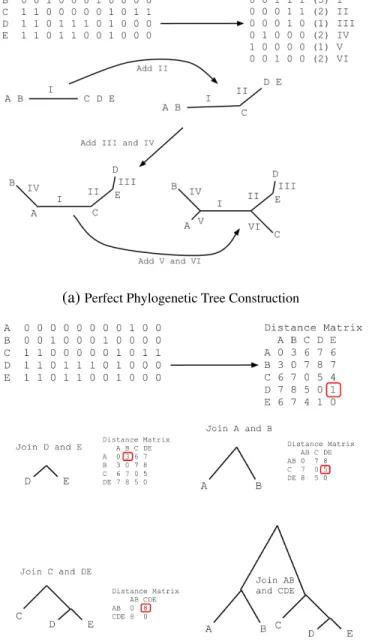
A subtree is added to this leaf containing those samples with 1s (the minority allele).
Fig-ure 2.3a illustrates this tree construction procedFig-ure. When constructing local phylogenetic
trees in this way, the outgroup is most often unknown, so the resulting tree is considered
unrooted after it is fully constructed.
It is not trivial to construct a meaningful tree over genotypes unless they are phased and
the corresponding haplotypes admit a perfect phylogeny. However, when perfect phylogeny
trees are unreasonable or we wish to construct trees over intervals which do not strictly admit
a perfect phylogeny (in some circumstances, I consider the collection of several adjacent
intervals), I use other tree construction methods. The neighbor-joining method [69] allows
the efficient construction of parsimonious phylogenetic trees based on pairwise distances (in
our case, SNPs). Given a population of samples and pairwise distances between them, we
repeatedly merge the samples with the smallest distance (see Figure 2.3b). After merging two
samples, we remove them from further consideration and add a virtual sample with distances
to the remaining samples equal to the average distance from the two merged samples. These
”merges” represent the roots of successive subtrees until all samples are merged into the root.
This method accurately represents the relationships between samples when genotypes do not
admit a perfect phylogeny [69].
2.4
A Lower Bound
2.4.1
LR and RL Covers
We first define two non-overlapping covers, the Left-to-Right cover (C(h)LR), and the
Right-to-Left cover (C(h)RL). A simple greedy algorithm, LRScan (Algorithm 1), which has been
previously described in [89], findsC(h)LRover a set of haplotypes. It begins at the leftmost
SNP (s1), and either extends or terminates the current active interval as it considers each
(a)Perfect Phylogenetic Tree Construction
(b)Neighbor-Joining Tree Construction
already in the active interval. If four gametes occur between the SNP under consideration
and a previous SNP found in the interval, the active interval is closed, and a new interval
begins from the candidate, otherwise the SNP is added to the active interval. This continues
until the last SNP is reached, thus closing the final interval (see Figure 2.4a).
The run-time of LRScan depends on the number of SNPs,m, and the number of the FGTs
performed for each SNP. Since the maximum number of distinct compatible SNP patterns
that can be mutually compatible among n haplotypes is2n−3[77], the FGT requires only
O(n)operations per SNP, assuming a constant-time overhead for each FGT. Therefore, the
complexity for LRScan isO(mn), and thus is linear in the size of the data matrix.
Algorithm 1:C(h)LR=LRScan(SN P)
Input:SN P = [snp1, ..., snpm]: an array ofmmarkers
Output:C(h)LR : a list of intervals covering 1 tom
Variables: l: list of unique SNP patterns we have seen for the current interval
s: the start of the current interval
s←1
fori= 1tomdo ifsnpi ∈/ lthen
forj = 1to||l||do
iflj is not compatible withsnpithen
append toC(h)LR interval[s, i−1]
s←i l← ∅ break
addsnpi tol
append toC(h)LR interval[s, m]
returnC(h)LR
A similar greedy Right-to-Left scan algorithm (RLScan) generating C(h)RL can be
de-fined via straightforward modifications to (LRScan). LikewiseC(h)RL can be generated by
merely reversing the input sequence, applying LRScan, and adjusting the indices of the
re-sulting intervals, including their starting and ending positions. Note that a cover’s interval
(a)CLR
(b)CLR(green) andCRL(orange)
(c)CM ax
Figure 2.4: This figure shows three covers. (a) depictsCLR created by the LRScan algorithm. (b) shows
CLR (in green) andCRL (in orange) together. The intersection of these two covers creates the set of cores
direction.
I define a similar notion over a set of genotypes. As described in Section 2.6, the only
difference is the manner in which the FGT is performed. We find an optimistic left-to-right
(C(g)LR) and right-to-left (C(g)RL) cover by closing an interval only when the subsequent
SNP will be definitely and unambiguously incompatible with a SNP in the interval (regardless
of the phasing chosen). Likewise, a pessimistic interval (C(p)LRandC(p)RL) is closed off if
there exists a phasing of the genotype set for which the next SNP will be incompatible with
SNPs already in the interval.
The run time of the pessimistic genotype scan is alsoO(mn). Like the haplotype case,
there is a limit on the number of distinct SNPs that can be compatible amongn genotypes
which is linear inn. So, the adjusted FGT requires onlyO(n)operations per SNP to
deter-mine if there exists any possible incompatibility.
The run time of the optimistic genotype scan is more complex. Eskin et al ([26])
pro-pose an algorithm withO(nm2)complexity to determine if a single region admits a perfect
phylogeny. I use a similar algorithm, adding SNPs incrementally. Since each interval is
bounded and scan proceeds linearly across the genome, this allows for anO(nm2)algorithm
to partition the entire genome.
2.4.2
Properties of
C
LRand
C
RLIn this section I present properties of compatible intervals and provide proofs. My first
the-orem states that “The covers CLR and CRL have the same number of intervals k, and k
is the minimal number of intervals possible for any complete cover.” A second theorem
identifies certain core subintervals are common to all completek-covers of a given SNP set
(Figure 2.2a). These subintervals are the intersections of corresponding intervals fromCLR
andCRLwhich I have called cores (Figure 2.4b). This implies that ak-cover must containk
any interval that does not contain an entire core is not part of any completek-cover and the
second is that theith core is only contained within theith interval of anyk-cover. Cores have
several interesting properties worth noting. All SNPs in a core are compatible because each
core is an intersection of two compatible regions. Adjacent cores must contain at least one
pair of incompatible SNPs.
LEMMA 1. Anyc-interval cover covering the range[1, ec], withec≤m, satisfiesec≤eLc,
whereeL
c is the endpoint of thecthinterval ofCLR over the same sequence.
PROOF. By induction, a single-interval cover must end at, or short of, eL
1 (an overage
would indicate LRScan closed the interval prematurely). Assume that the Lemma holds for
ani-interval cover, thus ei ≤ eLi. This implies for any(i+ 1)-interval cover bi+1 ≤ bLi+1.
We now proveei+1 ≤eLi+1. Since there exists a SNP,s, in the(i+ 1)th interval ofCLR(i.e.
within[bLi+1, eLi+1]) wheresis incompatible withseL
i+1+1,[bi+1, ei+1]cannot be a compatible
interval ifei+1 > eLi+1. Therefore, we haveei+1 ≤eLi+1.
A symmetric Lemma forCRLstates that anyC-interval cover covering the range[b1, m],
withb1 ≥ 1, satisfies bc ≥ bRc, wherebRc is the start of thecth interval ofCRL over the same
sequence.
THEOREM 1. The coversCLR andCRLhave the same number of intervalsk, andk is the
minimal number of intervals possible for any complete cover.
PROOF. Assume kCLRk = i. According to Lemma 1, for any c-interval cover, C, with
c < iand starting from the left-most SNP, the end of the cover’s rangeec ≤ bLc < bLi =m.
Therefore,C cannot be a complete cover if kCk < kCLRk, implying that a complete cover
must have at leastkCLRkintervals. A similar conclusion can be drawn forkCRLkusing the
symmetric version of Lemma 1. Therefore, we have kCLRk = kCRLk = k, and k is the
LEMMA 2. For alli= 1. . . k,Corei 6=∅.
PROOF. By induction. Assume CLR = {I1L, . . . , IkL}, and CRL = {I1R, . . . , IkR}. By
definitionCorei is[bLi, eiR]; therefore, it is sufficient to prove bLi ≤ eRi . This is trivially the
case fori = 1;bL
1 ≤ eR1. Assume thatbLi ≤eRi holds fori, we now prove it holds for i+ 1.
From bL
i ≤ eRi , we know bLi < bRi+1. If biL+1 ≤ eRi+1 does not hold, implying eRi+1 ≤ eLi ,
then we knowIiL ⊃ IiR+1, and SNP seR i (∈ I
L
i )must be compatible with all SNPs in IiR+1.
Figure 2.5b illustrates this proof. seR
i is outside and adjacent to I
R
i+1. By definition of the
Right-to-Left cover, SNP seR
i must be incompatible with at least one SNP in I
R
i+1, which
results in a contradiction.
THEOREM 2. For any completek-coverC1,m={I1, . . . , Ik}, theith interval contains the
entire ith core: Corei ∩ Ii = Corei, and, it does not contain any part of another core
Corej∩Ii =φ,1≤j ≤k, j 6=i.
PROOF. Since Corei = [bLi, eRi ], to prove the ith interval Ii = [bi, ei] contains Corei,
it is sufficient to prove bi ≤ bLi and ei ≥ eRi . Since {I1, . . . , Ii−1} is an (i −1)-cover
covering the range[1, ei−1]starting from the leftmost SNP, according to Lemma 1, we have
ei−1 ≤eLi−1, which meansbi ≤bLi . Similarly, we can proveei ≥eRi (see Fig. 2.5c). To prove
Corej ∩Ii = ∅ for any other coreCorej, it is sufficient to prove ei < bLi+1 and bi > eRi−1.
Since{I1, . . . , Ii} is an i-cover covering the range[1, ei], according to Lemma 1, we have
ei ≤eLi < bLi+1. Similarly, we can provebi > eRi−1.
Stated formally, Corei = IiL ∩ IiR. According to Lemma 1, eRi ≤ eLi and bLi ≥ bRi
(Figure 2.5a), therefore Corei = [bLi, eRi ]. Theorem 2 states, “For any complete k-cover,
C{1, m} = {I1, . . . , Ik}, theith interval contains the entire ith core: Corei∩Ii = Corei,
and, it does not contain any part of another core Corej ∩Ii = Φ,1 ≤ j ≤ k, j 6= i”.
This is due to the interleaving of the non-overlapping intervals of CLR and CRL. Corei
is necessarily compatible with both IL
i and IiR and cannot be extended beyond the outside
PROPERTY 1. All SNPs in a core are compatible, since each core is an intersection of two
compatible intervals
PROPERTY 2. Adjacent cores must contain at least one pair of incompatible SNPs
PROOF. This can be demonstrated by contradiction. Assume that two adjacent cores,corei
andcorei+1, are compatible. By definition,corei = [bLi , eRi ]. Since corei ⊆ IiL = [bLi, eLi],
corei is compatible with [eRi + 1, eLi ]. Similarly, corei+1 is compatible with [eRi + 1, eLi].
Therefore,corei∪[eRi + 1, eLi]∪corei+1 = [bLi , eRi+1]is a compatible interval containing both
cores and contradicting Theorem 2 (Fig. 2.5d).
2.5
Max-
k
Interval Set
First we introduce UberScan, which generates the set of all the maximal compatible intervals,
CU ber. UberScan, shown in Algorithm 2, is similar to the LRScan. Whenever a compatible
interval ends at SNPsi, instead of starting the next interval from si + 1 as LRScan does,
UberScan finds the nearest SNP sj(j < i + 1) that is incompatible with si + 1, and the
following SNP, sj + 1, begins the next interval. Note that si + 1 is a flagging SNP of the
previous maximal compatible interval andsj is a flagging SNP of the next maximal
compat-ible interval. UberScan is a simple modification of LRScan with added bookkeeping to track
of the index of the last occurrence of each unique SNP pattern. Recall that the maximum
number of distinct SNP patterns within a compatible interval is2n−3, orO(n). An analysis similar to that of LRScan shows that UberScan also takesO(mn)time. UberScan generates
CU ber, containing all maximal intervals of S, and generally, |CU ber| k. CU ber contains
all candidates for the Maximal-k-cover,CM ax, since a cover with maximal overlap must be
(a)Shows the definition of core (Corei=IiL∩I R i )
(b)Illustration of the proof for Lemma 2
(c)Illustration of the proof for Theorem 2
(d)Illustration of the proof for Property 2
(a)Max-kgraph
(b)CM ax
(c)C(g)M ax
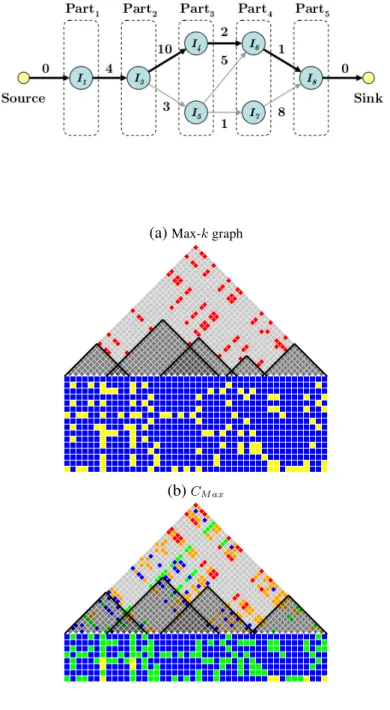
Figure 2.6:(a) shows thek-partite graph used to findCM axfor the running example. The node represents the
interval, and the edge connects intervals which overlap, with weight representing the number of shared SNPs. The longest path (bold) is computed from source to sink which isCM ax. It contains intervalsI1,I3,I5,I6, and I8fromCU ber, with a total overlap of 17. (b) is the Maximum-k-cover of the set of haplotypes,C(h)M ax. (c)
Algorithm 2:CU ber=UberScan(SN P)
Input:SN P = [snp1, ..., snpm]: an array ofmmarkers
Output:CU ber : a list of intervals covering 1 tom
Variables: l: sorted list of (position, SNP) tuples for the SNPs we have seen for the current interval
s: the start of the current interval
s←1
fori= 1tomdo
forj =||l||downto1do
iflj is not compatible withsnpithen
append toCU ber interval[s, i−1]
s←ljposition + 1
removel1tolj froml
break
appendsnpitol
append toCU ber interval[s, m]
returnCU ber
2.5.1
Finding the Maximal-k-cover
A Maximal-k-cover, CM ax, is of particular interest as it covers the entire SNP set using the
fewest,k, maximal intervals. While,CM ax is not necessarily unique, alternate solutions are
generally similar. Next we provide a fast graph algorithm to compute all Maximal-k-covers.
We consider only those maximal intervals inCU ber that entirely enclose a single core and
no part of a second core. According to Theorem 2, these intervals are the candidates for
Maximal-k-covers. Next, we organize the candidates into k groups according to the core
it contains. Each core is contained within at least one maximal interval, thus, no group is
empty. We then examine the overlap between groups. A candidate interval in group ican
only overlap candidates from groupsi−1or i+ 1, because, if any two candidates enclose non-adjacent cores (say Corex and Corey), at least one of them contains part of the core
betweenCorexandCorey, contradicting Theorem 2.
The Maximal-k-cover problem is solved by recasting it as finding the longest path in a
to a node and each group as a part, with particontaining all the candidates coveringCorei.
An edge connects nodes corresponding to overlapping candidates. Each edge’s weight is the
amount of overlap between the two intervals. The edge is directed towards the candidate that
contains the next core in the sequence. Because intervals only overlap adjacent groups, edges
only exist between adjacent parts. A source is added with edges to all nodes in part1and a
sink with edges from all the nodes in part k; both types of edges have weight0. Finding a
CM ax solution corresponds to finding the longest path in this directed graph withk+ 1edges
from source to sink. Note that the greedy approach of taking the largest interval that encloses
each core does not always yield a correct answer, as shown in the fourth core of our running
example (compare Figure 2.2a and Figure 2.4c).
The problem is a single-source shortest path problem for a weighted directed acyclic
graph (DAG), except that we search for longest path (maximizing instead of minimizing the
sum of weight on the path) with a constraint on the number of steps. The constraint can be
ignored since all edges lead from one part to the next, thus any path from source to sink will
havek+ 1steps. The problem can be solved using dynamic programming and requires only
Θ(|V|+|E|)time, whereV is the set of nodes, andEis the set of edges [15].
2.5.2
Critical SNPs
A critical SNP is any SNP whose removal reducesk, the minimum number of intervals
re-quired to cover the given SNP set. To check whether a SNP is critical, one could simply
remove each SNP and recalculatekby either a LRScan or an RLScan. This naive approach
requiresmscans, and takes O(nm2)time. However, it is unnecessary to test every SNP. In
fact, only flagging SNPs of maximal compatible intervals need to be considered. A flagging
SNP bounds an interval on one side and prevents the interval from growing toward an
adja-cent interval on that side, therefore a flagging SNP must be removed to allow any interval to
THEOREM 3. Critical SNPs are flagging SNPs ofCU berintervals.
PROOF. Consider two adjacent maximal compatible intervals,IiU ber andIiU ber+1 . Their
flag-ging SNPsseU ber
i +1 andsbU beri+1 −1 must be incompatible (see Fig. 2.2b for an example). This
incompatibility makes it infeasible for eU ber
i to be larger and bU beri+1 to be smaller. Without
removing at least one of these two flagging SNPs, it is impossible for either of these two
in-tervals to grow towards each other. SinceCM ax ⊆CU ber, a necessary condition of reduction
inkis that at least one interval inCU bergrows in size. Therefore, being a flagging SNP is a
necessary condition for being a critical SNP.
Since each maximal compatible interval has two flagging SNPs, one on each side of the
interval, the total number of flagging SNPs isO(|CU ber|). The running-time for computing
critical SNPs isO(nm|CU ber|).
2.6
Genotypes
Determining four-gamete compatibility and compatible intervals over unphased genotype
data is ambiguous in that there are many possible interpretations (phasings) of a set of
geno-types as haplogeno-types. I define two approaches for determining compatibility among genogeno-types
without explicitly phasing. The optimistic method determines intervals for which there might
exist a phasing such that the interval is four-gamete compatible. The pessimistic method
de-termines intervals by choosing a phasing which introduces the maximum possible
incompat-ibility.
I compared the haplotype and genotype intervals on three data sets. First, I created
simu-lated genotype data using a simple infinite-sites model of mutation with cross-over
recombi-nation - this served as a data source devoid of confounding factors such as experimental error
and homoplasy. Second, I used real data from F1 crosses between isogenic mouse strains.
2.6.1
Relating Genotype and Haplotype Covers
In simulated data, one can explore relationships between the compatible intervals of
geno-types and the compatible intervals of their “source” haplogeno-types. These haplotyeps can be
used as ground truth for the corresponding set of genotypes. The number of intervals in an
optimistic genotype cover,||C(g)LR||, is less than or equal to the number of ground truth
in-tervals (Theorem 4) and the size of the pessimistic genotype cover,||C(p)LR||, is greater than
or equal to the number of ground truth intervals (Theorem 5). Thus, the number of intervals
in an optimistic and pessimistic genotype scan are lower and upper bounds, respectively, on
the true number of intervals.
THEOREM 4. kC(g)LRk ≤ kC(h)LRk
PROOF. By contradiction. Assume C(h)LR exists such that kC(h)LRk < kC(g)LRk.
There must exist some incompatibility in Sg not in S. By definition, it must be
impossi-ble to phaseSgto makeS. Therefore,Smust not be a true phasing ofSg.
THEOREM 5. kC(h)LRk ≤ kC(p)LRk
PROOF. By contradiction. Assume C(h)LR exists such that kC(p)LRk < kC(h)LRk.
There must exist some incompatibility in S not in Sp. By definition, it must be
impossi-ble to phaseSto makeSp. Therefore,Sp must not be a true phasing ofS.
COROLLARY 1. kC(g)LRk ≤ kC(h)LRk ≤ kC(p)LRk
In Figure 2.7, ‘a’ represents the distribution of the set of all possible genotype “pairings”
of a fixed haplotype set into genotypes. The “ground truth”, or the number of intervals
required to form a cover using the source haplotypes, is 5. Notice that the covers resulting
from every optimistic genotype scan fall closer to the “ground truth” than those from every
Figure 2.7:The distribution of cover sizes for genotypes resulting from all pairings of a set of haplotypes. For ‘a’ distributions, data was simulated using the infinite sites model and recombination. The source haplotypes cover size (the “ground truth”) is represented by the solid black line. For ‘b’ distributions, a contrived haplotype set was made by phasing a pessimistic genotype result of ‘a’. The source haplotypes cover size is the dashed black line.
In contrast, ‘b’ represents the same plot for a contrived, non-biologically-based,
haplo-type data set. The distribution of the cover size of all genohaplo-types can be formed by pairings
of the haplotype set that achieves one of the pessimistic covers from ‘a’ (this can always be
achieved, as discussed in Section 2.6.2). Specifically, the “true” cover size for this contrived
set is 23. Notice that the distribution is different from the biology-based model. In
particu-lar, the optimistic and pessimistic distributions are closer together and the “ground truth” is
nearer the pessimistic estimations.
2.6.2
Achieving Genotype Covers by Phasing
In many circumstances, it is useful to determine if a particular genotype cover or interval set
is achievable by phasing. Pessimistic genotype covers can always be achieved (see
Algo-rithm 3). However, there does not always exist a phasing to accomplish a given optimistic