STRATEGIC APPLICATIONS OF NEW REDOX TRANSFORMATIONS IN ORGANIC SYNTHESIS
Scott William Krabbe
A dissertation submitted to the faculty of the University of North Carolina at Chapel Hill in partial fulfillment of the requirements for the degree of Doctor of Philosophy in the Department of Chemistry.
Chapel Hill 2015
ABSTRACT
Scott William Krabbe: Strategic Applications of New Redox Transformations in Organic Synthesis (Under the direction of Jeffrey S. Johnson)
I. Copper(II)-Catalyzed Aerobic Hydroperoxidation of Meldrum’s Acid Derivatives and Application in Intramolecular Oxidation: A Conceptual Blueprint For O2/H2 Dihydroxylation
Aerobic hydroperoxidation of Meldrum’s acid derivatives via a Cu(II)-catalyzed process is presented. The mild reaction conditions are tolerant to pendant unsaturation allowing the formation of endoperoxides via electrophilic activation. Cleavage of the OO bond provides 1,n-diols with differentiation of the hydroxy groups.
II. Copper-Catalyzed Asymmetric Hydrogenation of Aryl and Heteroaryl Ketones
III. Asymmetric Total Syntheses of Megacerotonic Acid and Shimobashiric Acid A
ACKNOWLEDGMENTS
I would like to express my sincere gratitude to my research advisor, Professor Jeffrey Johnson for fostering an atmosphere of growth and opportunity. Throughout my career, Jeff has allowed me the latitude to explore my own ideas, even when he surely must have known that they had little chance of being fruitful. He also allowed me to work independently, with input only when I asked for it, which I probably should have asked for more often. The opportunity to do research at GSK for an entire year has certainly steered my career path/goals and this would not have been possible without Jeff’s willingness to let me participate in this internship. I’m eternally grateful for his advice and understanding when I started my family in the midst of graduate work.
I would like to thank Professors Michel Gagné, David Nicewicz, Erik Alexanian, and Maurice Brookhart for serving on my defense committee and their mentorship during my coursework.
I’m thankful to have worked with an excellent set of friends and colleagues during my time at UNC. All Johnson group members, both past and present, have had a significant impact on my career and I’m indebted to each of them for all of the happy memories. A special thanks to all those friends outside the Johnson lab as well who certainly made brewing and cookouts enjoyable.
A special thanks to Mark Hatcher for his mentorship at GSK and beyond as I started my family during my time at UNC. I’d also like to thank Chris Butler for his many years of support following my pre-graduate internship at Pfizer and for his immense support in helping secure my postdoc.
I would also like to thank my family for their love and support as I spent the last several years 1000 miles away from all of them. Thank you all for making sacrifices to come visit and understanding when we were not able to make it home for most holidays.
TABLE OF CONTENTS
LIST OF TABLES ... x
LIST OF FIGURES AND SCHEMES ... xii
LIST OF ABBREVIATIONS AND SYMBOLS ... xv
CHAPTER 1: COPPER(II)-CATALYZED AEROBIC HYDROPEROXIDATION OF MELDRUM’S ACID DERIVATIVES AND APPLICATION IN INTRAMOLECULAR OXIDATION: A CONCEPTUAL BLUEPRINT FOR O2/H2 DIHYDROXYLATION ... 1
1.1 Introduction ... 1
1.2 Background ... 1
1.2.1 Benefits of Enolate Oxidation with Higher Oxidation State Electrophiles ... 1
1.2.2 Extant Methodologies for Enolate Hydroperoxidation ... 2
1.2.3 Biologically Active Endoperoxides and Selected Methodologies for the Synthesis of Endoperoxides and (1,n)-Diols ... 4
1.2.4 Discovery of Mild Hydroperoxidation Conditions for Meldrum’s Acid Derivatives ... 5
1.3 Results and Discussion ... 7
1.3.1 Optimization of Conditions for Hydroperoxidation of Meldrum’s Acid Derivatives ... 7
1.3.2 Scope and Limitations of Hydroperoxidation of Meldrum’s Acid Derivatives ... 7
1.3.3 Attempted Solutions to Alkene Reactivity Issues ... 9
1.3.4 Access to Endoperoxides Via Intramolecular Oxidation of Alkenyl Hydroperoxides ... 11
1.3.5 Secondary Transformations of Endoperoxides ... 12
1.3.6 Au(I)-Catalyzed Endoperoxidation of Alkynyl Substituted Hydroperoxides and Secondary Transformations of the Resulting Mixed Ketal Products ... 14
1.4 Conclusion ... 15
1.5 Experimental Details ... 16
1.6 References ... 37
2.1 Introduction ... 40
2.2 Background ... 41
2.2.1 Importance of Chiral Secondary Alcohols ... 41
2.2.2 Copper Hydride Complexes in Racemic Reductions ... 41
2.2.3 Copper-Catalyzed Asymmetric Hydrosilylation of Prochiral Ketones ... 42
2.2.4 Extant Methodologies for Copper-Catalyzed Asymmetric Hydrogenation of Prochiral Ketones ... 43
2.2.5 High-Throughput Experimentation (HTE) Collaboration with GlaxoSmithKline ... 44
2.3 Results and Discussion ... 44
2.3.1 Initial Ligand Screening for Copper-Catalyzed Asymmetric Ketone Reduction ... 44
2.3.2 Optimization of Reaction Conditions for Active Ligands ... 45
2.3.3 Screening of Active Ligands with Various Non-Chiral Ancillary Phosphines ... 46
2.3.4 Screening of Active Ligands with Various Chiral Ancillary Phosphines ... 47
2.3.5 Precomplexation Studies with Active Ligands ... 49
2.3.6 Pressure Effects in Hydrogenation with Active Ligands ... 50
2.3.7 Transfer Hydrogenation Studies ... 50
2.3.8 Synthesis of BoPhoz Analogs ... 51
2.3.9 Screening of Various Ancillary Ligands with BoPhoz Analogs ... 53
2.3.10 Optimization of Reaction Conditions for (R,S)-N-Me-3,5-xylyl-BoPhoz ... 54
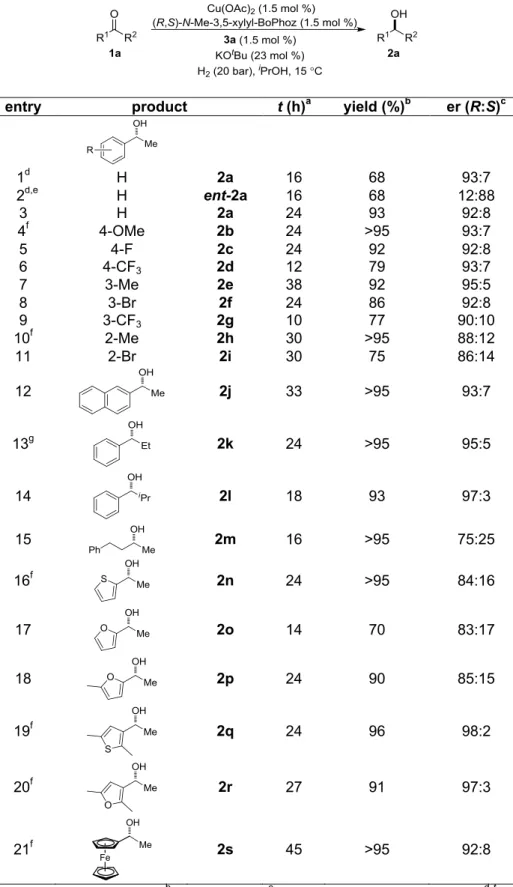
2.3.11 Scope and Limitations of Copper-Catalyzed Asymmetric Ketone Reduction ... 55
2.3.12 Chiral Trisphosphine Ligands ... 57
2.3.13 31P NMR Experiment Showing Ligation of Three Phosphines ... 59
2.4 Conclusion ... 60
2.5 Experimental Details ... 61
2.6 References ... 92
CHAPTER 3: ASYMMETRIC TOTAL SYNTHESES OF MEGACEROTONIC ACID AND SHIMOBASHIRIC ACID A ... 94
3.1 Introduction ... 94
3.2.1 Occurrence and Biological Activity of -Methylidene-, -Alkylidene- and
-Benzylidene--Butyrolactones ... 95
3.2.2 Isolation of Megacerotonic Acid and Shimobashiric Acid A ... 97
3.2.3 Racemic Total Synthesis of 1a ... 98
3.2.4 Rapid, Atom Economical Access to -Butyrolactones via Ruthenium-Catalyzed DKR-ATH of -Substituted -Keto Esters ... 99
3.3 Results and Discussion 3.3.1 Preliminary Retrosynthetic Analysis ... 100
3.3.2 Proposed Application of DKR-ATH in Preliminary Route to Intermediate 34a ... 101
3.3.3 Application of Heck Coupling and Cross Metathesis in the Synthesis of 34a ... 101
3.3.4 Application of Krapcho Dealkoxycarbonylation/Aldol/Elimination Sequence ... 105
3.3.5 Revised Route to Alcohol 43a ... 106
3.3.6 Revised Retrosynthetic Analysis ... 108
3.3.7 Optimization of the Synthesis of ,-Diketo--Aryl Ester 53a ... 109
3.3.8 Investigation of Proposed Dieckmann Cyclization ... 110
3.3.9 Reduction/Elimination Sequence for Installation of -Benzylidene ... 112
3.3.10 Optimization of Ester Epimerization/Hydrolysis ... 112
3.3.11 Completion of the Total Synthesis of 1a ... 113
3.3.12 Total Synthesis of 1b ... 114
3.4 Conclusion ... 116
3.5 Experimental Details ... 117
LIST OF TABLES
Table 1-1 Initial Hydroperoxidation Results and Optimization ... 7
Table 1-2 Scope and Limitations of Hydroperoxidation of Meldrum’s Acid Derivatives ... 9
Table 2-1 Results of Varying Copper Source on Reactivity and Selectivity ... 46
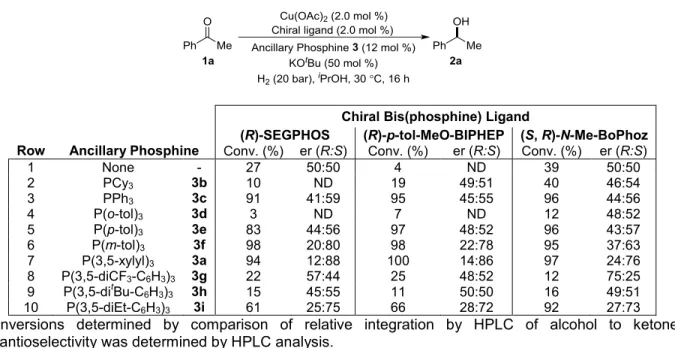
Table 2-2 Reactivity and Selectivity Trends Observed by Varying Ancillary Triarylphosphine ... 47
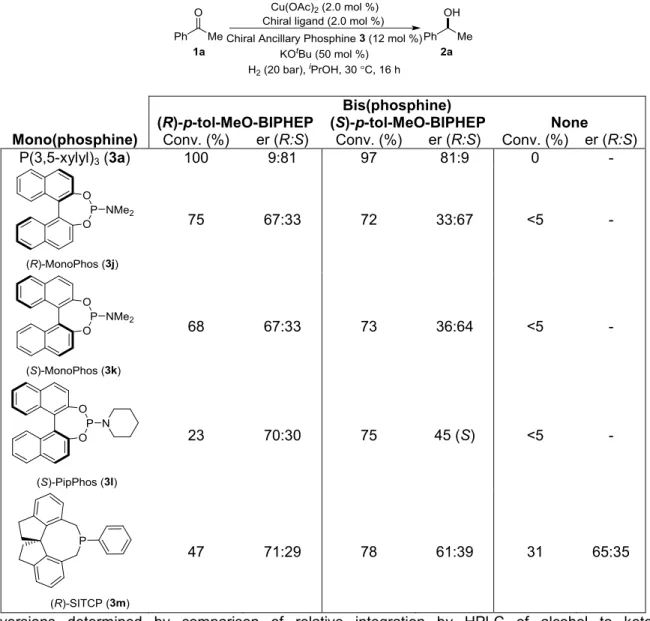
Table 2-3 Chiral Mono(phosphines) as Ancillary Ligands ... 49
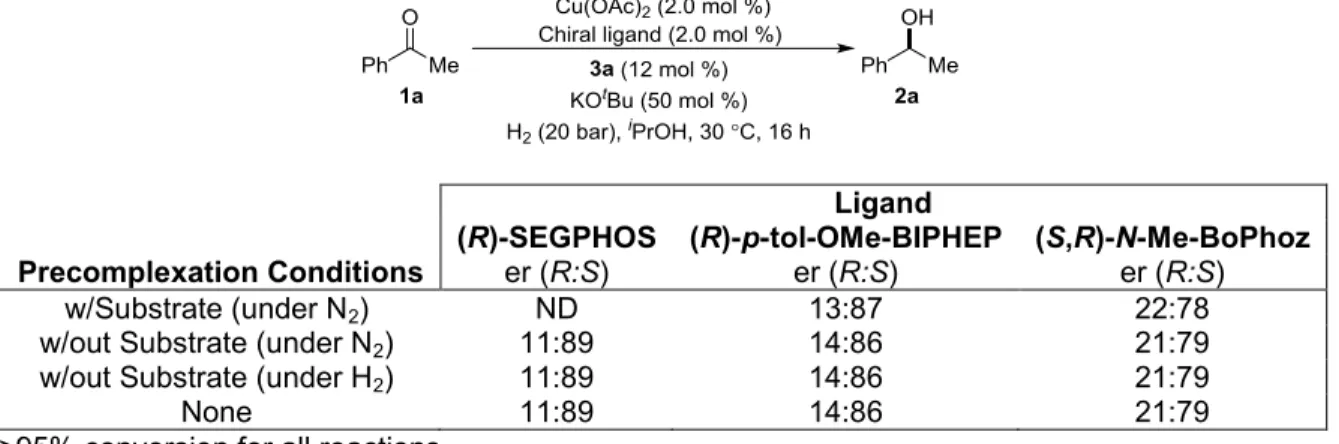
Table 2-4 Catalyst Precomplexation Studies ... 50
Table 2-5 Absence of Pressure Effects in Hydrogenation ... 50
Table 2-6 Transfer Hydrogenation Studies ... 51
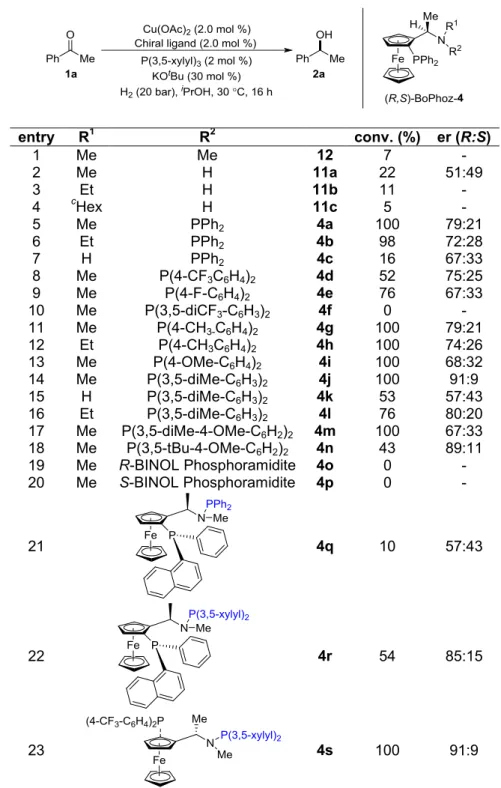
Table 2-7 Investigation of BoPhoz Derivatives in Acetophenone Reduction ... 53
Table 2-8 Investigation of Various Ancillary Phosphines with (R,S)-N-Me-3,5-xylyl-BoPhoz ... 54
Table 2-9 Pressure and Temperature Optimization for Hydrogenation ... 55
Table 2-10 Substrate Scope for Cu-Catalyzed Hydrogenation ... 56
Table 2-11 Investigation of Chiral Trisphosphine Ligands in Asymmetric Ketone Reduction ... 59
Table 2-12 Commercially Available Chiral Ligand Screening ... 72
Table 2-13 Commercially Available Chiral Ligand Screening at Higher Catalyst Loading ... 73
Table 2-14 Ancillary Phosphine Screening for Active Ligands ... 74
Table 2-15 Chiral Ancillary Phosphine Screening with p-Tol-MeO-BIPHEP ... 75
Table 2-16 Copper Source, Base and Solvent Screening with N-Me-BoPhoz ... 76
Table 2-17 Ancillary Phosphine and Base Loading with N-Me-BoPhoz ... 76
Table 2-18 BoPhoz Ligand Screening ... 77
Table 2-19 Screening of Ancillary Phosphines with (R,S)-N-Me-3,5-xylyl-BoPhoz... 78
Table 2-20 Solvent Screening with (R,S)-N-Me-3,5-xylyl-BoPhoz ... 79
Table 2-21 Temperature Optimization ... 80
Table 3-1 Heck Coupling Attempts for the Preparation of 34a ... 104
Table 3-2 Aldol/Elimination Sequence in the Synthesis of 43a ... 106
Table 3-4 Optimization of Dieckmann Cyclization ... 111
Table 3-5 Optimization of C4 Epimerization ... 113
Table 3-6 Optimization of Conditions for C4 Epimerization ... 116
Table 3-7 Comparison of Physiochemical Properties for Megacerotonic Acid... 149
Table 3-8 1H NMR Shifts as a Function of Concentration ... 150
LIST OF FIGURES AND SCHEMES
Scheme 1-1 Hydroperoxidation of Meldrum’s Acid Derivatives and Application in
Intramolecular Oxidation ... 1
Scheme 1-2 Traditional Versus Elevated Oxidation State Enolate Functionalization ... 2
Scheme 1-3 Copper-Catalyzed Internal Peroxide Formation ... 3
Scheme 1-4 Extant Methods for Hydroperoxidation of -Dicarbonyl Compounds ... 3
Scheme 1-5 Cerium(III) or Manganese(III) Promoted Peroxidation/Cyclization ... 4
Figure 1-1 Selected Biologically Active Natural Endoperoxides ... 4
Scheme 1-6 Approaches to Endoperoxides Via Cyclization Onto Pendant Alkenes ... 5
Scheme 1-7 Oxidative Deacylation of Acetoacetates and Proposed Mechanism ... 6
Scheme 1-8 Failed Oxidative Deacylation of Meldrum’s Acid Derivative ... 6
Scheme 1-9 Proposed Hydroperoxidation of Epoxide Substituted Meldrum’s Acids ... 10
Scheme 1-10 Acidic Methine Protection Strategy ... 10
Scheme 1-11 Formation of Dihydrofuran 20 Upon Attempted Chloride Removal ... 10
Scheme 1-12 Attempted Hydroperoxidation of Chloro-Epoxy Meldrum’s Acid 5. ... 11
Scheme 1-13 Iodoendoperoxidation of Hydroperoxy Meldrum’s Acid ... 11
Scheme 1-14 Iodoendoperoxidation with 1,3-Diiodo-5,5-Dimethylhydantoin ... 12
Scheme 1-15 Endoperoxide Cleavage in 1,2-Dioxolane System ... 13
Scheme 1-16 Attempts at Selective Meldrum’s Acid Cleavage. ... 13
Scheme 1-17 Proposed Mechanism for the Formation of 26 and 27 ... 14
Scheme 1-18 Gold(I)-Catalyzed Endoperoxidation of Alkynyl Hydroperoxides and Secondary Transformation of Endoperoxides ... 15
Scheme 2-1 Copper-Catalyzed Asymmetric Hydrogenation of Prochiral Ketones ... 40
Scheme 2-2 Stryker’s Reagent in 1,4-Reductions ... 41
Scheme 2-3 [(2-tripod)CuH] 2 in 1,2-Reductions ... 41
Scheme 2-4 1,2-Selective CuH Reduction and In Situ Formation of CuH... 42
Scheme 2-5 Asymmetric Hydrosilylation of Prochiral Ketones ... 43
Scheme 2-7 Copper-Catalyzed Asymmetric Hydrogenation with
Binaphthophosphepine Ligands ... 44
Figure 2-1 Ligands Identified by Parallel Screening ... 45
Scheme 2-8 Modular Synthesis of Bophoz Derivatives ... 51
Figure 2-2 Selected Chiral Trisphosphines ... 57
Scheme 2-9 Evaluation of Pigiphos in Cu-Catalyzed 2-Naphthone Hydrogenation ... 57
Scheme 2-10 Synthesis of New Chiral Trisphosphine Ligands from ChenPhos Derivatives ... 58
Figure 2-3 31P NMR Comparison of Free and Bound 19g ... 60
Figure 3-3 Structures of Chiral Ligands ... 67-70 Scheme 3-1 Total Synthesis of Megacerotonic Acid and Shimobashiric Acid A ... 94
Figure 3-1 Selected Biologically Active -Methylidene--Butyrolactones ... 95
Figure 3-2 Selected Biologically Active -Alkylidene--Butyrolactones ... 96
Figure 3-3 Selected Biologically Active Natural -Benzylidene--Butyrolactones ... 96
Figure 3-4 Comparison of Anticancer Activities of Selected Natural -Methylidene- -Butyrolactones and Semi-Synthetic -Benzylidene--Butyrolactones ... 97
Figure 3-5 Structures of 1a and 1b ... 98
Scheme 3-2 Papin and Coworkers’ Racemic Total Synthesis of 1a ... 99
Scheme 3-3 Atom Economical Access to -Butyrolactones via DKR-ATH ... 100
Scheme 3-4 Key Factors of DKR-ATH ... 100
Scheme 3-5 Preliminary Retrosynthetic Analysis ... 101
Scheme 3-6 DKR-ATH/Bromomethylation/Krapcho Dealkoxylcarbonylation/Elimination Route to 35 ... 101
Scheme 3-7 Heck Coupling of -Unsubstituted--Butyrolactones ... 102
Scheme 3-8 Heck Coupling for the Preparation of Semi-Synthetic -Benzylidene--Butyrolactones ... 103
Scheme 3-9 Palladium Catalyzed Oxidative Arylation of -Aryl--Methylidene Lactones ... 103
Scheme 3-10 Extant Methodology for Cross-Metathesis of -Methylidene Lactones and Styrenes and Attempted Application to Methylidene 35 ... 105
Scheme 3-11 Krapcho Dealkoxycarbonylation ... 105
Scheme 3-13 Retrosynthetic Analysis of Alcohol 43a ... 107
Scheme 3-14 Complexity of Proposed DKR-ATH of 45 ... 107
Scheme 3-15 Synthesis of 45 and Application in DKR-ATH ... 108
Scheme 3-16 Revised Retrosynthetic Analysis of 43a ... 108
Scheme 3-17 DKR-ATH of ,-Diketo--Aryl Ester 53a and Formation of Carbonate 56 ... 110
Scheme 3-18 Proposed Mechanism for Formation of 44a, 55a, and 58 ... 112
Scheme 3-19 Preparation of -Benzylidene--Butyrolacone 34a ... 112
Scheme 3-20 Completion of Route to 1a ... 114
Scheme 3-21 Preparation of 43b and Failed Extension of Elimination Conditions ... 114
Figure 3-6 Structural Differences in 43a and 43b Leading to Reduced Reactivity and Use of the Burgess Reagent for Less Electron Rich Arenes ... 115
LIST OF ABBREVIATIONS AND SYMBOLS
13C NMR carbon nuclear magnetic resonance spectroscopy 1H NMR proton nuclear magnetic resonance spectroscopy 2D NMR two-dimensional nuclear magnetic resonance 3,5-xylyl 3,5-dimethyl-phenyl
Ac acyl
acac acetylacetonate
AcOH acetic acid
aq aqueous
Ar aryl
BBr3 boron tribromide
BF4 tetrafluoroborate
br broad
bs broad singlet
cat catalyst or catalytic amount CH2Cl2 dichloromethane
CH3CN acetonitrile
conv conversion
CuH generic copper hydride
d doublet
DBU 1,8-Diazabicycloundec-7-ene
dd doublet of doublet
ddt doublet of doublet of triplet DIH 1,3-diiodo-5,5-dimethylhydantoin
DKR-ATH dynamic kinetic resolution asymmetric transfer hydrogentation DMAP 4-dimethylaminopyridine
DMF dimethylformamide
DMSO dimethylsulfoxide
dq doublet of quartet
dr diastereomeric ratio
E+ or El electrophile
equiv equivalent(s)
er enantiomeric ratio
ESI electrospray ionization
Et ethyl
Et2NH diethylamine
Et2O diethyl ether
Et3SiH triethylsilane
EtOAc ethyl acetate
EtOH ethanol
h hour
H2 hydrogen
H2SO4 sulfuric acid
HCO2H formic acid
HetAr heteroaryl
HFIP hexafluoroisopropanol
HPLC high pressure liquid chromatography HRMS high resolution mass spectrometry
Hz Hertz
IC50 half maximal inhibitory concentration
iPr isopropyl
iPr
2NEt diisopropylethylamine
iPrOH isopropanol
IR infared spectroscopy
J coupling constant
k rate constant
KHMDS/NaHMDS potassium or sodium bis(trimethylsilylamide)
KOAc potassium acetate
KOtBu potassium tert-butoxide LDA lithium diisopropylamide
m-CPBA meta-chloroperoxybenzoic acid
Me methyl
MeOH methanol
Mg milligram
MHz megahertz
Min minute
mL milliliter
L microliter
mmol millimole
mol % mole percent
MoOPH
Oxodiperoxymolybdenum(pyridine)(hexamethylphosphoric triamide)
mp melting point
MsCl methanesulfonyl chloride MTBE methyl tert-butyl ether
NaH sodium hydride
NaOH sodium hydroxide
NaOMe sodium methoxide
NBS N-bromosuccinimide
nBu normal butyl
ND not determined
NIS N-iodosuccinimide
nOe nuclear Overhauser enhancement
NOESY nuclear Overhauser enhancement spectroscopy
O2 oxygen
Ph phenyl
Piperonyl 3,5-methylenedioxy
Piv pivalate
ppm parts per million
psig pounds per square inch gas
Pt/C or Pd/C metal (platinum or palladium) deposited on carbon black p-TsOH para-toluenesulfonic acid
R substituent
rac racemic
Rf retention factor
rt room temperature
s singlet
SFC supercritical fluid chromatography
T temperature
t time
tBu tert-butyl
tBuOH tert-butanol
TfOH trifluoromethanesulfonic acid TGA thermogravimetric analysis HTE high-throughput experimentation
THF tetrahydrofuran
TLC thin layer chromatography
tr retention time
CHAPTER ONE: COPPER(II)-CATALYZED AEROBIC HYDROPEROXIDATION OF MELDRUM’S ACID DERIVATIVES AND APPLICATION IN INTRAMOLECULAR OXIDATION: A CONCEPTUAL
BLUEPRINT FOR O2/H2 DIHYDROXYLATION*
1.1 Introduction
The preparation of -functionalized carbonyl compounds is often achieved via enolate oxidation, and extant methodologies with oxygen electrophiles are generally concerned with hydroxylation (OH), despite the potential advantages of hydroperoxidation (OOH). The retained hydroperoxide can provide atom economical access to endoperoxides via remote oxidation of pendant unsaturation and (1,n)-diols via hydrogenolysis of the resulting endoperoxidic OO bond. In this chapter we report the discovery and optimization of mild, aerobic hydroperoxidation conditions for Meldrum’s acid derivatives and the utility of the retained hydroperoxide in remote, intramolecular oxidation (Scheme 1-1).
Scheme 1-1. Hydroperoxidation of Meldrum’s Acid Derivatives and Application in Intramolecular Oxidation
1.2 Background
1.2.1 Benefits of Enolate Oxidation with Higher Oxidation State Electrophiles
Enolate oxidation is an important tool in organic synthesis for the preparation of various -functionalized carbonyl compounds.1 This reaction is often achieved through the application of oxygen-based electrophiles such as oxaziridines, dioxiranes, and diacyl peroxides (Scheme 1-2a); these
reagents are useful for the installation of a hydroxyl group or hydroxyl surrogate but their atom economy is relatively poor.2
Scheme 1-2. Traditional Versus Elevated Oxidation State Enolate Functionalization
In the rarer cases where hydroperoxides 2 are generated during the course of enolate functionalization (often as ROH/RO2H mixtures), it is common practice to reduce the mixture to the hydroxylation (ROH) product 1 upon workup (Scheme 1-2b). This reductive workup in essence squanders one oxidation level conferred by the oxidant. By contrast, an enolate oxidation that preserved the elevated product oxidation state could in principle be used to functionalize remote sites, so long as the distal functionality was compatible with the oxidation conditions. Initially providing an endoperoxide 3, hydrogenolysis of the OO bond would provide formal dihydroxylation products 4 in a redox economical manner.3 Moreover, a catalytic enolate oxidation reaction that used O2 would carry the inherent advantages of complete atom economy and the use of a green oxidant. At issue in translating this construct to practice is (1) the development of a mild, functional group-tolerant enolate oxidation using O2, and (2) the development of tools for remote functionalization using the hydroperoxide products.
1.2.2 Extant Methodologies for Enolate Hydroperoxidation
Scheme 1-3. Copper-Catalyzed Internal Peroxide Formation
Extant methods for hydroperoxidation of -dicarbonyls are scant and often suffer from harsh conditions and/or form mixtures of hydroperoxide and alcohol. The use of photosensitized 1O
2 allows the formal addition of O2 into an active methine of 6-acyl or 6-carboalkoxybenzylcycloalkenones (Scheme 1-4a).5 The foremost methods for hydroperoxidation of active CH bonds utilize aerobic oxidation of dimedone derivatives (Scheme 1-4b)6 or employ Mn(III)/O2 to peroxidize 1,2-diphenylpyrazolidine-3,5-diones and barbituric acid derivatives (Scheme 1-4c).7
Scheme 1-4. Extant Methods for Hydroperoxidation of -Dicarbonyl Compounds
Scheme 1-5. Cerium(III) or Manganese(III) Promoted Peroxidation/Cyclization
1.2.3 Biologically Active Endoperoxides and Selected Methodologies for The Synthesis of Endoperoxides and (1,n)-Diols
Endoperoxides are prevalent in a number of natural products exhibiting antimalarial (artemisinin and its derivatives) and anticancer (plakinic acids) activity.10 With this knowledge and the findings that structurally simpler cyclic peroxides can still exhibit useful biological activity,11 the short and efficient synthesis of new cyclic peroxides has become a topic of increased effort.12
Figure 1-1. Selected Biologically Active Natural Endoperoxides
Scheme 1-6. Approaches to Endoperoxides Via Cyclization Onto Pendant Alkenes
In addition to biological relevance, endoperoxides also provide access to (1,n-diols) via OO bond cleavage by thiourea/MeOH17 or metal-catalyzed hydrogenolysis.18 The latter case is especially attractive from a green chemistry perspective19 since the overall sequence could in principle provide formal dihydroxylation with O2 as the oxidant and H2 as the reductant.
1.2.4 Discovery of Mild Hydroperoxidation Conditions for Meldrum’s Acid Derivatives
Scheme 1-7. Oxidative Deacylation of Acetoacetates and Proposed Mechanism
In considering the extension of this methodology to other -dicarbonyl substrates, Meldrum’s acid21 derivatives emerged with excellent potential due to ease of access to the enol tautomer22 and the fact that asymmetric syntheses of -stereogenic derivatives had been developed to a high level of sophistication, simplicity, and scalability.23,24 The expected reaction mechanism follows an identical pathway to that reported for acetoacetates, except upon [2+2] cycloreversion the expulsion of acetone and carbon dioxide would provide -stereogenic--ketoacids which represent interesting synthetic intermediates and therapeutics with varied biological activities.25 Upon exposing Meldrum’s acid derivative 10a to the conditions reported, no oxidative deacylation was observed and a mixture of hydroperoxide 11a and alcohol 12a products were obtained (Scheme 1-8). Increasing the temperature (up to 95 °C) provided no detectable conversion to 13. This truncated reactivity is likely a result of decreased electrophilicity of the ester carbonyl.
Surprisingly, the hydroperoxidation of Meldrum’s acid derivatives had not been previously reported, and we sought to develop this newly found reactivity into a simple, efficient, and green oxidation selectively providing hydroperoxides with a variety of useful, secondary transformations.
1.3 Results and Discussion
1.3.1 Optimization of Conditions for Hydroperoxidation of Meldrum’s Acid Derivatives
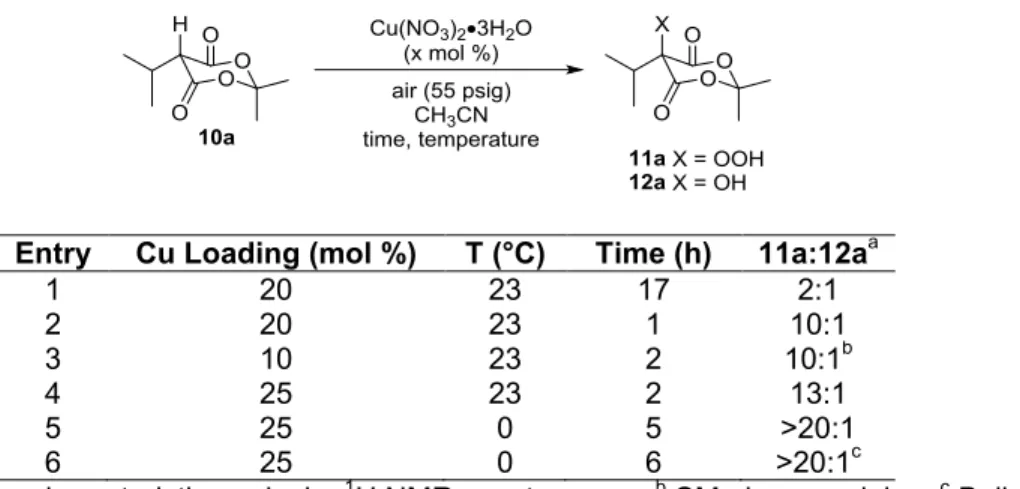
Our point of departure for this investigation was the application of the previously reported oxidative deacylation conditions utilizing a standard Fisher-Porter bottle for pressurized air20a to isopropyl Meldrum’s acid derivative 10a resulting in a mixture of hydroperoxide and alcohol (Table 1-1, entry 1). Shortening reaction time resulted in a more acceptable ratio of 11a to 12a, but these products proved inseparable by flash chromatography and additional hydroperoxide reduction on silica gel was observed (entry 2). We hypothesized that lower catalyst loading might still provide efficient reaction rate while increasing the ratio of 11a to 12a, but no decrease in alcohol formation was observed (entry 3). Increased catalyst loading provided marginal reduction in alcohol formation (entry 4), and reducing the temperature to 0 °C eliminated the formation of alcohol while still providing good conversion to hydroperoxide (entry 5). Operational simplicity was further achieved without detriment to yield by using a balloon of O2, eliminating the need for a pressure vessel (entry 6).26
Table 1-1. Initial Hydroperoxidation Results and Optimization
Entry Cu Loading (mol %) T (°C) Time (h) 11a:12aa
1 20 23 17 2:1
2 20 23 1 10:1
3 10 23 2 10:1b
4 25 23 2 13:1
5 25 0 5 >20:1
6 25 0 6 >20:1c
a Ratio by integration characteristic peaks by 1H NMR spectroscopy; b SM also remaining; c Balloon of O 2 instead of 55 psig air in pressure vessel, >95% isolated yield of 11a;
1.3.2 Scope and Limitations of Hydroperoxidation of Meldrum’s Acid Derivatives
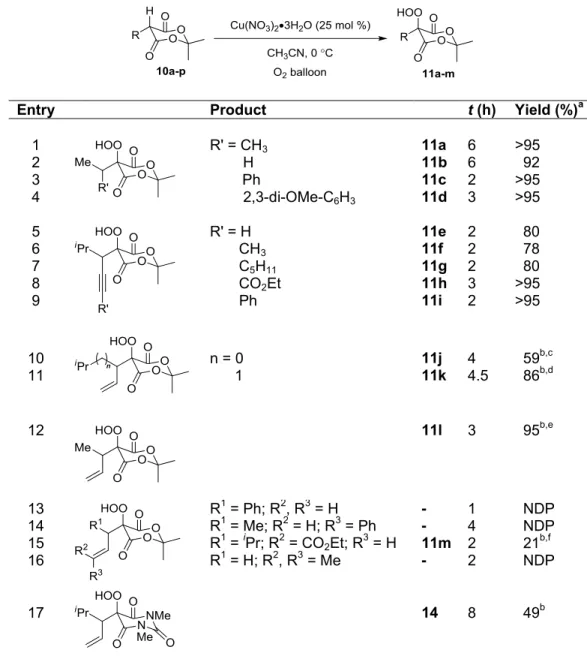
Table 1-2. Scope and Limitations of Hydroperoxidation of Meldrum’s Acid Derivatives
Entry Product t (h) Yield (%)a
1 2 3 4
R' = CH3 H Ph
2,3-di-OMe-C6H3
11a 11b 11c 11d 6 6 2 3 >95 92 >95 >95 5 6 7 8 9
R' = H CH3 C5H11 CO2Et Ph 11e 11f 11g 11h 11i 2 2 2 3 2 80 78 80 >95 >95 10
11 n = 0 1 11j 11k 4 4.5 59
b,c 86b,d
12 11l 3 95b,e
13 14 15 16
R1 = Ph; R2, R3 = H R1 = Me; R2 = H; R3 = Ph R1 = iPr; R2 = CO
2Et; R3 = H R1 = H; R2, R3 = Me
- - 11m - 1 4 2 2 NDP NDP 21b,f NDP
17 14 8 49b
a Isolated yield of clean hydroperoxide without need for purificaton; b Yield following purification on SiO 2; c 10:1 with alcohol; d 17:1 with alcohol; e 20:1 with alcohol; f 5:1 with alcohol;
1.3.3 Attempted Solutions to Alkene Reactivity Issues
Scheme 1-9. Proposed Hydroperoxidation of Epoxide Substituted Meldrum’s Acids
We believed the acidic site on Meldrum’s acid was potentially causing issues, so we investigated “protecting” this site prior to epoxidation. Installation of a halogen at the acidic methine of -dicarbonyl compounds containing alkenes is easily achieved via deprotonation and quenching with a suitable halonium ion source.27 Chlorination of isoprenyl Meldrum’s acid 10p and subsequent epoxidation proceeded smoothly providing chloro-epoxy Meldrum’s acid 18 in good overall yield.
Scheme 1-10. Acidic Methine Protection Strategy
Removal of the chloride protecting group proved facile, but the desired epoxy Meldrum’s acid 19 was not obtained (Scheme 1-11). Instead, nucleophilic opening of the epoxide by a Meldrum’s acid carbonyl occurred yielding dihydrofuran 20. Milder and less conventional conditions utilizing visible light photoredox catalysis [Ru(bpy)2Cl2] still provided dihydrofuran 20 as the major product.28
Scheme 1-11. Formation of Dihydrofuran 20 Upon Attempted Chloride Removal
opening by a Meldrum’s acid carbonyl oxygen followed by attack of the resulting alkoxide on the oxocarbenium ion formed. Due to the propensity for epoxide opening by a Meldrum’s acid carbonyl, protection strategies via epoxidation of alkene substrates were abandoned.
Scheme 1-12: Attempted Hydroperoxidation of Chloro-Epoxy Meldrum’s Acid 5.
1.3.4 Access to Endoperoxides Via Intramolecular Oxidation of Alkenyl Hydroperoxides
Although our attempts to access endoperoxide products in a one-pot manner were unsuccessful, alkenyl hydroperoxy Meldrum’s acid derivatives 11j-l provided the opportunity to investigate remote oxidation strategies. The formation of endoperoxide products from the retained hydroperoxide and pendant unsaturation was envisioned by electrophilic activation of the alkene followed by nucleophilic addition of the hydroperoxide. A number of conditions reported for Pd(II)-catalyzed cycloetherification were initially investigated with 11j,29 but only starting material decomposition was observed. Switching to electrophilic activation via iodonium ion formation, success was realized with N-iodosuccinimide providing the iodoendoperoxide 23a with excellent regio- and diastereoselectivity, albeit in modest yield (Scheme 1-13).14
Scheme 1-13. Iodoendoperoxidation of Hydroperoxy Meldrum’s Acid
1,3-diiodo-5,5-dimethylhydantoin32] was also conducted, and the only source giving a better result than NIS was a modest increase in yield with 1,3-diiodo-5,5-dimethylhydantoin (Scheme 1-14). The isopropyl substituent proved important as decreasing its size (11j11k11l) led to decreased yields of endoperoxide clearly indicating a Thrope-Ingold effect at play in the cyclization.33 Applying these conditions to N,N-dimethylbarbituric acid derivative 14 resulted in analogous reactivity, providing endoperoxide 24.
Scheme 1-14. Iodoendoperoxidation with 1,3-Diiodo-5,5-Dimethylhydantoin
1.3.5 Secondary Transformations of Endoperoxides
Scheme 1-15. Endoperoxide Cleavage in 1,2-Dioxolane System
Cleavage of the Meldrum’s acid of 23a while retaining the endoperoxide proved more difficult than endoperoxide O–O bond cleavage. Sensitive, fully substituted Meldrum’s acids have only been cleaved using a method reported by Spino.34 In our hands, these conditions resulted in a messy reaction in which only two products were isolated in poor yield, and the desired endoperoxide product was not observed (Scheme 1-16). Reducing the reaction temperature provided a modest yield of lactone 27, but no desired product was observed under these conditions.
Scheme 1-16. Attempts at Selective Meldrum’s Acid Cleavage.
Scheme 1-17. Proposed Mechanism for the Formation of 26 and 27
1.3.6 Au(I)-Catalyzed Endoperoxidation of Alkynyl Substituted Hydroperoxides and Secondary Transformations of the Resulting Mixed Ketal Products†
We next assayed the utility of alkynyl hydroperoxide products in intramolecular oxidation via endoperoxide formation. Au(I)-catalyzed cycloetherifications have been reported with a variety of gold catalysts,35 but to the best of our knowledge the corresponding endoperoxidation was unknown. Alkyl substituted alkynyl hydroperoxides 11f-g undergo 6-endo cyclization catalyzed by triphenylphosphinegold(I) triflimide36 in MeOH to give mixed ketal endoperoxides in good yield (Scheme 1-18).37 Subsequent reductive cleavage of the OO bond of 30a followed by hemiketal formation with the transient ketone provides hemiketal 31 in excellent yield with 3:1 dr. Ionic hydrogenation of 31 affords tetrahydrofuran 3238 in a highly diastereoconvergent process.39 By reversing the order of operations, entirely different products can be accessed from the same mixed ketal endoperoxide. Ionic hydrogenation of 30a provides endoperoxide 33 in modest yield with good diastereoselectivity. Reductive cleavage of the OO bond with concomitant Meldrum’s acid opening and decarboxylation gives the desired 1,4-diol functionality as lactone 34 in good yield as a single diastereomer, implying that the decarboxylation/protonation is completely stereoselective.
Scheme 1-18. Gold(I)-Catalyzed Endoperoxidation of Alkynyl Hydroperoxides and Secondary Transformation of Endoperoxides
1.4 Conclusion
1.5 Experimental Details
Methods. Infrared (IR) spectra were obtained using a Jasco 260 Plus Fourier transform infrared spectrometer. Proton and carbon nuclear magnetic resonance spectra (1H NMR and 13C NMR) were recorded on a Bruker DRX 400 or 600 (1H NMR at 400 MHz or 600 MHz and 13C NMR at 100 or 150 MHz) spectrometer with solvent resonance as the internal standard (1H NMR: CDCl3 at 7.26 ppm. 13C NMR: CDCl3 at 77.0 ppm). 1H NMR data are reported as follows: chemical shift, multiplicity (s = singlet, bs = broad singlet, d = doublet, dd = doublet of doublet, ddd = doublet of doublet of doublets, t = triplet, q = quartet, m = multiplet), coupling constants (Hz), and integration. Melting point data was collected on a Thomas Hoover Capillary Melting Point Apparatus and are uncorrected. Thermogravimetric data was collected on a PerkinElmer Pyris 1 Thermogravimetric Analyzer (25 C initial temperature, 20 C/min ramp rate, Purge gas: N2 at 20 mL/min). Analytical thin layer chromatography (TLC) was performed on Sorbent Technologies Silica G 0.20 mm silica gel plates. Visualization was accomplished with UV light, aqueous basic potassium permanganate solution, or aqueous ceric ammonium molybdate solution followed by heating. Flash chromatography was performed using Silia-P flash silica gel (40-63 μm) purchased from Silicycle. Yield refers to isolated yield of analytically pure material unless otherwise noted. Yields and diastereomeric ratios (dr) are reported for a specific experiment and as a result may differ slightly from those found in the tables, which are averages of at least two experiments.
Preparation of 2,2-dimethyl-5-(4-methylpent-1-yn-3-yl)-1,3-dioxane-4,6-dione (10e)
To a flame-dried 150-mL round bottomed flask was added a 0.6 M solution of ethynylmagnesium chloride in THF/toluene (6.0 mmol, 2.0 equiv) under N2. A solution of alkylidene Meldrum’s acid 34 (594 mg, 3.0 mmol) in dry THF (12 mL) was added over 10 min. The reaction was stirred at rt overnight then was quenched with 1 M citric acid (20 mL) and extracted with Et2O (2 x 50 mL). The combined organic extracts were washed with brine (15 mL), dried (MgSO4) and concentrated. Flash chromatography with gradient elution (20-30% EtOAc/hexanes) afforded 10e (403 mg, 1.8 mmol, 60% yield) as a white solid. Analytical data for 10e: mp 92-93 C; IR (thin film, cm-1) 3276, 2970, 2369, 1744, 1473, 1387, 1336, 1307, 1209, 1079, 996; 1H NMR (400 MHz, CDCl3) 3.67 (d, J = 2.6 Hz, 1H), 3.09-3.06 (ddd, J = 2.4, 2.6, 10.5 Hz, 1H), 2.48-2.41 (doublet of septets, J = 6.6, 10.5 Hz, 1H), 2.18 (d, J = 2.4 Hz, 1H), 1.79 (s, 3 H), 1.77 (s, 3H), 1.17 (d, J = 6.6 Hz, 3H), 0.98 (d, J = 6.6 Hz, 3H); 13C NMR (100 MHz, CDCl3) 165.1, 163.5, 105.3, 82.4, 72.1, 47.5, 39.4, 29.9, 28.5, 27.8, 21.8, 20.2; TLC (30% EtOAc/hexanes) Rf = 0.35. HRMS (ESI) Calculated for C12H17O4: 225.1127, Found: 225.1121.
Preparation of 2,2-dimethyl-5-(2-methyldec-4-yn-3-yl)-1,3-dioxane-4,6-dione (10g)
1294, 1207, 1075; 1H NMR (400 MHz, CDCl
3) 3.61 (d, J = 2.9 Hz, 1H), 3.02-2.98 (ddd, J = 2.3, 2.9, 10.6 Hz, 1H), 2.41-2.37 (doublet of septets, J = 6.7, 10.6 Hz, 1H), 2.14-2.09 (ddd, J = 2.3, 6.7, 6.7 Hz, 2H), 1.79 (s, 3H), 1.75 (s, 3H), 1.47-1.41 (m, 2 H), 1.34-1.26 (m, 4H), 1.13 (d, J = 6.7 Hz, 3H), 0.99 (d, J = 6.7 Hz, 3H), 0.88 (t, J = 7.0 Hz, 3H); 13C NMR (150 MHz, CDCl3) 166.1, 164.0, 105.1, 84.6, 78.1, 47.7, 40.6, 30.9, 30.4, 28.5, 28.4, 28.1, 22.1, 21.8, 20.3, 18.6, 14.0; TLC (20% EtOAc/hexanes) Rf = 0.30. HRMS (ESI) Calculated for C17H27O4: 295.1909, Found: 295.1908.
Preparation of 2,2-dimethyl-5-(4-methyl-1-phenylpent-1-yn-3-yl)-1,3-dioxane-4,6-dione (10i)
To a flame-dried 250-mL round bottomed flask containing phenylacetylene (2.37 g, 23.2 mmol, 2.00 equiv) and dry THF (25 mL) under N2was added a 1.0 M solution of ethylmagnesium bromide in THF (23.2 mL, 23.2 mmol, 2.0 equiv) over 5 min. A solution of alkylidene Meldrum’s acid 34 (2.30 g, 11.6 mmol) in dry THF (20 mL) was added via syringe pump over 3 h. After the addition was completed, the reaction was allowed to warm to RT and was stirred for 3 h. The reaction was quenched with 1 M HCl (10 mL) and the resulting mixture was extracted with Et2O (2 x 50 mL). The combined organic extracts were washed with brine (15 mL), dried (MgSO4) and concentrated. Flash chromatography (10% EtOAc/hexanes) afforded 10i (3.02 g, 10.1 mmol, 87 % yield) as an off-white solid. Analytical data matched that previously reported.23g
Preparation of 2,2-dimethyl-5-(1-(2,3-dimethoxyphenyl)ethyl)-1,3-dioxane-4,6-dione (10d)
reaction was quenched by slow addition of 1 M HCl and extracted with Et2O (2 x 30 mL). The combined organic extracts were washed with brine, dried (Na2SO4), and concentrated in vacuo. Flash chromatography (5-20% EtOAc/hexanes) provided 10d (191 mg, 0.62 mmol, 62%) as a very pale yellow oil. Analytical data matched that previously reported.50
Preparation of 2,2-dimethyl-5-(4-methylpent-1-en-3-yl)-1,3-dioxane-4,6-dione (10j)51
To a flame-dried 250-mL round bottomed flask was added dry THF (50 mL) and 0.7 M vinylmagnesium bromide in THF (33.7 mmol, 1.5 equiv) under N2. The resulting solution was cooled to 0 C and a solution of alkylidene Meldrum’s acid 34 (4.45 g, 22.5 mmol) in dry THF (20 mL) was added via syringe pump (10 mL/h). After the addition was completed, the reaction was allowed to warm to rt and was stirred for 1.5 h. The reaction was quenched with 1 M HCl (100 mL) and the resulting mixture was extracted with Et2O (3 x 150 mL). The combined organic extracts were washed with brine (50 mL), dried (MgSO4), and concentrated. Flash chromatography (15% EtOAc/hexanes) afforded 10j (4.59 g, 20.3 mmol, 90 % yield) as an off-white solid. Analytical data for 10j: mp 55-57 C; IR (thin film, cm-1) 3081, 2963, 2873, 1782, 1748, 1385, 1292, 1207, 1006, 840; 1H NMR (400 MHz, CDCl3) 5.80-5.70 (m, 1H), 5.18-5.11 (m, 2H), 3.64 (d, J = 2.5 Hz, 1H), 2.74 (ddd, J = 2.5, 10.0, 10.0 Hz, 1H), 2.27-2.17 (doublet of septets, J = 6.7, 10.0 Hz, 1H), 1.72 (s, 3 H), 1.71 (s, 3 H), 0.97 (d, J = 6.7 Hz, 3H) 0.91 (d, J = 6.7 Hz, 3H); 13C NMR (100 MHz, CDCl3) 165.8, 164.6, 136.9, 119.4, 104.9, 51.7, 48.1, 28.5, 28.3, 27.8, 21.4, 20.6; TLC (25% EtOAc/hexanes) Rf = 0.58. HRMS (ESI) Calculated for C12H18O4Na: 249.1103, Found: 249.1098.
Preparation of 2,2-dimethyl-5-(5-methylhex-1-en-3-yl)-1,3-dioxane-4,6-dione (10k)
completed, the reaction was allowed to warm to rt and was stirred for 40 min. The reaction was quenched with 1M HCl (20 mL) and extracted with Et2O (2 x 50 mL). The combined organic extracts were washed with brine (15 mL), dried (MgSO4) and concentrated. Flash chromatography (5% EtOAc/hexanes) afforded 10k (0.840 g, 3.50 mmol, 74% yield) as a white solid. Analytical data for 10k: mp 62-64 C; IR (thin film, cm-1) 2957, 2871, 1783, 1748, 1385, 1295, 1205, 1007, 884; 1H NMR (400 MHz, CDCl3) 5.95-5.86 (ddd, J = 10.2, 10.2, 16.5 Hz, 1H), 5.21-5.16 (ddd, J = 0.7, 1.6, 16.5 Hz, 1H), 5.13-5.10 (dd, J = 1.6, 10.2 Hz, 1H), 3.49 (d J = 2.7 Hz, 1H), 3.26-3.19 (m, 1H), 1.83-1.77 (ddd, J = 4.8, 10.5, 13.4 Hz, 1H), 1.73 (s, 3H), 1.72 (s, 3H), 1.62-1.53 (s, 3H), 1.26-1.19 (ddd, J = 4.4, 9.1, 13.4 Hz, 1H), 0.90 (d, J = 6.5 Hz, 3H), 0.88 (d, J = 6.3 Hz, 3H); 13C NMR (100 MHz, CDCl3) 164.9, 164.5, 137.8, 118.3, 104.8, 51.1, 41.5, 40.5, 28.3, 27.4, 25.6, 23.4, 21.2; TLC (25% EtOAc/hexanes) Rf = 0.39. HRMS (ESI) Calculated for C13H20O4Na: 263.1260, Found: 263.1254.
Preparation of 5-(but-3-en-2-yl)-2,2-dimethyl-1,3-dioxane-4,6-dione (10l)
Preparation of 1,3-dimethyl-5-(2-methylpropylidene)pyrimidine-2,4,6(1H,3H,5H)-trione (40)
To a stirred mixture of N,N'-dimethylbarbituric acid 36 (0.50 g, 3.2 mmol) and H2O (30 mL) was added isobutyraldehyde (0.44 mL, 4.8 mmol, 1.5 equiv) at rt in a 100-mL round bottomed flask. After stirring for 18 h, the reaction was extracted with EtOAc (2 x 30 mL). The combined organic extracts were dried (MgSO4) and concentrated. Flash chromatography (5% EtOAc/hexanes) afforded 40 (393 mg, 1.87 mmol, 58%) as a white solid. Analytical data for 40: mp 50-52 C; IR (thin film, cm-1) 2965, 2871, 1737, 1672, 1620, 1378, 1094, 795; 1H NMR (400 MHz, CDCl3) 7.71 (d, J = 10.3 Hz, 1H), 3.98-3.89 (doublet of septets, J = 6.6, 10.3 Hz, 1H), 3.31 (s, 3H), 3.30 (s, 3H), 1.11 (d, J = 6.6 Hz, 6H); 13C NMR (100 MHz, CDCl3) 173.8, 161.7, 160.8, 151.3, 118.3, 29.1, 28.7, 28.0, 21.3; TLC (25% EtOAc/hexanes) Rf = 0.58. HRMS (ESI) Calculated for C10H15N2O3: 211.1082, Found: 211.1074.
Preparation of 1,3-dimethyl-5-(4-methylpent-1-en-3-yl)pyrimidine-2,4,6(1H,3H,5H)-trione (41)
= 6.6, 10.1 Hz, 1H), 1.08 (d, J = 6.6 Hz, 3 H), 0.83 (d, J = 6.6 Hz, 3H); 13C NMR (100 MHz, CDCl
3) 169.2, 167.2, 151.7, 135.5, 119.2, 56.8, 51.2, 28.6, 28.2, 28.0, 20.9, 20.7; TLC (25% EtOAc/hexanes) Rf = 0.42. HRMS (ESI) Calculated for C12H19N2O3: 239.1395, Found: 239.1393.
Preparation of (E)-2,2-dimethyl-5-(4-phenylbut-3-en-2-yl)-1,3-dioxane-4,6-dione (10n)
To a solution of 39 (0.500 g, 1.94 mmol, 1.0 equiv) in dry THF (12 mL) at 0 °C was added methyl magnesium bromide (0.90 mL, 3 M in THF, 2.71 mmol, 1.4 equiv) over 1 min. After 25 min, the reaction was slowly quenched with 1 M HCl (15 mL) and extracted with Et2O (2 x 10 mL). The combined organic extracts were washed with brine, dried (Na2SO4) and concentrated in vacuo. Precipitaion from EtOH with H2O provided 10n (0.374 g, 1.36 mmol, 70%) as a white solid. Analytical data for 10n: 1H NMR (400 MHz, CDCl3) 7.40 – 7.35 (m, 2H), 7.30 (ddd, J = 7.7, 6.7, 1.3 Hz, 2H), 7.25 – 7.18 (m, 1H), 6.55 (d, J = 15.9 Hz, 1H), 6.44 (dd, J = 15.9, 8.5 Hz, 1H), 3.58 (d, J = 2.8 Hz, 1H), 3.56 – 3.42 (m, 1H), 1.76 (s, 3H), 1.73 (s, 3H), 1.38 (d, J = 7.0 Hz, 3H).
Preparation of ethyl (E)-4-(2,2-dimethyl-4,6-dioxo-1,3-dioxan-5-yl)-5-methylhex-2-enoate (10o) and ethyl (Z)-4-(2,2-dimethyl-4,6-dioxo-1,3-dioxan-5-yl)-5-methylhex-2-enoate (42)
1H NMR (400 MHz, CDCl
3) 6.92 (ddd, J = 15.7, 10.1, 1.0 Hz, 1H), 5.93 (dd, J = 15.7 1H), 4.15 (m, 2H), 3.69 (d, J = 2.5 Hz, 1H), 2.92 (td, J = 10.3, 2.6 Hz, 1H), 2.40 – 2.25 (m, 1H), 1.76 (s, 3H), 1.73 (s, 3H), 1.27 (m, 3H), 0.99 (d, J = 6.7 Hz, 3H), 0.92 (d, J = 6.7, 3H).
Preparation of 2,2-dimethyl-5-(3-methylbut-2-en-1-yl)-1,3-dioxane-4,6-dione (10q)
To a stirred suspension of Meldrum’s acid (4.85 g, 33.7 mmol, 1.5 equiv) and ethylenediammonium diacetate (1.01 g, 5.61 mmol, 0.25 equiv) in EtOH (20 mL) was added as solution of prenal (2.86 g, 66% pure, 22.4 mmol, 1.0 equiv) in EtOH (10 mL). The resulting clear solution slowly turned orange in color. After 1 h, borane dimethylamine complex (1.32 g, 22.4 mmol, 1.0 equiv) was added in small portions. The reaction warmed slightly and turned yellow. After 17 h, the reaction was diluted with H2O (100 mL) and 1 M HCl (12 mL), and extracted with CH2Cl2 (3 x 50 mL). The combined organic extracts dried (Na2SO4) and concentrated in vacuo. Flash chromatography (5-20% EtOAc/hexanes) provided a mixture of 10p and unidentified impurity. Recrystallization from hot EtOH provided 10p (1.85 g, 8.7 mmol, 39%) as a white solid. Analytical data for 10p: 1H NMR (400 MHz, CDCl3) 5.13 (ddt, J = 7.3, 5.8, 1.5 Hz, 1H), 3.53 (t, J = 4.9 Hz, 1H), 2.88 – 2.80 (m, 2H), 1.77 (s, 3H), 1.75 (s, 3H), 1.69 (s, 6H).
Preparation of 5-chloro-2,2-dimethyl-5-(3-methylbut-2-en-1-yl)-1,3-dioxane-4,6-dione (17)
(400 MHz, CDCl3) 4.85 (tdt, J = 7.7, 2.9, 1.5 Hz, 1H), 3.16 (d, J = 7.7, 2H), 1.88 (s, 3H), 1.73 (s, 3H),
1.67 (s, 3H), 1.65 (s, 3H).13C NMR (100 MHz, CDCl3) 163.9, 141.3, 114.0, 106.5, 56.5, 38.9, 28.5, 28.4, 26.0, 18.2; TLC (25% EtOAc/hexanes) Rf = 0.60.
Preparation of 5-chloro-5-((3,3-dimethyloxiran-2-yl)methyl)-2,2-dimethyl-1,3-dioxane-4,6-dione (18)
To a solution of 17 (271 mg, 1.10 mmol, 1 equiv) in CH2Cl2 (10 mL) at 0 °C was added m-CPBA (505 mg, 75% pure, 2.20 mmol, 2.0 equiv). After 6.5 h, the reaction was quenched with aqueous saturated sodium thiosulfate (5 mL) and extracted with CH2Cl2 (3 x 25 mL). The combined organic extracts were washed with aqueous saturated NaHCO3 (20 mL), dried (Na2SO4) and concentrated in vacuo to give 18 (289 mg, 1.10 mmol, 100%) as a white solid. Analytical data for 18: 1H NMR (400 MHz, CDCl3) 2.88 – 2.68 (m, 3H), 1.92 (s, 3H), 1.82 (s, 3H), 1.30 (s, 3H), 1.27 (s, 3H); 13C NMR (100 MHz, CDCl3) 163.4, 163.4, 107.1, 60.1, 58.6, 55.0, 37.6, 28.4, 28.3, 24.3, 18.2; TLC (25% EtOAc/hexanes) Rf = 0.55.
Preparation of 6-(2-hydroxypropan-2-yl)-2,2-dimethyl-5,6-dihydro-4H-furo[2,3-d][1,3]dioxin-4-one (20)
Preparation of 4a-chloro-2,2,7,7-tetramethyltetrahydro-4H-6,8a-epoxypyrano[2,3-d][1,3]dioxin-4-one (22)
To a solid mixture of Meldrum’s acid derivative 18 (131 mg, 0.50 mmol, 1 equiv) and Cu(NO3)23H2O (30
mg, 0.125 mmol, 0.25 equiv) at 0 C in a round bottomed flask was added CH3CN (1.3 mL) at rt. The flask was capped with a Teflon septum and the headspace was purged with O2 (balloon) for 3-5 min. After 6 h, the reaction was partitioned between H2O and EtOAc. The aqueous layer was separated and extracted a second time with EtOAc. The combined organic extracts were dried (MgSO4) and concentrated to afford 22 (100 mg, 0.383 mmol, 77%) as a white solid. Analytical data for 22: 4.27 (d, J = 5.6 Hz, 1H), 2.98 (dd, J = 14.6, 5.6 Hz, 1H), 2.56 (d, J = 14.6 Hz, 1H), 1.76 (s, 3H), 1.74 (s, 3H), 1.48 (s, 3H), 1.41 (s, 3H); 13C NMR (100 MHz, CDCl3) 166.2, 118.4, 108.3, 83.3, 79.8, 58.5, 38.1, 28.9, 28.6, 27.3, 22.8; TLC (25% EtOAc/hexanes) Rf = 0.43. The structure of 22 was confirmed by x-ray crystallography.
General Procedure A for Hydroperoxidation of Meldrum’s Acid Derivatives
of the ROOH functionality, several hydroperoxides were reduced with PPh3 to provide the corresponding alcohols (vide infra). The ROOH functionality was inferred from these successful reductions.]
Analytical data for 5-hydroperoxy-5-isopropyl-2,2-dimethyl-1,3-dioxane-4,6-dione (11a): mp 73-75 C; IR (thin film, cm-1) 3612, 3358, 2979, 2945, 2882, 1790, 1755, 1283, 912, 620; 1H NMR (400 MHz, CDCl3) 9.40 (s, 1H), 2.46-2.39 (septet, J = 6.9 Hz, 1H), 1.81 (s, 3 H), 1.77 (s, 3H), 1.07 (d, J = 6.9 Hz, 6H); 13C NMR (100 MHz, CDCl
3) 166.3, 107.0, 89.3, 36.8, 30.2, 27.7, 16.9; TLC (25% EtOAc/hexanes) Rf = 0.50.
Analytical data for 5-ethyl-5-hydroperoxy-2,2-dimethyl-1,3-dioxane-4,6-dione (11b): mp 91-93 C; IR (thin film, cm-1) 3354, 3006, 2989, 2950, 1791, 1757, 1395, 1079, 914, 693; 1H NMR (400 MHz, CDCl3) 10.09 (s, 1H), 2.06 (q, J = 7.6 Hz, 2H), 1.82 (s, 3H), 1.77 (s, 3H), 1.00 (t, J = 7.6 Hz, 3H); 13C NMR (100 MHz, CDCl3) 166.6, 107.1, 86.3, 30.5, 30.0, 28.0, 7.7; TLC (25% EtOAc/hexanes) Rf = 0.45.
Analytical data for 5-hydroperoxy-2,2-dimethyl-5-(1-phenylethyl)-1,3-dioxane-4,6-dione (11c): mp 71-73 C; IR (thin film, cm-1) 3362, 1746, 1383, 1294, 1201, 1135, 913, 701; 1H NMR (400 MHz, CDCl3) 9.52 (bs, 1H), 7.35-7.30 (m, 3H), 7.20-7.18 (m, 2H), 3.61 (q, J = 7.2 Hz, 1H), 1.64 (s, 3H), 1.53 (d, J = 7.2 Hz, 3H), 0.98 (s, 3H); 13C NMR (100 MHz, CDCl3) 167.0, 164.7, 136.2, 128.8, 128.7, 128.4, 107.1, 88.6, 47.3, 30.2, 26.8, 14.1; TLC (25% EtOAc/hexanes) Rf = 0.53.
Analytical data for 5-hydroperoxy-2,2-dimethyl-5-(1-(2,3-dimethoxyphenyl)ethyl)-1,3-dioxane-4,6-dione (11d): 1H NMR (400 MHz, CDCl3) 9.10 (s, 1H), 7.03 (t, J = 8.1 Hz, 1H), 6.85 (ddd, J = 7.9, 4.6, 1.5 Hz, 2H), 4.15 (q, J = 7.3 Hz, 1H), 3.84 (s, 3H), 3.84 (s, 4H), 1.68 (s, 3H), 1.56 (s, 3H), 1.46 (d, J = 7.3 Hz, 3H), 1.34 (s, 3H).
165.3, 164.6, 107.5, 87.0, 76.4, 76.3, 46.1, 30.4, 27.8, 27.5, 23.3, 18.8; TLC (30% EtOAc/hexanes) Rf = 0.32.
Analytical data for 5-hydroperoxy-2,2-dimethyl-5-(2-methylhex-4-yn-3-l)-1,3-dioxane-4,6-dione (11f): mp 88-89 C; IR (thin film, cm-1) 3377, 2970, 2875, 1786, 1744, 1394, 1339, 1286, 1265, 1124, 1022, 917; 1H NMR (400 MHz, CDCl3) 9.38 (s, 1H), 3.03-3.01 (m, 1H), 2.16-2.11 (m, 1H), 1.85 (d, J = 2.5 Hz, 1H), 1.81 (s, 3H), 1.80 (s, 3H), 1.02 (d, J = 6.7 Hz, 3H), 0.97 (d, J = 6.6 Hz, 3H); 13C NMR (150 MHz, CDCl3) 166.1, 164.9, 107.4, 87.5, 84.2, 71.4,
46.7, 30.3, 27.8, 27.7, 23.4, 19.3, 3.7; TLC (30% EtOAc/hexanes) Rf = 0.34.
Analytical data for 5-hydroperoxy-2,2-dimethyl-5-(2-methyldec-4-yn-3-yl)-1,3-dioxane-4,6-dione (11g): mp 70-71 C; IR (thin film, cm-1) 3366, 2960, 2933, 2872, 2360, 1791, 1749, 1394, 1264, 1200, 1123, 916; 1H NMR (600 MHz, CDCl3) 9.44 (s, 1H), 3.05 (m, 1H), 2.21-2.10 (m, 2H), 2.14 (m, 1H), 1.80 (s, 3H), 1.79 (s, 3H), 1.52-1.49 (m, 2 H), 1.35-1.26 (m, 4H), 1.03 (d, J = 6.6 Hz, 3H), 0.97 (d, J = 6.0 Hz, 3H), 0.88 (t, J = 6.6 Hz, 3H); 13C NMR (150
MHz, CDCl3) 165.7, 164.7, 107.1, 88.9, 87.7, 72.2, 46.7, 31.0, 30.4, 28.2, 27.8, 27.7, 23.4, 22.1, 19.2, 18.8, 13.9; TLC (30% EtOAc/hexanes) Rf = 0.43.
Analytical data for ethyl 4-(5-hydroperoxy-2,2-dimethyl-4,6-dioxo-1,3-dioxan-5-yl)-5-methylhex-2-ynoate (11h): Clear, colorless oil; IR (thin film, cm-1) 3346, 2972, 2877, 2240, 1792, 1759, 1714, 1467, 1395, 1253, 917; 1H NMR (400 MHz, CDCl
3) 9.87 (bs, 1 H), 4.23 (q, J = 7.1 Hz, 2H), 3.20 (d, J = 4.0 Hz, 1H), 2.23-2.18 (doublet of septets, J = 4.0, 6.7 Hz, 1H), 1.85 (s, 3H), 1.82 (s, 3H), 1.30 (t, J = 7.1 Hz, 3H), 1.08 (d, J = 6.7 Hz, 3H), 1.03 (d, J = 6.7 Hz, 3H); 13C
NMR (100 MHz, CDCl3) 165.1, 164.4, 152.9, 107.9, 85.8, 80.1, 79.6, 62.3, 45.9, 30.2, 27.7, 27.6, 23.3, 19.2, 13.9; TLC (25% EtOAc/hexanes) Rf = 0.45.
164.7, 131.8, 128.7, 128.3, 122.2, 107.5, 88.3, 87.4, 81.8, 47.1, 30.4, 27.9, 27.7, 23.5, 19.4; TLC (25% EtOAc/hexanes) Rf = 0.53.
Analytical data for 5-hydroperoxy-2,2-dimethyl-5-(4-methylpent-1-en-3-yl)-1,3-dioxane-4,6-dione (11j): mp 74-75 C; IR (thin film, cm-1) 3408, 2966, 1784, 1740, 1385, 1296, 1150, 916; 1H NMR (400 MHz, CDCl3) 9.57 (bs, 1H), 5.72-5.62 (ddd, J = 10.2, 10.2, 16.9 Hz, 1H), 5.29 (dd, J = 1.2, 10.2 Hz, 1H), 5.13 (dd, J = 1.2, 16.9 Hz, 1H), 2.56 (dd, J = 3.5, 10.4 Hz, 1H), 2.10-2.03 (doublet of septets, J = 3.5, 6.8 Hz, 1H), 1.78 (s, 3H), 1.77 (s, 3H), 0.93 (d, J = 6.8 Hz, 3H), 0.84 (d, J = 6.8 Hz, 3H); 13C NMR (100 MHz, CDCl3) 165.7, 165.6, 129.9, 122.0, 107.1, 89.0, 57.7, 30.3, 27.8, 27.3, 23.0, 18.4; TLC (25% EtOAc/hexanes) Rf = 0.32. The hydroperoxide was purified by flash chromatography on SiO2 (10% EtOAc/hexanes) to afford a 10:1 mixture of hydroperoxide and alcohol.
Analytical data for 5-hydroperoxy-2,2-dimethyl-5-(5-methylhex-1-en-3-yl)-1,3-dioxane-4,6-dione (11k): mp 62-65 C; IR (thin film, cm-1) 3357, 2958, 2871, 1791, 1749, 1287, 1096, 913; 1H NMR (400 MHz, CDCl3) 9.49 (bs, 1H), 5.50-5.40 (m, 1H), 5.28-5.18 (m, 2H), 2.84 (ddd, J = 4.0, 10.0, 10.0 Hz, 1H), 1.79 (s, 3H), 1.74 (s, 3H), 1.53-1.45 (m, 1H), 1.41-1.29 (m, 2H), 0.89 (d, J = 6.6 Hz, 3H), 0.79 (d, J = 6.6 Hz, 3H); 13C NMR (100 MHz, CDCl3) 166.0, 165.3, 132.8, 121.4, 107.1, 88.3. 49.9, 36.6, 30.4, 27.8, 24.8, 23.8, 20.4; TLC (25% EtOAc/hexanes) Rf = 0.47. The hydroperoxide was purified by flash chromatography on SiO2 (10% EtOAc/hexanes) to afford a
17:1 mixture of hydroperoxide and alcohol.
Analytical data for 5-hydroperoxy-2,2-dimethyl-5-(but-3-en-2-yl)-1,3-dioxane-4,6-dione (11l) mp 63-64 C; 1H NMR (400 MHz, CDCl3) 10.23 (s, 1H), 5.62 (ddd, J = 16.9, 10.3, 8.5 Hz, 1H), 5.29 – 5.01 (m, 2H), 3.05 – 2.76 (m, 1H), 1.79 (s, 3H), 1.73 (s, 3H), 1.14 (d, J = 7.0 Hz, 3H); 13C NMR (100 MHz, CDCl3) 166.2, 165.5, 133.9, 119.5, 107.2, 88.2, 45.8, 30.3, 27.7, 14.2; The hydroperoxide was purified by flash chromatography on SiO2 (10% EtOAc/hexanes) to afford a >20:1 mixture of hydroperoxide and alcohol.
9.74 (s, 1H), 6.78 (dd, J = 15.5, 11.0 Hz, 1H), 5.87 (d, J = 15.5 Hz, 1H), 4.20 (q, J = 7.1 Hz, 2H), 2.73 (dd, J = 11.0, 4.0 Hz, 1H), 2.09 (pd, J = 6.9, 4.1 Hz, 1H), 1.79 (s, 3H), 1.77 (s, 3H), 1.29 (t, J = 7.2 Hz, 3H), 0.96 (d, J = 6.8 Hz, 3H), 0.86 (d, J = 6.8 Hz, 3H); The hydroperoxide was purified by flash chromatography on SiO2 (10% EtOAc/hexanes) to afford a 5:1 mixture of hydroperoxide and alcohol.
Analytical data for 5-hydroperoxy-1,3-dimethyl-5-(4-methylpent-1-en-3-yl)pyrimidine-2,4,6(1H,3H,5H)-trione (14): mp 104-105 C; IR (thin film, cm-1) 3404, 2963, 1684, 1447, 1377, 1051; 1H NMR (400 MHz, CDCl3) 10.21 (bs, 1H), 5.51 (ddd, J = 10.4, 16.8, 16.8 Hz 1H), 5.19 (dd, J = 1.2, 10.4 Hz, 1H), 5.05 (dd, J = 0.9, 16.8 Hz, 1H), 3.33 (s, 3H) 3.26 (s, 3H), 2.46 (dd, J = 3.9, 10.4 Hz, 1H), 2.03-1.96 (doublet of septet, J = 3.9, 6.7 Hz, 1H), 0.89 (d, J = 6.7 Hz, 3H), 0.72 (d, J = 6.7 Hz, 3H); 13C NMR (100 MHz, CDCl
3) 168.1, 167.5, 150.6, 130.1, 121.7, 89.4, 58.1, 29.0, 28.7, 26.9, 22.9, 18.9; TLC (25% EtOAc/hexanes) Rf = 0.23. The hydroperoxide was purified by flash chromatography on SiO2 (5-15% EtOAc/hexanes).
General Procedure B for reduction of Meldrum’s acid hydroperoxides to alcohols
To a solution of hydroperoxide in dry Et2O (0.1M) at 0 C under N2 atmosphere was added triphenylphosphine (1.0 equiv). After 3 h the reaction was concentrated and flash chromatography on SiO2 (5-15% EtOAc/hexanes) provided the alcohol product as a white solid.
Analytical data for 5-hydroxy-2,2-dimethyl-5-(1-phenylethyl)-1,3-dioxane-4,6-dione (43a): 61% yield; mp 97-99 C; IR (thin film, cm-1) 3455, 3000, 1784, 1748, 1384, 1292, 1201, 1139, 908; 1H NMR (400 MHz, CDCl3) 7.34-7.32 (m, 3H), 7.22-7.20 (m, 2H), 3.46 (q, J = 7.2 Hz, 1H), 3.26 (s, 1H), 1.67 (s, 3H), 1.52 (d, J = 7.2 Hz, 3H), 1.42 (s, 3H); 13C NMR (100 MHz, CDCl
3) 167.9, 166.8, 137.0, 128.7, 128.6, 128.2, 106.9, 78.3, 50.1, 30.6, 26.7, 14.2; TLC (25% EtOAc/hexanes) Rf = 0.35. HRMS (ESI) Calculated for C14H16O5Na: 287.0896, Found: 287.0894.
Analytical data for 5-hydroxy-5-isopropyl-2,2-dimethyl-1,3-dioxane-4,6-dione (43c): 89% yield; mp 75-76 C; IR (thin film, cm-1) 3453, 2981, 2945, 1785, 1747, 1466, 1309, 1161, 1089, 1053, 913; 1H NMR (400 MHz, CDCl
3 H), 1.71, (s, 3H), 1.01 (d, J = 6.8 Hz, 6H); 13C NMR (100 MHz, CDCl
3) 167.9, 106.8, 78.3, 38.8, 30.6, 27.2, 16.4; TLC (25% EtOAc/hexanes) Rf = 0.24.
General Procedure C for gold(I)-catalyzed endoperoxidation of Meldrum’s acid hydroperoxides 11f-g
A mixture of the hydroperoxide 11f-g, Ph3PAuNTf2 (2 mol %), and PPTS (10 mol %) in methanol (~0.3-1.0 M) was stirred under nitrogen atmosphere at room temperature. After completion of the reaction (TLC analysis), the mixture was filtered through a short pad of Celite (CH2Cl2), and the solvents were evaporated under reduced pressure to give the crude mixed acetal endoperoxides 30a-b. Flash chromatography (30% EtOAc/hexanes) afforded 30a-b as a mixture of diastereomers.
Analytical data for 5-isopropyl-3-methoxy-3,9,9-trimethyl-1,2,8,10-tetraoxaspiro[5.5]undecane-7,11-dione (30a): mp 94-95 C; IR (thin film, cm-1) 2964, 2878, 1787, 1753, 1295, 1240, 1202, 1102, 1085, 928; 1H NMR of major diastereomer (400 MHz, CDCl3) 3.33 (s, 3H), 2.89-2.83 (ddd, J = 5.8, 9.1, 12.1 Hz, 1H), 2.21-2.14 (dd, J = 12.1, 13.4 Hz, 1H), 2.10-2.05 (dd, J = 5.8, 13.4 Hz, 1H), 1.95 (s, 3H), 1.76 (s, 3H), 1.64-1.58 (doublet of septets, J = 6.6, 9.1 Hz, 1H), 1.33 (s, 3H), 0.99 (d, J = 6.6 Hz, 3H), 0.80 (d, J = 6.6 Hz, 3H); 13C NMR (150 MHz, CDCl3) 162.5, 161.6, 161.1, 106.9, 106.7, 102.8, 79.4, 49.8, 49.2, 43.4, 38.5, 34.2, 33.3, 29.6, 29.4, 28.7, 28.6, 28.2, 21.5, 21.1, 20.9, 20.5, 20.4; TLC (10% EtOAc/hexanes) Rf1(major) = 0.26, Rf2 (minor) = 0.30.
= 6.6 Hz, 3H), 0.90 (t, J = 7.2 Hz, 3H), 0.80-0.79 (d, J = 6.6 Hz, 3H); 1H NMR of minor diastereomer (600MHz, CDCl3) 3.31 (s, 1H), 2.50-2.60 (m, 1H), 2.30-2.10 (m, 2H), 1.88 (s, 3H), 1.75 (s, 3H), 1.66-1.59 (m, 1H), 1.41-1.29 (m, 8H), 1.0 (d, J = 6.0 Hz, 3H), 0.90 (t, J = 7.2 Hz, 3H), 0.80-0.79 (d, J = 6.6 Hz, 3H); 13C NMR (150 MHz, CDCl3) 162.5, 161.1, 106.8, 106.6, 104.3, 79.7, 49.5, 48.7, 43.4, 38.3, 32.3, 31.9, 31.9, 31.8, 30.0, 29.5, 28.7, 28.6, 28.2, 22.5, 22.4, 22.3, 22.1, 21.5, 21.1, 20.8, 20.5, 14.0, 13.9; TLC (10% EtOAc/hexanes) Rf1 = 0.32, Rf2 = 0.34. HRMS (ESI) Calculated for C18H20O7Na: 381.1889, Found: 381.1890.
Preparation of 2-hydroxy-4-isopropyl-2,8,8-trimethyl-1,7,9-trioxaspiro[4.5]decane-6,10-dione (31) by palladium-catalyzed hydrogenolysis
To a solution of mixed acetal endoperoxide 30a (131 mg, 0.43 mmol) in dichloromethane (2 mL) was added 10% Pd/C (44 mg, 100mg/mmol). The reaction was then stirred under H2 (balloon) atmosphere at room temperature for 30 minutes. The mixture was filtered through a short pad of Celite (CH2Cl2), and the solvents were evaporated under reduced pressure. Flash chromatography (30% EtOAc/hexane) afforded 31 (104 mg, 0.38 mmol, 88 %) as a 3:1 mixture of diastereomers. Analytical data for 31: mp 108-109 C; IR (thin film, cm-1) 3525, 2965, 2876, 1784, 1751, 1394, 1309, 1289, 1201, 1073, 916; 1H NMR (400 MHz, CDCl3, major diastereomer) 3.16-3.10 (m, 2H), 2.33-2.22 (m, 3H), 1.82 (s, 3H), 1.76 (s, 3H), 0.95 (d, J =
Preparation of 4-isopropyl-2,8,8-trimethyl-1,7,9-trioxaspiro[4.5]decane-6,10-dione (32) by ionic hydrogenation
To a solution hemiacetal 31 (68 mg, 0.25 mmol) and triethylsilane (43.5 mg, 0.375 mmol, 1.5 equiv) in dichloromethane (2 mL) at -43 °C was slowly added triflic acid (~10 equiv). The reaction was maintained at -43 °C and monitored (TLC analysis) until the starting material was consumed. The reaction was quenched with water and extracted with dichloromethane (2 x 15 mL). The combined organic extracts were dried (Na2SO4) and concentrated. Flash chromatography (10% EtOAc/hexanes) afforded 32 (58 mg, 0.23 mmol, 90%). Analytical data for 32: mp 108-109 C; IR (thin film, cm-1) 2973, 2911, 1785, 1750, 1396, 1302, 1207, 1110, 1069, 1001, 918; 1H NMR (400 MHz, CDCl3) 4.53-4.48 (m, 1H), 2.98-2.90 (ddd, J = 6.4, 10.9, 12.7 Hz, 1H), 2.32-2.25 (m, 1H), 2.04-1.91 (m, 1H), 1.87-1.75 (m, 1H), 1.85 (s, 3H), 1.74 (s, 3H), 1.32 (d, J = 6.1 Hz, 3H), 0.96 (d, J = 6.6 Hz, 3H), 0.83 (d, J = 6.6 Hz); 13C NMR (150 MHz, CDCl3) 169.9, 167.6, 105.7, 80.9, 80.4, 60.0, 39.6, 29.9, 28.5, 27.5, 22.4, 21.7, 20.4; TLC (10% EtOAc/hexanes) Rf = 0.32. HRMS (ESI) Calculated for C13H20O5Na: 279.1209, Found: 279.1205.
Preparation of 5-isopropyl-3,9,9-trimethyl-1,2,8,10-tetraoxaspiro[5.5]undecane-7,11-dione (33) by ionic hydrogenation
1396, 1289, 1203, 1020, 947, 925; 1H NMR (600 MHz, CDCl
3) 4.46-4.42 (m, 1H), 2.63-2.58 (m, 1H), 2.01-1.94 (m, 2H), 1.93 (s, 3H), 1.76 (s, 3H) 1.73-1.66 (m, 1H), 1.21 (d, J = 6.4 Hz, 3H), 0.99 (d, J = 6.6 Hz, 3H), 0.80 (d, J = 6.6 Hz, 3H); 13C NMR (150 MHz, CDCl3) 162.8, 160.9, 107.0, 80.3, 78.2, 42.4, 32.5, 29.7, 28.7, 28.6, 21.0, 20.7, 18.6; TLC (10% EtOAc/hexanes) Rf = 0.31. HRMS (ESI) Calculated for C13H20O6Na: 295.1158, Found: 295.1164.
Preparation of 3-hydroxy-4-isopropyl-6-methyltetrahydro-2H-pyran-2-one (34) by palladium-catalyzed hydrogenolysis
To a solution of endoperoxide 33 (60 mg, 0.22 mmol) in CH2Cl2 (2 mL) was added 10% Pd/C catalyst (88 mg, 400mg/mmol). The reaction was stirred under H2 (balloon) atmosphere at room temperature overnight. The mixture was filtered through a short pad of Celite (CH2Cl2), and the solvents were evaporated under reduced pressure. Flash chromatography (30% EtOAc/hexane) afforded 34 (20 mg, 0.12 mmol, 53% yield). Analytical data for 34: mp 95-96C; IR (thin film, cm-1) 3419, 2956, 2872, 1729,
1540, 1472, 1226, 1210, 1130, 1091, 967; 1H NMR (600 MHz, CDCl3) 4.51-4.45 (m, 1H), 4.45-4.41 (dd,
J = 2.6, 9.2 Hz, 1H), 3.08 (d, 2.6 Hz, 1H), 2.49-2.43 (m, 1H), 2.26-2.21 (m, 1H), 1.94-1.89 (ddd, J = 2.7, 6.4, 14.6 Hz, 1H), 1.56- 1.50 (ddd, J = 8.5, 11.9, 14.6 Hz, 1H), 1.41 (d, J = 6.1 Hz, 3H), 0.88 (d, J = 7.0 Hz), 0.75 (d, J = 6.8 Hz); 13C NMR (100 MHz, CDCl3) 176.4, 73.2, 67.1, 39.4, 29.5, 26.0, 21.2, 20.5, 16.1; TLC (30% EtOAc/hexanes) Rf = 0.20. HRMS (ESI) Calculated for C9H16O3Na: 195.0997, Found: 195.0990.
General Procedure D for iodoendoperoxidation of alkenyl Meldrum’s acid and barbituric acid hydroperoxides (11j-l) and (14)
extracts were dried (Na2SO4) and concentrated. Flash chromatography on SiO2 (5% EtOAc/hexanes) provided the iodoendoperoxide as a white, solid mixture of regioisomers as indicated.
Analytical data for 3-(iodomethyl)-4-isopropyl-8,8-dimethyl-1,2,7,9-tetraoxaspiro[4.5]decane-6,10-dione (23a): mp 114-116 C (decomp); IR (thin film, cm-1) 2962, 1779, 1754, 1396, 1296, 1200, 1023, 923; 1H NMR (600 MHz, CDCl3) 4.59-4.56 (ddd, J = 2.6, 5.8, 8.4 Hz, 1H), 3.50 (dd, J = 8.4, 11.2 Hz, 1H), 3.41 (dd, J = 2.6, 11.2 Hz, 1H), 3.38 (dd, J = 5.8, 11.0 Hz, 1H), 2.39-2.32 (m, 1H), 1.86 (s, 3H), 1.78 (s, 3H), 1.04 (d, J = 6.7 Hz, 3H), 0.83 (d, J = 6.7 Hz, 3H); 13C NMR (150 MHz, CDCl
3) 162.6, 161.5, 106.9, 86.3, 83.5, 71.4, 29.3, 27.8, 27.5, 22.2, 21.8, 5.9; TLC (15% EtOAc/hexanes) Rf = 0.39. HRMS (ESI) Calculated for C12H17IO6Na: 406.9968, Found: 406.9974. 14:1 mixture with regioisomer 44 (at left).
Analytical data for 3-(iodomethyl)-4-isobutyl-8,8-dimethyl-1,2,7,9-tetraoxaspiro[4.5]decane-6,10-dione (23b): 1H NMR (400 MHz, CDCl3) 4.40 (q, J = 5.9 Hz, 1H), 3.67 (td, J = 7.5, 6.4 Hz, 1H), 3.53 (dd, J = 10.9, 5.7 Hz, 1H), 3.38 (dd, J = 10.9, 5.7 Hz, 1H), 1.80 (s, 3H), 1.77 (s, 3H), 1.56 (td, J = 7.1, 3.0 Hz, 2H), 1.42 (dp, J = 13.3, 6.6 Hz, 1H), 0.93 (d, J = 6.5 Hz, 6H); 13C NMR (100 MHz, CDCl3) 164.2, 162.9, 106.5, 85.6, 83.2, 63.2, 37.3, 29.8, 27.8, 27.1, 22.8, 22.3, 2.0; >20:1 regioselectivity.
Analytical data for 3-(iodomethyl)-4,8,8-trimethyl-1,2,7,9-tetraoxaspiro[4.5]decane-6,10-dione (23c): mp 115-116 C; 1H NMR (400 MHz, CDCl3) 4.40 (dt, J = 7.2, 5.8 Hz, 1H), 3.54 (p, J = 7.1 Hz, 1H), 3.46 (dd, J = 10.9, 5.9 Hz, 1H), 3.34 (dd, J = 10.9, 5.6 Hz, 1H), 1.79 (s, 3H), 1.77 (s, 3H), 1.30 (d, J = 7.0 Hz, 3H). 13C NMR (100 MHz, CDCl3) 164.1, 162.9, 106.6, 85.9, 84.0, 60.0, 29.9, 27.8, 12.5, 0.4; TLC (20% EtOAc/hexanes) Rf = 0.30. >20:1 regioselectivity.
Analytical data for 3-(iodomethyl)-4-isopropyl-7,9-dimethyl-1,2-dioxa-7,9-diazaspiro[4.5]decane-6,8,10-trione (24): mp 100-103 C (decomp); IR (thin film, cm -1) 2964, 2874, 1688, 14442, 1422, 1379, 1110, 1041, 752; 1H NMR (400 MHz, CDCl
28.9, 27.1, 22.1, 22.0, 5.6; TLC (15% EtOAc/hexanes) Rf = 0.24. HRMS (ESI) Calculated for C12H17IN2O5Na: 419.0080, Found: 419.0086.
O-O bond cleavage of iodoendoperoxide (23a) by thiourea
To a stirred solution of iodoendoperoxide (50 mg, 0.130 mmol, 10:1 mixture of 23a to 44) in dry MeOH (3.0 mL) in an aluminum foil wrapped vial was added thiourea (10 mg, 0.130 mmol, 1.0 equiv). After 4 h, the reaction was concentrated to dryness, the residue was taken up in CH2Cl2 (10 mL) and washed with H2O (5 mL). The aqueous layer was separated and extracted with CH2Cl2 (10 mL). The combined organic extracts were dried (Na2SO4), filtered, and a solution of freshly distilled dicyclohexylamine (21.2 mg, 0.90 equiv) in CH2Cl2 was added and stirred for 5 min. The solution was concentrated to dryness, and the residue triturated with hexanes. The precipitate was isolated by suction filtration to give 43 mg (72%) of the dicyclohexylamine salt as cream colored solid (dr >20:1). Analytical data for dicyclohexylamine (±)-3-hydroxy-5-(iodomethyl)-4-isopropyl-2-oxotetrahydrofuran-3-carboxylate 25: 1H NMR (400 MHz, CDCl3) 8.95 (bs, 2H), 4.91 (bs, 1H), 4.33 (m, 1H), 3.82 (dd, J = 4.8, 10.6 Hz, 1H), 3.56 (dd, J = 6.3 Hz, 10.6 Hz, 1H), 3.02-2.96 (m, 2H), 2.47 (app. t, J = 6.8 Hz, 1H), 2.21-2.12 (m, 1H), 2.02-1.99 (m, 4H), 1.83-1.81 (m, 4H), 1.66 (m, 2H), 1.48-1.39 (m, 4H), 1.30-1.21 (m, 6H), 0.97 (d, J = 6.8 Hz, 3H) 0.96 (d, J = 6.8 Hz, 3H);
13C NMR (100 MHz, CDCl
3) 175.8, 173.8, 79.9, 78.6, 53.4, 52.9, 28.9, 26.2, 24.9, 24.7, 21.2, 19.2, 8.2. Hydrogenolysis of iodoendoperoxide (23a) by Pt/C