Allelic Imbalance Analysis in
Crohn’s Disease Patients
Viraj Rapolu
Terrence Furey Lab
Abstract
Crohn’s Disease is an Inflammatory Bowel Disease (IBD) that affects up to 3 million Americans (Dahlhamer et al). It is a heterogeneous disease with variation in disease presentation, progression, and response to treatment. Genome Wide Association Studies (GWAS) discovered 242 genomic sites that were associated with Crohn’s Disease, many of which were found in noncoding regions (Mirkov et al). Since there is a genetic component associated with Crohn’s Disease, this project aims to look at this variation in patients with Crohn’s Disease to determine how GWAS loci influence disease. Specifically, this project aimed to develop and apply the WASP computational pipeline to detect sites of allelic imbalance in sample data (van de Geijn et al). ATAC-seq is a functional genomics assay used to assess chromatin accessibility. Using ATAC-seq data, we analyze allelic imbalance in noncoding regions of the genome. Mapping bias was mitigated in this pipeline by representing the alternate allele in each sequencing read. Over 150 patient samples were processed to determine sites of allelic imbalance. 10 Crohn’s Disease samples with the highest number of allelic imbalance sites were further analyzed to find 62 total sites that overlapped GWAS loci.
Introduction
variability with disease progression and response to treatment. Clinical phenotypes, however, have not been useful in predicting disease progression and response to treatment (Wolters et. al). We believe the solution to understanding the disease lies in the molecular characteristics of the colonic and intestinal tissue as opposed to clinical phenotypes. By understanding the molecular basis behind the disease, scientists can better determine progression, treatment response, and more.
After performing Genome Wide Association Studies (GWAS), 242 loci associated with IBD have been found (Mirkov et al). Individual variants in those loci were found largely in noncoding regions, which can impact gene regulatory elements. This presents a unique challenge, as it is difficult to determine how each variant affects gene expression. Variants in coding regions can directly affect gene expression by changing the amino acid sequence, whereas variants in noncoding regions can indirectly affect gene expression by influencing expression levels by affecting transcription factor binding sites. If allelic imbalance was found in a transcription factor binding site, one allele could result in downstream expression of the gene. The other allele could result in no gene expression, as the transcription factor cannot bind.
To identify locations of noncoding regions, we used the Assay for Transposase- Accessible Chromatin using sequencing (ATAC-seq) method, which maps chromatin accessibility genome-wide. ATAC-seq data identifies regions of open chromatin that are regulatory elements, and in doing so generates sequencing reads at these regions of open chromatin (Buenrostro et al). If a variant changes the chromatin accessibility, we can
The goal of this paper is looking at allelic imbalance -- a phenomenon where two
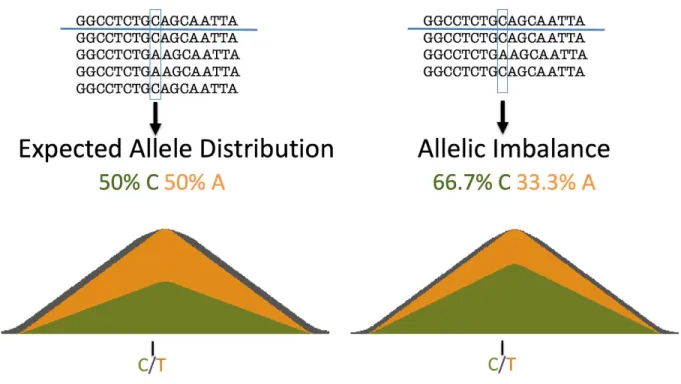
different alleles in the genome have differential levels of chromatin accessibility (Wagner et al). The ATAC-seq assay generates a sequencing readout. At a heterozygous site, we can quantify how much of the signal from the assay comes from one allele compared to the other. If there is a signaling imbalance, we can conclude that there is allelic imbalance (Figure 1).
Figure 1: Visualization of Allelic Imbalance with Sequencing Reads
This diagram demonstrates allelic imbalance with sequencing reads. The genome being aligned to is above each line, and the sequencing reads are below. The component on the left shows the expected allele distribution at a heterozygous site, whereas the right component shows allelic imbalance at the same site.
is affecting the overall gene regulatory program. We hypothesize that allelic imbalance analysis using ATAC-seq data will uncover instances of significant allelic imbalance at variants in
non-coding regulatory regions that have been associated with CD. This will serve as the basis for future hypotheses as to the functional mechanism driving this association.
In this project, we apply a robust computational pipeline that reduces mapping bias in allelic imbalance analysis using ATAC-seq data in noncoding regions. Mapping bias can arise when aligning a sequencing read to a genome. If the read does not contain the same sequence as that of the reference genome at a particular site, mapping can occur at a different location (Liu et al). This can be imprecise, as each read only represents one of the possible alleles at
heterozygous sites. By accounting for this by mitigating mapping bias, we are reducing the number of reads with non-reference alleles that are not being properly mapped to their true location. Sample data was later applied to this pipeline to determine allelic imbalance in Crohn’s Disease patients. An analysis of allelic imbalance sites from 10 patients was also performed.
Methods
Disease samples to generate paired-end reads in the form of fastq files. Fastq files were organized into three groups: nonIBD, uninflamed Crohn’s Disease colon tissue, and inflamed Crohn’s Disease colon tissue. Sample data was only processed from the nonIBD and uninflamed Crohn’s Disease colon tissue groups. Additionally, patients were genotyped using the
ImmunoChip genotyping array, and genotypes were phased and imputed using the University of Michigan Server. This created SNP data in the form of variant cell format (vcf) files.
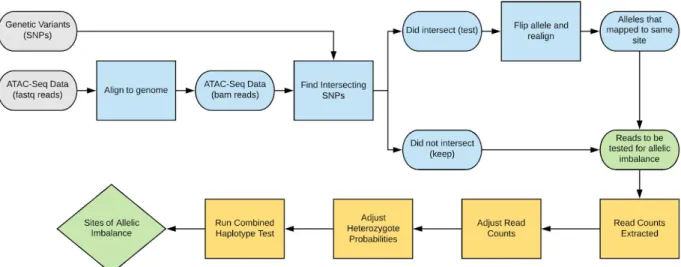
The WASP pipeline (van de Geijn et al) was used to perform allelic imbalance analysis for this project. Specifically, the mapping pipeline is used to mitigate mapping biases when aligning ATAC-seq reads to the genome. The output was a binary alignment map (bam) file which contained positional and counting data for each read. This served as an input for the combined haplotype test, which determined whether significant allelic imbalance was present for each site that had a heterozygous allele.
Figure 2:Overview of WASP Mapping Pipeline and CHT Test
Mapping Pipeline:
We converted variant information in the form of HDF5 files, which are in a binary format. The first step used the snp2h5 script to take the vcf input and output haplotypes.h5, index.h5, and snp_table.h5 files. These are referred to as h5 files throughout this analysis.
The fastq files were mapped to the hg19 reference genome using the bowtie aligner from the PEPATAC ATAC-seq pipeline. The output of this alignment process was a bam file, which stores similar information to the fastq files, in addition to containing read position information. This bam file was sorted and indexed using samtools.
To mitigate mapping bias, reads overlapping heterozygous sites were aligned normally, representing the reference allele. Then, a copy of these reads was created, but represented with the alternate allele and realigned. Reads that aligned to the same location with both alleles were kept (Figure 2). This step was performed using the find_intersecting_snps.py script, where the inputs were the h5 files, sample name, and output directory, and the output was a pair of fastq files. The output pair of fastq files were then mapped to the hg19 reference genome using the same alignment method. Again, bowtie was used, and the output .bam file was sorted and indexed.
Reads with the alternate allele represented that failed to map to the same position were removed. We used filter_remapped_reads.py with the inputs as each .bam file from the genome alignment; the output is a keep.bam file. Afterwards, this keep.bam file was merged with the first bam output to create a keep.merge.bam file by using the merge function in samtools. This
removed to avoid the double counting of reads by using the rmdup_pe.py script. The output bam file was sorted and indexed using samtools.
Combined Haplotype Test:
WASP’s Combined Haplotype Test uses the output bam file from the mapping pipeline and the SNP data used in the mapping file in the form of a vcf file. The SNP data was first converted to the binary h5 format to be utilized by WASP scripts. The bam file is also converted to the h5 format as the read counts are extracted from the bam2h5.py script.
Target regions and peaks for allelic imbalance were then identified using the get_target_regions.py script. Given the nature of regulatory elements, region sizes in open chromatin can vary from small distal regions to large promoter regions. In this step, the peaks were identified by SNP data, and regions were set to the default of 2000 bases. Peaks required that at least 10 reads overlapped the heterozygous site, with at least one from each allele, and that at least 100 total reads were in the defined peak.
The input for the statistical tests were then created using the
extract_haplotypes_read_counts.py script. This script uses the target regions and SNP peaks from the previous step to organize data in a new file format.
Read counts were adjusted after considering factors such as read depth and GC content and peakiness. The number of reads mapping to a target region were modelled with a
WASP accounts for this variability to provide an accurate representation of reads by using h5 files to discover regions of GC-rich content.
Reference and alternate allele total counts were used to adjust the heterozygote
probabilities in the statistical test input file. To avoid false positive heterozygous sites which can result from reads that only exhibit one allele, WASP assumes allele-specific reads follow two beta-binomial distributions (van de Geijn et al).
Then, the overdispersion parameters for the allele-specific beta-binomial test and association beta-negative binomial tests were estimated. These steps were performed using WASP’s update_het_probs.py, fit_as_coefficients.py, and fit_bnb_coefficients.py scripts before performing a combined likelihood ratio test. This test uses the aforementioned overdispersion parameters to compare the null and alternative hypotheses and generate a likelihood ratio statistic. For each site, a p value is calculated using this statistic.
Results
ATAC-seq data from the uninflamed tissue of 10 Crohn’s Disease patients served as input to the WASP pipeline to identify specific sites of allelic imbalance. First, for each individual, sequencing reads from the ATAC-seq were aligned or mapped to the human
reference genome, and reads that overlap heterozygous sites in an individual were identified. To remove any mapping bias, those same reads were modified to change the allele at the
heterozygous site to the alternate allele, and then the reads were re-mapped to the genome. Only those reads that were mapped to the same location were retained for further analyses. These reads were processed using a combined haplotype test, which performed statistical analyses and determined sites of significant allelic imbalance in each individual.
Sites of allelic imbalance in 10 Crohn’s Disease patients:
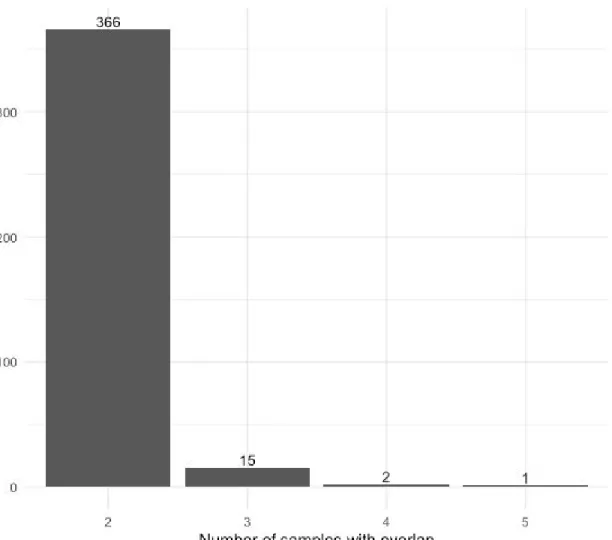
Figure 3: Histogram of allelic imbalance sites overlapping multiple samples
Each bar represents the number of sites that are present in the given number of samples. Of the 9470 statistically significant unique sites of allelic imbalance, 384 (4.05%) were present in at least two samples.
Allelic Imbalance in GWAS loci:
so a smaller number of sites overlapped unique GWAS loci. Two of these sites were further investigated, as they surrounded an interesting region in the genome (Figure 4).
Figure 4: Allelic imbalance sites overlapping GWAS loci
All allelic imbalance sites (p < 0.05) across the 10 samples that overlapped GWAS loci. Sites that were further investigated are in blue. The site in orange is present in two samples.
Allelic imbalance in a regulatory region near the IL2RA gene:
The IL2RA gene codes for a receptor protein that detects the IL2 cytokine. The IL2 cytokine plays a central role in organizing the immune response, and may cause Ulcerative Colitis susceptibility (Parkes et al).
The SNP at position 6110925 is in a CREBBP binding site. CREBBP is a protein which inhibits NFkB activity (McKay et al). NFkB has been documented as a key regulator in the chronic mucosal inflammation in Crohn’s Disease (Atreya et al). Additionally, each of these allelic imbalance sites encompass the transcription factor binding site of NFkB. Allelic imbalance at each of these sites could be influencing the inflammatory response in Crohn’s Disease.
Discussion
The purpose of this analysis was to apply WASP’s mapping and Combined Haplotype Test pipelines to the 169 patient samples. After processing each of the samples, an analysis was performed on the 10 Crohn’s Disease samples with the highest number of allelic imbalance sites. In the future, we aim to perform similar analyses on sites from all of the samples across both the Crohn’s Disease and nonIBD groups.
samples and overlapped a GWAS locus to merit further investigation. Therefore, we investigated other sites despite their only being present in a single sample.
Two of the sites that overlapped GWAS loci were found in the regulatory region of the IL2RA gene, which plays a key role in the immune response, and has been associated with Crohn’s Disease. At these heterozygous sites, allelic imbalance could be influencing the
inflammatory response in Crohn’s Disease by affecting transcription factor binding sites, due to differences in chromatin accessibility. By influencing whether a transcription factor could bind to the site, allelic imbalance could cause differential regulation of the target gene, IL2RA. Differential gene regulation would cause differential expression of this gene, which directly affects the inflammatory response.
We are performing a parallel allelic imbalance analysis with RNA-seq data. While ATAC-seq shows sites of open chromatin in noncoding regions, RNA-seq looks directly at gene expression (Wang et al). The RNA-seq analysis is performed on 195 patient samples, many of which have ATAC-seq data. Some of the GWAS loci are in coding regions, and allelic
imbalance sites of RNA-seq data may overlap these loci. Additionally, we can integrate allelic imbalance sites from the two datasets together to get a more comprehensive understanding of the mechanism behind gene expression pathways as they relate to Crohn’s Disease. If there is allelic imbalance in a promoter region, we can expect that the downstream gene variants, if
Acknowledgements
The Shehzad Sheikh Lab selected patients, processed tissue samples, and performed the ATAC-seq experiment (study #10-0355 (Dr. Hans Herfarth PI) and #17-0236 (Dr. Shehzad Sheikh, PI)). The Terrence Furey Lab performed the computational analysis, with help from Dr. Terrence Furey, Dr. Ben Keith, Rajee Ganesan, and Amber Tang.
References
Atreya I, Atreya R, Neurath MF. NF-kappaB in inflammatory bowel disease. J Intern Med. 2008;263(6):591–596. doi: 10.1111/j.1365-2796.2008.01953.x
Bouzid, Dorra, et al. “Polymorphisms in the IL2RA and IL2RB genes in inflammatory bowel disease risk.” Genetic Testing and Molecular Biomarkers, vol. 17, no. 11, 30 Oct 2013, pp. 833-839., doi:10.1089/gtmb.2013.0291
Buenrostro, Jason D., et al. “ATAC-Seq: A Method for Assaying Chromatin Accessibility Genome-Wide.” Current Protocols in Molecular Biology, 5 Jan. 2015,
doi:10.1002/0471142727.mb2129s109.
Dahlhamer, James M., et al. “Prevalence of Inflammatory Bowel Disease Among Adults Aged
≥18 Years — United States, 2015.” MMWR. Morbidity and Mortality Weekly Report, vol. 65, no. 42, 28 Oct. 2016, pp. 1166–1169., doi:10.15585/mmwr.mm6542a3.
Liu, Xinan, et al. “IMapSplice: Alleviating Reference Bias through Personalized RNA-Seq
McKay, Lorraine I. et al.“CBP (CREB Binding Protein) Integrates NF-κB (Nuclear Factor-κB) and Glucocorticoid Receptor Physical Interactions and Antagonism.” Molecular
Endocrinology, vol. 14, no. 8, 1 August 2000, pp. 1222–1234, https://doi.org/10.1210/mend.14.8.0506
Mirkov, Maša Umićević, et al. “Genetics of Inflammatory Bowel Disease: beyond NOD2.” The Lancet Gastroenterology & Hepatology, vol. 2, no. 3, 2 Mar. 2017, pp. 224–234., doi:10.1016/s2468-1253(16)30111-x.
Parkes, M et al. “Contribution of the IL-2 and IL-10 genes to inflammatory bowel disease (IBD) susceptibility.” Clinical and Experimental Immunology vol. 113,1 (1998): 28-32.
doi:10.1046/j.1365-2249.1998.00625.x
van de Geijn, B., McVicker, G., Gilad, Y. et al. WASP: allele-specific software for robust molecular quantitative trait locus discovery. Nat Methods 12, 1061–1063 (2015). https://doi.org/10.1038/nmeth.3582
Wagner, James R., et al. “Computational Analysis of Whole-Genome Differential Allelic Expression Data in Human.” PLoS Computational Biology, vol. 6, no. 7, 8 Jul. 2010, doi:10.1371/journal.pcbi.1000849.
Wang, Zhong et al. “RNA-Seq: a revolutionary tool for transcriptomics.” Nature reviews.
Genetics vol. 10,1 (2009): 57-63. doi:10.1038/nrg2484
Wen, Andy Y, et al. “The Role of the Transcription Factor CREB in Immune Function.” Journal
of Immunology, vol. 185, no. 11, 17 Nov. 2010, pp. 6413–6419.,