A Word Segmentation Method With Dynamic Adapting To Text
Using Inductive Learning
Zhongjian Wang Hokuto System Co.,LTD
Oyachi Higashi1-3-23, Atubetuku, Sapporo, 004-0041 Japan [email protected]
Kenji Araki
Graduate School of Engineering, Hokkaido University N13-W8, Kita-ku, Sapporo, 060-8628 Japan
[email protected] Koji Tochinai
Graduate School of Business Administration, Hokkai-Gakuen University, Asahimachi 4-1-40, Toyohira-ku, Sapporo, 062-8605 Japan
Abstract
We have proposed a method of word segmen-tation for non-segmented language using Induc-tive Learning. This method uses only surface information of a text, so that it has an ad-vantage that is entirely not dependent on any specific language. In this method, we consider that a character string of appearing frequently in a text has a high possibility as a word. The method predicts unknown words by recursively extracting common character strings. With the proposed method, the segmentation results can adapt to different users and fields. To evaluate effectivety for Chinese word segmentation and adaptability for different fields, we have done the evaluation experiment with Chinese text of the two fields.
1 Instruction
In NLP applications, word segmentation of non-segmented language is a very necessary initial
stage(Sun et al., 1998). In the other hands,
with the development of the Internet and popu-larization of computers, a large amount of text information in different languages on the In-ternet are increasing explosively, so it is nec-essary to develop a common method to deal with multi-language(Yamasita and Matsumoto, 2000). Furthermore, the standard of word seg-mentation is dependent on a user and destina-tion of use(Sproat et al., 1996), so that it is nec-essary that word segmentation can adapt users, can deal with multi languages.
In our method, we extract recursively a common character string that occur frequently
in text and call it a common part. When
some common parts contain still same charac-ter strings, furthermore we extract the same character string as high dimensional common parts and the remain parts is called different
parts. The high dimensional common parts
maybe have higher possibility as words because it is extracted by multi steps. Those extracted common parts and different parts are called WS(Word Segment), and classified into some ranks according to extracting condition. The proposed method segments a non-segmented sentence into words using the ranks of WS in order of the higher value of the certainty de-grees as words. When there are multiple seg-mentation candidates, the system gets a list of segmentable candidates, and picks a correct seg-mentation candidate from the list by using a value of LEF (Likelihood Evaluation Function,
Section 2.1) and so on. In addition, it is not
necessary to prepare a dictionary and any word segmentation rules beforehand. A dictionary of adapting to the user or the field is generated with increasing of processed text. Because only surface information of a text is used, it is possi-ble the method is used to deal with general non-segmented language. Here Inductive Learning is the procedure to extract recursively WS by multi steps(Araki et al., 1995).
2 Algrithm
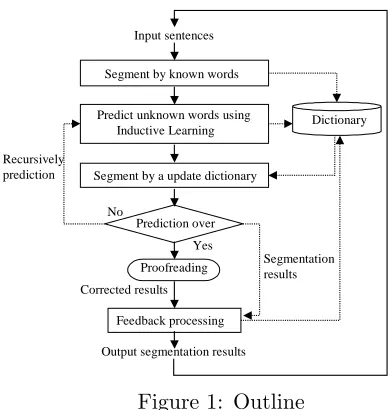
Fig. 1 shows the outline of the proposed
method.
Segment by a update dictionary
Prediction over No
Yes Input sentences
Predict unknown words using Inductive Learning Segment by known words
Output segmentation results Proofreading
Feedback processing
Segmentation results Corrected results
Recursively prediction
[image:2.612.74.269.71.276.2]Dictionary
Figure 1: Outline
(2) For the remaining part of the charac-ter strings that are unsegmented by the known words, the system predicts unknown words by extracting WS using Inductive Learning.
The system extracts WS as word candidates. This process is based on the supposition that a common character string of appearing repeat-edly in text has high probability as a word.
(3) The user judges whether the results of the word segmentation is correct or not. If there are errors in the result, the user will correct errors. (4) The system compares the proofread re-sults with the segmentation result to update the information in the dictionary. Through this procedure, the certainty of WS as a word is con-firmed and increased.
Here, the WS those are used in correct seg-mentation are called CW (Correct Word).
2.1 Segmentation by Known Words
Input sentence and then the system segments it into words by registered CW and WS that the system has got by using Inductive Learning until that time.
(1) In the first step, the system compares the registered CW or WS in the dictionary with the character string in the input sentence from the beginning of the sentence, and finds out the same character strings with the registered words. The system repeats this comparison pro-cess until the end of the sentence is reached. A list of segmentation candidate is established. Then the system segments the sentence into words.
(2) In the second step, however, for the char-acter strings of multiple segmentations, we use the registered candidates in order of their ranks
in the dictionary(Section2.3). When there are
more than one word candidate with the same rank, we decide the correct segmentation from the list of segmentation candidates by the value of LEF. We define LEF as follows:
LEF = F R+αCS−βES+γLE
F R+CS−ES+LE (1)
Where: FR, CS, ES and LE are the
fre-quency of CW or WS appearing in the text, the frequency of the correct segmentation, the fre-quency of the erroneous segmentation and the
length of CW or WS respectively. α,βandγare
coefficients. The optimum coefficients of LEF are decided by the preliminary experiments
us-ing Greedy method,α=10,β=1 and γ=5.
The word that has the maximum value of LEF is decided as the correct segmentation can-didate.
(3) When LEF value of the set of possible segmentations is equal to each other, the cor-rect segmentation candidate is decided by the word candidate that the value of ES is mini-mum, the value of CS is maximini-mum, the value of FR is maximum, the value of LE is the longest or the location of segmentation is the leftmost in a sentence in turn.
2.2 Prediction for Unknown Words
αβχδκϕφγΘπµτ γβπαβχδ
Θπµτ γβηΨφγτ γβαζθ.
Figure 2: An example of non-segmented sen-tence.
2.2.1 Extraction of a Common Part
A common part in non-segmented text is ex-tracted by two steps:
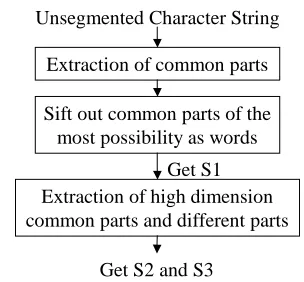
(1) When a character string appears in text frequently, we call it a common character string. If the common character string consists of more than two characters, we extract it as a word can-didate and call it common part and represent it by S1(Segment one). Here, we use length, fre-quency and location of S1 in the sentence to sift out it, to get the S1 of the most possible as a word. At this step, we acquired S1 from the
sentence that is shown in Fig. 2: “αβχδ”,“φγ”
and “Θπµτ γβ”.
(2) When the character string appears in the sentence only one times but meanwhile it is included in other extracted common part and made up by more than two characters, we also extract it as a word candidate. For example in
Fig. 2: “τ γβ” is included in “Θπµτ γβ”.
There-fore “τ γβ” is extracted and belongs to S1.
2.2.2 Extraction of a High Dimensional Common Part and a Different Part
The extracted S1 at 2.2.1 may still include a
common character string. At this situation, the common character string can be re-extracted moreover from the extracted S1. We consider it has a higher probability as a word that re-extracted common parts at this procedure. The conditions of re-extraction are presented as fol-lows:
(1) The common part can be re-extracted from the extracted S1 when it includes a com-mon character string that is more than two
characters. For example, “Θπµτ γβ” contains
“τ γβ” which can be extracted from “Θπµτ γβ”,
so “Θπµτ γβ(S1)” is equal to “Θπµ(S2)” +
“τ γβ(S3)”.
The part of re-extraction is called high di-mensional common part and represented by S2 (Segment two). The part of remain is called different part and represented by S3 (Segment three). The S1 is deleted from the dictionary
Extraction of high dimension common parts and different parts
Sift out common parts of the most possibility as words Extraction of common parts
Get S1
[image:3.612.348.500.71.212.2]Get S2 and S3 Unsegmented Character String
Figure 3: WS extraction procedure
when it is divided into S2 and S3.
(2) Furthermore one character can also be ex-tracted as a word candidate when both sides of it are extracted as a word candidate or both sides were segmented by known words.
Like “π” in “Θπµτ γβπαβχδ” is surrounded by
“Θπµτ γβ” and “αβχδ”, and “π” is extracted as a word candidate belonging to S2.
The extraction procedure is carried out re-peatedly until the new WS can not be extracted and the input can not be segmented.
2.3 Segmentation by a Update Dictionary
The extracted WS are classified to “S1”, “S2”,
and “S3”. Those WS that are confirmed
as a word by proofreading process are called
“CW” (Correct Word). Furthermore, the
FR(appearing FRequency), CS(Correct Seg-mentation frequency), ES(Erroneous Segmen-tation frequency), LE(LEength) and rankof a word candidate are rigestered simultaneously. Word Segmentation is carried out by the
up-date dictionary as2.1.
2.4 Feedback Process
Table 1: Experimental results
Fields Economics Engineering Average
words 92,085 70,017 162,102
CSR[%] 87.50 90.80 89.44
ESR[%] 5.40 5.60 5.45
USR[%] 7.10 3.60 5.11
feedbackprocess is described in detail as follows: (1) For the Correct Segmentation Results:
• When the result of segmentation is correct,
the value of FR and CS of a word that is used to segment are added one.
• If the rankof the words does not belong to
CW, it is changed to CW.
(2) For the Erroneous Segmentation Results:
• If the dictionary does not has the correct
words, the system registers the words in the dictionary. In this case, their FRs are 1, their ranks are CW.
• If the dictionary has the correct words, the
system adds one to the value of FR for a word and changes the value of CL to CW if it does not belong to CW.
• If the reason of erroneous segmentation is
that the erroneous word was used, then the ES of erroneous word is added one.
(3) For the Unsegmented Parts:
• The system registers the words in the
dic-tionary, as FR of the words equal 1 and rankequal CW.
3 Evaluation Experiments
3.1 Experimental Data And Procedure
To evaluate the adaptability of the proposed method for different fields and the effectivity for Chinese word segmentation. We use the Chi-nese text of two specialized fields from Sinica
Corpus1: the economics contains 92,085 words
and the engineering contains 70,017 words. To-tal words is 162,102. The economics consists of the text of economic system, economic policy and economic theory. The engineering consists of the text of electronics, communication engi-neering, machine engineering and nuclear indus-try.
1http://www.sinica.edu.tw/f tms−bin/kiwi.sh
0 10 20 30 40 50 60 70 80 90 100
0 2 4 6 8 10 12 14 16
Segmentation Rate(%)
Number of Words
Economics Engineering
Correct Segmentation Rate
Unsegmentation Rate Erroneous Segmentation Rate
[image:4.612.72.304.96.165.2](x10,000)
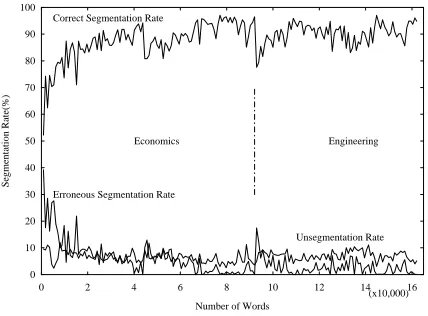
Figure 4: The changes of segmentation rates
In order to confirm the adaptability of pro-posed method to user, we let the initial
dic-tionary empty. We input a paragraph about
hundred words one times and two fields text in turns.
3.2 Experimental Results
The results of experiment are shown in Table 1. Fig. 4 shows the change of CSR, ESR and USR. In our method, the correct segmentation number is the number of correct segmentation that is judged by a user. The unsegmentation number is the number when all unsegmented strings are segmented correctly. The erroneous segmentation number is the number that sub-tracts the number of correct segmentation and unsegmentation from the number of all words in the input text. To evaluate the experiment result, we use these formulas of CSR (Correct Segmentation Rate), ESR (Erroneous Segmen-tation Rate) and USR (Unsegmented Rate) as follows:
CSR[%] =Correct segmentation number
T otal number of words ×100 (2)
ESR[%] =Erroneous segmentation number
T otal number of words ×100 (3)
U SR[%] = U nsegmentation number
T otal number of words ×100 (4)
4 Discussion
4.1 Adaptability To Different Fields
0 10 20 30 40 50 60 70 80 90
0 0.5 1 1.5 2 2.5 3 3.5 4 4.5 5
Precision & Recall
Number of words (x10,000)
[image:5.612.75.266.73.210.2]Precosion Recall
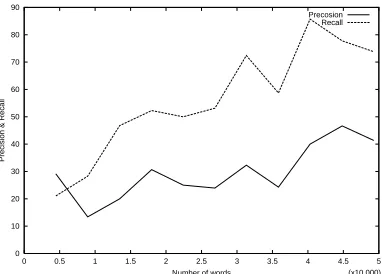
Figure 5: The ability to predict unknown words
is fall down temporary. However with increasing of processed sentence, the correct segmentation rate goes on increasing quickly.
We may consider that the proposed method has adaptability for different fields. Sometimes the correct segmentation rate is a little lower because the domain of text is a little difference, for example: the economics consists of the text of economic system, economic policy and eco-nomic theory and so on.
4.2 Evaluation of Ability for Predicting Unknown Words
We use 50,000 words to discuss the predicting ability of proposed method for unknown words.
P recision[%] = CW N
T W N ×100 (5)
Recall[%] = CW N
T U N ×100 (6)
Where, CWN is the number of words that are predicted correctly. TWN is the total number of words that are predicted. TUN is the total number of unknown words.
The precision and recall are shown in Fig. 5. The average precision is 26.0%. The average recall is 31.0%. With increasing of registered words in the dictionary, prediction effect for unknown words is becoming well, after 40,000 words are processed the precision and the recall are 85.0%, 40.0% respectively.
4.3 Analysis of Erroneous Segmentation
We select 1,000 words from the beginning of the experimental date and the end of the experi-mental date respectively, to analysis the reason
of an erroneous segmentation. At the begin-ning, ESR that is because of unregistered words is 18.0%, but after 16,000 words are processed, ESR that is because of unregistered words is 0.9%. However ESR that is caused by ambigu-ity goes on increasing from 1.6% to 7.0%. ESR caused by ambiguity is increasing with increas-ing of registered word in the dictionary. Am-biguous segmentation is still a difficult problem, so that it is necessary to improve the ability to deal with ambiguity.
5 Conclusion
The experiment results show the prediction ability for unknown words by using Inductive Learning. The experiment results of two fields shown the proposed method can adapt to dif-ferent fields text. In this paper, the emphasis is to evaluate the adaptivity of the method to dif-ferent user and fields. About comparison with other existed methods will be done in the future. The proposed method may be used to computer-aided acquisition of language
re-source. The experimental results show our
proposed method has ability of learning, pre-dictability for unknown words and effectivity for Chinese word segmentation. For the future works, we plan to improve the ability of dealing with segmentation ambiguity, and use this pro-posed method for Chinese morphological anal-ysis.
References
Kenji Araki, Yoshio Momouchi, and Koji
Tochi-nai. 1995. Evaluation for adaptability of
kana-kanji translation of non-segmentation
japanese kana sentences using inductive
learning. PACLING-II, pages 1–7.
Richard Sproat, Chilin Shih, William Gale, and Nancy Chang. 1996. A stochastic finite-state word-segmentation algorithm for
Chi-nese. Association for Computational
Linguis-tics, 22(3):377–404.
Maosong Sun, Dayang Shen, and Benjamin K
Tsou. 1998. Chinese word segmentation
without using lexicon and hand-crafted
train-ing data. 17th International Conference on