Epidemiological modelling of the
2005 French riots: a spreading wave
and the role of contagion
Laurent Bonnasse-Gahot
1, Henri Berestycki
1, Marie-Aude Depuise
t
2,3,4, Mirta B. Gordon
4,
Sebastian
Roché
2, Nancy Rodriguez
5& Jean-Pierre
Nadal
1,6As a large-scale instance of dramatic collective behaviour, the 2005 French riots started in a poor suburb of Paris, then spread in all of France, lasting about three weeks. Remarkably, although there were no displacements of rioters, the riot activity did travel. Access to daily national police data has allowed us to explore the dynamics of riot propagation. Here we show that an epidemic-like model, with just a few parameters and a single sociological variable characterizing neighbourhood deprivation, accounts quantitatively for the full spatio-temporal dynamics of the riots. This is the first time that such data-driven modelling involving contagion both within and between cities (through geographic proximity or media) at the scale of a country, and on a daily basis, is performed. Moreover, we give a precise mathematical characterization to the expression “wave of riots”, and provide a visualization of the propagation around Paris, exhibiting the wave in a way not described before. The remarkable agreement between model and data demonstrates that geographic proximity played a major role in the propagation, even though information was readily available everywhere through media. Finally, we argue that our approach gives a general framework for the modelling of the dynamics of spontaneous collective uprisings.
Attracting worldwide media attention, France experienced during the Autumn of 2005 the longest and most geo-graphically extended riot of the contemporary history of Europe1,2. Without any political claims nor leadership, localization was mainly limited to the “banlieues” (suburbs of large metropolitan cities), where minority groups are largely confined. Contrary to the London “shopping riots” of 2011, rioting in France essentially consisted of car destruction and confrontations with the police. The triggering event took place in a deprived municipality at the north-east of Paris: on October 27, 2005, two youths died when intruding into a power substation while trying to escape a police patrol. Inhabitants spontaneously gathered on the streets with anger. Notwithstanding the dramatic nature of these events, the access to detailed police data3, together with the extension in time and space–three weeks, more than 800 municipalities hit across all of France–, provide an exceptional opportunity for studying the dynamics of a large-scale riot episode. The present work aims at analysing these data through a mathematical model that sheds new light on qualitative features of the riots as instances of collective human behaviour4,5.
Several works6–15 have developed mathematical approaches to rioting dynamics, and their sociological impli-cations have also been discussed16. The 1978 article of Burbeck et al.8 pioneered quantitative epidemiological modelling to study the dynamics of riots. Very few works followed the same route, but similar ideas have been applied to other social phenomena such as the spreading of ideas or rumours17 and the viral propagation of memes on the Internet18. This original epidemiological modelling was however limited to the analysis within single cities, without spatial extension. From the analysis of various sources, previous historical and sociological studies have discussed riot contagion from place to place19–23. However few studies aim at quantitatively describing the spatial
1École des Hautes Études en Sciences Sociales, PSL Research University, CNRS, Centre d’Analyse et de Mathématique Sociales, Paris, France. 2University Grenoble Alpes, Institut d’Etudes Politiques de Grenoble, CNRS, PACTE, Grenoble, France. 3Université de Lille, CNRS, UMR 8019 - CLERSÉ - Centre Lillois d’Études et de Recherches sociologiques et Économiques, Lille, France. 4University Grenoble Alpes, CNRS, LIG, Grenoble, France. 5The University of North Carolina at Chapel Hill, Department of Mathematics, Chapel Hill, USA. 6Laboratoire de Physique Statistique, École Normale Supérieure, PSL Research University; Université Paris Diderot, Sorbonne Paris-Cité; Sorbonne Universités, UPMC – Université Paris 06; CNRS, Paris, France. Correspondence and requests for materials should be addressed to J.-P.N. (email: [email protected])
Received: 16 August 2017 Accepted: 2 December 2017 Published online: 08 January 2018
spread of riots, except for two notable exceptions. Studies of the 2011 London riots13,14 describe the displacements of rioters from neighbourhoods to neighbourhoods. In contradistinction with the London case, media reports and case studies3,24 show that the 2005 French rioters remained localized in a particular neighbourhood of each municipality. However, the riot itself did travel. Conceptualizing riots as interdependent events, Myers makes use of the event history approach25 to study the US ethnic riots on a period of several years. This analysis exhibits space-time correlations showing that riots diffused from cities to cities10,23,26. There, each rioting episode is con-sidered as a single global event (whether the city “adopts a riot” or does not), and measures of covariances allow to relate the occurrence of a riot in a city at a given time with the occurrence of riots in other cities at previous times. This approach however does not describe the internal dynamics of a riot (its rise and fall within each city), nor the precise timing of the spread from city to city. Of course, going beyond this framework requires much more detailed data.
Our dataset, at a level of detail hitherto unavailable, allows us to provide the first data-driven modelling of riot contagion from city to city at the level of a whole country, coupled with contagion within each city, and with a time resolution of a day. Our work, of a different nature than that of the econometric one, takes its root in the epidemiological approach introduced in the seminal work of Burbeck et al.8, and is in the spirit of recent contin-uous spatio-temporal data-driven approaches in social science14,27–29. Here we extend the notion of epidemio-logical propagation of riots by including spatial spreading, in a context where there is no displacement of rioters. Remarkably, the high quality of our results is achieved within the sole epidemiological framework, without any explicit modelling of, e.g., the police actions (in contrast with the 2011 London riots modelling14). For the first time, the present study provides a spatio-temporal framework that shows that, following a specific triggering event, propagation of rioting activity is analogous (but for some specificities) to the continuous propagation of epidemics.
More precisely, we introduce here a compartmental epidemic model of the Susceptible-Infected-Recovered (SIR) type30–32. Infection takes place through contacts within cities as well as through other short- and long-range interactions arising from either interpersonal networks or media coverage6,23. These influence interactions are the key to riots spreading over the discrete set of French municipalities. In particular, diffusion based on geographic proximity played a major role in generating a kind of riot wave around Paris which we exhibit here. This is sub-stantiated by the remarkable agreement between the data and the model at various geographic scales. Indeed, one of our main findings is that less than ten free parameters together with only one sociological variable (the size of the population of poorly educated young males) are enough to accurately describe the complete spatio-temporal dynamics of the riots.
The qualitative features taken into account by our model–the role of a single triggering effect, a “social tension” buildup, a somewhat slower and rather smooth relaxation, and local as well as global spreading–, are common to many riots. This suggests that our approach gives a general framework for the modelling of the spatio-temporal dynamics of spontaneous collective uprisings.
Results
The 2005 French riots dataset.
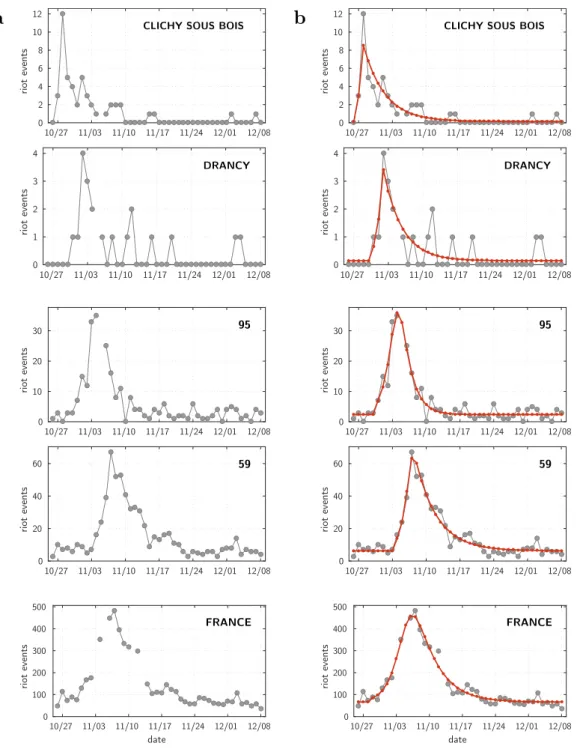
We base our analysis here on the daily crime reports3 of all incidents recorded by the French police at the municipalities (corresponding to the French “communes”) under police authority, which cover municipalities with a population of at least 20,000 inhabitants. Such data, on the detailed time course of riots at the scale of hours or days, and/or involving a large number of cities, are rare. In addition, as an output of a centralized national recording procedure applied in all national police units operating at the local level, the data are homogeneous in nature–and not subject to the selection or description biases which are frequent with media sources33. These qualities endow these data with a unique scientific value. We adopt a simple methodology for quantifying the rioting activity: we define as a single event any rioting-like act, as listed in the daily police reports, leaving aside its nature and its apparent intensity. Thus, each one of “5 burnt cars”, “police officers attacked with stones” or “stoning of firemen”, is labelled as a single event. We thus get a dataset composed of the number of riot-like events for each municipality, every day from October 26 to December 8, 2005, a period of 44 days which covers the three weeks of riots and extends over two weeks after.Figure 1a (left panel) shows at its top two typical examples of the time course of the number of events for municipalities (see also the plots for the 12 most active Île-de-France municipalities, Supplementary Fig. S1). A striking observation is that there is a similar up-and-down dynamics at every location, showing no rebound, or, if any, hardly distinguishable from the obvious stochasticity in the data. This pattern is similar to the one observed for the US ethnic riots8. In addition, as illustrated on Fig. 1 and Supplementary Fig. S3, we observe the same pat-tern across different spatial scales (municipalities, départements, régions, all country–see Materials and Methods for a description of these administrative divisions). Moreover, this pattern shows up clearly despite the difference in amplitudes (see also section Fitting the data: the wave across the whole country). This multi-scale property sug-gests an underlying mechanism for which geographical proximity matters. Finally, the rioting activity appears to be on top of a background level: as can be seen on Fig. 1, the number of events relaxes towards the very same level that it had at the outset of the period. Actually, in the police data, one cannot always discriminate rioting facts from ordinary criminal ones, such as the burning of cars unrelated to collective uprising. For each location, we assume that the stationary background activity corresponds to this “normal” criminal activity.
As the rioting activities are described by a discrete set of events, we assume an underlying point process34 characterized by its mean value. Assuming no coupling between the dynamics of the rioting and criminal activ-ities (see Materials and Methods for a discussion), the expected number of events at each site k (k= 1, ..., K, K
being the number of sites), is the sum of the mean (time independent) background activity λbk, and of the (time
dependent) rioting activity, λk(t). In fitting the model to the data, we take the background activity λbk as the
aver-age number of events at the considered site over the last two weeks of our dataset. Assuming Poisson statistics (which appears to be in good agreement with the data, see Materials and Methods), the means λk(t) fully
charac-terize the rioting activities. We make the assumption that this number of events λk(t) is proportional to the local
number of rioters, Ik(t):
Figure 1. Data and single site fits at different scales. (a) Raw data (grey dots), provided alone for a clearer
λk( )t =αI tk( ). (1) We model the coupled dynamics of the set of 2 ×K variables, the numbers Ik(t) of rioters (infected individuals
in the terminology of the SIR model) and the numbers Sk(t) of individuals susceptible to join the riot, by writing an
epidemic SIR model30,32 in a form suited for the present study, as explained below. This gives the coupled dynam-ics of the λk(t) and of the associated variables,
σk( )t ≡αS tk( ). (2)
These dummy variables can be seen as the reservoirs of events (the maximum expected numbers of events that may occur from time t onwards). We fit the model to the data by considering a discrete time version of the equations (events are reported on a daily basis), and by optimizing the choice of the model free parameters with a maximum likelihood method. The result of the fit is a set of K smooth curves (in time), λk(t), k= 1, .., K. For each location k, and each time t, the corresponding empirical data point has to be seen as a probabilistic realization of the Poisson process whose mean is λk(t).
Before going into the modelling details and the fits, we now give the main characteristics of the proposed SIR model. We assume homogeneous interactions within each municipality (a hypothesis justified by the coarse-grained nature of the data, and by the absence of displacements of rioters), and influences between sites. The model thus belongs to the category of metapopulation epidemic models35. Motivated by the relative smooth-ness of the time course of events, we make the strong assumption that, at each site, there is a constant rate at which rioters leave the riot. This parameter aggregates the effects of different factors–arrests, stringent policing, other sources of deterrence, fear, fatigue, etc.–, none of them being here modelled explicitly. In addition, since there are almost no rebounds of rioting activity, we assume that there is no flux from recovered (those who left the riot) to
susceptible (and thus we do not have to keep track of the number of recovered individuals).
In the epidemic of an infectious disease, contagion typically occurs by dyadic interactions, so that the proba-bility for a susceptible individual to be infected is proportional to the fraction of infected individuals–leading to equations written in terms of the fractions of infected and susceptible individuals. In the present context, conta-gion results from a bandwagon effect4,7,36. The probability of becoming a rioter is thus a function of the number of rioters, hence of the number of events given the above hypothesis. This function is non-linear since, being a probability, it must saturate at some value (at most 1) for large rioting activities.
Single site epidemic modelling.
As a first step, following Burbeck et al., we ignore interactions between sites, and thus specify the SIR model for each site separately. We consider here one single site (and omit the site index k in the equations). Before a triggering event occurs at some time t0, there is a certain number S0> 0 ofsusceptible individuals but no rioters. At t0 there is an exogenous shock leading to a sudden increase in the I
population, hence in λ, yielding an initial condition λ(t0) =A> 0. From then on, the rioting activity at a single
(isolated) site evolves according to:
d t
dt t t t
d t
dt t t
( ) ( ) ( ) ( ),
( ) ( ) ( ),
(3)
λ ωλ βσ λ
σ βσ λ
= − + = −
where β is a susceptibility parameter. Here we work within a linear approximation of the probability to become infected, which appears to provide good results for the single site modelling. The condition for the riot to start after the shock is that the reproduction number31R
0=βσ(t0)/ω is greater than 1. In such a case, from t=t0
onward, the number of infected individuals increases, passes through a maximum and relaxes back towards zero. We obtain the initial condition σ0=σ(t0) =αS0 from the fitting procedure. Thus for each site, we are left with
five free parameters to fit in order to best approximate the time course of the rioting events: ω, β, t0, A and σ0.
By showing examples at different scales, Fig. 1(b, red curves) illustrate the remarkable quality of the resulting fits (see also Supplementary Fig. S1). The obvious limitation is that fitting all the 853 municipalities present in the dataset amounts to determining 853 × 5 = 4265 free parameters. The fit is very good but meaningless (overfitting) for sites with only one or two events. In addition, these single site fits cannot explain why the riot started on some particular date at each location. Fitting the single site model requires one to assume that there is one exogenous specific shock at a specific time at each location, whereas the triggering of the local riot actually results from the riot events that occurred before elsewhere. Nevertheless, we see that everywhere the patterns are compatible with an epidemic dynamics and that through the use of the model it is possible to fill in missing data and to smooth the data (filtering out the noise). As a result of this filtering, the global pattern of propagation becomes more apparent. Indeed, looking at the Paris area, one observes a kind of wave starting at Clichy-sous-Bois municipality, diffusing to nearby locations, spreading around Paris, and eventually dying out in the more wealthy south-west areas (see Supplementary Video 1).
Modelling the riot wave.
We now take into account the interactions between sites, specifying the global metapopulation SIR model. Among the K sites under consideration, only one site k0, the municipality ofClichy-sous-Bois (département 93 when working at département scale), undergoes a shock at a time t0, October
λ ωλ σ
σ σ
= − + ψ Λ = − Ψ Λ
d t
dt t t t
d t
dt t t
( ) ( ) ( ) ( ( )),
( ) ( ) ( ( )),
(4)
k k k
k
k k
here ω is the site-independent value for the recovering rate. For the interaction term we consider that at any site
k the probability to join the riot is a function Ψ of a quantity Λk(t), the global activity as “seen” from site k. This represents how, on average, susceptible individuals feel concerned by rioting events occurring either locally, in neighbouring cities, or anywhere else in France. Whatever the means by which the information on the events is received (face-to-face interaction, phone, local or national media–TV or radio broadcasts, newspapers–, digital media, …), we make the hypothesis that the closer the events (in geographic terms), the stronger their influence. We thus write that Λk(t) is a weighted sum of the rioting activities occurring in all sites,
∑
λΛ( )t = W ( ),t
(5) k
j kj j
where the weights Wkj depend on the distance between sites k and j. A simple hypothesis would have been to
assume nearest-neighbour contagion. We have checked that such scenario fails to reproduce the riots dynamics, which can be easily understood: the riot would not propagate from areas with deprived neighbourhoods to other similar urban areas whenever separated by cities without poor neighbourhoods. We rather consider the weights as given by a decreasing function of the distance. We tested several ways of choosing this function and obtained the best results for two types of parameterization. One is a power law decay with the distance, motivated by several empirical studies of interactions relying on modern technologies37–39. The second option is the sum of an exponential decay and of a constant term. Both involve two parameters, a proximity scale d0 and, respectively, the
exponent δ and the strength ξ of the constant term.
For the (site independent) function Ψ(.), we consider either its linear approximation, writing
∑
β β λ
Ψ Λ( ( ))t = Λ( )t = W ( ),t
(6)
k k
j kj j
with the susceptibility β as a site-independent free parameter, or various non-linear cases, involving up to four parameters.
Lastly, we have to make the crucial choice of the initial values σk,0=σk(t0), specific to each site. By definition,
they must be proportional to the size of the initial susceptible population. We make the hypothesis that the latter scales with the size of a population defined by a sociological specification. Thus we assume
σk,0=ζ0 Nk, (7)
where ζ0 is a site-independent free parameter, and Nk is the size of a reference population provided for each
municipality by INSEE, the French national statistics and economic studies institute. The results we present below take as reference the population of males aged between 16 and 24 out-of-school with no diploma. We find this population, whose size can be viewed as an index of deprivation, to provide the best results when comparing the model fits done with different reference populations (see Materials and Methods). This is in line, not only with the fact that riots started and propagated in poor neighbourhoods, but also with the fact that most rioters where males, young, and poorly educated1–3–features common to many urban riots5. One should note that, once we have chosen this specific reference population–hence setting the susceptible population in deprived neighbour-hoods–, the hypotheses on the structure of the interactions implicitly assume interactions between populations with similar socio-economic characteristics. In particular, a distance-independent term in the interaction weights may correspond to proximity primarily perceived in terms of cultural, socio-economic characteristics. Our model thus allows to combine spatial and socio-economic characteristics, which are both known to potentially affect riot contagion10,40.
Finally, for the whole dynamics (with a number of coupled equations ranging from 186 up to 2560, depending on the case, see below), in the simplest linear case we are left with only six free parameters: ω, A, ζ0, d0, δ or ξ, and
β. In the non-linear case, we have five parameters as for the linear case, ω, A, ζ0, d0, δ or ξ, and, in place of β, up
to four parameters depending on the choice of the function Ψ. In the following, we will also allow for specific β
values at a small number of sites, adding as many parameters.
The above model, in the case of the linear approximation, makes links to the classical spatially continuous, non-local, SIR model41 (see section Links to the original spatially continuous SIR model in Materials and Methods, and Supplementary Videos 3 and 4). In dimension one, when the space is homogeneous, we know42 that travelling waves can propagate, quite similar to the way the riot spread around Paris as exhibited in the previous section. The new class of models we have introduced is however somewhat different and more general, and raises several open mathematical questions. The next section shows the wave generated by our global model and the fit to the data.
whole dynamics. We choose the free parameters with the maximum likelihood method, making use of the availa-ble data, i.e. the 462 municipalities. However, the model simulations take into account all the 1280 municipalities. Results are presented for a power law decrease of the weights and a non-linear function Ψ characterized by 3 parameters (see Materials and Methods for a quantitative comparison of different model variants). Thus, we have here a total of 8 free parameters: ω, A, ζ0, d0, δ, in addition to three for the non-linear function.
Figures 2, 3 and the Supplementary Video 2 illustrate the main results. Figure 2 compares the model and the data on four aspects: time course in each département (a), amplitude of the events (b), date at which the number of events is maximum (c), and spatial distribution of the riots (d). The global model with a single shock correctly
Figure 2. Results: Île-de-France région, model calibration at the scale of municipalities. (a) Time course of
reproduces the up-and-down pattern at each location, as illustrated on Fig. 2 at département scale. One can note the preservation of the smooth relaxation at each site, despite the influence of other (still active) sites. This can be understood from the SIR dynamics: at a given location, the relaxation term (−ωλk) dominates when there is
no more enough susceptible individuals, so that the local dynamics becomes essentially independent of what is occurring elsewhere. Quite importantly, these local patterns occur at the correct times. One sees that the date of maximum activity spreads over several days and varies across locations, which reflects the propagation of the riot. On the Supplementary Video 2 one can see the wave generated by the model. Figure 3b shows a sketch of this wave as a timeline with one image every 4 days–which corresponds to the timescale found by the parameter opti-mization, 1/ω ∼4 days. For comparison, we show side by side, Fig. 3a, the timeline built from the data which have been smoothed making use of the single site fits. One can see the good agreement, except for few locations where the actual rioting activity occurs earlier than predicted by the global model. A most visible exception is Argenteuil municipality (north-west of Paris on the map, see Fig. 3, second images from the top), where the Minister of Interior made a speech (October 25) perceived as provocative by the banlieues residents. This could potentially explain the faster response to the triggering event.
Figure 3. Timeline of the riots in Paris area (Île-de-France). The rioting activity is shown every 4 days, starting
The calibrated model gives the time course of the expected number of events in all municipalities, including those under “gendarmerie” authority for which we do not have any data. For all of the later, the model predicts a value remaining very small during all the studied period, except for one, the municipality of Fleury-Mérogis (see Fig. 2d, South of the map). Remarkably, searching in the media coverage, we found that a kindergarten has been burnt in that municipality at that period of time (Nov. 6).
Fitting the data: the wave across the whole country.
We now show that the same model reproduces the full dynamics across the whole country. We apply our global model considering each one of the départements of metropolitan France (except Corsica and Paris, hence 93 départements) as one homogeneous site–computing at municipality scale would be too demanding (more than 36,000 municipalities). The Materials and Methods section details the comparison between various model options. We present here the results for the model version making use of the linear approximation, with 9 free parameters: ω, A, ζ0, d0, ξ, the same susceptibility βevery-where except for three different values, for the départements 13, 62 and 93. As for the wave around Paris, the resulting fit is very good, as illustrated on Fig. 4 (see also Supplementary Fig. S3). Figure 4a and b show the results for the 12 most active départements. Figure 4c compares model and data on the total number of events, and Fig. 4d on the date of the maximum activity. For the latter, the data for the Île-de-France municipalities (Fig. 2c) are reported. One sees that the wave indeed spread over all France, with the dynamics in Paris area essentially preceding the one elsewhere.
Remarkably, one can see the effect of the riot wave even where few rioting events have been recorded. The data exhibit a concentration of (weak) activities (Fig. 5a), a pattern which would not be expected in case of independent random events. The epidemiological model predicts these minor sites to be hit by the wave, with a small amplitude and at the correct period of time. This is apparent on Fig. 5b and can be shown to be statistically significant (see Materials and Methods and Supplementary Fig. S4 for more details).
Finally, we validate here the hypothesis that it is the number, and not the proportion, of individuals (suscepti-ble individuals, rioters) that matters. The very same model, but with densities and not numbers, yields a much less good fit (see Materials and Methods). This comes as a quantitative confirmation of the hypothesized bandwagon effect, in line with previous literature4,7.
Discussion
Studying the dynamics of riot propagation, a dramatic instance of large-scale social contagion, is difficult due to the scarcity of data. The present work takes advantage of the access to detailed national police data on the 2005 French riots that offer both the timescale of the day over a period of 3 weeks, and the geographic extension over the country. These data exhibit remarkable features that warrant a modelling approach. We have shown that a simple parsimonious epidemic-like model combining contagion both within and between cities, allows one to reproduce the daily time course of events, revealing the wave of contagion. The simplest model version with only 6 parameters already accounts for the wave very well, and more elaborated versions with about 10 parameters account for even finer details of the dynamics. A crucial model ingredient is the choice of a single sociological variable, taken from the census statistics as a proxy for calibrating the size of the susceptible population. It shows that the wave propagates in an excitable medium of deprived neighbourhoods.
It is interesting to put in contrast the results obtained here with a model where homogeneous weights are independent of the geographic distance, which we can consider as a null hypothesis model with regards to the geographic dependency. As discussed in Materials and Methods and illustrated on Supplementary Fig. S5, such a hypothesis fails to produce a wave, and, more unexpectedly, cannot account for the amplitudes of the riot. This confirms that diffusion by geographic proximity is a key underlying mechanism, and points towards the influence on the riots breadth of the concentration of urban areas with a high density of deprived neighbourhoods (as it is the case for the départements of Île-de-France, 77, 78, 91, 92, 94 and 95). Thus, one can conclude that, having the outbreak location surrounded by a dense continuum of deprived neighbourhoods made the large-scale contagion possible.
What lesson on human behaviour can we draw from our analysis? First, as we just indicated, “geography matters”39: despite the modern communication media, physical proximity is still a major feature in the circu-lation of ideas or behaviours, here of rioting. Second, strong interpersonal ties are at stake for dragging people into actions that confront social order. The underlying interpretation is that interpersonal networks are relevant for understanding riot participation. Human behaviour is a consequence not only of individuals’ attributes but also of the strength of the relation they hold with other individuals44. Strong interpersonal connections to others who are already mobilized draw new participants into particular forms of collective action such as protest, and identity (ethnic or religious based) movements45,46. Third, concentration of socio-economic disadvantage facili-tates formation of a sizeable group and therefore involvement in destruction: the numbers of rioters in the model (rather than proportions) can be interpreted as an indirect indication of risk assessment before participating in a confrontation with the police5,47. From this viewpoint, rioters seem to adopt a rational behaviour and only engage in such event when their number is sufficient.
Whether an initially local riot initiates a wave, and, if so, what is its geographic extension, depend on condi-tions similar to those at work for disease propagation: a high enough density of susceptible individuals, a suitable contact network and large enough susceptibilities. The 2005 riot propagation from place to place after a single shock is reminiscent of the spreading of other riots, such as the one of food riots in the late eighteen century in the UK21, or of local propagations during the week of riots in the US in reaction to Martin Luther King assassination. The latter series of riots has been coined as a “wave within a wave”, the larger wave corresponding to the series of US ethnic riots from 1964 to 197123. However, this larger ‘wave’ does not appear to be of the same nature as the travelling wave discussed here. Indeed, first, most of the riots in this long time period in the US have each their
Figure 4. Results: All of France, model calibration at the scale of the départements. (a) Time course of the riots
own triggering event. Second, these events are separated one from another by large times gaps and are therefore discontinuous whereas we describe the continuous epidemiological spreading by a wave. To discuss such series of riots as these over long period of times, we note that there is no conceptual difficulty in extending our model to larger timescales–by adding a weak flux from recovered to susceptible individuals, and by dealing with several shocks–, although one would also have to take into account group identity changes and the effect of policies on structural characteristics of cities. However, the main issue here is rather the access to a detailed set of data.
In any case, the modelling approach introduced here provides a generative framework, different from the sta-tistical/econometric approach, that may be adapted to the detailed description of the propagation of spontaneous collective uprisings from a main triggering event–notably, the interaction term in our SIR model can be modified to include time delays (time for the information to travel), to take into account time integration of past events, or to be also based on non-geographic criteria (e.g. cultural, ethnic, socio-economic similarity features). We believe that such extensions will lead to interesting developments in the study of spreading of social behaviours.
Materials and Methods
French administrative divisions.
The three main French administrative divisions are: the “commune”, which we refer to as municipality in the paper (more than 36,000 communes in France); at a mid-level scale the “département”, somewhat analogous to the English district (96 départements in Metropolitan France, labelled from 1 to 95, with 2A and 2B for Corsica); the “région” aggregating several neighbouring départements (12 in Metropolitan France, as of 2016, excluding Corsica). At a given level, geographic and demographic characteristics are heterogeneous. The typical diameter of a département is ∼100 km, and the one of a région, ∼250 km.There are two national police forces, the “police” and the “gendarmerie” (a civilian like police force reporting to the ministry of Interior whose agents have a military status in charge of policing the rural parts of the country). Most urbanized areas (covering all municipalities with a population superior to 20000) are under police author-ity. The more rural ones are under gendarmerie authorauthor-ity. The available data for the present study only concern the municipalities under police authority, except Paris, for which we lack data (but was not much affected by the riots).
The full list of the municipalities is available on the French government website, https://www.data.gouv.fr/fr/ datasets/competence-territoriale-gendarmerie-et-police-nationales/.
Dataset.
From the source to the dataset. The present analysis is based on the daily crime reports of all inci-dents of civil unrest reported by the French police at the municipalities under police authority3 (see above). We have been working with this raw source, that is the set of reports as transmitted by the local police departments, before any formatting or recoding by the national police statistical unit. The daily reports are written in natural language, and have been encoded to allow for statistical treatment. From the reports we selected only facts related to urban violence. Some facts are reported more than once (a first time when the fact was discovered, and then one or two days later e.g. if the perpetrators have been identified). We carefully tried to detect and suppress double counting, but some cases may have been missed.In the police data, incidents in relation with the riots are mostly cases of vehicles set on fire (about 70%), but also burning of public transportation vehicles, public buildings, of waste bins, damages to buses and bus shelters, confrontations between rioters and police, etc. Facts have been encoded with the maximum precision: day and time of the fact, who or what was the target, the type of damage, the number and kind of damaged objects and the number and quality of persons involved, whenever these details are mentioned in the report. In the present work, as explained in the main text, from these details, we compute a daily number of events per municipality. We generated a dataset for these events (with a total of 6877 entries concerning 853 municipalities).
There are a few missing or incomplete data–notably in the nights when rioting was at its maximum, as the police was overwhelmed and reported only aggregated facts, instead of details city per city. Note that if one
Figure 5. Minor sites: Even where the number of events was very small, one can detect the riot wave. (a) Raster
has, e.g., a number of burnt cars only at the département scale, one cannot know what is the corresponding number of events, since each one of these events at municipality scale corresponds to an unknown number of burnt cars. Hence if for a particular day, the police report gives the information only aggregated at département scale, one cannot even make use of it when modelling at this scale. Quantitatively, for the analysis of the events in Île-de-France, working with the 462 municipalities under police authority, there is 1.6% of missing data (334 out of 462 × 44 days = 20,328 data values). For the analysis at the scale of the 93 départements, there is 0.2% of missing values (10 out 93 × 44 = 4092).
Datasets for future works. In addition, we have also built two other datasets. From the same police source, we built a dataset for the arrests (2563 entries), that in forthcoming work will serve to characterize the rioters as well as to investigate the deterrent effect of arrests on the riot dynamics. In future work we also plan to explore the rioting events beyond the sole number of events as studied here. One expects to see what has been for instance the role, if any, of curfews and other deterrent effects (in space and time). We also plan to study whether or not the intensity per event smoothly relaxes like the number of events itself. From both local newspapers and national TV and radio broadcasts, we built a specific dataset of media coverage. In ongoing work we extend our modelling framework by considering the coupling between the dynamics of riot events and the media coverage.
Background activity.
The rioting activity appears to be above a constant level which most likely corre-sponds to criminal activities (an average of an order of 100 vehicles are burnt every day in France, essentially due to criminal acts not related to collective uprising). Since this background activity has the same level before and after the riot, we assumed that the dynamics of the riot and of the criminal activities are independent. In addition, we also considered alternative models where the background activity and the rioting activity would be coupled, the background activity being considered as an equilibrium state, and the riot as a transient excited state. Such models would predict an undershooting of the activity just after the end of the riot–more exactly a relaxation with damped oscillations–, but the data do not exhibit such behaviour.For the fits, the background activity λb is taken as the mean activity over the last two weeks in our dataset
(November 25 to December 8), period that we can consider as the tail of the data, for which there is no longer any riot activity (see Fig. 1). For the sites with a non zero number of events in the tail, we observe that this base-line rate is proportional to the size of the reference population chosen for calibrating the size of the susceptible population. For the sites where the number of events in the tail is either zero or unknown (which is the case for a large number of small municipalities, in particular the ones under gendarmerie authority), one needs to give a non zero value to the corresponding baseline rate in order to apply the maximum likelihood method (see below). We estimated it from the size of the reference population (set as 1 when it is 0), using the latter proportionality coefficient (with a maximum value of λb set to one over the length of the tail, ie 1/14).
Statistical tests of the Poisson hypothesis are provided below, paragraph Poisson noise assumption, Stationary tails statistics.
Epidemiological modelling: Single site model.
We detail here the compartmental SIR model when applied to each site separately (each municipality, or, after aggregating the data, for each département). Let us consider a particular site (we omit here the site index k in the equations). At each time t there is a number S(t) of individual susceptible to join the riot, and I(t) of infected individuals (rioters). Those who leave the riots becomerecovered individuals. Since we assume that there is no flux from recovered to susceptible, we do not have to keep track of the number of recovered individuals. Initially, before a triggering event at some time t0 occurs, there is a
certain number S0> 0 of susceptible individuals but no rioters, that is, I(t) = 0 for all t≤t0. At t0 there is an
exoge-nous shock and the number of rioters becomes positive I(t0) =I0> 0. From there on, neglecting fluctuations, the
numbers of rioters and of susceptible individuals evolve according to the following set of equations:
Ι = −ωΙ + →
= − →
d t
dt t S t P s i t
dS t
dt S t P s i t
( ) ( ) ( ) ( , )
( ) ( ) ( , )
(8) Let us now explain this system of equations. In the first equation, ω is the constant rate at which rioters leave the riot. The second term in the right hand side of this first equation gives the flux from susceptible to infected as the product of the number of susceptible individuals, times the probability P(s→i,t) for a susceptible individual to become infected. The second equation simply states that those who join the riot leave the subpopulation of susceptible individuals.
We now specify the probability to join the riot, P(s→i,t) (to become infected when in the susceptible state). In line with accounts of other collective uprising phenomena5, testimonies from participants in the 2005 riots suggest a bandwagon effect: individuals join the riot when seeing a group of rioters in action. Threshold decision models7,36 describe this herding behaviour assuming that each individual has a threshold. When the herd size is larger than this threshold the individual joins the herd. Granovetter7 has specifically applied such a model to riot formation, the threshold being then the number of rioters beyond which the individual decides to join the riot. Here we make the simpler hypothesis that the probability to join the riot does not depend on idiosyncratic factors, and is only an increasing function of the total number of rioters at the location (site) under consideration. It is worth emphasizing that this herding behaviour is in contrast with the epidemic of an infectious disease, where contagion typically occurs from dyadic interactions, in which case the probability is proportional to the fraction
of infected individuals, I(t)/S0. Being a probability, P(s→i,t) must saturate at some value (at most 1) for large I,
approximate P(s→i,t) by its linear behaviour: P s( →i t, )∼κI t( ) (but note that κ does not scale with 1/S0) and
discuss later a different specification for this term.
Given the assumption λ(t) =αI(t), it is convenient to define
σ( )t =αS t( ) (9)
so that the riot dynamics at a single (isolated) site is described by:
d t
dt t t t
d t
dt t t
( ) ( ) ( ) ( )
( ) ( ) ( )
(10)
λ ωλ βσ λ
σ βσ λ
= − + = −
where β≡κ/α. Initially λ= 0, which is a fixed point of this system of equations. With σ(t0) =σ0> 0, the riot starts
after the shock if the reproduction number31R
0≡βσ0/ω=κS0/ω is greater than 1. In such a case, from t=t0
onward, the number of infected individuals first increases, then goes through a maximum and eventually relaxes back towards zero. Because κ is not of order 1/S0, this condition seems too easy to satisfy: at any time, any
per-turbation would initiate a riot. One may assume that the particular parameter values allowing one to fit the data describe the state of the system at that particular period. Previous months and days of escalation of tension may have led to an increase in the susceptibility κ, or in the number of susceptible individuals S0.
Epidemiological modelling: Non local contagion.
We give here the details on the global SIR model, with interactions between sites. We have a discrete number K of sites, with homogeneous mixing within each site, and interactions between sites. At each site k, there is a number Sk of “susceptible” individuals, Ik of “infected”(rioters), and Rk of “recovered” individuals. As above, there is no flux from recovered to susceptible (hence we
can ignore the variables Rk), and individuals at site k leave the riot at a constant rate ωk. Assuming homogeneous
mixing in each site, the dynamics is given by the following set of equations:
Ι
ω Ι
= − + → = →
d t
dt t S t P s i t
dS t
dt S t P s i t
( ) ( ) ( ) ( , )
( ) ( ) ( , )
(11) k
k k k k
k
k k
with the initial conditions t<t0Ik(t) = 0, Sk(t) =Sk0> 0, and at t=t0, a shock occurs at a single location k0, Ik(t0) =I0> 0. In the above equations, ωk is the local recovering rate, and Pk(s→i, t) is the probability for a
s-individual at location k to become a rioter at time t.
We now write the resulting equations for the λk. We assume the rioting activity to be proportional to the number of rioters:
λk( )t =αI tk( ) (12)
Note that different hypothesis on the dependency of λk on Ik could be considered. For instance we tested λ ∼k ( )Ikq with some exponent q coming as an additional free parameter. In that case, the optimization actually gives that q is close to 1.
Multiplying each side of (11) by α, one gets
d t
dt t t P s i t
d t
dt t P s i t
( ) ( ) ( ) ( , )
( ) ( ) ( , )
(13) k
k k k k
k
k k
λ ω λ σ
σ σ
= − + → = − →
where as before we introduce σk(t) =αSk(t). Taking into account the hypothesis on the linear dependency of the
number of event in the number of rioters, (12), we write P(s→i, t) directly in term of the λs:
→ = Ψ Λ
P sk( i t, ) k( ( ))k t (14)
where Λk(t) is the activity “seen” from site k (see main text):
∑
λΛ( )t ≡ W ( )t
(15) k
j kj j
where the weights Wkj are given by a decreasing function of the distance dist(k, j) between sites k and j: Wkj=
W(dist(k, j)) (see below). The single site case is recovered for Wkj=δk,j.
In the linear approximation,
β
d t
dt t t W t
d t
dt t W t
( ) ( ) ( ) ( )
( ) ( ) ( )
(17) k
k k k k
j kj j k
k k
j kj j
∑
∑
λ
ω λ β σ λ
σ β σ λ
= − + = −
The form of these equations is analogous to the ones of the original distributed contacts continuous spatial SIR model42 (see below) but here with a discrete set of spatial locations.
In the whole paper, we take a site independent value of the recovering rate, ωk=ω for every site k. Similarly, the susceptibility is chosen site-independent, βk=β, except for some variants where a few sites are singularized, see section Results, details: All of France, département scale, below.
In the non-linear case, we choose parameters for Ψk(Λ) in order to have a function (i) being zero when there is
no rioting activity; (ii) which saturates at a value (smaller or equal to 1) at large argument; (iii) with a monotonous increasing behaviour giving a more or less pronounced threshold effect (e.g. a sigmoidal shape). This has to be done looking for the best compromise between quality of fit and number of parameters (as small as possible). We tested several sigmoidal functions. For the fit of the Paris area at the scale of the municipalities, we made use of a variant with a strict threshold:
, ( ) 0
, ( ) (1 exp ( )) (18)
ck
ck ηk γk ck
Λ ≤ Λ Ψ Λ =
Λ > Λ Ψ Λ = − − Λ − Λ
The fit being done with site-independent free parameters, this function thus contributes to three free param-eters, Λc, η and γ.
Choice of the weights.
The best results are obtained for two options. One is a power law decay with the distance:= + −δ
Wkj (1 dist( , )/ )k j d0 (19)
where dist(k, j) is the distance between site k and site j (see below for its computation). The second option is the sum of an exponential decay and of a constant term
ξ ξ
= + − −
Wkj (1 ) exp( dist( , )/ )k j d0 (20)
In both cases we normalize the weights so that for every site k, Wkk= 1. Taking site-independent free
parame-ters, both cases give two free parameparame-ters, d0 and δ for the choice (19), d0 and ξ for the choice (20).
Distance-independent null hypothesis model.
In order to test for the possible absence of geographic dependency in the contagion process, we take as a “null hypothesis” model a version of our model where the weights Wkj do not depend on the distance between sites. In this version, a given site is concerned by what ishappening at its own location, and in an equally fashion by what is happening elsewhere. Mathematically, we thus consider the following weights:
ξ
=
{
=W 1, if, otherwisek j
(21) kj
where ξ is a constant term to be optimized as a free parameter. Apart from the choice of the weights, the model is the same as the one corresponding to the results shown on Fig. 4. Optimization is done over all the 8 free parameters. The results for this model are shown on Supplementary Fig. S5, to be compared with Fig. 4. As one would expect, this model does not generate any wave: following the shock, all the riot curves happen to peak at the same time. Remarkably, assuming no geographic effect in the interaction term does not simply affect the timing of the events: the model also fails to account for the amplitudes of the rioting activities (see Supplementary Fig. S5b).
For what concerns the statistical significance, as expected from the comparison between the figures, the distance-independent null hypothesis model is far worse than the model with geographic dependency, despite the fact that it has one less free parameter. Making use of the Akaike Information Criterion48 (AIC), the difference in AIC is ΔAIC =−438, which corresponds to a relative likelihood49 of 9.0e− 96. A similar conclusion is obtained from the BIC criterion50.
These results thus clearly underline the need for the interaction term to depend on the distance, supporting the view of a local contagion process.
d t
dt t t W
t N d t
dt t W
t N ( ) ( ) ( ) ( ) ( ) ( ) ( ) (22) k
k k k k
j kj j j k k k j kj j j
∑
∑
λω λ β σ λ
σ
β σ λ
= − + = −
where here β=κ/ζ0, and Nj is the size of the reference population at location j. These equations should be
com-pared with Eq. (17). Note that the weights being given by (20), the dependency in the population size Nj cannot
be absorbed in the weights.
Fitting this model with densities to the data leads to a much lower likelihood value compared to the model presented here. In the case of the fit of the whole dynamics at the scale of the départements, the difference in AIC is ΔAIC =−101, which corresponds to a relative likelihood of 9.6e− 23.
Links to the original spatially continuous SIR model.
In the case of the linear approximation, the meta-population SIR model that we have introduced leads to the set of equations (17) of a type simi-lar to the space-continuous non local (distributed contact) SIR model. With a view to describe the spreading of infections in spatially distributed populations, Kendall41 introduced in 1957 this non-local version of the Kermack-McKendrick SIR model in the form of space-dependent integro-differential equations. Omitting the recovered population R, the system in the S, I variables reads:∫
∫
ωΙ β β = − + = −dI x t
dt x t S x t K x y I y t dy
dS x t
dt S x t K x y I y t dy
( , ) ( , ) ( , ) ( , ) ( , )
( , ) ( , ) ( , ) ( , )
(23) where x∈N, with N= 1, 2, and here I(x, t) and S(x, t) are densities of immune and susceptible individuals. In the particular case of dimension N= 1, and the space is homogeneous, meaning here that K(x, y) is of the form
K(x, y) =w(x−y), we know42 that there exist travelling waves of any speed larger than or equal to some critical speed. Furthermore, this critical travelling wave speed also yields the asymptotic speed of spreading of the epi-demic51. There have been many mathematical works on this system and on various extensions18,52. Thus, at least in dimension N= 1 and for homogeneous space, this non-local system can generate travelling fronts for the density of susceptible individuals, hence the propagation of a “spike” of infected individuals. Although no proof exists in dimension N= 2, numerical simulations show that the model can indeed generate waves53,54, as illus-trated by the Supplementary Videos 3 and 4, similar to the way the riot spread around Paris giving rise to the informal notion of a riot wave.
However, the model we introduce here is more general and differs from the Kendall model in certain aspects. Indeed, rather than continuous and homogeneous, the spatial structure is discrete with heterogeneous sites. Moreover, the set of equations here (23) corresponds to the linear approximation (17), whereas our general model involves a non-linear term. The understanding of generalized travelling waves and the speed of propagation in this general context are interesting open mathematical problems.
More work is needed to assess the mathematical properties of the specific family of non local contagion models introduced here, that is defined on a discrete network, with highly heterogeneous populations, and a non-linear probability of becoming infected.
Date of the maximum.
Figures 2c and 4b show how well the model accounts for the temporal unfolding of the riot activity, thanks to a comparison between model and data of the date when the riot activity peaks at each location. Given the noisy nature of the data, the empirical date of that maximum itself is not well defined. For each site, we estimated this date as the weighted average of the dates of the 3 greatest values, weighted by those values. We filled in missing data values by linear interpolation.For the contagion around Paris, considering the 12 most active municipalities shown in Fig. 2c, the correlation coefficient is r= 0.80, p= 0.0017. At the scale of the whole country, Fig. 4d, considering the départements having more than 60 events, the correlation coefficient is equal r= 0.77, with a p-value of p= 5.2e− 6. Given the large differences in population size, the weighted correlation is more appropriate for comparing the timing of the riot activities. Using weights equal to the population sizes, this yields a weighted correlation coefficient of r= 0.87, with a p-value p< 1e− 5 estimated with a bootstrap procedure.
Non-free parameters: Choice of the reference population.
Populations statistics. For the choice of the reference population, we compared the use of various specific populations, considering cross-linked database that involve age, sex and diploma. The source of these populations statistics is the INSEE, the French national institute carrying the national census (http://www.insee.fr/). For the period under consideration, we used relevant data from 2006 since data from 2005 were not available.When applying the model at the scale of départements, for each département the size of a given specific popu-lation is computed as the sum of the sizes of the corresponding popupopu-lations of all its municipalities that are under police authority.
school (see Supplementary Fig. S7). We thus calibrated the susceptible population in (all variants of) the model by assuming that, for each site (municipality or département), its size is proportional to the one of the corresponding reference population.
Influence on the results. The choice of the reference population has a major influence on the results. We find that an improper choice cannot be compensated by the optimization of the free parameters. As an example when working at the scale of municipalities, compare Supplementary Fig. S2, for which the reference population is the total population, with Fig. 2a and b.
Non-free parameters: geographic data.
The geographic data are taken from the collaborative project Open Street Map (http://osm13.openstreetmap.fr/ cquest/openfla/export/).The distance dist(k, j) is taken as the one (in km) between the centroid of each site. In the case of the munici-palities, the centroid is taken as the geographic centroid computed with QGIS55. In the case of départements, the centroid is computed as the weighted centroid (weighted by the size of the reference population) of all its munic-ipalities that are under police authority.
Making use of these geographic data, all the maps (Figs 2d and 3, and Supplementary Videos 1 and 2), have been generated with the Mapping toolbox of the MATLAB43 software.
Free parameters: numerical optimization.
The data fit makes use of the maximum likelihood approach56. Let us call X= {xk,i, k= 1…K, i= 1…44} the data, where each xk i, ∈ corresponds to the number of
events for the site k at day i (i= 1 corresponding to October 26, 2005), and let θ denote the set of free parameters (e.g. θ= {ω, A, ζ0, d0, δ, β} in the multi-sites linear case). Assuming conditional independence, we have:
∏ ∏
θ θ
| = |
p X( ) p x( )
(24) k i k i,
Under the Poisson noise hypothesis, the xk,i are Poisson probabilistic realizations with mean (λk,i(θ) +λbk):
θ λ θ λ λ θ λ
| = + − +
p x
x
( ) ( ( ) )
! exp( ( ( ) )) (25)
k i k i bk
x
k i k i bk
, ,
, ,
k i,
The log-likelihood,
θ| = |θ
( X) log (p X ) (26)
computed over all the sites under consideration and over the whole period (44 days long) for which we have data, thus writes:
(θ|X)=
∑
(−λ θ( )−λ +x log(λ θ( )+λ ))−∑
logx !(27)
k i, k i, bk k i, k i, bk k i, k i,
Note that the last term in the right hand side does not depend on the free parameters and we can thus ignore it. We performed the numerical maximization of the log-likelihood using the interior point algorithm57 imple-mented in the MATLAB43fmincon function.
The method developed here allows one to explore the possibility of predicting the future time course of events based on the observation of the events up to some date. Preliminary results indicate that, once the activity has reached its peak in the Paris area, the prediction in time and space of the riot dynamics for the rest of France becomes quite accurate.
Results, details: Paris area, municipality scale.
For the results illustrated by the figures in the paper, we give here the free parameters numerical values obtained from the maximum likelihood method in the case of the fit at the scale of municipalities in Île-de-France. Note that this optimization is computationally demanding: it requires to generate a large number of times (of order of tens of thousands) the full dynamics (44 days) with 2560 (2 × 1280) coupled equations. For the choice of the function Ψ, we tested the linear case and several non-linear choices. Results are presented for the non-linear case, the function Ψ being given by (18). We find: ω= 0.26, A=5.5; for the power law decrease of the weights, d0= 8. 10−3km, δ= 0.67; ζ0= 7.7/Nmax, where Nmax= 1174 is the
maximum size of the reference populations, the max being taken over all Île-de-France municipalities; for the parameters of the non-linear function: η= 0.63, γ= 1.27, Λc= 0.06.
In Supplementary Table S1a we provide a summary of the variants that we have explored, together with a comparison according to the AIC criterion.
Results, details: All of France, département scale.
We detail here the model options and the numeri-cal results for the global model, considering each one of the départements of metropolitan France (except Corsica and Paris, hence 93 départements) as one homogeneous site. We have thus 186 (2 × 93) coupled equations with 6 to 12 free parameters, depending on the choice of the function Ψ and of the number of specific susceptibilities, see below and Supplementary Table S1b.population, these three départements show up as outliers: the riot intensity is significantly different from what one would expect from the size of the poor population. Outliers are here defined as falling outside the mean ±3 standard deviations range when looking at the residuals of the linear regression. If one considers 4 standard devi-ations from the mean, one only finds the département 13.
The cases of 93 and 13 are not surprising. Département 93 is the one where the riots started, and has the highest concentration of deprived neighbourhoods. Inhabitants are aware of this particularity and refer to their common fate by putting forward their belonging to the “neuf-trois” (nine-three, instead of ninety three). Events in département 13 are mainly those that occurred in the city of Marseille. Despite a high level of criminality, and large poor neighbourhoods, the inhabitants consider that being “Marseillais” comes before being French, so that people might have felt less concerned. The case of 62 (notably when compared to 59) remains a puzzle for us.
We have tested the model calibration with variants having possibly one more free parameter for each one of these sites, β93, β62 and β13, allowing for a different value of the susceptibility than the one taken for the rest of
France. The quality of fit for different options (a single β value, a specific value β13, and 3 specific values β93, β62
and β13) are shown on Supplementary Table S1b. The best result (with a linear function Ψ) is obtained in the case
of 3 specific values (with a total of 9 free parameters).
Function Ψ. We also compared the choice of the linear function with the one of a non-linear function (still with 3 specific β values). The best AIC is obtained with a non-linear Ψ, with a total of 12 free parameters. The main qualitative gains with this variant can be seen comparing Supplementary Fig. S6c with Supplementary Fig. S6a (which, for ease of comparison, reproduces Fig. 4b): a slightly sharper increase at the beginning for every site, and a better value of the maximum activity in département 59. However, the maximum values for départements 94 and 95 are clearly better predicted from the variant with only 9 free parameters. Apart from these main qualitative differences, the fits are essentially equivalent. We thus choose to present the results for the simpler variant with 9 parameters (with a linear function Ψ and three specific β values).
Parameterization and results. Making use of the linear choice for Ψ, introducing one free parameter for each one of the sites 13,62 and 93, and using the weights given by an exponential decrease plus a constant global value, Eq. (20), optimization is thus done over the choice of 9 free parameters: ω, A, ζ0, d0, ξ, β, β13, β62 and β93.
The numerical values of the free parameters obtained after optimization are as follows: ω= 0.41, A= 2.6; ζ0=
190/Nmax, where here Nmax= 15632 is the maximum size of the reference populations of all metropolitan
Figure 6. Test of Poisson statistics assumption. (a) Mean and variance computed on the tail of the data (taken as