Negotiation in the Shadow of an Extremist Threat:
Insurgencies and the Internal Commitment Problem
Rebecca H. Best
A dissertation submitted to the faculty of the University of North Carolina at Chapel Hill in partial fulfillment of the requirements for the degree of Doctor of Philosophy in the Department of Political Science.
Chapel Hill 2012
c
Abstract
REBECCA H. BEST: Negotiation in the Shadow of an Extremist Threat: Insurgencies and the Internal Commitment Problem.
(Under the direction of Navin Bapat)
Acknowledgements
Table of Contents
List of Symbols . . . x
1 Introduction . . . 1
2 Current Literature and Remaining Puzzles . . . 9
2.1 What is Missing from the Literature? . . . 16
2.2 An Alternative . . . 20
3 A Formal Model of the Prospects for Peace with Internally Divided Separatists . . . 31
3.1 Assumptions and Actors . . . 32
3.1.1 The Origins and Preferences of Factions . . . 33
3.1.2 Nature of Insurgencies Modeled . . . 34
3.1.3 The Credibility of Government Offers . . . 35
3.2 Model Structure . . . 36
3.2.1 Sequence of Moves . . . 37
3.2.2 Payoffs . . . 39
3.2.3 Information . . . 41
3.4 Analysis and Empirical Implications . . . 55
3.5 Conclusion . . . 64
4 Case Study Evaluation . . . 66
4.1 Introduction and Motivation . . . 66
4.2 Alternative Explanations . . . 70
4.3 Method of Evaluation . . . 73
4.3.1 Why Case Studies? . . . 73
4.3.2 Structure of the Analysis . . . 74
4.4 Case Selection . . . 74
4.4.1 Four Cases . . . 76
4.5 Operationalization of the Variables . . . 81
4.6 Cases . . . 82
4.6.1 Case 1: Low Parity; Low Divisiveness: 1977-1983 . . . 82
4.6.2 Case 2: Low Parity; High Divisiveness: 1990-1995 . . . 85
4.6.3 Case 3: High Parity; High Divisiveness: 2001-2007 . . . 89
4.6.4 Case 4: High Parity; Low Divisiveness: 2010-present . . . 94
4.7 Evaluation & Conclusion . . . 97
5 Concluding Remarks . . . 101
5.1 Summary . . . 101
5.2 Tentative Policy Implications . . . 106
List of Tables
3.1 Outcomes, Shares ofX, and Expected Utility by Actor . . . 41 3.2 Four Cases in Which A Evaluates an Offer xand Associated Outcomes. 43 3.3 Conditions For Acquiesce Outcomes. . . 48
List of Figures
1.1 Violence as a Percentage of Dyadic Events, 1989-2009 . . . 6
3.1 The Game Tree. . . 38
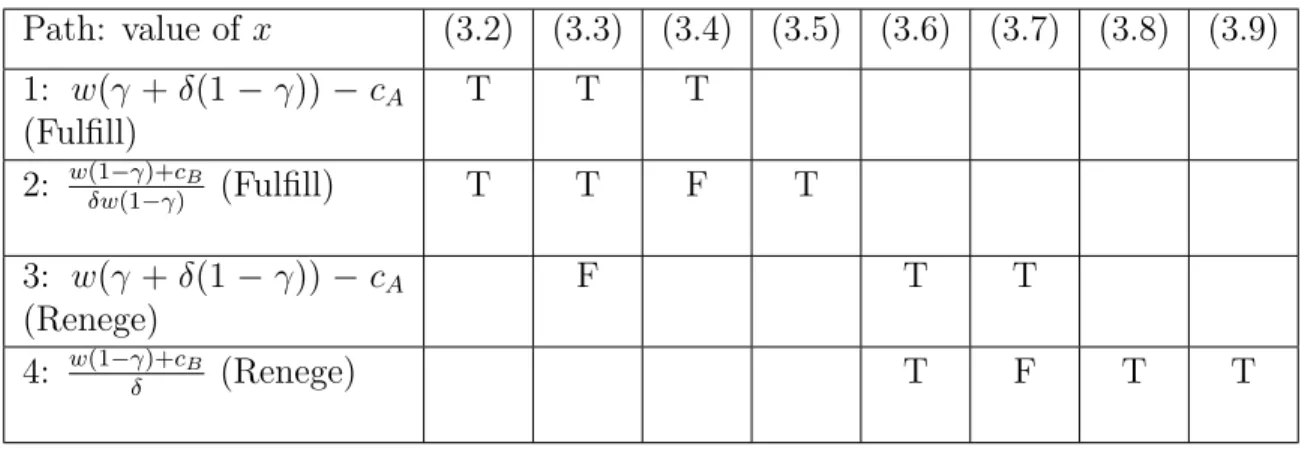
3.2 Paths to Acquiesce. . . 49
3.3 Paths to Acquiesce: γ =.99. . . 52
3.4 Paths to Acquiesce: γ =.99 and the effect of α. . . 52
3.5 Paths to Acquiesce (1, 2): γ =.1. . . 53
3.6 Paths to Acquiesce (3, 4): γ =.1. . . 53
3.7 Paths to Acquiesce (1,2): γ =.1 and cB=.5. . . 55
3.8 Paths to Acquiesce (1,2): γ =.1, cB =.5,α=.2. . . 55
3.9 Paths to Acquiesce (3, 4): γ =.1, α=.25. . . 56
3.10 Paths to Acquiesce (3, 4): γ =.1, cA=.25. . . 56
List of Symbols
A Opposition faction to which the Government makes an offer
B Opposition faction to which the Government does not make an offer
G Government facing a factionalized opposition
α∈[0,1] Cost the Government pays for reneging on a peace agreement
δ∈[0,1] Degree of similarity between preferences of A and B w∈[0,1] Probability with which A and B together defeatG γ ∈[0,1] Probability with which A is disarm B
ci ∈[0,1] Player i’s costs for fighting
X Value of contested resource, normalized to equal 1
x∈[0, X] Government offer to included faction A
Chapter 1
Introduction
“We will not allow these negotiations to pass over, and resistance will have its loud
voice as an answer to these land-selling negotiations.” - Abu Obaida, spokesman for the al Qassam Brigades, Gaza City, September 1, 2010.1
This dissertation examines the process of crafting peace agreements between a state and a divided, or factionalized insurgency, and the causes of both successful implementation and failure of such agreements. More specifically, it addresses the reasons why violence sometimes increases around peace negotiations in such conflicts (Kydd and Walter 2002; Bueno de Mesquita 2005) and why, given that attempts at peace seem to have the perverse effect of instead producing more violence, states continue to negotiate with armed opposition groups. I propose that to answer these questions, we need to change the way that we study and conceive of factionalized in-surgencies. Rather than continuing with the common conception of insurgent factions as being either “moderate” or “extremist,” we need to begin to think more carefully about what goals these different factions have. I argue that what really divides fac-tions is not the intensity of their preferences, but the substance of those preferences. This in turn suggests that the reason violence increases in response to negotiations is that factions that are not included in those negotiations fear that their own distinct
interests will not be protected by any resulting peace agreement. In the chapters that follow, I present this case as well as my conclusion that states continue to negotiate in the face of potential increases in insurgent violence because the mistrust between factions with different goals allows the state to divide those factions by manipulat-ing their preference divergences and eventually achieve peace (or at least a greatly weakened opposition movement) at a lower cost.
An insurgency is factionalized when it consists of multiple sub-groups, or factions, that have different goals or use different means by which to achieve those goals. The Palestinian movement is one such factionalized insurgency, the component groups of which include Hamas, Fatah, Palestinian Islamic Jihad, the Abu Nidal Organization, the al Aqsa Martyrs’ Brigade, the Democratic Front for the Liberation of Palestine, the Popular Front for the Liberation of Palestine (PFLP), the PFLP-General Com-mand, and the Palestinian Liberation Front. In the quote above, a spokesman for the militant wing of the Hamas party responds to an agreement between the Israeli gov-ernment and Hamas’ primary rival within Palestine, Fatah. Hamas and Fatah have long been the most powerful of the many factions within the Palestinian movement. Hamas, which seeks a religious Palestinian state and has long denied Israel’s right to exist, has a history of violent opposition to peace talks and agreements between the secular Fatah group and Israel. Hamas’ opposition to peace talks has been cited as one of the barriers to a peaceful resolution of the conflict between Palestine and Israel (Kydd and Walter 2002, 2006; Pearlman 2008).
Some opposition factions may exist purely or predominantly for the purposes of efficiency - where one faction operates as a militant group and another as the movement’s political arm, such as the past relationship between the IRA and the Irish Republican political party Sinn F´ein.2 Other movements become factionalized
2Siqueira (2005) models the relationship and interactions between militant and political factions
due to differences in ideology or loyalties to rival leaders. Ideological differences characterize the division between Hamas and Fatah - both Palestinian factions seek an independent Palestinian state, but they have different conceptions of how such a state should be governed. Where factions arise as a result of ideological or leadership differences, factions may still be able to cooperate against the government to some degree, these types of factions often result in inter-necine violence such as the conflicts within Palestine that followed Hamas’ 2006 electoral victory in Gaza. In the wake of the elections, fighting between Hamas and Fatah was so intense that the International Committee of the Red Cross estimated that 116 died as a result of factional fighting in Gaza City during the course of a single week in the summer of 2007, (International Committee for the Red Cross, 2007). The effects of the divisions between Hamas and Fatah extend beyond the deaths and destruction that their fighting brings within Palestine. The divisions among Palestine’s myriad factions, parties, and splinter groups mean that the Palestinian movement cannot operate as a single cohesive entity in negotiations with Israel or with states and international aid organizations.
are only a few of the world’s recent and ongoing factionalized insurgencies. Not all insurgencies are factionalized, but the extensive and often violent nature of the divi-sions between the factions of these highly visible movements suggests the significance of considering how factionalization of armed opposition groups affects the course of the broader opposition movement and attempts at negotiating peace.
When ideological differences divide insurgencies, the resulting divisions limit the range of settlements that would be acceptable to all actors, causing spoilers to arise and use violence to prevent the implementation of resolutions. Where insurgencies are factionalized, governments frequently craft deals with only one or a subset of the insurgent factions. Governments may exclude a faction because it is believed to be militarily or politically weak, because its demands are inconsistent with those of other factions the government prefers to work with, because it is perceived as extreme in its demands or insincere in its willingness to negotiate. In insurgencies that consist of many splinters and factions, it may simply be infeasible to gather representatives from all of the loosely defined factions for peace talks. Pearlman writes, “A peace agreement, or even the prospect of a peace agreement, can heighten contestation over the terms of legitimate representation [within a nonstate group] because it favors some factions and disfavors others” (2008, 84). I contend that the prospect of peace is particularly likely to heighten contestation between factions when those factions have substantively significant divergences in ideology and policy goals.
preferences between different factions create a commitment problem internal to the insurgency. Where preferences are sufficiently divergent, this commitment problem manifests as spoiler violence against either the faction that is cooperating with the government or against both that faction and the government. Empirically, it has been shown that peace deals are often met with violence from those parties that are excluded from the deal. While violence against the state has often been addressed by theories of spoiler violence (examples include Stedman 1997; Kydd and Walter 2002; Bueno de Mesquita 2005; Pearlman 2005), it is also evident that fighting between insurgent factions often accompanies attempts at peace. A recent example of this is the United States’ attempt to resolve the Iraqi insurgency by co-opting former Sunni insurgents to help contain the insurgency and fight on behalf of a future Iraqi state. These Sons of Iraq became targets for both Sunni and Shiite militias because of the deal they struck with the government. Likewise, animosity between the Palestinian Liberation Organization (PLO) and those factions that rejected the Oslo Accords, including Hamas and Palestinian Islamic Jihad, increased following the signing of the Accords.
Figure 1.1 below.3 Note that the violent events as a percentage of dyadic events
be-tween Palestinian groups (represented by the blue line in the graph) tend to increase following negotiations between the Palestinian leadership (Palestinian Liberation Or-ganization (PLO) or Palestinian Authority (PA)) and the Israeli government.
Figure 1.1: Violence as a Percentage of Dyadic Events, 1989-2009
I have established that factionalization is present in opposition movements in-volved in some of the world’s more intense and long-running civil conflicts, therefore we can conclude that the problems associated with factionalization and the prospects for peacefully resolving civil conflicts are somewhat prevalent in cases of civil conflict. This dissertation aims at furthering our understanding of how the internal politics of an insurgency, the relationships and interactions among components of that in-surgency, shape strategic interactions with the government. In particular, I propose
3Graph created using the “Levant Reuters CAMEO Data” from the Penn State Events Data
an answer to the question of how the existence of policy differences among multiple insurgent factions affects the possibilities for and stability of peace resolutions.
The project proceeds in several chapters. In Chapter two, I provide an overview of the literature on factionalized insurgencies, extremism, and commitment problems and identify the absence of focused research on the effect of ideological divisions between insurgent factions and other factional characteristics as a gap in the literature of peace processes in factionalized civil conflicts. I then develop the puzzles that motivate this project, specifically why does the level of violence often seem to increase rather than decrease in response to peace talks and agreements and why, despite this, do governments continue to negotiate with insurgents. Chapter two concludes with an overview of the general theory I propose.
Having introduced the general theory in Chapter two, in Chapter three, I for-malize and derive empirical implications from a model of interaction between two insurgent factions that have some exogenous level of common interest and a target government which can choose one of these factions with which to negotiate and can set an endogenous level of concessions to offer in return for that faction’s acquies-cence. I assume for the purposes of the model that factions are distinguished from one another by their individual costs of conflict and their relative power. I assume that factions of a common insurgency each have some utility for territory under the control of the rival faction (as opposed to the control of the state), but I assume that this utility is determined by the level of common interest between the factions, or the similarity of the factions’ ideologies. I present the model’s solution along with my own hypotheses regarding spoiler violence and its implications for state negotiations with divided insurgencies.
Chapter 2
Current Literature and Remaining Puzzles
There are multiple theories of civil war resolution - Walter (2002) provides an excel-lent review of six such theories and introduces a seventh. It is not my intention to provide a comprehensive review of the existing literature on civil war resolution and spoiler violence. Instead, in the following paragraphs, I will position my own the-ory of a variable intra-group commitment problem within the context of the current scholarship and present the alternative hypotheses that this scholarship suggests in a manner that will allow for an easy comparison of my own hypotheses with those of earlier work. My theory combines the concept of commitment problems with that of factionalization to consider the effect of multiple insurgent factions and the ideolog-ical distance between those factions on the potential for conflict resolution. I argue that commitment problems and factionalization, long understood as a hindrance to successful conflict resolution, together may create an opportunity for settlements be-tween an opposition faction and a targeted state for a resolution that would otherwise not be possible. Below I provide an overview of the extant literatures on commitment problems in civil war and on the ways that factionalization influences the course of an insurgency and affects prospects for peace. I then identify two closely related puzzles that remain in these veins of research and propose an answer for those puzzles.
not to take advantage of the other once it gains more power, are to blame for the difficulty of arriving at peaceful resolutions to civil conflicts (Walter 2002, 2003, 2009, Acemoglu and Robinson 2001, Azam and Mesnard 2003, and Fearon 2004). Com-mitment problems may result from change in an actor’s preferences (Strotz 1956) or from an actor’s disincentive to fulfill a promise once that promise has already pro-duced a desired action from another player (Schelling 1956). Schelling writes “both the kidnapper who would like to release his prisoner, and the prisoner, may search desperately for a way to commit the latter against informing on his captor, without finding one” (299). While the prisoner wants to be freed, and knows that to be freed he must convince the captor he will not inform the police, the prisoner cannot com-mit to acting against his own interests in turning the captor in once the captor has released him.
A parallel branch of the literature on civil conflicts and terrorism identifies the factionalization of opposition groups be they insurgencies or terrorist movements -as a factor that further complicates attempts at negotiating and implementing peace settlements (Kydd and Walter 2002; Bueno de Mesquita 2005; Pearlman 2008; Cun-ningham 2011). Factions can arise for any of a variety of reasons. Some factions may form purely for strategic or tactical reasons, as with organizations that consist of separate political and militant factions or organizations that are divided in order to limit damage in the event that the leadership of one faction is captured. Siqueira writes that “although there may be agreement among [the factions] as to what might be the broad political objectives of the movement each may have different opinions as to how to go about achieving them” (2005, 218). In other cases, factions may arise because of substantive differences among the members of the opposition. While all members of the opposition population may desire a replacement of the existing government in their territory for example, rather than differing primarily in their strategy for removing the present government, they may differ in their preferences regarding a replacement for the government. When factions form due to substantive differences, it may be more difficult to find a peace settlement that is acceptable to all factions.
leaders make with regard to capabilities and popular support are not easily verified. Factions and splinters are often the result of disputes regarding policy or ideology, which means that the demands of various factions are likely to be somewhat different - and may even be mutually exclusive. All of this complicates the bargaining process by increasing the number of actors and increasing uncertainty regarding which actors the state must appease in order to achieve peace and what sorts of offers might be able to appease all of the required factions simultaneously.
An understanding of the effects of factionalization is critical to developing our understanding of why and when peace agreements fail and when and how such agree-ments can be crafted for successful implementation. This is because, as established in the previous chapter, not all insurgencies are monolithic. Instead, some insur-gencies are characterized by factionalization and splintering. Pearlman argues that often within conflict settings a system of representation of the opposition is not well established, leading to factionalization and contestation over representation of the movement (2008).
negotiations if the state does not negotiate with all factions of the movement. Bueno de Mesquita assumes that there is some contingent of the movement that is “mod-erate,” or open to negotiations, and some contingent that is “extremist,” or closed to the idea of compromise. Under this framework, the state simply negotiates with the moderate faction, while the extremist faction remains armed, thereby ensuring that the state maintains an incentive to carry out its side of the deal with the mod-erate faction. Bueno de Mesquita underlines the potential for a government to pull so-called moderate terrorists to the negotiating table by encouraging the growth of their challengers - thereby forcing the hand of the moderates such that they need the government’s assistance to maintain their status, but he does not fully examine the potential for a commitment problem to exist within the insurgency or terrorist movement when the rival factions do not share the same interests or the potential for factional cooperation when there is extensive common interest among the factions.
The work on factionalization often emphasizes the complications that additional factions bring to peace processes by either reducing the set of agreements that are acceptable to all actors (Cunningham 2006) or through the potential for spoiler vi-olence due to extremist preferences in some factions (Kydd and Walter 2002 among others).1 The spoiler violence literature which focuses on the moderate-extremist
di-vide implicitly restricts itself to factions holding different preferences along a single
1As mentioned above, Bueno de Mesquita (2005), who, while predicting that the presence of
issue dimension.2 Proponents of the spoiler violence explanation for failure of
con-flict resolution have argued that spoilers use violence to cause the state to question either the capability or willingness of its negotiating partner to constrain the remain-ing factions of the opposition. Spoilers therefore aim to convince the state that the concessions it has made to its moderate negotiating partner are insufficient to quell the violence.3
Where groups hold preferences on multiple issues, moderate and extremist labels become less meaningful and it is possible for the state to make offers to different groups on different issues (rather than using a single offer to distinguish the moderate from the extreme as Cunningham (2011) proposes). These offers of concessions may incite violence from rival factions either because they are insufficient or because the nature of the offer is objectionable to the rival factions. An offer made to one faction may lower the utility of a rival faction if the interests of the factions are sufficiently different. Consider a factionalized opposition in which both factions desire independence and self-rule for their shared geographic area. The factions may differ on their preferences regarding what the governance of that area would look like - for example, one faction may desire a democratic system while the other might want a theocracy. The target state may be able to offer to the former limited autonomy under an elected council or, to the latter, limited self-rule by a council of clerics. Because the secondary preferences of the groups are mutually exclusive, either group may be willing to accept a little less than it would otherwise because it knows the government could make an offer to its rival. In the context of different preferences on multiple issues, factions may
2With, for example, two issue dimensions we could expect that while there might be a faction
that is more “extreme” on both, there might also be factions that take an “extreme” position on only one issue. As the number of relevant issues increases, the number of possible issue-based factional divisions also increases. As the factions that take “extreme” views on some, but not all, issues increase, it becomes less and less meaningful to refer to “extreme” and “moderate” factions as these labels are relative to individual issues.
3Pearlman adds that many spoilers have an additional goal of shifting the balance of power within
accept lower offers since they know that the state can pay off another faction. Where factional preferences are in opposition on a particular issue, an offer to one faction can be detrimental to another faction.
In this vein, Nilsson argues that the involvement of multiple factions in a conflict increases the state’s willingness to offer deals to weaker factions “reducing the number of fronts on which it is fighting” and weak groups may moderate their own demands to make getting a deal more likely (2010, 254). Nilsson finds that, ceteris paribus, peace agreements are more likely to be signed with weak factions as the number of factions increases. Like Nilsson, I adhere to the assumption that armed groups, as rational actors, will accept state concessions that leave them at least as well off as they can expect to be by continuing to fight - which suggests that weaker groups should accept lower payoffs. My theory differs from Nilsson’s in that, rather than only reducing the number of fighting fronts, I allow states to take advantage of the commitment problem between factions, co-opting one faction to fight another. Also, rather than focusing on the number of factions as a critical causal variable, I assume two factions and allow the degree of common interest between the factions to vary -capturing the severity of the commitment problem between the factions. As a result, where Nilsson expects that weaker factions will be more likely to receive offers as the number of factions increases, I anticipate that stronger factions will be more likely to receive offers as they are more likely to be able to resist the remaining factions, but as the factions become more united, offers from the government must in turn increase because united factions have a higher utility for war.
of those factions to government concessions reveal information about the movement and about what concessions are necessary to achieve peace (Cunningham, 2011). Cunningham allows states to use concessions strategically to determine the true pref-erences of factions (that is, which factions are using demands for independence to bargain for more limited concessions and which are more sincere in their demands) and to limit the number of factions they are facing. Thus, the offer of concessions can be part of the bargaining process. Cunningham promotes her “divide and con-cede” logic over the traditional “divide and conquer” approach whereby states avoid making concessions to factionalized groups because the factions do not have common demands and cannot constrain each other from using violence, so a concession made to one or several groups will not end the conflict. I build on Cunningham’s logic that concessions can be “part of the bargaining process, rather than just a potential end point” by suggesting that states also use concessions for the purpose of manipulating the rifts between factions and inciting intra-group conflict (278).
2.1 What is Missing from the Literature?
Much of the previous literature on spoiler violence argues or assumes that spoilers’ extreme preferences drive their actions. The proposition that, as much of the previous literature argues or assumes, spoilers’ actions are driven by their extreme preferences raises as many questions as it answers. What are extreme preferences? What is it that causes spoilers to oppose peace when conflict is costly? Why do some factions within an insurgency have moderate preferences, which seem to be indicated by a willingness to negotiate with the government toward a peaceful resolution, while other factions have extreme preferences? If spoilers do play a significant role in preventing peace, understanding the origins of their preference for the continuation of conflict may allow decision makers in the state to produce a more efficient and durable settlement.
conception of extremists; more specifically, Bueno de Mesquita distinguishes the mod-erates from extremists by “the extent to which they value defeating the government” (150). It is certainly conceivable that some would gain a degree of personal utility from deposing a hated regime. But Bueno de Mesquita does not address the reasons for this difference in intensity of preference. It is not necessary to the development of a formal model to establish the reasons that actors hold the preferences that they do, but a clear understanding of the preferences of actors allows for more well-defined and accurate payoff structures and, ultimately, a more reliable result. Stedman (1997) and Kydd and Walter (2002) among others are more limited in their conception of the difference between moderates and extremists (or limited and total spoilers). Both suggest that extremists (total spoilers) are disadvantaged by peace, but are not spe-cific as to the nature of this disadvantage.
they hope through conflict to achieve a better payoff for peace in the future. Lake’s general argument is very compelling, but he still relies on the moderate - extremist divide, which in turn artificially limits the political platforms that insurgencies can adopt to a single spectrum. Because opposition groups often hold positions on a va-riety of issues, a single left to right, or moderate to extreme, representation of their positions may not be adequate for understanding how and why states chose negoti-ating partners and, in turn, when we can expect to see successful implementation of agreements and when agreements will be challenged by rival opposition fractions.
This dissertation addresses the implications of allowing greater ideological and po-litical diversity between factions of an insurgency - thereby abandoning the traditional conception of terrorists or insurgents as being confined to a moderate to extremist continuum. In doing this, I consider two more specific puzzles. The literatures on spoiling behavior, types of spoilers, and reasons for spoiling, as well as the related literature on radicalization of violent non-state actors, indicate that peace processes in civil war are often marked by an increase or spike in the violence of those conflicts. Various explanations for this rise in violence have been proffered, but the persis-tence of the phenomenon raises the question at the heart of the first puzzle to which the theory elaborated here speaks, why do states continue to try to negotiate peace settlements with insurgents when such attempts are so often met with bloodshed?
some negotiated settlement, some division of the resources prior to their destruction, that will leave each actor at least as well off as they could expect to be at the end of a war (Fearon 1995). This leads me to the second motivating puzzle of my theory: why do we see spoiler violence if not as the result or manifestation of an uncompromising extremism? How can we reconcile the violence that marks attempts at civil war res-olution with a rational view of war as an inefficient means of dividing and allocating resources?
This project reconsiders the concept of extremism and the spoiler violence phe-nomena in a rational choice framework while challenging the assumptions of previous work. Others have argued that extreme factions or, in Stedman’s typology, “total spoilers” consist of those members of the opposition who are unwilling to accept any compromise agreement (Stedman 1997). This assumes that extremists’ first prefer-ence is for their ideal outcome and that they are at best indifferent among all other outcomes (or at worst, that, failing to achieve their ideal outcome, they prefer death and destruction). Extremists with a very low probability of prevailing against the government then will continue to fight regardless of any compromise offer made to them by the government. Extremists, therefore, must see the good for which they are fighting as indivisible, while moderates see their goal as divisible.4 But, why would
two actors see the same good (whether territory, policy, or something else) in such different lights? If a difference in views of the divisibility of a commonly sought good is not the reason for the distinction between moderates and extremists, then we are no closer to understanding extremism.
4It is worth noting here that Lake represents as exception to this, writing that extremists “seek
2.2 An Alternative
The argument presented here extends and builds upon the work begun by Walter, Bueno de Mesquita, Lake, and others in significant ways. First, while I address the effects of factionalization on an opposition, rather than assuming that the state always negotiates with the less extreme faction, I endogenize the government’s choice of a faction with which to negotiate. Consistent with Fearon’s (1995) findings, I contend that there should never be a faction that is firmly opposed on principle to negotiating with the state, what Stedman (1997) dubs a “total spoiler” or a faction with demands so high that the government cannot meet them. As Fearon demonstrates, the demands of a rational group will be conditioned by that group’s expectations from continued conflict, as will the demands of the state. Second, I consider the implications of commitment problems for peace processes in civil conflicts, but my primary concern is with the commitment problem between opposition factions, rather than between the government and the opposition.5
While great progress has been made in our understanding the effect of faction-alization on peace processes in civil war through the conception of moderate and extremist factions, there are many benefits to changing this conception to one more reflective of reality. When insurgents are divided in terms of their intensity of pref-erence for a common goal, as some of the previous work has assumed, then any offer that satisfies the more extreme faction will also satisfy the moderate faction. An offer to satisfy the most extremists may not be feasible, and a solution such as Cunning-ham’s divide and concede approach is very attractive in such a setting. However, when insurgents simply have different goals or prioritize different issue areas, a state may find that it can choose the issue on which it prefers to negotiate or the faction with which it prefers to negotiate. In such a case, where factional demands vary in
5It is worth noting that Bueno de Mesquita suggests the strategic interaction between terrorist
type as well as degree, we can expect that other factors will determine which faction a state ultimately attempts to make peace with and what the result of that peace process is. Specifically, I propose that factors such as how similar or dissimilar the faction’s ideologies are and factional strength are likely to play a role in determining both who is invited to the bargaining table and how peace negotiations result.
I argue that spoiler violence is the result, not of preferences for violence or prefer-ences that are so “extreme” as to eliminate the bargaining space between the spoiler and the government, but of a difference in preferences among factions that diminishes each faction’s expectations for the benefits it will gain from any share of contested territory that its rival is able to capture from the government. By dropping the as-sumption of extreme preferences, I find that factionalization actually presents the government with an opportunity to achieve peace more efficiently than it might with a unified opposition. When factions differ in their ideological or policy preferences, rather than only in the level of fervor with which they promote those preferences, factionalization allows the government to incite fighting that can weaken the in-surgency - and particularly that faction of the inin-surgency that is not cooperating with the government. Factionalization allows the government an opportunity to build something closer to a minimum winning coalition (that is, paying off only as much of the opposition as it needs to in order to shift the expected outcome farther in its own favor).
including those in Palestine, Northern Ireland, Iraq, and Uganda. The ideological and political divisions within opposition movements that produce factions can also be ex-pected to produce commitment problems, the severity of which should increase as the rival factions’ goals become more mutually exclusive and more divergent. Chang-ing the locus of the commitment problem to represent interactions between factions, rather than between the opposition and the government, both better reflects the re-ality of many cases and changes the expectations that models of conflict resolution produce. Intra-group commitment problems create additional incentives for each fac-tion to negotiate with the government - that is to gain control of resources that might otherwise end up under the control of the rival faction. They also increase the credibility of a faction that agrees to constrain rival opposition factions in exchange for government concessions. Separately, factionalization and commitment problems may hinder progress toward the negotiation and implementation of a civil war settle-ment, but when commitment problems occur between factions of an opposition, they may have the opposite effect by increasing the range of circumstances under which a settlement offered by the state will be accepted by an opposition faction.
could credibly commit to sharing control of the ceded territory with the faction ex-cluded from negotiations once the exex-cluded faction has disarmed, then spoiling could potentially be avoided. Where this internal commitment problem exists however, it creates incentives for spoiler violence. This understanding of the origins of spoiler violence suggests that spoiler violence and fragmentation of insurgencies actually presents governments with an opportunity for resolving or disentangling themselves from civil conflicts at a lower cost than they might when facing a consolidated insur-gency.
adequately represent the interests of the poorest classes.
In this light, the Mahdi Army can be viewed not as extremists who would not settle for representation by the SCIRI leadership in a new government, but as a group that feared being cut out of the political process entirely to be represented nominally by a group that did not share its position in society, history, or concerns for the future of Iraq (the latter fear reflecting the nationalism of the Mahdi Army). We can understand the Sadrist movement then as one that occurred not because its members views were a more extreme version of those shared by SCIRI, but as an organization that stood to lose its chance for influence if the peace went through according to terms that identified the SCIRI as the representative of the Shi’ite population. This suggests that the opposition toward peace settlements by groups like the Mahdi Army may not be because they believe the concessions involved are not sufficiently extensive, but because the concessions do not address their particular concerns. It seems likely that the Mahdi Army feared that if SCIRI were recognized as the representative of all Iraqi Shi’ites, the interests of those who had suffered under Saddam - and were less wealthy and well-educated as a result - would not be protected.
achieve a peaceful resolution by transferring to one faction the resources necessary to disarm a rival faction.
While the state might consider circumventing this problem by dividing the con-cessions between the factions in accordance to what those factions could expect to receive from continued fighting, there are problems with this approach. In particular, this paper addresses the greater utility the state may gain from granting a lower level of concessions to one faction, thereby inducing spoiler violence, than it would from making a higher total transfer of concessions divided between the factions in order to secure peace. Spoiler violence can have different targets: some spoiler violence is directed at the state to convince the state that its negotiating partner is not credi-ble, while other spoiler violence takes the form of conflict between factions designed to deter a faction from cooperating. Where there is sufficient distance between the preferred outcomes of the factions, a target state may be able to make an offer of concessions to one faction that gives that faction the resources it needs to disarm or constrain the remaining faction. In this way, the state can take advantage of the divi-siveness within the insurgency, and the damper this puts on the insurgents’ ability to combine their fighting strength effectively when they know that disarming the state will mean that they are left to vie with each other for control of the new government. The state can extract itself from the conflict at a cost lower than that required to continue the conflict or satisfy both factions.
faction disarms, the included faction would no longer have any incentive to share resources. The differing preferences of the two factions indicate that any resources shared with the rival may be used in ways that diminish the utility the included faction obtains. A faction included in negotiations with the state cannot credibly commit to sharing the concessions with the faction excluded from negotiations once that faction has disarmed. The only benefit that a faction excluded from negotiations can hope to receive from acquiescing is in the policies implemented by the faction in-cluded in negotiations. When there is great divergence between the factions’ policy goals, this benefit will be quite small.
This suggests that spoiler violence results when factions of an insurgency have very different goals and the state makes an offer to one faction that would advantage that faction at the expense of its rival. A faction receiving concessions from the state cannot credibly commit to protecting the interests of the excluded faction once the excluded faction has disarmed. In other words, what often appear to be extremist preferences for continued violence are actually manifestations of the internal commit-ment problem. Weaker factions should be more willing to accept governcommit-ment offers since they have less to gain from any potential rebel victory (as most of the spoils from such a victory would go to the faction with the power to take those spoils). Unfortunately, governments have little incentive to negotiate with weaker factions because these factions have little ability to constrain their stronger rivals. Even if a state is willing to transfer to one faction resources sufficient to allow that faction to constrain its rival, a weaker faction would require a much larger transfer and would therefore be a less desirable negotiating partner due to the cost of transferring power (Best and Bapat 2012). States will therefore prefer negotiating with stronger factions when they can.
intra-group fighting to achieve a deal with one faction at a lower cost than the en-tire opposition could be satisfied. As the factions become closer ideologically and politically, they are better able to overcome commitment problems and less likely to succumb to state offers that aim to turn them against each other. Where differences between factions are small, faction leaders and members are likely to have fewer ob-jections to the policies that a rival faction will implement. Therefore, as the factions become more similar in their preferences, it becomes more difficult to persuade either faction that it will do better for itself by disarming the remaining faction and trusting the state to transfer the promised concessions. Further, as the opposition movement becomes stronger vis-a-vis the government, we can expect that achieving a credible deal with an opposition faction will become more difficult for the government. This is because, when the opposition is strong, the stronger faction - that is the faction with which the government prefers to negotiate - will only accept very high conces-sions because it expects to do quite well in the conflict, and the weaker faction in such a situation is even less likely to be able to constrain its rival at a cost that the government is willing to pay.
autonomous Palestinian state. These groups demanded a Muslim Palestinian state to replace Israel. The momentum of Hamas was as evident as the PLO’s failure to stop Israeli settlements or to gain concessions. If Yasir Arafat wanted to maintain his position in Palestinian politics, he needed to produce results quickly, otherwise he risked seeing the secular and nationalist PLO marginalized in the face of a growing religious Palestinian movement. By the time the Oslo talks began, Arafat was still in a strong position relative to Fatah, but he had lost funding from Kuwait and Saudi Arabia, he had lost face for agreeing to Israeli preconditions for the Madrid talks,6 and he was prepared to moderate the PLO’s stance on certain issues if that would mean gaining the support he needed to constrain the rise of Hamas.
Fortunately for Arafat, the emergence of his domestic rivals was just what the Israeli state needed as incentive to negotiate with him. Israel recognized that the wide discrepancy in the goals that Fatah and Hamas held for any eventual Palestinian state produced just the sort of animosity between the Palestinian groups that would allow Israel to trust one to fight the other. Once Israel had decided to negotiate, choosing a negotiating partner was simple. Fatah was still stronger than Hamas, it had international name recognition, a long organizational history to lend it stability, and, significantly, it had the threat of a rival that might eventually overpower it and replace Fatah’s secular nationalist agenda with a religious one of its own. It was this threat of losing out to a rival that did not share its goals that led Fatah to compromise, recognizing Israel’s right to exist and accepting much less than the independence or full autonomy it had previously demanded. The threat that Hamas presented to Fatah and Hamas’ inability to credibly commit not to use any future advantage it might have to further its own agenda at the expense of Fatah’s, allowed Israel to gain Fatah’s cooperation in fighting Hamas at a lower cost than it could previously
6Israel had refused to allow official PLO recognition at Madrid. Instead, Palestinian moderate
have paid to simply end its own conflict with the PLO.7 When the member groups
of the PLO dominated Palestinian politics, there was not a sufficiently large division in the preferences of the factions to allow Israel to conclude a deal with any one faction or subset of the factions. When rivals with significant ideological differences emerged, deals with concessions that did not match the full strength of the Palestinian opposition became a real possibility.
The following chapter presents a formal model designed to shed light on the sources of both failure and success in negotiations and to capture the effect of varying the intensity of the commitment problem that results between insurgent factions when one faction is in a position to gain resources from the state that could alter the power balance between the factions. It is times when this commitment problem is severe, i.e. the common interest or shared preferences between the factions is low, that produces the appearance of “extreme” preferences or preferences for violence. Ex ante, promises of resource transfers to be made from one faction to another after disarmament of the proposed recipient cannot be made credible since, having disarmed the rival faction, a faction will prefer not to share its own resources. I assume that at the outset of the interaction modeled here the insurgency has some probability of disarming the state; the state has the complementary probability of disarming the insurgency. I further assume that opposition factions share a common preference (defeating the state, gaining autonomy), but that they each have a preference on a second issue as well.8 Further, the balance of power between the factions is captured by a variable representing the probability with which faction one faction disarms the other. The model suggests that as the degree of common interest between the factions increases,
7Of course, this same commitment problem also prevented Fatah from persuading Hamas to
accept the Oslo Agreement.
8As will be explained in chapter 3, this second issue preference is captured by a variable ranging
Chapter 3
A Formal Model of the Prospects for Peace with Internally Divided Separatists
In the previous chapter, I outlined a theory that explains why violence often increases in response to attempts at negotiating or implementing peace settlements. The expla-nation is that these settlements create winners and losers, and the would-be “losers” of the peace often turn to violence to disrupt the peace process, not because they would not prefer peace to continued war, but because the peace that is offered does not protect their interests and/or threatens to leave them worse off than would continued war.
aligned.1 Therefore, while a faction will prefer that its rival faction control the
con-tested territory than for the government to maintain control, that faction will gain even greater utility from controlling the contested territory itself.
The model suggests that states will be best able to produce broad peace agree-ments when they negotiate with the stronger of two factions rather than the weaker. This is because a broad peace requires that both factions acquiesce. If we assume that the faction directly receiving concessions gains the most utility from those concessions and that factions that are stronger have a higher utility for fighting than do those that are weaker, we can see that it is more efficient for a state to negotiate directly with the stronger faction, i.e. the faction with the more attractive outside option.
The model I develop represents a government targeted by a factionalized insur-gency seeking to wrest control of some contested territory from the government. The game allows the government to make some endogenously determined offer of conces-sions to one of the factions in an attempt to resolve or mitigate the conflict. In the first section I introduce the model’s actors and describe the basic assumptions of the game regarding factional competition and the actors’ utility functions. The second section gives the basic structure of the game including the sequence of moves, the payoffs, and the assumptions regarding information and beliefs. In the third section I present the solution to the game, and in the fourth I discuss the implications of the model.
3.1 Assumptions and Actors
In this section, I elaborate the assumptions regarding the nature of the factional actors, their origins as distinct factions and the properties that distinguish them, the willingness of factions to fight the government, and the credibility of government offers that underpin the model. In doing so, I will define the actors as well as their
1Where factional interests are perfectly aligned, this is equivalent to a unified group. The model
utility functions.
3.1.1 The Origins and Preferences of Factions
This project does not make any implicit assumptions regarding the reason for a fac-tional divide. However, breaking with previous work on negotiations with a facfac-tional- factional-ized opposition, this model explicitly captures the degree of common interest between factions and its effect. I also assume that factions cannot have greater common in-terest with the government than they have with each other as component groups of a common movement. If factions did have more in common with the government than with each other, they should find it difficult to unite to oppose the government. This means that a faction will prefer its rival faction to control the contested territory than for the government to control the territory. To clarify this assumption and its implementation in the model, I will now introduce the games’ three actors and their respective utility functions.
For simplicity, I model this interaction with two insurgent factions, A andB, and a target government, G. All players’ utility functions are represented by the share of the contested resources X = 1 in that player’s control. I normalize all actors’ utility for the status quo to 0 and assume that at the outset of the interaction the government controls all of the contested territory. I denote the share of X controlled by i ∈ A, B at the end of the interaction by xi, therefore, the government’s payoff at the game’s end is −xA−xB while the factions’ payoffs can be represented as the share, xi, of X controlled by faction i plus the share xj of X controlled by faction
j 6=i weighted by the value that each faction has for the other’s control of territory, which we can callδ ∈[0,1]. Therefore, we can defineA’s utility function asxA+δxB and B’s utility function as xB+δxA.
If the government makes an offer to concede some share of X, call this share x∈
honoring such an offer is−x. Factions are functionally identical and are distinguished from each other in the game only by their relative power, or probability of disarming each other (although factional interests are captured, they are only captured in terms of the value that the factions’ each have for the other’s control over the contested territory. I have used a single variable common to both factions to capture this value.). Thus, the game is symmetrical regardless of which faction the government chooses to negotiate with. For simplicity, I choose to assume that the government negotiates with faction A. Therefore, A’s utility for concessions is defined as x while
B’s utility for concessions made to A isδx. Since the government controls the entire contested territory in the status quo and the factions’ utility for government control of the territoryX is 0, we can say that the common interest between the factions and the government, that is the utility that the factions receive for the contested territory under the government’s control, is normalized to 0. So, if δ = 0 then each factions’ value for territory under the control of the other is equal to that faction’s value for territory under the control of the government. On the other hand, if δ= 1, then the factions are perfectly united in their interests and each faction gains the same utility from the other faction’s gains as from its own gains (presumably, in this case the group is factionalized only for strategic or operational purposes).
3.1.2 Nature of Insurgencies Modeled
opposition. The reasons for this are as follows. First, if there is only one faction that would be willing to fight in the absence of concessions, then there is effectively only one, unitary, violent opposition. The state could make concessions to a related non-violent faction, but this should only affect the probability or severity of a violent challenge if those concessions also satisfy the violent faction. Second, if there is no faction that considers the marginal benefit added by its own participation in a conflict to be worth the costs of participation, then there is no violent challenger to the state and the dispute will only take a political form. This assumption is formalized in section 3.2.2 on the model’s payoffs.
3.1.3 The Credibility of Government Offers
As discussed in Chapter 2, previous work has addressed the effects of a commitment problem between a target government and an insurgency. In particular, Bueno de Mesquita writes, “once the moderates accept a deal, the continued existence of the extremists helps to ensure the credibility of government concessions” (2005, 164). Kydd and Walter’s (2002; 2006) explanation of spoiler violence hinges on the inability of a moderate terrorist faction to commit to carrying out its end of any negotiated deal because the state is unable to perfectly observe when the moderates are defecting. Walter (2002) suggests that commitment problems often stand in the way of successful implementation of civil war resolutions unless there are third parties willing and able to observe and enforce compliance.
offer of concessions. Furthermore, the model assumes that a faction that accepts a government offer must integrate its own forces with those of the government such that the faction is no longer able to fight without government assistance and is thereby made credible in its commitment to discontinue anti-government violence (but also made vulnerable to government defections in the event that rival factions do not follow suit). Finally, I do not explicitly model the decision of one opposition faction to withhold from or grant a share of government concessions to a rival faction.2 Instead, I assume that when factions share many of the same interests and preferences, the policies that one faction will implement will further not only that faction’s own agenda, but to a degree determined by the level of common interest between the factions, will also further the agenda of the other. As this is merely an effect of having common preferences and requires only that the faction receiving concessions implements the policies it prefers (or distributes the concessions in the way it desires), it is always credible.
3.2 Model Structure
The model I present here considers a government with control over contested resource
X facing an armed challenge from a non-state actor that is assumed to be comprised of two factions, both of which want control over the contested resource X. The state may chose whether to make an offer of concessions to one faction in order to bring about peace or to improve its own chances in conflict with the remaining faction. In turn, factions can choose to accept a state offer (or acquiesce to a deal between the state and a rival faction) or continue fighting. The outcome of the interaction is determined by the choices that these three actors take. The primary contribution of this model is that I allow the strength of the insurgency relative to the government,
2As mentioned previously, Best and Bapat (2012) find that such offers are not credible as carrying
as well as strength of the factions relative to each other, to vary, while also varying the shared interest of the factions. In this section, I formalize the structure of the game.
3.2.1 Sequence of Moves
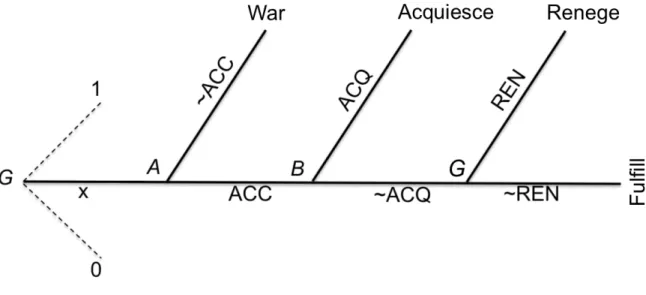
The game begins with the government’s choice of one of the two factions to which it will make an offer of concessions x and its decision regarding the size of offer x. Play proceeds in the same fashion regardless of which faction the government chooses to negotiate with. Therefore, the game tree in Figure 3.1 depicts only the branch of the game tree in which the government chooses to negotiate with A. Once the offer is made, play proceeds to the recipient of the offer, let us assume this is faction
A, and this faction determines whether to accept or reject the offer. If A rejects the government’s offer, the game terminates and conflict resumes with both factions fighting the government just as they were before G’s offer of concessions. If, on receiving an offer from G, A accepts that offer, A combines its resources with those of G in such a way that it cannot fight without G’s support, but if it does fight B
with G’s backing, A’s capabilities relative to those of B are increased. If A accepts the government’s offer, play continues to the faction excluded from negotiations, in this case B. B has the option of acquiescing to the peace deal negotiated by the government andAor opposing the deal by continuing to fight. IfB accepts the peace deal, the game ends with the government transferring toA the promised concessions. In this event, B must disarm, thereby precluding any potential for continuing the conflict in the future or forcing a renegotiation of the terms of peace. If, on the other hand, B opposes the deal, play continues to the government which can determine whether or not to fulfill its part of the deal with A in light of B’s continued use of violence. The government may either adhere to its deal with A, allowing her to fight
the agreement to cede territory and fight B itself. If the government chooses not to honor the deal with Aonce A has relinquished her ability to fight independently, the government may be able to defeatB and keep all of the contested territory for itself. If the government does not fulfill its deal, the government fights B alone (without assistance from A, but also without having to fight A as well as B) and leaves A
without the concessions x and disarmed (since A has combined its forces with those of the government such that A cannot fight with the government’s consent). If the government does fulfill, then the government supports A in containing B’s violence.
Figure 3.1: The Game Tree.
If B acquiesces to the deal, then the game terminates with a stable peace agree-ment wherein B gains its utility for the territory under A’s control. Rather than terminating the game at this point, it would be possible to give A the option of transferring some share of her resources into B’s control. However, as Best and Ba-pat (2012) note, in equilibrium, A would never choose to transfer any resources to
be swayed by an offer of a share of the concessions. The included faction cannot cred-ibly commit not to exploit the excluded faction in the event that peace is achieved and the excluded faction disarms. The lack of a credible commitment fromA givesB
greater incentives to fight when it might otherwise be persuaded to disarm. IfB were to disarm, it knows that, regardless of any promises made before the disarmament, thatA’s equilibrium response would be to renege and take all ofB’s resources onceB
is unable to defend itself. Once a faction disarms, it relinquishes the hope of defeating the government or forcing concessions for itself in the future. The faction also loses the ability to defend itself and its own resources from the government or the rival faction. The commitment problem, and the insecurity it produces inB, thus causeB
to appear to have preferences that are more extreme than B’s true preferences may be. B may however be inclined to acquiesce if it believes that its value for territory under the control of A will be sufficiently great thatB’s payoff for acquiescing is not too low.
3.2.2 Payoffs
The model structure suggests four possible outcomes which we can call war (Arejects the government’s offer of concessions), acquiescence (Aaccepts the government’s offer and B acquiesces to the deal), reneging (A accepts the government’s offer, but B
does not acquiesce and the government decides not to fulfill its part of the deal), and fulfillment (A accepts the government’s offer, B does not acquiesce, and the government does fulfill its deal with A). The war outcome represents a situation in which the government, having failed to achieve a deal of any sort, finds itself fighting both opposition factions. Letw∈[0,1] represent the probability with which factions
disarmB were the factions to fight each other (in other words, γ defines the internal balance of power in the opposition). Since there are only two factions in this model,
B’s probability of defeating A in the event of a fight is 1− γ. Next assume that when the factions fightG together they divide their expected spoils wbetween them in accordance with the balance of power. Finally, all actors pay expected costs ci for conflict.
As mentioned previously, I am assuming that in the absence of government con-cessions, both violent factions will prefer to fight the government (or at least be indif-ferent between fighting and not fighting). Specifically this assumption requires that the costs to the respective factions of fighting must be no greater than the marginal benefits to that faction of its own participation in the conflict (note that this is a more stringent requirement than that the costs be no greater than the faction’s total utility for conflict). We can formalize this as the requirements that cA > wγ and
cB > w(1−γ), or that the payoffs, as shown in Table 3.1, to A and B of war be non-negative.
When the acquiescence outcome is reached, none of the actors pay any costs for fighting, and payoffs are determined by the size of the offer x such that the government pays xand A receivesx. However, when faction B does not acquiesce, if the government decides to fulfill its deal withA, then all factions again pay the costs of war. But, in this case, B must fight the government and A, rather than fighting the government alongside A. Since A is no longer fighting as part of the opposition, the opposition can no longer expect to take spoils equal to w. Instead,B can expect to gain only w(1−γ) since it will no longer have A’s fighting power. Notice that sinceB does not have to divide any spoils withA, this is the same share ofX that B
attains from fighting with A, however, the expected utilities are different because B
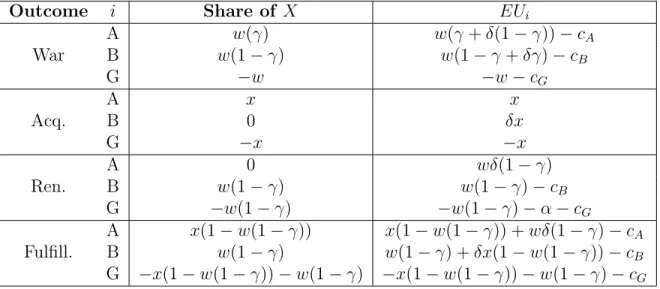
so A’s probability of defeating B increases from γ to 1−w(1−γ) which represents the complement ofB’s probability of defeating bothA and G. To see that this does increase the probability with which A can disarm B, recall that γ ∈ [0,1], therefore 1−w−wγ > γ because if we move thewγ term from the left to the right side of the equation and then divide both sides by 1−w, we can reduce the inequality to 1> γ. Finally, if the government abdicates its deal withA,Areceives no concessions and is disarmed, thereby preventing her from fighting B orG. The government can then fight only B and, if successful, keep all of the contested resources X for itself. But, when the government reneges on a deal, it pays a cost α ∈ [0,1] for doing so. Table 3.1 presents the model’s outcomes along with the associated payoffs and expected utilities to each actor. Note that the government’s utilities are always equal to its payoffs, but for factions A and B the utility of an outcome is dependent both on the respective actor’s own payoff and on the payoff of its rival.
Table 3.1: Outcomes, Shares of X, and Expected Utility by Actor
Outcome i Share of X EUi
A w(γ) w(γ+δ(1−γ))−cA
War B w(1−γ) w(1−γ+δγ)−cB
G −w −w−cG
A x x
Acq. B 0 δx
G −x −x
A 0 wδ(1−γ)
Ren. B w(1−γ) w(1−γ)−cB
G −w(1−γ) −w(1−γ)−α−cG
A x(1−w(1−γ)) x(1−w(1−γ)) +wδ(1−γ)−cA Fulfill. B w(1−γ) w(1−γ) +δx(1−w(1−γ))−cB G −x(1−w(1−γ))−w(1−γ) −x(1−w(1−γ))−w(1−γ)−cG
3.2.3 Information
the factions know if the government is making a non-credible offer. As we will see, though this does eliminate equilibria in which the government reneges,3 it does not
prevent the faction included in negotiations from accepting some non-credible offers (and thus, does not prevent the government from making some non-credible offers).
In what follows, I will present the structure of the game in greater detail as well as its solution in complete and perfect information using the Subgame Perfect Equilibrium solution concept (SGPE). I will then discuss the implications of the theory.
3.3 Solution
The game in complete and perfect information is solved using the Subgame Perfect refinement of the Nash Equilibrium solution concept (SGPE) which requires ratio-nal play in every subgame, thereby eliminating equilibria that rely on non-credible threats. Because play at every subgame is restricted to the Nash Equilbrium of that subgame, we can use backward induction to find the SGPE. To do this, we begin analyzing the game by finding the Nash of each subgame that represents an end to the game.
The final possible decision in the game is that of the government to fulfill or abdicate its agreement with the included faction given that B is continuing to fight. At this final subgame, the government will fulfill the terms of its agreement with A iff α > x(1−w+γw). Rearranging the terms, we see that G will only fulfill its agreement withA if the offer fulfills the condition:
x < α
1−w+γw. (3.1)
Moving up the game tree shown in Figure 3.1, at the next nodeB must determine whether to use violence or acquiesce given that the government has struck a deal
with A. B’s decision will be conditioned on whether the government will renege in the event of violence. If the government will fulfill the terms of its agreement with
A even in the face of violence from B, then B will acquiesce to the agreement if
A has gained concessions from the state that are sufficiently sizable that B cannot expect to do better by fighting than what it can expect to receive under A’s rule, then B will accept A’s control of the ceded territory. Therefore, B will accept the agreement in this case if x > w(1−δw(1−γ)−γcB) . If the government will respond to violence from B by retracting its agreement with A, then B will prefer to acquiesce to A’s peace agreement with the government iff x > w(1−γδ)−cB.
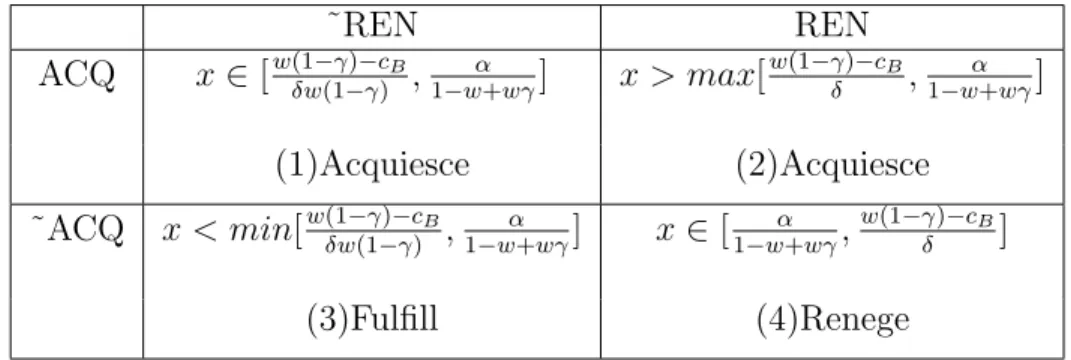
Table 3.2: Four Cases in Which A Evaluates an Offer x and Associated Outcomes: Government actions are shown in the top row, B actions in the left column.4
˜REN REN
ACQ x∈[w(1−δw(1−γ)−γcB) ,1−wα+wγ] x > max[w(1−δγ)−cB,1−wα+wγ]
(1)Acquiesce (2)Acquiesce
˜ACQ x < min[wδw(1−(1−γ)−γcB) ,1−wα+wγ] x∈[1−wα+wγ,w(1−γδ)−cB]
(3)Fulfill (4)Renege
The next node to consider is the one at which A decides whether to accept an offer x from the government. Here there are four cases to consider, these cases are shown in Table 3.2 along with the conditions under which they occur. In cases (1) and (2) B will acquiesce (though in case (1) the government would renege given violence from B and in case (2) it would not). As shown in the table, if A accepts the offer
x in either of these cases, the Acquiescence outcome will occur. However, A may also choose to reject any offer, yielding the War outcome. ComparingA’s utilities for these outcomes indicates that in both cases (1) and (2)A will accept offers such that
Following Table 3.1, A will accept the offer iff x > 1−wwγ+wγ. In the final case, B
does not acquiesce and the government reneges on its deal with A. If A accepts the offer, it will receive its utility for the Renege outcome and if A rejects the offer War results. Therefore, A will accept the offer iff 0 > wγ −cA. Since this is never true by assumption (see 3.2.2 above; for this to be true, A would need to be unwilling to fight regardless of the size of x), we can say that A will never accept offers that will result in the Renege outcome.
Of the eight possible equilibria above, four produce the outcome War which yields
UG = −w− cG, two produce the outcome Acquiesce which yields UG = −x, one produces the outcome Fullfill which yields UG =−x(1−w(1−γ))−w(1−γ)−cG, and one would produce the outcome Renege but is never possible. Because we know that when B will not acquiesce to the deal, A will only accept a government offer when that offer is at least 1−wwγ+wγ, we can substitute that value ofxinto the equation for UG(F U L), which yields (
−wγ
1−w+wγ)(1−w(1−γ))−w(1−γ)−cG, which can be simplified to UG(F U L) =−w−cG. This means that the government’s utility for the Renege outcome is the same as its utility for the War outcome.
As established previously, A will accept government offers that will result in B
acquiescing if those offers are at least as great as A’s payoff for war: x ≥ w(γ +
δ(1−γ))−cA. This means that for Acquiesce to be a possible outcome in either case (1) or (2), it must be that an offer of x ≥ w(γ+δ(1−γ))−cA will not violate the restrictions defining the cases (shown in Table 3.2). For case (1) to exist, it must be possible that there is some level of concessions at which B would acquiesce and G
would not renege on if B did not acquiesce. This level exists when Equation (3.2) is true:
δ > (1−w+wγ)(w(1−γ)−cB
αw(1−γ) . (3.2)