
6.1
Focus on…
After this lesson, you will be able to…• represent pictorial, oral, and written patterns with linear equations
• describe contexts for given linear equations
• solve problems that involve pictorial, oral, and written patterns using a linear equation
• verify linear equations by substituting values
Representing Patterns
A skiff is a two-person sailing boat that can be used for racing. The carbon foam sandwich hull and multiple sails allow the boat to travel at speeds of 5 to 35 knots.
Did You Know?
A knot is a measure of a boat’s speed. One knot is equal to 1.852 km/h. The term comes from the time when sailors measured the speed of a ship by tying knots an equal distance apart on a rope. The rope was gradually let out over the back of the ship at the same time that an hourglass was tipped. The sailors counted the number of knots that were let out until the sand ran out in the hourglass.
Materials • ruler
• coloured pencils
Explore Patterns
Course 1 15 km
Start Finish
Course 3
Course 2
The first three racing courses are shown for a class of skiffs. Each leg of the course is 15 km.
How could you determine the total distance of each racing course? Describe different strategies you could use to solve this problem.
1. Draw what you think the next two courses might look like.
2. Organize the information for the fi rst fi ve courses so that you can
summarize the results.
3. a) Describe the pattern in the race course lengths. Then, check that
your Courses 4 and 5 fi t the pattern.
b) Describe the relationship between the course number and the length of the course.
4. Write an equation that can be used to model the length of the course in terms of the course number. Explain what your variables represent.
Refl ect and Check
5. a) What are two methods you could use to determine the length of Course 9?
b) Which method do you prefer? Explain why.
6. a) Determine which course is 135 km long.
b) Determine the length of Course 23.
c) How did you determine the answers to parts a) and b)?
Link the Ideas
Example 1:
Describe a Pictorial Pattern Using a Linear
Equation
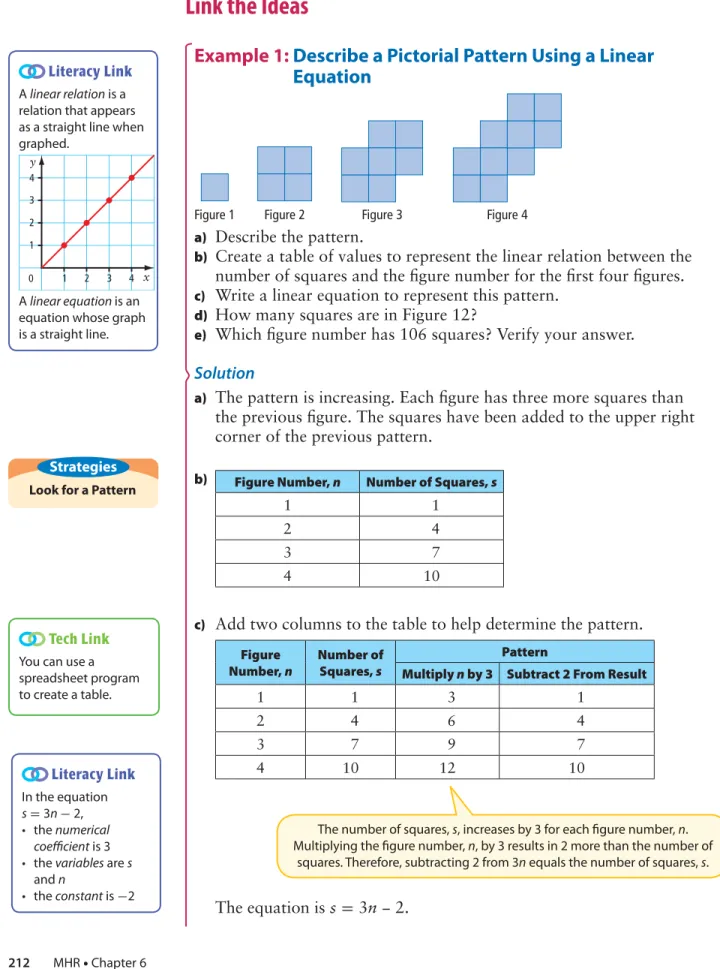
Figure 1 Figure 2 Figure 3 Figure 4
a) Describe the pattern.
b) Create a table of values to represent the linear relation between the number of squares and the fi gure number for the fi rst four fi gures.
c) Write a linear equation to represent this pattern.
d) How many squares are in Figure 12?
e) Which fi gure number has 106 squares? Verify your answer.
Solution
a) The pattern is increasing. Each fi gure has three more squares than the previous fi gure. The squares have been added to the upper right corner of the previous pattern.
b) Figure Number, n Number of Squares, s
1 1
2 4
3 7
4 10
c) Add two columns to the table to help determine the pattern.
Figure Number, n
Number of Squares, s
Pattern
Multiply n by 3 Subtract 2 From Result
1 1 3 1
2 4 6 4
3 7 9 7
4 10 12 10
The equation is s= 3n − 2. Look for a Pattern
Strategies
Tech Link
You can use a spreadsheet program to create a table.
Literacy Link In the equation s = 3n - 2, • the numerical
coeffi cient is 3 • the variables are s
and n
• the constant is -2
The number of squares, s, increases by 3 for each fi gure number, n. Multiplying the fi gure number, n, by 3 results in 2 more than the number of
squares. Therefore, subtracting 2 from 3n equals the number of squares, s. Literacy Link
A linear relation is a relation that appears as a straight line when graphed.
4 3 2 0
1 2 3 4
1 x
y
d) Substitute n= 12 into the equation and solve for s.
s = 3(12) - 2 = 36 - 2 = 34
There are 34 squares in Figure 12.
e) Substitute s= 106 into the equation and solve for n. 106 = 3n- 2
106 + 2= 3n - 2 + 2
108 = 3n
108 ____
3 = 3___ 3n
36 =n
The solution is n= 36.
Check:
Left Side = 106 Right Side = 3n - 2
= 3(36)- 2
= 108 - 2
= 106
Left Side = Right Side
The solution is correct. Figure 36 has 106 squares.
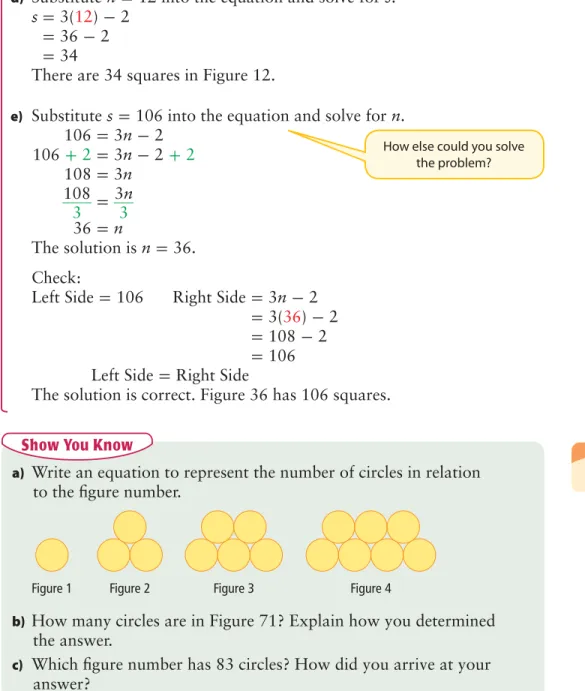
a) Write an equation to represent the number of circles in relation to the fi gure number.
Figure 1 Figure 2 Figure 3 Figure 4
b) How many circles are in Figure 71? Explain how you determined
the answer.
c) Which fi gure number has 83 circles? How did you arrive at your answer?
Show You Know
Use a Variable
Strategies How else could you solve
Example 2:
Describe a Written Pattern Using a Linear
Equation
A bead design for a necklace has an arc shape: • Row 1 has seven red beads.
• Row 2 has five additional beads and all the beads are green. • Row 3 has five additional beads and all the beads are blue. • The pattern repeats. Five beads are added to each successive row.
a) Draw the pattern for the fi rst four rows.
b) Make a table of values showing the number of beads in relation to the row number.
c) What equation shows the pattern between the row number and the number of beads in the row?
d) How many beads are in Row 4? Explain how to check your answer.
e) How many beads are in Row 38?
f) If the bead pattern were continued, which row number would have 92 beads? How did you determine the answer?
Solution a)
Row 1 Row 2 Row 3 Row 4
b) Row Number, n Number of Beads, b
1 7
2 12
3 17
4 22
c) Add two columns to the table to help determine the pattern.
Row Number, n
Number of Beads, b
Pattern
Multiply n by 5 Add 2 to Result
1 7 5 7
2 12 10 12
3 17 15 17
4 22 20 22
The equation is b= 5n+ 2. Draw a Diagram
Strategies
Make an Organized List or Table
Strategies
Look at the diagram of the pattern. In the equation, what does the 5 mean?
d) Count the number of beads in Row 4. There are 22 beads. You can check this by substituting n= 4 into the equation and solving for b.
b = 5n + 2 = 5(4) + 2 = 20 + 2 = 22
There are 22 beads in Row 4.
e) Substitute n= 38 into the equation and solve for b.
b = 5n+ 2 = 5(38) + 2 = 190 + 2 = 192
There are 192 beads in Row 38.
f) Substitute b= 92 into the equation and solve for n. 92 = 5n+ 2
92 - 2= 5n+ 2 - 2
90 = 5n
90 ___
5 = 5___ 5n
18 =n
The solution is n= 18.
Check:
Left Side = 92 Right Side = 5n + 2
= 5(18)+ 2
= 90 + 2
= 92
Left Side = Right Side
The solution is correct. Row 18 has 92 beads.
In a banquet hall, a single rectangular table seats six people. Tables can be connected end to end as shown. Four additional people can be seated at each additional table of the same size.
a) What linear equation could represent this situation? Share with a
classmate how you determined the equation.
b) How many tables connected together will seat 26 people? Show You Know
How else could you solve the problem?
Key Ideas
• Many pictorial and written patterns can be represented using a table of values or a linear equation.
The pentagonal table can seat fi ve people. The tables can be connected to form longer tables.
Number of Tables, t
Number of Sides, s
Pattern: Multiply t by 3 and Add 2
1 5 5
2 8 8
3 11 11
The equation that models the pattern is s = 3t + 2.
• Linear equations can be verifi ed by substituting values. Substitute t = 3 into the equation:
s = 3(3) + 2
= 9 + 2
= 11
The calculated value matches the value in the table.
Check Your Understanding
Communicate the Ideas
1. a) Explain how to develop a linear equation to represent this pattern.
b) What is the equation? Explain what each variable represents.
c) Compare your equation with one of a classmate’s.
2. Christina and Liam work in a shoe store and earn a fl at rate of $35/day plus $6.25 for every pair of shoes they sell. Each got a different value for how much they would earn after selling eight pairs of shoes.
Christina: Liam:
Who is correct? Explain how you know. What mistake did the other person make?
3. Describe to a partner how you could determine the ninth value in the following number pattern: 4, 7.5, 11, 14.5, 18, … .
I substituted p = 8 into the equation
w = 6.25p + 35. When I solved for w, I got $85.
I substituted p = 8 into the equation w = 6.25p. When I solved for w,
For help with #4 to #6, refer to Example 1 on pages 212–213.
4. a) Describe the relationship between the number of regular octagons and the number of sides in this pattern.
b) Make a table of values showing the
number of sides for each fi gure in relation to the number of octagons.
c) Write an equation to model the number
of sides of each shape. Explain what each variable represents.
d) How many sides would a shape made up
of 17 octagons have?
e) How many octagons are needed to make a fi gure with 722 sides?
5. a) Make a table of values to show the number of circles in relation to the fi gure number.
Figure 1 Figure 2 Figure 3
b) Describe the relationship between the number of circles and the fi gure number.
c) Develop an equation that can be used
to determine the number of circles in each fi gure. Explain what each variable represents.
d) How many circles are in Figure 17?
e) Which fi gure number has 110 circles?
6. Laura used green
Figure 1 Figure 2 Figure 3
and white tiles to create a pattern.
a) Make a table
of values to
show the number of green tiles in relation to the fi gure number.
b) Describe the relationship between the number of green tiles and the fi gure number.
c) Develop an equation to model the number of green tiles. Explain what each variable represents.
d) How many green tiles are in Figure 24?
e) Which fi gure number has 176 green tiles? Verify your answer.
For help with #7 to #9, refer to Example 2 on pages 214–215.
7. Matt created the following number pattern:
7, 16, 25, … .
a) Make a table of values for the fi rst fi ve terms.
b) Develop an equation that can be used to
determine the value of each term in the number pattern.
c) What is the value of the 123rd term? d) Which term has a value of 358?
8. The fi gure shows two regular heptagons connected along one side. Each successive fi gure has one additional heptagon. Each side length is 1 cm.
a) Draw the fi rst six fi gures.Then, describe the pattern.
b) Make a table of values showing the
perimeter for the fi rst six fi gures.
c) What equation can be used to determine the perimeter of each fi gure? Identify each variable.
d) What is the perimeter of Figure 12?
e) How many heptagons are needed to create a fi gure with a perimeter of 117 cm?
Literacy Link
A regular heptagon has seven sides of equal length.
9. Jessica created a number pattern that starts with the term -5. Each subsequent number is 3 less than the previous number.
a) Make a table of values for the fi rst fi ve numbers in the pattern.
b) What equation can be used to determine
each number in the pattern? Verify your answer by substituting a known value into your equation.
c) What is the value of the 49th term?
d) Which term has a value of -119? Verify your answer.
10. What linear equation models the relationship between the numbers in each table?
a) x y
0 13
1 16
2 19
3 22
b) r p
0 17
1 24
2 31
3 38
c) k t
1 -1.3 2 1.4 3 4.1 4 6.8
d) f w
1 -0.5
2 -4
3 -7.5 4 -11
Apply
11. Rob is in charge of
arranging hexagonal tables for a parent-night presentation. The tables, which can seat six people, can be connected to form longer tables.
a) Develop an equation to model the
pattern. Identify each variable.
b) How many parents can be seated at a row of fi ve tables?
c) Check your answer for part b). Show
your work.
d) A group of 30 people want to sit together. How many tables must be joined together to seat them?
12. A school pays a company $125 to design gym T-shirts. It costs an additional $15 to make each T-shirt.
a) Copy and complete the table of values.
Number of T-Shirts Cost ($)
0 125
5 200
10 15 35
950
b) Develop an equation to determine the
cost of the T-shirts. Explain the meaning of the numerical coeffi cient.
c) What would it cost to make 378 T-shirts? d) If the school store has a budget of $2345
for T-shirts, how many T-shirts can be ordered?
13. An art store sells square picture frames with a border of tiles that each measure 2 cm by 2 cm. The smallest frame is 10 cm by 10 cm and requires 16 tiles.
10 cm 20 cm 30 cm
a) Develop an equation to determine the number of tiles required for each size of frame.
b) How many tiles are needed to make a frame that is 30 cm by 30 cm?
c) What are the dimensions of a square
You are in charge of developing a racing course for a sailboat race on Lake Diefenbaker, in Saskatchewan. Five classes of sailboats will race on courses that are the same shape, but diff erent lengths.
a) Design a racing course based on a regular polygon. The shortest course must be at least 5 km long. The longest course must be no longer than 35 km.
• Draw and label a diagram of the racing course. Show at least the fi rst four courses. Record the total length of each course.
b) Develop a linear relation related to your racing course. • Make a table of values.
• Develop a linear equation that represents the relationship between the course number and the course distance.
c) Develop a problem related to your racing course. Provide the solution and verify it.
14. Edmund Halley, after whom Halley’s comet was named, predicted that the comet would appear in 1758. The comet appears approximately every 76 years.
a) Use a table to show the years of the next six sightings after 1758.
b) When will Halley’s comet appear
in your lifetime?
c) Write an equation that can be used to predict the years when Halley’s comet will appear.
d) Will Halley’s comet appear in the year 2370? How did you arrive at your answer?
Science Link
A comet, which is made of frozen gas and dust, orbits around the sun. The dust tail of a comet can be up to 10 000 000 km long. This is 2.5 times as great as the average distance from Earth to the moon.
Extend
15. Find the pattern that expresses all the
numbers that are 1 more than a multiple of 3.
a) What is the 42nd number?
b) How can your pattern test to see if 45 678 is 1 more than a multiple of 3?
16. a) A landscaper is planting elm trees along a street in a new subdivision. If elm trees need to be spaced 4.5 m apart, then how long is a row of n elm trees? Write the equation.
b) The street is 100 m long. If the landscaper wants to line the street on both sides with elm trees, how many trees will be needed? Will the trees be evenly spaced along the entire street?
17. A ball is dropped from a height of 2 m.
The ball rebounds to 2__
3 of the height it was dropped from. Each subsequent rebound is 2__
3 of the height of the previous one.
a) Make a table of values for the fi rst fi ve rebound heights in the pattern.
b) What is the height of the fourth
rebound bounce?
6.3
Focus on…
After this lesson, you will be able to…• graph linear relations
• match equations of linear relations with graphs
• solve problems by graphing a linear relation and analysing the graph
Graphing Linear Relations
Tina is in charge of ordering water supplies for a cruise ship. She knows the amount of water required per day for each passenger and crew member as well as the amount of water reserves that the ship carries. She decides to use her
knowledge of linear relations to draw a graph representing the relationship between the
amount of water needed and the length of a cruise.
If Tina were to develop an equation, how could she determine if the graph and the equation represent the same relationship?
Explore Graphs of Linear Relations
On a cruise, the average person requires a minimum of 4 L of water per day. The cruise ship has capacity for 1500 passengers and crew. The ship also carries a reserve of 50 000 L of water in case of emergency.
1. a) Use a method of your choice to determine how much water will be
needed each day of a seven-day cruise.
b) On grid paper, plot the data and label your graph. Compare your graph with that of a classmate.
2. a) Predict how much water is needed for a ten-day cruise.
b) What linear equation represents the litres of water needed per day?
c) How could you verify your answer for part a)? Try out your strategy.
Refl ect and Check
3. Do your graph and the equation represent the same relationship? Explain.
4. Discuss with a partner if it would be appropriate to interpolate or extrapolate values using a fraction of a day. Explain why or why not.
5. a) If the cruise ship used 152 000 L of water, approximately how long did the trip last? Compare the method you used with a classmate’s.
b) Is there more than one way to answer part a)? Explain. Which
method seems more effi cient?
Materials • grid paper
• ruler
What values will you plot along the horizontal axis? along
Link the Ideas
Example 1:
Graph a Linear Equation
The world’s largest cruise ship, Freedom of the Seas, uses fuel at a rate of 12 800 kg/h. The fuel consumption, f, in kilograms, can be modelled using the equation f= 12 800t, where t is the number of hours travelled.
a) Create a graph to represent the linear relation for the fi rst 7 h.
b) Approximately how much fuel is used in 11 h? Verify your solution.
c) How long can the ship travel if it has approximately 122 000 kg of fuel? Verify your solution.
Solution
Method 1: Use Paper and Pencil
a) Create a table of values. Graph the coordinate pairs.
Time, t (h)
Fuel Consumption, f (kg)
0 0
1 12 800
2 25 600
3 38 400
4 51 200
5 64 000
6 76 800
7 89 600
4 5
3 6 7
2 1 0 10 000 20 000 30 000 40 000 50 000 60 000 80 000 90 000
70 000
Fuel Consumption (kg)
Time (h)
t f Cruise Ship Fuel Consumption
b) Draw a straight
4 5
3 6 7 8 9 10 11 12
2 1 0 10 000 20 000 30 000 40 000 50 000 60 000 80 000 90 000 100 000 110 000 120 000 130 000 140 000
70 000
Fuel Consumption (kg)
t f Cruise Ship Fuel Consumption
line to connect the data points. Extend the line past the last data point.
Approximately 140 000 kg of fuel are used in 11 h. Describe the
connection between the equation and the
graph.
What diff erent methods might you use to represent and
Check:
Substitute the value t= 11 into the equation f= 12 800t. f = 12 800(11)
= 140 800
The approximate solution is correct.
c) The fuel will last approximately 9.5 h.
Check:
Substitute f= 122 000 into the equation and solve for t.
122 000= 12 800t
122 000 ________ 12 800 =t
t≈ 9.53
The approximate solution is correct.
Method 2: Use a Spreadsheet
a) In the spreadsheet, cell A1 has been labelled Time, t. Cell B1 has been labelled Fuel Consumption, f.
Enter the fi rst eight values for t in cells A2 to A9. Then, enter the formula for the equation into cell B2. Use an = sign in the formula and * for multiplication. The value for t comes from cell A2.
Use the cursor to select cells B2 down to B9.
Then, use the Fill Down command to enter the formula in these cells. The appropriate cell for t will automatically be inserted. For example, =12800*A6 will be inserted into cell B6.
Use the spreadsheet’s graphing command to graph the table of values. Note that different spreadsheets have different graphing commands. Use your spreadsheet’s instructions to fi nd the correct command.
1 2 3 4 5 6 7 8 9 10 11 12 13 14 15 16 17
A B C D E F G H I
4 5
3 6 7 8 9 10 11 12
2 1 0 20 000 40 000 60 000 80 000 100 000 120 000 140 000
Fuel Consumption (kg)
Time (h)
t f
Cruise Ship Fuel Consumption
Tech Link
You could use a graphing calculator to graph this linear relation. To learn about how to do this go to
www.mathlinks9.ca
b) and c) From the menu, select Add Trendline to draw a straight line from the fi rst data point to the last one. Extend the line past the last data point.
1 2 3 4 5 6 7 8 9 10 11 12 13 14 15 16 17 18
A B C D E F G H I J
4 5
3 6 7 8 9 10 11 12
2 1 0 20 000 40 000 60 000 80 000 100 000 120 000 140 000
Fuel Consumption (kg)
Time (h)
t f
Cruise Ship Fuel Consumption
For part b), approximately 140 000 kg of fuel are used in 11 h. For part c), the fuel will last approximately 9.5 h.
a) Graph the linear relation y= 2x- 5.
b) Use the graph to estimate the value of y if x= 8.
c) Use the graph to estimate the value of x if y=-4. Show You Know
Example 2:
Determine a Linear Equation From a Graph
Great Slave Lake, which is located in the Northwest Territories, is the deepest lake in North America. It has a maximum depth of 614 m. Sam decided to check the depth using his fish finder. He collected the following data up to a depth of 180 m, which was the maximum depth that his fish finder could read.Distance From Shore, d (m) Water Depth, w (m)
0 0
10 -35
20 -70
30 -105
40 -140
50 -175
Did You Know? Fish fi nders operate using sonar, which uses sound waves to “see” objects underwater. The fi sh fi nder produces a sound wave and sends it through the water. When the sound wave meets an object within its range, it bounces back to the fi sh fi nder. The fi sh fi nder determines the depth of the object by measuring the time between when the sound wave was sent and when it returns. The fi sh fi nder then sketches the object on the screen.
Sam used a spreadsheet to graph the data.
1 2 3 4 5 6 7 8 9 10 11 12 13 14 15 16 17 18
A B C D E F G H I J
40 50
30 60 70 80 90 100 20
10 0
–300 –250 –200 –150 –100 –50
W
ater Depth (m)
Distance From Shore (m)
t f
Great Slave Lake Depth Recordings
a) What linear equation does this graph represent? How do you know the equation matches the graph?
b) If this pattern continues, how far from shore would Sam be when the water is 614 m deep?
c) At what rate is the depth of the water decreasing?
d) Is it appropriate to interpolate or extrapolate values on this graph?
Explain.
Solution
a) Add a column to the table to help determine the pattern.
Distance From Shore, d (m) Water Depth, w (m) Pattern: Multiply d by -3.5
0 0 0
10 -35 -35
20 -70 -70
30 -105 -105
40 -140 -140
50 -175 -175
The water depth, w, decreases by 3.5 m for each 1-m increase in the distance from shore, d. The equation is w =-3.5d.
Check by substituting a known coordinate pair, such as (30, 105), into the equation.
Left Side =-105 Right Side =-3.5(30) =-105 Left Side = Right Side
The equation is correct.
What is the connection between the graph and the
b) Substitute w = 614 into the equation and solve for d.
-614=-3.5d
______ -614 -3.5 =d
d ≈ 175.4
Sam would be approximately 175.4 m from shore when the water is 614 m deep.
c) The depth is decreasing at a rate of 3.5 m for each metre away from shore. The rate at which the water depth is decreasing is the coeffi cient of d in the equation.
d) Yes, it is reasonable to interpolate or extrapolate values between and
beyond the given data points since the values for distance and depth exist. However, it is unreasonable to extrapolate values beyond the maximum depth of 614 m.
Identify the linear equation that represents the graph.
1 2 3 4 5 6 7 8 9 10 11 12 13 14 15 16 17 18 19
A B C D E F G H I
4 5
3 6 7 8 9 10 11 12
2 1
(2, 3) (4, 4) (6, 5)
(8, 6)
(10, 7)
0 2 4 6 8 10 12 14
Distance (m)
Time (s)
t d
Show You Know Solve an Equation
Strategies
Example 3:
Graph Horizontal and Vertical lines
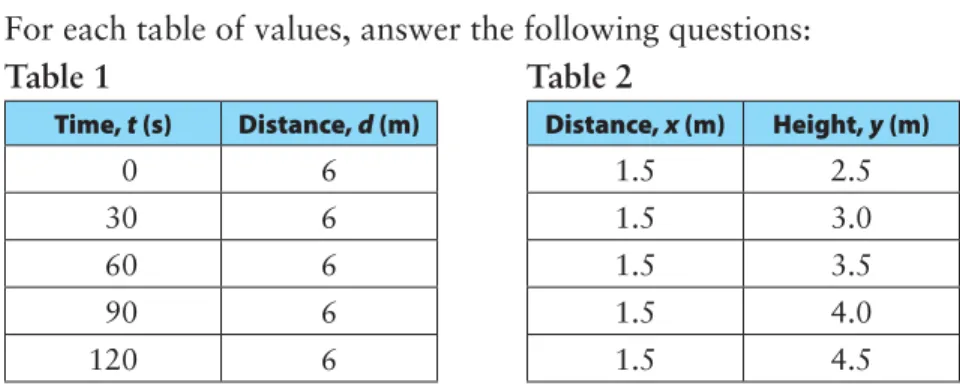
For each table of values, answer the following questions:Table 1 Table 2
Time, t (s) Distance, d (m)
0 6
30 6
60 6
90 6
120 6
Distance, x (m) Height, y (m) 1.5 2.5 1.5 3.0
1.5 3.5
1.5 4.0
1.5 4.5
a) Draw a graph to represent the table of values.
b) Describe a situation that the graph might represent.
c) Write the equation. Explain how you know the graph represents the equation.
Solution a)
80 100 60 120 140 40
20 0 1 2 3 4 5 6 7
Distance (m)
Time (s)
t d Graph of Table 1
1.2 1.5 0.9 1.8 0.6
0.3 0 2.0 2.5 3.0 3.5 4.0 4.5 5.0
Height (m)
Distance (m) x y Graph of Table 2
b) Table 1: The graph could show the relationship between distance and time when a pedestrian is waiting for a traffi c light to change. The distance from the pedestrian to the opposite side of the road is constant.
Table 2: The graph could show the relationship between the height of a ladder and its distance from the wall where it is placed. The distance of the base of the ladder from the wall is constant as the ladder is extended.
c) Table 1: The distance, d, remains constant for each interval of time. The equation is d= 6.
For each value of t in the table and the graph, the value of d is 6.
Table 2: The distance, x, remains constant for each interval of height. The equation is x= 1.5.
For each value of y in the table and the graph, the value of x is 1.5.
Think of a diff erent situation to represent
a) Write the linear equation that
represents the graph.
b) Explain how you know the graph matches the equation.
Show You Know
8 10
6 12
4 2 0 1 2 3 4 5
Distance (m)
Time (s)
t d
Key Ideas
• You can graph a linear relation represented by an equation. Use the equation to make a table of values.
Graph using the coordinate pairs in the table. The graph of a linear relation forms a straight line.
k = __ j 5 - 9
2 4 6
-8.2 -7.8 0
-8.6
-9.0
j k
j k
0 -9.0 1 -8.8 2 -8.6 3 -8.4 4 -8.2 5 -8.0
The graph of a linear relation can form a horizontal or a vertical line.
• You can use graphs to solve problems by interpolating or extrapolating values.
Check Your Understanding
Communicate the Ideas
1. You are given a linear equation. Describe the process you would
follow to represent the equation on a graph. Use an example to support your answer.
3. a) Describe a real-life situation to represent the data on this graph. 1 2 3 4 5 6 7 8 9 10 11 12 13 14 15 16
A B C D E F G H I
4 5
3 6 7 8 9 10 11 12
2 1 (0, 0) (3, 4.5) (6, 9.0) (8, 12.0) (9, 13.5) 0 2 4 6 8 10 12 14 x y
b) Explain how you woulddetermine the equation that represents the graph. Give your explanation to a classmate.
c) Canyouinterpolate or extrapolate values on this graph? Explain
your thinking.
Practise
For help with #4 to #7, refer to Example 1 on pages 232–234.
4. Ian works part-time at a movie theatre. He earns $8.25/h. The relationship between his pay, p, and the time he works, t, can be modelled with the equation p= 8.25t.
a) Show the relationship on a graph. b) Explain how you know the graph
represents the equation.
c) Ian works 8 h in one week. Use two methods to determine his pay.
5. Andrea is travelling by bus at an average speed of 85 km/h. The equation relating distance, d, and time, t, is d=85t.
a) Show the relationship on a graph.
b) How long does it take Andrea to travel 300 km?
6. Choose the letter representing the graph that matches each linear equation.
a) y= 5x b) y =−2x+ 3
c) y = − __ x 4 + 6
A
3 4 5 2 0 4 5 6 7 1 −1 −2 −3 −4
−5 x
y
B
3 4 5 2 0 2 −2 4 6 8 10 1 −1 −2 −3 −4
−5 x
y
C
3 4 5 2 0 5 −5 −10 −15 10 15 1 −1 −2 −3 −4
−5 x
y
Web Link
7. Create a table of values and a graph for each linear equation.
a) x= 4 b) r=−3s+ 4.5
c) m= __ k 5 + 13
For help with #8 to #11, refer to Example 2 on pages 234–236.
8. The graph shows the relationship between
the cost, C, in dollars and the mass, m, in kilograms of pears.
2.0 2.5
1.5 3.0 3.5 4.0 4.5 1.0 0.5 0 1 2 3 4 5 6 7 Cost ($) Mass (kg) m C Cost of Pears
a) What is the linear equation?
b) How much could you buy for $5?
c) Is it appropriate to interpolate or
extrapolate values on this graph? Explain.
9. The graph represents the relationship
between the height of water in a child’s pool,
h
, and the time, t, in hours as the pool fi lls.1 2 3 4 5 6 7 8 9 10 11 12 13 14
A B C D E F G
4 5
3 6 7
2 1 0 5 10 15 20 25 Height (cm) Time (h) t f
Water Height in Pool
a) Determine the linear equation.
b) What is the height of the water after 5 h? c) Is it appropriate to interpolate or
extrapolate values on this graph? Explain.
10. Determine the linear equation that models each graph. a) 1 2 3 4 5 6 7 8 9 10 11 12
A B C D E F G
4 3 2 1 –1 –2 –3 –4 0 4 –4 –8 –12 8 12 x y b) 1 2 3 4 5 6 7 8 9 10 11 12 13 14
A B C D E F
4 3 2 1 –1 –2 –3 –4 0 2 –2 –4 –6 4 8 6 x y
11. What linear equation does each graph
represent? a) 1 2 3 4 5 6 7 8 9 10 11 12
A B C D E F
4 3 2 1 –1 –2 –3 –4 0 0.5 –0.5 –1.0 –1.5 –2.5 –2.0 x y b) 1 2 3 4 5 6 7 8 9 10 11
A B C D E F
12. Create a graph and a linear equation to represent each table of values.
a) x y
-3 -10 -2 -7 -1 -4 0 -1 1 2 2 5 3 8
b) r t
-3 -2.5 -2 -1.0 -1 0.5 0 2.0 1 3.5 2 5.0 3 6.5
c) f z
-3 -3 -2 -3 -1 -3 0 -3 1 -3 2 -3 3 -3
d) h n
-3 -0.75 -2 -0.5 -1 -0.25 0 0 1 0.25 2 0.5 3 0.75
Apply
13. The graph represents the altitude of a hot-air
balloon the fi rst 20 min after it was released.
1 2 3 4 5 6 7 8 9 10 11 12 13 14 15 16
A B C D E F G
20 25 15 10 5 0 400 800 1200 1600 2000 Altitude (m) Time (min) t f
Balloon Altitude Over Time
(0, 0) (5, 450) (10, 900) (12, 1080) (17, 1530) (20, 1800) (21, 1890)
a) What was the approximate altitude of the balloon after 15 min?
b) Estimate how long it took for the balloon
to rise to an altitude of 1 km.
c) What linear equation models the graph?
d) How fast is the balloon rising?
14. Sanjay conducted an experiment to determine how long it takes to heat water from 1 °C to its boiling point at 100 °C. He plotted his data on a graph.
8 10
6 12 14 16 18 20 4 2 0 10 20 30 40 50 60 70 80 90 Temper atur e (ºC) Time (min) t w Water Temperature Over Time
a) Approximately how long did it take for
the water to reach boiling point? Explain your reasoning.
b) What was the temperature of the water
after 10 min?
c) At what rate did the water temperature increase? Explain your reasoning.
15. Paul drives from Time, t (h)
Distance, d (km)
0.5 55.0 0.9 99.0 1.2 132.0 1.5 165.0 2.3 253.0 2.7 297.0 Edmonton to Calgary.
He uses a table to record the data.
a) Graph the linear
relation.
b) How far did Paul drive in the fi rst 2 h?
c) How long did it take
Paul to drive 200 km?
d) Write the equation that relates time and distance.
e) What was Paul’s average driving speed?
What assumptions did you make?
Web Link
To learn about using a graphing calculator to enter data on a table and plot the data on a graph, go to
16. The relationship between degrees Celsius (°C) and degrees Fahrenheit (°F) is modelled by the equation F= 9 __
5 C+ 32.
a) Graph the relationship for values between -50 °C and 120 °C.
b) Water boils at 100 °C. What is this
temperature in degrees Fahrenheit?
c) Water freezes at 0 °C. How did you represent this on your graph?
d) At what temperature are the values for
°C and °F the same?
17. Scuba divers experience an increase in
pressure as they descend. The relationship between pressure and depth can be modelled with the equation P= 10.13d+ 102.4, where P is the pressure, in kilopascals, and
d is the depth below the water surface, in metres.
a) Graph the relationship for the fi rst 50 m
of diving depth.
b) What is the approximate pressure at a depth of 15 m? Verify your answer.
c) The maximum pressure a scuba diver
should experience is about 500 kPa. At what depth does this occur? Verify your answer.
d) What does “+ 102.4” represent in the equation? How is it represented on the graph?
Extend
18. The graph shows the normal range of length
for girls from birth to age 36 months.
20 16 12 8 0
50 60 70 80 90 100 110
4 24 28 32 36
Length (cm)
Age (months)
a l Growth Chart for Girls
a) For what age range does girls’ growth
appear to represent a linear relation?
b) For what age range, does girls’ growth appear to represent a non-linear relation?
19. Janice left the school at 12 noon riding her bike at 20 km/h. Flora left school at 12:30 riding her bike at 24 km/h.
a) Draw a distance–time graph to plot the data for both cyclists during the fi rst four hours. Use a different colour for each cyclist.
b) How can you tell from the graph that
Flora has caught up to Janice?
c) About what time did Flora catch up to Janice?
d) If Janice and Flora continued to ride
at their respective speeds, at what time would they again be apart by a distance of 2 km?
20. An online music download site offers two
monthly plans. Plan A offers $10 plus $1 per download and Plan B offers $1.50 per download.
a) Graph both linear relations on the same grid.
b) Explain the conditions under which
each deal is better. Did You Know?
21. Simple interest is paid according to the formula I = p×r×t,where p is the principal, r is the rate of interest per year, and t is the time in years. The interest is not added to the principal until the end of the time period. Canada Savings Bonds offer a simple interest bond payable at 3.5% per year up to a maximum of ten years.
a) Create a table of values to show the interest earned on a $1000 bond for the ten-year period.
b) Use a graph to show the interest earned over ten years.
c) How many years would it take to earn
$100 interest? $200 interest?
d) If you could leave the principal beyond the ten-year period, estimate the number of years it would take to earn $500 interest.
The world’s fastest submarines can reach speeds of 74 km/h in 60 s, starting from rest. If a submarine is already moving, then the time to reach its top speed will diff er.
a) Choose four diff erent starting speeds up to a maximum of 74 km/h. For each speed, assume that the acceleration is the same. For each speed include: • a table of values
• a linear equation and a graph to represent the relationship between speed and time
b) Describe each graph. Identify any similarities and diff erences you observe between the graphs and the equations.
Did You Know?
Chapter 6 Review
Key Words
For #1 to #5, unscramble the letters for each term. Use the clues to help you.
1. R A N E I L R A I N E T L O
a pattern made by a set of points that lie in a straight line when graphed
2. P L E X A T R O T E A
estimate values beyond known data
3. T S T O N C A N
in y= 4x+ 3, the number 3 is an example
4. E L I N A R Q U E I O N A T
an equation that relates two variables in such a way that the pattern forms a straight line when graphed
5. T R I P O L E N E A T
estimate values between known data
6.1 Representing Patterns, pages 210–219 6. a) Make a table of values for the toothpick
pattern.
Figure 1 Figure 2 Figure 3
b) Describe the pattern.
c) Develop anequation relating the number
of toothpicks to the fi gure number.
d) How many toothpicks are in Figure 10? Verify your answer.
e) How do the numerical values in the
equation represent the pattern?
7. Derek has $56 in his bank account. He
plans to deposit $15 every week for a year.
a) Create a table of values for his fi rst fi ve deposits.
b) What equation models this situation? c) How much money will Derek have in his
account after 35 weeks?
d) How long will it take him to save $500?
8. Taylor works at a shoe store. She makes
$50 per day plus $2 for every pair of shoes she sells.
a) Create a table of values to show how
much she would earn for selling up to ten pairs of shoes in one day.
b) Develop an equation to model this
situation.
c) How much money will Taylor make in a day if she sells 12 pairs of shoes? Use two methods for solving the problem.
6.2 Interpreting Graphs, pages 220–230
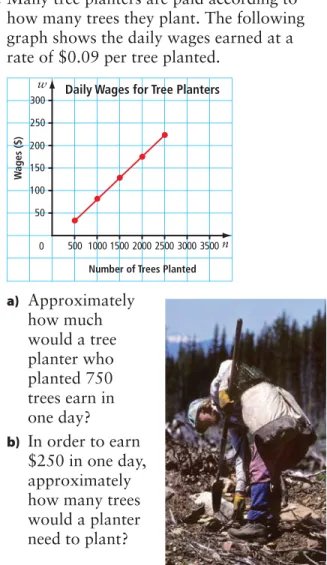
9. Many tree planters are paid according to
how many trees they plant. The following graph shows the daily wages earned at a rate of $0.09 per tree planted.
2000 2500 1500 3000 3500 1000
500 0 50 100 150 200 250 300
W
ages ($)
Number of Trees Planted n w Daily Wages for Tree Planters
a) Approximately how much would a tree planter who planted 750 trees earn in one day?
10. The graph shows the relationship between air pressure, in kilopascals, and altitude, in metres.
1000 1500 2000 2500 500
0 20 40 60 80 100 120
Air Pr
essur
e (kP
a)
Altitude (m)
a p Air Pressure Changes
a) What is the approximate air pressure at an altitude of 1500 m? 2400 m?
b) Approximately at what altitude is the
air pressure 90 kPa? 60 kPa?
c) Does it make sense to interpolate or extrapolate values on this graph? Explain.
11. There are 15 schools in an urban school
district. The table shows data about the student and teacher populations for eight of the schools.
Students 100 250 300 450 700 150 1025 650
Teachers 9 15 17 23 33 11 46 31
a) Graph the relationship between the
number of students and teachers.
b) How many teachers might be in a school that has 850 students? 1200 students?
c) How many students might attend
a school that employs 30 teachers? 50 teachers?
6.3 Graphing Linear Relations, pages 231–243
12. The cost of renting a snowboard can be calculated using the equation C= 40 + 20d, where C is the rental cost, in dollars, and d
is the number of rental days.
a) Graph the linear relation for the fi rst
fi ve days.
b) From the graph, what is the approximate cost of renting the snowboard for one day? seven days?
c) If buying a snowboard costs $300, use your graph to approximate how many days you could rent a board before it becomes cheaper to buy it.
d) Describe another method you could use
to solve parts b) and c).
13. Graph the linear relation represented in the
table of values.
Time (h) Distance (km) 0.5 52.5
1.0 105.0
1.5 157.5
2.0 210.0
2.5 262.5
3.0 315.0
3.5 367.5
4.0 420.0
a) Describe a situation that might lead to these data.
b) Develop a linear equation to model
the data.
c) What do the numerical coeffi cients and constants in the equation tell you?
14. A parking lot charges a fl at rate of $3.00 and $1.75 for each hour or part of an hour of parking.
a) Create a table of values for the fi rst 8 h of parking.
b) Graph the linear relation.
c) Use the graph to approximate how much
it would cost to park for 4 h.
d) Using the graph, approximately how long could you park if you had $15.25?
Chapter 6 Practice Test
For #1 to #3, select the best answer.
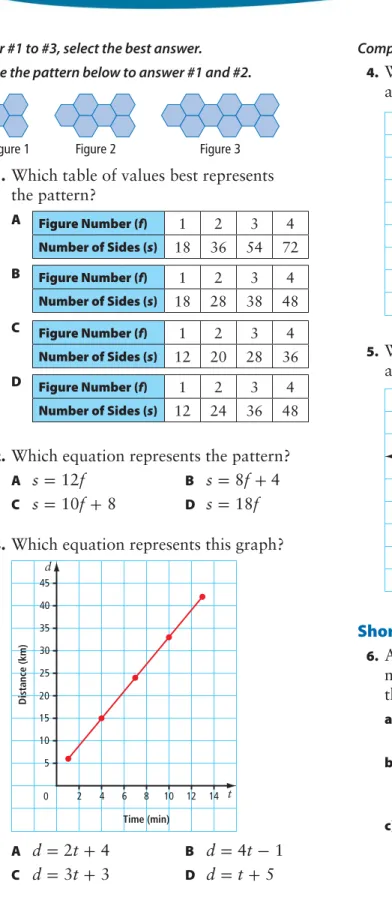
Use the pattern below to answer #1 and #2.
Figure 1 Figure 2 Figure 3
1. Which table of values best represents
the pattern?
A Figure Number (f) 1 2 3 4
Number of Sides (s) 18 36 54 72
B Figure Number (f) 1 2 3 4
Number of Sides (s) 18 28 38 48
C Figure Number (f) 1 2 3 4
Number of Sides (s) 12 20 28 36
D Figure Number (f) 1 2 3 4
Number of Sides (s) 12 24 36 48
2. Which equation represents the pattern?
A s= 12f B s= 8f+ 4
C s= 10f+ 8 D s= 18f
3. Which equation represents this graph?
8 10 12 14 4 6
2 0 5 10 15 20 25 30 35 40 45
Distance (km)
Time (min)
t d
A d= 2t+ 4 B d= 4t- 1
C d= 3t+ 3 D d=t+ 5
Complete the statements in #4 and #5.
4. When x= 1.5 on the graph, the approximate y-coordinate is .
4 5 6 7 8 2 3
1 0 1 2 3 4 5 6 7
x y
5. When y=−8 on the graph, the approximate x-coordinate is .
3 4 5 2
0 2 4
−2
−4
−6
−8
−10 1 −1 −2 −3 −4
−5 x
y
Short Answer
6. A number pattern starts with the
number −2. Each number is 4 less than the previous number.
a) Make a table of values for the fi rst fi ve
numbers in the pattern.
b) What equation can be used to determine each number in the pattern? Verify your answer.
You are planning a canoe trip with some friends. Where are you going? How long will your trip be? How many people are going?
You are in charge of ordering food supplies to meet the energy requirements of your group. For the trip, the amount of food energy required by a canoeist can be modelled by the equation a = ____ C
100 - 17, where a represents the person’s age and C represents the number of calories.
Use the Internet, travel brochures, or other sources to fi nd information about your trip.
a) Write a paragraph describing your trip.
b) Create a table of values for your data about total food energy requirements for the group.
c) Graph the linear relation.
d) Develop a problem based on your graph that also includes interpolation and extrapolation and provide a solution. Show your work.
7. A cheese party pizza costs $21.25. The graph shows the cost of adding additional toppings.
4 5 6 2 3
1 0 5 10 15 20 25 30 35
Cost ($)
Number of Toppings n C Cost of Pizza
a) What is the approximate cost of a party
pizza with fi ve toppings?
b) Is it reasonable to interpolate values on this graph? Explain.
8. Create a table of values and a graph for each equation.
a) y= -2x+ 6 b) y= 2x- 6
c) y= 6
9. How are the graphs in #8 similar? How are they different?
Extended Response
10. A cross-country ski park contains fi ve
different trails. The diagram shows the trails, with each trail being successively larger.
2 km
Trail 1
Trail 2
Trail 3
Trail 4
Trail 5
Each side length of the shortest trail is 2 km. The side length of each consecutive trail is 0.5 km longer than the previous one.
a) Construct a table of values to show the
relationship between the trail number and the total distance of each trail.
b) What equation represents the relationship? c) Graph the linear relation.
d) If a sixth trail were added, what would
be its total distance?
![Tax fraud indicators / Rohaya Md Noor … [et al.]](data:image/gif;base64,R0lGODlhAQABAIAAAP///wAAACH5BAEAAAAALAAAAAABAAEAAAICRAEAOw==)