LINEAR MATHEMATICS
IN
INFINITE DIMENSIONS
Signals
Boundary Value Problems
and Special Functions
U. H. Gerlach
January 2017
2nd Beta Edition
In its “2nd Beta Edition” this document is meant for private
or class room consumption. As such I ([email protected])
would appreciate feedback about the strengths as well as
weaknesses (e.g. lack of clarity, insufficient
Preface
Mathematics is the science of measurement, of establishing quantitative re-lationships between the properties of entities. The entities being measured occupy the whole spectrum of abstractness, from first-level concepts, which are based on perceptual data obtained by direct observation, to high-level concepts, which are further up in the edifice of knowledge. Furthermore, be-ing the science of measurement, mathematics provides the logical glue that cements and cross-connects the structural components of this edifice.
1. The effectiveness and the power of mathematics (and more generally of logic) in this regard arises from the most basic fact of nature: to be is to be something, i.e. to be is to be a thing with certain distinct properties, or: to exist means to have specific properties. Stated negatively: a thing cannot have and lack a property at the same time, or: in nature contradictions do not exist, a fact already identified by the father of logic1 some twenty-four
centuries ago.
Mathematics is based on this fact, and on the existence of a consciousness (a physicist, an engineer, a mathematician, a philosopher, etc.) capable of identifying it. Thus mathematics is neither intrinsic to nature (reality), apart from any relation to man’s mind, nor is it based on a subjective creation of a man’s consciousness detached from reality. Instead, mathematics furnishes us with the means by which our consciousness grasps reality in a quantitative manner. It allows our consciousness to grasp, in numerical terms, the micro-cosmic world of subatomic particles, the macro-micro-cosmic world of the universe and everything in between2. In fact, this is what mathematicians are
sup-1Aristotle, the Greek philosopher, 384-322 B.C.
2The objectivity of mathematics and its relation to physics is explicated in “The Role
of Mathematics and Philosophy”, Chapter 7, in THE LOGICAL LEAP: Induction in Physics by David Harriman (New York: Penguin Group, 2010).
posed to do, to develop general methods for formulating and solving physical problems of a given type.
In brief, mathematics highlights the potency of the mind, its cognitive efficacy in grasping the nature of the world. This potency arises from the mind ability to form concepts, a process which is made most explicit by the science of mathematics.3
2. Mathematics is an inductive discipline first and a deductive disci-pline second. This is because, more generally, induction preceeds deduc-tion4. Without the former, the latter is impossible. Thus, the validity of the
archetypical deductive reasoning process
“Socrates is a man. All men are mortal. Hence, Socrates is a mortal.” depends on the major premise “All men are mortal.” It constitutes an iden-tification of the nature of things. It is arrived at by a process of induction, which, in essence, consists of observing the facts of reality, of identifying their essential properties, and of integrating them with what is already known into new knowledge – here, a relationship between “man” and “mortal”. In math-ematics, inductively formed conclusions, analogous to this one, are based on motivating examples and illustrated by applications.
Mathematics thrives on examples and applications. In fact, it owes its birth and growth to them. This is manifestly evidenced by the thinkers of Ancient Greece who “measured the earth”, as well as by those of the En-lightenment, who “calculated the motion of bodies”. It has been rightfully observed that both logical rigor and applications are crucial to mathemat-ics. Without the first, one cannot be certain that one’s statements are true. Without the second it does not matter one way or the other5. These lecture
notes cultivate both. As a consequence they can also be viewed as an at-tempt to make up for an error committed by mathematicians through most
3Being a philosopher, Leonard Peikoff in hisObjectivism: The Philosophy of Ayn Rand
(New York: Penguin books, 1993, p. 90) describes the role of mathematics this way:
“The mathematician is the exemplar of conceptual integration. He does professionally and in numerical terms what the rest of us do implicitly and have done ever since childhood, to the extent that we exercise our distinctive human capacity”.
4“The Structure of Inductive Reasoning”, Section 1.5, inTHE LOGICAL LEAP: In-duction in Physics by David Harriman (New York: Penguin Group, 2010, p. 29-35).
5David Harriman, “Enlightenment Science and Its Fall”,The Objective Standard; 1(1):
iii
of history – the Platonic error of denigrating applications6.
This Platonic error, which arises from placing mathematical ideas prior to their physical origin, has metastasized into the invalid notion ‘“pure” math-ematics’. It is a post-Enlightenment (Kantian) fig leaf7 for the failure of
theoretical mathematicians to justify the rigor and the abstractness of the concepts they have been developing. The roots of this failure are expressed in the inadvertent confession of the chairman of a major mathematics depart-ment: “We are all Platonists in this department.” Plato and his descendants declared that reality, the physical world, is an imperfect reflection of a purer and higher mystical dimension with a gulf separating the two. That being the case, they aver that “pure” mathematics – and more generally the “ a priori” – deals only with this higher dimension, and not with the physical world, which they denigrate as gross and imperfect, and dismiss as mere appearances.
With the acceptance – explicit or implicit – of such a belief system, “pure” mathematics has served as a license to misrepresent theoretical mathematics as a set of floating abstractions cognitively disconnected from the real world. The modifier “pure” has served to intimidate the unwary engineer, physi-cist or mathematician into accepting that this disconnect is the price that mathematics must pay if it is to be rigorous and abstract.
Ridding a culture’s mind from impediments to epistemic progress is a non-trivial task. However, a good first step is to banish detrimental termi-nology, such as “pure” mathematics, from discourses on mathematics and replace it with an appropriate term such as theoretical mathematics. Such a replacement is not only dictated by its nature, but it also tends to reinstate the intellectual responsibility among those who need to live up to their task of justifying rigor (i.e. precision) and abstractness.
3. Mathematics is both complex and beautiful. The complexity of math-ematics is a reflection of the complexity of the relationships that exist in the universe. The beauty of mathematics is a reflection of the ability of the human mind to identify them in a unit-economical way8 : the more
eco-6ibid.
7more precisely, a rationalization, i.e. a cover-up, namely a process of providing one’s
emotions with spurious justifications. (“Philosophic Detection” in Ayn Rand,Philosophy: Who Needs It, New American Library, Penguin Group Inc., New York, 1984.)
8The principle of unit-economy (also known informally as the “crow epistemology”)
nomical the identification of a constellation of relationships, the more man’s mind admires it. Beauty is not in the eyes of the beholder. Instead it is giving credit where credit is due – according to an objective standard. In mathematics that standard is the principle of unit economy. Its purpose is the condensation of knowledge, from the perceptual level all the way to the conceptual at the highest level.
4. Linearity is as fundamental to mathematics as it is to our mind in forming concepts. The transition from recognizing thatx+y=x+y to the act of grasping thata+a= 2a is the explicit starting point of a conceptual consciousness grasping nature in mathematical terms with linearity at the center. Thus it is not an accident that linear mathematics plays its pervasive role in our comprehending the nature of nature around us. In fact, it would not be an exaggeration to say that “Linearity is the exemplary method – simple and primitive – for our grasping of nature in conceptual terms”. The appreciation of this fact is found in that nowadays virtually every college and university offers a course in linear algebra, with which we assume the reader is familiar.
5. Twentieth century mathematics is characterized by an inflationary version of Moore’s Law. Moore’s Law expresses the observation that the number of transistors that fit onto a microchip doubles every two years. This achievement has been a boon to everybody. It put a computer into nearly every household.
The mathematical version of Moore’s Law expresses the observation that, up to the Age of Enlightenment, all of Man’s mathematical achievements fit into a four-volume book; the achievements up to, say, 1900 fit into a fourteen-volume tome, while the mathematical works generated during the twentieth century take up a whole floor of a typical university library.
Such abundance has its delightful aspects, but it is also characterized by repetitions and non-essentials. This cannot go on for too long. Such an increase ultimately chokes itself off.
One day, confronted with an undifferentiated amorphous juxtaposition of mathematical works, a prospective scientist/engineer/physicist/mathematician might start wondering: “I know that mathematics is very important, but am I learning theright kind of mathematics?”
Such a person is looking for orientation as to what is essential, i.e. what is
v
fundamental, and what is not. It has been said that the value of a book9, like
that of a definition10, can be gauged by the extent to which it spells out the
essential, but omits the nonessential, which is, however, left implied. With that in mind, this text develops from a single perspective six mathematical jewels (in the form of six chapters) which lie at the root twentieth century science.
Another motivation for making the material of this text accessible to a wider audience is that it solves a rather pervasive problem. Most books which the author has tried to use as class texts either lacked the mathe-matics essential for grasping the nature of waves, signals, and fields, or they misrepresented it as a sequence of disjoint methods. The student runs the danger of being left with the idea that the mathematics consists of a set ofad hoc recipes with an overall structure akin to the proverbial village of squat one-room bungalows instead of a few towering skyscrapers well-connected by solid passage ways.
6. We extend and then apply several well-known ideas from finite dimen-sional linear algebra to infinite dimensions. This allows us to grasp readily not only the overall landscape but it also motivates the key calculations whose purpose is to connect and cross-link the various levels of abstraction in the constructed edifice. Even though the structure of these ideas have been developed in linear algebra, the motivation for doing so and then using them comes from engineering and physics. In particular, the goal is to have at one’s disposal the constellation of mathematical tools for a graduate course in elec-tromagnetics and vibrations for engineers or electrodynamics and quantum mechanics for physicists. The benefits to an applied mathematician is the acquisition of nontrivial mathematics from a cross-disciplinary perspective.
All key ideas of linear mathematics in infinite dimensions are already present with waves, signals, and fields whose domains are one-dimensional. The transition to higher dimensional domains is very smooth once these ideas have been digested. This transition does, however, have a few pleasant sur-prises. They come in the form of special functions, whose existence and prop-erties are a simple consequence of the symmetry propprop-erties of the Euclidean plane (or Euclidean three-dimensional space). These properties consist of the
9Question and answer period following “You and Your Research” by Richard Hamming. http://www.cs.virginia.edu/~robins/YouAndYourResearch.html
Also see the Appendix, page 477.
invariance under translations and rotations of distance measurements and of the shapes of propagating waves.
7. What is the status of the concept “infinite” appearing in the title of this text? Quite generally the concept “infinite” is invalid metaphysically but valid mathematically.
In the sense of metaphysics (i.e. pertaining to reality, to the nature of things, to existence) infinity falls into the category of invalid concepts, namely attempts to integrate errors, contradictions, or false propositions into something meaningful. Infinity as a metaphysical idea is an invalid concept because metaphysically it is only concretes that exist, and concretes are finite, i.e. have definable properties. An attempt to impart metaphysical significance to infinity is an attempt to rewrite the nature of reality.
However, in mathematics infinity is a well defined concept. It has a def-inite purpose in mathematical calculations. It is a mathematical method which is made precise by means of the familiar δ-ε process of going to the limit. This text develops only concepts which by their nature are valid. In-cluded is the concept “infinity”, which, properly speaking, refers to a math-ematical method.
8. The best way to learn something is to teach it. In order to facilitate this motto of John A. Wheeler, the material of this book has been divided into fifty lecture sessions. This means that there is one or two key ideas between “Lecture n” and “Lecture n + 1”, where n = 1,· · ·50. Often the distance betweenn andn+ 1 extends over more pages than can be digested in a forty-eight minute session. However, the essentials of the nth Lecture are developed in a small enough time frame. Thus the first four or five pages following the heading “Lecturen” set the direction of the development, which is completed before the start of lecture “Lecturen+ 1”.
Such a division can be of help in planning the schedule necessary to learn everything.
9. It is not necessary to digest the chapters in sequential order. A de-sirable alternative is to start with Sturm-Liouville theory (chapter 3) before proceeding systematically with the other chapters. Moreover, there is obvi-ously nothing wrong with diving in and exploring each chapter according to one’s background and predilections. The opening remarks of each one point out how linear algebra relates it to the others.
vii
multiresolution analysis.
Ulrich H. Gerlach Columbus, Ohio, March 24, 2009
Foreword to the Second Edition (
tentative
)
TBD
Mathematics is the language of Physics. Why?
Mathematics is beautiful. Why? Is its beauty in “the eyes of the be-holder”? Is beauty an attribute intrinsic to mathematics? Or is it an objec-tive attribute?
Contents
0 Introduction 1
1 Sturm-Liouville Theory 5
1.1 Three Archetypical Linear Problems . . . 5
1.2 The Homogeneous Problem . . . 7
1.3 Sturm-Liouville Systems . . . 11
1.3.1 Sturm-Liouville Differential Equation . . . 11
1.3.2 Homogeneous Boundary Conditions . . . 14
1.3.3 Basic Properties of a Sturm-Liouville Eigenvalue Problem 19 1.4 Phase Analysis of a Linear Second Order O.D.E. . . 36
1.4.1 The Pr¨ufer System . . . 37
1.5 Qualitative Results . . . 42
1.6 Phase Analysis of a Sturm-Liouville System . . . 45
1.6.1 The Boundary Conditions . . . 46
1.6.2 The Boundary Value Problem . . . 47
1.6.3 The Behavior of the Phase: The Oscillation Theorem . 48 1.6.4 Discrete Unbounded Sequence of Eigenvalues . . . 52
1.7 Completeness of the Set of Eigenfunctions via Rayleigh’s Quo-tient . . . 54
2 Infinite Dimensional Vector Spaces 61 2.1 Inner Product Spaces . . . 62
2.2 Normed Linear Spaces . . . 63
2.3 Metric Spaces . . . 67
2.4 Complete Metric Spaces . . . 69
2.4.1 Limit of a Sequence . . . 69
2.4.2 Cauchy Sequence . . . 69
2.4.3 Cauchy Completeness: Complete Metric Space,
Ba-nach Space, and Hilbert Space . . . 70
2.5 Hilbert Spaces . . . 72
2.5.1 Two Prototypical Examples . . . 74
2.5.2 Hilbert Spaces: Their Coordinatizations . . . 75
2.5.3 Isomorphic Hilbert Spaces . . . 96
3 Fourier Theory 107 3.1 The Dirichlet Kernel . . . 110
3.1.1 Basic Properties . . . 113
3.1.2 Three Applications . . . 114
3.1.3 Poisson’s summation formula . . . 126
3.1.4 Gibbs’ Phenomenon . . . 130
3.2 The Dirac Delta Function . . . 135
3.3 The Fourier Integral . . . 138
3.3.1 Transition from Fourier Series to Fourier Integral . . . 139
3.3.2 The Fourier Integral Theorem . . . 140
3.3.3 The Fourier Transform as a Unitary Transformation . . 144
3.3.4 Fourier Transform via Parseval’s Relation . . . 151
3.3.5 Efficient Calculation: Fourier Transform via Convolution156 3.4 Orthonormal Wave Packet Representation . . . 169
3.4.1 Orthonormal Wave Packets: General Construction . . . 170
3.4.2 Orthonormal Wave Packets: Definition and Properties 172 3.4.3 Phase Space Representation . . . 177
3.5 Orthonormal Wavelet Representation . . . 182
3.5.1 Construction and Properties . . . 184
3.6 Multiresolution Analysis . . . 189
3.6.1 Chirped Signals and the Principle of Unit-Economy . . 189
3.6.2 Irregular Signals and Variable Resolution Analysis . . . 193
3.6.3 Multiresolution Analysis as Hierarchical . . . 194
3.6.4 Unit-Economy via the Two Parent Wavelets . . . 202
3.6.5 Multiscale Analysis as a Method of Measurement . . . 208
3.6.6 Multiscale Analysis vs Multiresolution Analysis: MSA or MRA? . . . 209
3.6.7 The Pyramid Algorithm . . . 210
3.6.8 The Requirement of Commensurability . . . 213
CONTENTS xi
4 Green’s Function Theory 225
4.1 Cause and Effect Mathematized in Terms of Linear Operator
and Its Adjoint . . . 226
4.1.1 Adjoint Boundary Conditions . . . 228
4.1.2 Second Order Operator and the Bilinear Concomitant . 232 4.2 Green’s Function and Its Adjoint . . . 235
4.3 A Linear Algebra Review: Existence and Uniqueness . . . 235
4.4 The Inhomogeneous Problem . . . 236
4.4.1 Translation Invariant Systems . . . 239
4.5 Pictorial Definition of a Green’s Function . . . 241
4.5.1 The Simple String and Poisson’s Equation . . . 241
4.5.2 Point Force Applied to the System . . . 244
4.6 Properties and Utility of a Green’s Function . . . 246
4.7 Construction of the Green’s Function . . . 250
4.8 Unit Impulse Response: General Homogeneous Boundary Con-ditions . . . 254
4.9 The Totally Inhomogeneous Boundary Value Problem . . . 257
4.10 Spectral Representation . . . 260
4.10.1 Spectral Resolution of the Resolvent of a Matrix . . . . 260
4.10.2 Spectral Resolution of the Green’s Function . . . 263
4.10.3 Green’s Function as the Fountainhead of the Eigenval-ues and Eigenvectors of a System . . . 267
4.10.4 String with Free Ends: Green’s Function, Spectrum, and Completeness . . . 270
4.11 Boundary Value Problem via Green’s Function: Integral Equation . . . 275
4.11.1 One-dimensional Scattering Problem: Exterior Bound-ary Value Problem . . . 276
4.11.2 One-dimensional Cavity Problem: Interior Boundary Value Problem . . . 279
4.11.3 Eigenfunctions via Integral Equations . . . 281
4.11.4 Types of Integral Equations . . . 282
4.12 Singular Boundary Value Problem: Infinite Domain . . . 285
4.12.1 Review: Branches, Branch Cuts, and Riemann Sheets . 287 4.12.2 Square Integrability . . . 289
4.12.3 Infinite String . . . 291
4.13 Spectral Representation of the Dirac Delta Function . . . 298
4.13.1 Coalescence of Poles into a Branch Cut . . . 299
4.13.2 Contour Integration Around the Branch Cut . . . 300
4.13.3 Fourier Sine Theorem . . . 303
5 Special Function Theory 309 5.1 The Helmholtz Equation . . . 311
5.1.1 Cartesian versus Polar Coordinates . . . 311
5.1.2 Degenerate Eigenvalues . . . 313
5.1.3 Complete Set of Commuting Operators . . . 314
5.1.4 Translations and Rotations in the Euclidean Plane . . 316
5.1.5 Symmetries of the Helmholtz Equations . . . 321
5.1.6 Wanted: Rotation Invariant Solutions to the Helmholtz Equation . . . 322
5.2 Properties of Hankel and Bessel Functions . . . 329
5.3 Applications of Hankel and Bessel Functions . . . 350
5.3.1 Exterior Boundary Value Problem: Scattering . . . 351
5.3.2 Finite Interior Boundary Value Problem: Cavity Vi-brations . . . 353
5.3.3 Infinite Interior Boundary Value Problem: Waves Prop-agating in a Cylindrical Pipe . . . 357
5.4 More Properties of Hankel and Bessel Functions . . . 363
5.5 The Method of Steepest Descent and Stationary Phase . . . . 370
5.6 Boundary Value Problems in Two Dimensions . . . 380
5.6.1 Solution via Green’s Function . . . 381
5.6.2 Green’s Function via Dimensional Reduction . . . 382
5.6.3 Green’s Function: 2-D Laplace vs. (Limit of) 2-D Helmholtz . . . 385
5.7 Wave Equation for Spherically Symmetric Systems . . . 389
5.7.1 Spherically Symmetric Solutions . . . 391
5.7.2 Factorization Method for Solving a Partial Differential Equation: Spherical Harmonics . . . 392
5.8 Static Solutions . . . 404
5.8.1 Static Multipole Field . . . 405
5.8.2 Addition Theorem for Spherical Harmonics . . . 407
CONTENTS xiii
6 Partial Differential Equations 413
6.1 Single Partial Differential Equations: Their Origin . . . 416
6.1.1 Boundary Conditions of a Typical Partial Differential Equation in Two Dimensions . . . 417
6.1.2 Cauchy Problem and Characteristics . . . 419
6.1.3 Hyperbolic Equations . . . 422
6.1.4 Riemann’s Method for Integrating the Most General 2nd Order Linear Hyperbolic Equation . . . 427
6.2 System of Partial Differential Equations: How to Solve Maxwell’s Equations Using Linear Algebra . . . 436
6.2.1 Maxwell Wave Equation . . . 438
6.2.2 The Overdetermined System A~u=~b . . . 440
6.2.3 Maxwell Wave Equation (continued) . . . 443
6.2.4 Cylindrical Coordinates . . . 450
Chapter 0
Introduction
Lecture 1
The main focus of the next several chapters is on the mathematical frame-work that underlieslinear systems arising in physics, engineering and applied mathematics. Roughly speaking, we are making a generalization from the theory of linear transformation onfinite dimensional vector space to the the-ory of linear operators oninfinite dimensional vector spaces as they occur in the context of homogeneous and inhomogeneous boundary value and initial value problems.
The key idea is linearity. Itsgeometrical imagery in terms of vector space, linear transformation, and so on, is a key ingredient for an efficient compre-hension and appreciation of the ideas of linear analysis to be developed. Thus it is very profitable to repeatedly ask the question: What does this correspond to in the case of a finite dimensional vector space?
Here are some examples of what we shall generalize to the infinite dimen-sional vector case:
I. Solve each of the following linear algebra problems 1. A~u= 0 “Homogeneous problem”
2. A~u=~b “Inhomogeneous problem” 3. AG=I “Inverse ofA”
These are archetypical problems of linear algebra. (If 1. has a non-trivial solution, then 2. has infinitely many solutions or none at all, depending on ~b, and 3. has none.)
More generally we ask: For what values of λ do the following have a solution (and for what values do they not):
1. (A−λB)~u= 0 2. (A−λB)~u=~b 3. (A−λB)G=I
Of greatest interest to us is the generalization in which A is (part of) a differential operator with in general non-constant coefficients.
As we know from linear algebra, these three types of problems are closely related, and consequently this must also be the case for our generalization to linear differential equations, ordinary as well as partial. In fact, these three types are called
1. Homogeneous boundary or initial value problems; 2. Inhomogeneous problems;
3. Green’s function problems.
II. There is another idea which we shall extend from the finite to the infinite dimensional case. Consider the eigenvalue equation
Au=λIu .
Let us suppose that there are enough eigenvectors to span the whole vector space, but that at least one eigenvalue is degenerate, i.e., it has more than one eigenvector. In that case, the vector space has an eigenbasis, but it is not unique. Eigenvectors, including those used for a basis, derive their physical and geometrical significance from eigenvalues. Indeed, eigenvalues serve as labels for eigenvectors. Consequently, the lack of enough eigenvalues to distinguish between different eigenvectors in a particular eigensubspace introduces an intolerable ambiguity in our physical and geometrical picture of the inhabitants of this subspace.
In order to remedy this deficiency one introduces another matrix, say T, whose eigenvectors are also eigenvectors ofA, but whose eigenvalues are non-degenerate. The virtue of this introduction is that the matrix T recognizes explicitly and highlights, by means of its eigenvalues, a fundamental physical and geometrical property of the linear system characterized by the matrixA. This explicit recognition is stated mathematically by the fact that T commutes withA
3
In general, the matrixT is not unique. Suppose there are two of them, say T1, which highlights property 1 andT2, which highlights a different property
of the system. Thus
AT1−T1A= 0
and
AT2−T2A= 0,
but
T1T2−T2T1 6= 0.
Consequently, for hermitian matrices, the matrix A is characterized by two alternative orthonormal eigenbases, one due to T1, the other due to T2, and
there is a unitary transformation which relates the two bases.
The matrix A does not determine the choice of eigenbasis. Instead, this choice is determined by which of the two physical properties we are told to (or choose to) examine, that of T1 or that ofT2.
In the extension of these ideas to differential equations, we shall find that
A = Laplace operator T1 = translation operator
T2 = rotation operator
and that the T1-induced eigenbasis consists of plane wave solutions, the T2
-induced eigenbasis consists of the cylinder wave solutions, and the unitary transformation between them is a Fourier transform.
III.A further idea which these notes extend to infinite dimensions is that of an inhomogeneous four-dimensional system,
A~u=~b ,
which is overdetermined: the matrix A is 4×4, but singular with a one-dimensional null space.
The extension consists of the statement that (a) this equation is a vec-torial wave equation which is equivalent to Maxwell’s field equation, (b) the four-dimensional vectors ~u and~b are 4-d vector fields, and (c) the matrix A has entries which are second order partial derivatives.
functions. For Maxwell’s equations there are exactly three of them, and they are the scalars from which one obtains the three respective types of Maxweell fields,
• transverse electric (TE), • transverse magnetic (TM),
• transverse electric magnetic (TEM).
Chapter 1
Sturm-Liouville Theory
Lecture 2
1.1
Three Archetypical Linear Problems
We shall now take our newly gained geometrical familiarity with infinite dimensional vector spaces and apply it to each of three fundamental problems which, in linear algebra, have the form
1. (A−λB)~u = 0
2. (A−λB)G=I
3. (A−λB)~u =~b,
i.e., the eigenvalue problem, the problem of inverting the matrix A−λB, and the inhomogeneous problem.
The most important of these three is the eigenvalue problem because once it has been solved, the solutions to the others follow directly.
Indeed, assume that we found for the vector space a basis of eigenvectors, say
{~u1, . . . , ~uN}
as determined by
A~u=λB~u
(We are assuming that the matrices A and B are such that an eigenbasis does indeed exist.) In that case, the solutions to problems 2 and 3 are given by
G=
N
X
i=1
~ui~uHi
λi−λ
and
~u=
N
X
i=1
~uih~ui,~bi
λi−λ
respectively, as one can readily verify. Here~uH
i refers to the Hermitian adjoint
of the vector~ui.
On the other hand, suppose we somehow solved problem 2 and found its solution to be
G=Gλ.
Then it turns out that the complex contour integral of that solution, namely
1 2πi
I
Gλdλ=− N
X
i=1
~ui~uHi ,
yields the sum of the products
−
N
X
i=1
~ui~uHi
of the eigenvectors ~ui (i = 1, . . . , N) of the eigenvalue problem 1. Thus
solving problem 2 yields the solution to problem 1. It also, of course, yields the solution to problem 3, namely
~u =G~b .
Thus, in a sense, problem 1 and problem 2 are equally important.
1.2. THE HOMOGENEOUS PROBLEM 7
This will be done in the next chapter. There we shall also formulate and solve the inhomogeneous boundary value problem corresponding to problem 3.
We extend problems 1-3 to infinite dimensions by focussing on second order linear ordinary differential equations and their solutions. They are the most important and they illustrate most of the key ideas.
It is difficult to overstate the importance of Sturm-Liouville theory. Not only does it provide a practical means for dealing with those phenomena (namely wave propagation and vibrations) that underly twentieth century science and technology, but it also provides a very powerful way of reasoning which deals with the qualitative essentials, and not only with the quantitative details.
A Sturm-Liouville eigenvalue problem gives rise to eigenfunctions. It is extremely beneficial to view them as basis vectors which span an inner product space. Doing so places the theory of linear d.e.’s into the framework of Linear Algebra, thus yielding an easy panoramic view of the field. In particular, it allows us to apply our geometrical mode of reasoning to the Sturm-Liouville problem.
1.2
The Homogeneous Problem
The most basic linear problem consists of finding the null space of
A~u= 0.
The simplest nontrivial extension to differential equations consists of the homogeneous boundary value problem based on the second order differential equation
d2
dx2 +Q(x, λ)
d
dx +R(x, λ)
u(x) = 0
where a < x < b and λ is a parameter, with one of the following end point conditions:
1. u(a) = 0 Dirichlet conditions u(b) = 0
3. αu(a) +α′u′(a) = 0 βu(b) +β′u′(b) = 0
Mixed D. and N. conditions
4. u(a)−u(b) = 0 u′(a)−u′(b) = 0
Periodic boundary conditions
More generally one has
B1(u) ≡ α1u(a) +α′1u′(a) +β1u(b) +β1′u′(b) = 0
B2(u) ≡ α2u(a) +α′2u′(a) +β2u(b) +β2′u′(b) = 0,
which are the most general end point conditions as determined by the given α’s, α′’s, β’s, and β′’s, which are constants. These two boundary conditions B1 and B2 are supposed to beindependent, i.e., there do not exist any
non-zero numbers c1 and c2 such that
c1B1(u) +c2B2(u) = 0 ∀u(x).
By contrast, if there does exist a non-zero solutionc1 andc2 to this equation,
then B1 and B2 are dependent.
Question: Can one give a clear vector space formulation of B1(u) = 0
B2(u) = 0
in terms of subspaces?
Question: What geometrical circumstance is expressed by “independence”? Answer: The vector 4-tuples {α1, α′1, β1, β1′} and {α2, α′2, β2, β2′} point into
different directions.
Question: What, if any, is the (or a) solution to the homogeneous boundary value problem?
Answer: The general solution to the d.e. is
u(x) = eu1(x, λ) +f u2(x, λ)
where e and f are integration constants. Let us consider the circumstance where u(x) satisfies the mixed D.-N. boundary conditions (3.) at each end point. These conditions imply
1.2. THE HOMOGENEOUS PROBLEM 9
and
0 = e[βu1(b, λ) +β′u′1(b, λ)] +f[βu2(b, λ) +β′u′2(b, λ)].
The content of the square brackets is known because ui(x, λ), α, α′, and
β, β′ are known or given. The unknowns are e and f, or rather their ratio. Note that the trivial solution
e=f = 0⇔u(x) = 0 ∀x
is always a solution to the homogeneous system. Our interest lies in a non-trivial solution. For certain values ofλ this is possible. This happens when
0 = D(λ) =
[αu1(a, λ) +α′u′1(a, λ)] [αu2(a, λ) +α′u′2(a, λ)]
[βu1(b, λ) +β′u′1(b, λ)] [βu2(b, λ) +β′u′2(b, λ)] .
Values of λ, if any, satisfying D(λ) = 0 are called eigenvalues.
KEY PRINCIPLE: A differential equation is never solved until boundary conditions have been imposed.
We note that the allowed value(s) of λ, and hence the nature of the solution is determined by these boundary conditions.
Example (Simple vibrating string): Solve u′′+λu= 0 subject to the boundary conditions
u(a, λ) = 0 u(b, λ) = 0 .
Solution: Two independent solutions to the d.e. are u1(x) = sin
√ λx u2(x) = cos
√ λx . Consequently, the solution in its most general form is
u(x) = esin√λx+fcos√λx .
The boundary conditions yield two equations in two unknowns:
In order to obtain anontrivial solution, it is necessary that
0 =
sina√λ cosa√λ sinb√λ cosb√λ
or
sin(a−b)√λ= 0 which implies
λn =
πn a−b
2
n = 1,2, . . . .
Note thatn = 0 yields a trivial solution only. Why? Negative integers yield nothing different, as seen below.
What are the solutions corresponding to each λn? The boundary conditions
demand thate be related to f, namely, esinapλn+fcosa
p
λn= 0 ,
or
f =−esina √
λn
cosa√λn
. Thus
u(x) = e cosa√λn
(cosapλnsin
p
λnx−sina
p
λncos
p
λnx)
or
un(x) =cnsin
p
λn(x−a) .
Here we have introduced subscriptn to distinguish the solutions associated with the different allowed values
λn =
nπ a−b
2
n = 1,2, . . . .
The negative integers give nothing new. (Why?)
Comment: Forn = 0, i.e. λ= 0, there does not exist a non-trivial solution. Why? Because the application of the boundary conditions to the n = 0 solution,
u(x) = ex+f yields only e=f = 0.
1.3. STURM-LIOUVILLE SYSTEMS 11
a
b
x
u
u
2
1
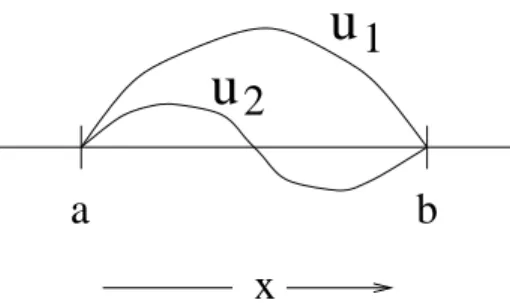
Figure 1.1: First two eigenfunctions of an eigenvalue problem based on Dirichlet boundary conditions.
1.3
Sturm-Liouville Systems
One of the most important and best understood eigenvalue problems in linear algebra is
(A−λB)u= 0,
whereAis a symmetric matrix andB is a symmetric positive definite matrix. For this problem we know that
1. its eigenvalues form a finite sequence ofreal numbers
2. the eigenvectors form aB-orthogonal basis for the vector space; in other words,
UT
i BUj =δij.
A Sturm-Liouville system extends this eigenvalue problem to the frame-work of 2nd order linear ordinary differential equations (o.d.e.’s) where the
vector space is infinite dimensional, as we shall see.
1.3.1
Sturm-Liouville Differential Equation
One of the original purposes of the Sturm-Liouville differential equation is the mathematical formulation of the vibration frequency and the amplitude profile of a vibrating string. Such a string has generally a space dependent tension and mass density:
T(x) = tension [force] ρ(x) = density
mass length
x
v(x,t)
Figure 1.2: Instantaneous amplitude profile of a suspended cable with vari-able tension and varivari-able mass density.
A cable of variable mass density, sayρ(x), suspended vertically from a fixed support is a good example. Because of its weight, this cable is under variable tension, sayT(x), along its length. Letv(x, t) be the instantaneous transverse displacement of the string.
Application of Newton’s law of motion, mass×acceleration=force, to the mass ρ(x)∆x of each segment ∆x leads to the wave equation for the trans-verse amplitude v(x, t),
ρ(x)∂
2v(x, t)
∂t2 =
∂ ∂xT(x)
∂v(x, t) ∂x .
The force (per unit length) on the right hand side is due to the bending of the cable. Suppose the cable is imbedded in an elastic medium. The presence of such a medium is taken into account by augmenting the force density on the right-hand side. Being linear in the amplitude v(x, t), the additional restoring force density [force/length] is
−k(x)v(x, t) .
Herek(x)∆xis the position dependent Hooke’s constant experienced by the cable segment ∆x. Consequently, the augmented wave equation is
ρ(x)∂
2v(x, t)
∂t2 =
∂ ∂xT(x)
∂v(x, t)
1.3. STURM-LIOUVILLE SYSTEMS 13
have vibrational frequencies ω and amplitudes v(x, t) =u(x) cosω(t−t0).
Thus the spatial amplitude profile u(x) of such a mode satisfies
d dxT(x)
d
dx +λρ(x)−k(x)
u(x) = 0, λ=ω2. (1.2)
For the purpose of mathematical analysis one writes this 2nd order linear
o.d.e. in terms of the standard mathematical notation
p(x) = T(x) ρ(x) = ρ(x) q(x) = k(x) ,
and thereby obtains what is known as the Sturm-Liouville (S-L) equation1,
d dx
p(x)du dx
+ [λρ(x)−q(x)]u= 0.
However, it is appropriate to point out that actually any 2nd order linear
o.d.e. can be brought into this “Sturm-Liouville” form. Indeed, consider the typical 2nd order homogeneous differential equation
P(x)u′′+Q(x)u′+ (R(x) +λ)u= 0.
We wish to make the first two terms into a total derivative of something. In that case, the d.e. will have its S-L form. To achieve this, divide by P(x) and then multiply by
eRx QPdt =p(x).
1The minus sign in front of q(x) is a reflection of the fact that the S-L equation had
its origin in the mathematization of vibrating systems. There
1
2p(u
′)2+1
2qu
2
dx
is the total potential energy stored in a string element of width dx: 1 2pu
2 is the bending
energy/length and 1 2qu
2is the energy/length stored in the string due to having pushed by
The result is
eRx QPdtu′′+ Q
Pe
Rx Q Pdtu′ +
R Pe
Rx Q Pdt+ λ
Pe
Rx Q Pdt
u= 0 or
p(x)u′′+p′(x)u′+ (λρ(x)−q(x))u= 0
in terms of newly defined coefficients. Combining the first two terms one has
d dx
p(x)du dx
+ [λρ(x)−q(x)]u= 0. (1.3)
This is known as theSturm-Liouville equation. In considering this equation, we shall make two assumptions about its coefficients.
The first one is
ρ(x) > 0 p(x) > 0
in the domain of definition, a < x < b. We make this assumption because nature demands it in the problems that arise in engineering and physics.
The second assumption we shall make is that the coefficients q(x), ρ(x), p(x) and p′(x) are continuous on a < x < b. We make this assumption be-cause it entails less work. It does happen, though, that p′(x), q(x), or ρ(x) are discontinuous. This usually expresses an abrupt change in the propa-gation medium of a wave, for example, the tension or the mass density of string, or the refractive index in a wave propagation medium. This disconti-nuity can be handled by applying “junction conditions” for u(x) across the discontinuity.
1.3.2
Homogeneous Boundary Conditions
We can now state the S-L problem. If the endpoint conditions are of the mixed Dirichlet-Neumann type,
αu(a) +α′u′(a) = 0 (1.4) βu(b) +β′u′(b) = 0 ,
1.3. STURM-LIOUVILLE SYSTEMS 15
If, by contrast,
u(a)−u(b) = 0 and p(a) =p(b) (1.5) u′(a)−u′(b) = 0
then Eqs.(1.3) and (1.5) constitute a periodic Sturm-Liouville system. Ifp(a) = 0 and the 1stb.c. in Eq.(1.4) is dropped, then we have asingular S-L
system. We shall consider the properties of these S-L systems in a subsequent section.
It is difficult to overstate the pervasiveness of these S-L systems in nature. Indeed, natural phenomena subsumed under the regular S-L problem, for example, are quite diverse. Heat conduction and the vibration of bodies illustrate the point.
A. Heat conduction in one dimension.
Consider the temperature profile u(x) of a conducting bar of unit length which is
1. insulated at x= 0 (no temperature gradient), and satisfies 2. radiative boundary condition at x= 1
Separation of variables applied to the heat equation yields the following S-L system:
u′′+λu= 0 (1.6)
with
u′(0) = 0 (1.7)
−u′(1) = hu(1). (1.8)
Here h is a non-negative constant. Note that at x= 1
h = 0 ⇒ no radiation
h >0 ⇒ finite heat loss due to radiation (Newton’s law of cooling).
B. Vibrations in one dimension.
1. At x = 0 there is no transverse force to influence the string’s motion. The tension produces only a longitudinal force component. In this circumstance the string is said to be free atx= 0. This free boundary condition is expressed by the statement
u′(0) = 0 .
2. At x = 1 the string is tied to a spring so that the vertical spring displacement coincides with the displacement of the string away from equilibrium. Even though the tail end of the string gets accelerated up and down, the total transverse force on it vanishes because it has no mass. Consequently,
−u′(1)T −ku(1) = 0 , or
−u′(1) = hu(1) , where
h= k T =
spring constant string tension
The transverse amplitude profile of the string is governed by Eq.(1.2). For constant tension and uniform mass density this equation becomes
u′′+λu = 0
We see that the S-L system for the heat conduction problem, Eqs.(1.6)- (1.8), coincides with that for the vibration problem.
The task of solving this regular S-L system consists of findingall possible values ofλ for which the solution u(x, λ) is non-trivial. Consequently, there are four distinct cases to consider:
1.3. STURM-LIOUVILLE SYSTEMS 17
We shall have to consider cases 1.-3. only. This is because the next subsection (1.3.3) will furnish us with some very powerful theorems about the nature of the allowed values of λ and the corresponding non-trivial solutions u(x, λ).
1. λ = 0 leads tou=c1 +c2x
h >0 ⇒ c1 =c2 = 0 i.e., u(x) = 0 for all 0 < x <1
h= 0 ⇒ u(x) = c1
constant solution. (What physical circumstance is expressed byu(x) = c1?)
2. λ =α2 >0, α >0
The general solution to the differential equation is
u(x) = c1cosαx+c2sinαx .
Now consider the boundary conditions.
(a) Eq.(1.7) ⇒c2 = 0. Consequently,u(x) =c1cosαx .
(b) Eq.(1.8) ⇒ −αc1sinα+hc1cosα = 0. Consequently,
tanα = h
α. (1.9)
This transcendental equation determines the allowed values of α and hence of λ. How do we find them? A very illuminating way is based on graphs. Draw the two graphs (Figure 1.3)
y= tanα and
y= h α.
Where they intersect gives the allowed values of α, and hence λ=α2,
the eigenvalues of the S-L problem. We see that there are an infinite number of intersection points
α
π 3π 5π 7π −π
2 2 2 2 2
αh tan α
Figure 1.3: There are two graphs in this figure: that oftan αand that of the two hyperbolash/α. The intersection of these two graphs is the solution set to the transcendental eigenvalue Eq.(1.9). The α-values of the heavy dots are the desired solutions. Note that if α is a solution, then −α is another solution, but it yields the same eigenvalueλ=α2.
For largen we have αn≃(n−1)π. The correspondingeigenvalues are
λn =α2n n = 1,2,3,· · · .
Comment: One important question is this: how do the allowed eigen-values and eigenfunctions depend on boundary conditions? More on that later.
3. λ=−β2 <0.This leads to the general solution
u(x) =c1coshβx+c2sinhβx .
The boundary conditions yield
tanhβ =−h β .
1.3. STURM-LIOUVILLE SYSTEMS 19
4. What about complex λ?
We shall see in the next section that the eigenvalues of a S-L problem are necessarily real.
Lecture 4
1.3.3
Basic Properties of a Sturm-Liouville Eigenvalue
Problem
It is surprising how much useful information one can infer about the eigenval-ues and eigenfunctions of a S-L problem without actually solving the differ-ential equation explicitly. Thus from very general and simple considerations we shall discover that the eigenvalues are real, are discrete if the domain is finite, have a lowest member, increase without limit, and that the cor-responding eigenfunctions are orthogonal to each other, oscillate, oscillate more rapidly the larger the eigenvalue, to mention just a few pieces of useful information.
In practice this kind of information is quite often the primary thing of interest. In other words, the philosophy quite often is that one verifies that a certain system is of the S-L types, thus having at one’s immediate disposal a concomitant list of properties of the system, properties whose qualitative nature is quite sufficient to answer the questions one had about the system in the first place.
As promised, we shall develop these and other properties by means of a collection of theorems. But before doing so, we remind ourselves about what is meant by a “Sturm-Liouville system”, by a “solution”, and by “orthogo-nality”. The Sturm-Liouville system we shall consider consists of (i) the S-L differential equation
d dxp(x)
d
dx +λρ(x)−q(x)
u(x) = 0, (1.10)
whereq,ρ,p, andp′ are continuous andρandpare positive definite functions on the open interval (a, b) together with (ii) the boundary conditions
where the given constants α, α′, β and β′ are independent of the parameter λ.
Corresponding to aneigenvalue of this S-L system, aneigenfunctionun(x)
is understood to be that solution which is “regular”, i.e.,
un(x) and
dun(x)
dx are continuous
and hence finite, on the closed interval [a, b]. In particular, an eigenfunction must not have any finite jump discontinuities anywhere in [a, b].
Orthogonality, Reality, and Uniqueness
Two eigenfunctionsum(x) andun(x) are said to beorthogonal relative to the
weight functionρ(x) if
Z b
a
um(x)un(x)ρ(x)dx= 0 whenever m6=n .
They are said to be orthonormal with respect toρ(x) if
Z b
a
um(x)un(x)ρ(x)dx=δmn. (1.12)
With these reminders at hand, one can now identify the two most impor-tant properties of a S-L system, the orthonormality of its eigenfunctions and the reality of its eigenvalues. The statement and the proof of these properties parallel those of the familiar eigenvalue problem from linear algebra,
A~u =λB~u
whereA is a Hermitian and B is a positive definite matrix.
Theorem 1 (Orthogonality) Let λm and λn be any two distinct eigenvalues
of the S-L problem 1.10 and 1.11 with corresponding eigenfunctions um and
un. Then um and un are orthogonal with respect to the weight ρ(x).
Orthogonality also holds in the following cases
1.3. STURM-LIOUVILLE SYSTEMS 21
2. when p(b) = 0 and the second (2) of the conditions 1.11 is dropped. This is equivalent to setting β=β′ = 0
3. when p(a) =p(b) and 1.11 are replaced by
u(a) = u(b) (1.13)
u′(a) = u′(b) .
Remarks:
1. In case (1.) or (2.), the S-L problem is said to be singular.
2. The S-L problem with mixed Dirichlet-Neumann conditions at both ends is said to be regular.
3. The same terminology, (“singular”) is also used when
ρ(x) vanishes at an endpoint, q(x) is singular at an endpoint, (a, b) is unbounded.
In other words, we are not interested in the actual value of u(x), just that it staysfinite. This is sufficient to select (a multiple of the correct) one of two independent solutions to the differential equation.
4. The boundary conditions 1.13 are those of aperiodic S-L problem, for example, the one where x is the angle ϕ in cylindrical coordinates. (More on that later.)
5. This theorem is analogous to the orthogonality hum, Buni = 0, of the
eigenvectors um and un of the familiar eigenvalue problem A~u=λB~u.
6. The physical significance of the orthogonality of the eigenfunctions is exemplified by the energy of a vibrating system governed by, say the wave equation, Eq.(1.1). Its total energy,
T.E.= 1 2
Z b
a
"
ρ(x)
∂v ∂t
2
+T(x)
∂v ∂x
2
+k(x)v2
#
dx , (1.14)
medium in which the string makes its transverse excursions. Performing an integration by parts on the second term, dropping the endpoint terms due to the imposed homogeneous boundary conditions, and using the governing wave equation, Eq.(1.1), one finds that the total energy is
T.E. = 1 2 Z b a " ρ(x) ∂v ∂t 2 +
−∂x∂ T(x)∂v
∂x +k(x)v
v # dx = 1 2 Z b a " ∂v ∂t 2 − ∂ 2v
∂t2v #
ρ(x)dx
Suppose the total vibrational amplitude is a superposition of the am-plitudes associated with with each eigenfrequency ωn,
v(x, t) = X
n
cnun(x) cos(ωnt+δn) .
Then the total energy becomes
T.E. = 1 2
X
m
X
n
[ωmωnsin(ωmt+δm) sin(ωnt+δn)
+ ωm2 cos(ωmt+δm) cos(ωnt+δn)
¯ cmcn
Z b
a
¯
um(x)un(x)ρ(x)dx
The orthonormality, Eq.(1.12), implies that
T.E.= 1 2
X
n
ωn2|cn|2 .
Thus we see that the orthonormality of the S-L eigenfunctions ex-presses the fundamental fact that the total energy, a constant inde-pendent of time, is composed of the mutually exclusive and constant energies residing in each normal mode (“vibratory degree of freedom”).
Proof in 3 Steps: In analogy to Aum = λmBum and Aun = λnBun one
first considers
Step (1)−(pu′m)′+qum
| {z }
k Lum
=λmρum; −(pu′n)′+qun
| {z }
k Lun
1.3. STURM-LIOUVILLE SYSTEMS 23
Then multiply the equations respectively by un and um and subtract
them. The left hand side becomes
l.h.s. = unLum−umLun≡
d
dxp(umu ′
n−unu′m) (1.15)
We now interrupt the three-step proof to remark that this is an important identity known as Lagrange’s Identity. We shall meet it and refer to it in several subsequent sections. This identity generalizes to higher dimensions by means of the vector identityun∇2um−um∇2un=∇ ·(un∇~um−um∇~un).
The integral version of Lagrange’s Identity is known as Green’s identity
Z b
a
(unLum−umLun)dx=p(x)(umu′n−unu′m)
b
a
(1.16)
in 1 dimension. Observe the parallel of this with Green’s Identity in three dimensions:
Z Z Z
volume
(un∇2um−um∇2un)d3x=
Z Z
boundary
(un∇~um−um∇~un)·dS .~
We now continue the three-step proof by considering the right hand side of the above subtraction result,
r.h.s.= (λm−λn)ρumun.
Step (2) Both sides are equal. Upon integrating them, one obtains
(λm−λn)
Z b
a
umunρ(x)dx=p(x)W[um, un](x)
b
a
where
W[um, un] =
um u′m
un u′n
.
This would be called theWronskian of um and un if λm and λn were equal.
Step (3a)If one has D-N conditions
αu(a) +α′u′(a) = 0 βu(b) +β′u′(b) = 0, then these D-N conditions imply
W(a) = 0 W(b) = 0
because 1st = 2nd columns are proportional. Thus for a regular S-L problem
(λm−λn)
Z b
a
um(x)un(x)ρ(x)dx= 0,
i.e., one hasorthogonality whenever λm 6=λn.
Step (3b) If one has aperiodic S-L problem p(b) =p(a)
u(a) = u(b) u′(a) = u′(b)
⇒W(a) =W(b).
i.e., one again hasorthogonality whenever λm 6=λn.
Setp (3c)If one has a singular S-L problem p(b) = 0
W(b) = finite
⇒p(b)W(b) = 0.
Similar considerations at the other end point also yield zero. Once again one has orthogonality whenever λm 6= λn. To summarize, the eigenfunctions of
different eigenvalues of regular, periodic, and singular Sturm-Liouville sys-tems are orthogonal.
Lecture 5
Theorem 2 (Reality of Eigenvalues) For a regular, periodic, and singular S-L system the eigenvalues are real.
Proof: Step (1) Let u be an eigenfunction corresponding to the complex eigenvalue λ =µ+iν. The eigenfunctions are allowed to be complex. Thus
1.3. STURM-LIOUVILLE SYSTEMS 25
because
L=L, ρ(x) =ρ(x) α, α′ =α, α′
β, β′ =β, β′
are real.
Step (2) We have, therefore,
Z b
a
(uLu−uLu)dx
| {z }
0 =p(x)W[u, u]
b
a
= (λ−λ)
Z b
a
uuρ(x)dx
0 = (λ−λ)
Z b
a |
u|2ρ(x)dx .
This implies that λ=λ, i.e., that λ is real.
We now inquire as to the number of independent eigenfunctions corre-sponding to each eigenvalue. This is a question ofuniqueness. The examples on page 15 have only one such eigenfunction for each eigenvalue. Consider, however, the following
Example (Periodic S-L system)
u′′+λu = 0 −1< x <1 u(−1) = u(1)
u′(−1) = u′(1).
We note that p(−1) = p(1). Consequently, this is a periodic S-L system. The form of the solution can be written down by inspection. Letting λ =α2, one obtains
u(x) =c1cosαx+c2sinαx
without loss of generality we assume α > 0. The two boundary conditions imply
2c2sinα = 0
and
Both conditions yield non-zero solutions whenever α = 0, π,2π, . . .. Conse-quently, the eigenvalues are
λn=n2π2 n= 0,1,2,· · · .
Note that for every eigenvalue (exceptλ0) there are two eigenfunctions
λ0 :
1 2
λ1 : cosπx , sinπx
...
λn : cosnπx , sinnπx .
Such nonuniqueness is expressed by saying that each of the eigenvalues λ1, λ2, . . . is degenerate, in this example doubly degenerate because there are
two independent eigenfunctions for each eigenvalue.
The next theorem states that this cannot happen for a regular S-L system. Its eigenvalues are simple, which is to say they are nondegenerate.
Note that the theorem below uses Abel’s Theorem, namely Theorem 4. Theorem 3(Uniqueness of solutions to the regular S-L system.) An eigen-function of a regular Sturm-Liouville system is unique except for a constant factor, i.e., the eigenvalues of a regular S-L problem are simple.
Proof: For the same eigenvalue λ, let u1 and u2 be two eigenfunctions of
the regular S-L system. For a regular S-L system the b.c. are
αu1(a) +α′u′1(a) = 0
αu2(a) +α′u′2(a) = 0.
In other words, both solutions satisfy the D-N mixed boundary conditions at the left hand endpoint. The value of the Wronskian at x=a is
W[u1, u2](a) =
u1 u′1
u2 u′2
x=a
= 0,
columns are proportional
.
Using Abel’s Theorem: p(x)W[u1, u2](x) = constant, we obtain
u′ 1(x)
u1(x) −
u′ 2(x)
u2(x)
= 0⇒u1(x) =ku2(x).
This conclusion says that the solution u1(x) is unique (up to a constant
1.3. STURM-LIOUVILLE SYSTEMS 27
NOTE:If the endpoint condition had been the periodic boundary condition, then one cannot conclude that the eigenvalues are simple. This is because
u(a) =u(b)
u′(a) =u′(b) doesnot imply [u1(x)u′2(x)−u′1(x)u2(x)]x=a= 0.
The previous uniqueness theorem used Abel’s theorem, which applies to a second order linear differential equation regardless of any boundary conditions imposed on its solutions.
Theorem 4 (Abel) If u1 and u2 are two solutions to the same differential
equation
− d dxp
d dx +q
u=λρu (i.e., Lu=λρu), then
p(x)[u1(x)u′2(x)−u2(x)u′1(x)] = constant. (1.17)
Remark. The expression in square brackets, W =u1u′2−u2u′1
is called the “Wronskian” or the “Wronskian determinant”. Proof: Start with Lagrange’s identity
u2Lu1−u1Lu2 =
d dxp(u1u
′
2−u2u′1)≡
d
dxp(x)W[u1, u2].
Use the given differential equation to conclude that the left hand side van-ishes, i.e.
0 = d
dxp(x)W[u1, u2].
Thus p(x)W[u1, u2](x) is indeed a constant, independent of x.
A nice application of this theorem is that it gives us a way of obtaining a second solution to the given differential equation, if the first one is already known.
Using Abel’s theorem, the Wronskian determinant can be rewritten in the form
u21
u′ 2
u1 −
u2
u′ 1
u2 1
or
u21 d dx
u2
u1
= const. p . Integration yields the following
Corollary (Second solution)
u2 =u1(x)
Z x dx′
p(x′)u2 1(x′)
+c1u1.
Thus one is always guaranteed a second solution if a first solution is known.
Exercise 1.3.1 (SCHR ¨ODINGER FORM: NO FIRST DERIVATIVES)
(a) SHOW that any equation of the form
u′′+b(x)u′+c(x)u= 0
can always be brought into the Schr¨odinger form (”no first derivatives”)
v′′+Q(x)v= 0
Apply this result to obtain the Schr¨odinger form for
(b)
u′′−2xu′+λu= 0 (HERMITE EQUATION)
(c)
x2u′′+xu′+ (x2−ν2)u= 0 (BESSEL’S EQUATION) (d)
xu′′+ (1−x)u′+λu= 0 (LAGUERRE’S EQUATION)
(e)
(1−x2)u′′−xu′+α2u= 0 (TSHEBYCHEFF’S EQUATION) (f)
(pu′)′+ (q+λr)u= 0 (STURM-LIOUVILLE EQUATION)
(g)
1 sinθ
d
dθ sinθ
d
dθ +ℓ(ℓ+ 1)−
m2
sin2θ
1.3. STURM-LIOUVILLE SYSTEMS 29
Exercise 1.3.2 (NONDEGENERATE EIGENVALUES)
Consider the S-L eigenvalue problem
[Lun](x)≡
− d
2
dx2 +x
2
un(x) =λnun(x) ; lim
x→±∞u(x) = 0 ; (1.18)
on the infinite interval (−∞,∞).
Show that the eigenvalues λn are nondegenerate, i.e. show that, except for a
constant multiplicative factor, the corresponding eigenfunctions are unique.
Nota bene:
(i) The eigenfunctions are known as the Hermite-Gaussian polynomials. They are known to professionals in Fourier optics who work with laser beams passing through optical systems. A laser beam which is launched with cross-sectional amplitude profile un(x) one focal length away from a lens, passes
through the lens, and is then observed (on, say, a screen) one focal length after that lens, has an amplitude profile identical to the initial profileun(x).
(ii) These eigenfunctions are also known to physicists who work with simple har-monic oscillators (e.g. vibrating molecules), in which case the eigenfunctions are the quantum states of an oscillator and the eigenvalues are its allowed energies.
Exercise 1.3.3 (EVEN AND ODD EIGENFUNCTIONS)
Consider the “parity” operatorP :L2(−∞,∞)→L2(−∞,∞) defined by
P ψ(x)≡ψ(−x)
(i) For a given function ψ(x), what are the eigenvalues and eigen functions of
P?
(ii) Show that the eigenfunctions of the operator L defined by Eq.(1.18) are eigenfunctions of P. Do this by first computing
P−1LP ψ(x)
forψ∈L2(−∞,∞) and then pointing out how P−1LP is related toL. Next point out how this relationship applied to an eigenfunction un of the
previous problem leads to the result P un=µun.
Exercise 1.3.4 (EIGENBASIS OF THE FOURIER TRANSFORM F)
Consider the S-L eigenvalue problem
[Lun](x)≡
− d
2
dx2 +x
2
un(x) =λnun(x) ; lim
on the infinite interval (−∞,∞). We know that the eigenvalues arenondegenerate
and are
λn= 2n+ 1, n= 0,1, . . . .
Consider now the Fourier transform onL2(−∞,∞):
F[u](k)≡
Z ∞
−∞
e−ikx
√
2πu(x)dx .
(a) By computing
FLF−1ψ(k)ˆ
for arbitrary ˆψ∈L2(−∞,∞), determine the Fourier representation
FLF−1 ≡L .ˆ of the operator
L=− d
2
dx2 +x
2
(b) By viewing F as a mapL2(−∞,∞)→L2(−∞,∞), compare the operators ˆ
Land L.
State your result in a single English sentence and also as a mathematical equation.
(c) Use the result obtained in (b) to show that each eigenfunctionunof the S-L
operatorLis also an eigenfunction ofF:
Fun=µ un.
By applying the result (e) of the Fourier eigenvector Exercise on page 149 to the previous Exercise determine the only allowed values forµ. What is
the Fourier transform of a Hermite-Gauss polynomialun(x)?
CONGRATULATIONS, you have just found an orthonormal eigenbasis of the Fourier transform operator F (in terms of the eigenbasis of the S-L operatorL)!
Exercise 1.3.5 (HOW TO NORMALIZE AN EIGENFUNCTION)
Consider the S-L system
d
dxp
d
dx −q+λρ
u= 0 a < x < b
1.3. STURM-LIOUVILLE SYSTEMS 31
Let w(x, λ) be that unique solution to dxdpdwdx + (λρ−q)w = 0 which satisfies
αw(a, λ) +α′w′(a, λ) = 0. i.e. it satisfies the left hand boundary condition. Then
wn(x) ≡ w(x, λn) is an eigenfunction of the above S-L system corresponding to
the eigenvalue λn.
Calculate the normalization integral
b R a
w2
n ρ dxas follows:
(a) Obtain the preliminary formula
(λ−λn) Z b
a
wn(x)w(x, λ)ρ(x)dx=p(b)W(w, wn)|x=b .
(b) By taking the limitλ→λn show that Z b
a
wn2 ρ dx=p(b)
"
w′n(b)dw(b, λ) dλ
λ=λn
−wn(b)
d
dλw′(b, λ)
λ=λn
#
,
where prime denotes differentiation w.r.t. x.
Exercise 1.3.6 (ORTHONORMALIZED BESSEL FUNCTIONS)
Consider the Sturm-Liouville (S-L) problem
− d dx x d dx + ν2 x
u=λxu .
Here u, du
dx bounded as x→0,u(1) = 0 whereν is a real number.
(a) Using the substitutiont=√λ x,show that the above differential equation reduces to Bessel’s equation of order ν. One solution which is bounded as t→ 0 is Jν(t); a second linearly independent solution, denoted by Yν(t), is
unbounded as t→0.
(b) Show that the eigenvalues λ1, λ2, . . . of the given problem are the squares
of the positive zeroes of Jν(
√
λ),and that the corresponding eigenfunctions are
un(x) =Jν( p
λn x) .
(c) Show that the eigenfunctions un(x) satisfy the orthogonality relation
1
Z
0
(d) For the caseν = 0, apply the method of the previous problem toexhibit the set of orthonormalized eigenfunctions{u0(x), u1(x), u2(x),· · · }.
(e) Determine the coefficients in the Fourier-Bessel series expansion
f(x)=.
∞
X n=1
cn un(x).
Exercise 1.3.7 (ORTHOGONALITY OF LEGENDRE POLYNOMIALS)
Consider the S-L problem
−dxd (1−x2) d
dx +
m2
1−x2
u=λu
Here u, du
dx bounded as x → ±1. Here m = integer. The solutions to this S-L problem are un =Pnm(x), the “associated Legendre polynomials”, corresponding
toλn=n(n+ 1), n= integer. Show that
1
Z
−1
Pnm(x)Pnm′(x) dx= 0 λn6=λn′.
Lecture 6
Sturm’s Comparison Theorem
When confronted with the regular boundary value problem
d dxp(x)
d
dx −q(x) +λρ(x)
u(x) = 0 (1.19)
αu(a) +α′u′(a) = 0 (1.20) βu(b) +β′u′(b) = 0
we must ask
1.3. STURM-LIOUVILLE SYSTEMS 33
2. Why do the values of λ permitted by (1.19) and (1.20) form adiscrete and semi-infinite sequence
λ0 < λ1 <· · ·< λn<· · ·
with a smallest eigenvalue λ0 and with λn → ∞ as n→ ∞?
The “oscillatory nature” of a solution u(x, λ) is expressed qualitatively by the location of the zeroes of its graph. One could also inquire about its behaviour between successive zeroes. However, we shall see that such an inquiry always leads to the same answer: Provided q(x) +λρ(x) is positive between a pair of successive zeroes, the graph of u(x;λ) has only a single maximum (or minimum). This means that u(x, λ) cannot oscillate between two of its successive zeroes.
Thus the most important issue is the existence and location of the zeroes, which are controlled entirely by the phase of a given solution u(x, λ). This phase is a scalar function from which one directly constructs the solution. It is preferrable to discuss the behavior of the solution u(x;λ) in terms of its phase because the key qualitative properties of the latter are very easy to come by. As we shall see, one only needs to solve a first order differential equation, not the second order S-L equation.
However, before establishing and solving this differential equation, let us use the second order S-L differential equation directly to determine how the zeroes of u(xλ) are affected if the parameter λ is changed. We express this behaviour in terms of the
Sturm Comparison Theorem:
Wheneverλ1 < λ2, then between two zeroes of the nontrivial solutionu(x, λ1),
there lies a zero of u(x, λ2).
This theorem demands that one compare the two different solutions
u(x, λ1)≡u1(x) and u(x, λ2)≡u2(x)
of Eq. 1.19 corresponding two different constants λ1 and λ2. The conclusion
is obtained in three steps:
Step 1: Multiply these two equations respectively by u2 and u1, and then
form their difference. The result, after cancelling out the q(x)u1u2 term, is
d dx
p(x)
u2
du1
dx −u1 du2
dx
u(x,
λ
1
)
u(x,
λ
1
)
ζ
u (x)
1st zero of
x= a
1
x
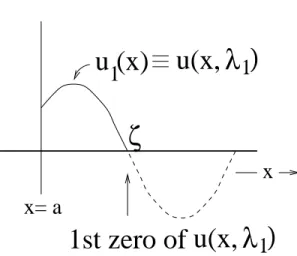
Figure 1.4: Graph of a solutionu(x, λ1) which satisfies the mixed D-N
bound-ary condition at x=a.
which is the familiar Lagrange identity, Eq.(1.15), in disguise. Upon inte-gration one obtains
p(x)(u2u′1−u1u′2)
x
a
= (λ2 −λ1) Z x
a
u1u2ρ dx .
If bothu1 and u2 satisfy the mixed Dirichlet-Neumann boundary conditions
αu(a) +α′u′(a) = 0 at x=a, then
(u2u′1−u1u′2)x=a=−
α
α′[u2(a)u1(a)−u1(a)u2(a)] = 0.
Ifx=a is a singular point of the differential Eq.(1.19),p(a) is zero. Thus, if uandu′are finite atx=a, then the left hand side vanishes again at the lower limit x = a. Thus both for a regular and for this singular Sturm-Liouville problem we have
p(x)
u2(x)
du1(x)
dx −u1(x)
du2(x)
dx
= (λ2−λ1) Z x
a
u1u2ρ dx .