QOS Requirements and
Service Level Agreements
Application SLA Requirements
Different applications have different SLA requirements; the impact that different network services with different SLAs have on an application is dependent upon the specific application:
Excessive packet loss or delay may make it difficult to support real-time applications although the precise threshold of “excessive” depends on the particular application. The larger the value of packet loss or network delay, the more difficult it is for
transport-layer protocols to sustain high bandwidths.
We consider the most common applications or application types, which impose the tightest SLA requirements on the network. In practice, most applications that have explicit SLA requirements will fall into one of the following categories, or will have SLA requirements, which are similar to one of those categories described:
voice over IP; video streaming; video conferencing;
throughput-focused TCP applications; interactive data applications;
Voice over IP
Voice over IP (VoIP) is most commonly transported as a digitally encoded stream using the Real-time Protocol (RTP) [RFC3550] over UDP; RTP is the transport layer protocol, which deals with the delivery of the VoIP bearer stream from sender to receiver. Signaling protocols such as the Session Initiation Protocol (SIP) [RFC3261] may be used to set up the RTP bearer streams and to determine the media formats (i.e. codecs) that will be used.
The key factors that determine the impact that variations in networks SLA characteristics such as delay and loss have on VoIP are the codec that is used to encode the signal and the specific details of the end-system implementation. The most widely used codecs are those defined by the ITU G.71x and G72x standards.
Voice over IP
VoIP: Impact of Delay
For VoIP the important delay metric is the one-way end-to-end (i.e. from mouth-to-ear)
delay, in each direction. The main impact that end-to-end delay has on VoIP is to the interactivity of conversational speech. If the delay is too high, participants find it difficult to discern the difference between natural pauses in speech and the delays introduced by the system. Excessive end-to-end delay can also impair the effectiveness of mechanisms used for echo-cancellation.
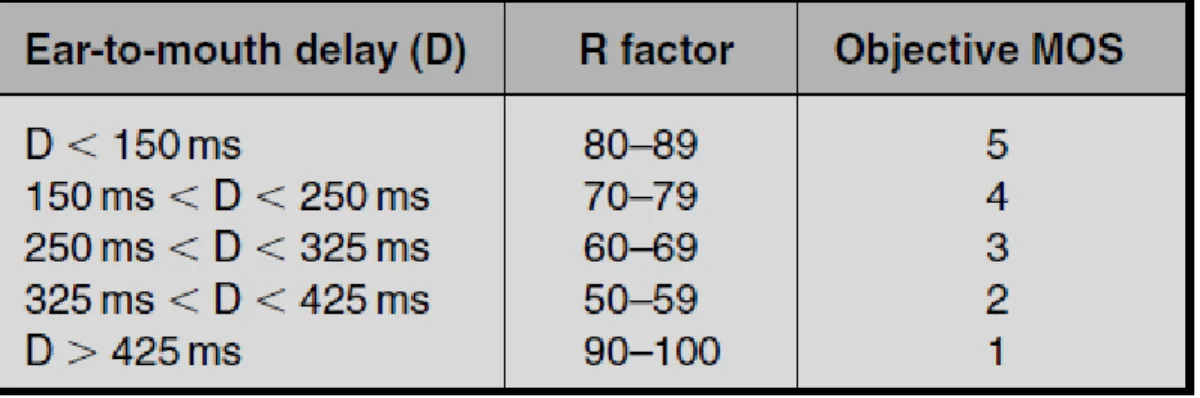
The goal commonly used in designing networks to support voice over IP (VoIP) is the target specified by ITU-T recommendation G.114, which uses the E-model to estimate the effects of delay on mouth-to-ear speech transmission quality. Recommendation G.114 suggests that 150 ms of end-to-end one-way delay is sufficient to ensure that users will be very satisfied for most applications of telephony.
VoIP: Impact of Delay
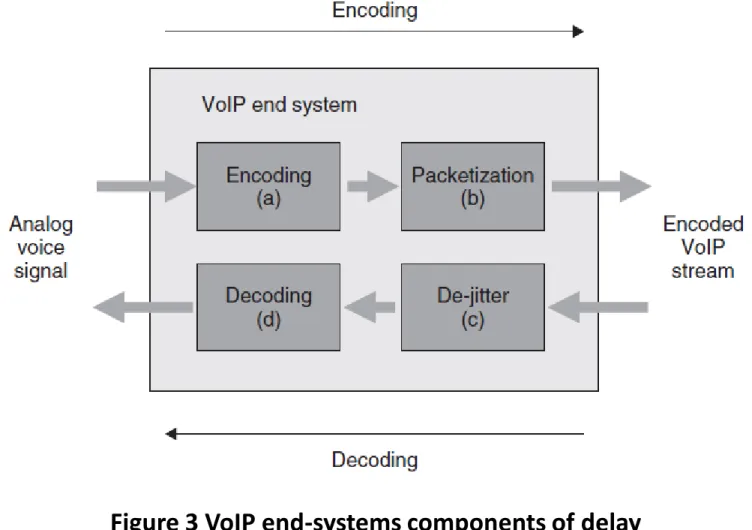
Having determined what the maximum acceptable ear-to-mouth delay is for a particular VoIP service, a network QOS design should take this budget and apportion it to the various components of network delay (propagation delay through the backbone, scheduling delay due to congestion, and the access link serialization delay) and end-system delay (due to VoIP codec and de-jitter buffer).
The example timeline in Figure 5
VoIP: Impact of Delay-jitter
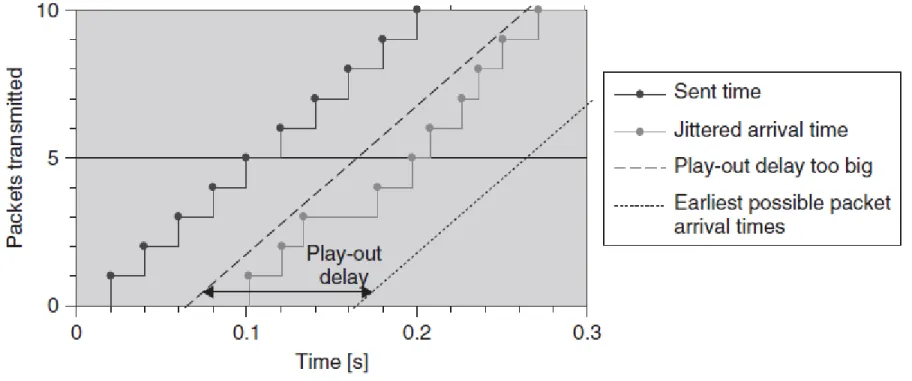
It is a common misconception that jitter has a greater impact on the quality of VoIP calls than network delay. Applications which are susceptible to jitter, such as VoIP, use de-jitter buffers (also known as jitter buffers and play-out buffers) to compensate for jitter in packet arrival and for out-of-order packets. De-jitter buffers remove delay variation by turning variable network delays into constant delays at the destination end-systems.
VoIP: Impact of Delay-jitter
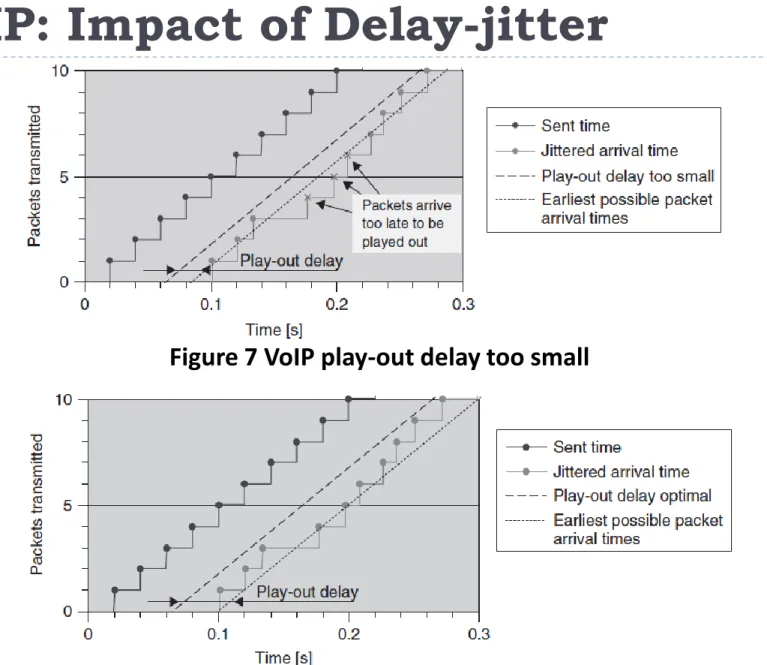
Figure 7 VoIP play-out delay too small
VoIP: Impact of Delay-jitter
Well-designed adaptive de-jitter buffer algorithms should not impose any unnecessary constraints on the network design if they display the following characteristics:
increasing the play-out delay to the current measured jitter value following an underflow, and using packet loss concealment to interpolate for the “lost” packet and for the play-out delay size increase;
if the play-out delay can decrease then it should do so slowly when the measured jitter is less that the current buffer play-out delay.
VoIP: Impact of Loss
Packet Loss Concealment (PLC) is a technique used to mask the effects of lost or discarded VoIP packets. The method of packet loss concealment used depends upon the type of codec used.
A simple method of packet loss concealment, used by waveform codecs like G.711, is to replay the previously received sample; the concept underlying this approach is that, except for rapidly changing sections, the speech signal is locally stationary. This technique can be effective at concealing the loss of up to approximately 20 ms of samples.
Low bit rate frame-based codecs, such as G.729 and G.723, use more sophisticated PLC techniques, which can conceal up to 30–40 ms of loss with “tolerable” quality, when the available history used for the interpolation is still relevant.
VoIP: Impact of Loss
Possible causes of packet loss:
Congestion;
Lower layer errors;
Network element failures;
Loss in the application end-systems.
VoIP: Impact of Throughput
VoIP codecs generally produce a constant bit rate stream; that is, unless silence suppression is used. Silence suppression, which is also known as voice activation detection (VAD), prevents the transmission of packets carrying “silent” samples. Silence suppression becomes active when it detects periods of silence from the microphone that exceed defined thresholds; when silence suppression is active it prevents the encoder output from being sent to the far end. When silence suppression is active for a leg of a VoIP call, the bandwidth used for that leg of the call is almost zero. As most conversational speech contains approximately 50% silence, this can significantly reduce the average bandwidth used for a call; however, the peak bandwidth used for the call remains unchanged.
VoIP: Impact of Packet Re-ordering
Video. Video Streaming
IP-based streaming video is most commonly transported as a data stream encoded using standards defined by the Motion Picture Expert Group (MPEG) and transported using RTP over UDP. MPEG defines the encoding used for the actual video stream, while [RFC2250, RFC 2343, and RFC3640] define how real-time audio and video data are formatted for RTP transport. RTP is the transport layer protocol, which deals with the delivery of that stream from sender to receiver. Protocols such as the Real-time Streaming Protocol (RTSP) [RFC2326] may be used to set up the RTP streams.
Video Streaming
An MPEG encoder converts and compresses a video signal into a series of pictures or frames; as there is generally only a small amount of change between one frame and the next it is possible to compress the video signal significantly by transmitting only the differences. Three different types of MPEG frames:
● “I”-frames. Intra or “I”-frames carry a complete video frame and are coded without reference to other frames. An I-frame may use spatial compression; spatial compression makes use of the fact that pixels within a single frame are related to their neighbors. Therefore, by removing spatial redundancy, the size of the encoded frame can be reduced and prediction can be used in the decoder to reconstruct the frame. A received I-frame provides the reference point for decoding a received MPEG stream.
● “P”-frames. Predictive coded or “P”-frames are coded using motion compensation (temporal compression) by predicting the frame to be coded from a previous “reference” I-frame or P-frame. P-frames can provide increased compression compared to I-frames with a P-frame typically 10–30% the size of an associated I-frame.
Video Streaming
Video Streaming: Impact of Delay
For video streaming, the important delay metric is the one-way end-to-end delay from streaming server to client. The main constraint that end-to-end network delay and jitter have on streaming video is on end-user “interactivity,” or the “finger-to-eye” delay.
Broadcast Video Services
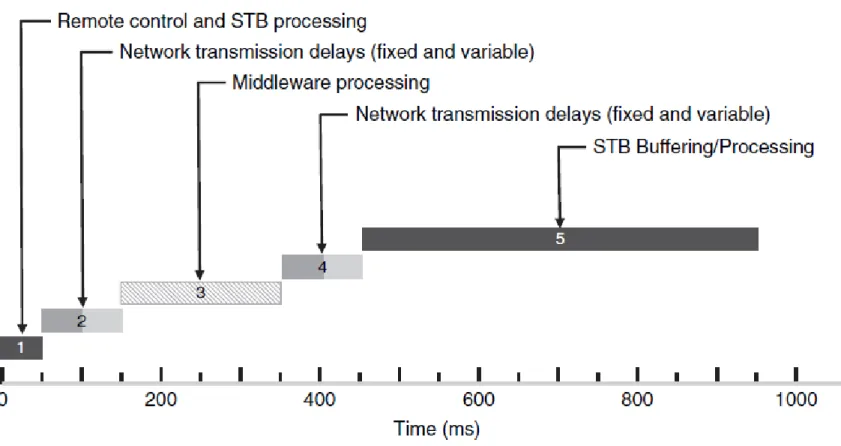
Broadcast television services delivered over IP (also known as IPTV) commonly use IP multicast. Assuming a broadcast video service being delivered using IP multicast to a receiver – which could be a set-top box (STB) for example – where each channel is a separate multicast group, the overall channel change time is made up of a number of components:
Remote control and STB processing. Network transmission delay.
Multicast processing.
Network transmission delay.
Broadcast Video Services
Video-on-demand Services
Video-on-demand (VOD) and network personal video recorder (PVR) services are commonly delivered as unicast. For VOD services the end-to-end delay impacts the finger-to-eye delay, i.e. the response time it takes for user requests to be translated into actions visible to the end-user; for example, how long it takes after pressing play for a VOD to start. Typically, response times of approximately 1 second are targeted.
Assuming a video-on-demand service being delivered over IP unicast to a receiver, which could be a set-top box (STB) for example, the overall response time is made up of a number of components:
Remote control and STB processing. Network transmission delay.
Middleware processing.
Network transmission delay.
Video-on-demand Services
Video Streaming
Video Streaming: Impact of Delay-jitter
Digital video decoders used in streaming video receivers need to receive a synchronous stream, typically with jitter tolerances of only 500 ns, in order to decode without visible impairments. Such jitter tolerances are not achievable natively in IP networks, hence as for VoIP, broadcast video services use de-jitter buffers (also known as play-out buffers) in receivers to remove delay variation caused by the network and turn variable network delays into constant delays such that the tolerances required by the decoder can be met.
Video Streaming: Impact of Loss Causes of packet loss:
Congestion.
Lower layer errors. There are two main techniques for loss concealment for streaming video:
Forward error correction (FEC). Real-time retransmission.
Network element failures.
Loss in the application end-systems.
Video Streaming
Video Streaming: Impact of Throughput
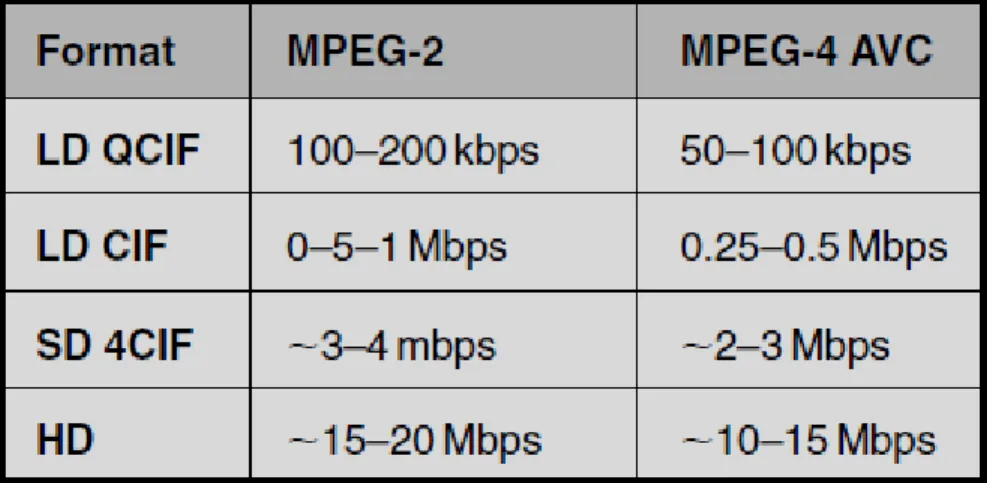
The bandwidth requirements for a video stream depend upon the video format, the encoder and the specific GOP structure. There are four main video formats used for IP-based video services:
1. Standard definition (SD). 2. High definition (HD).
3. Common interchange format (CIF) – low definition (LD) format. 4. Quarter CIF (QCIF).
MPEG allows for streaming video to be encoded either as variable bit rate streams, where the quality of the resultant video is constant, or as constant bit rate streams where the quality of the resultant video is variable. The table in
Video Streaming
Video Streaming: Impact of Packet Re-ordering
Many real-time video end-systems do not support the re-ordering of received frames, hence packet re-ordering effectively results in higher packet loss and should be avoided.
Video Conferencing
Video conferencing sessions are typically set up using the signaling protocols specified in ITU recommendation H.323 or SIP. Whichever method is used to establish the connections, from an SLA perspective, the fundamental requirements and principles remain the same.
The audio streams will typically use codecs such as those defined by the ITU G.71x/G72x standards.
The video formats and encoding used for video conferencing applications are less constrained than for broadcast quality video services. Codecs such as MPEG-2/H.262 or MPEG-4 AVC/H.264 are typically used; where bandwidth is constrained, lower definition (e.g. CIF or QCIF) and lower frame rates (e.g. 10 fps), potentially reduce the bandwidths required significantly compared to broadcast video services.
Data Applications
QOE requirements for data application, which in turn drive network level SLAs, are less well defined than for voice or video applications. While there are multiple types of data applications that exist, from a QOS perspective they can be broadly divided into interactive data applications and applications that are targeted at data transfer with no requirements on interactivity.
Throughput focussed applications in general use TCP as their transport layer protocol, due to the reliability and flow control capabilities that it provides.
Interactive applications depend on providing responses to an end-user in real-time. As the specific implementations of interactive data applications can vary, the impact that network characteristics such as delay have on them can also vary.
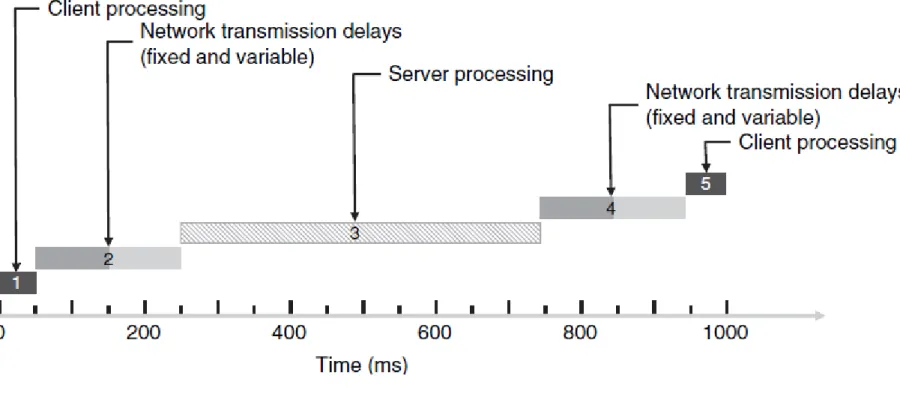
For client/server applications which require a network transaction, network delay is but one aspect of the total transactional delay, which may be comprised of the following components:
Interactive Data Applications
Interactive Data Applications
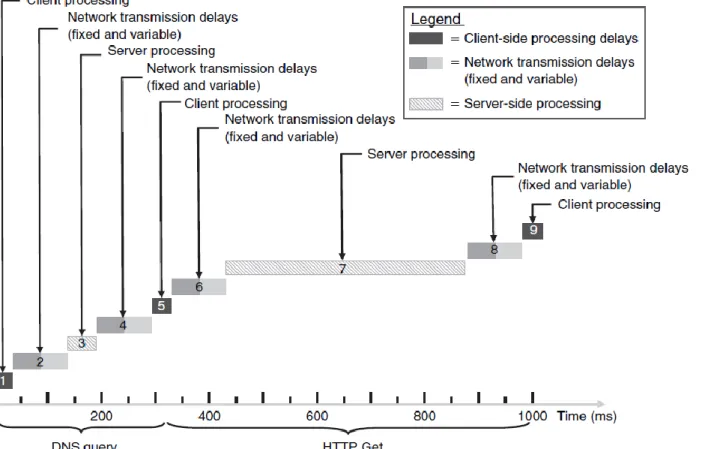
Another example: an application with the same total client-side, and server-side processing delays, but which instead required two network transactions (a DNS query and an HTTP GET for example) per user transaction, a network RTT of approximately 200 ms or less would be required in order to meet the target.
Interactive Data Applications
Jitter has no explicit impact on interactive data applications; jitter only has an impact on TCP in that it is a component of network delay. Network loss and packet ordering can have an impact on interactive data applications in that lost or re-ordered packets may need to be retransmitted which may probabilistically increase the network component of the total transaction delay. The impact of packet loss and resequencing will depend upon the characteristics of the transport layer protocol that is used.
On-line Gaming
Multiplayer on-line or networked games are the most popular form of a type of application known as Networked Virtual Environments (NVEs); other uses of NVEs include military simulation. Users in NVEs, who may be in geographically separate locations, interact with each other in a virtual world in real-time. The IEEE Distributed Interactive Simulation (DIS) [IEEE1278] standard covers NVE; however, this is not generally used by the software vendors that produce on-line games who instead use proprietary implementations.
Although there are different types of real-time on-line games – the most common game types being: First Person Shooter (FPS), Real-Time Strategy (RTS) and
On-line Gaming
Most on-line gaming implementations have evolved to work over the public Internet and have bandwidth requirements of less than 64 kbps and in-built mechanisms to deal with packet loss.
However, it is noted that these bandwidth requirements may increase over time, with the prevalence of higher bandwidths available to end-users due to broadband access. In addition, some games provide the capability to tweak various network parameters, which can have a significant impact on their bandwidth requirements.