PHYSICAL REVIEW C76, 054302 (2007)
Self-consistent quasiparticle random-phase approximation for a multilevel pairing model
N. Quang Hung1,*and N. Dinh Dang1,2,†
1Heavy-Ion Nuclear Physics Laboratory, RIKEN Nishina Center for Accelerator-Based Science, 2-1 Hirosawa, Wako City, 351-0198 Saitama, Japan
2Institute for Nuclear Science and Technique, Vietnam Atomic Energy Commission, Hanoi, Vietnam (Received 12 June 2007; published 2 November 2007)
Particle-number projection within the Lipkin-Nogami (LN) method is applied to the self-consistent quasiparticle random-phase approximation (SCQRPA), which is tested in an exactly solvable multilevel pairing model. The SCQRPA equations are numerically solved to find the energies of the ground and excited states at various numbersof doubly degenerate equidistant levels. The use of the LN method allows one to avoid the collapse of the BCS (QRPA) to obtain the energies of the ground and excited states as smooth functions of the interaction parameterG. The comparison between results given by different approximations such as the SCRPA, QRPA, LNQRPA, SCQRPA, and LNSCQRPA is carried out. Although the use of the LN method significantly improves the agreement with the exact results in the intermediate coupling region, we found that in the strong coupling region the SCQRPA results are closest to the exact ones.
DOI:10.1103/PhysRevC.76.054302 PACS number(s): 21.60.Jz
I. INTRODUCTION
The random-phase approximation (RPA), which includes correlations in the ground state, provides a simple theory of excited states of the nucleus. However, the RPA breaks down at a certain value Gcr of interaction parameter G, where it yields imaginary eigenvalues. The reason is that the RPA equations, linear with respect to the X and Y amplitudes of the RPA excitation operator, are derived based on the quasiboson approximation (QBA). The latter neglects the Pauli principle between fermion pairs and its validity is getting poor with increasing the interaction parameter G. The collapse of the RPA at the critical value Gcr of G invalidates the
use of the QBA. The RPA therefore needs to be extended to correct this deficiency, at least for finite systems such as nuclei.
One of methods to restore the Pauli principle is to renormalize the conventional RPA to include the nonzero values of the commutator between the fermion-pair operators in the correlated ground state. These so-called ground-state correlations beyond RPA are neglected within the QBA. The interaction in this way is renormalized and the collapse of RPA is avoided. The resulting theory is called the renor-malized RPA (RRPA) [1–3]. However, the test of the RRPA carried out within several exactly solvable models showed that the RRPA results are still far from the exact solutions [3–5].
Recently, a significant development in improving the RPA has been carried out within the self-consistent RPA (SCRPA) [4–6]. Based on the same concept of renormalizing the particle-particle (pp) RPA, the SCRPA made a step forward by including the screening factors, which are the expectation
*On leave of absence from the Institute of Physics and Electronics, Hanoi, Vietnam; [email protected]
values of the products of two pairing operators in the correlated ground state. The SCRPA has been applied to the exactly solvable multilevel pairing model, where the energies of the ground state and first excited state in the system withN+2 particles relative to the energy of the ground-state level in the N-particle system are calculated and compared with the exact results. It has been found that the agreement with the exact solutions is good only in the weak coupling region, where the pairing-interaction parameterGis smaller than the critical valuesGcr. In the strong coupling region (GGcr),
the agreement between the SCRPA and exact results becomes poor [4,5]. In this region a quasiparticle representation should be used in place of the pp one, as has been pointed out in Ref. [7]. As a matter of fact, an extended version of the SCRPA in the superfluid region has been proposed and is called the self-consistent quasiparticle RPA (SCQRPA), which was applied for the first time to the seniority model in Ref. [8] and a two-level pairing model in Ref. [9]. However, the SCQRPA also collapses atG=Gcr. It is therefore highly desirable to develop a SCQRPA that works at all values ofGand also in more realistic cases, e.g., multilevel models. The aim of the present work is to construct such an approach. Obviously, the collapse of the SCQRPA at G=Gcr, which is the same as
that of the nontrivial solution for the pairing gap within the Bardeen-Cooper-Schrieffer theory (BCS), can be removed by performing the particle-number projection (PNP). The Lipkin-Nogami method [10,11], which is an approximated PNP before variation, will be used in such extension of the SCQRPA in the present article because of its simplicity. This approach shall be applied to a multilevel pairing model, the so-called Richardson model [12], which is an exactly solvable model extensively employed in literature to test approximations of many-body problems.
II. FORMALISM
A. Model Hamiltonian
The Richardson model (also called the multilevel pairing model, picket-fence model, or ladder model) was described in detail in Refs. [4–6,12]. It consists ofdoubly-fold equidistant levels interacting via a pairing force with a constant parameter
G. The model Hamiltonian is given as
H=
j=1
(j −λ)Nj −G
j,j=1
Pj†Pj, (1)
wherej are the single-particle energies on thej shells. The
particle-number operatorNj and pairing operatorsPj†, Pj on
thej-th orbital (with unit shell degeneracyj +1/2≡1) are defined as
Nj =aj†aj +a−†ja−j, (2)
Pj†=aj†a−†j, Pj =(Pj†)†. (3)
These operators fulfill the following exact commutation relations
[Pj, Pj†]=δjj(1−Nj), (4)
[Nj, Pj†]=2δjjPj†, [Nj, Pj]= −2δjjPj. (5)
By using the Bogoliubov transformation from particle opera-torsaj†andaj to quasiparticle onesαj†andαj
aj†=ujαj†+vjα−j, a−j =ujα−j−vjαj†, (6)
the pairing Hamiltonian in Eq. (1) is transformed into the quasiparticle Hamiltonian as [13,14]
H =a+
j
bjNj +
j
cj(A†j +Aj)+
jj
djjA†jAj
+
jj
gj(j)(A†jNj +NjAj)
+
jj
hjj(A†jA†j+AjAj)+
jj
qjjNjNj, (7)
where Nj is the quasiparticle-number operator, whereas A†j
andAj are the creation and destruction operators of a pair of
time-conjugated quasiparticles:
Nj =αj†αj +α−†jα−j, (8)
A†j =αj†α−†j, Aj =(A†j)†. (9)
The commutation relations among operatorsNj,A†j, andAj
are similar to those for particle operators in Eqs. (4) and (5), namely
[Aj,A†j]=δjj(1−Nj), (10)
[Nj,A†j]=2δjjA†j, [Nj,Aj]= −2δjjAj. (11)
The coefficientsa, bj, cj, djj, gj(j), hjj, qjj in Eq. (7) are given in terms of the coefficients uj, vj of the Bogoliubov
transformation, and the single-particle energiesj as (see, e.g.,
Ref. [13,14])
a=2
j
(j −λ)v2j −G
j ujvj
2
−G j
vj4, (12)
bj =(j −λ)
u2j −vj2
+2Gujvj
j
ujvj+Gvj4, (13) cj =2(j −λ)ujvj
−Gu2j −v2j j
ujvj−2Gujvj3, (14) djj = −G
u2ju2j+v2jv 2 j
=djj, (15) gj(j)=Gujvj
u2j−v2j
, (16)
hjj = G
2
u2jvj2+v2ju2j
=hjj, (17) qjj = −Gujvjujvj=qjj. (18)
The single-particle energies are given asj =j , wherej =
1, . . . , , and is the level distance chosen to be equal to 1 MeV in the present work. The chemical potential λ and the coefficientsuj andvj are determined by solving the gap
equations discussed in the next section.
B. Gap and number equations
1. Renormalized BCS
It is well known that the Pauli principle between the quasiparticle-pair operatorsAjandA†jis neglected within the
conventional BCS, which assumes thatBCS|Nj|BCS =0
within the BCS ground state|BCS. A simple way to restore the Pauli principle is to introduce a new ground state|¯0 in which the correlations among quasiparticles lead to nonzero values of the quasiparticle occupation numbers so that the contribution of theNj term at the right-hand side of Eq. (10)
is preserved. By doing so, the BCS equations are renormalized and the resulting theory is called the renormalized BCS (RBCS) [15]. Within the RBCS the commutator between the quasiparticle-pair operators are defined as
¯0|[Aj,A†j]|¯0 =δjjDj, (19)
with
Dj =1−Nj, Dj =1−2nj, (20)
wherenj is the quasiparticle number in the correlated ground
state|¯0
nj ≡12¯0|Nj|¯0 =0. (21)
Taking into account Eq. (19) and performing a constrained variational calculation to minimize the Hamiltonian H ≡ H−λNˆ, where ˆN =jNj is the particle-number operator,
Nhave been derived as [15]
=G
j
τj, N =2
j
ρj, (22)
where
τj =ujvjDj, ρj =v2jDj +12(1− Dj), (23)
u2j = 1
2 1+
j −Gvj2−λ
Ej
,
(24)
vj2= 1
2 1−
j −Gvj2−λ
Ej
,
Ej =
(j −Gvj2−λ)2+2. (25)
The renormalization factors Dj, called the ground-state
correlation factors, are obtained by solving the SCQRPA equations discussed later in this article (see Sec.II D2). The internal energy of the system within the RBCS ground state (the RBCS ground-state energy) is given as
Eg.s.RBCS=2
j
(j −λ)ρj − 2
G −G
j
ρj2. (26)
By settingDj =1, the RBCS equations go back to the
well-known BCS ones.
2. BCS with SCQRPA correlations
In the minimization procedure, which leads to the equation (see, e.g., Ref. [16])
¯0|[H,A†j]|¯0 =0, (27) the RBCS ignores the expectation values A†jAj ≡
¯0|A†jAj|¯0 andAjAj ≡ ¯0|AjAj|¯0 of the products of
pair operators in the correlated quasiparticle ground state|¯0. By retaining these screening factors in calculating the left-hand side of Eq. (27), we derive from Eq. (27) an equation for the level-dependent pairing gap in the form
j =G
jujvjDjDj
Dj
, (28)
with the single-particle energiesj in the expressions foruj
andvj in Eq. (24) being renormalized toj as j =j+
G
Dj
j
u2j−vj2
(A†jA†j + A†jAj). (29)
We call Eq. (28) the BCS gap equation with SCQRPA correla-tions, and use the abbreviation BCS1 to denote this approach, having in mind that it includes the screening factorsA†jA†j
andA†jAjin the renormalized single-particle energies given
by Eq. (29). These screening factors are found by solving Eqs. (28) and (29) self-consistently with the SCQRPA ones to be discussed later in Sec.II D, where the explicit expressions of the screening factors are given in terms of the SCQRPA
forward- and backward-going (XandY) amplitudes. The limit case of Eqs. (28) and (29) for a degenerate two-level model is studied in Ref. [9].
The right-hand side of Eq. (28) contains the expectation values DjDj, whose exact treatment is not possible as
it involves an infinite series in terms of the products of A†jAjA†jAj [9], or an infinite boson expansion [17], which again needs to be truncated at a certain order. In Ref. [9] this series is truncated at the first order, whereas the consideration in Ref. [17] is limited up to the four-boson terms. Such expansion is based on the method of treating the single-particle (quasiparticle) density used by Rowe in Ref. [2] or a mapping employed in Ref. [3]. In the numerical calculations within the present article we treat these terms approximately as follows. By noticing that the expectation values DjDj
are present in the ratios DjDj/Dj or, more generally,
DjDj/
DjDj, and that
DjDj = DjDj +δNjj, with
(30)
δNjj = NjNj − NjNj,
we rewrite these ratios as DjDj
DjDj
=DjDj +
δNjj
DjDj
. (31)
The numeratorδNjj of the last term at the right-hand side of
Eq. (31) can be estimated by using the mean-field contraction as
δNjj 2δjjnj(1−nj)=δjj(δNj)2, (32)
where (δNj)2≡ Nj2 − Nj2=2nj(1−nj) is the
quasiparticle-number fluctuation on the j-th orbital. This quantity is much smaller than 1, whereas the denominator
DjDj, which is also the first term at the right-hand
side of Eq. (31), is comparable with 1 as the ground-state correlations factors Dj are not much smaller than 1.
Therefore the last term at the right-hand side of Eq. (31) can be safely neglected so that
DjDj
DjDj
DjDj. (33)
Consequently, the ratioDjDj/Djin the sum overjat the
right-hand side of Eq. (28) can be simply approximated with Dj.1In this case Eq. (28) takes the same level-independent
form as that of Eq. (22) for the RBCS gap except that the single-particle energies inujandvjare now given by Eq. (29).
In the rest of the article, such level-independent approximation for the pairing gap is assumed, whose numerical accuracy is checked in the Appendix.
1In Refs. [4,5] the factorizationN
jNj NjNj(j= p, h) was straightforwardly used to close the SCRPA equations because
C. Lipkin-Nogami method with SCQRPA correlations
The main drawback of the BCS is that its wave function is not an eigenstate of the particle-number operator ˆN. The BCS, therefore, suffers from an inaccuracy caused by the particle-number fluctuations. The collapse of the BCS at a critical valueGcrof the pairing parameterG, below which it has only
a trivial solution with zero pairing gap, is intimately related to the particle-number fluctuations within BCS [11]. This defect is cured by projecting out the component of the wave function that corresponds to the right number of particles. The Lipkin-Nogami (LN) method is an approximated PNP, which has been shown to be simple and yet efficient in many realistic calculations (see Ref. [18] for a recent detailed clarification of the use of the LN method). This method, discussed in detail in Refs. [10,11], is a PNP before variation based on the BCS wave function, therefore the Pauli principle between the quasiparticle-pair operators Eq. (10) is still neglected within the original version of this method. In the present work, to restore the Pauli principle we propose a renormalization of the LN method, which we refer to as the renormalized LN (RLN) method or LN method with SQRPA correlations (LN1) when they are based on the RBCS or BCS1, respectively. Similarly to the BCS1 (RBCS), the LN1 (RLN) includes the quasiparticle correlations in the correlated ground state |¯0, and the LN1 (RLN) equations are obtained by carrying out the variational calculation to minimize Hamiltonian ˜H ≡H−λNˆ −λ2Nˆ2.
The LN1 equations obtained in this way have the form ˜
=G
j
˜
τj, N =2
j
˜
ρj, (34)
˜
j =j +(4λ2−G) ˜vj2, λ=λ1+2λ2(N+1), (35)
where ˜
τj =u˜jv˜jDj, ρ˜j =v˜2jDj +12(1− Dj), (36)
˜
u2j = 1
2
1+˜j −λ ˜
Ej
, v˜2j =1 2
1−˜j −λ ˜
Ej
,
(37) ˜
Ej =
( ˜j −λ)2+˜2.
The coefficientλ2has the following form [19] λ2=
G
4
j(1−ρ˜j) ˜τj
jρ˜jτ˜j−
j(1−ρ˜j)2ρ˜j2 jρ˜j(1−ρ˜j)
2−
j(1−ρ˜j)2ρ˜j2
, (38)
which becomes the expression given in the original article [11] of the LN method in the limit ofDj =1 andj =j. The
internal energy obtained within the LN1 ground state (the LN1 ground-state energy) is given as
Eg.s.LN1=2
j
(j −λ) ˜ρj −
˜
2
G −G
j
˜
ρj2−λ2N2, (39)
where the expression for the particle-number fluctuationN2
in terms of ˜uj,v˜j, andnj ≡(1− Dj)/2 has been derived in
Ref. [14]. The LN1 equations becomes the RLN equations by replacing the renormalized single-particle energiesj defined in Eq. (29) withj. The RLN equations return to the BCS ones
in the limit case, whenλ2=0 andDj =1.
D. SCQRPA equations
1. QRPA
The QRPA excited state |ν is constructed by acting the QRPA operatorQ†ν
Q†ν =
j
XνjA†j −YjνAj
, Qν =(Q†ν)†, (40)
on the QRPA ground state|0as
|ν =Q†ν|0, (41) where|0is defined as the vacuum for the operator (40), i.e.,
Qν|0 =0. (42)
The QBA assumes the following relation
0|[Aj,A†j]|0 =δjj. (43)
Within the QBA the QRPA amplitude Xν j andY
ν
j obey the
well-known normalization (orthogonality) conditions
j
XνjXνj−YjνYjν=δνν, (44)
to guarantee that the QRPA operators (40) are bosons, i.e., 0|[Qν, Q†ν]|0 =δνν. (45)
By linearizing the equation of motion with respect to Hamilto-nian (7) and operators (40), the set of linear QRPA equations is derived and presented in the matrix form as follows
A B B A
Xjν Yν j
=ων
Xνj
−Yν j
, (46)
where the QRPA submatrices are given as
Ajj =2(bj +2qjj)δjj+djj, (47)
Bjj =2(1−δjj)hjj, (48)
and the eigenvaluesων≡Eν−E0 are the energiesEν of the
excited states relative to that of the ground-state level,E0. The
QRPA ground-state energy is given as the sum of the BCS ground-state energyEg.s.BCSand the QRPA correlation energy as follows [2,20]
Eg.sQRPA=EBCS+
1 2
ν ων−
j Ajj
. (49)
2. Renormalized QRPA
To restore the Pauli principle, the QRPA is renormalized based on Eq. (19) instead of the QBA (43). The RQRPA operators are introduced as [20]
Q† ν =
j
1
Dj
Xν jA†j −Y
ν jAj
, Qν =(Q†ν)†, (50)
which are bosons within the quasiparticle correlated ground state|¯0, i.e.,
if theXjν andY ν
j amplitudes satisfy the same orthogonality
conditions (44), namely
j Xν jX ν
j −Y
ν jY
ν j
=δνν. (52)
The RQRPA submatrices are given as
Ajj =2
bj +2qjj+2
j qjj
1−DjDj Dj
δjj
+djj DjDj
DjDj
, (53)
Bjj =2hjj DjDj
DjDj
−δjj
. (54)
The ground-state correlation factorDjhas been derived as
a function of the backward-going amplitudes Yjν (see, e.g.,
Refs. [3,20]) as
Dj =
1 1+ν
Yν j
2, (55)
whose values are found by consistently solving Eq. (55) with the RQRPA equations under the orthogonality condition (44) for Xν
j and Y ν
j amplitudes. In the limit of Dj =1, one
recovers from Eqs. (53) and (54) the QRPA matrices (47) and (48).
3. SCQRPA and Lipkin-Nogami SCQRPA
The only difference between the SCQRPA and the RQRPA is that, similarly to the SCRPA [4–6], the SCQRPA includes the screening factors, which are the expectation values of the pair operators A†jAj and AjAj over the correlated
quasiparticle ground state |¯0. The SCQRPA operators are defined in the same way as that for the RQRPA ones so is the correlated ground state. Therefore we use for it the same notation|¯0, having in mind the above-mentioned difference due to screening factors.
The SCQRPA submatrices are obtained in the following form
Ajj =2
bj +2qjj+2
j qjj
1−DjDj Dj
− 1 Dj j
djjA†jAj +2
j
hjjAjAj
δjj
+djj
DjDj
DjDj
+8qjj
A†jAj
DjDj
, (56)
Bjj = −2
hjj+
1 Dj j
djjAjAj
+2
j
hjjA†jAj
δjj
+2hjj
DjDj
DjDj
+8qjj
AjAj
DjDj
, (57)
where the screening factorsA†jAjandAjAjare given in
terms of the amplitudesXjνandY ν j as
A†jAj ≡ ¯0|A†jAj|¯0 =
DjDj
ν
Yν jY
ν
j, (58)
AjAj ≡ ¯0|AjAj|¯0 =
DjDj
ν
Xν jY
ν
j. (59)
The right-hand sides of Eqs. (58) and (59) are obtained by using the inverted transformation of Eq. (50), namely
A†j =
Dj ν Xν jQ†ν+Y
ν jQν
, (60)
and Eq. (51).
For the internal (ground-state) energy, the relation (49) no longer holds due to the presence of the ground-state correlation factorsDjin the SCQRPA equations. Therefore,
the SCQRPA ground-state energy is calculated directly as the expectation value of the Hamiltonian (7) in the correlated quasiparticle ground state, namely
Eg.s.SCQRPA= ¯0|H|¯0 =a+ j
bj(1− Dj)
+
jj
djjA†jAj +
jj
hjj(A†jA†j + AjAj)+
jj
qjj(1−Dj)(1−Dj). (61)
In the numerical calculations in the present article the exact ratios DjDj/DjDj in the RQRPA and SCQRPA submatrices (53), (54), (56), and (57) are calculated within the approximation (33), whose accuracy within the SCQRPA is numerically tested in the Appendix.
Concerning the SCQRPA ground-state energy, by using Eq. (30) and relation (32), the last term at the right-hand side of Eq. (61) can be approximated as
jj
qjj(1−Dj)(1−Dj)
jj
qjj(1− Dj)(1− Dj)
+
j
qjj(δNj)2= − G
4 jj
(1− Dj)(1− Dj) EjEj
+
j
1− Dj2
2E2j
. (62)
The set of Eq. (24) (for uj and vj) with the renormalized
single-particle energies j (29) replacing j, Eq. (46) with
submatrices (56), (57), and Eq. (52) (for the amplitudesXν j,Y
ν j
and energiesων), together with Eq. (55) (for the ground-state
correlation factors Dj) forms a set of coupled nonlinear
equations foruj, vj,Xjν,Yjν, ων, andDj. This set is solved
by iteration in the present article to ensure the self-consistency with the SCQRPA. Neglecting the screening factors (58) and (59) the SCQRPA is reduced to the RQRPA, and the SCQRPA correlated ground state |¯0 becomes the RQRPA ground state.
0 0.1 0.2 0.3 0.4 0.5 0.6 0.7
G (MeV)
∆
(MeV)
2.5
2.0
1.0
0.5
N = 10
1.5
FIG. 1. (Color online) Pairing gapsas functions ofGforN= 10. The dotted, thin, and thick dash-dotted lines denote the BCS, RBCS, and BCS1 results, respectively, whereas the dashed, thin, and thick dash-double-dotted lines represent the LN, RLN, and LN1 results, respectively.
of the Bogoliubov transformation are determined by solving the LN1 gap equations (34) and (35) instead of the BCS ones.
III. ANALYSIS OF NUMERICAL CALCULATIONS
We carried out the calculations of the ground-state energy,
Eg.s, and energies of excited states, ων ≡Eν−E0, in the
quasiparticle representation using the BCS, QRPA, SCQRPA as well as their renormalized and PNP versions, namely the RBCS, BCS1, LN, RLN, LN1, LNQRPA, and LNSCQRPA, at several values of particle numberN. The detailed discussion is given for the case withN=10. In the end of the discussion we report a comparison among results obtained forN =4,6,8, and 10 to see the systematic with increasingN.
A. Pairing gap
Shown in Fig.1are the pairing gaps obtained within the BCS, RBCS, BCS1, LN, RLN, and LN1 as functions of the pairing-interaction parameter G for N = 10. Similarly to the two-level case [20], the BCS has only a trivial solution
BCS=0 at GGBCScr =0.34 MeV, whereas at G > GBCScr
the gap BCS increases with G. Within the BCS1 (RBCS)
the ground-state correlation factorDjis always smaller than
1 (at G=0). This shifts up the value of the critical point
Gcr toGRBCS
cr 0.38 MeV, and GBCS1cr 0.47 MeV so that GBCS
cr < GRBCScr < GBCS1cr . The PNP within the LN method
completely smears out the BCS and BCS1 (RBCS) critical points to produce the pairing gapLN as a smooth function
ofG, which increases withGstarting from its zero value at
G=0. It is worth noticing that, whereas the BCS1 and RLN gaps are smaller than the BCS one at a givenG, especially for the BCS1 gap atGGBCS1cr , the increases of the gap offered by the LN1 and RLN compared to the LN value are negligible at allG.
B. Ground-state energy
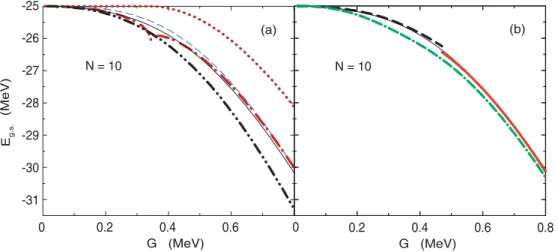
Shown in Fig.2are the results for the ground-state energies obtained within the BCS, LN, SCRPA, QRPA, LNQRPA, SCQRPA, and LNSCQRPA in comparison with the exact one for N =10. The exact result is obtained by directly diagonalizing the Hamiltonian in the Fock space [21]. It is seen that the BCS strongly overestimates the exact solution. The LN result comes much closer to the exact one even in the vicinity of the BCS (QRPA) critical point, whereas the QRPA (RPA) result agrees well with the exact solution only atGGBCS
cr (GGBCScr ). The improvement given by
the SCRPA is significant as its result nearly coincides with the exact one in the weak coupling region. However, the convergence of the SCRPA solution is getting poor in the strong coupling region. As a result, only the values up to
N = 10
0 0.2 0.4 0.6
G (MeV) -31
-30 -29 -28 -27 -26 -25
Eg.s.
(MeV)
N = 10
0.2 0.4 0.6 0.8
G (MeV) 0
(a) (b)
FIG. 2. (Color online) Ground-state energies as functions ofGforN=10. The exact result is represented by the thin solid line in both (a) and (b). In (a), the dotted line denotes the BCS result, the thin dashed line stands for the LN result, the dash-dotted line shows thepp RPA result atGGBCS
G0.46 MeV are accessible. The SCQRPA is much better than the QRPA as it fits well the exact ground-state energy at GGBCS1
cr . The LNQRPA strongly underestimates the
exact solution, whereas the LNSCQRPA, which includes the effects due to the screening factors in combination with PNP, significantly improves the overall fit. From this analysis, we can say that, among all the approximations undergoing the test to describe simultaneously the ground and excited states, the SCRPA, SCQRPA, and LNSCQRPA can be selected as those which fit best the exact ground-state energy. The LN method based on the BCS (thin dashed line) also fits quite well the exact one at allGbut it does not allow to describe the excited states as the approaches based on the QRPA do. Although the fit offered by the LNSCQRPA in the vicinity of the critical point is somewhat poorer than those given by the SCRPA and the SCQRPA, its advantage is that it does not suffer any phase-transition point due to the violation of particle number as well as the Pauli principle.
The corrections due to ground-state correlations can also be clearly seen by examining the energy difference
E≡Eg.s.(G)−Eg.s.(0) (63)
between the ground-state energies defined at finite and zero
G.2 The values of this energy difference as predicted by the
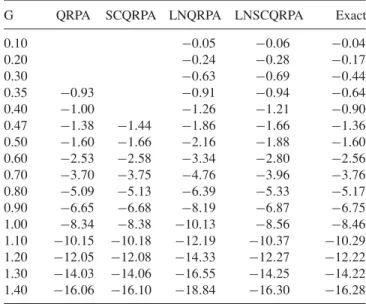
QRPA, SCQRPA, LNQRPA, and LNSCQRPA for the system withN =10 at variousGare compared with the exact ones in Table I. It is seen from this table that, although in the weak coupling regime (GBCS
cr G0.8 MeV) the QRPA and
SCQRPA predictions for this energy difference are closer to the exact result, at highGthe SCQRPA and LNSCQRPA are the ones that offer the better fits for this quantity. The LNQRPA, on the contrary, offers a quite poor fit forEto the exact result.
More quantitative calibrations can be seen by analyzing the relative errors
δE(a)= E
(approx)−E(exact)
E(exact) , and
(64)
δE(b)= E
(approx)−E(exact)
E(exact) ,
which are shown in TableII. BecauseE(exact)are quite small at smallG, the relative errorsδE(a)are quite large in the
weak-coupling region. In this respect the relative errorδE(b) turns
out to be a better calibration. AlthoughδE(a)decreases asG
increases for all approximations with the LNSCQRPA having the smallest relative errors at largeG, the behavior ofδE(b)on
Gis somewhat different depending on the approximation. A decrease of this quantity is seen within the QRPA and SCQRPA
2Within the RPA and SCRPA, where the mean field is the HF one,E coincides with the correlation energyEcorr≡Eg.s.−EHF becauseE(exact)
g.s. (0)=EHF,(fpHF=0, fhHF=1). Within the quasipar-ticle formalism, however,Ecorr is defined as the difference between the QRPA (LNQRPA, SCQRPA, LNSQRPA) ground-state energy and that given within the BCS (LN, LN1) method. ThisEcorris quite different fromEin the strong-coupling regime because of the large pairing gap. Therefore we find more appropriate in the quasiparticle representation to compare the approximated and exact energiesE (63) rather thanEcorr.
TABLE I. The energy difference E≡Eg.s.(G)−Eg.s.(0) at variousG(in MeV) as predicted by the QRPA, SCQRPA, LNQRPA, LNSCQRPA, and exact solutions forN =10.
G QRPA SCQRPA LNQRPA LNSCQRPA Exact
0.10 −0.05 −0.06 −0.04 0.20 −0.24 −0.28 −0.17 0.30 −0.63 −0.69 −0.44 0.35 −0.93 −0.91 −0.94 −0.64 0.40 −1.00 −1.26 −1.21 −0.90 0.47 −1.38 −1.44 −1.86 −1.66 −1.36 0.50 −1.60 −1.66 −2.16 −1.88 −1.60 0.60 −2.53 −2.58 −3.34 −2.80 −2.56 0.70 −3.70 −3.75 −4.76 −3.96 −3.76 0.80 −5.09 −5.13 −6.39 −5.33 −5.17 0.90 −6.65 −6.68 −8.19 −6.87 −6.75 1.00 −8.34 −8.38 −10.13 −8.56 −8.46 1.10 −10.15 −10.18 −12.19 −10.37 −10.29 1.20 −12.05 −12.08 −14.33 −12.27 −12.22 1.30 −14.03 −14.06 −16.55 −14.25 −14.22 1.40 −16.06 −16.10 −18.84 −16.30 −16.28
with increasingGup toG=0.7 MeV, and an increase with
G takes place at large G. For the LNSCQRPA, the relative error δE(b) increases first withGup to G=0.4 MeV, then decreases at larger G. Within LNQRPA one sees a steady increase ofδE(b)withGto reach a value as large as 6.2% at G=1.4 MeV.
The quantities that are directly defined by the differences of ground-state energies are the chemical potentialsλ±andλ, namely
λ+ = 1
2[Eg.s.(N+2)−Eg.s.(N)], λ− = 1
2[Eg.s.(N)−Eg.s.(N−2)], (65) λ= 1
2(λ++λ−).
The exact values of the chemical potentials λ and λ± are shown in Fig. 3 in comparison with the predictions within quasiparticle presentations for N =10. It is seen from this figure that the SCRPA and SCQRPA [Fig. 3(d)–3(f)] offer the best fit to the exact results except that the SCRPA poorly converges at G >0.4 MeV, whereas SCQRPA stops atG=GBCS1
cr . The RPA and QRPA also describe very well
the exact results, except the values in the critical region, where the RPA and QRPA diverge. The LNSCQRPA predictions for the chemical potentials show smooth functions at allG, which fit well the exact results, including the region around Gcr,
where they slightly underestimates the exact ones.
C. Energies of excited state
As has been discussed in Refs. [9,20], the first solutionω1
of the QRPA or SCQRPA equations is the energy of spurious mode, which is well separated from the physical solutionsων
withν2. The first excited state energy is therefore given by
ω2. Figure4shows the exact eigenvalues for the excited states.
TABLE II. Relative errorsδE(a)andδE(b)from Eq. (64) at variousGas predicted by the QRPA, SCQRPA, LNQRPA, and LNSCQRPA forN=10.
G(MeV) δE(a)(%) δE(b)(%)
QRPA SCQRPA LNQRPA LNSCQRPA QRPA SCQRPA LNQRPA LNSCQRPA
0.10 25.00 50.00 0.04 0.08
0.20 41.18 64.71 0.28 0.44
0.30 43.18 56.82 0.75 0.98
0.35 43.51 42.19 46.88 1.13 1.05 1.17 0.40 11.11 40.00 34.44 0.39 1.39 1.20 0.47 1.47 5.88 36.76 22.06 0.08 0.30 1.90 1.14 0.50 0.00 3.75 35.00 17.50 0.00 0.23 2.11 1.05 0.60 1.17 0.78 30.47 9.37 0.11 0.07 2.83 0.87 0.70 1.60 0.27 26.60 5.32 0.21 0.03 3.48 0.70 0.80 1.55 0.77 23.60 3.09 0.27 0.13 4.04 0.53 0.90 1.48 1.04 21.33 1.78 0.32 0.22 4.54 0.38 1.00 1.42 0.95 19.74 1.18 0.36 0.24 4.99 0.30 1.10 1.36 1.07 18.46 0.78 0.40 0.31 5.38 0.23 1.20 1.39 1.15 17.27 0.41 0.46 0.38 5.67 0.13 1.30 1.34 1.13 16.39 0.21 0.48 0.41 5.94 0.08 1.40 1.35 1.11 15.72 0.12 0.53 0.44 6.20 0.05
perturbations in the single-particle levels. With increasingG
the system goes to the crossover regime, where level splitting and crossing are seen, releasing the levels’ degeneracy. In the strong coupling regime the levels coalesce into narrow well-separated bands. The approaches based on the QRPA
-5.8 -5.6 -5.4 -5.2 -5.0
-6.4 -6.2 -6.0 -5.8 -5.6
0 0.2 0.4 0.6 0
G (MeV) -5.4
-5.2 -5.0 -4.8 -4.6
λ
(MeV)
λ
(MeV)
+
λ
(MeV)
−
(a)
(b)
(c)
N = 10
0.2 0.4 0.6 0.8
G (MeV) (d)
(e)
(f)
FIG. 3. (Color online) Chemical potentialsλandλ±as functions ofGforN =10 as predicted by the exact solutions, RPA, QRPA, SCRPA, SCQRPA, and LNSCQRPA. Notations are as in Fig.2.
with PNP within the LN method also splits the levels but the nature of the splitting comes from the two components within the QRPA operator (40), which correspond to the addition and removal modes, respectively, in the RPA limit. When the pairing gapis finite, it is not possible to consider the QRPA excitations as purely addition or removal modes but only as those with some components having the dominating property inherent to one of these modes. The QRPA eigenvalues also have two branches with positiveωνand negative−ωνenergies.
However, unlike theppRPA, where the negative eigenvalues in the equations for addition modes are also physical as they are the energies of the removal modes taken with the minus sign and vice versa, within the QRPA only the positive energies
ων are physical, and they are compared with the exact ones, Eexν ≡Eν(N)−E0(N), in the present article.
0 5 1 0 1 5 2 0 2 5 3 0 3 5 4 0
0 0 .5 1 1 .5 2 2 .5 3 3 .5 4
N = 10
E (MeV)
ex
G (MeV)
ν
FIG. 4. Exact energiesEex ν ≡E
ex ν (N)−E
ex
0 (N) obtained within the Richardson model for excited statesνrelative to the exact ground-state levelEex
0.0
0.2
0.4
0.6
0.8
1.0
1.2
1.4
0 2 4 6 8 10 12
N = 10
ω
G (MeV)
(MeV)
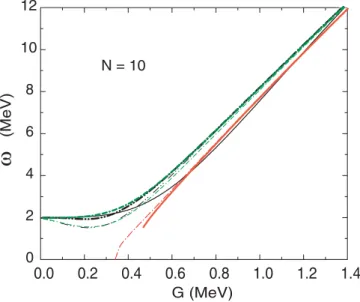
FIG. 5. (Color online) The energies of the first excited state as functions ofGatN=10. The results refer to the exact solution, Eex
1 (solid line), the QRPA solution,ω QRPA
2 (dash-dotted line), the SCQRPA solution,ω2SCQRPA(thick solid line), the LNQRPA solutions, ωLNQRPA2 (thin dash–double-dotted line), and ω3LNQRPA (thick dash– double-dotted line), as well as the LNSCQRPA solutions,ωLNSCQRPA2 (thin double-dash–dotted line), andωLNSCQRPA3 (thick double–dash-dotted line).
As an example to illustrate this level-splitting pattern, we show in Fig. 5 the exact energy E1ex≡E1(N)−E0(N) of
the lowest excited state (ν=1) with respect to the exact ground state (ν=0 ) in the system withN =10 particles in comparison with the predictions within the QRPA, LNQRPA, SCQRPA, and LNSCQRPA.3As the exact energyEex
1
repre-sents the energy of the lowest pair-vibration state, it is com-pared with the energiesω1of the lowest excited state obtained
within QRPA, LNQRPA, SCQRPA, and LNSCQRPA, which are built on the pairing condensate (quasiparticle vacuum). The splitting is clearly seen from Fig.5within the LN method, namely the LNQRPA and LNSCQRPA. One can see that, within the LN(SC)QRPA, each single level atG=0 splits into two components in the small-Gregion, e.g., the pairωLNQRPA2
andωLNQRPA3 orωLNSCQRPA2 andωLNSCQRPA3 . To look inside the source of the splitting, we rewrite the QRPA operator (40) into the components with dominating contributions of addition-and removal-mode patterns as follows:
Q†ν =(Q†ν)(A)+(Q†ν)(R),
(Q†ν)(A)=
p
XνpA†p− h
YhνAh, (66)
(Q†ν)(R)=
h
XνhA†h− p
YpνAp,
where the indicesj run over all the levels, from which those located below (above) the chemical potential are formally
3For the two-level caseEex
1 corresponds to the solid line in the upper panel of Figs.1and3–5in Ref. [9] or Figs.1–3in Ref. [17] forN=4,8, and 12).
0.0 0.2 0.4 0.6 0.8
0 1 2 3 4 5 6
N = 10
G (MeV)
ω
(MeV)
FIG. 6. The energies of the first excited state in different schemes as functions ofGforN=10. The thin and thick dash–double-dotted lines denote the second and third LNQRPA solutions, whereas the thin and thick dotted lines stand for the absolute values of the corresponding solutions within the LNQRPA1 scheme.
labeled with h (p) indices. It is not difficult to see that in the RPA limit (or zero-pairing limit), (Q†ν)(A)is transformed
into operatorA†ν that generates the addition modes, whereas (Q†ν)(R) becomes R†
ν that generates the removal modes (in
the standard notations for addition and removal operators from Refs. [4–6]). Using this formal expression (66), we derived the QRPA equations for the excitations generated by operators (Q†ν)(A)and (Q†
ν)(R), separately. The energies of the
corresponding first excited states from the resulting sets of equations were calculated by using the LN method. We call this scheme as LNQRPA1. The set of equations for the modes generated by operator (Q†ν)(A)gives a negativeωLNQRPA1
2 and
positiveωLNQRPA13 , which means that they correspond to the energies of the removal and addition modes, respectively. The absolute values of these energies are shown in Fig.6along with
ω2,3LNQRPA. It is seen from this figure that in the weak-coupling region the higher-lying levels ωLNQRPA3 andω3LNQRPA1 nearly coincide, whereas the lower-lying one, ω2LNQRPA, is almost the same as|ωLNQRPA12 |. From here, we can identifyωLNQRPA3
and ωLNQRPA2 as the levels where the addition and removal modes dominate, respectively. As the interactionGincreases, the occupation probabilities of the levels below and above the Fermi level become comparable so it becomes more and more difficult to separate the patterns belonging to addition and removal modes in the QRPA excitations.
From this analysis and Fig.5, it becomes clear that, in the weak coupling region, the levelωLNQRPA3 , which is generated mainly by the addition mode, fits well the exact result, whereas the agreement between the exact energy andω2QRPAas well as
0 2 4 6 0 2 4 6 8 10
0.2 0.4 0.6 0.8 1.0 1.2 1.4
1 2 3 4
G (MeV) (d) N = 8
(e) N = 6
(f) N = 4
0
-6.5 -6.0 -5.5 -5.0 -4.5 -4.0 -14 -13 -12 -11 -10
-9
-24 -22 -20 -18 -16
(a) N = 8
N = 6
N = 4
0.2 0.4 0.6 0.8 1.0 1.2
0
G (MeV) Eg.s.
(MeV)
ω
(MeV)
(b)
(c)
FIG. 7. (Color online) Energies of ground state (left panels) (notations as in Fig.2) and first excited state (right panels) (notations as in Fig.5) for several values ofNindicated on the panels as functions of G.
The energies of the ground state and the first excited state obtained for N =4,6,8 are depicted in Fig. 7. The figure shows that increasingNworsens the agreement of the results obtained within the LNQRPA and LNSCQPPA with the exact ones for both the ground state and the first excited state, whereas the QRPA and SCQRPA results become closer to the exact ones atGGcr. At smallN (N=4), the solution ωLNQRPA3 seems to fit best the exact result for all values ofG.
The pair-vibration excitation energyEex
1 is usually larger
than the energy of the lowest state with one broken pair. The latter is described within theppRPA as the energy of the lowest addition mode in the laboratory reference frame fixed to the ground state ofN-particle system [4–6]. It is worthwhile to compare the predictions for the excited-state energies obtained within the quasiparticle approaches developed in the present article withppRPA and SCRPA predictions by transforming the latter into the intrinsic reference frame of the system with
N+2 particles. This is done as follows. From the (SC)RPA energy of the ground-state level ω(SC)RPA0 =E0(SC)RPA(N+
2)−E0(SC)RPA(N) and that of the first excited stateω(SC)RPA1 =
E(SC)RPA
1 (N+2)−E (SC)RPA
0 (N)4it follows that ω(SC)RPA ≡ω(SC)RPA1 −ω(SC)RPA0
=E(SC)RPA
1 (N+2)−E (SC)RPA
0 (N+2), (67)
This energyω(SC)RPA is shown in Fig.8as a function ofG
along with the corresponding LNQRPA, LNSCQRPA, and
4The energiesω(SC)RPA 0 andω
(SC)RPA
1 correspond to energiesE1and E2shown in Figs.3and4in Ref. [4], respectively.
exact energies for several values of N. This figure clearly shows that the LNQRPA and LNSCQRPA are superior to the
ppRPA and SCRPA as they offer an overall prediction closer to the exact result for all G and N. They neither collapse at a Gcr as in the case with the pp RPA nor have a poor convergence as the SCRPA does atGGcr.
0.0 0.2 0.4 0.6 0.8
1 2 3 1 2 3 4 5 6
1 2 3 4 5
0.0 0.2 0.4 0.6 0.8
1.0 1.5 2.0 2.5
(c) N = 6
(a) N = 10 (b) N = 8
(d) N = 4
ω
(MeV)
ω
(MeV)
G (MeV) G (MeV)
∆
FIG. 8. (Color online) Energyω(SC)RPA(67) obtained within the ppRPA (dash-dotted line) and SCRPA (thick solid line) as a function ofGfor several values ofNin comparison with the energyω3LNQRPA (dash–double-dotted line),ω3LNSCQRPA(double-dash–dotted line), and the exact energyEex
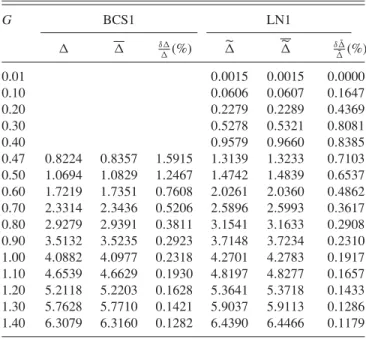
TABLE III. BCS1 and LN1 pairing gaps (in MeV) at various values ofG(in MeV) (see text).
G BCS1 LN1
δ
(%)
δ˜ ˜ (%) 0.01 0.0015 0.0015 0.0000 0.10 0.0606 0.0607 0.1647 0.20 0.2279 0.2289 0.4369 0.30 0.5278 0.5321 0.8081 0.40 0.9579 0.9660 0.8385 0.47 0.8224 0.8357 1.5915 1.3139 1.3233 0.7103 0.50 1.0694 1.0829 1.2467 1.4742 1.4839 0.6537 0.60 1.7219 1.7351 0.7608 2.0261 2.0360 0.4862 0.70 2.3314 2.3436 0.5206 2.5896 2.5993 0.3617 0.80 2.9279 2.9391 0.3811 3.1541 3.1633 0.2908 0.90 3.5132 3.5235 0.2923 3.7148 3.7234 0.2310 1.00 4.0882 4.0977 0.2318 4.2701 4.2783 0.1917 1.10 4.6539 4.6629 0.1930 4.8197 4.8277 0.1657 1.20 5.2118 5.2203 0.1628 5.3641 5.3718 0.1433 1.30 5.7628 5.7710 0.1421 5.9037 5.9113 0.1286 1.40 6.3079 6.3160 0.1282 6.4390 6.4466 0.1179
IV. CONCLUSIONS
This work proposes a self-consistent version of the QRPA in combination with particle-number projection within the Lipkin-Nogami method as an approach that works at any values of the pairing-interaction parameterGwithout suffering a phase-transition-like collapse (or poor convergence) due to the violation of Pauli principle as well as of the integral of motion such as the particle number. The self-consistency is maintained within a set of coupled equations for the pairing gap, QRPA amplitudes, and energies by means of the screening factors, which are the expectation values of the products of quasiparticle-pair operators, and the ground-state correlation factor, which is a function of the QRPA backward-going amplitudes.
The proposed approach is tested in a multilevel exactly solvable model, namely the Richardson model for pairing. The energies of the ground and first-excited states are calculated within several approximations such as the BCS, RBCS,
BCS1, LN, RLN, LN1, QRPA, SCQRPA, LNQRPA, and LNSCQRPA. The obtained results for the ground-state energy show that the use of the LN method that includes the SCQRPA correlations not only allows us to avoid the collapse of the BCS as well as the QRPA but also fits well the exact result. For the energy of the first excited state, the LNQRPA and LNSCQRPA results offer the best fits to the exact solutions in the weak coupling region with large particle numbers, whereas the QRPA and SCQRPA reproduce well the exact one in the strong coupling region. In the limit of very largeGall the approximations predict nearly the same value as that of the exact one. As the number of particles decreases, it becomes sufficiently well to use the predictions given by the LNQRPA and LNSCQRPA for energies of both the ground state and first-excited state to fit the exact results.
We believe that the approach proposed in this work can be useful in the applications to light and unstable nuclei, where the validity of the QBA and that of the conventional BCS are in question. Such applications are the goal for forthcoming studies.
ACKNOWLEDGMENTS
The authors are grateful to Michelangelo Sambataro (Catania) for his assistance in the exact solutions of the Richardson model. The numerical calculations were carried out using the FORTRAN IMSL Library by Visual Numerics on the RIKEN Super Combined Cluster (RSCC) system. N.Q.H. is a RIKEN Asian Program Associate.
APPENDIX: ACCURACY OF APPROXIMATION (33)
Let us analyze the accuracy of the assumption (33) used in the numerical solutions of the BCS1, LN1, and SCQRPA equations in the present article.
Shown in the second and fifth columns of Table III are the values of the pairing gaps and obtained under the approximation (33) within the BCS1 and LN1 method, respectively. They are compared with the average gaps
(third column) and (sixth column), which are the values obtained by averaging the level-dependent BCS1 gapj and
LN1 gapj over all the levels, namely=
jj/N and
TABLE IV. The ratio (δNj)2/D
jfrom Eqs. (31) and (32) corresponding to the five lowest levelsj=1, . . . ,5, and the energiesω3(in MeV) of the first excited state described in the text forN=10 at different values ofG(in MeV) within the LNSCQRPA. The energy ω3(a) is obtained including the last term at the right-hand side of Eq. (31), whereasω3(b) is calculated using the approximation (33).
G j=1 j=2 j=3 j=4 j=5 ω3(a) ω3(b)
=jj/N. The second term at the right-hand side of
Eq. (31), which containsδNj2as evaluated by the approxima-tion (32), is taken into account in calculatingjandjwithin
the perturbation theory, i.e., with nj being evaluated within
SCQRPA and LNSCQRPA (where this term is neglected). Except for the two values atG=GBCS1
cr =0.47 MeV andG=
0.5 MeV within the BCS1, we see that the values of the relative errorsδ/≡(−)/andδ/≡(−)/are all smaller than 1%, and decrease with increasingG.
Shown in TableIVare the values of the ratio (δNj)2/Dj
from Eqs. (31) and (32) corresponding to the five lowest levels
for N =10 at various G obtained within the LNSCQRPA. The largest value of this ratio is observed at the level with
j =5, the closest one to the Fermi level, at G=0.4 MeV (close to GBCS1
cr ). But it amounts to only 0.0082, which is
a clear evidence that this ratio is indeed negligible. The last two columns of this table display the energies ω3(a),
obtained within the LNSCQRPA, including the last term at the right-hand side of Eq. (31), andω3(b), which the LNSCQRPA
predicts within the approximation (33). Although a systematic
ω3(a)> ω3(b) is observed, the largest difference, also seen at
G=0.4 MeV, does not exceed 0.15%. These results guarantee the high accuracy of the approximation (33).
[1] K. Hara, Prog. Theor. Phys.32, 88 (1964); K. Ikeda, T. Udagawa, and H. Yamamura,ibid.33, 22 (1965); P. Schuck and S. Ethofer, Nucl. Phys.A212, 269 (1973).
[2] D. J. Rowe, Phys. Rev.175, 1283 (1968).
[3] F. Catara, N. D. Dang, and M. Sambataro, Nucl. Phys.A579, 1 (1994).
[4] J. Dukelsky and P. Schuck, Phys. Lett.B464, 164 (1999). [5] J. G. Hirsch, A. Mariano, J. Dukelsky, and P. Schuck, Ann. Phys.
(NY)296, 187 (2002).
[6] N. D. Dang, Phys. Rev. C71, 024302 (2005).
[7] N. D. Dang and K. Tanabe, Phys. Rev. C74, 034326 (2006). [8] J. Dukelsky and P. Schuck, Phys. Lett.B387, 233 (1996). [9] A. Rabhi, R. Bennaceur, G. Chanfray, and P. Schuck, Phys. Rev.
C66, 064315 (2002).
[10] H. J. Lipkin, Ann. Phys. (NY)9, 272 (1960); Y. Nogami and I. J. Zucker, Nucl. Phys.60, 203 (1964); Y. Nogami, Phys. Lett. 15, 4 (1965); J. F. Goodfellow and Y. Nogami, Can. J. Phys.44, 1321 (1966).
[11] H. C. Pradhan, Y. Nogami, and J. Law, Nucl. Phys.A201, 357 (1973).
[12] R. W. Richardson, Phys. Lett.3, 277 (1963);14, 325 (1965). [13] J. H¨ogaasen-Feldman, Nucl. Phys.28, 258 (1961).
[14] N. D. Dang, Z. Phys. A335, 253 (1990).
[15] N. Dinh Dang and A. Arima, Phys. Rev. C67, 014304 (2003). [16] J. Dukelsky and P. Schuck, Nucl. Phys.A512, 466 (1990). [17] M. Sambataro and N. Dinh Dang, Phys. Rev. C59, 1422 (1999). [18] A. Valor, J. L. Egido, and L. M. Robledo, Nucl. Phys.A665, 46 (2000); T. R. Rodriguez, J. L. Egido, and L. M. Robledo, Phys. Rev. C72, 064303 (2005).
[19] P. Magierski, S. Cwiok, J. Dobaczewski, and W. Nazarewicz, Phys. Rev. C48, 1686 (1993).
[20] N. D. Dang, Eur. Phys. J. A16, 181 (2003).
[21] A. Volya, B. A. Brown, and V. Zelevinsky, Phys. Lett.B509, 37 (2001).