Effects of quantal and thermodynamical
fluctuations on superfluid pairing in nuclei
Doctoral Dissertation
by
Nguyen Quang Hung
Institute of Physics
10, Daotan street, Badinh district, Hanoi city, Vietnam
Acknowledgements
I would like to express my deep gratitude to my supervisor Dr. Nguyen Dinh Dang for
his guidance and encouragement during this research. He taught me not only physics
but also how to become an independent researcher. He always encourages me to develop
independent thoughts. He brought me the passion to research. My life really changed
after I met him.
I would like to thank Prof. Hoang Ngoc Long for his continuous support and great
advices to me since I was his Master’s student. He opened the door for me to theoretical
physics. I am greatly indebted to him.
I would like also to thank Prof. Pham Quoc Hung and Prof. Bach Thanh Cong of
Hanoi University of Science for their recommendations to the program of RIKEN Asia
Associate.
I am grateful to RIKEN Asia Program Associate for the financial support for my
research in RIKEN, and my life during my three-year stay in Japan between 2006 and
2009. This has been a very useful program for students from developing countries like
Vietnam to come to conduct research of high-quality international standard in RIKEN.
I am thankful to Dr. Y. Yano - director of RIKEN Nishina Center for Accelerator-Based
Science, Prof. T. Motobayashi - director of the Heavy-Ion Nuclear Physics Laboratory,
my RIKEN colleagues and friends for their continuous support, assistance, attention
to my research and to me. All the numerical calculations in the present dissertation
were carried out using the FORTRAN IMSL Library by Visual Numerics on the RIKEN
Super Combined Cluster (RSCC) system.
Global Relation Office), Ms. R. Kuwana (RIKEN Nishina Center) for their kind
assis-tances during my stay in RIKEN.
I am also thankful to Prof. S. Frauendorf (University of Notre Dame), Prof. V.
Zelevinsky (Michigan State University), Prof. B.A. Brown (Michigan State
Univer-sity), Prof. P. Danielewicz (Michigan State UniverUniver-sity), Prof. P. Schuck (Institute de
Physique Nucl´eaire - Orsay), Prof. L.G. Moretto (Lawrence Berkeley National
Lab-oratory), Dr. M. Sambataro (Istituto Nazionale di Fisica Nucleare), Dr. V. Kim Au
(Texas A&M University), Dr. A. Rios (Michigan State University), and Mr. I. Bentley
(University of Notre Dame) for fruitful discussions and various suggestions on a number
of issues included in this dissertation.
I am indebted to my parents, brother, sister, and my relatives in Vietnam for their
encouragement and confidence in me. Finally, I would like to thank my wife for her
Statement of authorship
I hereby certify that the present dissertation is my own research work. All the data
and results presented in this dissertation are true and correct. They are based on
the results and conclusions of four papers written in co-authorship with my thesis
supervisor Dr. N. Dinh Dang. Three of them have been published in international
peer-review journals, the fourth one is now under peer review. The anonymous referees
of these papers are qualified experts in the field. These results have also been reported
at 5 international meetings and 6 seminars in France, Germany, Italy, Japan, New
Zealand, and USA. This approbation process guarantees that these results have never
been published by anyone else in any other works or articles.
Contents
Acknowledgements iii
Statement of authorship v
Contents vi
Introduction 1
1 Exact solution of pairing Hamiltonian 9
1.1 Pairing Hamiltonian . . . 9
1.2 Exact solution at zero temperature . . . 11
1.3 Exact solution embedded in thermodynamic ensembles . . . 12
1.3.1 Grand canonical and canonical ensembles . . . 12
1.3.2 Microcanonical ensemble . . . 15
1.3.3 Determination of pairing gaps from total energies . . . 17
1.4 Analysis of numerical results . . . 19
1.4.1 Details of numerical calculations . . . 19
1.4.2 Results within GCE and CE . . . 21
1.4.3 Results within MCE . . . 24
1.4.4 Pairing gaps extracted from odd-even mass differences . . . 27
1.5 Conclusions of Chapter 1 . . . 28
2 SCQRPA at zero temperature 30 2.1 Gap and number equations . . . 30
2.1.1 Renormalized BCS . . . 30
2.1.2 BCS with SCQRPA correlations . . . 31
2.1.3 Lipkin-Nogami method with SCQRPA correlations . . . 34
2.2 SCQRPA equations . . . 36
2.2.1 QRPA . . . 36
2.2.2 Renormalized QRPA . . . 37
2.2.3 SCQRPA and Lipkin-Nogami SCQRPA . . . 38
2.3 Analysis of numerical results . . . 40
2.3.1 Pairing gap . . . 40
2.3.2 Ground-state energies . . . 41
2.3.4 Accuracy of approximation (2.22) . . . 53
2.4 Conclusions of Chapter 2 . . . 55
3 SCQRPA at finite temperature 57 3.1 Finite-temperature BCS with the effects due to QNF . . . 57
3.1.1 Without particle-number projection (FTBCS1) . . . 58
3.1.2 With Lipkin-Nogami particle-number projection (FTLN1) . . . 59
3.2 Effects of dynamic coupling to SCQRPA vibrations . . . 59
3.2.1 Screening factors . . . 60
3.2.2 Quasiparticle occupation number . . . 61
3.3 Analysis of numerical results . . . 67
3.3.1 Ingredients of calculations . . . 67
3.3.2 Results within the Richardson model . . . 69
3.3.3 Results by using realistic single-particle spectra . . . 75
3.3.4 Self-consistent and statistical treatments of quasiparticle occu-pation numbers . . . 75
3.3.5 Comparison between FTBCS1 and MBCS . . . 77
3.3.6 Factorization of the pair correlatorhA†jAj0i . . . 79
3.4 Conclusions of Chapter 3 . . . 81
4 SCQRPA at finite temperature and angular momentum 83 4.1 Pairing Hamiltonian for rotating system . . . 83
4.2 Gap and number equations . . . 85
4.3 Coupling to the SCQRPA vibrations . . . 87
4.3.1 SCQRPA equations and screening factors . . . 87
4.3.2 Quasiparticle occupation numbers . . . 87
4.4 Analysis of numerical results . . . 89
4.4.1 Ingredients of numerical calculations . . . 89
4.4.2 Results within the doubly-folded multilevel equidistant model . 90 4.4.3 Results for realistic nuclei . . . 93
4.4.4 Backbending . . . 100
4.4.5 Corrections due to particle-number projection and coupling to the SCQRPA vibrations . . . 100
4.4.6 On the comparison with canonical results . . . 103
4.5 Conclusions of Chapter 4 . . . 109
Summary and outlook 112
List of publications 116
List of Tables
2.1 The energy difference ∆E ≡Eg.s.(G)−Eg.s.(0) at variousG(in MeV) as
predicted by the QRPA, SCQRPA, LNQRPA, LNSCQRPA, and exact
solutions for N = 10. . . 43
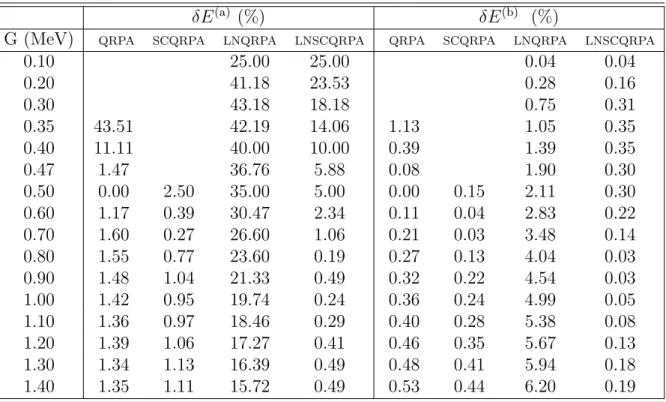
2.2 Relative errorsδE(a)andδE(b) from Eq. (2.54) at variousGas predicted
by the QRPA, SCQRPA, LNQRPA, and LNSCQRPA forN = 10. . . 44
2.3 BCS1 and LN1 pairing gaps (in MeV) at various values of G (in MeV)
(see text). . . 54
2.4 The ratio (δNj)2/hDji from Eqs. (2.19) and (2.20) corresponding to
the 5 lowest levels j = 1, . . . , 5, and the energies ω3 (in MeV) of the
first excited state described in the text for N = 10 at different values
of G (in MeV) within the LNSCQRPA. The energy ω3(a) is obtained
including the last term at the right-hand side of Eq. (2.19), while ω3(b)
List of Figures
1.1 Pairing gaps ∆, total energies hEi, and heat capacities C, obtained for
N = 8, 10, and 12 (G= 0.9 MeV) within the FTBCS (dotted lines), CE
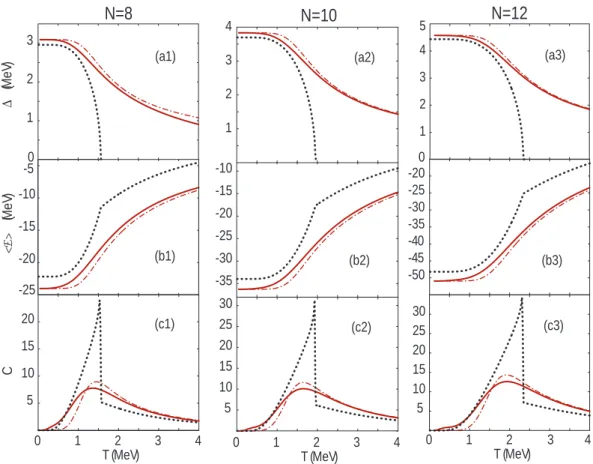
(dash-dotted lines), and GCE (solid lines) vs temperatureT. . . 20
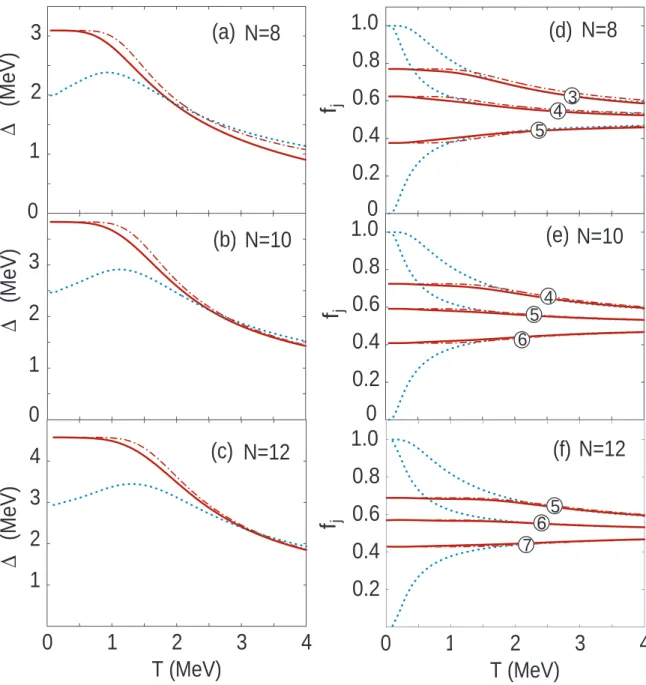
1.2 Pairing gaps (1.42) and single-particle occupation numbersfj forN = 8,
10, and 12, obtained within the mean field (dotted lines) as functions of
T, in comparison with the GCE gaps (solid lines), and CE (dash-dotted
lines) ones. . . 22
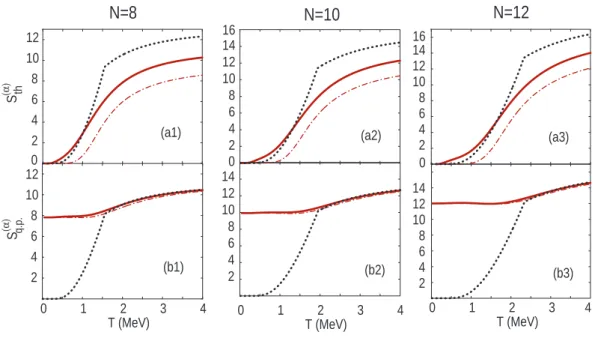
1.3 Thermodynamic entropySth(α), and quasiparticle (single-particle) entropy
Sq.p.(α), obtained forN = 8, 10, and 12 (G= 0.9 MeV) vsT. The notations
forα = FTBCS, CE, and GCE are the same as in Fig. 1.1. . . 23
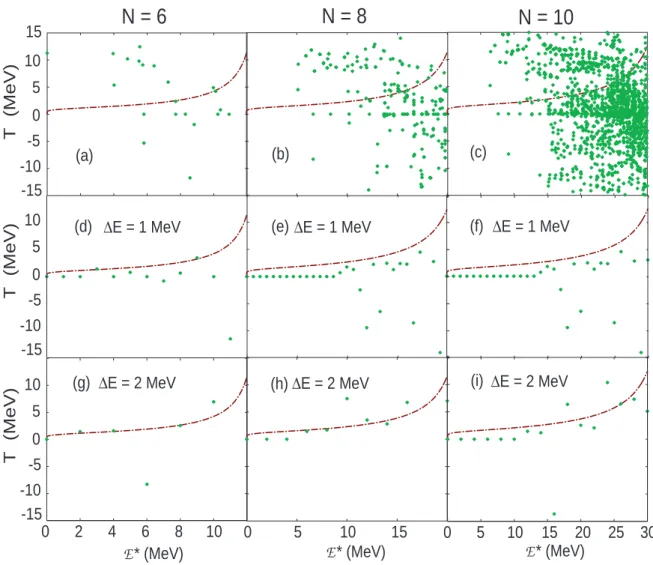
1.4 Temperature extracted from Eq. (1.37) within the MCE (dots) vs
exci-tation energy E∗ in comparison with the CE results (dash-dotted line)
for N = 8, 10, and 12. The results in the top panels, (a) – (c), are
obtained by using Eq. (1.31), whereas those in the middle panels, (d) –
(f), and bottom ones, (g) – (i), are calculated by using Eq. (1.37) with
two different values of the energy interval ∆E in the statistical weight
Ω in Eq. (1.36). . . 25
1.5 Temperatures [(a) – (c)], entropies [(d) – (f)], and pairing gaps [(g) – (i)]
within the MCE as functions of excitation energy E∗ for N = 8 (G =
0.9 MeV) obtained by using the Gaussian, Lorentz, and Breit-Wigner
distributions from Eq. (1.38) for the level density at different values of
1.6 Pairing gaps extracted from the odd-even mass differences as functions
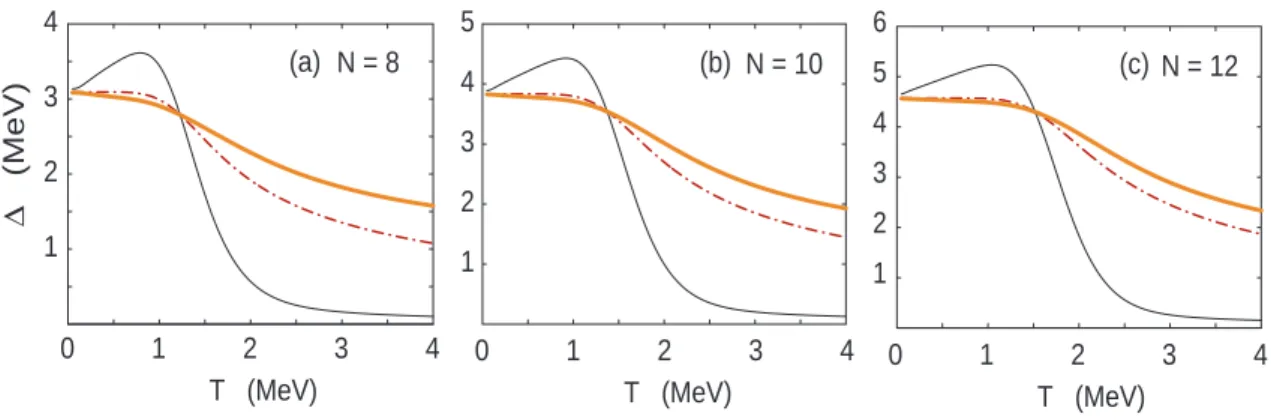
of T for N = 8, 10, and 12. The thin solid and thick solid lines denote
the gaps ∆(β, N) from Eq. (1.43), and the modified gaps ∆(e β, N) from
Eq. (1.45), respectively. The dash-dotted lines are the same canonical
gaps ∆C as in Figs. 1.1 and 1.2. . . 27
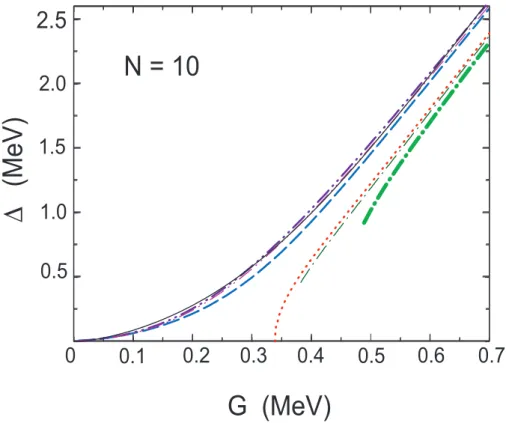
2.1 Pairing gaps ∆ as functions of G for N=10. The dotted, thin and
thick dash-dotted denote the BCS, RBCS, and BCS1 results,
respec-tively while the dashed, thick and thin dash-double-dotted lines
repre-sent the LN1, LN and RLN results, respectively.. The thin solid line
depicts the exact gap (see the text). . . 41
2.2 Ground state energies as functions of G for N = 10. The exact result
is represented by the thin solid line in both panels (a) and (b). In
panel (a), the dotted line denotes the BCS result, the thin dashed line
stands for the LN result, the dash-dotted line shows thepp RPA result
atG≤GBCS
c , and the QRPA one at G > GBCSc , while the
dash–double-dotted line depicts the LNQRPA result. Predictions by self-consistent
approaches are plotted in panel (b), where the thick dashed line denotes
the SCRPA result, while the SCQRPA and LNSCQRPA are shown by
the thick solid and thin double-dash–dotted lines, respectively. . . 42
2.3 Chemical potentials λand λ± as functions ofG forN = 10 as predicted
by the exact solutions, RPA, QRPA, SCRPA, SCQRPA, and
LNSC-QRPA. Notations are as in Fig. 2.2. . . 46
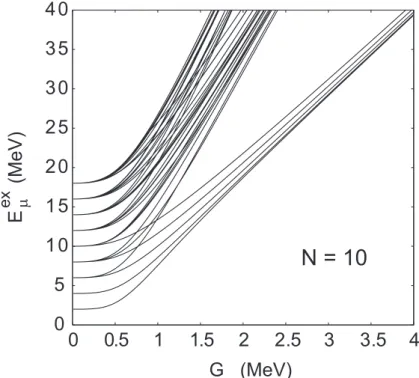
2.4 Exact energies Eex
µ ≡ Eµex(N)− E0ex(N) obtained within the Richardson
model for excited statesµrelative to the exact ground-state levelEex 0 as
2.5 The energies of the first excited state as functions of G at N=10. The
results refer to the exact solution, Eex
1 (solid line), the QRPA
solu-tion, ωQRPA2 (dash-dotted line), the SCQRPA solution, ω2SCQRPA (thick solid line), the LNQRPA solutions,ω2LNQRPA(thin dash – double-dotted line) and ω3LNQRPA (thick dash – double-dotted line), as well as the LNSCQRPA solutions,ω2LNSCQRPA (thin double-dash – dotted line) and
ω3LNSCQRPA (thick double-dash – dotted line). . . 48 2.6 The energies of the first excited state in different schemes as functions of
Gfor N = 10. The thin and thick dash – double-dotted lines denote the
second and third LNQRPA solutions, while the thin and thick dotted
lines stand for the absolute values of the corresponding solutions within
the LNQRPA1 scheme. . . 50
2.7 Energies of ground state (left panels) (notations as in Fig. 2.2) and first
excited state (right panels) (notations as in Fig. 2.5) for several values
of N indicated on the panels as functions of G. . . 52
2.8 Energy ∆ω(SC)RPA(2.57) obtained within theppRPA (dash-dotted line)
and SCRPA (thick solid line) as a function of G for several values of
N in comparison with the energy ωLNQRPA3 (dash – double-dotted line),
ω3LNSCQRPA (double-dash – dotted line), and the exact energy Eex 1 (thin
solid line), which are the same as those in Fig. 2.7 (d) – (f) forN = 4,
3.1 Diagrams summarized within the FTBCS1+SCQRPA. An arrow thin
line denotes the quasiparticle propagation, whereas a wavy line
repre-sents an SCQRPA phonon. The free quasiparticle Green function G0 j is
shown as the graph (a), whereas the loops in (b) and (c) stand for the
first and second summations at the right-hand side of Eq. (3.29),
respec-tively. An open circle in (b) denotes the vertex∼Vjµp1−nj +νµ, while
a box in (c) stands for ∼ Vjµ√nj +νµ. An SCQRPA phonon is
repre-sented in (d) as a sum of forward- and backward-going time conjugated
quasiparticles pairs. . . 65
3.2 (Level-weighted pairing gaps ∆ obtained within the FTBCS1 as
func-tions of temperature T at various values of pairing parameter G (in
MeV) indicated by the figures near the lines for several values of particle
number N. Open circles on the axes of abscissas in panels (a) and (b)
mark the valuesT1 of temperature, where the FTBCS1 gap turns finite
at low G. Full circles denote temperature Tec, where the gap vanishes,
and T2, where it reappears. . . 69
3.3 Level-dependent pairing gap ∆j (3.2) and level-weighted pairing gap ∆
(3.36) obtained within the FTBCS1 as functions of temperature T for
N = 20 andG= 0.44 MeV. Thick solid lines represent the level-weighted
gaps ∆. Thin solid lines denote the level-dependent gaps ∆j
correspond-ing to thej-th orbitals, whose level numbers j are marked at the lines.
Dashed and dotted lines stand for the level-independent part (quantal
component), ∆, and the level-dependent one (thermal component),δ∆j,
3.4 Level-weighted pairing gaps (a, d), total energies (b, e), and heat
capac-ities (c, f) as functions of temperatureT, obtained forN = 10 [(a) – (c)],
andN = 50 [(d) – (f)]. The dotted, thin solid, thick solid lines show the
FTBCS, FTBCS1, and FTBCS1+SCQRPA results, respectively. The
predictions by the FTLN1 and FTLN1+SCQRPA are presented by the
thin and thick dashed lines, respectively. The thin and thick dash-dotted
lines in (a) – (c) denote results of the GCE and CE ensembles,
respec-tively. The calculations of the mass operator and quasiparticle damping
within the SCQRPA were performed usingε= 0.05 MeV. . . 74
3.5 Level-weighted pairing gaps, total energies, and heat capacities for 10
neutrons in the 1f7/22p3/22p1/21f5/2 shell of 56Fe and all neutron bound
states of120Sn as functions of T (ε= 0.1 MeV). Notations are as in Fig.
3.4. In (b) and (c), the predictions by the finite-temperature quantum
Monte Carlo method [59] are shown as boxes and crosses with error bars
connected by dash-dotted lines. . . 76
3.6 Quasiparticle occupation numbers for N = 10 with G = 0.4 MeV (a,
b) and 120Sn with G = 0.137 MeV (c) as functions of T. In (a) and
(b) the solid lines are predictions within FTBCS1+SCQRPA for the
levels numerated by the numbers in the circles starting from the lowest
ones. The dashed lines, numerated by the italic numbers, show the
corresponding results obtained within the FTBCS1. In (c) predictions
for the neutron orbitals of the (50 - 82) shell in 120Sn, obtained within
the FTBCS1 and FTBCS1+SCQRPA, are shown as the dashed and solid
lines, respectively. . . 77
3.7 Level-weighted gaps for N = 10 with G = 0.4 MeV as predicted by
the WT (dashed), HP (dash-dotted), and QBA (thin dotted)
approxi-mations in comparison with the FTBCS (thick dotted), FTBCS1 (thin
4.1 Level-weighted pairing gaps ¯∆ as functions of T at various M [(a), (d)],
and as functions ofM [(b), (e)] andγ [(c), (f)] at several T for N = 10,
G= 0.5 MeV obtained within the FTBCS (left) and FTBCS1 (right). 91
4.2 Same as Fig. 4.1 but for neutrons in 20O using G= 1.04 MeV. . . . . 94
4.3 Same as Fig. 4.1 but for neutrons in 44Ca using G= 0.48 MeV. . . . . 97
4.4 Level-weighted pairing gaps as functions of T at various M obtained
within the FTBCS (left) and FTBCS1 (right) for neutrons [(a), (c)],
and protons [(b), (d)] in 22Ne using G
n= 1.0 MeV and Gp = 1.32 MeV. 98
4.5 Moment of inertia as a function of the square γ2 of angular velocity γ
obtained within the FTBCS (left) and FTBCS1 (right) at various T for
N = 10 [(a), e)], neutrons in 20O [(b), (f)] and 44Ca [(c), (g)], and the
whole22Ne nucleus (including both proton and neutron gaps) [(d), (h)]. 99
4.6 Level-weighted pairing gaps ¯∆ for N = 10 with G= 0.5 MeV [ε = 0.1
MeV in Eqs. (4.26) and (4.27)]. (a1) – (c1): ¯∆ vs temperature T at
different angular momentaM. (a2) – (c3): Results obtained at different
values of T, namely, (a2) – (c2): ¯∆ vs M; (a3) – (c3): ¯∆ vs angular
velocity γ. The dotted, thin solid, thick solid, thin dash-dotted, thick
dash-dotted lines are results obtained within the FTBCS, FTBCS1,
FT-BCS1+SCQRPA, FTLN1, FTLN1+SCQRPA, respectively. The solid
lines with circles and boxes in (a1) and (a3) correspond to two
defini-tions ∆(1)c and ∆(2)c of the canonical gaps at T = 0, respectively (See
Sec. 4.4.6). In (a2) the dashed lines connecting the discrete values of
the corresponding canonical gaps atT = 0 are drawn to guide the eye. 101
4.7 Moment of inertia J as function of the squareγ2 of angular velocity at
various T for N = 10 with G= 0.5 MeV (ε = 0.1 MeV). Notations are
4.8 Level-weighted pairing gaps ¯∆, total energies E, and heat capacities C
as functions of temperatureT for three values of angular momentumM
obtained within the FTBCS (dotted lines), FTBCS1 (thin solid lines)
and FTBCS1 + SCQRPA (thick solid lines) for neutrons in 20O with
G= 1.04 MeV (ε= 0.1 MeV). . . 104
4.9 Same as in Fig. 4.8 but for neutrons in 44Ca with G = 0.48 MeV (ε =
1 MeV). . . 105
4.10 (a) Canonical moment of inertia vs γ2; (b): Absolute values |hEi C −
Em.f.| (solid line) and |Eunc.| (dotted line) vs γ; (c): [∆(1)C ]2 vs γ for the
Introduction
Many experiments on heavy-ion fusion reaction had been carried out in the last two
decades (See Ref. [37] for a detail account). In these experiments compound nuclei
at highly excitation energies were created. The time required for these compound
nuclei to reach thermal equilibrium is around 10−23 seconds, which is much shorter
than the typical time of ∼ 10−15 seconds, after which they start to decay. Therefore
one can apply statistical thermodynamics to these highly-excited nuclei, and assign for
them a temperature T, which is extracted from their total or excitation energies after
subtracting the contribution due to angular momentum. This is why such systems
can be referred to as nuclei at finite temperature or hot nuclei. The typical range of
temperature for a self-sustained thermally equilibrated nucleus is below the neutron
binding energy, which is T < 6 – 8 MeV for heavy nuclei.
Phase transitions are common features of infinite systems in thermodynamics. At
the phase-transition point, called critical point, physical properties of the system
un-dergo an abrupt change. Phase transitions like the one from the superfluid
(supercon-ducting) state to the normal state are experimentally found in metal superconductors,
ultracold gases, liquid helium, etc. They are described very well by the many-body
mean-field theories, such as the Bardeen-Cooper-Schrieffer (BCS) [3] theory for the
superfluid-normal (SN) phase transition. Fluctuations play no role in these systems
as their effects are either zero in infinite systems or negligible for very large systems.
However, in small finite systems such as atomic nuclei or ultrasmall superconducting
finiteness of these systems. Therefore, in order to be reliable, the well-known
many-body theories such as the BCS theory or random-phase approximation (RPA) [58],
which is a theory to describe small-amplitude vibrations around the mean field, need
to be corrected to take into account the effects of quantal and thermal fluctuations.
Zero temperature
At zero temperature, one of standard methods to treat the quantal correlations beyond
the mean field is the well-known random-phase approximation (RPA). Extensively
employed in nuclear systems, the RPA includes correlations in the ground state, and
provides a simple theory of excited states of the nucleus. However, the RPA breaks
down at a certain value Gc of interaction parameter G, where it yields imaginary
solutions. The reason is that the RPA equations, linear with respect to the X and
Y amplitudes of the RPA excitation operator, are derived based on the quasi-boson
approximation (QBA). The latter neglects the Pauli principle between fermion pairs,
and its validity is getting poor with increasing the interaction parameter G. The
collapse of the RPA at the critical value Gc of G invalidates the use of the QBA. The
RPA therefore needs to be extended to correct this deficiency, at least for finite systems
such as nuclei.
One of methods to restore the Pauli principle is to renormalize the conventional
RPA to include the non-zero values of the commutator between the fermion-pair
oper-ators in the correlated ground state. These so-called ground-state correlations beyond
RPA cause the quantal fluctuations, whose effects are neglected within the QBA. The
interaction in this way is renormalized and the collapse of RPA is avoided. The
result-ing theory is called the renormalized RPA (RRPA) [36, 62, 9]. However, the test of
the RRPA carried out within several exactly solvable models showed that the RRPA
results are still far from the exact solutions of the models [9, 27, 38].
Recently, a significant development in improving the RPA has been carried out
of renormalizing the particle-particle (pp) RPA, the SCRPA made a step forward by
including the screening factors, which are the expectation values of the products of two
pairing operators in the correlated ground state. The SCRPA has been applied to the
exactly solvable multi-level pairing model, where the energies of the ground state and
first excited state in the system withN+2 particles relative to the energy of the
ground-state level in theN-particle system are calculated and compared with the exact results.
It has been found that the agreement with the exact solutions is good only in the weak
coupling region, where the pairing-interaction parameter Gis smaller than the critical
valuesGc. In the strong coupling region (G >> Gc), the agreement between the SCRPA
and exact results becomes poor [27, 38]. In this region a quasiparticle representation
should be used in place of theppone, as has been pointed out in Ref. [21]. As a matter
of fact, an extended version of the SCRPA in the superfluid region has been proposed
and is called the self-consistent quasiparticle RPA (SCQRPA), which was applied for
the first time to the seniority model in Ref. [28] and a two-level pairing model in Ref.
[55]. The derivations of the SCQRPA equations were based on the
Bardeen-Cooper-Schrieffer (BCS) [3] equations and self-consistently coupled to the quasiparitcle RPA
(QRPA). However, the SCQRPA also collapses at G = Gc. It is therefore highly
desirable to develop a SCQRPA that works at all values ofGand also in more realistic
cases, e.g., multilevel models. One of the aim of present study is to construct such
an approach. Obviously, the collapse of the SCQRPA at G = Gc, which is the same
as that of the non-trivial solution for the pairing gap within the BCS theory, can be
avoided by performing the particle-number projection (PNP). The latter removes the
quantal fluctuations caused by particle-number violation inherent in the BCS wave
functions. The Lipkin-Nogami method [47, 54], which is an approximated PNP before
variation, will be used in such extension of the SCQRPA in the present study because
of its simplicity. This approach shall be applied to a multi-level pairing model, the
so-called Richardson model [57], which is an exactly solvable model extensively employed
Finite temperature
At finite temperature, fluctuations strongly affect thermal pairing correlations in
nu-clear systems, which has been extensively studied within the BCS theory at finite
temperatureT (FTBCS theory) [3]. The FTBCS theory predicts a destruction of
pair-ing correlation at a critical temperatureTc '0.568∆(0) [∆(0) is the pairing gap at zero
temperature], resulting in a sharp transition from the superfluid phase to normal one
(the SN phase transition) [30, 45] in good agreement with the experimental findings
in macroscopic systems such as metallic superconductors. However, the BCS theory is
valid only when the assumption on the quasiparticle mean field is good, i.e. when the
difference between the pair operator Pjm† ≡a†jmaj†−m and its expectation valuehPjm† iis small so that the quadratic term (Pjm† − hPjm† i)2 is negligible, wherea†
jm is the operator
that creates a particle with angular momentum j and spin projection m. For small
systems such as atomic nuclei or for underdoped cuprates, where the coherence lengths
(the Cooper-pair sizes) are very short, the fluctuations (Pjm† − hPjm† i)2 are no longer
small, which invalidate the quasiparticle mean-field assumption, and break down the
BCS theory. As the result, the gap evolves continuously across Tc, and persists well
above Tc [26, 42].
The effects of thermal fluctuations on the pairing properties of nuclei have been
the subject of numerous theoretical studies in the last three decades. In the seventies,
by applying the macroscopic Landau theory of phase transitions to a uniform model,
Moretto has shown that thermal fluctuations smooth out the sharp SN phase
transi-tion in finite systems [49]. In the eighties, this approach was incorporated by Goodman
into the Hartree-Fock-Bogoliubov (HFB) theory at finite temperature [32] to account
for the effect of thermal fluctuations [33]. Theoretical studies within the static-path
approximation (SPA) carried out in the nineties also came to the non-vanishing pairing
correlations at finite temperature [60], which are qualitatively similar to the predictions
calculations [73, 24] also show that pairing does not abruptly vanish atTc, but still
sur-vives atT > Tc. The recent microscopic approach to thermal pairing, called
modified-HFB (Mmodified-HFB) theory [18], includes the quasiparticle-number fluctuation (QNF) in the
modified single-particle density matrix and particle-pairing tensor. Its limit of constant
pairing interactionGis the modified BCS (MBCS) theory [22, 19, 12, 13]. The MBCS
theory predicts a pairing gap, which does not collapse at Tc, but monotonously
de-creases with increasingT, in qualitative agreement with the predictions by the Landau
theory of phase transitions and SPA. This feature also agrees with the results obtained
by averaging the exact eigenvalues of the pairing problem over the canonical ensemble
(CE) with a temperature-dependent partition function [12]. The recent extraction of
pairing gap from the experimental level densities [42] confirms that the pairing gap
does not vanish atTc but decreases asT increases, in line with the predictions by these
approaches.
The above mentioned approaches are based on the independent quasiparticles,
whose occupation numbers follow the Fermi-Dirac distribution of free fermions.
Dy-namic effects such as those due to coupling to small-amplitude vibrations within the
RPA are ignored. These effects have recently been explored by extending the SCRPA
to finite temperature using the double-time Green’s function method [21]. However,
the finite-temperature SCRPA also fails in the region of strong pairing, where it should
be replaced by the quasiparticle representation. Therefore, it is highly desirable to
develop a self-consistent quasiparticle RPA (SCQRPA) at finite temperature, which is
workable at any value of pairing interaction parameter G.
The thermodynamic averages of the exact solutions of the pairing Hamiltonian are
usually carried out within CE assuming that nucleus is a system with a fixed number of
particles, and the results are compared with those obtained within different theoretical
approximations at finite temperature. However, the latter are always derived within the
grand canonical ensemble (GCE), where both energy and particle number are allowed
should be extracted from the microcanonical ensemble (MCE) of thermally isolated
nuclei is also quite often debated and studied in detail [73]. In thermodynamics limit
(i.e. when the system’s particle number N and volume V approach infinity, but N/V
is finite), fluctuations of energy and particle number are zero, therefore three types
of ensembles offer the same average values for thermodynamic quantities.
Thermo-dynamics limit works quite well in large systems as well where these fluctuations are
negligible. The discrepancies between the predictions by three types of ensembles arise
when thermodynamics is applied to small systems such as atomic nuclei or
nanometer-size clusters. These systems have a fixed and not very large number of particles, their
single-particle energy spectra are discrete with the level spacing comparable to the
pairing gap. Under this circumstance, the justification of using the GCE for these
sys-tems becomes questionable. These results suggest that a thorough comparison of the
predictions offered by the exact pairing solutions averaged within three principal
ther-modynamic ensembles, and those given by the recent microscopic approaches, which
include fluctuations around the thermal pairing mean field in nuclei, might be timely
and useful. This question is not new, but the answers to it have been so far only partial.
Already in the sixties Kubo [43] drew attention to the thermodynamic effects in
very small metal particles. Later, Denton et al. [25] used Kubo’s assumption to study
the difference between the predictions offered by the GCE and CE for the heat
ca-pacity and spin susceptibility within a spinless equidistant level model for electrons.
Very recently, the predictions for thermodynamic quantities such as total energy, heat
capacity, entropy, and microcanonical temperature within three principal ensembles
were studied and compared in Ref. [68] by using the exact solutions of an equidistant
multilevel model with constant pairing interaction parameter. However, no results for
the pairing gaps as functions of temperature were reported. It would be, therefore,
in-teresting to make a systematic comparison of predictions for nuclear pairing properties
obtained by averaging the exact solutions in three principle ensembles as well as those
Finite angular momentum
Fluctuations affect not only the nuclear systems at zero and finite temperature, but
also the rotating nuclei. The rotational phase of nucleus as a whole, such as that in
spherical nuclei, is known to affect nuclear level densities. The relationship between this
noncollective rotation and pairing correlations has been the subjects of many theoretical
studies. The effect of thermal pairing on the angular momentum at finite temperature
was first examined by Kammuri in Ref. [40], who included in the FTBCS equations the
effect caused by the projectionM of the total angular momentum operator on thez-axis
of the laboratory system (or nuclear symmetry axis in the case of deformed nuclei). It
has been pointed out in Ref. [40] that, at finite angular momentum, a system can turn
into the superconducting phase at some intermediate excitation energy (temperature),
whereas it remains in the normal phase at low and high excitation energies. This
effect was later confirmed by Moretto in Refs. [50, 51] by applying the FTBCS at finite
angular momentum to the uniform model. It has been shown in these papers that, apart
from the region where the pairing gap decreases with increasing both temperature T
and angular momentum M, and vanishes at given critical values Tc and Mc, there
is a region of M, whose values are slightly higher than Mc, where the pairing gap
reappears at T =T1, increases with T at T > T1 to reach a maximum, then decreases
again to vanish atT ≥T2. This effect is called anomalous pairing or thermally assisted
pairing correlation. In the recent study of the projected gaps for even or odd number
of particles in ultra-small metallic grains in Ref. [2] a similar reappearance of pairing
correlation at finite temperature was also found, which is referred to as the reentrance
effect. Recently, this phenomenon was further studied in Refs. [31, 65] by performing
the exact calculations within the canonical ensemble for the pairing Hamiltonian at
finite temperature and rotational frequency. The results of Refs. [31, 65] also show a
manifestation of the reentrance of pairing correlation at finite temperature. However,
different from the results of the FTBCS theory, the reentrance effect shows up in such
due to the strong fluctuations of the order parameters.
The goal of the present study is to construct an approach that works at all values
of pairing interaction parameter G at zero temperature as well as finite temperature
to explore the effects due to QNF and dynamic coupling to the SCQRPA vibrations
on the pairing properties of finite systems in a self-consistent way. This approach
shall also be extended to describe hot rotating nuclei in which both the effects due to
temperature and angular momentum on nuclear pairing can be studied simultaneously
in a microscopic way.
Structure of the dissertation
The present dissertation is organized as follows. The exact solution of pairing
Hamil-tonian at zero temperature and the thermodynamic averages of exact solutions within
three principle ensembles are presented in Chapter 1. The derivation of the SCQRPA
at zero temperature and its extensions to finite temperature and angular momentum
are introduced in Chapters 2, 3 and 4, respectively, where the analysis of numerical
results are also discussed. Conclusions are given in the end of each chapter. The last
chapter summarizes the dissertation and offers an outlook for further extensions and
applications of the theory developed in this work. This dissertation has 142 pages
including 30 figures and 4 tables.
The results of the present dissertation have been published and reported as follows
(see the list of publications):
Chapter 1: (I.B.4), (III.B.4), (IV.8); Chapter 2: (I.A.1), (II.A.1), (III.A.1) and
(IV.1 – 3); Chapter 3: (I.A.2), (III.A.2), and (IV.4 – 11); Chapter 4: (I.A.3), (II.A.2),
Chapter 1
Exact solution of pairing
Hamiltonian
1.1
Pairing Hamiltonian
The pairing Hamiltonian
H=X
jm
²ja†jmajm−G
X
jj0
X
mm0>0
a†jma†jmeaj0mf0aj0m0 , (1.1)
describes a set of N particles with single-particle energies ²j, which are generated by
particle creation operators a†jm on j-th orbitals with shell degeneracies 2Ωj (Ωj =
j + 1/2), and interacting via a monopole-pairing force with a constant parameter G.
The symbol e denotes the time-reversal operator, namely ajme = (−)j−maj−m. In
general, for a two-component system with Z protons and N neutrons, the sums in
Eq. (1.1) run over all jτmτ, jτ0m0τ, and Gτ with τ = (Z, N). This general notation is
omitted here as the calculations in the present study are carried out only for one type
of particles.
By using the Bogoliubov’s transformation from the particle operators, a†jm andajm,
to the quasiparticle ones, α†jm and αjm,
a†jm =ujα†jm+vjαjme , ajme =ujαjme −vjα†jm , (1.2)
the pairing Hamiltonian (1.1) is transformed into the quasiparticle Hamiltonian as
follows [19, 12]
H =a+XbjNj +
X
cj(A†j +Aj) +
X
djj0A†jAj0 +
X
+X
jj0
hjj0(A†jAj†0 +Aj0Aj) +
X
jj0
qjj0NjNj0 , (1.3)
where Nj is the quasiparticle-number operator, whereas A†j and Aj are the creation
and destruction operators of a pair of time-reversal conjugated quasiparticles:
Nj = Ωj
X
m=−Ωj
α†jmαjm = Ωj
X
m=1
(α†jmαjm+αj†−mαj−m), (1.4)
A†j = √1
2
£
α†j ⊗α†j¤00 = p1
Ωj Ωj
X
m=1
α†jmα†jme , Aj = (A†j)† . (1.5)
They obey the following commutation relations
[Aj , A†j0] = δjj0Dj , where Dj = 1−Nj
Ωj
, (1.6)
[Nj , A†j0] = 2δjj0A†j0 , [Nj , Aj0] = −2δjj0Aj0 . (1.7)
The functionals a, bj, cj, djj0, gj(j0), hjj0, qjj0 in Eq. (1.3) are given in terms of the
coefficients uj, vj of the Bogoliubov’s transformation, and the single particle energies
²j as (See Eqs. (7) – (13) of Ref. [19], e.g.)
a = 2X
j
Ωj²jvj2−G
¡ X
j
Ωjujvj
¢2
−GX
j
Ωjv4j , (1.8)
bj =²j(u2j −v2j) + 2Gujvj
X
j0
Ωj0uj0vj0 +Gvj4 , (1.9)
cj = 2
p
Ωj²jujvj −G
p
Ωj(u2j −vj2)
X
j0
Ωj0uj0vj0 −2G
p
Ωjujvj3 , (1.10)
djj0 =−G
p
ΩjΩj0(u2ju2j0 +vj2vj20) =dj0j , (1.11)
gj(j0) = Gujvj
p
Ωj0(u2j0 −vj20) , (1.12)
hjj0 = G
2
p
ΩjΩj0(u2jv2j0 +vj2u2j0) =hj0j , (1.13)
1.2
Exact solution at zero temperature
The pairing Hamiltonian (1.1) was solved exactly for the first time in the sixties by
Richardson [57]. By noticing that the operators ˆJz
j ≡ ( ˆNj −Ωj)/2, ˆJj+ ≡ Pˆj†, and
ˆ
Jj− ≡ Pˆj close an SU(2) algebra of angular momentum, the authors of Ref. [71] have
reduced the problem of solving the Hamiltonian (1.1) to its exact diagonalization in the
subsets of representations, each of which is given by a set basis states|ki ≡ |{sj},{Nj}i
characterized by the partial occupation numberNj ≡(Jjz+ Ωj)/2 and partial seniority
(the number of unpaired particles) sj ≡ Ωj −2Jj of the jth single-particle orbital.
Here Jj(Jj + 1) is the eigenvalue of the total angular momentum operator ( ˆJj)2 ≡
ˆ
Jj+Jˆj− + ˆJz
j( ˆJjz −1). The partial occupation number Nj and seniority sj are bound
by the constraints of angular momentum algebra sj ≤ Nj ≤ 2Ωj −sj with sj ≤ Ωj.
The pairing Hamiltonian (1.1) can be expressed in terms of basis|{sj},{Nj}iwith the
diagonal elements, which have the form as [71]
h{sj},{Nj}|H|{sj},{Nj}i=
X
j
·
²jNj+
G
4(Nj −sj)(2Ωj−sj −Nj + 2)
¸
, (1.15)
and off-diagonal elements given as
h{sj}...Nj + 2, ...Nj0 −2, ...|H|{sj}, ...Nj, ...Nj0, ...i
= G
4 [(Nj0 −sj0)(2Ωj0 −sj0−Nj0 + 2)(2Ωj −sj −Nj)(Nj −sj+ 2)]
1/2 . (1.16)
Diagonalizing the matrix defined in Eqs. (1.15) and (1.16), one finds all the
eigenval-ues Es and eigenstates (eigenvectors) |siof the Hamiltonian (1.1). Eachsth eigenstate
|si is fragmented over the basis states|kiaccording to |si=PkCk(s)|ki with the total seniority s=Pjsj, and degenerated by
ds =
Y
j
·
(2Ωj)!
sj!(2Ω−sj)!
− (2Ωj)!
(sj −2)!(2Ω−sj+ 2)!
¸
, (1.17)
where (Ck(s))2determine the weights of the eigenvector components. The state-dependent
average value of partial occupation numbers Nj(k) weighted over the basis states |ki as
fj(s) =
P
kN (k) j (C
(s) k )2
P
k(C (s) k )2
=X
k
Nj(k)(Ck(s))2 , with X k
(Ck(s))2 = 1 . (1.18)
1.3
Exact solution embedded in thermodynamic
en-sembles
The properties of the nucleus as a system of N interacting fermions at energy E can
be extracted from its level density ρ(E, N) [6]
ρ(E, N) =X
s,n
δ(E − Es(n))δ(N −n) , (1.19)
whereEs(n)are the energies of the quantum states|siof then-particle system. Applying
to the pairing problem, these energies are the eigenvalues, which are obtained by exactly
diagonalizing the pairing Hamiltonian (1.1), as has been discussed in Sec. 1.2.
1.3.1
Grand canonical and canonical ensembles
Since each system in a grand canonical ensemble (GCE) is exchanging its energy and
particle number with the heat bath at a given temperatureT = 1/β, both of its energy
and particle number are allowed to fluctuate. Therefore, instead of the level density
(1.19), it is convenient to use the average value, which is obtained by integrating (1.19)
over the intervals in E and N. This Laplace transform of the level density ρ(E, N)
defines the grand partition functionZ(β, λ) [6],
Z(β, λ) =
ZZ ∞
0
ρ(E, N)e−β(E−λN)dNdE =X n
eβλnZ(β, n) , (1.20)
where Z(β, n) denotes the partition function of the canonical ensemble (CE) at
tem-perature T and particle number fixed at n, namely
Z(β, n) =Xps(β, n), ps(β, n) =d(sn)e−βE (n)
The summations over n and s in Eqs. (1.20) and (1.21) are obtained by using Eq.
(1.19) taking into account the degeneracyd(sn) (1.17) of each sth state in then-particle
system, and carrying out the double integration with δ functions.
The average value of any observableO, which depends onsandn, is now calculated
within the GCE and CE as
hOiGC =
1
Z(β, λ)
X
s,n
O(n)
s zs,n(β, λ), zs,n(β, λ) = eβλnps(β, n) . (1.22)
within the GCE, and
hOiC =
1
Z(β, N)
X
s
O(N)
s ps(β, N), (1.23)
within the CE at the particle number fixed at n = N. Using Eqs. (1.22) and (1.23)
to calculate thermodynamic quantities within the GCE and CE, we obtain the total
energies
hEiGC =
1
Z(β, λ)
X
s,n
E(n)
s zs,n(β, λ) , hEiC =
1
Z(λ, N)
X
s
E(N)
s ps(β, N) , (1.24)
for a system within the GCE and CE, respectively. The derivative of the total energy
over temperature gives the heat capacity C, namely
C(α) = ∂hEiα
∂T . (1.25)
Carrying out the derivative in Eq. (1.25) by using hEαi=−∂lnZ(β)α/∂β leads to the
identity
C(α)=β2∂
2lnZ(β) α
∂β2 =β 2
·
hE2iα− hEi2α
¸
, (1.26)
with Z(β)α = Z(β, λ) for the GCE (α = GC), and Z(β)α = Z(β, N) for the CE
(α= C), whereas
hE2i GC=
1
Z(β, λ)
X
s,n
(E(n)
s )2zs,n(β, λ), hE2iC =
1
Z(β, N)
X
s
(E(N)
s )2ps(λ, N) ,
(1.27)
according to Eqs. (1.22) and (1.23), respectively. Although Eqs. (1.25) and (1.26) are
equivalent, the latter yields more precise results in practical calculations as it does not
The thermodynamic entropy Sth(α) is calculated within the GCE (α = GC) or CE (α= C) based on the general definition of the change of entropy (by Clausius):
dS=βdE . (1.28)
By using the differentials of lnZ(β)α, namely
d[lnZ(β, λ)] =βNdλ− hEiGCdβ , d[lnZ(β, N)] =−hEiCdβ , (1.29)
to integrate Eq. (1.28), one obtains
Sth(GC)=β(hEiGC−λN) + lnZ(β, λ) , Sth(C) =βhEiC+ lnZ(β, N) . (1.30)
Similar to Eq. (1.26) for the heat capacity, the expressions at the right-hand side of Eq.
(1.30) contain only the energies hEiα and logarithms lnZ(β)α of partition functions.
Therefore, in practical calculations, the identities in Eq. (1.30) are free from errors
caused by numerically integrating Eq. (1.28), i.e.
Sth(α) =
Z T
0
1
τC
(α)dτ . (1.31)
Since the particle number fluctuates within the GCE, the average particle numberhNi
is calculated as
hNi= 1
Z(β, λ)
X
s,n
nzs,n(β, λ) =
1
β
∂lnZ(β, λ)
∂λ . (1.32)
This equation implies that, within the GCE, the chemical potentialλshould be chosen
as a function ofT so that the average particle numberhNiof the system always remains
equal to N.
The occupation number fj on the jth single-particle orbital is obtained as the
ensemble average of the state-dependent occupation numbers fj(s), namely
fj(GC) = 1
Z(β, λ)
X
s,n
fj(s,n)zs,n(β, λ) , fj(C) =
1
Z(β, N)
X
s
fj(s,N)ps(β, N), (1.33)
for the GCE and CE, respectively. By using Eq. (1.33), the single-particle entropy
Ss.p.(α) is calculated within the GCE (α= GC) or CE (α= C) in the standard way as
S(α) s.p. =−2
X
Ωj[fj(α)lnf (α)
j + (1−f (α)
j )ln(1−f (α)
The single-particle entropy (1.34) is different from the thermodynamic entropy [Eqs.
(1.28) – (1.31)] as Eq. (1.34) represents the entropy of a system of noninteracting
fermions with occupation numbers equal to fj(α). Within the mean field, the single-particle occupation numbersfj are described by the Fermi-Dirac distribution for
inde-pendent particles as
fFD
j =
1
eβ(²j−λ)+ 1 . (1.35)
1.3.2
Microcanonical ensemble
Different from the GCE and CE, there is no heat bath within the microcanonical
ensemble (MCE). A MCE consists of thermodynamically isolated systems, each of
which may be in a different microstate (microscopic quantum state) |si, but has the
same total energyE and particle number N. Since the energy and particle number of
the system are fixed, one should use the level density (1.19) to calculate directly the
entropy by Boltzmann’s definition, namely
S(MC)(E) = lnΩ(E) , (1.36)
where Ω(E) = ρ(E)∆E is the statistical weight, i.e. the number of eigenstates of
Hamil-tonian (1.1) within a fixed energy interval ∆E. The condition of thermal equilibrium
then leads to the standard definition of temperature within the MCE as [6]
β = ∂S
(MC)(E)
∂E =
1
ρ(E)
∂ρ(E)
∂E , (1.37)
using which one can build a “thermometer” for each value of the excitation energy
E of the system. By using Eqs. (1.18) and (1.34) together with the “thermometer”
(1.37), the single-particle entropy Ss.p.(s) for the sth eigenstate can also be evaluated as
a function of temperatureT.
In practical calculations, to handle the numerical derivative at the right-hand side
distribution in Eq. (1.19). This is realized by replacing the Dirac-δ function δ(x) at
the right-hand side of Eq. (1.19), where x ≡ E − Es, with a nascent δ-function δσ(x)
(σ >0), i.e. a function that becomes the originalδ(x) in the limitσ →01. Among the
popular nascent δ functions are the Gaussian (or normal) distribution, Breit-Wigner
distribution [8], and Lorentz (or relativistic Breit-Wigner) distribution, which are given
as
δσ(x)G =
1
σ√2πe
−x2
2σ2 , δσ(x)BW = 1
π σ x2+σ2 ,
δσ(E − Es)L=
1
π
σE2
(E2− E2
s)2+σ2E2
, (1.38)
respectively. In these distributions, σ is a parameter, which defines the width of the
peak centered at E = Es. The full widths at the half maximum (FWHM) Γ of these
distributions are Γ = 2σ√2ln2 ' 2.36σ for the Gaussian distribution, and 2σ for the
Breit-Wigner and Lorentz ones. The disadvantage of using such smoothing is that the
temperature extracted from Eq. (1.37), of course, depends on the chosen distribution
as well as the value of the parameter σ. It is worth mentioning that changing σ is
not equivalent to changing ∆E for the discrete ρ(E) used in calculating the statistical
weight Ω(E) in Eq. (1.36), since the wings of any distributions in Eq. (1.38) extend
with increasingσ, whereas for the discrete spectrum, no more levels might be found in
the low E by enlarging ∆E.
The generalized form of Boltzmann’s entropy (1.36) is the definition by von
Neu-mann
S =−Tr[ρlnρ] , (1.39)
which is the quantum mechanical correspondent of the Shannon’s entropy in classical
theory. By expressing the level densityρ(E) in Eq. (1.19) in terms of the local densities
of states Fk(E) [73],
ρ(E) =X
k
Fk(E) , Fk(E) =
X
s
[Ck(s)]2δ(E − E
s) , (1.40)
1This replacement is equivalent to the folding procedure for the average density, discussed in Sec.
the von Neumann’ s entropy becomes
S(s)=−X k
[Ck(s)]2ln[C(s)
k ]2 . (1.41)
By using Eqs. (1.37) and (1.41) one can extract a quantity Ts as the “microcanonical
temperature of each eigenstates”.
1.3.3
Determination of pairing gaps from total energies
A. Ensemble-averaged pairing gaps
Although the exact solution of Hamiltonian (1.1) does not produce a pairing gap per
se, which is a quantity determined within the mean field, it is useful to define an
ensemble-averaged pairing gap to be closely compared with the gaps predicted by the
approximations within and beyond the mean field. In the present chapter, we define
this ensemble-averaged gap ∆α from the pairing energy Epair(α) of the system as follows
∆α =
q
−GEpair(α) , Epair(α) =hEiα−hEi(0)α , hEi(0)α ≡2
X
j
Ωj
£
²j−
G
2f
(α) j
¤
fj(α), (1.42)
within the GCE (α = GC), CE (α = C), and MCE (α= MC), where for the latter we
put Epair(α) ≡ Epair(s) with hEiMC ≡ Es(N). The termhEi(0)α denotes the contribution from
the energy 2PjΩj²jfj(α)of the single-particle motion described by the first term at the
right-hand side of Hamiltonian (1.1), and the energy −GPjΩj[fj(α)]2 of uncorrelated
single-particle configurations caused by the pairing interaction in Hamiltonian (1.1).
Therefore, subtracting the term hEi(0)α from the total energy hEiα yields the residual
that corresponds to the energy due to pure pairing correlations. By replacingfj(α) with
v2
j, one recovers from Eq. (1.42) the expression E (BCS)
pair =−∆2BCS/Gof the BCS theory.
Given several definitions of the ensemble-averaged gap existing in the literature, it is
worth mentioning that the definition (1.42) is very similar to that given by Eq. (52)
of Ref. [23], whereas, even within the CE, the gap ∆C is different from the canonical
−GPjj0hPˆj†Pˆj0iα of the last term of Hamiltonian (1.1) as the latter still contains the
uncorrelated term−GPjΩj[fj(α)]2.
B. Empirical determination of pairing gap at finite temperature
The three-point odd-even mass difference [6] is often used as a linear approximation to
the empirically derived pairing gap ∆(3)(N) of a nucleus with an even particle number
N in the ground state (T = 0) 2. A simple extension of this formula to T 6= 0 reads
∆(β, N)' 1
2[hE(N + 1)iα−2hE(N)iα+hE(N −1)iα] , (1.43) which was used, e.g., in Ref. [41] to extract the thermal pairing gaps in molybdenum
isotopes. A drawback of the gap ∆(β, N) defined in this way is that it still contains the
admixture with the contribution from uncorrelated single-particle configurations. To
remove this contribution so that the experimentally extracted pairing gap is comparable
with ∆α in Eq. (1.42), we propose in the present chapter an improved odd-even mass
difference formula at T 6= 0 as follows. Using Eq. (1.42) to express the total energy
hE(N)iα of the system in terms of ∆α(N) and hE(N)i0α, we obtain
hE(N)iα =hE(N)i(0)α −
e
∆2(β, N)
G . (1.44)
wherehE(N)iα is the experimentally known total energy of the system with even
par-ticle number N at T 6= 0, whereas ∆(e β, N) is the pairing gap of this system to be
determined. ReplacinghE(N)iα in the definition of the odd-even mass difference (1.43)
with the right-hand side of Eq. (1.44), and requiring the obtained result to be equal
to the pairing gap ∆(e β, N) at the left-hand side of (1.43), we end up with a quadratic
equation for∆(e β, N), whose positive solution is
e
∆(β, N) = G 2
·
1 +
r
1−4S0
G
¸
, (1.45)
S0 = 1
2
£
hE(N + 1)iα+hE(N −1)iα
¤
− hE(N)i(0) α .
2Sometime the four- and five-point formulas are also used, which represent only the average values
of the gaps ∆(3) over the neighboring nuclei, namely, ∆(4)(N) ≡ [∆(3)(N) + ∆(3)(N −1)]/2 and
As compared to the simple finite-temperature extension of the odd-even mass (1.43),
the modified gap ∆(e β, N) is closer to the ensemble-averaged gap ∆α (1.42) since it is
free from the contribution of uncorrelated single-particle configurations. In Eq. (1.45),
the energieshE(N+ 1)iα andhE(N−1)iα can be extracted from experiments, whereas
the pairing interaction parameterGcan be obtained by fitting the experimental values
of ∆(T = 0, N). The energy hE(N)i(0)α remains the only model-dependent quantity
being determined in terms of the single-particle energies ²j and occupation numbers
fj(α).
1.4
Analysis of numerical results
1.4.1
Details of numerical calculations
The schematic model employed for numerical calculations consists ofN particles, which
are distributed over Ω =N doubly-folded equidistant levels (i.e. with the level
degen-eracy 2Ωj = 2). These levels, whose energies are ²j =²[j −(Ω + 1)/2] (j = 1, . . . , Ω),
interact via the pairing force with a constant parameter G. The model is half-filled,
namely, in the absence of the pairing interaction, all the lowest Ω/2 levels (with
neg-ative single-particle energies) are filled up with N particles, leaving Ω/2 upper levels
(with positive single-particle energies) empty 3. It is worth mentioning that the
exten-sion of the exact solution to T 6= 0 is not possible at a large value of Ω = N. For the
present schematic model, the number of eigenstates, each of which is 2S-degenerated,
increases almost exponentially with Ω so that at Ω = 16 there are 5.196627×10⁶ states,
which corresponds to the order ∼ 2.7×10¹³ for the square matrix to be diagonalized.
This makes the finite-temperature extension of the exact pairing solution practically
impossible for Ω>16 since all the eigenvalues must be included in the partition
func-tion. Therefore, here we limit the calculations up to Ω = N = 14, for which there
3This model is also called Richardson’s model, picket-fence model, ladder model, multilevel pairing
1 2 3 -25 -20 -15 -10 -5 5 10 15 20 (a1) N=8 (b1) (c1) ∆ ( MeV ) <E> ( MeV ) C 1 2 3 4 -35 -30 -25 -20 -15 -10 5 10 15 20 25 30 1 2 3 4 5 -50 -45 -40 -35 -30 -25 -20 5 10 15 20 25 30 (a2) N=10 (b2) (c2) (a3) N=12 (b3) (c3) 0 0
0 1 2 3 4
T (MeV) 0 1 T (MeV) 2 3 4
0 1 2 3 4
T (MeV)
Figure 1.1: Pairing gaps ∆, total energieshEi, and heat capacitiesC, obtained forN = 8, 10, and 12 (G= 0.9 MeV) within the FTBCS (dotted lines), CE (dash-dotted lines), and GCE (solid lines) vs temperature T.
are 73789 eigenstates. For the GCE average (1.22) with respect to the system with N
particles and Ω = N levels, the sum over particle numbers n runs from nmin = 1 to
nmax = 2Ω−1 with the blocking effect caused by the odd particle properly taken into
account. The calculations are carried out by using the level distance²= 1 MeV and the
pairing interaction parameter G= 0.9 MeV. With these parameters, the values of the
pairing gap obtained at T = 0 are equal to around 3, 3.5, and 4.5 MeV for N = 8, 10,
1.4.2
Results within GCE and CE
Shown in Fig. 1.1 are the pairing gaps, total energies, and heat capacity obtained
for N = 8, 10, and 12 as functions of temperature T within the conventional finite
temperature BCS (FTBCS) theory, along with the corresponding results obtained by
embedding the exact solutions (eigenvalues) of the Hamiltonian (1.1) in the CE and
GCE. These latter results using the exact pairing solutions are referred to as CE and
GCE results hereafter. It is seen from this figure that the GCE results are close to
the CE ones for the gaps, obtained from Eq. (1.42), as well as for the total energies,
obtained by using Eq. (1.24). Among three systems under consideration, the largest
discrepancies between the CE and GCE results are seen in the lightest system (N =
8), for which the GCE gap is slightly lower than the CE one, and consequently, the
GCE total energy is slightly higher than that obtained within the CE. AsN increases,
the high-T values of the GCE and CE gaps become closer, so do the corresponding
total energies. Different from the FTBCS results (dotted lines), which show a collapse
of the gap and a spike in the temperature dependence of the heat capacity at T =Tc,
no singularity occurs in the GCE and CE results. Both GCE and CE gaps decrease
monotonously with increasing T and remain finite even at T À 5 MeV. For the heat
capacities [Figs 1.1 (c1) – 1.1 (c3)], the spike obtained at T = Tc within the FTBCS
theory is completely smeared out within the GCE and CE, where only a broad bump
is seen in a large temperature region between 0 and 3 MeV. At T < 1 – 1.2 MeV,
the difference between the GCE and CE energies leads to a significant discrepancy
between the GCE and CE values for the heat capacity. The GCE and CE pairing gaps
are compared with the “mean-field” gap in Figs. 1.2 (a) – 1.2 (c). The “mean-field”
gap is calculated from the same Eq. (1.42), but with the Fermi-Dirac distributions from
Eq. (1.35) replacing the single-particle occupation numbers fj(GC). The corresponding single-particle occupation numbers fj for 3 levels around the Fermi surface in the
systems with N = 8, 10, and 12 are shown in Figs. 1.2 (d) – 1.2 (f). This figure show
1
2
3
1
2
3
1
2
3
4
0
1
2
3
4
T (MeV)
0.2
0.4
0.6
0.8
1.0
5 5 50.2
0.4
0.6
0.8
1.0
5 5 6 60.2
0.4
0.6
0.8
1.0
0
1
2
3
4
T (MeV)
f
jf
jf
j∆
(MeV)
∆
(MeV)
∆
(MeV)
N=8
(a)
N=10
(b)
N=12
(c)
N=8
(d)
N=10
(e)
N=12
(f)
0
0
0
0
3 3 3 4 4 7 7 7 5 5Figure 1.2: Pairing gaps (1.42) and single-particle occupation numbersfj forN = 8, 10,
![Figure 1.5: Temperatures [(a) – (c)], entropies [(d) – (f)], and pairing gaps [(g) – (i)]](https://thumb-us.123doks.com/thumbv2/123dok_us/8200735.2174276/41.892.148.808.304.808/figure-temperatures-a-c-entropies-and-pairing-gaps.webp)