OpenDrop ELISA: Surface Development for Digital Microfluidic ELISA Testing Sponsored by Dr. Ben Hawkins
Report prepared by:
Madeline Jackson ([email protected]) Michaela Mead ([email protected])
Jacob Taylor ([email protected]) 29 May 2020
2
Executive Summary
This project aimed to develop a process to create a hydrophobic coating with capture antibodies attached. This process was developed in an attempt to create a digital microfluidic platform upon which an enzyme-linked immunosorbent assay (ELISA) could be run, indicated for clinicians and educators in low-resource settings. Four requirements dictated the course of the design process: 1) the contact angle with water of the hydrophobic layer must be greater than 90º, 2) the colorimetric response of a positive ELISA result on our platform must be at least 85% of that run on polystyrene with the same result, 3) the platform with pre-immobilized antibodies must last at least two weeks on the shelf, and 4) the platform must confer a cost of at most $10 per test.
The design process began with brainstorming ideas for low-cost hydrophobic materials for use in the hydrophobic layer. We began testing with Parafilm, as it is inexpensive and easily
accessible. We were fortunate to provide Proof of Concept with Parafilm early on in the process, finding that Parafilm has an average contact angle of 103º with water. We went on to prove that there is no significant difference in contact angle between either side of the Parafilm strip, a test requested by our sponsor to increase ease of use.
Table of Contents
Page #
Statement of Work ... 5
Network Diagram... 9
Indications for Use ... 10
Budget ... 11
Customer Requirements ... 12
Specification Development ... 13
Total Available Market and Competitive Advantage ... 14
Intellectual Property ... 15
Conjoint Analysis ... 16
Morphology ... 18
Concept Evaluation ... 21
Conceptual Model ... 22
Detailed Design ... 24
Prototype Manufacturing Plans... 25
Future Test Protocols ... 26
Completed Testing Data and Analyses ... 28
Conclusions... 30
Discussion ... 31
References ... 32
List of Tables/Figures
Table I – Key Deliverables Table II – Preliminary Budget Table III – Product Specifications
4 Table VIII – Concept Evaluation via Pugh Chart
Table IX – Spectrophotometer Wavelengths depending on Colorimetric Responses Table X – Contact Angle Pilot Study Data
Table XI – Contact Angle/Side Comparison Study Data Table XII – t-Test: Paired Two Sample for Means
Figure 1. Surface design process Figure 2. Network diagram
Figure 3. Results of conjoint analysis
Figure 4. Concept Sketch #1: Untreated Parafilm with immobilized antibodies
Figure 5. Concept Sketch #2: Oxygen-plasma pre-treatment of Parafilm for better antibody immobilization Figure 6: Concept Sketch #3: Silicon plates with immobilized antibodies
Figure 7: Concept Sketch #4 Protein A/G binding to Parafilm for antibody immobilization Figure 8: Process flow diagram as a conceptual model
Statement of Work
Abstract
This project aims to develop a process to create a hydrophobic coating with antibody markers attached. The film will be used on the OpenDrop system to allow it to be used in ELISA test. The hydrophobic coating will allow the fluid to be maneuvered around the working surface without short-circuiting the system. The antibody markers will be attached in specific sequences to react in the presence of a known antibody. Using a completed OpenDrop system with the antibody markers attached to a hydrophobic film, will allow users to perform ELISA tests with minimal amounts of biological samples.
To develop such a film, we will be testing multiple materials and adhesion methods. Currently, we are exploring Parafilm as a material, since it is inexpensive and readily available in most laboratory environments. Testing possible materials will include checking the hydrophobicity, and cost. The antibody adhesion process will be evaluated or efficacy of antibody immobilization, shelf life of antibody immobilization, and cost of the process.
Introduction
This project aims to combine digital microfluidics with enzyme-linked immunosorbent assay (ELISA) testing. Digital microfluidics employs an array of electrodes generating an electric field and a hydrophobic coating to dispense, maneuver and manipulate drops of fluid across a working surface. Atop this working surface, we wish to employ an ELISA by immobilizing antibodies on a hydrophobic coating and moving the sample, substrate, and enzyme to the antibodies. Doing so would allow for hands-free research and diagnostics at a relatively low-cost. After purchasing the digital microfluidic platform, individuals would merely need to purchase the hydrophobic film with pre-immobilized antibodies (otherwise known as the cartridge) in order to run their tests. This provides users with a quick and easy way to run an ELISA, whether its application is research in a lab or diagnostics in a clinical setting.
The main stakeholders in this project are our sponsor Dr. Hawkins, our senior design project advisor Dr. Whitt, and the Cal Poly College of Engineering. These three entities will be assisting in the realization of the main goals of this project: (1) identify and characterize an
inexpensive hydrophobic coating for the cartridge and (2) deliver a protocol for the immobilization of antibodies on said material that delivers a consistent measurable outcome in a lab setting. Background
The OpenDrop Digital Desktop Laboratory by GaudiLabs will serve as the testbed for all developments and plans. OpenDrop employs a 14x8 gold-plated electrode array, a changeable cartridge and either alternating or direct currents based on the need. To stop the liquid droplets from short circuiting the gold-plated array, the OpenDrop system is coated in a thin hydrophobic film that insulates the plates but allows the electrical field to affect the liquid contact angle. It has electronic controls for voltage level, frequency and AC/DC selection.
To turn the OpenDrop system into a functioning ELSA test, the platform requires some process to adhere antibody markers to a hydrophobic film while preserving the contact angle properties of the liquid. There are several different kinds of enzyme-linked immunosorbent assays, but the main four are immuno-oncology tests, neurobiology tests, cytokine/chemokine tests
6 ThermoFisher makes the Human BTLA ELISA Kit for the quantification of B-and
T-lymphocyte Attenuator in human serum, plasma and cell culture medium. As an immuno-oncology test, it aids in the identification of negative regulation of T cell immune function.
Similarly, ThermoFisher makes a neurobiology kit called the Tau (Total) Human ELISA Kit, which identifies the neuronal microtubule-associated protein Tau. This protein is a major
component in neurofibrillary lesions in Alzheimer's patients.
As for cytokine/chemokine tests and phospho-specific tests, ThermoFisher makes the BAFF Human Instant ELISA Kit and the STAT3 (Phospho) Multispecies ELISA Kit respectively.
The Phospho-specific test uses a monoclonal capture antibody specific for STAT3. During the first incubation, standards of known content and unknown samples are pipetted into the wells and the antigen binds to the immobilized (capture) antibody. After washing, a rabbit antibody specific for the target protein is added to the wells and serves as a detection antibody. Table IV tabulates patents for similar devices.
The sponsor has indicated that this project may or may not prove fruitful in developing a suitable way to attach antibodies and fluorescent enzymes to a hydrophobic film placed over the OpenDrop apparatus. The goal remains, however, to find some way of doing so in a cost-efficient manner. The end goal is to use these tools to turn the OpenDrop platform into a functioning ELISA test system.
In immunoassays, immobilized antibodies are preferred over their free counterpart to curtail the number of detection steps and time, as well as to improve high detection sensitivity and reproducibility. The performance of an IA is critically dependent on the characteristics of the immobilized antibody (Ab) as this immobilization step will dictate detection sensitivity, reproducibility, robustness, and other bioanalytical parameters.
A wide range of Ab immobilization chemistries have been developed during the last three decades. Initially, the detection Ab was simply adsorbed onto the substrate after a prolonged incubation by passive adsorption. Subsequently, various functionalization and cross-linking strategies were developed to circumvent critical shortcomings of the passive adsorption procedure, leading to the emergence of a wide range of Ab immobilization chemistries. These include covalent, oriented, noncovalent, site-specific, affinity or entrapment-based, peptide nucleic acid (PNA) and deoxyribonucleic acid (DNA)-directed, and highly simplified Ab immobilization chemistries.
Objectives
We seek to create a hydrophobic interface to be placed on top of the OpenDrop array, that can be used to immobilize antibodies for an ELISA testing. This project will not include processes or test to evaluate the ELISA capabilities, or the base function of the OpenDrop platform. The project’s goal is to design only a process of adhering antibody stains to the hydrophobic film while still allowing the OpenDrop platform to function.
Contact angle goniometry tests will be performed on the Video Contact Angle (VCA) Optima system in 192-328. Colorimetric response will be measured as a percent of the colorimetric response of the ELISA run on polystyrene. Images of the responses on both our selected material and on polystyrene will be taken under controlled lighting and aperture settings and compared qualitatively. Shelf life will be measured based on the efficacy of the immobilized antibodies over time. Tests will be run every two days, comparing colorimetric responses to the latter test, with the first being used as the gold standard. When colorimetric response drops–albeit qualitatively–below 85% of the gold standard, the previous time check will be determined to be the shelf life. If it is too difficult to determine if we are meeting our specification (not identical response but very similar), a less subjective analyzing method may be sought out. Due to the nature of this product, there are no high-risk specifications.
Project Management
Contact angle measurements to test hydrophobicity will be compared to a baseline of water contact angles on the gold-plated array. The surface’s ability to immobilize antibodies will be measured by a colorimetric response test and will be compared to the response on polystyrene—a common material in ELISA testing.
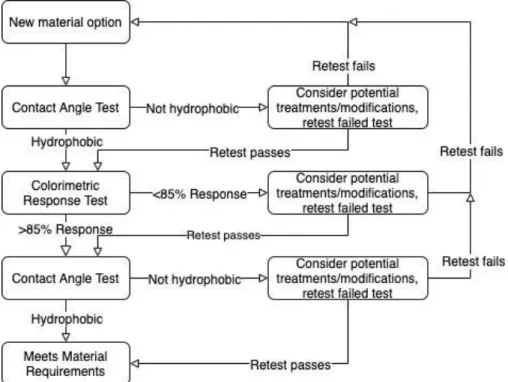
The design process will consist of testing different films and possible coatings to increase hydrophobicity. For each selected material, a contact angle goniometry test will be used to compare hydrophobicity. If it meets the specification, then a colorimetric response test will be used to compare antibody immobilization. If there is successful antibody immobilization, then another contact angle test will be executed to ensure no significant change in hydrophobicity due to the antibody markers. If at any point the selected material does not meet the specifications, then the process will start over with a new material selection.
8 Table I – Key Deliverables
Item Description
Functioning prototype A thin film that will include several
immobilized antibodies* and will not interfere with the ability of the OpenDrop platform.
Test Protocol A process to evaluate the film for proper
antibody immobilization and hydrophobicity. *we will be testing our device functionality with the Bio-Rad Immuno Explorer kit which tests for immunoglobulins. We expect other antibodies to have a similar response.
The next steps in the project are to execute baseline testing and testing the first material: Parafilm with a thin coating of mineral oil. The steps on the critical path of a PERT chart include baseline contact angle study and research of Parafilm chemical modifications and/or other film materials. Included in the research is also cost comparison in order to justify a low-cost solution. Conclusion
We seek to create a hydrophobic film to be placed on top of the OpenDrop array, that can also immobilize antibodies for an ELISA test. An ELISA process or capabilities of an ELISA will not be tested; the purpose is to design a surface for an OpenDrop cartridge that adheres antibodies and doesn’t impede OpenDrop function. Progress of the project and subsequently, the results, will be communicated with the sponsor throughout the project. Currently we will be testing the
Network Diagram
The PERT chart for the project was created in Microsoft Projects. A list view of all the tasks are shown below with the critical path items highlighted in yellow. The tasks and their associated numbers are also shown below for reference.
10
Indications for Use
The OpenDrop ELISA system is indicated for the ability to run an ELISA test on the OpenDrop digital microfluidics platform to be used by educators in a laboratory setting or clinicians in a low-resource setting.
Budget
The current projected budget is tabulated below. The actual cost column is nulled because no materials have been purchased to date. Additional materials will be needed, such as Parafilm and mineral oil, but they are readily available from our sponsor.
Table II – Preliminary Budget
Item Description Purpose Estimated Cost ($)
Bio-Rad Assay Kit Assay kit for testing 138
Protein A/G Binding* Immobilization treatment 135
TOTAL 273
Additional costs that should be factored into the finished product, but will not be purchased for testing because it is readily available include:
• Parafilm (2” x 250’ roll) — $24 on Amazon
• Mineral Oil (12 oz.) — $8 on Amazon
It should be taken into consideration that very little of Parafilm and mineral oil will be needed for 1 cartridge.
12
Customer Requirements
The customer requirements to be met are a hydrophobic surface compatible
with the OpenDrop electrodes and effective immobilization of antibodies. Additional goals of the project are to maximize the shelf life of the antibody immobilization and reduce the overall cost. The current product specifications we look to achieve are outlined below:
Table III – Product Specifications
Requirement Measurement Specification
Hydrophobic surface Contact Angle 90°–120°
Immobilization Colorimetric response > 85%
Antibody shelf-life Weeks ≥ 2 Weeks
Cost USD ($) ≤ $10
Specification Development
Baseline testing will be conducted in order to have a reference point for hydrophobicity and antibody immobilization. For hydrophobicity, we will measure the contact angle of a
current OpenDrop cartridge. Also, considering that the more hydrophobic the surface the better, we will be using the contact angle of polytetrafluorethylene as the “gold standard” for comparison. For antibody immobilization, we will compare the effectiveness of our design to the immobilization on polystyrene—a common ELISA surface.
The Parafilm pilot study has the potential to cause the specifications to change. Parafilm is the first surface we have been directed to investigate in addition to Parafilm chemical modifications. If, for any reason, we have to investigate something other than Parafilm, the cost per cartridge goal could potentially change in order to meet the other specifications. A process flow diagram for the design process has been created and is shown in Figure 2.
14
Total Available Market and Competitive Advantage
The total ELISA market is predicted to reach $2.3 Billion by 2025, assuming our product fully replaces all competitors, the total potential market is 2.3 billion USD [7].
The target market for this product is educators in a laboratory or physicians in a low-resource setting. The total available market includes companies or individuals in the biomedical industry, particularly in diagnostics or academia.
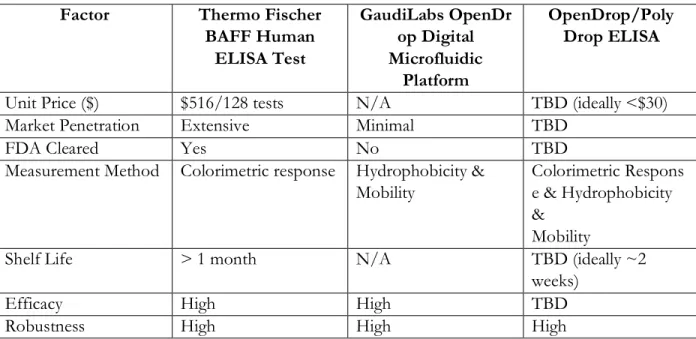
A competitive advantage matrix is below comparing the project (OpenDrop/Poly Drop) to a Thermo Fischer BAFF Human ELISA test and the GaudiLabs OpenDrop platform. This was done because there is no predicate device for this project and therefore, we are comparing the functions of the OpenDrop ELISA to the functions on the separate devices we are trying to combine.
Table IV – Competitive Advantage Matrix
Factor Thermo Fischer
BAFF Human ELISA Test GaudiLabs OpenDr op Digital Microfluidic Platform OpenDrop/Poly Drop ELISA
Unit Price ($) $516/128 tests N/A TBD (ideally <$30)
Market Penetration Extensive Minimal TBD
FDA Cleared Yes No TBD
Measurement Method Colorimetric response Hydrophobicity & Mobility
Colorimetric Respons e & Hydrophobicity &
Mobility
Shelf Life > 1 month N/A TBD (ideally ~2
weeks)
Efficacy High High TBD
Robustness High High High
Intellectual Property
Several patents (or applications for patents) potentially conflict with the proposed device. They are tabulated below alongside a necessary mitigation in our project to avoid patent
infringement (with exception for 2 patents, see note below table).
Table V – Intellectual Property Assessment Patent Number —
Assignee
Patent Description Patent Status Mitigation
9492824 —Sharp Kabushiki Kaisha
Efficient dilution method, including washing method for immunoassay
Patent granted Proceed with caution and knowledge of risk
10006909 —Vibrant Holdings, LLC
Methods, systems, and arrays for
biomolecular analysis
Patent granted Proceed with caution and knowledge of risk 8541176 —Advanced
Liquid Logic Inc.
Droplet-based surface modification and washing
Patent granted Will not have design dispense liquid with actuator
20200025757 —N/A
Surface-immobilized bistable p oly-nucleotide devices for the sensing and quantification of molecular events
Patent application Will not
use bistable molecular sensor for assay analysis under the conditions outlined in patent
20200025760 —N/A Immunoassay for Detecting Zika Virus Infection
Patent application Will not use platform to specifically
diagnose Zika virus 20200025729 —N/A Small molecule
profiling for disease diagnosis and health assessment
Patent application Will not use a mass spectrometer for assay analysis under the conditions outlined in the patent
16
Conjoint Analysis
A conjoint analysis was used to analyze costumer attraction towards different device factors. The considered factors and levels used are shown below:
Table VI – Conjoint Analysis Factors
Factor Level 1 Level 2
Hydrophobicity 90-105° contact angle >105° contact angle Efficacy of antibody
immobilization
50-75% >75%
Cost of Cartridge $30 $10
Using these factors and levels, potential design options were used using Taguchi Orthogonal Arrays. 9 customers ranked each of the potential options and a regression model was used to
determine if any of the factors had a significant effect on customer attraction. The results of the analysis are below:
Figure 3. Results of conjoint analysis.
Because the P-value for immobilization less than .05, we can state that immobilization has a significant effect on customer attraction.
18
Morphology
Table VII – Morphology Product:
OpenDrop ELISA
Function Concept 1 Concept 2 Concept 3 Concept 4
Antibody Immobilization
No treatment Oxygen-plasma pre-treatment on Parafilm
Covalent antibody immobilization
Protein A or G binding
Hydrophobic Layer
Parafilm Parafilm Silicon Plates Parafilm
Storage Methods ~25°C -45-20ºC
~25°C,
sealed/airtight
~25ºC ~25°C
Team members: Maddie Jackson, Jacob Taylor, Michaela Mead Approved by: TBD
Checked by: Dr. Whitt
Figure 4. Concept Sketch #1: Untreated Parafilm with immobilized antibodies
Concept #1: Untreated Parafilm with Immobilized Antibodies
This is our original concept from the first planning meeting with our sponsor. This is the morphology we will be going into our pilot studies with; it’s the most cost-effective and has the lowest risk, as it requires the fewest steps. It was developed directly from the need for a low-cost hydrophobic coating for the OpenDrop platform with possible antibody immobilization capabilities. The immobilization would be carried out in the most basic way: static immobilization.
Figure 5. Concept Sketch #2: Oxygen-plasma pre-treatment of Parafilm for better antibody immobilization
Concept #2: Oxygen-Plasma Pre-Treatment Parafilm for Better Antibody Immobilization
Oxygen-plasma pre-treatment has the function of removing organic contamination from the surface of a material. Parafilm may be more susceptible to antibody immobilization if its surface is cleared of ions, free electrons and molecular fragments. Therefore, this concept was developed for the case in which we cannot readily immobilize the antibodies atop Parafilm without a pre-treatment step.
Figure 7. Concept Sketch #3: Silicon plates with immobilized antibodies
Concept # 5: Silicon Plates with Immobilized Antibodies
20 immobilization but is often expensive and time consuming. We developed this idea for the case in which Parafilm is simply not hydrophobic enough.
Figure 7. Concept Sketch #4: Protein A/G binding to Parafilm for antibody immobilization
Concept #4: Protein A/G Binding to Parafilm for Antibody Immobilization
Proteins A and G are referred to as binding proteins due to their high affinity specific antibody regions. Normally antibodies are composed in three parts, a fragment-crystallizable region (Fc region) and two antigen-binding fragments (Fab regions). A and G proteins have a strong binding affinity to the Fc region of the antibody. By coating surface of the Parafilm cartridge with A/G proteins we can immobilize the antibodies, allowing a sandwich approach to ELISA testing. Sandwich ELISAs use a surface antibody to immobilize the patient’s antigens which will bind to a second antibody that starts the enzyme reaction. The antigen is sandwiched between the two
antibodies, thus giving this technique its name. These proteins are a cheap and common method of antibody immobilization that will be explored for possible immobilization methods on the
Concept Evaluation
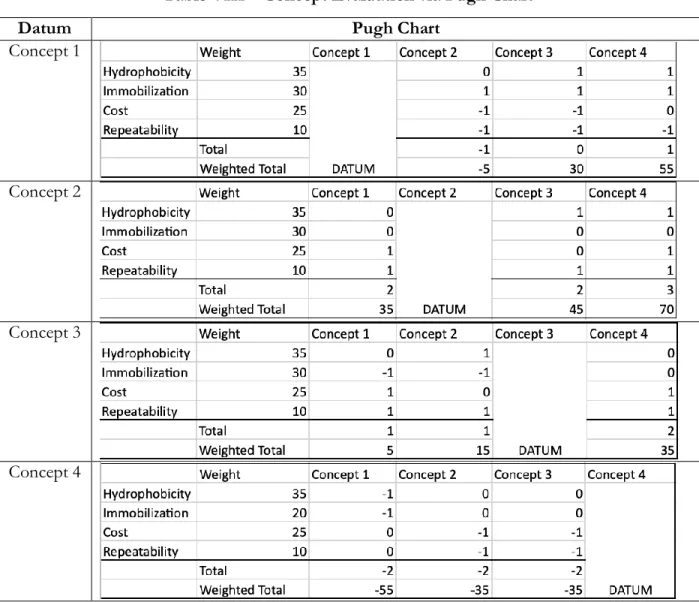
Table VIII – Concept Evaluation via Pugh Chart
Datum Pugh Chart
Concept 1
Concept 2
Concept 3
Concept 4
Our Pugh chart highlighted concept 4, the mineral oil coated Parafilm with A or G binding, as the most effective concept. We came to this conclusion because concept 4 had the highest weighted total in all charts; in the chart with concept 4 as the datum, all other concepts had a negative weighted total. We feel confident that this concept will readily address all our
22
Conceptual Model
Concept: Mineral Oil-Adhered Parafilm with A or G Protein Binding Surface Treatment Since our deliverables are in the form of protocols for the immobilization of antibodies atop a hydrophobic surface, we opted to create a process flow diagram as our conceptual model. Below is the process by which the antibodies will be immobilized atop Parafilm, based on the results of our Pugh chart analysis.
Figure 8. Process flow diagram as a conceptual model
Design options for wettability, hydrophobicity, and antibody immobilization were researched in published literature and analyzed for cost, repeatability, and efficacy. Simpler designs (sans
treatment) were recommended as a starting point for the design from our sponsor. A Pugh matrix was used to determine that Parafilm with a lower cost antibody treatment would match our
customer needs the best. We will begin with Parafilm without any treatment as a baseline and move to adding a treatment if it is necessary to meet our antibody immobilization specifications.
24
Detailed Design
Figure 9. Detailed design in comparison to Gaudi Labs schematic
The detailed design is shown above. This is what we are calling the “cartridge”, featuring a cartridge shell with an adhered hydrophobic layer. Antibodies for the ELISA test will be
immobilized atop the hydrophobic material via a method that will be determined through our immobilization pilot study. Testing will be done on the hydrophobic layer by adhering it to a glass cover slide.
Prototype Manufacturing Plans
The manufacturing of the cartridge plate is outsourced by our sponsor. The copper-alloy plate is shipped to us as shown in the photo below:
Figure 10. Cartridge
26
Future Test Protocols
Contact Angle with Assay Kit Materials Purpose
Validate hydrophobicity of surface with Bio-Rad assay kit solutions used for rinsing (phosphate buffered saline, PBS) and permeabilization (Triton-X).
Procedure
1. Tear off a 2”x2” piece of Parafilm
2. Evenly stretch Parafilm to approximately a 5”x3” rectangle. There should be no tears or unevenly stretched areas.
3. Place stretched Parafilm over glass side. Be sure it is smoothly applied onto the slide with no air bubbles. Tear off the excess.
4. Clean Parafilm with IPA. 5. Load syringe with solution.
6. Dispense 3µl of solution to clean out the syringe. 7. Perform contact angle measurement with 8µl droplet.
8. Record left and right contact angle in the datasheet provided.
Repeat steps 6-7 five more times (total of 6 samples). The same slide with the same piece of Parafilm on top can be used, the droplets just need to be placed in different locations.
Antibody Immobilization Purpose
Examine if untreated Parafilm can be used to adhere antibodies for an ELISA comparable to at least 85% of the response done on polystyrene.
Procedure
The following steps should be performed on both stretched Parafilm and the 12-well strip (polystyrene) provided by the Bio-Rad ELISA Immuno Explorer Kit [9]:
1. Transfer 15 uL of the purified antigen (AG) into 6 wells of the 12-well strip and six pieces of stretched Parafilm.
2. Wait five minutes for the antigen to bind to the plastic wells. 3. Wash:
a. Remove the AG solution from the surfaces.
b. Deposit 15 uL of PBS atop the AG immobilization sites on both surfaces. c. Remove the PBS from the surfaces.
4. Repeat step 3.
5. Transfer 15 uL of the positive control solution atop the AG immobilization sites on both surfaces.
7. Repeat step 3 two times.
8. Transfer 15 uL of the secondary antibody (SA) to the sites on both surfaces. 9. Wait 5 minutes for the antibodies to bind to their targets.
10.Repeat step 3 three times.
11.Transfer 15 uL of the enzyme substrate on to the sites on both surfaces. 12.Wait five minutes for the colorimetric response to occur.
13.Qualitative data collection:
a. Under the same lighting and using the same aperture/shutter speed on the same camera, take pictures of each response.
b. Qualitatively compare the responses on Parafilm to those on polystyrene. 14.Quantitative data collection [10]:
a. Set up the spectrophotometer:
i.Turn on the spectrophotometer and allow to warm up for 5-10 minutes. ii.Set the wavelength, based on the color of the colorimetric response (see
Table IX).
Table IX – Spectrophotometer Wavelengths depending on Colorimetric Responses
Color Wavelength (nm)
Violet 300-376
Blue 375-520
Yellow 520-740
Red 740-900
iii. Select the mode that displays Percent Transmittance and Absorbance. iv. With an empty sample chamber, set Percent Transmittance to 0. v. Insert a solvent cuvette into the chamber and set the Percent Transmittance
to 100.
b. Place a cuvette with your sample (either from polystyrene or from Parafilm) in the chamber.
c. View the meter to determine the reading and record it, being sure to keep results from polystyrene different from those from Parafilm.
28
Completed Testing Data and Analyses
Contact Angle Pilot Study
Table X – Contact Angle Pilot Study Data Sample Left Contact Angle (º) Right Contact Angle
(º) Overall Contact Angle (º)
1 106.2 107 106.6
2 99.8 98.6 99.2
3 101.9 101.9 101.9
4 103.7 103.4 103.55
5 100.3 99.6 99.95
6 108.4 107.8 108.1
The average contact angle of water with stretched Parafilm is 103.21 ± 1.33º.
Parafilm Stretch Study No tabulated data to display.
Contact Angle with Parafilm Side Comparison
Table XI – Contact Angle/Side Comparison Data
Paper Side L (º) R (º) Overall (º)
Down 100.5 100.5 100.5
Down 100 101.6 100.8
Down 102.3 101.4 101.85
Down 98.6 99.7 99.15
Down 102.4 101.8 102.1
Up 99.6 100.5 100.05
Up 103 103.4 103.2
Up 105.3 104.6 104.95
Up 97.9 97.4 97.65
Table XII – t-Test: Paired Two Sample for Means
Down Up
Mean 100.88 101.04
Variance 1.512888889 9.380444444
Observations 10 10
Pearson Correlation 0.515801274 Hypothesized Mean
Difference 0
df 9
t Stat -0.191139515
30
Conclusions
Contact Angle Pilot Study
With an average contact angle with water of 103.2º, Parafilm meets the requirements for hydrophobicity (contact angle > 90º).
Parafilm Stretch Study
To achieve the optimal thickness, a 2”x2” square of Parafilm should be stretched to a 5”x3” rectangle.
Contact Angle with Parafilm Side Comparison
Discussion
Contact Angle Pilot Study and Parafilm Side Comparison
Hydrophobicity is one of the key performance metrics of the surface. These initial tests have given us enough confidence in Parafilm as a viable, low-cost surface to move forward with further testing of other performance metrics. The two tests performed were with DI water and the next step is to do a contact angle test with the assay kit materials (as stated above). A limitation of the observed results is that the sample size was low (n<10 for each test) due to time constraints. However, the average contact angles observed were both >10º over the performance metric which provides sufficient confidence to continue with this design.
Parafilm Stretch Study
The surface for this device must be thin in order to effectively move droplets on the OpenDrop platform. This study was performed by simply stretching pieces of Parafilm and examining how to consistently achieve the desired surface thickness. It was observed that if the Parafilm was stretched too slowly, striations would appear in the surface yielding to an uneven surface. Obviously,
32
References
[1] Vashist, Sandeep, and John Luong. “Immobilized Antibody.” Immobilized Antibody - an Overview | ScienceDirect Topics, 2018, www.sciencedirect.com/topics/neuroscience/immobilized-antibody. [2] M, Alistar, and Gaudenz U. “OpenDrop: An Integrated Do-It-Yourself Platform for Personal
Use of Biochips.” Bioengineering, vol. 4, no. 4, 2017, p. 45., doi:10.3390/bioengineering4020045.
[3] Crowther, John R. “Indirect ELISA.” Elisa, 2017, pp. 131–160., doi:10.1385/0-89603-279-5:131. [4] Bio-Rad. “Types of ELISA: Bio-Rad.” Bio, 2016,
www.bio-rad-antibodies.com/elisa-types-direct-indirect-sandwich-competition-elisa-formats.html.
[5] Vuckovac, Maja, et al. “Uncertainties in Contact Angle Goniometry.” Soft Matter, The Royal Society of Chemistry, 19 Aug. 2019,
pubs.rsc.org/en/content/articlelanding/2019/sm/c9sm01221d#!
[6] “Critical Surface Tension and Contact Angle with Water for Various Polymers.” Critical Surface Tension and Contact Angle with Water for Various Polymers (Sort by Contact Angle),
2019, www.accudynetest.com/polytable_03.html?sortby=contact_angle.
[7] Insights, Coherent Market. “Enzyme Linked Immunosorbent Assay (ELISA) Market 2017 Predicted To Reach $ 2.3 Billion By Industry Size Till 2025: At A CAGR of 5.1%: Size, Trends, Revenue Analysis By Products, Techniques, Therapeutic Area, Application And End-Users |.” Medgadget, 19 Nov. 2019,
www.medgadget.com/2019/11/enzyme-linked- immunosorbent-assay-elisa-market-2017-predicted-to-reach-2-3-billion-by-industry-size-till-2025-at-a-cagr-of-5-1-size-trends-revenue-analysis-by-products-techniques-therapeut.html. [8] SK. “Effect of Drop Volume on Static Contact Angles.” Kruss Scientific, 2004,
www.kruss-scientific.com/fileadmin/user_upload/website/literature/kruss-tn310-en.pdf.
[9] Bio Rad. Laboratory Quick Guide, ELISA Antibody Test (Bulletin 3136, Rev B). Retrieved from https://www.bio-rad.com/en-us/product/elisa-immuno-explorer-kit?ID=1e3f3100-99f6-49b3-b9a0-2c8aad9d9285
[10] Purdue University. Instructions for the use of the visible spectrophotometer; Spec 20/20D, Spec Educator and Flinn Spec. Retrieved from