Re-evaluating Genetic Models for Porphyry Mo
Mineralization at Questa, New Mexico: Implications for
Ore Deposition Following Silicic Ignimbrite Eruption
Joshua M. Rosera
A thesis submitted to the faculty of the University of North Carolina at Chapel Hill in partial fulfillment of the requirements for the degree of Master of Science in the Department of
Geological Sciences.
Chapel Hill 2012
Approved by:
Dr. Drew Coleman
Abstract
JOSHUA M. ROSERA: Re-evaluating Genetic Models for Porphyry Mo Mineralization at Questa, New Mexico: Implications for Ore Deposition
Following Silicic Ignimbrite Eruption (Under the direction of Drew Coleman)
The Questa Mo deposit in New Mexico provides an opportunity to study the relationship between pluton assembly and mineralization. Magmatism along the Questa caldera margin initiated at 25.20 Ma and continued for ~ 770 ka. Emplacement of
Acknowledgements
Table of Contents
List of Tables... vi
List of Figures... vii
1. Introduction... 1
2. Geological Setting... 4
3. Methods... 9
3.1. U-Pb zircon geochronology ... 9
3.2. Re-Os molybdenite geochronology ... 10
4. Results ... 12
4.1. U-Pb zircon geochronology ... 12
4.2. Re-Os molybdenite geochronology ... 16
5. Discussion ... 20
5.1. Intrusive history of the caldera margin plutons ... 20
5.2. History of mineralization ... 22
5.3. Re-Os molybdenite: a new thermochronometer ... 24
5.4. Integrated T-t history of the Questa porphyry system... 26
5.5. Evaluation of previous genetic models for the Questa Mo deposit ... 28
5.6. Relationship between caldera formation and mineralization... 29
6. Conclusions... 35
List of Tables
List of Figures
Figure 1: Geologic Maps of Latir volcanic field and southern caldera margin ...5
Figure 2: Cross-section of Southwest zone of the Questa deposit...7
Figure 3:Th-corrected 206Pb/238U results for individual fractions...15
Figure 4: Re-Os molybdenite results ...18
Figure 5: Summary of geochronology for the Latir volcanic field...21
Figure 6: Temperature-time history of the Questa deposit ...27
Figure 7: Schematic models for genesis of the Questa deposit ...30
1. Introduction
In 2010, the United States produced over $800 million of molybdenum oxide [USGS MCS, 2011], and the demand for Mo as an alloying agent in high-grade steel will likely increase as global economies recover. The majority of the world’s Mo reserves are contained within porphyry Cu (± Mo) and porphyry Mo (± Cu) deposits. Although porphyry Mo deposits are often volumetrically smaller than porphyry Cu systems, they are still a significant source of Mo owing to higher ore grades.
Understanding the timing of mineralization within a magmatic region is important for making accurate regional ore predictions. High-silica granite-related porphyry Mo deposits (Climax-type deposits) are often interpreted to form as magmatic cupolas above larger, more dynamic, magma chambers [Wallace et al., 1968; White et al., 1981; Carten et al., 1988a;b; 1993; Lowenstern, 1994; Burnham, 1997; Klemm et al., 2008]. The depth and size of the magma body, as well as trends in chemical variation, remain a significant topic of debate [Keith et al., 1986; Carten et al., 1993; Audétat, 2010]. Outstanding questions in this debate include: 1) How large is the magma chamber from which mineralizing cupolas originate? 2) At what depth in the crust do these magma bodies exist? 3) What is the mechanism for concentrating Mo in these systems?
Round Mountain, Nevada [Henry et al., 1997] and the Borovista caldera in Bulgaria [Singer and Marchev, 2000].
Climax-type deposits are thought to form during multiple magmatic-hydrothermal events that occur close in space and time [e.g., Wallace et al., 1968; White et al., 1981; Carten et al., 1988a]. Some models for Mo mineralization rely on over-simplified
assumptions about the thermal history of plutons associated with the deposits. For example, Burnham [1997] modeled the formation of porphyry ore deposits above plutons intruded as large bodies of mostly liquid magma with relatively simple cooling histories. More recently, Seedorff and Einaudi [2004a] analyzed overprinted alteration assemblages along cross-cutting veins to derive a pseudocyclical thermal evolutionary model for the Henderson porphyry Mo deposit in Colorado. These authors note that unidirectional models (simple high- to low-temperature through time, [e.g., Lowell and Gilbert, 1970; Fournier, 1999]) are of limited use for understanding the complexities observed within these deposits.
The suggestion that thermal cycling is important to development of Climax-type Mo deposits is consistent with recent studies that indicate plutons are assembled episodically and have more complex thermal histories than that of a single intrusion [e.g., Coleman et al., 2004; Seedorff and Einaudi, 2004a; Davis et al., 2012]. However, studying the relationship between porphyry-style mineralization and sub-adjacent magma reservoirs is largely inhibited by the lack of exposure of cogenetic rocks. The Questa porphyry Mo system presents an opportunity to study this relationship because numerous intrusions of varying volume and emplacement depths are currently exposed throughout the Latir volcanic field. Additionally, because the system is relatively young, abundant pre-, syn- and (some) post-caldera volcanic rocks [Lipman et al., 1986] are preserved.
2. Geological Setting
The Questa porphyry Mo deposit is located in the New Mexico portion of the Southern Rocky mountain volcanic field. It is part of the composite Latir volcanic field which covers an area of ~ 1200 km2 [Fig. 1; Lipman et al., 1986]. Uplift and erosion along
the eastern flank of the Rio Grande rift exposed a vertical section of volcanic strata and upper crustal plutons of the Latir field. Volcanism in the field began at 28.5 Ma with the eruption of dominantly andesite with local dacite and rhyolite [Zimmerer and McIntosh, 2012] and climaxed with the eruption of the ~ 500 km3 Amalia Tuff at 25.52 ± 0.06 Ma [Tappa et al.,
2011] which resulted in the collapse of the Questa caldera.
Questa 37˚30’ 37˚45’ 105˚37’30” 105˚30’ RH LP RM BC RP SG RR CL CP VC ring dikes 0 5 km �� ��� �� ���� ��� � ��� � ���� �������� ��� ���� ���� ����� ���������� �� ��������� �� ����� ��������� �� ���� � ��������� � � ����� ����� ��������� � ��� ��� �� �� ������ ��� � ��� ����� ��� ��� ��� � ����� ���� �� ������ � ������ ���� �� ��� ����� ���� ������ � ������� ������������� ����� �� �� � ����� �� ��� ����� ������ �� ��� ���� ��� ��� ��� ��� �� �� �� ��� ��� �� �� �� ��� ��� �� �� �� ��� ��� �� �� �� ��� ��� �� �� �� ��� ��� �� �� �� ��� ��� �� �� �� ��� ��� �� �� �� ��� ��� �� �� �� ��� ��� �� �� �� ����� �� ������� � � �������� ���� �������� ���� �������� ���� �������� ���� �������� ���� �������� ���� �������� ���� �������� ���� �������� ���� �������� ���� �������� ���� �������� ���� �������� ���� �������� ���� ������� ����� �������
Approximate area of Figure 1C
La �r v ol cani c fiel d �� �� ���� ��� � ��� �� ����� ��� ������ � ��� �� ��� ����� ��� � ��� � ������� ����� � � �� ��������� Figure 1.
Overview map showing study area location. Simplified geologic map of the Latir volcanic field, after Lipman and Reed (1989). Pluton name
abbreviations: CP
, Cañada Pinabete; RM, Rito del Medio;
VC,
V
irgin Canyon; CL, Cabresto Lake; BC, Bear Canyon; SG, Sulphur Gulch; RR, Red River;
RH; Rio Hondo; RP
, Relica Peak. Detailed map of the southern caldera mar
gin showing U/Pb zircon sample locations. Ore zones approximately correspond
to 0.2 wt. % MoS
2
contours projected to the surface.
of the Sulphur Gulch pluton and texturally grades from aplite to granite porphyry.
The mineralizing intrusions at Questa dip at a low angle to the north and likely followed a pre-existing anisotropy [Ross et al., 2002]. The structural anisotropy may be related to the low-angle normal faults that are observed throughout the southern caldera margin [Meyer and Foland, 1991]. These faults are believed to have originally formed at high angles and were subsequently rotated to low angles above a batholith that underlies the southern caldera margin [Meyer and Foland, 1991].
The Questa porphyry Mo system is divided into three separate ore deposits: Spring Gulch, Central, and the Log Cabin (Fig. 1). The Central deposit is horseshoe shaped in map view and is the only one that is mined. The most recent mining activity has moved underground along the southwest limb of the horseshoe (“Southwest zone”). Ore bodies are discontinuous along the Southwest zone and subdivided into the Vein zone, D ore body, and the Goat Hill ore body (Fig. 2). The Log Cabin ore body lies near the roof zone of the Bear Canyon pluton, whereas the Spring Gulch deposit lies above the Sulphur Gulch pluton. Major ore bodies at Questa are typically found at the intrusive contact with, or entirely within, pre-caldera volcanic units.
One notable feature of the Questa ore system is that it contains two separate styles of mineralization [Ross et al., 2002]. Both, the Goat Hill and D ore bodies contain significant disseminated molybdenite within the matrix of a magmatic hydrothermal breccia. Superimposed on the hydrothermal breccia bodies are stockwork quartz + molybdenite veins. Ross et al. [2002] estimated that 30 to 40% of the molybdenite within the Goat Hill ore body is disseminated within the hydrothermal breccia matrix. Both the breccia and stockwork veins contain similar paragenetic sequences; however, the stockwork veins contain late-stage fluorite, calcite and beryl [Klemm et al., 2008; Rowe, 2012].
Figure 2. A) Simplified geologic cross section through the Southwest zone of the Central deposit (note inset, compare to Fig. 1). Some samples are projected from nearby drill holes. B) Zoomed in cross section of the Goat Hill ore body showing the semi-stratified facies of Ross et al.
[2002]. Numbers represent Re-Os molybdenite ages in Ma. See text for discussion. Figures after B. Walker [per. comm.].
9,000
8,000
6,000 ft AMSL
6,000 ft AMSL
Longitudinal section through the Southwest Zone looking north-northwest
D-ore body
Vein ore body Goat Hill
ore body
Pit profile
0.2 wt. % MoS�
Magmatic hydrothermal breccia (MHBX) Granite porphyry and late stage dikes
Quartz-orthoclase aplite Biotite-plagioclase porphyry
No vertical exaggeration
A A’
Southwest intrusive suite
Sulphur Gulch pluton
23.4 - 11.8 G 22.0 - 14.0
28.9 - 25.5 H
36.5 - 54.6 AR-98
AR- 76
AR-126
AR-126
AR-130
AR- 110 JC-1 QV11-02
JC-2
Molybdenite sample Zircon and molybdenite
sample A’
A
North
Southwes
t zone Northeas
t zone
Drill hole used in this study
Fig. 2B
� �
�� ��
� �
24.49 24.52
24.76 24.61
24.59
8,000
7,000
3. Methods
3.1. U-Pb zircon geochronology
Rock samples were collected from units most closely associated with epithermal mineralization (Red River intrusive complex) and the porphyry Mo deposit (the Sulphur Gulch pluton, Southwest intrusive suite, and Bear Canyon pluton; Fig. 1C and 2). Another sample was collected from what is tentatively defined here as the Goat Hill igneous complex (sample QM11-04). Whole-rock samples were broken down with jaw crushers and a disc mill. Samples were either processed on a water table, sieved, or both prior to standard heavy liquid and magnetic mineral separation. Only the least magnetic zircons were analyzed.
Zircons were placed into a 950 °C oven for 48 hours to anneal lattice sites that were damaged due to radiation. Following thermal annealing, the samples were chemically abraded in HF + HNO3 at 220 °C for 12 hours [Mattinson, 2005]. The abraded zircons were split into fractions, spiked with a 205Pb-233U-236U tracer and equilibrated in HF + HNO
3 for
samples were loaded with colloidal Si-gel onto 99.998% Re filaments. Mass analyses were made on the Daly detector of the VG Sector 54 thermal ionization mass spectrometer at the University of North Carolina – Chapel Hill. In-run U fractionations were calculated based on the measured value for 233U/236U in the spike, and Pb fractionation was assumed to be 0.15
%/amu. Analyses in which U was analyzed as an oxide were corrected for oxygen isotope interferences. Raw data were processed and reduced through Tripoli [Bowring et al., 2011] and U-Pb Redux [McLean et al., 2011]. Some analyses had anomalously high total common Pb (>3 pg) that we suspect is derived from inclusions that were not removed during chemical abrasion (e.g., fluorite). Therefore, we assumed a maximum of 3 pg blank Pb and assigned all remaining common Pb to initial sample Pb. The isotopic composition of the sample common Pb was estimated using whole-rock data from Johnson et al., [1990] and Stacey and Kramers [1975] where Pb isotope data were unavailable. All U-Pb ages are Th-corrected weighted mean 206Pb-238U ages. Correction for Th-disequilibrium was made using published
whole-rock data for the plutons [Johnson et al., 1989].
3.2. Re-Os molybdenite geochronology
Molybdenite samples were collected from the Southwest zone of the Central deposit at Questa. We chose to date the five samples of Rowe [2012] and two from Cline and Bodnar [1994] because they determined the mineralization temperatures using fluid inclusion
microthermometry for the Goat Hill and D ore bodies, respectively. The granite porphyry host for one of the samples from the Vein zone (QV11-02) was used for U-Pb zircon geochronology.
Molybdenite was physically separated from its host rock with a diamond-tipped drill bit and chemically equilibrated with a mixed 185Re-188Os-190Os spike using the aqua regia
digestion, Os was selectively extracted into chloroform (CHCl3) and then back extracted into HBr following the procedure of Cohen and Waters [1996]. Further Os purification was completed with micro-distillation [Birck et al., 1997] prior to being loaded onto degassed Pt filaments with Ba(OH)2 activator. Rhenium was isolated using Cl-based anion exchange column chromatography and loaded onto Pt filaments with Ba(NO3)2. In both cases, the activators permit the sample to run as oxide anions (N-TIMS). Measurements were made at AIRIE (Colorado State University) on a Thermo-Fisher Triton TIMS using simultaneous Faraday cup collectors for Re and stronger intensity Os signals whereas weaker Os signals were collected in peak jumping mode with a secondary electron multiplier. Both Re and Os analyses were corrected for oxygen isotope compositions, and Os was further corrected for: 1) isobaric interferences (W, Re, and Pt); 2) common Os; 3) and mass fractionation based on the measured 190Os/188Os in the spike [Markey et al., 2003]. During data reduction, Re and Os
abundances were also corrected for total analytical blank from reagents and Pt wire although values were negligible compared to molybdenite Re and Os concentrations. Ages are reported in Table 2 with both 2σ analytical errors and the combined analytical + 187Re decay constant
4. Results
4.1. U-Pb zircon geochronology
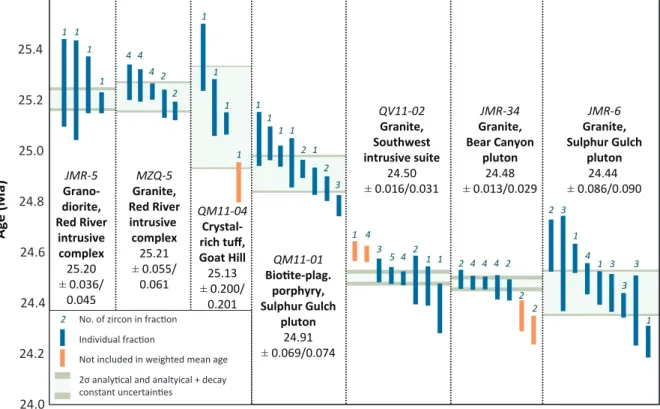
After Th-correction, all zircon U-Pb ages are concordant within analytical and decay constant uncertainties (Table 1; Fig. 3). Some samples show evidence for minor inheritance (e.g., QV11-02) or Pb-loss (e.g., JMR-34) which are identified where there are at least two outliers. A conservative age estimate was made for two samples from the Sulphur Gulch pluton (QM11-01 and JMR-6) and one from the Red River intrusive complex (MZQ-5) because they revealed a continuum of ages that could be related to inheritance, Pb loss and/or protracted zircon growth.
A granite porphyry (MZQ-5) and equigranular granodiorite (JMR-5) were collected from the southern and central portion of the composite Red River intrusive complex,
respectively. Five zircon fractions from the granite porphyry yield a weighted mean 206Pb/238U
age of 25.21 ± 0.055 Ma (N = 5; MSWD = 5.5). Four of the five fractions overlap within uncertainty. All four fractions analyzed from the granodiorite phase of the Red River pluton agree within uncertainty and define a weighted mean age that is identical to the granite porphyry (25.20 ± 0.036; MSWD = 0.79).
One crystal-rich tuff was collected from the south side of Goat Hill (QM11-04), just below the summit. A preliminary age of 25.13 ± 0.20 Ma was obtained for this sample on the basis of three single-grain zircon analyses.
24.0 24.2 24.4 24.6 24.8 25.0 25.2 25.4
Ag
e
(M
a)
QM11-01
Bio�te-plag. porphyry, Sulphur Gulch
pluton
24.91 ±0.069/0.074 QM11-04
Crystal-rich tuff, Goat Hill
25.13 ±0.200/
0.201
QV11-02
Granite, Southwest intrusive suite
24.50 ±0.016/0.031
JMR-34
Granite, Bear Canyon
pluton
24.48 ±0.013/0.029
JMR-6
Granite, Sulphur Gulch
pluton
24.44 ±0.086/0.090 MZQ-5
Granite, Red River intrusive complex
25.21 ±0.055/
0.061 JMR-5
Grano-diorite, Red River
intrusive complex
25.20 ±0.036/
0.045
1 1 1
1 4 4
4 2 2
1
1
1
1 1
1 1 1
1
1
1 2 4 5 3 4
1 2 4 4 4 2
2 2
2 3
1 4
1 3 3
3
1 2
3 2
2
Individual frac�on
Not included in weighted mean age No. of zircon in frac�on
2σ analy�cal and analtyical + decay constant uncertain�es
granite porphyry (JMR-6) collected near the milling site for the mine. The interpreted age for this sample is 24.44 ± 0.086 Ma (N=9; MSWD = 11).
A granite porphyry with moderate potassic and silicic alteration from the Southwest intrusive suite had five overlapping analyses with a weighted mean age of 24.50 ± 0.016 (MSWD = 2.0). Two fractions not included in the weighted mean age define a slightly older population at 24.60 Ma and are interpreted as antecrysts [Miller et al., 2007].
Sample JMR-34 from the Bear Canyon pluton was the freshest sample collected near the molybdenum mine. Zircon separates from this sample were generally larger and more euhedral than those from more altered samples (e.g. Sulphur Gulch). Two fractions from this sample are significantly younger than the other analyses and probably represent Pb loss. The older population (24.48 ± 0.013 Ma; MSWD = 0.87) is interpreted as the crystallization age. Including the two younger fractions yields a weighted mean age of 24.46 ± 0.050 Ma (MSWD = 11).
4.2. Re-Os molybdenite geochronology
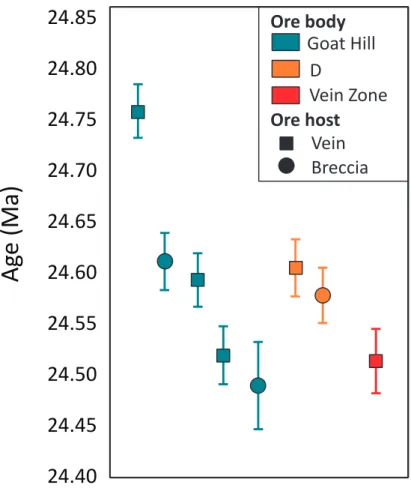
Five vein-hosted and three breccia matrix molybdenite samples were analyzed from three separate ore bodies (Goat Hill, D, and Vein; Table 2, Fig. 4). All samples have moderate Re concentrations less than 70 ppm and there is no correlation of Re concentration with mineralization style or ore body. Errors in this section are analytical only, and quoted at two-sigma.
The oldest molybdenite age obtained in this study is 24.76 ± 0.026 Ma and comes from a thin quartz + molybdenite vein hosted in the aplite beneath the Goat Hill ore body. Two breccia matrix-hosted molybdenite samples yield analytically distinct ages of 24.61 ± 0.028 and 24.49 ± 0.043 Ma. Similarly, two vein-style molybdenite veins from within the same Goat Hill ore body yield ages of 24.59 ± 0.026 and 24.52 ± 0.028 Ma.
T a b le 2 . R e-O s da ta f or m ol ybeni te of the Quest a por phy ry Mo de posi t AIRIE Sam pl e Dr ill Hol e Des cr ipti on a O re b od y R e 18 7 O s Com m on O s w ei gh t Age ± 2σ ab s ± 2σ ab s Run # Nam e (pp m ) b (pp b) b (pp b) c (g) d (Ma ) e (an al yti cal ) f (an al yti cal + λ ) f MD -1 25 4 A R -9 8 22 .0 - 14 .0 Vein in so ur ce ap lite f ac ies Go at Hill 22.2 5.8 0.012 0.0260 2 4 .7 6 0.026 0.083 MD -1 25 5 A R -1 10 23 .4 - 11 .8 G Vein in MH B X fac ies A 3 Go at Hill 45.2 11.7 0.041 0.0212 2 4 .5 9 0.026 0.083 MD -1 29 9 A R -1 30 22 .0 - 14 .0 MH B X, C fac ies Go at Hill 30.6 7.9 0.000 0.0223 2 4 .6 1 0.028 0.084 MD -1 26 5 A R -7 6 22 .0 - 14 .0 Vein in MH B X fac ies D Go at Hill 39.0 10.0 0.000 0.0214 2 4 .5 2 0.028 0.083 MD -1 29 6 A R -1 26 22 .0 - 14 .0 MH B X, D fac ies Go at Hill 1.9 0.5 0.000 0.0258 2 4 .4 9 0.043 0.090 MD -1 29 5 JC -1 28 .9 - 25 .5 HA Vein D 6.6 1.7 0.000 0.0331 2 4 .6 1 0.028 0.084 MD -1 29 8 JC -2 28 .9 - 25 .5 HA MH B X D 39.0 10.0 0.016 0.0276 2 4 .5 8 0.027 0.083 MD -1 30 8 QV1 1-02 36 .5 - 54 .5 VN2 0 Vein Vein zo ne 26.4 6.8 0.000 0.0323 2 4 .5 1 0.032 0.085 a MH B X = Ma gm atic-hy dr oth er m al br ec cia; Facies c or resp on de to th os e of R os s et al. (2 00 2) b A ll d ata ar e blan k co rr ec ted , an d Os is oto pic m ea su rem en ts ar e fr ac tio natio n co rr ec ted (u sin g th e do ub le Os s pik e) c C om m on Os is in sig nif ican t to th e ag e ca lcu latio n, an d ess en tially ze ro fo r all an aly ze d m oly bd en ites d P er ce nt m oly bd en ite in sep ar ate var ies f ro m 2 0% to 1 00 %, dep en din g on o cc ur ren ce an d av ailab ilit y of m oly bd en ite; qtz-feld sp ar -b io tite d ilu tan t d oes n ot a ffec t Re-Os ag e ca lcu latio n e Fo r A R -9 8, A R -1 10 , A R -7 6, R e blan k = 24 .2 2 ± 0. 15 p g, to tal Os = 2. 00 ± 0 .0 2 pg w ith 18 7 Os/ 18
8 Os =
0. 23 1 ± 0. 00 1 A ll o th er s, R e blan k = 7. 85 ± 1 .4 8 pg , to tal Os = 1. 86 ± 0 .0 3 pg w ith 18 7 Os/ 18
8 Os =
0. 32 2 ± 0. 01 0 f Un ce rtain ty o n ag es sh ow n fo r b oth an aly tical er ro r, an d co m bin ed an aly tical an d dec ay co ns tan t u nce rtain ty fo r 18
7 Re
24.40
24.45
24.50
24.55
24.60
24.65
24.70
24.75
24.80
24.85
Ag
e
(M
a)
Goat Hill D
Ore body
Vein Zone
Vein Breccia
Ore host
for vein and breccia matrix-hosted mineralization styles, respectively. One thin molybdenite vein that cuts granite porphyry within the Vein ore body was selected for both Re-Os
molybdenite and U-Pb zircon geochronology. This sample yields a Re-Os age of 24.51 ± 0.032/0.085 Ma (uncertainties corresponding to analytical, and analytical with 187Re decay
5. Discussion
Combining U-Pb zircon geochronology of intrusive rocks with Re-Os molybdenite ages from the Questa Mo deposit allows us to characterize the timing and duration of magma emplacement with respect to mineralization. Additionally, most of the samples used for Re-Os geochronology were analyzed for mineralization temperatures in earlier studies [Cline and Bodnar, 1994; Rowe, 2012], thus permitting combination of the new ages with temperature data to evaluate Re-Os as a thermochonometer. All the data can be considered within the framework of the evolution of the host Latir volcanic field to develop a model for porphyry Mo mineralization.
5.1. Intrusive history of the caldera margin plutons
The Red River intrusive complex is the oldest and easternmost of the caldera margin plutons. Equigranular granodiorite exposed in the central portion of the pluton was previously interpreted as the remnant magma chamber of a pre-caldera andesitic volcano [Lipman, 1988; Lipman and Reed, 1989]. However, the geochronologic data presented here indicate that the granodiorite crystallized approximately 300 ka after the eruption of the Amalia Tuff, nearly concurrently with high-silica granitic magma at ~ 25.20 Ma (Fig. 5). However, field relations demonstrate that the Red River granite is part of a dike swarm that crosscuts the granodiorite [Lipman and Reed, 1989]. Therefore, although the units are the same age within uncertainty, the granite is demonstrably younger.
25.5 25.0
26.0 24.5 24.0 23.5 23.0 22.5
Granodiorite, Red River intrusive complex
Crystal rich tuff, Goat Hill vent complex
Granite porphyry, Red River intrusive complex
Bio�te-plagioclase porphyry, Sulphur Gulch pluton
High silica granites
N. plutons
S. margin plutons S. plutons
(to 19 Ma)
Amalia T
uff
eru
p�on
Mo mineraliza�on
Re-Os molybdenite age popula�ons Southwest intrusive suite
Bear Canyon pluton
Sulphur Gulch pluton
Age (Ma)
assembled rapidly by intrusion of compositionally diverse magma pulses.
Following intrusion of the Red River intrusive complex, magmatism moved
westward. New U-Pb zircon ages presented here suggest that the Sulphur Gulch pluton was assembled between 24.91 and 24.44 Ma with the biotite-plagioclase porphyry predating the granitic phase of the pluton. The granitic phases of the Sulphur Gulch pluton, Southwest intrusive suite and Bear Canyon pluton all intruded within uncertainty of each other at ~ 24.50 Ma. These high-silica granites were the primary contributors of metal-rich brines that resulted in breccia matrix-hosted and stockwork-style mineralization [Cline and Bodnar, 1994; Ross et al., 2002; Klemm et al., 2008; Rowe, 2012].
Field mapping and gravity anomaly data indicate that the southern caldera margin plutons are upper portions of a partial ring intrusion along the caldera margin [Cordell et al., 1985; Lipman et al., 1986; Meyer, 1991]. The U-Pb zircon geochronologic data presented here indicate that assembly occurred over ~ 770 ka. This period corresponds to only a small interval of the ~ 6 Ma post-caldera pluton assembly history for the entire region [Tappa et al., 2011; Zimmerer and McIntosh, 2012], but brackets the time in which major magmatic hydrothermal systems were active [McLemore and North, 1984; Lipman et al., 1986; Lipman, 1988; Meyer and Foland, 1991; Ross et al., 2002]. These data are consistent with Zimmerman et al. [2008], who observed that major porphyry-style mineralization episodes are short-lived relative to their host magmatic districts.
5.2. History of mineralization
Major molybdenite mineralization at Questa was coeval with the emplacement of the Southwest intrusive suite, and the Sulphur Gulch and Bear Canyon plutons. The earliest mineralizing intrusion identified in this study is the biotite-plagioclase porphyry of the Sulphur Gulch pluton (24.91 ± 0.069 Ma) which is exposed in the open pit, just east of the Central ore body. The open pit mine, which is no longer active, targeted lode-style molybdenum mineralization [Ross et al., 2002] which probably received its metals from this intrusion. Generally, local ore grades are highest sub-parallel to the contact between the biotite-plagioclase porphyry and the pre-caldera andesite. [B. Walker, per. comm.]. These field relationships suggest that this intrusion contributed ore to the system rather than acting as a host for later mineralization events.
Molybdenite Re-Os ages record 250 ka of mineralization in at least three discrete episodes (Fig. 4). These data reflect the minimum duration of molybdenite mineralization because we targeted samples with independent temperature estimates rather than initial and final events. Seven of the eight molybdenite samples have ages between ~ 24.6 to 24.5 Ma, suggesting that major mineralization event occurred over this time interval. During this time period, both breccia matrix- and vein-style ore were deposited within the Goat Hill and D ore bodies [Ross et al., 2002]. These data demonstrate that the two distinct styles of mineralization were coeval in space and time for ~ 100 ka.
The Goat Hill ore body alone was mineralized over a period of 250 ka, and
molybdenite Re-Os ages become progressively younger upsection through its semi-stratified facies [Fig. 2B; Ross et al., 2002]. These data could reflect time-progressive fluid evolution away from the source intrusion [Ross et al., 2002], but that requires the hydrothermal system to have been active for hundreds of thousands of years. This is unlikely given the short lifespan predicted by numerical models for an intrusion the size of the source (< 1 km3; Cathles et al., 1997; Ross et al., 2002). It is proposed that initial brecciation created an
breccia may have acted as a small trap that was easily shattered, thereby depressurizing small intrusions and favoring magma quenching and fluid exsolution [Candela, 1997].
Burnham [1997] suggests that the presence of multiple populations of stockwork veins within porphyry-type systems could be related to the interplay between downward crystallization and repetitious crack-seal events within a single magma chamber. However, the total duration of Re-Os molybdenite ages observed in this study is too long for such a simplified process. It is proposed here that each mineralization stage corresponds to a complete cycle of magma injection, fluid exsolution, circulation, cooling, and mineralization. These data substantiate previous interpretations that Climax-type deposits form via complex multi-phase mineralization [Wallace et al., 1968; Seedorff and Einaudi, 2004a].
In all, our data indicate syn-mineralization pluton assembly over a period of about 770 ka with early Au-Ag mineralization followed by at least 250 ka (and perhaps 400 ka if mineralization of the biotite-plagioclase porphyry was synchronous with intrusion) of Mo mineralization. Variable textures throughout caldera margin plutons with discrete intrusive contacts indicate at least a portion of the system was assembled by injection of numerous small and fast-cooling intrusions. These data are consistent with growing body of evidence for incremental pluton assembly [e.g. Coleman et al., 2004; Matzel et al.,2006; Davis et al., 2012; Tappa et al., 2011; Leuthold et al., 2012], and links this concept with models for episodic porphyry mineralization [Wallace et al., 1968; Carten et al., 1988; Maksaev et al., 2004; Seedorff and Einaudi, 2004a; Wilson et al., 2007].
5.3. Re-Os molybdenite: a new thermochronometer
Rowe, 2012]. Because thermal modeling [e.g., Hanson and Glazner, 1995; Yoshinobu et al., 1998] demonstrates that incrementally assembled plutons “dwell” in the temperature window between hornblende and biotite Ar closure temperatures [~ 525 °C and ~ 325 °C, respectively; Harrison, 1981; Harrison et al., 1985], Re-Os molybdenite data can fill an important gap in our understanding of these systems [e.g., Stein et al., 2001; Markey et al., 2003].
Most of the molybdenite separates used in this study are extracted from the same samples that were used in fluid inclusion studies, thereby allowing correlation of microthermometry results and Re-Os molybdenite ages. For the Goat Hill ore body, Rowe [2012] determined a primary mineralization stage to occur at 380 °C, with another significant stage at ~ 280 °C. Rowe [2012] observed evidence for halite trapping (e.g., multiple
halite crystals in one inclusion), and as a result she reported liquid-vapor homogenization temperatures. This is in contrast to the studies from the D ore body [Cline and Bodnar 1994; Klemm et al. 2008], for which halite homogenization temperatures are reported. Both of these studies determined mineralization temperatures to be > 410 °C for the D ore body. Because halite typically dissolves at a higher temperature than liquid-vapor homogenization in fluid inclusions from porphyry ore systems [e.g. Becker et al., 2008], the difference in temperature estimates between the Goat Hill and D ore bodies is likely minimal. Consequently, we use an intermediate temperature of ~ 400 °C for our discussion.
result, Re-Os molybdenite is considered a useful new thermochronometer in geologic settings where molybdenite is the primary sulfide phase.
5.4. Integrated T-t history of the Questa porphyry system
Combination of new U-Pb and Re-Os dates with published Ar-Ar dates allows evaluation of the T-t history of the caldera margin plutons and mineralization. Uncertainties in ages in this section include propagation of full analytical uncertainties and 238U and 187Re
decay constant uncertainties. Individual cycles of magma emplacement, fluid exsolution and mineralization cooled were short-lived from zircon saturation (~ 750 °C) through molybdenite mineralization (~ 400 °C). Consider sample QV11-02 from the Vein ore body (Fig. 2; 6A). Zircon crystallization within this sample occurred at 24.50 ± 0.032 Ma and the pluton is cut by a molybdenite vein, dated at 24.51 ± 0.085 Ma. It is possible that molybdenite from the vein was not sourced from the same intrusive rock that was sampled; regardless, these data limit the duration of time between zircon crystallization and brittle-vein formation to have occurred within uncertainty of the ages, consistent with rapid cooling.
Biotite 40Ar/39Ar ages for the Southwest intrusive suite and Bear Canyon pluton also
agree within uncertainty with U-Pb zircon crystallization ages (Fig. 6). The weighted mean of nine 40Ar/39Ar biotite ages for the Goat Hill ore body overlaps the emplacement age of
the SW intrusive suite (24.56 ± 0.06 Ma; Rowe et al., [2003]). The close spatial proximity of the Southwest intrusive suite to the Goat Hill ore body and temporal agreement between U-Pb zircon, Re-Os molybdenite and 40Ar/39Ar biotite chronometers argue strongly for rapid
cooling from magma emplacement through biotite closure (~ 325 °C).
24.9 24.8 24.7 24.6 24.5 24.4 24.3 Zircon
Molybdenite
Bio�te
24.8
24.9 24.7 24.6 24.6 24.4
a b
Age (Ma)
Temper
atur
e (
o C)
�
SW Zone
QV11-02 JMR-34
QV11-02 Sulphur GulchBear Canyon
inferred cooling:
SW Zone SG (bt-plag) BC pluton 800
700 600 500 400 300 200 100
Figure 6. A) T-t plot showing crystallization ages of plutons related to molybdenite mineralization within the Questa ore system. Yellow horizontal band corresponds to uncertainties in molybdenite precipitation temperature (see text). Zircon U-Pb saturation temperature was calculated using whole rock data of Johnson et al. [1989] and equations of Watson and Harrison [1983]. Biotite closure temperature from Harrison et al.
250 ka if it is assumed that each hydrothermal circulation event corresponds to a specific intrusion that cools rapidly [Cathles et al., 1997; blue line, Fig. 6B].
Evidence for rapid cooling from igneous through hydrothermal conditions is
consistent with numerical models for shallow magmatic systems such as the one responsible for mineralization at Questa [3 – 5 km at time of emplacement; Cline and Bodnar, 1994; Cathles et al., 1997]. These data add to a growing body of evidence that suggest porphyry ore systems are characterized by multiple injections of magma where each pulse creates a hydrothermal circulation cell that remains active for < 100 ka [Marsh et al., 1997; Maksaev et al., 2004; Lawley et al., 2010; Braxton et al., 2012]. However, this study is the first to provide the timing and duration of multiple cycles for a Climax-type porphyry Mo system and we suggest that individual cycles are possibly active for very short times (within uncertainty of the chronometers in this study).
5.5. Evaluation of previous genetic models for the Questa Mo deposit
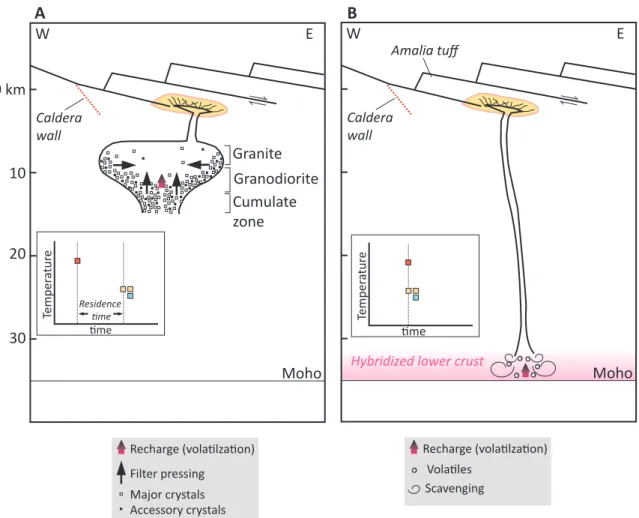
Previous thought on the origin of the Questa porphyry Mo deposit calls upon 1) chemical differentiation processes (assimilation, crystal fractionation, volatile fluxing) in a long-lived magma chamber within the middle to upper crust [Johnson et al., 1989; Carten et al., 1993] or 2) fractional crystallization in the lower crust [Klemm et al., 2008]. The mineralizing intrusions in these cases are believed to be cupolas that emanate from these long-lived reservoirs. Detailed geo-thermochronology presented here challenges these hypotheses.
(Fig. 7A). Mafic recharge into the base of the system could reheat it above zircon saturation temperatures [e.g. Carten et al., 1993], however, this requires a significant volume of mafic magma that is unrecognized in surface and subsurface data [Lipman and Reed, 1989; Meyer, 1991; Unpub. Consultant Report].
Alternatively, in situ magma differentiation could take place in the deep crust where ambient temperatures are higher. Klemm et al. [2008] suggested that ~ 95% crystallization of a middle to lower crustal magma chamber is required to explain the rapid increase in [Cs] within hydrothermal fluids between breccia matrix-style and vein-style mineralization. However, the Re-Os molybdenite ages in this study clearly show that these mineralization styles were concurrent over a ~ 100 ka period. The data of Klemm et al. [2008] suggest a source magma with trace element gradients or the hydrothermal fluids analyzed by these authors exsolved from magmas that were not in communication with one another.
The repetitious intrusion of mineralizing granitic magmas and the synchroneity of high- and low-temperature thermochronometers favors an evolution model in which the magmas are generated, ascend and cool quickly (Fig. 7B). We propose that, like other magmas associated with the Latir field, the origin of the mineralizing magmas was the lower crust [Johnson et al, 1990; Tappa et al., 2011].
5.6. Relationship between caldera formation and mineralization
0 km
10
20
30
W E
Granite Granodiorite Cumulate zone
Moho
Caldera wall
W E
Moho
Caldera wall
Hybridized lower crust Amalia tuff
Major crystals Accessory crystals Filter pressing
Recharge (vola�lza�on) Recharge (vola�lza�on)
Scavenging
Vola�les Residence
�me
Temper
atur
e
�me Temper
atur
e
�me
A B
Figure 7. Schematic drawings showing general differences between expected T-t distribution across multiple chronometers (insets) for different magma evolution settings along an E-W cross-section through the southern caldera margin (surface features after Meyer and Foland, 1991). Inset symbols: orange, U-Pb zircon; yellow, Re-Os molybdenite; blue, Ar-Ar biotite. A) Crystal fractionation model with variable recharge (modified from Johnson et al., 1989; von Quadt et al., 2011) in a vertically extensive mid- to upper-crust magma
controls related to caldera subsidence (e.g. ring faults) and rarely on the relationship between ignimbrite generation and mineralization.
Recent studies of volcanic-plutonic connections focus on magma flux variations responsible for ignimbrite and non-ignimbrite stages of volcanic field evolution [Glazner et al. 2004; Lipman, 2007; Annen et al., 2009; Tappa et al., 2011]. Although there are fundamental differences in interpretation among these papers, all agree that an unusually high flux of material (melt, fluid, gas) is required for ignimbrite formation. Most models also focus on the role of a high flux of material from the upper mantle to either remobilize an existing magma body [Bachmann and Bergantz, 2003; Huber et al., 2012) or initiate deep crustal melting [Glazner et al. 2004; Tappa et al. 2011].
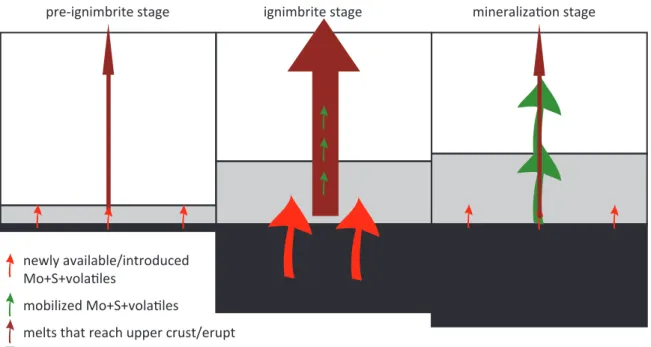
It is hypothesized here that the period of high magma flux responsible for generating the Amalia Tuff set the stage for generating mineralizing intrusions at Questa (Fig. 8). A high flux of juvenile mafic rocks may have exsolved hydrothermal fluids during crystallization and created a zone of hybridized crust (juvenile mafic rocks + old lower crust + hydrothermal assemblages). Stein [1985] and Stein and Hannah [1985] analyzed sulfur isotopes from molybdenite and concluded that all of the sulfur in porphyry Mo systems is derived from the intrusions. Observing the same data, Pettke et al. [2010] emphasize that the δ34S values are
consistent with a mantle source. The high mafic magma flux required for formation of the ignimbrite rapidly transferred unusually high masses of material, including sulfur, into the lower crust as juvenile mafic rocks and hydrothermal fluids. Although mafic underplating throughout the history of the Latir field is hypothesized [Johnson and Lipman, 1988; Johnson et al., 1989; 1990] and thus, volatiles were presumably consistently transferred from the mantle to the crust, the unusually high flux necessary for formation of the ignimbrite may have prepared the system for economic mineralization.
pre-ignimbrite stage ignimbrite stage mineraliza�on stage
newly available/introduced Mo+S+vola�les
mobilized Mo+S+vola�les
melts that reach upper crust/erupt Precambrian crust
hybridized crust
enriched mantle-derived melts
Figure 8. Schematic model showing the relationship between ignimbrite eruption and subsequent
show that partial melting of hydrous amphibolites (~ lower crust) can create appreciable volumes of granitic magma [Faure and Powell, 1972; Mahood and Halliday, 1988; Ratajeski et al., 2005]. Variable contributions from older lower crust, juvenile mafic rocks, and
hydrothermal assemblages may explain slight compositional variations within productive intrusions at Questa (e.g. biotite-plagioclase porphyry –QM11-01 vs. quartz-alkali feldspar porphyry [JMR-6, QV11-02, JMR-34]). Metal endowment within the caldera margin plutons likely comes from a combination of 1) metal-rich lower crust source rocks and 2) scavenging of the hybridized lower crust by volatiles released during crystallization of underplating mafic magmas. According to this model, the halogen-rich volatilization that is typically inferred in porphyry Mo systems occurred during melting, rather than crystallization in an upper crustal magma reservoir [Hildreth, 1981; Keith et al., 1986; Carten et al., 1993; Fig. 7B]. Moreover, this model can account for the observed components of both juvenile mafic rocks and much older (> 1 Ga) lower crust components within porphyry Mo magmas inferred from radiogenic isotope studies [Farmer and DePaolo, 1984; Stein, 1985; Pettke et al., 2010].
6. Conclusions
New U-Pb zircon geochronology from the Latir volcanic field shows that mineralizing magmas were emplaced along the Questa caldera margin over 770 ka. Epithermal Au-Ag mineralization near the Red River intrusive complex post-dates caldera formation by at least 300 ka. Molybdenite Re-Os ages show that the Questa porphyry Mo deposit was assembled episodically over 250 ka between ~24.76 and 24.50 Ma, and the bulk of the mineralization was synchronous with the emplacement of suite of high-silica granites.
This study demonstrates that Re-Os molybdenite geochronology can be used as a thermochronometer in cases where temperature can be determined independently. These data provide further evidence that the Re-Os chronometer remains closed to diffusion during repeated hydrothermal circulation events with temperatures in excess of ~ 400 °C. These data are used to show the complex thermal history of the incrementally assembled Questa porphyry Mo deposit.
References
Annen, C. [2009] Implications of incremental emplacement of magma bodies for magma differentiation, thermal aureole dimensions and plutonism-volcanism relationships, Tectonophysics,doi:10.1016/j.tecto.2009.04.010.
Audétat, A. [2010] Source and evolution of molybdenum in the porphyry Mo [-Nb] deposit at Cave Peak, Texas, J. Petrol., 51, 1739 – 1760.
Bachmann, O., and G. W. Bergantz [2003] Rejuvenation of the Fish Canyon magma body: a window into the evolution of large-volume silicic magma systems, Geology, 31, 789 – 792.
Becker, S. P., A. Fall, and R. J. Bodnar [2008] Synthetic fluid inclusions. XVII. PVTX properties of high salinity H2O-NaCl solutions (> 30 wt % NaCl): Application to fluid inclusions that homogenize by halite disappearance from porphyry copper and other hydrothermal ore deposits, Econ. Geol., 103, 539 – 554.
Best, M. G., E. H. Christiansen, and R. H. Blank Jr. [1989] Oligocene caldera complex and calc-alkaline tuffs and lavas of the Indian Peak volcanic field, Nevada and Utah, Geol. Soc. Am. Bull., 101, 1076 – 1090.
Birck, J. L., M. R. Barman, and F. Capmas [1997] Re-Os isotopic measurements at the femtomole level in natural samples, Geostand. Newsl., 20, 19 – 27.
Bowring, J. F., N. M. McLean, and S. A. Bowring [2011] Engineering cyber infrastructure for U-Pb geochronology: Tripoli and U-Pb_Redux, Geochem., Geophys., Geosyst., 12, doi: 10.1029/2010GC003479.
Braxton, D.P., D.R. Cooke, J. Dunlap, M. Norman, P. Reiners, H. Stein, H., and P. Waters, [2012] From crucible to graben in 2.3 Ma: A high-resolution geochronological study of porphyry life cycles, Boyongan-Bayugo copper-gold deposits, Phillippines: Geology, v. 40, no. 5, p. 471-474.
Burnham, C. W. [1997] Magmas and hydrothermal fluids, in Geochemistry of Hydrothermal Ore Deposits, edited by H. L. Barnes, 3rd ed. John Wiley & Sons, p. 63-123.
Candela, P. A. [1997] A review of shallow, ore-related granites: textures, volatiles, and ore metals, J. Petrol., 38, 1619 – 1633.
Carten, R. B., E. P. Geraghty, B. M. Walker, and J. R. Shannon, [1988a] Cyclic development of igneous features and their relationship to high-temperature hydrothermal features in the Henderson porphyry molybdenum deposit, Colorado, Econ. Geol., 83, 266-296. Carten, R. B., B. M., Walker, E. P. Geraghty, and A. Gunow [1988b] Comparison of
field-based studies of the Henderson porphyry molybdenum deposit, Colorado, with experimental and theoretical models of porphyry systems: in Canadian Institute of Mining and Metallurgy Special Volume 39, edited by Taylor, R. P., and D. F. Strong, 351 – 366.
I. Thorpe, and J. M. Duke, 521-544.
Cathles, L. M., A. H. J. Erendi, and T. Barrie [1997] How long can a hydrothermal system be sustained by a single intrusive event? Econ. Geol., 92, 766 – 771.
Chapin, C. E. [2012] Origin of the Colorado Mineral Belt, Geosphere, 8, 28 – 43, doi: 10.1130/GES00694.1
Cline, J. S. and R. J. Bodnar, [1994] Direct evolution of a brine from a crystallizing silicic melt at Questa, New Mexico, molybdenum deposit, Econ. Geol., 89, 1780-1802. Cohen, A. S., and F. G. Waters [1996] Separation of osmium from geological materials by
solvent extraction for analysis by thermal ionization mass spectrometry, Anal. Chim. Acta, 332, 269 – 275.
Coleman, D. S., W. Gray, and A. F. Glazner [2004] Rethinking the emplacement and
evolution of zoned plutons; Geochronologic evidence for incremental assembly of the Tuolumne Intrusive Suite, California, Geology, 32, p. 433-436.
Cordell, L., C. L. Long, D. W. Jones [1985] Geophysical expression of the batholith beneath Questa caldera, New Mexico, J. Geophys. Res., 90, 11263 – 11269.
Davis, J. W., D. S. Coleman, J. T. Gracely, R. Gaschnig, and M. Stearns [2012] Magma accumulation rates and thermal histories of plutons of the Sierra Nevada batholith, CA, Contrib. Mineral. Petrol., 163, 449 – 465, doi: 10.1007/s00410-011-0683-7 Farmer, G., and D. DePaolo [1984] Origin of Mesozoic and Tertiary granite in the western
United States and implications for pre-Mesozoic crustal structure 2. Nd and Sr isotopic studies of unmineralized and Cu- and Mo-mineralized granite in the Precambrian Craton, J. Geophys. Res., 89, doi:10.1029/JB089iB12p10141.
Faure, G., and J. L. Powell [1972] Strontium isotope geology, Springer, Berlin Heidelberg, New York.
Fournier, R. O. [1999] Hydrothermal processes related to movement of fluid from plastic into brittle rock in the magmatic-epithermal environment, Econ. Geol., 94, 1193 – 1211. Glazner , A. F., J. M. Bartley, D. S. Coleman, W. Gray, R. Z. Taylor [2004] Are plutons
assembled over millions of years by amalgamation from small magma chambers? GSA Today, 14, 4 – 11.
Hanson, R. B., and A. F. Glazner [1995] Thermal requirements for extensional emplacement of granitoids, Geology, 23, 213 – 216.
Harrison, T. M. [1981] Diffusion of 40Ar in hornblende, Contrib. Mineral. Petrol., 78, 324
– 331.
Harrison, T. M, I. Duncan, and I. McDougall [1985] Diffusion of 40Ar in biotite: Temperature,
pressure and compositional effects, Geochim. Cosmochim. Acta, 49, 2461-2468. Henry, C. D., H. B. Elson, W. C. McIntosh, M. T. Heizler, and S. B. Castor [1997] Brief
Hildreth, W. [1981] Gradients in silicic magma chambers: implications for lithospheric magmatism, J. Geophys. Res., 86, 10153 – 10192.
Huber C., O. Bachmann, and J. Dufek [2012] Crystal-poor verses crystal-rich ignimbrites: a competition between stirring and reactivation, Geology, 40, 115 – 118.
Hulen J. B., D. L. Nielson, F. Goff, J. N. Gardner, and R. W. Charles [1987] Molybdenum mineralization in an active geothermal system, Valles caldera, New Mexico, Geology, 15, 748 – 752.
Johnson, C. M., and P. W. Lipman [1988] Origin of metaluminous and alkaline volcanic rocks of the Latir volcanic field, northern Rio Grande rift, New Mexico, Contrib. Mineral. Petrol., 100, 107 – 128.
Johnson, C. M., G. K. Czamanske, and P. W. Lipman [1989] Geochemistry of intrusive rocks associated with the Latir volcanic field, New Mexico, and contrasts between evolution of plutonic and volcanic rocks, Contrib. Mineral. Petrol., 103, 90 – 109. Johnson, C. M., P. W. Lipman, and G. K. Czamanske [1990] H, O, Sr, Nd, and Pb isotope
geochemistry of the Latir volcanic field and cogenetic intrusions, New Mexico, and relations between evolution of a continental magmatic center and modifications of the lithosphere, Contrib. Mineral. Petrol., 104, 99 – 124.
Keith, J. D., W. C. Shanks, D. A. Archibald, and E. Farrar [1986] Volcanic and intrusive history of the Pine Grove porphyry molybdenum system, southwestern Utah, Econ. Geol., 81, 553 – 577.
Klemm, L. M., T. Pettke, C. A. Heinrich [2008] Fluid and source magma evolution of the Questa porphyry Mo deposit, New Mexico, USA, Miner. Deposita, 43, 533-552. Lawley, C. J. M., J. P. Richards, R. G. Anderson, R. A. Creaser, and L. M. Heaman
[2010] Geochronology and geochemistry of the MAX porphyry Mo deposit and its relationship to Pb-Zn-Ag mineralization, Kootenay arc, southeastern British Columbia, Canada, Econ. Geol., 105, 1113 – 1142.
Leuthold, J., O. Müntener, L. P. Baumgartner, B. Putlitz, M. Ovtcharova, and U. Schaltegger [2012] Time resolved construction of a bimodal laccolith [Torres del Paine,
Patagonia], Earth Planet. Sci. Lett., 325, 85 – 92.
Lipman, P. W. [1988] Evolution of silicic magma in the upper crust: the mid-Tertiary Latir volcanic field and its cogenetic granitic batholith, northern New Mexico, U.S.A., Trans. R. Soc. Edinburgh: Earth Sci., 79, 265 – 288.
Lipman, P. W. [1992] Ash-flow calderas as structural controls of ore deposits – recent work and future problems, U. S. Geol. Surv. Bull. 2012, L1-L12.
Lipman, P. W. [2006] Geologic map of the central San Juan caldera cluster, southwestern Colorado, Pamphlet to accompany U.S. Geol. Surv. Map, I-2799, 37 p.
Lipman, P. W., H. H. Mehnert, and C. M. Naeser [1986] Evolution of the Latir volcanic field, northern New Mexico, and its relation to the Rio Grande rift, as indicated by potassium-argon and fission track dating, J. Geophys. Res., 91, 6329-6345.
Lipman, P. W., and J. C. Reed [1989] Geologic map of the Latir volcanic field and adjacent areas, northern New Mexico, U.S. Geol. Surv. Map, I-1907, scale 1:48,000.
Lowell, J. D., and J. M. Guilbert [1970] Lateral and vertical alteration-mineralization zoning in porphyry ore deposits, Econ. Geol., 65, 373 – 408.
Lowenstern, J. [1994] Dissolved volatile concentrations in an ore-forming magma, Geology, 22, 893 – 896.
Mahood G. A., and A. N. Halliday [1988] Generation of high-silica rhyolite; a Nd, Sr, and O isotopic study of Sierra La Primavera, Mexican neovolcanic belt, Contrib. Mineral. Petrol., 100, 183 – 191.
Maksaev, V., F. Munizaga, M. McWilliams, M. Fanning, R. Mathur, J. Ruiz, and M. Zentilli [2004] New chronology for El Teniente, Chilean Andes, from U-Pb, 40Ar/39Ar, Re-Os
and fission-track dating: implications for the evolution of a supergiant porphyry Cu-Mo deposit, Soc. Econ. Geol. Special Publication, 11, 15 – 54.
Markey, R., J. L. Hannah, J. W. Morgan, and H. J., Stein [2003] A double spike for osmium analysis of highly radiogenic samples, Chem. Geol., 200, 395 – 406.
Marsh, T. M., T. M. Einaudi, and M. McWilliams [1997] 40Ar/39Ar geochronology of Cu-Au
and Au-Ag mineralization in the Potrerillos district, Chile, Econ. Geol, 92, 784 – 806. Mattinson, J. M. [2005] Zircon U-Pb chemical abrasion [CA-TIMS] method: combined
annealing and multi-step dissolution analysis for improved precision and accuracy of zircon ages, Chem. Geol., 220, 47 – 56.
Matzel, J. E. P., S. A. Bowring, and R. B. Miller [2006] Time scales of pluton construction at differing crustal levels; examples from the Mount Stuart and Tenpeak intrusions, north Cascades, Washington, Geol. Soc. Am. Bull., 118[11-12], 1412 – 1430.
McLean, N.M., J. F. Bowring, and S. A. Bowring [2011] An algorithm for U-Pb isotope dilution data reduction and uncertainty propagation, Geochem., Geophys., Geosys., 12, doi:10.1029/2010GC003478.
McLemore, V. T., and R. M. North, [1984] Occurrences of precious metals and uranium along the Rio Grande rift in northern New Mexico, New Mexico Geol. Society Guidebook, 35th Field Conference.
Meyer, J. [1991] Volcanic, plutonic, tectonic, and hydrothermal history of the southern Questa caldera, New Mexico, Ph.D thesis, University of California at Santa Barbara, Santa Barbara.
Meyer, J., and K. A. Foland [1991] Magmatic-tectonic interaction during early Rio Grande Rift extension at Questa, New Mexico, Geol. Soc. Am. Bull., 103, 993-1006.
Volcanol. Geotherm. Res., 167, 282 – 299.
Pettke, T., F. Oberli, and C. A. Heinrich [2010] The magma and metal source of giant porphyry-type ore deposits, based on lead isotope microanalysis of individual fluid inclusions, Earth Planet. Sci. Lett., 296, 267 – 277, doi:10.1016/j.epsi.2010.05.007. Ratajeski, K., T. W. Sisson, and A. F. Glazner [2005] Experimental and geochemical evidence
for derivation of the El Capitan Granite, California, by partial melting of hydrous gabbroic lower crust, Contrib. Mineral. Petrol., 149, 713 – 734.
Rose, M., D. E. Pride [2010] “Target mapping” at Bonanza, Colorado; integrating geology, geochemistry, and mineralization models in a caldera setting, Abstracts with
Programs – Geological Society of America, 42, 54.
Ross, P. S., M. Jèbrak, and B. M. Walker [2002] Discharge of hydrothermal fluids from a magma chamber and concomitant formation of a stratified breccia zone at the Questa porphyry molybdenum deposit, New Mexico, Econ. Geol., 97, 1679 - 1699.
Rowe, A. [2012] Fluid evolution of the magmatic-hydrothermal breccia of the Goat Hill ore body, Questa Climax-type porphyry molybdenum system, New Mexico – a fluid inclusion study, Ph.D thesis, New Mexico Institute of Mining and Technology, Socorro.
Rowe, A., A. R. Campbell, V. T. McLemore, D. I. Norman, and B. M. Walker [2003] The Goat Hill ore body, Questa porphyry Mo system, New Mexico; a geochemical study of a stratified magmatic-hydrothermal breccia and stockwork veinlets, Abstracts with programs, Geological Society of America, 35, 232.
Rytuba, J. J. [1994] Evolution of volcanic and tectonic features in caldera settings and the importance in the localization of ore deposits, Econ. Geol., 89, 1687 – 1696. Seedorfff, E. and M. T. Einaudi, [2004a] Henderson porphyry molybdenum system,
Colorado: I. Sequence and abundance of hydrothermal mineral assemblages, flow paths of evolving fluids, and evolutionary style, Econ. Geol., 99, 3-37.
Seedorfff, E. and M. T. Einaudi [2004b] Henderson porphyry molybdenum system, Colorado: II. Decoupling of introduction and deposition of metals during geochemical evolution of hydrothermal fluids, Econ. Geol., 99, 37 – 70.
Selby, D., B. E. Nesbitt, K. Muehlenbachs, and W. Prochaska [2000] Hydrothermal alteration and fluid chemistry of the Endako porphyry molybdenum deposit, British Columbia, Econ. Geol., 95, 183-202.
Selby, D., Creaser, R.A., Stein, H.J., Markey, R.J., and Hannah, J.L. (2007) Assessment of the 187Re decay constant by cross calibration of Re-Os molybdenite and U-Pb zircon
chronometers in magmatic ore systems: Geochim. et Cosmochim. Acta, v. 71, no. 8, p. 1999-2013.
Shirey, S. B., and R. J. Walker [1995] Carius tube digestion for low-blank rhenium-osmium analysis, Anal. Chem., 67, 2136 – 2141.
Geol., 95, 1155 – 1164.
Smoliar, M.I., R. J. Walker, and J. W. Morgan, [1996] Re-Os ages of group IIA, IIIA, IVA, and IVB iron meteorites, Science, 271, 1099 – 1102.
Stacey, J. S., and J. D. Kramers [1975] Approximation of terrestrial lead isotope evolution by a two-stage model, Earth Planet. Sci. Lett., 26, 207 – 221.
Stein, H.J. [1985] A Lead, Strontium, and Sulfur Isotope Study of Laramide-Tertiary Intrusions and Mineralization in the Colorado Mineral Belt with Emphasis on Climax-type Porphyry Molybdenum Systems plus a Summary of Other Newly Acquired Isotopic and Rare Earth Element Data: University of North Carolina at Chapel Hill, PhD dissertation, 493 p.
Stein, H. J., and J. L. Hannah [1985] Movement and origin of ore fluids in Climax-type systems, Geology, 13, 469 – 474.
Stein, H.J., J.W. Morgan, R. J. Markey, A. E. Williams-Jones, M. Heiligmann, and J. R. Clark [1999] Re-Os age for the Hemlo Au deposit, Ontario, Canada: durability of the Re-Os chronometer, EOS Trans. AGU, 80, F1082.
Stein, H.J., R. J. Markey, J. W. Morgan, J. L. Hannah, and A. Scherstén [2001] The
remarkable Re-Os chronometer in molybdenite: how and why it works, Terra Nova, 13, 479 – 486.
Stein, H. J., A. Scherstén, J. Hannah, and R. Markey [2003] Subgrain-scale decoupling of Re and 187Os and assessment of laser ablation ICP-MS spot dating in molybdenite,
Geochim. Cosmochim. Acta, 67, 3673 – 3686, doi:10.1016/S0016-7037[00]00269-2. Suzuki, K., Shimizu, H. and Masuda, A. [1996] Re-Os dating of molybdenites from ore
deposits in Japan: Implication for the closure temperature of the Re-Os system for molybdenite and the cooling history of molybdenum ore deposits, Geochim. Cosmochim Acta, 60, 3151–3159.
Tappa, M.J., D. S., Coleman, R. D. Mills, and K. M. Samperton [2011] The plutonic record of a silicic ignimbrite from the Latir volcanic field, New Mexico, Geochem., Geophys., Geosys., 12, Q10011, doi: 10.1029/2011GC003700
U.S. Geological Survey, Molybdenum, Mineral Commodity Summaries, January 2011. von Quadt, A., M. Erni, K. Martinek, M. Moll, I. Peytcheva, and C. Heinrich [2011] Zircon
crystallization and the lifetimes of ore-forming magmatic-hydrothermal systems, Geology, 39, 731 – 734.
Wallace, S.R., N. K. Muncaster, D. C. Jonson, W. B. MacKenzie, A. A. Bookstrom, and V. E. Surface [1968] Multiple intrusion and mineralization at Climax, Colorado, in Ore deposits of the United States, 1933 – 1967: New York, American Institute Mining Metallurgy and Petroleum Engineers, 1, edited by Ridge, J. D., 605 – 640. Watson, E.B., and T. M. Harrison [1983] Zircon saturation revisited: temperature and
White, W.H., A. A. Bookstrom, R. J. Kamilli. M. W. Ganster, R. P. Smith, D. E. Ranta, and R. C. Steininger [1981] Character and origin of Climax-type molybdenum deposits, Econ. Geol. 75th Anniversary Volume, 270 – 316.
Wilson, A.J., D. R. Cooke, H. J. Stein, M. C. Fanning, J. R. Holliday, and I. J. Tedder [2007] U-Pb and Re-Os geochronologic evidence for two alkali porphyry ore-forming events in the Cadia district, New South Wales, Australia, Econ. Geol., 102, 3 – 26.
Yoshinobu, A.S., D. A. Okaya, and S. R. Paterson [1998] Modeling the thermal evolution of fault-controlled magma emplacement models: implications for the solidification of granitoid plutons, J. Struct. Geol., 20, 1205 – 1218.
Zimmerer, M.J., and W. C. McIntosh [2012] The Ar/Ar geo- and thermochronology of the Latir volcanic field and the associated intrusions: understanding caldera magmatic processes using the volcanic-plutonic relationship: Geol. Soc. Am. Bull., doi: 10.1130/ B30544.1