Debt Collection
Harmonisation Regulation
Options Paper
Consumer Affairs Victoria 121 Exhibition Street Melbourne VIC 3000
Contents
1. Executive Summary... 6
1.1 Purpose ... 6
1.2 Background ... 6
1.3 Industry landscape ... 6
1.4 Inter-jurisdictional inconsistency ... 7
1.5 Consumer protection within the current regulatory framework ... 8
1.6 The suitability of the national credit model ... 9
1.7 The role of the National Occupational Licensing System ... 9
1.8 Options for harmonisation ... 10
1.8.1 Licensing options ... 10
1.8.2 Conduct options... 11
1.8.3 Trust accounting options ... 11
1.8.4 Complaint handling options ... 12
1.8.5 Administration options ... 12
1.8.6 Information standards options ... 13
1.8.7 Educational requirements options ... 13
1.9 How to make a submission ... 14
2. Background – the industry landscape ... 15
2.1 What is debt collection? ... 15
2.1.1 Contingent collection ... 15
2.1.2 Debt purchasing... 15
2.1.3 Service delivery ... 16
2.2 The industry at a glance ... 16
2.2.1 Industry structure ... 16
2.2.2 Industry bodies ... 17
2.2.3 Major markets ... 17
3. The regulatory framework – key problems ... 19
3.1 The licensing framework ... 19
3.1.1 Exemptions ... 22
3.2 The credit model... 22
3.2.1 ACCC-ASIC debt collection guidelines ... 23
3.3 Consumer protection elements of the current regulatory framework... 26
3.3.1 Physical force, undue harassment and coercion... 26
3.3.2 Misleading and deceptive conduct & false and misleading representations ... 27
3.3.3 Debt education... 28
3.3.4 Inaccurate, incomplete or misinformation... 29
4. Options for harmonising debt collection ... 33
4.1 Licensing options... 33
Option 1: Status quo ... 33
Option 2: Remove exemption from national credit act ... 34
Option 3: The National Occupational Licensing System (NOLS) model ... 35
Option 4: Mandatory exclusion requirements (negative licensing)... 36
Option 5: Deemed licensing via the national credit act or a separate national licensing act ... 38
4.2 Conduct options ... 39
Option 1: Status quo ... 39
Option 2: Non-prescribed industry codes of conduct ... 40
Option 3: Mandatory prescribed code ... 40
Option 4: Legislative provisions... 42
4.3 Trust accounting options ... 42
Option 1: Status quo ... 42
Option 2: Require disclosure of trust account or professional indemnity insurance details ... 43
Option 3: Abolish trust account requirements ... 43
4.4 Complaint handling options... 44
Option 1: Status quo ... 44
Option 2: Mandatory membership of EDR scheme... 45
Option 3: Mandatory internal dispute resolution ... 45
Option 4: Regulator administered dispute resolution ... 46
4.5 Administration options ... 46
Option 1: Status quo ... 46
Option 2: Transfer administration to a dedicated debt collection regulator ... 46
Option 3: Modernise and harmonise state and territory administration... 47
4.6 Information standards ... 47
Option 1: Status quo ... 47
Option 3: Mandatory disclosure upon request... 48
4.7 Educational requirements options... 49
Option 1: Status quo ... 49
Option 2: Modernise and harmonise statutory training standards... 49
Option 3: Introduce industry determined training standards... 50
Option 4: No mandatory training... 50
Appendix 1: Comparative table ... 51
Appendix 2: Latitude research... 55
Appendix 3: Credit act requirements ... 70
Appendix 4: Generic collection model ... 73
Appendix 5: Victorian mandatory exclusion licensing provisions ... 74
Appendix 6: Shortened forms ... 76
1. Executive Summary
1.1 Purpose
The purpose of this paper is to discuss the regulatory framework for debt collection and to present for comment several options for its harmonisation. The paper is written in the context of the Ministerial Council on Consumer Affairs' (MCCA)1 objectives that aim to:
develop an understanding of the new model for credit regulation and what it means for debt collection regulation, by December 2011
develop consistent regulation for debt collection having regard to new models for credit and the National Occupational Licensing System, by December 2012. As part of these objectives, reduced consumer detriment and resolution of jurisdictional inconsistencies within the current legislative framework will also be considered. 2
1.2 Background
In 2008, the Council of Australian Governments (COAG) agreed to pursue wide-ranging
regulatory reform in order to increase Australia’s productivity and provide the
environment for a seamless national economy. COAG found that Australia’s productivity was hampered by regulatory duplication and inconsistency, which compromised economic competitiveness and required reform. In particular, fair trading and consumer credit laws were targeted to ensure a harmonised
1
Soon to be named COAG Legislative and Governance Forum on Consumer Affairs (CAF).
2
Court enforcement of a debt through state and territory civil procedures is out of scope for this national harmonisation project.
regulatory framework with seamless laws and enhanced consumer protection provisions. Late in 2009, it was agreed that regulation of debt collection would be placed on MCCA’s forward agenda, with the aim of minimising the regulatory overlap between the regulation and licensing of debt collectors and the regulation of debt collection currently administered by the states and territories, and the new national consumer credit regime. It was agreed that Victoria would lead this project and release a paper discussing these issues on behalf of MCCA.
1.3 Industry landscape
The debt collection industry has changed significantly over the past ten years. The impact of technology on debt collection practices, industry consolidation, regulatory developments and increased government usage of debt collection services have moved the debt collection environment towards professionalism and specialisation in service delivery.3
The debt collection industry can be distinguished by two types of collection servicing; ‘in-house’ debt collection and ‘out-sourced’ debt collection.4 In-house collection is collection of debts by the original creditor, that is, ‘in-house’, while out-sourced collection
3
Some businesses specialise in call centre collections, others in field calls, repossessions, skip tracing and other related debt collection functions. These would include phone calls to clients, site visits, repossession of goods and holding of client funds.
4
It has been reported that consumer debt in Australia – mortgages, credit cards and personal loans for example – now exceeds more than the Australian economy earns in a year. That is $1.2 trillion or approximately $56 thousand for every Australian man, woman or child. See Barnes, Terry (2010) ‘Consumption at all costs’, in The Age, 13 January.
involves a third party, such as an agent or debt buyer.
The two main areas of out-sourced collection are the credit and financial service industry (74 per cent) and utilities industry (13 per cent, which includes telecommunications companies).5
Third-party debt collectors collect debts across a range of industries and on behalf of a range of creditors including credit providers, utility companies and local government. This is called contingent debt collection. Contingent debt collectors are typically paid either a flat fee for pursuing overdue accounts, or a commission based on the amount of money recovered. A debt collector may also purchase a debt outright. Debt buyers purchase the debt at a discount, making a profit if the amount recovered exceeds the purchase price of the debt and the cost of collection. Debt purchasing is increasing within the industry.6
The out-sourcing industry is increasingly dominated by a small number of large companies. These include Dun & Bradstreet, Collection House and Credit Corp Group Limited. In addition to these larger companies, the industry has a large number of small collection agencies, many of whom are sole traders. Technology has facilitated delivery of services across multiple jurisdictions without the need for aphysical presence in each
jurisdiction. However, ambiguity exists as to whether a licence is required for each jurisdiction.
The process of debt collection has evolved due to corporatisation and increased
professionalism in the industry. Debt collection
5
That market generates approximately $1.6 billion of revenue. See IBIS (2010) Debt Collection at a Glance, Melbourne: IBIS, p 11.
6
Ibid p 12. Importantly, once the debt is sold to the debt buyer consumers may lose some protections (such as those under codes of conduct or membership to dispute resolution schemes) imposed by specific legislation such as telecommunications regulation, unless the debt buyer has independently agreed to conform to the obligations (and joined an industry body for example).
itself is generally no different whether the collector owns the debt or is acting as a third party, however, two distinct ‘specialisations’ have emerged within the industry. They are debt collection-debt purchasing functions (characterised by high volume telephone based activity), which incorporates the bulk of the industry, and field call-repossession and process service functions (characterised by low volume activity in the ‘field’).7
A wide range of entities not required to be licensed also participate in the industry.
Participants not required to have a specific debt collection licence include banks, other finance companies, legal practitioners, accountants and businesses that collect their own debts in-house.
The industry is represented by a range of industry associations that promote professional and ethical conduct, however, membership is voluntary.
1.4 Inter-jurisdictional inconsistency
The regulatory framework for debt collection in Australia is complex, inconsistent and occurs on a number of levels. This is a consequence of shifts in the objectives of regulation over time (such as the general re-orientation from anti-fraud provisions and the protection of creditors to consumer protection provisions) and the subsequent differences between state and territory regulation, as well as the range of instruments currently used for regulation. This has created a ‘patchwork’ of debt collection regulation.The ‘patchwork’ can be separated into three groups that overlap depending on the industry of debt collection activity. They are:
general regulation, which applies to all debt collectors and includes state, territory and Commonwealth fair trading legislation and licensing legislation
7
such as the Australian Consumer Law (ACL)
credit industry specific regulation, which includes the National Consumer Credit Protection Act 2009 (the 'National Credit Act'), other relevant state, territory and Commonwealth legislation, such as privacy or credit reporting legislation ( which is out of scope for this project), and specific codes of conduct
other regulation, which includes the ACCC-ASIC Guidelines for Debt Collection8 and regulation associated with telecommunications, energy and water suppliers.9
Legislative inconsistencies and overlap lead to a range of problems and associated costs for both consumers and industry. For example, collectors collecting debts interstate are required to adhere to different licensing arrangements, some more prescriptive than others. Collectors are also required to adhere to a range of different regulations depending on the requirements of the industry where the debt has arisen, which can make it more difficult to comply.
1.5 Consumer protection within the
current regulatory framework
Over the last two decades, a large volume of qualitative data has built up that reflects a potential for a lack of compliance with
consumer protection laws by the debt collection industry.10 While compliance has definitely
8
Industry has made clear that due to the range of inconsistencies with the current regulatory framework and the collection of inter-jurisdictional debt, the ACCC-ASIC Guidelines are frequently used as the core instrument guiding their behaviour. See for example, ACDBA (2009) Submission to the National Consumer Credit
Protection Bill 2009, May, NSW: ACDBA.
9
This includes a range of Codes of Conduct and dispute resolution requirements.
10
See for example:
Australian Law Reform Commission (1987) Debt Recovery
and Insolvency, Report No. 36, Canberra: Australian
Government Publishing Service
ACCC (1999) Undue Harassment and Coercion in Debt
Collection, May: Canberra: ACCC
improved over this time, misconduct by some debt collectors, most notably third party debt collectors, has continued. Instances of
harassment and coercion, and misleading and deceptive conduct, as well as the lack of effective dispute resolution mechanisms have continually been raised anecdotally by consumers and bodies representing consumers.
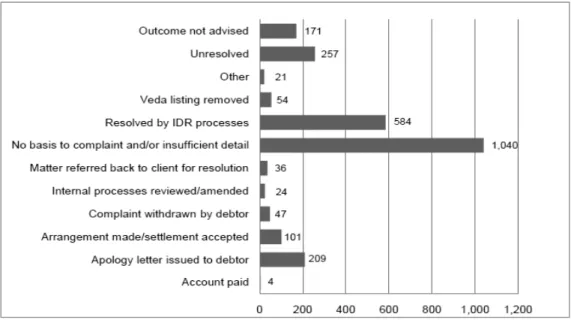
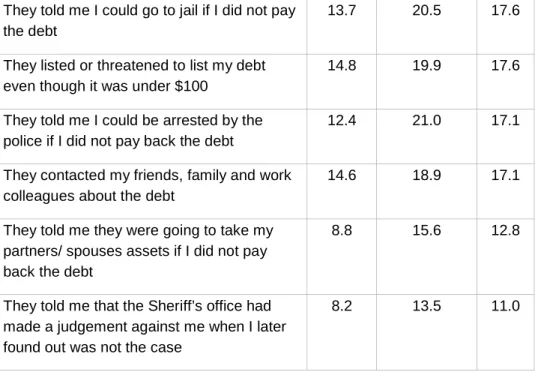
There is also national quantitative data that supports the anecdotal evidence, and highlights that there are a range of exacerbating factors that contribute to debt disputes, such as misinformation and educational issues. This research also highlighted that a large proportion of debt collectors engaged in practices that, according to consumers, did not comply with the ACCC-ASIC Guidelines for Debt Collectors. See Appendix 2 for further detail.
When analysing this research, however, it is important to recognise the emotional nature of debt complaints that may exasperate the collection process and contributeto complaints, as well as the level of complaints relative to the large amount of debt collection that occurs throughout Australia.11
Indeed, education for consumers and collectors early on in the debt collection process, which outlines their debt responsibilities, the avenues for help that are available to them and the sensitivities involved, may help reduce the number of consumers who find themselves
Consumer Credit Legal Centre (CCLC) (NSW) (2004) Report
in Relation to Debt Collection, April, NSW: CCLC
ACCC-ASIC, Debt Collection Practices in Australia, Summary
of Stakeholder Consultation, ACCC, Commonwealth of
Australia, May 2009
Latitude Insights (2010) Debt Collection Regulation
Harmonisation Research: Final Report, Melbourne: Latitude
Insights, contained in Appendix 2. 11
For example, industry statistics suggest that despite a high volume of contacts (over 60 million p.a.), reported complaints (considered to be any matter relating to professional conduct) against the industry amount to one debtor complaint per 9000 accounts under management, representing less than 0.0001 per cent of total contacts p.a.. See Australian Collectors Association (ACA) (2008) Submission to Consumer Affairs Legislation
Modernisation Consultation: Private Agents Act 1966, November,
pursued by a debt collector late in the collection process.
1.6 The suitability of the national credit
model
One objective of this paper is to develop an understanding of the new model for credit and what it means for debt collection regulation. The main reforms under the National Credit Act are that debt buyers must hold an Australian Credit Licence and have the same requirements imposed upon them as ‘credit providers’.12 These are:
minimum training requirements with adequate financial and human resources to meet their obligations
enhanced standards of conduct
including a requirement to act honestly, efficiently and fairly, and to properly train and supervise people who act on their behalf
mandatory membership of an external dispute resolution (EDR) scheme. ASIC has the power to take prompt action Australia-wide to cancel or suspend a licence or ban people from engaging in credit activities. The National Credit Act applies to persons who undertake ‘credit activities’, which includes both in-house and out-sourced debt collection, but only in the context of debts arising out of consumer credit.
Research has shown that there is a lack of understanding amongst consumers about their responsibilities with credit and repaying debt.13 Indeed, the very nature of credit, including credit education and financial literacy (and the processing of that information), is a complex
12
See Appendix 3 for more detail.
13
Schetzer, L (2007) Drowning in Debt: The experiences of people
who seek assistance from financial counsellors, December,
Melbourne: Department of Justice, pp 38-42; AND Pleasence et al (2007) A Helping Hand: The Impact of Debt Advice on People’s
Lives, March, United Kingdom: Legal Services Research Centre and
Department for Constitutional Affairs.
environment for vulnerable and disadvantaged consumers.14 Because of these complexities it has been subject to specific regulation.
In the context of consumer credit, the National Credit Act would provide a solid legislative platform for any new regulation of debt collection. In particular, its focus on minimum training requirements, enhanced standards of conduct and mandatory membership of an EDR scheme would help alleviate many of the consumer problems highlighted by the recent research.
However, the National Credit Act does not regulate debt collection outside consumer credit contracts, and the increased EDR and training requirements may duplicate existing industry practice (for example, with respect to utility debts) as well as impact upon the efficient collection of debts.15
Currently, regulations made under the National Credit Act exempt certain persons engaging in debt collection activities (such as those already licensed or authorised under specific state debt collector legislation) from the requirement to hold a licence, but does not apply to debt collectors collecting assigned debts. This exemption means that these debt collectors are not subject to their state or territory licensing obligations as well as those under the credit framework.
1.7 The role of the National
Occupational Licensing System
Another objective of this paper is to include consideration of the National Occupational Licensing System (NOLS)16 in the development14
Consumer Affairs Victoria (2004) Discussion Paper: What do we
mean by ‘vulnerable’ and ‘disadvantaged’ consumers? Melbourne:
CAV, p 14.
15
The Latitude Insights research report stated that approximately 40 per cent of the 1200 respondents interviewed throughout Australia reported having a debt relating to consumer credit. Therefore, this would potentially leave over 60 per cent of the industry to other regulation.
16
The NOLS timeframe of delivery (July 2012 for Phase 1 of the scheme and July 2013 for Phase 2) is not consistent with the timeframes for this project (to be completed in December 2012), and
of the harmonisation of debt collection project.17 NOLS is being developed to remove licensing inconsistencies across state and territory borders and to provide for a more mobile workforce.
Under NOLS, licence holders will be able to perform work in any state or territory with a single national licence. NOLS aims to provide a framework that reduces red tape and improves business efficiency and the competitiveness and productivity of the national economy. For example, harmonisation of the debt collection licenceunder NOLS could reduce the
regulatory burden on the industry by minimising legislative inconsistencies and reducing inter-jurisdictional anomalies.
Further, national licensing will provide greater security for consumers because qualification requirements, if they are deemed suitable, could become streamlined. There may also be increased productivity because debt collectors would be able to work across Australian jurisdictions under one consistent licensing system.
However, there are a number of difficulties with NOLS eligibility criteria, and there may be limited benefit if debt collection were included in the scheme. For example, occupations that are currently included in NOLS are those that contain many classes or sub-classes of licence in each jurisdiction, such as builders, property agents and electricians. The large number of these classes and sub-classes compound restrictions on mobility and competition, and consequently has a considerable impact on the Australian economy. Licensing of debt
collectors does not exhibit these kinds of problems.
its work program is already taken up with other occupations. However, once work on the harmonisation of debt collection regulation is completed, it could become part of NOLS after that date.
17
MCCA (2009) Ministerial Council on Consumer Affairs: A New
Approach to Consumer Policy, Strategy 2010-2012, p 11.
NOLS eligibility criteria also strictly involve licensing, which offers no variation to other regulatory tools, which may be more suitable in the context of debt collection regulation. Further, a suitable licensing framework has already been established under the National Credit Act that could readily be applied to debt collectors, and debt buyers who also engage in debt collection for fee or reward will already be covered by these credit licensing requirements. Harmonisation of the debt collection licence will reduce burden within the industry and provide some legislative clarity for its participants by eliminating overlap, but for the reasons outlined above it is not clear whether the benefits would be of the scale of the occupations that are already included in NOLS.
1.8 Options for harmonisation
For the purposes of the debt collectionregulation harmonisation project, it is necessary to present several options for consultation. Respondents are asked to comment on and justify which option(s) they prefer. Part 4 of this paper details and discusses on the options.
1.8.1 Licensing options
Status quo
The status quo would see the existing licensing regulation of debt collectors continue without change.
Remove the exemption
This option would remove the exemption for third-party collectors from the National Credit Act and would apply the requirements of that Act (such as mandatory EDR, training requirements and enhanced standards of conduct) to third-party collectors who collect debts, though only in the context of consumer credit. Collection of debts not covered by the National Credit Act would still require those debt collectors to hold separate licences, which would duplicate regulation.
Use the NOLS model
NOLS would be extended to include debt collectors under this option. Licensees would be able to undertake their business in any state or territory that is participating in NOLS. This option will provide an established framework that aims to reduce red tape and promote a seamless economy.
Mandatory exclusion requirements As in Victoria, mandatory exclusionary requirements would allow anybody to operate as a debt collector unless they are excluded from the industry by particular criteria and not permitted to practise. This could occur where conduct provisions are breached. Mandatory exclusion requirements are a more targeted, less restrictive and less costly form of regulation compared to positive licensing for example. Licensing via the national credit act or a specific national licensing act
This option would use state legislation to apply the National Credit Act to all debt collectors, or alternatively impose consistent positive
licensing on debt collectors as part of a specific licensing act. This act could impose similar conditions to the National Credit Act, and would provide the opportunity to develop a specific Act exclusively for debt collectors.
1.8.2 Conduct options
Status quo
Under this option, the existing regulatory framework for the conduct of debt collectors would continue notwithstanding any
harmonised licensing framework. Collection agents would continue to be subject to the range of consumer protection provisions found in the Australian Consumer Law, the ASIC Act and the ACCC-ASIC Guidelines for Debt Collectors.
Non-prescribed industry code of conduct A voluntary industry code of conduct is a ‘light-touch’ form of regulation that sets out specific standards of conduct on how an industry will
deal with its customers. Collectors would voluntarily agree to uphold these standards by signing up to the code. However, given the availability of voluntary membership to industry bodies (and the standards they impose on their members) a voluntary code may not increase standards for the industry.
Prescribed industry code of conduct This option would impose a mandatory code of conduct for collectors. The main benefit of a code is that it outlines specific prohibitions or conduct that must be followed. Industry uses the ACCC-ASIC Debt Collection Guidelines as their core instrument for guidance on conduct. These guidelines outline particular prohibitions in accordance with relevant legislation, and would provide a suitable model for a code of conduct. The main disadvantage of this option is that mandatory codes of practice can be highly prescriptive, limiting debt collector discretion with respect to the most appropriate course of action in the circumstances when collecting a debt.
Legislative provisions
This option would see legislative provisions that regulate conduct introduced either into
exclusive debt collection legislation or as a new part inserted into existing state and territory debt collector legislation. Legislative provisions contained in an Act would have a similar effect to a code, and contain similar content, though codes do not generally have monetary penalties attached for non-compliance.
1.8.3 Trust accounting options
Status quo
Under this option, debt collectors would be required to maintain trust accounts, as they already do in most states and territories. This would ensure that money recovered for clients is kept separate from money paid to the business for its services.
Under this option, while a debt collector would not be required to operate a trust account, they would be required to disclose to clients whether they operate a trust account, and, if they do not have a trust account, to explain the potential consequences of this. This option would lower compliance costs for collection agents, giving them discretion as to whether or not they maintain a trust account.
Abolish trust account requirements This option would see the removal of trust account requirements. Instead, it would be left to each purchaser of collection agency service to satisfy themselves that appropriate prudential arrangements have been put in place to protect against default. The main advantage of
abolishing a requirement that collection agencies have a trust account is that it would reduce compliance costs such as bank fees and audit costs for collection agents and compliance costs for governments. A risk is that under this option, many small business
purchasers of collection agency services may only do so infrequently, and therefore, may not be aware of the risks where a collector does not have a trust account.
1.8.4 Complaint handling options
Status quo
This option would see the existing arrangement for complaint handling maintained in spite of any harmonised legislative framework, for example in relation to licensing or conduct. There is no current requirement for all debt collectors to have internal or external dispute resolution processes unless they are credit providers or telecommunications, energy or water suppliers. Debt collectors that belong to an industry association may have dispute resolution processes as part of their contractual arrangements.
Mandatory membership of an external dispute resolution scheme
This option would require all debt collectors who are not members of an EDR scheme to
join one that provides a dispute resolution process for people with problems with their financial service provider, such as the Financial Ombudsman Service, for example. The EDR process would provide an independent complaint handling process, though it may be exploited by consumers.
Mandatory internal dispute resolution Mandatory Internal Dispute Resolution (IDR), at least in accordance with the Australian
Standard for Complaint Handling, would provide an efficient internal process for handling
complaints made against the debt collector. However, it would not be an independent process and may be viewed as biased towards the collector.
Regulator-administered dispute resolution Conciliation is already provided by state and territory fair trading offices as part of their respective fair trading legislation. Depending on how enforcement of the new debt collection regulatory framework is to be decided (for example, whether through a state or federal regulator), this option would see a regulator be the primary channel for complaints and the resolution of those complaints.
1.8.5 Administration options
Status quo
This option would retain the existing
administrative framework for the regulation of debt collection, with each jurisdiction
individually responsible at the state and territory level (varying from state to state between the police and offices of fair trading), and ACCC and ASIC being responsible at the
Commonwealth level.
Transfer administration to a regulator exclusive to debt collection
Depending on the type of legislative framework (in relation to licensing or conduct for example), this option would see responsibility for debt collection transferred to a regulator exclusively established for debt collection. This would provide specialist administration, but would take time and resources to be established.
Modernise and harmonise state and territory administration
The current responsibility amongst states and territories varies between the police and offices of fair trading. This option would make each state and territory’s fair trading office the sole regulator of debt collection in that jurisdiction and ensure states and territories collaborated on compliance and enforcement issues. The main advantages of this option are that the states and territories may continue
administration and modernisation will provide the opportunity for appropriate reforms and collaboration. The main disadvantage of this option is that different jurisdictions may apply varying degrees of enforcement, which may subsequently reduce competition.
1.8.6 Information standards options
Status quo
The Privacy Act 1988 (Cwth) (Part IIIA and the Credit Reporting Code of Conduct), relevant state and territory privacy legislation, and numerous conduct provisions that prohibit misleading and deceptive conduct regulate debt collectors and their handling of credit reporting and information sharing matters. This option would see that regulation remain unchanged. Prescribe statutory forms
This option would prescribe information standards (such as forms or minimum requirements) that collectors would have to adhere to, in relation to minimum information disclosure when collecting debts. This would also apply in relation to debts that have been assigned or sold to a third party and where confusion exists as to the identity of the debtor and the particulars of the debt. Provisions could be inserted into the chosen regulatory
framework as part of their existing state
legislation or new industry-specific legislation, if preferred.
Mandatory disclosure upon request This option would implement the requirement that any person who is not the original creditor must provide certain information about a debt within five days of commencing collection efforts. A consumer would be able to request further details of the debt within 30 days of
collection efforts commencing. The required information includes the name and address of the original creditor and verification of the debt itself.
1.8.7 Educational requirements options
Status quo
This option would see the existing irregular education requirements continue without change. States and territories would continue to vary regarding the qualifications required to carry on business as a debt collector, and industry would continue to impose internal education requirements for collectors who choose to be members of an industry association.
Modernise and harmonise statutory training standards
New South Wales South Australia and Tasmania impose statutory education
requirements on debt collectors18,. Queensland retains a power to prescribe qualifications but has not done so to date. This option would see the requirements modernised and harmonised throughout Australia.
Introduce training standards that are set by industry
Introducing training standards across the industry, and having those standards set by industry (but, for example, approved by the regulator) will have similar benefits to Option 2. The standards would form part of the chosen licensing framework and be approved by the regulator; they could be tailored by industry to suit particular specialisations. For example, call centre staff would receive training relevant to their duties, which may differ from the training received by a repossession agent. However, there is no direct evidence of a lack of training causing a problem.
Abolish all mandatory training requirements It is often argued by industry that current training requirements are inconsistent and irrelevant to current industry practice, not
18
In NSW the Certificate III in Financial Services (Mercantile Agencies) in & TAS - three units from the Diploma in Financial Services (Credit Management & Mercantile Agencies).
effective, difficult to access and lack flexibility. As a result industry peak bodies have
implemented their own training requirements for their members. This option would abolish all mandated training requirements leaving it up to the market to decide whether they undergo training independently or through membership to a peak body.
1.9 How to make a submission
There is no specified format for a submission. Submissions may range from a letter
addressing one issue to a systematic analysis of the impact of the reform of regulation of debt collection. Submissions will be accepted in electronic or printed form.
Submissions will be regarded as public documents and will be posted on CAV’s website unless a submission is marked ‘CONFIDENTIAL’. Notwithstanding any such marking, documents held by government may be the subject of a request for access under the Freedom of Information Act 1982. Documents are assessed under the Act and not all information is automatically made available. The suggested topics in this paper are
presented as a guide only. Respondents should not feel the need to address all topics or be restricted to only the issues raised under each topic. Respondents are encouraged to provide data, case studies or other evidence to support the arguments they submit.
Please indicate in what capacity you are making a submission. If your submission is lodged on behalf of a representative group, you are asked to provide a summary of the people and/or organisations that you represent. Submissions close at 5pm on Friday 9 December 2011 and can be sent to: Debt Collection Consultation Consumer Affairs Victoria Policy and Legislation Branch GPO Box 123
MELBOURNE 3001
or by email to:
2. Background – the industry
landscape
An assessment of the current state of the regulatory framework is assisted by first examining the current market context of the regulation and major changes and growth in the market that has occurred.
There are two main groups of consumers of collection agency services: creditors, who purchase services from collection agencies, and debtors, who deal with the collection agents who are recovering debts.
The data presented in this section can be attributed to IBIS (2010) Debt Collection at a Glance, Melbourne: IBIS, unless otherwise indicated.
2.1 What is debt collection?
All businesses must, at some stage, undertake debt collection. Whether that business collects debts in-house or out-sources the collection, having rules that allow cheap and effective recovery of debt is vital to ensure that
businesses feel confident in advancing credit, goods and services to consumers.
For the purposes of this paper, ‘debt collection’ is defined as any attempt to enforce an
obligation or alleged obligation to pay money arising out of a transaction in which the subject matter of the transaction is predominantly for personal, domestic, or household purposes. It is important to recognise that debt collection agents are not the only debt collectors. A ‘debt collector’ can be:
the original creditor, for example, a bank or trader/business (an in-house or ‘original creditor’)
an agent acting on the behalf of a creditor who receives a fee or
percentage of the total amount collected (‘third-party collector’)
a person who purchases debt from the original creditor at a discount to its face value (a ‘debt buyer’).
There are two main business models adopted by the out-sourced debt collection industry. They are the collection of debt on behalf of the original creditor (contingent collection) and the outright purchase of debt ledgers or portfolios by collection agencies (including specialised debt buyers). The growing use of credit by households up to 2008 supported both the volume of contingency collection and the value of debt ledgers available for purchase.
Agencies may receive a fee based on the number of accounts managed. More commonly collection agencies are paid a commission, calculated as a percentage of recovered money.
2.1.1 Contingent collection
Contingent fee services are the traditional services provided in the out-sourced debt collection industry (accounting for 68 per cent of the market). Creditors typically assign non-performing accounts for debt collection after they have been deemed non-collectible, usually 90 to 180 days overdue.
The commission rate for contingent fee services is generally based on the degree of difficulty of the collection. Importantly, the earlier the debt is assigned, the higher the probability of
recovering the debt and, therefore, the lower the cost to collect and the commission rate.
2.1.2 Debt purchasing
While contingent fee servicing remains the most widely used method of recovering
increasingly become a more beneficial alternative (accounting for 22 per cent of the market).
The majority of purchased portfolios originate from the credit card and retail markets. Such portfolios are typically purchased at a deep discount from the total value of the accounts. In this model the creditor no longer has any association with the money owed by the debtor, and the risk associated with non-collection is transferred to the collection agent.
2.1.3 Service delivery
The collection industry has developed into two distinct specialisations. They are:
collectors, that perform contingent collecting or debt purchasing functions, with no face to face debtor contact; and
field agents or process servers that perform field call, repossession and process service functions, with no face to face debtor contact.
The business functions of contingent debt collectors and debt purchasers are the same, with the only difference relating to the
ownership of the debt.19 A generic model of the debt collection process can be found at
Appendix 4.
Field agents and process servers act on behalf of original creditors or third parties such as collection agencies. The purpose of field calls varies and includes physically attending an address to speak directly with a debtor, usually to interview the debtor to establish their capacity to pay, to service a court process or repossess a specific asset for which the original creditor holds a security interest. Field agents may also be required to ‘skip-trace’, which requires the agent to locate the debtor if they are not at their last known address.20
19
ACDBA (2011) Australian Collections Industry Snapshot April, p 8.
20
In some jurisdictions (e.g. NSW), industry licensing provides that field agents who hold commercial agent or sub-agent licences can undertake related enquiries to ascertain the whereabouts of debtors. However, in other jurisdictions, another licence (e.g. private
2.2 The industry at a glance
In the past, the industry has had a poor public image and been accused of using unethical practices to recover debts. This has led to some reluctance on the part of creditors who are concerned to protect their relationship with customers to engage the services of third party collectors.
However, the professionalisation of the industry, the existence of a number of industry bodies that promote ethical collection practices, continuing educational requirements, industry accreditation and other compliance measures has raised the minimum standards of the industry.
2.2.1 Industry structure
It is estimated that there is more than $6 billion of purchased debt under collection, with 120 million accounts under management, and increased competition for the debt portfolios of large firms operating in industries such as banking and telecommunications driving up the price of debt ledgers.
Around 61 per cent of debt collection accounts are consumer accounts, while 32 per cent are commercial accounts.
The out-sourcing debt collection industry remains highly fragmented, despite some consolidation occurring within the industry. The industry has a range of operators of varying size offering collection, repossession, process servicing and investigative services. According to IBIS, the largest four industry participants in terms of revenue account for around 24 per cent of the total market – they are Collection House Limited, Credit Corp Group Limited, Dunn & Bradstreet Holdings and Trans Tasman Holdings.
Industry consolidation is expected to increase as larger firms within the industry acquire smaller firms that found it difficult to maintain investigator/enquiry agent) may be required. ACDBA (2011) op cit, p 15.
recovery rates and profit margins over last three years. Greater use of information technology and increasing compliance costs will also likely drive further industry consolidation.
2.2.2 Industry bodies
Creditors, collectors, investigators, process servers and repossession agents involved in debt recovery activities are represented through a range of industry associations that promote professional and ethical conduct. However, membership is voluntary. These bodies include:
Australian Collectors and Debt Buyers Association (ACDBA)21
Institute of Mercantile Agents Limited (IMA)22
Australian Institute of Credit Management (AICM).
ACDBA, which recently became independent of the IMA, currently has seven members
including major firms such as Baycorp, Dun & Bradstreet and Collection House. These firms comprise more than 60 per cent of the debt collection and debt purchasing markets.23
Figure 1: Location of Debt Collection Businesses
State No. of
Businesses
Victoria 582
New South Wales 919
Queensland 387
Western Australia 197 South Australia 142 Australian Capital
Territory
46
21
ACDBA’s membership is estimated to represent approximately 70% of the Australian debt collection and debt purchasing industry, generally represents the views of the debt collection and debt purchasing industry. See ACDBA (2011) op cit, p 20.
22
IMA generally represents the position of the field service industry.
23
Australian Collectors Association (ACA) (2008) Submission to
Consumer Affairs Legislation Modernisation Consultation: Private Agents Act 1966, November, Newcastle: ACA, p 7.
Tasmania 31
Northern Territory 16
Total 2320
2.2.3 Major markets
Third-party debt collectors are used by an increasing number of credit card companies, banks and companies that are owed money with clients failing to meet repayments. There have been increased opportunities for debt collectors from the health and medical sector, and this sector is expected to continue to offer good opportunities for collection agencies over the next few years. Federal government bodies, such as the Australian Taxation Office have also
increasingly outsourced their debt collection activities. Collection of traffic, toll road and court fines are also often outsourced by
governments.
The chart below demonstrates the total revenue segmentation of the industry.
Figure 2: Major Market Segmentation (2010) – Total Market $1.6 billion
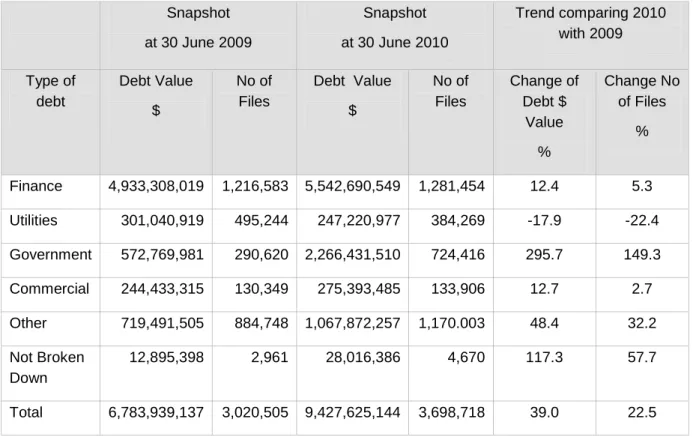
Figure 3: Total Value of Debts Under Collection by ACBDA Members By Type Of Debt
Snapshot at 30 June 2009
Snapshot at 30 June 2010
Trend comparing 2010 with 2009 Type of
debt
Debt Value $
No of Files
Debt Value $
No of Files
Change of Debt $
Value %
Change No of Files
%
Finance 4,933,308,019 1,216,583 5,542,690,549 1,281,454 12.4 5.3 Utilities 301,040,919 495,244 247,220,977 384,269 -17.9 -22.4 Government 572,769,981 290,620 2,266,431,510 724,416 295.7 149.3 Commercial 244,433,315 130,349 275,393,485 133,906 12.7 2.7 Other 719,491,505 884,748 1,067,872,257 1,170.003 48.4 32.2 Not Broken
Down
12,895,398 2,961 28,016,386 4,670 117.3 57.7
Total 6,783,939,137 3,020,505 9,427,625,144 3,698,718 39.0 22.5
3. The regulatory framework – key
problems
Two significant problems currently exist in relation to the current regulatory framework, they are:
legislative inconsistency across jurisdictions
the ineffectiveness of the consumer protection elements of the current regulatory framework.
3.1 The licensing framework
Inconsistency within the existing debtcollection regulatory framework is reflected in the range of state, territory and
Commonwealth regulation that exists and the differing evolutionary path that each has followed.
The framework represents a ‘patchwork’ approach to the regulation of debt collection, which leads to a range of associated
regulatory costs.24
24
The regulatory costs of the current framework vary across jurisdictions and depend on the stringency of the licensing regulation. Costs increase if the debt collector collects debts across a range of states and territories because, despite the ambiguity, they may need to be licensed in that state or territory they are collecting the debt. For example, when a debt collector in Victoria was required to be licensed, they were imposed approximately $6000 of regulatory costs per year to be able to collect debts in Victoria (See Price Waterhouse Coopers (2010) Standard Cost Model Assessment for Changes to the Travel Agents Act 1986, Introduction Agents Act 1997 and the Private Agents Act 1966, April, Melbourne: PWC). If that Victorian debt collector wanted to collect a debt in New South Wales they would then be imposed that jurisdiction’s licensing costs, such as a more stringent licensing application (having to get it processed via the police for example, which may increase ‘time costs’ due to processing delays). ACDBA has argued that licence processing delays can take up to 72 days with loss of income and overhead costs of up to $100K (See Australian Collectors Association (ACA) (2008) Submission to CAPI Act Review, June, Newcastle: ACA, p 16.) and education requirements. More costs would be imposed on that debt collector for collection in any other Australian jurisdiction, depending on the stringency of the regulatory requirements of that jurisdiction.
Background to licensing acts
The objectives and requirements of debt collection regulation have historically not differed greatly from jurisdiction to jurisdiction, though there is some variation in how they have evolved. For example, licensing
regulation existed primarily to protect creditors against problems of fraudulent debt collectors or their defalcation. This is reflected in prescriptive licensing and trust account provisions and the initial police administration of that regulation, which has continued in some jurisdictions (New South Wales and
Tasmania).
Gradually the regulation re-orientated itself towards consumer protection and raising the standards of the industry. This is highlighted by conduct and training provisions, and office of fair trading administration of that regulation occurring in most jurisdictions.
The legislation was introduced in a time where the industry lacked professionalisation and specialisation. Therefore, debt collectors were regulated to protect their clients (creditors) and were traditionally grouped together with ‘investigation agents’ or ‘commercial agents’. For example, the Private Agents Act 1966 (Vic) before it was repealed was introduced to ensure that:25
“commercial agents are of such character, and that their practices are such as would make them suitable to perform the functions of a commercial agent
“that they have lodged or will be capable of lodging, a fidelity bond of a
stated amount as a measure of protection against loss of clients’ money.”
The Minister’s Second Reading Speech suggests that the Act was introduced to protect creditors. It states that the objectives of the legislation with respect to debt collectors were “to regulate the activities of debt collectors by applying to them a licensing system of control similar to that now in force with respect to process servers and inquiry agents, with special provisions relating to the keeping of a separate trust account and the lodgement with the court of a fidelity bond from an insurance company.”26 This approach is similar in other jurisdictions.
Although some jurisdictions have more recently enacted legislation compared to Victoria, and have sporadically included training requirements or general conduct provision for consumer protection, the same fundamental objectives and requirements contained in the Victorian Act are still evident. This is reflected in part in the titles of the legislation, which all reflect the grouping of debt collectors with other ‘agents’, and with that, the main objective of protecting the agent’s principal (such as the creditor through the use of trust accounts) rather than the debtor.27
Overview of state and territory debt collection licensing
Today, all Australian jurisdictions licence debt collectors with the exception of the Australian Capital Territory (ACT) and, since 1 July 2011, Victoria.28 Licensing requirements differ
26
Ibid, p. 784.
27
For example, South Australia (Security & Investigations Agents
Act 1995), Tasmania (with the Security & Investigations Agents Act 2002) and New South Wales (Commercial Agents & Private Agents Act 2004), though all Acts reflect similar approaches.
28
Victoria recently reformed its regulatory framework for debt collectors by abolishing its licensing scheme, and replacing it with a negative licensing system that sees any person who is convicted of engaging in coercion, physical violence or undue harassment under Fair Trading Act 1999 (or a range of other legislation) automatically prohibited from acting as a debt collector. It also
considerably between jurisdictions and require collection agents to engage in a range of compliance and education activities. Appendix 1 contains a comparative table that highlights the jurisdictional inconsistencies and overlap within the debt collection regulatory framework. The current objectives of licensing legislation include seeking to ensure that:
debt collectors are of the good character required to perform the functions of debt collectors (licensing application);
the standards of the industry are high by ensuring collectors know legislative and other requirements (education and training);
creditors are protected from defalcation (trust accounts); and
consumers are protected from certain practice (prohibited conduct
provisions).
The regulators that administer and enforce this regulation also vary from police to fair trading agencies, or a combination of both, which further increases regulatory inconsistency. The ACT, like New Zealand, does not require licensing for debt collectors, relying instead on provisions against harassment and coercion contained in the Australian Consumer Law. No legislation exists to exclude debt collectors who have been found guilty of using undue harassment, coercion or physical force from continuing in the industry. Likewise, no
provisions exist to protect creditors in the event that a collection agent defaults, and collection agents are not required to have a trust account.
Variations also exist throughout jurisdictions with regard to the definitions of a ‘debt collector’; process of application, such as who determines them, the grounds, what
retained its fair debt collection practices provisions applying them directly to the conduct of debt collectors.
qualifications are required; and distinctions between master and operator licences. For this reason the interaction between state and territory licensing requirements is difficult to interpret. For example, a person ‘carrying on the business of debt collection’ in NSW is required to be licensed. However, if that debt collector is pursuing a debt interstate, ambiguity exists whether they are required to be licensed interstate.29
Furthermore, ACDBA has suggested that the framework for regulation in most jurisdictions does not recognise the distinct specialisations involved in collecting debts, such as debt collecting over the phone compared with field calls, and that licensing requirements that apply generally (rather than separately) to both of these areas can be unnecessarily
burdensome.30
Protections within licensing acts
With the exception of Victoria and the ACT, all licensing systems require collection agents to establish trust accounts, and also impose varying degrees of record-keeping and audit requirements on the holders of those accounts.31
Most jurisdictions’ licensing legislation (with the exceptions of Western Australia and South Australia) also prohibit collection agents engaging in harassing behaviour (over and above similar provisions in the ACL32). Unlike Victoria's recently repealed licensing
legislation, direct penalties can attach to breaches of these provisions in other jurisdictions. Such measures enable the regulator to directly regulate debt collection
29
This is highlighted in Institute of Mercantile Agents (2007) ‘Collectors Under the Gaze of Interstate Regulators’, AGENT, June/July, Volume 40, Issue 3, Newcastle: IMA, pp 6-7.
30
ACDBA (2011) op cit, p 8.
31
The purpose of a trust account is for the protection of creditors (and the defalcation of the debt collector).
32
The ACL largely replicates the harassment and coercion provisions that were contained in section 60 of the Trade Practices
Act 1974 (Cth). It also contains general prohibitions on misleading
or deceptive conduct, as well as the capacity for banning and disqualification orders.
practices, with high penalties for non-compliance.
For example, section 25 of New South Wales’
Commercial Agents and Private Inquiry Agents Act 2004 prohibits third party collectors from
leaving notices, vehicles or other objects outside a debtor’s premises indicating that the licensee is visiting the premises,
communicating at times that are unreasonable in their frequency or time, and disclosing to the person’s employer that the person is a debtor. Western Australia and the Northern Territory require collection agents to pay sureties to compensate creditors in the event of default. On the other hand, Tasmania, New South Wales, South Australia and Queensland do not require such sureties.
Many creditors, being commercial operations, would be in a position to make assessments about credit risks given most transactions entered into are commercial arrangements, and may be one-off jobs for creditors of failing companies.
It is possible that trust accounts are not needed and that “protection of creditors from low quality debt collectors does not appear to be warranted and affords little public benefit”.33 Queensland requires collection agents to engage in, and refrain from, certain types of behaviour under a mandatory code of conduct. New South Wales’ regulations also prescribe a range of behaviours to be followed, including providing the debt collector’s name and licence number, and providing evidence of the debt on demand.
Licensing training requirements
New South Wales (Certificate III in Financial Services (Mercantile Agencies)), South Australia and Tasmania (both requiring three units from the Diploma in Financial Services (Credit Management and Mercantile
Agencies)) impose education requirements on
33
See Consumer Affairs Victoria (2008) Modernising Victoria’s
Consumer Policy Framework: Collection Agents and Debt Collection, October, Melbourne: CAV, p 20; and, Freehills
Regulatory Group (1999) National Competition Policy Review of
commercial agents. Queensland retains a power to prescribe qualifications but has not done so to date.
ACDBA has argued 34 that the prescribed training is inflexible to market changes and ignores the broad legislative environment in which collectors work, including consideration of the ACCC-ASIC Debt Collection Guidelines and the Privacy Act. These are key compliance areas for the debt collection industry. In
addition, the qualifications can only be obtained through a Registered Training Organisation, which is a substantial cost imposition.
Consequently, industry associations run intensive internal training programs to ensure their employees understand the legislative environment in which they work and the agency’s specific approach to debtor management and compliance. These standards are often requirements of
membership to industry associations, which include annual refresher courses.
3.1.1 Exemptions
Each state and territory exempts a large sector of the debt collection industry, such as banks, other finance companies, legal practitioners and accountants. Additionally, firms that collect debts in-house are not required to be licensed. The following are examples of who may be exempted in Australia. These are based on the Commercial and Private Inquiry Agents Act 2004 (NSW), though each jurisdiction is quite similar:
any state police officer
any police officer of the Australian Federal Police
any member of the Australian Defence Force
any officer or employee of the Commonwealth or of any other State or Territory
34
See the Australian Collectors Association (2008) Submission to
CAPI Act Review, op cit, p 13.
any officer or employee of a public authority of the Commonwealth or of any other State or Territory
any legal practitioner or legal practitioner’s clerk
any registered company auditor within the meaning of the Corporations Act 2001 (Commonwealth)
any insurance company registered under the Insurance Act 1973
(Commonwealth), any person carrying on the business of an insurance loss adjuster on behalf of an insurance company so registered and any employee of any such insurance company or of any person carrying on any such business
any officer or employee of an authorised deposit-taking institution within the meaning of the Banking Act 1959 (Commonwealth).
Some of these exemptions may create weaknesses in the consumer protection provisions those particular Acts provide.
3.2 The credit model
The National Credit Act has introduced a comprehensive national licensing system for persons who undertake ‘credit activities’. This framework applies to debt collectors, but only in the context of debts arising out of consumer credit.
This regulatory framework ensures that any party that collects debts on behalf of a credit licensee must be either a licensee or authorised in writing by the licensee as a ‘credit representative’, with the intent of making the holder of the credit licence ultimately responsible for the conduct of the credit representative. In addition, any person who is an assignee of the debts of another credit provider (for example, purchasing the debts of the original credit provider) would be required to obtain a licence.
Debt collectors who fall within scope of the National Credit Act must hold an Australian Credit Licence and have the same
requirements imposed upon them that apply to credit providers. Generally, the main reforms relating to debt collection are:35
minimum training requirements with adequate financial and human resources to meet their obligations.
enhanced standards of conduct including a requirement to act honestly, efficiently and fairly, and to properly train and supervise people who act on their behalf.
mandatory membership of an EDR scheme36
The power for ASIC to take action promptly to cancel or suspend a licence or ban people from engaging in credit activities Australia-wide.
These requirements will provide consumers and industry valuable tools to adhere to their responsibilities throughout the debt collection process.
However, the National Credit Act’s Regulations currently exempt certain persons engaging in debt collection activities (such as those already licensed or authorised under specific state legislation regulating debt collectors) from the requirement to hold a licence. This exemption does not apply to debt collectors collecting assigned debts (for example, where they have purchased the debts from the lender) who still have to be licensed. The rationale here is that those collecting assigned debts become a credit provider because they have been assigned the rights of the debt. Therefore, in the interests of consumers they are transferred
35
A table containing all the requirements can be found at Appendix 3.
36
Consumers will have access to a three-tiered dispute resolution process for credit issues. They will have access to the credit provider’s and credit service provider’s internal dispute resolution process as a first point of dispute resolution, then the EDR scheme.
the same responsibilities as would a credit provider under the Act.
The exemption means that debt collectors that simply collect debts on behalf of a credit provider are not subject to state or territory licensing obligations as well as those under the credit framework.
3.2.1 ACCC-ASIC debt collection guidelines
In 2005, ACCC and ASIC jointly published Debt Collection Guidelines: for Collectors and Creditors (the Guidelines)37, replacing earlier Guidelines published in 1999.
The Guidelines are intended to assist persons or corporations engaged in debt collection to understand their legal obligations when collecting debts. The Guidelines outline conduct that ACCC and ASIC consider best practice for collectors and provides some examples of what may be considered misleading or deceptive, or unconscionable conduct, or action that may constitute undue harassment and coercion.38
Earlier guidelines have been described by French J (as he was then) as “helpful prudential guidelines for conduct which, if adhered to, should minimise the risk of
contravening the law.”39 However, as French J stated, ultimately the “publication is not a statement of the law. It can only be a guide.”40 The Guidelines do not, in themselves, have any legal force.
Only the courts can provide definitive interpretations of what constitutes undue harassment or coercion. As such, the Guidelines cannot be said to function as a substitute for the kind of statutory guidance
37
ACDBA and IMAL have indicated that the Guidelines are the main instrument that allows them to guide their practices in a consistent manner.
38
ACCC-ASIC (2005) Debt Collection Guidelines: For Collectors
And Creditors, October, ACCC/ASIC: Melbourne and CAV (2004) Victorian Guidelines for debt collection, CAV: Melbourne.
39
ACCC v McCaskey [2000] FCA 1037, [58].
40
provided by laws such as the ACL and Victoria's Fair Trading Act 1999. Furthermore, the Guidelines are secondary to any rights and responsibilities created by any other relevant laws, or by mandatory codes of conduct, which are discussed below.
By complying with the Guidelines, businesses may minimise the risk of breaking the law. However, should a business choose not to comply with the Guidelines, enforcement may be difficult because regulators are left to rely on the high level concepts embodied in the ACL such as ‘undue harassment’, ‘coercion’ and ‘misleading or deceptive conduct’. As discussed below, reliance on high level concepts can make it difficult to take effective compliance action.
3.2.2 Other industry arrangements
Other legislation
In addition to the general state and territory licensing regulation and the requirements of the ACL, there is a range of other State and Commonwealth legislation that may need to be adhered to, as well as a range of industry codes that may apply depending on the industry of collection. 41
This is in addition to legislation governing the service of process and statutory notices, legal repossession activities and enforcement of securities interests, obligations under industry licensing schemes and any orders made by a court, all of which are out of scope for this particular project.
Codes of conduct
The regulatory framework covers a range of different industries that involve debt collection activities, such as telecommunications, energy (electricity and gas) and water. These
41
Such as the Privacy Act 1988, Australian Securities and
Investments Commissions Act 2001, Bankruptcy Act 1966, Financial Services Reform Act 2001, the National Consumer Credit Protection Act 2009 and the Corporations Act 2001. State-based
legislation dealing with unauthorised documents, information privacy and the recovery of judgment debts may also apply.
industries have codes of conduct that include complaints procedures, debt management and debt collection practices. Industry members (such as utility providers) are required to comply with these codes, in addition to the general legislative requirements discussed earlier in this paper. They are also responsible for third party debt collectors collecting debts on their behalf.
Similar to the credit model, utility companies (telecommunication companies, energy and water suppliers) must belong to independent EDR schemes as part of their requirements, such as the:
Telecommunications Industry Ombudsman Electricity and Water Ombudsman (Vic) Electricity and Water Ombudsman (NSW) Essential Services Consumer Council (ACT) Energy Ombudsman (TAS)
Energy Ombudsman (WA)
Energy Industry Ombudsman (SA) State Ombudsman (NT)
Energy Consumer Protection Office (QLD) Nationally, the Australian Energy Regulator monitors, investigates and enforces
compliance with the national energy framework [comprising the National Electricity Law
(Electricity Law) and National Electricity Rules (Electricity Rules), the National Gas Law (Gas Law) and National Gas Rules (Gas Rules)] and associated regulations.
These laws do not in themselves encompass debt collection requirements, though different codes may be enforced at state and territory level. In Victoria for example, the Energy and Water Ombudsman Victoria can investigate debt collection issues, even though an energy or water company may have outsourced the debt to a debt collection agency. The
complaint must relate to the agency’s action on an outstanding energy or water bill.
The Essential Services Commission regulates the Victorian retail energy industry and
protects consumers by ensuring that all energy providers adhere to legislated codes,
regulations and guidelines. The Energy Retail Code (2009)42 states, for example, that an energy retailer:
Must comply with guidelines on debt collection issued by the Australian Competition and Consumer Commission concerning section 60 of the Trade Practices Act 1974 (Cwth). (This section relates to the prohibition of physical force, harassment and coercion, and is now section 50 of the Competition and Consumer Act 2010]
Similarly, at a national level, the
Telecommunications Industry Ombudsman can ensure that a telecommunications
company (such as an internet service provider or phone company) acts in accordance with its debt collection policy, and in accordance with any payment plan it may have negotiated with a customer. For example, the
Telecommunications Consumer Protections Code (2007) states that a supplier must ensure that:
its compliance arrangements with debt collection agencies require that the collection methods employed are not harsh and unconscionable at law, constitute undue harassment or are otherwise unlawful disreputable or offensive inconsistent with the standards approved by any relevant industry body
its debt collection agents comply with accepted professional and ethical standards for collection of debts and have compliance systems which accord with principles of the current Australian Standard on Compliance Programs
42
The National Energy Retail Code has replaced the respective state energy codes, though the requirements are similar.
have complaint handling processes which generally accord with the current Australian Standard on Complaint Handling.
With regard to third-party action, the Telecommunications Code states that a supplier must take all reasonable steps to:
ensure that debts sold or assigned to third parties or listed with a credit reporting agency do not include any unresolved service or billing issues involving disputed account balance amounts
resolve any billing or service issues that arise after an amount has been sold or assigned to a third party. Industry associations
Debt collectors that are members of an
industry association are required to incorporate aspects of the legislation and guidelines into their business contracts as a condition of the particular association’s membership. For example, members of ACDBA have service agreements in place that specify conduct and account management standards for members. These are in addition to statutory requirements. ACDBA members’ service agreements typically contain the following obligations:
performance standards, including quality management systems duties, obligations and warranties compliance with relevant legislation – including the ACL and Fair Trading Acts (FTAs), National Credit Act, Privacy Act and the ACCC-ASIC Guidelines
dispute resolution procedures
reporting obligations
auditing requirements.
The agreed contractual obligations can increase standards of debt collection for members and may contain more stringent