1953
Adaptive position based Secured routing protocol for Mobile Ad Hoc Networks N. Senthil kumar 1, Dr. R. K. Gnanamurthy 2
1.
Department of ECE, Vivekanandha College of Engineering for Women, Tiruchengode, India
2.
Dean of ECE, Odayappa College of Engineeringg and Technology, Theny, India [email protected]
Abstract: To develop routing protocol is an big challenge that meets the needs of different applications. There are several routing algorithm in mobile adhoc network, to make routing decisions at each node. It utilizes topology information. In location based routing protocols, nodes location information are used instead of node links. In position based routing protocols, the position information of its neighbor and packet destination node will be in the packet source node with its position information. In this we proposed a position based routing protocol called greedy. Most forward within radius (MFR) by using this packet forwarder node or source node, send packet to its neighbor, which is more forward towards destination node. Forward packet to neighbor nodes are not suitable for a condition by using distance deciding metric in greedy. The packet loss probability will increase, if the speed or battery power of closest neighbor towards destination node is more than the source or intermediate packet forwarder node. The proposed system uses combination of both position & energy routing protocol, which divides neighbor to send the packet.
[N.Senthil kumar, R.K.Gnanamurthy. Adaptive position based Secured routing protocol for Mobile Ad Hoc Networks. Life Sci J 2013;10(3):1953-1958] (ISSN:1097-8135). http://www.lifesciencesite.com. 289
Keywords: Mobile Ad-Hoc Network, Position based routing, MFR, greedy. 1. Introduction
Mobile ad-hoc networks (MANETs) are infra structure free networks of mobile nodes that communicate with each other in wireless mode. The several routing schemes have been proposed and several of these routing schemes have been extensively simulated and also implemented. The primary applications of such networks have been in military use, disaster relief operations, conferencing and environment sensing. To make routing decisions at each node in the network, There are several ad hoc routing algorithms at present that utilize topology information. The aim of this work is to utilize position information to provide more reliable as well as efficient routing for certain applications. Existing position based routing algorithm have been extended to work more efficiently even in cases where they are not working in presently implemented algorithms for implemented applications.
Most of the routing protocols for sensor networks require location information for sensor nodes. Calculate the distance between two particular nodes, the location information is needed. So that energy consumption can be estimated. In energy efficient way location information can be utilized in routing data. For sensor networks like IP-addresses, there is no addressing scheme since they are spatially deployed on a region. For instance, query can be diffused using the location of sensors, if the region to be sensed is known. Only to that particular region which will eliminate the number of transmission significantly. Using GPS (Global Positioning System), the location
of nodes may be available directly by communicating with a satellite, if nodes are equipped with a small low power GPS receiver. These protocols select the next-hop towards the destination based on the known position of the neighbors and the destination. The destination position may denote either centric region or the exact position of a specific node. The communication overhead caused by flooding can be avoided by location-based routing protocols, but the calculation of the positions of neighbors may result extra overhead. To save energy, some location based schemes demand that nodes should go to sleep if there is no activity. By having as many sleeping nodes in the network more energy savings can be obtained. The local minimum problem is also common for all decentralized location-based routing protocols: it might happen that all neighbors of an intermediate node are farther from the destination than the node itself. In order to overcome this problem, every protocol uses different routing techniques.
2. Material and Methods
Geographic non-Geographic routing
Geographic routing based only on local information and without the need for any extra infrastructure, it provides a way to deliver a packet to a destination location, which makes geographic routing the main basic component for geographic protocols. Geographic routing provides the most efficient and natural way to route packets comparable to other routing protocols, while the existence of location information.
1954 A certain geographic area, Geocasting is the delivery of packets to nodes. It is an extension to geographic routing where in this case the destination is a geographic region instead of a specific node or point. In wireless sensor networks Geographic Adaptive Fidelity and Geographic Energy Aware Routing in Ad Hoc Routing Geocasting is an important communication primitive. In certain region the target is to reach nodes in many applications. Geographical locations are used as a rendezvous place for providers and seekers of information, in geographic-based rendezvous mechanisms. For service location and resource discovery using the Geographic-based rendezvous mechanisms is efficient in addition to data dissemination and access in sensor networks. Due to the high dynamics and limited resources Routing in ad hoc and sensor networks is a challenging task. There has been a large amount of non-geographic ad hoc routing protocols proposed in the literature that are either proactive (maintain routes continuously), reactive (create routes on demand)
Due to the frequent topology changes, non-geographic routing protocols suffer from a huge amount of overhead for route setup and maintenance since limit their scalability and efficiency, they typically depend on flooding for route discovery or link state updates. On the other hand, geographic routing protocols are very efficient in wireless networks and it requires only local information. First, nodes need to know only the location information of their direct neighbors in order to forward packets and hence the state stored is least. Second, since discovery floods and state propagation are not required beyond a single hop the protocols conserve energy and bandwidth. Third, geographic routing has fast response and can find new routes quickly by using only local topology information in mobile networks with frequent topology changes. In the discussion of geographic routing mechanisms we use the following assumptions:
1. Some localization mechanism used to Each node knows its geographic location. For many wireless network applications the location awareness is important, so the wireless nodes will be equipped with localization techniques. Several techniques exist for location sensing based on proximity or triangulation using radio signals, acoustic signals, or infrared. Localization granularity, deployment complexity, and cost are differing in this technique. Many localization systems have been proposed in the literature: Infrastructure based localization systems, GPS (Global Positioning System) and ad-hoc localization systems. 2. Each node knows its direct neighbour’s locations. This information could be obtained by nodes
periodically or on request broadcasting their locations to their neighbours.
3. The source knows the destination location. Each node knows the location of its direct neighbours (neighbours within its radio range) in geographic routing. Inside the packet, source inserts the destination location. Each node uses the location information of its neighbours and the location of the destination to forward the packet to the next-hop, during the packet forwarding. A single node or multiple nodes can be forwarded. Forwarding to multiple nodes is more robust and leads to multiple paths to the destination, but it could waste a lot of resources (energy and bandwidth) and thus forwarding to a single node is more efficient and it is the common approach among unicast protocols. Greedy forwarding is a main component of geographic routing, in which the packet should make a progress at each step along the path. Each node forwards the packet to a neighbour closer to the destination than itself until ultimately the packet reaches the destination. Greedy forwarding is guaranteed to be loop-free, If nodes have consistent location information.
Greedy algorithm
Under this approach, a node decides about the transmission path based on the position of its neighbors. To proceed, the localization of the destination with the coordinates of its neighbors compared by the source. Then, it propagates the message to the neighbor which is closest to the final destination. The packet reaches the intended destination until the process is repeated. Several metrics related to the concept of closeness have been proposed for this context. Among them, the Euclidean distance and the projected line joining the relaying node and the destination are the most popular metrics. With this strategy, the network is able to adapt proficiently to the topological changes and flooding processes are restricted to one hop. According to the reliability of links, this simple forwarding rule is modified. In this proposal, the unreliable neighbors are not taken into account for the retransmissions. On the other hand the SPEED (Stateless Protocol for End-to-End Delay) to estimate the delay of the transmitted packets are used in the geographic information. Similar to this algorithm, the greedy algorithm with the “most-forward-within-R forwarding technique opts to select the most distant neighbor of the packet holder which is closer to the final destination as the next hop. In contrast, the “nearest-forward-process chooses the nearest neighbor that is closer to the intended destination as the next relaying node. The transmission may fail when the current holder of the message has no neighbors closer to the destination is the main limitation of the greedy algorithms. For instance, when an obstacle is present, greedy could
1955 occur even when there is a feasible path between the two extremes.
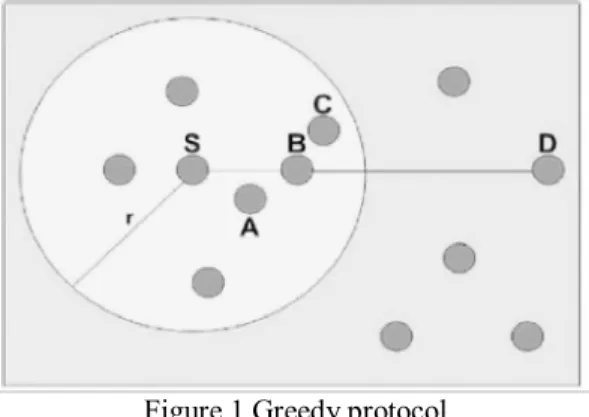
The circle with radius r indicates maximum transmission range of S. One strategy is forwarding packet to closest neighbour to destination D. node S sends packet to node C using this strategy. This strategy is known as MFR, it tries to minimize the number of hops a packet has to traverse in order to reach D. In another strategy named NFP (Nearest with Forward Progress), packet sender node, sends packet to its nearest neighbour node (its closest neighbour with forward progress towards destination node). In Fig. 1, by using this strategy, node S sends packet to node A. packet sender node sends packet to neighbour closest to supposed straight line between sender and destination nodes in compass routing strategy, by using this strategy, node S sends packet to node B
Figure 1 Greedy protocol MFR
It is a progress-based algorithm, in which data is forwarded to the neighbor with the greatest progress as in figure 2. Its objective is to maximize obtainable expectable progress in a certain direction. If no node is in the forward direction, within the range of the sender, the message is sent to the neighbor node with the least backward progress. This algorithm minimizes the number of hops, but doesn’t minimize energy consumption. In inhomogeneous node density (for uniform Poisson distribution of nodes), it is recommended for short range transmission because of the low possibility of packet collision. Another version is proposed (f-MFR), which uses flooding to guarantee delivery and eliminate looping. F-MFR is not presented in the tables.
Position based routing
Mobile ad-hoc network frequently change their topology without prior information, which makes routing in such networks is a challenging task. A position-based routing algorithm has lot of advantages over topology-based routing by using additional information. The participating nodes physical position information should require in the network. By the use
of GPS, each node finds its own position or from some other positioning service. Mainly Two issues were focused on Position based routing to determine the position of the destination, sender of a packet uses a location service, which include it in the packet's destination address to forward the Packets forwarding strategy is used. At each node routing decision is based on the destination's position contained in the packet and the position of the forwarding node's neighbors. Position-based routing does not require the maintenance or establishment of routes. To keep routing tables up-to date, the nodes neither have to store routing tables nor do they need to transmit messages.
Figure 2 illustration process with MFR Routing Design Parameters
The performance of position-based routing algorithms can be judged according to the provision they offer for important design parameters. Problems may appear during routing such as packet cycling around the network without reaching their destination, packets being dropped and never being retransmitted due to node failure, package copies being transmitted in the network redundantly, consuming energy unnecessarily. Routing performance can be rated by the way protocols handle network challenges such as these. So, it is necessary to analyze the qualitative and quantitative routing characteristics of position-based protocols, as proposed, as well as other features which have not been given the same consideration. This is especially important when considering the implementation of a certain position-based routing protocol for a specific application.
3. Results and Discussion
The simulation parameters shows that the scenario is created for 50 nodes by enabling AODV routing protocol considering neigh boring nodes (with & without energy), as shown in Figure 4. In this paper, the proposed Greedy strategy was implemented by using Network Simulator (NS-2). The simulation
1956 environment has been shown in Table 1. In real network, each node finds its position by a positioning system like GPS, but in simulation, the energy is applied to every node, its position without any expense. Periodically, every node propagates its position to its neighbors, in real network and in simulation. The packet source node finds the location of destination node by a suitable location server in real network, but we give position of destination node, to source node in simulation, without any expense. To simulate greedy (MFR), sender node calculates, the distance between its neighbors and destination node, and sends packet to its closest neighbor to destination node [1].
Figure. 3. Node (A) with most forward progress towards destination (D), has high speed in compare
with the source node (S).
Figure. 4. Node (A) with most forward progress towards the destination (D), has very low remained
battery power.
In the simulation environment, the proposed strategy, sender node selects some (in this simulation, this number is 5) closer neighbor nodes to destination node, and again selects some (in this simulation, this number is 3) of them, which have more similar speeds to its own speed (the nodes with less speed difference with sender node speed) and finally, selects one of them which has most remained battery power and
sends packet to it. We define two scenarios, in the first one: neighbor nodes have low speed, in compare with the source node or intermediate packet forwarder node speed. In second one, the neighbour nodes have high speed, in compare with the source node or intermediate packet forwarder node speed [1].
Table 1. Simulation Environment
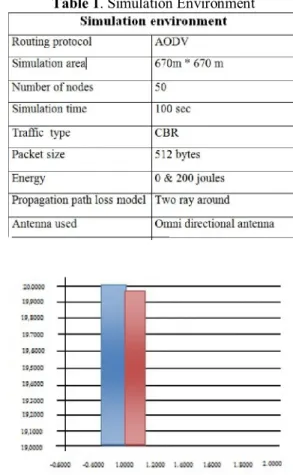
Figure 5.Packet Delivery Ratio
We simulated Greedy and proposed scheme and compared them by their packet delays and lost packets ratios.
The strategies Packet delivery Ratio
The simulation results shown in Figure 6, the neighbor nodes have high speed, Greedy protocol has less packet delay. Because of lost packets, there will be less congestion and there are less packets, waiting in nodes queues, in less delay packets are received by destination node.
The strategies node with energy and without energy
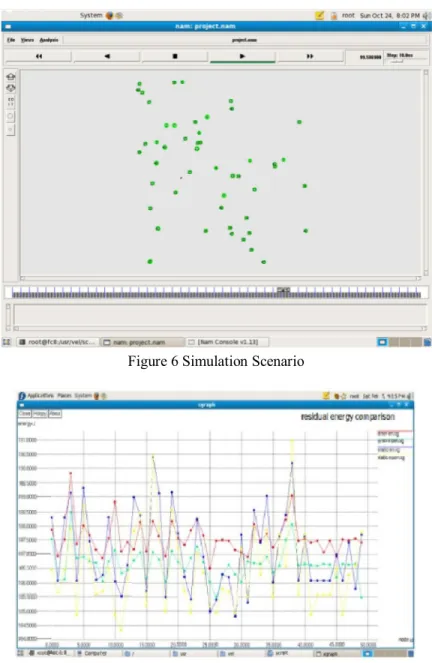
Figure 7 gives a comparative study of the nodes by considering with and without energy. The residual energy of greedy protocol consumes less energy when compared to the node with energy.
The graph has plotted between energy Vs nodes for the following cases, by considering:
1957 1. Static nodes with energy
2. Static nodes without energy 3. Dynamic nodes with energy 4. Dynamic nodes without energy
From the graph, by comparing static nodes with and without energy the average energy consumed by the static nodes was higher than the other conditions. By comparison, the dynamic node with energy consumes less power than the other three cases.
Figure 6 Simulation Scenario
Figure 7 Node Vs Residual Energy Secured protocols
Routing protocols should look at this, especially because some of these protocols applied in areas such as national crises, military (battlefield) operations and emergency operations. The MANETs unique characteristics combined with security threats, securing ad hoc networks in commercial and military applications. The design of the secure multicast routing protocols include open peer-to-peer network
architecture, shared wireless medium, demanding dynamic network topology and resource constraints. In routing moving packets around in a network is an challenging task. Any node can perform the role of the router in MANET which is an major problem and security concepts were not included into the routing protocols when they were designed. The routing table forms the basis of the network operations so it is important. Among several security protocols, no
1958 approach fit for all networks because there is a nodes variation c between any devices.
MANETs has no fixed infrastructure and by batteries nodes are powered with a limited energy supply. Nodes stops functioning when the battery drains. it is impossible to replace or recharge a mobile node, powered by battery during mission, It is a difficult challenge to provide energy efficiency. So energy efficiency is an important consideration. in the way energy consumption is minimized in the way Traffic should be routed. By using energy saving techniques total power consumption is minimized which is possible by minimizing the control overhead and maximizing the lifespan.
Conclusion
In this paper position based secured routing is presented with the protocol called greedy. Source or intermediate node, forward packets to its closest neighbor towards destination node. Packet loss probability increases, if closest neighbor towards destination has high speed and low battery power comparing source and intermediate packet forwarder node. The proposed method improves greedy and its reliability, by adding matrices likes power and velocity. The proposed strategy uses combination tradeoff between metrics distance-energy routing protocol, which decides the neighbor, to which packet should be forwarded. The proposed strategy greedy with MFR improves reliability with lower lost packets. For maintaining location privacy routing along with efficiency is done by Secured Position Based Routing .mobile ad-hoc networks with many application has an wide area of research with emerging solution
Corresponding Author: N. Senthil kumar
Department of ECE, Vivekananda College of Engineering for Women, Tiruchengode, India.
Email:[email protected] References
[1] N.Senthil Kumarl, Dr.R.K.Gnanamurth, N.Senthil vel,”Certain Investigations on Adaptive Routing Protocol Based on Geo location, Energy and Mobility for MANETS” Computing Communication & Networking Technologies (ICCCNT), 2012 Third International Conference [2] I. S. a. L. Xu, "Loop-free hybrid
single-path/flooding routing algorithms with guaranteed delivery for wireless networks," IEEE Transactions on, vol. 12, 2001,pp. 1023-1032. [3] S. Giordano, I. Stojmenovic, “Position based
routing in ad hoc networks, a taxonomy”, Ad Hoc Wireless Networking, 2004, pp. 103-136.
[4] Holger Fubler, Martin Mauve, Hannes Hartenstein, Michael Kasemann, Dieter Voltmer, "Mobile computing and communication review", ACM SIGMOBILE Journal, Vol. 1, Issue 2,2001, PN. 20- 30.
[5] David Johnson, 'Routing in ad hoc networks of mobile hosts", IEEE workshop on mobile computing systems and applications, Vo18- 9, Issue1,1994 ,PN. 158-163.
[6] Elizabeth Royer, Chai-Keong Toh, "A review of current routing protocols for ad hoc mobile wireless networks", IEEE personal communication, Vol. 6, Issue 2,1999, PN. 46-55. [7] Marc Heissenbuttel, Torsten Braun, David Jorg,
Thomas Huber, "A framework for routing in larg ad-hoc networks with irregular topologies", ad hoc& sensor wireless networks Journal, Vol. 1,2005 Issuel, PN.l-24.
[8] S. Giordano, I. Stojmenovic, L. Blazevic, " Position based routing algorithms for ad hoc networks :A TAXONOMY", University Of Ottawa, White Paper http://www.site.uottawa.cal-ivan/routingsurvey. pdf,2002.
[9] I. Stojmenovic, " Position-based routing in ad hoc networks", IEEE Communications Magazine, vol. 40, Issue 7, pp. 128-134, 2002.
[10] K.Akkaya, M.Younis, A survey on routing protocols for wireless sensor networks, Ad Hoc Networks, May, 2005, pp. 325-349.
[11] R.V. Biradar, V.C.Patil, S.R. Sawant, R.R. Mudholkar, Classification and Comparison of routing protocols in wireless sensor networks, Special Issue on Ubiquitous Computing Security Systems, Vol. 4, July, 2009, pp. 325-349
[12]. K. El Defrawy and G. Tsudik, “Alarm: Anonymous location-aided routing in suspicious manets,” IEEE ICNP 2007,oct.2007 ,pp. 304–313. [13]. Joo-han-Song, Vincent.W.S.Wong, “Secure position based routing protocol for Mobile ad hoc networks position based routing protocol for Mobile ad hoc networks” Science Direct ,June 2006.
[14]. Karim El Defrawy, et al, “ Privacy-Preserving Location-Based On-Demand Routing in MANETs” IEEE Journal On Selected Areas In Communications, VOL. 29,NO. 10, DECEMBER 2011 NO. 2003.
[15] G. Xing, et al., "On greedy geographic routing algorithms in sensing-covered networks," 2004, pp. 31-42.
[16] P. J. Wan, et al., "Asymptotic critical transmission radii for greedy forward routing in wireless ad hoc networks," Communications, IEEE Transactions on, vol. 57,2009, pp. 1433-1443.