Technical Specification
Universal Mobile Telecommunications System (UMTS);
3G Security;
Lawful Interception Architecture and Functions
(3GPP TS 33.107 version 3.1.0 Release 1999)
Reference
RTS/TSGS-0333107UR1
Keywords
UMTS
ETSI
650 Route des Lucioles
F-06921 Sophia Antipolis Cedex - FRANCE
Tel.: +33 4 92 94 42 00 Fax: +33 4 93 65 47 16
Siret N° 348 623 562 00017 - NAF 742 C Association à but non lucratif enregistrée à la
Sous-Préfecture de Grasse (06) N° 7803/88
Important notice
Individual copies of the present document can be downloaded from:
http://www.etsi.org
The present document may be made available in more than one electronic version or in print. In any case of existing or perceived difference in contents between such versions, the reference version is the Portable Document Format (PDF). In case of dispute, the reference shall be the printing on ETSI printers of the PDF version kept on a specific network
drive within ETSI Secretariat.
Users of the present document should be aware that the document may be subject to revision or change of status. Information on the current status of this and other ETSI documents is available athttp://www.etsi.org/tb/status/
If you find errors in the present document, send your comment to: [email protected]
Copyright Notification
No part may be reproduced except as authorized by written permission. The copyright and the foregoing restriction extend to reproduction in all media.
© European Telecommunications Standards Institute 2000.
Intellectual Property Rights
IPRs essential or potentially essential to the present document may have been declared to ETSI. The information pertaining to these essential IPRs, if any, is publicly available for ETSI members and non-members, and can be found in ETSI SR 000 314: "Intellectual Property Rights (IPRs); Essential, or potentially Essential, IPRs notified to ETSI in
respect of ETSI standards", which is available from the ETSI Secretariat. Latest updates are available on the ETSI Web
server (http://www.etsi.org/ipr).
Pursuant to the ETSI IPR Policy, no investigation, including IPR searches, has been carried out by ETSI. No guarantee can be given as to the existence of other IPRs not referenced in ETSI SR 000 314 (or the updates on the ETSI Web server) which are, or may be, or may become, essential to the present document.
Foreword
This Technical Specification (TS) has been produced by the ETSI 3rd Generation Partnership Project (3GPP). The present document may refer to technical specifications or reports using their 3GPP identities, UMTS identitiesor GSM identities. These should be interpreted as being references to the corresponding ETSI deliverables.
Contents
Foreword ...5
Introduction ...5
1
Scope ...6
2
References ...6
3
Definitions, symbols and abbreviations ...6
3.1 Definitions ...6
3.2 Abbreviations...7
4
Functional architecture...7
5
Activation, deactivation and interrogation ...8
5.1 Activation...9
5.1.1 X1_1-interface...9
5.1.2 X1_2-interface (IRI)...10
5.1.3 X1_3-interface (CC)...11
5.2 Deactivation ...12
5.2.1 X1_1-interface...12
5.2.2 X1_2-interface (IRI)...13
5.2.3 X1_3-interface (CC)...13
5.3 Interrogation...13
5.3.1 Interrogation of the 3G MSC and 3G GSN ...14
5.3.2 Interrogation of Delivery Functions ...14
6
Invocation of Lawful Interception for Circuit Switched Services...15
6.1 Provision of Intercept Product - Circuit Switched ...16
6.1.1 Delivery configuration to the LEMF ...16
6.1.2 X3-interface...17
6.2 Provision of CC - Short Message Service...17
6.3 Provision of Intercept Related Information...17
6.3.1 X2-interface...18
6.3.2 Structure of the events...18
6.3.3 Call Related events...20
6.3.3.1 Call establishment ...20
6.3.3.2 Answer ...20
6.3.3.3 Supplementary Services ...21
6.3.3.4 Handover ...21
6.3.3.5 Release ...21
6.3.4 Non Call Related events ...22
6.3.4.1 SMS 22 6.3.4.2 Location update ...22
6.3.4.3 Subscriber Controlled Input (SCI)...22
6.4 Intercept cases for circuit switched supplementary services ...23
6.4.1 Interception of Multiparty call...23
6.4.2 Interception for Call Forwarding / Call Deflection / ECT...23
7
Invocation of Lawful Interception for Packet Data services ...24
7.1 Provision of Intercept Product - Short Message Service...25
7.2 Provision of Intercepted Content of Communications – Packet data services ...25
7.2.1 X3p-interface...26
7.3 Provision of Intercept Related Information...26
7.3.1 X2p-interface...27
7.3.2 Structure of the events...27
7.4 Packet Data related events ...29
7.4.1 Mobile Station Attach ...29
7.4.2 Mobile Station Detach...29
7.4.4 Start of interception with PDP context active ...30
7.4.5 Packet Data PDP context deactivation ...30
7.4.6 Cell and/or RA update...30
7.4.7 SMS...30
7.5 Intercept cases for supplementary services ...31
8
Security ...31
8.1 Administration security...31
8.2 IRI security...31
8.2.1 Normal operation...31
8.2.2 Communication failure...32
8.3 CC security...32
8.4 Security aspects of Lawful Interception billing ...32
8.5 Other security issues ...32
8.5.1 Log files ...32
8.5.2 Data consistency...32
Annex A (informative):
Information flows for Lawful Interception invocation of circuit
switched services ...33
A.1
Mobile originated circuit switched calls ...33
A.2
Mobile terminated circuit switched calls...34
A.3
Call hold / call waiting ...35
A.4
Multiparty calls ...36
A.5
Call forwarding / call deflection...39
A.5.1 Unconditional call forwarding...39
A.5.2 Call forwarding on not reachable (IMSI detached) ...39
A.5.3 Call forwarding on busy (network determined) ...40
A.5.4 Call forwarding on not reachable (no response to paging/radio channel failure) ...40
A.5.5 Call forwarding on no reply ...41
A.5.6 Call forwarding on busy (user determined)/call deflection ...41
A.5.7 Call waiting / call forwarding on no reply...42
A.6
Explicit call transfer ...44
Annex B (informative):
Information flows for Lawful Interception invocation of Packet Data
services ...46
B.1
Mobile Station Attach ...46
B.2
Mobile Initiated Mobile Station Detach...47
B.3
Network initiated Mobile Station Detach...47
B.4
Intra 3G GSN Routing Area Update ...48
B.5
Inter 3G GSN Routing Area Update ...48
B.6
PDP Context Activation ...49
B.7
Start of interception with PDP context active ...49
B.8
MS initiated PDP Context Deactivation...50
B.9
Network initiated PDP Context Deactivation ...50
B.10 SMS...51
Foreword
This Technical Specification has been produced by the 3GPP.
The contents of the present document are subject to continuing work within the TSG and may change following formal TSG approval. Should the TSG modify the contents of this TS, it will be re-released by the TSG with an identifying change of release date and an increase in version number as follows:
Version 3.y.z where:
3 the first digit:
3 Indicates TSG approved document under change control.
y the second digit is incremented for all changes of substance, i.e. technical enhancements, corrections, updates, etc.
z the third digit is incremented when editorial only changes have been incorporated in the specification.
Introduction
This Technical Specification has been produced by the 3GPP TSG SA to allow for the standardisation in the area of lawful interception of telecommunications. This document describes in general the architecture and functions for lawful interception. Laws of individual nations and regional institutions (e.g. European Union), and sometimes licensing and operating conditions define a need to intercept telecommunications traffic and related information in modern
telecommunications systems. It has to be noted that lawful interception shall always be done in accordance with the applicable national or regional laws and technical regulations.
1
Scope
The present document describes the architecture and functional requirements within a Third Generation Mobile Communication System (3GMS).
The specification shows the service requirements from a Law Enforcement point of view only. The aim of this
document is to define a 3GMS interception system that supports a number of regional interception regulations, but these regulations are not repeated here as they vary. Regional interception requirements shall be met in using specific
(regional) mediation functions allowing only required information to be transported.
2
References
The following documents contain provisions which, through reference in this text, constitute provisions of the present document.
• References are either specific (identified by date of publication, edition number, version number, etc.) or non-specific.
• For a specific reference, subsequent revisions do not apply.
• For a non-specific reference, the latest version applies. In the case of a reference to a 3GPP document (including a GSM document), a non-specific reference implicitly refers to the latest version of that document in the same Release as the present document.
[1] ETR 331: "Definition of User Requirements for Lawful Interception of Telecommunications Requirements of the Law Enforcement Agencies".
[2] ES 201 158: "Lawful Interception; Requirements for network functions".
[3] ES 201 671: "Handover Interface for the lawful interception of telecommunications traffic". [4] GSM 01.33: "Lawful Interception requirements for GSM".
[5] GSM 02.33: "Lawful Interception - stage 1". [6] GSM 03.33: "Lawful Interception - stage 2".
[7] 3G TS 33.106: "3GPP Lawful Interception Requirements".
[8] J-STD-25: "Interim Standard, Lawfully Authorised Electronic Surveillance".
3
Definitions, symbols and abbreviations
3.1
Definitions
For the purposes of the present document, the following terms and definitions apply.
Network Based Interception: Interception that is invoked at a network access point regardless of Target Identity. Subject Based Interception: Interception that is invoked using a specific Target Identity
Target Identity: A technical identity that uniquely identifies a target of interception. One target may have one or several identities.
Interception Area: is a subset of the network service area comprised of a set of cells which defines a geographical zone.
one or several Interception Areas (IA).
3.2
Abbreviations
For the purposes of the present document, the following abbreviations apply: 3GMS 3rd Generation Mobile Communication System 3G GGSN 3rd Generation Gateway GPRS Support Node 3G GSN 3rd Generation GPRS Support Node (GGSN/SGSN) 3G MSC 3rd Generation Mobile Switching Center
3G SGSN 3rd Generation Serving GPRS Support Node 3G UMSC 3rd Generation Unified Mobile Switching Centre
ADMF Administration Function
CC Content of Communication
CGI Cell Global Identity
DF Delivery Function
ECT Explicit Call Transfer
GPRS General Packet Radio Service
HI Handover Interface
IA Interception Area
IP Internet Protocol
IRI Intercept Related Information
LDI Location Dependent Interception
LEA Law Enforcement Agency
LEMF Law Enforcement Monitoring Facility
RA Routing Area
4
Functional architecture
The following picture contains the reference configuration for the lawful interception. The various entities and interfaces are described in more detail in the succeeding subclauses.
ADMF
HI1
LEMF LEMF LEMF
X1_2 X1_3
X1_1
X2
X3
Mediation Function
Mediation Function
Delivery Function 3 Delivery Function 2
HI2
HI3
Mediation Function
3G MSC, 3G GSN
Figure 1: Reference configuration
The reference configuration is only a logical representation of the entities involved in lawful interception and does not mandate separate physical entities. This allows for higher levels of integration.
Regional Mediation Functions, which may be transparent or part of the administration and delivery functions, are used to convert information on the HI1, HI2 and HI3 interfaces in the format described in various national or regional specifications. For example, if ES 201 671 or J-STD-25 is used, then the adaptation to HI1, HI2 and HI3 will be as defined in those specifications.
There is one Administration Function (ADMF) in the network. Together with the delivery functions it is used to hide from the 3G MSC and 3G GSN that there might be multiple activations by different Law Enforcement Agencies (LEAs) on the same target. The administration function may be partitioned to ensure separation of the provisioning data from different agencies.
The HI2 and HI3-interfaces represent the interfaces between the LEA and two delivery functions. The delivery functions are used:
- to distribute the Intercept Related Information (IRI) to the relevant LEA(s) via HI2 (based on IAs, if defined); - to distribute the Content of Communication (CC) to the relevant LEA(s) via HI3 (based on IAs, if defined). See the remaining sections of this document for definitions of the X1_1, X1_2, X1_3, X2 and X3 interfaces. Interception at the Gateways is a national option.
5
Activation, deactivation and interrogation
Figure 2 is an extraction from the reference intercept configuration shown in figure 1which is relevant for activation, deactivation and interrogation of the lawful interception.
D e live ry F u n ctio n 2
3 G M S A D M F
D e live ry F u n ctio n 3 X 1 _ 2 X 1 _ 3
X 1 _ 1 H I1
Figure 2: Functional model for Lawful Interception activation, deactivation and interrogation
In addition to the typical 3G MSC and 3G GSN functional entities, a new functional entity is introduced the ADMF -the Lawful Interception administration function. The ADMF:
- interfaces with all the LEAs that may require interception in the intercepting network; - keeps the intercept activities of individual LEAs separate;
- interfaces to the intercepting network.
Every physical 3G MSC and 3G GSN is linked by an own X1_1-interface to the ADMF. Consequently, every single 3G MSC and 3G GSN performs interception (activation, deactivation, interrogation as well as invocation) independently from other 3G MSCs and 3G GSNs. The HI1-interface represents the interface between the requester of the lawful interception and the Lawful administration function; it is included for completeness, but is beyond the scope of standardisation in this document.
The target identities for 3GMS interception can be at least on of the following: IMSI, MSISDN or IMEI. In case of location dependent interception the following network/national options exist:
- target location versus Interception Areas (IAs) check in the 3G MSC , 3G SGSN, and Delivery Functions (DFs); - target location versus IAs check in the DFs (physical collocation of the DFs to the 3G MSC and 3G SGN may be
required by national law).
NOTE 1: The IA is previously defined by a set of cells. From the location of the target this set of cells permits to find the relevant IA.
NOTE 2: It is not required that the 3G GMSC or the 3G GGSN are used for interception when Location Dependent Interception is invoked and the location of the target is not available.
5.1
Activation
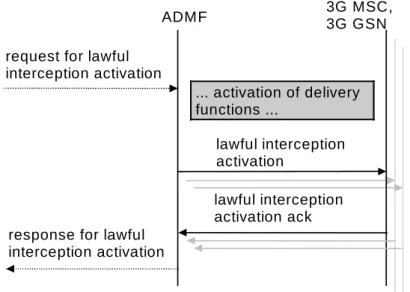
Figures 3,4 and 5 show the information flow for the activation of Lawful Interception.
5.1.1
X1_1-interface
The messages sent from the ADMF to the 3G MSC and 3G GSN (X1_1-interface) contain the: - target identities (MSISDN, IMSI or IMEI) (see note 4);
- information whether the Content of Communication (CC) shall be provided (see note 1); - information whether the Intercept Related Information (IRI) shall be provided (see note 1); - address of Delivery Function 2 (DF2) for the intercept related information (see note 2);
- address of Delivery Function 3 (DF3) for the intercepted content of communications (see note 3); - IA in case of location dependent interception.
NOTE 1: As an option, the filtering whether intercept product and/or intercept related information has to be provided can be part of the delivery functions. If the option is used, the corresponding information can be omitted on the X1_1-interface, while "information not present" means "intercept product and related information has to be provided" for the SN. Furthermore the delivery function which is not requested has to be "pseudo-activated", in order to prevent error cases at invocation.
NOTE 2: As an option, only a single DF2 is used by and known to every 3G MSC and 3G GSN. In this case the address of DF2 can be omitted.
NOTE 3: As an option, only a single DF3 is used by and known to every 3G MSC and 3G GSN. In this case the address of DF3 can be omitted.
NOTE 4: Since the IMEI is not available, interception of IMEI is not applicable at the 3G Gateway.
If after activation subsequently Content of Communications (CC) or Intercept Related Information (IRI) has to be activated (or deactivated) an "activation change request" with the same identity of the target is to be sent.
... activation of delivery functions ...
request for lawful interception activation
response for lawful interception activation
ADMF 3G MSC,3G GSN
lawful interception activation
lawful interception activation ack
Figure 3: Information flow on X1_1-interface for Lawful Interception activation
Interception of a target can be activated on request from different LEAs and each LEA may request interception via a different identity. In this case, each target identity on which to intercept will need to be sent via separate activation messages from ADMF to the 3G MSC and 3G GSN on the X1_1-interface. Each activation can be for CC only, IRI only, or both CC and IRI.
When several LEAs request activation on the same identity then the ADMF determines that there are existing activations on the identity. In this case, the ADMF will not send an additional activation message to the 3G MSC and 3G GSN except when the activation needs to change from CC only or IRI only to CC and IRI. In that case an activation change message will be sent to the 3G MSC and 3G GSN.
5.1.2
X1_2-interface (IRI)
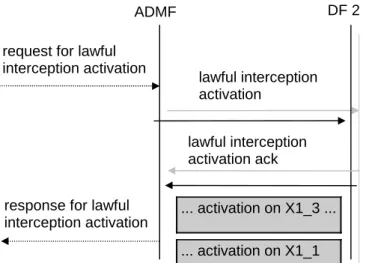
For the activation of IRI the message sent from the ADMF to the DF contains: - the target identity;
- the address for delivery of IRI (= LEMF address); - which subset of information shall be delivered;
- a DF2 activation identity, which uniquely identifies the activation for DF2 and is used for further interrogation or deactivation, respectively;
- the IA in case of location dependent interception;
- the warrant reference number if required by national option.
If a target is intercepted for several LEAs and/or several identities simultaneously, a single activation of delivery is necessary for each combination of LEA and identity.
... activation on X1_3 ... ... activation on X1_1 request for lawful
interception activation
response for lawful interception activation
ADMF DF 2
lawful interception activation
lawful interception activation ack
Figure 4: Information flow on X1_2-interface for Lawful Interception activation
5.1.3
X1_3-interface (CC)
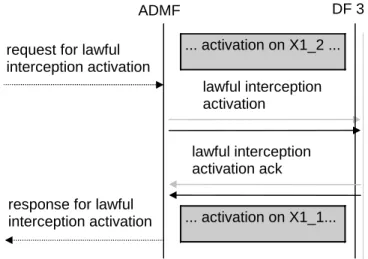
For the activation of intercepted Content of Communications the message sent from the ADMF to the Delivery Function contains:
- the target identity;
- the address of delivery for CC (= LEMF address);
- a DF3 activation identity, which uniquely identifies the activation for DF3 and is used for further interrogation or deactivation, respectively;
- the IA in case of location dependent interception;
- the warrant reference number if required by national option.
If a target is intercepted by several LEAs and/or several identities simultaneously, a single activation of delivery is necessary for each combination of LEA and identity.
... activation on X1_2 ...
... activation on X1_1... request for lawful
interception activation
response for lawful interception activation
ADMF DF 3
lawful interception activation
lawful interception activation ack
Figure 5: Information flow on X1_3-interface for Lawful Interception activation
5.2
Deactivation
Figures 6,7 and 8 show the information flow for the deactivation of the Lawful interception.
5.2.1
X1_1-interface
The messages sent from the ADMF to the 3G MSC and 3G GSN for deactivation contain: - the target identity;
- the possible relevant IAs in case of location dependent interception.
... deactivation of delivery functions ... request for lawful
interception deactivation
response for lawful interception deactivation
ADMF 3G MSC3G GSN
lawful interception deactivation
lawful interception deactivation ack
Figure 6: Information flow on X1_1-interface for Lawful Interception deactivation
If interception of a target has been activated via different identities then a separate deactivation message will need to be sent from the ADMF to the 3G MSC and 3G GSN for each identity.
When several LEAs requested activation on the same identity and subsequently request deactivation then the ADMF determines that there are remaining activations on the identity. In this case, the ADMF will not send a deactivation message to the 3G MSC and 3G GSN except when the activation needs to change from CC and IRI to CC only or IRI only. In that case an activation change message will be sent to the 3G MSC and 3G GSN.
5.2.2
X1_2-interface (IRI)
The messages sent from the ADMF to Delivery Function 2 for the deactivation of the Intercept Related Information contain:
- a DF2 activation id, which uniquely identifies the activation to be deactivated for DF2.
If a target is intercepted by several LEAs and/or several identities simultaneously, a single deactivation is necessary for each combination of LEA and identity.
... deactivation on X1_3 ... deactivation on X1_1 request for lawful
interception deactivation
response for lawful interception deactivation
ADMF DF 2
lawful interception deactivation ack lawful interception deactivation
Figure 7: Information flow on X1_2-interface for Lawful Interception deactivation
5.2.3
X1_3-interface (CC)
For the deactivating the delivery of the CC the messages from the ADMF to DF3 contain: - a DF3 activation id, which uniquely identifies the activation to be deactivated for DF3.
... deactivation on X1_1 and X1_2 ...
request for lawful interception deactivation
response for lawful interception deactivation
ADMF DF 3
lawful interception deactivation ack lawful interception deactivation
Figure 8: Information flow on X1_3-interface for Lawful Interception deactivation
5.3
Interrogation
given LEA is an ADMF function.
5.3.1
Interrogation of the 3G MSC and 3G GSN
Figure 9 shows the information flow for the interrogation of the Lawful Interception. It shall be possible to interrogate - a specific activation at each relevant 3G MSC and 3G GSN;
- all activations at each relevant 3G MSC and 3G GSN.
As result of the interrogation the activation status and data are returned.
... interrogation for activation status on
X1_1 request for lawful
interception interrogation
response for lawful interception interrogation
ADMF 3G MSC
3G GSN
lawful interception interrogation ack lawful interception interrogation
Figure 9: Interrogation of the Lawful Interception (3G MSC and 3G GSN)
5.3.2
Interrogation of Delivery Functions
Figure 10 shows the information flow for the interrogation of the Lawful Interception. It shall be possible to interrogate: - a specific activation at a DF;
- all activations at a DF for a given target identity; - all activations at a DF.
As result of the interrogation the activation status and data are returned.
... interrogation for activation status on X1_2 and X1_3 ... request for lawful
interception interrogation
response for lawful interception interrogation
ADMF DF2/DF3
lawful interception interrogation ack lawful interception interrogation
6
Invocation of Lawful Interception for Circuit Switched
Services
Figure 11 shows an extraction from the reference configuration in figure 1which is relevant for the invocation of the lawful interception.
Delivery
Function 2 3G MSC
X2
X3 Delivery Function 3 HI2
HI3 LEMF
Figure 11: Functional model for Lawful Interception invocation
The HI2 and HI3 interfaces represent the interfaces between the LEMF and two delivery functions. Both interfaces are subject to national requirements. They are included for completeness, but are beyond the scope of standardization in this document. The delivery functions are used:
- to convert the information on the X2-interface to the corresponding information on the HI2-interface; - to convert the information on the X3-interface to the corresponding information on the HI3-interface; - to distribute the intercept related information to the relevant LEA(s) (based on IAs, if defined); - to distribute the intercept product to the relevant LEA(s) (based on IAs, if defined).
In case a call is selected based on several identities (MSISDN, IMSI, IMEI) of the same target, the 3G MSC will deliver CC and IRI only once to the DF2 and DF3. DF2 and DF3 will then distribute the information to the relevant LEA that requested interception on a particular target identity.
For the delivery of the CC and IRI, the 3G MSC provides a correlation number and target identity to the DF2 and DF3 which is used there in order to select the different LEAs to which the product shall be delivered.
NOTE: If interception has been activated for both parties of the call both CC and IRI will be delivered for each party as separate intercept activity.
For Location Dependent Interception, the location dependency check occurs at the establishment of each call. Subsequent dependency checks for simultaneous calls are not required, but can be a national option.
If a target is marked using an IA in the 3G MSC, the 3G MSC shall perform a location dependency check at call set-up. Only if the target's location matches the IA is call the intercepted.
If a target is marked using an IA in the DF2, the DF2 shall perform a location dependency check at reception of the first IRI for the call. Only if the target’s location matches the IA for certain LEAs is IRI the relayed to these LEAs. All subsequent IRIs for the call are sent to the same LEAs.
If a target is marked using an IA in the DF3, the DF3 shall perform a location dependency check at reception of the CC. Only if the target’s location matches the IA for certain LEAs is the CC relayed to these LEAs.
6.1
Provision of Intercept Product - Circuit Switched
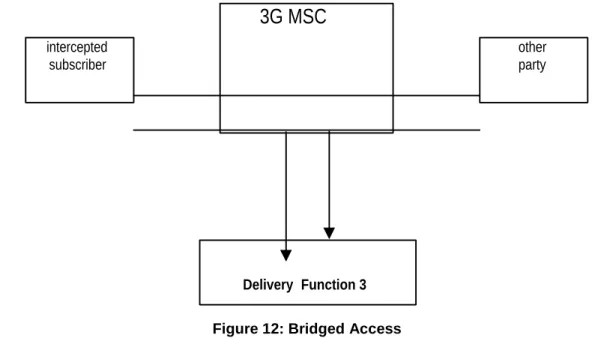
Figure 12 shows the access method for the delivering of CC shall be bridged/ T-connection (see figure 12).
intercepted subscriber
other party
3G MSC
Delivery Function 3 Figure 12: Bridged Access
6.1.1
Delivery configuration to the LEMF
Figure 13 shows the configuration for circuit switched calls. The signals of both parties of the configuration to be intercepted are delivered separately to the requesting function. The requesting function itself has no impact on the connection between the subscribers.
The two stublines towards the LEMF are established in parallel to the call set up. For both stublines the address is used which has been provided during activation.
NOTE: For data calls it is necessary to provide means for fast call establishment towards the LEMF so that it doesn’t miss the beginning of the data transmission.
3G MSC intercepted
subscriber
other party
Delivery Function 3
Two stublines
LEMF
Two stublines
6.1.2
X3-interface
The following information needs to be transferred from the 3G MSC to the DF3 in order to allow the DF3 to perform its functionality:
- target identity (MSISDN, IMSI or IMEI); note 1
- signal indicator (direction indication; - Signal from target or signal to target); note 2 - the target location (if available) or the IAs in case of location dependent interception. note 1 - correlation information (IRI <-> CC);
NOTE 1: For DF3 internal use only.
NOTE 2: e.g. integer, CC from target = 1, CC from other party = 2. Additional information may be provided if required by national laws.
6.2
Provision of CC - Short Message Service
Figure 14 shows an SMS transfer from the 3G MSC to the LEMF. Quasi-parallel to the delivery from / to the mobile subscriber a message, which contains the contents of the SMS with the header, is generated and sent via the Delivery Function 2 to the LEMF in the same way as the Intercept Related Information.
The IRI will be delivered to the LEMF:
- for a SMS-MO, when the SMS-Centre receives the SMS; - for a SMS-MT, when the MS receives the SMS.
3G MSC intercepted
subscriber
SMS service
center
LEMF Delivery Function 2
Figure 14: Provision of Content of Communication - Short Message Service
6.3
Provision of Intercept Related Information
Intercept Related Information (Events) are necessary at the Begin and End of the call, for all supplementary services during a call and for information which is not call associated. There are call related events and non call related events Figure 15 shows the transfer of intercept related information to the DF2. If an event for / from a mobile subscriber occurs, the 3G MSC sends the relevant data to the DF2.
3G MSC intercepted
subscriber
Other party
LEMF Delivery Function 2
Figure 15: Provision of Intercept Related Information
6.3.1
X2-interface
The following information needs to be transferred from the 3G MSC to the DF2 in order to allow a DF2 to perform its functionality:
- target identity (MSISDN, IMSI or IMEI);
- in case of location dependent interception, the IAs and/or target cell ID shall be provided. - events and associated parameters as defined in subclauses 6.3.3 and 6.3.4 may be provided.
6.3.2
Structure of the events
The information sent to DF2 is triggered by up to eight different call related and non-call related events. Details are described in following subclause. The events for interception are configurable (if they are sent to DF2) in the 3G MSC and can be suppressed in the DF2. The events are listed as follows:
Call Related Events: - Call Establishment - Answer
- Supplementary Service - Handover
- Release
Non Call Related Events:
- SMS
- Location Update
- Subscriber Controlled Input
Table 1 below shows the set of information that is used to generate the events. The events transmit the information from the 3G MSC to DF2. This set of information can be extended in the 3G MSC, if this is necessary in a specific country. DF2 can extend this information if this is necessary in a specific country e.g. a unique number for each surveillance warrant.
Table 1: Information Elements for Circuit Event records
Observed MSISDN
Target Identifier with the MSISDN of the target subscriber (monitored subscriber). Observed IMSI
Target Identifier with the IMSI of the target subscriber (monitored subscriber). Observed IMEI
Target Identifier with the IMEI of the target subscriber (monitored subscriber), It shall be checked for each call over the radio interface
event type
Description which type of event is delivered: Establishment, Answer, Supplementary service, Handover, Release, SMS, Location update, Subscriber controlled input
event date
Date of the event generation in the 3G MSC event time
Time of the event generation in the 3G MSC dialled number
Dialled phone number before digit modification, IN-modification etc. Connected number
Number of the answering party other party address
Directory number of the other party for MOC Calling party for MTC
call direction
Information if the monitored subscriber is calling or called e.g. MOC/MTC or originating/ terminating In or/out
Correlation number
Unique number for each call sent to the DF, to help the LEA, to have a correlation between each Call and the IRI
cell id
Cell number of the target; for the location information Location area code
Location-area-code of the target defines the Location Area in a PLMN basic service
Information about Tele service or bearer service. Supplementary service
Supplementary services used by the target e.g. CF, CW, ECT Forwarded to number
Forwarded to number at CF call release reason
Call release reason of the target call SMS Message
The SMS content with header which is sent with the SMS-service Redirecting number
The number which invokes the call forwarding towards the target. This is provided if available. SCI
6.3.3
Call Related events
6.3.3.1
Call establishment
For call establishment a call establishment-event is generated. This event is generated at the begining of a call when the 3G MSC attempts to reach the subscriber. This information will be delivered to the DF2 if available:
Observed MSISDN Observed IMSI Observed IMEI event type event date event time dialled number other party address call direction Correlation number Redirecting number cell id
Location area code basic service
Supplementary service
6.3.3.2
Answer
If the called party answers, an answer- event is generated. This information will be delivered to the DF2 if available:
Observed MSISDN Observed IMSI Observed IMEI event type event date event time dialled number other party address Connected party call direction Correlation number Redirecting number cell id
Location area code basic service
6.3.3.3
Supplementary Services
For supplementary services events are generated with the information which supplementary service is used e.g. Call Forwarding (CF), Call Waiting (CW), Explicit Call Transfer (ECT), Multi Party (MPTY), Call Hold and information correlated to the service like the forwarded to number. This information will be delivered to the DF2 if available:
Observed MSISDN Observed IMSI Observed IMEI event type event date event time dialled number other party address call direction Correlation number cell id
Location area code basic service
Supplementary service Forwarded to number
6.3.3.4
Handover
For each handover due to a target Cell ID change, a handover-event with the information about the new cell ID is generated. This information will be delivered to the DF2 if available:
Observed MSISDN Observed IMSI Observed IMEI event type event date event time Correlation number cell id
Location area code
6.3.3.5
Release
For the release or failed attempt of a target call, a release event with the following information is generated. This information will be delivered to the DF2 if available:
Observed MSISDN Observed IMSI Observed IMEI event type event date event time dialled number other party address call direction Correlation number cell id
Location area code basic service call release reason
6.3.4
Non Call Related events
6.3.4.1
SMS
For MO-SMS the event is generated in the 3G MSC, when the SMSC successfully receives the SMS; for MT-SMS the event is generated in the 3G MSC when the target receives the message. This information will be delivered to the DF2 if available:
Observed MSISDN Observed IMSI event type event date event time cell id
Location area code SMS Message
6.3.4.2
Location update
For location updates a Location update-event is generated, with the new location (location area) information. This information will be delivered to the DF2 if available:
Observed MSISDN observed IMSI event type event date event time cell id
location area code
6.3.4.3
Subscriber Controlled Input (SCI)
SCI includes subscriber initiated changes in service activation and deactivation. SCI does not include any information available in the CC. For subscriber controlled inputs - a SCI-event is generated with information about the SCI. This information will be delivered to the DF2 if available:
observed MSISDN observed IMSI event type event date event time cell id
location area code SCI
6.4
Intercept cases for circuit switched supplementary services
6.4.1
Interception of Multiparty call
A
B
C
D
3 G M S C
D F 3
Figure 16: Interception of Multiparty for CC
Figure 16 shows the delivery of CC from intercepted multiparty call where party A is the target of interception. One pair of call content channels are delivered to the delivery function. Party A is delivered to the DF3 on one channel and the sum of the balance of the parties, B,C and D is delivered on the second channel.
It should be noted that if parties B,C or D is a target of interception, that intercept is treated as a simple call intercept. The events contain information about B, C and D if subscriber A is monitored. If one of B, C or D is monitored, events contain the information about A but not the other parties of the conference.
6.4.2
Interception for Call Forwarding / Call Deflection / ECT
Signalling
A B
Bearer Traffic
C
Figure 17: Interception for Call Forwarding / Deflection / ECTFor Intercept Related Information it depends who is monitored:
- If subscriber A is monitored the number of A and B are mandatory in the event information and the number of C if available.
- If subscriber B is monitored the number of B and C are mandatory in the event information and the number of A if available.
- If subscriber C is monitored the number of C is mandatory in the event information and the number of A and B if available.
7
Invocation of Lawful Interception for Packet Data
services
Figure shows the extract from the reference configuration which is relevant for the invocation of the Lawful Interception.
Delivery Function 2P
3G GSN X2p
X3p Delivery
Function 3P HI2
HI3 LEAs
Figure 18: Functional model for Packet Data Lawful Interception invocation
The HI2 and HI3 interfaces represent the interfaces between the LEA and two delivery functions. Both interfaces are subject to national requirements. They are included for completeness, but are beyond the scope of this specification. The delivery functions are used:
- to convert the information on the X2p-interface to the corresponding information on the HI2 interface; - to distribute the intercept related information to the relevant LEA(s);
- to distribute the intercept product to the relevant LEA(s).
In case a Packet Data communication is selected based on several identities (MSISDN, IMSI, IMEI, ) of the same target, the 3G SGSN and/or, per national option 3G GGSN will deliver CC and IRI only once to the DF2P and DF3P. DF2P and DF3P will then distribute the information to the relevant LEAs.
For the delivery of the CC and IRI the 3G SGSN and/or, per national option 3G GGSN provides correlation number and target identity to the DF2P and DF3P which is used there in order to select the different LEAs where the product shall be delivered.
The correlation number is unique in the whole PLMN and is used to correlate CC with IRI and the different IRI's of one PDP context.
The correlation number shall be generated by using existing parameters related to the PDP context.
NOTE: If interception has been activated for both parties of the Packet Data communication both CC and IRI will be delivered for each party as separate intercept activity.
In case of location dependent interception :
- for each target, the location dependency check occurs at each Packet Data session establishment or release and at each cell and/or Routing Area (RA) update to determine permanently the relevant IAs (and deduce, the possible LEAs within these IAs),
- when an IA is left, a Mobile Station Detach event is sent when changing servicing 3 G G SNs or a cell and/or RA update event is sent when changing IAs inside the same servicing 3G SGSN to DF2P.
- when a new IA is entered a cell and/or RA update event is sent to DF2P and, optionally, a Start of Interception with Active PDP Context event for each PDP context
- concerning the CC, when crossing IAs, the CC is not sent anymore to the DF3P of the old IA but sent to the DF3P of the new IA.
7.1
Provision of Intercept Product - Short Message Service
Figure 19 shows an SMS transfer from the 3G SGSN node to the LEA. Quasi-parallel to the delivery from / to the mobile subscriber a message, which contains the content and header of the SMS, is generated and sent via the Delivery Function 2P to the LEA in the same way as the Intercept Related Information.
The IRI will be delivered to the LEA:
- for a SMS-MO, when the SMS-Centre receives the SMS; - for a SMS-MT, when the MS receives the SMS.
3G GSN intercepted
subscriber
SMS service
center
LEA delivery function 2P
Figure 19: Provision of Intercept Product - Short Message Service
7.2
Provision of Intercepted Content of Communications –
Packet data services
The access method for the delivering of Packet Data Intercept Product is based on duplication of packets without modification at 3G GSN. The duplicated packets with additional information in the header, as described in the following sections, are sent to DF3P for further delivery via a tunnel.
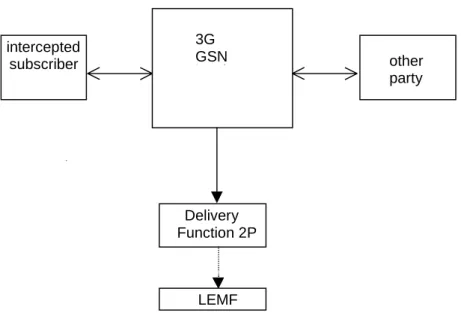
3G GSN intercepted
subscriber
other party
Delivery Function 3P
LEA
Duplicator of packets
Figure 20: Configuration for interception of Packet Data product data
7.2.1
X3p-interface
In addition to the intercepted call content, the following information needs to be transferred from the 3G GSN to the DF3P in order to allow the DF3P to perform its functionality:
- target identity; - correlation number;
- the target location (if available) or the IAs in case of location dependent interception. Additional information may be provided as a national option.
7.3
Provision of Intercept Related Information
Intercept Related Information (Events) are necessary at the Mobile Station Attach, Mobile Station Detach, PDP Context Activation, Start of intercept with PDP context active, PDP Context Deactivation, Cell and/or RA update, and SMS events.
Figure 21 shows the transfer of intercept related information to the DF2P. If an event for / from a mobile subscriber occurs, the 3G GSN sends the relevant data to the DF2P.
3G GSN intercepted
subscriber other
party
Delivery Function 2P
LEMF
Figure 21: Provision of Intercept Related Information
7.3.1
X2p-interface
The following information needs to be transferred from the 3G GSN to the DF2P in order to allow a DF2P to perform its functionality:
- target identity (MSISDN, IMSI, IMEI);
- events and associated parameters as defined in section 7.3.2 and 7.4 may be provided; - the target location (if available) or the IAs in case of location dependent interception. - Correlation number
7.3.2
Structure of the events
There are seven different events in which the information is sent to the DF2P if this is required. Details are described in the following section. The events for interception are configurable (if they are sent to DF2P) in the 3G GSN and can be suppressed in the DF2P.
The following events are applicable to 3G SGSN: - Mobile Station Attach;
- Mobile Station Detach; - PDP context activation;
- Start of intercept with PDP context active; - PDP context deactivation;
- Cell and /or RA update; - SMS.
The following events are applicable to the 3G GGSN: - PDP context activation ;
- PDP context deactivation ;
- Start of interception with PDP context active.
A set of fields as shown below is used to generate the events. The events transmit the information from 3G GSN to DF2P. This set of fields as shown below can be extended in the 3G GSN, if this is necessary as a national option. DF2P can extend this information if this is necessary as a national option e.g. a unique number for each surveillance warrant.
Table 2: Information Events for Packet Data Event Records
Observed MSISDN
MSISDN of the target subscriber (monitored subscriber) Observed IMSI
IMSI of the target subscriber (monitored subscriber) Observed IMEI
IMEI of the target subscriber (monitored subscriber),it shall be checked for each activation over the radio interface. Event type
Description which type of event is delivered: PDP attach, PDP detach, PDP context activation, Start of intercept with PDP context active, PDP context deactivation, SMS, Cell and/or RA update,
Event date
Date of the event generation in the 3G GSN Event time
Time of the event generation in the 3G GSN PDP address
The PDP address of the target subscriber. Note that this address might be dynamic. Access Point Name
The APN of the access point. (Typically the GGSN of the other party) Routing Area Code
The routing area code of the target defines the RA in a PLMN. PDP Type
The used PDP type. Correlation Number
The correlation number is used to correlate CC and IRI. SMS
The SMS content with header which is sent with the SMS-service. The header also includes the SMS-Centre address.
CGI
Cell Global Identity Failed attach reason
Reason for failed attach of the target subscriber. Failed context activation reason
Reason for failed context activation of the target subscriber. IAs
7.4
Packet Data related events
7.4.1
Mobile Station Attach
For attach an attach-event is generated. When an attach activation is generated from the mobile to servicing 3G G SN this event is generated. These fields will be delivered to the DF2P if available:
Observed MSISDN Observed IMSI Observed IMEI Event Type Event Time Event Date CGI
Routing area code Failed attach reason IAs (if applicable)
7.4.2
Mobile Station Detach
For detach a detach-event is generated, this is for the common (end) detach. These fields will be delivered to the DF2P if available:
Observed MSISDN Observed IMSI Observed IMEI Event Type Event Time Event Date CGI
Routing Area code IAs (if applicable)
7.4.3
Packet Data PDP context activation
For PDP context activation a PDP context activation-event is generated. When a PDP context activation is generated from the mobile to 3G GSN this event is generated. These fields will be delivered to the DF2P if available:
Observed MSISDN Observed IMSI Observed IMEI
PDP address of observed party Event Type
Event Time Event Date Correlation number Access Point Name PDP Type
CGI
Routing area code
Failed context activation reason IAs (if applicable)
7.4.4
Start of interception with PDP context active
This event will be generated if interception for a target is started and if the target has at least one PDP context active. If more then one PDP context are open for each of them an event record is generated. These fields will be delivered to the DF2P if available:
Observed MSISDN Observed IMSI Observed IMEI
PDP address of observed party Event Type
Event Time Event Date Correlation number Access Point Name PDP Type
CGI
Routing area code IAs (if applicable)
7.4.5
Packet Data PDP context deactivation
At PDP context deactivation a PDP context deactivation-event is generated. These fields will be delivered to the DF2P if available:
Observed MSISDN Observed IMSI Observed IMEI
PDP address of observed party Event Type
Event Time Event Date Correlation number Access point name CGI
Routing area code IAs (if applicable)
7.4.6
Cell and/or RA update
For each cell and/or RA update an update-event with the fields about the new location is generated. These fields will be delivered to the DF2P if available:
Observed MSISDN Observed IMSI Observed IMEI Event Type Event Time Event Date CGI
Routing area code IAs (if applicable)
7.4.7
SMS
For MO-SMS the event is generated in the 3G SGSN, when the SMS-Centre successfully receives the SMS; for MT-SMS the event is generated in the 3G SGSN when the target receives the message. This fields will be delivered to the DF2P if available:
Observed MSISDN Observed IMSI Observed IMEI Event Type Event Time Event Date CGI
Routing area code SMS
IAs (if applicable)
7.5
Intercept cases for supplementary services
Supplementary services may be used with Packet Data. However they are not standardised and therefore Lawful Interception interwork cases can not be defined at the time of publication of this document.
8
Security
The security requirements are valid for the whole Lawful Interception system, i.e. rules and procedures shall be used for all involved entities, 3G GSN and the DF.
8.1
Administration security
The administration of the LI function, i.e. Activation, Deactivation and Interrogation of Lawful Interception, in the 3G GSN, 3G MSC and the DFs shall be done securely as described below:
- It shall be possible to configure the authorised user access within the serving network to Activate, Deactivate and Interrogate Lawful Interception separately for every physical or logical port at the 3G MSC and DF. It shall be possible to passwork protect user access.
- Only the ADMF is allowed to have access to the LI functionality in the 3G MSC, 3G GSN and DF.
- The communication links between ADMF, 3G GSN,3G MSC, DF2, DF2P, and DF3, DF3P may be required by national option to support secutiry mechanisms. Options for security mechansisms include:
- CUG / VPN;
- COLP;
- authentication; - encryption.
Through the use of user access restrictions, no unautorized network entities or remote equipment shall be able to view or manipulate LI data in the 3G GSN, 3G MSC or the DFs.
8.2
IRI security
8.2.1
Normal operation
The transmission of the IRI shall be done in a secure manner.
When DFs are physically separate from the 3G MSC and 3G GSN, the X2 and X2p-interfaces may be required by national option to support security mechanisms. Options for security mechansisms include:
- CUG/VPN;
- authentication; - encryption.
8.2.2
Communication failure
Depending on the national law in case of communication failure IRI may be buffered in the 3G MSC and 3G GSN. After successful transmission of IRI the whole buffer shall be deleted. It shall be possible to delete the content buffer via command or a timer, in an unrestoreable fashion.
8.3
CC security
The transmission of the CC shall be done in a secure manner.
When DFs are physically separate from the 3G MSC and 3G GSN, the X3 and X3p-interfaces may be required by national option to support security mechanisms. Options for security mechansisms include:
- CUG/VPN;
- COLP;
- authentication; - encryption.
In case of transmission failure no buffering is required within the intercepting network.
8.4
Security aspects of Lawful Interception billing
Billing information may be suppressed or made available at the DFs and the ADMF. Billing information for Lawful Interception shall be separated from ”regular” billing data.
Billing data transmission to the Lawful Interception billing system may be done in a secure manner per national option. In case of transmission failure billing-data shall be buffered/stored in a secure way. After successful transmission billing data shall be deleted in an unrestorable fashion.
8.5
Other security issues
8.5.1
Log files
Log files shall be generated by the ADMF, DF2, DF2P, DF3, DF3P, 3G MSC and the 3G GSN. All log files are retrievable by the ADMF, and are maintained by the ADMF in a secure manner.
8.5.2
Data consistency
The administration function in the PLMN shall be capable to perform a periodic consistency check to ensure that the target list of MSISDN, IMSI or IMEI is the same in all involved 3G MSCs and 3G GSNs in the PLMN and the DFs. The reference data base is the ADMF data base.
Annex A (informative):
Information flows for Lawful Interception invocation of circuit
switched services
The following figures show the information flows for the invocation of Lawful Interception for various types of calls. The figures show some of the basic signalling messages of the target calls and the events on the X2 and X3-interfaces. The ISUP messages to and from the network are shown for informational purposes only; some of them may not be sent or may be combined in certain networks.
A.1
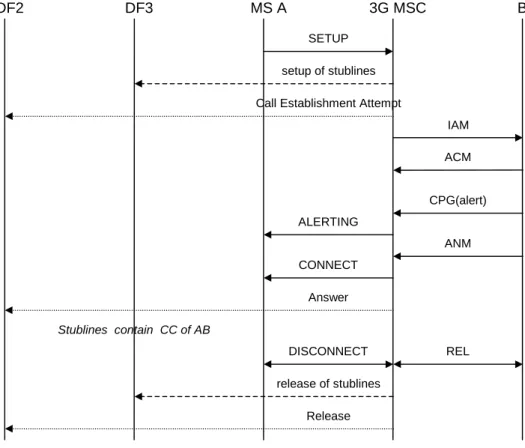
Mobile originated circuit switched calls
Figure A1 shows the interception of a basic mobile originated circuit switched speech or data call where the originating mobile (A) is the target for interception. B is not necessarily also a mobile subscriber and resides on a different
exchange.
DF2 DF3 MS A 3G MSC B
SETUP
DISCONNECT REL
Release release of stublines
ALERTING
ACM Call Establishment Attempt
setup of stublines
CPG(alert)
ANM IAM
Answer CONNECT
Stublines contain CC of AB
Figure A1: Interception of mobile originated circuit switched calls
In figure A1 the result (answer) of the set-up of the stublines is not shown. This assumes no special action is taken in case of failure.
A.2
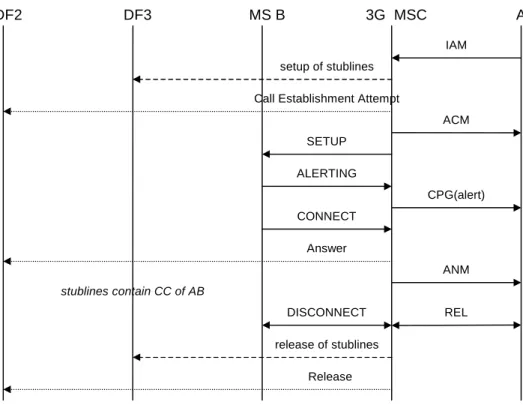
Mobile terminated circuit switched calls
Figure A2 shows the interception of a basic mobile terminated circuit switched speech or data call where the terminating mobile (B) is the target for interception. A is not necessarily also a mobile subscriber and resides on a different exchange.
DF2 DF3 MS B 3G MSC A
IAM
ACM SETUP
Call Establishment Attempt
CPG(alert) CONNECT
ANM Answer
stublines contain CC of AB
DISCONNECT REL
Release setup of stublines
ALERTING
release of stublines
A.3
Call hold / call waiting
Figures A3 and A4 show the interception of calls involving call hold / call waiting. Figure A3 covers the case where one stubline or one pair of stublines is used per target, figure A4 covers the case where a separate stubline or pair of stublines is used for each target call. The mobile that receives the waiting call (A) is the target for interception.
... release of AB call and interception as in figure A1 ...
... setup and interception of AB call as in figure A1 ...
DF2 DF3 MS A 3G MSC B C
Release(AB) SETUP(AB)
Answer(AB)
Stublines contain CC of AB
IAM
ACM SETUP(CA)
Call Establishment Attempt(CA, CWAIT)
CPG(alert) HOLD(AB)
Suppl. Service(AB, CHOLD) CONNECT(CA)
ANM Answer(CA)
stublines contain CC of CA
DISCONNECT(CA) REL
Release(CA) RETRIEVE(AB)
Suppl. Service(AB, CRETR)
Stublines contain CC of AB
ALERTING(CA)
RETRIEVE ACK(AB) HOLD ACK(AB)
DISCONNECT(AB) REL
... release of AB call and interception as in figure A1 ...
... setup and interception of AB call as in figure A1 ...
DF2 DF3 MS A 3G MSC B C
Release(AB) SETUP(AB)
Answer(AB)
Stublines contain CC of AB
IAM
ACM SETUP(CA)
Call Establishment Attempt(CA, CWAIT)
CPG(alert) HOLD(AB)
Suppl. Service(AB, CHOLD) CONNECT(CA)
ANM Answer(CA)
stublines” contain CC of CA
DISCONNECT(CA) REL
Release(CA) RETRIEVE(AB)
Suppl. Service(AB, CRETR)
stublines’ contain CC of AB
ALERTING(CA)
RETRIEVE ACK(AB) HOLD ACK(AB)
DISCONNECT(AB) REL
setup of stublines”
release of stublines”
Figure A4: Interception of call hold / call waiting - stublines per target call
A.4
Multiparty calls
Figures A5 and A6 show the interception of multiparty calls. Figure A5 covers the case where one stubline or one pair of stublines is used per target, figure A6 covers the case where a separate stubline or pair of stublines is used for each target call. The mobile setting up the multiparty call (A) is the target for interception.
... setup and interception of AC call as in figure A1 without setup of stublines ...
... release of AC call and interception as in figure A1 without release of the stublines ...
... release of AB call and interception as in figure A1 ...
... setup and interception of AB call as in figure A1 ...
DF2 DF3 MS A 3G MSC B C
DISCONNECT(AC) REL
Stublines contain CC of AB
SETUP(AB)
Answer(AB)
BuildMPTY(AB)
Suppl. Service(AB, BMPTY) Suppl. Service(AC, BMPTY)
Stublines contain CC of ABC
SplitMPTY(AC)
Suppl. Service(AC, SMPTY)
Stublines contain CC of AC
Release(AC) HOLD(AB)
Suppl. Service(AB, CHOLD) HOLD ACK(AB)
Stublines contain CC of AC
SETUP(AC)
Answer(AC)
Suppl. Service(AB, HMPTY)
RetrieveMPTY(AB)
Suppl. Service(AB, RMPTY) RetrieveMPTY ACK(AB)
Stublines contain CC of AB
DISCONNECT(AB) REL
Release(AB) BuildMPTY ACK(AB)
SplitMPTY ACK(AB)
... setup and interception of AC call as in figure A1 ...
... release of AC call and interception as in figure A1 ...
... release of AB call and interception as in figure A1 ...
... setup and interception of AB call as in figure A1 ...
DF2 DF3 MS A 3G MSC B C
DISCONNECT(AC) REL
Stublines contain CC of AB
SETUP(AB)
Answer(AB)
BuildMPTY(AB)
Suppl. Service(AB, BMPTY) Suppl. Service(AC, BMPTY)
stublines’ contain CC of ABC
SplitMPTY(AC)
Suppl. Service(AC, SMPTY)
Release(AC) HOLD(AB)
Suppl. Service(AB, CHOLD) HOLD ACK(AB)
stublines” contain CC of AC
SETUP(AC)
Answer(AC)
Suppl. Service(AB, HMPTY)
RetrieveMPTY(AB)
Suppl. Service(AB, RMPTY) RetrieveMPTY ACK(AB)
stublines’ contain CC of AB
DISCONNECT(AB) REL
Release(AB) BuildMPTY ACK(AB)
SplitMPTY ACK(AB)
stublines” contain CC of AC stublines” contain CC of ABC
A.5
Call forwarding / call deflection
The following pictures show the information flows for the interception of forwarded calls. Information flows will be given for three typical cases of call forwarding. All other types of call forwarding / call deflection are intercepted similar to one of these.
A.5.1
Unconditional call forwarding
Figure A7 shows the interception of unconditionally forwarded calls. The mobile that activated unconditional call forwarding (B) is the target for interception. In this case interception will be performed at the 3G GMSC, where the Service Request Indicator (SRI) request for B is issued and subsequently the SRI response indicating that the call shall be forwarded is received.
DF2 DF3 HLR 3G GMSC A C
SRI request for B SRI response
IAM
ACM setup of stublines
IAM
Release release of stublines
CPG(alert) Call Establishment Attempt
CPG(alert)
ANM Answer
ANM
REL REL
Stublines contains CC of AC
Suppl. Service(CFU)
ACM
Figure A7: Interception of unconditional call forwarding
A.5.2
Call forwarding on not reachable (IMSI detached)
Call forwarding on not reachable because the IMSI is detached is also handled on the 3G GMSC. Interception of this type of call forwarding is similar to interception of unconditional call forwarding.
A.5.3
Call forwarding on busy (network determined)
Figure A8 shows the interception of call forwarding on busy (network determined). The mobile that activated call forwarding on busy (B) is the target for interception. In this case interception will be performed at the 3G MSC where B resides, where the busy condition is detected and the call is forwarded.
... setup and interception of BD call as in figure A1 ...
... release of BD call and interception as in figure A1 ...
DF2 DF3 MS B 3G MSC A D
IAM
ACM setup of stublines”
IAM
Release(AB) release of stubline”
CPG(alert) Call Establishment Attempt(AB)
CPG(alert)
ANM Answer(AB)
ANM
REL REL
Stublines” contain CC of AC
Suppl. Service(AB, CFB)
ACM SETUP(BD)
Answer(BD) stublines’ contain CC of BD
C
DISCONNECT(BD) REL
Release(BD)
Figure A8: Interception of call forwarding on busy (network determined)
A.5.4
Call forwarding on not reachable (no response to
paging/radio channel failure)
Call forwarding on not reachable because of no response to paging or radio channel failure is also handled on the 3G MSC similar to call forwarding on busy (network determined). Interception of this type of call forwarding is therefore done in the same way. (see section A.5.3)
A.5.5
Call forwarding on no reply
Figure A9 shows the interception of call forwarding on no reply. The mobile that activated call forwarding on no reply (B) is the target for interception. In this case interception will be performed at the 3G MSC where B resides, where the no reply condition is detected and the call is forwarded. Initially, the interception is similar to the interception of a basic mobile terminated circuit switched speech of data call. On no reply time-out, the interception will continue on the forwarded call to C.
DF2 DF3 MS B 3G MSC A C
IAM
ACM setup of stubline
IAM
Release release of stublines
CPG(alert) Call Establishment Attempt
CPG(alert)
ANM Answer
ANM
REL REL
Stublines contain CC of AC
Suppl. Service(CFNR)
ACM
CPG(alert) No reply timeout
CPG(forward) SETUP
ALERTING
Figure A9: Interception of call forwarding on no reply
In figure A9 the release of the stublines is done after the forwarded call is released by A or C. It is a national option not to support interception of forwarded calls. In that case, the release of the stublines is done after the call is forwarded and B is no longer involved.
A.5.6
Call forwarding on busy (user determined)/call deflection
Call forwarding on busy (user determined) and call deflection are also handled on the 3G MSC similar to call forwarding on no reply. Interception of this type of call forwarding is therefore done in the same way. (see A5.5)
A.5.7
Call waiting / call forwarding on no reply
Figures A10 and A11 show the interception of a call involving both call waiting and call forwarding on no reply. Figure A10 covers the case where one stubline or one pair of stublines is used per target, figure A11 covers the case where a separate stubline or pair of stublines is used for each target call. The mobile that activated call forwarding on no reply and receives the waiting call (B) is the target for interception. In figure A10 a new (pair of) stublines needs to be set up when the call is forwarded since the first (pair of) stublines is still used for the initial call.
... setup and interception of BD call as in figure A1 ...
... release of BD call and interception as in figure A1 ...
DF2 DF3 MS B 3G MSC A D
IAM
ACM IAM
Release(AB) release of stublines”
CPG(alert) Call Establishment Attempt(AB, CWAIT)
CPG(alert)
ANM Answer(AB)
ANM
REL REL
Stublines” contain CC of AC
Suppl. Service(AB, CFNR)
ACM
CPG(alert) No reply timeout
CPG(forward) SETUP(AB)
ALERTING(AB)
C
SETUP(BD)
Answer(BD) stublines’ contain CC of BD
setup of stublines”
DISCONNECT(BD) REL
Release(BD)
... setup and interception of BD call as in figure A1 ...
... release of BD call and interception as in figure A1 ...
DF2 DF3 MS B 3G MSC A D
IAM
ACM IAM
Release(AB) release of stublines”
CPG(alert) Call Establishment Attempt(AB, CWAIT)
CPG(alert)
ANM Answer(AB)
ANM
REL REL
Stublines” contain CC of AC
Suppl. Service(AB, CFNR)
ACM
CPG(alert) No reply timeout
CPG(forward) SETUP(AB)
ALERTING(AB)
C
SETUP(BD)
Answer(BD) stublines’ contain CC of BD
setup of stublines”
DISCONNECT(BD) REL
Release(BD)
A.6
Explicit call transfer
Figures A12 and A13 show the interception of explicit call transfer. Figure A12 covers the case where one pair of stublines is used per target, figure A13 covers the case where a separate pair of stublines is used for each target call. The mobile transferring the call (B) is the target for interception.
... setup and interception of BC call as in figure A1 without setup of stublines ...
... setup and interception of AB call as in figure A2 ...
DF2 DF3 MS B 3G MSC A C
IAM
Release(AB) release of stublines
ECT(AB)
REL REL
Stublines contain CC of AC Stublines contain CC of AB
Answer(AB)
HOLD(AB)
Suppl. Service(AB, CHOLD) HOLD ACK(AB)
stublines contain CC of BC
SETUP(BC)
Answer(BC)
Suppl. Service(AB, ECT) Suppl. Service(BC, ECT)
Release(BC)
... setup and interception of BC call as in figure A1 ... ... setup and interception of AB call as
in figure A2 ...
DF2 DF3 MS B 3G MSC A C
IAM
Release(AB) release of stublines’
ECT(AB)
REL REL
Stublines’ contain CC of AC stublines’ contain CC of AB
Answer(AB)
HOLD(AB)
Suppl. Service(AB, CHOLD) HOLD ACK(AB)
stublines” contain CC of BC
SETUP(BC)
Answer(BC)
Suppl. Service(AB, ECT) Suppl. Service(BC, ECT)
Release(BC) Stublines” contain CC of AC
release of stublines”
Figure A13: Interception of explicit call transfer - stublines per target call
In figures A12 and A13 the release of the stublines is done after the transferred call is released by A or C. It is a national option not to support interception of transferred calls. In that case, the release of the stublines is done after the call is transferred and B is no longer involved.
Annex B (informative):
Information flows for Lawful Interception invocation of
Packet Data services
The following figures show the information flows for the invocation of Lawful Interception for Packet Data and typical scenarios. The figures show some of the basic signalling messages of the target Packet Data communication and the events on the X2P and X3P interfaces. The dotted lines indicate signalling depending on whether CC and/or IRI information has been requested. The Gateway 3G GGSN may setup/release packet tunnels and send IRI information depending on national requirements.
The use of the Gateway 3G GGSN for interception is a national option.
B.1
Mobile Station Attach
Figure B1 shows the interception of a basic Mobile Station Attach where the mobile (A) is the target for interception.
Mobile Station Attach Attach Accept
Signalling Attach Request
DF2P DF3P MS A 3G SGSN
B.2
Mobile Initiated Mobile Station Detach
Figure B2 shows the interception of a Mobile Initiated Mobile Station Detach where the originating mobile (A) is the target for interception.
Mobile Station Detach Detach Accept
Detach Request
DF2P DF3P MS A 3G SGSN
MS initiated PDP Context Deactivation See B.8 when context is deactivated
Figure B2: Interception of mobile originated Mobile Station Detachment
B.3
Network initiated Mobile Station Detach
Figure B3 shows the interception of a network initiated (by 3G SGSN or HLR) Mobile Station Detach where the mobile (A) is the target for interception.
Cancel Location *
Mobile Station Detach Indication Detach Accept
Detach Request
DF2P DF3P MS A 3G SGSN
Network initiated PDP Context Deactivation See B.9 when context is deactivated
HLR MSC/VLR
Cancel Location Ack * Mobile Station Detach
NOTE: * Additional signals in case of HLR initiated