Year XXI, No. 1, 2015, pp. 171-181
Money and Design
A. Borcuch
Artur Borcuch
The Jan Kochanowski University in Kielce
Faculty of Management and Administration, Poland
Abstract
The purpose of this article is to analyze the influence of the money design on willingness to make purchases. In this paper, we focus on three aspects that structure the relation between money and design: the link between design and finance (in general), determinants of design and perspective of currency design. The main research problem explored in this paper is: Does the money design have influence on the willingness to make purchases by employees/employers at design studios, design students and students of economics/management? The main hypothesis is as follows – the more experience in design practice, the more important is money design.
Keywords: economics, money, design,
Introduction
The 21st century shows that the design practice is maturing, and what was once a focused on aesthetics and usability is broadening to incorporate interdisciplinary knowledge from economics and finance.
The study is divided into four parts. In Section 1, the relation between economics (finance) and design is presented. In Section 2, definitions and determinants of design are presented. In Section 3, currency design from the perspective of form, subject and security is presented. Finally, the results of own research are presented and implications are discussed.
Relations between economics (finance) and design
Design is not limited to certain sectors or professions, but applies across the economy [7]. Design deals with the creation of forms and the appearance of products. Creative design is expressed in several ways: through the creation of decorative luxury items such as jewellery, by the uniqueness of a functional service such as the architectural design of a building, or as utilitarian mass-produced goods such as an interior object. Design products are usually aesthetic functional creations based on concepts and specifications [2]. On the other hand, professional design is an essential part of a large range of products, and consequently, design affects most widely the business and society. Design has a great significance for brand and value creation processes i.e. mobile phone industry [8].
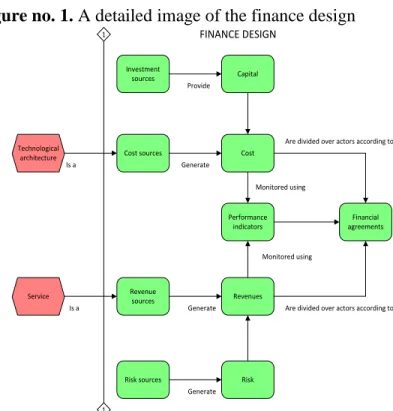
Searching the link between finance and design can be proposed finance design as a description of how a value network intends to capture monetary value from a particular service offering and how risks, investments and revenues are divided over the different actors of a value network [5]. In finance, the result of the finance design is the set of financial arrangements between the actors in the value network in which the profit, investment, cost, risk and revenue sharing among the actors is arranged. In turn, the investments and costs are closely related to the design choices made in the technology design. However, the question of who will supply investment capital is another important design variable in finance. The costs may also be influenced by the coordination costs of the value network. The risks that may exist in the other domains come with financial consequences. Typically, the design variables are not static, but change over time. So, they are dynamic and may respond to changes in other variables, either in finance or in other domains [5].
Figure no. 1. A detailed image of the finance design
Capital
Cost Investment
sources
Financial agreements Cost sources
Performance indicators
Revenue
sources Revenues
Risk sources Risk Provide
Generate
Generate
Generate
Monitored using
Monitored using
Are divided over actors according to
Are divided over actors according to Technological
architecture
Service Is a Is a
FINANCE DESIGN
1
1
Source: E. Faber, P. Ballon, H. Bouwman, T. Haaker, O. Rietkerk, M. Steen, Designing business models for ICT services, 16th Bled Electronic Commerce
Definition of design
The Industrial Design Society of America, define “design” as “the creation and development of concepts and specifications that optimize the functions, and value the appearance of products and systems for the mutual benefit of users and manufacturers [2]. Design might be defined as an activity aimed at creating, improving and sustaining human living conditions through the design and implementation of facilities or services included in the network of cultural, social and economic phenomena. The definition of design introduced by International Council of Societies of Industrial Design underlines the important role of design in shaping the culture-forming processes and directions of economics [10]. Other definition of design indicates that it is a creative activity whose aim is to establish the multi-faceted qualities of objects, processes, services and their systems in the whole life cycles. Therefore, design is the central factor of innovative humanization of technologies and the fundamental factor of cultural and economic exchange [7].
Design seeks to discover and assess structural, organizational, functional and economic relationships, with the task of:
Enhancing global sustainability and environmental protection (global ethics);
Giving profits and freedom to the human community, individual and collective;
Final users, producers and market protagonists (social ethics);
Supporting cultural diversity despite the globalization of the world (cultural ethics);
Giving products, services and systems, those forms that are expressive (semiology) and coherent with (aesthetics) their proper complexity.
The design analysis from the economics/finance perspective needs a closer look at money and its dematerialization. In general, dematerialization covers a large field of ongoing evolutions: miniaturization of products, servicizing, and reducing material use by recycling and the shift from matter to information. In the context of this study, dematerialization occurs when digital content becomes disengaged from its carrier, and flows freely through networks and devices, while the carrier disappears. Money is dematerializing, which means, that coins and paper money are disappearing and being replaced by electronic payment transactions [1].
Money and design
It is said that recession provokes artists, designers to create some of their best work but for some people, money is the constant source of question regardless of the economic climate. In economics the main functions of money are: a medium of exchange, a unit of account, a store of value and occasionally in the past, a standard of deferred payment. The design perspective needs to add next function – a work of design/art [4].
Throughout its many evolutions, money has been designed using the latest technologies, whether they are metal forming techniques for coins or printing methods for paper banknotes. Designers and artists have played a key role in giving form to currency since its beginning. Today, money design practitioners are either graphic designers or highly specialized craftspeople who are well trained in the process of making money [4].
Picture no. 1. Currency design
Source:Design boom,
http://www.designboom.com/design/money-design-and-history/ (13.02.2009).
As mentioned in the form of money, most coins and banknotes features a variety of subjects in addition to the country of origin, value and date of issue. Each currency is different. Portraits of politicians, members of royalty and cultural figures are probably the most iconic and common subject matter depicted on money. The other examples are: animals, plants, buildings, landmarks and landscapes. What is more, cultural scenes and themes are popular images in contemporary currency. These patterns are often inspired by motifs found in the currency’s culture of origin or based on historical patterns taken from calligraphy or art [4].
Security has always been an important part of currency and money design. With new technology and printing techniques, today’s banknotes and coins are the most sophisticated ever produced. Less priority is given to coins in terms of security. Banknotes, on the other hand, are carefully protected especially the most common denominations. Most money is printed using a heavy paper made with fibers that can be cotton, linen or specialty color fibers. Polymer bills offer a more durable solution and can be made with small transparencies that are hard to counterfeit [4].
Method/Methodology/Research model and hypothesis development
The purpose of this article is to analyze the influence of the money design on willingness to make purchases.
employees/employers at design studios, design students and students of economics/management?
The detailed research problems explored in this paper are:
Q1: Does the money design has influence on willingness to make purchases by employees/employed at design?
Q2: Does the money design have influence on willingness to make purchases by students of design (Poznań and Kielce)?
Q3: Does the money design have influence on willingness to make purchases by students of management/economics (Kielce)?
The main hypothesis (H0) is as follows – the more experience in design practice the more important is money design.
The detailed hypotheses explored in this paper are:
H1: Size and/or color of the banknotes and coins have an impact on the size of purchases;
H2: Employees/employed at design, would do the shopping more often if they could pay with money designed by themselves.
Data analysis
To encourage response and speed the data gathering process, we constructed an Internet-based survey. The questionnaire was published in February 2014 and closed one month later.
The survey received a total of 65 responses (15 employees/employers at design studios; 18 design students - the Concordia Design in Poznań; 10 design students - the Jan Kochanowski University in Kielce and 22 economics or management students - the Jan Kochanowski University in Kielce). It needs to be added that, a number of limitations deserve to be highlighted. The small sample size raises the issue of generalizability.
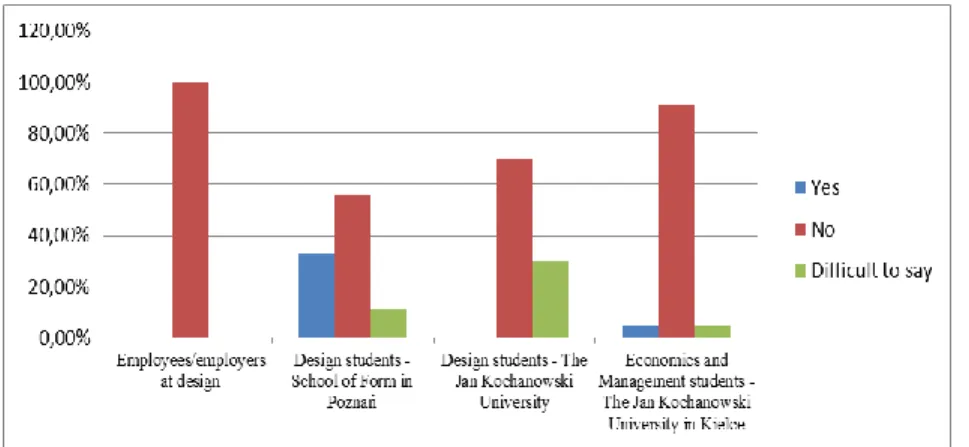
For the employers of the design studios the money design is very important (60%). Students of management/economics from the Jan Kochanowski University in Kielce don’t appreciate the money design (for 58% of respondents, the money design is not important).
Figure no. 2. The importance of money design (banknotes and/or coins)
Source: Own analysis
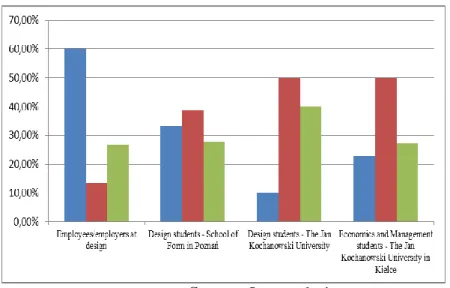
For all respondents, the impact of the size and/or color of banknotes and coins on the size of purchases weren’t important at the moment of purchase.
Figure no. 3. The impact of the size and/or color of banknotes and coins on the size of purchases
Figure no. 4 indicates that, employees/employers at design studios would pay more often using designed money by themselves. On the other hand, the students wouldn’t.
Figure no. 4. If you design the money (size, shape, color, imprints), would you pay more often with that money?
Source: Own analysis
Discussion and Conclusions
This study examined the main research problem, which implies, the money design has a greater influence on the willingness to make purchases on employees/employers at design, rather than students (design and/or management/economics).
Table no. 1. The detailed research problems Researched problem Employees/ employers at design Students of design – School of
Form in
Poznań
Students of
design – The Jan
Kochanowski University in Kielce
Students management and
economics –
The Jan
Kochanowski University in Kielce Does the money design has influence on willingness to make purchases by … Research Problem no. 1. No Research Problem no. 2a. No Research Problem no. 2b. No Research Problem no. 3.
No
Source: Own analysis
The main hypothesis was confirmed - the more experience in design practice the more important is money design.
Table no. 2. The detailed hypotheses
Hypothesis Verification
H1 Size and/or color of the banknotes and coins has an impact on the size of purchases
No H2 Employees/employed at design, would do the
shopping more often if they could pay money designed by themselves
Yes
Source: Own analysis
Bibliography
Campenhout van L., Frens, J., Overbeeke, K., Standaert, A., Peremans, H. (2013). Physical Interaction in a Dematerialized World.
International Journal of Design 7 (1): p. 1-2.
Definition of design (15.01.2013).
http://www.icsid.org/about/about/articles31.htm
Designboom (13.02.2009). http://www.designboom.com/design/money-design-and-history/
Faber, E., Ballon, P., Bouwman, H., Haaker, T., Rietkerk, O., Steen, M. (2003). Designing business models for ICT services, 16th Bled Electronic Commerce Conference eTransformation, Slovenia: p. 2-12.
Heskett, J. (2009). Creating Economic Value by Design. International Journal of Design 3 (1): p. 78-79.
Hollanders, H., Cruysen, A. (2009). Design, Creativity and Innovation: A Scoreboard Approach, Innometrics, Pro Inno Europe, Maastricht: 5. Laakso, S., Kostianen, E. (2009). Design in the Local Economy: Location,
Factors and Externalities of Design. Knowledge, Technology & Policy 22 (4): p. 227.
Palafox, A. (2010). Think design change. How can design thinking be applied to the achievement of positive social change?, MA Design Management, University of the Arts, London: 25.
Smolicki, J. (06.02.2010). Projektowanie doznawania,