TECHNICAL UNIVERSITY OF CLUJ-NAPOCA
ACTA TECHNICA NAPOCENSIS
Series: Applied Mathematics, Mechanics, and Engineering Vol. 60, Issue I, March, 2017
STUDIES REGARDING THE CONSTRUCTIVE VARIANTS OF THE
VIBRATING INDUSTRIAL WORK TABLES
Cosmin DEAC, Aurora Felicia CRISTEA
Abstract: The paper is proposing to analyze several types of vibration work table, which are useful to the pouring of the concrete panels and large choice of work table and depending on this end, taking into account the advantages and disadvantages of their use and construction.
Key words: vibration industrial work tables, constructive types.
1. INTRODUCTION
1.1 Vibrating work tables models using in the industry
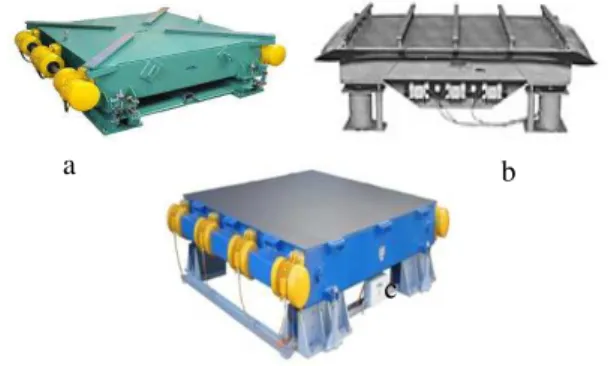
a. Vibrant work table (Fig. 1) with a flat surface for the production of finished parts made of materials such as concrete, refractory concrete etc. [11].
Vibrating work table has a size of 3 x 3 meters, and is designed to withstand the weight of 7000kg, the supply vibrated with a maximum frequency of 60 Hz.
Fig. 1 a. Work table; b. Vibrating work table with vibrant guide rails; c. Vibranting work table for tamping
the concrete carcasses [11].
b. Work table with vibrant guiding rails like as attachment for drums or other containers. Drums or other round containers are fixed with clamps on the work table. The clips can be variable moved on the diagonal rails, which lies on the surface of the work table [11].
c. Vibrating work table for compacting concrete in thin layers (as option of mounting) Vibrating work table for mounting of the same flush with the floor of the hall, it used for tamping of form-work concrete into the steel sheet.
For isolation of oscillations and to control the work table race in the position of working, it will be used for filling some pneumatic clamping [11].
1.2 Vibrating motors used in vibrating work tables’ construction
a. Excitatory series A
It due to the elastic join includes in the foot of these series of excitatory, instead of the circular force, it transmitted of elliptical force, almost linear force.
In this way, in some uses, instead of two normal excitatory could be mounted only one of this excitatory (Fig.2).
The fields of application are the realization of sifting and transport channels and transport gutters, concrete beams, containers of vibrators, vibrating (oscillating) etc. [6].
Fig. 2 Excitatory series A [6].
a b
Technical characteristics:
• Centrifugal force from 2 kN at 39 kN.
•Angular velocity from 1500 RPM (revolutions per minute) at 3000 RPM.
• Frequency: 50-200 Hz. • Power: 400 W.
c. Excitatory series R
The compact construction of this facilitates the exploitation centrifugal forces, all these requiring minimal spaces (Fig.3).
This is imperative rule, for mounting of machines used often. The areas of use for these are for example: excitation overload, machines gravel, vibrating work tables powered by batteries etc. [3].
Technical characteristics:
• the centrifugal force from 0.5 kN to 16.5 kN. • Angular velocity from 1500 RPM to 3000 RPM. • Frequency: 50-200 Hz.
• Power: 230 W.
Fig. 3 Excitatory series R [6].
2. MAIN ELEMENTS OF THE MACHINE VIBRATING
2.1. General considerations on the machine vibrating
The theory problems of vibration in engineering [6] have been developed over time after three main directions:
- the preventing, the eliminating and damping of unwanted vibration;
- the generating and using vibration with certain characteristics in different fields industries; - the apparatus and systems for tracking, verification and control of vibrations.
The second direction, it knows a great development and diversification and it is related to the construction and calculation of vibrating machines and devices.
The vibration action upon the environmental, it is carried out by means of machines, devices, tools, test benches or excitation tools. The most complex aggregates are vibrating machines of the most varied types
and uses, including use them as excitation devices and vibrating tools etc.
In the evolution of the development of construction of vibrating machines are distinguished three stages [6]:
The first stage, today it has been overcome, it characterized by the fact that the efficiency of these machines was achieved by increasing sizes, the weight of the excitation machine and the power consumed, too. The second stage is characterized by building of machines that work as a sounding board or close to regime of resonation. This resulting leads of a reduction in the size and power consumption. All these results were obtained by applying the theory of vibrations of linear systems.
The last stage, highly topical, relates to obtaining superior performance with minimal power and small price on the product obtained. They involve the design, the calculations, the nonlinear modeling of friction forces, as essential factor of elastic elements, the auto-synchronization and synchronization of excitation vibration etc. [6].
In the following paragraphs it will outline of the general images about vibrating machines (work tables) and using their.
2.2. Industrial fields of use of vibrating equipments
The most important areas in which technological processes are based on the vibrations there are applied with much success [6]:
a) the manufacture of the reinforced concrete elements on vibrating vertical platforms, they use the power of vertical batteries etc;
b) the concrete compaction using vibrating devices immersion and surface;
c) the compaction of ground and the earthworks of roads with vibratory rammers and vibratory rollers, compaction and vibratory of the finishing using the excitation devices;
d) the geological equipments drilling using the vibrating devices and percussion equipments; e) the handling bulk material conveyors with vibratory feeders;
tables of concentration etc., in relation to the shape, size and density or frictional coefficients; g) using the models to foundry cores with vibrating press;
h) the cleaning of parts of foundry cast and forged with vibratory reels;
i) correction the machine vibrating using the vibrating instruments and devices;
j) the intensity of extraction processes with devices of vibrating;
In the fields mentioned, there are the common applications on the large scale of the vibration.
As an example, we mention technology of metal powder and parts of foundry pieces, where are used the equipment of vibration in compaction operations.
2.3. Variety of the machines vibrating
There is a complete idea about the variety of constructive types of vibrating machines;
We list below some basic criteria for classifying these machines [6]:
a. after general purpose:
- the general use: - the equipments like compaction machines, separators, conveyors etc.;
- the general - purpose machinery: - the vibrating platforms for reinforced concrete elements, feeders for automatic’s machine tools etc. b. after type training: - the machines with electric, hydraulic, pneumatic and internal combustion engines.
c. after type of energy transformation in the mechanical energy: - the generators of centrifugal, machines with connecting rod-beam, electro-magnetic, piezoelectric with relevant international recommendations, auto-induction etc.
d. after the number of parts of vibrating machines: - with one, two or more moving masses.
e. after form-body vibration machine: - with rectilinear vibration, circular, elliptical, helical, compound vibration etc.
f. after the vibrations of frequency: - the periodical vibration simple machines, the modulated, almost periodic and random machines.
g. after periodic spectrum is the periodical machines of work: - with sinusoidal vibration, bi-harmonically, and multi - harmonically vibrations.
h. after the presence of shock: - the shock machines, the machines produced of shocks, with shocks of the first, second and third order, in terms of the amplitude of the vibrations. i. after the relationship between the frequency and the excitation owner frequency: - the post-resonance, almost resonant and resonant.
j. after the band-high frequency: - low frequency and medium frequency.
k. after synchronization method of vibration: - the mechanical synchronization machines, with electrical synchronization, timing with auto-synchronization or without auto-synchronization. l. after control method: - the machine without manual adjustment control, the automatic control, the auto-control and the optimal working conditions etc.
It could be used for the classification vibrating machines the other criteria too, that to include new aspects of these machines. In this way, any classification becomes unsatisfactory due their quickly progress [6].
2.3.1 Concrete panels’ vibrating on the vibrating work tables
The items of concrete can be performed on the compact work tables of vibration. The patterns will be fixed on the vibrating work table. Duration of vibration varies function of workability and the thickness of concrete, i.e. between 60-120 min. Power of vibrating work table will be correlated with the weight assembly of the printing element.
It is applying a re-vibrating of the concrete with a length of 15-30 min. during compaction, as direction before up, thus producing the concretes of the better quality and with a peripheral capacity superior [1].
is isolated by means of elastic elements of the fixed part of the work table (its support). The vibrations are induced by fitting of the metal counter in the top, with ones or more electric or hydraulic vibrators. Centrifugal force to them, it can be adjust by changing eccentrically and position of vibrators elements. You can also, adjust the vibration frequency. The vibrations can be low frequency 5-15 Hz or high frequency over 100 kHz.
The work tables could be fitted with restraint systems or forms of containers, which containers are used in the production process. The using of vibrating work tables have the scope of the manufacture of semi-finished products made of concrete, starting from small moldings (the pavers, the kerbs) till of moldings of large and very large fields (the panels, fence poles, tubes and concrete homes, beams etc.).
2.4 VERSIONS’ DESIGNED OF WORK TABLE VIBRATING
2.4.1 Machines vibrating of vibration generating
- these generate a harmonic force of inertia after the normal direction of the lamellar springs; - the vibration amplitude of these machines is relatively small (1-8 mm) [6];
Usage: vibration of the small and medium parts of concrete.
Fig. 4 Machine vibrating of vibration generating [6]
2.4.2 Machines with elastic and damping coupling
- the connection between the device and the drive is made by means of a spring and a damper, linked there in parallel [6];
Usage: for vibration of medium size situating in the different parts in construction.
Fig. 5 Machine with elastic coupling and damping [6].
2.4.3 Machines with coil springs, vibration generators with unbalanced masses
- this design is met in most cases at the vibrating sieves;
- such a machine has the working body tilted by an angle α = 15°-25° in rapport with the horizontal, from these types it could be fitted to one or more vibrating sieves;
- the vibration generator with an unbalanced mass develops a big disruptive force, in comparison with normal machine [6];
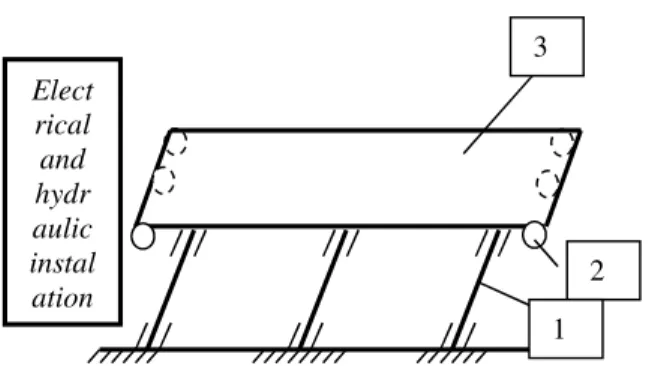
The constructive elements are: 1- vibrating work table; 2 - the coil springs;
3 - the excitatory motor with disruptive unbalanced mass;
4 - the coil springs.
Usage: to separate assemblies in a gravel pit (e.g. vibrating sieve).
In the following, it will describe a comparison between these vibrating work tables (Fig. 4-6) and choosing work table proposed in this study including design and dimension. This work table could name "MEVI", and in the following presentation, we will present a comparison between it and the other work tables with describe advantages and disadvantages of using these vibrating work tables.
Fig. 6 Machines with the coil springs [6].
a) The vibrating work table of figure 4 has the following advantages, in comparison with perturbation work table vibrating:
- this type of work table could be designed as a vibrant conveyor, vibrating sieve, dividers sieves etc;
- is coached by a rigid generator vibration mounted on the body of work;
- it is used often in construction; Disadvantages:
- the vibration amplitude of these machines is relatively small (1-8 mm);
- the yield vibration on the work tables of lamellar springs couldn’t be too big.
b) the vibrating work table of the figure 5 has the following advantages, in comparison with perturbation vibrating work table:
- it are used, generally, at produce of vibrations for the formation of concrete pavements, concrete panels, which are small dimensions (a few cm);
- the scale of frequencies up to 60 Hz; - the good duration of viability. Disadvantages:
- the corrupting of the lamellar spring and the efficiency is falls, necessitating his replacement; - load too large of this work table it could lead to cracking of these;
- satisfy of to the many hours of running, it leads of using of these on traks, in comparison with a normal parameters.
c) The vibrating work table of the figure 6 has the following advantages, in comparison with a perturbation vibrating work tables:
- this type of vibrating work table is used particularly in gravel pits, thanks to its increased effectiveness and efficiency;
- the vibration amplitude is the average value (10 mm);
- the operating frequency up to 100 Hz; Disadvantages:
- because of these vibrating work tables must be mounted one or more sieves, thanks to big vibrations, they could succumb and created the work accidents and default process disruption of work;
- the coil springs may be broken due to vibrations and large tasks (3t) provided of the aggregates.
In comparison with the three variants of vibrating work table’s exposure in the paper, (Fig.6-8), in the variant vibrating work table "MEVI" are using the vibration generators, it is compose of:
1. work table (10 m x 4, 80 m);
2. vibrating motors with eccentric series A (6 PCs. - 3 pieces on one side of the work table "MEVI" and 3 pieces into the opposite side (mounted under the work table)), spaced equidistant;
3. rubber pads (2 PCs.);
4. telescopic hydraulic Pistons (3 PCs) consisting of 3 telescopic elements each, mounted under the work table;
5. the exterior form of design; 6. hydraulic pump (1 PCs.);
7. hydraulic tubes and pipes (under mounting scheme);
8. constraints of electrical and hydraulic installation when lifting pieces;
So the vibrant mass "MEVI" has the following advantages in opposite with of the other versions shown in figures 4-6:
- loading of vibrating work table is up to 2 tons; - vibration work table could be made at frequencies between 50-200 Hz;
- there is possibility of variation of amplitudes (since generators);
- this work table is designed to be used in construction for vibration produce of concrete panels of large size (approximately 5m x 10 m); - hydraulic operation will need the pistons, these to raise work table of the vertical wedge close to 85°, this with the purpose of better manipulation of concrete panels, namely transporting them, so that the panels will be raised by a bridge on the work table without being broken;
- the productivity will be great due to the large dimensions of the work table;
- the operate of vibration work table will be done through a remote control by the operator; - the acting of hydraulic pistons will do it manually or from the remote control, use a distributor with sense (up-down), which will be mounted on the pump;
- etc.
Disadvantages:
- due of the large work table "MEVI ", the power consumption is one considerable;
- it could manufacture only pieces of large gauge (about 50 m2), the small pieces to require a very high energy consumption in relation to productivity and therefore are to be avoided; - it requires a staff made up at least 3 or 4 operators, simultaneously;
- etc.
2.4.4 Vibrating work table „MEVI”
Vibrant work table, "MEVI" (Fig. 9) has the following simplified model.
2 - the vibrating motors with eccentric ((6 PCs-3 PCs on one side of the work table and PCs-3 PCs. in the opposite side (mounted under the work table)), the distance between the two flanks of the chosen engines are equidistant;
3 - vibrating work table.
Fig. 7 Vibrating work table ,,MEVI” – designed variant.
3. CONCLUSIONS
The designing and the widespread use of vibrators devices, tools and machines are of relatively recent date, such as a number of important issues are still unsolved or partially solved. Modern trends of increasing power, the efficiency and the qualitative indices, it suppose a field approach of theoretical and experimental research, that can meet these challenges and also, to ensure a rapid progress in the future. Further it may list some of the major research directions, current and future [6] like as: generating mechanical vibrations:
- the study of the generators as energy conversion devices regarding of the mass in mechanical vibration;
- design of mechanical vibration generators, shapes and vibration spectra, including prescribes and random vibration generators; - the development of methods and gear ratios of vibration frequencies; OR the choice of
frequency domain, which depends on the type of construction and the purpose of the machine. For machines operating in the field of post-resonance, the duration of transitional motion analysis of startup and shutdown have a special importance, it due to the fact that through the continuous variation of value’s pulsation, and they effect are disruptive It coincides at any given time with resonance frequency after which continues its variation with a certain amplitude.
4. REFERENCES
[1] P. Bratu – Vibraţiile sistemelor mecanice, Editura Tehnică, Bucureşti, 2000, 350 pagini.
[2] P. Bratu – Izolarea şi amortizarea vibraţiilor la utilaje de construcţii, Editura, INCERT, Bucureşti 1982, 300 pagini.
[3] Gh. Buzdugan , L. Fetcu , M. Radeş, Vibraţii Mecanice, Editura Didactică şi Pedagogică Bucureşti 1982, 336 pagini.
[4] C. Bia, V. Ille, M.V.Soare – Rezistenţa Materialelor şi Teoria Elasticităţii, Editura Didactică şi Pedagogică, Bucureşti 1983, 936 pagini.
[5] Manualul Inginerului Mecanic – partea I – Materiale, Rezistenţa Materialelor, Teoria Mecanismelor şi a Maşinilor, Editura Tehnică Bucureşti, 1959, 754 pagini.
[6] M. Munteanu – Introducere în dinamica maşinilor vibratoare, Editura Academiei Republicii Socialiste România, Bucureşti 1986, 307 pagini.
[7] M. Popoviciu , V. Anton , Hidraulică şi maşini hidraulice, Editura Didactică şi Pedagogică, Bucureşti, 1979.
[8] R. Voinea, D. Voiculescu, F. Simion – Introducere în Mecanica Solidului cu Aplicaţii în Inginerie, Editura Arad RSR, 1989, 1151 pagini.
[9]http://www.vibroprese-boltari.ro/produse/mese vibrante.html, March 2013.
[10] http://www.knauer.de, April 2013. http://www.knauer.de/vibrationsmotor_ruettlermotore n.0.html, April 2013.
[11]http://www.knauer.de/vibrating_work table_block_making48.0.html, April 2015.
[12]http://ro.scribd.com/doc/97807093/5-Cilindri-hidraulici, April 2016.
[13]http://dsd.utcb.ro/teze/Falcuta%20Bogdan-Dragos%20-%20Rezumat.pdf, May 2016.
Studii privind variantele constructive de mese industriale vibrante
Rezumat: Lucrarea îşi propune să analizeze mai multe tipuri de variante constructive, cu avantajele şi dezavantajele lor, privind construcţia unei mase vibratoare pentru turnat plăci de beton.
Cosmin DEAC, Dipl. Eng., [email protected].
Aurora Felicia CRISTEA, Lector, Ph.D. Eng., Technical University of Cluj-Napoca, Mechanical Engineering Systems Department, tel. 0264-401667, e-mail: [email protected].
Elect rical and hydr aulic instal
ation
3
2
![Fig. 5 Machine with elastic coupling and damping [6].](https://thumb-us.123doks.com/thumbv2/123dok_us/8000102.2120986/4.892.88.382.765.860/fig-machine-elastic-coupling-damping.webp)