TECHNICAL UNIVERSITY OF CLUJ-NAPOCA
ACTA TECHNICA NAPOCENSIS
Series: Applied Mathematics, Mechanics, and Engineering Vol. 60, Issue II, June, 2017
IDENTIFIERS FOR HUMAN MOTION ANALYSIS
Mircea MIHĂLCICĂ, Sorin VLASE
Abstract: This paper proposes a series of identifiers that show the fact that the human motion is specific to each person. In order to find these parameters, a simple system based on video analysis was used to capture and analyze the human motion. Measurements were conducted on seven different subjects that were filmed during normal walking. Experimental data were processed with dedicated software and specific software programs developed by the authors. In the end, a combination of five identifiers that demonstrate the uniqueness of human motion was proposed.
Key words: human motion analysis, gait identifiers, markers, video processing, inverse kinematics
1. INTRODUCTION
The study of human motion was of interest to researchers since ancient times, the results being relevant to areas such as sports, medicine and forensics [1-4]. The main purpose of the studies in these fields was to improve performances of athletes, to offer new solutions and also to improve the methods used in medicine (mainly rehabilitation medicine for orthopedics) and to offer alternatives to the usual human identification methods used in forensics.
Based on experimental observations and pattern analysis, different mathematical models were proposed [5-8] and multiple approaches were considered. Some of the approaches were based on gait cycle analysis [9-11], some of them on inverse kinematics, following the idea of obtaining motion parameters like velocity or acceleration starting from the position of body parts during motion [12].
In this paper the authors focus on finding a series of motion identifiers extracted from video materials of human walking in normal conditions. The goal is to prove that these identifiers are unique and stable for every individual. This is consistent with the needs in the above described fields: sports, rehabilitation medicine and forensics.
2. MATERIALS AND METHODS
When choosing a gait analysis system, there are lots of variants to be considered: video analysis methods, image analysis only methods, methods based on GPS and different other radio technologies etc. [13-14].
Aiming for low costs and wide availability, the plan was to use simple systems and methods so that the results can be easily obtained, verified and replicated. Also, it was very important that the system used did not influence in any way the human motion during walking.
Considering the possible practical applications in domains like sports and medicine, it was mandatory that the system is non-intrusive, so the choices were limited to gait analysis systems that carry almost no weight on the subject’s joints and any solutions that include any form of electrical / electronic systems installed directly on the joint were also rejected from the start. Also, the ease of installation and ease of use are important factors in choosing a suitable gait analysis system.
considered. Markers (consisting of coloured paper) were installed on these leg joints and a frame-by-frame temporal evolution of these joints in motion, specific for every person who was video recorded using the system, was obtained. The motion was considered to be plane [15-19].
A lateral video camera, perpendicular on the walking axis, was used to capture the motion of the leg for every subject who walks in front of it. In order to keep things simple, 30 frames per second were chosen for the video recordings, but tests were made also using a high-speed camera, able of providing 500 frames per second videos. The processing time of high frames per second videos is significantly higher. Considering the goal of this research, 30 frames per second were enough, but for professional applications in sports or medicine a higher frame rate is advised.
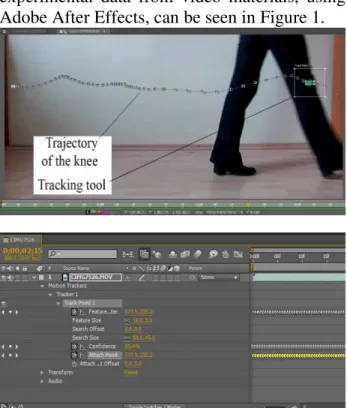
Adobe After Effects was used as software to extract the data from the video materials. The extracted data was then transferred to Microsoft Excel tables, processed and analyzed using software programs which the authors developed in MATLAB [20]. The process of gathering the experimental data from video materials, using Adobe After Effects, can be seen in Figure 1.
Fig. 1. Extracting the data from video materials
Extracting the coordinates is done using Adobe After Effects. The software offers a
tracking tool which will follow the motion of the selected leg joint. The tool looks like two overlapping squares and a „+” in the middle.
Adobe After Effects automatically processes the video material frame by frame, and for each frame it analyzes the outer square versus the inner square (considering colour, luminance or saturation) to determine the correct position of the moving object. In the end, a list of (X,Y) coordinates for the selected leg joint was obtained [21-22]. That list was stored in an Excel table. This repeats 10 times for each subject, so, in the end, for each subject we have 10 tables for each leg joint, 30 tables of experimental data in total for each subject.
The data was then imported into MATLAB and a set of programs was developed by the authors in order to obtain the identifiers presented in Chapter 3 of this paper, Gait Identifiers.
Using inverse kinematics, the authors were able to determine values for velocity and acceleration for human walking, and these parameters were taken into consideration for the analysis.
3. GAIT IDENTIFIERS
In order to be considered useful for the purpose of this work, a Gait identifier has to have two primary characteristics: stability and uniqueness. Stability means that, for the same subject, a Gait identifier does not change drastically (remains between some boundaries) every time the subject walks normally. Uniqueness means that, for two or more subjects, the same Gait identifier is sufficiently different in value to be able to be used as a criterion to differentiate the different subjects considered.
In order to reduce error when working with a large number of subjects, the recommendation is that combinations of those gait identifiers are preferred to be used instead of using single identifiers alone.
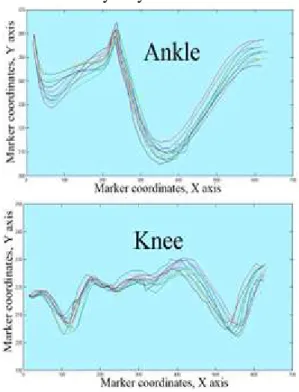
of coordinates (0,0) to be the top-left corner and not the usual bottom left corner; the authors did not want to alter the data in any way and used the values as they were given by the application. In order to visually re-create the trajectory of the joints, these images should be viewed upside down. Again, this has only a visual effect, the math behind the identifiers is not affected in any way.
Fig. 2. Temporal evolution for the Ankle and Knee
markers: same subject, 10 different recording sessions
By looking at the graphical representation of the temporal evolution of markers, it can be seen that the trajectories of the joints, for each subject, present both stability (Fig. 2) and uniqueness (Fig. 3). The idea is to extract some mathematical parameters which can be used to define these characteristics of motion (uniqueness and stability).
Fig. 3. Temporal evolution of the Ankle marker: two
different subjects, 10 different recording sessions
The gait parameters which the authors found useful were directly computed using the
coordinates obtained from the experimental data. The authors focused on their distribution during motion, these parameters being the main ones which they used in order to uniquely define the motion of the leg of an individual. These parameters were:
- The variance to the mean, on the y axis:
(1)
- The weighted mean velocity moment:
To ease the calculus, the authors have chosen so and then:
(2)
- The weighted mean acceleration moment:
To ease the calculus, the authors have chosen so and then:
(3)
- The mean displacement moment on the y axis,
1st degree:
and if :
(4)
- The mean displacement moment on the y axis,
2nd degree:
and if :
(5)
seconds), represents the vertical coordinate corresponding to the i frame, n is the number of
frames and .
In the end, a file can be assigned for each subject, containing all the important data for the respective subject (Fig. 4).
Fig. 4. The file of a subject, for one walking session
4. RESULTS
To prove the stability and uniqueness of the chosen motion parameters, the following analysis was done:
− a combination of 3 of the 5 Gait
identifiers was considered for a 3D graphical representation of the motion for the 7 considered subjects (for the presentation of the results shown in this paper, just one combination of parameters is shown, but, during the experiment, many other combinations were tested, all proving consistent with the facts presented in this work)
− the authors used those Gait identifiers as
axis for a 3-dimensional graphic
− the authors drew the graphics for the
values of these Gait identifiers, for all the 7 subjects and all the 10 walking sessions
− the above steps were repeated 3 times,
one time for each leg joint: ankle, knee and hip; in the end, each joint had its own 3D graphical representation for the 7 subjects
It was expected that the values for each subject (the points determined by the combination of the 3 parameters) would group together, each group of points being at a
significant distance from the points belonging to other subjects.
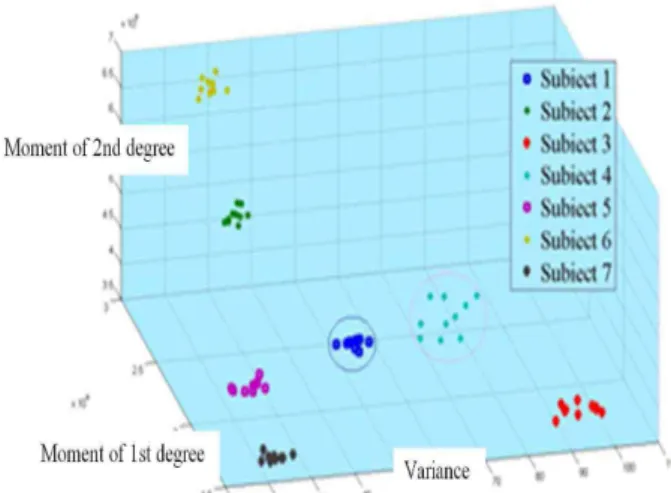
The authors present the analysis for a knee marker, for the 7 subjects x 10 walking sessions, having as axis the Variance, the Mean Displacement Moment of 1st degree and the Mean Displacement Moment of 2nd degree (on the y axis). These three identifiers have been chosen for presentation based on their variance, but any combination of the above identifiers can be considered. This method was chosen because it also offers a good visual representation for the results, which might be useful in fields where fast interpretations of results are needed (like athletics, where sports motions can be both recorded and analyzed on the sports field).
Fig. 5. Knee representation for the 7 subjects over 10 walking sessions, having as axis: the Variance, the Mean
Displacement Moment of 1st degree and the Mean Displacement Moment of 2nd degree
In Fig. 5 it can be seen that the combination of identifiers for each subject groups together and, at the same time, at a reasonable distance from the combination of identifiers which corresponds to the other subjects. The authors consider that, on this sample, this proves the stability and uniqueness of the combination of parameters which they have chosen for the analysis.
5. LIMITATIONS AND FUTURE WORK
presented should be taken as combinations, as their uniqueness is not that consistent when considered each on their own.
For future research, the authors aim to find correlations between these gait identifiers and the physical characteristics of subjects (things like weight, height, gender and age are to be considered), a mathematical model for human walking being their ultimate goal in this field.
It is expected that the number of identifiers will increase after future research, and plans are that the Principal Component Analysis method to be used in order to statistically analyze the data.
6. CONCLUSION
The authors proposed and presented a simple gait analysis system which can successfully be used to capture process and analyze the human motion data in order to extract gait parameters which can be used to prove the uniqueness of human motion.
A simple solution for obtaining the gait data, from video capture to actual coordinates of a few human joints was presented. The authors aimed to find a series of statistical elements that make the human gait unique. They obtained five identifiers which, used in combination with each other, offer representations that are both stable and unique.
As practical applications, the authors consider these parameters to be useful in domains like medicine (especially rehabilitation medicine), sports (with the aim of improving athletic performances by identifying good / bad patterns for athletes) and, usually with the help of other tools from those fields, forensics and security, to help identify people from databases based on gait. The gait analysis system and the methods used in this work were carefully chosen so that eventual practical applications would be suitable for institutions on a limited budget, such as junior sports clubs, old foster care etc.
8. REFERENCES
[1] Barris S, Button C., A Review of Vision-Based Motion Analysis in Sport, Sports
Medicine, Volume 38, Issue 12, p. 1025-1043, 2008
[2] Yang H.D., Lee S.W., Reconstruction of 3D Human Body Pose for Gait Recognition, in:
D. Zhang, A. Jain (Eds.), Advances in Biometrics, Vol. 3832, Springer Berlin / Heidelberg, pp. 619-625, 2005
[3] Berme N, Cappozzo A, Meglan J.,
Biomechanics of human movement: applications in rehabilitation, sports and ergonomics, Worthington, Ohio. Bertec
Corporation, 1990
[4] Mihălcică M., Contributions to the Identification of Individuals Using Motion Analysis, PhD Thesis, "Transylvania"
University of Brasov, Romania, 2011
[5] Tofan MC, Burcă I, Mihălcică M, Secară E,
Hisom R, Popa I. Mathematical models for the human body motions analysis, The 13th
International Conference Modtech, Modern Technologies, Quality and Innovation, New face of TMCR, Iasi-Chişinau, ISSN
2066-3919, p. 671-674, 2009
[6] Lee S.H., Choi J.S., A Single-View Based Framework for Robust Estimation of Height and Position of Moving People, Advances in
Image and Video Technology, pp. 562-574, 2007
[7] Lee MW, Cohen I., A Model-Based Approach for Estimating Human 3D Poses in Static Images, IEEE Transactions on
Pattern Analysis and Machine Intelligence, 28(6):905-916 2006
[8] Zhou F, De la Torre Frade F, Hodgins JC.,
Hierarchical Aligned Cluster Analysis for Temporal Clustering of Human Motion,
IEEE Transactions on Pattern Analysis and Machine Intelligence (PAMI), 35(3):582-596, 2013
[9] Ren L, Jones RK, Howard D., Predictive modelling of human walking over a complete gait cycle, Journal of Biomechanics, Volume
40, Issue 7, pp 1567-1574, 2007
[10] Jordan K, Challis JH, Newell KM.,
Walking speed influences on gait cycle variability, Gait & Posture, Volume 26,
Issue 1, pp 128-134, 2007
[11] Tlalolini D, Aoustin Y, Chevallereau C.,
locomotor system of a thirteen-link 3D biped using the parametric optimization,
Multibody System Dynamics, Volume 23, Number 1, 33-56, DOI: 10.1007/s11044-009-9175-1, 2010
[12] Meredith M., Maddock S., Adapting Motion Capture using weighted Real-Time Inverse Kinematics, ACM Computers in
Entertainment, Vol. 3, No. 1., 2005
[13] Higginson BK., Methods of running gait analysis, Current Sports Medicine Reports
8(3): p.136-141, 2009
[14] Molloy M, Salazar-Torres J, Kerr C, McDowell BC, Cosgrove AP., The effects of industry standard averaging and filtering techniques in kinematic gait analysis, Gait &
Posture 11/2008; 28(4):559-62, 2008
[15] Mihalcica M, Modrea A, Munteanu V, Burca I., Tracking Kinematic Gait Parameters During the Recovery of Motor Function After Total Knee Arthroplasty,
INTER-ENG 2015, Tirgu-Mures, Romania, 2015
[16] Mihalcica M, Burca I, Munteanu V., A motion capture and analysis system to aid the physician during the motor recovery of patients, Palestrica of the third millennium -
Civilisation and Sport, 15(4), pp 296-300, 2014
[17] Vlase S, Danasel C, Scutaru ML, Mihalcica M., Finite Element Analysis of a Two-Dimensional Linear Elastic Systems with a Plane “Rigid Motion”, Rom. Journ.
Phys., Vol. 59, Nos. 5–6, pp. 476–487, Bucharest, 2014
[18] Vlase, S., A Method of Eliminating Lagrangian-Multipliers from the Equation of Motion of Interconnected Mechanical Systems. Journal of Applied Mechanics-Transaction of the ASME, vol. 54, Issue:1, pp.235-237,1987
[19] Negrean I, Kacso K, Schonstein C, Duca A, Mecanica. Teorie și aplicație. Ed.
U.T.PRESS, 2012
[20] Mihalcica M, Guiman V, Munteanu V., A Cheap and Portable Motion Analysis System, the International Conference
COMAT 2014,16-17 October 2014, Braşov,
Romania, 2014
[21] Smith J., Adobe After Effects CS5 Digital Classroom, Wiley Publishing, 2010
[22] Magrab EB, Azarm S, Balachandran B, Duncan J, Herold K, Walsh G., Engineers Guide to Matlab, Prentice Hall Press Upper
Saddle River, NJ, USA, 2007
Identificatori pentru mișcarea umană
Lucrarea propune găsirea unei serii de identificatori care arată faptul că mișcarea umană este specifică fiecărei
persoane. În scopul de a găsi acești parametri, a fost utilizat un sistem simplu bazat pe analiza video pentru a înregistra și analiza mișcarea umană. Măsurătorile au fost efectuate pe șapte subiecți diferite, care au fost filmați în timpul mersul
normal. Datele experimentale au fost prelucrate cu software dedicat și programe software specifice, elaborate de autori.
În final, a fost propusă o combinație de cinci identificatori care demonstrează unicitatea mișcării umane.
Mircea MIHĂLCICĂ, Lect. PhD, Transylvania University of Brașov, Department of Mechanical
Engineering, [email protected], Tel. +40 268 413000 / 168, Str. Politehnicii 1, Brașov
500024, Romania
Sorin VLASE, Prof. PhD, Transylvania University of Brașov, Department of Mechanical
Engineering, [email protected], Tel. +40 268 413000 / 168, Str. Politehnicii 1, Brașov 500024,