Christine U Oramasionwu, Angela DM Kashuba, Sonia Napravnik, David A Wohl, Lu Mao, Adaora A Adimora
Christine U Oramasionwu, Angela DM Kashuba, UNC Eshelman School of Pharmacy, University of North Carolina, Chapel Hill, NC 27599, United States
Angela DM Kashuba, Sonia Napravnik, David A Wohl, UNC Center for AIDS Research, University of North Carolina, Chapel Hill, NC 27599, United States
Angela DM Kashuba, Sonia Napravnik, David A Wohl, Adaora A Adimora,School of Medicine, University of North Carolina, Chapel Hill, NC 27599, United States
Lu Mao, Adaora A Adimora, Gillings School of Global Public Health, University of North Carolina, Chapel Hill, NC 27599, United States
Author contributions: Oramasionwu CU designed and coor dinated the research and wrote the manuscript; Kashuba ADM and Adimora AA help design the research and draft the manuscript; Napravnik S helped design the research and acquire clinical cohort data; Wohl DA helped design the research; Mao L conducted data analysis; all authors approved the final manuscript.
Supported by The University of North Carolina at Chapel Hill Center for AIDS Research (CFAR) an NIH funded program to Dr. Oramasionwu, No. P30 AI50410; Dr. Oramasionwu was also supported partially by the NIH Loan Repayment Program (LRP) through the National Institute on Minority Health and Health Disparities, No. L60 MD003770.
Institutional review board statement: This research was reviewed and approved by the University of North Carolina at Chapel Hill Institutional Review Board.
Informed consent statement: The clinical cohort, approved by the UNC Institutional Review Board, has ongoing enrollment and participants provide written informed consent.
Conflict-of-interest statement: The authors declare no other conflicts of interest.
Data sharing statement: No additional data are available.
Open-Access: This article is an openaccess article which was selected by an inhouse editor and fully peerreviewed by external reviewers. It is distributed in accordance with the Creative Commons Attribution Non Commercial (CC BYNC 4.0) license, which permits others to distribute, remix, adapt, build upon this work noncommercially, and license their derivative works on different terms, provided the original work is properly cited and the use is noncommercial. See: http://creativecommons.org/ licenses/bync/4.0/
Correspondence to:Christine U Oramasionwu, PharmD, PhD, Assistant Professor, UNC Eshelman School of Pharmacy, University of North Carolina, Kerr Hall 2215, Chapel Hill, NC 27599, United States. [email protected]
Telephone: +19198434071 Fax: +19199668486
Received: August 1, 2015
Peer-review started: August 3, 2015 First decision: September 14, 2015 Revised: October 24, 2015 Accepted: December 3, 2015 Article in press: December 4, 2015 Published online: March 8, 2016
Abstract
AIM: To assess whether reasons for hepatitis C virus (HCV) therapy non-initiation differentially affect racial and ethnic minorities with human immunodeficiency virus (HIV)/HCV co-infection.
METHODS: Analysis included co-infected HCV treat-ment-naïve patients in the University of North Carolina CFAR HIV Clinical Cohort (January 1, 2004 and December 31, 2011). Medical records were abstracted to document non-modifiable medical (
e.g.
, hepatic decompensation, advanced immunosuppression), potentially modifiable medical (e.g., substance abuse, severe depression, psychiatric illness), and non-medical (e.g., personal, DOI: 10.4254/wjh.v8.i7.368 © 2016 Baishideng Publishing Group Inc. All rights reserved.Non-initiation of hepatitis C virus antiviral therapy in
patients with human immunodeficiency virus/hepatitis C
virus co-infection
Retrospective Cohort Study
social, and economic factors) reasons for non-initiation. Statistical differences in the prevalence of reasons for non-treatment between racial/ethnic groups were assessed using the two-tailed Fisher’s exact test. Three separate regression models were fit for each reason category. Odds ratios and their 95%CIs (Wald’s) were computed.
RESULTS: One hundred and seventy-one patients with HIV/HCV co-infection within the cohort met study inclusion. The study sample was racially and ethnically diverse; most patients were African-American (74%), followed by Caucasian (19%), and Hispanic/other (7%). The median age was 46 years (interquartile range = 39-50) and most patients were male (74%). Among the 171 patients, reasons for non-treatment were common among all patients, regardless of race/ethnicity (50% with ≥ 1 non-modifiable medical reason, 66% with ≥ 1 potentially modifiable medical reason, and 66% with ≥ 1 non-medical reason). There were no significant differences by race/ethnicity. Compared to Caucasians, African-Americans did not have increased odds of non-modifiable [adjusted odds ratio (aOR) = 1.47, 95%CI: 0.57-3.80], potentially modifiable (aOR = 0.72, 95%CI: 0.25-2.09) or non-medical (aOR = 0.90, 95%CI: 0.32-2.52) reasons for non-initiation.
CONCLUSION: Race/ethnicity alone is not predictive of reasons for HCV therapy non-initiation. Targeted interventions are needed to improve access to therapy for all co-infected patients, including minorities.
Key words: Human immunodeficiency virus; Hepatitis C virus; Co-infection; Antiviral therapy; Race
© The Author(s) 2016. Published by Baishideng Publishing Group Inc. All rights reserved.
Core tip: Historically, hepatitis C virus (HCV) treat-ment rates have been low in patients with human immunodeficiency virus (HIV) co-infection, especially for African-American patients. Identifying the reasons for treatment non-initiation may help improve treatment rates among racially and ethnic minorities. In our study of patients with HIV/HCV coinfection, non-modifiable medical reasons, potentially modifiable medical reasons, and non-medical reasons for non-treatment were common among all patients, regardless of their race/ ethnicity. There is a need to recognize and overcome potential treatment barriers in order to improve HCV treatment uptake in this patient population.
Oramasionwu CU, Kashuba ADM, Napravnik S, Wohl DA, Mao L, Adimora AA. Noninitiation of hepatitis C virus antiviral therapy in patients with human immunodeficiency virus/hepatitis C virus coinfection. World J Hepatol 2016; 8(7): 368375 Available from: URL: http://www.wjgnet.com/19485182/full/ v8/i7/368.htm DOI: http://dx.doi.org/10.4254/wjh.v8.i7.368
INTRODUCTION
Hepatitis C virus (HCV) treatment rates have been low in patients who are co-infected with human immu-nodeficiency virus (HIV). Up until 2011, when the first direct-acting antivirals (DAAs) became available, only one-third of co-infected patients were deemed eligible to receive HCV therapy, of whom less than
one-third initiated HCV treatment[1-4]. Of great concern is
the proportion of racial and ethnic minorities with co-infection that have not received HCV therapy. Nearly half of United States patients with HIV/HCV co-infection
are African-American[5-7]. Previous studies involving
older HCV regimens [pegylated interferon plus ribavirin (pegIFN-RBV)] reported that African-Americans were
less likely than Caucasians to initiate HCV therapy[6,8,9].
Of co-infected patients in the HIV Outpatient Study during 1999-2007, African-Americans had a lower likeli-hood of HCV treatment than Caucasians (HR = 0.3,
95%CI: 0.2-0.6)[6]. African-American patients have been
shown to not initiate therapy due to presence of IFN-related contraindications or to defer therapy due to lack
of symptoms[10,11].
Non-initiation of HCV therapy in co-infected patients is attributed to diverse factors such as patient- and provider-level barriers, perceived risks and benefits of therapy, and patient ineligibility to receive therapy due
to medical contraindications[12]. Examples of medical
conditions that sometimes precluded treatment with older regimens include hepatic decompensation, active injection drug use (IDU), alcohol abuse, severe de-pression, and advanced HIV-associated
immunosuppre-ssion[13-16].
Although these treatment-related barriers have been identified in the general co-infected population, scant research has documented their prevalence in co-infected minorities. Some reasons for non-treatment, such as substance abuse, are potentially modifiable. Addressing them could help improve access to HCV therapy in minorities. Despite the clinical promise of the DAAs, it is possible that some of the historical challenges to treating patients with HIV/HCV co-infection are still obstacles to treatment, particularly
for minority patients[1,10,17]. The objectives of this study
were to document reasons for non-treatment with HCV antiviral therapy and to assess how they differentially affect racial and ethnic minorities with HIV/HCV co-infection.
MATERIALS AND METHODS
Study design and population
This was a retrospective study of patients with HIV/HCV co-infection enrolled in the University of North Carolina (UNC) Center for AIDS Research HIV Clinical Cohort. This prospective cohort began enrolling patients in 1996
and includes over 4000 HIV-infected patients ≥ 18
approved by the UNC Institutional Review Board, has ongoing enrollment and participants provide written informed consent. Data for the cohort are retrieved from two sources. Patient demographic characteristics and laboratory values are retrieved electronically, whereas patient medication histories and comorbid conditions are obtained by standardized and comprehensive electronic medical record reviews.
This study examined patients with HIV and HCV infection who had never received treatment for HCV and who had at least one outpatient clinic visit between January 1, 2004 and December 31, 2011. Patients were included in the study if they had the following: (1) a concomitant diagnosis of HCV based on positive HCV serostatus (as determined by HCV antibody test enzyme-linked immunosorbant assay/enzyme immunoassay); and (2) a positive HCV recombinant immunoblot assay (RIBA) test, detectable HCV RNA or HCV genotype test results. Patients with a history of HCV antiviral therapy were excluded. Anti-HCV therapy was defined as interferon, pegIFN, RBV, telaprevir, or boceprevir. The study period (2004-2011) was selected to best capture the timeframe when combination the-rapy with pegIFN-RBV was the standard of treatment for most patients with co-infection.
Measurements
Baseline variables were retrieved from the cohort database and included patient demographics and clinical characteristics at time of HCV diagnosis. Baseline clinical characteristics were measurements taken proximal (allowing a 30-d window) to the date of the first positive HCV test. Demographic variables included age, gender, race/ethnicity (African-American, Caucasian, or Hispanic/ other), and insurance coverage (private, public, none, or other). Clinical characteristics included CD4, HIV-1 RNA, HCV RNA, HCV genotype, HIV risk category (risk categories were not mutually exclusive), prior AIDS-defining clinical conditions, and use of highly active antiretroviral therapy (HAART), defined as a combination of three or more antiretroviral drugs. Prior to May 1, 2007, HCV RNA assays were measured in copies/mL, whereas subsequent HCV RNA assays were measured in IU/mL. Results for both assays are presented, where applicable, within the study period.
We reviewed individual medical records to identify reasons cited in the clinic notes by providers for not initiating HCV therapy. Reasons for treatment non-in-itiation were then categorized as non-modifiable medical reasons, potentially modifiable medical reasons, or non-medical reasons. Non-modifiable medical reasons included death (patients with a poor life expectancy or patients that died before treatment was ever initiated), hepatic decompensation, advanced immunosuppression (CD4 < 200) not controlled by antiretroviral therapy, renal insufficiency, uncontrolled autoimmune conditions, or hematological disease. Potentially modifiable medical reasons included active or recent (within the past six months) IDU/cocaine use, alcohol use, severe
depre-ssion (defined as depredepre-ssion with suicidal ideation), psychiatric illness, or pregnancy/unwillingness to use contraception. Lastly, non-medical reasons included
personal factors (e.g., refusal of available therapies, poor
adherence to care), social factors (e.g., social instability,
homelessness/lack of housing, lack of transportation),
and economic factors (e.g., lack of health insurance,
prohibitive cost).
Statistical analysis
Descriptive analyses were conducted on baseline variables, including demographic and clinical charac-teristics. For each type of reason for non-treatment, the prevalence of the sub-categories by racial/ethnic groups was computed. Statistical differences in the prevalence of reasons for non-treatment between racial/ethnic groups were assessed using the two-tailed Fisher’s exact test. For each reason type (non-modifiable medical, potentially modifiable medical, and non-medical), risk factors such as age, gender, race/ethnicity, insurance status, and select HIV clinical characteristics were analyzed using multivariate logistic regression. Three separate regression models were fit for each reason type; the three reason types were the dependent variables in the respective models. Odds ratios and their 95%CIs (Wald’s) were computed. All data analyses were conducted using SAS software (version 9.2; SAS Institute Inc., Cary, North Carolina, United States). All statistical analyses were performed by Lu Mao, a trained biostatistician with the UNC CFAR Biostatistics Core.
RESULTS
Baseline demographics and clinical characteristics
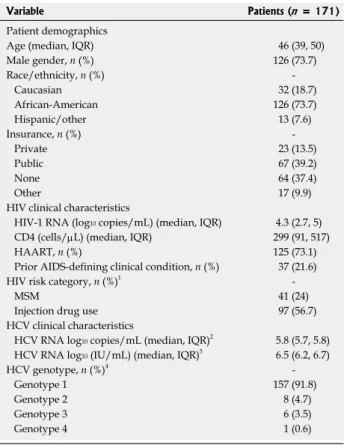
Within the cohort, 246 patients had a positive HCV sero-status and either a positive HCV RIBA test or detectable HCV RNA at baseline. Of these, 75 patients (30%) were excluded during the chart review process due to lack of HCV genotype results or due to reported history of antiviral therapy. We present results for the 171 patients (70%) that met criteria for this study. Baseline demographic and clinical characteristics are summarized in Table 1. The median age was 46 years [interquartile range (IQR) = 39-50] and most patients were male (74%). The study sample was racially and ethnically diverse; most patients were African-American (74%), followed by Caucasian (19%), and Hispanic/other (7%). This largely reflects the racial/ethnic makeup of the clinical cohort. More than one-third of patients lacked any insurance coverage (37%).
At baseline, patients had a median (IQR) HIV-1 RNA
of 4.3 (2.7-5) log10 copies/mL, a median (IQR) CD4 299
(91-517) cells/μL, and 73% of patients were treated
with HAART. Twenty-five patients (15%) had a baseline
median (IQR) HCV RNA of 5.8 (5.7, 5.8) log10 copies/mL
(values reported prior to May 1, 2007) and 10 patients (6%) had a baseline median (IQR) HCV RNA of 6.5 (6.2,
6.7) log10 IU/mL (values reported after May 1, 2007).
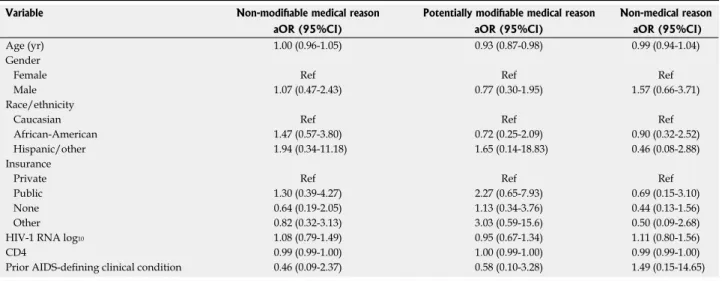
HIV-1 RNA, CD4, and prior AIDS-defining clinical con-ditions as factors independently associated with reasons for not initiating therapy (Table 3). Compared to Cau-casian race/ethnicity, African-American race/ethnicity was not associated with having at least one non-modi-fiable medical reason [adjusted odds ratio (aOR) = 1.47, 95%CI: 0.57-3.80], potentially modifiable medical reason (aOR = 0.72, 95%CI: 0.25-2.09), or non-medical reason (aOR = 0.90, 95%CI: 0.32-2.52).
DISCUSSION
While low uptake of older HCV antiviral regimens in HIV/HCV co-infected patients, particularly in racial and ethnic minorities, is well-documented in the literature,
the reasons for low uptake are less clear[6,8,16]. This
study evaluated reasons cited by the provider for non-initiation of HCV therapy in a cohort of untreated patients. Patients in our study were predominantly African-American and largely had genotype 1, which is
comparable to other studies[1,18-21]. Our findings suggest
that race/ethnicity alone is not predictive of having at least one reason for not initiating therapy. Rather, a key finding of this study was the high prevalence of multiple reasons for non-treatment, regardless of racial/ethnic group.
Nearly one-third of all patients in this study died without ever receiving HCV therapy. Of note, it cannot be assumed that patients who died would have ever initiated therapy while alive. Advanced immunosuppre-ssion (CD4 < 200) was also a common reason for non-treatment in our study. The majority (73%) of patients were on HAART at baseline, yet more than half of all patients had advanced immunosuppression documented as a reason for non-treatment, a finding that has been noted previously. In a study of patients with HIV/HCV co-infection at one of three Los Angeles HIV clinics,
HAART use was common (> 90%), yet CD4 ≤ 200 was
independently associated with decreased HCV treatment
acceptance (OR = 0.08, 95%CI: 0.01-0.40)[13].
Treat-ment guidelines suggest postponing HCV antiviral therapy in HIV/HCV co-infected patients with CD4 < 200 and recommend HAART initiation to preserve and
restore immune function[22]. Treatment-related factors
such as adherence and regimen appropriateness can influence immune response. CD4 and HIV-1 RNA are indirect, objective measures of these treatment-related factors. However, we only evaluated baseline CD4 and HIV-1 RNA values, which precluded us from drawing inferences about the effects of adherence and regimen appropriateness on immunosuppression and resultant non-initiation of HCV therapy.
As expected, IDU/cocaine use was reported as a potentially modifiable reason for not initiating therapy. Past studies have classified substance abuse as an
absolute contraindication to HCV therapy[23]. In a recent
systematic review evaluating barriers to HCV therapy in HIV/HCV co-infected patients, substance abuse was (92%), followed by genotype 2 (5%), genotype 3 (3%),
and genotype 4 (< 1%).
Documented reasons for HCV non-treatment
Reasons for HCV non-treatment did not vary signifi-cantly by race/ethnicity (Table 2). Subcategories for each reason type are illustrated in Figure 1. At least one non-modifiable medical reason was documented in approximately half of all patients. Patient death was the most common non-modifiable medical reason in all three racial/ethnic groups, followed by advanced immuno-suppression. Two-thirds of patients in each racial/ethnic group had at least one potentially modifiable reason for not initiating therapy (range 66%-69% across racial/ ethnic groups); of these, IDU/cocaine use and psychiatric illness was the most common, followed by alcohol use and severe depression. Non-medical reasons were also common in each racial/ethnic group; these were most often due to personal and social reasons, and least commonly due to economic reasons.
Factors associated with HCV non-treatment
We evaluated age, gender, race/ethnicity, insurance,
Table 1 Baseline demographic and clinical characteristics of
patients with human immunodeficiency virus/hepatitis C virus co-infection that did not initiate hepatitis C virus therapy
Variable Patients (n = 171)
Patient demographics
Age (median, IQR) 46 (39, 50) Male gender, n (%) 126 (73.7) Race/ethnicity, n (%) Caucasian 32 (18.7) African-American 126 (73.7) Hispanic/other 13 (7.6)
Insurance, n (%)
Private 23 (13.5)
Public 67 (39.2)
None 64 (37.4)
Other 17 (9.9)
HIV clinical characteristics
HIV-1 RNA (log10 copies/mL) (median, IQR) 4.3 (2.7, 5) CD4 (cells/μL) (median, IQR) 299 (91, 517) HAART, n (%) 125 (73.1) Prior AIDS-defining clinical condition, n (%) 37 (21.6) HIV risk category, n (%)1
MSM 41 (24)
Injection drug use 97 (56.7) HCV clinical characteristics
HCV RNA log10 copies/mL (median, IQR)2 5.8 (5.7, 5.8) HCV RNA log10 (IU/mL) (median, IQR)3 6.5 (6.2, 6.7) HCV genotype, n (%)4 Genotype 1 157 (91.8) Genotype 2 8 (4.7) Genotype 3 6 (3.5) Genotype 4 1 (0.6)
the most frequently cited barrier[23]. However, substance
users should not be routinely excluded from treatment,
as substance use can fluctuate with time[24]. Recent
guidelines recommend deferral of treatment if active or ongoing substance abuse is expected to interfere with regimen adherence, and frequent re-evaluation of each patient’s adherence to routine medical care, other
comorbidities, and potential for reinfection[15,24].
Personal and social factors were commonly reported in all racial/ethnic groups as reasons for not initiating therapy. Engagement in care and adherence are often perceived by the provider as an indicator of treatment readiness and are based on characteristics such as mental health, clinic attendance, substance use, and the
patient’s attitudes and beliefs about therapy[25]. These
factors can decrease the likelihood of patient referral for HCV care.
Historically, patients with HIV/HCV, most often African-Americans, have had poor virologic response to
HCV therapy[26-29]. African-Americans have been shown
to be less likely to accept pegIFN-RBV antiviral therapy
when it was recommended by their providers[13]. It
has been suggested that patient awareness of low sustained virologic response (SVR) among African-Americans with genotype 1 may contribute to decisions
to refuse therapy[11]. The high proportion of personal
factors for non-treatment in our study could have also
been attributed to patient refusal of pegIFN-RBV in anticipation of more effective, and ultimately more convenient, therapies. DAA-based therapy demonstrates excellent efficacy in clinical trials; 87% SVR has been
attained in African-Americans[30]. Nevertheless, some of
the reasons for non-treatment identified in the present study are still likely barriers to the DAAs.
Current treatment guidelines acknowledge substance
abuse, psychiatric disorders, and lack of access (e.g.,
cost, insurance, distance to provider) as barriers to
current HCV treatment regimens that include DAAs[31].
Several strategies are proposed to increase HCV treatment, particularly DAA therapy, in patients with HIV/HCV. At the patient level, pre-treatment educa-tion, management of comorbidities and mental health conditions, and harm reduction counseling in individu-als with continued substance abuse can be provided through patient referral for specialty services, such as
substance abuse treatment and psychiatric therapy[24].
Strategies at the provider level include collaborative care models with primary care providers and HCV
specialists[32], and co-localization models that combine
HCV treatment and care with other primary medical care
or substance abuse treatment and social services[31].
Systems-level strategies are needed, such as medication patient assistance programs, removal of Medicaid state restrictions regarding substance abuse and HCV therapy, Table 2 Prevalence of reasons for hepatitis C virus non-treatment in patients with human immunodeficiency virus/hepatitis C virus
co-infection
Total Race/ethnicity
(n = 171) African-American
(n = 126) (Caucasian n = 32) Hispanic/other (n = 13) P value
1
≥ 1 non-modifiable medical reason, n (%) 85 (49.7) 64 (50.8) 14 (43.8) 7 (53.8) 0.806 ≥ 1 potentially modifiable medical reason, n (%) 113 (66.1) 83 (65.9) 21 (65.6) 9 (69.2) 1.000 ≥ 1 non-medical reason, n (%) 113 (66.1) 85 (67.5) 21 (65.6) 7 (53.8) 0.597
1Fisher’s exact test.
Table 3 Multivariate analyses for associations between characteristics and reasons for hepatitis C virus non-treatment
Variable Non-modifiable medical reason Potentially modifiable medical reason Non-medical reason
aOR (95%CI) aOR (95%CI) aOR (95%CI)
Age (yr) 1.00 (0.96-1.05) 0.93 (0.87-0.98) 0.99 (0.94-1.04) Gender
Female Ref Ref Ref
Male 1.07 (0.47-2.43) 0.77 (0.30-1.95) 1.57 (0.66-3.71) Race/ethnicity
Caucasian Ref Ref Ref
African-American 1.47 (0.57-3.80) 0.72 (0.25-2.09) 0.90 (0.32-2.52) Hispanic/other 1.94 (0.34-11.18) 1.65 (0.14-18.83) 0.46 (0.08-2.88) Insurance
Private Ref Ref Ref
Public 1.30 (0.39-4.27) 2.27 (0.65-7.93) 0.69 (0.15-3.10) None 0.64 (0.19-2.05) 1.13 (0.34-3.76) 0.44 (0.13-1.56) Other 0.82 (0.32-3.13) 3.03 (0.59-15.6) 0.50 (0.09-2.68) HIV-1 RNA log10 1.08 (0.79-1.49) 0.95 (0.67-1.34) 1.11 (0.80-1.56) CD4 0.99 (0.99-1.00) 1.00 (0.99-1.00) 0.99 (0.99-1.00) Prior AIDS-defining clinical condition 0.46 (0.09-2.37) 0.58 (0.10-3.28) 1.49 (0.15-14.65)
decrease prescription prior authorization requirements, and ultimately, to lower DAA drug prices in order to
increase treatment access for patients[33].
Our study is subject to limitations. The UNC clinic is a large academic center and may not be representative
of patients receiving care in other clinic settings. All baseline variables were retrieved from the clinical cohort database; however, individual patient records were reviewed to ascertain reasons for non-treatment in the medical record. Some limitations of medical record data
Patients with
≥
1 non-modifiable reason (
n
= 85)
100%
80%
60%
40%
20%
0% Death Hepatic Advanced Renal insufficiency Autoimmune Hematological disease decompensation immunosuppression conditions
Non-modifiable medical reasons 50%
64% 86%
19% 14%
29%
47%50% 71%
34%
7% 29%
3% 0% 0% 9% 7% 0% African-Americans (n = 64) Caucasians (n = 14) Hispanic/other (n = 7)
Patients with
≥
1 modifiable reason (
n
= 113)
100%
80%
60%
40%
20%
0%
African-Americans (n = 83) Caucasians (n = 21) Hispanic/other (n = 9)
IDU/cocaine Alcohol use Severe depression Psychiatric illness Pregnancy Potentially modifiable medical reasons
46%
24%22%
35%38%33%
11%14%
22% 20%24% 33%
1% 0% 11%
Patients with
≥
1 non-medical reason (
n
= 113)
100%
80%
60%
40%
20%
0%
African-Americans (n = 85) Caucasians (n = 21) Hispanic/other (n = 7)
Personal Social Economic Non-medical reasons
82%
62% 86%
33% 62%
57%
29% 24%
14%
collection include variability in documentation across clinic providers, missing data due to errors that occur during clinic visit narrative dictation and transcription, and lack of specificity for patient information. Listed reasons were based on providers’ cited reasons for not initiating HCV therapy. These may differ from patient-reported barriers to care that are specific to racial and
ethnic groups, such as medical mistrust[34]. As our study
was designed to focus on the untreated, we were unable to make any causal associations between documented reasons and why patients were not treated. We did not assess continuity of HAART. Given that advanced immunosuppression greatly contributed to having a non-modifiable medical reason, it is possible that patients who had advanced immunosuppression documented as a reason for non-treatment were maintained on HAART, but did not experience the full clinical benefits of HAART due to regimen adherence, regimen appropriateness, and/or due to inability for some patients to achieve
immune reconstitution[35]. We did not measure these
factors in our study. Lastly, we did not evaluate diffe-rences in HCV treatment by race/ethnicity, and were therefore, unable to determine if any treatment dispari-ties exist among patients in the UNC clinic.
In summary, reasons for non-treatment did not diffe-rentially affect racial and ethnic minorities co-infected with HIV/HCV. Rather, there was a high prevalence of multiple reasons for non-treatment in patients, regard-less of racial/ethnic group. The advent of DAAs has undoubtedly revolutionized HCV care, however, there is still a need to recognize and overcome potential treat-ment barriers in order to improve treattreat-ment uptake and eradicate HCV in this patient population.
ACKNOWLEDGMENTS
The authors would like to thank Oksana Zakharova, Sam Stinnette, Christine Sun, Dan-Thanh Nguyen, Heather Moore, and Joshua Toliver for their assistance with data extraction and data collection for this study.
COMMENTS
Background
Historically, hepatitis C virus (HCV) treatment rates have been low in patients
with human immunodeficiency virus (HIV) co-infection, especially for African-American patients. Identifying the reasons for treatment non-initiation may help improve treatment rates among racially and ethnic minorities.
Research frontiers
The authors’ findings suggest that race/ethnicity alone is not predictive of having at least one reason for not initiating therapy. Rather, a key finding of this study was the high prevalence of multiple reasons for non-treatment, regardless of racial/ethnic group.
Innovations and breakthroughs
While low uptake of older HCV antiviral regimens in HIV/HCV co-infected
patients, particularly in racial and ethnic minorities, is well documented in
the literature, the reasons for low uptake are less clear. This study evaluated
reasons cited by the provider for non-initiation of HCV therapy in a cohort of
untreated patients.
Applications
This study demonstrates that there is a need to recognize and overcome potential treatment barriers in order to improve HCV treatment uptake in this
patient population.
Peer-review
This article is of interest to clinicians that manage patients with HIV/HCV
coinfection.
REFERENCES
1 Mehta SH, Lucas GM, Mirel LB, Torbenson M, Higgins Y, Moore RD, Thomas DL, Sulkowski MS. Limited effectiveness of antiviral treatment for hepatitis C in an urban HIV clinic. AIDS 2006; 20: 23612369 [PMID: 17117023 DOI: 10.1097/QAD.0b013e3280108 6da]
2 Fleming CA, Craven DE, Thornton D, Tumilty S, Nunes D. Hepatitis C virus and human immunodeficiency virus coinfection in an urban population: low eligibility for interferon treatment. Clin Infect Dis 2003; 36: 97100 [PMID: 12491208 DOI: 10.1086/344907] 3 Restrepo A, Johnson TC, Widjaja D, Yarmus L, Meyer K, Clain
DJ, Bodenheimer HC, Min AD. The rate of treatment of chronic hepatitis C in patients coinfected with HIV in an urban medical centre. J Viral Hepat 2005; 12: 8690 [PMID: 15655053 DOI: 10.1111/j.13652893.2005.00548.x]
4 Hooshyar D, Napravnik S, Miller WC, Eron JJ. Effect of hepatitis C coinfection on discontinuation and modification of initial HAART in primary HIV care. AIDS 2006; 20: 575583 [PMID: 16470122 DOI: 10.1097/01.aids.0000210612.37589.12]
5 Ananthakrishnan AN, McGinley EL, Fangman J, Saeian K. Hepatitis C/HIV coinfection is associated with higher mortality in hospitalized patients with hepatitis C or HIV. J Viral Hepat 2010;
17: 720729 [PMID: 20002558 DOI: 10.1111/j.13652893.2009.01 232.x]
6 Vellozzi C, Buchacz K, Baker R, Spradling PR, Richardson J, Moorman A, Tedaldi E, Durham M, Ward J, Brooks JT. Treatment of hepatitis C virus (HCV) infection in patients coinfected with HIV in the HIV Outpatient Study (HOPS), 19992007. J Viral
Hepat 2011; 18: 316324 [PMID: 20367803 DOI: 10.1111/j.1365
2893.2010.01299.x]
7 Johnson TL, Toliver JC, Mao L, Oramasionwu CU. Differences in outpatient care and treatment utilization for patients with HIV/ HCV coinfection, HIV, and HCV monoinfection, a crosssectional study. BMC Infect Dis 2014; 14: 217 [PMID: 24755037 DOI: 10.1186/1471233414217]
8 Backus LI, Boothroyd DB, Phillips BR, Mole LA. Pretreatment assessment and predictors of hepatitis C virus treatment in US veterans coinfected with HIV and hepatitis C virus. J Viral Hepat 2006; 13: 799810 [PMID: 17109679 DOI: 10.1111/j.13652893.2 006.00751.x]
9 Butt AA, Justice AC, Skanderson M, Good C, Kwoh CK. Rates and predictors of hepatitis C virus treatment in HCVHIV coinfected subjects. Aliment Pharmacol Ther 2006; 24: 585591 [PMID: 16907891 DOI: 10.1111/j.13652036.2006.03020.x] 10 Schaeffer S, Khalili M. Reasons for HCV nontreatment in under
served African Americans: implications for treatment with new therapeutics. Ann Hepatol 2015; 14: 234242 [PMID: 25671833] 11 Khokhar OS, Lewis JH. Reasons why patients infected with
chronic hepatitis C virus choose to defer treatment: do they alter their decision with time? Dig Dis Sci 2007; 52: 11681176 [PMID: 17357838 DOI: 10.1007/s1062000695791]
13 Osilla KC, Wagner G, Garnett J, GhoshDastidar B, Witt M, Bhatti L, Goetz MB. Patient and provider characteristics associated with the decision of HIV coinfected patients to start hepatitis C treatment. AIDS Patient Care STDS 2011; 25: 533538 [PMID: 21823907 DOI: 10.1089/apc.2011.0048]
14 Osilla KC, Ryan G, Bhatti L, Goetz M, Witt M, Wagner G. Factors that influence an HIV coinfected patient’s decision to start hepatitis C treatment. AIDS Patient Care STDS 2009; 23: 993999 [PMID: 19929229 DOI: 10.1089/apc.2009.0153]
15 Panel on Opportunistic Infections in HIV-Infected Adults and Adolescents. Guidelines for the prevention and treatment of opportunistic infections in HIVinfected adults and adolescents: recommendations from the Centers for Disease Control and Prevention, the National Institutes of Health, and the HIV Medical Association of the Infectious Diseases Society of America. [Accessed 2015 Mar 12]. Available from: URL: http://aidsinfo.nih. gov/contentfiles/lvguidelines/adult_oi.pdf
16 Butt AA, Tsevat J, Leonard AC, Shaikh OS, McMahon D, Khan UA, DoreyStein Z, Lo Re V 3rd. Effect of race and HIV co infection upon treatment prescription for hepatitis C virus. Int J
Infect Dis 2009; 13: 449455 [PMID: 18993100 DOI: 10.1016/j.
ijid.2008.06.041]
17 Walley AY, White MC, Kushel MB, Song YS, Tulsky JP. Know ledge of and interest in hepatitis C treatment at a methadone clinic.
J Subst Abuse Treat 2005; 28: 181187 [PMID: 15780548 DOI:
10.1016/j.jsat.2004.12.004]
18 Adeyemi OM, Jensen D, Attar B, Ghaoui R, Gallagher M, Wolen D, Cotler SJ. Hepatitis C treatment eligibility in an urban population with and without HIV coinfection. AIDS Patient Care STDS 2004;
18: 239245 [PMID: 15142354 DOI: 10.1089/1087291043230389 19]
19 Backus LI, Boothroyd D, Deyton LR. HIV, hepatitis C and HIV/ hepatitis C virus coinfection in vulnerable populations. AIDS 2005; 19 Suppl 3: S13S19 [PMID: 16251809]
20 Butt AA, Khan UA, Shaikh OS, McMahon D, DoreyStein Z, Tsevat J, Lo Re V 3rd. Rates of HCV treatment eligibility among HCVmonoinfected and HCV/HIVcoinfected patients in tertiary care referral centers. HIV Clin Trials 2009; 10: 2532 [PMID: 19362993 DOI: 10.1310/hct100125]
21 Pearlman BL. Hepatitis C virus infection in African Americans. Clin
Infect Dis 2006; 42: 8291 [PMID: 16323096 DOI: 10.1086/498512]
22 Panel on Antiretroviral Guidelines for Adults and Adolescents. Guidelines for the use of antiretroviral agents in HIV1infected adults and adolescents. Department of Health and Human Services. [Accessed March 12, 2015]. Available from: URL: http://aidsinfo. nih.gov/ContentFiles/AdultandAdolescentGL.pdf
23 Oramasionwu CU, Moore HN, Toliver JC. Barriers to hepatitis C antiviral therapy in HIV/HCV coinfected patients in the United States: a review. AIDS Patient Care STDS 2014; 28: 228239 [PMID: 24738846 DOI: 10.1089/apc.2014.0033]
24 Robaeys G, Grebely J, Mauss S, Bruggmann P, Moussalli J, De Gottardi A, Swan T, Arain A, Kautz A, Stöver H, Wedemeyer H, Schaefer M, Taylor L, Backmund M, Dalgard O, Prins M, Dore GJ. Recommendations for the management of hepatitis C virus infection among people who inject drugs. Clin Infect Dis 2013; 57
Suppl 2: S129S137 [PMID: 23884061 DOI: 10.1093/cid/cit302]
25 Wagner GJ, Ryan GW. Hepatitis C virus treatment decision making in the context of HIV coinfection: the role of medical, behavioral and mental health factors in assessing treatment readiness. AIDS 2005; 19 Suppl 3: S190S198 [PMID: 16251817 DOI: 10.1097/01.aids.0000192089.54130.b6]
26 Sterling RK, Stravitz RT, Luketic VA, Sanyal AJ, Contos MJ, Mills AS, Shiffman ML. A comparison of the spectrum of chronic hepatitis C virus between Caucasians and African Americans. Clin
Gastroenterol Hepatol 2004; 2: 469473 [PMID: 15181614]
27 Conjeevaram HS, Fried MW, Jeffers LJ, Terrault NA, Wiley Lucas TE, Afdhal N, Brown RS, Belle SH, Hoofnagle JH, Kleiner DE, Howell CD. Peginterferon and ribavirin treatment in African American and Caucasian American patients with hepatitis C genotype 1. Gastroenterology 2006; 131: 470477 [PMID: 16890601 DOI: 10.1053/j.gastro.2006.06.008]
28 Ioannou GN, Scott JD, Yang Y, Green PK, Beste LA. Rates and predictors of response to antiviral treatment for hepatitis C virus in HIV/HCV coinfection in a nationwide study of 619 patients.
Aliment Pharmacol Ther 2013; 38: 13731384 [PMID: 24127691
DOI: 10.1111/apt.12524]
29 Martel-Laferrière V, Brinkley S, Bichoupan K, Posner S, Stivala A, Perumalswami P, Schiano T, Sulkowski M, Dieterich D, Branch A. Virological response rates for telaprevirbased hepatitis C triple therapy in patients with and without HIV coinfection. HIV Med 2014; 15: 108115 [PMID: 24025147 DOI: 10.1111/hiv.12086] 30 Lawitz E, Mangia A, Wyles D, RodriguezTorres M, Hassanein
T, Gordon SC, Schultz M, Davis MN, Kayali Z, Reddy KR, Jacobson IM, Kowdley KV, Nyberg L, Subramanian GM, Hyland RH, Arterburn S, Jiang D, McNally J, Brainard D, Symonds WT, McHutchison JG, Sheikh AM, Younossi Z, Gane EJ. Sofosbuvir for previously untreated chronic hepatitis C infection. N Engl J
Med 2013; 368: 18781887 [PMID: 23607594 DOI: 10.1056/
NEJMoa1214853]
31 American Association for the Study of Liver Diseases and the Infectious Diseases Society of America. Recommendations for testing, managing, and treating hepatitis C. [Accessed 2015 Jan 15]. Available from: URL: http://www.hcvguidelines.org/full reportview
32 Arora S, Thornton K, Murata G, Deming P, Kalishman S, Dion D, Parish B, Burke T, Pak W, Dunkelberg J, Kistin M, Brown J, Jenkusky S, Komaromy M, Qualls C. Outcomes of treatment for hepatitis C virus infection by primary care providers. N Engl J Med 2011; 364: 21992207 [PMID: 21631316 DOI: 10.1056/NEJMoa1009370] 33 Grebely J, Oser M, Taylor LE, Dore GJ. Breaking down the
barriers to hepatitis C virus (HCV) treatment among individuals with HCV/HIV coinfection: action required at the system, provider, and patient levels. J Infect Dis 2013; 207 Suppl 1: S19S25 [PMID: 23390301 DOI: 10.1093/infdis/jis928]
34 Jordan AE, Masson CL, MateuGelabert P, McKnight C, Pepper N, Bouche K, Guzman L, Kletter E, Seewald RM, DesJarlais DC, Sorensen JL, Perlman DC. Perceptions of drug users regarding hepatitis C screening and care: a qualitative study. Harm Reduct J 2013; 10: 10 [PMID: 23786800 DOI: 10.1186/147775171010] 35 Geng EH, Deeks SG. CD4+ T cell recovery with antiretroviral
therapy: more than the sum of the parts. Clin Infect Dis 2009; 48: 362364 [PMID: 19123869 DOI: 10.1086/595889]
P- Reviewer: Larrubia JR, Li ZF, Wang K S- Editor:Qi Y