0
Journal of Algebra Combinatorics Discrete Structures and Applications
A constructive approach to minimal free resolutions of
path ideals of trees
Research Article
Rachelle R. Bouchat, Tricia Muldoon Brown
Abstract: For a rooted treeΓ,we consider path ideals ofΓ, which are ideals that are generated by all directed paths of a fixed length in Γ. In this paper, we provide a combinatorial description of the minimal free resolution of these path ideals. In particular, we provide a class of subforests ofΓ that are in one-to-one correspondence with the multi-graded Betti numbers of the path ideal as well as providing a method for determining the projective dimension and the Castelnuovo-Mumford regularity of a given path ideal.
2010 MSC:05E40
Keywords: Betti numbers, Path ideals, Rooted trees, Monomial ideals
1.
Introduction
Monomial ideals have been studied extensively in the literature and many applications of monomial ideals have been explored. In this paper, we consider a specific class of monomial ideals, known aspath ideals. Path ideals are a type of squarefree monomial ideals that are generated in a fixed degree. Edge ideals, a specific class of path ideals, were first studied by Conca and De Negri in [4]. Given a graph Γ = (V, E)having vertex setV and edge setE, we can form the path ideal of length (t−1)associated to Γby considering the ideal generated by the monomials corresponding to all(t−1) length paths inΓ. IfV ={x1, . . . , xn}, this ideal is considered in the polynomial ringR:=k[x1, . . . , xn], wherekis a field. In [10], Nagel and Reiner showed in Proposition 6.1 that the Betti numbers of edge ideals of arbitrary graphs can be as complicated as desired. In particular, this proposition implies that the Betti numbers of the edge ideal of an arbitrary graph can depend on the choice of the field, k. For the case of path ideals of directed, rooted trees Bouchat, Há, and O’Keefe showed in Theorem 2.7 of [3] that the Betti
Rachelle R. Bouchat; Indiana University of Pennsylvania (email: [email protected]).
x8 x4
x5 x6
x7
x2 x3
x1
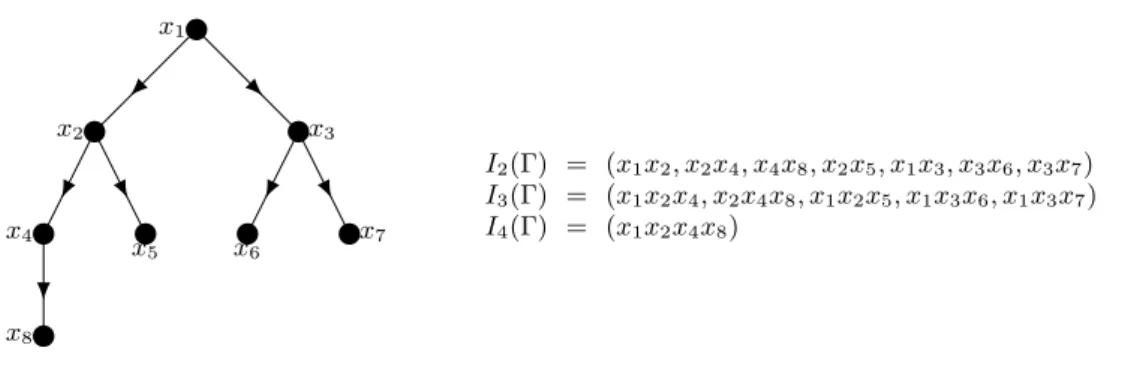
I2(Γ) = (x1x2, x2x4, x4x8, x2x5, x1x3, x3x6, x3x7) I3(Γ) = (x1x2x4, x2x4x8, x1x2x5, x1x3x6, x1x3x7) I4(Γ) = (x1x2x4x8)
Figure 1. An example of a graph, Γ, and its associated path ideals
numbers of a path ideal associated to a rooted tree are independent of the choice of the field, k. In this paper, we will restrict our focus to the study of path ideals ofrooted trees. Recall that atree is a simple, connected graph containing no loops or multi-edges. Then a rooted tree is a tree together with a fixed vertex, called the root. It is natural to consider a rooted tree as a directed graph in which all edges are assigned the direction going away from the root. It should be noted that xi will denote both the vertex in the graphΓas well as the monomial in the polynomial ringR.
Definition 1.1. Given a directed, rooted treeΓandt≥2, the path idealof length(t−1) ofΓ is:
It(Γ) := (xi1xi2· · ·xit | {xi1, xi2, . . . , xit} forms a directed path inΓ).
Thus, for a given directed, rooted tree Γ there can be more than one path ideal associated toΓ as illustrated in Figure1.
For a given tree Γ, we can successively remove any leaves that occur at level less than (t−1)when considering the path ideal It(Γ), as these vertices cannot contribute to a minimal generator inIt(Γ). A tree that has had successive removal of all leaves ocurring at level less than (t−1)will be said to be in clean form.
The minimal free resolutions of path ideals of trees have been studied by many authors, including Há and Van Tuyl in [7], Katzman in [8], and Kummini in [9]. The basic tools and decompositions that will be used in this paper were introduced by Faridi and Alilooee in [1]. The aim of this paper is to give a constructive description of the multi-graded Betti numbers for path ideals of rooted trees. This constructive description of the Betti numbers corresponding to a path ideal of a rooted tree will also provide a method to compute the projective dimension as well as the Castelnuovo-Mumford regularity.
2.
Basic definitions
We begin with the background concepts from commutative algebra.
LetM be a finitely generated gradedS-module. Associated toM is aminimal free resolution, which is of the form
0→M
a
S(−a)βp,a(M)−→δp M a
S(−a)βp−1,a(M)δ−→ · · ·p−1 δ1
−→M
a
S(−a)β0,a(M)→M →0
where the mapsδiare exact and whereS(−a)denotes the translation ofSobtained by shifting the degree of elements ofS bya∈(N∪ {0})n. The numbersβi,a(M)are called themulti-graded Betti numbers (or
Nn-graded Betti numbers) ofM, and they correspond to the number of minimal generators of degreea
occurring in theith-syzygy module ofM. It should be noted that thegraded Betti numbers (or
N-graded
Betti numbers) ofM can be defined asβi,j(M) := M
a1+···+an=j
There are two invariants corresponding to the minimal free resolution ofM which measure the “size” of the resolution.
Definition 2.1. Let M be a finitely generated gradedS-module.
1. The projective dimensionof M, denoted pd(M), is the length of the minimal free resolution asso-ciated toM.
2. The Castelnuovo-Mumford regularity(or regularity), denotedreg(M), is
reg(M) := max{j−i|βi,j(M)6= 0}.
We also need the following definitions from simplicial topology.
Definition 2.2.
1. An abstract simplicial complex,∆, on a vertex setX ={x1, . . . , xn} is a collection of subsets ofX satisfying:
(a) {xi} ∈∆ for alli, and (b) F∈∆,G⊂F=⇒G∈∆.
The elements of∆are called facesof ∆, and the maximal faces (under inclusion) are called facets of∆. The simplicial complex ∆with facesF1, . . . , Fswill be denoted by hF1, . . . , Fsi.
2. If∆ is an abstract simplicial complex, then a face τ∈∆ is called a free faceif it is contained in a unique facet of∆.
3. For any Y ⊆ X, an induced subcollection of ∆ on Y, denoted by ∆Y, is the simplicial complex
whose vertex set is a subset of Y and whose facet set is given by
{F|F ⊆ Y andF is a facet of∆}.
4. IfF is a face of ∆ =hF1, . . . , Fsi, the complement ofF in ∆is given by
FXc =X \F
and
∆cX =h(F1)Xc , . . . ,(Fs)cXi.
It should be noted that if F1, . . . , Fs are facets in Definition 2.2(1), thenhF1, . . . Fsi is a minimal representation of ∆. In particular, the complementary complex ∆cX, described in the fourth part of Definition2.2, is heavily utilized within this paper.
Definition 2.3.
1. Let∆be a simplicial complex with vertex setx1, . . . , xn. Then the facet idealof ∆is defined as
I(∆) := Y x∈F
x|F is a facet of∆ !
.
Moreover,I is an ideal in the polynomial ring R:=k[x1, . . . , xn].
2. LetI be an ideal inR :=k[x1, . . . , xn] minimally generated by square-free monomialsm1, . . . , ms.
The facet complex∆(I) associated toI has vertex set {x1, . . . , xn} and is defined by
∆(I) :=hF1, . . . , Fsi
The above constructions provide a one-to-one correspondence between simplicial complexes on the vertex set {x1, . . . , xn} and the square-free monomial ideals in R := k[x1, . . . , xn]. We illustrate this construction with the following example.
Example 2.4. Consider the path ideal I3(Γ) = (x1x2x3, x2x3x4, x2x3x5)associated to the tree, Γ,
pic-tured below. Then the facet complex associated toΓ with respect tot= 3is
ΓcVert(Γ)=h(x1x2x3)cVert(Γ),(x2x3x4)cVert(Γ),(x2x3x5)cVert(Γ)i=hx4x5, x1x5, x1x4i
x4
x3
x2
x1
x5 x5 x1
x4
Γ ΓcVert(Γ)
The dimension of the reduced homology group of the complementary complex of a path ideal is instrumental in determining the Betti numbers of the corresponding minimal free resolution. We will use a corollary of Theorem 2.8 of Alilooee and Faridi in [1] to help determine the multi-graded Betti numbers for path ideals of rooted trees. This corollary, found below, appears in [2] as Corollary 2.11.
Corollary 2.5. LetS=k[x1, . . . , xn]be a polynomial ring over a fieldk, and letI be a pure, squarefree monomial ideal inS. Then the multi-graded Betti numbers ofI are given by
βi,a(I) = dimkHei−1
ΓcVert(Γ)
fori≥1whereΓis an induced subcollection of∆(I)withVert(Γ) ={xi |ai= 1}wherea= (a1, . . . , an).
It should be noted that the Betti numbers β0,a(I)correspond to the minimal generating set of I.
Finally, we will rely upon Lemma 4.1 in [1] of Alilooee and Faridi, which is a tool that allows us to determine the ith reduced homology group of the complementary complex using the (i−1)st reduced
homology group of a smaller complex, which we call thedeleted complementary complex, that is,
Lemma 2.6 ([Lemma 4.1, Alilooe and Faridi]). SupposeΓis a tree generated by the pathsP1, P2, . . . , Pk and suppose P1∩(P2∪P3∪ · · · ∪Pk)6=∅. Then
dimkHei(hP1c, P2c, . . . , Pkci) = dimkHei−1
h(P2)cVert(Γ)\P1,(P3)
c
Vert(Γ)\P1, . . . ,(Pk)
c
Vert(Γ)\P1i
.
It should further be noted that in Corollary 6.1 of [5], it is shown that the independence complex of graph forests are simple-homotopy equivalent to a vertex or to a sphere. Thus by Corollary 2.5, the multi-graded Betti numbers of path ideals of directed, rooted trees correspond via simple-homotopy equivalence to a vertex or to a sphere. We conclude this section with some graph theoretic definitions before stating our three line graph constructions on directed, rooted trees.
Definition 2.7. Let Γbe a rooted tree with rootxand vertex set Vert(Γ), and lety∈Vert(Γ).
1. The level ofy, denotedlevel(y), is the length of the unique path inΓ fromxtoy. The height ofΓ is the maximal level over all vertices inΓ.
3. A subgraphH ofΓ is called an induced subgraphif for every pair of verticesx, y∈H the following condition holds: if{x, y} is an edge of Γ, then it is also an edge of H.
Now we can define the essential constructions for this paper. Starting with a treeΓwhich is composed of generating paths of length(t−1)in the set{P1, P2, . . . , Pk}, we assumeΓcVert(Γ) is not contractible, that is, there exists an i≥ 0 for which dimkHei
Γc
Vert(Γ)
= 1. We create a new tree Γ0 such that all edges and vertices ofΓ are also contained inΓ0 as follows.
Definition 2.8. Let Γ be a tree with vertex set Vert(Γ)and edge set E(Γ) and assume the vertex set
{y1, y2, . . . , yt+1} ∩Vert(Γ) =∅.
1. LetΓ0 be the tree whose vertex set is Vert(Γ0) = Vert(Γ)∪ {y1, y2, . . . , yt+1} and whose edge set is
E(Γ0) =E(Γ)∪ {(x0, yt+1),(yt+1, yt),(yt, yt−1), . . . ,(y2, y1)}for some vertex x0∈Vert(Γ). We say
Γ0 is aglueofΓ.
2. LetΓ0 be the tree whose vertex set is Vert(Γ0) = Vert(Γ)∪ {y1, y2, . . . , yn} for some 1≤n≤t and whose edge set is E(Γ0) = E(Γ)∪ {(x0, yn),(yn, yn−1),(yn−1, yn−2), . . . ,(y2, y1)} for some vertex
x0 ∈Vert(Γ). If level(y1) = level(x`) for at least one leaf vertex x` ∈ Γ which lies on a directed path from x0, we sayΓ0 is asplitof Γ.
3. LetΓ0 be the tree whose vertex set is Vert(Γ0) = Vert(Γ)∪ {y1, y2, . . . , yn} for some 1≤n≤t and whose edge set is E(Γ0) = E(Γ)∪ {(x0, yn),(yn, yn−1),(yn−1, yn−2), . . . ,(y2, y1)} for some vertex
x0 ∈Vert(Γ). If level(y1)= level(6 x`) for at least one leaf vertex x` ∈ Γ which lies on a directed path from x0, we sayΓ0 is acontraction ofΓ.
Remark 2.9. We will also use the terms glue and split as constructions on the empty graph. Consider
t≥2. Starting with the empty graph, a split will result in the line graph having exactlyt vertices, and a glue from the empty graph will result in the line graph having exactlyt+ 1vertices. It should be noted that adding less than t new vertices to the empty graph will result in a graph having no minimal generators for the ideal It(Γ).
Definition2.8along with Lemma2.6will allow us to begin with a tree whose complementary complex is homotopic to a sphere in some dimension, adjoin a line graph, and consequently determine the homotopy type of the resulting complementary simplicial complex of the modified tree. In particular, we will show that these three cases, glue, split, and contraction, are the only needed constructions and consequently the new simplicial complex will be homotopic to a sphere in either one or two dimensions higher, or it will be contractible.
3.
Constructions and Betti numbers
In this section, we will explore how a glue, split, and contraction of a directed graphΓwill determine the non-zero Betti number of top dimension in the corresponding minimal free resolution of the path ideal of the newly constructed graph, Γ0 and consequently will determine the projective dimension.
When we create a new tree, Γ0, from Γ by adding n new vertices {y1, y2, . . . , yn} through a glue, split, or contraction, at most n new generating paths of length (t−1) will be added to the path ideal of It(Γ); depending on the level of the vertexy1. Let Ei be the unique directed path of length (t−1) which terminates in vertex yi for1 ≤i≤j where j = min{level(y1)−t+ 2, n}. The number j of new
generating paths depends on the level of x0 in the tree Γ and the number of vertices added, as there
may not exist a path of length (t−1)which terminates in vertexyi. Thus Γ0 is generated by the paths
{P1, . . . , Pk, E1, . . . , Ej}.
In each of the following cases we consider the deleted complementary complex that was described in Section 2. SinceE1 always contains a leaf ofΓ0, the conditions of Lemma2.6are satisfied and
Γ0cVert(Γ0)\E
1=h(P1)
c
Vert(Γ0)\E
1, . . . ,(Pk)
c
Vert(Γ0)\E 1,(E2)
c
Vert(Γ0)\E
1, . . . ,(Ej)
c
We begin with the case of a glue.
Proposition 3.1. Let Γ be a tree in clean form with respect to t ≥2 such that there exists i ≥0 for which βi,a(It(Γ)) = 1, where a= (a1, . . . , am)and aj = 1 if and only if xj ∈Γ. LetΓ0 be a glue of Γ, then
βi+2,a0(It(Γ0)) = 1
where a0 = (a1, . . . , am+t+1)andaj = 1if and only if xj ∈Γ0.
Before the proof, we illustrate the deletion methods of Lemma 2.6 in the case of a glue with the following example.
Example 3.2. Consider the treeΓ1, occurring as a glue ofΓ:
x4
x3
x1
x5
y4
y3
y2
y1
x2
Then using the deletion method of Lemma 2.6, we set E1 = {y1, y2, y3}, E2 = {y2, y3, y4}, E3 = {x2, y3, y4}, E4 ={x1, x2, y4}, E5 = {x1, x2, x3}, E6 ={x2, x3, x4}, and E7 ={x2, x3, x5}. It follows
that:
dimkHei
(Γ1)cVert(Γ1)
= dimkHei−1h(E2)cVert(Γ1)\E1, . . . ,(E7)cVert(Γ1)\E1i
= dimkHei−1hx1x2x3x4x5, x1x3x4x5, x3x4x5, x4x5y4, x1x5y4, x1x4y4i
= dimkHei−1hx1x2x3x4x5, x4x5y4, x1x5y4, x1x4y4i
After identifying the verticesx2 andx3, the simplicial complex can be visualized as,
x1 x4
x2x3
x5
y4
where the tetrahedron labeled by x1x2x3x4x5 is solid, but the tetrahedron labeled by x1x4x5y4 is
hol-low. Thus dimkHf2(hx1x2x3x4x5, x4x5y4, x1x5y4, x1x4y4i) = 1, and thus, by Lemma 2.6, we have
dimkHf3
(Γ1)cVert(Γ1)
Proof of Proposition 3.1. LetΓ0be a glue of the treeΓin clean form with respect tot≥2 such that there exists i ≥0 for which βi,a(It(Γ)) = 1, where a = (a1, . . . , am) and ai = 1 if and only if xi ∈ Γ. Further, letE1, E2, . . . , Ej be the new generating paths of lengtht−1that are inΓ0 but not inΓ, where
E1 is the directed pathE1=yt. . . y2y1. To proceed, we will delete the pathE1 and apply Lemma2.6.
First, the sole vertex in the set Vert(E2)\Vert(E1) is yn, so h(E2)cVert(Γ0)\E
1i= h(yn)
c
Vert(Γ0\E 1)i.
Further yn is a vertex contained in every generating pathE3, E4, . . . Ej, thus h(yn)cVert(Γ0\E
1)i contains h(Ei)cVert(Γ0)\E
1ifor all3≤i≤j. Therefore,
Γ0cVert(Γ0)\E
1 =h(P1)
c
Vert(Γ0)\E
1, . . . ,(Pk)
c
Vert(Γ0)\E 1,(yn)
c
Vert(Γ0\E 1)i.
We observe, for all 1 ≤ i ≤ k, the complex h(Pi)cVert(Γ0\E
1)i is equal to the simplicial join h(Pi)cVert(Γ)∗yni, and thus yn must be a vertex of the simplex h(Pi)cVert(Γ0)\E
1i. Therefore the complex h(P1)cVert(Γ0)\E
1, . . . ,(Pk)
c
Vert(Γ0)\E
1iis exactly the cone ofynoverΓ
c
Vert(Γ). In particular, because of our
as-sumption of a non-zero Betti number in dimensioni≥0, there exists a union of faces ofΓcVert(Γ)that is ho-motopic to ani-dimensional sphere, and thus the simplicial complexh(P1)cVert(Γ0)\E
1, . . . ,(Pk)
c
Vert(Γ0)\E 1i
is homotopic to a cone over ani-dimensional sphere. The complexh(yn)cVert(Γ0\E
1)iis the simplex whose
vertices are all the vertices in Vert(Γ). Any vertex in Vert(Γ) that in not contained in the resulting
i-dimensional sphere is a free face of the complexΓc
Vert(Γ) as well as of the complex Γ
0c
Vert(Γ0)\E 1, and
hence can be collapsed into the face not containing the vertexyn. In particular it can be retracted to the face whose boundary is contained in the union of faces ofΓcVert(Γ) that is homotopic to ani-dimensional sphere. Therefore Γ0cVert(Γ0)\E
1 is homotopic to the cone over an open i-dimensional sphere which has
been filled with the simplexh(yn)cVert(Γ0\E
1)i, thus creating a sphere of dimensioni.
We now have
dimkHei+1((Γ0)cVert(Γ0)) = dimkHei((Γ0)cVert(Γ0)\E 1) = 1.
Then the complex(Γ0)c
Vert(Γ0)is homotopic to a sphere of dimensioni+ 1; that is, of dimension two more
than the sphere describing the complementary complex ofΓand further
βi+2,a0(It(Γ0)) = 1
where a0= (a1, . . . , am0)andai= 1if and only ifxi∈Γ0.
Next, we consider the split construction from a given tree.
Proposition 3.3. Let Γ be a tree in clean form with respect to t ≥2 such that there exists i ≥0 for which βi,a(It(Γ)) = 1, where a= (a1, . . . , am) andaj = 1 if and only ifxj ∈Γ. Let Γ0 be a split of Γ, then
βi+1,a0(It(Γ0)) = 1
where a0 = (a1, . . . , am0) andaj= 1 if and only ifxj∈Γ0.
As before, we illustrate the deletion methods of Lemma2.6in the case of a split with the following example before providing the proof.
Example 3.4. Consider the treeΓ2, occuring as a split ofΓ:
Using the deletion method, we set E1 = {x2, y1, y2}, E2 = {x1, x2, y2}, E3 = {x1, x2, x3}, E4 = {x2, x3, x4}, andE5={x2, x3, x5}. It follows that
dimkHei
(Γ2)cVert(Γ2)
= dimkHei−1h(E2)cVert(Γ2)\E1, . . . ,(E5)cVert(Γ2)\E1i
= dimkHei−1hx3x4x5, x4x5, x1x5, x1x4i
= dimkHei−1hx3x4x5, x1x5, x1x4i.
The complex can be visualized as:
x5 x1
x4
x3
Hence dimkHf1(hx3x4x5, x1x5, x1x4i) = 1, and by Lemma2.6dimkHf2
(Γ2)cVert(Γ 2)
= 1.
Proof of Proposition 3.3. LetΓbe a tree in clean form such thatβi,a(It(Γ)) = 1for somei≥0where a = (a1, . . . , am)and ai = 1 if and only if x∈ Vert(Γ), and let Γ0 be a split of Γ. Then Γ0 is formed from Γ by attaching a line graph with vertices yn, . . . , y1 where n ≤ t via the edge {x0, yn} for some
x0 ∈ Vert(Γ). Further there exists a leaf vertex x` of Γ that is on a directed path from x0 such that
level(x`) = level(y1). LetEi be the length t−1path inΓ0 terminating at vertexyi whileP1, . . . , Pk will denote the paths of length t−1 inΓ.
If E1∩Vert Γ =∅, the result follows directly from Lemma2.6. Suppose to the contrary, and letx
be a vertex in the intersection of E1 and Vert(Γ). We note for any1 ≤ i≤k, ifx ∈(Pi)cVert(Γ), then
x` ∈(Pi)cVert(Γ). This is because level(x`)−level(x) ≤t, so all paths containing x` must also contain
x. Thus every face inΓcVert(Γ) containingxmust also containx`. Hence, vertex xis a free vertex in the complexΓc
Vert(Γ)which may be retracted ontox`, and the complexΓ
c
Vert(Γ) is collapsed onto the complex h(P1)cVert Γ0\E
1, . . . ,(Pk)
c
Vert Γ0\E 1i ⊆(Γ
0)c
Vert(Γ0\E
1). As retractions preserve homotopy, we have
ΓcVert(Γ)∼ h(P1)cVert Γ0\E
1, . . . ,(Pk)
c
Vert Γ0\E 1i.
If Γ0 only contains one additional path when compared to Γ, then the paths making up Γ0 are
E1, P1, . . . , Pk. It follows that
βi+1,a0(It(Γ0)) = dimkHei
(Γ0)cVert(Γ0)
= dimkHei−1
h(P1)cVert Γ0\E
1, . . . ,(Pk)
c
Vert Γ0\E 1i
where a0= (a
1, . . . , am0)such thatai= 1if and only ifxi∈Γ0. It follows that
βi,a(It(Γ)) = dimkHei−1
(Γ)cVert(Γ)= 1
and hence the claim is proven.
Now assume thatΓ0 contains two or more new paths when compared toΓ. It follows that
βi+1,a0(It(Γ0)) = dimkHei
(Γ0)cVert(Γ0)
= dimkHei−1
h(E2)cVert Γ0\E
1, . . . ,(Ej)
c
Vert Γ0\E 1,(P1)
c
Vert Γ0\E
1, . . . ,(Pk)
c
Vert Γ0\E 1i
.
Let x0 denote the sole vertex in the set Vert(E2)−Vert(E1). Then (E2)cVert(Γ0)\E 1 = (x
0)c
Vert(Γ0)\E 1.
Furthermore, notice that (Ei)cVert(Γ0)\E
1 ⊆(E2)
c
Vert(Γ0)\E
1 for all3≤i≤j. Hence,
βi+1,a0(It(Γ0)) = dimkHei−1
h(x0)cVert Γ0\E 1,(P1)
c
Vert Γ0\E
1, . . . ,(Pk)
c
Vert Γ0\E 1i
Furthermore, because the complex h(P1)cVert Γ0\E1, . . . ,(Pk)cVert Γ0\E1i is just the complex formed by
re-tracting the vertices in Vert(E1)∩Vert(Γ) onto the leaf vertex x` in the complex ΓcVert(Γ), it is left to check that the face (x0)c
Vert(Γ0)\E 1 of (Γ
0)c
Vert(Γ0\E
1) does not close the i-dimensional hole that we know
by assumption is in Γc
Vert(Γ). Suppose to the contrary, when the simplex (x0)
c
Vert(Γ0)\E
1 is inserted in
the complexh(P1)cVert Γ0\E
1, . . . ,(Pk)
c
Vert Γ0\E
1i, the newly formed complex (Γ
0)c
Vert(Γ0\E
1)is contractible.
First observe that the height of the subtree rooted at x0 is t. We first assume that Γ0 has exactly two leaves,x`andy1on directed paths fromx0. Therefore, without loss of generality, we assume the directed
path fromx0tox`was glued onto some subtree ofΓwhose leaves are all at a level less thanlevel(x`). We know from the proof of Proposition3.1that in this case, the vertexx0 is on the boundary of the complex homotopic to the i-dimensional sphere formed by the glue. Hence,x0 is not a free vertex and cannot be
retracted onto another vertex in the complex. Therefore, the simplex (x0)cVert(Γ0)\E
1 cannot fill this hole
and the thus the complex(Γ0)cVert(Γ0\E
1)is not contractible. By extension, ifΓ
0 has more than two leaves
on directed paths fromx0, each additional split still has a face determined by the complement ofx0, and hence the complex cannot be contractible.
In the final proposition of this section, we consider a contraction of a given tree.
Proposition 3.5. Let Γ be a tree in clean form with respect to t ≥2 such that there exists i ≥0 for which βi,a(It(Γ)) = 1, where a= (a1, . . . , am)andaj = 1if and only if xj∈Γ. Let Γ0 be a contraction of Γ, then
βi,a0(It(Γ0)) = 0
for all iwherea0 = (a1, . . . , am0)andaj = 1if and only if xj ∈Γ0.
We precede the proof with an example illustrating the deletion methods of Lemma 2.6 in the case of a contraction.
Example 3.6. Consider the treeΓ3, occurring as a contraction ofΓ:
x4
x2
x1
x5 y2
y1
x3
Then using the deletion method, we set E1 ={x3, y1, y2}, E2 ={x2, x3, y2}, E3 = {x1, x2, x3}, E4 = {x2, x3, x4}, andE5={x2, x3, x5}. It follows that:
dimkHei
(Γ3)cVert(Γ 3)
= dimkHei−1h(E2)cVert(Γ
3)\E1, . . . ,(E5)
c
Vert(Γ3)\E1i
= dimkHei−1hx1x4x5, x4x5, x1x5, x1x4i
= dimkHei−1hx1x4x5i
The complex can be visualized as:
x5 x1
Notice that dimkHfi(hx1x4x5i) = 0for all i. Hence, by Lemma2.6βi,a(It(Γ)) = 0for all i.
Proof of Proposition 3.5. LetΓ be a tree in clean form with respect tot ≥2 such that there exists
i≥0for which βi,a(It(Γ)) = 1, wherea= (a1, . . . , am)and ai= 1if and only if xi ∈Γand let Γ0 be a contraction ofΓ, also in clean form. (If Γ0 is not in clean form, the vertices lying on the paths of length less than t−1 do not contribute to the minimal free resolution and hence triviallyβi,a’(It(Γ0)) = 0for all i where a0 = (a1, . . . , am0) and ai = 1 if and only ifxi ∈ Γ0.) Assume E1, E2, . . . , Ej are the new
paths of length(t−1)found inΓ0 but not inΓ. In this final case, we still assume1≤n≤t, but now let level(y1)6= level(x)for all leaf verticesxofΓwhich lie on a directed path fromx0. First we look at the
situation wherelevel(y1)<level(x`)for some leaf vertexx`. As before we want to apply Lemma2.6, but this time we delete the pathP=xtxt−1· · ·x1 which terminates at the leafx`∈Γwhich is on a directed path from x0. Let xt+1 be the unique parent vertex of the initial vertex xt of the path P, which must exist because Γ0 is in clean form. Thenx
t+1xt· · ·x2=Pm was a generating path ofΓ for somem, and
so h(Pm)cVert(Γ0)\Pi=h(xt+1)cVert(Γ0)\Piis a part of the deleted complementary complex
Γ0cVert(Γ0)\P =h(P1)cVert(Γ0)\P, . . . ,(Pk)cVert(Γ0)\P,(E1)cVert(Γ0)\P, . . . ,(Ej)cVert(Γ0)\Pi.
Any other generating paths that contain xt+1, will have complementary complexes contained in the
simplex h(xt+1)cVert(Γ0)\Pi, and because level(y1) < level(x1), this includes all of the new generators
E1, E2, . . . , Ej, so
Γ0cVert(Γ0)\P =h(P1)cVert(Γ0)\P, . . . ,(Pk)cVert(Γ0)\Pi.
Now, the vertex y1 is a vertex of the simplex hxct+1i, buty1 is also a vertex of every simplex generated
from the original paths Pc
1, P2c, . . . , Pkc in Γ. Thus(Γ0) c
Vert(Γ0)\P is homotopic to a cone of the vertexy1
over some simplicial complex and hence is contractible.
On the other hand, if the level ofy1is greater than the level of some leaf vertexx`, apply Lemma2.6 and delete the unique pathE1of lengtht−1terminating aty1. In this final situation, we must be careful
of the case wherex0 is a leaf. Ifx0 is not a leaf, as above, letxt+1 be the parent of the initial vertex of
the pathE1. Proceeding as before we see
Γ0cVert(Γ0)\E
1=h(P1)
c
Vert(Γ0)\E
1, . . . ,(Pk)
c
Vert(Γ0)\E 1i
and that h(Pm)cVert(Γ0)\E
1i = h(xt+1)
c
Vert(Γ0)\Pi for some m. This time x` is a vertex of the simplex
h(xt+1)cVert(Γ0)\Pi as well as of every other simplex h(Pj)cVert(Γ0)\E
1i not contained in h(xt+1)
c
Vert(Γ0)\Pi.
Therefore(Γ0)cVert(Γ0)\E
1 is a cone over the vertexx`, and thus is contractible.
If x0 is a leaf, then y1y2· · ·yn is a part of a longer line graph containing x0. In this case the
attachment of this longer line graph should be considered as whole: as either a glue or a contraction with a different attaching vertexx0which is not a leaf.
In the final section, we state our main result and apply the constructions above to an example, completely determining the Betti numbers of the minimal free resolution of its path ideal.
4.
Minimal free resolutions
We observe, any tree Γ0 can be constructed from one of its subtrees,Γ, through a sequence of line graph attachments. Therefore, we only need to consider the situation whereΓ0 differs fromΓby exactly
model, any directed graph Γ0 containing the directed graph Γ as a subgraph, could have been created from Γthrough a sequence of glues, splits, and contractions.
By extension and given the conventions of a glue and split to an empty graph, any clean graph can be created from a sequence of glues, splits, and contractions starting with an empty graph for some
t≥2. As the empty graph trivially satisfies the conditions on Propositions3.1,3.3, and3.5, we have that all clean, directed graphs can be constructed from a sequence of glues, splits, and contractions. Given a subforest Λ of Γ, let g(Λ) and s(Λ) denote the number of glues and splits, respectively, required to constructΛfrom an empty graph. Then we have the following theorem.
Theorem 4.1. Let Γ be a directed, rooted tree, and let t ≥ 2. Then βi,a(It(Γ)) = 1 precisely when
{xj | aj6= 0} corresponds to the vertex set of an induced subforest,Λ, of Γ constructed from the empty graph by a sequence of only glues and splits. Moreover, in this casei= 2g(Λ) +s(Λ)−1.
Proof. Since multigraded Betti numbers correspond to induced subforests of Γ, the result follows immediately from Propositions3.1,3.3, and 3.5.
We illustrate Theorem4.1with an example.
Example 4.2. Consider the tree Γ depicted below. The graded minimal free resolution of I3(Γ) is also
provided below and was obtained using Macaulay 2 (see [6]).
x1
x2
x3 x4
x5 x6
x8
x7 x9
x10
I3(Γ) = (x1x2x3, x2x3x5, x3x5x7, x3x5x8, x5x7x10, x1x2x4, x2x4x6, x4x6x9)
0→R3(−8)→
R(−5)
⊕
R(−6)
⊕
R8(−7) →
R8(−4)
⊕
R(−5)
⊕
R5(−6)
→R8(−3)→I3(Γ)→0
The Betti numbers, β0,3(I3(Γ))correspond to all paths in Γ of length2, which are all induced
sub-forests of Γ formed as a split from the empty graph. The Betti numbers, β1,j(I3(Γ)), correspond to all
induced subtrees of Γ formed either by two splits from the empty graph or by one glue from the empty graph. Hence, these Betti numbers correspond to induced subforests of Γ of the following form:
Two Splits Two Splits Two Splits One Glue (2 of this type) (1 of this type) (5 of this type) (6 of this type)
The Betti numbers, β2,j(I3(Γ)), correspond to all induced subforests of Γ formed either by three splits
One Glue & One Split One Glue & One Split One Glue & One Split One Glue & One Split (1 of this type) (1 of this type) (2 of this type) (1 of this type)
One Glue & One Split One Glue & One Split Three Splits (1 of this type) (3 of this type) (1 of this type)
Lastly, the Betti numbers, β3,j(I3(Γ)), correspond to all induced subforests of Γ formed from either
four splits, from one glue and two splits, or from two glues. The only possible induced subforests of these types in Γ are depicted below:
One Glue & Two Splits Two Glues Two Glues (1 of this type) (1 of this type) (1 of this type)
It should be noted that the vertex sets of the induced subforests correspond to the multi-graded Betti numbers in the minimal free resolution of I3(Γ).
Theorem4.1also implicitly describes the projective dimension and regularity of theIt(Γ). We have the following corollaries.
Corollary 4.3. Let Γ be a directed, rooted tree and lett≥2, and let
C := {Λ | Λis an induced subforest ofΓ constructible from the empty graph using only splits and glues}.
Then the projective dimension of It(Γ) is given by
pd(It(Γ))) = max{2g(Λ) +s(Λ) | Λ∈ C} −1.
and the Castelnuovo-Mumford regularity of It(Γ) is given by
References
[1] A. Alilooee, S. Faridi, On the resolution of path ideals of cycles, Commun. Algebra 43(12) (2015) 5413–5433.
[2] R. R. Bouchat, T. M. Brown, Multi–graded Betti numbers of path ideals of trees, to appear in J. Algebra Appl.
[3] R. Bouchat, A. O’Keefe, H. Tài Hà, Path ideals of rooted trees and their graded Betti numbers, J. Combin. Theory Ser. A 118(8) (2011) 2411–2425.
[4] A. Conca, E. De Negri, M–sequences, graph ideals, and ladder ideals of linear type, J. Algebra 211(2) (1999) 599–624.
[5] R. Ehrenborg, G. Hetyei, The topology of the independence complex, European J. Combin. 27(6) (2006) 906–923.
[6] D. Grayson, M. E. Stillman, Macaulay 2, a software system for research in algebraic geometry, Available at http://www.math.uiuc.edu/Macaulay2/.
[7] H. Tài Hà, A. Van Tuyl, Monomial ideals, edge ideals of hyper graphs, and their graded Betti numbers, J. Algebraic Combin. 27(2) (2008) 215–245.
[8] M. Katzman, Characteristic–independence of Betti numbers of graph ideals, J. Combin. Theory Ser. A 113(3) (2006) 435–454.
[9] M. Kummini, Regularity, depth and arithmetic rank of bipartite edge ideals, J. Algebraic Combin. 30(4) (2009) 429–445.