UDC 519.872:[504.5:622.807]
V. V. BILIAIEVA
1*, P. S. KIRICHENKO
2*, O. V. BERLOV
3*, V. O. GABRINETS
4*,
V. M. HORIACHKIN
5*1*Dep. «Aerohydrodynamics and Energy Mass-transfer», Oles Honchar Dnipro National University, Haharina Av., 72, Dnipro, Ukraine, 49000, tel. +38 (056) 374 98 22, e-mail [email protected], ORCID 0000-0003-2399-3124
2*Dep. «Heat and Gas Supply, Drainage and Ventilation», Kryvyi Rih National University, Vitaliia Matusevycha St., 11, Kryvyi Rih, Ukraine, 50027, tel. +38 (056) 409 06 06, e-mail [email protected], ORCID 0000-0002-0793-9593
3*Dep. «Life Safety», Prydniprovsk State Academy of Civil Engineering and Architecture, Chernyshevskoho St., 24а, Dnipro, Ukraine, 49600, tel. +38 (056) 756 34 57 e-mail [email protected], ORCID 0000-0002-7442-0548
4*Dep. «Heat Engineering», Dnipro National University of Railway Transport named after Academician V. Lazaryan, Lazaryan St., 2, Dnipro, Ukraine, 49010, tel. +38 (056) 373 15 87, e-mail [email protected], ORCID 0000-0002-6115-7162
5*Dep. «Heat Engineering», Dnipro National University of Railway Transport named after Academician V. Lazaryan, Lazaryan St., 2, Dnipro, Ukraine, 49010, tel. +38 (056) 373 15 87, e-mail [email protected],ORCID 0000-0002-8952-952X
COMPUTER MODELING OF AIR POLLUTION IN CASE OF DUST
CLOUD MOVEMENT IN OPEN PIT MINE
Purpose. Explosions in open pits lead to the formation of dust clouds. These clouds lead to intense air pollution. An important task is the development of methods for predicting the dynamics of atmospheric air pollution during ex-plosions in open pits. The purpose of this work is development of a numerical model to predict atmosphere pollution after explosion in open mine pit. The task is to develop a numerical model that would allow for the calculation to take into account the geometrical shape of the open pit mine, the parameters of the meteorological situation (wind speed, atmosphere), the shape of the dust cloud that is formed in the open pit mine at the site of the explosion. Methodology. Mathematical modeling of dust cloud dispersion during an explosion in an open pit mine is based on the use of fundamental equations of aerodynamics and mass transfer. The airflow velocity field in the open pit mine is modeled using the Laplace equation for the velocity potential. The formation of the concentration field of dust is mod-eled on the basis of the equation of convective-diffusion dispersion of an impurity. For numerical integration of model-ing equations, difference schemes are used. The Laplace equation for the velocity potential is numerically integrated using the Richardson method. For the numerical integration of the convective-diffusion dispersion equation for an im-purity, an implicit difference splitting scheme is used. Findings. A CFD model has been developed that allows you to calculate the formation of pollution zones during the movement of a dust cloud in the open pit mine. A feature of the developed model is the speed of calculation. For practical use of the developed model, standard input information is required. Originality. In contrast to the existing models in Ukraine, the developed numerical model allows taking into account the geometrical shape of the open pit mine and the geometrical shape of the dust cloud when making predictive calculations to assess the level of air pollution caused by explosions in open pits. Practical value. The developed nu-merical model can be implemented on computers of low and medium power. For practical use of the nunu-merical model, standard information on meteorological conditions in open pit mine is required. The numerical model can be used for environmental assessment of the effect of explosions in open pit mine on environmental pollution and work areas.
Keywords: dust cloud; open pit mine;atmosphere pollution; computer simulation
Introduction
Explosions in open pit mine yield in large
amount of different pollutants emission into the
atmosphere [3]. Assessment of risk as a result of
air pollution in case of such emissions or others at
the different enterprises is of great interest [1,2, 4,
5, 11, 14, 15]. Under the influence of atmospheric
diffusion and wind flow, dust clouds are removed
from the pit. During explosions in the open pit
mines, the territory adjacent to the open pit mine is
contaminated. An important problem is prediction
of air pollution after explosions in an open pit
mine. In Ukraine, at present, the OND-86 method
is used to predict the process of atmospheric
pollu-tion during explosions in open pit mine. However,
this technique has a number of significant
draw-backs. It does not take into account the geometric
shape of the open pit mine, the wind velocity
pro-file, and atmospheric diffusion.
emissions on atmospheric pollution. The use of
numerical
models,
commercial
codes
like
ANSYS® for the prediction of air pollution
re-quires the use of powerful computers and much
computer time [7, 8, 12, 13]. For practice, it is
im-portant to have numerical models that would take
into account the main physical factors influencing
the formation of contaminated areas, and on the
other hand could be quickly implemented on
com-puters of low and medium power [2, 4, 5].
Purpose
The aim of the work is to develop an efficient,
fast computing numerical model for prediction of
dust cloud dispersion after explosion in open pit
mine.
Methodology
As it is known, the application of the
Navier-Stokes equations to calculate the wind flow in open
pit mine takes computing time. The calculation
may take several days. Therefore, to create a
fast-calculating computer model, the inviscid fluid
model will be used.
Modeling equations.
Introducing the assumption
that airflow is potential, the basic equation of
aero-dynamics has the form [6, 9, 10]:
2 2
2 2
0
P
P
x
y
,
(1)
where
Р
– is velocity potential,
x
,
y
– are Cortesian
coordinates, m.
When applying this equation, it is assumed that
the Y axis is directed vertically upwards.
To solve the equation (1) the following
bounda-ry conditions are used [6]:
1) on the walls of the open pit mine, as well as
on other solid surfaces located inside it, a
follow-ing boundary condition is set:
P
/
n
= 0, where
n
–
is unit vector of external normal to solid wall;
2) at the inlet boundary we set:
P
/
n
=
V
n,
where
V
n– known airflow velocity, m·s
-1;
3) at the outlet boundary we set:
P
= P
0+const,
P
0– is arbitrary number (Dirichlet condition).
To simulate the dispersion of dust in open pit
mine, the mass transfer equation (Marchuk
equa-tion) is used [6, 9, 10]:
v
w C
s
C
uC
C
t
x
y
,
x yC
C
x
x
y
y
(2)
where
С
– is dust concentration in the atmosphere,
g·m
-3;
u
,
v
– are wind flow velocity components,
m·s
-1;
w
s
– is dust fallout speed, m·s
-1;
x,
y
– are turbulent diffusion coefficients,
m
2·s
-1,
x
,
y
– are Cortesian coordinates, m; σ –
co-efficient of pollutant chemical decay, s
-1.
Initial and boundary conditions for (2) are
discussed in [6].
Numerical model.
Numerical integration of
modeling equations is carried out using a
rectangu-lar difference grid.
Convective derivatives are represented as [6]:
,
,
uC
u C
u C
x
x
x
vC
v C
v C
y
y
y
where
,
,
,
.
2
2
2
2
u
u
u
u
v
v
v
v
u
u
v
v
The approximation of these derivatives is carried
out according to the formulas [6]:
1 1
1, , , 1, 1
1 1
1, 1, , , 1
1 1
, 1 , , , 1 1
1 1
, 1 , 1 , , 1
,
,
,
.
n n
i j i j i j i j n x
n n
i j i j i j i j n x
n n
i j i j i j i j n y
n n
i j i j i j i j n y
u
C
u C
u C
L C
x
x
u
C
u C
u C
L C
x
x
v
C
v C
v C
L C
y
y
v
C
v C
v C
L C
y
y
The time derivative is approximated as follows:
1
, ,
.
n n
i j i j
C
C
C
t
t
1 1 1 1
1, , , 1,
2 2
n n n n
i j i j i j i j
x x x
C
C
C
C
C
x
x
x
x
1 1,
n n xx xxM C
M C
1 1 1 1
, 1 , , , 1
2 2
n n n n
i j i j i j i j
y y y
C
C
C
C
C
y
y
y
y
1 1.
n n yy yyM C
M C
Taking into account the above notation for
dif-ference operators, the original mass transfer
equa-tion is represented as:
1
, , 1 1
n n
i j i j n n
x x
C
C
L C
L C
t
1 1 1
,
n n n
y y i j
L C
L C
C
1 1 1 1
.
n n n n
xx xx yy yy
M C
M C
M C
M C
Further, splitting of this difference equation is
carried out as following:
1) on the first step of splitting (k = n+1/4) the
difference equation has the appearance:
, , ,1
2
4
k ni j i j k k k
x y i j
C
C
L C
L C
C
t
1
.
4
n k n k
xx xx yy yy
M C
M C
M C
M C
(3)
2) on the second step of splitting (k = n+1/2;
c = n+1/4) the difference equation has the
appear-ance:
, , ,1
2
4
k ci j i j k k k
x y i j
C
C
L C
L C
C
t
1
.
4
k c k c
xx xx yy yy
M C
M C
M C
M C
(4)
3) on the third step of splitting (k = n+3/4;
c = n+1/2) the equation (4) is used;
4) on the fourth step of splitting (k = n+1;
c = n+3/4) the equation (3) is used.
From equations (3) and (4) the unknown value
of the dust concentration is calculated by explicit
formula of running calculation.
For the numerical integration of velocity
poten-tial equation, Richards method was used. To solve
the two-dimensional equation for the velocity
po-tential, first of all, this equation was written in
evo-lutionary form [6]:
2 2
2 2
P
P
P
t
x
y
,
(5)
where
t
– fictitious time (dimensionless).
It is known, that when
t
the solution of
this equation will approach to the Laplace equation
solution for the velocity potential. To solve
equa-tion (5), it is necessary to set “initial’ field of
ve-locity in computational region at
t
= 0. For
exam-ple, before starting the calculation, you can set
P
=
0 in the entire computational domain for
t
= 0.
Numerical integration of equation (5) is carried out
on a rectangular grid. Function
P
is determined in
the center of the difference cells.
Differential scheme (Richardson’s method) for
numerical integration of the evolutional equation
(5) is written as:
1, , 1,
1
, , 2
2
n n n
i j i j i j
n n
i j i j
P
P
P
P
P
t
x
, 1 , , 1
2
2
0.
n n n
i j i j i j
P
P
P
t
y
The unknown value of the velocity potential is
determined by the explicit running calculation
formula. The calculation is completed when the
following condition is fulfilled:
1
n n
ij ij
P
P
,
(6)
where ε – is a small number (e.g.,
ε =0.001);
n
–
iteration number.
After determining the velocity potential field, the
components of the air velocity vector are calculated
at the sides of the computational cell using formulae:
1,
, 1
,
.
ij i j ij
ij i j ij
P
P
u
x
P
P
v
y
For practice, it is extremely important to
repro-duce the geometric form of the open pit mine. For
this, in the numerical model we used porosity
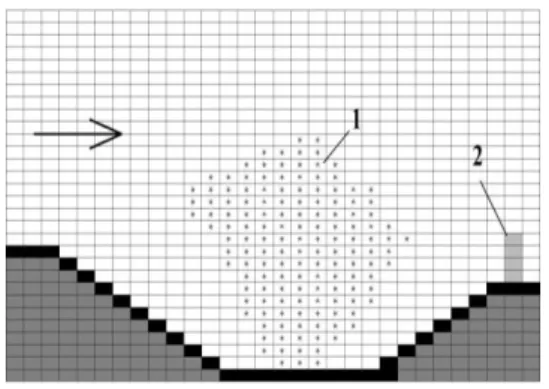
technique (‘markers’ method). The computational
domain is divided using a rectangular difference
grid (Figure 1). Using markers, we constructed
open pit mine boundaries. Using other markers, we
constructed the initial geometrical form of dust
cloud in open pit mine. Other markers were used to
construct the geometrical form of obstacle near
open pit mine. This technique for computational
region formation in numerical model allows to
change quickly this form during numerical
experi-ments. In Figure 1 the arrow indicates the wind
direction.
Fig. 1. Sketch of computational domain scheme:
1 – dust-gas cloud; 2 – obstacle (trees position)
The developed numerical model was coded
us-ing Fortran language.
Findings
Developed numerical model was used to
com-pute dust cloud movement in open pit mine.
To make all parameters dimensionless, we have
chosen the following scales [2]:
1)
v
wis the wind velocity at the left boundary,
8
w
v
m s
;
2)
L
x, m is the length of the computational
domain;
3)
C
0, μg·m-3 is the initial dust concentration
in the cloud for
t
0
.
The dimensionless parameters are calculated as
follows:
1)
t
t
pv
wL
x, where
t
pis time, s;
2)
C
C
pC
0, where
C
pis dust concentration,
μg·m-3;
3)
L
L
pL
x, where
L
pis length, m;
4)
v
v
pv
w, where
v
pis local wind velocity,
m/s.
The length of the computational domain is
1
x
L
(dimensionless), the height of the
computa-tional domain is
L
y
1
(dimensionless). The initial
concentration of dust in the cloud is
C
1
(dimen-sionless) for
t
0
.
Figures 2-8 show dust concentration field for
different time after explosion in open mine. In
Fig-ures 2-8 the arrow indicates the wind direction.
Fig. 2. Pollution zone: t=0.1 (time is dimensionless):
1 – C=0.82; 2 – C=0.88; 3 – C=0.94
Fig. 3. Pollution zone: t=10 (time is dimensionless):
1 – C=0.67; 2 – C=0.73; 3 – C=0.81
Fig. 4. Pollution zone: t=35 (time is dimensionless):
Fig. 5. Pollution zone: t=48 (time is dimensionless):
1 – C=0.42; 2 – C=0.48; 3 – C=0.55
From Figures 2-5 we see deformation of dust
cloud form in open pit mine. This dust cloud is
expanding during the time as a result of
atmospher-ic diffusion action.
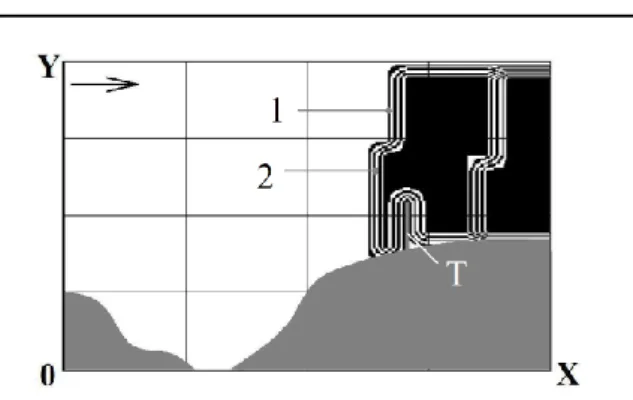
Figures 6-8 show dust concentration field for
different time after explosion in open mine but
when obstacle was introduced at one side of the
open pit mine.
Fig. 6. Pollution zone: t=39 (time is dimensionless):
T – obstacle, 1 – C=0.48; 2 – C=0.56; 3 – C=0.61
Fig. 7. Pollution zone: t=48 (time is dimensionless):
T – obstacle, 1 – C=0.40; 2 – C=0.46; 3 – C=0.53
Fig. 8. Pollution zone: t=67 (time is dimensionless):
T – obstacle, 1 – C=0.32; 2 – C=0.41
Figures 6-8 illustrate the process of dust cloud
diffraction on the obstaclе, the height of the
obstacle is
L
=0.2 (dimensionless). This obstacle
(see Figures 6-8, position T) simulates trees
position near the open pit mine [7].
Worthy of note that computational time was 5 s.
Originality and practical value
New numerical model was developed to predict
atmosphere pollution after blasts in open pit mines.
The model is based on equation of dust dispersion
in the atmosphere and equation for speed potential.
To solve governing equations difference schemes
of splitting were used. Proposed numerical model
can be used for predictive calculations to assess the
impact of explosions in open pit mines on the
envi-ronment.
Conclusions
LIST OF REFERENCE LINKS
1. Алымов, В. Т. Техногенный риск: Анализ и оценка : учеб. пособие для вузов / В. Т. Алымов, Н. П. Та-расова. – Москва : Академкнига, 2004. – 118 с.
2. Беляев, Н. Н. Защита зданий от проникновения в них опасных веществ : монография / Н. Н. Беляев, Е. Ю. Гунько, Н. В. Росточило. – Днепропетровск : Акцент ПП, 2014. – 136 с.
3. Бересневич, П. В. Аэрология карьеров : справочник / П. В. Бересневич, В. А. Михайлов, С. С. Филатов. – Москва : Недра, 1991. – 280 с.
4. Оценка техногенного риска при эмиссии опасных веществ на железнодорожном транспорте / Н. Н. Бе-ляев, Е. Ю. Гунько, П. С. Кириченко, Л. Я. Мунтян. – Кривой Рог : Р. А. Козлов, 2017. – 127 с.
5. Стоецкий, В. Ф. Оценка риска при авариях техногенного характера / В. Ф. Стоецкий, В. И. Голинько, Л. В. Дранишников // Наук. вісн. НГУ. – 2014. – № 3. – С. 117–124.
6. Численное моделирование распространения загрязнения в окружающей среде / М. З. Згуровский, В. В. Скопецкий, В. К. Хрущ, Н. Н. Беляев. – Киев : Наук. думка, 1997. – 368 с.
7. Alvarez, J. T. Dust Barriers In Open Pit Blasts. Multiphase Computational Fluid Dynamics (CFD) Simulations / J. T. Alvarez, I. D. Alvarez, S. T. Lougedo // WIT Transactions on Ecology and the Environment. – 2008. – 116 p. 8. Bai, Y. Grey Mathematics Model for Atmospheric Pollution Based on Numerical Simulation / Y. Bai //
Chem-ical Engineering Transactions. – 2018. – Vol. 71. – P. 679–684. doi: http://doi.org/10.3303/CET1871114 9. Berlov, O. V. Atmosphere protection in case of emergency during transportation of dangerous cargo /
O. V. Berlov // Наука та прогрес транспорту. – 2016. – № 1 (61). – С. 48–54. doi: http://doi.org/10.15802/stp2016/60953
10. Biliaiev, M. M. Numerical Simulation of Indoor Air Pollution and Atmosphere Pollution for Regions Having Complex Topography / M. M. Biliaiev, M. M. Kharytonov // NATO Science for Peace and Security. Series C: Environmental Security. – Dordrecht, 2012. – P. 87–91. doi: http://doi.org/10.1007/978-94-007-1359-8_15 11. Cefic Guidance on safety Risk Assessment for Chemical Transport Operations [Electronic resource] /
Croner-i. – Available at: http://clc.am/OnkmUw – Title from the screen. – Accessed : 29.03.2019.
12. Effect of barriers on the status of atmospheric pollution by mathematical modeling / Z. Naserzadeh, F. Atabi, F. Moattar, N. M. Nejad // Bioscience Biotechnology Research Communications. – 2017. – Vol. 10 (1). – P. 192–204. 13. Oyjinda, P. Numerical Simulation to Air Pollution Emission Control near an Industrial Zone / P. Oyjinda,
N. Pochai // Advances in Mathematical Physics. – 2017. – Vol. 2017. – P. 1–7. doi: http://doi.org/10.1155/2017/5287132
14. Protective Action Criteria. A Review of Their Derivation, Use, Advantages and Limitations [Electronic re-source] // Environmental Public Health Science Unit, Health Protection Branch, Public Health and Compli-ance Division, Alberta Health. – Edmonton, Alberta, 2017. – Available at: http://open.alberta.ca/publications/9781460131213 – Title from the screen. – Accessed : 23.04.2019.
15. The analysis of the use of mathematical modeling for emergency planning purposes [Electronic resource] / O. Zavila, P. Dobes, J. Dlabka, J. Bitta // The science for population protection. – 2015. – № 2. – Available at: http://www.population-protection.eu/prilohy/casopis/eng/22/112.pdf – Title from the screen. – Accessed : 23.04.2019.
В. В. БІЛЯЄВА
1*, П. С. КІРІЧЕНКО
2*, О. В. БЕРЛОВ
3*, В. О. ГАБРІНЕЦЬ
4*,
В. М. ГОРЯЧКІН
5*1*Каф. «Аерогідромеханіка та енергомасоперенос», Дніпровський національний університет імені Олеся Гончара, пр. Гагаріна, 72, Дніпро, Україна, 49000, тел. +38 (056) 374 98 22, ел. пошта [email protected], ORCID 0000-0003-2399-3124
2*Каф. «Теплогазопостачання, водовідведення та вентиляція», Криворізький національний університет, вул. Віталія Ма-тусевича, 11, Кривий Ріг, Україна, 50027, тел. +38 (056) 409 06 06, ел. пошта [email protected],
ORCID 0000-0002-0793-9593
3*Каф. «Безпека життєдіяльності», Придніпровська державна академія будівництва та архітектури, вул. Чернишевського, 24а, Дніпро, Україна, 49600, тел. +38 (056) 756 34 57, ел. пошта[email protected], ORCID 0000-0002-7442-0548 4*Каф. «Теплотехніка», Дніпровський національний університет залізничного транспорту імені академіка В. Лазаряна, вул. Лазаряна, 2, Дніпро, Україна, 49010, тел. +38 (056) 373 15 87, ел. пошта [email protected],
ORCID 0000-0002-6115-7162
КОМП'ЮТЕРНЕ МОДЕЛЮВАННЯ ЗАБРУДНЕННЯ
АТМОСФЕРНОГО ПОВІТРЯ ПІД ЧАС РУХУ ПИЛОВОЇ ХМАРИ
В КАР'ЄРІ
Мета. Вибухи в кар’єрах призводять до утворення пилових хмар, які інтенсивно забруднюють атмосферне по-вітря. Метою цієї роботи є розробка чисельної моделі для прогнозування забруднення атмосфери після вибуху в кар’єрі. Така чисельна модель повинна під час розрахунку враховувати геометричну форму кар'єру, параметри метеорологічної ситуації (швидкість вітру, стан атмосфери), форму пилової хмари, що утворюється в кар’єрі на місці вибуху. Методика. Математичне моделювання розсіювання пилової хмари під час вибуху в кар’єрі ґрунту-ється на використанні фундаментальних рівнянь аеродинаміки й масопереносу. Поле швидкості повітряного пото-ку в кар’єрі моделюється за допомогою рівняння Лапласа для потенціалу швидкості. Формування концентраційно-го поля пилу моделюється на основі рівняння конвективно-дифузійноконцентраційно-го розсіювання домішки. Для чисельноконцентраційно-го інтегрування моделювальних рівнянь використано різницеві схеми. Рівняння Лапласа для потенціалу швидкості чисельно інтегрується за допомогою методу Річардсона. Для чисельного інтегрування рівняння конвективно-дифузійного розсіювання домішки використано неявну різницеву схему розщеплення. Результати. Розроблено CFD – модель, яка дозволяє виконати розрахунок формування зон забруднення під часу руху пилової хмари в кар’єрі. Особливістю розробленої моделі є швидкість розрахунку. Для її практичного використання необхідна стандартна вхідна інформація. Наукова новизна. На відміну від наявних в Україні моделей, розроблена чисельна модель дозволяє враховувати геометричну форму кар’єра й геометричну форму пилової хмари для проведення прогнозних розрахунків з оцінки рівня забруднення атмосферного повітря під час вибухів у кар’єрах. Практична значимість. Розроблена чисельна модель може бути імплементована на комп’ютерах малої й серед-ньої потужності використанням стандартної інформації про метеоумови в кар’єрі. Цю модель можна використову-вати для екологічної оцінки впливу вибухів у кар’єрі на забруднення навколишнього середовища й робочих зон.
Ключові слова: пилова хмара; кар’єр; забруднення атмосфери; комп'ютерне моделювання
В. В. БЕЛЯЕВА
1*, П. С. КИРИЧЕНКО
2*, А. В. БЕРЛОВ
3*,
В. А. ГАБРИНЕЦ
4*,
В. Н. ГОРЯЧКИН
5*1*Каф. «Аэрогидромеханика и энергомассопереноса», Днипровский национальный университет имени Олеся Гончара, пр. Гагарина, 72, Днипро, Украина, 49000, тел. +38 (056) 374 98 22, эл. почта [email protected], ORCID 0000-0003-2399-3124
2*Каф. «Теплогазоснабжение, водоотведение и вентиляция», Криворожский национальный университет, ул. Виталия Матусевича, 11, Кривой Рог, Украина, 50027, тел. +38 (056) 409 06 06, эл. почта [email protected],
ORCID 0000-0002-0793-9593
3*Каф. «Безопасность жизнедеятельности», Приднепровская государственная академия строительства и архитектуры, ул. Чернышевского, 24а, Днипро, Украина, 49600, тел. +38 (056) 756 34 57, эл. почта [email protected],
ORCID 0000-0002-7442-0548
4*Каф. «Теплотехника», Днипровский национальный университет железнодорожного транспорта имени академика В. Лазаряна, ул. Лазаряна, 2, Днипро, Украина, 49010, тел. +38 (056) 373 15 87, эл. почта [email protected], ORCID 0000-0002-6115-7162
5*Каф. «Теплотехника», Днипровский национальный университет железнодорожного транспорта имени академика В. Лазаряна, ул. Лазаряна, 2, Днипро, Украина, 49010, тел. +38 (056) 373 15 87, эл. почта [email protected],
ORCID 0000-0002-8952-952X
КОМПЬЮТЕРНОЕ МОДЕЛИРОВАНИЕ ЗАГРЯЗНЕНИЯ
АТМОСФЕРНОГО ВОЗДУХА ПРИ ДВИЖУЩЕМСЯ ПЫЛЕВОМ
ОБЛАКЕ В КАРЬЕРЕ
массо-переноса. Поле скорости воздушного потока в карьере моделируется с помощью уравнения Лапласа для потенциала скорости. Формирование концентрационного поля пыли моделируется на базе уравнения конвективно-диффузионного рассеивания примеси. Для численного интегрирования моделирующих уравнений использованы разностные схемы. Уравнение Лапласа для потенциала скорости численно интегрируется с помощью метода Ричардсона. Для численного интегрирования уравнения конвективно-диффузионного рассеивания примеси исполь-зована неявная разностная схема расщепления. Результаты. Разработана CFD – модель, которая позволяет выпол-нить расчет формирования зон загрязнения при движении пылевого облака в карьере. Особенностью разработанной модели является быстрота расчета. Для её практического использования необходима стандартная входная инфор-мация. Научная новизна. В отличие от существующих в Украине моделей, разработанная численная модель позволяет учитывать геометрическую форму карьера и геометрическую форму пылевого облака для проведения прогнозных расчетов по оценке уровня загрязнения атмосферного воздуха при взрывах в карьерах. Практическая значимость. Разработанная численная модель может быть имплементирована на компьютерах малой и средней мощности с использованием стандартной информация о метеоусловиях в карьере. Эту модель можно использовать для экологической оценки влияния взрывов в карьере на загрязнение окружающей среды и рабочих зон.
Ключевые слова:пылевое облако; карьер; загрязнение атмосферы; компьютерное моделирование
REFERENCES
1. Alymov, V. T., & Tarasova, N. P. (2004). Tekhnogennyy risk: Analiz i otsenka: Uchebnoe posobie dlya vuzov.
Moscow: Akademkniga. (in Russian)
2. Biliaiev, N. N., Gunko, E. Y., & Rostochilo, N. V. (2014). Zashchita zdaniy ot proniknoveniya v nikh opasnykh veshchestv: Monografiya. Dnepropetrovsk: Aktsent PP. (in Russian)
3. Beresnevich, P. V., Mikhaylov, V. A., & Filatov, S. S. (1991). Aerologtya karerov: spravochnik. Moskva: Nedra. (in Russian)
4. Biliaiev, N. N., Gunko, E. Y., Kirichenko, P. S., & Muntian, L. Y. (2017). Otsenka tekhnogennogo riska pri emissii opasnykh veshchestv na zheleznodorozhnom transporte. Krivoy Rog: Kozlov R. A. (in Russian) 5. Stoetsky, V. F., Golinko, V. I., & Dranishnikov, L. V. (2014). Risk assessment in man-caused accidents.
Sci-entific Bulletin of National Mining University, 3, 117-124. (in Russian)
6. Zgurovskiy, M. Z., Skopetskiy, V. V., Khrushch, V. K., & Biliaiev, N. N. (1997). Chislennoe modelirovanie rasprostraneniya zagryazneniya v okruzhayushchey srede. Kyiv: Naukova dumka. (in Russian)
7. Alvarez, J. T., Alvarez, I. D., & Lougedo, S. T.(2008). Dust Barriers in Open Pit Blasts. Multiphase Compu-tational Fluid Dynamics (CFD) Simulations. WIT Transactions on Ecology and the Environment. (in English) 8. Bai, Y. (2017). Grey Mathematics Model for Atmospheric Pollution Based on Numerical Simulation.
Chemi-cal Engineering Transactions, 71, 679-684. doi: http://doi.org/10.3303/CET1871114 (in English)
9. Berlov, O. V. (2016). Atmosphere protection in case of emergency during transportation of dangerous cargo.
Science and Transport Progress, 1(61), 48-54. doi: http://doi.org/10.15802/stp2016/60953 (in English) 10. Biliaiev, M. M., & Kharytonov, M. M. (2012). Numerical Simulation of Indoor Air Pollution and Atmosphere
Pollution for Regions Having Complex Topography. NATO Science for Peace and Security. Series C: Envi-ronmental Security. Dordrecht. doi: http://doi.org/10.1007/978-94-007-1359-8_15 (in English)
11. Cefic Guidance on safety Risk Assessment for Chemical Transport Operations. Croner-i. Retrieved from http://clc.am/OnkmUw (in English)
12. Naserzadeh, Z., Atabi, F., Moattar, F., & Nejad, N. M. (2017). Effect of barriers on the status of atmospheric pollu-tion by mathematical modeling. Bioscience Biotechnology Research Communications, 10(1), 192-204. (in English) 13. Oyjinda, P., & Pochai, N. (2017). Numerical Simulation to Air Pollution Emission Control near an Industrial
Zone. Advances in Mathematical Physics, 2017, 1-7. doi: http://doi.org/10.1155/2017/5287132 (in English) 14. Government of Alberta. (2017). Protective Action Criteria: A Review of Their Derivation, Use,
Advantage-sand Limitations. Environmental Public Health Science Unit, Health Protection Branch, Public Health and Compliance Division, Alberta Health. Edmonton, Alberta. Retrieved from http://open.alberta.ca/publications/ 9781460131213 (in English)
15. Zavila, О., Dobes, Р., Dlabka, J., & Bitta, J. (2015). The analysis of the use of mathematical modeling fore-mergency planning purposes. The Science for Population Protection, 2. Retrieved from http://www.population-protection.eu/prilohy/casopis/eng/22/112.pdf (in English)