TECHNICAL UNIVERSITY OF CLUJ-NAPOCA
ACTA TECHNICA NAPOCENSIS
Series: Applied Mathematics, Mechanics, and Engineering Vol. 63, Issue II, June, 2020
OPTIMIZATION OF THE ADJUSTMENT PARAMETERS OF THE
PERCUSSIVE DRILLING MACHINE
Zina RABBOUCHE, Azzedine BOUZAOUIT, Lakhdar KHOCHEMANE, Ouafae BENNIS
Abstract: The work presented consists in elaborating the methods of determining the parameters of the rational operating regime of the percussion drilling machine during its exploitation in the defined geological and mining conditions (Algerian career filafila )To define the purpose of empirical research, Is based on bibliographic research where several researchers have studied the method of drilling percussion with different methods based on the physico-mechanical properties of the rock, parameters of adjustment of the machine, geometrical parameters of the tool. The bibliographic analysis has shown that there are now certain methods of determining the dependencies of the drilling speed, and the penetration height is a function of the energy of a stroke of the piston and the drilling speed is A function of the height of penetration into the rock and the speed of rotation. The analysis of these methods shows that they are based on the knowledge of the peculiarities of the interaction of the tool against the rock. Each time, the parameters mentioned above are taken into account.
Key words: Rock, Percussive drilling,Energy of a stroke,Drilling process, Abrasiveness.
1. INTRODUCTION
The mining industry is one of the largest branches of industry, includes the oil, gas, coal, mineral, metallic and non-metallic. The extension of the Algerian quarries has allowed the increase in productivity intended for export from 100 million dinars in 1966 to 900 million in 1986 Processed in Algeria for the national industry has 90%.
The complexity presented by the mining sector in the choice of a method rational exploitation adapted to the programmed and inspired objectives of the operating and profitability parameters. The choice of mechanization has a direct impact on production, prices and especially as investments are high. In terms of production the objective of our mines and quarries optimal exploitation of Algerian resources, taking into account their diverse technical, economic and human characteristics.
This gives some thought to the Work to be carried out and among them the drilling process which is the predominant factor In the development of a farm. By analyzing the
geology of deposits of low, medium, and high hardness in the quarries of Algeria, we can deduce that the latter are of mountainous types.The Bridging inclination varies within the limits of 35° to 80°.the extraction work is done after drilling and firing.
measure of the impact resistance of rock. The CRS test was then modified by Paone et al. [2], Tandanand and Unger [3] obtained simple relations between CRS and compressive strength, Rabia and Brook [4] used the modified test apparatus to determine the impact hardness number of the rock and developed an empirical equation to predict drilling speeds for DTH and drifting drills. Singh [5] showed that the compressive strength was not directly related to the drilling speed of a drill Clark [6] stated that the strength of drilling depends mainly on the hardness and the triaxial strength of the rock. Pathinkar and Misra [7] concluded that the properties of the rock such as compressive strength, tensile strength, specific energy, Shore hardness, Mohs hardness do not, individually, make it possible to establish good correlation with penetration rate of impact drilling. Hengyu Songand and Huaizhong Shi studied the effectiveness of energy transfer from percussive drilling[8].
Percussive drilling is widely used in the mining industry and the construction of holes in the rock. Usually the drilling of the rock, containing an alternate hammer drill, is placed hole, The mode of percussive drilling is widespread during the exploitation of ore deposits [9]
Some researchers have experimentally or percussively investigated impact drilling, which they have conducted in laboratory experiments to determine the exploitation indices and the technical characteristics. Sementchenko A. [10] studied the operating regime of mining machines, R. Poderni [11] has calculated the setting parameters of mining machines, the choice of mining machines [12], [13], [14].
2. THE OPERATING PRINCIPLE OF THE PNEUMATIC PERFORATOR MARTAU
Hammers or perforators are intended for the drilling of mine holes in very hard, hard and medium formations. They are often used in underground mines, open-cast mining and construction. The use of pneumatic drills is widespread in mine work because of the
advantages they offer, such as: simplicity of construction compared to other types, high efficiency and safety during operation. The pneumatic drill is a percussion machine consisting of a cylinder, a ratchet wheel, a compressed air distribution device, a piston, a bushing, a helical rod and a a mandrel.
The purpose of the rotation mechanism is to rotate the drilling tool at a certain angle (6-15°) for the successive destruction of the size of the borehole over its entire surface. Depending on the stroke of the piston, there is the rotating mechanism depending. The dependent rotating mechanism rotates the tool during the return path of the piston. It is represented either by a helical rod or a piston with a shank provided with a helical thread.
In the first case (Fig. 1), the ratchet ring 1 is fixed to the cylinder 2, it is provided with several orifices to allow the penetration of the compressed air into the distribution box 10.
Inside the ratchet ring, is installed the head of the helical rod 3 with the pawls 9. The pawls are pressed by springs introduced into the vanes 7 and are in permanent contact with the teeth of the ring 1.
The rotation of the helical rod whose filtering with a big step, is only possible in one direction; that is to say during the race of work.
The rod through the nut 4 enters the piston 5 connects to the rotating sleeve 6 by grooves. During the working stroke, the pawls do not prevent the rod from rotating, which is why the piston moves without rotation and longitudinal grooves of the piston are associated with the sleeve. During the idle stroke the helical rod is blocked by the pawls, which causes the piston to slide into the grooves of the helical rod and rotate at a certain angle. The rotation of the piston obligatorily causes the rotation of the sleeve as well as that of the foil 11.
The mechanism with helical rod, (Fig. 1) has great reliability. The angle of rotation of the drill bit can be easily varied by changing the nut and the helical rod.
out by the variation of the parameters of the working regime.
Fig. 1. Mechanism of rotation [15].
This is why it is necessary to know the dependencies between these parameters and external factors. In addition, the parameters of the work patterns of the drilling machine must be coordinated with the factors characterizing the firing work [16].
The choice of perforators, the main issue that concerns us has always been the productivity that can ensure the perforator in well-defined conditions, but this factor remains related to the operating speed of the machine, which in turn depends on the properties of the rock , the type of the tool and the parameters of the perforator without neglecting the factors that may have an influence on the choice of the operating regime, such as: the maximum power, the maximum forward speed that the perforator can provide, the penetration height of the tool during the destruction of the rock according to the tool parameters and the torque. [17].
3. ANALYSISOF THE
PHYSICO-MECHANICAL PROPERTIES
OF ROCKS INFLUENCING THE
DRILLING PROCESS
3.1 Idnex of abrasiven
An method is proposed for the determination of the resistance to the impression Pk, this
method consists in depressing the stamp in the form of a trunk of cane on the surface of the raw rock (untreated); the use of this index as a criterion of the efficiency of the drilling process has allowed to receive the values of the coefficients of variation which do not exceed zero, this index is more preferable compared to the coefficient of hardness, but there exist cases or the coefficient of variation remains
considerable, one of the causes is that this index does not take into account the capacities of the rock to use the working tool; to correct this inconvenience, Baron and Kouznotsov [18], have proposed the method of applying this ability called abrasiveness.
The results of the researches carried out show that the common account of the indices solidity and abrasiveness allows to receive the parameters of drilling with the coefficient of variation not exceeding 10%, so it is recommended to receive the most certain data to appreciate the rocks of after two characteristics, impression resistance and abrasiveness; abrasiveness must be taken into account if its value exceeds 10 mg, if it is necessary to obtain the rapid information on the mechanical properties of the rocks, it is possible to take into account or use the coefficient of hardness
unhardened steel. Before the test the stem is weighed using the analytical balance with the accuracy of 0.1 mg. After having tested for 10 minutes, the rod is moved so that it is turned from the other end to the rock; then we connect the machine for 10 mn.
The abrasiveness index is calculated by the following formula
a
=
(
P
1i−
P
2i)
/
2
N
(1) Where; N: The number of tests in each sample.P1i: Initial sample weight.
P2i: Final sample weight
After the tests carried out, the following results were obtained:
Sample of the ore: am = 4mg. Sample of sterile: as = 5mg.
The results obtained are compared with the recommendations of the classification proposed by Baron. L [19]. We can say that the limestones of the Filafila quarry refer to the first class that is to say of a very weak abrasiveness.
Fig. 2. Stand for determining the abrasiveness of rocks. 3.2 Index impression resistance
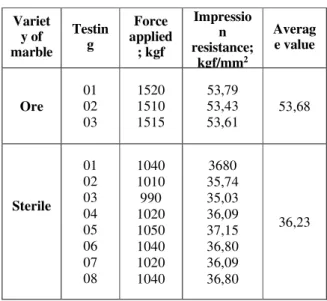
The determination of the index of resistance to the imprint was carried out by means of a mechanical press the press in question consists of a base or one installs all the necessary equipment of two slide along which a Plunger (3) on the upper table thereof a sample (4) which is fed by a fixed stamper (5) into a clamping
device (6), the die (Fig. 3) is made of steel Soaked; During the tests, the load on the stamp is increased until a punch is formed in the sample.; during the tests, the load on the stamp is increased until the formation of a pouch in the sample.
The index of the impression resistance is calculated by the following formula:
= F i N S
p k . (2) Where: Fi: Charge when a poquet is formed.
S: Area of the cross section of the stamp. N: The number of tests in each sample.
The rocks studied have an average footprint resistance of 105 Kgf / mm². These rocks relate to the class called "average hardness".
Fig. 3. Stand for the determination of strength indexes, impression resistance and compressive strength [20]. 4. THE GEOMETRICAL PARAMETERS OF THE PERFORATOR
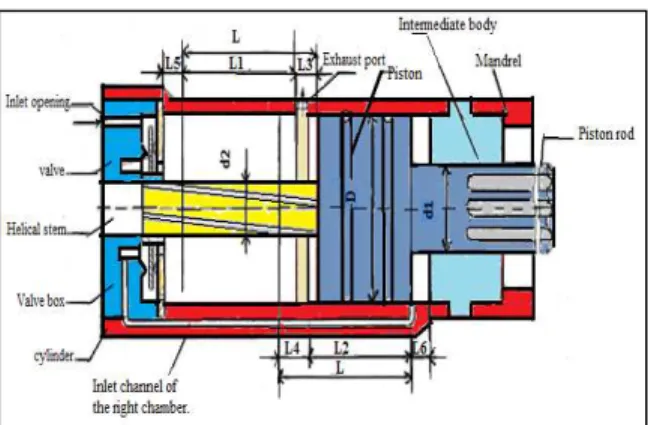
The geometrical parameters of the perforator are indicated on Figure 4.
The useful surface area of the piston to carry out the way outward journey in (m²) is :
(
D
d
)
S
a2
2 2
4
−=
π
(3)And for the way return:
(
D
d
)
S
r2 1 2
4
−Fig 4: Diagram of determination of basic parameters of perforators
Where; D -diameter of the piston, m d1 -diameter of the stem of the piston, m
d2 -diameter of the helical rod, m The force applied to the piston during the way outward journey in (kgf) is equal to:
F a=(S a⋅p a−S r⋅pe
)
⋅k1 (5)And during the way return:
F r=
(
S r⋅pa−S a⋅pe)
⋅k2 (6)Where: Pa-pressure of compressed air in the
cylinder intake chamber. It is equal to the pressure in the power grid, Pa;
Pe -air pressure in the exhaust chamber, Pa
Pe 0.08 to 0.12 MPa;
K1 - coefficient taking into account friction
losses between the piston and the cylinder,
K1:0.85 to 0.95;
K2 - coefficient taking into account losses by
friction and rotation of the foil, K2: 0.5 to 0.7.
To simplify the determination speeds we admit that the movement of the piston to the opening of the exhaust port (under the action of the force Fa is uniformly accelerated. This is why the maximum speed of the piston at the distance l1 in (m/s) is determined by:
G
g l F a V a
⋅ ⋅
= 2 1 (7)
And that, at the distance l2 during the way
return:
G g l F r V r
⋅ ⋅
= 2 2 (8)
Where;
G - piston weight, N;
g - acceleration of gravity, g = 9.61 m/S² . The number of strokes of the piston per minute is beats per minute:
n
T
c c60
= (9)
With;
T c
=
t a
+
t r
(10) The duration of the outward journey will be:V a l L
F a g
V a G
ta ⋅ + − 1
⋅
= (11)
And that of the return journey:
V r l L
F r g
V r G
t r 2
− + ⋅ ⋅
= (12)
the number of revolutions of the foil by minute in( tr/mn):
n
h
L
n
t= ⋅ c(13)
Where h is the step of the threading of the helical rod, h = 0.8 to 1.0 m.
The number of blows of the piston by a turn by a foil in (blows /tr) is equal to:
n
n
n
t c c=
' (14)
One can determine the swing angle of the foil by a blow in (degree) according to the expression:
n
c' 0
360
=5. METHODOLOGY OF WORK
The operating productivity (Qexp) is a
function of the mechanical drilling speed (Vf)
and consequently the supply pressure (Pa) the problem posed consists in determining the values of the adjustment parameters or the minimum cost price of one meter of the drilled hole.
• Determination of the drilling speed:
) . 10 25 5 (
300 f f
d = + − +
σ ) (16)
f: The hardness of the rock; f =7
τ
σ d e
d f n c E ou Vf . . 2 . . 3 , 1
= (17)
EOU: The energy of a shot of the piston; nc: Number of piston strokes;
The yield of the energy transmission from foil to rock is taken from
τ
e = 0.4 to 0.7;df: Drilling diameter (44 mm)
• The theoretical productivity:
Qtheo
=
60
⋅
V f
(18)• Technical productivity:
t aux K rep V f
T T
Q tech pr
. 1 + −
= (19)
• Operating productivity:
Qexp = Q theo .Kexp .T (20)
Where: taux Duration of auxiliary operations
reduced to one metre of drilled hole, (min/m); Tpr : Duration of preparatory
operations, (min);
T: Workstation time, (min);
Krep : Coefficient taking into account
the workers' break.
Kexp : operating coefficient
The cost structure of one meter of the drilled hole consists of two parts: Time-dependent
expenses related to the productivity of the drilling works as well as to the measurement of a tool. It should be said that the cost price of One meter of the drilled hole is the criterion that takes into account the technical level of machinery used and the organization of work. If it concerns the exploitation of the machines of the chosen drillings allowing to drill holes of determined diameter. The most accurate criterion for determining the parameters of the rational drilling regime will be the cost price of one meter of drilled hole. The latter can be determined according to the following formula (DA/m): + = H C ou Q C p C exp (21)
Cp :Expense relating to the operation of the rotary hammer by post.
Qexp : Operating productivity per punch
positioner.
Cou: Neck: Tool price.
H: Metering of the drilled holes relating to a tool; (m).
6.RESULTS AND DISCUSSION
The results of the tests carried out in the rock (marble) are presented in the tables:
Table 1
Table 2
Determination of impression resistance; Kgf/ mm2 (S=28.26 cm²)
The results obtained for determining the operating parameters of a hammer drill are shown in Table 3
Table 3
Basic parameters of the pneumatic drill
Pa
Kgf/cm2 Fa
kgf Fr
Kgf V1
m/s V2
m/s ta
s t r
s
T c
s
nc
c/mn nt
tr/mn n’c
tr/mn (°) φ
Ec
Kgf.m
2 22.58 5.72 2.61 1,26 0.023 0.049 0.072 833.33 41.88 27.03 13.31 0.60 2,5 33.26 10.87 3.17 1.74 0.020 0.035 0.055 1090.9 41.11 27.03 13.31 0.89 3 43.93 17.83 3.65 2.23 0.016 0.027 0.043 1395.3 51.62 27.03 13.31 1.18 3,5 54.61 23.89 4.07 2.59 0.015 0.023 0.038 1578.9 58.42 27.03 13.31 1.47 4 65.29 29.95 4.45 2.90 0.014 0.021 0.035 1714.2 63.42 27.03 13.31 1.76 4,5 75.97 36.01 4.80 3.18 0.013 0.018 0.031 1935.4 71.61 27.03 13.31 2.05 5 86.65 42.01 5.13 3.43 0.011 0.017 0.028 2142.8 79.28 27.03 13.31 2.33 5,5 97.33 48.12 5,43 3.67 0.011 0.016 0.027 2222.2 82.22 27.03 13.31 2.62 6 108.0 54.18 5,72 3.90 0.011 0,015 0.026 2307.6 85.38 27.03 13.31 2.91 6,5 118.6 60.24 6 4.11 0.010 0,014 0.024 2500 92.5 27.03 13.31 3.20
Table 4 shows the results of calculation the productivity of the hammer perforator.
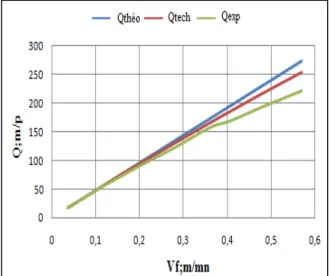
Figures (5) and (6) show the results obtained respectively from the variations of the energy of a piston stroke and the drilling speed as a function of the compressed air pressure, the productivity as a function of the drilling speed.
Table 4
Productivity of the hammer drill Pa
kgf/cm2
Vf m /mn
H m
Qthe m/p
Qtech m/p
Qexp m /p 2 0,036 600 17,28 17,21 17,01 2,5 0,07 530 33,6 33,39 32,99 3 0,11 500 52,8 52,27 51,84 3,5 0,16 470 76,8 76,33 73,42 4 0,21 420 100,8 98,48 94,34 4,5 0,28 380 134,4 129,96 122,16 5 0,36 360 172,8 165,19 157,07 5,5 0,41 350 196,8 186,76 169,83 6 0,48 300 230,4 216,57 193,30 6,5 0,57 220 273,6 253,62 221,61 Variety of
marble Testing
Force
applied; kgf Solidity
Abrasiveness (mg)
Compressive strength (kgf / cm2)
Ore
01 02 03
33000 37200 46128
6, 90 7,75 9,61
0.004 0.005 0.004
690 775 961
Sterile
01 02 03 04 05 06 07 08
25000 10200 40760 35100 31500 35750 12600 15000
5.20,83 2.12,58 0,4916 7,3125 6,5625 7,4479 6,2650 3,1250
0.005 0.005 0.005 0.005 0.005 0.005 0.005 0.005
Fig. 5. The variation of the energy of a stroke of the piston and the drilling speed as a function of compressed
air pressure
Fig. 6. The variation of the productivity according to the speed of drilling
It is noted that the energy of a blow of the pneumatic drill piston and the drilling speed increases so that the pressure of compressed air increases so the relationship is proportional (Fig.5). On our side the productivity of the pneumatic perforator increases as the drilling speed increases to improve the organization of work. The productivity of the pneumatic perforator depends primarily on the parameters of the drilling regime because these determine the value of the drilling speed (Fig. 6). The study of the curves presented leads to a recommendation on the improvement of work
organization, which gives us the possibility of increasing the operating productivity of the pneumatic drill and reducing the cost price of the machine.
The rational parameters of the operating regime of percussive drilling machines under the conditions of the marble quarry (Filfila) cited above are shown in the following table:
Table 5
Optimal parameters of the hammer drill.
Pa Kgf/Cm2
EC kgf. m
Vf m/mn
Productivity
Qthé m/p
Qtech m/p
Qexp m/p 5 2,33 0,36 172,8 165,19 157,07
The calculation results in question are qualitative and can be considered as approximate, therefore it is necessary to extend the research in question by studying the drilling process given its complexity. These have highlighted the following information, by varying the settings of the machine, we can determine or the technical productivities, operating and the cost depending on the drilling speed and the drilled footage.The index to limit the setting parameters of the machine is a technical-economic index. This last check exactly the rationality of the operating regime of the drilling machine.
7. CONCLUSION
In our work we have studied the percussive drilling mode with different methods based on the physico-mechanical properties of the rock, machine control parameters, geometric parameters of the tool. We studied the influence of the borehole footage on drilling speed. Knowing that the setting parameters have a significant influence on the output parameters. The factors studied represent the values of the variables in the field at which the study of the drilling process begins with the aim of obtaining the optimal values of these factors. The factors studied (compressed air pressure, piston stroke) represent variables. , that is to say during the experimental drilling, we can give them certain values.
As a result of research carried out, we concluded that under quarry conditions employing the defined drilling means, it is preferable to use the 1 meter drilled hole cost criterion to determine the parameters of the rational operating regimes.
8. REFERENCES
[1] Protodyakonov, M. M., Mechanical properties and drillability of rocks, pp. 103-118. 5th Symposium on Rock
Mechanics, University. Minnesota, May 1962. EUA.
[2] Paone, J., Madson, D., Bruce, W.E.,
Drillability studies, Laboratory percussive drilling, USBM RI 7300, 1969, USA [3] Tandanand, S., Unger, H.F., Drillability
determination - A drillability index of percussive drills, U.S. Bureau of Mines Reports, Twin Cities, pp. 5-24, 1975 [4] Rabia, H., Brook, W., An empirical equation
for drill performance prediction, In: Proceedings of the 21st US Symposium on Rock Mechanics. Rolla, MO: University of Missouri, 1980, pp. 103-111, Rolla, USA.
[5] Singh, D.P., Drillability and physical properties of rocks, In Proceedings of the Rock Mechanics Symposium, University
of Sydney, 1983, pp. 29-34, Sydney, Australia.
[6] Clark, G.B., Principles of rock drilling, Colorado School of Mines Quarterly 1979, pp 91-93, 1979, Colorado.
[7] Pathinkar, A.G., Misra, G.B., Drillability of rocks in percussive drilling from `energy per unit volume as determined with a microbit, Mining Engineering, Vol. 32, pp.1407-1416, 1980.
[8] Hengy, S., Huaizhong, S., Zhaosheng, J., Xiaoguang, W., Gensheng, L., Heqian, Z., Gaosheng, W., Yong, L.L., Xinxu, H., The percussive process and energy transfer efficiency of percussive drilling with
consideration of rock damage,
International Journal of Rock Mechanics an Mining Sciences, ISSN:1365-1609, Volume 119, pp. 1-12, July 2019.
[9] Lundberg, B., Collet, P., Onde optimale en ce qui concerne l'efficacité du forage percussif avec l'acier de forage intégré. Int. J. Impact Eng. 37, pp. 901-906, 2010. [10] Sementchenko, A., Karbachev, A., OUADI, M., choix des machines minières et leurs régimes de fonctionnement, Université de Annaba, 1983.
[11] Poderni, R., Machines minières et complexes pour les travaux à ciel ouvert. Moscou, NEDRA, 1971.
[12] Rakov, I., Radkevitche, J., calcul et choix des machines minières. Partie1. Travaux de forage et de chargement au fond et à ciel ouvert, Université de Annaba, 1981. [13] Nanaieva, G., machines minières et
complexes pour l’extraction des minéraux. Moscou, NEDRA, 1982.
[14] Begagoene, I., Drilling machine, Moscow, Nedra, 1972.
[15] Ouadi, M., Assenov, I., Machine Minière (Machine de forage), Office de Publication Universitaire, mars 1993, Algérie.
[17] Semenov, V., Machines Minières, Calcul des machines de forage percutant et roto-percutant ,1983-1984.
[18] Baron, L. I., Kouznotsov, A. V., Abrasivité des roches lors de l’abattage, Edition des sciences URSS, 1961, Moscou.
[19] Baron, L., Etat contemporain des études sur les propriétés physico-mécaniques des
roches et des découpages, (SKOTCHINKI A. A), 1967, Moscou.
[20] Khochemane, L., Optimisation des paramètres de forage à molette, Doctorat thesis, Badji Mokhtar university of Annaba, 2006, Algeria.
Optimizarea parametrilor de reglare a mașinii de găurit cu percuție
Rezumat: lucrarea prezentată constă în elaborarea metodelor de determinare a parametrilor regimului de operare rațional al mașinii de găurit cu percuție în timpul exploatării sale în condițiile geologice și miniere definite (fila de carieră algeriană ) Pentru a defini scopul cercetării empirice, se bazează pe cercetare bibliografică în cazul în care mai mulți cercetători au studiat metoda de foraj percuție cu diferite metode bazate pe proprietățile fizico-mecanice ale rock, parametrii de ajustare a aparatul, parametrii geometrici ai mașinii. Analiza bibliografică a arătat că există acum anumite metode de determinare a dependențelor vitezei de foraj, iar înălțimea de penetrare este o funcție a energiei unui accident vascular cerebral al pistonului și viteza de foraj este o funcție a înălțimii penetrarea în stâncă și viteza de rotație. Analiza acestor metode arată că acestea se bazează pe cunoașterea particularităților interacțiunii instrumentului împotriva stâncii. De fiecare dată, parametrii menționați mai sus sunt luați în considerare.
RABBOUCHE Zina, Magister degree in Electromechanical from Mechanical department of Engineering University of 20 Août 1955 Skikda ALGERIA, Email: [email protected], phone: +213698343044
BOUZAOUIT Azzedine, Professor in Electromechanical engineering, department of mechanical engineering, University of 20 Août 1955 Skikda Algeria, Email: [email protected], phone: +213557930093
KHOCHEMANE Lakhdar, Professor in Electromechanical Engineering, department of mechanical engineering, University of 20 Août 1955 Skikda Algeria, Email: [email protected].
BENNIS Ouafae, Doctorate in automatic engineering, PRISME Research laboratory, University of Orleans, France, Email : [email protected]
![Fig. 1. Mechanism of rotation [15]. This is why it is necessary to know the](https://thumb-us.123doks.com/thumbv2/123dok_us/7993952.2119836/3.918.197.760.165.320/fig-mechanism-rotation-necessary-know.webp)
![Fig. 3. Stand for the determination of strength indexes, impression resistance and compressive strength [20]](https://thumb-us.123doks.com/thumbv2/123dok_us/7993952.2119836/4.918.102.420.567.872/stand-determination-strength-indexes-impression-resistance-compressive-strength.webp)