CHAPTER 2
Introduction
2.1 There was general agreement amongst almost all submitters that the bill represented the most fundamental reform of the Safety Rehabilitation and Compensation Act 1988 (SRC Act) since its introduction.
2.2 The key issues and points of contention are summarised in the introduction. The remainder of the chapter sets out the issues in greater detail on a schedule by schedule basis.
2.3 Key points made by the government included the need to modernise the SRC Act in keeping with significant changes in health care and rehabilitation practices, recent research on the benefits for employees of returning to work after rehabilitation, prevailing community expectations about encouraging people to work and return to work, and the overarching importance of maintaining the integrity and financial viability of the scheme on an ongoing basis.1
2.4 The Department of Employment (the department) noted that the Comcare scheme (the scheme) was established in an era with low expectations of recovery and return to work after illness or injury. As a consequence, the scheme was designed to compensate people for injury, but it 'had no focus on return to work'.2
2.5 The department further noted that decisions by the Administrative Appeals Tribunal (AAT) and courts have skewed the application of the SRC Act away from the original intention of compensating for work-related activities by extending the scheme to compensate employees for non-work related injuries.3
2.6 The department stated that the focus on compensation and the extension of the scheme into non-work related injuries have had unfortunate consequences. The first consequence has been a tendency to entrench low expectations for recovery and return to work. This has deprived injured workers of the support and encouragement to recover and return to work. In turn, injured workers (and their families) have been denied the mental, social and health benefits associated with returning to work.4
2.7 The second consequence has been a decline in return to work rates from 89 per cent in 2008-09 to around 80 per cent in recent years. Studies indicate that the longer an injured worker is off work, the chances of them rehabilitating successfully and returning to work reduce dramatically. In turn, this decline in return to work rates
1 Department of Employment, Submission 22, p. 5. 2 Department of Employment, Submission 22, p. 5. 3 Department of Employment, Submission 22, p. 5. 4 Department of Employment, Submission 22, p. 5.
has placed an increasing burden on the scheme finances (see figures 2.1 and 2.2 below).5
Figure 2.1: Decline in return to work rates over last five years (Source: Department of Employment, Submission 22, p. 5).
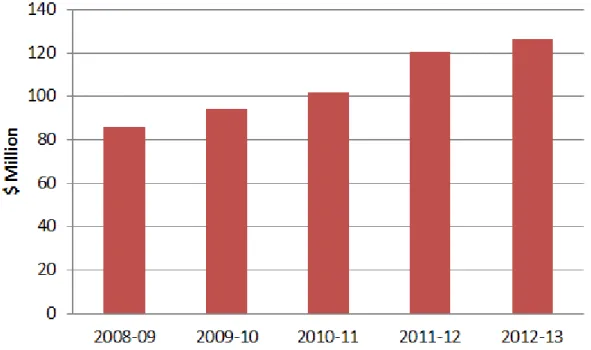
Figure 2.2: Medical and Rehabilitation costs from 2008-09 to 2012-13 (Source: Department of Employment, Submission 22, p. 5).
2.8 Claim costs under the SRC Act have risen by 37 per cent in the five years to 2012-13 and the premiums charged to Commonwealth agencies have increased by more than 50 per cent over the four years to 2013-14.6 The department noted that steadily increasing medical and rehabilitation costs had contributed to the rise in claim costs and that Comcare's 'limited ability to determine the reasonableness or the
5 Department of Employment, Submission 22, p. 5. 6 Department of Employment, Submission 22, p. 6.
appropriateness of medical treatment and rehabilitation' prescribed by doctors had resulted in payments for 'questionable treatments' (see figure 2.3 below).7
Figure 2.3: Total Payment for claims under the Comcare scheme from 2009-10 to 2013-14 (Source: Department of Employment, Submission 22, p. 6).
2.9 The points outlined above by the department were endorsed by the Australian Public Service Commission (APSC). The APSC noted that the Australian Public Service was of the view that the scheme provided 'a generous set of entitlements for injured public service employees'. However, the APSC pointed out that there was 'general agreement amongst Secretaries and Chief Executive Officers that the current legislation focuses on administrative decision making rather than injury management and supporting staff to get back to work'. Consequently, the APSC stated that the senior leadership of the Australian Public Service welcomed the reforms to the scheme.8 The committee notes that this is a unique situation whereby the senior leadership across the Australian Public Service is united in support of the changes embodied in the bill.
2.10 Several submitters, particularly employers, employer groups, and licensee associations agreed with the key elements set out in the bill. These submitters noted that the SRC Act was outdated and did not take account of modern trends in business and employer/employee expectations. Employers were also gratified that the bill rectified certain anomalies introduced by case law. Employers considered that the bill was balanced, fair and equitable for both employees and employers, that it would lead
7 Department of Employment, Submission 22, p. 6.
to greater business confidence and employment opportunities, and that the bill should be passed either in its entirety,9 or with minor amendments.10
2.11 Some submitters recommended that certain proposals be amended or omitted, and considered that, whilst undertaking such fundamental reform of the SRC Act, Parliament should include provisions for access to common law.11 Other submitters recommended that the bill not be passed without substantial amendment.12
2.12 Opponents of the bill disagreed with the fundamental premise of the proposed legislation and argued that the bill would dramatically reduce the rights and entitlements of workers and would make it even harder for genuine claimants to gain urgent and necessary access to benefits. Noting that the primary objective of reform should be to achieve safe and healthy workplaces, these submitters pointed out that the bill failed to give effect to most of the recommendations made in the Hanks/Hawke Review, especially those which would be advantageous to injured workers. Opponents also argued that the bill put the considerations of big business ahead of those of injured workers. Opponents therefore considered the bill to be unbalanced, unfair, and punitive and recommended that the bill be rejected in its entirety.13
2.13 Many submitters also stated that the bill should be seen in a broader context, and expressed concerns about the combined effect of the three Comcare bills before Parliament. These submitters argued that the cumulative impact of the changes would be to remove rights that workers currently enjoy under State workers' compensation laws and enable employers to join a cheaper scheme with minimal health and safety regulations that was not designed for blue collar workers who often perform high risk work in remote locations.14
9 Australian Air Express, Submission 2; TNT Express, Submission 8; Australian Public Service Commission, Submission 12; Jim Pearson Transport, Submission 17, Australian Chamber of Commerce and Industry, Submission 18; CSL Limited, Submission 19; National Electrical and Communications Association, Submission 20; Safety Rehabilitation and Compensation Licensees Association, Submission 23.
10 Transpacific Industries, Submission 1; Ai Group, Submission 6; John Holland, Submission 10. 11 Law Council of Australia, Submission 29.
12 Angela Sdrinis Legal, Submission 13, p. 9.
13 Australian Lawyers Alliance, Submission 3; UnionsWA, Submission 7; Victorian government,
Submission 9; Slater and Gordon Lawyers, Submission 14; Communication Workers Union,
Submission 15; Finance Sector Union, Submission 16; Queensland Council of Unions,
Submission 21; Australian Manufacturing Workers' Union, Submission 24; Maritime Union of Australia , Submission 25; Australian Council of Trade Unions, Submission 26; Construction, Forestry, Mining and Energy Union, Submission 27.
14 UnionsWA, Submission 7; Victorian government, Submission 9; Communication Workers Union, Submission 15; Finance Sector Union, Submission 16; Queensland Council of Unions,
Submission 21; Australian Manufacturing Workers' Union, Submission 24; Maritime Union of Australia , Submission 25; Australian Council of Trade Unions, Submission 26; Construction, Forestry, Mining and Energy Union, Submission 27; Queensland Government, Submission 28.
2.14 Other submitters stated that the bill, in combination with the Safety, Rehabilitation and Compensation Legislation Amendment Bill 2014, would seriously damage every state and territory workers' compensation and work health and safety arrangements.15
2.15 In addition, several submitters drew attention to the extensive number of new rules to be established or altered by legislative instruments under the bill.16 ACTU noted that several of the legislative instruments will 'provide for the removal or alteration of rights and exclusions from compensation'. ACTU therefore noted that the full impacts of the bill might not be known when the bill is voted on.17
2.16 Finally, a connection was drawn between the Seafarers Rehabilitation and Compensation Act 1993 (Seafarers Act) covering Australian seafarers and the SRC Act including that the Seacare and Comcare schemes were both founded on the no-fault principle. In this regard, concerns were raised about the potential for shipping employers to exit the Seafarers scheme and join the Comcare scheme should the Safety, Rehabilitation and Compensation Legislation Amendment Bill 2014 pass the Parliament.18
Schedule 1: Tightening eligibility requirements for compensation and
rehabilitation
2.17 The bill tightens the eligibility requirements for workers compensation by distinguishing between work and non-work related injuries. The department sets out the rationale behind these changes:
There is little justification for workers' compensation to be paid where an injury or disease is not caused by work but occurred at work. Similarly, workers' compensation should only be available where either an underlying condition, or the culmination of that condition (such as a heart attack or stroke), is contributed to, to a significant degree, by the employee's employment.19
2.18 The department noted that in 2002, the Federal Court decided in Wiegand v Comcare20 that an employee's perception that their illness or injury was caused by work was sufficient to enable them to claim and receive workers' compensation, irrespective of the reasonableness or reality of that perception:
In 2013 a CSIRO employee received workers' compensation under the Comcare scheme for migraines that he claimed were caused by the
15 Queensland Government, Submission 28; see also Construction, Forestry, Mining and Energy Union, Submission 27.
16 Australian Council of Trade Unions, Submission 26, pp 57–61; see also Law Council of Australia, Submission 29; Slater and Gordon Lawyers, Submission 14.
17 Australian Council of Trade Unions, Submission 26, p. 57. 18 Maritime Union of Australia , Submission 25.
19 Department of Employment, Submission 22, p. 7. 20 Wiegand v Comcare [2002] FCA 1464.
electromagnetic frequency (EMF) emitted from his work computer even though there was no medical evidence to support his claim. For recreation, this employee flew a light aircraft from his rural property. Experts considered that in-flight EMF would be considerably higher than in an office environment. Based on the Federal Court judgement in Wiegand v
Comcare [2002] the Administrative Appeals Tribunal found that the
employee's perception that the disorder from which he suffered was caused by exposure to EMF was sufficient to accept his claim, even though the perception was not reasonable or based in fact.21
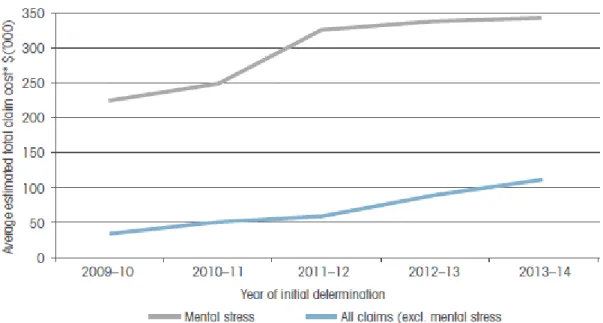
2.19 The department also noted that a 61 per cent increase in the incidence of mental stress claims under the scheme between 2009-10 and 2013-14 'is significantly higher than the average cost of other claims' (see figures 2.4 and 2.5 below).22
Figure 2.4: Incidence of mental stress claims (Source: Department of Employment, Submission 22, p. 7).
21 Department of Employment, Submission 22, p. 7. 22 Department of Employment, Submission 22, p. 7.
Figure 2.5: Average total cost of mental stress claims (premium payers)( Source: Department of Employment, Submission 22, p. 7).
2.20 In order to address the consequences of the decision in Wiegand v Comcare, the bill therefore requires 'reasonable grounds' for an employee's perception that an injury 'was contributed to, to a significant degree, by an employee's employment'.23 2.21 The APSC welcomed the differentiation between work and non-work related injuries. The APSC pointed out that:
By requiring an increased causal connection between the injury and the employee's employment, employers in the Comcare scheme will no longer be required to insure against the costs of injuries, like strokes and degenerative spinal conditions, over which they have little control or influence.24
2.22 The APSC also welcomed the increased threshold for perception-based claims because it 'will introduce further rigour into the scheme when determining liability for psychological injury claims'.25
2.23 The APSC gave the following example of how the findings in Wiegand v Comcare had been applied in a work related stress claim:
In 2012, an Australian Government employee submitted a claim for workers compensation for 'work related stress'.
In her claim, the employee alleged that when she requested a fellow colleague assist her to move a table on a trolley, the colleague did so by moving the table 'wildly from side to side' and 'banging on glass and metal'.
23 Department of Employment, Submission 22, p. 7.
24 Australian Public Service Commission, Submission 12, p. 5. 25 Australian Public Service Commission, Submission 12, p. 5.
The employee further stated that the colleague's behaviour was 'volatile and extremely pressured' and she could 'feel the intensity of his anger and rage'. Whilst CCTV footage shows the employee and her colleague moving a table together, it did not reveal any behaviour which may be construed as aggressive or violent.
Comcare applied the Federal Court decision of Wiegand v Comcare in finding that the employee's perception of the events significantly contributed to her condition.
The claim was therefore eligible and compensation was paid.26
2.24 The APSC noted that as a result of successful claims based on the decision in
Wiegand v Comcare, 'managers in the APS regularly report that some employees covered by the Commonwealth scheme see Comcare as a 'soft touch'. The APSC stated that 'such an attitude is not healthy for the individual concerned, undermines the majority of hard working and ethical public servants and is not fair on agencies and taxpayers'.27
2.25 The APSC saw the tightening of the eligibility requirements as vital for arresting the substantial increase in workers' compensation premiums over the last four financial years.28
2.26 Furthermore, the APSC noted that fraud notifications had increased by 15 per cent during 2013-14 compared to the previous year, and that injured worker fraud accounted for more than 95 per cent of all allegation types. The two most significant fraud allegations were embellishment of an injury and injured workers earning an undisclosed income or working without notifying Comcare or their workplace.29
2.27 The APSC stated that spurious and fraudulent claims not only undermined the viability of the scheme, but also unfairly tarnished the reputation of the majority of public servants:
The APS believes in providing support to employees who are injured and genuinely need support. Doing so requires a viable and sustainable workers' compensation scheme. The APS cannot afford to continue paying for a scheme that accepts claims that are unrelated to work, and provides treatment and services to employees that are not evidence-based.
…
The taxpaying public expects the Comcare scheme to be fair and comparable to other schemes. The cost associated with defending spurious claims has been increasing. If unchecked, this has implications for the
26 Australian Public Service Commission, Submission 12, p. 5. 27 Australian Public Service Commission, Submission 12, p. 6. 28 Australian Public Service Commission, Submission 12, p. 4. 29 Australian Public Service Commission, Submission 12, p. 6.
scheme’s viability. In addition, a prevalence of spurious claims invokes a broader impact of undermining respect for APS employees.30
2.28 Employers and employer groups generally welcomed the changes to eligibility requirements proposed in Schedule 1. Ai Group viewed the amendment as important because it 'should ensure that employers are not required to make workers' compensation payments for injuries which are not closely connected to work'.31
2.29 Transpacific Industries (TPI) supported both the proposal to exclude designated injuries such as heart attacks, strokes and spinal disc ruptures where there is no significant employment contribution, and the increase to the threshold for perception-based disease claims. Noting that the changes would align the scheme with State based workers compensation legislation, TPI stated that the amendments 'will greatly assist employers in reducing the burden of cost for lifestyle and age related disease processes over which they have limited control'.32
2.30 Ai Group also welcomed clauses 10 to 13 and new section 7A that enables Comcare to determine, by legislative instrument, a Compensation standard. Ai Group was of the view that:
these combined amendments will allow for a transparent assessment to be undertaken in relation to the very difficult scenarios that arise when there is a potential combination of work related and non-work related factors associated with an ailment or aggravation. Employers continually raise this issue across all schemes and it will only become more important as the ageing workforce continues to work into years where it would generally be expected that such ailments or aggravations would occur as part of the ageing process.33
2.1 Concerns about Schedule 1 went to both the form and the substance of the changes. The Law Council of Australia (Law Council) was concerned about the basis upon which decisions are to be made. The Law Council proposed safeguards around the provision for a decision-maker to assess the probability that an injury was employment-related to a significant degree. The Law Council recommended the decision be based on appropriate medical evidence:
The Law Council recommends that Parliament impose a safeguard in Schedule 1, Part 1, Clause 11 of the Bill, requiring that, in the assessment of the probability that an employee would have suffered an ailment or aggravation, or a similar ailment or aggravation, at or about the same time or stage of an employee's life, a decision-maker must base his/her/its decision on medical evidence from an appropriately qualified specialist.34
30 Australian Public Service Commission, Submission 12, p. 6.
31 Ai Group, Submission 6, p. 5; see also TNT Express, Submission 8, p. 2.
32 Transpacific Industries, Submission 1, p. 2; see also TNT Express, Submission 8, p. 2; National Electrical and Communications Association, Submission 20, p. 5.
33 Ai Group, Submission 6, p. 6.
2.31 Concerns were also raised about making substantive changes to the law by regulation. The Law Council, Slater and Gordon Lawyers (Slater and Gordon), and the Australian Council of Trade Unions (ACTU) were of the view that substantive legislative change should be effected by amending the SRC Act rather than by using delegated legislation:
The Law Council is also concerned that further conditions could be added by regulation rather than amending the Act itself (Schedule 1, Item 15 - Clause 5C(1)(g)). Additional injuries should be added to the legislation only by legislative amendment, not regulation, which should only be used for non-substantive changes.35
2.32 Several submitters disagreed with the basic premise of the legislation.36 The Australian Lawyers Alliance (ALA) claimed that the changes to the assessment that an injury was employment-related to a significant degree might provide an avenue for an employer to 'shirk responsibility' for an injury by contending that, because of an employee's age,' they probably would have suffered the injury anyway'.37
2.33 Angela Sdrinis Legal (Angela Sdrinis) expressed disappointment that the bill will reduce the costs of the scheme by cutting the benefits currently available to workers, rather than reducing costs by focusing on reducing injuries in the first place and getting injured workers back to work more quickly:
There is no doubt workplace injuries do cost too much both in monetary terms and in terms of human suffering. Work injuries cost employers and they cost workers. The SRCA has never provided common law type damages the aim of which is to put a worker in the position they would have been had they not been injured. Increasingly, with limits on and reduction of benefits, workers who are in receipt of compensation under the Comcare scheme, find that they struggle to make ends meet. Many workers with long term injuries go so far backwards after a work injury that they never recover, either psychologically or financially. Of course the effects are worse for those workers whose claims are denied altogether and the proposed changes to the SRCA will mean that some workers will lose the right to receive compensation at all or their benefits under the scheme will be substantially reduced.
If the Government and employers want to save money in the long term the emphasis should be on health and safety and not on trying to reduce benefits once an injury occurs. In the area of mental health in particular,
35 Law Council of Australia, Submission 29, p. 5; see also Slater and Gordon Lawyers,
Submission 14; Australian Council of Trade Unions, Submission 26.
36 Australian Lawyers Alliance, Submission 3; UnionsWA, Submission 7; Victorian government,
Submission 9; Slater and Gordon Lawyers, Submission 14; Communication Workers Union,
Submission 15; Finance Sector Union, Submission 16; Queensland Council of Unions,
Submission 21; Australian Manufacturing Workers' Union, Submission 24; Maritime Union of Australia , Submission 25; Australian Council of Trade Unions, Submission 26; Construction, Forestry, Mining and Energy Union, Submission 27.
where we are seeing an increasing incidence of psychological injury because of bullying in the workplace, the changes proposed in the Bill will make it even harder for these workers to successfully claim compensation. This means that there will be even less pressure on employers to provide a safe workplace and injured workers will end up on the scrap heap at the cost of tax payers rather than employers.38
2.34 Angela Sdrinis stated that, overall, the bill 'is very hard on workers who develop psychiatric injuries' and might even be counter-productive:
Instead of reducing benefits available to workers, the Government should be asking what is making workers sick and how to decrease the incidence of work place bullying and stress. There is no incentive for employers to deal with bullies in the workplace, or indeed with injuries generally, if they do not have to deal with the consequences and someone else has to pay for the damage done.39
2.35 Slater and Gordon stated that:
The Bill will dramatically reduce the rights and entitlements of workers currently in the Comcare scheme. Many more thousands of injured workers will lose rights to compensation if the 2014 bill is passed as the 2014 bill proposes opening up the Comcare scheme for major expansion nationally. …
The Bill fails to give effect to most of the recommendations made in the Hanks/Hawke Review, especially those which would be advantageous to injured workers. It contains a series of devices to remove injured workers from the scheme and other provisions that reduce quantum of compensation. We believe that almost all provisions in the Bill are unfair to injured workers and that some of the provisions can be characterized as grossly unfair and inhumane.40
2.36 Several submitters found the introduction of a 'reasonable basis' test for psychological injuries deeply troubling.41 The ALA noted that the test had 'the potential to drastically restrict legitimate access to compensation' by unfairly judging workers' actions:
Many people faced with difficult, urgent and threatening situations at work are likely to be judged by decision makers with the benefit of hindsight. Decision makers are essentially asked to retrospectively analyse a situation
38 Angela Sdrinis Legal, Submission 13, pp 2–3; see also Construction, Forestry, Mining and Energy Union, Submission 27, p. 10.
39 Angela Sdrinis Legal, Submission 13, p. 9. 40 Slater and Gordon Lawyers, Submission 14, p. 1.
41 Australian Lawyers Alliance, Submission 3, p. 5; Slater and Gordon Lawyers, Submission 14, p. 3; Angela Sdrinis Legal, Submission 13, p. 3; Australian Council of Trade Unions, Submission 26, p. 19.
and form a judgement concerning how someone should have reacted objectively.42
2.37 Slater and Gordon stated that:
The current test for psychiatric injury is known as the Weigand test. Whilst this test requires there to be a significant work event that contributed to the condition for liability to be accepted, it is not necessary to establish the worker's response was reasonable. The bill removes this test and introduces an objective test that requires a worker to demonstrate there were reasonable grounds for the belief or interpretation of the incident or state of affairs'.
…
This is at odds with the fact that psychological conditions may of their nature not be rational. The Courts define a psychological condition as one that is 'outside the bounds of normal mental functioning'. Consequently, this proposed test is flawed and inappropriate.43
2.38 Noting that 'many workers never recover from the effects of work place stress/bullying and some actually take their lives', Angela Sdrinis found the further restrictions placed on claims for psychological injuries 'particularly concerning'.44 2.39 The implications for workers engaged in manual work, of excluding spinal injuries from compensation, were of concern to several submitters. Angela Sdrinis noted that since the expansion of the scheme to include licensees, the scheme no longer just covered white collar workers. Consequently, with many workers under the scheme now employed in industries where the work is largely manual, 'there are many more workers suffering serious spinal injuries', and those injuries will not be compensable under the changes proposed in the bill:
We all suffer degeneration in the spine as we age. The law to date has essentially been that provided that a worker with degenerative changes had been asymptomatic, where an injury at work renders the conditions symptomatic, workers are entitled to compensation. The proposed changes will mean that many workers with back injuries will no longer be eligible to receive compensation and employers will be under less pressure to ensure safe work places in terms of lifting and other manual handling arrangements.45
2.40 The Communication Workers Union (CWU) noted that many of its members worked for self-insurers in the Comcare scheme such as Telstra and Australia Post. The CWU noted that motorcycle crashes and manual handling formed a significant component of all injuries amongst workers at Australia Post:
42 Australian Lawyers Alliance, Submission 3, p. 5. 43 Slater and Gordon Lawyers, Submission 14, p. 3.
44 Angela Sdrinis Legal, Submission 13, p. 3; see also Australian Council of Trade Unions,
Submission 26, p. 19.
Truck drivers and posties recorded the highest number of deaths on the job in 2012. Transport workers accounted for nearly one-third of all workplace deaths that year. Vehicle collisions caused most fatalities. Motorcycle crashes occur in significant numbers accounting for about 30 per cent of all workers' compensation claims within Australia Post
Muscular stress while lifting, carrying or putting down objects (manual handling) is the most common cause of serious injury across the postal industry. Manual handling is about 43 per cent of all workers' compensations claims within Australia Post. Machinery hazards persist in causing injury and being struck by moving objects such as mail handling equipment.
Our postal members also work in the retail trade. The retail trade is in the top 10 most dangerous line of work. The most common cause of serious injury for retail workers within Australia Post is manual handling, slips, trips and falls, being struck by objects, verbal abuse and threats from customers and armed hold ups. The system of work itself contributes to musculoskeletal injury because of the burden of standing all day upon the body.
…
Our field workforce members continue to suffer muscular injuries associated with work in confined spaces (pits, ceilings, spaces under houses), work which also involves potential exposure to hazardous substances, including (but by no means limited to) asbestos.46
2.41 Given the prevalence of musculoskeletal conditions within this sector of the workforce, the CWU therefore expressed grave concern that 'the changes to eligibility requirements ('designated injury') potentially rule out any or every musculoskeletal injury from workers' compensation'.47
2.42 Likewise, the CFMEU pointed out that the proposal to disallow musculoskeletal claims would be particularly unfair on manual workers whose 'vulnerability and susceptibility invariably arises from the simple fact of doing hard manual work all their lives'. The CFMEU was therefore of the view that workers are:
…entitled to expect that their employer will make financial provision so that if an accident happens they will be properly paid until they are able to come back to work. If that is expensive for employers the way a First World country should seek to limit those costs is by paying even more attention to safety and eliminating, to the maximum extent possible, injury and illness at work.
The method proposed in the 'Improving Comcare' Bill is to do it in the way of a Third World country, by reducing the cost of each claim, or making it impossible for claims to be made.
46 Communication Workers Union, Submission 15, pp 2–3. 47 Communication Workers Union, Submission 15, p. 4.
That is not something that the Parliament should be involved in.48 Reasonable management action
2.43 Mental stress claims related to 'reasonable administrative action' was a particular area of contention. Some submitters argued that the balance had tilted too far in favour of employees and that this shift had had a detrimental impact on the ability of employers to effectively manage employees in the workplace. The department noted that as a result of recent rulings by the AAT and courts, even appropriate action by employers and managers can lead to successful claims for mental stress injury, with unfortunate consequences for management practices, professional reputations and staff morale:
Employers have argued that if they and their managers behaved appropriately when an employee claims to have suffered a mental stress injury, they should not be liable for workers’ compensation. The AAT and courts have ruled that the only areas that are exempt from employee mental stress claims are those where managers are undertaking formal performance appraisals, counselling action, suspension action or disciplinary action. In practice, this means that a stress claim can be successful in every other circumstance, even where a manager was behaving appropriately. For example, stress claims can be successful where the workplace undertook a reasonable and appropriate restructure and the employee did not like it; or where a manager has asked an employee to work in another location that is reasonable; or where a manager is working one on one with an employee to improve their performance.
…
Most Commonwealth agencies have reported they are concerned that if they encourage assertive and accountable management practices they risk mental stress claims being lodged. Managers are understandably concerned about the impact of this on their professional reputations, and on the morale of the rest of their staff.49
2.44 The department argued that by broadening the definition of 'reasonable administrative action' to include any reasonable management action, the bill would remove impediments to effective workplace management. Furthermore, the bill would close a loophole that had allowed employees to 'make a claim in anticipation of reasonable management action being taken'. The department noted these changes were necessary to ensure that 'employers and taxpayers are not held financially responsible for certain injuries and illnesses (including stress) that have no causal connection to the workplace or to a manager's behaviour'.50
2.45 The APSC provided the following example to demonstrate the narrowness of the current 'reasonable administrative action' exclusions:
48 Construction, Forestry, Mining and Energy Union, Submission 27, pp 9–10. 49 Department of Employment, Submission 22, pp 8–9.
An Australian Government employee's manager had a discussion with her about aspects of her performance, and a failure to follow direction.
The employee filed a workers' compensation claim for psychiatric symptoms she claims arose out of that discussion. The employee claimed her manager was ineffective, subjected her to bullying and harassment, and socially isolated her from the rest of the team when she complained.
The employee's claim progressed to the Administrative Appeals Tribunal, where Comcare agreed that the employee had been properly diagnosed as suffering from adjustment disorder with symptoms of anxiety and that her employment made a significant contribution to the condition.
However, Comcare denied liability for the claim on the basis that the manager took reasonable administrative action in a reasonable manner. In 2014, the Tribunal found that the discussion between the employee and her manager did not constitute administrative action and was not action taken in respect of the employee's employment. It ruled in favour of the employee and ordered Comcare to pay compensation.51
2.46 The APSC pointed out that the ability to manage employee underperformance is a critical and legitimate aspect of successful management. However, the threat of potential stress claims can impede reasonable management action with negative impacts on the organisation, co-workers, and every supervisor in the APS:
The reasonable administrative action provisions were introduced to protect an employer's capacity to manage their staff through legitimate human resource management actions undertaken in a reasonable manner. This means that when an employer has exercised a legitimate human resource action, which was reasonable in the circumstances and done in a reasonable manner, an employee should not be eligible for workers' compensation for an ailment that arises from that action.
…
However, over time, the Courts have adopted a narrow interpretation of the definition of reasonable administrative action. This has resulted in unintended consequences. Anecdotal evidence suggests that APS managers are often apprehensive of workers' compensation claims or allegations of bullying and harassment when they are being pro-active and responsible managers.
…
Failure to manage underperformance is a drain on resources and productivity, which also has a negative impact on co-workers, and must be addressed.52
2.47 The APSC therefore welcomed the proposed amendments because they would 'empower managers to better manage underperformance and workplace change
51 Australian Public Service Commission, Submission 12, p. 7. 52 Australian Public Service Commission, Submission 12, pp 7–8.
without fear of reprisal through a workers' compensation stress claim, if they manage their workers in a reasonable manner'.53
2.48 Within the context of reasonable management action, it is important to note that employers in the APS are governed by a stringent set of rules:
Employers in the APS are subject to a strict framework of rules and regulations when managing employees and workplace change including under the Public Service Act 1999, the Fair Work Act 2009 and the Work
Health and Safety Act 2011.54
2.49 Employer responsibility also extends to preventing and, where required, managing workplace bullying:
The APS acknowledges that it has a responsibility to prevent bullying. Also, they are committed to engendering a workplace culture that does not tolerate bullying. In circumstances where bullying does occur, employers have an important role under the Act to manage early intervention and rehabilitation. The amendments strengthen and clarify this role and the mutual obligations of employers and employees.55
2.50 Both Ai Group and TPI supported the proposal to exclude reasonable management action (including anticipated actions and organisational and corporate restructures). Ai Group stated that it was 'totally inappropriate for a person to be able have a claim accepted simply because they lodged the claim before the employer commenced reasonable management action in a reasonable manner'.56 TPI noted that the change would align with State based workers compensation legislation.57
2.51 The degree to which the bill accurately reflected the recommendations of the Hanks Review with respect to the definition of 'reasonable administrative action' was questioned by several submitters.
2.52 The Law Council argued that contrary to recommendation 5.6 from the Hanks Review, 'the bill expands the notion of 'reasonable administrative action' to virtually any management action by an employer'.58
2.53 Angela Sdrinis stated that widening the scope of 'reasonable administrative action' while ignoring other relevant elements of the Hanks Review amounted to 'cherry-picking' the Review recommendations.59
53 Australian Public Service Commission, Submission 12, p. 8. 54 Australian Public Service Commission, Submission 12, p. 8 55 Australian Public Service Commission, Submission 12, p. 9. 56 Ai Group, Submission 6, p. 4.
57 Transpacific Industries, Submission 1, p. 2.
58 Law Council of Australia, Submission 29, p. 4; see also Slater and Gordon Lawyers,
Submission 14, p. 3.
59 Angela Sdrinis Legal, Submission 13, p. 4; see also Australian Manufacturing Workers' Union,
2.54 Slater and Gordon (and ACTU) pointed out that a further consequence of broadening the concept of 'reasonable administrative action' to 'management action' (and thereby include any operational direction) would be to not only exclude most workplace injuries, but also reverse the existing burden of proof, contrary to the original purpose of the scheme:
Hence, an injury which has been contributed to by a system of work may be excluded from compensation unless the worker can establish that the system of work was not reasonable. This introduces the concept of fault into a no-fault scheme and a perverse onus of proof upon a faultless injured worker. The injured worker may be completely faultless and merely following an employer direction when injured, but unless the worker is prepared to take legal action to prove unreasonableness on the part of the employer, they will be excluded from Comcare.
…
We submit that such a proposition is at odds with the history and purpose of all Australian workers' compensation schemes.60
2.55 Furthermore, the Law Council warned that the failure to qualify the meaning of 'management action' could lead to protracted litigation:
…the absence of a limitation or qualification of what is meant by the phrase 'management action' is likely to lead to uncertainty and complex litigation, such as in Commonwealth Bank of Australia v Reeve (2012) 199 FCR 463, in order to determine the distinction between an employee's usual duties and 'management action'.61
2.56 The Law Council also pointed to an inconsistency between the SRC Act and the Fair Work Act 2009 (Fair Work Act) regarding the definition of 'management action', noting that the effect of the inconsistency could be undesirable:
The effect is particularly significant given the decision of Hart v Comcare, that if just one of the factors leading to the development of a condition was 'reasonable administrative action', then the claim will be excluded, even if that factor was a minor or insignificant one.62
2.57 The Law Council and Angela Sdrinis both noted that the Hanks Review had suggested amending the SRC Act to make the operation of the provisions fairer by ensuring that 'reasonable administrative action' must be a significant contributing factor in the injury in order for a psychological injury claim to fail.63
60 Slater and Gordon Lawyers, Submission 14, p. 4; see also Australian Council of Trade Unions,
Submission 26, p. 19.
61 Law Council of Australia, Submission 29, p. 4; see also Australian Manufacturing Workers' Union, Submission 24, p. 4.
62 Law Council of Australia, Submission 29, p. 4.
2.58 The Law Council recommended that 'Parliament adopt an exhaustive definition of 'management action' and harmonise the definition' between the SRC Act and the Fair Work Act.64
2.59 Noting that broadening the definition of 'reasonable management action' would make 'it much easier to disqualify claims', the ALA argued that the change was a complete reversal of what paragraph 5.123 of the Hanks Review recommended.65 2.60 The Finance Sector Union (FSU) and the ALA pointed out that the Full Federal Court judgment in Reeve66 distinguished between the 'administrative' and 'operational' actions of an employer. The distinction meant that an instruction to an employee to perform work at a particular location was an operational and not an administrative action and would not therefore trigger the exclusionary provision. This meant that any injury to an employee resulting from an operational action would still be compensable.67
2.61 The ALA argued that 'the Court came to this conclusion because otherwise it would be difficult to see how 'anyone would have an entitlement to workers' compensation'':
The Court gave the example of injury incurred to an employee in falling down stairs at his or her workplace being the result of administrative action in directing that employee to work at that workplace. If a truck driver became injured as a result of a motor vehicle collision, it could be asserted that the injury was the result of the administrative action in directing the driver to drive a particular route on that day.68
2.62 The FSU noted that many of their members work in financial services organisations that undertake regular organisational and corporate restructures, including off-shoring' jobs. Given the uncertainty regarding ongoing employment, employees are especially vulnerable to stress-related injuries at this time. The FSU was concerned that the bill would absolve the employer from any responsibility for their workforce's mental well-being resulting from the restructuring process.69
2.63 The CFMEU pointed out that many of their members work in FIFO operations and that the bill would serve to exclude those workers from advancing a claim for psychiatric illness:
Those workers are not FIFO because it suits them. They are FIFO because employers choose to structure their operations in that way. This Committee will be well aware of the issues to psychiatric health posed by that lifestyle. As a result of the amendments proposed in the 'Improving' Bill, it will be
64 Law Council of Australia, Submission 29, p. 5. 65 Australian Lawyers Alliance, Submission 3, p. 7.
66 Commonwealth Bank of Australia v Reeve [2012] FCAFC 21
67 Australian Lawyers Alliance, Submission 3, p. 7; Finance Sector Union, Submission 16, p. 5. 68 Australian Lawyers Alliance, Submission 3, p. 7.
almost impossible to advance a claim. It will no doubt be said by employers that all rostering, accommodation, messing, travel and other decisions affecting the health and well-being of FIFO workers are simply 'Management Actions' and therefore squarely caught by the exclusionary provisions. This is not an improvement.70
2.64 The ALA argued that by circumventing the decision made by the Court in
Reeve, the bill would 'make it far more difficult for anyone to receive compensation for accidents and injuries arising in the workplace'.71 The ALA gave the following example of the dangers in the new approach:
Michael works as an Agent for the Australian Federal Police. As part of his duties, he was directed by his Superior Officer to investigate a suspected drug lab that was located in a residential home.
Michael goes to the location and sees the drug lab through the back window. He knocks on the front door and out jumps a stranger and stabs him in the chest multiple times, causing severe puncture wounds to his heart and lungs. He is put in a critical condition and is fighting for his life in hospital.
A compensation claim was lodged. However, under the new laws, the claim can be rejected because the injury resulted from the reasonable operational direction given by Michael's superior officer to investigate the suspected drug lab.72
Committee view
2.65 The committee recognises that difficult decisions will need to be made regarding situations that involve a combination of work related and non-work related injuries or ailments, and that this situation will be exacerbated by both an ageing population and people working till later in life.
2.66 However, decisions made under the current SRC Act have placed employers in an invidious position by lumbering them with responsibility for injuries that have scant connection to the workplace. The committee is of the view that the amendments will bring a greater degree of clarity and transparency to the decision-making process around eligibility for compensation. The committee is also of the view that the bill strikes the right balance between fair and reasonable compensation for employees and ensuring scheme viability by enabling employers to fund work-related claims.
2.67 The committee takes very seriously the evidence provided by the Australian Public Service Commission concerning the increasing incidence of allegations of injured worker fraud. The committee regards it as imperative that greater rigour is introduced into the assessment of compensation claims and is confident that the
70 Construction, Forestry, Mining and Energy Union, Submission 27, p. 8.
71 Australian Lawyers Alliance, Submission 3, p. 7; see also Finance Sector Union,
Submission 16, p. 5.
changes brought in by the bill are both necessary and sufficient to accomplish this vital task.
Schedule 2: Enhancing rehabilitation and return to work outcomes
2.68 A key facet of the bill is the focus on the vocational (rather than medical) nature of rehabilitation services. The bill amends the rehabilitation and return to work requirements in the SRC Act in order to improve return to work outcomes.
2.69 Comcare noted that early intervention programs benefit both employees and employers:
Early intervention programs have been found to have a positive effect not only in terms of improving employee outcomes (recovery), but also in terms of their capacity to remain at work, reducing the length of time they are away from work, reducing the likelihood of further sickness absences, and ultimately, improving their longer term perceptions of the workplace. Similarly, workplaces using early intervention programs have found that they reduced the number of days employees are absent from work, their costs, and the amount of lost productivity.73
2.70 Comcare also pointed to 'compelling international and Australasian evidence that work is generally good for health and wellbeing, and that long-term absence, disability and unemployment generally have a negative impact on health and wellbeing'. Comcare noted these views are endorsed by Australian medical experts led by The Royal Australasian College of Physicians and the Royal Australian College of General Practitioners.74
2.71 The APSC supported the moves to improve return to work outcomes and agreed with the evidence on the benefits to employees of returning to work in some capacity as soon as possible:
The APS believes that the Comcare scheme provides a generous set of entitlements for injured public service employees. However, there is general agreement amongst Secretaries and Chief Executive Officers that the current legislation focuses on administrative decision making rather than injury management and supporting staff to get back to work.
…
There is strong international evidence that injured workers will get sicker if they remain at home. Historical thinking was that injured employees should be at home until they are 100 per cent job ready. Current evidence is that the interests of employees are best served if they return to work as soon as possible, with workplace adjustments to support their return.75
2.72 The Safety Rehabilitation and Compensation Licensees Association (SRCLA) noted that licensees 'have a proven history of effective rehabilitation of injured
73 Comcare, Submission 5, pp 4–5. 74 Comcare, Submission 5, p. 5.
employees and the SRCLA welcomes the proposed introduction of change that will provide further opportunity to improve rehabilitation effectiveness'.76
2.73 However, the Australian Manufacturing Workers' Union (AMWU) argued that the department was using the research on the benefits of work selectively:
Research on the benefits of work is selectively used to justify the changes. Being employed in good work is much better than being unemployed and it is also better than being employed in bad work. The evidence is strong – there are health benefits of being involved in good work. Work that kills or maims – physically or psychologically – is not beneficial.77
Suitable employment
2.74 The bill expands the definition of what is considered suitable employment by enabling an employee to 'look beyond their current employer while they are returning to work without losing the right to employment with their employer'. Consequently, authorities can maximise the opportunities for vocational rehabilitation by using the return to work hierarchy set out below:
• Same job/same employer: the first goal is to return the injured employee to the original employer in the original job.
• Modified job/same employer: to encourage the employer to modify the original job or to provide employment in a different job at that employer.
• New job/same employer: to enable continuity of employer when the employee is no longer able to undertake their original job.
• Same job/new employer: to assist the injured worker in finding employment with a different employer in a related industry.
• Modified job/new employer: to assist the injured employee in finding employment in a modified role with a different employer in a related industry.
• New Job/new employer: to assist the injured worker in finding a job in another industry.78
2.75 TPI welcomed the simplification and streamlining of the administrative process relating to the provision of rehabilitation services as well as 'the focus on work readiness and assessment in line with vocational capability rather than incapacity'.79
2.76 Comcare noted that the bill will engender greater cooperation between employers, employees and the relevant authority to improve return to work outcomes
76 Safety Rehabilitation and Compensation Licensees Association, Submission 23, p. 2. 77 Australian Manufacturing Workers' Union, Submission 24, p. 5.
78 Department of Employment, Submission 22, p. 9. 79 Transpacific Industries, Submission 1, pp 2–3.
for employees, and will provide Comcare with the ability under the SRC Act to support employees to find suitable employment in all employment sectors.80
2.77 The APSC noted that under the bill, Comcare would be empowered to take a more active role in determining which agency has rehabilitation responsibilities following a machinery of government change.81
2.78 Angela Sdrinis welcomed the emphasis on return to work requirements, but expressed disappointment employers will face no penalties if they 'fail to provide suitable duties in circumstances where there is evidence that alternative work could be made readily available'.82
2.79 Furthermore, Angela Sdrinis pointed out that the Hanks Review had made specific recommendations with regard to return to work and job replacement programs:
Hanks recommended that the SRCA be amended to provide for a requirement that all reasonable steps be undertaken to return an injured employee to work (6.14) and to provide for the power to impose penalties where this does not occur (6.17). Further, Hanks recommended the establishment of a scheme wide job placement program (6.18). This could work particularly well with respect to workers with work related psychological injuries where the barriers to ever returning to the workplace where their injuries occurred are in many cases insurmountable.
It is very disappointing that this approach has not been adopted by the Government. There would be a certain reciprocity involved in a scheme wide job placement program i.e. employers would be a lot more willing to take on a worker injured in another workplace if they knew that other employers would be under pressure to take on 'their' injured workers.83
2.80 Likewise, Slater and Gordon (and ACTU) argued that the new workplace rehabilitation plans in the bill put the interests of employers ahead of the needs of workers:
The bill allows the 'liable' employer unfettered discretion to impose workplace rehabilitation requirements, whether or not the requirements could in fact be harmful. This will put many workers in an impossible position whereby they must either disobey the advice of their qualified medical practitioner or face sanctions and further financial penalty. Their right to challenge the reasonableness of directions given to them by their employer is removed by the bill.
…
80 Comcare, Submission 5, pp 6–7.
81 Australian Public Service Commission, Submission 12, p. 4.
82 Angela Sdrinis Legal, Submission 13, p. 4: see also Australian Council of Trade Unions,
Submission 26, p. 25.
On the one hand, workers are faced with financial penalty and sanctions for failure (in the opinion of the employer) to adhere to their obligations, however, on the other hand, employers are to be provided with financial incentives to meet their obligations. Again, this is a further illustration of putting the interests of employers before the needs of injured workers and their families.84
2.81 UnionsWA and ACTU expressed concern that the changes imposed greater responsibilities and penalties on workers while at the same weakening the responsibilities of liable employers:
The proposed Schedule 2 of the bill on Rehabilitation would weaken the responsibility of the liable employer to assist workers to return to work, yet it also provides those same employers with extraordinary powers to direct injured workers on what health providers they must see and what tasks they must under-take. The proposals take rehabilitation out of the hands of qualified health practitioners and into the hand of employers.
Despite these new powers for employers, the bill provides for no penalties on employers if they fail genuinely to engage in the rehabilitation process. The bill ensures that a Workplace Rehabilitation Plan remains valid even when a worker is not consulted. Employers also need only consult with medical practitioners as far as 'reasonably practicable' when constituting a plan.85
2.82 The FSU recounted several instances of injured workers either being pressured to return to work too early or not being provided with adequate equipment (such as a seat and footstool), or appropriate breaks to accommodate posture changes, despite the recommendations in certificates of capacity provided by treating doctors and specialists.86
Schedule 3: Improving the scheme's integrity and financial viability
Provision of medical information2.83 The ALA asserted that requirements dealing with the provision of medical information lacked any privacy protections and effectively undermined the doctor-patient relationship:
The bill's proposal to compel workers to provide all medical information from treating medical providers is highly inappropriate. No other workers' compensation scheme provides for such a broad and unrestrictive provision of private medical information. The private rights of individuals to consultation and treatment are being eroded by these provisions without justification. Workers may be obliged to disclose highly confidential and
84 Slater and Gordon Lawyers, Submission 14, p. 8; see also Finance Sector Union,
Submission 16, pp 8–9; Australian Council of Trade Unions, Submission 26, pp 26–27. 85 UnionsWA, Submission 7, p. 2; see also Australian Council of Trade Unions, Submission 26,
p. 25; Australian Manufacturing Workers' Union, Submission 24, p. 10.
86 Finance Sector Union, Submission 16, p. 8; see also Australian Council of Trade Unions,
sensitive information irrelevant to the workers compensation issues in dispute. That information can be used for a variety of purposes to the detriment of the injured worker without adequate protection checks and balances.
S 58, 58A, 120A and 120B all represent changes that now enable Comcare and licensees to force an injured worker or claimants to obtain their doctor's private clinical notes. A worker must obtain 'relevant information' or risk draconian sanctions being applied which, in this case, extends to a refusal to deal with a claim.
These changes represent an erosion of the doctor-patient relationship of confidentiality.
…
Such a proposal is deeply concerning and attacks the fundamental rights of individuals to engage in meaningful and confidential consultations with their medical practitioners.87
2.84 Slater and Gordon agreed with the above assessment and also made the following observations. First, there is no appeal mechanism 'where there is a genuine dispute in relation to whether certain information or a certain document is actually relevant to a claim'. Second, 'there is no obligation enshrined in the bill that requires an employer to use the information for the purpose for which it was obtained'. And third:
The new section 58A takes the breach of privacy one step further in that it enables Comcare or the relevant authority to obtain documents about an injured worker from a third party. The bill also enables the gathering of information without the permission of the injured worker from third parties.88
2.85 UnionsWA and ACTU also expressed concern that the bill invaded the privacy of injured workers backed up with the force of sanctions:
If it is passed Comcare or an employer can demand that an injured worker provide documents in not less than 14 days. A failure or refusal to do so would be a breach of an obligation of mutuality. Comcare or a relevant authority would also be able to obtain third party documents about injured workers.89
Timeframes
2.86 ACTU welcomed the introduction of statutory time limits on decision-making, but noted that the timeframes 'are the least beneficial by far for injured
87 Australian Lawyers Alliance, Submission 3, p. 14. 88 Slater and Gordon Lawyers, Submission 14, p. 8.
89 UnionsWA, Submission 7, p. 3; see also Australian Council of Trade Unions, Submission 26, p. 28.
workers of any scheme in Australia (except for other Commonwealth schemes that like Comcare, don't have time frames)'.90
2.87 Furthermore, ACTU pointed out that:
There are no sanctions or penalties placed on Comcare, the employer, or the relevant insurer if self-insured, if these time frames are not met.
If these time frames are not met, the worker's claim is automatically deemed to be rejected, even if their claim is in fact valid. Although the worker has access to an appeals process, they may not always be aware of this and as a result, may not receive compensation to which they are entitled, due to lack of knowledge of the proper processes.91
Compensation for detriment caused by defective administration
2.88 The department noted that the bill will rectify this matter and improve the integrity of the scheme 'by creating an avenue for reparation' through 'empowering Comcare to make discretionary payments to people who have suffered detriment due to defective administration on Comcare's part'.92 These changes were welcomed by Angela Sdrinis.93
Schedule 4: Provisional medical expense payments
Medical expense payments2.89 The bill introduces provisional medical expenditure payments capped at $5 000 without the need for an employee to lodge a formal workers' compensation claim.
2.90 The APSC supported this change as being complementary to the focus on early intervention by ensuring that injured or unwell employees gain assistance as soon as it is required, leading to improved health outcomes.94
2.91 Several submitters made suggestions for improving the schedule of fees. TPI did not fully support the provision in Schedule 4 to enable a relevant authority to make provisional medical expense payments capped at $5 000 in respect of an alleged injury before a claim is determined. While supporting the current medical expense process, TPI recommended that the capped amount be at the discretion of the relevant authority rather than legislated:
TPI does not fully support the amendments proposed under Schedule 4. TPI strongly agrees with the provisional medical expense process as it already allows an ability to pay provisional expenses under an Early Intervention program. This is currently working well with the goal of employees receiving and having access to medical assessment and treatment post
90 Australian Council of Trade Unions, Submission 26, p. 29. 91 Australian Council of Trade Unions, Submission 26, p. 29. 92 Department of Employment, Submission 22, p. 20.
93 Angela Sdrinis Legal, Submission 13, p. 5.
injury without a need for liability determination. Treatment then follows from this, but it is time and cost limited to enable management and control. It also ensures that claims are moved to determination of liability outside of the set parameters. This sets an expectation that if the nature of the injury is ongoing then the claim liability determination process is important to ensure the appropriate expertise in its management. The ability to recover payments being made as a result of false or misleading statements is an important protection in this process. TPI’s primary concern with the proposed change is the legislated amount of $5 000 as an upper limit. This will potentially present an extra burden in relation to management of this process, potentially delay employees submitting claims as they will be keen to utilize the full (new) amount available under provisional medical treatment. TPI proposes that the capped amount is not legislated but at the discretion of the relevant authority.95
2.92 John Holland did not support a mandated schedule of medical fees and recommended greater flexibility in the development of any fee schedule:
John Holland considers that the mandated schedule of fees for medical treatment, examination and reports will negatively impact on our employee's ability to access appropriate care in a timely manner. Mandating schedule fees for independent medical examinations may also restrict the number of bookings doctors are willing to take which may also delay decisions regarding claimed entitlements or treatment options such as surgery requests. John Holland considers that treatment outcomes as well as managing costs associated with it, can be better achieved through initiatives such as clinical frameworks. We strongly suggest that any schedule of fees that is developed, be developed in a manner providing for flexibility to account for changes in location; urgency; particular; and peculiar circumstances. Our people are often working in remote and rural settings where choice of treatment is limited and we do not support legislation that may result in them needing to seek treatment in alternate locations purely due to cost; or situations where our employees themselves will be required to contribute to their own medical treatment as a result of the introduction of a mandated schedule of fees.96
2.93 Ai Group was similarly cautious about the proposal:
…there is scope, unless the scheme has specific protections, for employees to obtain multiple short periods of weekly compensation without claims ever being determined. This is of particular concern to employers when liability would generally be contested, i.e. psychological injury or aggravations of pre-existing injuries.97
2.94 On balance, however, Ai Group believed 'that the granting of provisional liability for medical costs establishes a workable compromise that enables an
95 Transpacific Industries, Submission 1, p. 4. 96 John Holland, Submission 10, p. 2.
employee to seek timely medical treatment which could enable them to stay at work, or return to work in a timely manner'.98
2.95 Angela Sdrinis welcomed the introduction of the provisional medical expense payments because early medical intervention can often assist in quick recovery. However, Angela Sdrinis noted that the Hanks review also recommended the introduction of provisional acceptance of liability:
Hanks also recommended provisional acceptance of liability so that an injured worker may access up to 12 weeks in incapacity payments (recommendation 6.1). Interim liability to pay incapacity payments mean that workers can survive financially whilst claims are being investigated. The capacity to be paid and to have treatment also means that some of the 'heat' would be taken out of claims during the investigation phase and this in turn generally means that workers are better disposed to trust an employer and be more willing to give early return to work a go.99
2.96 Slater and Gordon, the FSU, and ACTU all noted that 'the bill includes no appeal mechanism in the event an employer refuses to pay provisional medical expense payments'.100
Schedule 5: Ensuring compensated medical expenses are evidence-based
Medical treatment based on evidence2.97 The department stated that medical treatment under the SRC Act is ill-defined and lacks objective standards, resulting in potentially poor outcomes for employees, excessive costs for employers, and sub-optimal return to work outcomes:
…medical treatment under the SRC Act is currently broadly defined, not based on objective standards, and not required to be provided by medical practitioners who meet a level of national accreditation. This puts injured employees at risk, increases costs for employers, and delays recovery and return to work.101
2.98 The department (and the APSC) noted that current practices have led to questionable claims for treatments and potential damage to the professional reputation of the Commonwealth public service:
There have been many legal cases over the years that have considered 'reasonable' medical treatment and compensation has been awarded for what are arguably questionable claims. These have received media attention and potentially undermined the professional reputation of the public service. For example:
98 Ai Group, Submission 6, p. 7.
99 Angela Sdrinis Legal, Submission 13, pp 5-6.
100 Slater and Gordon Lawyers, Submission 14, p. 8; see also Finance Sector Union,
Submission 16, p. 10; Australian Council of Trade Unions, Submission 26, p. 30. 101 Department of Employment, Submission 22, p. 16.
The AAT approved the continuation of massage therapy payments as part of a broader treatment plan, despite no evidence of any curative effect associated with the massage therapy in this case. This cost $29,000 over an eight-year period.
The AAT found it was reasonable for an injured employee living in Alice Springs (who had 'generalised anxiety disorder and adjustment reaction with brief depressive reaction') to attend a Buddhist meditation retreat in Queensland as part of their workers' compensation treatment.
The AAT found it was reasonable for an employee to be funded through Comcare to be flown from Canberra to Townsville to receive psychoneuroimmunology treatment after the clinical nurse psychotherapist providing the treatment relocated. This relatively new form of treatment was not offered by anyone else in Canberra.102
2.99 The department argued that the bill addresses the issues outlined above by ensuring that 'compensable medical treatment is based on evidence and provided by appropriately qualified health practitioners'.103
2.100 The APSC agreed with the department's views on these matters and noted that, as a result of the changes in the bill, agencies would 'no longer be liable through premiums for the cost of treatments with little to no curative effect'.104
2.101 TPI was of the view that the requirement to ensure medical treatment was performed by an appropriately qualified health would 'enhance clinical standards and controls of treatment delivery'. TPI also stated that the requirement to consider the Clinical Framework principles would be of benefit to the scheme.105
2.102 Both Angela Sdrinis and Slater and Gordon raised concerns about the Clinical Framework Principles (prepared by Comcare and defined by legislative instrument) stating that the attempt to codify reasonable medical treatment might unduly impinge on an individual's choice of medical practitioner.106
2.103 The CWU noted the increasing use of Facility Nominated Doctors (FNDs) doctors by Australia Post and expressed concern about the discrepancies between the recommendations of the injured worker's treating doctor and those of the FND. Furthermore, by empowering employers to make the final decision on return to work, backed up by the sanctions regime (see Schedule 15), 'the rights of workers to follow
102 Department of Employment, Submission 22, p. 16; see also Australian Public Service Commission, Submission 12, p. 3.
103 Department of Employment, Submission 22, p. 16.
104 Australian Public Service Commission, Submission 12, p. 3. 105 Transpacific Industries, Submission 1, p. 5.
106 Slater and Gordon Lawyers, Submission 14, p. 10; see also Angela Sdrinis Legal,