A Process for COTS Software
Product Evaluation
Santiago Comella-Dorda John Dean Grace Lewis Edwin Morris Patricia Oberndorf Erin Harper July 2004 TECHNICAL REPORT CMU/SEI-2003-TR-017 ESC-TR-2003-017Pittsburgh, PA 15213-3890
A Process for COTS Software
Product Evaluation
CMU/SEI-2003-TR-017 ESC-TR-2003-017 Santiago Comella-Dorda John Dean Grace Lewis Edwin Morris Patricia Oberndorf Erin Harper July 2004Integration of Software-Intensive Systems Initiative
This report was prepared for the SEI Joint Program Office HQ ESC/DIB
5 Eglin Street
Hanscom AFB, MA 01731-2116
The ideas and findings in this report should not be construed as an official DoD position. It is published in the interest of scientific and technical information exchange.
FOR THE COMMANDER
Christos Scondras Chief of Programs, XPK
This work is sponsored by the U.S. Department of Defense. The Software Engineering Institute is a federally funded research and development center sponsored by the U.S. Department of Defense. Copyright 2004 by Carnegie Mellon University.
NO WARRANTY
THIS CARNEGIE MELLON UNIVERSITY AND SOFTWARE ENGINEERING INSTITUTE MATERIAL IS FURNISHED ON AN "AS-IS" BASIS. CARNEGIE MELLON UNIVERSITY MAKES NO WARRANTIES OF ANY KIND, EITHER EXPRESSED OR IMPLIED, AS TO ANY MATTER INCLUDING, BUT NOT LIMITED TO, WARRANTY OF FITNESS FOR PURPOSE OR MERCHANTABILITY, EXCLUSIVITY, OR RESULTS OBTAINED FROM USE OF THE MATERIAL. CARNEGIE MELLON UNIVERSITY DOES NOT MAKE ANY WARRANTY OF ANY KIND WITH RESPECT TO FREEDOM FROM PATENT, TRADEMARK, OR COPYRIGHT INFRINGEMENT.
Use of any trademarks in this report is not intended in any way to infringe on the rights of the trademark holder. Internal use. Permission to reproduce this document and to prepare derivative works from this document for internal use is granted, provided the copyright and "No Warranty" statements are included with all reproductions and derivative works. External use. Requests for permission to reproduce this document or prepare derivative works of this document for external and commercial use should be addressed to the SEI Licensing Agent.
This work was created in the performance of Federal Government Contract Number F19628-00-C-0003 with Carnegie Mel-lon University for the operation of the Software Engineering Institute, a federally funded research and development center. The Government of the United States has a royalty-free government-purpose license to use, duplicate, or disclose the work, in whole or in part and in any manner, and to have or permit others to do so, for government purposes pursuant to the copy-right license under the clause at 252.227-7013.
For information about purchasing paper copies of SEI reports, please visit the publications portion of our Web site (http://www.sei.cmu.edu/publications/pubweb.html).
Table of Contents
Abstract...vii
1 Fundamentals of COTS Software Product Evaluations...1
1.1 COTS Products and COTS-Based Systems: Definitions...1
1.2 Why a COTS Product Evaluation Process? ...3
1.2.1 Common Evaluation Mistakes ...4
1.3 What Makes Evaluations Difficult ...5
1.3.1 COTS Product Evaluation in the COTS-Based System Context ...6
1.3.2 Strategies for Effective Evaluation...9
1.4 The PECA Process ...11
1.4.1 Evaluation Inputs ...12
1.4.2 Evaluation Outputs...13
1.4.3 Introduction to Evaluation Techniques ...14
2 Planning the Evaluation ...15
2.1 Forming Evaluation Teams ...15
2.2 Creating the Charter ...15
2.2.1 Creating the Charter: Example ...16
2.3 Identifying Stakeholders...17
2.4 Picking the Approach ...17
2.4.1 Depth of the Evaluation ...18
2.4.2 First Fit vs. Best Fit ...18
2.4.3 Using Filters ...19
2.4.4 Picking the Approach: Example...19
2.5 Estimating Resources and Schedule ...20
3 Establishing Criteria ...21
3.1 Requirements vs. Criteria ...21
3.2 Defining Evaluation Requirements ...22
3.2.1 Sources of Evaluation Requirements ...22
3.2.2 Classes of Evaluation Requirements...25
3.3 Defining Evaluation Criteria ...27
3.3.1 Characteristics of Good Evaluation Criteria ...27
3.3.3 Measurement: Common Problems...29
3.4 Establishing Priorities...32
3.4.1 Techniques for Weighting Criteria ...32
4 Collecting Data ...35
4.1 Results of Collecting Data...35
4.2 Techniques for Data Collection ...36
4.2.1 Literature Reviews ...36
4.2.2 Vendor Appraisals...37
4.2.3 Hands-on Techniques...37
5 Analyzing Results...43
5.1 Consolidating Data...43
5.2 Techniques for Consolidating Data...43
5.2.1 All-to-Dollars Technique ...44
5.2.2 Weighted Aggregation ...44
5.3 Techniques for Analyzing Data ...45
5.3.1 Sensitivity Analysis ...45 5.3.2 Gap Analysis ...46 5.3.3 Cost of Fulfillment ...48 5.4 Making Recommendations ...51 5.4.1 Documenting Recommendations ...51 6 Conclusion ...55
Appendix A Step by Step Description of the PECA Process...57
Appendix B Product Dossier Template ...59
Appendix C Evaluation Record Template ...61
Appendix D Criteria Classification...63
Appendix E Generic Organizational Checklist...66
Acronym List ...68
Glossary...70
Bibliography ...74 Deleted: 174444444545464647495252555759616 365676973
List of Figures
Figure 1: A Spectrum of COTS-Based Systems ...3
Figure 2: The Fundamental Change...7
Figure 3: A Good CBS Process ...8
Figure 4: PECA – A Recommended Process ...12
Figure 5: Scoring Ranges and Functions ...31
Figure 6: Pair-Wise Comparison...34
Figure 7: Test Bed ...39
Figure 8: Weighted Aggregation ...44
Figure 9: Sensitivity Analysis ...46
Figure 10: Gap Analysis – 1...47
Figure 12: Cost of Fulfillment – 1...49
List of Tables
Table 1: Common Evaluation Mistakes...4 Table 2: Charter Example...16
Table 3: Example of an Organizational Checklist ...24
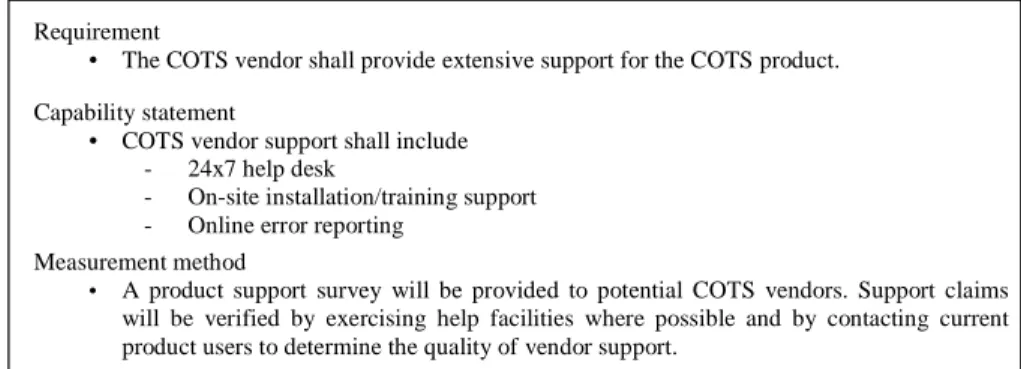
Table 4: Example of a Requirement, Capability Statement, and Measurement
Method ...27
Abstract
The growing use of commercial software products in large systems makes evaluation and selection of appropriate products an increasingly essential activity. However, many organiza-tions struggle in their attempts to select appropriate software products for use in systems. As part of a cooperative effort, the Software Engineering Institute and National Research Coun-cil Canada have defined a tailorable commercial off-the-shelf (COTS) software product evaluation process that can support organizations in making carefully reasoned and sound product decisions. The background fundamentals for that evaluation process, as well as steps and techniques to follow, are described in this report.
1 Fundamentals of COTS Software Product
Evaluations
Using commercial off-the-shelf (COTS) software products in large systems provides many bene-fits, including the potential of rapid delivery to end users, shared development costs with other customers, and the opportunity to expand capacity and performance as improvements are made in the products. For systems that depend on COTS products, the evaluation and selection of ap-propriate products is essential to the success of the entire system. Yet many organizations strug-gle during the evaluation and selection process.
1.1 COTS Products and COTS-Based Systems: Definitions
Although the meaning of COTS may seem obvious, in practice determining what is COTS and what is not can be complex. The definitions in this report are by design imprecise, since the COTS market continues to define and redefine itself.
We define a COTS product as one that is
• sold, leased, or licensed to the general public
• offered by a vendor trying to profit from it
• supported and evolved by the vendor, who retains the intellectual property rights
• available in multiple, identical copies
• used without modification of the internals
Some products are COTS-like, but, based on our definition, are not pure COTS products. Free-ware and open source products, for example, are available to the public, but no vendor is trying to profit directly from selling the product; in the case of open source, the community acts like a vendor in enhancing the product. Products that are available for sale to approved organizations or governments but not the general public are also COTS-like, as are software products devel-oped for internal uses but opportunistically offered for sale to a particular customer. The Defense Commissary Information System (DCIS) program warns against such “opportunities.” The DCIS found that a company that has not created a product with the intention of making money from it is unlikely to support and evolve that product the way normal vendors would.
The point of this definition is to capture the characteristics that most people have in mind when they say “COTS.” Deviations from this definition simply change the corresponding set of expec-tations and risks. The evaluation principles and process described herein apply equally to COTS products and those that are COTS-like.
Although our definition of a COTS product does not include products that are modified inter-nally, a particularly difficult distinction exists between tailoring and modifying a COTS product. We consider tailoring to mean changes to COTS software product functions along parameters the vendor has predetermined. We consider modification to mean changes to the internal capa-bilities of a product that are not part of the vendor’s original intent; generally, this means any change to the vendor’s source code. However, many COTS products provide only a core capa-bility, with vendor or third party support for extensive tailoring of product functions. In these cases, often only the core capability is considered COTS. In general, the degree to which the tailored capability has moved away from pure COTS is roughly indicated by the magnitude of the management, handling, and potential retrofitting of changes required when new releases of the core product are installed in the deployed system.
COTS-Based Systems
Our definition of a COTS-based system (CBS) is any system partially or completely constructed using COTS software products as integral components. This definition is primarily aimed at software systems but does not specifically exclude hardware. The term “integral” is important because it highlights the tight relationship that the COTS product has with the rest of the system. The system would not function or would be incomplete without the product.
Measures like “percent of system composed of COTS products” or even “percent of functions provided by COTS products” are not part of our definition of a COTS-based system. While these and similar concepts might be heard elsewhere, they are misleading because they fail to capture the extent to which COTS products are central to fulfilling the mission of the system. The per-centages are also difficult to measure because there is no clear basis for calculating them, and even when they can be measured, they offer little value.
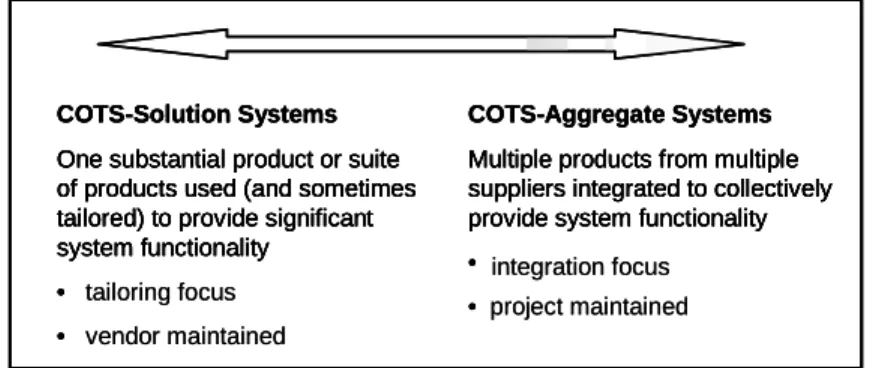
A broad spectrum of COTS-based systems exists, ranging from COTS-solution systems to COTS-aggregate systems. A COTS-solution system is a single product or suite of products, usu-ally from a single vendor, that can be tailored to provide the system’s functionality. Vendors of-fer such solutions if a consistent and well-bounded range of end-user needs exists throughout a broad community, justifying the vendors’ costs for developing the products or suites of products. Significant tailoring is required to set up and use these products, and the ability and willingness of an organization to understand and adopt the processes supported by the products are often key factors in success or failure. COTS-solution systems are commonly found in such
well-established domains as personnel management, financial management, manufacturing, payroll, and human resources. Typical software vendors in this area include PeopleSoft, Oracle, and SAP.
COTS-aggregate systems are systems in which many disparate products (from different and
sometimes competing vendors) are integrated to provide a system’s functionality. Such systems are created if operational procedures are sufficiently unique to preclude the possibility of a sin-gle COTS product solution, if the constituent technologies are immature, if the scale of the sys-tem is large enough to encompass several domains, or simply because different products provide distinct pieces of functionality to form the complete system. Systems with these characteristics include software support environments, large information systems, and command-and-control systems. Often, the COTS products and other components are combined in ways or to degrees that are unprecedented. Figure 1 shows this spectrum of COTS-based systems.
Figure 1: A Spectrum of COTS-Based Systems
1.2 Why a COTS Product Evaluation Process?
All organizations faced with the prospect of constructing major software systems from COTS products must evaluate the available commercial products to determine their suitability for use in a particular system. Yet, as we study the experiences of some of these organizations, we find one of the hard lessons of COTS product evaluation: reasonable people doing reasonable things still have problems that can be traced to the quality of their evaluation process.
One system we studied was initially conceived in the 1980s as a custom computer-based re-placement for an old supply system. However, planning for the system was overtaken by rapid changes in computing and communications technology and the system was redirected to ac-commodate a burgeoning number of interfaces with related systems. The resulting “stovepipe” system proved expensive to sustain, and a few years later the direction changed again. This time the use of a particular COTS enterprise resource planning (ERP) product was mandated without being evaluated. The selected product was incompatible with the system design and the project was ultimately cancelled.
COTS-Solution Systems One substantial product or suite of products used (and sometimes tailored) to provide significant system functionality
• tailoring focus • vendor maintained
COTS-Aggregate Systems Multiple products from multiple suppliers integrated to collectively provide system functionality • integration focus • project maintained COTS-Solution Systems
One substantial product or suite of products used (and sometimes tailored) to provide significant system functionality
• •
COTS-Aggregate Systems Multiple products from multiple suppliers integrated to collectively provide system functionality •
• COTS-Solution Systems
One substantial product or suite of products used (and sometimes tailored) to provide significant system functionality
• tailoring focus • vendor maintained
COTS-Aggregate Systems Multiple products from multiple suppliers integrated to collectively provide system functionality • integration focus • project maintained COTS-Solution Systems
One substantial product or suite of products used (and sometimes tailored) to provide significant system functionality
• •
COTS-Aggregate Systems Multiple products from multiple suppliers integrated to collectively provide system functionality •
In another system, the program office selected a product proposed by four out of seven integra-tion bidders, assuming that it meant the product represented the best soluintegra-tion.1 No independent
evaluation was performed. Many problems came to light after the system was installed. For ex-ample, end users were required to manually enter data that the legacy system handled automati-cally, and required capabilities had to be added to the product. After a few years of trying to make the product fit, the program abandoned the effort and COTS products in general and started all over again with a largely custom system.
1.2.1 Common Evaluation Mistakes
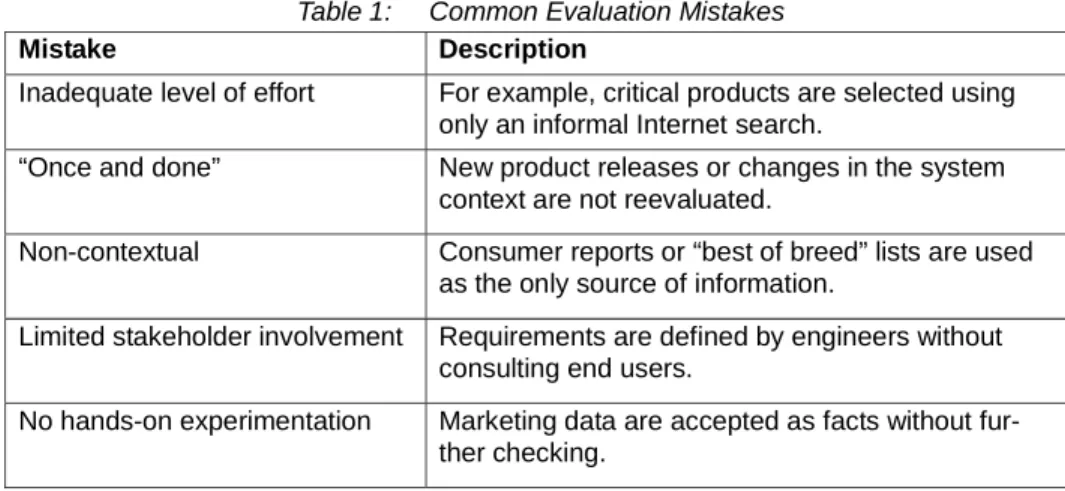
The mistakes shown in Table 1 were found to occur again and again in many of the projects we studied. It is not easy to prioritize these mistakes, since all are potentially “project killers.”
Table 1: Common Evaluation Mistakes
Mistake Description
Inadequate level of effort For example, critical products are selected using
only an informal Internet search.
“Once and done” New product releases or changes in the system
context are not reevaluated.
Non-contextual Consumer reports or “best of breed” lists are used
as the only source of information.
Limited stakeholder involvement Requirements are defined by engineers without
consulting end users.
No hands-on experimentation Marketing data are accepted as facts without
fur-ther checking.
By applying the principles and recommendations identified in this report, organizations can avoid these (and other) pitfalls and be more successful in their COTS product evaluations and their COTS-based system (CBS) development efforts. To be successful, evaluators need to
• understand the impact of COTS software products on the system development process
• determine evaluation requirements for COTS software
• develop COTS software evaluation criteria
• select COTS software evaluation techniques
• employ a COTS software evaluation process that addresses the inherent tradeoffs
1
Among the reasons that eventually came to light was that the bidders knew how much fourth genera-tion language (4GL) code would need to be written and saw an opportunity for a large amount of paid work.
1.3 What Makes Evaluations Difficult
Evaluation means different things to different people, and organizations use COTS product evaluations in different ways. For example, the type of evaluation carried out by an accountant concerned with cost will be different from one carried out by an engineer concerned with system architecture and design. Some evaluations of COTS software products are carried out by parent organizations to identify products that can be endorsed for use by their subsidiaries, while other evaluations are carried out solely to gain a feel for the marketplace.
This report focuses on COTS product evaluations conducted for the purpose of selecting prod-ucts to meet a known need in a system (that is, to select prodprod-ucts for use). To determine if a product is fit for use in a system, ask such questions as
• Does it provide adequate functionality?
• Is it capable of operating with other components?
• Can it be adapted to satisfy my needs?
• Is it appropriate for my business strategy?
Evaluation is a complex operation in which individual products are not evaluated in isolation, but in the context of intended use. Part of the evaluation must be conducted in concert with other system components, and possibly at the same time as evaluations of other COTS products that are being considered for use in the system. Determining their fitness for use involves more than just meeting technical criteria. Criteria can also include the fitness of the vendor (such as repu-tation and financial health), the technological direction of the marketplace, the expecrepu-tations placed on support staff, and a wide range of other concerns.
Evaluation is inevitably difficult. Often, COTS products must be chosen before the system archi-tecture is defined and before requirements are completely understood. Added to the difficulty of understanding the system is the inevitable conflict of interest between stakeholders. For exam-ple, while the end users typically want as much capability as they can get, software designers and engineers often prefer a simpler solution. Fortunately, evaluation helps to resolve conflicting interests while simultaneously leading to more complete system understanding.
Another complexity involves identifying and considering the interactions (both favorable and unfavorable) between products. Products often provide functions that overlap with those pro-vided by other products (such as data storage and version management). Overlapping functions can lead to conflicts when a product attempts to perform a task while other products are per-forming that same task. Normally, you cannot see how COTS products are engineered, which limits your ability to understand the assumptions embedded within the products. If these as-sumptions are not discovered by evaluators and engineers, they can prove disastrous in systems.
Unfortunately, many of the most important attributes of a product are subject to assumptions that are difficult to assess.
Evaluations are also limited by how quickly COTS products change. Many vendors release new versions of products more than once per year. If you are fortunate, new releases will not invali-date your plans for using the product. However, even with the best vendors and most stable products, unanticipated technology advances can affect product viability (consider the rapid im-pact of browser technology on the user interface).
1.3.1 COTS Product Evaluation in the COTS-Based System Context
Successful COTS product evaluation is part of a larger process of architecting, designing, build-ing, and sustaining a COTS-based system. This section places COTS product evaluation within the context of a larger process for developing COTS-based systems defined by the Carnegie Mellon Software Engineering Institute (SEI). The COTS-based system process presented here is only one of many possible. You do not need to follow this particular contextual process to make effective use of the COTS product evaluation process presented in this report. You can find details of a process framework in the SEI technical report Basics for an Assembly Process
for COTS-Based Systems (APCS) [Carney 03]. An instance of the APCS process framework can
be found in the technical report Evolutionary Process for Integrating COTS-Based Systems
(EPIC) [Albert 02].
The Fundamental Change
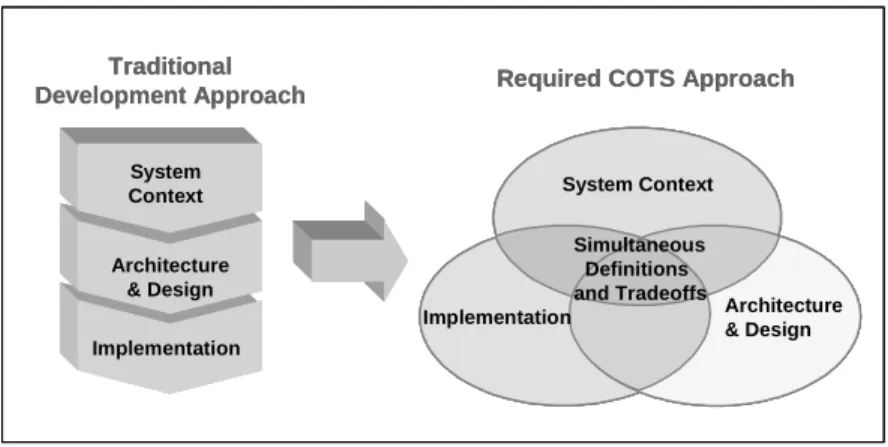
If you try to follow the traditional custom-development approach when you implement a COTS-based system, you are likely to encounter the following scenario:
• You define your requirements (taking into account your system context).
• You or your contractor defines an architecture and design to satisfy the defined require-ments.
• You or your contractor explores the marketplace to find products that will provide the func-tionality needed and fit within the defined architecture.
• You find no appropriate COTS products.
The fundamental change necessary with a COTS-based systems approach is the simultaneous exploration of the system context, potential architectures and designs, and available products in the marketplace (see Figure 2). “System context” represents requirements (functional and non-functional), end-user processes, business drivers, operational environment, constraints, policy,
cost, and schedule. “Architecture2 and design” represents the software and system architecture and design, and “marketplace” represents available and emerging COTS technology and prod-ucts, non-developmental items (NDI), and relevant standards.
Traditional
Development Approach Required COTS Approach
System Context Architecture & Design Implementation Simultaneous Definitions and Tradeoffs Implementation Architecture & Design System Context Traditional
Development Approach Required COTS Approach
System Context Architecture & Design Implementation Simultaneous Definitions and Tradeoffs System Context Architecture & Design Implementation Simultaneous Definitions and Tradeoffs Implementation Architecture & Design System Context
Figure 2: The Fundamental Change
A COTS-based approach requires a carefully reasoned selection of alternatives from among the various options and tradeoffs. Engineering activities must support this concept, and its effects permeate everything you do. As a result, the acquisition strategy, contractual activities, and busi-ness activities must all support this approach too.
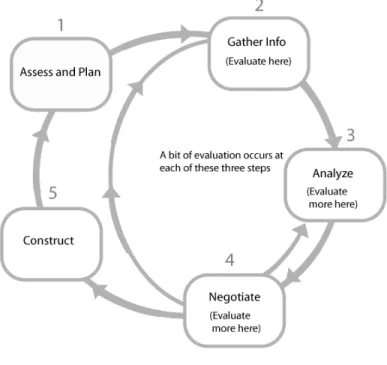
The conceptual COTS-based approach developed by the SEI is iterative. Typically you go through the process below several times, gathering more information and eliminating or adding alternatives each time, until a viable solution remains. The steps in the process are as follows: 1. Assess and plan. This step includes developing effort estimations, setting goals, identifying
stakeholders, and other typical planning activities. At the end of each iteration, accom-plishments are assessed to set the goals for the next iteration.
2. Gather information. This step includes defining requirements, learning about COTS prod-ucts, and understanding design constraints and risks.
3. Analyze. This step includes considering the entire body of knowledge that has been gath-ered about the products and the system, noting emerging compatibilities and identifying conflicts.
4. Negotiate. This step includes reaching an accepted understanding among the various parties involved in the system by resolving divergent expectations and points of contention.
2
Architecture is the structure of components, their interrelationships, and the principles and guidelines governing their design and evolution over time [Garlan 95].
5. Construct. This step includes implementing the selected solution for the current iteration. This can be any sort of model, partial implementation, or implementation subject to further analysis.
Figure 3 places COTS product evaluation within the context of this conceptual CBS process.
Figure 3: A Good CBS Process
This process is highly iterative. Expect to make multiple passes prior to defining the system to be delivered and even after system delivery. COTS product evaluation plays an important role in several steps, most obviously the “gather information” step. However, evaluation is often neces-sary during the “analyze” step to support understanding of alternatives and during the “negoti-ate” step to respond to stakeholder concerns regarding the alternatives. The overall process—and COTS product evaluation—continues for the entire system life cycle. A good evaluation is nec-essary but not sufficient for COTS-based systems success!
Building a COTS-based system is like completing a puzzle. Filling each hole in the puzzle re-quires an evaluation. The shape and size of the remaining hole changes each time a piece is added, and the choice of appropriate pieces becomes more constrained as pieces are selected. Finding the right pieces (products) to build a COTS-based system, however, is more difficult because the puzzle (the overall system) has no definite form or single solution. The shapes of the
required puzzle pieces (the needed product characteristics) also change as your understanding of the system changes. The changing nature of the COTS marketplace adds another complication: the puzzle pieces, and therefore the holes themselves, change over time.
COTS product evaluation is performed at many points in a CBS project. When a project is first starting, there are many unknowns and few constraints and commitments. At this early stage, the primary goal of evaluation is to discover information about a class of products and relate that information to the system at hand. However, as the project progresses, more decisions are made that constrain product selections. At later stages of a project, evaluation tends to involve match-ing products against well-known objectives. This journey from many unknowns to many com-mitments continues even after the system has been built.
1.3.2 Strategies for Effective Evaluation
There are six strategies that are often employed in successful evaluations. Effective Evaluators Consider the Context
Because each system is unique, it is not sufficient to select a COTS product simply because it appears on a pre-approved list of acceptable products, is in someone's opinion the best product, or worked well in the context of another system. The more closely the evaluation reflects the actual usage of a product, the more accurate it will be.
The context of an evaluation encompasses the conditions under which evaluation of a COTS product is carried out. The results of an evaluation carried out in an environment that models the system will be more trustworthy than the results of an evaluation that involves a paper exercise or faith in a product because it is generally considered to be the “best of breed.”
Remember that other COTS products form part of the system context. While this is particularly important when products are intended to work closely together, it also can be important when products are intended to work independently. As you perform evaluations and pick products and other system components, your understanding of the system context will change. By selecting one COTS product, you are sometimes making other important product decisions, because the selected product works best with (or works only with) certain other products. The set of products that are used together is called an ensemble. An ensemble should be evaluated as a unit. Effective Evaluators Account for Uncertainty
Regardless of how cautiously a COTS product evaluation is completed, the potential for error still exists. The system context might not be completely understood when the evaluation begins,
or the criteria and data gathering techniques used might be faulty. Since the potential for error cannot be eliminated, the evaluation must accommodate uncertainty.
The use of a traditional risk management approach, applied to the COTS-based system evalua-tion, can help manage such uncertainty. Possible risks must be documented and mitigation strategies outlined as appropriate.
Effective Evaluators Conduct Comprehensive Evaluations
Evaluating the functional capabilities of a product is not enough. Other factors to evaluate in-clude business aspects, vendor qualifications, quality attributes, and integration compatibility. Just as it is unwise to buy a house based solely on price or square feet, it is also unwise to select a COTS product based on a single characteristic or an overly limited number of characteristics. On the other hand, it is impractical to evaluate all the possible qualities and characteristics of complex COTS products, so a sufficient but practical set of criteria must be defined.
Defining broad and sufficient criteria, however, does not help in meeting the goal unless enough resources are committed to measure products against those criteria. Many projects fall short of their goals because they do not expend enough effort in evaluation.
Effective Evaluators Know That Evaluation Is Continuous
Evaluation is not “once and done.” Technologies advance and change. Products are upgraded. Requirements change. Most engineers know that expectations placed on systems change over time—what engineer has not bemoaned changing requirements? These factors make COTS product evaluation an important activity at many points in the system life cycle.
The back and forth nature of continuing evaluations may seem tedious for some people. If some-thing is done right the first time, why should it be repeated? The answer is that if everysome-thing is known from the start, then the evaluation can be done right the first time. If there are uncertain-ties at the start (as is almost always the case with COTS products and COTS-based systems), then it is very difficult to get all the necessary information on the first attempt. Repeating tasks as necessary is not a waste of time, since each repeated step increases the evaluators’ under-standing of the product, the system, and the evaluation activity, moving them closer to their goal. Effective Evaluators Are Guided by Facts
Opinions and impressions are useful but not sufficient. Far too often a COTS product evaluation is a mixture of unverified assumptions and hunches, which is completely unacceptable in any other engineering discipline.
The only way to achieve predictability in selecting COTS products is to base decisions on veri-fied facts. This means that evaluations must be facts-centric, as opposed to “marketing-data-centric” or “my-hunch-centric.” In the words of W. Edwards Deming, “In God we trust, all oth-ers must bring data.”
Effective Evaluators Follow a Defined Process
Whether the task is frying eggs, building ships, or evaluating COTS products, consistently good results can be achieved only by following a consistent process. This does not mean that product evaluations require a highly complex, exquisitely documented process (although sometimes they do), but it does mean that without some kind of consistent process, evaluation results will vary. A good evaluation process should be
• cost-effective, yielding maximum results with a reasonable amount of effort
• iterative, to address the evolving nature of the COTS marketplace
• inclusive of multiple criteria, so different aspects of products and systems can be addressed
• simple, to be attractive to users
1.4 The
PECA
Process
An evaluation process defined by the SEI and National Research Council Canada (NRC), called PECA (Plan, Establish, Collect, Analyze), helps organizations make carefully reasoned and sound product decisions. The process can be tailored by each organization to fit its particular needs, and is flexible enough to be used within many organizations and with many COTS-based development processes.
Although the PECA process was derived in part from ISO 14598 [ISO 99], the process was freely adapted to fit the needs of COTS software product evaluation. The process begins with initial planning for an evaluation of a COTS product (or products) and concludes with a recom-mendation to the decision maker. The decision itself is not considered part of the evaluation process—the aim of the process is to provide all of the information necessary for a decision to be made.
PECA was named for the four main activities that make up the process:
• Planning the evaluation
• Establishing the criteria
• Collecting the data
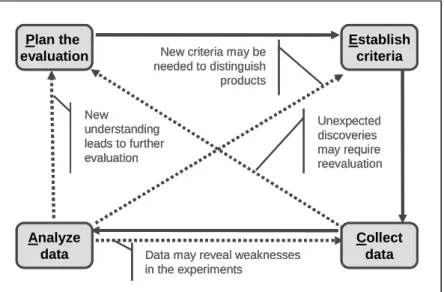
As illustrated in Figure 4, the elements in the PECA process are not always executed sequen-tially. Evaluation events, such as a need for new criteria to distinguish products, unexpected dis-coveries that lead to the start of a new iteration, or inadequacy of collected data, will direct the process flow. One of the hallmarks of the PECA process is this flexibility to accommodate the realities of based systems. The process is flexible enough to be used within many COTS-based development processes, but is particularly suited to the process described on page 7. The steps of the PECA process are explained in detail in Sections 2, 3, 4, and 5, and a summary of the PECA process can be found in Appendix A.
Plan the evaluation Establish criteria Analyze data Collect data New criteria may be
needed to distinguish products Unexpected discoveries may require reevaluation New understanding leads to further evaluation
Data may reveal weaknesses in the experiments Plan the evaluation Establish criteria Analyze data Collect data New criteria may be
needed to distinguish products Unexpected discoveries may require reevaluation New understanding leads to further evaluation
Data may reveal weaknesses in the experiments Plan the evaluation Establish criteria Analyze data Collect data New criteria may be
needed to distinguish products Unexpected discoveries may require reevaluation New understanding leads to further evaluation
Data may reveal weaknesses in the experiments
Figure 4: PECA – A Recommended Process
1.4.1 Evaluation Inputs
Two primary inputs to the process are the set of products that will be considered and the system requirements that must be met. However, system requirements alone are not sufficient for mak-ing an appropriate choice from among the products because they do not include many important characteristics of COTS products and vendors, such as underlying technology, quality of reputa-tion, and support services offered.
Also, stakeholders may have expectations and assumptions that are not fully documented in the system requirements. For example, users often expect to interact with a product in a certain way, and developers expect to be able to tailor a product in a certain way. Reengineered end-user processes might not be represented in the original requirements either. Almost inevitably, COTS software solutions require particular business processes that affect the way end-users work. For
example, using ERP packages has huge process implications. While highly tailorable, these packages inevitably impose new processes and constrain the existing processes of end users. The processes actually used by people in an organization are rarely the ones found in available documentation, so it will probably be necessary to find out what the users are really doing and why. For more information about business process reengineering—the analysis and redesign of workflow within and between enterprises—see the Electronic College of Process Innovation [DoD 04].
Evaluation Guide
The evaluation guide, which is actually both an input and an output, is where an organization captures its “know how” about performing evaluations. It describes how to perform an evalua-tion and includes descripevalua-tions of processes and techniques. Each COTS product evaluaevalua-tion adds to the organization’s knowledge about evaluation, and new information should be recorded in the evaluation guide.
1.4.2 Evaluation Outputs
The type and detail of required documentation depend on the goals of the evaluation. The main outputs of the PECA process are the product dossier, the evaluation record, and the summary with recommendations, although all evaluations do not require all of these documents. These documents are described briefly below; more detailed information can be found in Section 5.4.1, “Documenting Recommendations.”
• Product dossier. This document acts as a repository of software documentation and includes discovered facts, assessment results, classifications, and other explanatory material about a specific product. (See also Appendix B.)
• Evaluation record. This record contains a description of the evaluation process. It provides information about the steps used, including effort expended, and lists evaluators’ references and expertise. (See also Appendix C.)
• Summary/recommendation. This document includes a summary of the evaluation activity and the resulting findings, along with any messages the evaluation team wants to transmit to the decision maker.
Beneficial Side Effects of Evaluation
Documents are not the only result of evaluations, and might not even be the most important re-sults. During the evaluation, the evaluation team gains deep insights into the system impacts of using COTS products. Ideally, this insight will have a significant impact on perceptions about the system. For example, unrealistic expectations held by stakeholders should be detected, clari-fied, and negotiated. Requirement and system engineers should use this insight to refine the
sys-tem requirements. Finally, architects and integrators should apply this insight to correct design flaws and adapt the system to work in a COTS product world.
Improving Future Evaluations
Gathering data about successes and failures during a COTS product evaluation process is the best way to improve future evaluations.
• Information about cost and schedule breakdowns can improve future estimations.
• Measures of the effectiveness of criteria can aid in the generation of better criteria.
• Measures of the effectiveness of techniques for evaluating criteria can aid in the develop-ment of better evaluation approaches.
1.4.3 Introduction to Evaluation Techniques
While a good process is imperative for the consistent evaluation of COTS products, a successful evaluation relies on more than just a process. In addition, a set of techniques is needed to com-plete each step in the evaluation. While the evaluation process is a high-level description of what we need to do, techniques are low-level descriptions of how to do it.
Some steps in the PECA process require techniques that might be familiar to you. For example, requirements elicitation is a technique used to draw out stakeholders’ expectations, and Gantt charts are a technique used for scheduling [Modell 96]. Other activities require less well-known techniques: scenario-based evaluation can be used for data collection, and the analytical hierar-chical process (AHP) can be used for consolidation and analysis.
This report does not include all the techniques that exist, but instead focuses on lesser-known techniques that are more specific to COTS product evaluation. Techniques are included with the step at which we think they will be most useful, although many of the techniques can be used in other steps of the evaluation process as well.
2 Planning the Evaluation
The first step in the PECA process is planning the evaluation. Planning for each COTS product evaluation is different because the evaluation may involve different types of products (from sim-ple to extremely comsim-plex) and different system expectations placed on the product (from trivial to highly demanding). Tasks that might be completed during this step include forming the evaluation team, creating a charter, identifying stakeholders, and picking the approach.
2.1 Forming
Evaluation
Teams
The importance of an effective evaluation team should not be underestimated, since without an effective team, an evaluation cannot succeed. We have unfortunately seen situations where the most junior engineer, with little support from anyone else, was assigned to evaluate products. A lone engineer does not usually have the range of skills necessary to perform a broad-based COTS product evaluation. A good balance of power is also important for a good team. In one situation we observed, the most senior employee (the company president) sat on the evaluation team and biased the results toward his or her preference.
An evaluation team should include people with diverse skills, such as
• technical experts • domain experts • contracts personnel • business analysts • security professionals • maintenance staff • end users
2.2 Creating the Charter
Some very general questions should be answered before an evaluation task begins. These ques-tions include
• What are the attributes of the evaluation team? Do they have decision authority?
• What are the responsibilities of each member of the team?
• In what ways is the system context flexible?
• How will the evaluation team measure success?
• When should the evaluation finish?
• What constraints must the evaluation team adhere to?
Often, this basic information is not documented, even though the slightest misunderstanding can doom a project. Moreover, people tend to be more productive when they have a clear picture of the ultimate goals of the project. A charter, created by the evaluation team to define the scope and constraints of the evaluation, can record the answers to these questions. The charter should contain
• goals of the evaluation
• scope of the evaluation
• names of team members and their roles
• statement of commitment from both evaluators and management
• summary of factors that limit selection
• summary of decisions that have already been made
2.2.1 Creating the Charter: Example
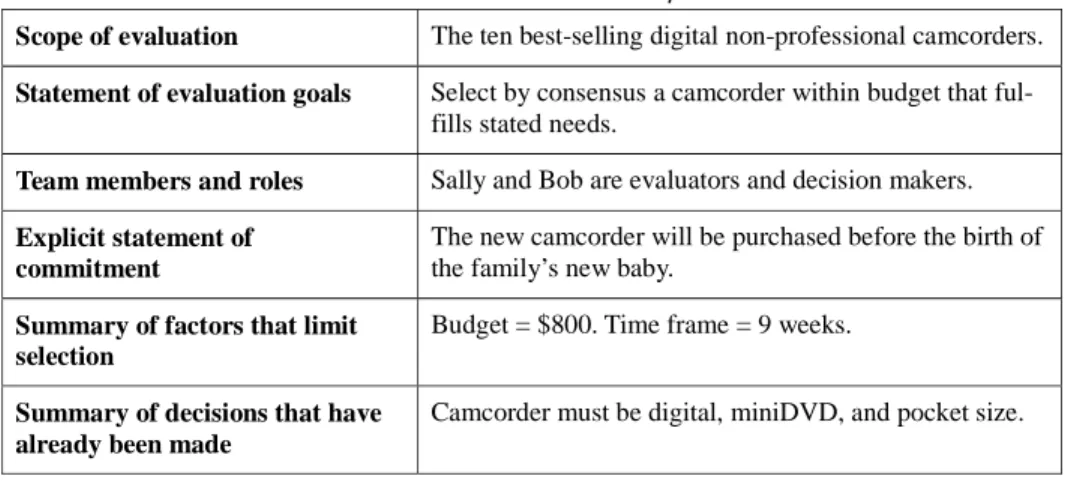
An example of a simple charter is shown in Table 2. A family might create a charter like this when selecting a new camcorder.
Table 2: Charter Example
Scope of evaluation The ten best-selling digital non-professional camcorders. Statement of evaluation goals Select by consensus a camcorder within budget that
ful-fills stated needs.
Team members and roles Sally and Bob are evaluators and decision makers. Explicit statement of
commitment
The new camcorder will be purchased before the birth of the family’s new baby.
Summary of factors that limit selection
Budget = $800. Time frame = 9 weeks. Summary of decisions that have
already been made
2.3 Identifying
Stakeholders
Evaluation stakeholders are individuals or groups with a vested interest in the results of a COTS product evaluation, including all individuals or groups that will be affected by the selection of a particular COTS product in a significant way.
While there are no rules for identifying evaluation stakeholders, errors of inclusion (including additional individuals or groups) are less risky than errors of exclusion (omitting legitimate stakeholders), since errors of exclusion can lead to rejection of the system. Errors of inclusion, however, may make it harder to identify an appropriate COTS product because more people must agree. Practical experience suggests that the main stakeholder group should be limited to approximately seven or eight individuals. If there is a larger number of stakeholders, multiple sessions and management of various groups may be necessary.
Potential stakeholders include
• end users • system administrators • operators • maintainers • integrators • architects • sponsors • program managers • vendors
The stakeholders for a particular evaluation might not be a subset of the stakeholders identified for the entire system, since the concerns and expectations relevant to a specific component, COTS product, and vendor are often different from the concerns and documented expectations for the whole system.
2.4 Picking
the
Approach
During the planning stage, the basic characteristics of the evaluation activity are determined. Some of the parameters of the approach selected include the depth or rigor of the evaluation, the basic strategy for selection, and the filters needed to reduce the number of candidate products.
2.4.1 Depth of the Evaluation
Different situations demand deeper or more superficial evaluations. Some situations require an extremely rigorous evaluation of COTS products; in other situations, an inappropriate product selection carries little risk. Two factors help determine the depth:
• complexity of the evaluation. How likely is it the wrong product will be selected?
• risk of failure. What would be the system impact of making the wrong selection? For exam-ple, would it involve significant financial or environmental damage?
If the COTS product being considered will have relatively low technical risk for the system and little involvement with strategic or critical end-user processes, the focus of the evaluation can be on cost and the speed of implementation. A set of low-impact COTS product evaluation criteria can be established and reused (with appropriate tailoring) for all of an organization’s COTS products and systems that share these characteristics. The product can then be selected based on an informed decision—for example, a decision made after conducting unstructured product re-search, such as reading marketing brochures.
If the COTS product will have a pervasive impact on the system or support strategic or critical business processes, it should be chosen using a methodic selection process, which is preferred in most situations. The PECA process is a good example of a methodic selection process.
If the COTS product could cause the entire business to fail if not executed properly, then a
mathematically formal methodology should theoretically be used to select the product. In reality,
however, this approach is viable only in a limited number of situations and is difficult to use. 2.4.2 First Fit vs. Best Fit
You must also decide whether you will choose the first product you evaluate that satisfies your needs or if you will consider the entire group of products before making a selection.
First fit can be applied at any level of evaluation rigor and should be used when the goal is
sim-ply to fulfill a minimum set of needs—when additional “goodness” of a product is unimportant or it is not cost effective to evaluate to determine additional goodness. First fit considers mini-mum requirements and answers the question “Is it good enough?” This does not imply that the criteria by which products are assessed are any less complete. Although the first adequate candi-date is selected without comparison to other candicandi-dates’ capabilities, all requirements must still be met.
Best fit should be used when there is an appreciable gain in getting more than the minimal
amount of some characteristic. For example, in many situations a minimum performance is specified, but better performance adds significant value to a product within the context of the system. Best fit is also the approach to use in situations where no product has all the capabilities being sought in a particular evaluation. Best fit answers the question “How good is it?” 2.4.3 Using Filters
Sometimes it is not reasonable to perform a thorough evaluation on all candidate products be-cause the number of candidates is too large. The goal of filtering is to narrow the range of prod-ucts that must be further evaluated by developing progressively more selective filters. By start-ing with a coarse filter that is easy and cheap to use, products that are a poor fit can be eliminated quickly. The remaining products can be evaluated using increasingly discriminating filters. Using this process, the most complex and expensive filters will be used on the smallest number of products.
Filters that focus on easily measured criteria can provide a useful mechanism for winnowing the list of products under consideration. Product price is a coarse filter focusing on easily measured criteria. Market share is another. As the number of candidates to consider is reduced, filters may become increasingly discriminating and complex. A complex filter may involve building a test harness for multiple products to determine which products respond to erroneous inputs in the manner most appropriate for the system.
2.4.4 Picking the Approach: Example
In the example introduced earlier of a camcorder purchase, some issues that might influence the depth of the evaluation include the following:
• A camcorder is an important, long-term investment.
• Buying a “lemon” has an important risk associated: the family might stop using the camcor-der, and the investment would be lost.
• The family has no particular expertise in camcorders.
Because of these concerns, the camcorder should be chosen using a methodical selection proc-ess. Although a camcorder could easily be selected at random from a store display, a camcorder is a large, important investment, which makes its selection an important decision that requires careful evaluation.
The approach chosen should follow these steps:
• Reduce the number of camcorders to three or four (filtering).
• Try each of those camcorders to find the best (best fit).
2.5 Estimating Resources and Schedule
Expert opinion, analogy, decomposition, and cost modeling are classic and well understood techniques used for cost evaluation in engineering disciplines. Unfortunately, there are few tech-niques available specifically for estimating resources and schedules for COTS product evalua-tions. The Constructive COTS Model (COCOTS) is one of the few attempts to specifically ad-dress the costs associated with building a COTS-based system [Abts 97]. The technique does not separately address the costs associated with COTS product evaluation, however. An earned value management approach can be used in an evaluation context; an example is given in Using EVMS
with COTS-Based Systems [Staley 01].
Some factors that may affect cost estimation include the following:
• level of rigor and risk involved. In general, the more rigorous the evaluation, the greater the short-term cost. However, rigorous evaluations may lower long-term costs in building the system because data obtained during the evaluation effort is useful during system archi-tecting, design, and integration. In addition, a rigorous evaluation may head off the greatest cost of all: a failed system.
• number of candidates being evaluated. The more candidates evaluated, the higher the overall cost.
• evaluators’ levels of experience. Evaluation costs are often higher when evaluations are per-formed by more experienced evaluators because they tend to perform more rigorous evalua-tions. However, use of experienced evaluators can be expected to reduce costs down the road.
In general, the resources commonly allocated to COTS product evaluation are insufficient. This is particularly the case for COTS products that are at the core of complex systems.
3 Establishing Criteria
Evaluation criteria are the facts or standards by which the fitness of products is judged. Perhaps the most critical step in the entire COTS evaluation process is establishing appropriate criteria. The criteria selected will determine whether you ask the right questions regarding the viability of the product in your system. This chapter provides a simple three-step process, recommenda-tions, and techniques for transforming a set of requirements into a set of product evaluation cri-teria that can be applied in a COTS product evaluation and selection process. The three steps are 1. Define evaluation requirements.
2. Define evaluation criteria. 3. Prioritize criteria.
These steps are defined in detail below.
3.1 Requirements
vs.
Criteria
The starting point for virtually all software development efforts is a set of requirements that rep-resent at some level the expectations of those that have a stake in the system. If the organization is considering the use of COTS products as system components, it is natural and appropriate to look first to these requirements as a basis for evaluating and selecting the right products. Unfor-tunately, for some organizations, an initial focus on system requirements leads them to believe that generating the actual criteria for COTS evaluation is trivial—each requirement is directly transformed into a criterion. However, our experience suggests that this simple transformation is not likely to achieve the desired result—selection of an appropriate COTS product—because of the following:
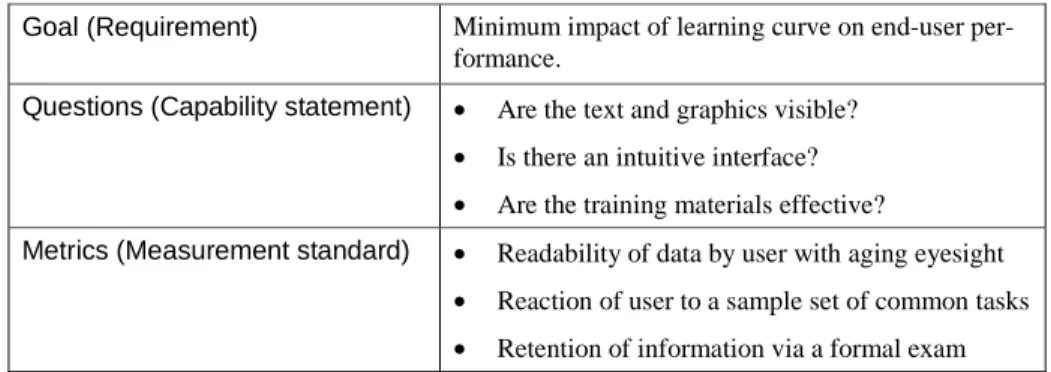
• System requirements are normally written at an abstract level in order to allow sufficient flexibility for choosing multiple technical solutions. Unfortunately, criteria derived directly from such requirements are too abstract to serve as a way of evaluating products. For exam-ple, a requirement such as “The system shall be easy to use” is too abstract to judge whether a product is or is not easy to use. A less abstract and more useful requirement might be “The system follows the Windows interface standard” or “The learning curve for the system shall not exceed two weeks.”
• System requirements are stated in terms of needs, whereas criteria should be stated in terms of capabilities to satisfy those needs. For example, a requirement such as “Information trans-fer shall be protected from unauthorized access” might be transformed into a criterion such
as “Support for secure sockets or equivalent security mechanism,” which is the expected concrete capability.
• Criteria should be obviously measurable, whereas system requirements are often stated in a manner such that it is not immediately obvious how to measure them. Criteria should in-clude the way in which the expected capability is to be determined in order to facilitate the evaluation process. Such a criterion might be “System will accurately process 500 transac-tions an hour. This will be verified using a performance testing tool.”
• System requirements tend to be incomplete, hardly ever stating every expectation placed on a COTS product. Often qualities of the component other than required functionality are overlooked. For example, a system requirement regarding the level of effort necessary to apply appropriate tailoring to new releases of a product is rare.
3.2 Defining Evaluation Requirements
Because the expectations placed on a COTS product are not just a subset of the system require-ments, the first step in defining evaluation criteria is to establish evaluation requirements. Be-cause COTS products rarely align exactly with anticipated system functions (some products combine functions, use different vocabularies, etc.), the mapping between product functions and system functional requirements may not be obvious or straightforward. In addition, COTS products add an entirely new class of concerns regarding licenses, testing, rapid deployment, and control of the content of upgrades that are often not addressed by system requirements.
3.2.1 Sources of Evaluation Requirements
There are many sources of legitimate evaluation requirements that are derived from the context in which a COTS product will execute but are not always addressed by system requirements. These sources include
• Architecture/interface constraints: COTS product decisions are often constrained by other decisions that have already been made. These constraints become evaluation requirements when choosing a COTS product. For example, if a decision has been made to use a certain middleware mechanism, it makes little sense to buy a product that is clearly going to conflict with this technology.
• Programmatic constraints: Time, money, available expertise, and many other programmatic factors may be sources of evaluation requirements that are not captured in system functional requirements. For example, availability of trained staff adept at using a product can be a useful criterion when choosing products, but is not likely to appear in system requirements.
• Operational environment: Not all aspects of the operational environment are included as sys-tem requirements. For example, information about the organization that will perform main-tenance on the system is frequently omitted. Thus, the operational environment may be a source of additional evaluation requirements.
• Stakeholder expectations: People place additional expectations on products that are not clear from system requirements. For example, users may have a strong preference about the style of the user interface to a product. These expectations are often not captured in system
re-quirements, in part because it is assumed that the user interface can be tailored to expecta-tions. However, the user interface of a COTS product is not as flexible as that provided by custom code. Therefore, it is more important to determine the acceptability of the interface. All of the previously listed sources are specific to the system under construction. There are also a number of sources that provide lists of potential evaluation requirements that are not system specific.3 These sources can provide insight into a diverse range of COTS product and vendor characteristics, but no requirement identified from these sources should be used without careful consideration of relevance to the situation at hand. Sources of non-specific requirements include
• product feature checklists
• organizational checklists
• previous evaluations for other systems
• marketplace
Product feature checklists are a standard fare for product comparisons. While they are only as reliable as the source, they are widely used—and misused—in COTS software evaluation. The basic capability provided by a product feature checklist is an itemized list of the features of a class of products. This list is often used as a basis for comparing different products.
In some market segments, organizations have formed a niche market by identifying a set of gen-erally preferred features and characteristics and evaluating products against this set. The most notable example of this approach is Consumer Reports, which monthly evaluates consumer items and provides recommendations for preferred products [Consumer 00]. However, in the COTS software domain, the context in which the software will be used is not nearly as consis-tent as the various contexts for which Consumer Reports makes recommendations. Thus, an effective Consumer Reports for the COTS product marketplace does not exist today and is not likely in the near term.
Some firms, however, regularly assess products that make up particular market segments; exam-ples of these are Gartner and Ovum [Gartner 98, Ovum 00]. In addition, trade magazines often publish product feature checklists. One should guard against accepting at face value product feature checklists that appear in trade magazines. These are sometimes produced by vendors specifically to present their product in the best light or to highlight some feature that distin-guishes their product from those of competitors. It is also important to keep in mind that no ge-neric list can reflect all of the requirements that need to be considered—a gege-neric list will in-clude some features that are irrelevant for the system and other important features will be missed. These lists should not be used as the only evaluation requirements for COTS products.
3
ISO 14598 includes the concept of “evaluation modules” that are reusable packages containing re-quirements and other data about an evaluation. In theory, these modules can be reused in different settings. This approach is similar to the reuse of evaluation requirements described here.
Other sources of “reusable” evaluation requirements are organizational checklists that represent a consistent way to ensure that corporate interests are addressed in the evaluation and selection of COTS products. Organization checklists may maintain relevant information about corporate policies, preferred architectures, and expected engineering practices and can provide some uni-formity and predictability in selecting products.
In general, corporate need for such checklists is not driven solely by technical considerations: many other concerns are reflected as well, such as legal considerations (e.g., “due diligence” in managing financial assets) and issues of scale (many organizations, many projects, many evalua-tors). Table 3 identifies the categories of criteria covered in an organizational checklist built by a large aerospace contractor. Appendix E provides a larger compendium of several lists we’ve encountered. In addition to the requirements covered in these categories, the actual checklist provides a 70-step process for evaluation and selection.
Table 3: Example of an Organizational Checklist Organizational Checklist for COTS Products Compatibility with other COTS products in use Adaptability, flexibility, reliability, maintainability Impact on system integrity
Impact on system integration Vendor support
Training Documentation Licenses
Evaluations that the members of the team (or the wider organization) have performed for similar purposes are also sources of evaluation requirements. While these requirements are likely to re-flect some of the context-specific nature required, it is a mistake to consider them equally appro-priate for the new evaluation context as they were for the old. This mistake is reflected in state-ments such as: “We looked at Product X before and it was pretty good. It will be good for the new system also.” A variant of this problem is represented by selecting “pre-approved” products from a product list without further analysis. In essence, such choices indicate that the require-ments for COTS products in “this” system are sufficiently close to that of a “benchmark” system and therefore no product evaluation process is warranted—a very bold and risky position. Finally, a source for evaluation requirements is the marketplace itself. Risk-Driven Generation is a technique that looks at what the COTS marketplace can offer and focuses on the risk
intro-duced by or reintro-duced by product and vendor features4 [Wallnau 01]. This approach derives a set of potential evaluation requirements from the features of products rather than from system re-quirements. This set of requirements is pruned by analyzing the risk to the system should the product provide or not provide a particular feature. The steps involved in Risk-Driven Genera-tion are straightforward:
1. Identify interesting product features.
2. Assert risk to the system of a product not exhibiting a feature. 3. Categorize and quantify risk (optional).
4. Identify mitigations (optional).
The overall effect is that expectations regarding system needs are “adjusted” to agree with prod-uct capabilities. By focusing on risk, the approach also helps to combat “gold plating” of re-quirements and “featuritis.” If little or no risk results from absence of a product feature, then the feature is not required of products under consideration. Note that this approach may also gener-ate negative requirements—features that the product should not have.
3.2.2 Classes of Evaluation Requirements
A problem when evaluating COTS products is to treat the majority of requirements as providing no leeway for negotiation. Stakeholders are the common source of this problem because they are most familiar and comfortable with the end-user processes, user interfaces, and capabilities provided by existing systems and have high expectations that the new system will provide all of these plus the latest “whizz-bang” technologies. This is almost inevitably a mistake because virtually all COTS products are compromises suited to multiple organizations and will very probably work in a way that is different from the way to which stakeholders have grown accus-tomed. In the most severe case, this approach will render all COTS products unacceptable, since none can meet the expectations and specifications5 desired by users. If the organization is com-mitted to using COTS products, it should strive for achieving sufficient flexibility in require-ments.
In reality, identified evaluation requirements will fall in one of two general classes or categories: 1. Hard requirements that are mandatory—if the product does not meet these requirements,
then the product or the system must be augmented in some way or the product is unsuitable. The augmentation could take the form of external custom code that handles functionality
4 The Risk-Driven Generation approach identified in Building Systems from Commercial Components by Wallnau et al.
refers to criteria. However, the use of the term criteria in the document is consistent with our use of the term requirement.
5
the COTS product does not provide or the selection of another product that provides the missing capability.
2. Negotiable requirements that are flexible—if a product does not demonstrate the preferred
characteristic, then it is not automatically excluded. The options in this case are to adjust the requirement to some degree or to tailor the product or the other components in the sys-tem to address the requirement.
We expect that the majority of requirements fall somewhere towards the center of a spectrum between totally inflexible and completely flexible, where there is some room for negotiation but in the end the requirement (or some version of it) must somehow be met. In many cases, the implementation expressed by the COTS product, though it may not completely match the origi-nal need, will be an acceptable requirement. This has even been shown in several cases involv-ing requirements that were thought to be controlled by legislative mandate (laws). In these cases, the driving force behind the requirement was the "traditional" approach of manual proc-esses or legacy systems, rather than the actual letter of the law. Several state and federal organi-zations have suggested to the SEI that many laws have more leeway than people who have grown accustomed to current procedures tend to believe. In all cases, the organization should carefully research any perceived legislative mandates to determine whether the letter of the law (rather than some traditional interpretation) is the limiting factor.
Errors Compiling Evaluation Requirements
There are two types of errors that can occur when compiling evaluation requirements: errors of inclusion and errors of exclusion. Errors of inclusion are caused when non-applicable require-ments are included in the evaluation requirement set. Errors of inclusion have two unfortunate effects. First, they tend to reduce the total amount of time and effort that is focused on the evaluation of the product against necessary and important requirements. Thus, the organization may focus its evaluation efforts on determining whether a product supports a feature of ques-tionable value, while spending less effort determining whether a product’s vendor can appropri-ately support the product in a certain context. Second, errors of inclusion can eliminate suitable COTS products simply because they do not support the unnecessary and unimportant “require-ment.” Perhaps the best example of an error of inclusion is the tendency to want every “cool” capability—even if the capability does not add any appreciable value in the present context. A good technique to combat this tendency is to consider the risk to the system mission should the feature be absent or provided in a different manner (e.g., risk-driven requirements generation, as covered in Section 3.2.1, pages 24-25). If there is no risk or it is minimal, then the requirement may be unnecessary.
Errors of exclusion involve omitting evaluation requirements that are crucial to the fitness of the product and vendor within the system context. The main danger of errors of exclusion is that they can lead to the selection of an unsuitable product. For example, neglecting to consider the vendor’s ability to support a product within a certain context may lead to the selection of an