Revision
Revision
of
of
calculations
calculations
Stoichiometric
Stoichiometric calculations
calculations
Osmotic
Osmotic
pressure
pressure
and
and
osmolarity
osmolarit
y
MUDr. Jan Pláteník, PhD
Concentration of a solution
Concentration of a solution
• mass concentration: grams of substance per
litre of solution
• molar concentration: moles of substance per
litre of solution
• in %:
–
% (w/v):
weight per volume, grams of
substance per 100 ml of solution
–
% (v/v)
volume per volume, ml of substance
per 100 ml of solution
Molar Volume
Molar Volume
one mole of any gaseous substance occupies
the same volume at the same temperature
and pressure
..22.414 litres at 101.325 kPa, 0 °C (273.15 K)
(Avogadro’s Law)
P . V = n . R . T
P . V = n . R . T
P: pressure in kPa
V: volume in dm
3(l)
n: number of moles
R: universal gas constant (8.31441 N.m.mol
-1.K
-1)
T: temperature in K
Example: what is volume of one mole of gas at
101.325 kPa and 25 °C ?
P.V = n.R.T
n.R.T 1 x 8.31441 x (273.15+25) V = —————— = ———————————— =
P 101.325
= 24.465 dm3
Conversions between mass and
Conversions between mass and
molarity: Summary
molarity: Summary
•
Always distinguish between amount of
substance in moles (grams) and
concentration of substance in mol/l (g/l)
•
For conversion from mass to molarity
divide the mass (g or g/l) with molar mass
(relative AW/MW/FW)
•
For conversion from molarity to mass
multiply the molarity (mol or mol/l) with
molar mass (relative AW/MW/FW)
Conversion from mass to molar
Conversion from mass to molar
Example: Calculate molar concentration of Na2HPO4 solution c = 21 g /l.
(AW of Na: 23, P: 31, O: 16, H: 1)
FW of Na2HPO4 : 46+1+31+4x16 = 142
Molar concentration = Mass conc. (g/l) / FW = 21 / 142 =0.15 mol/l
Conversion from molar to mass
Conversion from molar to mass
Example: Calculate how many g of KClO4is needed for preparation of 250 ml of 0.1 M solution.
(AW of K: 39, Cl: 35.4, O: 16)
FW of KClO4: 39 + 35.4 + 4x16 = 138.4 Mass conc. = molar conc. x FW
Conversion from
Conversion from
% to
% to
molar
molar
ity
ity
Example: The physiological saline is NaCl 0.9 % (w/v) What is molar concentration of NaCl in this solution? (AW of Na: 23, Cl: 35.5)
FW of NaCl : 23+35.45 = 58.5
0.9 % (w/v) is 0.9 g/100 ml = Mass conc. 9 g/l Molar concentration = Mass conc. (g/l) / FW
= 9/58.5 =0.154 mol/l
Calculations with molar volume
Calculations with molar volume
Example: What is weight (in grams) of 1 liter of oxygen at atmospheric pressure and ambient temperature ?(AW of O: 16)
Molar volume at 101.325 kPa and 25 °C: 24.5 l/mol 1 liter of oxygen is 1/24.5 = 0.040816 mol
Diluting solutions
Diluting solutions
Example: You need to prepare 1 liter of 0.1 M HCl. How many ml of concentrated HCl (12 M) do you need to take ?
c
1. v
1= c
2. v
212 x v
1= 0.1 x 1000
v
1= 100/12 =
8.33 ml
What
What
is
is
molarity
molarity
of
of
pure
pure
water
water
?
?
Molar concentration: moles of
substance per liter of solution
1 liter of water weighs 997 g at 25 °C
FW of H
2O: 2+16=18
997 g H
2O is 997/18 = 55.4 moles
Stoichiometric
Stoichiometric
calculations
calculations
Titration calculations
Titration calculations
Example: An unknown sample of sulfuric acid H2SO4was titrated with the known KOH solution. It was found that 12 mL of the KOH c=0.1 mol/L was needed for just complete neutralisation of 10 mL H2SO4unknown sample.
What is concentration of sulfuric acid in the sample?
Equation: H2SO4 + 2 KOH → K2SO4 + 2 H2O
Calculation: H2SO4 KOH c1. v1 = c2. v2 c1 = c2. v2/ v1
c1 = 0.1 . 12 / 10 = 0.12 Including stoichiometry : c(H2SO4) = 0.12/2 = 0.06 mol/L
Stoichiometric calculations
Stoichiometric calculations
Example: In the reaction between barium nitrate and sodium sulfate, how many grams of barium sulfate can be prepared from 10 ml of 10 % (w/v) barium nitrate? Take into account that about 5% of the product is lost.
(AW of barium: 137.3, sulfur: 32.1, nitrogen: 14.0, oxygen: 16.0)
equation: Ba(NO3)2 + Na2SO4 → BaSO
4 + 2NaNO3
FW Ba(NO3)2: 261.3 FW BaSO4: 233.4
10 ml of 10% (w/v) Ba(NO3)2: 1 g ... 1/261.3 = 0.003827 moles amount of BaSO4 formed: 0.003827 moles ....
... 0.003827 x 233.4 = 0.8932 g (theoretical yield, 100%) Actual yield: 0.8932 x 0.95 = 0.849 g
Stoichiometric calculations
Stoichiometric calculations
Example II: Propane gas burns on air to water and carbon dioxide: CH3CH2CH3(g) + O2(g) → H2O(g) + CO2(g)
Balance the equation and then calculate how many grams of water and carbon dioxide will result from burning of 10 liters of propane gas (molar volume at 25 °C and atmospheric pressure: 24.465 l/mol )
Balanced equation:
CH3CH2CH3(g) + 5O2(g) → 4H2O(g) + 3CO2(g) 10 l ? (MW: 18) ? (MW: 44) 10 l of propane: 0.4087 moles
... →1.635 mol H2O = 29.4 g ... →1.226 mol CO2= 53.9 g
Stoichiometric calculations
Stoichiometric calculations
Example III: Solid lithium hydroxide is used in space shuttles to remove exhaled carbon dioxide from the living environment:
2LiOH(s) + CO2(g) → Li2CO3(g) + H2O(l)
Imagine that you are planning a space mission of two astronauts for 72 hours. One astronaut will produce 250 ml of CO2per minute at rest. How many kg of solid lithium hydroxide are needed for the mission? (AW Li: 6.941, molar volume 24.465 L/mol)
CO2production: 0.25 L ×60 ×72 ×2 = 2160 L (88.3 mol)
2 ×88.3 mol LiOH needed: 176.6 mol
FW LiOH: 6.941 + 17 = 23.941 176.6 mol LiOH is 4228 g = ~ 4.23 kg
Osmolarity
Osmolarity
Osmotic
Osmolarity
Osmolarity
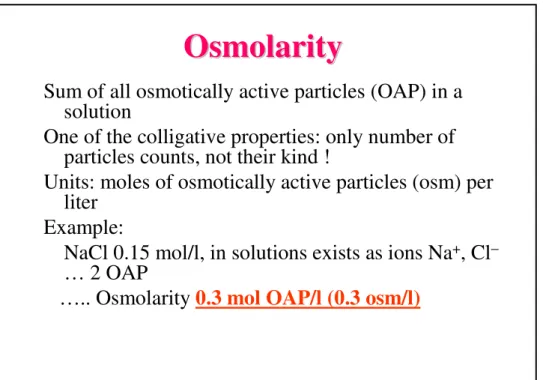
Sum of all osmotically active particles (OAP) in a
solution
One of the colligative properties: only number of
particles counts, not their kind !
Units: moles of osmotically active particles (osm) per
liter
Example:
NaCl 0.15 mol/l, in solutions exists as ions Na
+, Cl
−… 2 OAP
….. Osmolarity
0.3 mol OAP/l (0.3 osm/l)
Osmotic
Osmotic
pressure
pressure
Π
Π
= n .
= n .
C .
C .
R . T
R . T
Figure from: http://www.bbc.co.uk/dna/h2g2/A686766
Π: osmotic pressure in kPa n: number of OAP per mole C: molar concentration in mol/l R: universal gas constant (8.31441 N.m.mol-1.K-1)
T: temperature in K
Osmolarity
Osmolarity
Osmolarity
is
is
important
important
in medicine
in
medicine
• Isotonic: osmolarity = 0.3 osm/l (NaCl 0.15 mol/l)
• Hypotonic: osmolarity < 0.3 osm/l
• Hypertonic: osmolarity > 0.3 osm/l
Figure from:Wikipedia
Calculations of
Calculations of
osmolarity
osmolarity
/osmotic pressure
/osmotic pressure
Example I: Calculate osmolarity of Na2HPO4solution of c = 21 g /l.
(AW of Na: 23, P: 31, O: 16, H: 1) FW of Na2HPO4 : 46+1+31+4x16 = 142
Molar concentration = Mass conc. (g/l) / FW = 21 / 142 = 0.15 mol/l 3 OAP: 2x Na+, 1x HPO
4
Calculations of
Calculations of
osmolarity
osmolarity
/osmotic pressure
/osmotic pressure
Example II: Calculate osmotic pressure of Na2HPO4solution of c = 21 g /l at 37 °°°°C.
(AW of Na: 23, P: 31, O: 16, H: 1; R = 8.31441 N.m.mol-1.K-1) FW of Na2HPO4 : 46+1+31+4x16 = 142
Molar concentration = Mass conc. (g/l) / FW = 21 / 142 = 0.15 mol/l 3 OAP: 2x Na+, 1x HPO
4
2-Osmolarity: 0.15 x 3 = 0.45 mol OAP/l Osmotic pressure: Π= n . C . R . T
Π=3 x 3 x 0.15 x 8.31441 x (273.15 + 37) = 1160 kPa (hypertonic)
Calculations of
Calculations of
osmolarity
osmolarity
/osmotic pressure
/osmotic pressure
Example III: 0.2 M KCl solution is combined with an equal volume of 0.5 M glucose solution.
What is the resulting osmolarity? After mixing:
KCl:
c= 0.1 mol/l, 2 OAP: contribution to osmolarity 0.2 mol/l Glucose:
c=0.25 mol/l, 1 OAP: contribution to osmolarity 0.25 mol/l