CMOS Differential Amplifier
1. Current Equations of Differential Amplifier
VDD
VSS VC VSS VSS
ISS
VG1 VG2
VGS2 VGS1
ID1 ID2
(a)
+
+ +
+
E+=VID/2
E-=-VID/2 (1)
(10)
(2) VG1
VG2 VIC
VID (7)
(b)
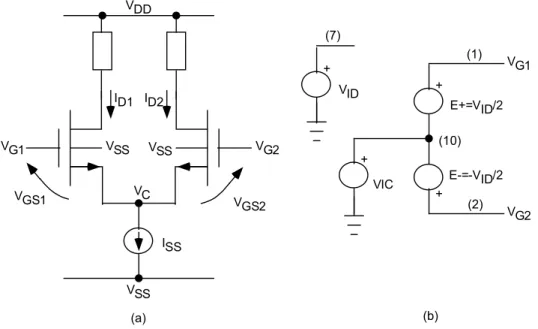
Figure 1. General MOS Differential Amplifier: (a) Schematic Diagram, (b) Input Gate Voltages Implementation.
Figure 1(a) shows the schematic diagram of a typical differential amplifier. The differential input is given by:
)
V
V
(
)
V
V
(
V
V
V
ID=
G1−
G2=
GS1+
C−
GS2+
C --(1)2 D2 1
D1 TN
GS2 TN
GS1 GS2
GS1 ID
I
2
I
2
)
V
V
(
)
V
V
(
V
V
V
β
β
−
=
−
−
−
=
−
=
--(2)The common-mode input signal is given by:
2
V
V
V
G1 G2IC
+
=
--(3)The input voltages in term of VID and VIC are given by
2
/
V
V
V
G1=
IC+
ID --(4)2
/
V
V
Figure 1(b) shows the implementation of the 2 gate voltages in terms of the differential and common mode voltages. Its PSpice implementation using voltage controlled voltage source is given below:
VID 7 0 DC 0V E+ 1 10 7 0 0.5 E- 2 10 7 0 -0.5 VIC 10 0 DC 0V
Two special cases of input gate signals are of interests : pure differential and pure common mode input signals. Pure differential input signals mean VIC=0, from equation (4) and (5);
2
/
V
V
2
/
V
V
ID G2
ID G1
−
=
=
This case is of interest when studying the differential gain of differential amplifier, see Figure 2(a). Pure common-mode input signals mean VID=0, from equation (4) and (5);
IC G2
IC G1
V
V
V
V
=
=
This case is of interest when studying the common-mode gain of differential amplifier, see Figure 5(a). Assume both transistor drivers are matched, that is:
β
β
β
1=
2=
β
β
D1 D2ID
I
2
I
2
V
=
−
--(6)D2 D1
ID
I
I
V
2
/
=
−
β
--(7)The transistor currents satisfy the following equations: D2
D1
SS
I
I
I
=
+
--(8)D2 D1
OD
I
I
I
=
−
--(9)
2
/
)
I
I
(
I
D1=
SS+
OD --(10)2
/
)
I
I
(
I
D2=
SS−
OD --(11)Substituting Eq(10) and Eq(11) to Eq(7)
2
/
)
I
I
(
2
/
)
I
I
(
V
2
/
ID=
SS+
OD−
SS−
ODNormalizing by ISS
)
I
I
1
I
I
1
(
V
I
SSOD SS
OD ID
SS
−
−
+
=
β
--(13) To simplify the equation, let
SS OD ID
SS
I
I
=
y
and
,
V
I
=
x
β
--(14)The equation reduces to:
y
-1
y
+
1
=
x
−
Solve for y,
2 2
(
1
y)
-
2
(
1
y)
(
1
y)
(
1
y)
=
2
-
2
1
-
y
x
=
+
+
−
+
−
2
x
1
y
1
2 2
=
−
−
4
x
x
1
y
1
−
2=
−
2+
4)
4
x
1
(
x
y
2 2
2
=
−
The result is:
1
|
2
x
|
provided
,
4
x
-1
x
=
y
2
≤
--(15)Substituting for x and y, one obtains
4
I
V
1
V
I
I
I
SS 2 ID ID
SS SS
OD
=
β
−
β
--(16)2 SS
4 ID SS
2 ID SS OD
4I
V
I
V
I
I
=
β
−
β
--(17)2 SS
4 ID SS
2 ID SS SS
D1
4I
V
I
V
I
2
1
I
2
1
2 SS
4 ID SS
2 ID SS SS
D2
4I
V
I
V
I
2
1
I
2
1
I
=
−
β
−
β
, providedβ
SSID
I
2
|
V
≤
|
--(19)2. Low Frequency Small Signal Equivalent Circuit With Pure Differential Input
Signal
VG1
VGS1
VSS VG2
VGS2 VDD
VSS VC VSS
ISS
S3
D3
D1
S1
S4
D4
D2
S2 gm3
gds1 gds2
gm4vgs4
gm2(-vid/2) gm1(vid/2)
gds3 gds4
VC
+ VO
-ID2
ID4 IO
ID3 ID1 M1
w=9.6u l=5.4u
M2 w=9.6u l=5.4u M3
w=25.8u l=5.4u
M4 w=25.8u l=5.4u
(6) (3)
(4)
(1) (2)
(5)
(b) (a) +
VID/2
+ VID/2 +2∆I
+∆I +∆I
+∆I −∆I
Figure 2. Differential Amplifier Implementation: (a) Differential Amplifier with PMOS current mirror load, (b) Small Signal Equivalent Circuit for Purely Differential Input Signal.
An active load acts as a current source. Thus it must be biased such that their currents add up exactly to ISS. In practice this is quite difficult. Thus a feedback circuit is required to ensure this equality.
This is achieved by using a current mirror circuit as load, as in Figure 2. The current mirror consists of transistor M3 and M4. One transistor (M3) is always connected as diode and drives the other transistor (M4). Since VGS3=VGS4, if both transistors have the same β, then the current ID3 is mirrored to ID4, i.e.,
ID3=ID4.
The advantage of this configuration is that the differential output signal is converted to a single ended output signal with no extra components required. In this circuit, the output voltage or current is taken from the drains of M2 and M4. The operation of this circuit is as follows. If a differential voltage, VID=VG1-VG2, is applied between the gates, then half is applied to the gate-source of M1 and half to the
gate-source of M2. The result is to increase ID1 and decrease ID2 by equal increment, ∆I. The ∆I increase ID1
is mirrored through M3-M4 as an increase in ID4 of ∆I. As a consequence of the ∆I increase in ID4 and the
∆I decrease in ID2 , the output must sink a current of 2∆I. The sum of the changes in ID1 and ID2 at the
common node VC is zero. That is, the node VC is at an ac ground, see Figure 2(b). From Eq(4) and Eq(5)
for pure differential input signal means the common-mode signal VIC is zero. That is, the input signals are
VG1=VID/2 and VG2=-VID/2. This is shown in Figure 2(a). The transconductance of the differential amplifier
is given by:
m1 gs1 ID
ID ID
O
mD
g
V
I
2
/
V
I
V
I
2
V
I
g
=
∆
=
∆
∆
=
∆
∆
=
∆
∆
=
That is, the differential amplifier has the same transconductance as a single stage common source amplifier.
gm2(vid/2) gds2 gm4vgs4 gds4 G1 D1
S1 S3
D2
S2
D4
S4 D3=G3=G4
vgs3= vgs4
+
-+
-+
-V2=vo V1=vid/2
2gm1(vid/2) gds2 gds4 G1
V1=vid/2 +
-S1
D2
S2
D4
S4
+
-V2=vo
gm1vid gds2 gds4 D2
S2
D4
S4
+
-G1
+
-S1
V2=vo V1=vid
(b)
(c)
gds3
(a)
gm1 (vid
/2)
gds1 gm3
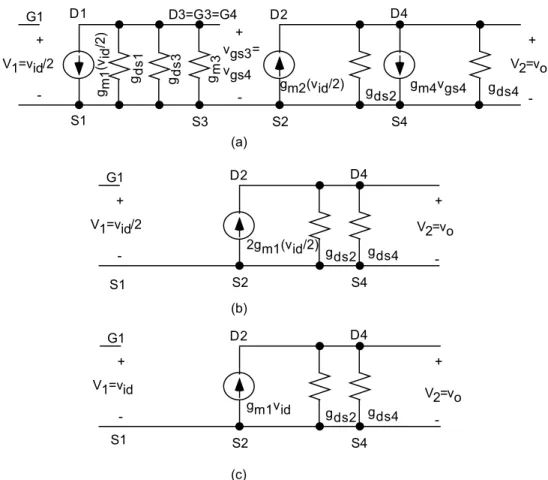
Figure 3. Differential Amplifier Operating in Purely Differential Input Signal: (a) Original Equivalent Circuit, (b) Reduction to Two-port Network, and (c) Changing Input Port Variable to V1=Vid .
The derivation of the small signal equivalent circuit is shown in Figure 2. The simplification is based on the symmetry of the circuit. In Figure 2(b), each transistor equivalent circuit is drawn. Figure 3(a) redraws the equivalent circuit in Figure 2(b) in a form suitable for two-port analysis. The further reduction is obtained after the two-port parameters are obtained.
From Figure 3(a), the following two-port variables and load are obtained.
O 2
ID 1 L
V
V
and
/2
V
V
0
Y
=
=
=
The port current equations are derived to obtain the Y parameters:
0
I
1=
--(20)2 ds4 ds2 gs4
m4 1 m2
2
-g
V
g
V
(g
g
)V
V
g
g
g
g
-V
1m3 ds3 ds1
m1
gs4
=
+
+
--(22)Substitute eq(22) to eq(21)
2 ds4 ds2 1
m1
2 ds4 ds2 1 m3 ds3 ds1
m4 m1 m2
2 ds4 ds2 1 m3 ds3 ds1
m4 m1 1
m2 2
)V
g
(g
V
-2g
)V
g
(g
V
)
g
g
g
g
g
(g
-
)V
g
(g
V
g
g
g
g
g
-V
-g
I
+
+
=
+
+
+
+
+
=
+
+
+
+
=
--(23)
ds3 ds1 m3
m4 m3 m2
m1
g
g
g
g
g
g
g
assuming
=
=
>>
+
The resulting Y-parameter matrix is:
+
=
ds4 ds2
m1
g
g
2g
-0
0
Y
The dc voltage gain is,
ds4 ds2
m1 L
22 21 id
O 1
2 VD02
g
g
g
2
Y
y
y
2
/
V
V
V
V
A
+
=
+
−
=
=
=
Instead of half differential input, dc gain with respect to full differential input is desired. That is,
ds4 ds2
m2 ds4
ds2 m1 id
O 1 2 VDO
g
g
g
g
g
g
V
V
V
V
A
+
=
+
=
=
VG1
VGS1
VSS VG2
VGS2 VDD
VSS VC
VSS Vo
+
-M6 w=21.6u l=1.2u
M1 w=9.6u l=5.4u
M2 w=9.6u l=5.4u M4 w=25.8u l=5.4u M3
w=25.8u l=5.4u
M5 w=21.6u l=1.2u
ISS=220uA ID2
ID4 IO
ID1 ID3
(1) (2)
(8)
(9)
(4) (3)
(6) (5)
IB=220uA
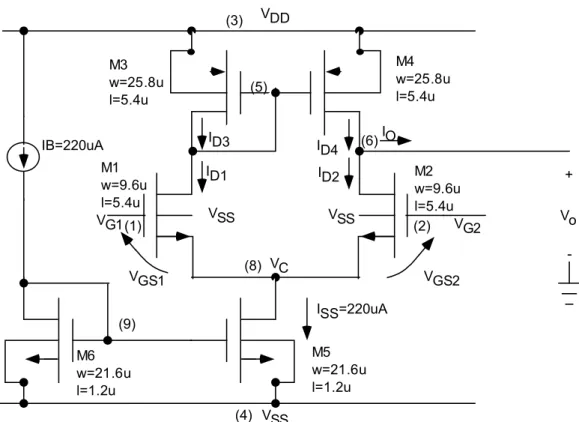
Figure 4. The Complete Differential Amplifier Schematic Diagram
Figure 3(c) is the resulting two-port equivalent circuit. Except for the polarity this gain equation is identical to that of the single NMOS inverter with PMOS current load. Figure 4 shows the complete differential amplifier implemented using a pair of inverter amplifier with PMOS current load, and 200uA current souce. The PSpice netlist is given below:
* Filename="diffvid.cir"
* MOS Diff Amp with Current Mirror Load *DC Transfer Characteristics vs VID VID 7 0 DC 0V AC 1V
E+ 1 10 7 0 0.5 E- 2 10 7 0 -0.5 VIC 10 0 DC 0.65V VDD 3 0 DC 2.5VOLT VSS 4 0 DC -2.5VOLT
M1 5 1 8 8 NMOS1 W=9.6U L=5.4U M2 6 2 8 8 NMOS1 W=9.6U L=5.4U M3 5 5 3 3 PMOS1 W=25.8U L=5.4U M4 6 5 3 3 PMOS1 W=25.8U L=5.4U M5 8 9 4 4 NMOS1 W=21.6U L=1.2U M6 9 9 4 4 NMOS1 W=21.6U L=1.2U IB 3 9 220UA
.MODEL NMOS1 NMOS VTO=1 KP=40U + GAMMA=1.0 LAMBDA=0.02 PHI=0.6 + TOX=0.05U LD=0.5U CJ=5E-4 CJSW=10E-10
+ U0=550 MJ=0.5 MJSW=0.5 CGSO=0.4E-9 CGDO=0.4E-9 .MODEL PMOS1 PMOS VTO=-1 KP=15U
+ TOX=0.05U LD=0.5U CJ=5E-4 CJSW=10E-10
+ U0=200 MJ=0.5 MJSW=0.5 CGSO=0.4E-9 CGDO=0.4E-9 .DC VID -2.5 2.5 0.05V
.TF V(6) VID .PROBE .END
The operating point current is determined by the source current ISS, which is split between the two PMOS
current loaded inverters. IDSQ1=IDSQ2=ISS/2, and similarly IDSQ3=IDSQ4=ISS/2. For the given differential
amplifier ISS=220uA. The voltage gain is computed as follows:
87.95uA/V
=
0.5u))
*
2
-5.4u
6)(25.8u/(
-E
15
(
)
L
/
W
(
K
87.3uA/V
=
0.5u))
*
2
-.4u
6)(9.6u/(5
-E
40
(
)
L
/
W
(
K
2 P3 P3 P3 P4 P3 2 N1 N1 N1 N2 N1=
=
=
=
=
=
β
β
β
β
umho
1
.
139
6)
-6)(110E
-E
95
.
87
(
2
I
2
g
g
umho
59
.
138
6)
-6)(110E
-E
3
.
87
(
2
I
2
g
g
DSQ3 P3 m4 m3 DSQ1 N1 m2 m1=
=
=
=
=
=
=
=
β
β
umho
4.4
=
6)
-E
220
(
02
.
I
I
g
umho
2.2
=
6)
-E
110
(
02
.
I
I
g
umho
2.2
=
6)
-E
110
(
02
.
I
I
g
DSQ5 P DSQ DS5 ds5 DSQ1 P DSQ4 DS4 ds4 DSQ1 N DSQ2 DS2 ds2=
=
=
=
=
=
=
=
=
λ
λ
λ
λ
λ
λ
5
.
31
6
-2.2E
+
6
-2.2E
6
-E
59
.
138
g
g
g
A
ds4 ds2 m1The low frequency input resistance Rin = ∞. The output resistance Rout = 1/(gds2+gds4)= 1/(2.2E-6+2.2E-6)
=.2272M, see Figure 3(d), and the computation above. These calculations agree well with Pspice simulation results of:
**** SMALL-SIGNAL CHARACTERISTICS V(6)/VID = 3.347E+01
INPUT RESISTANCE AT VID = 1.000E+20 OUTPUT RESISTANCE AT V(6) = 2.423E+05
VG1
VGS1
VSS VG2
VGS2 VDD
VSS VC VSS
ISS
M3 M4
M1 M2
S3
D3 D1
S1
S4
D4 D2
S2 gds1
gds2
gm4vgs4
gm2vgs2 gm1vgs1
M5 VGG +
VIC
+ VIC
gds5
Vo +
-Vo +
-gm3 gds3 gds4
VC
VDS5 VDG1
VSD3 VSD4
Vgs3 Vgs4
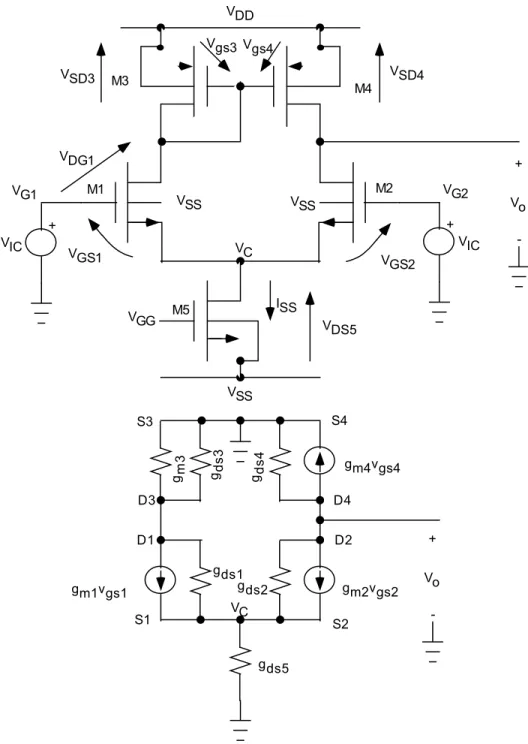
Figure 5. Differential Amplifier with Purely Common-mode Input Signal: (a) Schematic Diagram, and (b) Small Signal Equivalent Circuit.
The input common-mode range is the range of common-mode voltage Vic=VG1=VG2 in which all
the transistors are operating in saturation region. To determine this a purely common-mode input is applied at both inputs, see Figure 5.
3.1 Maximum VG1 or VG2 Determination
As VG1 approaches VDD transistor M1 and M2 go into the triode region. VG1(max) is the value
of the input when it occurs. This can be determined from Figure 5 by writing the KVL equation from VDD
G
=
D
since
,
V
V
V
=
V
V
V
V
DG1 SG3
DD
DG1 SD3
DD G1
−
−
−
−
=
|
V
|
|
I
|
2
|
V
|
|)
V
|
|
V
(|
V
TP3P3 DS3 TP3
TP3 GS3
SG3
=
−
+
=
β
+
DG1 TP3
P3 DS3 DD
G1
|
V
|
V
|
I
|
2
V
V
=
−
−
−
β
From Figure 5(a), VDG1 can be determined in term of the commonly known transistor voltages of M1.
DG1 GS1
DS1
GS1 DS1 DG1
V
V
V
or
V
-V
V
+
=
=
Transistor M1 is on saturation when the following condition holds. DG1
GS1 DS1
TN1
GS1
V
V
V
V
V
−
≤
=
+
That is,
DG1 TN1
V
V
≤
−
The minimum value of VDG1 is achieved when transistor M1 is on the threshold of saturation. That is,
DG1 TN1
V
V
=
−
The maximum input voltage is obtained when
−
V
TN1=
V
DG1. That is,P3 SS DD
P3 DS3 DD
TN1 TP3
P3 DS3 DD
G1
I
V
|
I
|
2
V
V
|
V
|
|
I
|
2
V
(max)
V
β
β
β
−
=
−
=
+
−
−
=
--(25)
Assuming |VTP3| ≈VTN1.
As VG1 approaches VSS, M1 becomes cutoff. The minimum input voltage VG1 is determined when
M5 is no longer in saturation. This is obtained by writing the KVL equation from VSS to VG1.
GS1 DS5
SS
G1
V
V
V
V
=
+
+
Transistor M5 is on saturation when, DS5
TN5
GS5
V
V
V
−
≤
M5 is at verge of saturation when,
V
GS5−
V
TN5=
V
DS5=
V
DS5(SAT)That is, the minimum input voltage occurs when,
V
GS5−
V
TN5=
V
DS5(SAT).GS1 DS5(SAT)
SS
G1
(min)
V
V
V
V
=
+
+
--(26)
GS1 TN5
GS5 SS
G1
(min)
V
(V
V
)
V
V
=
+
−
+
N1 SS GG
N1 DS1 GG
TN1 N1
DS1 TN5
GG
TN1 TN1
GS1 TN5
SS GG SS
G1
I
V
2I
V
V
2I
V
V
V
)
V
-V
(
)
V
V
V
(
V
(min)
V
β
β
β
+
=
+
=
+
+
−
=
+
+
−
−
+
=
--(27)
Ignoring the bulk bias effect.
Using the SPICE parameters for the differential amplifier implemented in Figure 4. From Eq(25),
P3 SS DD
G1
I
V
(max)
V
β
−
=
2 3
3 P
P3
=
K
(
W
/
L
)
=
(
15
E
-
6)(25.8u/(
5.4u
-
2
*
0.5u))
=
87.95
uA/V
β
V
92
.
0
58
.
1
5
.
2
6
-87.95E
6
-E
220
5
.
2
(max)
V
G1=
−
=
−
=
and from Eq(27),
V
38
.
0
2
.
1
58
.
1
2
.
1
87.3
6
-E
220
V
I
(min)
V
GGN1 SS
G1
=
β
+
=
−
=
−
=
To guarantee that the differential amplifier stays on the linear region of operation, set common-mode signal at half way the common-mode range. That is, VIC=[VG1(max)+VG1(min)]/2=[0.92+.38]/2=0.65.
4. Low Frequency Small Signal Equivalent Circuit With Pure Common-Mode Input
Signal
2gm1vgs1 D1
S1
D3
S3 +
-G1
+
-V2=vo V1=Vic
gds5
gds
1
+g
ds2
gds
3
+g
ds4
+g
m3
+gm4
Vgs1
D5
S5 VC
YL
(c)
gm1vgs1 gm2vgs2 gds2 gds4
G1 D1
S1
S3
D2
S2
D4
S4 D3=G3=G4
+
-vo +
-vgs1
+
-gds5 +
-Vic
Vc vgs3
gds
1
D5
gm4 v gs
4
S5
+
-vgs4
gds
3
+g
m3
gds
4
+g
m4
gm1vgs1 gm2vgs2 gds2
G1 D1
S1
S3
D2
S2
D4
S4 D3=G3=G4
+
-vo +
-vgs1
+
-gds5 +
-Vic
Vc vgs3
gds
1
gds
3
+g
m3
D5
S5
(b) (a)
I2
I2
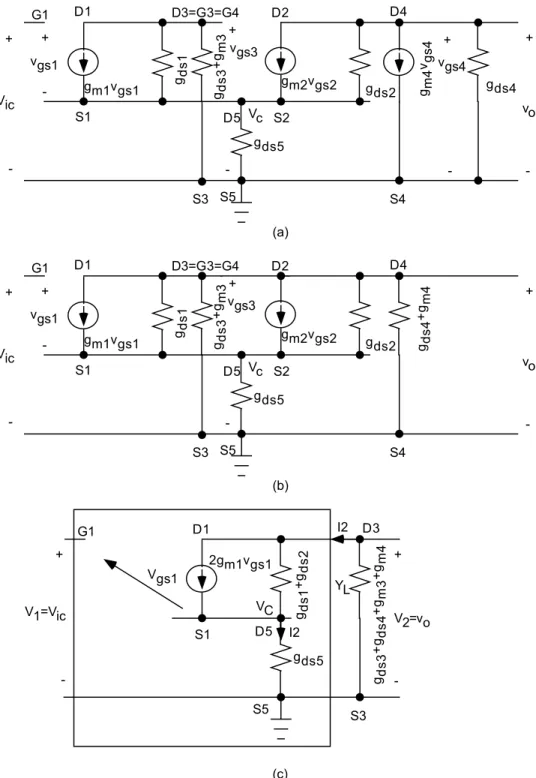
Figure 6. Small Signal Equivalent Circuit: (a) Original Small Signal Equivalent Circuit, (b) Accounting for Source Values and Polarities, and (c) Two-port Conversions.
Figure 5(a) shows the schematic when a purely common-mode input is applied at both inputs that is, VG1=VG2 =VIC . If VIC increases both ID1 and ID2 increases. Their sum at the common node VC also
increases. Figure 5(b) shows that VC is not at ac ground, unlike the pure differential input signal case
shown in Figure 2(b). Due to signal symmetry when both inputs are the same, VDS3=VDS4. Since both G
and S of M3 and M4 are connected to each other, means VGS3=VGS4. M3 is diode connected with G and D
across D and S of M4 can be labelled as VGS4, see Figure 6(a). The current source of M4 is therefore
reduced to conductance gm4, see Figure 6(b). Since VDS3=VDS4, the D3 and D4 can be connected together.
Figure 6(c) shows the final equivalent circuit after combining all components that are in parallel. From Figure 6(c), the following two-port variables and load are obtained.
O 2 IC 1 m3 ds4 ds3 m3 ds3 m4 m3 ds4 ds3 L
V
V
and
V
V
g
g
g
g
assuming
g
2
g
2
g
g
g
g
Y
=
=
=
=
+
=
+
+
+
=
m4The two-port current equations are derived to obtain the Y parameters.
2 m1 ds5 ds2 ds1 ds5 ds2 ds1 1 m1 ds5 ds2 ds1 ds5 m1 2 2 ds5 m1 ds2 ds1 2 ds2 ds1 1 m1 2 2 ds5 C C m1 ds2 ds1 2 ds2 ds1 1 m1 C 1 m1 C 2 ds2 ds1 2 1
V
2g
g
g
g
)g
g
g
(
V
2g
g
g
g
g
g
2
I
I
g
1
)
2g
g
(g
-)V
g
(g
V
2g
I
I
g
1
V
)V
2g
g
(g
-)V
g
(g
V
2g
)
V
-(V
2g
)
V
-)(V
g
(g
I
0
I
+
+
+
+
+
+
+
+
=
+
+
+
+
=
=
+
+
+
+
=
+
+
=
=
The Y-parameter matrix is:
m4 m3 ds2 ds1 m1 ds5 ds1 ds5 ds1 m1 ds5 ds1 ds5 m1 m1 ds5 ds2 ds1 ds5 ds2 ds1 m1 ds5 ds2 ds1 ds5 m1
g
g
g
g
assuming
2g
g
2g
g
g
2
2g
g
2g
g
g
2
0
0
2g
g
g
g
)g
g
g
(
2g
g
g
g
g
g
2
0
0
Y
=
=
+
+
+
+
=
+
+
+
+
+
+
+
=
.
g
g
assuming
r
g
2
1
r
g
2
g
g
r
g
2
1
g
g
g
2g
2g
1
g
g
g
g
)
2g
g
2g
)(
g
g
(
2
g
g
2
g
g
2
)
g
g
(
2
2g
g
2g
g
g
2
2g
g
2g
g
g
2
Y
y
y
A
ds3 m3
ds5 m3 ds5
m1 m3 m1
ds5 m1
m3 m1
ds5 m1 ds1
m3 ds1
m3 m1
m1 ds5
ds1 m3 ds3 ds5
ds1
ds5 m1
m3 ds3 m1
ds5 ds1
ds5 ds1
m1 ds5
ds1
ds5 m1
L 22
21 VC0
>>
−
≈
−
≈
+
−
≈
+
+
+
−
=
+
+
+
+
−
=
+
+
+
+
+
+
−
=
+
−
=
* Filename="diffvic.cir"
* MOS Diff Amp with Current Mirror Load *DC Transfer Characteristics vs VIC VID 7 0 DC 0V
E+ 1 10 7 0 0.5 E- 2 10 7 0 -0.5 VIC 10 0 DC 0V VDD 3 0 DC 2.5VOLT VSS 4 0 DC -2.5VOLT
M1 5 1 8 8 NMOS1 W=9.6U L=5.4U M2 6 2 8 8 NMOS1 W=9.6U L=5.4U M3 5 5 3 3 PMOS1 W=25.8U L=5.4U M4 6 5 3 3 PMOS1 W=25.8U L=5.4U M5 8 9 4 4 NMOS1 W=21.6U L=1.2U M6 9 9 4 4 NMOS1 W=100.8U L=3.6U M7 9 9 3 3 PMOS1 W=3.6U L=3.6U .MODEL NMOS1 NMOS VTO=1 KP=40U + GAMMA=1.0 LAMBDA=0.02 PHI=0.6
+ TOX=0.05U LD=0.5U CJ=5E-4 CJSW=10E-10
+ U0=550 MJ=0.5 MJSW=0.5 CGSO=0.4E-9 CGDO=0.4E-9 .MODEL PMOS1 PMOS VTO=-1 KP=15U
+ GAMMA=0.6 LAMBDA=0.02 PHI=0.6
+ TOX=0.05U LD=0.5U CJ=5E-4 CJSW=10E-10
+ U0=200 MJ=0.5 MJSW=0.5 CGSO=0.4E-9 CGDO=0.4E-9 .OP
.DC VIC -2.5 2.5 0.05V .TF V(6) VIC
.PROBE .END
01582
.
0
)
6)(.2272E6
-E
1
.
139
(
2
1
r
g
2
1
A
ds5 m3
VCO
=
−
=
−
=
−
This is very closed to the PSpice simulation result. **** SMALL-SIGNAL CHARACTERISTICS
V(6)/VIC = -1.459E-02
INPUT RESISTANCE AT VIC = 1.000E+20 OUTPUT RESISTANCE AT V(6) = 2.386E+05
The goal of differential amplifier is to amplify the difference signal and to reject common-mode signal. A figure of merit called common-mode rejection ration (CMRR) is defined as:
15
.
1991
0.01582
-5
.
31
A
A
CMRR
VC
VD
=
=
=
VG1 +
VGS1
VSS
VG2 + VGS2 VDD
VSS VC VSS
ISS
M3 M4
M1 M2
CL Cgd2
Cdb4 Cdb2
Cgs4 Cgs3
Cgd4 Cdb3
Cgd1
(a) Cdb1
VGS1
VSS
VGS2
VSS VC VSS
ISS
M3 M4
M1 M2
C2 C3
C1
(b) VDD
VG2 + VG1
+
C1=Cgd1+Cdb1+Cdb3+Cgs3+Cgs4 C2=Cgd2+Cdb2+Cdb4+CL C3=Cgd4
(1) (2)
(5) (6)
(8)
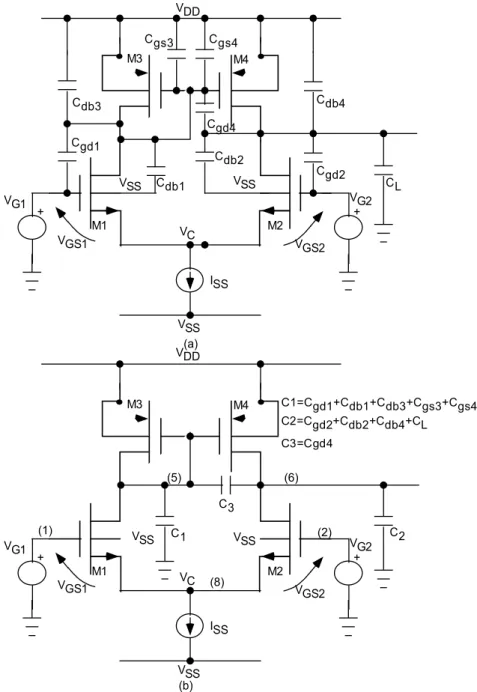
Figure 7. Parasitic Capacitances of Differential Amplifier Operating in Purely Differential Input Signal: (a) Parasitic Capacitances of each Transistor, (b) Lumped Parasitic Capacitances.
Figure 7(a) shows all the parasitic capacitances of the differential amplifier with purely
differential input signals. Since both inputs are voltage sources, they are at ac ground when considering the effects of gate capacitances. Figure 7(b) shows that there are basically three capacitances. These are:
gd4 3
L db4 db2 gd2 2
gs4 gs3 db3 db1 gd1 1
C
C
C
C
C
C
C
C
C
C
C
C
C
=
+
+
+
=
+
+
+
+
=
gm1(vid/2)
gds
1
+gds3
+g
m3
C1 C3
gm2(vid/2) gm4vgs4 gds
2
+g
ds
4
C2 G1 D1
S1
D3=G3=G4
S3
D2 D4
S2 S4
+ vo
-+
vid/2
-gm1(vid/2) gm1(vid/2) gm4vgs4 G1 D1
S1
D3=G3=G4
S3
D2 D4
S2 S4
+
-+
-I3 + -Vgs4
C1=Cgd1+Cdb1+Cdb3+Cgs3+Cgs4 C2=Cgd2+Cdb2+Cdb4+CL
C3=Cgd4 (a)
(b) Y3
Y1 Y2
V1=Vid/2 V2=VO
=
gm1=gm2
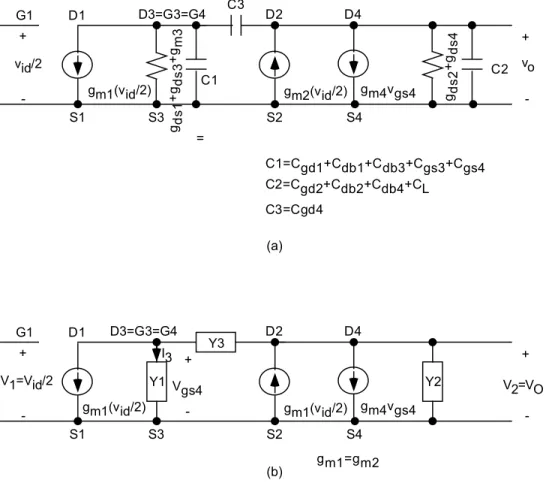
Figure 8. High Frequency Small Signal Equivalent Circuit: (a) Small Signal Equivalent Circuit Showing Lumped Capacitances, (b) Small Signal Equivalent Circuit Combining Capacitance and Resistance to Admittance.
NOTE C3 is not a miller capacitance, it is connected between the outputs of the two inverter amplifiers,
and not between an output and an input terminals of an amplifier. C3 in this case is normally small and can
be ignored. Figure 8(b) shows that the three admittances are given by:
gd4 3
3
2 ds4 ds2 2
1 m3 ds3 ds1 1
C
C
Y
C
g
g
Y
C
g
g
g
Y
s
s
s
s
=
=
+
+
=
+
+
+
=
The two-port Y parameters are to be determined. Figure 8(b) shows that the two-port variables are:
O 2
id 1 L
V
V
and
2
/
V
V
0
Y
=
=
=
2 3 1 3 m1 3 2 3 1 2 1 1 3 1 m4 m1 1 m1 2 3 1 3 1 3 1 m1 m4 3 2 3 2 1 m1 2 2 3 1 3 1 3 1 m1 gs4 gs4 gs4 2 3 1 m1 gs4 1 gs4 1 3 gs4 2 3 1 m1 3 gs4 m4 3 2 3 2 1 m1 2 2 gs4 m4 1 m1 gs4 2 3 2 1
V
Y
Y
Y
g
Y
Y
Y
Y
Y
Y
V
Y
Y
g
g
-Y
g
)
V
Y
Y
Y
V
Y
Y
g
)(
g
Y
(
)V
Y
Y
(
V
-g
I
V
Y
Y
Y
V
Y
Y
g
V
V
for
Solve
0
)
V
-(V
Y
-V
g
V
Y
V
Y
I
0
)
V
-(V
Y
-V
g
I
D3
node
At
)V
g
Y
(
)V
Y
Y
(
V
-g
V
Y
V
g
V
g
-)
V
-(V
Y
I
0
I
+
+
+
+
+
+
=
+
+
+
−
+
−
+
+
+
=
+
+
+
−
=
=
+
=
=
+
+
−
+
+
+
=
+
+
=
=
The Y-parameter matrix is:
+
+
+
+
+
=
3 1 3 m1 3 2 3 1 2 1 3 1 m4 m1 1 m1Y
Y
Y
g
Y
Y
Y
Y
Y
Y
Y
Y
g
g
-Y
g
-
0
0
Y
For differential amplifier the assumption that Y3 or C3 is approximately 0 is valid. That is,
−
=
2 1 m4 m1 m1Y
Y
g
g
-g
0
0
Y
+
+
+
+
+
+
+
+
+
+
=
+
+
+
+
+
+
+
+
+
+
+
+
+
+
+
=
+
+
+
+
+
+
+
+
+
=
+
+
+
+
+
+
=
+
=
+
=
+
−
=
=
ds4 ds2 2 m3 ds3 ds1 1 m4 m3 ds3 ds1 1 ds4 ds2 m1 ds4 ds2 2 m3 ds3 ds1 1 m3 ds3 ds1 m4 m3 ds3 ds1 1 m4 m3 ds3 ds1 ds4 ds2 m1 2 ds4 ds2 1 m3 ds3 ds1 1 m4 m3 ds3 ds1 m1 2 ds4 ds2 1 m3 ds3 ds1 m4 m1 2 1 m4 m1 2 1 m4 m1 m1 L 22 21 1 2 VD2g
g
C
1
g
g
g
C
1
g
g
g
g
C
1
g
g
g
2
g
g
C
1
g
g
g
C
1
)
g
g
g
(
g
g
g
g
C
1
)
g
g
g
g
(
g
g
g
)
C
g
)(g
C
g
g
(g
)
C
g
g
g
(g
g
)
C
g
(g
)
C
g
g
g
g
(1
g
Y
)
Y
g
(1
g
Y
Y
g
g
g
Y
y
y
V
V
A
s
s
s
s
s
s
s
s
s
s
s
The differential gain when the input voltage V1 is changed to VID is:
1 m3 1 m4 m3 ds3 ds1 1 m3 1 m3 ds3 ds1 2 2 ds4 ds2 1 1 2 VDO ds4 ds2 2 m3 ds3 ds1 1 m4 m3 ds3 ds1 1 ds4 ds2 m1 id O VD
C
2g
C
g
g
g
g
z
C
g
C
g
g
g
p
C
g
g
p
:
where
)
p
1
)(
p
1
(
)
z
1
(
A
g
g
C
1
g
g
g
C
1
g
g
g
g
C
1
g
g
g
V
V
A
−
≈
+
+
+
−
=
−
≈
+
+
−
=
+
−
=
−
−
−
=
+
+
+
+
+
+
+
+
+
+
=
=
s
s
s
s
s
s
p1 << p2 << z
NOTE the differential voltage gain has pole-zero doublets. That is, the zero z is double that of the non-dominant pole p2. The dominant (lowest frequency) pole p1 occurs at the output node. The above transfer
Each node is at a finite impedance with respect to ground. That is, each node there is a resistance Rn (or
conductance) and capacitance Cn to ground. To determine which poles are dominant (or more significant),
the impedance levels must be monitored. The parasitic capacitances Cn are of approximately the same
magnitude, but Rn usually vary considerably. When the resistance (conductance) is high (low), a dominant
pole is generated. The impedance levels are summarized in the follwing table:
Node(From Netlist) Resistance Capacitance Pole
1 0 (ac ground) X
2 0 (ac ground) X
5 R5=1/(gds1+gds3+gm3) C1 p2=1/(R5C1)*
6 R6=1/(gds2+gds4) C2 p1=1/(R6C2)
8 0 (ac ground) X
The derivation shows that the pole p2 create a zero doublet.
* Filename="diffreq.cir"
* MOS Diff Amp with Current Mirror Load *DC Transfer Characteristics vs VID VID 7 0 DC 0V AC 1V
E+ 1 10 7 0 0.5 E- 2 10 7 0 -0.5 VIC 10 0 DC 0.65V VDD 3 0 DC 2.5VOLT VSS 4 0 DC -2.5VOLT
M1 5 1 8 8 NMOS1 W=9.6U L=5.4U M2 6 2 8 8 NMOS1 W=9.6U L=5.4U M3 5 5 3 3 PMOS1 W=25.8U L=5.4U M4 6 5 3 3 PMOS1 W=25.8U L=5.4U M5 8 9 4 4 NMOS1 W=21.6U L=1.2U M6 9 9 4 4 NMOS1 W=100.8U L=3.6U M7 9 9 3 3 PMOS1 W=3.6U L=3.6U .MODEL NMOS1 NMOS VTO=1 KP=40U
+ GAMMA=1.0 LAMBDA=0.02 PHI=0.6
+ TOX=0.05U LD=0.5U CJ=5E-4 CJSW=10E-10
+ U0=550 MJ=0.5 MJSW=0.5 CGSO=0.4E-9 CGDO=0.4E-9 .MODEL PMOS1 PMOS VTO=-1 KP=15U
+ GAMMA=0.6 LAMBDA=0.02 PHI=0.6
+ TOX=0.05U LD=0.5U CJ=5E-4 CJSW=10E-10
+ U0=200 MJ=0.5 MJSW=0.5 CGSO=0.4E-9 CGDO=0.4E-9 .AC DEC 100 1HZ 100000GHZ
.PROBE .END
VG1
VGS1
VSS VG2
VGS2 VDD
VSS VC VSS
M3 M4
M1 M2
M5 VGG
+ VIC
+ VIC
Vo +
-Cdb5 Csb2 Csb1 Cgd5
VG1
VGS1
VSS VG2
VGS2 VDD
VSS
VC VSS
M3 M4
M1 M2
M5 VGG
+ VIC
+ VIC
Vo +
-CS
CS=Csb1+Csb2+Cdb5+Cgd5
Figure 9. Differential Amplifier Operating in Pure Common-Mode Input Signal: (a) All Parasitic Capacitances at Common Node Vc, (b) Total Capacitances Across the Drain and Source of M5.
From the expression of the dc common-mode gain, it is primarily a function of gm3 and rds5. The
first order frequency response analysis can be simplified by ignoring all parasitic capacitances except the capacitance CS across rds5, see Figure 9. That is rds5 is replaced by zds5 in the the common-mode gain
gd5 db5 sb2 sb1 S
ds5 m3
S ds5
S ds5 ds5 m3
ds5 m3 VC
S ds5 ds5 S
ds5 ds5
C
C
C
C
C
:
where
r
g
2
)
C
r
1
(
C
r
1
r
g
2
1
z
g
2
1
A
C
r
1
r
)
//C
r
(
z
+
+
+
=
+
−
=
+
−
=
−
=
+
=
=
s
s
s
* Filename="diffreqc.cir"
* MOS Diff Amp with Current Mirror Load *DC Transfer Characteristics vs VIC VID 7 0 DC 0V
E+ 1 10 7 0 0.5 E- 2 10 7 0 -0.5
VIC 10 0 DC 0.65V AC 1V VDD 3 0 DC 2.5VOLT VSS 4 0 DC -2.5VOLT
M1 5 1 8 8 NMOS1 W=9.6U L=5.4U M2 6 2 8 8 NMOS1 W=9.6U L=5.4U M3 5 5 3 3 PMOS1 W=25.8U L=5.4U M4 6 5 3 3 PMOS1 W=25.8U L=5.4U M5 8 9 4 4 NMOS1 W=21.6U L=1.2U M6 9 9 4 4 NMOS1 W=100.8U L=3.6U M7 9 9 3 3 PMOS1 W=3.6U L=3.6U .MODEL NMOS1 NMOS VTO=1 KP=40U
+ GAMMA=1.0 LAMBDA=0.02 PHI=0.6
+ TOX=0.05U LD=0.5U CJ=5E-4 CJSW=10E-10
+ U0=550 MJ=0.5 MJSW=0.5 CGSO=0.4E-9 CGDO=0.4E-9 .MODEL PMOS1 PMOS VTO=-1 KP=15U
+ GAMMA=0.6 LAMBDA=0.02 PHI=0.6
+ TOX=0.05U LD=0.5U CJ=5E-4 CJSW=10E-10
+ U0=200 MJ=0.5 MJSW=0.5 CGSO=0.4E-9 CGDO=0.4E-9 .AC DEC 100 1HZ 100000GHZ
.PROBE .END
The differential-mode voltage gain decreases with increasing frequency but common-mode voltage increases. Therefore, CMRR decreases with increasing frequency.
7. Designing Differential Amplifier With Specified CMR
Given a common-mode range of –0.75 <= VIC <=0.75 , VGG=-1, ISS=IDS5=100uA, Lmin=5.4u,
. Determine the size of each transistor in the differential amplifier circuit, see Figure 4.
5
.
0
V
V
V
=
GS−
TN=
∆
1. Determine the (W/L)5 to sink 100uA.
=
=
=
=
=
=
=
u
4
.
5
u
108
20
1]
-(-2.5)
-6)[-1
-(40E
6)
-E
100
(
2
)
V
-V
-V
(
K
I
2
)
V
-V
(
K
I
2
L
W
)
V
-V
(
L
W
2
K
)
V
-V
(
2
I
2
2 TN5 SS GG N
DS5 2
TN5 GS5 N
DS5 5
2 TN5 GS5 5 N 2 TN5 GS5 N5 DS5
β
2. Determine (W/L)1 =(W/L)2 from VIC(min)=VG1(min) specification
=
=
=
=
=
=
−
−
−
−
=
−
−
−
≥
−
≥
+
+
=
=
u
4
.
5
u
216
40
1)
-6)(1.25
-E
40
(
6)
-E
50
(
2
)
V
-(V
K
I
2
L
W
L
W
25
.
1
5
.
0
)
5
.
2
(
75
.
0
V
V
75
.
0
V
75
.
0
V
V
V
min)
(
V
V
2 2 TN GS1 N DS1 2 1 DS5(SAT) SS GS1 GS1 DS5(SAT) SS G1 IC3. Determine (W/L)3=(W/L)4 from VIC(max)=VG1(max) specification
From Eq(25),
=
=
=
=
=
=
−
=
=
u
4
.
5
u
75
.
11
177
.
2
0.75)
-6)(2.5
-E
15
(
6)
-E
50
(
2
(max))
V
-(V
K
|
I
|
2
L
W
(max))
V
-V
(
L
W
2
K
(max))
V
-V
(
2
|
I
|
|
I
|
2
V
(max)
V
(max)
V
2 2 G1 DD P DS3 3 2 G1 DD 3 P 2 G1 DD P3 DS3 P3 DS3 DD G1 ICβ
β
The above is simulated using PSpice. The results agree well with the calculations.
* Filename="diffcmr.cir"
* MOS Diff Amp with Current Mirror Load *DC Transfer Characteristics vs VIC VID 7 0 DC 0V
E+ 1 10 7 0 0.5 E- 2 10 7 0 -0.5 VIC 10 0 DC 0V VDD 3 0 DC 2.5VOLT VSS 4 0 DC -2.5VOLT
M1 5 1 8 8 NMOS1 W=216U L=5.4U M2 6 2 8 8 NMOS1 W=216U L=5.4U M3 5 5 3 3 PMOS1 W=11.75U L=5.4U M4 6 5 3 3 PMOS1 W=11.75U L=5.4U M5 8 9 4 4 NMOS1 W=108U L=5.4U VGG 9 0 DC -1V
.MODEL NMOS1 NMOS VTO=1 KP=40U + GAMMA=1.0 LAMBDA=0.02 PHI=0.6
+ TOX=0.05U LD=0.5U CJ=5E-4 CJSW=10E-10
+ U0=550 MJ=0.5 MJSW=0.5 CGSO=0.4E-9 CGDO=0.4E-9 .MODEL PMOS1 PMOS VTO=-1 KP=15U
+ GAMMA=0.6 LAMBDA=0.02 PHI=0.6
+ TOX=0.05U LD=0.5U CJ=5E-4 CJSW=10E-10
+ U0=200 MJ=0.5 MJSW=0.5 CGSO=0.4E-9 CGDO=0.4E-9 .DC VIC -2.5 2.5 0.05V
.TF V(6) VIC .PROBE