
379
A STUDY REGARDING THE ACTUAL STATE OF ART FOR
TECHNOLOGIES AND EQUIPMENT’S USED TO SEPARATE THE SEA
BUCKTHORN FRUITS FROM HARVESTED BRANCHES
Dumitru Milea, Alexandra Liana Visan, Constantin Gabriel Bogdanof
National Institute of Research-Development for Machines and Installations designed to Agriculture and Food Industry – INMA / Bucharest, Romania
Tel: 021/269.32.50; Fax: 021/269.32.73; E-mail: [email protected]
Keywords: fruit separation equipment’s, sea buckthorn separation, sea buckthorn harvest, fruit manipulation, fruit integrity
ABSTRACT
In the Phyto-pharmaceutical
products industry, the sea buckthorn extracts are very valuable in many European countries and for this reason are manufactured many products that use different plant parts (fruits, seeds, lives, etc.). The bioproduct marketing policies and alternative medicine (especially to new-borns) promote products to stimulate the immune system and to provide large vitamin concentration, from this reason the sea buckthorn plantations were established in many rural Romanian regions, but nowadays the fruit harvesting process involves cutting the branches,
process that requires a lot of labour and a long period of time, more than that, the transport, handling, cleaning and fruit separation operations that are included in well-controlled technology designed to reduce fruit loss and damage. To support sea buckthorn plantation holders and processors, the INMA directs its expertise to make a study regarding the actual state of art on technologies and equipment’s used to separate the sea buckthorn fruit from the harvested branches in the developed countries, which also take the lead on the market.
INTRODUCTION
Currently, on international market, sea buckthorn berries are fully capitalized and are commercialized as raw material: fruits, buds, leaves, seeds and even bark, and as following products: tea, syrup and Liquor, food supplements, sea buckthorn
oil and cosmetics, powder and
supplement feeds, because the whole plant has a medicinal impact, but the fruit is the most beneficial.
As a result of a market survey for 2011 production, there was a large discrepancy in the acquisition of sea buckthorn berries
cost for the major exporting countries, as follows: Hungary (6,772 US$/t); New Zealand (4,383 US$/t) and importing are: the Netherlands (3,158 US$/t), the United Kingdom (2,138 US$/t), France (2,059 US$/t). And these trade figures should be correlated with the quantities that are exported/imported, Fig. 1, and the raw material quality (fruit consistency,
nutritional value, purity, etc.).
380
Figure 1 The largest players on the sea buckthorn stock exchange market [Bilegtsaikhan Batjargal, 2014]
In 2013, Romania exported more than 521 tonnes of sea buckthorn to the EU
Member States, namely: Belgium,
Germany, Hungary, Poland, and Bulgaria, because the Romanian farmer's fund that from economic point of view this business profitable. Taking in to consideration that the SWOT analysis, presented in Fig.2, it can be observed that Romanian farmers have a great interest to invest and develop this sector, due to large establishment plantations that are at this
period in the phase to create a grate producer associations as “Cooperativa Agricolă BIO CĂTINA”, which has 155 ha plantation area owned by 10 partners. The largest sea buckthorn plantation is in Arad county (about 16 ha) and produces about 24 t/ha, harvesting is done every two years and the price is 20,000 euro/ ha (0.9 euro/kg) and is therefore considered to be the "most profitable fruit growing" because the maintenance costs are relatively small. [9]
Figure 2 SWOT analysis of sea buckthorn farmers/producers.
Taking in to consideration the equipment’s that the farmers had
381 said that they had focused on pre-processing technology with fast freezer chambers up to ‐40 0C and mobile/fixed
cold storage rooms at ‐20 0C. But the
pre-processing operation, separation of berries from the branches is made entirely with human labour.
In order to support the fruit growers in this area, National Institute of Research
- Development for Machines and
Installations Designed to Agriculture and
Food Industry - INMA Bucharest, wishes to come to their support and to eliminate the weakness (namely: human labour deficit, harvest risks, and lack of pre-processing technology) and to encourage the Romanian farmers with crops of native sea buckthorn variety (Cora, Dora, Clara, Mara, Pitesti, Ovidiu, Victoria, Auras, etc.) to develop their businesses and to place their products on the European market and not only.
MATERIAL AND METHOD
Technologies and equipment’s designed to separate and handling the sea buckthorn fruits present in the big farms exploitation technical endowments.
A trunk vibration harvesting device was developed by the Department of Agricultural Machinery Development at the Russian Institute of Medicine, which is built from a fruit picker, vibrator clamp, hydraulic engine and control cylinder. [Fu L., at all in 2014] But harvesting process records good results when are used vibrations at 25 Hz and 25 mm amplitude on sea-buckthorn culture "Hergo", Fig.3. At lower amplitudes, was required a frequency of 30 Hz.
a) Russian model
b)Swedish model
Figure 3. Methods to place the manual vibration devices and tray collection [Roman
P., Hohne F. In 2012],[10]
Also, a Swedish prototype was tested at amplitudes of 40 and 55 mm at frequencies up to 25 Hz. For summer
cultivation from western Canada, found that this method can be applied at 20 ÷25 Hz frequencies and the percentage of
forest fruits removed by shaking
increased linearly with the amplitude increase. The combination of 25 Hz and 32 mm produced the best result during the November harvest when 98% of the forest fruits were removed within 15 seconds of agitation. [Fu L., at all in 2014] Recently, sea buckthorn varieties
brought from Russia have been
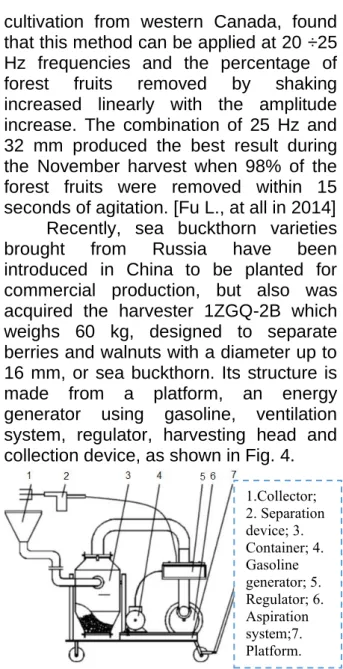
introduced in China to be planted for commercial production, but also was acquired the harvester 1ZGQ-2B which weighs 60 kg, designed to separate berries and walnuts with a diameter up to 16 mm, or sea buckthorn. Its structure is made from a platform, an energy generator using gasoline, ventilation system, regulator, harvesting head and collection device, as shown in Fig. 4.
Figure 4 Structure of a harvesting system 1ZGQ-2B [Fu L., at all in 2014]
The power of the generator is transmitted both to the collection head via the regulator and to the fan, after which it
382 is passed to the container and to the collection device. The harvesting head separates sea buckthorn fruits using the vibrations produced by a small built-in engine. Then the separated fruit moves to the collection device and is sucked into the container. It is mentioned that this harvester could separate the large plantations, because it has a productivity of 70÷80 kg/h. However, the high-frequency vibrating head that is held in the hand is not suitable for long-lasting work.
30 years ago, in Germany, a harvester called Hranemann, called by its inventor, has been made to mechanize the sea buckthorn crops harvesting operation (that can be adjusted the branches cut height in accordance with shrub type), after which the operator unloads them in a trailer using a scraper conveyor, Fig. 5.A. Once the fruit is introduced in pre-harvesting hall, the transported material feeds a technological
line equipped with a series of machines and installations to separate the fruits from cut branches. The productivity of this machine is 4-6 t/ha.
After that, the sea buckthorn branches are unloaded and transported to a fast-freezing module (tunnel equipped with conveyor belt), at the outlet the feedstock is directed to a separating module, Fig. 5.B, provided with a rotary engine and a fingers vibrator that transfers the vibratory motion to the moving branches so, that the inertia forces to detach the fruits from branches. The mall impurities (leave pieces, twigs and dried fruits) are transported to a cyclone, a rotating sieve module and then a fine-grain separator, Fig.5.C. The sea buckthorn fruits at the end are collected in containers and weighed, Fig.5.D, finally these are placed in refrigeration chambers. [11].
Figure 5 Harvesting and pre-processing the sea buckthorn berries [Kauppinen S. in 2015]
A similar technology to the previous one is the one used by Sanddorn Storchennest GmbH, Germany's largest producer and supplier of sea buckets,
with a cultivated area of 120 ha, of which
only 25 hectares are handmade
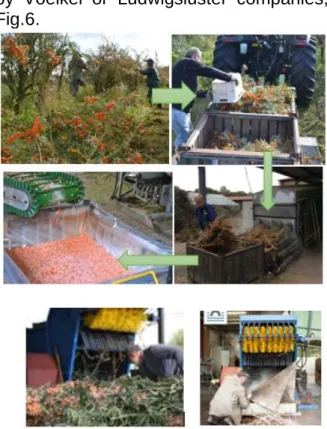
383 by Voelkel or Ludwigsluster companies, Fig.6.
Figure 6 Manual harvesting technology and mechanical berries sea buckthorn
pre-processing [11-16]
In Fig. 7 is presented another
technologic pre-processing line
developed by Kranemann, which is made from 4 systems: I – rapid foreseeing, II- evacuation of freezing branches, III – berries detachment system, and IV-berries collection and packing.
Figure 7 Kranemann technology for separating fruit from branches [17,18, Gusovius H.J. in
2013]
In 2018, on the plantation in Mecklenburg-Western Pomerania, from Poland, a sea buckthorn harvesting
equipment was used for the first time, Fig. 8.
Figure 8 Poland Sea buckthorn technology [20, 21]
The technology used is specific to this crop, respectively to the fruit branches that are quickly frozen (-23 °C within 12 hours) and separated from the vegetal debris. The fast-freezing process is important because the fruits break out more easily from the branches, remain on the lookout, and not on the vitamins.
384 and Neu Steinhortiar plantations, the total harvested product was around 60 tonnes [19]. The harvest is then sold in full to one of Germany's largest Sanddorn GbR producers in Herzberg, Branderbug, where the grains are transformed into juice, pulp and seed and powder oil.
The Ernst Triquardt WEM 01 is an old experimental model (1985) for the separation of the herring and the Hergo variety because it has large pulp fruits and separation forces are around 1.5 N. This equipment has been experimented
on the Mecklenburg-Vorpommern
plantation, set up in 1990 near
Fredersdorf, which has about 4.5
hectares [22]. This equipment was developed at Humboldt University, the transport platform is a few meters long and has to provide space for operators and conveyor belts, Fig. 9. Once the
branches are harvested, they are
disposed on the conveyor belt that directs them to the rear of the equipment where brushes and metal beaters are positioned when they operate at a 30 Hz frequency.
The shaken branches are then left behind the equipment, and the fruit and leaves are transported to the front and passed through the Triquart cleaning systems, the fruits are collected in 15 kg of plastic bags. For a 3.45-hectare plantation covering 6210 m, 31.41 hours of work are required and 21540 kg and 6243 kg/ha respectively are harvested; the speed of the wire is 198 m/h; equipment efficiency is 656 kg/Mh. [7]
Figure 9 Mobile equipment for sea blackthorn separation [22, 23]
In Canada (1999-2001), a research project was carried out to design a sea buckthorn harvesting self-propelled machine of Fig. 10.
Figure 10 Canadian sea buckthorn harvesting self-propelled machine [8]
The SBT MII 70-6 vacuum
harvesting machine, see Fig.11, was developed by the Moscow Research Institute of Agriculture and it is coupled to a tractor with a power of more than 36.6 kW. This machine has a universal shaft 1, pulley assembly 2, wheel set 5, compress air tank 6, vacuum pumps 4, fruit tank 7, fruit boxes 3, vacuum tubes 8 and caps 9.
During harvesting, negative
pressure generated by the vacuum pump, which was generated by the tractor through the universal shaft, formed a sorting device to take the sea buckthorn in the container. Once the container is filled, the fruit can be transferred to fruit storage boxes.
385 The technology used in Italy and implemented on the San Mario farm, located in the Tuscan region, harvest the sea buckthorn fruits from Hippophae rhamnoides vearity (variety predominant in China, Russia, Northern Europe and India). The frits quality is high and well placed on the market, affirmation that is demonstrated by the fact that they have a great collaboration with Kurt Künzi and Weleda company, a pioneer in the cultivation of the dog using the concept of
Biodynamic@, which is based on
gardening method developed by Rudolf Steiner that aims to ensure sustainability and improve soil fertility in the long run, concept that was proven by this collaboration, that is running over 10
years. [24,25,26] This technology
includes the following phases:
mechanized harvesting; manual
harvesting to reduce losses, unload harvested material in transport and freezing containers; freezing of raw material; bursting equipment’s; fruit separators, packing and reconfiguration. [26-28, 5]
In Asia, BEYOND-Shanghai China, produced a complex technological line adapted to the sea buckthorn fruit processing, Fig.13 and 14, and its
development has been completed
(design, equipment manufacture,
installation and commissioning) by training the operators that will serve it.
Primarily, the line removes vegetable debris (branches, leaves, etc.) to adapted to the buyer's requirements. The features of the processing line are: wide range of raw fruits, all type-sizes; flexible configuration, in accordance with different requirements of the finished product; some equipment’s have flexible functions; whole line has a high level of automation, low workforce, easy operation, safe function, low operating cost, sanitary design, (to be carefully cleaned with high-level sanitation); working capacity 20 t/day until 2000 t/day and a yield of 90 %.
[29]
Figure 12. Technological line for seabuckthorn pre-processing [29]
RESULTS AND DISCUSSIONS
The actual state of art for
technologies and equipment’s used to separate and handle the sea buckthorn fruits from harvested branches is an important phase in the research project financed by Romanian Research and Innovation Ministry, that has the objective to develop suited technologies and machines to harvest and separate national sea buckthorn variates.[6,30] Analysing these technologies and their
implementation on different sea
blackthorn crop types, the INMA will develop and test an adaptive harvesting
technology designed to incorporate performant equipment’s and installations to separate the fruits without deterioration and impurities using the concept of Agriculture 4.0 and in accordance with latest market requirements.
As it can be seen in Fig.12, here in presented technology it takes in to consideration two different trends that are nowadays successfully used.
1 the vacuum harvesting
386 integrity of the tree and stimulates its development in the coming years. This method can be successfully used only for
the verities that have the same
mechanical properties as Hergo type. the productivity can be 12 kg/h if are 8 pickers;
2 the mechanical chuting
(represented with white arrows) - sea buckthorn branch harvesting, method that ensures the berries integrity if the bark is
fragile, but in the next year the branch
regeneration consume much more
resources.
A main advantage of vacuum picking is that the fruit separation is made in the same time by the light impurities (lives, dust, vegetal residues to a separate container) so, the technologic flow is shortened and the harvesting process is not influenced by fruit trees distance.
387
CONCLUSIONS
In both cases the fruit must pass through a mix separation equipment that will be developed and tested by INMA and will be endowed with automotive actuation systems and cyclone, that will work in a continuous flow technology easy to adapt to sea buckthorn crop properties. Another challenge that this equipment has to deal with, is the fruit separation phases is required to be performed in an air conditioning chamber designed for low temperatures (cooling system, dehumidifier, air decontamination unit, etc.) so the frozen fruits introduced into this technological stream to maintain
their state and avoid the burst
phenomenon.
The vegetable waste obtained can be capitalized as fodder material or raw
material from sea buckthorn tee industry or Phyto-pharmaceutical industry if the processing agent wants to apply the latest sustainable waste management method and to aligned with circular and green economy concepts.
The steam removal and optical sorting module are necessary if the buyer wants to acquire high-quality fruits and is willing to pay extra for these services. The berries that not comply with quality standards (color or dimension) are turned in to powder and added in food and cosmetics products as high valuable and nutritional additives.
Usually this requirement is justified if the fruits are included in food products whit high visual impact (jams, fruit honey, confectionery, sweets, etc.).
ACKNOWLEDGEMENT
This work was supported by a grant of the Romanian Research and Innovation
Ministry, through Programme 1 –
Development of the national research-development system, subprogramme 1.2 – Institutional performance – Projects for
financing excellence in RDI, contract no. 16PFE and research was conducted on project “Integrated management of works on agricultural, wine and fruit farms”, financed by NUCLEU Program- PN 19 10 01 05.
BIBLIOGRAPHY
1. Bilegtsaikhan Batjargal, 2014,
https://www.slideshare.net/bilegtsaikhanb /beca-team-sea-buckthorn-tea-project
2. Fu L.,Su H., Li R., Cui Y.,
Engineering in Agriculture, Environment and Food, no.2, 64, (2014);
3. Gusovius H.J. & Budde J., Stezenko, Kranemann H., Leibniz
Institute for Agricultural Engineering Potsdam‐Bornim and KranemannGmbH, Biomass Workshop St. Petersburg,17, (2013);
4. Kauppinen S., Tyrnin ciljely ja
terveysvaikutukset, Luonnonvarakeskus Mikkeli, (2015);
5. Melandri F., Melandri G.,
INERTISED DESTEMMING MACHINE, US 2011/0048253 A1
6. Roman P., Hohne F.,
Sanddornernte – Untersuchungen zum Einsatz eines Rüttelgerätes, Obstbau in Norddeutschland,ovr.67-11,382, (2012);
7. Triquart; Mechanisierte Ernte kleinfrüchtiger Wildfrüchte; Beiträge zur 1.Internationalen Wildfruchttagung, Humboldt-Universität zu Berlin, (1997)
8. Thorsten Rocksch, Internationaler Stand der Erntetechnologie bei
Sanddorn, Institut für
Gartenbauwissenschaften, Humboldt-Universität zu Berlin,
388
9. ***https://stirileprotv.ro/stiri/social/c atina-planta-care-i-a-imbogatit-in-2014- pe-fermierii-care-au-cultivat-o-cat-poti- castiga-cu-o-investitie-de-7-000-de-euro.html;
10. ***http://m.professional-
generator.com/sale-7615351-olive- agriculture-harvester-with-2-stroke-single-cylinder-air-cooling-engine.htm;
11. ***http://kranemann.org/alt/seabuc kthorn0.html
12. ***http://www.sanddorn-storchennest.de/der-betrieb/;
13. ***https://bioboden.de/partnerhoef e/sanddorn-storchennest/;
14. ***https://www.lup-o-mat.de/impressum
15.
***http://sebastian-pfuetze.com/editorial/sanddorn;
16. ***https://www.youtube.com/watch ?v=ghMrEs6DPak;
17. ***http://www.kranemann.org/eng/s eabuckthorn.html;
18. ***http://www.kranemann.org/fotog alleries/sanddorn/I%20Kranemann%20G mbH%20I/album;
19.
***http://www.ostsee-zeitung.de/Vorpommern/Grimmen/Wirtsc haft/Ernte-der-Vitaminbomben-laeuft-auf-Hochtouren;
20. ***https://www.gettyimages.com/de
tail/news-photo/september-2018- mecklenburg-west-pomerania-alt-steinhorst-on-news-photo/1034688556;
21. ***https://www.alamy.com/17- september-2018-mecklenburg-west-
pomerania-alt-steinhorst-at-forst- schneebecke-anett-wengorz-and-gregor- sznejkowski-inspect-the-sea-buckthorn- which-was-previously-separated-from- the-branches-and-leaves-after-shock- freezing-fears-of-drought-have-been- reversed-after-rains-in-july-and-august- the-fruit-farmers-in-alt-steinhorst-expect-
four-times-the-results-of-the-two- previous-years-photo-bernd-wstneckdpa-image218874396.html;
22. ***https://www.moz.de/landkreise/
maerkisch-oderland/strausberg/artikel8/dg/0/1/97568 4/;
23.
***http://www.nig-magdeburg.de/index.php?id=98&lang=2& hp=24;
24. ***https://www.youtube.com/watch ?v=ghMrEs6DPak;
25. ***https://www.youtube.com/watch ?v=xW5r7LZM2sI&feature=autoshare;
26. ***http://www.weleda.co.nz/tuscan y-italy/w3/i1039717/#.XIvI7ygzaUk;
27. ***https://www.youtube.com/watch ?v=NfZWwDSB3eI;
28. ***https://www.youtube.com/watch ?v=xW5r7LZM2sI;
29. ***http://site.shbenyou.com/seabuckt horn%20processing%20line.html;
![Figure 1 The largest players on the sea buckthorn stock exchange market [Bilegtsaikhan Batjargal, 2014]](https://thumb-us.123doks.com/thumbv2/123dok_us/8065703.2136229/2.892.154.757.95.336/figure-largest-players-buckthorn-exchange-market-bilegtsaikhan-batjargal.webp)
![Figure 5 Harvesting and pre-processing the sea buckthorn berries [Kauppinen S. in 2015]](https://thumb-us.123doks.com/thumbv2/123dok_us/8065703.2136229/4.892.156.742.610.1040/figure-harvesting-pre-processing-sea-buckthorn-berries-kauppinen.webp)
![Figure 9 Mobile equipment for sea blackthorn separation [22, 23]](https://thumb-us.123doks.com/thumbv2/123dok_us/8065703.2136229/6.892.489.783.178.470/figure-mobile-equipment-sea-blackthorn-separation.webp)
![Figure 12. Technological line for seabuckthorn pre-processing [29]](https://thumb-us.123doks.com/thumbv2/123dok_us/8065703.2136229/7.892.534.743.427.733/figure-technological-line-seabuckthorn-pre-processing.webp)
![Figure 12 Block diagram of INMA technology to separate sea buckthorn berries [31]](https://thumb-us.123doks.com/thumbv2/123dok_us/8065703.2136229/8.892.182.750.334.1102/figure-block-diagram-inma-technology-separate-buckthorn-berries.webp)
