258
USING CROP DUSTERS FOR PHYTOSANITARY PROTECTION OF THE
AGRICULTURAL AND FORESTRY CROPS
GLODEANU MIHNEA, VASILE CRISTIAN, ALEXANDRU TUDOR
Keywords: crop duster, liquid flow, productivity
ABSTRACT
In some conditions, like the excess moisture content in the soil is not possible to use terrestrial equipments for pest and disease control. As an alternative, using crop dusters at the current time constitutes an important and effective means to perform agricultural and forestry works.
The possibility of carrying out treatments with low volume and ultra low volume of pharmacologically substance, using pneumatic and centrifugal scattering systems, has determined that the specialists in this field to grant this technology a special importance.
The work raises in a uniform manner problems concerning an uniform application of the sprayed solution and presents the possibilities for the determination of the liquid flow, the treated areas, all of these in direct relation with the productivity of the crop duster. Highlighting the obtained effect of combating and also the superior effectiveness of treatments carried out with crop dusters is one of the major features of this work.
INTRODUCTION
Because of the relatively high cost of air treatments, in practice are applicable treatments with average volume (50 to 150 l/ha), low volume (5 to 50 l/ha), and ultra-low volume (0,5 to 5 l/ha) (Brady R. B., 1999; Bungescu S. T., Jorg P., Walter S., 2004).
In order to avoid the danger of contamination of surface waters will waive application of pesticides at least 50 m from the course of the rivers, or lakes (FAO, 2001; Popescu C., 2005).
Using crop dusters for the application of plant protection treatments involves a series of organizational measures made for the purpose to ensure the optimum conditions of treatment to be applied: checking the terrain if it is suitable for use crop dusters; determination of the dose of liquid applied and on the basis of this, the number of passes and the distance between the two passes; layout of the port flight pod. (Bungescu S. T., Jorg P., Walter S., 2004; Frățian Al.,1993)
In the framework of the
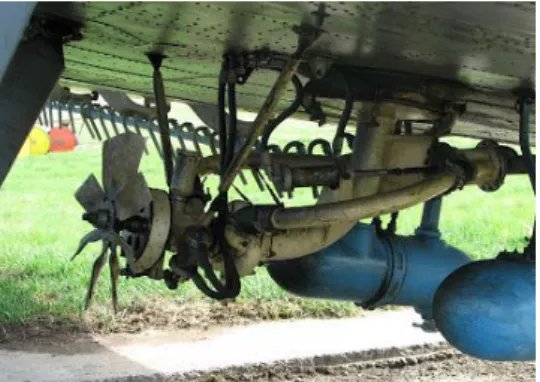
experimental research program it was used a biplane airplane AN 2 (fig. 1), equipped to perform works for the application of the plant protection
treatments. Spraying booms are
equipped with hydraulic spray nozzles type 28-08-46. The adjustment of the liquid flow is achieved by changing the size of the jets fitted into the distributions pipes (Bungescu S. T., Jorg P., Walter S., 2004; Naghiu Livia, 2008).
The main objectives of the experimental determinations were the following:
- the determination of the transverse profile distribution of the liquid dose and establishing the optimal spray width;
259
Fig. 1. Spraying equipment, mounted on AN-2 plane.
Experimental investigations have been carried out in the framework of an autumn rape crop, using Acanto Plus fungicide, which is a complex systemic product, with a wide range of combat foliar disease to rape.
MATERIAL AND METHOD
In the frame of experiments have been performed calculations in order to determine the following parameters:
➢ side drift (Dl) , determined with relation (Bungescu S. T., Jorg P., Walter S., 2004):
sin =
d w l
V V H
D [m] (1)
where: H is the height of the flight of the aircraft, in m;
Vw – side wind speed, in ms-1; Vd – fall droplets speed, in ms-1; α – the value of the angle formed by the direction of flight with the wind direction, in °.
➢ the surface sprayed (S) with a load (full) of the tank, calculated using the relationship (Bungescu S. T., Jorg P., Walter S., 2004):
S = C / D [ha] (2) where: C – the capacity of the tank, in l; D – the dose of liquid applied, in l/ha.
➢ the overall width of the surface sprayed (Lp) with a full tank, determined with relation (Bungescu S. T., Jorg P., Walter S., 2004):
Lp = (C ·10.000) / (D·L) [m] (3) where: L is the length of the parcel, in m.
➢ the total flow of the nozzles (Qt), calculated on the basis of the relation:
Qt = (V·B·D) / 600 [l /s] (4) where: V – the speed of flight of the aircraft, in km/h;
B – the working width, respectively the distance between two passages, in m. ➢ productivity per minute of aircraft (P), using the relation:
Prod = (V·B) / 600 [ha/min] (5) In order to determine the specific parameters of the work are using the following sizes:
- capacity of full tank: C=1200 l;
- the length of the plot: L=750 m;
- flight speed of the aircraft: V=150 km /h;
- the distance between two passages: B=15 m;
- wind speed determined using an anemometer: v=1,6 ms-1;
- the value of the angle formed by the direction of flight with the wind direction: α=300;
- size of droplets: VMD=200μm;
- fall speed of droplets, determined in laboratory conditions: Vd =0,4 m/s.
The experimental investigation (concerning the determination of the transverse profile distribution of the liquid dose and the optimal spray width) was based on the following:
- collection of the distributed particles on a well defined area (samples of absorbent paper having a surface S=1,0 m2);
- achieving a quantitative analysis of samples by weighing, data acquisition and processing in the computer system.
260
1. Spray deposition on paper targets; 2. The average quantity of spray deposition on samples test (gm), using the relations: ; 0 0 1 m i i n i m g n g g g − + =
= ] [ 0 1 g n g g i n i om
== (1)
where: gi is the quantity of solution distributed on a samples test, in g; g0i - weight of samples test in initial conditions, in g;
g0m - average weigh of samples test, in initial conditions, in g;
n - number of samples test.
3. Uniformity of distribution on the transverse direction (U), with relation:
[%] 100 1 ) ( 100 100 2 1 − − − = − =
= m m i n i V g n g g CU (2)
where Cv is the coefficient of variation of
the distribution uniformity on the transverse direction, in %.
Measurement equipment and data acquisition includes the following
components: portable computer;
electronic balance Kern EWJ 600-2M (precision of weighing 0,01 g); collecting system for distributed particles, based on absorbent paper. (Vasile C., 2017).
In the framework of experiments were performed two tests, in the following conditions (table 1).
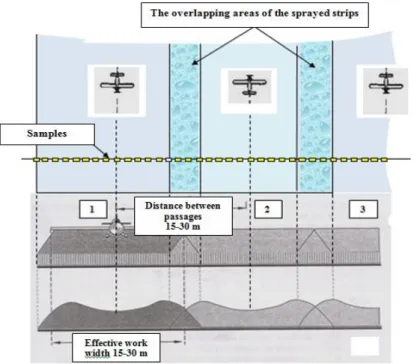
The paper samples were mounted on wooden frames (in order to avoid their movement by air currents), horizontally and equidistant (fig. 2). In order to make a clear comparison between the deposition of the cloud drops on the treated surface, for the calm atmospheric conditions, respectively side wind of moderate intensity, the location of the samples has been made on a greater width (45 m).
Table 1 Conditions for carrying out of tests
Working parameters TEST 1 TEST 2
Type of nozzles Hydraulic: 28-08-46
(medium atomization)
Hydraulic: 28-08-46
(medium atomization) The dose of liquid D=70 l/ha D=70 l/ha Working pressure p=25 psi p=25 psi
Working height H=5 m H=5 m
Atmospheric conditions calm atmospheric wind with moderate intensity, v=1,6 ms-1
261
Before placing samples for tests it will proceed to their individual weighing. The obtained values (g0i) are registered into the computer, using a software, which allows recording the measured values by cumulating (in their order of determining with the electronic balance) (Glodeanu M., Vasile C, Alexandru T., 2017)
RESULTS AND DISCUSSIONS
The working parameter values obtained from experiments are shown in table 2.
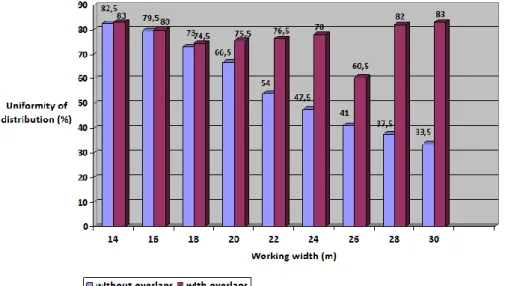
Graphical representation of the data file with the calculated values led to obtain the transverse distribution diagrams achieved by the crop duster for test 1 (with and without overlaps) (fig. 3). The values of the transverse distribution uniformity for various working widths, in test conditions of test 1 are shown in figure 4.
Table 2
Working parameter values obtained from experiments
Working parameters Dl [m] S [ha] Lp [m] Qt [l /min] Prod [ha/min]
Value 10 17,1 228,5 8,75 7,5
Fig. 3. Transverse distribution diagram of the droplets on the treated surface, in conditions of atmospheric calm (Test 1).
262
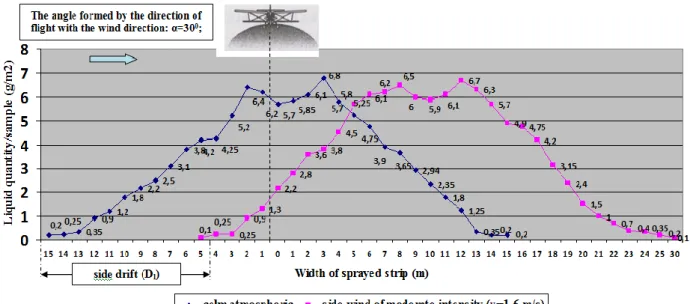
The chart from figure 5 shows a comparison between the deposition of the cloud drops on the treated surface, for the
calm atmospheric conditions, respectively side wind of moderate intensity (test 2).
Fig. 5. Comparison between the deposition of the cloud drops on the treated surface, for the calm atmospheric conditions, respectively side wind of moderate intensity (v=1,6 m/s).
Analysis of the obtained results, judging by the distribution diagrams emphasizes the following:
- the working width of the crop duster is much higher, as a result of the lateral displacement of the cloud drops, between the point of origin and point of impact at ground level (the width of the strip treated at ground level is approx. 30 m);
- the distribution of the solution applied is not uniform across this strip, this having a similar form to normal distribution curve;
- in the framework of the tests it finds a satisfactory uniformity of distribution on the middle area of the strip (over a width of about 14m), after which the applied dose decreases gradually to approx. 0;
- analysis of the transverse distribution diagrams (without overlaps) indicated low values of the transverse uniformity of distribution to the ends of the sprayed strips (approx. 33%);
- also the analysis of the transverse distribution diagrams has shown
that the adoption of a driving mode with overlaps of the sprayed strips has a favorable influence for ensuring a significant increases of the transverse uniformity of distribution (in particular in the extremes areas of the sprayed strips);
- due to side winds, the droplet deposit shall be made at a relatively large distance from the vertical point of production and depends on the volume median diameter (VMD) of droplets.
CONCLUSIONS
263
application of insecticides and fungicides it is recommended to use nozzles which ensure droplets of medium size
(insecticides - VMD=150...300 μ; fungicides - VMD=150...200 μ); for the application of herbicides it is
recommended to use nozzles which ensure a coarse size of droplets (contact herbicides - VMD=250...400 μ).
3. Taking into account the fact that the liquid doses applied in these cases are smaller, and also the fact that the values of the working parameters obtained from experiments are increased, researches have highlighted the use of crop dusters for the application of treatments to combat pests and diseases (provided to calculate with precision the side drift).
BIBLIOGRAPHY
1. Brady R. B., 1999, Aerial Advantage, Lightweight agricultural aircraft makes work fun, Resource, pp. 7-8.
2. Bungescu S. T., Jorg P., Walter S., 2004, Aerial means for the application of the plant protection treatments and fertilization of agricultural and forestry crops, MIRTON Publishing House, , pp. 30-45, Timișoara.
3. FAO, 2001, Guidelines on Good Practice for Aerial Application of Pesticides, FAO, 2001, pp. 12-18, Rome.
4. Frățian Al., 1993, Technique d′aplication des trataments UBV dans les forets et quelque posibilites de diminuer leur incidence sur l′environnement,
ANPP-BCPC, Second Symposium international sur techniques d′aplication des pesticides, pp. 425-430, Strasbourg.
5. Glodeanu M., Vasile C, Alexandru T., 2017, Evaluation in
working conditions the
performances of an electronic regulator that equips sprinkling
machines, SGEM 2017
Conference Proceedings, June 28 - July 6, Book 3, Vol. II, pp. 217-224.
6. Naghiu Livia, 2008, Horticultural machines and installations, vol I, RISOPRINT Publishing House, pp. 309-314, Cluj-Napoca.
7. Popescu C., 2016 - The modification of some features of soils located nearby chemical plant Craiova zone that is affected by noxioux substances, SGEM 2016 Conference Proceedings, vol. 2, pag. 409-415;
8. Popescu, C., 2017 –
Reconstrucția ecologică și ameliorarea solurilor și terenurilor degradate, Editura Sitech Craiova, ISBN 978-606-11-5397-3;
9. Vasile C., 2015, The analytical and experimental modeling of
functioning of automated
installations from CFF, Annals of the University of Craiova -
Agriculture, Montanology,