131
All Rights Reserved © 2012 IJARCSEE
Tailoring RUP to Shataayu Project : A
Case Study
Fatema Rangwala, Kirti Mathur, Taher Ali Rangwala, Ashwini Mathur Devi Ahilya Viswavidhyalay, Vellore Institute Of Technology.
Abstract – For developing a project the
framework which is widely used is Rational Unified Process (RUP). RUP is used widely due to its core principles i.e. architecture centric, uses use case model for user documentation and is an iterative and incremental process model. RUP defines many artifacts and roles which are very useful during software development. But RUP does not fit for all software’s to be developed as there are many different type of software with different requirements. Therefore RUP as defined cannot be used in some projects. Therefore it has to be tailored. In this case study we are representing a project in which how RUP is tailored is shown. Research method used in this case study is action research and for data collection postmortem analysis is done. In which all the team members evaluate the project being developed and project’s flip side is also discussed.
Keywords – RUP (Rational Unified
Process), UML (Unified Modeling Language), action research, postmortem analysis.
I. INTRODUCTION –
RUP is a software engineering process widely used by software developers. It is an iterative software development process framework
based on UML created by the Rational Software Corporation, a division of IBM since 2003[1]. UML (Unified Modeling Language) is a standardized general purpose modeling language in field of software engineering[2]. Rational Unified Process (RUP) is a software engineering approach to the assignment of tasks and responsibilities within a development organization. Its goal is to deliver the software on time with assured quality and within affordable cost. RUP is modified and customized in accordance with project but it does not deal with issues like how to provide security to a developing software. RUP deals with
“HOW” and not with “WHAT” i.e. it shows
how to do and not what to do. RUP is a iterative software engineering process, though it is not a well defined process model instead it is an adaptable process framework which can be tailored or customized by an organization according to different application. RUP is a disciplined, iterative approach used to assign task and responsibilities to software development team. In 1995, the Standish group published the first version of the CHAOS report on software projects effectiveness. This report showed the main reasons for projects being in trouble: lack
of user involvement, low quality of
requirement specification, and changing
132
All Rights Reserved © 2012 IJARCSEE limitations. For example, in it is argued that
RUP lacks of a truly “architecture centric” approach to software development, it is said to be unnecessarily complex, inadequate to structure complex software processes, does not properly support project management and fails short in achieving adequate users feedback. Hence, the question of the advantages and disadvantages of RUP is still an open discussion in software engineering [3]. Security is also a big issue nowadays in every software but in RUP the security is limited to only initial phases of development during the identification and documentation of supplementary requirements. But only in the initial phase the threats cannot be identified completely. No security plans exists thereafter for finding malicious objects within a software. In RUP, software engineering processes are organized into phases and iterations[4]. It comprises of six best practices which are : develop iteratively, manage requirements, employ a component based architecture, model software visually, continuously verify quality and control
changes. Four Phases of RUP are Inception
Phase in this phase initial cost, budget and success factor is forecasted. Use case model, project plan and initial risk assessment is
generated. Elaboration Phase this phase
focuses on risk items and architecture of
project. Construction Phase objective is to
develop components and other features of the
project results in deliverable output. Transition
Phase in this the software transits from producers to end users. End user training, maintenance and testing is done. There are nine disciplines within each iteration which describes unit of work assigned to a role. Six
engineering disciplines are - Business
Modeling is used for enterprise process analysis, improving process efficiency and
quality. Requirements deals with functional,
quality and performance requirement which collectively defines what system should do.
Analysis And Design Transforms requirement to system design using use cases and models defined by UML (Unified Modeling Language) defines object characterized by its class to develop comprehensive architecture adapting design of system for
performance. Implementation Classes and
objects are implemented in terms of executables, source files and others. Components are tested and integrate to
produce executable system. Test and
Deployment where test verify the
implementation correctness. Any defects encountered is either fixed or elicited. Deployment refers to custom install and
end user can access the system. Three
supporting disciplines Generally are –
Configuration and Change Management
discipline deal with identifying and managing configuration item and control changes demanded and change version. Project Management discipline focuses on monitoring project by planning, staffing and risk management. Metrics and progress of iterative projects are also monitored. Environment discipline aims to configure the process and provides tools and Supporting processes to software development as shown in Fig. 3. [5]. How all this disciplines fit in our project is shown in next section.
II. RESEARCH METHOD –
133
All Rights Reserved © 2012 IJARCSEE used is action research. Action research is
simply a form of self-reflective enquiry undertaken by participants in social situations in order to improve the rationality and justice of their own practices, their understanding of these practices, and the situations in which the
practices are carried out (Carr and Kemmis
1986: 162). Action research is an cyclic process, the steps involved are –
Figure 2. The cyclic process of action research [6]
Before we describe the phases of action research, let us have a look at research context.
A. Research Context –
The company whose project has been undertaken in this case study name is not revealed due to some reason. At the time of this project the employee number of that company were 30. Company used to undertake both public sector project and private sector project. They have made many public sector projects. The projects were developed under guidance of two project leader. The projects developed were desktop application as well as web application projects. The technology used were Java, J2EE, C#, PHP. The technology
used for project been discussed here is PHP, it is a web application, with strong back end logic and good user interface. The project was developed for a private doctor clinic to fix and cancel appointments and for doctor to keep track of the number of people in queue waiting at his/her clinic for checkup turn. RUP
mentors were appointed for training
developers to develop project according to RUP. But while using RUP the developers faced some problems. The solution of which was found after tailoring RUP according to our project requirements.
Compa ny Name
Project Type
Team Size
Projec t Size
Process Model Used Not
Mentio ned
Deskto p Applica tion
10 team mem bers
Small Projec t develo ped in 20 days.
RUP(Rat ional Unified Process)
Table 1. Representing company and project details.
B. Identify or diagnose the problem phase
In the diagnosing phase of the project, the training needs are determined for persons with different disabilities, abilities, learning styles and literacy levels. This research is conducted in partnership with training specialists, educators, educational, kinesiologists, and specialists in the disability domain[7]. In this case study team leader, project manager, project leader, project developer with different experience were interviewed.
a) The interview general experience –
Identify the problem
Gather data
Interpret data Act on
evidence Evaluate
134
All Rights Reserved © 2012 IJARCSEE This interview was conducted to find general
area of problem and finding how well RUP artifact and roles fit while developing the project. RUP disciplines one by one were examined for that. Lets have a look on each discipline-
Business Modeling – It is used in this project for understanding the need of the doctor for this project, the problems faced and the possible solution. Roles defined by RUP in
business modeling are business
process analyst, business designer and business model viewer. Of which business process analyst establishes business actors and use cases and also show how they interact. Business designer describe the workflow of use cases, decides team size and members and realize use cases. Activities
mentioned in RUP are assess target
organization, set and adjust goals, maintain business rules, define business architecture, capture common business vocabulary, find business actors and use cases, structure business use case model, detail business worker, find business workers and entities, detail business
entity, define automation
requirement, review business use case model and review business object model. Of which applied in our project were assess target organization for understanding doctor need and environment of clinic. Find business actor and use case to identify boundaries, customers for which it is developed and use case diagrams are developed in it and structure business use case model.
Artifacts defined by RUP are business
glossary, business rules, business use
case model, business object model,
target organization assessment,
business vision, business architecture document, supplementary business
specification, business use case,
business use case realization, business actors, business entity and business worker. Of which we used were business use case and business use case realization.
Requirement Discipline – It helps in
eliciting requirement from
stakeholder and developing software accordingly. The roles defined by
RUP in it are system analyst,
software architect, requirements specifier, requirement reviewer and user - interface designer. Roles required in our project were system analyst to outline project functionality, software architect coordinates technical activities and artifacts, user interface designer designs the user
interface, requirement specifier
details use case and doctor’s requirements. Activities specified in RUP are develop requirements management plan, develop vision, elicit stakeholder requests, capture common vocabulary, find actors and use cases, manage dependencies, structure the use case model, prioritize use cases, detail use case, detail software requirements, model the user interface, prototype user interface, review requirement, used
were develop management
135
All Rights Reserved © 2012 IJARCSEE case, find actors and use cases is used
for define functions of the website, use case model diagrams are created and defines website is being used by whom, model the user interface is used for building model of user interface and review requirements is used for verifying that requirement result conform user’s view. Artifacts are requirement management plan, stakeholder requests, glossary,
vision, use case model,
supplementary specification, use case, use case package, software
requirement specification, user
interface prototype and use case storyboard. Artifacts used are requirement management plan which is the output artifact of activity
develop requirement management
plan, glossary it is the output of activity capture a common vocabulary, Vision defines the stakeholders view of the product to be developed, use case model defines system’s intended functions, supplementary specification it captures specification other than use case like usability, reliability. Software requirement specification consists of a package containing use cases of the use-case model and applicable supplementary specifications.
Analysis and Design – In this
discipline requirements are converted to designs. Roles defined are software architect, capsule designer, designer, database designer, architecture reviewer, design reviewer. Used in our project were software architect, designer, database designer handles all back end logic. Activities are architectural analysis, identify
design mechanisms, identify design elements, construct architectural proof of concept, incorporate existing design elements, describe run time architecture, describe distribution, capsule design, use case analysis, use case design, sub system design, class design, design test classes and packages, database design, review the architecture and review the design. Activities used are architectural analysis used for planning and defining reuse strategy, identify design mechanism to refine analysis
mechanisms into design
mechanisms, incorporate existing design elements analyze interactions of analysis classes to find interfaces,
design classes and design
subsystems, use case analysis and use case design describes use case related things, database design ensures database entries to be stored consistently, review the architecture is done to identify any architectural flaws, review the design to ensure that the design guidelines fulfills the requirements.
Artifacts are deployment model,
software architecture document,
analysis model, design model, reference architecture, interface, signal, event, protocol, use case realization, analysis class, design class, design subsystem, design package, capsule and data model. Used are deployment model,
software architecture document
provides a comprehensive
136
All Rights Reserved © 2012 IJARCSEE operations, use case realization
describes how a particular use case is realized within the design model and data model describes the logical and physical representation of persistent data in the system.
Implementation – It defines the
organization of code, test and integrate developed components.
Roles defined are software
architect, implementer, integrator and
code reviewer. Software architect
coordinates technical activities and artifacts throughout the project,
implementer is responsible for
developing and testing components, implementers deliver their tested components into an integration
workspace whereas integrators
combine them to produce and build, code reviewer ensures source code quality plans and conducts source code reviews. Activities defined are structure the implementation model, implement component, fix a defect, implement test components and subsystem, perform unit tests, plan
system integration, integrate
subsystem, integrate system and
review code. Used are structure the implementation model establishes the structure in which the implementation will reside,
implement component produce
source code in accordance with the design model, fix a defect for fixing defect occurred, implement test component and subsystem implements test-specific functionality, perform unit tests to verify internal structure of unit, plan system integration plans the integration of the system, integrate
system to integrate the
implementation subsystems
piecewise, review code to verify the code. Artifacts are component, implementation subsystem, integration build plan, build, implementation
model. Used are component
represents a piece of software code or a file containing information, integration build plan summarizes of detailed integration plan within an iteration, build is an operational version of a system or part of a system, implementation model is a collection of components like executables and source file.
Test – It is done for assessment of
quality. Roles defined are test
manager, test analyst, test designer and tester. Test manager has the overall responsibility for test effort’s success. Test analyst defines the required tests, test designer defines the test approach and ensures its
successful implementation and
tester is responsible for the core activities of the test effort. Activities
defined are agree mission, identify
137
All Rights Reserved © 2012 IJARCSEE resolution, assess and improve test
effort is used for making an assessment of the productivity, effectiveness and completeness of the test effort, identify targets of test identifies system elements that need to be tested, define assessment and traceability needs to identify assessment strategy and traceability requirements, determine test results evaluate product quality and if encounter any defect in quality propose corrective actions, define test approach for identifying techniques for testing, define test environment configuration defines requirements for the evaluation environment to support test effort, structure the test implementation defines the required test suites, implement test is used for implementing tests to provide required product validation, implement test suite is used for assembling collections of tests to be executed together, execute test suite is used for executing test suite for obtaining test results, analyze test failure details and analyze the failures that occurred during test implementation and
execution. Artifacts are test plan,
test evaluation summary, test script, test log, test ideas list, Test case, workload analysis model, test data, test results, test automation
architecture, test interface
specification, test environment
configuration, test suite, test
guidelines, test class and test component. Artifacts applied are test plan defines item targeted, approaches taken, resources required and deliverables produced, test evaluation summary
provides general statement of
relative quality and
recommendations for future test effort, test log represents the output resulting from the execution of a Test Suite, test case specifies set of test inputs, execution conditions, and expected results, for evaluating some aspect of a Target Test Item, test result is a collection of summary information determined from the analysis of one or more Test Logs and Change Requests helps in quality assessment, test environment configuration specifies hardware, software and associated environment setting required for testing and evaluating target test items, test suite is a collections of Test Scripts, both for execution of the tests and to provide a useful and related set of Test Log information from which Test results can be determined.
Deployment – It concerns with
software product delivery. Roles
specified are deployment manager,
course developer, implementer,
138
All Rights Reserved © 2012 IJARCSEE
artwork, develop support materials. Applied are Deployment plan documents how and when the product is to be made available to the user, manage acceptance test ensures that the developed product fulfills its acceptance criteria at both the development, and target installation site, verify manufactured product ensures that the manufactured product is complete, and useable, define bill of material is a complete list of artifacts that will be required to make up the build/product, manage beta test is a pre release test for testing the end product, develop installation artifact Produce all the software required to install and uninstall the product quickly, easily and safely without affecting other applications or system characteristics and develop support material develops the end user
support material. Artifacts are
deployment plan, bill of materials, release notes, product, installation
artifacts, training materials,
deployment unit, product artwork and end user support material. Deployment plan is output from activity develop deployment plan, bill of material is output from activity define bill of materials, installation artifact is a output activity of develop installation artifact, end user support material is output activity from develop support material.
Environment - Focuses on the
activities necessary to configure the process for a project. Roles
specified are process engineer, tool
specialist, user interface designer, system analyst, business process analyst, software architect, test designer, technical writer and system
administrator. Process engineer deal with software development process, continuously evaluate process and improve it, tool specialist selects and acquires tools, user interface
designer builds user interface
prototype, system analyst ensures what actors and use cases exist and how
they interact, software architect
coordinates technical activities and artifacts, test designer defines test approach and ensures it’s successful implementation. Activities defined in
RUP are assess current organization,
develop development case, develop project specific templates, launch development case, select & acquire tools, setup tools, develop toll guidelines, verify tool configuration and installation, develop user interface guidelines, develop use case modeling guidelines, develop business modeling guidelines, develop design guidelines, develop programming guidelines, develop test guidelines, develop manual style guide and support development. Develop development case describes website development process, select and acquire tools deal with selecting and acquiring tools for our website development, set up tools deal with setting up tool at client side like in our project xamp server was installed at client side for database. Artifacts defined are development case, development organization assessment, project specific
templates, business modeling
guidelines, design guidelines,
139
All Rights Reserved © 2012 IJARCSEE Development case is the output from
activity develop development case, Tools is the output from the activity set up tools and select & acquire tools.
Project Management : It provides a
framework for managing software project and their risks, guidelines for planning, staffing, executing, and monitoring projects. Roles are project manager and project reviewer. Used are project manager allocates resources, shapes priorities,
coordinates interactions with
customers and users, and generally keeps the project team focused on the right goal. The project manager also establishes a set of practices that ensure the integrity and quality of project artifacts. Activities defined are develop business case, initiate project, identify and assess risks, define monitoring and control processes, plan phases and iterations, compile software development plan,
define project organization and
staffing, develop quality assurance plan, develop measurement plan, develop product acceptance plan, develop problem resolution plan, develop risk management plan, develop iteration plan, acquire staff, initiate iteration, assess iteration, prepare for phase close out, prepare for project close out, monitor project status, schedule and assign work, report status, handle exceptions and problems, project approval review, project planning review, iteration plan review, PRA project review, iteration evaluation criteria review, iteration acceptance review, lifecycle milestone review and project acceptance review. Identify and assess risks identify, analyze and priority risks
to determine appropriate risk management strategies, plan phases and iterations estimate scope, cost and effort for the project, develop resource plan, budget, schedule and project plan defining goals to be achieved, acquire staff in this human and available resources are collaborated according to project requirements, initiate iteration starts iteration by allocating staff and other resources defined for project, assess iteration identifies failures and success of the project and any improvement identified, prepare for project close out formalities associated with project acceptance and close-out, reassign project staff, and transfer other project resources, monitor project status captures the current status of project against decided plan, lifecycle milestone review in this project state is reviewed at end of the phase to conclude whether next phase should be initiated or not. Artifacts defined
are software development plan,
business case, iteration plan, iteration assessment, status of assessment, problem resolution plan, risk management plan, risk list, work order, product acceptance plan, measurement plan, quality assurance plan, issue list, project measurements and review records. Artifacts applied are iteration plan is a time sequenced set of activities and tasks, with assigned resources, containing task dependencies, for the
iteration, iteration assessment
captures the result of the iteration it is then evaluated for if any change encountered.
140
All Rights Reserved © 2012 IJARCSEE
Configuration and Change
Management : In this configuration items are identified and changes made due to them are managed and
restricted. Roles defined are
configuration manager, change
control manager, integrator and any role. Integrator integrates the tested subsystem to form a unit. Activities
defined are set up CM environment,
establish CM policies, write CM plan, create deployment unit, report on configuration status, perform
configuration audits, establish
change control process, review change request, confirm duplicate or rejected CR, create integration workspaces, create baselines, promote
baselines, create development
workspaces, make changes, deliver changes, update workspace, submit change request and update change
request. Set up CM environment
creates a baseline for further
development by allocating hardware and drivers required for project development, write configuration management plan describe all CM related activities to be performed during the course of the project lifecycle, create baselines ensures that all developed artifacts are captured and archived, at given points in time, as a basis for further product
development, promote baseline
purpose is to ensure that baselines (individually tested components from
various implementers, and
development teams, combined
together to work together as a
product) and then further
development is done. Artifacts defined
are configuration audit findings,
configuration management plan, project repository, change request,
workspace (integration), workspace (development). Used are configuration audit findings in which baseline,
incompletely tested or failed
requirements are identified,
configuration management plan details the schedule of activities, the assigned responsibilities, and the required resources, including staff, tools, and computer facilities, project repository stores all the derived data and meta data associated with the files and directories, in integration workspace the workspace is shared by all team members.
b. RUP experiences –
Our project team was small comprising of 15 members, some members were playing more than one role in project development. The
roles were developer, project leader/
141
All Rights Reserved © 2012 IJARCSEE action planning is done, which is discussed in
later section.
C. Gather Data –
In this case study we have used postmortem analysis as a tool for data
gathering Dingsøyr’s defines [46],
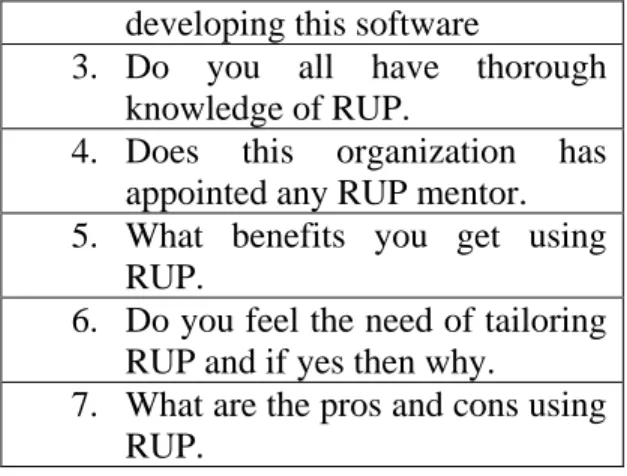
retrospective analysis as a : “collective learning activity, which can be organized for projects either when they end a phase or are terminated. The main motivation is to reflect on what happened in a project in order to improve future practice - for the individuals that have participated in the project and for the organization as a whole.” It is used as a process improvement approach by collecting the positive and negative feedback from each team member using RUP so that it can help in future projects and also help developers for choosing better software development process which lead them to a successful project development. The results obtained are documented in the form of a PMA-report that shows experiences using RUP. During the PMA - sessions, the researchers took personal notes during the work sessions. These notes are also treated as data since they give valuable information about the Post Mortem analyses [8]. The PMA is done through process workshop which was conducted in our office for half a day and all team members experience using RUP were noted. The things that went wrong were listed to find corrective measures for that. The things that went right was also listed with most beneficial thing with high priority.
Questions asked in Process Workshop
1. Is RUP usage beneficial in this
project.
2. Do you think coverage of all the
phases of RUP are essential for
developing this software
3. Do you all have thorough
knowledge of RUP.
4. Does this organization has
appointed any RUP mentor.
5. What benefits you get using
RUP.
6. Do you feel the need of tailoring
RUP and if yes then why.
7. What are the pros and cons using
RUP.
Table 2. Showing the questions used to gather data.
D. Interpret data –
In this the data collected using post mortem analysis is analyzed to find a solution for negative feedback. The report made during PMA sessions play a vital role in research and data analyses. The PMA reports in this case study follow a template which ensure that both positive and negative experiences from the project are documented [9]. PMA helps company to analyze what worked well and what had gone wrong during software development which will help team members to create a baseline for other projects by avoiding the things that gone wrong previously. The list created in process workshop is analyzed minutely to find solutions of the problem occurred.
E. Act on Evidence –
142
All Rights Reserved © 2012 IJARCSEE changed frequently, software development
process model vary according to project as the project leader told us, but they mainly use RUP for project development by using use cases and UML. Process workshop was conducted to get a in depth view of what process model is being used and how or to what extend it is implemented. In process workshop team members, project leader, project manager were involved and how they decide which process model to use is investigated. Investigated things were project type, roles defined, models used for training purpose, technology being used, literacy level of people to understand language defined and
their learning styles. Based on this
investigation actions are taken for developing prototype and test models.
F. Evaluate Result –
Through workshop experience of each and every team member is recorded of using RUP. Though they don’t have thorough knowledge of RUP, but through their working experience they all find that RUP requires too much documentation which is very inconvenient for small project. Thus they all felt that tailoring RUP is necessary with our project scope and requirement. team members also feels that a knowledge management environment should be developed within the organization so that team members can share their knowledge with other members and thus helps in tailoring RUP.
III. Conclusion –
In this case study we presented scenario of a medium sized organization developing a small project with team of 10 members. They found RUP is too much documentation seeking, so for small size project it is difficult to concentrate on coding as many documents
have to be prepared first, and focus is mainly on documentation so the coding part suffers as time for developing small project is not much. So for small projects RUP has to be tailored for its effective use. Also for understanding RUP in detail RUP mentor should be appointed so that time is not wasted in understanding RUP by team members on their own.
IV. Future Research –
In this case study only one project is focused; in future we will compare two or three projects using empirical data of each project so that how RUP should be tailored for seeking its benefit will become more clear.
References :
[1] http://en.wikipedia.org/wiki/RUP [2] http://aelinik.free.fr/cmm/tr25_o2.html [3] Moving From Waterfall to Iterative Development An Empirical Evaluation of Advantages, Disadvantages and Risks of RUP, Jorge A. Osorio Michel R.V.
Chaudron Werner Heijstek, 2011 37th
EUROMICRO
[4]Evaluating RUP Software Development Processes Through Visualization of Effort Distribution, Werner Heijstek, Michel R. V. Chaudron. 978-07695-3276-9/08 ©2008 IEEE.
[5]http://en.wikipedia.org/wiki/IBM_Rationa_ Unified_Process
[6] Action Research by Eileen Ferrance, Northeast and Islands Regional Educational Laboratory At Brown University, 2000.
[7]] Mard´e Greeff and Louis Coetzee,” Using Action Research for Complex Research Initiatives,
143
All Rights Reserved © 2012 IJARCSEE [9] Birk, A., T. Dingsøyr, and T. Stålhane,
Postmortem: Never leave a project
without it. IEEE Software, special issue
on knowledge management insoftware
engineering, 2002. 19(3): p. 43 - 45. [10] Rational Unified Process: Disciplines. [11] Mard´e Greeff and Louis Coetzee,” Using Action Research for Complex Research Initiatives,.
[12]http://en.wikipedia.org/wiki/RUP.
Conference on Software Engineering and Advanced Applications
[13]http://en.wikipedia.org/wiki/IBM_Rational _Unified_Process.
[14]Pedro Borges, Paula Monteiro and Ricardo J. Machado, “Tailoring RUP to Small Software Development Teams”, 011 37th EUROMICRO Conference on Software Engineering and Advanced Applications.
[15] Geir K. Hanssen, Hans Westerheim, Finn Olav Bjørnson, “Tailoring RUP to a defined project type: A case study”.