13
OPTIMIZATION OF CNC TURNING PROCESS PARAMETERS ON
ALUMINIUM 6063 USING RESPONSE SURFACE METHODOLOGY
N.Muthu prakash
Assistant Professor Coimbatore Institute of Engineering and Technology [email protected]
M.Dhineswaran
Assistant Professor Coimbatore Institute of Engineering and Technology
T.Nateshasundharan
Assistant Professor Coimbatore Institute of Engineering and Technology
R.Venkatramanan
Assistant Professor Coimbatore Institute of Engineering and Technology
ABSTRACT
This project presents the effect of process parameter in turning operation to predict surface roughness. The turning process by using CNC turning lathe is widely used in industry because of its versatility and efficiency. Applications of the turning process can be found in many industries ranging from large engine manufactures to small die shops. The parameters that affect the turning operation are vibration, tool wear, surface roughness etc. Among this surface roughness is an important factor that affects the quality in manufacturing process. The main objective of this project is to predict the surface roughness on aluminium 6063, by optimizing the input parameters such as spindle speed, feed rate and depth of cut by using coated carbide tool. A second order mathematical model is developed using regression technique and optimization is carried out using Box-Behnken of response surface methodology. The application of response surface methodology for optimizing the input parameters such as spindle speed (rpm), feed rate (mm/min) and depth of cut (mm), the output parameter surface roughness can also be optimized for economical production. Therefore, this study attempts the application of response surface methodology to find the optimal solution of the cutting conditions for giving the minimum value of surface roughness using design- expert 8.0 software
Key words: Optimization, RSM, Surface roughness
1. INTRODUCTION 1.1 TURNING:
Turning is the process whereby a single point cutting tool is parallel to the surface. It can be done manually, in a traditional form of lathe, which frequently requires continuous supervision by the operator,or by using a computer controlled and automated lathe which does not. This type of machine tool is referred to as having computer numerical control, better known as CNC, and is commonly used with many other types of machine tool besides the lathe.
When turning, a piece of material (wood, metal, plastic even stone) is rotated and a cutting tool is traversed along 2 axes of motion to produce precise diameters and depths. Turning can be either on the outside of the cylinder or on the inside and produce tubular components to various geometries. Although now quite rare, early lathes could even be used to produce complex geometric figures, even the platonic solids; although until the advent of CNC it had become unusual to use one for this purpose for the last
three quarters of the twentieth century. It is said that the lathe is the only machine tool that can reproduce itself.
The turning processes are typically carried out on a lathe, considered to be the oldest machine tools, and can be of four different types such as straight turning, taper turning, profiling or external grooving. Those types of turning processes can produce various shapes performance measures surface roughness and flank wear were investigated. The relationship between the machining input parameters of materials such as straight, conical, curved,
or grooved work piece. In general, turning uses
simple single-point cutting tools. Each group of work piece materials has an optimum set of tools angles which have been developed through the years
2. LITERATURE REVIEW
1. K.Saravanakumar, Dr.A.K.ShaikDawood,
(ESTIJ),(August
14
machining process parameters such as cutting speed (X1, m/min), feed rate(X2, mm/rev), and depth of cut (X3, mm) on the output parameters such as material removal rate and surface roughness. By optimizing input parameters such as cutting speed, feed rate, and depth of cut, etc., the output parameters like surface finish and metal removal rate can also be optimized for economical production. Number of
experiments had been conducted with suitable
combinations of input parameters. Relationship between material removal rate and input parameters and between surface roughness and input parameters are arrived through Design expert software. These regression equations are solved using genetic algorithm tool.
2. Mr.Ch.Madhu.V.N, .Prof., A.V.N.L. Sharma,
Dr.K.VenkataSubbiah, (April 2012) The main objective of this paper is to predict the surface roughness on Work piece material – TITANIUM. In machining process, Surface roughness is an important index to evaluate cutting performance. The influence of cutting speed, feed rate and depth of cut on the surface roughness is examined. The model for the surface roughness, as a function of cutting parameters, is obtained using ANN in MATLAB7.This research is to carry out the experiments by selecting different variables and their levels, applying artificial neural network (ANN) and then analyzing the results obtained.
3. J.S.Senthilkumaar,P.Selvarani, R.M.Arunachalam,
(November 2010)Inconel 718 is widely used in aerospace industries because of their ability to withstand excessive loads even at elevated temperature. This property makes it, one of the most difficult to machining the material with inferior surface quality and rapid tool wear. Cutting experiments were conducted as per the full factorial design under dry cutting conditions. The effects of the machining parameters on these studies show that cutting conditions, tool wear, the material properties of tool and work piece, as well as cutting speed ‘V’ (m/min), feed rate ‘f’ (mm/rev) and depth of cut ‘a’ (mm) and Surface roughness ‘Ra’ (µ m) Flank wear ‘VB’ (mm) Surface roughness ‘Ra’ (µ m) Flank wear ‘VB’ (mm) the performance measures were established using the nonlinear regression analysisfactors level, its significance to influence the surface roughness and flank wear for the tuning and facing processes.
3. PROBLEM IDENTIFICATION AND METHODOLOGY
3.1 PROBLEM IDENTIFICATION:
Turning is the process whereby a single point cutting tool is parallel to the surface. It can be done manually, in a traditional form of lathe, which frequently requires continuous supervision by the operator, or by using a computer controlled and automated lathe which does not. This type of machine tool is referred to as having computer numerical control, better known as CNC, and is commonly used with many other types of machine
tool besides the lathe. When turning, a piece
of material (wood, metal, plastic even stone) is rotated and a cutting tool is traversed along 2 axes of motion to produce precise diameters and depths. Turning can be either on the outside of the cylinder or on the inside and produce tubular components to various geometries. Although now quite rare, early lathes could even be used to produce complex geometric figures, even the platonic solids; although until the advent of CNC it had become unusual to use one for this purpose for the last three quarters of the twentieth century. It is said that the lathe is the only machine tool that can reproduce itself.
Traditionally, the selection of cutting conditions for machining was left to the machine operator. In such cases, the experience of the operator plays a major role, but even for a skilled operator it is very difficult to attain the optimum values each time. Thus the selection of cutting parameters such as cutting speed, feed rate and depth of cut for machining became difficult and it created great impact in product quality.
15
3.2.Methodology
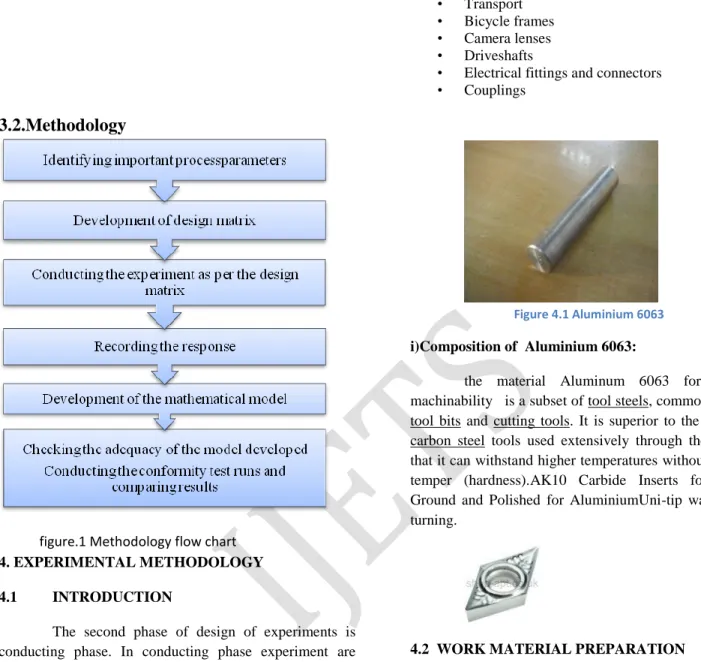
figure.1 Methodology flow chart 4. EXPERIMENTAL METHODOLOGY 4.1 INTRODUCTION
The second phase of design of experiments is conducting phase. In conducting phase experiment are conducted for the selected process parameter combinations at a random order. The conducting phase involves the following tasks.
1. Preparation of work piece.
2. Conducting experiments.
3. Measuring surface roughness.
4. Developing a mathematical model.
The work piece selected Aluminum 6063 is still not given consideration by researchers and suitable for most engineering applications such as
• Aircraft and aerospace components
• Marine fittings
• Transport
• Bicycle frames
• Camera lenses
• Driveshafts
• Electrical fittings and connectors
• Couplings
Figure 4.1 Aluminium 6063
i)Composition of Aluminium 6063:
the material Aluminum 6063 for ease of machinability is a subset of tool steels, commonly used in tool bits and cutting tools. It is superior to the older high carbon steel tools used extensively through the 1940s in that it can withstand higher temperatures without losing its temper (hardness).AK10 Carbide Inserts for Turning Ground and Polished for AluminiumUni-tip was used for turning.
4.2 WORK MATERIAL PREPARATION Specification:
Control system-fanuc emulated Spindle power-1Hp
16
Table 4.1 Composition of Aluminium 6063
(ii)Work material specification:
5.1 Regression equation:
Computer-generated experimental designs, such as the D-optimal design, have some advantages over traditional response surface designs such as the central composite design .One major advantage is much greater flexibility in selecting response surface model types and the number of experimental runs. For example, for a three-factor and one response surface experiment, the following
second-order model is the standard model for box benkhenRegression equations were formed using software for surface roughness.
The regression equation for Surface Roughness Ra (Y) is
Y=0.50527 -– 005 * XI + 1.37625 * X2+ 0.23025 * X3 + 3.25000E 004 * XIX2 1.50000 E 005* XIX3
-2.50000* X2 X3 + - 008* XI 2 - 3.56250*
X28.12500E-003* X32 Where,
X1- refers of input parameters spindle speed. X2 -refers of input parameters feed rate. X3-refers of input parameters depth of cut. Y-refers of output parameters surface roughness
5. OPTIMIZATION METHODOLOGY 5.4 ANOVA
ANOVA: Analysis of Variance
The tests we have learned up to this point allow us to test hypotheses that examine the difference between only
two means. Analysis of Variance or ANOVA will allow us to test the difference between 2 or more means. ANOVA does this by examining the ratio of variability between two conditions and variability within each condition.An ANOVA test, on the other hand, would Cutting
parameter Unit
s
Levels
-1 0 1
Spindle Speed (X1)
Rpm 1000 1500 2000
Feed Rate (X2)
mm/
min 0.06 0.08 0.1
Depth of
Cut (X3) Mm 0.4 0.6 0.8
S. N O
Spindle speed
X1
(rpm)
Feed rate X2
(mm/mi n)
Depth of cut X3
(mm)
Experiment al surface roughness
(µm)
predicte d surface roughnes
s (µm)
1 1000 0.1 0.6 0.623 0.66
2 2000 0.1 0.6 0.687 0.64
3 1000 0.08 0.8 0.638 0.65
4 1500 0.06 0.4 0.641 0.66
5 1500 0.06 0.8 0.678 0.66
6 1500 0.08 0.6 0.661 0.64
7 1500 0.08 0.6 0.663 0.66
8 1500 0.08 0.6 0.653 0.67
9 1000 0.06 0.6 0.646 0.66
10 1500 0.1 0.4 0.661 0.66
11 2000 0.08 0.4 0.695 0.65
12 2000 0.06 0.6 0.697 0.69
13 1000 0.08 0.4 0.638 0.66
14 1500 0.08 0.6 0.659 0.68
15 2000 0.08 0.8 0.689 0.67
16 1500 0.08 0.6 0.667 0.68
17 1500 0.1 0.8 0.658 0.66
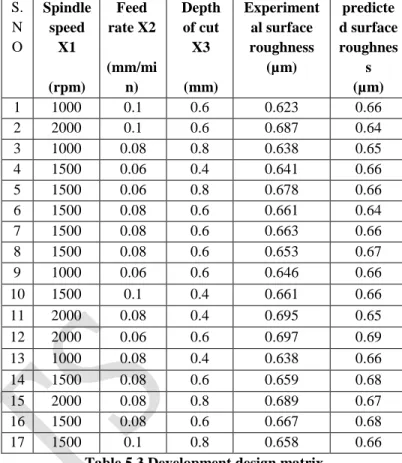
Table 5.3 Development design matrix
R20
mm
17
compare the variability that we observe between the two conditions to the variability observed within each condition. Recall that we measure variability as the sum of the difference of each score from the mean. When we actually calculate an ANOVA we will use a short-cut formula Thus, when the variability that we predict (between the two groups) is much greater than the variability we don't predict (within each group) then we will conclude that our treatments produce different
results.
5.5Results and discussion: Response surface
methodology:
5.5.1 Interaction effect of spindle speed,
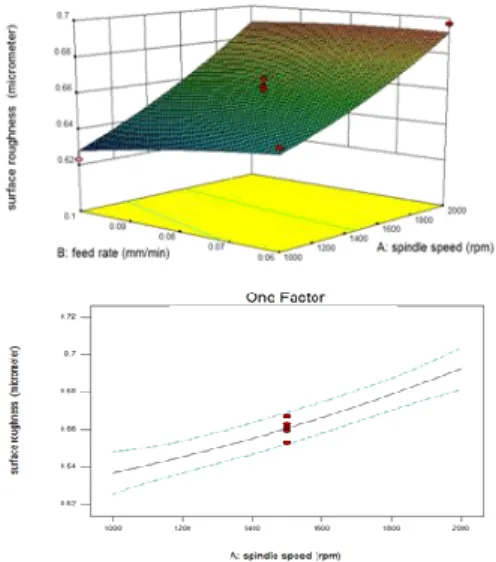
The interaction and direct effect of spindle speed on surface roughness is discussed below.Fig.5.9.1, shows the interaction and direct effect of feed rate and spindle speed on surface roughness. The above interaction figure evidenced that the spindle speed and feed rate on the surface roughness of turning process has a significant effect.
Figure. 5.5.1, Surface interaction dimensional views and direct effect views of spindle speed and feed rate over surface roughness.
As the spindle speed increases from 1000 rpm to 2000 rpm the surface roughness value is reduced from 0.68 to 0.62 µm, where feed rate has the inverse relationship on surface roughness compared to the spindle speed. From the result it is concluded that the change in feed rate (0.06-0.08 mm/min) has significant effect on surface roughness (0.64-0.680.66µm) at higher spindle speed (2000rpm) whereas the change in feed rate (0.06-0.08 mm/min) has no significant effect on surface roughness (0.67-0.68µm) at lower spindle speed (1000 rpm). The conclusion can also be verified from the ANOVA.
5.5.2 Interaction effect of feed rate
The interaction and direct effect of spindle speed on surface roughness is discussed below. Surface roughness is discussed below
Weight
(%) 6063
Al Bal
Si 0.40-0.80
Fe 0.70 max
Cu 0.15-0.40
Mn 0.15
Mg 0.8-1.2
Cr 0.04-0.35
Zn 0.25 max
Ti 0.15 max
Others
each 0.05 max
Others
each 0.15 max
18
Fig.5.5.2, Surface interaction and direct dimensional views and direct effect views of feed rate and depth of cut over surface roughnessFig.5.5.2shows the interaction and direct effect of feed rate and depth of cut on surface roughness. The above interaction figure evidenced that the feed rate and depth of cut on the surface roughness of turning process has a significant effect. From the Fig.8 it has been concluded that higher feed rate and depth of cut was increase the surface roughness whereas lower feed rate and depth of cut decrease the surface roughness. To obtain the quality surface of Ra between 0.62 and 0.64 feed rate less than 0.06 and depth of cut less than 0.70 should be preferred.
5.5.3 Interaction effect of Depth of cut:
The interaction and direct effect of Depth of cut on surface roughness is discussed below.
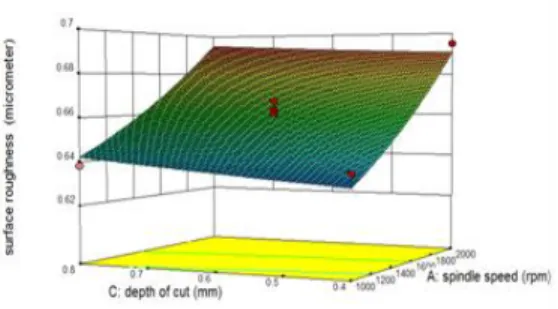
Fig.5.5.3, Surface interaction and direct dimensional views and direct effect views of spindle speed and depth of cut over surface roughness
Fig.5.5.3 shows the interaction and direct effect of depth of cut and spindle speed on surface roughness. The above interaction figure evidenced that the spindle speed and depth of cut on the surface roughness of turning path of cutrsm process has a significant effect. From the Fig.10 it has been concluded that the lower spindle speed (1000 rpm) with the increase in depth of cut (0.7 to 0.8 mm) has a significant effect on surface roughness (0.62-0.67µm) at higher spindle speed (2000rpm) whereas the increase in depth of cut (0.4 to 0.5 mm) has no significant effect on surface roughness (0.65 to 0.64µm) at lower spindle speed (1000 rpm).
5.5.4Prediction Vs Actual
Fig. 4 revealed that they have no obvious pattern and unusual structure. This implies that the models proposed are adequate and there is no reason to suspect any violation of the independence or constant variation assumption
has no significant effect on surface
roughness (0.67-0.69µm) at lower spindle speed (1000 rpm).
A feed rate less than 0.08 and depth of cut less than 0.60 have been preferred for obtaining good surface finish
Fig.5. 5.4 Prediction Vs Actual
6. CONCLUSION 6.1 CONCLUSION:
19
±1.5%. The following conclusions are obtained by analysis of work are,
The obtained experimental data can be used to predict the surface roughness 'Ra' by developing the regression model using DoE
A good surface roughness was obtained at the
feed rate (0.06-0.07 mm/min) and spindle speed (1700-2000 rpm).
The change in feed rate (0.06-0.1 mm/min) has
a significant effect on surface roughness (0.69-0.66µm) at higher spindle speed (2000rpm).
The change in feed rate (0.06-0.08 mm/min)
Components in hard turning with CBN tool”, Prediction
model and cutting conditions Optimization,
Measurement 45 (2012),pp.344–353
VII.REFERENCES
[1] Zeelan Basha N, ―Determining the Effect of Cutting
Parameters on Surface
Roughness Using Genetic Algorithm‖ Science, Technology
and Arts Research
Journal, pp.98-101, 2013.
[2] Hamdi, A., Mohamed, A.(2011). Analysis of surface
roughness and cutting force
components in hard turning with CBN tool: Prediction model
and cutting
conditions optimization. Measurement: 344- 354.
[3] Anil, G., Hari, S., Aman,A.(2010).Taguchi-fuzzy multi
output optimization (MOO)
in high speed CNC turningof AISI P-20 tool steel.Expert
Systems with
Applications:.6822-6828.
[4] Amit, S., Vinod, Y.(2011) .Modeling and optimization of
cut quality during pulsed
laser cutting of thin Al-alloy sheet for straight profile. Optics &
Laser Technology:
159-168.
[5] Zeelan Basha N, ―Determining the Effect of Cutting
Parameters on Surface
Roughness Using Genetic Algorithm‖ Science, Technology
and Arts Research
Journal, pp.98-101, 2013.
[6] Marks' Standard Handbook for Mechanical Engineers, 8th
Ed., McGraw Hill, pp.
6-50 to 6-57
[7] Ilhan , A., Mehmet, Ç.(2010).Modeling and prediction of
surface roughness in
turning operations using artificial neural network and multiple
regression
method.Expert Systems with Applications:.5826-5832.
[8] Aman Aggarwal ―Optimizing power consumption for
CNC turned parts using
response surface methodology and Taguchi’s technique—A
comparative analysis‖
journal of materials processing technology 2 0 0 ( 2 0 0 8 ) 373–384.
[9] P.V.S. Suresh ―A genetic algorithmic approach for
optimization of surface
roughness prediction model‖ International Journal of Machine
Tools &
Manufacture 42 (2002) 675–680.
[10] N. Zeelan Basha, ―Optimization of CNC Turning Process
Parameters on
ALUMINIUM 6061 Using Genetic Algorithm‖, International
Journal of
Innovative Science and Modern Engineering, pp.43-46, 2013.
M. Brezocnik, M.
Kovacic, M. Ficko, ―Prediction of surface roughness with Genetic
programming‖,Journal of Materials Processing Technology, 2004,pp.28-36
[11] MaciejGrzendaa, Andres Bustillo, ‖The evolutionary
development of
roughness prediction models‖, Applied Soft Computing
(2012), pp.1-10.
[12] S.S.K. Deepak, ―Applications of Different Optimization
Methods for Metal Cutting
Operation‖–A Review, Research Journal of Engineering Sciences,Vol.1(3),Sept.2012,pp.52-58
[13] HamdiAouici, Mohamed AthmaneYallese, KamelChaoui, TarekMabroukic, JeanFrançois Rigal, ―Analysis of surface
roughness and cutting force components in
hard turning with CBN tool‖, Prediction model and cutting conditions
Optimization, Measurement 45 (2012),pp.344–353.
[14] Arokiadass, K. Palaniradja, N. Alagumoorthi,
―Prediction and Optimization of End
Milling Process Parameters Of cast Aluminium Based MMC.‖,
Trans. Nonferrous