Volume 4 Number 3 December 2018 page 1-2 p-ISSN:2460-1497 and e-ISSN: 2477-3840 DOI: http://dx.doi.org/10.26858/est.v1i1.6047
151
Efforts to Improve Scientific Thinking Skills Through Application Discovery
Model-Based Learning Environment Around
Rindang Prakasiwi1, Bambang Ismanto2
1 Pendidikan Profesi Guru PGSD, Universitas Kristen Satya Wacana Salatiga, Indonesia
Email: [email protected]
2 Pendidikan Profesi Guru PGSD, Universitas Kristen Satya Wacana Salatiga
Email: [email protected]
©2018 – EST Graduate Program Universitas Negeri Makassar. This is an article with open access under license CC BY-NC-4.0 (https://creativecommons.org/licenses/by-nc/4.0/ ).
ABSTRACT
The purpose of the study was to describe the steps of the Discovery Learning-based learning model that can improve students' scientific thinking skills and to find out the effect of the Discovery Learning learning model on improving scientific thinking skills of first grade elementary school(Blotongan 02) students in thematic learning of two subjects: Indonesian and Mathematics. This is a classroom action research conducted in 2 cycles. The instruments used in data collection were questions, observation sheets, questionnaires, and documentation. Qualitative analysis technique was conducted on the data of scientific thinking skills while the quantitative analysis was conducted on the data of learning mastery. The results of the research show that in the first cycle, the students’ mean score was 2.60 (good) and increased to 3.28 (very good) in cycle II. In the first cycle, 67% of students completed the minimum standard and in the second cycle, it increased to 85%. Thus, thematic learning using the Discovery Learning model based on the surrounding environment was concluded to improve scientific thinking skills and learning completeness of students in grade 1, SD Negeri Blotongan 02.
Keywords: discovery learning; scientific thinking; environment
INTRODUCTION
2013 Curriculum is competency-based and is developed to achieve some competencies which are formulated as Competency Mastery Standards. The learning objectives are based on Graduates' Competency Standards Number 21 of 2016 covering the development of student competencies in the realm of attitudes, knowledge and skills. In accordance with the demands of the 2013 Curriculum, learning is conducted thematically. Thematic learning carried out in elementary schools prioritizes experiences through scientific processes. The standard process of education in elementary schools based on Minister of Education and
Culture Number 22 of 2016 states that the learning process is carried out entirely for the development of competencies in the realm of attitude, the realm of knowledge and the realm of skills in a holistic manner.
learning, the contents of lessons are merged so students unconsciously receive and understand the learning content. Thematic learning aims to help students to observe, ask questions, gather information, reason and communicate during the learning process. This is in accordance with the scientific approach emphasized in the 2013 curriculum. Drake (2012) stated that thematic learning uses certain themes to create active, interesting, and meaningful learning.
Problem-solving activities provided in the learning activities will be more meaningful for students than information that is notified directly. This is in line with Brunner's view (Mariza Fitri and Derlina, 2015) which stated that learning models must be designed to help develop students' thinking skills and train them to solve some problems which might be encountered in everyday life. Students must play an active role while studying in the class. The concept of this method is to learn by finding (Discovery Learning) then students organize various learning materials with a final form that is in accordance with the level of their thinking (Suyono and Hariyanto, 2014).
Learning by linking material with the real situation of the surrounding environment will be more meaningful and students will experience a firsthand. This is in line with the opinion of Hamalik (2011) which stated that everything that exists in the environment has meaning and
can influence students’ abilities. Herfin
Purnamawati (2016) stated that giving direct experience to students is important for developing their active and critical thinking skills when learning or understanding the
environment. Learning based on the
environment is also one of the efforts to improve this capability. The scientific process in learning will be much better if students make direct discoveries in the surrounding environment or outdoors to get the concepts learned (Dwi Cahaya Nurani, Sarwanto and Peduk Rintayati, 2018).
Some studies suggesting that the
Discovery Learning model can improve learning outcomes are such as Gina Rosarina, Ali Sudin & Atep Sujana (2016) which concluded that the application of the Discovery Learning model can improve student learning result in the material of “objects form changes” indicated by the percentage of students passing the standard minimum criteria. In this case, the first, second and third cycles showed 26.92%, 65.38% and
88.46% respectively. Another research
conducted by Bekti Yuni Maharani & Agustina Tyas(2017) concluded that the Discovery Learning Model improved the science learning result of fourth-grade elementary school students based on the percentage of the first cycle which was 72% and the second cycle k which was 90%. A study conducted by Ida Wahyu Kurniati, Emi Pujiastuti, and Ary Woro Kurniasih (2017) showed that the ability to think critically in the experimental class was more than 70%. Critical thinking ability and mathematical disposition were indicated to be more improved in that class than in the control class. Rahman Mardia (2016) found that students' creative thinking skills could be improved through the Discovery Learning learning which was shown by the high level of creative thinking ability test score that increased from 0% to 9.1%.
Based on several studies that had been carried out, there had been no research on the application of the environment-based Discovery Learning model that aimed to improve scientific
thinking skills and learning outcomes
emphasizes on discovery and focuses on developing students’ ability to solve problems that are in accordance with the development of the present situation. The discovery based learning needs to be actualized in real life so that students can solve problems that they might encounter (Edi Nurcahyono, Leo Agung and Djono, 2018).
SDN Blotongan 02 had implemented the 2013 curriculum using a thematic approach in the learning process. The implementation of thematic learning there was based on 2013
curriculum education standards, but the
implementation of learning process had not been optimal yet because the teacher was still difficult to integrate surrounding environment condition into learning themes.
The application of learning by using a meaningful environment had not been yet fully
emphasized. Based on observations and
interviews conducted to a Grade 1 teacher at SD Negeri Blotongan 02, we found that learning was less meaningful because the process was still oriented towards cognitive values. Learning was still fixated on teacher books and student books so that it was not in accordance with the students’ context.
were still limited in receiving material from the teacher's instruction so that their scientific thinking skills still did not appear actively. This was seen in the process of observing the reading, ten students were still not careful in observing it, only four students were active in asking, only
seven students were actively gathering
information by looking for learning material sources, in reasoning activities, only seven students were active in group discussions and in the communication process, and only five students dared to come forward to convey their work. The teacher already used models and learning media but had not been able to improve the scientific thinking skills of some students. Based on data on grade 1-students’ learning outcomes in semester 1, in Indonesian Language Subject, students who passed the KKM were 63% (17 out of 27 students) and in Mathematics was 67% (18 out of 27 students).
From the reflection with class 1 teachers, we could identify several problems as follows: (1) the learning process in the theme was still felt to separate several subjects; (2) the use of learning resources in the environment existing around students had not been linked to the learning that has been done; (3) learning was still fixated on teaching materials such as teacher books and student books; (4) scientific approach skills in the 2013 curriculum were not optimal.
As a follow-up to the problem, the researcher and the team of collaborators concluded that the problems were important and urgent to improve. If these problems were not immediately solved, students would become passive in learning, the scientific approach skills became less optimal and it would have an impact on student learning completeness.
The problem-solving plan that would be applied in this study was the use of the Discovery Learning model based on the surrounding environment. The purpose of this study was to improve the scientific thinking skills of elementary school students in thematic learning using the Discovery Learning model based on the surrounding environment. The hypothesis in this study was that the application of the Discovery Learning model based on the environment to learning according to the syntax was believed to improve students 'scientific thinking skills and the application of the Discovery Learning model based on the environment can improve students' scientific thinking skills.
METHOD
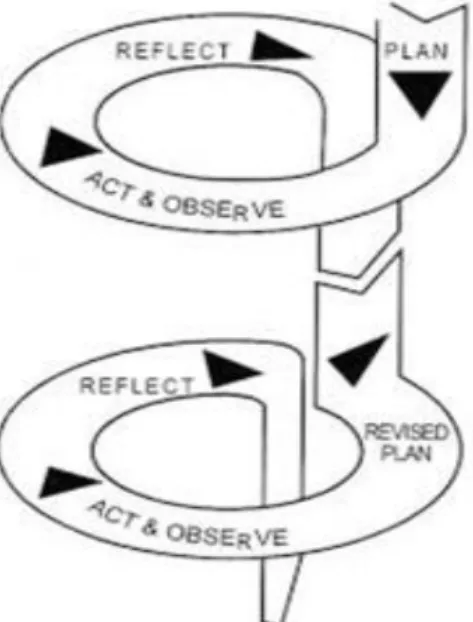
This was a class action research with a research procedure in the form of a cycle using a model adapted from Kemmis & Taggart (1998). The stages of each cycle included planning, action, observing, and reflection as in the following illustration.
Figure 3.1. PTK Cycle Structure (Kemmis & Taggart, 1988)
Operational definitions of variables in this study were: (1). The discovery learning model based on the environment was a way of teaching that involved students in discovery activities that empowered the surrounding environment. (2). Scientific thinking skills were some abilities to find systematic and factual solutions. This research was conducted in the even semester of the academic year 2017/2018 to 27 first grade students of SD Negeri Blotongan 02
This class action research collected quantitative and qualitative data through
observation, documentation, questionnaires,
field notes and tests.
Data analysis techniques in this study included: (1) the analysis of the qualitative data covering the scientific thinking skills obtained
from observation conducted during the
RESULTS AND DISCUSSION Results
The description of the application of the environment-based Discovery Learning mode.Discovery Learning is a learning model that emphasizes direct discovery. This learning model is integrated with the needs of the
surrounding environment. Learning that
involves the surrounding environment will become more meaningful so students better understand the material provided.
The surrounding environment is the things around us. The materials and media used for learning are taken from the surrounding environment. Not only are they easy to get, but the learning will also be more concrete.
Learning by involving the surrounding
environment will be more fun because students experience conditions directly. The surrounding environment becomes one of the learning resources because in it there are many aspects that relate to real everyday experiences.
The Discovery Learning model based on the surrounding environment is a learning model that emphasizes the discovery that involves things existing in the environment around students. Some steps of the Discovery Learning model in this study included: (1) stimulation, which was, in this case, the provision of learning stimuli, (2) the identification of problems formulated as a problem statement that aimed to provide opportunities for students to identify
problems, (3) data collection that was gathering information from various sources, (4) data processing through activities carried out, (5) verification to convey the truth, (6) drawing conclusions (generalization) from activities which had been conducted. The application of the Discovery Learning model based on the surrounding environment is very effective to boost the quality of learning. The systematic model steps are believed to improve students' scientific thinking skills.
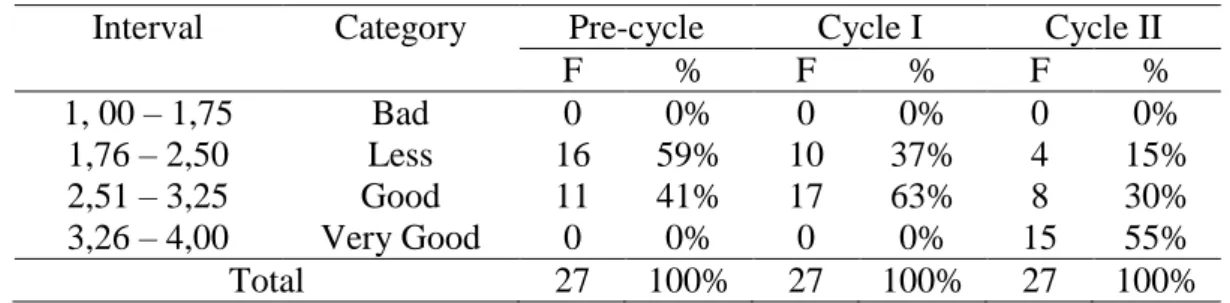
Students' Scientific Thinking Skills in Learning. Based on observations made on students' scientific thinking skills in the learning process in cycle I and cycle II, we identified that scientific thinking skills increased and more students were active during learning. This was shown from the observation sheet of students’ scientific thinking skills measuring 5 indicators including (1) observing skills, (2) questioning skills, (3) information gathering skills, (4) association skills, and (5) communication skills. The measurement interval was (1) a score of 1.00 - 1.75 showing a bad category, (2) a score of 1.76 - 2.50 indicating a bad category, (3) 2.51 - 3.25 showing a good category, ( 4) a score of 3.26 - 4 indicating a very good category.
All activities related to the improvement of scientific thinking skills that were planned properly were proven to successfully improve students' scientific thinking skills during the learning process. The table below compares the student's achievement after the implementation of the three cycles.
Table 4.1 The Growth of Scientific Thinking Cycles during Pre-cycle, Cycle I, and Cycle II
Interval
Category
Pre-cycle
Cycle I
Cycle II
F
%
F
%
F
%
1, 00 – 1,75
Bad
0
0%
0
0%
0
0%
1,76 – 2,50
Less
16
59%
10
37%
4
15%
2,51 – 3,25
Good
11
41%
17
63%
8
30%
3,26 – 4,00
Very Good
0
0%
0
0%
15
55%
Total
27
100%
27
100%
27
100%
The table above shows the data about the improvement of scientific thinking skills obtained from observation. The percentage of students in the precycle which were in the interval of 3.26-4.00 (the very good category) was 0%, in the interval 2.51-3.25 (the good category) was 41%, in the interval 1.76-2.50 (the less good category) was 59% and the interval 1,00-1,75 (the bad category) was 0%.
2.51-3.25 (the good category) was 30%, in the interval 1.76-2.50 (the less good category) was
15% and in the interval 1,00-1,75 (the bad category) was 0%.
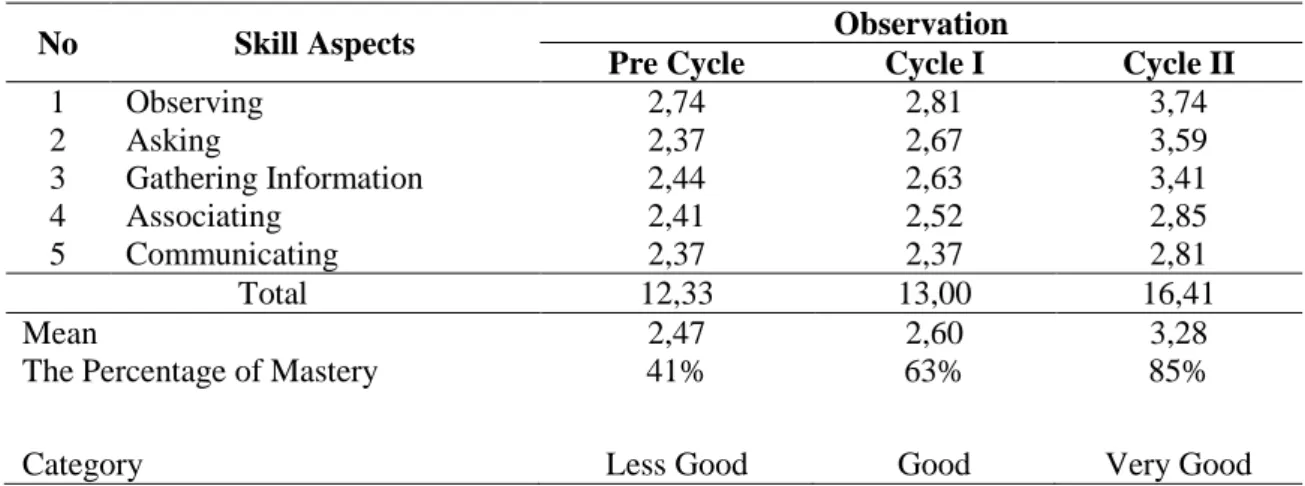
Table 4.2 The Improvement of Scientific Thinking Skills from Pre Cycle to Cycle I and Cycle II
No Skill Aspects Observation
Pre Cycle Cycle I Cycle II
1 Observing 2,74 2,81 3,74
2 Asking 2,37 2,67 3,59
3 Gathering Information 2,44 2,63 3,41
4 Associating 2,41 2,52 2,85
5 Communicating 2,37 2,37 2,81
Total 12,33 13,00 16,41
Mean 2,47 2,60 3,28
The Percentage of Mastery 41% 63% 85%
Category Less Good Good Very Good
Based on the table above, we can identify that the average score of students' scientific thinking skills in the pre-cycle was 2.47 (the Poor category) and there were 41% of students included in the less good category. In the first
cycle, students' scientific thinking skills
experienced an increase which is shown by the average value that increased to 2.60 with the
Good category and the students who received the less good value were 63%. Students' scientific thinking skills then increased again after the cycle II had been implemented. The average value of scientific thinking skills increased to 3.28 with a very good category and the percentage of students who got a less good score reached 85%. Below is the graph illustrating the improvement of scientific thinking skills.
Graph 4.1 The Increasing Students' Scientific Thinking Skills
Student learning outcomes. The increase in the results of students' scientific thinking skills influenced the increase in student
learning outcomes. Based on the measurements made with tests on student learning outcomes using the Discovery Learning model in the
0 0.5 1 1.5 2 2.5 3 3.5 4
Pra Siklus Siklus I Siklus II
Mengamati
Menanya
Mengumpukan Informasi
Mengasosiasi
learning process in cycle I and cycle II, we found that there was an increase in learning outcomes.
In this study, students were given 3 tests, namely the pre-cycle test, the final cycle I test, and the second cycle final test. Each cycle in
this study consisted of one meeting to provide action and one meeting to test the results of learning. The form of the test was a descriptive question. Student learning outcomes in this study experienced an increase in each cycle. Test results can be seen in the table below.
Table 4.3 Pre-cycle, Cycle I and Cycle II Learning Completeness
Categories
Pre Cycle Cycle I Cycle II
Indonesian Language
Mathematics Indonesian
Language
Mathematic s
Indonesian Language
Mathematics
f % f % f % f % f % f %
Completed 17 63% 18 67% 21 78% 20 74% 23 85% 23 85%
Uncompleted 10 37% 9 33% 6 22% 7 26% 4 15% 4 15%
Total 27 100% 27 100% 27 100% 27 100% 27 100% 27 100%
Based on the data in the table above, we identified that the number of students who passed increased from the pre-cycle to cycle I and to cycle II. In Indonesian language lesson, the completeness of pre-cycle learning outcomes was 63%, then in the first cycle it rose to 78%
and continued to rise to 85% in the second cycle. In Mathematics, the completeness of learning outcomes in the pre-cycle was 67%, then in the first cycle, it became 74%, and it continued to increase to 85% in the second cycle.
Graph 4.2 The Mastery of Student Learning Using the Discovery Learning Model
Discussion
The observation conducted in this study provided evidence that the application of the Discovery Learning model based on the
surrounding environment could improve
students' scientific thinking skills. Steps carried out through that approach has stimulated students to be more active in the learning process.
Each indicator in cycle I and cycle II increased. This finding is in line with Brunner's theory which stated that the ideal concept of
learning is learning by finding. This is in accordance with the Discovery Learning learning model, which encourages students to ask questions and draw conclusions from practical general principles of experience samples in discovery activities (Hosnan, 2014). The purpose of the Discovery Learning model based on the environment is to train students to explore or carry out the discovery process by utilizing the environment as information that will never be thoroughly explored.
Research conducted by Joseph Patandung
0% 10% 20% 30% 40% 50% 60% 70% 80% 90%
Pre-Cycle Cycle I Cycle II
Mathematics
showed that there was a significant influence on the application of discovery learning models to student motivation. The research conducted by Nabila Yuliana showed that the Discovery Learning model was able to increase student activeness in the learning process because students could find information on their own. Based on previous studies, the application of the Discovery Learning model always improved learning outcomes.
From this classroom action research, we could identify that scientific thinking skills and student learning outcomes could be increased. This is in accordance with the theory proposed by Sudjana (2013) which stated that the level of success of each teaching and learning activity is measured from the process during learning and from student learning outcomes. Students' scientific thinking skills were measured through observations made during the learning process. Rachman (2009) explained that scientific thinking skills are the ability to identify and analyze phenomena and truths that occur based on data in the field to find solutions through a series of logical and systematic thinking processes. The development of scientific thinking skills can be identified by measuring which indicators of scientific thinking skills achieved. Indicators of scientific thinking skills showed an increase in each cycle and reached the very good category in cycle II.
Students’ learning outcomes also
increased after the implementation of the Discovery Learning model. The increase in learning completeness was indicated by the percentage of learning outcomes in the second cycle which included two subjects namely Indonesian Language which achieved 85% classical completeness and Mathematics which achieved 85% classical completeness.
The increase in learning outcomes was in line with the theory put forward by Bruner stating that meaningful learning is learning by finding something by someone’s own (Discovery Learning). In other words, students played an active role in learning so that they could better understand the material and resulted in the increase of their learning outcomes.
In this study, we identified that improving scientific thinking skills had an effect on the improvement of learning outcomes. Learning outcomes measured were the cognitive aspects. The measurement used a written test. Learning outcomes showed an increase in the cycle I and
cycle II which achieved 85% completeness.
CONCLUSION AND SUGGESTION
Based on the results and discussions, some conclusions were withdrawn as follows. (1). The implementation of the Discovery Learning model based on the surrounding environment on learning carried out according to syntax can improve students' scientific thinking skills. (2) The Discovery Learning model based on the surrounding environment used in the learning process can improve students' scientific thinking skills.
Therefore, the Discovery Learning model based on the surrounding environment can be used by the teacher as an alternative solving problem in the learning process to improve students' scientific thinking skills. The use of Discovery Learning based on the surrounding environment can be developed in other learning contents and as a reference for future research.
REFERENCES
Astutik, P.P. (2016). Integrasi Penguatan Pendidikan Karakter (PPK) dan Higher Order Thinking Skill (HOTS) dalam Pembelajaran Tematik SD.
Drake, S.M. (2012). Creating Standards-Based Integrated Curriculum: The Common Core
State Standards Edition. California:
Corwin Press A Sage Publication.
Fitri, Mariza dan Derlina. (2015). Pengaruh Model Pembelajaran Discovery Learning Terhadap Hasil Belajar Siswa Pada Materi Pokok Suhu dan Kalor. Jurnal Infapi. Volume 3, No. 2: 89-96.
Hamalik, Omar. (2011). Proses Belajar
Mengajar. Jakarta: Bumi Aksara.
Hosnan. (2014). Pendekatan Saintifik dan
Kontekstual Dalam Pembelajaran Abad 21. Bogor: Penerbit Ghalia Indonesia.
Kemendikbud. (2016). Permendikbud No. 21
Kemendikbud. (2016). Permendikbud No. 22 tentang Standar Proses Pendidikan Dasar Dan Menengah. Jakarta: Kementerian Pendidikan dan Kebudayaan.
Kemmis, S & Mc. Taggart, R. (1988). The
Action Research Planner. Deakin University Press. Victoria.
Kurniati, Ida Wahyu., Pujiastuti, Emi.,
Kurniasih, Ary Woro. (2017). Model
Pembelajaran Discovery Learning
Berbantu Smart Sticker untuk
Meningkatkan Disposisi Matematik dan
Kemampuan Berfikir Kritis. Jurnal
MatematikaKreatif Inoatif. Vol 8 (2).
109-118.DOI :
http://dx.doi.org/10.15294/kreano.v8i2.50 60.
Maharani, Bekti Yuni. (2017). Penerapan Model
Pembelajaran Discovery Learning
Berbantu Benda Konkret Untuk
Meningkatkan Hasil Belajar IPA. Jurnal Mitra Pendidikan Edisi Juli. Vol. 1 No. 5. 549-561.
Mardia Hi, Rahman. (2016). Using Discovery
Learning to Encourage Creative Thinking. International Journal of Social Sciences & Educational Studies. Vol. 4 No. 2. 98-103. Doi:10.23918/ijsses.v4i2sip98.
Nurani, Dwi Cahaya, Sarwanto dan Peduk Rintayati. (2018). Influence of Guided Inquiry-Based Outdoor Learning on the Concept Mastery of Thematic Learning by Fourth-Grade Student at Primary School. International Journal of Multicultural and Multireligious Understanding. Volume 5,
Issue 4:485-491.
http://dx.doi.org/10.18415/ijmmu.v5i4.201 7.
Nurcahyono, Edi; Leo Agung S; Djono. (2018).
The Implementation of Discovery
Learning Model with Scientific Learning Approach to Improve Students’ Critical Thinking in Learning History. Volume 5,
Issue 3: 106-112.
http://dx.doi.org/10.18415/ijmmu.v5i3.234
Patandung, Yosef. (2017). Pengaruh Model Discovery Learning Terhadap Peningkatan Motivasi Belajar IPA Siswa. Makassar: Journal of Education Science and Technology. Volume 3, No. 1: 9-17.
Purnamawati, Herfin. (2016). Pembelajaran Berbasis Lingkungan Sekitar Sekolah Pada Siswa Kelas V SD N Deyangan 2. Jurnal Pendidikan Guru Sekolah Dasar. Volume 30, No. 5: 2838-2847.
Rachman, M . (2009). Filsafat Ilmu. Semarang:
Unnes Press.
Rosarina, Gina., Sudin, Ali., Sujana,
Atep.(2016). Penerapan Model Discovery
Learning untuk Meningkatkan Hasil
Belajar siswa pada Materi Perubahan Wujud Benda. Jurnal Pena Ilmiah. Vol.1 No.1. 371-380.
Sudjana.(2013). Dasar-dasar Proses Belajar
Mengajar. Bandung: Sinar Baru Algensindo.
Suyono & Hariyanto. (2014). Belajar dan
Pembelajaran. Bandung: PT Remaja
Rosdakarya.Sudjana, Nana. 2010.
Penilaian Hasil Proses Belajar Mengajar. Bandung: PT Remaja Rosdakarya.