144
RESEARCH ON THE FERTILIZATION OF SWEET POTATOES
ACCORDING TO THE NUTRITIONAL SPACE, IN THE SANDY SOIL
CONDITIONS FROM ROMANIA
Reta Draghici (1), Aurelia Diaconu (1), Mihaela Croitoru (1), Draghici I.(1), Milica Dima (1), Coteț Gh. (1), Alina Paraschiv (1), Oana Boiu Sicuia (2), Mihaela Cioloca (3)
(1) Research and Development Center for Agricultural Plants on Sands, Dabuleni, Romania; E-mail: [email protected] (2) Research and Development Institute for Plant Protection Bucuresti, Romania; E-mail: [email protected] (3) National Institute of Research and Development for Potato and Sugar Beet, Brasov, Romania; E-mail: [email protected]
Keywords: Ipomoea batatas nutrition, physiology, tubers, quality
ABSTRACT
Research conducted during 2015-2017, in the climatic conditions of sandy soils in Romania, highlights the role of fertilization and plant density on the growth and development of sweet potato plants (Ipomoea batatas). The obtained results, show the positive implications of chemical and foliar fertilization on the physiological processes in the plant and on the quantity and quality of the obtained production. The fertilization of the sweet potato culture with N150P80K80, prior to planting and the use of a density of 50000 plants / ha led to a maximum yield of 27907 kg / ha. From the point of view of the quality of the production, the application of two foliar fertilizations with the product Timasol in a concentration of 1%, having N15P15K30 + 13 microelements, determined the increase of the biochemical components from the sweet potato tubers, compared to the only radicular fertilized.
INTRODUCTION
145
MATERIALS AND METHODS
The research was carried out during the period 2015-2017, at the Research and
Development Center for Agricultural Plants on Sands, Dabuleni, by ADER Project 2.2.2.,
within the Sectoral Program 2015-2018, financed by the Ministry of Agriculture and Rural Development of Romania. The eperimental device was placed on a sandy soil, with a reduced natural fertility (extractable phosphorus between 75 ppm and 115 ppm, exchangeable potassium between 57 ppm and 97 ppm, organic carbon with values of
0.18% - 0.51% , and the pH of the soil oscillated between 5.64 and 6.98). The study aimed
to establish the fertilization system for sweet potato culture according to the plant nutrition space. The experience was placed in according to the subdivision parcel method, studied
four fertilization levels (N0P0K0; N80P80K80; N80P80K80; N150P80K80 + 2 foliar fertilization with
Timasol product, in 1% concentration (having the composition in N15P15K30 + 13
microelements), and three planting densities (30000 plants / ha, 40000 plants / ha, 50000 plants / ha) in the KSP 1 variety. Culture was established in the field by seedling obtained by planting sweet potato tubers in a double solar protection during 20 to 25 March. At 35-40 days of vegetation (10-15 May), the shoots were cut, kept for 24 hours at room temperature and then the next day after 17 o'clock, were planted in the field on billy ground and mullioned with foil PE and drip irrigation. During the vegetation period, in the root tuberization phase, was determined photosynthesis rate and plant perfusion rate at leaf level with the LCpro + Portable Photosynthesis System, in 3 moments of the day (9
o'clock, 12 o'clock, 15 o'clock). The sweet potato was harvested about 120 days after the
shoots were planted in the field and the production was analyzed qualitatively as follows: water content and total dry substance (%) by gravimetric method; soluble dry matter content (%) by refractometric method; total carbohydrate content (%) by Fehling Soxhlet method; C vitamin content (mg / 100g of fresh substance) by iodometric method; starch content (%) by gravimetric method. The obtained results were statistically interpreted by variance analysis and mathematical function.
RESEARCH RESULTS
Analyzing the evolution of climatic conditions during the period 2015-2017, during the growing season of sweet potatoes, there is an increase of average air temperature in all years of study compared to the multiannual average (Table 1). There were temperature increases of 1.53-2 0C, relative to the multiannual average, which were favorable for the growth and development of sweet potato plants. From the point of view of the precipitation regime, these were not sufficient for the consumption of sweet potato plants, being supplemented by the irrigation work, in order to ensure 80% of the active humidity range on a 50 cm depth. Of the three experimental years, 2017 was marked by higher air temperature values, with peaks above 40 0C and very low air humidity (25-30%) during root tuberization, which affected the accumulation of the dry substance.
Table 1
Climate conditions recorded at the weather station from R&DCAPS Dabuleni during the potato growing season
Period / Climate parameters May June July August September Average (0C)
∑
0
C /mm
2015
Monthly average
temperature (0C) 19.2 20.5 24.9 24.3 20.1 21.8 3335.4 Maximum monthly
temperature (0C) 30.2 36.1 39.2 37.6 37.3
146 2016
Monthly average
temperature (0C) 16.8 23.6 24.8 23.5 20.4 21.82 3338.5
Maximum monthly
temperature (0C) 32.9 37.3 38.0 38.0 34.1
Rainfall (mm) 104.4 53.2 31.6 1 37.6 227.8
2017
Monthly average
temperature (0C) 17.8 24 24.8 24.8 20.2 22.32 3415
Maximum monthly
temperature (0C) 29.0 41.2 40.8 40.4 36.9
Rainfall (mm) 78.6 17.4 120.8 28.8 18.2 263.8
Multiannual period (1956-2017)
Monthly average
temperature (0C) 16.8 21.6 23.1 22.4 17.8 20.32 3109
Rainfall (mm)
62.12 69.30 53.15 37.28 41.81 263.66
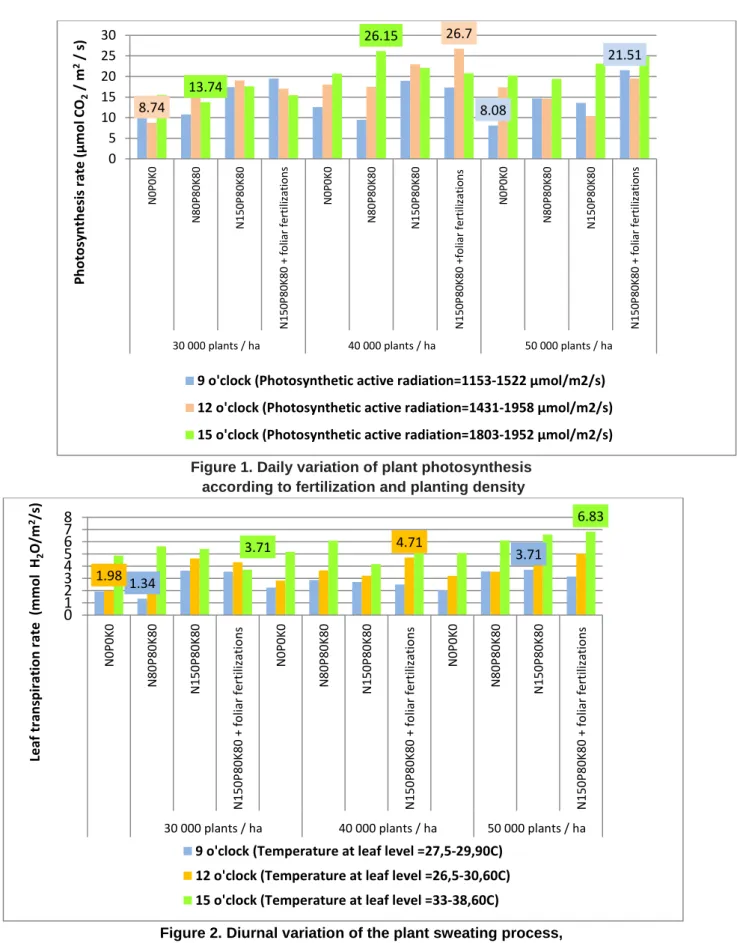
The climatic conditions in the sandy soils area, with high temperatures in the air up to 40 °C, with soil surface temperatures of 65 °C, minimum air humidity at 25% act as stressful factors on the plants, which they dehydrate through the very pronounced foliar sweating. By directing agro-technical factors (irrigation, fertilization, treatment and herbicide of plants) their metabolism can be guided. Plant density influences physiological processes through competition on nutrition space, vegetative shading, and water and mineral consumption. The rate of plant photosynthesis in sweet potato (Figure 1) recorded a daily variation with different values depending on density and fertilization dose. The increase of atmospheric and pedological drought at 12 o'clock and 15 o'clock reduces the absorption of mineral elements due to the increase in the soil solution concentration. Sweet potato has used the most of the nutrition space created by planting 40000 plants / ha and N150P80K80 fertilization + 2 foliar fertilization with Timasol product, in 1%
concentration, recording a maximum rate of photosynthesis in plant (26.7 μmol CO2 / m2 /
s) at 12 o'clock at an active photoisynthesis radiation of 1431-1958 μmol / m2
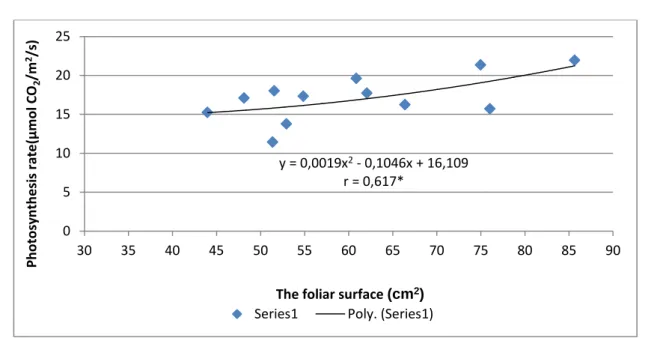
/s. Increasing plant density per hectare causes increased mineral consumption, due to competition on the nutrition space. Stressing factors in the sandy soil area, especially the hydro and thermal regime, have influenced the sweat of the sweet potato plant, depending on the number of plants per hectare and the fertilization regime (Figure 2). The analysis of the results obtained, highlights the increase in the rate of perspiration, as well as increased fertilization doses and planting density. The increase in air temperature also correlates positively with the perspiration rate, with the minimum perspiration values at 9 o'clock (1.34-3.71 mmol H2O / m2 / s), when at the leaf level, in the LCpro + air chamber, was
recorded 27.5-29.9 ° C, and the maximum of perspiration rate at 15 o'clock (3.71-6.83 mmol H2O / m2 / s), when the temperature was 33-38.6 °C. The climatic conditions in the
147
Figure 1. Daily variation of plant photosynthesis according to fertilization and planting density
Figure 2. Diurnal variationof the plant sweating process, according to the density of planting and fertilization
8.08 21.51 8.74 26.7 13.74 26.15 0 5 10 15 20 25 30 N 0P 0K0 N 80P 80K 80 N 150 P 80 K80 N 150 P 80 K80 + f o liar f er ti liz at io ns N 0P 0K0 N 80P 80K 80 N 150 P 80 K80 N 150 P 80 K80 + fo liar f er ti liz at io ns N 0P 0K0 N 80P 80K 80 N 150 P 80 K80 N 150 P 80 K80 + f o liar f er ti liz at io ns
30 000 plants / ha 40 000 plants / ha 50 000 plants / ha
Ph o to sy n th e si s r ate ( µ m o l CO 2 / m
2 /
s)
9 o'clock (Photosynthetic active radiation=1153-1522 µmol/m2/s)
12 o'clock (Photosynthetic active radiation=1431-1958 µmol/m2/s)
15 o'clock (Photosynthetic active radiation=1803-1952 µmol/m2/s)
1.34 3.71 1.98 4.71 3.71 6.83 0 1 2 3 4 5 6 7 8 N 0P0K0 N 80P80K80 N 150P80K80 N 150P80K80 + fo liar fe rti liz ati o n s N 0P0K0 N 80P80K80 N 150P80K80 N 150P80K80 + fo liar fe rti liz ati o n s N 0P0K0 N 80P80K80 N 150P80K80 N 150P80K80 + fo liar fe rti liz ati o n s
30 000 plants / ha 40 000 plants / ha 50 000 plants / ha
Leaf tr an sp ir ation r ate (m m o l H2 O/m 2/s)
9 o'clock (Temperature at leaf level =27,5-29,90C)
148
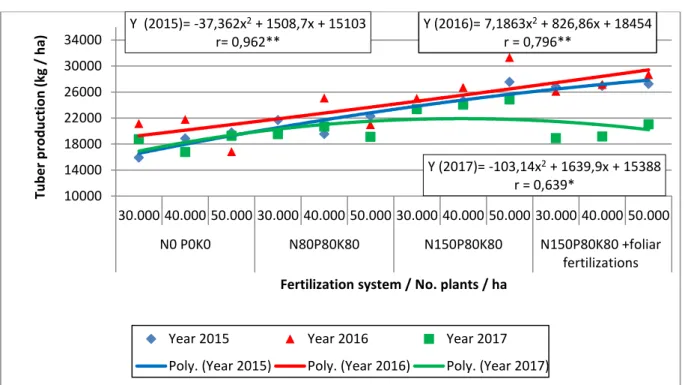
Figure 3. Correlation between the foliar surface and the photosynthesis process in sweet potatoes in the sandy soils conditions
The production of tubers (tuberous roots) in sweet potatoes was influenced both by the climatic conditions and by the technological factors studied (Figure 4). Sweet potato produced the largest production in 2016, significantly correlated with fertilization and planting density (r = 0.796 **). The same distinct positive correlation between production and experimental technological factors was recorded in 2015. The extreme drought conditions of 2017, during the period of tuber rooting, have negatively influenced the effect of applying radicular + foliar fertilization on the accumulation process. This year, a significantly negative correlation was established between production and increased fertilization doses. The variance analysis on the production of tuberous roots with a diameter of more than 3.5 cm, (average 2015-2017) highlights fertilization with N150P80K80
and fertilization with N150P80K80 + the application of two foliar fertilizations with the product
Timasol in a concentration of 1%, having N15P15K30 + 13 microelements, through statistically insured differentiations, of 5309-9300 kg / ha, against the control (planting 30000 plants / ha in non-fertilized system). The maximum yield (27907 kg / ha) was recorded in the fertilized variant with N150P80K80, when 50000 shoots / ha were planted
(Table 2).
y = 0,0019x2 - 0,1046x + 16,109
r = 0,617*
0 5 10 15 20 25
30 35 40 45 50 55 60 65 70 75 80 85 90
Ph
o
to
sy
n
th
e
si
s r
ate
(µ
m
o
l C
O2
/m
2/s)
The foliar surface (cm2)
149
Figure 4. Correlations between plant nutrition and tuber production obtained from sweet potatoes, depending on the climatic year
Table 2
Significance of tuber production obtained from sweet potatoes, depending on fertilization and nutrition space (Average 2015-2017)
Fertilization dose No.
plants/ha
Production of tubers Kg/ha
% din control variant
Difference
Kg/ha Significance
N0 P0K0
30000 18607 100.0 control
variant
40000 19144 102.9 537 -
50000 18626 100.1 19 -
N80P80K80
30000 20287 109.0 1680 -
40000 21778 117.0 3171 -
50000 20806 111.8 2199 -
N150P80K80
30000 23916 128.5 5309 *
40000 25140 135.1 6533 **
50000 27907 150.0 9300 ***
N150P80K80 +two foliar
fertilizations with 1% Timasol product
30000 23942 128.7 5335 *
40000 24426 131.3 5819 *
50000 25673 138.0 7066 **
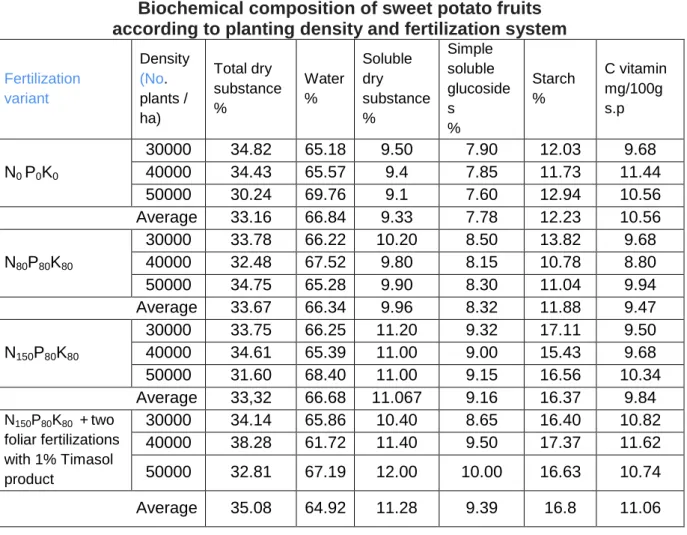
LSD 5%=4213kg/ha LSD 1% = 6051 kg/ha LSD 0.1%= 8908 kg/ha The results obtained with regard to the quality of sweet potato tubers, depending on the fertilization system and the planting density, are presented in Table 3. The biochemical components of the sweet potato tubers were influenced by the plant nutrition regime, with the best results evidenced by the fertilized variant with N150P80K80 + the application of two
foliar fertilizations with the product Timasol in a concentration of 1%, having N15P15K30 + 13 Y (2015)= -37,362x2 + 1508,7x + 15103
r= 0,962**
Y (2016)= 7,1863x2 + 826,86x + 18454
r = 0,796**
Y (2017)= -103,14x2 + 1639,9x + 15388
r = 0,639* 10000
14000 18000 22000 26000 30000 34000
30.000 40.000 50.000 30.000 40.000 50.000 30.000 40.000 50.000 30.000 40.000 50.000
N0 P0K0 N80P80K80 N150P80K80 N150P80K80 +foliar fertilizations
Tu
b
e
r
p
ro
d
u
ction
(k
g /
h
a)
Fertilization system / No. plants / ha
Year 2015 Year 2016 Year 2017
150
microelements, which resulted in increases in the total dry substance content by 1, 92%, of the soluble carbohydrate content by 1.61%, the starch content by 4.57% and the C vitamin content by 0.5 mg / 100 g of fresh substance, compared to the unfertilized variant. From the point of view of the nutrition space, the most balanced content of total dry substance, starch, soluble carbohydrates and C vitamin was achieved when 40000 shoots / ha were planted.
Table 3
Biochemical composition of sweet potato fruits according to planting density and fertilization system
Fertilization variant
Density (No. plants / ha)
Total dry substance %
Water %
Soluble dry substance %
Simple soluble glucoside s
%
Starch %
C vitamin mg/100g s.p
N0 P0K0
30000 34.82 65.18 9.50 7.90 12.03 9.68
40000 34.43 65.57 9.4 7.85 11.73 11.44
50000 30.24 69.76 9.1 7.60 12.94 10.56
Average 33.16 66.84 9.33 7.78 12.23 10.56
N80P80K80
30000 33.78 66.22 10.20 8.50 13.82 9.68
40000 32.48 67.52 9.80 8.15 10.78 8.80
50000 34.75 65.28 9.90 8.30 11.04 9.94
Average 33.67 66.34 9.96 8.32 11.88 9.47
N150P80K80
30000 33.75 66.25 11.20 9.32 17.11 9.50
40000 34.61 65.39 11.00 9.00 15.43 9.68
50000 31.60 68.40 11.00 9.15 16.56 10.34
Average 33,32 66.68 11.067 9.16 16.37 9.84
N150P80K80 +two
foliar fertilizations with 1% Timasol product
30000 34.14 65.86 10.40 8.65 16.40 10.82
40000 38.28 61.72 11.40 9.50 17.37 11.62
50000 32.81 67.19 12.00 10.00 16.63 10.74
Average 35.08 64.92 11.28 9.39 16.8 11.06
CONCLUSIONS
The climatic conditions in the southern Oltenia soils are favorable for the growth and development of sweet potato plants.
The fertilization of the sweet potato, before planting, with N150P80K80 and the use of
a density of 50000 plants / ha resulted in a maximum yield of 27907 kg / ha.
The application of two foliar fertilizations with the 1% Timasol product, which has N15P15K30 + 13 microelements, led to increase the biochemical components of sweet potato tubers compared to the only radicular fertilized variant.
BIBLIOGRAPHY
1. Aurelia DIACONU, Cho EUN-GI, Reta DRĂGICI, Mihaela CROITORU, Marieta PLOAE, Iulian DRĂGHICI, Milica DIMA, 2016. The behavior of sweet potato
(Ipomoea batatas) in terms psamosoils in southern Romania. Scientific Papers.
Series B. Horticulture, Vol. LX, 2016 PRINT ISSN 5653, CD-ROM ISSN 2285-5661, ONLINE ISSN 2286-1580, ISSN-L 2285-5653 Pages 167 to 174.
151
Journal of Pest Management. Volume 41, Issue 1, 1995, p. 27-30, publicat on line 2008. DOI:10.1080/09670879509371917
3. Draghici Reta, Diaconu Aurelia, Draghici Iulian, Toma Vasile, Croitoru Mihaela, Ploae Marieta, Dima Milica, Eun-Gi, CHO, Jong-Sang KIM, 2013.
Preliminary results on sweet potato (Ipomoea batatas) on sandy soils. Annals of Univ. Craiova, Series: Biology, Horticulture, Agricultural Products Processing Technology, Environmental Engineering,Vol. XVII (LIV), I.S.S.N. 1453 – 1275. Editura Universitaria
4. Iamandei Maria, Draghici Reta, Diaconu Aurelia, Drăghici I., Dima Milica, Cho Eun-Gi,2014. Preliminary data on the arthropod biodiversity associated with sweet potato (Ipomoea batatas) crops under sandy soils conditions from southern Romania. Romanian Journal for Plant Protection, Vol. VII, 2014. ISSN 2248 – 129X;
ISSN-L 2248 – 129X
5. Kareem I., 2013. Fertilizer Treatment Effects on Yield and Quality Parameters of Sweet potato (Ipomoea batatas), 2013. Research Journal of Chemical and Environmental Sciences Res. J. Chem. Env. Sci., Volume 1 Issue 3 (August 2013): 40-49, Available Online, ©2013 AELS, India, Online ISSN 2321-1040
http://www.aelsindia.com
6. Klass, Donald.L.,1998. Biomass for renewable energy, fuels and chemicals. Academic Press, Elsevier, Sydney, Australia. ISBN-13: 978-0-12-410950-6, ISBV-10: 0-12-410950-0
7. Marinică Gh., D. Gheorghe, P. Ploae, Milica Baron, Floarea Ciolacu, Elena Ciuciuc, Reta Draghici, I. Draghici, Alisa Marinica, I. Ratoi, V. Toma, 2003.
Research on the agricultural system for sandy and sandy soils. Lucrări Ştiinţifice
SCDCPN Dăbuleni, Vol. XV, Ed. SITECH, Craiova, ISBN 973-657-514-4;
8. Nicholas A. George, Kenneth V. Pecota, Blake D. Bowen, Jonathan R. Schultheis and G. Craig Yencho, 2011. Root Piece Planting in Sweetpotato - A Synthesis of Previous Research and Directions for the Future. HortTechnology
December 2011 vol. 21 no. 6 703-711, ISSN: 1943-7714 (online)
9. Pathleen Titus, 2008. A crop production technical guide - Sweet potato (Ipomoea batatas(L) Lam). Caribbean Agricultural Research and Development Institute. St Vincent and the Grenadines. ISBN: 978-976-617-015-8
10. Sipoş Gh., D. Scurtu,Gh. Sin, I. Moga, 1981. The optimal density of agricultural plants. Ed. Ceres, Bucureşti.