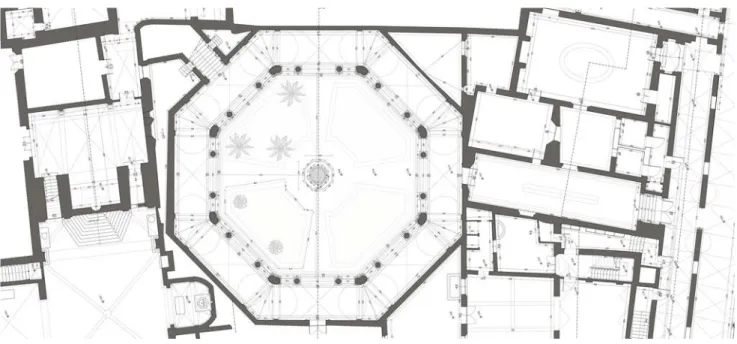
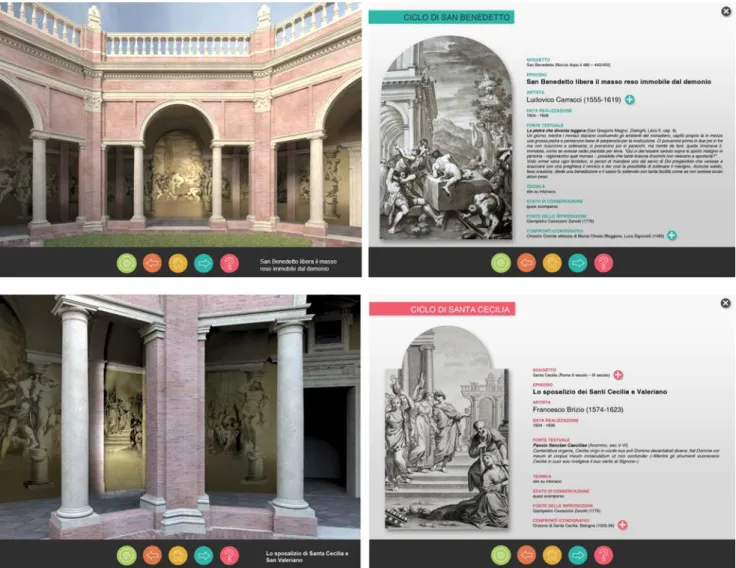
Vol 4, Issue 2 (2014), 87-‐108
e-‐ISSN 2239-‐4303, DOI 10.2423/i22394303v4n2p87
© CASPUR-‐CIBER Publishing, http://caspur-‐ciberpublishing.it
F
ROM SURVEY DATA TO VIRTUAL ENVIRONMENT
.
TWO CASE STUDIES
Manuela Incerti*, Stefania Iurilli*
* University of Ferrara, Department of Architecture -‐ Ferrara, Italy. Abstract
In this paper we present the latest experiences carried out by our research group in the field of multimedia communication. Starting from the construction of virtual models, interactive and non-‐interactive, we pursued the aim to introduce edutainment paths in some museum contexts, both increasing the value of cultural assets and creating an attractive pole for the visitors. The current trends are gradually transforming museums from static places of conservation into active and engaging spaces to deliver accessible culture to the masses, using digital technologies for creating new paradigms of interaction and enhance the experience of the visitor. Here we present two case studies, whose purpose is to bring together the different competences by various experts to test the potential of digital products as non-‐formal teaching tools to allow a satisfying learning experience. The case explored are those of the Civic Museum of Schifanoia (Ferrara) and the octagonal cloister of the Carracci in San Michele in Bosco (Bologna). The multimedia products discussed here relate to these two research themes, and up to now 3 out of 5 planned products have been made (in final mode, or in prototype form). The experimentation led to concrete results that introduced a reflection on what investigative methodologies and protocols are more suitable to be adopted in these cases, in compliance to the aim identified by the project.
Keywords
Multimedia communication, Digital models, Virtual Museum, Edutainment, Survey, Palace of Schifanoia, San Michele in Bosco, Carracci Cloister.
1. Introduction
The present contribution concerns
experiences conducted by the research group on
new multimedia communication modes
(interactive and non-‐interactive), based on virtual models using edutainment1 to benefit cultural heritage sites. The current trends have primarily focused on scientific structures, such as the Science Museum of London, the Victoria & Albert Museum in London2 or the more recent MUSE
Science Museum of Trento, gradually
1 Neologism born from the fusion of the words educational
and entertainment, means enjoying education and educating. A reference glossary containing the terms used in this contribution can be found at: https://www.v-‐ must.net/virtual-‐museums/glossary, site network MusT (last consultation December 2014). V-‐MusT.net is a Network of Excellence. The research leading to these results has received funding from the European Community's Seventh framework Programme (FP7 2007/2013) under the Grant Agreement 270404.
2 See for example the videogame Strawberry Thief, realized
for the Victoria & Albert Museum: a playful celebration of the Victorian artist William Morris and his popular repeating designs for textiles.
transforming museums from places of
conservation of tangible or intangible heritage into active and engaging spaces to deliver accessible culture to the masses. This has been made possible by the extensive use of technology,
creating new paradigms of interaction.
Furthermore, the various forms of interactivity and immersion in use today not only increasingly focus on education and research, but also cater to the enjoyment and enhancement of the experience of the visitor.
of interest. Starting from the acquired knowledge, we planned a multi-‐year research program in phases: it involves the construction and development of different and coordinated multimedia products, aimed to build an edutainment path based on scientifically reliable contents. In both cases the first products (two phases for Palazzo Schifanoia and a sample interactive model for the cloister of the Carracci), have already been made: the phases and their state of progress will be widely described in the following sections.
2. The Este’s “Delizia” of Schifanoia in Ferrara between past and future
The earthquake that struck the territories of Emilia and the city of Ferrara in 2012 has left many unresolved problems in the field. Immediately after the first operations and safety measures, the start of a process of investigation was required, which used survey as the central pivot around which recovery, consolidation, restoration and revitalization operations developed.
Palazzo Schifanoia, Estense “delight” founded around 1385 by Alberto d’Este, is among the largest historic buildings damaged. For this reason the building has long been closed to the public, only the Hall of Months is actually usable. In synergy with the operations of consolidation, restoration and renovation, a development project was undertaken, aiming to create a digital representation of the building to act as an essential tool for the communication of heterogeneous content (scientific, iconographic etc...).
The information apparatus dedicated to the visitors of the Schifanoia Museum, a prestigious structure in the Civic Museum sector of Ancient Art in Ferrara, has long been committed to a series of panels of historical contextualization and to a video accessible from a source located near the exit. The experience of visiting the rooms and the works on display in the building has always been a critical problem recognized and reported even by the museum management personnel. The building has undergone heavy transformations over the centuries, which have completely altered the nature of the Estes town “delight”, nestled in an elegant Renaissance garden. In the Hall of Months, both the controlled lighting of the surviving frescoes (for reasons of protection) and the height of the painted scenes (6 meters) constitute a limit to the use of the famous cycle that covers the walls. Furthermore, given the low lighting of the room,
the consultation of traditional paper guides is uncomfortable. Some rooms of great interest have always been inaccessible and unknown to the public for reasons of expediency (for example rooms converted to provide storage of artifacts) or security. Such is the case of the attic, which has
recognizable ancient crowning battlement
paintings on the walls, or even the Marble Hall, where traces of the ancient exterior decoration of the fifteenth century building are still visible.
For these reasons, a research project supported by an agreement with the body of Civic Museum of Ancient Art was developed. The aim of the project is the creation of a 4-‐stage3 program starting from the survey produced and recently integrated,4 the execution of digital models of the building, virtual reconstructions to provide information on the history and architecture system thanks to high-‐definition reproductions of images of pictorial cycles. The models, highly detailed, initially non-‐interactive, will in future also be navigable on tablet device screens or via network during the tour route, and may be used as the basis of projects of augmented reality which are key to a revival of the museum reality of Ferrara.
3 The four steps of the program, described in the next
sections, are respectively: the chronological development of the Palace (step 1), a historical study on the Hall of Months (step 2), the iconological program of the Hall (step 3) and its perceptive reconstruction (step 4). The realisation of the program has started from step 1, which has been completed and presented to the public (21st of
december 2014). To test a different type of multimedia product, on exact request of the Musei Civici di Arte Antica, it was decided to work directly on the third step, leaving the second step to be completed later. For this reason we also present here the first results produced for Step 3 (under construction). The Steps 2 and 4 will be developed in the near future: in this sense a declaration of interest of the managing body has already been expressed.
4 The scale of representation used for the survey is 1:50.
Fig. 1: Palazzo Schifanoia, Ferrara. Interactivity project for a diachronic model describing the development of the
building.
In the definition of the communication format, particular attention has been paid to the needs of young audiences to facilitate their approach to cultural issues that often do not
collect interest. Speed, immediacy and
multitasking characterize the cognitive approach of youths: the communicative success, even in the case of layered content, is for this reason always subordinate to the quality of involvement obtained.
Fig. 2: Palazzo Schifanoia (Ferrara). Some frames taken from the first informative-‐educational video made for the multimedia program of the museum.
2.1 Step 1. The different ages of Schifanoia Palace, the narration
The Este’s family “delight”, Schifanoia Palace, was built around 1385 by order of Alberto d’Este. The current building is the result of numerous expansions and renovations:
Around 1450 the initial works are wanted by the Marquis Leonello. The adjustments of the square and the raising of the palace of Borso date to 1465. Between 1469 and 1470, the famous cycle of frescoes of the Hall of Months was painted. Between 1483 and 1498, more changes were carried out, cutting down the battlements and expanding under the direction of Biagio Rossetti and the Duchy of Ercole.5
The building was located in the East of the city, adjacent to the complex of San Vito, near St. Andrew of the Augustinians and Santa Maria in Vado. A grand staircase, destroyed in 1700, allowed access to the large Renaissance garden
5 For an essential bibliography see: Varese, R. (1989). Atlante di Schifanoia. Modena: Panini; Settis, S., Bentini, J., Ghiraldini, A., & Cupperi, W. (2007). Il Palazzo Schifanoia a Ferrara. Modena: F.C. Panini; Bertozzi, M., & Hübner, W. (1999). La tirannia degli astri: gli affreschi astrologici di Palazzo Schifanoia. Livorno: Sillabe; Bertozzi, M. (2002). Aby Warburg e le metamorfosi degli antichi dei. Modena: F.C. Panini; Schifanoia (2013) Rivista dell’Istituto di Studi Rinascimentali di Ferrara, Atti della Settimana di Alti Studi, Febbraio 2012, Vol. 42-‐43, 2013; Visser Travagli, A. (1991). Palazzo Schifanoia e Palazzina Marfisa a Ferrara. Milano: Electa.
from the main floor. Among the interior rooms, all sumptuously decorated, the Hall of the months stood out for its richness and vivacity, synthesis of the thought of the astronomical and astrological Renaissance in Ferrara.
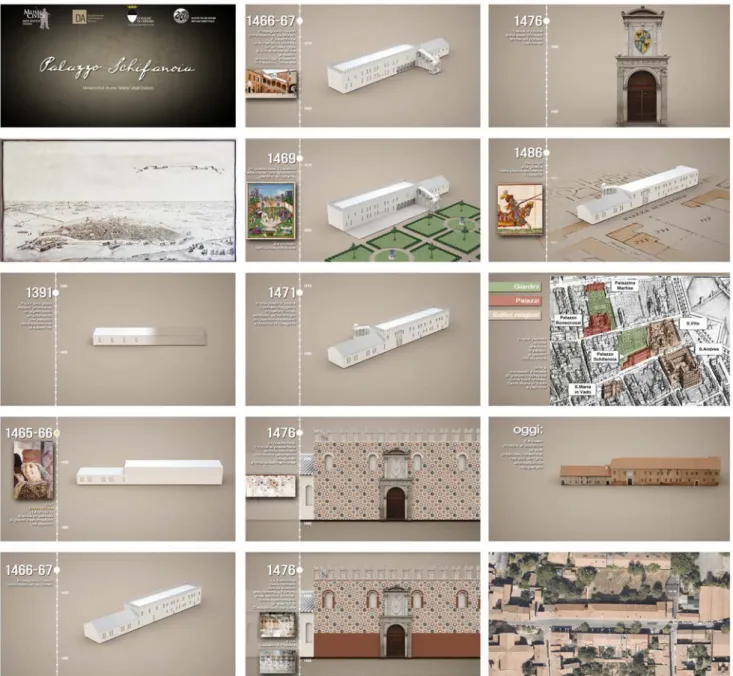
The multimedia product realized for the first step of the program,6 an animated sequence of almost eight minutes, shows the chronological phases of the development of the building through the evolution of its shape, supported by historical documents. In the layout, a scrolling vertical time-‐line splits the screen into two different areas, occupied respectively by the moving model and historical documentary sources. The images play an important role in creating an engaging narrative and simultaneously providing an element of rigorous scientific support to the story. The narrative dimension7 pursued includes
6 The multimedia product was presented in a press
conference at Palazzo Schifanoia on 21st of December, 2014
and put into operation on the same date. Scientific coordination of the project: Manuela Incerti. Research group: Angelo Andreotti (Director of Musei Civici di Arte Antica di Ferrara), Marco Bertozzi (Director of Istituto di Studi Rinascimentali di Ferrara), Manuela Incerti (Department of Architecture of Ferrara), Stefania Iurilli (Department of Architecture of Ferrara), Giovanni Sassu (Curator of Musei Civici di Arte Antica di Ferrara). Models and animation: Dario Arnone e Stefania Iurilli. Video editing: Paolo Marchetti. 7 «A narration is a symbolic presentation of a sequence of events connected by subject matter and related by time. Without temporal relation, we have only a list. Without continuity of subject matter we have another type of list. A
Fig. 3: Perspective section of the partial model of Schifanoia Palace, passing through the staircase and the Hall of Months. Image
developed in the integrated course of Tecniche della Rappresentazione II, A.A. 2013/2014 (Proff. M. Incerti, S. Iurilli), students: C. Solis Bonini, C. Troisi e S. Venturini.
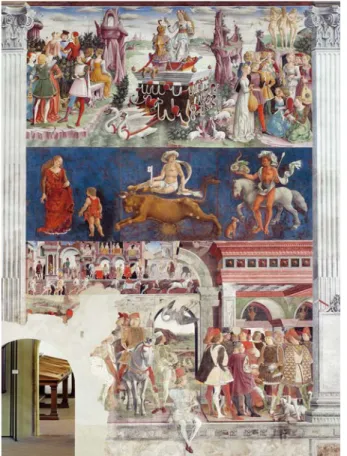
Fig. 4: Palazzo Schifanoia (Ferrara): frame dedicated to the month of April (author: Francesco del Cossa, 1469-‐70).
the description and interpretation of spaces, objects and events, but also the development of logical connections and space with the purpose of contextualizing Palazzo Schifanoia in the history of the Estense family and the city of Ferrara.
The different 3D models (reconstructed models) created for this phase (corresponding to the stages of development of the building and its garden) were modelled on the basis of the shape and appearance of the real building thanks to survey data previously collected and historical document sources. The final products have adequate attention to the replication of the "thickness" of architecture (walls, openings, cornices and details) avoiding processing models that are excessively rough and imprecise, which we often encounter in museums and websites:
telephone directory is a list, but we can give it a strong push in the direction of narrative by adding the word ‘begat’ between the first and secod entries of the words ‘who begat’ after each successive entry until the end.» Scholes, R. (1981). Language, Narrative, and Anti-‐Narrative. In W.J.T. Mitchell (Ed.), On narrative (pp. 200-‐8). Chicago: University of Chicago Press.
Fig. 5: Palazzo Schifanoia (Ferrara): frame dedicated to the month of March (author: Francesco del Cossa, 1469-‐70).
"boxes" consisting of elementary-‐sheet walls devoid of depth on which textures materials are simply resting on.
To convey the morphological aspects, a palette of neutral colours was selected, as it was considered most effective with the ability to not overwhelm with the weight of its visual content. On the other hand, the quality of fifteenth century colours (prior to rossettian intervention) is preferred to characterize the photo-‐textured surfaces reconstructed based on the existing fragments. The outer eastern wall (now incorporated in the Marble Hall) in fact still has a painted patterned polychrome decoration on an octagonal base, very similar to that recently rediscovered in the castle of Padua8. It is probably a decorative theme spread around the middle of the fifteenth century, as attested by Michele Savonarola (Padua 1384 -‐ Ferrara 1468) doctor of
8 In the castle of Padua the motif is on a hexagonal base. We
Niccolò III d’Este, Ferrara University professor and tutor of the most famous grandson Michele.9
The digital model shows a new hypothetical reconstruction of the outer shell,10 aiming to involve the viewer in a perceptual experience of strong and ringing colors that, in the last years of the fifteenth century, still characterized the geometric designs and the grotesques of the fresco facade.
With the same intention, the crest of Borso d’Este was revived, located on the monumental entrance portal, in its original two-‐tone gold-‐blue received on May 5 1452 with the investiture by Emperor Frederick III. The operation was made possible thanks to the discovery of ancient traces of colors documented during the recent restoration.
2.2 Step 2. The Hall of the Months, location, history and organization
The second multimedia product uses the same format and layout of the previous one and aims to deepen the historical and descriptive knowledge of the main space of the Estes: the Hall of Months, synthesis of astronomical and astrological thought of Renaissance Ferrara. At the heart of the program is the client, Borso d’Este, born August 24th, Thursday, 1413 hora XXII under the Virgo sign, the third son of a pair of lovers: Stella de’ Tolomei and Nicolò III d’Este.
The letter of Francesco del Cossa in Borso d’Este, dated March 25 1470, remains the most important document for the authorship of the pictorial program of the Hall of Months and its dating. Among the various authors, Prisciani Pellegrino is mentioned, a man of great influence in Ferrara in the late fifteenth century. The letter allows you to attribute the execution of the three compartments of the east wall to the Ferrarese painter. Historians have instead only been able to formulate hypotheses about the authorship of the other surviving sectors (June, July, August, September), based on technical and stylistic
9 Savonarola, M., & Segarizzi, A. (1902). 24.15: Libellus de magnificis ornamentis regie civitatis Padue Michaelis Savonarole, 50-‐51. Citta di Castello: S. Lapi. Written around 1446.
10 Some reconstructive hypotheses used in the multimedial
product have been drawn from: Ghironi, S., & Baroni, F. (1975), Note storiche su palazzo Schifanoia, in Atti e memorie della Deputazone Ferrarese di Storia Patria, S. III, XXI, 1975. R. Varese hypothesised on the distribution of the external decoration in 1978. See R. Varese, Atlante di Schifanoia (1978), p. 145.
criteria. June and July are attributed to the Master with wide open eyes (active in the second half of the fifteenth century), August to Andrea Fiorini Gherardo da Vicenza (documented between 1424 and 1485-‐86), September to Ercole de’ Roberti (Ferrara, c. 1450 -‐1496)11.
The model shows the original space characterized by a different access on the north-‐ west, a wide staircase that has now disappeared. A large fireplace and a system of internal obscuration were also present; frescoes that met the need for visual continuity of the cycle were reproduced on the wooden panels mounted over the windows.
The organization of the geometric decorative painting,12 based on rectangles with sides of proportional relationship,13 is the backbone of composition of the three narrative bands: the stories of the Duke Borso (12 frames), the 12 zodiac signs and 36 deans (12 frames) and, above, the triumph of the gods (12 frames). The goal is to recreate a unified vision of the project for the observer, an image currently lost due to the deterioration suffered by the paintings and the transformations that occurred.
2.3 Step 3. The Hall of Months and its iconographic reading14
The complexity and layered nature of the information contained in the painting program have always made the narration of the cultural, geographic and iconographic route of the images difficult, synthesis of the Arab-‐Persian, Indian and greek-‐Ptolemaic knowledge of the astronomical and astrological matter.
Astronomy and astrology, during the government of Lionello, Borso and Ercole I, played an outstanding role at the court of Ferrara, as well as in other Italian Renaissance courts15.
11 Sassu, G. (2010). Guida a Palazzo Schifanoia, Ferrara:
Musei Civici di Arte Antica 2010.
12 The photographic images have been supplied by Musei
Civici di Arte Antica, thank you for the courtesy.
13 On this matter see Incerti, M. (2013), Misura del cielo e misura dello spazio nella sala dei mesi di Schifanoia, in Schifanoia Rivista dell’Istituto di Studi Rinascimentali di Ferrara, Atti della Settimana di Alti Studi, 42-‐43. Pisa-‐Roma: Serra editore.
14 The realization of this product is in progress, herein we
present the first partial results.
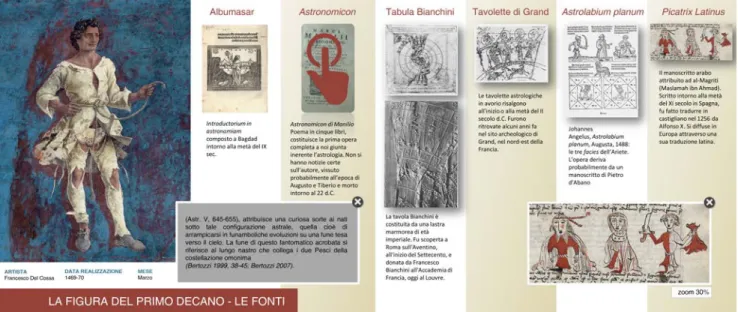
The development of knowledge of these cultural aspects of Ferrara have largely contributed investigations, especially in the field of iconography, conducted on the famous cycle. Starting from the innovative and fruitful studies of Aby Warburg16 has proved the presence of a specific strand of the history of astrology in the pictorial program: they belong to the Astronomicon of Manilio17, the Introductorium in astronomiam of Albumasar and the tradition of medieval magic and renaissance Picatrix.18 In this strand, great importance is given to the constellations, their mythical images, the visual representation and the fantastic suggestions from which they are born.
The project, currently under construction, uses a high detail photo-‐textured model, from which extracting informations using a simple input device or a touchscreen. The deepening possibilities are inevitably different depending on the state of preservation: the frescoes preserved with colors (March, April, May, June, July, August, September) and the paintings lost and subject to hypothetical reconstructions (in black and white and color) by artist Maurizio Bonora.19
In addition to the general description of the 36 main panels, arranged on three horizontal bands, you can interrogate individual or homogeneous groups to identify the meaning and characteristics. The individual visitor can choose the level of information desired, based on his personal curiosity and the time available for the visit. This so allows immediate access to the
in 1996-‐97. Vasoli, C. (1980). La cultura delle corti (pp. 129-‐ 158). Bologna: Cappelli.
16 Warburg, A. (1912). Arte italiana e astrologia internazionale nel Palazzo di Schifanoia a Ferrara. In Bertozzi, M., & Hübner, W. (1999). La tirannia degli astri: gli affreschi astrologici di Palazzo Schifanoia. Livorno: Sillabe. Bertozzi, M. (2002). Aby Warburg e le metamorfosi degli antichi dei. Modena: F.C. Panini.
17 Poetic work in five books constitutes the first complete
work to reach us regarding astrology. There is no information on the author, who probably lived at the time of Augustus and Tiberio and died around 22 d.C. The work is published in the critical edition: Manilius, M., Flores, E., Scarcia, R., & Feraboli, S. (2011). Il poema degli astri. Milano: Fondazione Lorenzo Valla.
18 The Arab manuscript, written around the middle of the XI
century in Spain, was translated to Castilian in 1256 by Alfonso X (work attributed to: al-‐Magriti Maslamah ibn Ahmad). It diffused in Europe through its Latin translation al-‐Maǧrīṭī, M. Rossi, P. (1999). Picatrix: dalla versione latina del Ghāyat al-‐hakīm. Milano: Mimesis.
19 The reconstructions were published in Bonora, M. (1992).
Lo zodiaco del principe: i decani di Schifanoia di Maurizio Bonora. Ferrara: M. Tosi.
iconographic sources (such as the Bianchini’s Tabula Planisphaerium) and to their deeper meaning.
A query by subjectwill also be possible, which will be able to trace back to the specific representation from the name through tags. The name of Leon Battista Alberti (whose image was identified by Ranieri Varese) will thus be connected to the panel governed by Pallas Athena (Minerva), goddess of wisdom, war, the sciences and the arts. To the left of the scene, amongst the doctors, artists, poets and jurists (sons and disciples of the goddess) Alberti would in fact appear. Alberti arrived in Ferrara in 1438 with the opening of the Ecumenical Council in the wake of the papal court, but previously already linked to the Este as testified by the dedication of Philodoxeos fabula in 1437 to Lionello, elder brother of Borso.20
2.4 Step 4. The Hall of Months and perceptive reconstruction
The last phase regards the reconstruction of immersive perceptual space and its original elements (garden access, fireplace, lost and reconstructed frescoes). A wide and spectacular marble staircase connected the vast Renaissance garden with the impressive show. From the top of the staircase, it was definitely possible to see the Bonaccossi palace and its grounds (wanted by Borso around 1469) and, later, the sixteenth-‐ century Palazzina Marfisa. To formulate a reconstructive hypothesis (on which historians do not agree) we made use of the survey of the staircase of honour in the Town Hall, designed by ducal architect Pietro di Benvenuto dagli Ordini, part of the complex of works of transformation of the building court made since 1471 according to the will of Ercole I d’Este.21 The communicative and expressive value of digital models is rendered very effective in relation to this aspect because
20 A second draft of a pseudo antique comedy composed by
Battista in 1924, still a student in Bologna. His relationship with the Este household was long lasting: the dedications date back to 1441 (still to Lionello) the treatise of moral consolation Theogenius and the De equo animante (1444-‐45), while the Ludi Matematici, dating to the period between 1450 and 1452 are dedicated to Meliaduso, brother of Lionello. Again by direct sollicitation of Lionello in 1447, finally, the draft of Alberti’s most important work begins, the De re aedificatoria.
manages to make explicit and real what was previously described in documents and ancient maps.
The model at this stage will also evoke the movement of unusual lighting effects that, in some significant dates (for example, the celebration of the election of Borso, Duke of Modena and Reggio) would illuminate the frescoes. It will simulate the natural light and artificial light of ancient torches at a salon furnished with contemporary furnishings.
Through animated reconstructions, it will also be possible to communicate the strict geometric constructions that underlie the perspectives painted by Francesco del Cossa in the band dedicated to Borso in the months of March and April in an immediate and accessible way.
3. Designing interactivity in a “symbolic”
environment. Palazzo Schifanoia and its Hall of Months
From the point of view of a visitor, Palazzo Schifanoia today impresses more for evocation than for appearance: the big spaces of its rooms, clear of furniture, calls to mind a magnificence in part disappeared, although still detectable through architectural masses and remains of the wonderful decorations.
Room after room, the museum path introduces the history of the building starting from the observation of its current appearance and it gradually fascinates its visitors. For this fascination to turn into real involvement, the visitor is required a creative effort in visualizing a remote time, elements and an atmosphere that do not exist anymore. However, these are all abilities that the average visitor rarely uses, even the most motivated and interested.
The design of the virtual apparatus for the museum, as described in the previous paragraphs, aims to fill this gap, making the visit more stimulating and culturally constructive; the proposed contents derive from the combination of different scientific matters, and are communicated with different methods depending on the target group and on the level of interest
expressed.
The literature on the topic of virtual museums is wide although recent, and among the examples already realized all over the world, it is possible to individuate the traits that allow a typological classification. The effectiveness of the final project is conditioned by the model on which the virtual museum will be built, as well as by the levels and modes of sharing knowledge.22
22 For a possible classification see Caraceni, S. (2012). Musei virtuali-‐Augmented heritage. Evoluzioni e classificazione delle tipologie di virtualità in alcuni case histories. Rimini:
The multimedia project designed for the Este family Palace does not substitute, but complements the visit to the museum. Therefore it does not belong to that category of museum-‐ replica (mostly based on quick time VR technology, with panoramic 360 degrees from a unique viewpoint), which allow the viewer to virtually visit the exhibition areas through a client provided by a web-‐browser and accessible from any place in the world. The museum-‐replica is useful to plan a path inside the physical museum, bookmark points of interest, or to "return" on the site for further study; neverthless it does not replace or recreate the atmosphere of the place, nor the journey feeling, which the visitor often perceives during a visit to the museum. Concisely, the museum-‐replica does not create a real emotion and it does not generate an event to be told once that experience is over. Exploration is conditioned by the rules dictated by the available technologies and software used, as well as by the choices of the programmer of the user interface; the feeling of freedom of movement and selection is always subject to rules imposed from above about explorability, databases consultability and model illumination.23
At the current state of the media and technologies, this condition can be mitigated but not canceled, thanks to the different levels of interactivity, which can now be implemented into a VR artwork. The perspective changes if the virtual reconstruction becomes a complement to the physical visit experience, a sort of enhanced guide that uses different multimedia products on different matters and complexity levels. This content can be displayed on different devices (touchscreen, tablet, stereoscopic viewers, HMD24 devices like oculus 3D), in an articulated perceptual path, that stimulates the senses and increases user involvement. In this way the inertia of the acquisition of information through the reading of panels along the exhibition is cancelled; at the same time a simple visit is
Guaraldi, and Bandelli, A. (1999), Virtual Spaces and Museums. In The Journal of Museum Education, Vol. 24, No. 1/2, pp. 20-‐22. Boston: Maney Publishing.
23 Maldonado, T. (1992). Reale e virtuale (p.150). Milano: Feltrinelli.
24 Head-‐Mounted Displays. An HMD is a display device, worn
on the head or as part of a helmet, with a small display optic in front of one or each eye. It has the capability of reflecting projected images as well as allowing the user to see through it.
enriched with reconstructions, captivating images, motion sequences, auditory stimuli.
The experience is enhanced by the possibility of comparing past and present, what is visible with what has disappeared, and to discover symbolic meanings and hidden paths, as in the case of the painted perspectives.
If we look at its implementation, the project includes a first stage – corresponding to Steps 1 and 2, currently almost completed – during which two different animated sequences will be introduced in the museum. The videos will be projected on screens strategically placed along the museum path, and they will be accompanied by a narrating voice available in multiple languages25 that provides information about the history of the building and the people who influenced its development. At this stage, the animated clips are focused on two main themes of general interest (exterior development of the building with chronological phases, Step 1, a historical study on the Hall of Months, Step 2). They will be limited to a one-‐way, non-‐interactive communication: we choose therefore to opt for a very didactic and simple message, addressed to an audience of any age and at level of education.
For step 1 we needed a set of versatile, extremely concise models, describing the volumetric qualities of the building with the metric accuracy of a urban scale maquette. The 12 models used, one for each chronological stage, were made starting from the survey data, through a synthesis and discretization process, using a direct modeling application coming from the entertainment industry26. Starting from the essential measures we built continuous, low-‐poly mesh models, made of quadrilateral (quad) polygons27. This choice was made to ensure the processability of the model in animation and, in a second time, in interactive apps, when the same models are used to calculate real time interaction. The same software was used to set the essential
25 The actual product is underlined by a background music, a
renaissance instrumental composition; the narrating voice will be recorded and mounted in a second time.
26 3d modeling and animation application (for the whole
project): Luxology Modo; video editing and post production application; Adobe Premiere, Adobe After Effects.
27 In this way the material transformations of the model
camera movements and calculate the video sequence in HD, compatibly with the screens present in the museum.
In a subsequent phase, there is provided a upgrading of the materials realized for the first two steps: it consists of arranging the same content in a explorable graphical interface. Touchscreens will be placed on especially designed holders and positioned at eye level, with the possibility for the user to take action, skip forward or backward on the timeline, select an event or a document, open the dedicated database record and access data (multi-‐resolution images, scientific references, videos, audio guides, historical data). In this direction a first experimental sample (not yet released) has already been made, using the game engine Unity 3D. It allows to visualize, orbit and manage a real-‐ time textured model, even with multiple sets of textures and lights. It is also possible to connect the different states (ages of the Palace) with clickable buttons on the timeline.
The media dedicated to the Salone dei Mesi are to be placed preferably inside the hall itself.28 The visitor will be given the chance to turn a detailed model of the environment of 360 degrees, select one wall or one of the frescoes just by touching it, zoom on the details and access to the related metadata.
The next phases of the project will focus exclusively on the Salone dei Mesi, and include the creation of more advanced multimedia contents, featuring more complex informations, different degrees of detail and a more advanced type of interactivity (applications on tablets, switching to immersive virtual environments). Even in this case we realized a first test, an immersive exploration of the Salone with Unity. Through the use of Prefabs (special parametric items supported by the software) it’s possible to generate a virtual exploration of a selected model, already compatible with the chosen output device (in our case the HMD oculus 3d).
The general proposal stresses the
programmatic intent to propose a communication which is initially simple, dedicated to everyone, then passing to a more stratified and complex information, where a single model can be enquired in different ways. It enables the user to choose how much time to dedicate to the learning
28 The screen is actually located into the adjacent Sala delle
Virtù, while awaiting the recovered total practicability of the hall after the earthquake of 2012.
experience and what information to listen or watch, by selecting the content according to his own profile.
In this way both the casual user, moved by curiosity, and the scholar seeking specific insights, can be motivated by a kind of information which is different from the one that can be read in a guide book or listened from a simple audio guide. The multimedia guide thus facilitates an accelerated and selective synthesis, allowing the user to operate all those mental connections (between information and source, between perception and data) that are not always obvious if one lacks deep knowledge of the places of interest and the related works of art.
As stressed in the previous paragraph, the technologies used to develop the multimedia contents comes from the field of entertainment and videogames; the construction of models and databases uses instead the data coming from the survey, processed through modeling and programming techniques, based on the synthesis of geometric data and the optimization of models and textures for real time rendering.
3.1. Content analysis, multidisciplinarity and construction of visual databases
The construction of virtual contents and guides on the model described above often clashes, in a first phase of research, with the difficulty of coordinating the different contributions and useful skills, as well as the large amount of data needed to effectively describe a fine architectural complex.29
In the case of Palazzo Schifanoia our research unit has availed itself of first-‐hand basic geometric information from the integrated architectural survey of the building, in addition to literature and other basic sources, as well as unpublished data from the historical, geometrical and metrological study. The study has produced a summary of the state of the art that has been the subject of several discussions and exchanges with specialists with different skills (historians from Ente Musei Civici di Arte Antica and from the Istituto di Studi Rinascimentali). The results of surveys and investigations by other research
groups will be implemented at a later time,30 so that they can be made known to visitors. The objective, already partially achieved, is the development of a database of information which is ever updatable, and upon which the models and their interactivity are built – and will keep on being built in the following phases.
The images database (photos, orthophotos, maps, archival footage, and historical photos) is particularly interesting and useful, as it is the core for thematic research about color and of the elaboration of structural textures, needed for recreating painted surfaces, both the existing ones and the lost ones.
3.2. Digital models and multimedia products
Already at this early state of the project, different models for different uses and products have been built.
The first is a set of low detail models31, used as a basis for the video on the diachronic development of the building (choice conditioned by the lack of information on the oldest iconographic and descriptive chronological phases). The second one is a highly LOD model of the current status, based on the data coming from the survey and from high-‐resolution models of salient architectural details, such as marble portals. In some cases, the general surveys of the buliding have been complemented by further analysis aimed at acquiring details
through digital photogrammetry and
photomodeling techniques.
Due to optimization needs, it has been necessary to shape low-‐poly models, based on data fetched through specific decimation algorythms.
The process of production of the models, limited to what was achieved up to now, can be summarized as follows:
• Semantic study and identification of the appropriate communication features of the different models in each phase.
• Storyboarding and design of the different layouts, GUI32 , and of the functionalities of the single multimedia objects.
30 We mainly refer to the multimedia content dedicated to
the iconographic program of Salone dei Mesi (Step 3).
31 The set of 3D models is the one described in the previous
paragraph.
32 Graphic User Interface. The Unity UI system allows to
create custom User Interfaces (UIs) fast and intuitively.
• Extraction of the essential measures and production of synthetic models for Step 1, including the reconstruction of missing elements on the basis of existing documents (as in the example of the staircase).
• Production of more detailed models, even textured, in support of some specific phases of the narration (patterned façade, portal). The same detailed models were then incorporated into the general model of the current state of the Palace.
• Production of the general "perceptual" model of the current state (interior and exterior). At this stage the perceptual quality is essentially entrusted to the textures. The aim was to keep the model low-‐poly, already thinking to use it for a real time exploration.
• Creation of the animated clip for the Step 1
• Introduction of interactivity in the
multimedia product of the Step 1 (timeline navigation)
• Test of interactive exploration with oculus 3d interior of the Hall of Months.
In the later stages the general models will be complemented by thematic textured models focused on specific environments, such as the interior of the Salone dei Mesi, both as it is now and how it was in the sixteenth century setting. In this case, the need to produce a data, which is easily processable and manageable – and thus a low-‐polygon model – collides with the attempt of not affecting the perceptual quality of the final product. The successful result is guaranteed by the use of texture mapping techniques based on the use of color maps and normal maps, but also thanks to multi-‐resolution images that are loaded progressively from the rendering engine33, especially when it comes to yield coloured pictorial surfaces, existing or missing. The loading is done in a directly proportional measure to the zoom level on the paintings.
33 Unity automatically supports this function, through a