268
EXPERIMENTAL STUDY ON MATERIALS GRANULOMETRY USING
STATISTICAL ANALYSIS AND BOOTSTRAPPING
BANICA MIHAI1*, ȘUGAR IOAN RADU1, GIURGIULESCU LIVIU2
Faculty of Engineering, Technical University of Cluj-Napoca Faculty of Sciences, Technical University of Cluj-Napoca *Corresponding author, e-mail: [email protected]
Keywords: cleaner separator, granulometry, bootstrapping
ABSTRACT
Machinery and equipment used in conditioning the raw material and in grinding are of importance in obtaining superior quality products. Among these machines a vital role is played by the equipment used in the separating the impurities by aerodynamic matters and size. Given the exponential growth of the population and implicitly an increasing need for food, it is important that losses during the technological process should be as low as possible. The widespread use of biofuels (in the US 10% on the fuel market) will lead to a more dramatic decrease of losses during the process.
In order to reduce the losses to the cleaning operation, the meshes of the sieves must be properly dimensioned / adjusted according to the size of the grains. We propose a statistical methodology to provide the necessary results.
INTRODUCTION
Since ancient times, even from the first food revolution, cereals have been and are of importance for human food. Thus, since the Palaeolithic era, 8,000 years ago, plant food was ensured by accidentally picking up fruit, roots and seeds of plants that were consumed as such. Only from the Mesolithic (12,000 BC), man begins to select the plant species for consumption and crush them by a primitive technique (Țucu, 2007). The first stone mills appear in the Neolithic (3000 BC), initially trained with their arms and then with animals, simultaneously switching from the consumption of boiled grains to the one with baked cakes made from broken grains.
MATERIAL AND EQUIPMENT
The vacuum separator, also known as the vacuum cleaner, is in fact a multi-layered sieve, equipped with a light particle air separation system. In most cases, the machine is composed of three oscillating sieves. They separate the particles based on the difference in width and thickness, the size of the holes dropping from top to bottom, so that the first sieve retains the coarse impurities (strings, stones, earth, and straw). The second retains impurities of near size but slightly larger than the particles to be cleaned, and the third sieve retains the cleaned particle (Țucu, 2007).
While entering the machine, on the first sieve and at the exit, the particles are superimposed on a counter current flow of air to remove the light impurities (straw, dust, shells).
Selectors are used in the first stage of cereal conditioning (precleaning), but also in subsequent cleaning steps, often relying on the use of the same type of machinery, placed in cascade.
The working capacity of a selector is expressed by the number of particles cleaned in unit time and sieve width, [kg/h m2] (Tisan, 2009).
269
The equipment differs in the number of sieves, sieve inclination and layout, sieve perforations, the sieve cleaning systems, and light particle suction mode (Bâlc & Șugar, 2013).
The grains that arrive at the mills, although largely undergoing a cleaning process at their receiving bases, still contain many impurities. The degree of pollution admitted at the receiving base is established through internal regulations or direct contractual conventions. The impurities from the grains have a negative influence both during their manipulation in the silo and while depositing the grains in depositing cells. Among the negative influences the most important are: they cause the clogging of the installations, make cell evacuation more difficult, favour insect’s infestation, and occupy storage space.
To reduce these negative effects, cereals undergo a partial cleaning operation. This is called precleaning because the amount of foreign bodies removed at this stage does not exceed 20÷25%. Removed foreign bodies generally have the largest and smallest dimensions in relation to the total mass of foreign bodies contained. They are made of earth, stones, straw, spice, chaff and dust.
Specific machinery is used to perform the precleaning stage. The most used tool is the silage vacuum cleaner separator. The silage vacuum cleaner used for precleaning is TA-1216 due to its precision (Bâlc & Șugar, 2016).
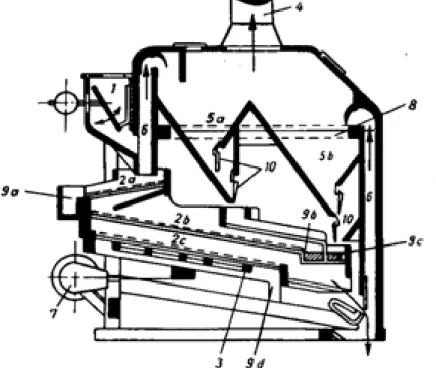
This machine has a special construction and high cleaning capacity, due primarily to the inclination of the sieves. It is a multi-layered sieve, equipped with a light particle air separation system. It has 3 oscillating tilting sieves separating the particles based on the difference in length, width and thickness (size). It is used both in precleaning and in cleaning.
1 - inlet; 2a, 2b, 2c - sieves;3 - the drive system; 4 - suction mouth; 5a, 5b - settling chambers; 6 - suction tube; 7 - wheel with eccentric; 8 - filters; 9 - inclined troughs; 10 - flaps;
Figure 1. Vacuum cleaner separator
The separation process is influenced by the following factors: the feeding/charging mode; shape and size of the sieve; the length of the route the particles must do on the sieve; the speed and character of the material movement; the thickness of the material layer; the state of the material (dry or wet).
270
particles in the upper part of the material layer appear; granulometry of the material (www.creeaza.com/afaceri/agricultura/Conditii-de-pastrare-si-conser624.php).
The shape and dimensions of the sieve must be chosen according to the shape of the particles that are to be separated. In the case of spherical particles, the meshes shall be round or square, and irregular or rectangular meshes shall be chosen with irregular dimensions; placing the round meshes on the sieve is offset done to accommodate as many holes per unit area as possible. In the case of long holes, this are arranged in parallel or inclined directions to the edge of the sieve: a longer route of the particle over the sieve, a better separation effect.
The granulometry of the material; the ratio between the average diameter (d) and the side of the mesh (ℓ) has a major influence on the separation efficiency; thus, the granules exhibiting a diameter smaller than 0.7·ℓ pass easily through the sieve meshes, those of diameter larger than 1.5·ℓ pass quickly along the surface of the sieve and do not prevent the small granules from passing through the meshes. The granules with intermediate dimensions (0.7·ℓ < d <1.5·ℓ) tend to clog the meshes of the sieve. In such a situation, the sieves must have the meshes with 10÷15% greater than the size of the fractions.
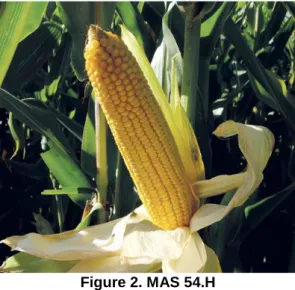
To establish the granulometry of the material, MAS 54.H maize cultivated by Maïsadour Semences was used.
Figure 2. MAS 54.H
MAS 54.H is the acronym for Tardif Mixed with14 to 16 rows of 36 to 40 grains on
the row (www.maisadour-semences.fr/pdf-varietes).
To cultivate this type of maize we recommend a density (silo) of 85,000÷80,000 plants/ha and for cereals 83,000÷75,000 plants/ha. MAS54.H is a hybrid with a very good level of silo production. Its grain yield will meet the expectations of the cereal market.
Considering the losses due to the universality of the machines, it is proposed to make an adjustable mesh site for the MAS hybrid. 54.H.
The method can also be used for wheat, barley, rye, orzo, sunflower etc. It can also be used in production for cleaning from harvesting to milling and lately to produce biofuels (Barabás & Todoruț, 2011), (Burnete, 2008).
STATISTICAL ANALYSIS AND BOOTSTRAPPING
271
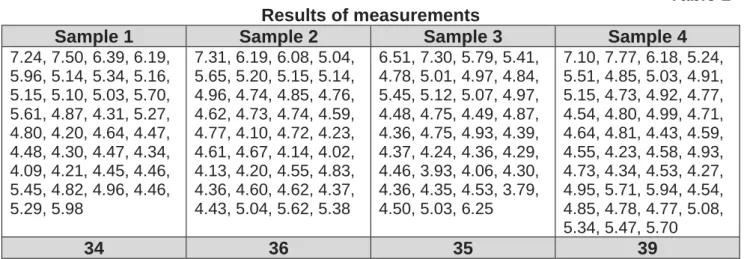
The results are presented in the following table.
Table 1 Results of measurements
Sample 1 Sample 2 Sample 3 Sample 4
7.24, 7.50, 6.39, 6.19, 5.96, 5.14, 5.34, 5.16, 5.15, 5.10, 5.03, 5.70, 5.61, 4.87, 4.31, 5.27, 4.80, 4.20, 4.64, 4.47, 4.48, 4.30, 4.47, 4.34, 4.09, 4.21, 4.45, 4.46, 5.45, 4.82, 4.96, 4.46, 5.29, 5.98
7.31, 6.19, 6.08, 5.04, 5.65, 5.20, 5.15, 5.14, 4.96, 4.74, 4.85, 4.76, 4.62, 4.73, 4.74, 4.59, 4.77, 4.10, 4.72, 4.23, 4.61, 4.67, 4.14, 4.02, 4.13, 4.20, 4.55, 4.83, 4.36, 4.60, 4.62, 4.37, 4.43, 5.04, 5.62, 5.38
6.51, 7.30, 5.79, 5.41, 4.78, 5.01, 4.97, 4.84, 5.45, 5.12, 5.07, 4.97, 4.48, 4.75, 4.49, 4.87, 4.36, 4.75, 4.93, 4.39, 4.37, 4.24, 4.36, 4.29, 4.46, 3.93, 4.06, 4.30, 4.36, 4.35, 4.53, 3.79, 4.50, 5.03, 6.25
7.10, 7.77, 6.18, 5.24, 5.51, 4.85, 5.03, 4.91, 5.15, 4.73, 4.92, 4.77, 4.54, 4.80, 4.99, 4.71, 4.64, 4.81, 4.43, 4.59, 4.55, 4.23, 4.58, 4.93, 4.73, 4.34, 4.53, 4.27, 4.95, 5.71, 5.94, 4.54, 4.85, 4.78, 4.77, 5.08, 5.34, 5.47, 5.70
34 36 35 39
Statistical analysis of the data was done with QI Macros Add-In for Excel (KnowWare International, Inc.):
1. Normality test concerning the four samples: we used Anderson Darling's p-value
and Critical Value Method, α=0.05. Result: none of the analysed samples has a normal distribution for;
2. Test for “equality” of variances concerning the four samples: because our data comes from non-normal distributions, we used Levene Test for Equality of Variances, α=0.05. Result: the p-value=0.472>0.05, so we cannot reject the null hypothesis that variances are equal, viz., variances are the same;
3. Test for “equality” of means concerning the four samples: for the same reasons we used a non-parametric test, Tukey Test, α=0.05. Results: Sample 1 vs. Sample 2: p-value=0.500>0.054; Sample 1 vs. Sample 3: p-value=0.250>0.054; Sample 1 vs. Sample 4: p-value=0.250>0.054; Sample 2 vs. Sample 3:
p-value=0.375>0.054; Sample 2 vs. Sample 4: p-value=0.072>0.054; Sample 3 vs. Sample 4, p-value=0.250>0.054, so we cannot reject the null hypothesis that mean are equal, viz., mean are the same;
4. Test for “equality” of medians concerning the four samples: we used the non-parametric Kruskal-Wallis Test, α=0.05. Results: Sample 1 vs. Sample 2 vs. Sample 3: p-value=0.253>0.05; Sample 1 vs. Sample 2 vs. Sample 4:
p-value=0.311>0.05; Sample 1 vs. Sample 3 vs. Sample 4: p-value=0.157>0.05; Sample 2 vs. Sample 3 vs. Sample 4: p-value=0.167>0.05, so we cannot reject the null hypothesis that median are equal, viz., median are the same;
5. Because the means, medians and dispersions of the four samples do not differ significantly, we can conclude that the samples are extracted from the same population and can form a single sample;
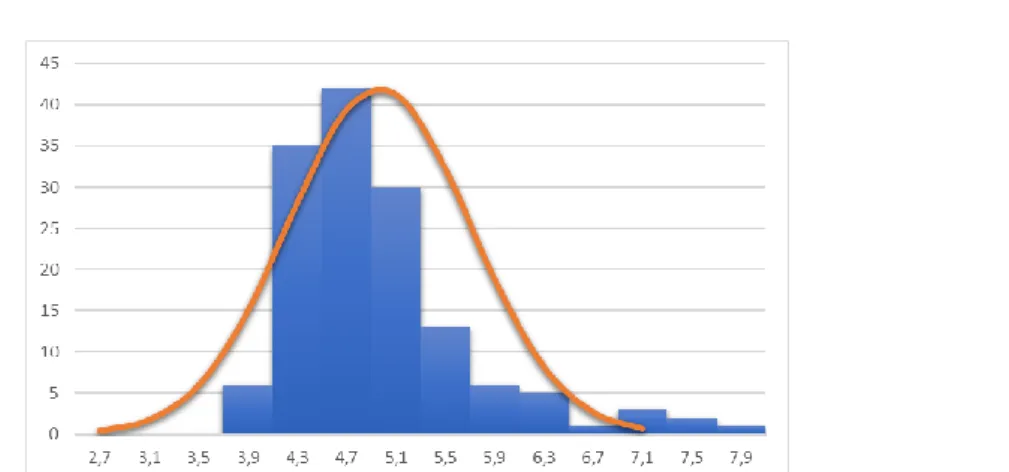
6. Grouping of data: the calculation of the number of intervals was done with Rice formula, r=2∙n1/3, for n=144 and resulted 10.483≈11 intervals and the magnitude
of intervals of h=0.362mm intervals; h*=0.4mm was adopted; the result of the grouping is shown in Table 2;
Table 2
Results of grouping by classes
Class (3.7;4.1] (4.1;4.5] (4.5;4.9] (4.9;5.3] (5.3;5.7] (5.7;6.1] (6.1;6.5] (6.5;6.9] (6.9;7.3] (7.3;7.7] (7.7;8.1] C.M. 3.9 4.3 4.7 5.1 5.5 5.9 6.3 6.7 7.1 7.5 7.9
Abs.
272
Figure 3. Absolute frequencies of the sample vs. Normal probability function
Figure 4. Difference between the cumulative frequencies of the sample and the normal distribution function
7. Applying the Kolmogorov-Smirnov normality test (Tașcu et al., 2008): max|Fn(x)–
F0(x)|=0.216> 1.36/sqrt(144)=0.1133, results that the distribution is not normal.
For estimating some maize grain statistical values, we have considered the
Bootstrap technique. We used the “bootci” function from MATLAB (MathWorks, Inc.). The syntax of the function:
bootci(NBOOT, {BOOTFUN,...}, 'type',TYPE,'alpha',0.05,'stderr',std(x))
where: NBOOT is a positive integer indicating the number of bootstrap data samples used in the computation; BOOTFUN is a function handle specified with @; TYPE is the confidence interval type, specifying different methods of computing the confidence interval; alpha computes the 100*(1-ALPHA) percent BCa bootstrap confidence interval of the statistic defined by the function BOOTFUN, ALPHA is a scalar between 0 and 1, the default value of ALPHA is 0.05; 'stderr' the standard error of the bootstrap statistics is evaluated by the function STDERR who has the same arguments as BOOTFUN and return the standard error of the statistic computed by BOOTFUN.
For our application, the syntaxes are:
273
Table 3
Results of Bootstrapping Confidence
level
(P=1–α)
Confidence interval
Mean [mm] Stdv [mm] Max. [mm] Min. [mm]
P=0.95 (4.8443; 5.0855) (0.6118; 0.8786) (7.5347; 8.2562) (3.5422; 3.9061
P=0.99 (4.8069; 5.1247) (0.5676; 0.9231) (7.4188; 8.3813) (3.4844; 3.9626
According to these results, with a probability of 0.95 (95%), the maximum considered value of maize grains of MAS 54.H, cultivated on the parcel analyzed, is between 7.5347mm and 8.2562mm and with a probability of 0.99 (99%) is between 7.4188mm 8.3813mm.
The meshes of the sieve will need to be designed/adjusted according to the resulting data.
CONCLUSIONS
1. Machinery has a key role in the separation of impurities after aerodynamic principles and size. They have a significant role in the production of quality products.
2. Although they are used for a long time in a food shortage, they can be improved.
3. It is possible to use sieves for each maize variety, which would increase the cost price of the machine.
4. Regarding the rectangular shape of the site meshes, adjustable sieves can be constructed.
5. The calculations made, allow the regulation of the selectors function used in the production process.
REFERENCES
1. Barabás, I., Todoruț, I.A., 2011, Biodiesel Quality, Standards and Properties, BiodieselQuality, Emissions and By-Products, Gisela Montero and Margarita Stoytcheva (Ed.), ISBN 978-953-307-784-0, InTech, Rijeka, DOI: 10.5772/25370. 2. Bâlc, G., Șugar, I.R., 2013, Mașini și instalații pentru industria alimentară, Vol.I,
ISBN 978-973-53-1180-3, Editura Risoprint, Cluj-Napoca.
3. Bâlc, G., Șugar, I.R., Gaspar, F., 2016, Mașini și instalații pentru industria
alimentară, Vol.II, ISBN 978-973-53-1748-5, Editura Risoprint, Cluj-Napoca.
4. Burnete, N., Naghiu, A, Rus, I., et al., 2008, Motoare diesel și biocombustibili
pentru transportul urban, ISBN 978-973-713-217-8, Editura Mediamira, Cluj‐
Napoca.
5. Tașcu, I., Pop, M.S., et al., 2008, Probabilități și statistică. Teorie și aplicații, ISBN 978-973-751-753-1, Editura Risoprint, Cluj-Napoca.
6. Tisan, V., 2007, Utilaje în industria alimentară, ISBN 978-973-751-609-1, Editura Risoprint, Cluj-Napoca.
7. Țucu, D., 2007, Sisteme tehnologice integrate pentru morărit și panificație, ISBN 978-973-638-304-5, Editura Orizonturi Universitare, Timisoara.
8. *** www.maisadour-semences.fr/pdf-varietes