47
STRUCTURAL CHANGES OF MIXED SEEDLINGS OF HUNGARIAN OAK
(
QUERCUS FRAINETTO
) AND TURKEY OAK (
QUERCUS CERRIS
)
TREES FOLLOWING THE WOODLAND
STAGE
IULIAN BERCEA, FLORIN-DORIAN COJOACĂ Faculty of Agriculture and Horticulture, University of Craiova, [email protected]
Faculty of Agriculture and Horticulture, University of Craiova, f_cojoacă@yahoo.com
Key words: Hungarian oak, Turkey oak, crown length,pruningheight
ABSTRACT
The ecosystem processes follow the woodland stage in the mixed Hungarian and Turkey oak stand, as a result of the inter- and intra-specific competition, depending on the thickness variable and competition for resources. The forestry-related interventions will take place according to the evolution stage of the trees, priority being given to the sampling out of young trees and seedlings.
INTRODUCTION
48
MATERIALS AND RESEARCH METHODS
The research was conducted in sample areas of permanent specimens planted at the start of the regeneration process, which have been the topic of numerous scientific papers published since 2005. The research was carried out in sample areas located in phytoclimatic average conditions for Hungarian and Turkey oak trees in the widespread forests in the western part of the Getic Plateau, in Simian, Strehaia, Filiaşi, Melinesti, Drăgăşani (Bercea , 2007). In the forest of Macrea, the sample unit 82 M (ua) of the R&D Unit II Argetoaia (U.P.), Filiaşi Woodland, Hungarian and Turkey oak trees are mixed in equal proportion stands. The location of the sample areas was chosen after a long period of observation of the wilting of the Hungarian and Turkey oak trees since 1989, and permanent monitoring of the wilting phenomenon has been carried out in these sample areas. The wiltering rate of the Hungarian oak trees is 15% higher than in the case of the Turkey oak trees. The gaps due to the the removal of the wilted or wilting trees were filled with already existing seedlings of the 1994 low fructification of Hungarian and Turkey oak trees, contributing to the establishment of young stands following the regeneration cuts of the last two decades.
Upon the completion of the regeneration process and of the woodland stage, we continued research in the young stands through measurements and determination of the main characteristic features of young stands: group diameter, height, pruning height, length and crown diameter. Measurements and observations were performed in the former regeneration cuts when applying progressive cutting on two sample areas of two-meter width, one to the south and the other to the east-west. The results of the measurements and observations were shown in tables for each species and for the whole stand. Tables were processed using Excel and plotted using the same software.
RESEARCH FINDINGS AND INTERPRETATION
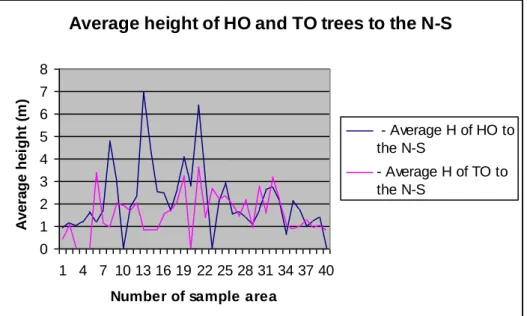
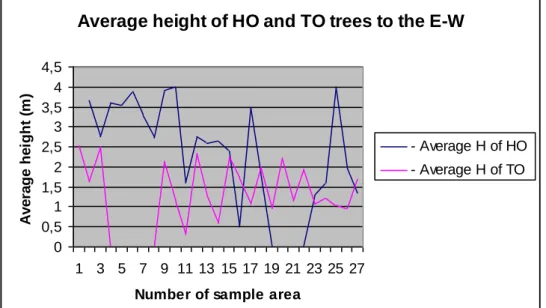
Observations in the permanent sample surfaces show the sinuous profile of the young trees due to the progressive cutting treatment described in the literature (Florescu, 2004).Following the woodland stage, the ecosystem processes started, manifested by the active growth in height and vertical differentiation of specimens according to a more favourable position in the stand or less exposure to direct light. The vertical differentiation of specimens was highlighted by measuring the height of the Hungarian and Turkey oak trees in 2 sample areas perpendicular to the north-south and east-west (Fig. 1, 3).
Average height of HO and TO trees to the N-S
0 1 2 3 4 5 6 7 8
1 4 7 10 13 16 19 22 25 28 31 34 37 40
Number of sample area
A
v
e
ra
g
e
h
e
ig
h
t
(m
)
- Average H of HO to the N-S
- Average H of TO to the N-S
49
Figure 1 indicates the vertical differentiation of the Hungarian and Turkey oak trees planted before the regeneration process within the ten-year harvest-regeneration plan, in the middle of the regeneration stand which was the regeneration core.
Average height of HO + TO trees to the N-S
0 0,5 1 1,5 2 2,5 3 3,5 4 4,5 5
1 4 7 10 13 16 19 22 25 28 31 34 37 40
No. of sample area
A
v
e
ra
g
e
h
e
ig
h
t
(m
)
- Average height of HO + TO
Fig. 2 Average height of Hungarian and Turkey oak trees to the north-south
Diagram 2 shows that the average height of of the Hungarian and Turkey oak trees in the north-south sample area is larger in the middle of the former regeneration stand, in correlation with the planting of seedlings and the subsequent regeneration cuts.
Figure 3 indicates the vertical differentiation in the eastern sample area of Turkey oak trees due to their planting on the brighter side of the stand at the first opening cut.
Average height of HO and TO trees to the E-W
0 0,5 1 1,5 2 2,5 3 3,5 4 4,5
1 3 5 7 9 11 13 15 17 19 21 23 25 27
Number of sample area
A
v
e
ra
ge
he
igh
t
(m
)
- Average H of HO
- Average H of TO
Fig. 3 Average height of Hungarian and Turkey oak trees to the east-west
50
Average crown diameter of HO and TO trees to the N-S
0 20 40 60 80 100 120
1 4 7 10 13 16 19 22 25 28 31 34 37 40
Number of sample area to the N-S
A
v
e
ra
ge
c
row
n
di
a
m
e
te
r
(m
m
) - Average crown
diameter of HO
- Average crown diameter of TO
Fig. 4 Average crown diameter of Hungarian and Turkey oak trees to the north-south
The distribution of the diameter size to the north-south is comparable to that of the height in the same direction.
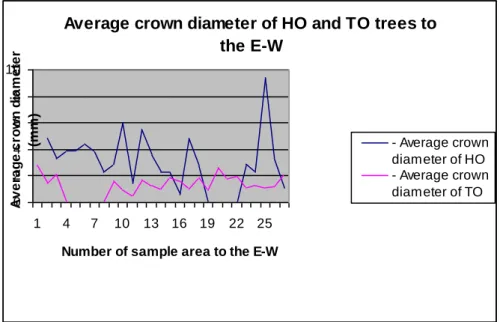
The distribution of the diameters of the Hungarian and oak trees to the east-west is highly similar (Fig. 5).
Average crown diameter of HO and TO trees to the E-W
0 2 4 6 8 10
1 4 7 10 13 16 19 22 25
Number of sample area to the E-W
A
v
e
ra
g
e
c
ro
w
n
d
ia
m
e
te
r
(m
m
)
- Average crown diameter of HO - Average crown diameter of TO
Fig. 5 Average crown diameter of Hungarian and Turkey oak trees to the east-west
51
Crown length of HO and TO trees to the N-S
0 0,5 1 1,5 2 2,5 3 3,5 4 4,5 5
1 4 7 10 13 16 19 22 25 28 31 34 37 40
Number of sample area
C
row
n
le
ng
th
(m
)
- Crown length of HO - Crown length of TO
Fig. 6 Crown length of Hungarian and Turkey oak trees to the north-south
Figure 6 shows that the crown length of the Hungarian oak trees to the north-south is higher in the middle of the former regeneration stand, whereas the crown length of the Turkey oak trees is larger in the middle of the former regeneration stand towards the outer area.
Crown length of HO and TO trees to the E-W
0 0,5 1 1,5 2 2,5 3 3,5 4
1 3 5 7 9 11 13 15 17 19 21 23 25 27
Number of sample area
A
v
e
ra
ge
c
row
n
le
ng
th
(m
)
- Crown length of HO
- Crown length of TO
Fig. 7 Crown length of Hungarian and Turkey oak trees to the east-west
Figure 7 indicates that the crown length of the Hungarian oak trees is larger in the eastern outer area and smaller towards the middle and western area, and the crown height of the Turkey oak trees is larger in the eastern area, smaller in the middle, and larger again in the western area.
52
Pruning height of HO and TO trees to the N-S
0 1 2 3 4 5 6
1 4 7 10 13 16 19 22 25 28 31 34 37 40
Number of sample area
P
ru
n
in
g
h
e
ig
h
t
(m
)
- Pruning h of HO - Pruning h of TO
Fig. 8 Pruning height of Hungarian and Turkey oak trees to the north-south
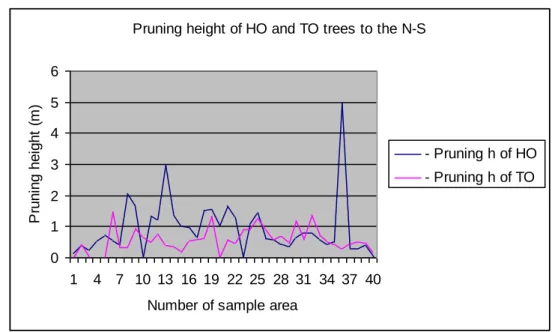
Figure 8 presents the pruning height of the Hungarian and Turkey oak trees to the north-south; thus, the pruned stem of the Hungarian oak trees is larger to the north and central area as well as in the southern part of the former regeneration stand. The Turkey oak tree have stem portions less pruned than the Hungarian oak ones. The pruning height of the Turkey oak trees is larger in the middle and the southern part of the former regeneration stand.
Pruning height of HO and TO trees to the E-W
0 0,2 0,4 0,6 0,8 1 1,2 1,4 1,6 1,8 2
1 3 5 7 9 11 13 15 17 19 21 23 25 27
Number of sample area
P
ru
n
in
g
h
e
ig
h
t
(m
)
Pruning H of HO Pruning H of TO
Fig. 9 Pruning length of Hungarian and Turkey oak trees to the east-west
The pruning height of the Hungarian oak trees is larger in the middle and the eastern area, whereas the pruning height of the Turkey oak trees is larger in the middle and the southern part as shown by the diagram of the pruning height of the Turkey and Hungarian oak trees to the east-west.
53
line with the goals of forest management, and to remove the inadequate samples of valuable species that would affect the productivity and the value of the wood at the age of exploitability.
CONCLUSIONS
The research findings are reflected in a number of conclusions of particular practical application in the management of mixed stands of Hungarian and Turkey oak trees:
- the average height of specimens of mixed of Hungarian and Turkey oak trees is larger in the central area of the former regeneration stand;
- the general shape of the height curve is increasing, starting from the outer areas to the middle of the former regeneration stand;
- the curve of the diameters of the young stand is similar to that of the height curve; - the outer areas of the former regeneration stand are at the thicket stage;
- the central and, partly, the outer areas are at the saplings and rod stage, mixed with sticks of the young wood;
- the crown length is larger in the case of Hungarian oak trees compared to that of the Turkey oak trees;
- the transition from the thicket stage to the saplings and poles stage is highlighted by natural pruning ;
- natural pruning is stronger in Hungarian oak specimens that are planted before the Turkey oak ones;
In order to ensure the rational management of these stands, the following works are mandatory:
- care work, cleaning in the central and outer area, where priority is given to the removal of Hungarian oak trees grown from young wood with long non-pruned crowns;
- in the central and outer areas, some of the young trees should be removed.
BIBLIOGRAPHY
1. Badea, O., 2003. Starea de sănătate a pădurilor din România în intervalul
1986-2000 (Romania’s Forests Health Status between 1986-2000), Bucuresti: Regia Naţională a Pădurilor, pp. 889-897.
2. Bercea, I., 2007. Cercetări privind regenerarea arboretelor de gârniţă şi cer din
partea vestică a Podişului Getic (Research on the Regeneration of the Hungarian and Turkey Oak Seedlings in the Western Part of the Getic Plateau). Doctoral Thesis. “Transilvania” University of Braşov.
3. Florescu, I.I., 2004. Silvicultură (Forestry). Arad: "Vasile Goldiş" University Press.