T E C H N O L O G Y W H I T E P A P E R
With the right infrastructure, service providers can leverage their greatest assets — their network and their expertise — to deliver cloud services from their data centers as a natu-ral extension of the network and hosting services they offer today. The cloud-ready data center infrastructure must support new service models at the scale necessary to meet demand, and operate efficiently to ensure profitability and support full virtualization. HP and Alcatel-Lucent have combined their strengths to bring service providers all of the elements needed to deliver cloud services from their data center: Compute resources, storage, data center fabric, inter-data-center connectivity and unified service orchestra-tion. With the HP and Alcatel-Lucent offering, service providers will be better positioned to address their customers’ needs and reap the rewards of the cloud services opportunity.
Creating the Cloud-Ready Data Center
Combining the strengths of HP and Alcatel-Lucent to position service providers
for the cloud services opportunity
Table of contents
1 1. The cloud services opportunity for service providers
1 2. The challenges of the virtualized data center
3 3. HP and Alcatel-Lucent: Delivering the building blocks for cloud services
3.1 Unified service management: A critical capability 3.2 Enhancing service providers’ inherent advantage
8 4. HP and Alcatel-Lucent help service providers win in cloud services
1. The cloud services opportunity for service providers
The advent of cloud computing has created a significant new business opportunity for service pro-viders. To win their share of this new opportunity, service providers need a cloud-ready infrastruc-ture that can both support new service models at the scale necessary to meet demand and operate at an efficiency level that ensures profitability.
With the right infrastructure, service providers can leverage their network assets and apply their ex-pertise to deliver cloud services from their data centers as a natural extension of the virtual private network (VPN) and hosting services they offer today. The key building blocks of this infrastructure are the network, the virtualized data center and unified service orchestration.
These building blocks put service providers in a strong position to deliver cloud serivces. For ex-ample, they can embed server and storage resources across their network, using the network’s reach to efficiently distribute services across their entire infrastructure. This will allow service providers to offer bandwidth and latency characteristics that are superior to those of non-telco data center pro-viders. The infrastructure will deliver services that come with the service level agreements (SLAs) that the most demanding customers have come to expect. It will also combine IT and network performance information into a single, unified SLA to provide higher levels of application assurance and reporting than are available to their enterprise customers today.
Service providers looking to adapt and extend their data center assets to support cloud services will turn to technologies that are similar to those used by their enterprise customers. They will also face many of the same challenges. However, service providers must support a broader range of require-ments to meet the security, data privacy and scalability levels expected by their enterprise customers. Computer virtualization technologies will enable service providers to create multi-tenancy models in their data centers to ensure the economies of scale necessary to deliver cost-competitive, yet profitable, services. Enterprises will only adopt cloud services that offer an economic advantage over those they can deliver themselves. This is the economic threshold service providers must meet. The HP and Alcatel-Lucent strategic alliance enables service providers to profit from cloud technol-ogy. It allows them to leverage existing network assets to expand their offerings to large enterprise and small- and medium-sized business (SMB) customers while making network and IT operations more efficient across their business.
Before we take a closer look at the HP and Alcatel-Lucent offering for data centers, it is worthwhile to consider the challenges service providers face in operating today’s virtualized data centers.
2. The challenges of the virtualized data center
The demands on today’s service provider data centers are significantly different than the demands on yesterday’s more traditional data centers. The advent of computer virtualization creates a truly agile service environment. For example, service providers can place a customer’s service in the opti-mal data center and on the optiopti-mal platform to meet the customer’s requirements and increase their own ability to meet SLAs and drive maximum profitability.
Service providers can now host many customers on a single computing asset; like the service network, the compute environment is now multi-tenant. In addition, just as the computing environ-ment operates independently of physical infrastructure through virtualization, so does the storage infrastructure that supports it. Operating the three data center “silos” of compute, storage and network independently does not meet the requirements of this new paradigm.
The virtualized data center poses a number of operational and management challenges. Some of the primary challenges include:
• Secure multi-tenancy
Computer virtualization maximizes the economies of scale that service provider data centers de-liver. Today, it is not uncommon to have 20 or more virtual machines on a single physical server. This could mean the service provider is supporting 20 different customers on the same server. The service provider must ensure that customer data never mixes on the virtual platform. They must also ensure it does not mix in the network. The multi-tenant model must be end-to-end, from the customer premises to the server where the service is instantiated.
• Virtual machine mobility
Computer virtualization allows service providers to instantiate a customer’s compute service on any machine in its inventory, in any of its data centers. This means service providers now have the luxury of moving a customer’s service from one machine to another at will — ideally with-out service disruption. This new flexibility requires a new virtualized network model that not only virtualizes the IP domain, but now also virtualizes the Layer 2 domain so that Layer 2 spans servers and data centers.
• Infrastructure scalability
With computer virtualization, service providers can host many more customers on their physical infrastructure. This dramatically increases the number of logical nodes operating over the data center network. For example, a rack of 64 servers with 20 virtual machines each could force the service provider to support, as many as 1200 IP subnets and virtual LANs (VLANs) just for that one rack. Because virtual machines can suport up to 10 virtual interfaces, that figure can rapidly increase. Ten racks would require at least 12,000 IP subnets and VLANs. This is a significant is-sue becuase it breaks the limit of 4094 usable VLANs that is specified in the Institute of Electri-cal and Electronics Engineers (IEEE) 802.1Q standard. The dramatic growth of IP and Layer 2 networks puts significant strain on the switches and routers required to operate the network. • Storage transport
Many data centers use centralized storage systems to aggregate customer data. While computer virtualization has enabled service providers to move customer services from one machine to an-other, each of these virtual machines must still communicate with its storage system. To increase efficiency and reduce latency, service providers need to move storage with virtual machines. This is particularily important in cases where, for optimal perfromance, the service provider deploys micro data centers at points of prescence near end users. It is also likely that inter-data-center storage transport will be required.
• Bandwidth and latency
Most service providers will want to host a wide array of application-based services in their data centers. Technologies such as video conferencing, unified communications and desktop virtu-alization require low-latency, high-bandwidth networks. Service providers will be required to choose the placement of these services based on network characteristics, not just the availability of RAM and CPU resources.
• Unified service management
A service being delivered from a service provider’s data center is multi-faceted. It is composed of compute, storage and network elements, all working together. This drives the need for unified provisioning, assurance and billing. Service providers need the ability to troubleshoot across technology boundaries, provide one bill and offer one complete-stack SLA.
HP and Alcatel-Lucent have developed a data center offering that addresses these challenges while simultaneously focusing on enhancing service providers’ competitive advantage.
3. HP and Alcatel-Lucent: Delivering the building blocks for cloud services
The HP and Alcatel-Lucent offering for data centers includes the complete data center portfolio: Compute resources, storage, data center switching fabric, high-speed inter-data-center connectivity and unified data center orchestration.
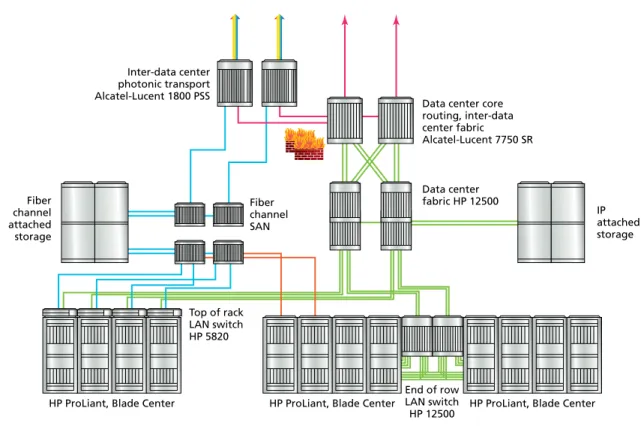
With these assets, service providers are better positioned to leverage the network as a resource in the cloud to automate and more effectively manage and distribute resources for improved performance. As illustrated in Figure 1, the HP ProLiant and Blade Center server technology is internal to the data center. Intra-data-center connectivity is provided by either the HP A-Series switching portfolio or the Alcatel-Lucent 7450 Ethernet Service Switch (ESS), depending on whether the data center deployment is in a central office or a central data center. The Alcatel-Lucent 7750 Service Router (SR) family and the Alcatel-Lucent 1830 Photonic Service Switch (PSS) provide inter-data-center connectivity.
Figure 1. HP and Alcatel-Lucent enable service providers to intra- and inter-connect data centers
Data center core routing, inter-data center fabric Alcatel-Lucent 7750 SR Inter-data center
photonic transport Alcatel-Lucent 1800 PSS
Data center fabric HP 12500 Fiber
channel SAN
End of row LAN switch HP 12500
HP ProLiant, Blade Center HP ProLiant, Blade Center HP ProLiant, Blade Center
Top of rack LAN switch HP 5820
IP attached storage Fiber
channel attached storage
To address the challenges of multi-tenancy and mobility, the HP and Alcatel-Lucent offering uses industry-standard technologies such as Multiprotocol Label Switching (MPLS), Virtual Private Routed Networks (VPRN), Virtual Private LAN Services (VPLS) and Provider Backbone Bridging (PBB). The result is a scalable, secure, virtualized network that allows service providers to provision customer services anywhere within their infrastructure while still enjoying the benefits of virtual machine mobility. PBB is used within the data center while MPLS and PBB over VPLS are used between data centers and from data centers to clients to create a highly available, low-latency fabric that supports long-distance virtual machine mobility.
Multi-tenancy means individual customers must always remain isolated from one other, starting at their premises, all the way to the virtualized computer that defines their data services. Technolo-gies such as VPRN, VPLS and VPLS-PBB isolate and massively scale customer VLANs and MAC addresses on the cloud network. HP FlexFabric isolates individual virtual machines on the same physical server. The Alliance Data Centre storage offering is capable of providing thousands of secure “virtual private arrays” – Virtual Domains. By providing secure administrative segregation of users, hosts, and application data, HP virtual domains allows the service provider to deliver virtual private array services and “self-service” storage that is both secure and capable of high quality-of-service. The combination of FlexFabric, virtual private arrays and a virtualized data center network ensures service providers can leverage their data center to maintain the highest level of security for every customer.
The HP and Alcatel-Lucent offering gives service providers scalability at both Layer 2 and Layer 3. The Alcatel-Lucent 7750 SR platform scales to support more than 10,000 VPRNs, enabling service providers to scale and to segregate the Layer 3 domains needed to support customer isolation. Using PBB inside the data center switching fabric as well across the wide area network masks the potentially tens of thousands of MAC addresses and VLANs that could be required. PBB groups all of a customer’s Layer 2 domains within one service-specific container. As a result, service providers’ backbone routers are not burdened by immense numbers of MAC addresses. This approach maxi-mizes the router’s scalability and simplifies the challenge of troubleshooting issues across multiple data centers.
Storage in a service provider data center must be mobile and always available. There are a number of different storage models in use today. Storage over IP (SoIP), Fiber Channel over Ethernet (FCoE) and traditional Fiber Channel all require a network that offers low latency and high availability. In addition, strong multi-tenant support of storage separation mirrors virtual machine separation within the hypervisor1. The HP and Alcatel-Lucent approach to data centers accommodates all of
these models, including storage mobility between data centers.
The Alcatel-Lucent 1830 PSS supports native Fiber Channel transport with low latency, enabling inter-data-center storage mirroring. FCoE or SoIP models are fully supported inside the data center and between data centers. Because Alcatel-Lucent optical products include advanced quality of service (QoS) features, long-distance mirroring over Ethernet is also possible. The rapid distribution of storage enables the fastest possible virtual machine movement.
The HP and Alcatel-Lucent offering is designed with network elements that scale to meet the largest bandwidth requirements. All of the photonic and data elements in the offering are 40 Gigabit- and 100 Gigabit-capable. The Alcatel-Lucent 1830 PSS and the Alcatel-Lucent 7750 SR support 100 Gigabit interfaces today. Inside the data center, pairs of HP S12500-series core data center switches are clustered to operate as a single logical system. Four HP S12516 switches provide 12 Terabits of capacity.
3.1 Unified service management: A critical capability
One of the most significant challenges that service providers must address is that of unified service management. Within the data center, multiple systems must be managed as a cohesive system. Ad-ditionally, the data center systems themselves are complex. The workflows to create a service that includes multiple compute resources, storage and is linked to a specific customer VPN service could involve so many steps that the service provider is unable to quickly turn up a service.
1 A hypervisor is also known as a Virtual Machine Monitor (VMM) or a virtualization manager. It is software that manages either mul-tiple operating systems, or mulmul-tiple instances of the same operating system, on a single computer.
Unified service management for the data center must automate and link multiple workflows, allow-ing service providers to complete service requests in a competitive period of time. Non-telco cloud service providers can activate services in minutes; service providers must have the same capability. To address the challenges of managing the entire data center stack, HP and Alcatel-Lucent are unifying their management tools. Figure 2 illustrates the data center stack.
Figure 2. Unified service management allows service providers to manage the entire data center stack
Unified management
Application OS vertualization
Servers
LAN and storage
Service routers
Service access
• Linux® • VMware®
• Windows Server System™
Access network
Alcatel-Lucent provides advanced network and service management, provisioning, reporting and analysis. Alcatel-Lucent also contributes its application assurance technology which allows service providers to enable the network to automatically adjust QoS metrics to ensure the highest level of SLA granularity available.
HP provides data center facilities management, compute, storage, operating system, virtualization and application management. Once combined, these capabilities are converged to allow service providers to simplify data center service provisioning, minimize time to troubleshoot and provide full-stack SLAs.
3.2 Enhancing service providers’ inherent advantage
Service providers have a natural advantage over other providers: The network. Service providers can distribute their data centers to create advantages in terms of service-access latency and band-width. They can also bundle data center and network services with unified SLAs.
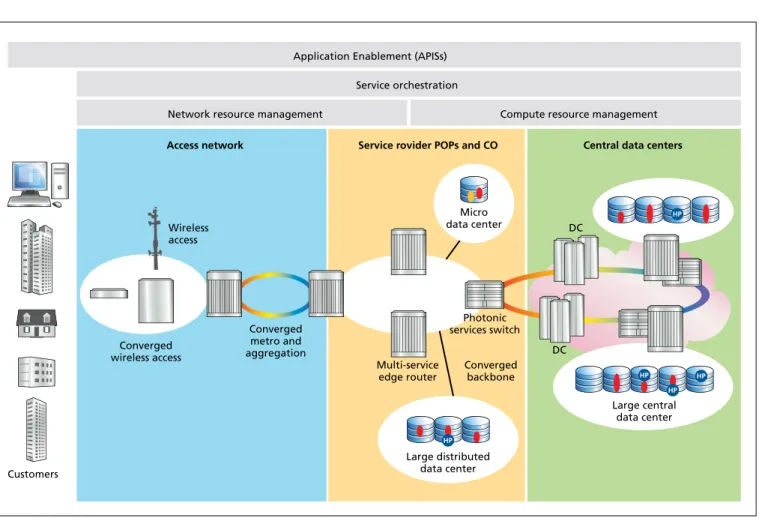
With this in mind, the HP and Alcatel-Lucent offering for data centers allows service providers to place services in both central and distributed data centers based on the economic model that pro-vides them with the greatest advantage. Figure 3 illustrates the elements in a distributed data center.
Figure 3. A distributed data center improves service access latency and bandwidth
Customers
Access network Service rovider POPs and CO Central data centers
Compute resource management Network resource management
Service orchestration Application Enablement (APISs)
Converged metro and aggregation Converged
wireless access Wireless
access DC
DC
Multi-service
edge router Convergedbackbone Photonic services switch
Large distributed data center
Micro data center
Large central data center
HP
HP HP
HP
HP
Service providers gain financial benefit by distributing their data centers, positioning select services close to the customers who will use them. Due to their proximity to customers, distributed data centers will have much lower latency characteristics per application and per service than those that are deployed centrally, further away from customers. Applications such as virtualized desktops, online gaming and video distribution are all affected by latency and can consume more network bandwidth as the number of users increases.
Alcatel-Lucent Bell Labs has developed models that confirm the benefits of distributed data centers. The Bell Labs models describe the relationships among the number of application subscribers, the network bandwidth and proximity to the customer.
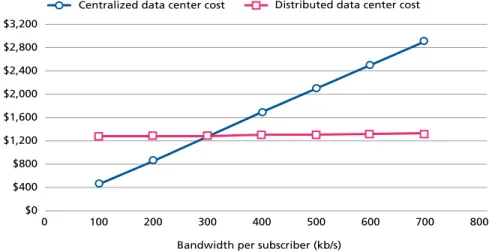
In one scenario, Bell Labs examined the relationship between bandwidth consumed per-subscriber for a data-center-hosted application and the cost to deliver it. The Bell Labs model shows that the cost of bandwidth per subscriber eventually exceeds the cost of operating the distributed data center. As illustrated in the upper chart in Figure 4, the cost per application increases linearly for services hosted in a centralized data center while it remains relatively stable for applications hosted in a distributed data center.
Figure 4. A distributed data center stabilizes and reduces the cost per application compared to a centralized data center
0 2,000 4,000 6,000 8,000
Subscribers/application
Cost per application, varying number of subscribers/application
10,000 12,000 14,000
$0 $16,000
$12,000
$4,000
Distributed data center cost Centralized data center cost
$14,000
$10,000
$6,000
$2,000 $8,000
0 100 200 300 400 500
Bandwidth per subscriber (kb/s)
Cost per application, varying number of subscribers/application
600 700 800
$0 $3,200
$2,400
$800 $2,800
$2,000
$1,200
$400 $1,600
Source: Alcatel-Lucent Bell Labs
In another model, Bell Labs examined the relationship between the cost of delivering an applica-tion and the growth rate in the number of subscribers using it. In this scenario, the centralized data center has the early cost advantage. However, as illustrated in the lower chart in Figure 4, the cost advantage of the distributed data center is significant as the application becomes more popular. These are just two of many scenarios that illustrate the flexibility service providers have in deploy-ing appropriately-sized IT assets across their data centers. By providdeploy-ing an end-to-end architecture that scales from the smallest micro data center to the largest central data center as well as unified service management and data center automation capabilities, HP and Alcatel-Lucent enable service providers to monetize their network.
The HP and Alcatel-Lucent approach uses the network as a critical resource in the cloud to auto-mate and more effectively manage and distribute resources for better performance. For example, our approach uses the resources freed through optimization efforts to support service providers’ entry into public and private hybrid cloud services. This helps service providers differentiate themselves by delivering responsive and distributed cloud-based services that take advantage of their real-estate footprint, brand, culture of customer experience management and access networks.
4. HP and Alcatel-Lucent help service providers win in cloud services
The HP and Alcatel-Lucent offering for data centers ensures that service providers’ networks are a competitive advantage, enabling new selling opportunities and allowing service providers to deliver more services from their data centers. Service providers gain the IT expertise, data center technol-ogy, carrier-grade scalability and network agility needed to deliver new and high-value data-center-based services.
The unique combination of global reach, technology and portfolio breadth offered by HP and Alcatel-Lucent cannot be matched by other vendors. The following offers a brief look at the benefits that HP and Alcatel-Lucent bring to service providers considering cloud services.
End-to-end offerings
HP and Alcatel-Lucent are commited to synchronizing their product roadmaps to create end-to-end offerings. For example, HP supports PBB in its core Ethernet switches within the data center while Alcatel-Lucent supports PBB in its multiservice edge routers. This allows for highly scalable, end-to-end service delivery from the heart of the data center, all the way to the edge of the service provider’s network.
A rich API set
HP and Alcatel-Lucent offer a complete API set for both network and IT assets. The combined assets of the IT and service network infrastructure are exposed as an open development platform that provides new service capabilities to end users and to application and content providers. This enables migration from a closed system to an open system that provides access to network, compute, memory, and storage resources through web APIs. These APIs can be federated through agreements with other service providers to extend the reach of services and prevent fragmentation.
Commitment to industry standards
HP and Alcatel-Lucent are commited to industry standards across both the IT and network stacks. This commitment reduces vendor lock-in, simplifies integration and migration and ensures that service providers are not tied to technologies that are at risk of becoming obsolete.
Fast deployments
HP and Alcatel-Lucent enable quick micro and remote data center deployments. Our combined offering is based on the HP Peformance-Optimized Data Center (POD) pre-integrated with HP and Alcatel-Lucent servers, storage and networking components. This combination gives service provid-ers a unique plug-and-play approach to rapid service delivery.
Flexible financing
HP and Alcatel-Lucent offer flexible multivendor financing options that range from up-front capital for equipment purchases to financing for pruduent, growth-based operational expenditures.
Services expertise
HP and Alcatel-Lucent offer a full range of professional services to help service providers assess, plan, design, test, install, integrate and manage data centers and cloud services. Our offerings include consulting services that enable applications to be migrated to the cloud. They also include network design methodologies, algorithms, tools and financial modeling techniques developed at Bell Labs. Our services offerings help ensure service providers benefit from a cost-effective and future-oriented data center.
In summary: All the benefits of two world leaders
With the leader in IT and the leader in networking, service providers gain the best of both worlds.
HP brings: ALcAteL-LUcent brings:
In-depth IT expertise In-depth network expertise A large installed IT base A large installed telecoms base Leadership in IT and data center transformation Leadership in network transformation IT outsourcing leadership Telecoms outsourcing leadership
Together, HP and Alcatel-Lucent create a data center offering that empowers service providers to deliver cloud services.
5. Abbreviations
API application programming interface ESS Ethernet Service Switch
FCoE Fiber Channel over Ethernet IP Internet Protocol
IEEE Institute of Electrical and Electronics Engineers IT information technology
MAC media access control MPLS Multiprotocol Label Switching PBB Provider Backbone Bridging POD Performance-Optimized Data Center PSS Photonic Service Switch
QoS quality of service SAM Service Aware Manager SLA service level agreement SMB Small and medium-sized business SoIP Storage over IP
SR Service Router VLAN virtual LAN
VMM Virtual Machine Monitor VPLS Virtual Private LAN Service VPN virtual private network VPRN Virtual Private Routed Network
www.alcatel-lucent.com Alcatel, Lucent, Alcatel-Lucent and the Alcatel-Lucent logo are trademarks of Alcatel-Lucent. All other trademarks are the property of their respective owners. The information presented is subject to change without notice. Alcatel-Lucent assumes no responsibility for inaccuracies contained herein. Copyright © 2010 Alcatel-Lucent. All rights reserved. RMK0591100801 (11)
© Copyright 2010 Hewlett-Packard Development Company, L.P. The information contained herein is subject to change without notice. The only warranties for HP products and services are set forth in the express warranty statements accompanying such products and services. Nothing herein should be construed as constituting an additional warranty. HP shall not be liable for technical or editorial errors or omissions contained herein.