Smart TV forensics: Digital traces on televisions
A. Boztas
*, A.R.J. Riethoven, M. Roeloffs
Netherlands Forensic Institute, Laan van Ypenburg 6, The Hague, The Netherlands
Keywords: Digital forensics Smart TV Smart TV forensic Cyber crime Digital crime
a b s t r a c t
The Smart TV is becoming increasingly popular amongst consumers. Many consumers use a Smart TV to gain quick access to the Internet including video on demand, social networking and instant messaging. Most Smart TVs also provide capabilities to connect with external devices such as a USBflash drive, a mobile phone etc. All of these features make a Smart TV a potentially rich source of information for forensic purposes. With increasing utilisation, it is also easier for malicious users to abuse a Smart TV. Therefore a digital forensics study on thefield of Smart TV is imperative. This paper proposes new procedures for acquiring, analysing and investigating a Smart TV.
©2015 The Authors. Published by Elsevier Ltd. This is an open access article under the CC BY-NC-ND license (http://creativecommons.org/licenses/by-nc-nd/4.0/).
Introduction
Electronic technology continues to develop. Each day new electronic devices that influence human daily life are entering the market. These devices may store digital data which may be interesting from a digital investigation perspective. A Smart TV (Wikipedia, 2014) is one of these devices. A Smart TV, sometimes referred to as connected TV or hybrid TV, describes a trend of integration of the Internet into television sets and set-top boxes, as well as the tech-nological convergence between computers, television sets and set-top boxes. Smart TVs are available as stand-alone products, but regular televisions can also be made
“smart”through set-top boxes that enable advanced func-tions; for example, Google TV, Apple TV. These devices are mostly IP devices, which enable streaming content over Internet without the need for cable or satellite. Most of the Smart TVs provide access to external hard drives, digital cameras, mobile phones or Internet applications. A Smart TV allows the viewers to connect to the Internet and
browse the web as on a computer without the need for additional peripherals. Smart TVs include a wide range of applications which can be used for different means. Viewers can use applications to search and find videos, music, photos and other content on the web, a local cable TV channel, a satellite TV channel or a local storage device. In the digital forensic area, questions arise as to whether a Smart TV should be an important component of a digital investigation. In the article (Sutherland et al., 2014) a number of questions are posed concerning the relevance of the Smart TV in a digital forensic investigation: do Smart TVs retain and contain relevant information? How easily is this data accessed? In Mutawa et al. (2012) it is stated that the increased use of social networking applications on smartphones makes these devices a ‘‘goldmine’’ for forensic investigators. Is the use of, for example, social networking applications on Smart TVs doing the same for forensic investigators?
This paper presents research on extracting and ana-lysing digital data from a Smart TV in a forensically sound manner. It will give a complete guide to acquiring and investigating data on a Smart TV. This paper does not present an in-depth study of the inner workings of a Smart TV. The scope of this research focuses only on the methods of extracting data from a Smart TV and the global analysis
*Corresponding author.
E-mail addresses: [email protected] (A. Boztas), r.riethoven@ holmes.nl (A.R.J. Riethoven), [email protected] (M. Roeloffs).
Contents lists available at ScienceDirect
Digital Investigation
j o u r n a l h o m e p a g e : w w w . e l s e v i e r . c o m / l o c a t e / d i i n
http://dx.doi.org/10.1016/j.diin.2015.01.012
of the said acquired data. Our goal is to show that a Smart TV may indeed contain different kinds of digital traces which can be relevant for investigations, such as, pictures, connected devices, visited websites, etc. If forensic exam-iners are not knowledgeable regarding the different types of Smart TV based systems and what artifacts each may leave behind, they could miss critical information during an investigation.
Related work
Earlier work on Smart TVs focuses mainly on gaining access to the Smart TV in order to get user data remotely (Grattafiori and Yavor, 2013) and (Lee and Kim, 2013). The latter authors also go further into making a surveillance device from the Smart TV, by recording audio and video from the built-in microphone and camera respectively. The main point made in the previous research is that it is not that hard tofind ways to gain access to the Smart TV on a low-level. With these methods it should be possible to gain access to a Smart TV. There is no forensic research available for any brand or model of Smart TV.
From a hardware perspective, the Smart TV is just an embedded system with a large (for example 40-inch) screen. The Smart TV can be handled like any embedded system. An embedded system which has been investigated thoroughly is a mobile phone. Willassen (2005) and van der Knijff (2010) show methods which can be used during the investigation of a Smart TV.
Materials and methods
In this section we will explain how we carried out this research. Initially, a literature and market share survey was conducted. The Smart TV market continues to grow (Tarr, 2013) and expand rapidly in major coun-tries (Hong, 2013). We determined which models and brands of Smart TV are popular (Top10, 2014) or more common under users and which functionality of these Smart TVs are commonly used. On the basis of this literature study, the model and type of the Smart TV for our research was selected. Secondly, we set up an experimental environment to generate different types of digital traces when using the Smart TV. Finally methods were developed to acquire and analyse the digital traces of this Smart TV.
Selecting a smart TV
As previously stated, there exists a great deal of va-riety of types and models of Smart TVs on the market. The features available on a Smart TV vary depending on the brand and model of TV. Most Smart TVs will allow access to popular social networking sites and communi-cation programs such as Skype. The most popular brands of Smart TV are Samsung, LG, Panasonic and Sony. This research was conducted on a Samsung television model UE40F7000SLXXN, based on popularity, the fact that it contains a camera and microphone, and the fact that Samsung has an open source platform for their Smart TVs. The Samsung Smart TVs are very popular amongst
customers and offer a great deal of functionality which therefore may leave relevant digital traces for a digital investigation. This type of television allows the viewer to install applications, visit websites, peruse pictures, communicate by voice and video, connect external de-vices, etc. User data was generated by performing different usage scenario's which covered most of the available functionality of the Samsung Smart TV.
Data acquisition methods
The selected Smart TV usesflash memory as storage. Theflash memory on the investigated Smart TV is an eMMC chip (Wikipedia MultiMediaCard, 2015). Depending on the hardware, there are several options to acquire data. The following methods for acquiring the data were utilised:
eMMCfive-wire method: an eMMC chip, like the one used in our reference Smart TV only needsfive signals to be connected: Vss, Vdd, Clock, Command&Data0. These signals were detected on the main board. It is then possible to read the eMMC chip using a standard USB SD-cardreader attached to a writeblocker.
NFI Memory Toolkit II (MTK II): (NFI, 2011) this is a universal forensic solution that enables investigators to read memory chips and potentially extract user datae
such as text messages, phone numbers, pictures and browser historyefrom a wide variety of devices. The MTK II is a combination of hardware and software. The hardware makes a physical connection, generates sig-nals and supplies power to a memory chip, while the software runs the necessary command-sets to access data in the various types of memory chips.
Application: a software approach for acquiring data is the use of a custom application with a small footprint which was installed on the Smart TV and writes the data out to an external storage device. This might be possible as Samsung distributes a Software Development Kit to develop applications for this particular model of Smart TV.
Analysis of digital traces
The fundamental goal of this research is to determine which digital traces are left behind on a Smart TV for investigation purposes. This means that this paper is not a complete description of the inner workings of this partic-ular Smart TV and instead is focused on acquiring traces of user interaction. Different tools and forensic programs like EnCase were used to search through the data of the Smart TV. Our research was focused on the following types of traces which may well be relevant for a digital forensic study:
System information and settings: device name, con-nected devices, network information and smart functions.
Apps: Facebook, Twitter, YouTube, etc.
Web browsing: visited websites, traces of search en-gines, etc.
External media: connected external devices such as USB flash drive, harddiscs, etc.
E-mails and appointments
Cloud services: Dropbox and OneDrive
Channel information: which channels are viewed.
Data acquisition
eMMCfive-wire method
On the main board of the Samsung Smart TV, thefive necessary signals were detected in order to use thefi ve-wire method and extract data from the eMMC chip. It was not possible to make a copy of the eMMC memory. This is probably due to the fact that the processor is also trying to access the memory. It was not possible to reset or halt the processor, because reset points were not found. It was also not possible to put the Smart TV into a specific mode, in order to prevent the processor from accessing the memory. For this specific brand and model Smart TV the five-wire method did not work.
NFI memory toolkit
The next option was to desolder theflash memory and read it with the MTK II.
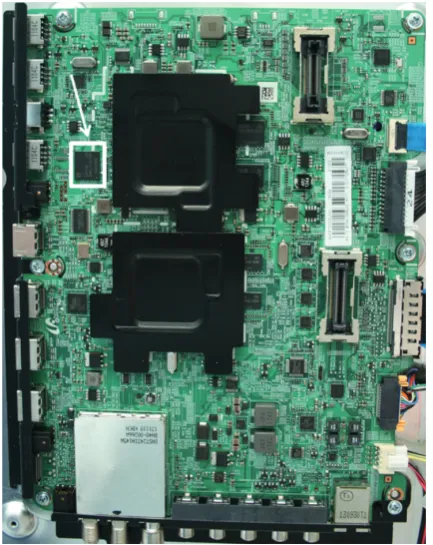
Fig. 1 depicts the main board of the Samsung Smart TV. The white square emphasises the location of the memory chip of the Smart TV.
The memory chip of the Samsung model UE40F7000SLXXN is a Samsung KLM4G1FE3B-B00, which is a 4GiB MoviNANDflash chip. MoviNAND is the trade-marked name for Samsung's eMMC chips. By utilising a (hot air) rework station, the memory chip was removed from the main board (Breeuwsma et al., 2007). The MTK II was then used to make an image of the memory chip.
Application
Due to the fact that data acquisition by chip extraction is very specialised and destructive, a software method was investigated. A hacking community (SamyGo, 2014) has already made progress in this area. The SamyGO Forum describes a method to‘root’a Samsung Smart TV (SamyGo Forum, 2013b). Rooting is needed to obtain elevated priv-ileges for an application that runs on Linux for ARM oper-ating system installed on this Smart TV. Without elevated privileges, it is not possible to extract data from the user space memory or have full access to thefile system. The rooting procedure is as follows:
1. Install the Skype App from the Samsung App store. 2. Start the Skype app and ensure Skype is set to autostart,
before closing it.
3. Install the SamyGO widget.
(a) Download the SamyGO_usb widget.
(b) Place the SamyGO folder on a USBflash drive. (c) Navigate to “more apps”and insert the USBflash
drive.
(d) Start the SamyGO widget.
By examining the code in theMain.jsfile of the SamyGO widget, it is derived that afile patch was unzipped in the Skype folder. The patchfile is a zipfile with the contents:
AutoStart
libSkype.so
remoteSamyGO.zip
runSamyGO.sh
Thefile libSkype.sooverwrites the currentfile, and is
started by Skype at the startup of the Smart TV. This
lib-Skype.soin turn starts the scriptrunSamyGO.sh, which
in-stalls busybox and initiates an ftp server. With the added functionality of an ftp-server on the rooted Smart TV it is possible to transfer data.
With changes to the SamyGO shell script, it is possible to make images of the completeflash memory from the Smart TV. The scriptrunSamyGO.shwas modified, so that it would start another script (run1.sh), which installs a busybox instance into the/tmp/bindirectory and uses thedd com-mand from the busybox to create an image. During this imaging process the data is written to a USB flash drive which is inserted into the Smart TV.
[image:3.561.53.270.408.681.2]This software method is vulnerable to updates of the firmware of the Smart TV. As (Grattafiori and Yavor, 2013) show, security researchers are also targetting the Smart TV operating systems. During our research thefirmware was automatically updated to a newer version. The root method
of the Smart TV ceased to work and therefore the appli-cation was rendered useless. For other models of Samsung Smart TVs this method might still be working and the SamyGO userbase might overcome this problem in the future by releasing an updated version or method. As (Lee and Kim, 2013) shows there will be more methods of get-ting software access to the Smart TV, but it will take work for each brand and model of TV. It will always be an arms race between the makers of exploits and the Smart TV manufacturers who will repair these exploits. Therefore, the hardware methods for getting access to Smart TVs will be more lasting and forensically more sound than the software methods.
File system analysis
As described in the previous section, data can be suc-cessfully acquired from the Smart TV using two different methods. Each of these methods results in an image which can be analysed with both standard tools and specific forensic tools. In this section the results of the image analyse are presented.
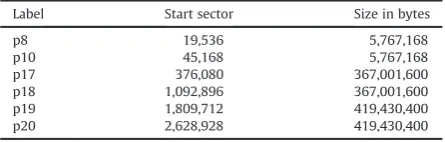
The image from the 4 GiBflash memory contains in total 24 partitions. It uses a standard DOS partition scheme (Carrier, 2005, p. 81e84) with four primary partitions. One of the primary partitions is an extended partition con-taining 20 logical partitions. All partitions, except the placeholder extended partition, have a hex byte 83 stan-dard Linux identifier (Carrier, 2005, p. 90). Based upon a signature identification of the content within the partition, at least two differentfile system images were discovered. Table 1 lists the partitions containing a Squash File System image (SquashFS) and Table 2 lists the partitions with the proprietary Samsung eMMC chip oriented File System (eMMCfs). In Table 3 u-boot images are listed that were discovered.
The acquiredddimage and the MTK II eMMC storage area image are both equal in size. However, besides the standard eMMC storage area, the MTK II also acquired the Boot area and Replay Protected Memory Block (RPMB) area from the chip in separate imagefiles.
SquashFS
The SquashFS, which is intended to be a read-onlyfile system, is not viewable with the standard squashfs-tools (Lougher, 2014). Samsung made its own changes to squashfs-tools version 4.2. This version (squashfs4.2.tar.gz) can be downloaded from Samsungs Open Source Release Center (Samsung, 2014), in the TV/DTV/ETC section. With
this program it is possible to unsquash the file system thereby exporting all content. Loopback mounting a Sam-sung SquashFS image is possible when applying the modification Samsung made to SquashFS for a given Linux kernel.
In the unsquashed partitionp17 we found a text file
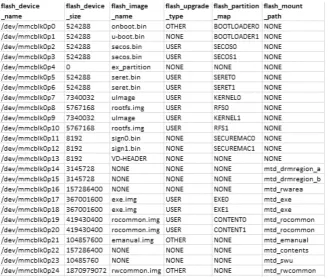
partitions.txt(see Fig. 2) which lists more information about
the used partition schema. This figure however lists 25 partitions instead of the previous found 24. One partition with the size of 524,288 bytes is missing in our 4GiB im-ages. Because partitionp1is zero-filled in theddimage, we assume that this is the RPMB and p0 is the Boot area. Further research on the Boot area and RPMB acquired with the MTK II should be conducted to support this assumption.
Samsung eMMC chip orientedfile system
The eMMCfs is a proprietaryfile system made by Sam-sung. In order to investigate the contents of the partitions with this type offile system, specifications were needed. On most of their Smart TVs, Samsung uses VD GNU/Linux, which is an open source Linux distribution by the VD Project (2014). Our particular Smart TV uses this distribu-tion of Linux on its ARM processors. In the source code of this operating system, found in Samsung (2014) in the TV/ DTV/LED section with the name 13_UNxxF7200.zip, the Linux file system drivers for eMMCfs were found. These sources can be compiled for any Linux-based operating system. Depending on the version of the Linux kernel, a user wanting to include native support for eMMCfs can do so. On the SamyGO forums (SamyGo Forum, 2013a) users have already made some patches for different kernel ver-sions which can be used, or an expert user can use the sources from Samsung and incorporate them into their Linux distribution.
U-boot legacy uImage
[image:4.561.291.511.80.159.2]U-Boot is a universal bootloader that is used to boot devices. This particular bootloader has comprehensive support for loading and managing boot images. The boot
Table 1
SquashFSfile system, little endian, version 4.0.
Label Start sector Size in bytes
p8 19,536 5,767,168
p10 45,168 5,767,168
p17 376,080 367,001,600
p18 1,092,896 367,001,600
p19 1,809,712 419,430,400
p20 2,628,928 419,430,400
Table 2
Samsung eMMC chip oriented File System.
Label Start sector Size in bytes
p14 56,544 3,145,728
p15 62,704 3,145,728
p16 68,864 157,286,400
p21 3,448,144 104,857,600
p22 3,652,960 157,286,400
p23 3,960,176 10,485,760
[image:4.561.45.268.624.695.2]p24 3,980,672 1,870,979,072
Table 3
u-boot legacy uImage (Linux 3.0.33, Linux/ARM OS Kernel Image).
Label Start sector Size in bytes
p7 5184 7,340,032
[image:4.561.289.515.658.694.2]images in Table 3 are so called secure boot images which are signed by Samsung. This is used to prevent the Smart TV from booting other type of images, unless the security is broken.
Partition redundancy
As seen in Fig. 2, a number of partitions have the same size, some of which have the same bitwise content. Refer-encep2is short for/dev/mmblk0p2, henceforth the parti-tions that have the same content are p2þp3,p5 þp6,
p7þp9and p8þp10. This is most likely to enable the resetting of the Smart TV to factory settings or in the event of an unsuccessful software orfirmware upgrade, it may be reverted to a previous version.
Analysis of digital traces
In this section, digital traces contained in thefile system of the Smart TV will be analysed. For clarity partition ref-erences in this section are also based on the partition schema depicted in Fig. 2 shortened top<number>.
System and network information
The Samsung Smart TV provides functionality to display information about the Smart TV itself. Fig. 3 shows an example of information that is displayed by the Smart TV. First this functionality was used to display information about the Smart TV and then files were searched that
contained this information. Experiments show that infor-mation is redundantly stored in multiplefiles on the Smart TV. The following files contain information about serial number, model name, device ID of Smart TV.
p16/dlna_web_root/dmr/SamsungMRDesc.xml
p16/dlna_web_root/rcr/RemoteControlReceiver.xml
p16/dlna_web_root/MainTVServer2/ MainTVServer2Desc.xml
p16/dlna_web_root/rcr/dialreceiver.xml
[image:5.561.120.449.61.340.2]For example; a part of thefileSamsungMRDesc.xmlfile contains the following information:
Fig. 2.Filepartitions.txt.
[image:5.561.298.513.381.511.2]The followingfiles contain information about thefi rm-ware version:
p17/infolink/manager/versionfile
p24/common/WidgetMgr/mgrinfo.dat
Network information
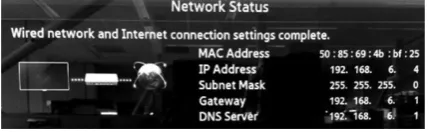
The Samsung Smart TV provides functionality to display network information, as seen in Fig. 4. Network related information was found to be stored in the followingfiles:
p16/network/network_tv_name: information about TV name on network
p16/network/network_wfd_config: information about port numbers
p16/wfd_rtspsource: information about IP-address
p16/Bluetooth_Dev_info: information about paired bluetooth devices
p24/common/WidgetMgr/network.info: the MAC-address of the ethernet port
Apps activity
Experiments show that information about installed apps is saved in the subdirectorywidgetswhich is located on the root ofp24. The subdirectorywidgetscontains two subdirectories, which are namedUserandNormal. The sub-directoryUsercontains information about apps which have been manually installed by the user. The subdirectory
Normal contains information about apps which were
installed from the Samsung App Store. The followingfiles and subdirectories contain relevant information about the applications:
p24/common/WidgetMgr/info.xml: information about installed apps on Smart TV
p24/common/11111000001/_sfdata.json: information about the installation date of apps
p24/common/WidgetMgr/history.xml: historic infor-mation about paths in which pictograms from the last used apps were saved.
p24/history/capture: a folder containing low resolution screenshots from the last used apps, which are named with the identifier number of the app. The corre-sponding identifier number is also saved in afile which is called history.xmllocated in the root folder history.
This means that the Samsung TV takes a screenshot from the running app with content. The number of screenshots, when a screenshot is being made and their longevity has not yet been determined.
p16/SOCIAL: a directory about social media related apps, containing for each social media related app, one sub-directory with an abbreviation of the app name. For example: SOCIAL/FB contains information about Face-book app or SOCIAL/TW contains information about Twitter
In order to illustrate the type of information gain from thesefiles, a part of thefile_sfdata.jsonis included:
Web browsing activity
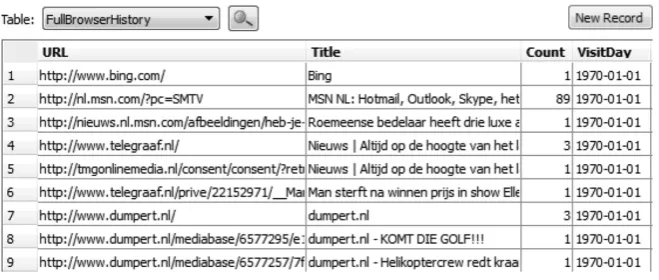
While conducting our research, it was discovered that all relevant Internet traces were kept in SQLite databases. This database is thefilesettings.dbin partitionp24in the sub-directory webkit/WebBrowser. This database contains 14 tables. Below the tables which contain relevant infor-mation are listed:
FullBrowserHistory: contains information about the URL, title, count and visited date. During this investi-gation it was determined that VisitDay was always 1970 and was not updated to the actual date and time.
fullBrowser_HiddenHistory: contains only the name of visited websites without additional information
[image:6.561.49.264.616.682.2]fullBrowser_Bookmark: contains information about websites which are bookmarked
fullBrowser_Search: contains the name of search en-gines. For example google, bing
Fig. 5 depicts an example of a table as found in
settings.db.
Pictures, audio and videofiles
Thefile.CM.dbwhich is located on the root of partition
p22, contains information about audio, picture and video files as well as other specific information such as when these files were opened, played etc. This file is also an SQLite database and contains 20 tables. Below are the relevant tables:
PhotoTable: name and EXIF information of the picture
MusicTable: name of thefile, media information such as artist, genre etc.
VideoTable: name of thefile, title, container type etc.
FileTable: media files which were opened. The sub-directory p22/Recently Played contains files with the .mta extension. According to information on (File Extensions, 2014) these files are Samsungs AllShare files and they can contain thumbnails. During this research it was not possible to view thesefiles.
Fig. 6 shows an example of a table as found in the database.CM.db.
External media artifacts
Thefiledevice0013.dbwhich is located in the root ofp22
contains information about USBflash drives that have been connected to the Smart TV. Thisfile is an SQLite database and contains one table TABLE_DEVID. Fig. 7 shows the fields of this table. During this research it was not possible to determine with experiments why the database file is calleddevice0013.db. There are nofiles numbered 0 through 12 or higher found (for exampledevice0015.db).
TV channels
The followingfiles contain information about television channels.
p16/map-AirA, map-AirD, map-CableA, map-CableD, map-SateD; Thesefiles contain the names of channels for analogue and digital terrestrial, cable or satellite connections.
p22/.EPG.db; This is an SQLite database and contains the Electronic Program Guide. The tables contains TV pro-gram broadcast information. Fig. 8 shows as an example of the schema of a table in thisfile.
Cloud artifacts
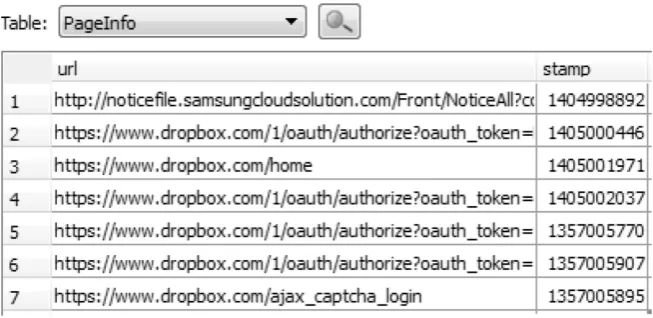
During this research of cloud services, databases that log http and https requests were found. The following data-bases relate traces to cloud services:
p24/webkit/database/snapshot/WebpageSnapshots.db. Fig. 9 shows an example of a table in thisfile.
p24/webkit/localstorage/StorageTracker.db
p24/webkit/WebBrowser/settings.db
p16/UDBCOMMON.
Conclusion
This paper presents the possibilities to perform a digital forensic investigation on a Smart TV. The results of this research will be of importance to forensic investigators, as well as in criminal investigations and civil litigation matters.
It is important to understand that malicious users can abuse a Smart TV for criminal purposes such as viewing child pornography, communication with other criminals, botnet, etc. The Smart TV can be a member of a home network and can contain traces and information about other digital equipment or computers at a crimescene. Therefore forensic investigators have to realise that a Smart TV may contain relevant information. In the future we expect that the Smart TV will also be a major component in thefield of digital forensics.
[image:7.561.119.449.544.684.2]This research has shown that it is possible to make a copy of data from a Smart TV for forensic investigation purposes. Section Data acquisition contains two methods for data collection from a Smart TV, an application and the NFI Memory Toolkit II. We expect the chip-off method, in combination with the MTK II, to continue to work for Smart
TVs containingflash based storage. Until now it was not possible tofind other ways which will always work. The de-soldering is also the best forensically sound method to make a copy of a device. With this method, no data is changed during the acquisition process.
The use of this method has also some disadvantages. The desoldering process needs to be done with specific equipment and there is also a risk that the process will
[image:8.561.113.442.64.257.2]damage the Smart TV. This method cannot be performed on-site. This research also explored the collection of data via these methods and determined thatfile contents were not altered by the use of the NFI Memory Toolkit. An application can only be used in cases where it is not possible to extract the chip from the TV. Due to the installation of this application on a Smart TV, the original state of data will be changed. The change of data is in some
Fig. 6.Example table from .CM.db.
Fig. 7.Example table fromdevice0013.db.
[image:8.561.115.442.522.681.2]Fig. 8.Example table from .EPG.db.
cases predictable, for example it is possible to determine the directory where the applicationfiles are stored during installation. But the problem with an embedded system which runs an operating system is that the operating sys-tem will always change data in the memory/file system when an embedded system is running such as logfiles. So it is not always feasable to determine all the conditions for an embedded operating system that cause changes in data.
Forensic examiners know that every type of digital equipment can contain artifacts of digital data that may be interesting for their case. In practice a great deal of digital equipment is still being overlooked. The analysis of ac-quired data from the Smart TV shows that a Smart TV also contains relevant digital artifacts for digital forensic pur-poses, and that this data is easily acquired and interpreted. Section Analysis of digital traces describes the found digital artifacts on Smart TV during this research, including traces of social networking applications like Facebook and Twitter. The screenshots the Smart TV makes from content within a running application are valuable for a forensic investigator to get afirst quick impression of user activity. The forensic investigator can use the result of this paper as a guide for performing a digital forensic investigation on a Smart TV. This research shows that a Smart TV can contain relevant digital data for forensic investigations and therefore it should be a part of digital investigations. It also describes multiple methods which are usable for acquiring data on other embedded systems.
Future work
In this paper only one brand and model of Smart TV was analysed. There are many different types and brands of Smart TVs on the market. In order to get a better under-standing of Smart TVs, other types also need to be exam-ined. Only certain types of digital traces and mostly traces that were easy to interpret were analysed. A deeper anal-ysis of the Smart TV would reveal even more interesting traces, for example the frequency of the creation of appli-cation content screenshots and the longevity of said screenshotfiles. It is also expected that there are a lot more digital traces in the various types of Smart TV, as each brand or model can contain different types of apps or have different functionality which can leave behind different digital traces.
The SamyGO rooting method will most probably only work for a specific model and firmware. An alternative method could be a triage type of application which copies only importantfiles from a Smart TV or makes a copy of the Smart TV without altering the content.
Another important research point is internal volatile memory of the Smart TV. The internal volatile memory should also be acquired and analysed. Internal volatile memory can contain very relevant information such as passwords, last activity on the Smart TV, etc. More research should be done in thefield of obtaining a memory dump of a Smart TV.
Thefive-wire method shouldn't be excluded in future research, it may still be a viable method for other brands and models Smart TV.
There is also research to be done on the network activity of a Smart TV, be it by ethernet, wifior bluetooth. This is interesting for cases where data interception is part of the investigation.
Acknowledgements
The authors wish to thank S. Laraghy for her valuable support in producing this paper.
References
Breeuwsma MF, de Jongh M, Klaver C, van der Knijff R, Roeloffs M. Forensics data recovery from flash memory. Small Scale Device Forensics J 2007;1(1).
Carrier B. File system forensic analysis. Addison-Wesley Professional; 2005.
File Extensions, http://www.fileinfo.com/extension/mta; 2014. SamyGo Forum. emmcesamsung chip orientedfilesystem. 2013. http://
forum.samygo.tv/viewtopic.php?f¼63&t¼5993 [accessed 18.09.14]. SamyGo Forum. [How to] get root access on F series. 2013. http://forum.
samygo.tv/viewtopic.php?f¼64&t¼6239 [accessed 18.09.14]. Grattafiori A, Yavor J. The outer limits: hacking the samsung smart tv.
Blackhat Briefing 2013; 2013.
Hong K. Out of nowhere, chinas smart tv market explodes into the mainstream. 2013. http://thenextweb.com/asia/2013/10/16/out-of-nowhere-chinas-smart-tv-market-explodes-into-the-mainstream [accessed 19.09.14].
Lee S, Kim S. Hacking, surveilling and deceiving victims on smart tv. Blackhat Briefing 2013; 2013 (updated 2013, cited 16.06.2014). Lougher P. Squashfs. 2014. http://squashfs.sourceforge.net [accessed
19.09.14].
Wikipedia MultiMediaCard. Multimediacard. 2015. http://en.wikipedia. org/wiki/MultiMediaCard [accessed 07.01.15].
Mutawa NA, Baggili I, Marrington A. Forensic analysis of social networking applications on mobile devices. Digit Invest 2012;9(0): S24e33. The Proceedings of the twelfth annual {DFRWS} conference 12th annual Digital Forensics Research conference.
NFI. A universal forensic solution to read memory chips. 2011. http:// www.forensicinstitute.nl/products_and_services/forensic_products/ memory_toolkit/index.aspx [accessed 18.09.14].
VD Project,. Vd project is a group to release a linux distributionevd gnu/ linux. vd gnu/linux is based on slackware, bsd like system, i18n/m17n, ipv6, secure, free, and so on. 2014 http://vdlinux.sourceforge.net/ [accessed 04.02.15].
Samsung. Opensource release center. 2014. http://opensource.samsung. com [accessed 19.09.14].
SamyGo. Samsung tvfirmware hacking. 2014. http://samygo.tv/ [accessed 19.09.14].
Sutherland I, Read H, Xynos K. Forensic analysis of smart TV: a current issue and call to arms. Digit Investig September 2014;11(3):175e8. http://dx.doi.org/10.1016/j.diin.2014.05.019. ISSN: 1742-2876. Tarr G. IHS: smart TVs rise to 27% of TV shipments. 2013. http://www.
twice.com/news/tv/ihs-smart-tvs-rise-27-tv-shipments/3471. Top10. Top 10 best tv manufacturing brands. 2014. http://top-10-list.org/
2014/04/30/top-10-best-tv-manufacturing-brands.
van der Knijff R. Chapter 8-embedded systems analysis. In: From ECc, Altheide C, Daywalt C, Donno Ad, Forte D, Holley JO, et al., editors. Handbook of digital forensics and investigation. San Diego: Academic Press; 2010. p. 383e435. ISBN 13: 978-0-12-374267-4.
Wikipedia. Smart_tv. 2014. http://en.wikipedia.org/Smart_TV [accessed 18.09.14].