Project Number: 41461 June 2010
Proposed Loans
Socialist Republic of Viet Nam: Sustainable Rural
Infrastructure Development in Northern Mountain
Provinces
Indigenous Peoples Planning
Framework
I. INTRODUCTION
1. The population of Sustainable Rural Infrastructure Development Project (SRIDP) in the Northern Mountain Provinces target area, the northern Mountains and Midlands, is approximately 12 million, of whom 51% are of Indigenous Peoples (also referred to as Ethnic Minorities). There are over 20 different Indigenous Peoples, but six of them—the Tay, Nung, Thai, Muong, Dao and Hmong, represent 49% of the total population. SRIDP is intended to directly benefit Indigenous Peoples, and, a strategy has been developed to ensure that: (i) Indigenous Peoples are consulted and given opportunities to participate in the subprojects, to ensure that the designs and implementation methods are wanted and culturally appropriate; (ii) any adverse impacts on Indigenous Peoples are mitigated; and (iii) any constraints on Indigenous Peoples benefiting from the subprojects are removed.
2. The preparation of SRIDP has been based on the Government of Viet Nam’s policies and programs for Indigenous Peoples, and the specific interventions discussed below conform to the requirements of ADB’s Policy on Indigenous People. This Indigenous Peoples Planning Framework (IPPF) begins by setting out these policies and then provides guidance to help identify, prepare and implement the different Indigenous Peoples interventions that might be appropriate for the range of SRIDP’s various subprojects.
3. The IPPF is part of a suite of social safeguard documents, including the Social Impact Assessment (SIA) for SRIDP and the Feasibility Studies of the Core Subprojects, the Consultation and Participation Framework, the Gender Action Framework, the Resettlement and Compensation Frameworks, and it should be considered in light of these documents.
II. LEGAL AND POLICY FRAMEWORK A. National Policies and Programs for Indigenous Peoples
1. Definitions
4. The definition of Indigenous Peoples, or “Ethnic Minorities” in Viet Nam is based on four criteria: (i) a language different from the national language; (ii) long traditional residence on, or relationship with, land; and long traditional social institutional system; (iii) a self-provided production system; and (iv) a distinct cultural identity, and self–identification as a distinct cultural group that is accepted by neighboring ethnic groups.
5. In Viet Nam there are 54 ethnic groups, including the majority Kinh, who represent 87% of the population. Most of the minority groups live in the northern and central regions, and mostly in rural, mountainous areas. Although these Indigenous Peoples only represent 13% of the population, they account for nearly one third of the poor. In 12 of the 13 poorest provinces, they represent nearly half of poor households.
6. The Government has a strong commitment to addressing poverty amongst Viet Nam’s Indigenous Peoples, as evidenced by the large number of policies and programs targeting Indigenous Peoples development. To understand the logic of these programs, it is useful to view them chronologically.
7. The Constitution of Viet Nam was passed in 1992, and Article 5 proclaims the equality and rights of all ethnic groups in Viet Nam, in stating:
“The Socialist Republic of Viet Nam is the unified state of all nationalities living together in Viet Nam. The state carries out a policy of equality, solidarity, and mutual assistance among all nationalities, and prohibits all acts of discrimination and division. Nationalities have the right to use their own language and system of writing, to preserve their national identity and to express their good customs, habits, traditions and culture. The State carries out a policy of comprehensive development, and step by step will raise the material and spiritual living conditions of the Indigenous Peoples. (HDDT-QH 2000 [1992]).”
8. Instruction 525/TT of November 1993 provides an overall policy framework for the accelerated development of mountainous areas and areas of ethnic minorities. Its main provisions are: (i) the promotion of an economy based on consumer goods, instead of an economy of self-sufficiency; (ii) the development of the rural infrastructure, in particular the access roads to the villages and the supply of drinking water; (iii) the reinforcement of the existing education systems, the adaptation of the education and training programs to the local conditions and the encouragement of informal education efforts; and (iv) the study of the causes of the insufficient food supply and the identification of ways to resolve this problem in each province.
9. Details of Indigenous Peoples related development programs are provided in the Social Impact Assessment and the two most important are mentioned briefly below.
2. Program 135
10. Program 135, promulgated in 1998, focuses on poverty reduction in Ethnic Minority groups in mountainous areas or communes with special difficulties. In the first phase of P135 (1998-2005) livelihood improvements were promoted largely through construction of small scale, village or commune based infrastructure, such as intra-commune roads, small irrigation schemes. The second phase (2006-2010) also allocated a lot of the budget to small infrastructure, but put a new emphasis on support for economically productive activities.
3. Resolution 30A
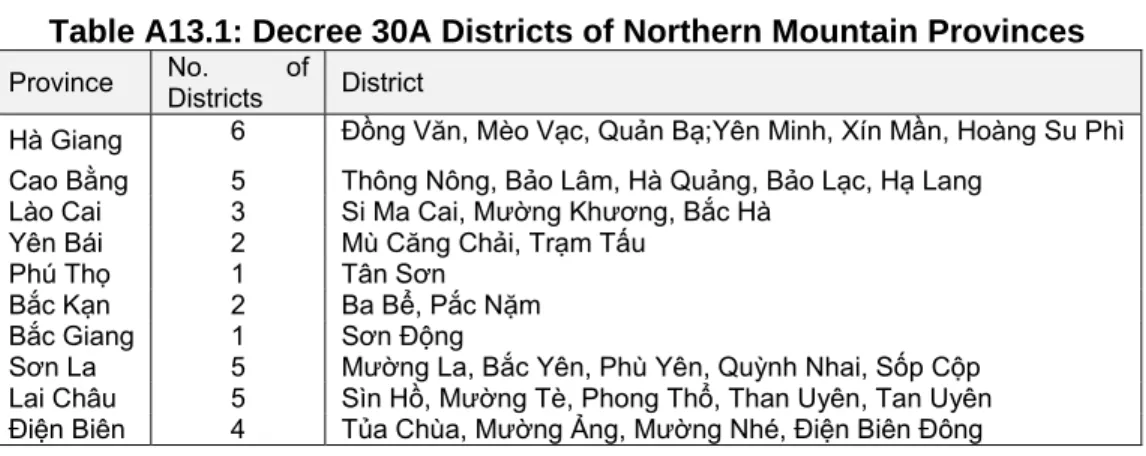
11. The Government of Viet Nam has recently initiated a new program in poverty reduction, based on Resolution No.30a/2008/NQ-CP dated 27 December 2008 on rapid and sustainable poverty reduction. This Resolution targets 62 extremely poor districts, in mainly mountainous and international boundary areas, with a total population of 2.4 million persons, 90% of whom are of ethnic minorities. The poverty rate in these districts is on average 3.5 times higher than the national average. The northern mountain districts included in the program are given in Table A14.1.
12. The Resolution calls for a 12-year accelerated development program to be based on District level comprehensive socio-economic development Master Plans. The program, to be executed by Ministry of Labor, Invalid and Social Affairs, sets specific interim targets:
By 2010 to reduce poverty by 40%;
By 2015 to reach the average poverty rate of the whole province;
By the end of the program in 2020, to reach the average poverty rate of the whole region.
13. The 30A program is predicated on mobilizing substantial funding from three main sources: i) private sector; ii) government; and iii) international donors.
Table A13.1: Decree 30A Districts of Northern Mountain Provinces Province No. of Districts District
Hà Giang 6 Đồng Văn, Mèo Vạc, Quản Bạ;Yên Minh, Xín Mần, Hoàng Su Phì Cao Bằng 5 Thông Nông, Bảo Lâm, Hà Quảng, Bảo Lạc, Hạ Lang
Lào Cai 3 Si Ma Cai, Mường Khương, Bắc Hà
Yên Bái 2 Mù Căng Chải, Trạm Tấu
Phú Thọ 1 Tân Sơn
Bắc Kạn 2 Ba Bể, Pắc Nặm
Bắc Giang 1 Sơn Động
Sơn La 5 Mường La, Bắc Yên, Phù Yên, Quỳnh Nhai, Sốp Cộp
Lai Châu 5 Sìn Hồ, Mường Tè, Phong Thổ, Than Uyên, Tan Uyên
Điện Biên 4 Tủa Chùa, Mường Ảng, Mường Nhé, Điện Biên Đông
14. Two main agencies are mandated on matters relating to Indigenous Peoples:
Ethnic Peoples’ Council of the National Assembly, which is responsible for submitting proposals and plans for Ethnic Minority groups and controlling and monitoring the implementation of national policies and development programs targeted at Indigenous Peoples and
Committee for Ethnic Minorities (CEM), which is responsible for proposing policies and supervising development programs for Indigenous Peoples. It is the implementing agency for P 135.
B. ADB’s Policy on Indigenous Peoples
1. ADB Safeguard Policy Statement 2009
15. ADB’s updated “Safeguard Policy Statement 2009” (SPS) seeks to enhance the effectiveness of ADB’s safeguard policies and to ensure that these policies remain relevant to changing client needs and to new business opportunities. The SPS affirms that environmental and social sustainability is a cornerstone of economic growth and poverty reduction in Asia and the Pacific. The goal of the SPS is to promote the sustainability of project outcomes by protecting the environment and people from projects’ potential adverse impacts. The objectives of ADB’s safeguards are to:
avoid adverse impacts of projects on the environment and affected people, where possible;
minimize, mitigate, and/or compensate for adverse project impacts on the environment and affected people when avoidance is not possible; and
help borrowers/clients to strengthen their safeguard systems and develop the capacity to manage environmental and social risks.
2. ADB Safeguard Requirement for Indigenous Peoples
16. The Asian Development Bank (ADB) recognizes the rights of Indigenous Peoples to direct the course of their own development. Indigenous Peoples do not automatically benefit from development, which is often planned and implemented by those in the mainstream or
dominant population in the countries in which they live. Special efforts are needed to engage Indigenous Peoples in the planning of development programs that affect them, in particular, development programs that are supposedly designed to meet their specific needs and aspirations. Indigenous Peoples are increasingly threatened as development programs infringe into areas that they traditionally own, occupy, use, or view as ancestral domain.
17. ADB’s Safeguard Policy Statement 2009 uses the term Indigenous Peoples to refer to a distinct, social and cultural group who self-identify as members of a distinct indigenous cultural group and recognition of this identity by others; have collective attachment to geographically distinct habitats or ancestral territories in the project area and to the natural resources in these habitats and territories; have customary cultural, economic, social or political institutions that are separate from those of the dominant society and culture; and a distinct language, often different from the official language of the country or region.
18. These definitions apply directly to some of the populations classified in Viet Nam as “Ethnic Minority” because certain groups: (i) have special attachment to ancestral territories; (ii) maintain specific cultural/social traits including language, belief, production patterns, and especially law and social institutions, which make them radically different from national mainstream culture; (iii) they are recognized by mainstream groups and government as having unique features; and finally (iv) because of their difference and isolation, they may experience deprivation of rights, marginalization, and discrimination.
19. The objective of safeguard requirements for Indigenous Peoples is to design and implement projects in a way that fosters full respect for Indigenous Peoples’ identity, dignity, human rights, livelihood systems, and cultural uniqueness as defined by the Indigenous Peoples themselves so that they (i) receive culturally appropriate social and economic benefits, (ii) do not suffer adverse impacts as a result of projects, and (iii) can participate actively in projects that affect them.
20. The Indigenous Peoples safeguards are triggered if a project directly or indirectly affects the dignity, human rights, livelihood systems, or culture of Indigenous Peoples or affects the territories or natural or cultural resources that Indigenous Peoples own, use, occupy, or claim as their ancestral domain.
C. Project Screening and Classification
21. All ADB projects are screened to determine whether or not they have potential impacts on Indigenous Peoples. Projects are categorized by the significance of their impacts on Indigenous Peoples. The significance is decided by scrutinizing the type, location, scale, nature, and magnitude of a project’s potential impacts on Indigenous Peoples. The degree of impacts is determined by evaluating (i) the magnitude of the impact on Indigenous Peoples’ customary rights of use and access to land and natural resources; socioeconomic status; cultural and communal integrity; health, education, livelihood systems, and social security status; or indigenous knowledge; and (ii) the vulnerability of the affected Indigenous Peoples. The categories are as follows:
Category A. Such projects are expected to have significant impacts on Indigenous Peoples. IPP and SIA are required unless the overwhelming majority of the population is an ethnic minority and there are no expected negative impacts from the project. Most subprojects under the Project will fall into this category and in most cases the latter qualification will apply.
Category B. Such projects are expected to have limited impacts on Indigenous Peoples. An IPP and SIA are required.
Category C. Such projects are not expected to have impacts on Indigenous Peoples and, therefore, do not require special provisions.
D. Indigenous Peoples Planning Frameworks
22. A sector-type project such as SRIDP has potential impacts on Indigenous Peoples, but the project comprises a large number of subprojects spread over a wide and diverse geographic area, and the majority of these subprojects have yet to be clearly defined. Hence, Indigenous Peoples plans of subprojects, where deemed necessary, cannot be prepared before project appraisal.
23. For sector-type investments such as SRIDP (multiple subprojects with anticipated impacts on Indigenous Peoples, but where the full extent of the impacts cannot be determined), an Indigenous Peoples Planning Framework (IPPF) is required to guide subproject selection, screening and categorization, social impact assessment, and preparation and implementation of safeguard plans.
24. The IPPF sets out Indigenous Peoples policy with screening and planning procedures which apply to subprojects that will be approved during loan implementation. It provides a strategy to ensure requirements of ADB policy are met.
III. INDIGENOUS PEOPLES IN THE PROJECT AREA A. Diversity and Distribution
25. Two of the key features of the Indigenous Peoples in the project area are the diversity of different groups and the non-exclusive (i.e. mixed), often complex distribution. In much of the development thinking and programming around Indigenous Peoples in Viet Nam, there has been a tendency to apply a simple Kinh1 vs Indigenous Peoples dichotomy, but this obscures
the big differences amongst the different Indigenous Peoples in terms of population, culture, livelihoods, economic development and assimilation and integration in the national economy. 26. In Viet Nam as a whole, there are 53 minorities, belonging to seven different language groups. They have a total population of around 10 million, or 13% of the national population. Four groups have more than one million people (Tay, Thai, Muong and Khmer), while five groups have under 1,000 members (Brau, Ro Mam, O Du, Si La and Pu Peo). The smallest, the O Du, numbered barely 300 in the 1999 census. Many minority groups share languages and histories with groups in neighboring countries, but some are found only in Viet Nam. Many ethnic groups have a long history in Viet Nam, even pre-dating settlement by the Kinh majority, while others are more recent migrants, arriving as recently as the late 19th century.
27. The Northern Mountains have the greatest proportion of Indigenous Peoples of any region in Viet Nam: of the 10 provinces with the largest minority populations, 9 are in the Northern Mountains. Cao Bang, for example, is more than 95% of the population are Indigenous
Peoples. In all, about 20 Indigenous Peoples groups are found in the Northern Mountains but 6 minorities, in three language groups, constitute over 90% of the rural Indigenous Peoples population. These groups are discussed briefly below, and additional information on their distribution in the 15 SRIDP provinces is provided in Annex 1.
28. The Thai-Kadei Language Group:
The Tay are the largest minority group in Viet Nam, with around 1.5 million people. In the Northern Mountains they represent 12% of all rural households, and 25% of Indigenous Peoples households. They are the dominant group in Cao Bang and Bac Kan and are numerous throughout the other North Eastern provinces. They are traditionally valley-dwelling, wet-rice cultivators, and are quite developed economically and quite assimilated with the Kinh majority.
The Thai dominate in the Northwestern provinces of Dien Bien, Lai Chau and Son La, but are small minorities in the other provinces. They number over 1.3 million nationally, and represent 7.5% of the population in the Northern Mountains. Sub-groups include the White Thai (northern Lai Chau and Lao Cai provinces) and Black Thai (Son La and southern Lai Chau). They have strong traditions of governance and rich culture. Like the Tay, they are essentially valley dwelling wet rice cultivators.
The Nung number 865,000 people nationally and represent 6.5% of rural households in the Northern Mountains. They are the dominant group in Lang Son, comprising 46.8% of all households, and are also numerous neighboring Cao Bang and Ha Giang. Sub-groups include the Nung San and the Nung Phan Sinh. The Nung are also in the main, valley-dwelling wet-rice cultivators.
29. The Viet-Muong Language Group:
The Muong comprise only 7.3% of all households in the northern mountains, but in Hoa Binh, where they dominate, they represent over 70% of rural households. Nationally, they are the third largest group, with over 1.15 million people. Culturally and linguistically, they are closely related to the Kinh, and are also inhabit lowlands where they cultivate wet rice.
30. The Hmong-Dao Language Group:
The Hmong constitute the fifth largest minority group in Viet Nam, with 787,604 people. They dominate in Ha Giang province and are also well represented in the north western provinces Dien Bien, Lai Chau and Son La, as well as neighboring Laos and in China, where they are known as the Miao. In the Northern Provinces, they represent 6.5% of households. Various sub-groups are identified: Black, White and Flower. Traditionally, they live in more remote settlements, at higher altitudes, on steeper slopes and cultivate hill rice in swidden fields.
The Dao represent 5% of the northern mountains rural households but nowhere exceed 17% of rural provincial households, and they are not the dominant group in any province. They are most numerous in Ha Giang, Bac Kan and Lai Chau. There are several different sub-groups. Like the Hmong, they tend to live in remote upland communities and practice swidden agriculture.
31. A small but economically important ethnic group in the Northern Mountains is the Hoa, or Chinese. They live primarily in the provincial and district centers, and are often grouped with the Kinh due to their relative economic advancement. Smaller ethnic groups in the study area
include the San Dui (related to the Han), the San Chi and Lao (Thai Kadei), the Si La and Lo Lo (Tibeto-Burmese) and the Xin Mun (Mon Khmer).
32. As mentioned above, the proportion of Kinh in the population increases dramatically as one moves from the border areas into the provinces ringing the Red River Delta and Hanoi, and that the Kinh remain the dominant ethnic group in seven of the 15 provinces and absolute majorities in four (Ba Giang, Phu Tho, Vinh Phuc and Thai Nguyen). There are also concentrations of Kinh up the Red River valley into Lao Cai, and in nearly all the provincial and district towns throughout the region.
33. Another striking feature about minorities in Viet Nam is that many do not live in geographically exclusive territories. As a result of long histories of migration, as well as more recent sedentarization and resettlement programs, more than half the districts in the Northern Mountains are inhabited by 10 or more ethnic groups. Even at the commune level diversity is the norm, with the majority of communes having long consisted of two to four ethnic groups, and some have as many as seven. Moreover, most individual ethnic groups are spread over hundreds of communes, rather than being concentrated. For example, according to the 1989 census, the Tay, were found in 1,385 communes, the Nung in 988, the Dao in 938, and the Hmong in 745.
B. Livelihood Diversity and Cultural Assimilation of Indigenous Peoples
34. The Northern Mountains are characterized by considerable diversity in agro-ecological conditions, which combined with cultural diversity discussed above, leads to significant differences in agricultural livelihoods and living standards across the region. However, most of the available socio-economic survey and census data in Viet Nam report according to the dichotomy “Kinh” and “non-Kinh” (all other Indigenous Peoples). Although most rural populations are dependent on agriculture, some Indigenous Peoples are actually much like Kinh in terms of levels of livelihoods and social development, while others much less so. Thus the amount of variation with the group “non-Kinh” is tremendous, and can be obscured by this simplistic division.
35. The Tay, for example, is the largest minority group, with a population of nearly 1.5 million people. They are also generally doing better in terms of poverty reduction than nearly all other Indigenous Peoples. Thus, including the Tay in averages with other minority groups can distort perceptions of general minority trends, and obscure the fact that some less numerous Indigenous Peoples groups are doing quite badly. In fact, the Tay have done so well and have long been considered quite assimilated with Kinh. The Tay are well-represented in the civil service, for example, often accounting for the largest portion of ethnic minority cadres in district and provincial positions. The dominance of Tay in the civil service, for example, may lead to false impressions that many Indigenous Peoples are cadres when in fact the proportion of cadres representing non–Tay local ethnic groups may be very low or nonexistent.
36. In addition to the Tay, the Muong, Thai, and Nung minorities are also seen as closer to the Kinh way of life than other groups. They are more commonly found living in the valleys within the mountainous areas, with greater access to flat land and reliable water supplies, and they have developed a dependence on wet rice farming.
37. Other groups however, (Hmong and Dao in particular) are often associated with higher attitudes, steeper slopes and swidden cultivation. Their settlements are often remote, access to education and services limited and ability to speak Vietnamese limited. Some historians have
argued that when minorities like the Hmong and Dao came from China, the best lower elevation land was already taken by longer standing groups (Thai and Tay), so Hmong and Dao had no other choice but to settle at higher altitudes. Although there has been a great deal of migration which has modified these traditional settlement patterns for
many groups, in many places, the basic pattern still holds.
38. There are also substantial differences in traditional land tenure systems amongst Indigenous Peoples. In some minority groups, land is owned at the household level. In others, it is owned collectively, and allocated periodically to households for their use.
39. As described above, Viet Nam’s Indigenous Peoples tend not to occupy discrete territories but are found in intimate mixture with various other minorities and with the Kinh majority at the district, commune and even down to the village level. Since SRIDP is developing basic infrastructure, and since many of the subprojects are upgrading existing facilities, the key issue is not whether Indigenous Peoples are disturbed or disadvantaged by the proposed developments, but whether the poor Indigenous Peoples in the area have been accurately targeted and able to benefit at all. What is really required is not the remedial action of development frameworks or specific actions, but better project identification and preparation, and approaches flexible enough to respond to the diversity and complexity of the Indigenous Peoples situation.
IV. PROCESS FOR PREPARING INDIGENOUS PEOPLES PLANS
40. As described above, an IPP is required in cases where ethnic monitories do not make up the majority of the population and where there maybe negative impacts on minority people. In most subproject areas the overwhelming majority of the population belongs to an ethnic minority and there will be no anticipated negative effects from subproject investment. In the concurrence with the safeguard policy measures to improve the welfare of Indigenous People and mitigate any potential negative effects will be incorporated into the overall subproject design and documented. In a small number of project areas an IPP will be required.
41. The IPP will address the twin issues of risk mitigation and benefit enhancement. It will first describe the legal and socio-economic contexts in which the project will operate, profile the beneficiary community and then describe the positive and negative impacts likely for the different Indigenous Peoples beneficiaries and non-beneficiaries. It will then set out the solutions to these issues, as generated through the participation with the Indigenous Peoples themselves. These might represent changes in the nature of the intervention, or in the approach taken to implement it. The IPP will also set out the capacity building requirements of different stakeholders for the successful implementation of the IPP. Monitoring indicators will be required and these should also be integrated into the monitoring framework for the overall subproject. A full outline of an IPP is provided in Annex 2.
V. STRATEGY FOR INDIGENOUS PEOPLES’ PARTICIPATION IN SUBPROJECTS 42. The Project’s strategy for encouraging participation of Indigenous Peoples is based on the recognition of Indigenous Peoples’ particular social and cultural characteristics that may require different approaches and interventions than when working with the Kinh, and that may limit or prevent Indigenous Peoples from participating in and/or benefiting from the Project. 43. The Project has drawn up a consultation and participation framework as outlined in the PAM, providing a process to ensure the design of subproject specific plans that will result in the
full, informed and meaningful participation of all beneficiaries and affected communities, including both Kinh and the range of Indigenous Peoples. Through implementation of these Plans, appropriate facilitation will be engaged (individuals, non-government organizations (NGOs)) to work with the PPMUs and District level teams and Commune Supervisory Boards to promote this participation at all stages in the subproject: in design, implementation and subsequent operation, monitoring, maintenance and management and impact evaluation.
VI. INSTITUTIONAL RESPONSIBILITIES
44. The overall roles and responsibilities of the different agencies involved in SRIDP are provided elsewhere. In this section, we examine the agencies that should be involved in the different Indigenous Peoples related interventions, from the national down to the commune level.
A. National Level
45. MARD is the executing agency for SRIDP, and is the highest administrative agent for Project coordination, guidance and support for implementation at the provincial level.
46. MARD and its CPMU will in turn be supported by a donor funded Project Implementation Team of international and national specialists, including one in Indigenous Peoples issues and community participation.
47. The CPMU will be responsible for recruiting an independent monitoring specialist (NGO or individual), to conduct annual assessments and final evaluation of all the social components of the Project: the ethnic minority development, community participation, resettlement, and gender aspects.
B. Provincial Level
48. The PPMUs will be responsible for subproject implementation and will carry out the day-to-day management and other activities required for successful implementation. They will necessarily be responsible for the subprojects adhering to the agreed safeguards. The PPMU should ensure that the resources, including financial and human resources, are sufficient to take into account IP concerns. The PPMU shall coordinate with the Provincial Committee for Ethnic Minorities and local authorities. In the event that an IPP is required, the activities and the outcomes of the EMDP implementation should be recorded and placed in communal, district levels, at PPMU office and at the office of the Provincial Committee for Ethnic Minorities. For such issues, the PPMU shall:
Appoint a Provincial Safeguards Officer;
Provide support to Commune Supervision Boards to lead engagement with local Indigenous Peoples communities to implement the Consultation and Participation Plan. They will operate, with the support and supervision of the Implementation team technical specialists;
Use feasibility study socio-economic surveys to provisionally understand local Indigenous Peoples development issues;
Consult with communities and any local Indigenous Peoples during detailed design;
Design interventions to address identified issues relevant to the overall subproject.
Recruit experienced local consultants as required to assist with social assessments, and prepare the relevant documentation; and
Supervise the implementation and monitoring of the IPPs, or the enhancement measures.
C. Commune Level
49. At the commune level, government regulations require the establishment of a Commune Supervision Board, to oversee the quality and timeliness of project implementation, and provide support where needed. The role of this Board shall be expanded to help coordinate community inputs, particularly where detailed design is an issue, and for organizing the provision of wage labor from amongst community members, to ensure that the poorest households benefit.
50. These committees typically involve the leaders of the Community Participation Committee, the local women’s union, farmers union, veterans union etc, but for SRIDP ethnic affairs will also involve representatives from the main minority communities, down to village level, if necessary. They should also participate in consultations on detailed design and monitoring implementation of the subprojects, and in areas where they help decide that IPPs are to be prepared.
51. If any Indigenous Peoples household or group raises a grievance or complaint, the Commune Supervisory Board should be the first to handle it, following the guidelines established in the Consultation and Participation Framework and disseminated to communities in its implementation. As a second level of redress, complaints can also be taken to Provincial Committee on Ethnic Minorities or the Provincial Peoples’ Committee (PPC).
VII. MONITORING AND EVALUATION
52. SRIDP has developed a DMF, which establishes three main output indicators which will require monitoring: average household income, the number of poor households and the number of poor Indigenous Peoples households. Subprojects similarly have their DMFs, through which achievement of benefits, compliance with project procedures and safeguards, timeliness of implementation (adherence to schedules) and execution within budgets.
53. Internal monitoring and progress reporting will be the responsibility of the PPMUs and CPMU, and an independent monitoring organization or consultant, appointed by the CPMU in consultation with the implementation TA team, will provide the external monitoring. At the local level, the Community Supervision Board will monitor on a regular basis, and coordinate the participatory monitoring by beneficiaries. The process of establishing participatory monitoring must begin with the identification of monitoring criteria by the beneficiaries themselves, against which they will judge the success or failure of the subproject.
54. Any IPP prepared for a subproject will be monitored in terms of: (i) process and implementation of activities according to the overall plans and schedules, including the delivery of information, the schedule of consultations and participatory exercises and any mitigation or enhancement measures; (ii) disbursement, expenditure and any budget issues; (iii) outputs and outcomes; (iv) lessons learnt.
VIII. BUDGET
55. Funds have been allocated within the project cost to provide for national consultants to undertake safeguard studies for each of the subprojects. As required and indicated in the initial social assessments undertaken for each subproject specific funds will be allocated to safeguard
activities to ensure that ethnic minorities can maximize the use of the planned infrastructure and also avoid or mitigate any foreseen negative impacts. Funds have also been provided within the budget for international and national loan implementation consultants for indigenous People's specialists. This will help ensure a continuous focus on the welfare of ethnic minorities during subproject planning, review and implementation. In addition, budget will be provided for the operation of Commune Supervision Boards, the membership of which includes ethnic minority representatives in areas where a large portion of the population belongs to an ethnic minority. These will ensure that the concerns of ethnic minorities are properly taken into account during the subproject implementation phase. Lastly, funds have also been provided for the independent monitoring of safeguard activities by an external institution or agency recruited by the CPMU and reporting directly to it.
IX. PROCEDURAL ARRANGEMENTS
56. Procedural arrangements have been discussed in detail above. To summarize, the sequences of steps is as follows:
A. Existing Subproject Investment Proposals
Screening of Subproject Investment Proposals for Indigenous Peoples issues subproject categorization and identification of Indigenous Peoples Intervention (IPP);
Subproject Investment Report and Feasibility Study SIA;
Confirmation of Categorization and Indigenous Peoples (IP) intervention;
Incorporation of IP concerns into subproject design
Participatory preparation of IPP if required. B. New Subprojects
Engagement with community at identified sites during feasibility study phase;
Preparation of Subproject Investment Proposal with budget;
Identification of any IP issues and the need for an IPP;
Detailed participatory design of subproject incorporating social safeguards;
CSB monitors implementation and impact on ethnic minorities along with independent monitoring agency recruited by the CPMU.
ANNEX 1: INDIGENOUS PEOPLES IN THE 15 SRIDP PROVINCES
Language Group TOTAL Viet
Muong Various Thai - Kadei Group Hmong-Dao
Viet
Muong Various
Province/Ethnicity Household (HH) Kinh IP2 Tay Thai Nung Dao Hmong Muong Other Other Significant Groups
Ha Giang 115,654 7.6 92.4 26.4 0.0 11.1 15.6 32.6 0.0 6.7
Cao Bang 90,450 1.7 98.3 45.4 0.1 33.4 8.8 8.7 0.0 1.9 San Chi, Lo Lo
Bac Kan 52,931 8.1 91.9 58.5 0.0 9.9 17.4 5.0 0.0 1.0 San Chi, Hoa
Tuyen Quang 145,697 47.1 52.9 26.0 0.0 1.9 11.5 1.8 0.1 11.5
Yen Bai 126,770 44.0 56.0 22.0 6.6 2.3 11.5 9.1 2.3 2.2
Lao Cai 90,173 26.8 73.2 18.2 0.3 5.3 16.1 24.6 0.1 8.6
Thai Nguyen 199,735 70.8 29.2 11.6 0.0 6.3 2.5 0.5 0.0 8.1 San Chi, San Dui, Hoa
Lang Son 124,599 9.8 90.2 38.5 0.1 46.5 3.7 0.2 0.0 1.0 San Chi, San Dui, Hoa
Bac Giang 339,009 88.2 11.7 2.4 0.0 4.5 0.5 0.0 0.0 4.3
Phu Tho 265,965 84.4 15.6 0.1 0.0 0.0 1.0 0.0 14.2 0.3
Dien Bien 68,506 12.9 87.1 0.3 44.2 0.2 1.1 32.9 0.1 8.2 San Chi, Kho Mu, Lao, Hoa
Lai Chau 51,156 6.5 93.5 0.1 35.9 0.0 15.1 23.6 0.1 18.7
Son La 172,267 11.6 88.4 0.1 58.9 0.0 2.0 12.7 9.2 5.5 Kho Mu, Xin Mun, Lao, Hoa
Hoa Binh 149,203 19.6 80.4 3.2 4.3 0.0 2.0 0.6 70.2 0.1
Vinh Phuc 222,579 96.5 3.5 0.0 0.0 0.0 0.1 0.0 0.0 3.4
TOTAL NMR 2,214,694 50.4 49.6 12.2 7.5 6.5 5.0 6.5 7.3 4.6
No. Provinces dominant 7 8 2 3 1 0 1 1 0
2
This figure includes Hoa (Chinese) minority, who are usually classified with the Kinh, due to their relative economic advancement. However, it has not been possible to disaggregate their numbers from this total for non-Kinh ethnic groups.
ANNEX 2: OUTLINE OF INDIGENOUS PEOPLES PLAN
1. This outline corresponds to Safeguard Requirements 3, Indigenous Peoples, as described in ADB’s updated Social Safeguard Statement 2009.
2. An Indigenous Peoples Plan (IPP) is required for all projects with impacts on Indigenous Peoples. Its level of detail and comprehensiveness is commensurate with the significance of potential impacts on Indigenous Peoples. The substantive aspects of this outline will guide the preparation of IPPs, although not necessarily in the order shown.
A. Executive Summary of the Indigenous Peoples Plan
3. This section concisely describes the critical facts, significant findings, and recommended actions.
B. Description of the Project
4. This section provides a general description of the project; discusses project components and activities that may bring impacts on Indigenous Peoples; and identify project area.
C. Social Impact Assessment
5. This section:
(i) reviews the legal and institutional framework applicable to Indigenous Peoples in project context.
(ii) provides baseline information on the demographic, social, cultural, and political characteristics of the affected Indigenous Peoples communities; the land and territories that they have traditionally owned or customarily used or occupied; and the natural resources on which they depend.
(iii) identifies key project stakeholders and elaborate a culturally appropriate and gender-sensitive process for meaningful consultation with Indigenous Peoples at each stage of project preparation and implementation, taking the review and baseline information into account.
(iv) assesses, based on meaningful consultation with the affected Indigenous Peoples communities, the potential adverse and positive effects of the project. Critical to the determination of potential adverse impacts is a gender-sensitive analysis of the relative vulnerability of, and risks to, the affected Indigenous Peoples communities given their particular circumstances and close ties to land and natural resources, as well as their lack of access to opportunities relative to those available to other social groups in the communities, regions, or national societies in which they live.
(v) includes a gender-sensitive assessment of the affected Indigenous Peoples’ perceptions about the project and its impact on their social, economic, and cultural status.
(vi) identifies and recommends, based on meaningful consultation with the affected Indigenous Peoples communities, the measures necessary to avoid adverse effects or, if such measures are not possible, identifies measures to minimize, mitigate, and/or compensate for such effects and to ensure that the Indigenous Peoples receive culturally appropriate benefits under the Project.
D. Information Disclosure, Consultation and Participation
1. This section:
(i) describes the information disclosure, consultation and participation process with the affected Indigenous Peoples communities that was carried out during project preparation;
(ii) summarizes their comments on the results of the social impact assessment and identifies concerns raised during consultation and how these have been addressed in project design;
(iii) in the case of project activities requiring broad community support, documents the process and outcome of consultations with affected Indigenous Peoples communities and any agreement resulting from such consultations for the project activities and safeguard measures addressing the impacts of such activities; (iv) describes consultation and participation mechanisms to be used during
implementation to ensure Indigenous Peoples participation during implementation; and
(v) confirms disclosure of the draft and final IPP to the affected Indigenous Peoples communities.
E. Beneficial Measures
7. This section specifies the measures to ensure that the Indigenous Peoples receive social and economic benefits that are culturally appropriate, and gender responsive.
F. Mitigating Measures
8. This section specifies the measures to avoid adverse impacts on Indigenous Peoples; and where the avoidance is impossible, specifies the measures to minimize, mitigate and compensate for identified unavoidable adverse impacts for each affected Indigenous Peoples groups.
G. Capacity Building
9. This section provides measures to strengthen the social, legal, and technical capabilities of (a) government institutions to address Indigenous Peoples issues in the project area; and (b) Indigenous Peoples organizations in the project area to enable them to represent the affected Indigenous Peoples more effectively.
H. Grievance Redress Mechanism
10. This section describes the procedures to redress grievances by affected Indigenous Peoples communities. It also explains how the procedures are accessible to Indigenous Peoples and culturally appropriate and gender sensitive.
I. Monitoring, Reporting and Evaluation
11. This section describes the mechanisms and benchmarks appropriate to the project for monitoring, and evaluating the implementation of the IPP. It also specifies arrangements for participation of affected Indigenous Peoples in the preparation and validation of monitoring, and evaluation reports.
J. Institutional Arrangement
12. This section describes institutional arrangement responsibilities and mechanisms for carrying out the various measures of the IPP. It also describes the process of including relevant local organizations and NGOs in carrying out the measures of the IPP.
K. Budget And Financing