The University of San Francisco
USF Scholarship: a digital repository @ Gleeson Library |
Geschke Center
Master's Theses Theses, Dissertations, Capstones and Projects
Fall 12-12-2014
Combating HIV/AIDS in Marginalized
Communities: Papua and West Papua Provinces,
Indonesia
Bani Cheema
University of San Francisco, [email protected]
Follow this and additional works at:https://repository.usfca.edu/thes
Part of theAnthropology Commons,Growth and Development Commons,Health
Communication Commons,Health Policy Commons,International and Area Studies Commons, Public Health Commons,Public Policy Commons, and theVirus Diseases Commons
This Thesis is brought to you for free and open access by the Theses, Dissertations, Capstones and Projects at USF Scholarship: a digital repository @ Gleeson Library | Geschke Center. It has been accepted for inclusion in Master's Theses by an authorized administrator of USF Scholarship: a digital repository @ Gleeson Library | Geschke Center. For more information, please [email protected].
Recommended Citation
Cheema, Bani, "Combating HIV/AIDS in Marginalized Communities: Papua and West Papua Provinces, Indonesia" (2014).Master's Theses. 125.
Combating HIV/AIDS in Marginalized Communities:
Papua and West Papua Provinces, Indonesia
Key words: HIV/AIDS, Tanah Papua, Indigenous people, Prevention, Behavior change communication
Bani Cheema
Advisor: Dr. Rue Ziegler
Department of International Studies San Francisco 2130 Fulton St.
San Francisco, CA 94117
TABLE OF CONTENTS
Abstract iv
Acknowledgements v
Acronyms and Abbreviations vi
Chapter One: Introduction 1 -7
1.0 Introduction 1
1.1 Statement of the Problem 1
1.2 Purpose and Significance 4
1.3 Theoretical Framework 5
1.4 Chapters Summary 6
1.4.1 Chapter Two: Background 6
1.4.2 Chapter Three: Methodology 6
1.4.3 Chapter Four: Literature Review 6
1.4.4 Chapter Five: New Data, Thesis Conclusion and Recommendations 7
Chapter Two: Background 8 - 23
2.0 Introduction 8
2.1 Indonesia 8
2.1.1 HIV/AIDS in Indonesia 9
2.2 Tanah Papua 11
2.2.1 HIV/AIDS in Tanah Papua 12
2.3 International Assistance to Fight HIV/AIDS 15
2.3.1 Australia 17
2.3.2 Australia & Implementation Partners 17
2.3.3 United States 18
2.3.4 United States & Implementation Partners 18 2.3.5 Non-governmental & Faith Based Organizations 20
2.4 Delivery of Health Services 21
Chapter Three: Methodology 24 - 32
3.0 Introduction 24
3.1 Project Development 24
3.2 Research Methods & Timeline 27
3.2.1 Library/Desktop Research 28
3.2.2 Interviews 29
3.3 Solicitation and Consent Procedure 30
3.4 Potential Risks to Participants and Minimization Strategies 31
3.5 Potential Benefits 31
Chapter Four: Literature Review 33 - 64
4.0 Introduction 33
4.1 Foreign Assistance Debate 34
4.3 Behavior Change Communication 39
4.3.1 HIV/AIDS Prevention Campaigns 44
4.4 Barriers to HIV/AIDS Prevention 46
4.4.1 Marginalization 47
4.4.2 Structural Violence 51
4.4.3 Stigma and Discrimination 54
4.5 Female Commercial Sex Workers 59
4.6 Summary & Implications 62
Chapter Five: NewData, Thesis Conclusion and Recommendations 65-79
5.0 Summary 65
5.1 New Data 66
5.1.1 Decentralization 66
5.1.2 HIV/AIDS Prevention Programs 67
5.1.3 Stigma and Discrimination 72
5.2 Thesis Conclusion 74
5.3 Recommendations 77
Bibliography 80 -95
List of Figures
Figure 1: Map of Indonesia 8
Figure 2: The Potential Future Trend for HIV in Indonesia 10 Figure 3. Map of Papua and West Papua provinces 11
Figure 4: Prevalence of New HIV Cases 13
Figure 5: Population and HIV Rates 13
Figure 6: Major Donor Agencies Funding HIV/AIDS Programs 16
Figure 7: List of Implementation Partners 17
Figure 8: Analytic Framework for HIV/AIDS Intervention in Tanah Papua 26
Figure 9: Search Terms and Sources 28
Figure 10: Domestic & International Expenditures on AIDS 39
Figure 11: New HIV/AIDS Cases in Indonesia 39
Abstract
My study focuses on foreign aid and local initiatives for HIV/AIDS prevention in
eastern Indonesia using the provinces of Papua and West Papua as a case study. The two
provinces are home to indigenous tribal groups that are socioeconomically marginalized
and most affected by the epidemic. My research investigates behavior change
communication as a principal strategy undertaken by multiple organizations for
HIV/AIDS prevention in this region. I take a qualitative approach by examining the
effectiveness of this strategy in local communities and by revealing social and cultural
barriers that impede success. Obstacles that negatively impact prevention efforts include
structural violence, stigma and discrimination. I identify areas, such as targeted health
messaging, where HIV/AIDS prevention efforts can be improved to benefit marginalized
Acknowledgements
First, I would like to thank my parents Pritpal and Jagdeep Cheema for always
believing in me. Their constant love, support and patience made this Master’s possible. I
thank, my older sister Sukhmani for her love and humor, and for handling my share of
work while I pursued my own ambitions. I am appreciative of my grandmother for
always being a pillar of strength for our family. I am thankful to both my aunts’ here in
the U.S., for always being available to help and share their skills.
Second, I would like to express my deepest gratitude to my advisor,
Dr. Rue Ziegler, for her excellent guidance and providing me with extremely helpful and
detailed feedback that allowed me to grow in my work. I also thank and appreciate Dr.
John Ziegler for reviewing my work and sharing his expertise of this field. I am very
grateful to Professor Lucia Cantero for her counsel and encouragement that helped me
develop my thoughts and ideas to excel in my work.
Finally I would like to thank my friends, who believed in my path and encouraged
me to pursue it. I especially thank Hillary Wysocki, Lisa Henning, Nilufer Pashutani and
Martin Schneider for their help, and cohort three for all the coffees, laughs and
Acronyms and Abbreviations
ABC Abstinence, Be Faithful, Condom use
AIDS Acquired Immunodeficiency Syndrome
AIPH Australia Indonesia Partnership for HIV
ART Antiretroviral Therapy
AUD Australian Dollar
AusAID Australian Agency for International Development
BCC Behavior Change Communication
CSO Community Service Organization
DOD Department of Defense
FBO Faith Based Organization
FHI 360 Formerly Family Health International
FSW Female Sex Workers
GFATM The Global Fund to Fight AIDS, Tuberculosis and Malaria
GOI Government of Indonesia
HAPP I&II HIV/AIDS Prevention Project
HIV Human Immunodeficiency Virus
IDUs Injecting Drug Users
IEC Information, Education and Communication
IRIN Integrated Regional Information Networks
MOH Ministry of Health
MSM Men who have sex with men
NGO Non-governmental Organization
ODC Offices of Defense Cooperation
PEPFAR President's Emergency Plan for AIDS Relief
POC Point of Contact
SCC Social Change Communication
STD Sexually Transmitted Disease
SUM I&II Scaling up Most at Risk Populations
UNAIDS United Nations Programme on HIV/AIDS
UNICEF United Nations Children’s Fund
U.S. United States
USAID United States Agency for International Development
VCT Voluntary Counseling and Testing
Waria Transgender persons
WHO World Health Organization
Chapter One: Introduction
1.0 Introduction
Since the emergence of the Human Immunodeficiency Virus (HIV) and Acquired
Immune Deficiency Syndrome (AIDS) over 30 years ago, 60 million people have been
infected worldwide, resulting in approximately 25 million deaths (Laksono 2010,14).
HIV is a persistent, deadly and infectious virus that if not treated causes AIDS (Turk,
Ewing and Newton 2006, 333). It is spread by the exchange of bodily fluids such as
through unprotected sex with an infected person and by sharing contaminated needles.
The virus can also spread through childbirth and breastfeeding. The sexual transmission
of HIV/AIDS can be prevented with the use of condoms. There is no known cure for the
disease, but long-term antiretroviral therapy (ART) is available and can prolong life.
Antiretroviral treatment is also a form of prevention and an important component to
managing HIV/AIDS (World Health Organization-HIV/AIDS n.d.).
There are five countries that account for 99% of the HIV burden in Southeast
Asia. These countries include Indonesia, India, Nepal, Myanmar and Thailand. In this
region approximately 220,000 people die each year from the disease (Plianbangchang
2011) (Aids2014 2014).
1.1 Statement of the Problem
This study examines the prevalence (percent or proportion of people with HIV at
a given time) of HIV/AIDS in Indonesia, particularly in its eastern provinces of Papua
and West Papua also known as Tanah Papua1. Prior to being known as Tanah Papua,
1 “Tanah is the Malay and Indonesian word for ‘land’, so Tanah Papua means ‘Land of Papua’” (Gil
from 1973 to 2002 the province of Papua was officially known as Irian Jaya or the western half of New Guinea (Munro 2004). In 2007, the province of Papua was divided
into Papua and West Papua (Butt 2008, 118). In Tanah Papua the prevalence of
HIV/AIDS is 15 times higher than the national average (Butt, Numbery and Morin 2002,
283; USAID Indonesia 2014). The epidemic is in a generalized2 stage, exceeding the national average of 0.3% (Plianbangchang 2011; Reckinger and Lemaire 2013). In these
two provinces, the virus is mostly transmitted through heterosexual sex and the overall
affected population is between 15 and 49 years of age (Laksono 2010, 11). As I discuss in
chapter two, the HIV/AIDS rates are twice as high in the indigenous population than the
non-indigenous in-migrants.
This region is a useful case study in the context of HIV/AIDS because of the high
prevalence of the disease among the geographically isolated and socioeconomically
marginalized indigenous populations such as the Dani ethnic group3. The marginalization
of the indigenous Papuans is a result of complex ethno-religious differences with the
Malay-Indonesians, also known as “in-migrants,” who moved to Tanah Papua after 1969 when the provinces became a part of Indonesia (Butt, Numbery and Morin 2002, 282).
Approximately 73% of all indigenous Papuans live along the coast or in the highlands;
these are rural, underdeveloped regions with no roads, few schools, and inadequate health
infrastructure (International Labour Organization (ILO) 2012-2013). In addition to their
geographic isolation and marginalization, there are high levels of economic and social
inequality between the indigenous groups and in-migrants based on their past colonial
2 According to WHO when HIV is over 1% in the general population and HIV infection is monitored in the
general population, it is a generalized epidemic.
3 The Dani ethnic group is one of most widely known indigenous groups in Papua central highlands in the
structures and relationships. The indigenous Papuans are racially and culturally different
than the Indonesian in-migrants, distinguished by their skin tone, hair, diet and traditions.
As I discuss in chapter four, the indigenous groups are extremely disadvantaged
in comparison to the in-migrants. Two-thirds of the indigenous population cannot read or
write. This population also has poorer health than the in-migrants. For example, Susan
Rees et al. find that the maternal mortality rate is three times higher in Tanah Papua than in other Indonesian provinces due to the lack of access to health facilities. Further, there
is a lack of awareness about HIV/AIDS among the indigenous groups that is exacerbated
by the lack of adequate health services as well as the mistrust of the Indonesian
government and in-migrant health practitioners. Some indigenous people believe that the
health facilities are part of the “Indonesian Colonial Machinery” and that HIV was
introduced into indigenous communities to annihilate them (Reckinger and Lemaire
2014). Moreover, extreme poverty in the rural areas of Tanah Papua is said to be approximately 36%, which is double that of the national average. The indigenous
population also faces an oppressive social, cultural and political environment as a legacy
of the Dutch colonial past (International Labour Organization (ILO) 2012-2013; J.
Elmslie 2013).
Despite the efforts of multiple organizations working in HIV/AIDS in Tanah Papua, little development has taken place to improve education and health infrastructure in rural areas, and the HIV/AIDS rates are rising among the indigenous groups. Since the
prevalence of disease is higher in the indigenous population compared to the
non-indigenous Indonesian in-migrants, it is important to find why this difference exists. In
• Why are HIV/AIDS rates climbing in Tanah Papua among the indigenous
Papuans, despite multi-agency prevention programs?
• What are the current approaches toward HIV/AIDS prevention?
• How are these approaches effective or ineffective?
• Who are the most-at-risk social groups and how have programs attempted to reach
them?
• What are the main barriers to effective HIV/AIDS prevention?
• How are local communities considered in the design and implemnetation of
HIV/AIDS prevention programs?
• What implementation models are having the greatest impact to manage
HIV/AIDS?
1.2 Purpose and Significance
Finding effective HIV/AIDS prevention strategies has proven challenging for this
area because of the influence of structural violence4 and a turbulent socio-economic,
cultural and political environment that has continued since Tanah Papua became part of Indonesia. As I discuss later in chapter four, in addition to the geographic isolation,
structural violence has created challenging social barriers for HIV/AIDS programs in this
region. It has also exacerbated the marginalization, stigma and discrimination against the
indigenous people.
There are multiple organizations and countries working in Tanah Papua to address the problem of HIV/AIDS. Due to the above-described barriers, it is difficult for
HIV/AIDS prevention programs implemented by local and international organizations to
4 The systematic exclusion of people from basic human needs such as health care and education that is
achieve desired results. HIV/AIDS programs implemented in Tanah Papua are based on the theory of “behavior change communication” that implies the use of communication
strategies to promote positive behaviors in communities. For example, one strategy is to
promote methods of prevention, such as condom use, among Papuans. Because such
campaigns ignore the socio-cultural context of the indigenous Papuans, it is difficult for
the marginalized communities to understand HIV/AIDS, prevention and its modes of
transmission.
Other researchers have examined the HIV/AIDS epidemic in Tanah Papua, but from a limited and specific standpoint, in that most literature is focused on analyzing
isolated topics in relation to the public health problem. For instance, different studies
discuss foreign assistance effectiveness, or stigma and discrimination, or social
marginalization, independently.My work adds to the existing literature by providing a
deeper analysis of the social and cultural aspect of the problem and draws on other
scholarly research to synthesize all the important components for HIV/AIDS prevention.
I apply the experiences of the indigenous Dani ethnic group to show the inequalities
faced by this population. I also describe commercial female sex workers to explain why
and how HIV/AIDS campaigns are ineffective among these marginalized groups in
Tanah Papua. I argue that future prevention strategies need to integrate indigenous culture and traditions, develop strategies to address barriers (such as stigma and
discrimination), and improve health service delivery for indigenous Papuans.
1.3 Theoretical Framework
My research draws on four bodies of literature to assess why HIV/AIDS
growth and health; (ii) social and cultural anthropology; (iii) behavior change theory in
communication; and (iv) the growing role of civil society, non-governmental, and faith
based organizations in HIV/AIDS prevention.
1.4 Chapters Summary
1.4.1 Chapter Two: Background
In chapter two, I provide a context in which to analyze HIV/AIDS prevalence in
Tanah Papua. I include background information on Indonesia and Tanah Papua relevant to the problem of HIV/AIDS. I also discuss the prominent bilateral, multilateral donors
and organizations working on HIV/AIDS control, prevention, and treatment. I end this
chapter with a brief description of the delivery of health services in Tanah Papua.
1.4.2 Chapter Three: Methodology
In this chapter, I present my methodology for the study. I used the qualitative method
to find and analyze data. My study relies on library/desktop research and phone interviews.
My sources improve understanding on this subject and help identify gaps in the academic
literature and current approaches to HIV/AIDS prevention. I also searched key websites
including USAID (United States Agency for International Development), WHO (World
Health Organization), and AusAID (Australia Agency for International Development) and
found evaluation reports and audits of programs by scholars, economists, policy consultants
and field workers. I searched for key terms such as “HIV/AIDS,” “Tanah Papua” and “prevention,” using multiple search engines, databases and websites. My key word research
returned articles from peer reviewed journals.
1.4.3 Chapter Four: Literature Review
relation to the rising HIV/AIDS rates among indigenous Papuans. I present the debate on
foreign assistance and review arguments on foreign assistance for HIV/AIDS. I consider
the prevention strategies being implemented in Tanah Papua and examine the behavior change communication approach undertaken for HIV/AIDS prevention. Finally, I present
the interlinked barriers, including structural violence, to HIV/AIDS prevention.
1.4.4 Chapter Five:New Data, Thesis Conclusion and Recommendations
In this chapter, I provide new data on additional barriers to HIV/AIDS prevention
programs in Indonesia at district and provincial levels. I provide data on the current
approaches being implemented and also highlight major themes such as stigma and
discrimination. I present a conclusion based on my research and findings. Finally, I make
Chapter Two: Background
2.0 Introduction
In this chapter, I first review the historical background on Indonesia and present
data on HIV/AIDS rates in the country. Second, I provide background on Tanah Papua
and describe the epidemic in its two provinces. In section three, I describe the prominent
bilateral and multilateral donors working with the Government of Indonesia by providing
support at district and provincial levels. This section is divided by separate subheadings
for each donor agency. Finally, I discuss the delivery of health services in Tanah Papua.
2.1 Indonesia
Figure 1: Map of Indonesia
Source: http://mapsof.net/map/indonesia-regions-map
Indonesia is an archipelago of 17,000 islands that hosts a population of
approximately 250 million people (World population review 2013). It has the fourth
largest population in the world and is a predominantly Muslim country. Indonesia has 33
capital of Indonesia is Jakarta. In 2001, the country underwent a decentralization5 process
that devolved responsibilities from the center to provincial and district levels. For
example, the authority to deliver health services transferred from the Ministry of Health
(MoH) at the central level to district offices (Heywood and Choi 2010, 2).
Prior to Indonesia’s colonization by the Dutch in 1600, it had a trading economy
based on domestic commodities, such as spices, pepper and gold (Kahn 1982). Although
the trading economy of the country is beyond the scope of this paper, it is relevant in
order to understand the situation in Tanah Papua. The highlands are rich in timber, gold and copper. In the 1960s the Grasberg mine was established and owned by
Freeport-McMoran, the largest international mining company that produces gold and copper
(Schiffman and Corbin 2007). Currently, Indonesia has a gross domestic product (GDP)
of USD$1 trillion and is a major economic partner with the United States (USAID,
Indonesia 2014). Despite its growing economy, approximately 40 million people or about
one out of sixth of people in Indonesia currently live below the international poverty line
of $1.25 a day (USAID, CDCS Indonesia 2014).
2.1.1 HIV/AIDS in Indonesia
The first case of AIDS in Indonesia was reported in Bali in 1987 (Laksono 2010, 14). By 2000, the number of HIV/AIDS cases in Indonesia had risen gradually to 225
people. By 2006, 7,195 people were infected and five years later the numbers rose to
76,879 people (Laksono 2012, 1; MoH, Year end Report on Situation of HIV and AIDS
in Indonesia, 2006 and 2011). Currently about 480,000 people in Indonesia are living
with HIV/AIDS, or approximately 0.19% of the Indonesian population (United States
5 Central government has overall regulatory function but responsibilities for planning, financing and
Agency for International Development Indonesia 2014). The Indonesian Ministry of
Health predicts that the number of people infected with HIV/AIDS will increase to
541,700 by the end of 2014. Indonesia’s increase in HIV/AIDS prevalence is one of the
most rapid in Asia (Hind et al. 2011, xi).
Figure 2: The Potential Future Trend for HIV in Indonesia
Source: (Laksono 2010, 15)
HIV is most prevalent among injecting drug users, transgender people (waria), men who have sex with men (MSM) and commercial sex workers. It is also transmitted during birth and breastfeeding. These risk groups constitute a concentrated6 epidemic (rapid spread of the disease) in Indonesia (Laksono 2010, 14). The epidemic is largely
driven by unprotected sexual intercourse with an infected person, and by sharing of
infected needles among injecting drug users (IDUs). Mother to child transmission of HIV
is low. Data from 2008 to 2014 shows that HIV transmission by sexual relations has
increased from 43% to 58% while transmission by IDUs decreased from 53% to 34%
(Laksono 2012, 15). Indonesia has an active commercial sex industry and the use of
6 According to the WHO: A concentrated epidemic means when HIV is over 5% in any sub-population at higher risk of
condoms is noted to be “low,” placing sex workers and their clients in a high risk
category for contracting HIV/AIDS (Laksono 2011, 56). In 2008, the overall sex worker
population was estimated to be anywhere from 200,000 to 300,000 with a clientele of
over four million people (Kendall and Razali 2010).
Although the sex industry employees are male, female, waria and MSM, my study mainly investigates female sex workers and their clients. I discuss this further in chapter
four. Evidence shows there are approximately 190,000 to 270,000 female sex workers
(FSWs) in Indonesia (Riono and Jazant 2004, 82). Data from Integrated Biological and
Behavioral Surveillance Surveys (IBBS) in 2011 confirms that overall 10% of “direct”
female sex workers (women who work in brothels and on the streets) and three percent of
“indirect” FSWs (women who work in bars and massage parlours) have HIV. One in four
HIV positive women in Indonesia are below the age of 25 years (Plianbangchang 2011,
24).
2.2 Tanah Papua
Figure: 3 Map of Papua and West Papua Provinces
Source: http://www.boelenspythons.com/naturalhistory now
After Tanah Papua gained independence from the Netherlands in 1962 the Indonesian military occupied Tanah Papua. This region has a politically volatile environment because of ethno-religious and racial disparities among population groups
(Rees et al. 2008). One of the reasons for these disparities is the “transmigration initiative”. The Dutch colonial government introduced the transmigration initiative in
1905, to reduce the burden of overpopulation on the island of Java by encouraging people
to move to less populated provinces, such as Tanah Papua (Fearnside 1997, 553). The Indonesian government also encouraged in-migrants to move to Tanah Papua by promising better economic opportunities and employment in the natural resources
industry (Hedman 2008, 150). Consequently, the population demographics in this
province began to change, as I discuss further in chapter four.
Currently, Tanah Papua has a population of approximately 1.2 million indigenous Papuans who are descendants of Melanesia and are predominantly animist or Christian
converts. Close to one million Malay-Indonesians, also referred to as in-migrants, are
predominantly Muslim (Butt, Numbery and Morin 2002, 283). Tanah Papua has approximately 260 Indigenous Papuan tribes (Reckinger and Lemaire 2013). The Dani
ethnic group is one of the largest of the indigenous groups. The Dani people live in the
Papua central highlands in the Jayawijaya Mountains and largely practice subsistence
agriculture (Schwimmer 1997).
2.2.1 HIV/AIDS in Tanah Papua
A World Health Organization (WHO) report shows that the HIV/AIDS rates vary
national rate of “0.42 per 100,000” infected people in the rest of Indonesia. As noted
previously, the rates are twice as high in the indigenous population than the
non-indigenous and in some areas Papuans constitute 80% of the cases. Figure 4, below
shows the HIV/AIDS prevalence in Papua and West Papua.
Figure 4: Prevalence of New HIV Cases per 100,000 population in 2011
Source: (United Nations Children's Fund Indonesia 2012; Pas 2008)
Figure 5: Population and HIV/AIDS Rates in Tanah Papua
Source: (United Nations Children's Fund Indonesia 2012; Pas 2008)
Population Prevalence Rate
General Population 2.4%
Adult Male 2.9%
Adult Women 1.9%
Indigenous 2.8%
In West Papua, the prevalence of HIV/AIDS in all adults is projected to rise to
seven percent by 2025 (Rees et al. 2008, 642), forming a concentrated stage (Riono and Jazant 2004, 78) of the epidemic. Butt, Numbery and Morin also find that the Papua
province comprises about 40% of HIV/AIDS cases in Indonesia and this province
represents less than one percent of the total Indonesian population (Butt, Numbery and
Morin 2002, 283). The main drivers of the epidemic in Tanah Papua are female sex workers (FSWs) and their clients who are geographically mobile and do not use condoms
(Plianbangchang 2011, 23). Sex workers in the Papua province are mostly women of
Papuan and Malay-Indonesian (in-migrants) descent. HIV/AIDS interventions do not
reach both groups equally; as a result Papuan women are at higher risk of HIV infection
than Indonesian women. There are about 12,000 sex workers in the province who do this
work on a temporary basis to survive. Of the 12,000, approximately 4,000 sex workers
are regulated by the government and work within fixed and safe places, such as sex
centers and bars, while the remaining 8,000 are known to work independently on the
street, or in a more secretive way across rural areas, making them more vulnerable. The
4,000 sex workers who are regulated get precedence in interventions, as the ones who
operate independently are harder to reach (Butt, Numbery and Morin 2002 285, 286).
According to researchers Carole Reckinger and Antoine Lemaire, the most recent
data indicates that 13,836 people have tested positive for HIV in Tanah Papua
(Reckinger and Lemaire 2013). They state that the numbers for HIV infections are
inconsistent particularly in the Papuan highlands. Due to the physical and geographic
isolation of the people, not everyone has been tested and therefore the infection rates are
and voluntary counseling and testing (VCT) centers in the Jayawijaya region indicates
3,257 people tested positive for HIV as of July 2013. NGOs suggest that this number is
probably not accurate (Reckinger and Lemaire 2013). The growing epidemic in Tanah Papua has gained the attention of multiple foreign agencies, which have focused their assistance on halting the epidemic in this region.
2.3 International Assistance to Fight HIV/AIDS
Indonesia relies on foreign assistance or aid funding for HIV/AIDS prevention
programs, capacity building of institutions at national and local levels and technical
assistance to enhance programs. In 2012, there were over ten donor agencies committed
to providing aid to Indonesia (Dugay 2012). However, the Global Fund to Fight AIDS,
Tuberculosis and Malaria (GFATM), The U.S. President's Emergency Plan for AIDS
Relief (PEPFAR) and the Australian government are the major financers of HIV/AIDS
programs in Indonesia (Peiffer and Boussalis 2010, 561). The Global Fund receives
funding from multiple countries, while PEPFAR is an initiative of the U.S. government.
The Australian and U.S. governments remain the largest bilateral donors in aid directed
toward HIV/AIDS. Donor agencies that work under bilateral assistance vary in their
programs, approach and funding mechanisms, depending on respective agendas and
concerns, such as economic partnerships, democracy building, gender inequality and
geo-politics (Renzio and Rogerson 2005). The donor agencies provide funding for programs
while the implementation partners manage and facilitate these programs. The multiplicity
of agendas and the involvement of many stakeholders, such as national governments,
their internal ministries, multilateral organizations and NGOs as implementation partners,
The multiple assistance organizations aim to support the Government of
Indonesia’s (GOIs) approach to fighting HIV/AIDS in Indonesia. The Government of
Indonesia has a comprehensive national HIV/AIDS strategy implemented by the National
AIDS Commission and the Ministry of Health. The approach identifies four key areas to
combat HIV/AIDS, including: (i) prevention; (ii) care, support and treatment; (iii) impact
mitigation; and (iv) conducive environments (Laksono 2010, 33).
Figure 6: Shows funding given by multilateral and bilateral agencies to Indonesia and
Tanah Papua, 2014
As seen in Figure 6, GFATM is the major organization funding HIV/AIDS
programs with US$116 million allocated to Indonesia for the years 2014 to 2016 (The
Global Fund to Fight AIDS, Tuberculosis and Malaria 2014). PEPFAR/Indonesia has
helped the Government of Indonesia with building its capacity at national and local
government levels to implement, plan, monitor and evaluate programs at a countrywide
level (PEPFAR 2013). It has provided approximately US eight million dollars in funding.
In 2012, of the US$24 million in total funding for prevention (domestic and
international), US two million dollars were spent on prevention in the Papua province
(2012 National AIDS Spending Assessment report).
GFATM (Global Fund)
116 million 66% USAID/PEPFAR
8 million 5%
Australian Government
51 million 29%
The Australian and U.S. governments are implementing a number of programs
with the help of their implementation partners that are focused on providing technical
support, capacity building, and HIV/AIDS prevention and treatment in Indonesia.
Figure 7: List of implementation partners
• Non-governmental Organizations
• Civil Society Organizations
• International Non-governmental Organizations
• Private Sector
• Faith Based Organizations
2.3.1 Australia
The Australian government has supported Indonesia for more than 16 years with
the most recent Australia Indonesia Partnership for HIV (AIPH) initiated in 2008 to 2016
(Hind et al. 2011, xiii). Due to its close proximity to Australia, Indonesia relies heavily on AIPH, which provides funding for HIV/AIDS programs and uses behavior change
communication for HIV/AIDS prevention and to slow the spread of the disease (Hind et al. 2011, xiii).
2.3.2 Australia & Implementation Partners
Just like the U.S., the Australian government through its Department of Foreign
Affairs and Trade provides funding and support to its implementation partners working in
HIV/AIDS in Tanah Papua. These organizations, and funding amounts are listed below in Australian Dollars (AUD)7:
• The Clinton Health Access Initiative (CHAI) is funded by the Australian
government and managed by the Clinton Foundation. It addresses the biomedical
(includes care, support and treatment) aspect of HIV/AIDS and received over four
million dollars from 2010 to 2012.
• HIV Cooperation Program for Indonesia (HCPI) also works in prevention of HIV.
Gunn Rural Management International manages the program, supplying and
supporting the Provincial AIDS Commission. This program received a funding
amount of approximately $45 million from 2008 to 2013.
• The Indonesia Partnership Fund for HIV (IPF) provides funds to national,
provincial and district AIDS Commissions and received one million dollars per
year from 2011 to 2013 (Hind et al. 2011, xiii; Australian Government Department of Foreign Affairs and Trade 2013).
2.3.3 United States
The United States and Indonesian bilateral partnership is over 50 years old and is
based on mutual interests (USAID, Indonesia 2014) to increase Indoensia’s capacity in
health services and help it advance economically. However in the context of health, the
new U.S. foreign aid strategy for Indonesia (implemented by USAID) is focused more on
capacity building of local organizations and providing technical assistance. It is also
supported by the more recent U.S. President's Emergency Plan for AIDS Relief
(PEPFAR) to improve health care services at local levels (USAID Strategy For Indonesia
2014-2018 2013).
2.3.4 United States & Implementation Partners
Office of Defense Cooperation (ODC). PEPFAR reinforces the need for an assertive
strategy for condom use and provides technical assistance to USAID with service
delivery. This includes addressing the supply and demand of condoms. The ODC trains
the Indonesian military and Ministry of Defense and provides technical assistance for
prevention, care and treatment (PEPFAR 2013, 3).
Increasing the capacity of civil society organizations (CSOs) is an important
element to reaching most at risk populations. PEPFAR also supports the Government of
Indonesia by expanding the capacity of local civil society organizations,
non-governmental organizations and the provincial governments, in an effort to increase the
effectiveness of HIV/AIDS prevention programs (GHI 2011). For example, Scaling up
for Most at Risk Populations (SUM) I and (SUM) II are the new technical assistance
programs by PEPFAR/Indonesia, implemented by FHI360 (formerly called Family
Health International, a non-profit and human development organization). They work with
national participants and CSOs to strengthen the links between various HIV prevention
sites. The Kinerja8 program is another local governance service improvement program
that is operating in about 20 districts. It is working to improve public services and build
stronger health service delivery systems in Papua (PEPFAR 2013).
Futures Group, a global health consulting firm and DKT International, a private non-profit, have also implemented HIV/AIDS prevention strategies in Indonesia. These
private sector groups are among the U.S. implementation partners that use
communication for HIV/AIDS prevention. They impart HIV/AIDS information and
education through social marketing tools, and modes of mass and social media (Cullen
2009). From 1996 to 2000, Futures Groupimplemented an HIV/AIDS Prevention Project
(HAPP) I & II, funded by USAID and managed by FHI 360 formerly Family Health International (Future’s Group n.d.).
The Futures Group partnered with condom manufactures to conduct a three month long campaign called “Kondomania” that focused on sales and condom
advertisements. Education about condom usage in red light districts was part of this
strategy. The Futures Group piloted entertainment events and media gatherings to educate people about sexually transmitted diseases (STDs)/HIV/AIDS and condom use.
Some of the events included “street dramas, street music, dance competitions, radio talk
shows conducted live in bars or discos, kite festivals, car rallies, and karaoke” (Futures
Group Indonesia n.d.)9.
2.3.5 Non-governmental and Faith Based Organizations
A number of NGOs, such as Médecins du Monde (MdM) and faith based organizations (FBOs) like Bethesda Health Foundation, also known as Yayasan
Kesehatan Bethesda (YKB), are involved with local communities to provide care and prevention information. In 2009, Médecins du Monde (MdM) started working with
indigenous Papuans from the Puncak Jaya district. The initiative is focused on improving medical aid and health of people living in the highlands. It works on developing new
prevention strategies while encompassing the socio-economic, political and cultural
conditions of highlanders. For example, Médecins du Monde used an information, education and communication approach through peer education and condom
demonstrations during educational workshops. The workshop organizers drew simple
images of people having sexual intercourse to make it easier for the Dani indigenous
people to understand how HIV/AIDS is transmitted (Simonin, Bushee and Courcaud
2011).
The involvement of FBOs in HIV/AIDS prevention efforts is controversial
because some religious groups do not condone discussions of sexual behaviors. In Tanah Papua, the Bethesda Health Foundation (YKB) is a Christian organization that works with leaders of local churches, rural communities, street children and people living with
HIV/AIDS. Because many Papuans are influenced by religious ideologies and a moralist
approach, YKB’s information about HIV/AIDS prevention is better understood (requoted in Simonin, Bushee and Courcaud 2011, 190; Butt, Numbery and Morin 2002). I describe
an example of this approach in chapter four.
Despite the efforts of above organizations, HIV/AIDS prevalence rates in Tanah Papua are not decreasing. Data from the Indonesian Central Statistics Agency shows that 52% of Papuans have not heard about HIV/AIDS and a high 65% were unaware of using
condoms as a means of prevention from the virus (requoted in Simonin, Bushee and
Courcaud 2011,186; Indonesian Central Statistics Agency 2007). One major concern is
the coordination of the partnership mechanisms. The AIPH review states that the efforts
are not well harmonized as a result of inefficiency and pluralistic grant mechanisms
(Hind et al. 2011, 24, 25). They suggest that Global Fund grant initiatives provide more favorable incentives for staff than the Ministry of Health. This tactic draws staff away
from local governments creating an internal “brain drain” that hinders the capacity of the
domestic health service delivery system (Hind et al. 2011, 29).
2.4 Delivery of Health Services
According to the 1945 Constitution of Indonesia, health is identified as “a means
(Spratt et al. 2007, 3). An audit published in 2007 by USAID’s Health Policy Initiative on Indonesia’s HIV/AIDS strategy shows that post decentralization, the legal framework
for the Indonesian health system has remained unchanged (Spratt et al. 2007, 3). According to the National AIDS Commission, National HIV and AIDS Strategy and
Action Plan 2010-2014, although there was an increase in domestic funding for
HIV/AIDS in 2004 from (USD 0.18/capita to USD 0.23/capita in 2008), the service
delivery and functions of the public health system remain stagnant (Laksono 2010, 22). A
more recent audit of the USAID Indonesia’s Kinerja Program the local governance
service improvement program, issued by the Regional Office of Inspector General
USAID in November 2013, suggests an ongoing need for foreign technical support at
district levels in Indonesia (Murphy 2013). Scholars Kiat Ruxrungtham, Tim Brown and
Praphan Phanuphak argue that Indonesia’s efforts to scale up its HIV/AIDS response
needs to be met with co-ordination and careful planning at all levels of government in
order to reach all population groups (Ruxrungtham, Brown and Phanuphak 2004, 76).
The local health system operates with minimum funds, lack of resources and staff,
making the health system fragile and creating gaps in the implementation of prevention
programs developed by donor agencies. Most health facilities are located in urban areas
and there are few testing locations in the highlands (Butt, Silence Speaks Volumes 2008,
122). According to Integrated Regional Information Networks (IRIN) data collected from
2012, the ratio of doctors and nurses to the population was 2: 10,000 and 17:10,000
respectively, much lower than the minimum requirement of the World Health
A report by the district office of Puncak Jaya District and Médecins du Monde
indicates that only eight percent of the budget is allotted to health services (Rees et al. 2008). The data for health facility budgets in the Province of Papua is limited. A report
by the Indonesian Department of Health shows that only one hospital with 70 beds serves
a population of 400,000 in the central highlands, an area of about 53,000 square
kilometers. There are approximately 15 health centers with one doctor across 13 sub
districts (West Papua Information Kit n.d.). Most affected by this physician shortage are
the indigenous people who reside in Papuan highlands or rural areas that remain
untouched by the development that is taking place in cities. Often, HIV/AIDS campaigns
are unable to reach Papuans living in the highlands due to the lack of roads and their
geographic isolation. The weak health infrastructure in this region is ill prepared to serve
its population. There are also other explanations for the gaps in services, as I discuss in
Chapter Three: Methodology
3.0 Introduction
The remote geographic location of Tanah Papua makes these provinces difficult for researchers to access. For these reasons, I was unable to go into the field to conduct
my research. I used mostly library research and conducted limited phone interviews to
obtain information from people working in the field. This project describes how foreign
agencies are working with local governments and non-governmental organizations to
lower HIV/AIDS prevalence in Tanah Papua.
Over the years, scholars, academics, economists and heads of various institutions
have debated the effectiveness of foreign assistance by analyzing data on economic
growth, poverty reduction, and looking at different health indicators. I focus on the role
of foreign assistance agencies and multiple organizations working to manage the
epidemic. I triangulate my research by looking at international and domestic funding for
HIV/AIDS prevention, the current strategies being implemented, by examining barriers to
HIV/AIDS assistance programs and prevention strategies. By reviewing reports and
evaluations about the planning and implementation of programs, I examine whether or
not these programs integrate local contexts to strengthen their message, and achieve
long-term solutions in this region. My study also reviews social, economic and cultural
factors that influence implementation of HIV/AIDS assistance programs and services to
marginalized communities in Tanah Papua.
3.1 Project Development
through USAID working in HIV/AIDS in Indonesia. I hoped to interview officials from
USAID in Washington D.C., development officials from program implementation
agencies contracted by USAID (such as RTI International who implemented the Kinerja
program), and members of non-governmental organizations (not funded by USAID)
working in HIV/AIDS programs in Indonesia. As my study focused on marginalized
populations and foreign assistance, I thought of an approach that would involve “studying
up10” and “studying down”, in an attempt to conduct balanced research.
I planned to gain access to potential interviewees through my personal
connections. I did not anticipate any difficulty in gaining access to the minimum number
of participants. As intended, I was connected with the Point of Contact (POC) at USAID
through my personal contact. I sent them an introductory email to the project that
explained what was expected. Despite multiple efforts, I could not get a firm date and
time for interviews or names of potential interviewees. Due to time constraints, I
determined that I could get reliable data from existing research without the interviews.
To avoid additional delay, I decided to broaden my research and include other
bilateral and multilateral agencies working in this region in my review of literature.
Therefore, I conducted further desktop research on the work of prominent agencies and
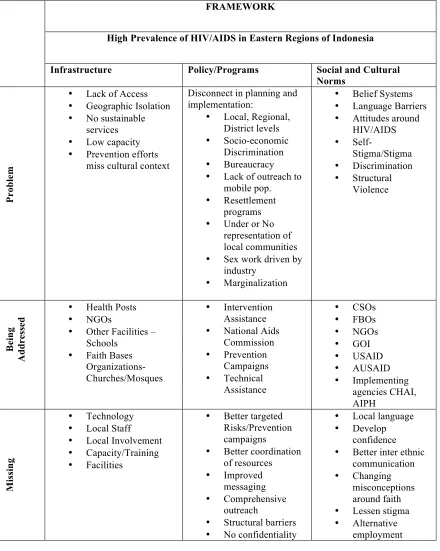
their evaluation reports for this region. I developed an analytic framework as shown
below in Figure 8, to understand the complex landscape of the main problem areas and
potential barriers to success. Due to length constraints I do not discuss all the components
mentioned in the framework.
10 In the 1960s Laura Nader created the term “studying up”. She wanted to encourage anthropologists to
Figure 8: AnalyticFramework for HIV/AIDS Intervention in Tanah Papua
FRAMEWORK
High Prevalence of HIV/AIDS in Eastern Regions of Indonesia
Infrastructure Policy/Programs Social and Cultural Norms
Pr
ob
le
m
• Lack of Access
• Geographic Isolation
• No sustainable
services
• Low capacity
• Prevention efforts
miss cultural context
Disconnect in planning and implementation:
• Local, Regional,
District levels
• Socio-economic
Discrimination
• Bureaucracy
• Lack of outreach to
mobile pop.
• Resettlement
programs
• Under or No
representation of local communities
• Sex work driven by
industry
• Marginalization
• Belief Systems
• Language Barriers
• Attitudes around
HIV/AIDS • Self-Stigma/Stigma • Discrimination • Structural Violence Be in g Ad d re ss ed
• Health Posts
• NGOs
• Other Facilities –
Schools
• Faith Bases
Organizations- Churches/Mosques
• Intervention
Assistance
• National Aids
Commission • Prevention Campaigns • Technical Assistance • CSOs • FBOs • NGOs • GOI • USAID • AUSAID • Implementing agencies CHAI, AIPH Mi ss in g • Technology
• Local Staff
• Local Involvement
• Capacity/Training
• Facilities
• Better targeted
Risks/Prevention campaigns
• Better coordination
of resources
• Improved
messaging
• Comprehensive
outreach
• Structural barriers
• No confidentiality
• Local language
• Develop
confidence
• Better inter ethnic
communication
• Changing
misconceptions around faith
• Lessen stigma
• Alternative
employment
I used the framework above to analyze the problems and potential solutions about how
strategies. I extensively researched the published literature on my area of study. From
these documents, I was able to identify the gaps in service delivery to Tanah Papua and the barriers to prevention strategies, as I have discussed in my literature review in chapter
four.
To learn further about NGOs and implementing partners working on the ground, I
emailed known scholars based in Australia, such as Leslie Butt and Jenny Munro, whom
I have cited in my paper, as they have conducted extensive research Tanah Papua. They both responded promptly and gave me few points of reference for my research. I also
emailed my contact at the World Health Organization (WHO), who was able to refer me
to the people who work in the HIV/AIDS program at the Jakarta office. The WHO office
in Jakarta gave me a list of NGOs operating in the area. Upon receiving the list, I began
to send emails to solicit interviews with people who worked for organizations in Papua
and West Papua.
3.2 Research Methods and Timeline
The research period for this study was approximately six months from June 2014
to November 2014.
Initially I had scheduled approximately two weeks of time for visiting officials in
Washington D.C. to conduct interviews with selected informants. I used qualitative
methods to collect and analyze data. I collected information for this research using two
research resources: The library research/desk review approach and limited phone
interviews allowed me to integrate multiple perspectives of people working in
HIV/AIDS.
agencies working in Tanah Papua; ii) the debate on foreign Aid; iii) foreign and domestic funding for HIV/AIDS programs to Indonesia; iv) NGOs, CSOs and FBOs working in
Tanah Papua; v) prevention strategies being implemented in Tanah Papua; vi) barriers to prevention efforts.
I used one telephone interview with a person who works for an implementation
partner of the Australian government to gain any information that is not covered in my
review of literature. I dedicated two months to reading and reviewing the background and
literature, one month to organizing and conducting interviews and three months to
analyzing my data and drafting my study.
3.2.1 Library/Desktop Research
Since my interviews with the mission director to Indonesia and other development
officials were not feasible, I searched key websites including USAID, World Health
Organization, Australian government and found evaluation reports and audits of
programs by scholars, economists, policy consultants and field workers.
Figure: 9 Search Terms and Sources
Key Terms Search engines & Database
Journals Websites
HIV/AIDS AND Indonesia Google scholar PubMed World Health
Organization
Indonesia AND health OR aid EBSCO Publishing Public culture United Nations
Foreign assistance AND effectiveness JSTOR Economic perspectives USAID
HIV/AIDS AND prevention programs Indonesia
Online Journals Search Engine
Culture, Health & Sexuality
AusAID
USAID AND Tanah Papua Project Muse Asia Pacific Media
Educator
UNAIDS
Behavior Change AND Condom use ProQuest Lancet CIA World Factbook
Health Communication AND HIV prevention
I searched for key terms using multiple search engines, databases and websites and my
key word research returned articles from various journals and peer reviewed literature.
My main research questions were:
• What are the current HIV/AIDS prevention programs in Tanah Papua and how do
they involve local NGOs and local communities?
• Are local attitudes, beliefs and preferences taken into account when designing and
implementing the programs?
• Who are the most-at-risk groups and how have programs attempted to reach them?
• What implementation models are having the greatest impact to manage HIV/AIDS?
• What are the main barriers to effective HIV/AIDS prevention?
• What have been some unintended consequences?
3.2.2Interviews
I interviewed one person who is non-indigenous and an Indonesian of Muslim
faith and works as a GIPA (the greater involvement of people living with HIV) officer
with one of the implementation partners. This helped me to “study down” and learn about
the epidemic from someone in the field. I was able to gauge my informant’s level of
involvement in HIV/AIDS prevention strategies and also get their opinion on how
effective the government is at local levels. I developed a separate set of questions for this
interview to gain an insight into how the community is considered in the design and
implementation of programs and what are some of the obstacles faced by people. This
approach helped answer the following research questions:
• Does the role of community organizations help strengthen implementation of
• Are community workers helpful in HIV/AIDS prevention?
• What is the level of response of the community to engage these programs?
• What are some of the major barriers to these efforts?
The phone interview I conducted lasted a little longer than one hour due to the
slight language barrier with my informant. Because of the remoteness of my informant’s
location, I experienced technical difficulties, such as poor Internet connection, while
trying to schedule and conduct the interview. I asked questions along the lines of my
areas of study and asked for permission to record the interview. I also took handwritten
notes. The participant requested anonymity when answering some of the questions. To
protect my informant’s identity, I assigned a pseudonym calling him/her Atma.
I also emailed a questionnaire to one other potential participant. She preferred
participating via email, stating it would be easier for her, as she had to arrange for an
interpreter due to the language barrier. I developed a set of standard questions and some
questions were specific to the organization’s work. Although the intended participant sent
me her signed consent form, I did not receive any information from her.
3.3 Solicitation and Consent Procedure
I presented the consent forms via email to the interested participants, explaining
the purpose of my research, their role in the process, and their rights as participants. My
point of contact at WHO informed me of the language barrier that I would encounter in
my outreach to NGOs, especially if I were to conduct phone interviews. It would require
the interviewee to arrange a translator to interpret into the local language. I requested that
participants review the documents and, if they chose to participate, type out an electronic
signature functions like a written signature and shows their consent to what was written
on the form. I encouraged the participants to ask questions and seek clarification if
needed prior to signing the form.
I received two consent forms back with participant signatures and filed them on
my computer. But, as mentioned earlier, I was only able to interview one participant, as I
did not hear back from the other participant.
3.4 Potential Risks to Participants & Minimization Strategies
During the interview, if I sensed that the participant was tired, or felt
uncomfortable answering some questions or had any other questions, I paused to address
this issue. During my telephone interview, I was aware of the language barrier and had to
repeat the questions and answers a few times to make sure we both understood the
context. I also made sure to ask the participant if they would like to take a short break.
As I was not able to ask all my questions in the first interview, I requested to
schedule a second interview. I sensed that the participant was enthusiastic about my topic
and agreed. Confidentiality of informant data was ensured because all personal identifiers
(name, age, address) were removed from the transcript.
3.5 Potential Benefits
My study adds value to the existing academic literature on HIV/AIDS initiatives
and prevention strategies for marginalized populations in Eastern Indonesia. It draws on
health initiatives being implemented by foreign assistance organizations and the
the barriers and suggests a localized approach to help improve services for marginalized
populations. Each organization can gain a fuller understanding about the constraints
facing marginalized communities and how best to serve them. The study adds to valuable
literature explaining the socio- cultural challenges in Indonesia that need to be overcome
Chapter Four: Literature Review
4.0 Introduction
In this section of my study, I describe how other researchers have explained the
rising HIV/AIDS prevalence among indigenous Papuans in Tanah Papua. It is
noteworthy that other researchers present this problem from a specific standpoint, such as
studying only stigma and discrimination or marginalization as reasons for this problem.
My study draws on four bodies of literature that are interlinked to assess why HIV/AIDS
prevalence is on the rise in Tanah Papua (i) foreign assistance,economic growth and health, (ii) social and cultural anthropology, (iii) behavior change theory in
communication (iv) the growing role of civil society, non-governmental, and faith based
organizations in HIV/AIDS prevention. My work adds to the existing literature by
providing an overall assessment of why HIV/AIDS is persistent in Tanah Papua and why a “one size fits all,” blanket prevention approach is not appropriate in this region. I draw
on other scholarly research and synthesize all the important components to HIV/AIDS
prevention. In some instances, I apply the experiences of the Dani ethnic group as
examples.
I have organized this review of the literature in five main categories: First, in
section 4.1, I review literature on foreign assistance. Second in 4.2, I review arguments
on foreign assistance for HIV/AIDS. Third in 4.3, I examine HIV/AIDS prevention
strategies such as the use of condom promotion in local communities implemented by
foreign agencies like PEPFAR, and by local organizations. I examine HIV/AIDS
with a focus on modifying sexual behavior. These strategies include: 4.3.1 HIV/AIDS
prevention campaigns. Fourth in 4.4, I study specific barriers that are mentioned by other
researchers in literature on HIV/AIDS and are known to hinder prevention efforts in
Tanah Papua. Most barriers, I review are interlinked to socio-economic factors and include: 4.4.1 marginalization; 4.4.2 structural violence; and 4.4.3 stigma and
discrimination. Fifth in 4.5, I examine the literature that covers commercial female sex
workers to explain why HIV/AIDS prevention and outreach to marginalized groups is not
decreasing in prevalence. Finally, in 4.6, I summarize the review.
4.1 Foreign Assistance Debate
Foreign assistance is also known as international or development aid given by
bilateral and multilateral donors to poorer recipient countries (Phillips 2013). Bilateral
assistance is aid given by the government of one country to another through its
development agencies, and multilateral assistance involves funding from multiple
institutions such as the International Monetary Fund, United Nations, and the World
Bank.
Donors have their own objectives according to which they give multiple forms of
aid to recipient countries, such as for development, economic growth, poverty reduction
and humanitarian aid (Burall and Roodman n.d., 3). Aid agencies, their departments and
implementation partners monitor and evaluate outcomes to varying degrees of rigor and
inclusiveness. The evaluations may be biased based on the practices and policies of
agencies and the administrating departments (Blue, Clapp-Wincek and Benner 2009). A
plethora of literature indicates that foreign assistance is tied to political, diplomatic, and
Nations University-WIDER, “foreign aid is not always a free resource transfer and often
arrives with economic and political conditions” (Tarp 2012).
Therefore, the debate on foreign assistance involves polarized opinions from two
schools of thought, with a particular focus on aid outcomes. One side of the scholarship
argues in favor of aid effectiveness while the other side argues that foreign assistance is
ineffective or even harmful. My study does not add any new information to this debate,
but the review of this controversy is important to understanding foreign aid and outcomes
in relation to HIV/AIDS programs.
The debate about foreign assistance, in the context of poverty alleviation,
economic growth, and managing infectious diseases, is not new (Lum 2008). “Aid
optimists,” such as economists, Jeffrey Sachs, David Dollar and Craig Burnside, continue
to argue in favor of foreign aid, calling it a powerful tool for economic growth and
development. Their argument depends on good governance, sound policies, and
transparency in recipient countries, stating that these elements are essential for allow aid
to be effective (Wright and Winters 2010). In a recent article, “The Case for Aid,” Jeffrey
Sachs refutes critics of foreign assistance. He points out that large-scale foreign aid has
achieved remarkable results in improving public health in poor countries, such as
expanding health programs and increasing coverage for vaccinations and malaria control
(Sachs 2014).
In contrast, “aid pessimists,” such as economists William Easterly and Ross
Levine, argue against foreign assistance. They state that foreign aid along with political
and economic conditionalities levied on countries has done more harm than good (Wright
simplification” and claims that aid bureaucracies in donor institutions foster a top-down
approach that benefits only a small number of people for a limited time (Easterly 2003).
Other aid skeptics, such as Rajan, Subramanian and Younger, argue that foreign
assistance can negatively impact a country leading to reluctance by national governments
to invest in their own countries (Mishra and Newhouse 2009; Easterly 2006). Easterly
argues that aid can create economic dependency in poor countries and worsen health
outcomes. Other cynics of aid, such as Sofia Gruskin et al., indicate that the effectiveness of aid is dependent on overcoming structural barriers, such as poverty and low economic
development (Gruskin et al. 2013).
A complex, causal relationship exists between poverty reduction and positive
health outcomes. To achieve the latter, it is also important to look at factors such as
nutrition, sanitation, and access to health services. Simply removing barriers, such as
extreme poverty and low economic development will not automatically improve health
outcomes in a linear fashion.
The growing role of non-governmental and civil society organizations in recent
decades cannot be neglected. Non-governmental organizations either work independently
or assist larger agencies in program implementation at local levels. Such organizations
also have advocates, such as professor Kusman Ibrahim, and opponents such as scholar
James Pfeiffer. Professor Ibrahim et al., indicate that aid in the form of training, capacity building, and technical assistance given to local non-governmental organizations can
improve community health systems and benefit local communities. With the necessary