A Reliable Low Bandwidth Email-based
Communication Protocol
by
Janelle Kenty-Joan Prevost
S.B., Mathematics
Massachusetts Institute of Technology (2000)
Submitted to the Department of Electrical Engineering and Computer
Science in partial fulfillment of the requirements for the degrees of
Bachelor of Science in Computer Science and Engineering
and
Master of Engineering in Electrical Engineering and Computer Science
at the
MASSACHUSETTS INSTITUTE OF TECHNOLOGY
May 2001
Lim
1I
@
Janelle Kenty-Joan Prevost, MMI. All rights reserved.
The author hereby grants to MIT permission to reproduce and
distribute publicly paper and electronic copies of this thesis document BARKER
in whole or in part.
MASSACRUSETTS INSTITUTOF TECHNOLOGY
JU L 11
Z001
LIBRARIES
A uth or ... . ... ...Department of El ctrical Engineering and Computer Science
May 29, 2001
Certified by.
...
Lynn Andrea Stein
Associate Professor
4''hepj, Supervisor
Accepted by...
Arthur C. Smith
Chairman, Department Committee on Graduate Students
A Reliable Low Bandwidth Email-based Communication
Protocol
by
Janelle Kenty-Joan Prevost
Submitted to the Department of Electrical Engineering and Computer Science on May 29, 2001, in partial fulfillment of the
requirements for the degrees of
Bachelor of Science in Computer Science and Engineering and
Master of Engineering in Electrical Engineering and Computer Science
Abstract
In many places in the world, network infrastructure is characterized by intermittent connectivity, low-bandwidth and errors. As a result, web-browsing is slow. Because users frequently pay for each minute that they are connected, browsing the web can be an expensive proposition. In these places, what is needed is a communication protocol that can provide reliable end-to-end data delivery even in the face of episodic connectivity and low-bandwidth routes.
This thesis details the design and prototype implementation of a reliable, low-bandwidth, email-based communication protocol. It was designed for communication between principals in the TEK Search System, whose main goal is to improve access to the information available on the World Wide Web in low-connectivity areas. We provide a low-bandwidth message format and an error-recovery scheme, and address the issue of compression.
Thesis Supervisor: Lynn Andrea Stein Title: Associate Professor
Acknowledgments
" I thank my supervisors, Dr. Libby Levison, Prof. Saman Amarasinghe, and
Prof. Lynn Stein for their guidance and contributions to this thesis. Libby was especially encouraging and always had time to discuss issues as they arose, even when she was many miles away in Peru. I also thank Dr. David Clark for the conversations he had with Libby and me about TEK and this thesis.
* My family has been extremely supportive of me during my 5 years at MIT. Their love, prayers, and words of encouragement were invaluable. I thank my mother, Joan Prevost, for proof-reading my thesis and for her excellent suggestions. I thank both parents for reminding me that it is ok to rest when one is tired and eat when one is hungry.
" I thank the Government of the Commonwealth of Dominica for its financial support for the past 5 years.
" Finally, I thank my friends (Kenroy, Kavita, Olu et al), especially those at MIT who were also going through the thesis-writing process at the same time as I was, for the countless laughs, frustrations, and all-nighters that we shared. Janelle K. Prevost
Contents
1 Introduction 13 1.1 Motivation . . . . 13 1.2 W hy Email? . . . . 14 1.3 Related Work . . . . 15 1.4 Outline of thesis. . . . . 162 Background: The TEK System 17 2.1 Architectural Overview . . . . 17 2.2 Related Work . . . . 20 2.3 Summary . . . . 21 3 Protocol Design 23 3.1 Design Criteria . . . . 23 3.2 Design Details . . . . 24 3.2.1 Architectural Overview . . . . 25 3.2.2 Message Format . . . . 26
3.2.3 Error Detection and Recovery . . . . 27
3.2.4 Message Compression . . . . 29
3.3 TEK-specific Design Details . . . . 29
4 Implementation 33 4.1 Module Overview . . . . 34
4.1.2 Server . . . . 4.2 Implementation Details . . . . 4.2.1 Message Object . . . . 4.2.2 Message Types . . . . 4.2.3 Data Storage . . . . 4.2.4 Classes . . . . 4.3 Message Exchange Examples . . . . 4.3.1 Search . . . . 4.3.2 Retransmission of a message . . 5 Testing
6 Conclusion
6.1 Future Work . . . . 6.1.1 Fragmentation and Reassembly 6.1.2 Message piggybacking . . . . 6.1.3 Adaptive Timeouts . . . . 6.1.4 Client-side Database . . . . 6.1.5 TEK-specific extensions . . . . 6.2 Possible Evaluation Techniques . . . . 6.3 Conclusion . . . . A Database Tables 37 40 40 41 46 49 51 51 54 57 59 59 59 60 60 61 61 62 63 65
List of Figures
2-1 TEK Client-Server Interaction . . . . 18
2-2 TEK Server Modules . . . . 20
3-1 High-level protocol architecture . . . . 26
4-1 Client-side Control Flow . . . . 35
List of Tables
3.1 General Message Format . . . . 4.1 4.2 4.3 4.4 4.5 4.6 4.7 4.8 4.9 4.10 4.11
Registration Message Body . . . . Registration Reply Message Body . . . Search Query Message Body... Search Query Reply Message Body URL Direct Fetch Message Body . . . URL Reply Message Body . . . . Hardware Update Message Body . . . Hardware Update Reply Message Body Software Upgrade Message Body . . . Software Upgrade Reply Message Body Ping Reply Message Body . . . .
27 . . . . 42 . . . . 42 . . . . 43 . . . . 43 . . . . 43 . . . . 44 . . . . 44 . . . . 45 . . . . 45 . . . . 45 . . . . 46
Chapter 1
Introduction
1.1
Motivation
The problem of how to exchange digital information across a stable network has been solved in many different ways. For real-time data transmission over the Internet, the de facto standard is the TCP/IP protocol suite. This protocol works well on the high-rate fibre networks of first-world countries where continuous connectivity is available typically with negligible error, loss or delays.
In contrast, in many developing countries, the network environment is quite differ-ent: low bandwidth, low connectivity, and data corruption are characteristic. Those few people who have access to the Internet do so by dialing up to a local Internet Service Provider (ISP) through a modem. In these countries, the telephone network has a sparse reach, and teledensity is extremely low. As such, accessing the Web and downloading information is slow. Emails sometimes get lost or take longer than normal to reach their destination. What is more, the cost of basic Internet access over this unreliable telecommunications infrastructure is expensive.
ISPs in many countries of the world distinguish between an account with Internet (WWW) access, and an account with only email access; Internet access accounts are typically much more expensive than email accounts. As such, a large majority of online users in these countries have access only to email. The store and forward nature of email makes it well suited for use in situations where connectivity is not
always continuous, since it affords the opportunity to take advantage of spurts when the network is expected to perform well1.
This thesis addresses the problem of how to deliver data reliably over unreliable, low bandwidth networks. The major challenge is to design a robust communication protocol that can recover from message loss and errors, and which minimizes both the number of messages that need to be exchanged in order to accomplish a task and the amount of data transmitted per message.
We will present a design and prototype implementation of a reliable, low band-width email-based communication protocol for the Time Equals Knowledge (TEK) system [1]. TEK is a search engine aimed at improving WWW access in developing countries where low bandwidth, unstable connectivity and high telecommunications charges make the use of current Internet search utilities unviable. The implementation
of this email-based protocol is central to making TEK a reality.
1.2
Why Email?
Several reasons motivated the choice of email as the transport mechanism for our protocol. First, connectivity constraints made it clear that the protocol could not require real-time responses. In other words, the protocol had to be asynchronous. The communication environment of most developing countries is characterized by intermittent connectivity. This means establishing and maintaining a connection to a remote end-point is difficult. In order to work well, the protocol had to be designed in such a way that it could take advantage of time spurts when the network is expected to work well. The store and forward nature of email made it an obvious candidate. With email for transport, the protocol can package information for delivery, wait until the network is ready and then forward the message in an email to its destination.
Second, since Internet access and the cost of telephone calls in developing countries is expensive relative to per capita income, the length of time spent connected to the
'For example, this might be late at night, when there might be fewer users engaging lines on the local telephone network.
ISP is a significant part of the cost of access. Checking email requires short on-line time: the time to log on, download new mail, send composed messages, and log off. Using a connection-oriented, synchronous communication method would require a longer connection time, and would therefore be more expensive. Email does not require maintaining a persistent connection, as such it fits as the best solution.
Third, recall that in many places in the world more people have access to email than to the World Wide Web. This made email an even more attractive option. Since it would be infeasible to try to change the underlying communication means between machines with Internet access, the protocol leverages the existing store and forward nature of email to produce a solution to the problem of low connectivity. In this way, the sender can package messages in advance and send them via email to the recipient at some later time.
1.3
Related Work
The Interplanetary Internet Project
A current research project with motivations and issues very similar to those addressed by this thesis is NASA's Interplanetary Internet Project [5]. The project aims to de-fine the architecture and protocols needed to allow the Earth's Internet to be able to communicate with Internets located on other planets. The communication environ-ment that underlies the Interplanetary Internet is faced with:
9 long speed-of-light delays (from Earth to other planets);
e intermittent connectivity (communicating entities may lose their line of sight due to interference from other planetary bodies);
* asymmetric data rates (inbound and outbound data may travel at different data rates);
9 low signal to noise ratios (higher ratios imply a reduced likelihood of error when the receiver is decoding information from the sender)
* and high cost (using the Deep Space network is very expensive).
Durst, et al [6] cite the email model, with its store and forward nature, as "perfect for operating in environments in which there is not continuous connectivity between all hosts", though they indicate that SMTP as a protocol is not.
1.4
Outline of thesis
In the following chapters, we discuss the design and implementation of an email-based communication protocol which addresses the issues of low bandwidth and low con-nectivity. We begin in Chapter 2 with a brief background on the TEK System, which motivated the development of this protocol. Next, in Chapter 3 we look at the proto-col design. This will include the definition of the core functionality that the protoproto-col should provide and design details. In Chapter 4 we discuss the implementation of the protocol for use by the TEK Search System. This is followed in Chapter 5 by a brief look at the testing done on the implementation. Finally, in Chapter 6 we look at future extensions to the protocol and give conclusions.
Chapter 2
Background: The TEK System
The TEK System is a low-connectivity search engine designed to accept search queries via email from a user at a remote location. It also returns the search results by email. While most existing search engines aim for instantaneous delivery of search results, TEK focuses on:
1. trying to extract a well-defined query from the user;
2. post-processing of search results, in order to return more relevant information, in a more compact form.
These are both extremely important because they translate to the difference between relevant and irrelevant search results. Because the TEK service is targeted to be deployed in the developing world, where the telecommunications infrastructure is poor and Internet access is expensive, every irrelevant search result returned to the user is a waste of precious bandwidth and money.
2.1
Architectural Overview
The TEK System follows a client-server architectural model. This is illustrated in Figure 2-1.
Local Client Network
TEK Client Search request (HTTP)
* Search results
(hTt Proxy Search request on
F e 1etServer - ehalf of TEK client (email)
TEK Server Search results
(email)
TEK Client
The TEK client makes search requests to the TEK server via a local web proxy server. It connects via a web browser to the proxy server, which communicates (using our email-based protocol) with the TEK server on the client's behalf when necessary. The client user interface is a set of HTML pages. This HTML-based user interface allows searching of the information stored in the local proxy server's cache, and viewing of search results obtained from the local proxy server's cache. Also, it allows for the creation of search queries for transmission to the TEK server, and presentation of query results returned from the TEK server. In addition, access to the other resources of the system (e.g. thesaurus, dictionary) is through the HTML user interface.
TEK Server
On receiving a query, the TEK server funnels the search terms to other search engines (e.g. Google [2]), selects the best' results from what was returned, clusters related files, and removes extraneous information that would waste bandwidth. It then gen-erates summaries of the resulting information, and compresses and sends the results back to the TEK client side using the protocol. The TEK server is comprised of 6 modules, which make use of a central database for storing intermediate results at different stages of the search.
1. Controller module. This is a central controller responsible for passing the search query along to the different processing modules of the Server.
2. Query Generator module. This receives the search query and records it in a database on the server side.
3. Query Engine module. This module performs the search by forwarding the query terms off to some Internet search engine2, and retrieving the URLs re-turned.
'Natural language algorithms are used to select a subset of files from the preliminary collection of results.
Query Results in out
Query
Generate
Transfer
TEKController
Query
Info
Engine
Refine
Info
WWW
Select
Figure 2-2: TEK Server Modules
4. Information Select module. Here, HTML tags are removed from the result files and a clustering algorithm is run to group similar results files together. 5. Information Refine module. This module removes any unnecessary text
(e.g. JavaScript code) and images (unless the search query explicitly instructed otherwise). It also generates summaries of the results.
6. Transfer module. This module picks a selection of URLs from each cluster up to the size limit for the client and packages them for return to the client.
2.2
Related Work
GetWeb and www4mail
Several web-to-email servers, such as GetWeb and www4mail currently exist. Both of these allow a user with basic email functionality to retrieve web pages.
utility. To retrieve a specific URL, GetWeb requires that the user send an email to a GetWeb server with the subject line blank, and the body of the email containing only ' 'GET' followed by the exact URL to be returned. The GetWeb server then retrieves the page from the web and returns it in an email as text.
To perform a search, the user must send an email to a GetWeb server, with the subject line being blank, and the body containing the search instruction:
SEARCH Search-Engine-Name SearchTerms
where SearchEngineName might be ALTAVISTA, INFOSEEK, or YAHOO, and
Search-Terms, the search terms to be processed. The server returns a list of URLs found by the search engine. The user must then compose another GetWeb email to request the URLs he wants to view from among those in the list.
www4mail [4] is similar to GetWeb, in that it requires that the user construct an email to the www4mail server in a specified format. To perform a web search, one has to know the exact format that the search engine expects.
The main advantage of the TEK system over these web-to-email servers is that it provides a search tool via a user interface that hides all formatting details from the user. This makes it easier to use, and in some sense, almost parallel with standard search engines. In addition, TEK uses intelligent filtering techniques to return the most relevant results, and removes high bandwidth content such as images. Further-more, TEK performs a local search of cached pages before sending search requests out in an email to the TEK server, thus making efficient use of previously returned results.
2.3
Summary
As explained in this chapter, the goal of the TEK system is to provide a search tool that overcomes the connectivity problems being faced in many developing countries. To recapitulate, the following assumptions were made as the system was designed:
1. Connectivity is unreliable. This major assumption is that the client is unable to maintain a persistent connection to the server. This had a huge influence on
several key design decisions, in particular, the choice of email for communication between TEK clients and server.
2. Bandwidth on the client side might be extremely constrained. This implies that downloading may be slow.
3. Transactions between the client and server should be accomplished with the minimal number of round-trip communications.
Under these assumptions, it was clear that for reliable communication between a TEK client and the TEK server a robust, low bandwidth protocol that did not require real-time communication, and which could take advantage of real-times when the network on the client side would be most reliable was needed. The store and forward nature of email makes it ideal as a transport mechanism for such a protocol. In the subsequent chapter, we discuss in detail the design of the TEK communication protocol.
Chapter 3
Protocol Design
In this chapter we present the detailed design for the low bandwidth protocol moti-vated by the requirements of the TEK system. As much as possible, the design will be presented as application-independent. However, in the final section of this chapter, we will discuss some aspects of the design which are TEK-specific.
3.1
Design Criteria
The following design criteria were used to drive the design process:
1. Simplicity. The design should be low in complexity so as to minimize the chance of implementation errors. A simple protocol is easier to implement, debug, maintain and extend.
2. Extensibility. The design should be easy to extend. A modular design ap-proach was chosen. Modular designs are easy to extend provided that the modules and the interfaces between them are clearly defined.
3. Fault Tolerance and Reliability. The protocol must be reliable in the face of errors. It must adapt gracefully to any of the failure modes of email.
4. Ease of Integration. The design should ensure that integrating the protocol into an application is simple and straightforward.
5. Functionality. To fully address the issues of low bandwidth and intermittent connectivity, the protocol must provide the following core data manipulation and transfer control functions [7]:
(a) Message Formatting. Before any information is transferred from the
sender, it should conform to a fixed message format so that it can be read at its destination.
(b) Error recovery. The protocol should be able to recover from certain errors, including message loss and message duplication. For the TEK Sys-tem in particular, the protocol should be able to recover from interrupted downloads. This is important because of how expensive Internet access is in the regions that TEK will be deployed. It is imperative that if a down-load operation is interrupted before the complete file has been obtained, the protocol restart the download from the point of interruption, and not repeat the download.
(c) Message Compression. To maximize the amount of information trans-mitted per email, large messages should be compressed before they are transmitted.
(d) Message fragmentation and reassembly. To reduce bandwidth con-straints, the protocol should fragment large messages before they are sent, and reassemble the fragments when they have arrived at their destination. (e) Encryption. To ensure privacy, the protocol should encrypt all messages
before they are sent.
3.2
Design Details
In this section we give details of the overall design of the protocol. The protocol follows a simple request-reply paradigm. Each request originating from a sender is matched with a reply from the recipient. Replies are not explicitly acknowledged, however. This is primarily in order to minimize the number of messages that need to
be exchanged in order to complete a task. Secondly, if the protocol were to explic-itly acknowledge replies, then it would have also to deal with the possibility of lost acknowledgments; this would add significant overhead.
Another important feature of the protocol is that it is asynchronous. This means that the sender does not block while it awaits a reply from its peer. This choice was preferred over an asynchronous design, due to the assumption that connectiv-ity is episodic and unreliable. In the context of TEK, the server may take several hours before returning a set of search results in response to a search query, thus an asynchronous design is better suited for the protocol.
The protocol uses timeouts and retransmission for error recovery. Simply put, request messages are retransmitted if the timeout parameter associated with the request is triggered.
3.2.1
Architectural Overview
In general, we can think of the protocol as a series of layers below the application. More specifically, the protocol controls and abstracts the communication of the ap-plication with the outside world. As Figure 3-1 illustrates, the protocol is comprised of two layers: the Transport layer, and the Protocol Management layer.
The Transport Layer
This is the outermost layer of the protocol. It provides reliable, end-to-end data transport. The Transport layer formats content for delivery, and emails it to its des-tination. It also handles picking up of incoming messages. On receiving a message in an email, the Transport layer parses it, and dispatches it to the correct function in the Protocol Management layer. The Transport layer is also responsible for fragmenting large messages into smaller, fully addressed fragments, so that messages transmitted between endpoints are of an acceptable size for the network. Timers that trigger retransmission of messages, and other processes that aid with error detection and recovery, are also found in this layer of the protocol.
1X1-: X .. M ... .. ... ... .. ... ... ..... ... ... ... * ... ... %X... ... ... .. ... ... X... ... ----... ... .... n (Applicatio D on Applicatii) .... ... ... .. .... ... ... ... .. .. ... I ... .... .. ... ..... ... ... .... ... .. . ... .... ... ... ... ...... ... ... .I . .... ... .. .. I .. .. .. ... I ... ... .... .... .. ... .. ... ... ... .I I ... ... .. ... .. .... .. .. .. ... .... ... ...... ... ... ... .... ... I ... ... I ... ...... I ... ... .... ... ... ...... ...... ... ... ......... ... ... .. ....... ... ... . ... ... ...... ... . ... ... ... ...... . ... ... .. ... ... ... .... ... ... .. ... ... .... _ -.. ...-.. ... - -... .. ... ... .- -... ...... - .. .. ... .. .... ... ... .. ... ... ...... ... ...... .1 1, ... ... ... .... .. ... ............ ... ...... ... .. ...... ... I .. .... .. .. .. .. ... ... ... ...- ....1 ......_ ... ...... ... . ... ... . ....Mona. 0... ... ... ...::.:.:g ... ...... ... ... .. .... .. ... ... ... ... _ _ .... ...... ...... . ... .. .. .... .1 1 ... -.. ... ... .. .... I .. .. .I .... ... .. .... .... ... ...... ... .. ... .... .... ..... .. .. .. ... ... .... .. .. .... .. ... .... ... .. ... -... ... .. .... ... .. ... .. ... .... ... ... -. .. ... ... ... .. -.. ...... . ... ... ... I .. ... ... .. ... ... .. .... .... .. .... .. .... . ... .. .. ... ... .. .... -.... ..... .. .. .. .. .. .... ... ... ..._ ... I ... I ...... _ I ...... ... ...... ... ... ... ... ... ...1- 1 ... ...... ... ... ... ... I ... _ _ ...... ... ... ... .. .. .. .. .. .. .... ... ... .... ... .. .. ... .. .. .... .. ... .. ... .... .. _ _ _ .... .. _ .. ... .... ...... ... ... ..... I ... ... ... ... .. ... .... ... .. ... .... .. ... ... . .. .. ... . ... . .. ... .. .. .... ... ... ... .. .... .. .. .. .... .. .... ... .... .. .. ... -.... ... ... .. ... .. .. ... ...... ... ... .... .. .. ... .. ... .. 1- ... 1- ... ... ... ... .. ...... .. ... .. ... .... .. .... ... ... ... .. ... ... I ... ... ... .... .... .... .. .. .. .. .... ... ... ... ... ...I .... 1- 1- ... ... .. ... ... ... ... ... ... .... ... ... ... . .. ... ... .... ... ... .. .. .. ... .. . ... .. ... ... .... .. ... .. .. ... ... ... ... .. .... .. .. .. .... ... ... ... .. ... ... .... .. .. ... .... ... ... .... .. ... .. ... ... .. . ... ... _ _ ... _ .... Sender
message transmifted in email
Recipient
Figure 3-1: High-level protocol architecture
The Protocol Management Layer
Parsed messages from the Transport layer are passed to functions in the Protocol Management layer. Among others, functions responsible for checking whether clients and servers are up and running are found in this layer of the protocol. The Protocol Management layer is also responsible for passing application-specific messages to the appropriate application function. For example, when a TEK query arrives at the TEK server, the Protocol Manager passes the message parameters to the TEK search handler.
3.2.2
Message Format
In keeping with the design criteria that the protocol be simple and easy to extend, we designed a simple message structure for all messages to be transmitted by the protocol. Each message consists of two components (Figure 3. 1): a Header, which contains information used to identify the message, and a Body, which, as its name implies, contains the bulk of the message content, which is often application-specific information.
Header:
MID Message ID
EID Entity (Client or Server) ID
Type Message Type
Source Email address from which message originated
FN Fragment Number
TNF Total Number of Fragments
DUP Flag indicating whether the message is a duplicate of a previous message. Body:
The rest of the message content.
Table 3.1: General Message Format Message Identifiers
The protocol is designed to stamp each message with a unique Message Identifier (MID). This is to ensure that the messages can be tracked. Unique identifiers must be generated for each request and reply message sent using the protocol. The body of a reply message must also contain the MID of the request message to which it is a reply.
3.2.3
Error Detection and Recovery
The protocol provides a detection and recovery mechanism for messages that do
not arrive at their destination (lost messages), duplicate messages, certain corrupt messages, and reordered messages.
Lost Messages
Messages may fail to arrive at their destination for several reasons:
1. Network transmission failure. The email (carrying the message) is dropped by the network.
2. Send-omission failure [8, p.56]. The message is deleted from the outgoing mes-sage buffer after it is packaged by the sender, but before it is emailed to the
receiver. This might be due to a system failure on the sending machine.
3. Receive-omission failure [8, p.56]. The message is deleted from the incoming message buffer on the receiving side before it can be parsed and dispatched to the appropriate process.
Each sender has a standard, configurable, timeout parameter that indicates how long it should wait for a response to a request. If a sender sends a message and does not receive a response within the timeout period, then it assumes that the original message is lost, and it reconstructs and retransmits the message, flagging it as a duplicate message, but assigning it the same MID as the original. This requires that each sender keep track of all messages that are unresolved i.e. those messages for which a response has not yet been received.
Duplicate Messages
Duplicate messages can be received for several reasons:
1. Network transmission error. The mail transport protocol causes duplicate mes-sages to be sent in error.
2. The sender resends the message in error.
3. The sender resends the message because it never received a response to the original message.
The receiving entity will get a duplicate request either while it is still processing the original request or after it has already sent the reply (meaning the original reply was lost). If the receiver is still processing the original request when the duplicate arrives, the protocol will detect this (by recognizing that the new request has the same MID as the original), and will discard the duplicate. If however, the duplicate request message is due to a lost reply, the receiver simply re-executes the operation to regenerate a reply to the message.
Corrupt Messages
For the protocol, corrupt messages are defined as those emails that cannot be parsed. One case of this is bounced emails. The protocol will handle unrecognizable emails (i.e. emails that are rejected by the Protocol Management parser module) by auto-matically forwarding them to the application administrator, or by placing them in a special folder where they can easily be dealt with by the administrator.
Reordered Messages
The protocol is designed so that it does not require that messages are received in the order that they were sent. This is because each request is associated with exactly one reply. Furthermore, each request-reply message pair (unless it is fragmented) is independent of other request-reply pairs. Reordering of messages may be a problem when messages are fragmented and sent over several emails, instead of just one large one. This is discussed further in Chapter 6.
3.2.4
Message Compression
The protocol is designed to compress all messages before transmitting them over the network, and then decompress the messages when they have been received at the destination site. A disadvantage often cited when dealing with data compression is that it can be slow, since the compression algorithms are often time-consuming. This is not a concern for the TEK project since we are operating under the assumption that it is acceptable to make the tradeoff of speed for information.
3.3
TEK-specific Design Details
The protocol layers have little knowledge of what happens in the application. To the application, these layers abstract away all communication details. On the TEK server side, the protocol interfaces with the TEK search functionality. The TEK server forwards search results to the Transport layer of the protocol for packaging and
delivery. On the client side, the protocol is responsible for delivering search queries, and receiving search results. However, TEK needs to be capable of exchanging other information, i.e. not just search information, between TEK entities. We now look at the different classes of information that the protocol must be able to transport for the TEK System.
Information to be transported
1. Search Information. The main function of the TEK system is to provide search capabilities to its users. When a user types a search query into the TEK client user interface, the search terms, along with any other information specified by the user (e.g. the language to perform the search in) must be collected and sent to the TEK server for processing. The server must respond with the results of the search.
2. URL Request Information. Another function of the TEK System is the direct URL request function. The user types in a specific URL into the TEK client user interface, the client sends the URL address to the server, and the server must reply with the HTML file addressed by that URL. This is the basic functionality provided by web-to-email servers [3, 4].
3. Client Registration Information. All new clients must register with a TEK server. The client must send registration information to the TEK server; the server replies with a unique client identifier for that new client. This client identifier is used in all subsequent communication messages exchanged between that client and the server.
4. Hardware Update Notification Information. The TEK server uses infor-mation about the hardware specifications of each client to determine, among other things, the maximum file size that the client can download without high risk of failure. The client provides its hardware profile at registration. If any hardware information supplied at registration is later upgraded, then the TEK
server needs to be updated with this information. The server should respond with information to indicate whether or not the update was successful.
5. Software Upgrade Information. When small upgrades are made to the TEK Client implementation, it may be possible to send these changes from the TEK server to the client through the protocol, instead of having the client wait for a new version to be sent (on a CD-ROM via snail mail, for example). The client should respond with information to indicate whether or not the upgrade was successful.
6. Data Upgrade. An electronic dictionary, thesaurus and atlas are included with every TEK client. Whenever additions need to be made to this reference library, the new data could be sent to the client using the protocol. The client should reply with information to indicate that it received the data upgrade. 7. Test of System Health. Information used to ensure that the system is up and
running, and to facilitate error-recovery may also need to be exchanged. For example, system health testing can be initiated from the TEK server to check whether a particular client is up, or from a TEK client, to check whether the TEK server is up.
8. Database Synchronization. The TEK system builds its own local database for the client as search results are returned. There must be a mechanism to update this database of information as time passes (since files may become outdated), and in the case that local files get deleted or corrupted.
In the following chapter, we discuss the implementation of the protocol specifically for use in the TEK System.
Chapter 4
Implementation
In this chapter we describe the prototype implementation of the protocol for the TEK system. The implementation was done in Java to ensure ease of integration with the TEK system, which itself is implemented in Java, and because of Java's easy porta-bility to both Windows and Unix platforms. For the prototype, implementation of the core features of the protocol were undertaken, namely, end-to-end data transport
and reliability.
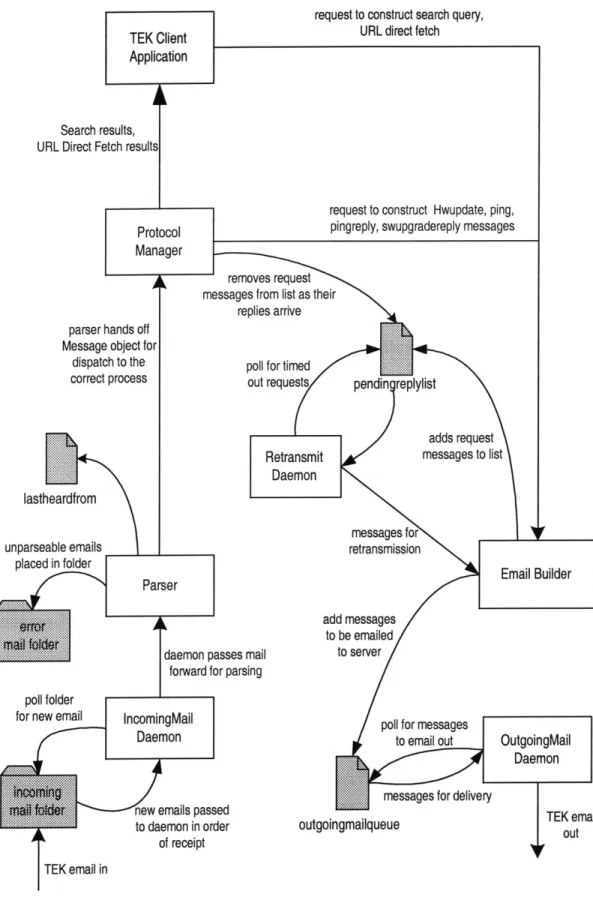
We begin in Section 4.1 with a descriptive overview of the implementation modules of the protocol on the TEK client and the TEK server. The discussion in this section is based on the control flow diagrams in Figures 4-1 and 4-2. From these figures, it is evident that the structure of the implementation on the server mirrors that of the client. However, there is one key difference between the client-side and server-side implementations, which we will discuss. In Section 4.2 we delve further into the implementation details. We define the specific message types supported by this implementation of the protocol, and their message body format. We will also look at the storage media used on the client and server, and the classes for the control flow modules. Finally, to demonstrate the use of the protocol, we run through some message exchange examples in Section 4.3.
4.1
Module Overview
In this section we discuss the control flow for the protocol, as illustrated in Figures 4-1 and 4-2. We will describe in detail each module involved in sending and receiving messages.
4.1.1
Client
The implementation modules of the protocol on the client side are illustrated in Figure 4-1. In our discussion, we follow the control flow from the time a TEK email
arrives at the client.
At the TEK client, TEK emails are filtered out and placed in a special directory as they arrive. This directory is the incoming mail f older. The incoming mail f older is polled periodically for new mail by the IncomingMailDaemon module. This polling frequency is configurable. The IncomingMailDaemon reads mail messages from the folder in the order that they are placed there. This means that the oldest emails are read and removed first. The IncomingMailDaemon then passes all emails, in the order that it reads them, to the Parser module.
The Parser, as its name implies, is responsible for parsing TEK emails to deter-mine their message type, since this indicates how the mail must be handled. If, for some reason, the email cannot be parsed successfully, the Parser assumes that it is an error message and stores it in the error mail folder for intervention by the ad-ministrator. When a message has been successfully parsed, the lastheardfrom file is updated with the date and time that the message was received. The lastheardfrom file stores the date and time that the last message from the server was received. The data from successfully parsed emails is housed in a Message object. The Parser mod-ule is responsible for dispatching the Message object to the correct handler function in the Protocol Manager.
The Protocol Manager has two major functions: handling incoming requests from the TEK server, and handling replies to messages the client had sent to the server. For application-specific messages, e.g. search results, the Protocol Manager
TEK Client Application
Search results, URL Direct Fetch results
Pro
Man
parser hands off Message object for
dispatch to the correct process lastheardfrom unparseable emails placed in folder Pa poll folder
for new email Incom
Dae
new
to d
tocol
request to construct search query, URL direct fetch
request to construct Hwupdate, ping,
pingreply, swupgradereply messages ager
removes request messages from list as their
replies arrive
poll for timed
out requests pendin replylist
adds request
Retransmit messages to list
Daemon messages for retransmission Email Builder rser add messages to be emailed
daemon passes mail to server
forward for parsing
ingMail poll for messages
mon to email out OutgoingMail
- . Daemon
messages for delivery
emails passed TEK email
aemon in order outgoingmailqueue out of receipt
TEK email in
passes control to the TEK Client Application module. In handling replies from the TEK server, the Protocol Manager removes associated request messages from the pendingreplylist' file, which serves to store all requests that have been sent to the server, but have not yet received a reply from the server. This list of requests awaiting a reply from the TEK server is kept in order to facilitate message retransmission where necessary. To better understand what other functions the Protocol Manager must provide, we briefly review the types of information that a TEK client must be able to handle.
1. Search Results. The TEK client must be able to receive search results that get sent back from the TEK server in response to a search query.
2. URL Direct Fetch results. The TEK client must be able to receive results that arrive in response to a request for a specific URL.
3. Registration Response. The TEK client must be able to receive the registra-tion response returned by the server with its unique CID.
4. Hardware Update Response. The server sends a Hardware Update response to the client when it has received and processed a Hardware Update notification message from the client.
5. Software Upgrade. The client must be able to receive Software Upgrades from the server.
6. Data Upgrade. The client must be able to handle Data Upgrade messages from the server.
7. Pings and Ping Replies. The client must be able to respond to pings, and handle ping replies sent by the TEK server.
8. Database synchronization response. The client must be able to receive database synchronization responses from the server.
'When the client constructs a request to send to the server, the request is added to the pendingreplylist file.
When the TEK client needs to send messages to the TEK server, these messages are constructed by the EmailBuilder. The EmailBuilder ensures that the message headers are included, and in the correct format, and that the message body follows these headers. The format for the messages supported by this implementation is discussed in Section 4.2. After the message has been created the EmailBuilder:
1. places the message, coupled with its destination, into the outgoingmailqueue file where it is picked up and emailed out by another protocol module;
2. in the case of a request message, appends the message to the list of messages on the pendingreplylist that are awaiting a reply from the server. This list is maintained for error recovery purposes, so that a duplicate request can be sent if the server is taking too long to send a response.
The EmailBuilder is also responsible for constructing duplicate messages, and en-suring that the body of a duplicate message is flagged as such.
The TEK client has a daemon which facilitates the retransmission of request mes-sages that have been awaiting replies for an extended period of time. The Retransmit daemon can be configured to run at certain intervals. It polls the list of messages awaiting replies, i.e. the pendingreplylist file, searching for any message that has been on the list for a long time (e.g. more than one week, or more than one month). If it finds any messages that fall into this category, the Retransmit daemon hands it to the EmailBuilder, which flags the message as a duplicate, and puts it back in the outgoingmailqueue file where it can be picked up for delivery to its destination.
The OutgoingMailDaemon on the client polls the outgoingmailqueue file for new messages and emails these messages to their destination.
4.1.2
Server
Our discussion of the implementation on the server side will be analogous to the discussion of the client implementation. The server-side implementation is indeed quite similar to the client-side implementation, as such, many of the details explained
in the previous section will be left out of this discussion. The implementation modules of the protocol on the TEK server are illustrated in Figure 4-2.
At the TEK server, TEK emails are filtered out and stored in the incoming mail f older. The server's IncomingMailDaemon module reads mail from this directory and passes it to the Parser module. Any messages that cannot be successfully parsed by the Parser are placed in the error mail folder. The Parser stores the data from successfully parsed messages in a Message object and dispatches it to the correct handler function in the Protocol Manager. The following messages are transmitted to the TEK server by the TEK clients:
1. Search Queries. The TEK server must be able to receive search queries from TEK clients.
2. URL Direct Fetch Requests. The TEK server must be able to receive requests
from TEK clients for specific URLs.
3. Registration Requests. The TEK server must be able to receive registration requests from clients.
4. Hardware Updates. The client sends a Hardware Update to the TEK server when some aspect of its hardware configuration has changed.
5. Software Upgrade Responses. The server must be able to handle Software Upgrade responses from the client.
6. Data Upgrade Responses. The server must be able to handle Data Upgrade messages from the server.
7. Pings and Ping Replies. The server must be able to handle pings, as well as ping replies sent by TEK clients.
8. Database Synchronization Requests. The server must be able to receive database synchronization requests from clients.
request to construct search reply,
and urd reply messages TEK Server
Application
Search requests, URL Direct Fetch requests
request to construct ping, ping reply, swupgrade, registration. reply,
Hwupdate reply messages
Protocol Manager
adds request
messagesRetransmit
Parser hands off Message object for
dispatch to the a m
correct process add messages to be
Email Builder
unparseable emails messages passed to
placed in folder daemon for delivery
Parser save
attachment files
daemon passes mail forward for
parsing
daemon polls folder lncomingMail daemon polls queue daemon reads
for new emai Daemon for new message attachment files to email out
- - - eOutgoingMail
new emails passed Daemon
to daemon in order of
receipt
TEK email in TEK email out
The Protocol Manager passes search requests to the TEK application, and han-dles all other messages itself. If a message received by the Protocol Manager is a re-ply message, then the corresponding request is moved from the await ing-rere-ply-list to the closed-msg-list. Both lists are stored on the database and their functionality is described in Section 4.2.3, and Appendix A.
Like the TEK client, the TEK server uses its EmailBuilder module to construct messages that must be sent to the client. The EmailBuilder adds messages to an outgoing mail list (mail-q on the database). Request messages are placed on the awaiting-reply-list on the database. The server also has a Retransmit daemon that resends requests if they remain in the awaiting-reply-list for too long. The server's OutgoingMailDaemon sends messages from the mail-q to their destination.
4.2
Implementation Details
In this section we introduce the Message object, and define the message types sup-ported by the protocol. We will also look at how the protocol stores information on the TEK client and TEK server.
4.2.1
Message Object
This object stores the parsed data from a TEK email. It is an immutable object that provides accessor methods to all its stored data, but does not allow editing of the data that it holds. The member variables of the Message object are:
public class Message
{
/
the unique string identifier for the messageprivate String mMessageID;
//
the unique string identifier of the client or server sending the messageprivate String mEntityID;
// this indicates what type of information the message is housing private int mType;
//
the email address from which the message originatedprivate String mSource;
private int mFragNum;
// the total number of fragments the original message had been divided into private int m-TotalFrags;
//
a boolean flag to indicate whether this message is a duplicate1/
of a previous messageprivate boolean m-Duplicate;
//
this stores the message body contentsprivate Hashtable mfBody;
We use a Java Hashtable object to store the body of the message. This facilitates easy indexing of the message body parts, which are defined for each message type in the following section.
For messages created by a client, MIDs are of the form: CIDTimestamp. CID is the unique client identifier assigned to a client. It identifies the message as orig-inating from a particular client. Timestamp is a GMT time-stamp obtained from the system clock. It is the number of milliseconds since midnight GMT January 1, 1970. Using this time-stamp function provides an increasing sequence of nonce iden-tifiers. Timestamp makes the message unique among all messages originating from that particular client.
For messages created by a server, MIDs are of the form: RANDTimestamp. RAND is a random number between 0 and 1. Timestamp is defined as for the client.
4.2.2
Message Types
We now look in detail at the messages transported by the TEK-specific implementa-tion of the protocol, and the structure of the message body for each message.
Type: REGISTRATION
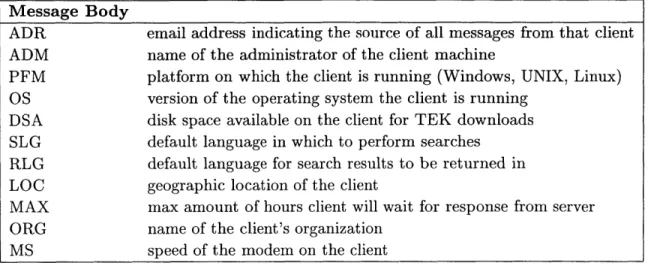
The format for this message type is shown in Table 4.1. This message is generated by the client. It is sent to the server when a new client is installed on some machine. It contains all the information needed to register a new client with the server.
Message Body
ADR email address indicating the source of all messages from that client ADM name of the administrator of the client machine
PFM platform on which the client is running (Windows, UNIX, Linux) OS version of the operating system the client is running
DSA disk space available on the client for TEK downloads SLG default language in which to perform searches
RLG default language for search results to be returned in LOC geographic location of the client
MAX max amount of hours client will wait for response from server ORG name of the client's organization
MS speed of the modem on the client
Table 4.1: Registration Message Body Type: REGISTRATIONREPLY
After processing a REGISTRATION message, the server assigns a unique ID to the new client. The server generates a REGISTRATIONREPLY message to send this ID back to the client. This Client identifier (CID) must be used in all subsequent messages from that client to the server. Table 4.2 below presents the format for the body of this type of message.
Message Body
CID Client ID assigned to the client by the server AMID MID of the message to which this is a reply
Table 4.2: Registration Reply Message Body
Type: SEARCHQUERY
When the user types a search query into the TEK Client User Interface, the protocol builds a SEARCHQUERY message for transport to the TEK server. As Table 4.3 shows, these messages contain the query ID assigned to the query by the client, and the query string typed in by the user. In future upgrades to TEK the user will be able to specify more parameters for SEARCHQUERY messages e.g. the return type of the
results.
Table 4.3: Search Query Message Body Type: SEARCHQUERYREPLY
This message is generated by the TEK server after it has processed a search query and is ready to return results to the client that sent the query. The format of the body of this message is shown in Table 4.4.
Message Body
AMID MID of the message to which this is a reply QID ID assigned to this query by the client RES compressed search results
Table 4.4: Search Query Reply Message Body
Type: URLREQUEST
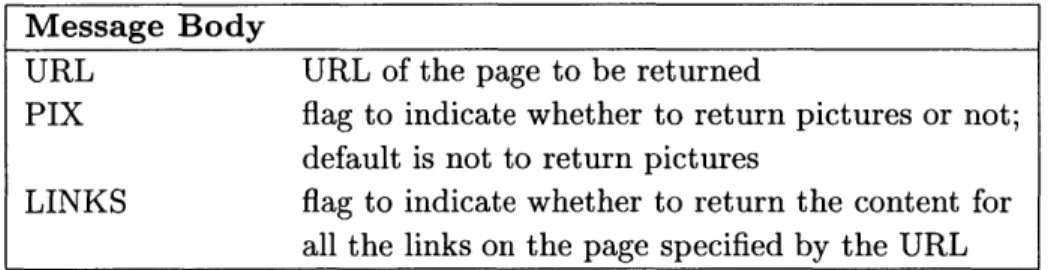
The URLREQUEST message (Table 4.5) is generated by the client. It is a request from the client for the server to return a specific URL.
Table 4.5: URL Direct Fetch Message Body
Message Body
QID ID assigned to the query by the client
QS
Query String as typed in by the user -this may include boolean ANDs and ORsMessage Body
URL URL of the page to be returned
PIX flag to indicate whether to return pictures or not; default is not to return pictures
LINKS flag to indicate whether to return the content for all the links on the page specified by the URL
Type: URLREPLY
This message is generated by the server in response to a URLREQUEST message from the client. As Table 4.6 shows, it contains the HTML page addressed by the URL that the client requested.
Message Body
AMID URL RES
MID of the message to which this is a reply URL that had been requested by the client compressed html page requested
Table 4.6: URL Reply Message Body
Type: HWUPDATE
This message originates from the client. It is sent to notify the server of upgrades to the hardware on the client machine. Any of the hardware information that was sent to the server when the client registered could be changed using one of these messages. The format for the body of the HWUPDATE message is shown in Table 4.7.
Message Body
HID hardware code of the item to be updated DATA new hardware specification
Table 4.7: Hardware Update Message Body
Type: HWUPDATEREPLY
The HWUPDATEREPLY message, shown in Table 4.8, originates from the server. It is sent in response to a HWUPDATE message.
Type: SWUPGRADE
This message originates from the server. It is sent to the client when minor upgrades are to be made to the TEK client software. For example, it could be used to update
Message Body
AMID MID of the message to which this is a reply
Table 4.8: Hardware Update Reply Message Body
a specific class on the client. Table 4.9 shows the format for the body of messages of this type.
Message Body
SWU software upgrade contents
Table 4.9: Software Upgrade Message Body
Type: SWUPGRADEREPLY
This message (Table 4.10) is generated by the client in response to a SWUPGRADE reply message.
Message Body
AMID MID of the message to which this is a reply
Table 4.10: Software Upgrade Reply Message Body
Type: PING
This message can originate from either a TEK client or server. The sender uses it to test whether the recipient is up and running. The PING message contains only headers.
Type: PINGREPLY
This message can originate from either a TEK client or TEK server. The sender generates it in response to a PING message. The body of this message simply contains the MID of the ping message to which it is a reply, as shown in Table 4.11.
Message Body
AMID MID of the message to which it this a reply
Table 4.11: Ping Reply Message Body
NB: The database synchronization messages described in Chapter 3 were not imple-mented for this prototype.
4.2.3
Data Storage
A key difference between the implementation of the protocol for the client and for
the server is that the client makes use of the file system to store information for
the protocol. The server, however, makes use of tables in the TEK server's central
database. In this section we describe the files used by the TEK client and the database
tables used by the TEK server for protocol storage. This section is supplemented in
Appendix A with further detail on the server database tables.
TEK Client: Files
1. outgo ingmailqueue. This file stores a serialized Queue2 object that has the
queue of messages to be emailed out. The EmailBuilder module on the client constructs email messages and stores them in the outgoingmailqueue file. This
file is polled by the OutgoingMailDaemon module periodically for new messages to be emailed out.
2. pendingreplylist. This file is used to facilitate retransmission of request messages for which there has been no response from the server. When the EmailBuilder constructs a request message to be sent to the server, it adds the message to the pendingreplylist file. This file stores a serialized Java Hashtable of the messages awaiting reply from the server indexed by their MIDs.
When the ProtocolManager module is handling a reply message from the server
it checks the pendingreplylist file for the associated request, and removes it from the file. The Retransmit daemon examines the MIDs of all the messages on the pendingreplylist to check whether any of the messages have expired. (Recall that part of the MID consists of the timestamp of when the message was created. This is easily extracted and read by the Retransmit daemon.) 3. lastheardfrom. This file is used to store the date that the last email from
the server was received by the client. It is updated by the Parser module and stores a serialized Java Date object.
4. ClientID. This file is created when the registration reply message is received from the server. It stores the unique ID for the client.
TEK Server: Database Tables
The TEK server has an Oracle database which the different TEK server application modules use for tracking the state of a query as it is being processed. The server-side protocol implementation makes use of this database to store certain information. To summarize, the following information is stored in tables in the database for use by the protocol:
1. client-inf o.table. This table stores client registration information, including the date and time that the last message was received from each client. When a TEK client registration request arrives at the TEK server, a new row is added to client-info-table for this new client. One of several functions that pro-vides access to this table is the get-client-email(String ciient.ID) func-tion, which returns the email address of the client identified by <clientID>. Other functions used to update and query this table are listed in Appendix A. 2. mail-q. This table stores the queue of messages to be emailed out to different TEK clients. It is analogous to the outgoingmailqueue file on a TEK client. The EmailBuilder module on the TEK server calls insert-in-mailq(Vector in-msg) to add a new message to the list of outgoing messages stored on the
mail-q table. The in-msg argument is either a 4-element or 3-element Vector, depending on whether the message has a file attachment or not. If there is no attachment, in-msg is composed as follows:
" inimsg.elementAt(O) = destination email address (String)
" in-msg.elementAt(1) = message headers and body (String)
" in-msg.elementAt(2) = FALSE (Boolean) to indicate there is
no attachment
However, if there is an attachment, in-msg is composed as follows:
" in-msg.elementAt(O) = destination email address (String)
" in-msg.elementAt(1) = message headers and body (String)
" in-msg.elementAt(2) = TRUE (Boolean) to indicate there is
an attachment
" inimsg.elementAt(3) = attachment file name (String)
SEARCHQUERYREPLY and URLREPLY messages sent to the TEK client include their
results a file attachment to the email carrying the message. When a message has a file attachment, the EmailBuilder module on the TEK server stores the attachment in the TEK server's attachments folder, and places the file name under which the attachment was saved into the mail-q. The file name of an attachment to a message includes the MID associated with that message. This ensures that no files in the attachments folder are overwritten.
3. awaiting-reply-list. This table is analogous to the client's pendingreplylist file. It stores the request messages awaiting a reply from a TEK client. Recall that the protocol follows a request-reply paradigm. Therefore, each request message originating from the TEK server is matched with a reply message from a TEK client. The fate of a request message on the awaiting-reply-list de-pends on whether a response from the client ever arrives. If the reply does arrive after a reasonable amount of time (including after a number of retrans-missions), then the message is moved to the closed-msg-list. However, if the