Chapter 2
Concurrency in
Object-Oriented
Programming Languages
Michael Papathomas
Abstract An essential motivation behind concurrent object-oriented programming is to exploit the software reuse potential of object-oriented features in the development of concurrent systems. Early attempts to introduce concurrency to object-oriented languages uncovered interferences between object-oriented and concurrency features that limited the extent to which the benefits of object-oriented programming could be realized for developing concurrent systems. This has fostered considerable research into languages and approaches aiming at a graceful integration of object-oriented and concurrent programming. We will examine the issues underlying concurrent object-oriented programming, examine and compare how different approaches for language design address these issues. Although it is not our intention to make an exhaustive survey of concurrent object-oriented languages, we provide a broad coverage of the research in the area.
2.1
Introduction
Considerable research activity in the past few years has concentrated on the design of con-current object-oriented programming languages (COOPLs). This research activity aimed at providing an integration of object-oriented and concurrent programming. The follow-ing points discuss some motivation for concurrent object-based programmfollow-ing:
• To augment the modelling power of the object-oriented programming paradigm. One goal of object-oriented programming can be seen as to model the real world directly and naturally [89]. Concurrency then adds to the modelling power by making it easier to model the inherently concurrent aspects of the real world.
Michael Papathomas, “Concurrency in Object-Oriented Programming Languages,” Object-Oriented Software Composition, O.
Nierstrasz and D. Tsichritzis (Eds.), pp. 31-68, Prentice Hall, 1995.
Reproduced with the permission of the Publisher, Prentice Hall (a Pearson Education company). This work is protected by copyright and may not be reproduced other than when downloaded and viewed on a single Central Processor Unit (CPU) for private use only. It is not otherwise to be reproduced or transmitted or made available on a network without prior written permission of Prentice Hall. All other rights reserved.
• To take advantage of the software design benefits of object-oriented programming and the potential for software reuse in the development of concurrent and distributed systems. Concurrent and distributed systems are becoming more widespread and the need to develop concurrent programs is becoming more common. This is witnessed by the support provided for concurrent programming at the application level provid-ed by modern operating systems.
• To support sharing of distributed persistent data. The object-oriented paradigm lends itself well for providing location transparency by encapsulating within objects access to distributed persistent data. However, as information has to be shared, ac-cess to the objects has to be scheduled in a way that avoids interference and provides support for recovering from failures in the distributed environment. Although this could be left to the language implementation, as is the case in database management systems, taking advantage of the semantics of object types to ensure atomicity has substantial benefits with respect to performance and availability. This, however, requires the use of concurrency control mechanisms for the implementation of object types[90].
• To take advantage of parallelism in the implementation of object classes for increased execution speeds. Data abstraction can be used to conceal parallel implementations of objects from programs that use them so as to increase their per-formance when run on parallel machines. Parallelizing compilers could be used to generate parallel implementations of object classes, thus avoiding the need for con-currency constructs. However, better results are generally achieved by the use of ex-plicit parallel algorithms as imex-plicit approaches for parallel execution uncover and exploit only a number of restricted classes of parallelism [46]. Moreover, as data ab-straction hides the details of the implementation of classes, users of these classes need not be aware of their concurrent implementation.
In all of the above cases it is necessary to combine the concurrent and object-oriented programming paradigms, provide linguistic support for concurrent object-oriented pro-gramming and, ideally, exploit the reuse potential of object-oriented propro-gramming for concurrent software.
However, combining object-oriented and concurrency features has proven to be more difficult than might seem at first sight. Clearly, devising a language that has both concur-rent programming and object-oriented constructs poses no problem. There has been a large number of proposals for combining object-oriented and concurrency features. How-ever, they are not equally successful in drawing the benefits of object-oriented program-ming for concurrent software development. The problem is that these features are not orthogonal, and consequently they cannot be combined in an arbitrary way. Most of the re-search in the area is devoted to devising graceful combinations that limit the interference of features.
In this chapter we present a design space for the approaches for combining object-oriented and concurrency features and a set of criteria for evaluating the various choices. We use the criteria to evaluate some proposals and identify approaches that do not
Design Space 33
adequately support object-oriented programming as well as approaches that do achieve a graceful combination of the features.
In section 2.2 we present a design space for combining object-oriented and concurren-cy features with respect to several aspects of language design. In section 2.3, we discuss the issues that have to be addressed to provide the benefits of object-oriented program-ming. Section 2.4 examines the impact of some proposals on the integration of the pro-gramming paradigms and their potential for reuse. Finally, in section 2.5 we present our conclusions, discuss open problems and directions for further work in the area.
2.2
Design Space
We start by presenting three aspects of COOPLs that we consider for constructing the de-sign space, and then we discuss the dede-sign choices with respect to each of these aspects. Later, in section 2.4, we will examine more closely some existing languages showing how the design of their features situate them in the design space.
2.2.1 A Design Space for Concurrent Object-Oriented Languages
We seek to evaluate language design choices with respect to the integration of their con-currency and object-oriented features and the degree to which software reuse is supported. In particular, we wish to understand how choices of concurrency constructs interact with object-oriented techniques and affect the reusability of objects. As such, our classification scheme concentrates on the relationship between objects and concurrency. We shall con-sider the following aspects:
• Object models: how is object consistency maintained in the presence of concurren-cy? The way objects are considered with respect to concurrent execution may or may not provide them with a default protection with respect to concurrent invocations. Furthermore, different languages may favour or enforce a particular way of structur-ing programs to protect objects.
• Internal concurrency: can objects manage multiple internal threads? This issue con-cerns the expressive power that is provided to objects for handling requests. Note that the execution of internal threads is also related to the protection of the internal state objects, which is determined by the choice of object model.
• Constructs for object interaction: how much freedom and control do objects have in the way that requests and replies are sent and received? The choice of concurrency constructs for sending and receiving messages determines the expressive power that is provided for implementing concurrent objects. Moreover, the design of constructs for conditional acceptance of messages interacts with the use of class inheritance.
In the presentation of the design space, it will become apparent that these aspects are not entirely independent: certain combinations of choices are contradictory and others are re-dundant or lack expressive power.
2.2.2 Concurrent Object Models
There are different ways one can structure a concurrent object-based system in order to protect objects from concurrency. A language may support constructs that favour or even enforce one particular way, or may leave it entirely to the programmer to adopt a particular model. There are three main approaches:
• The orthogonal approach: Concurrent execution is independent of objects. Synchronization constructs such as semaphores in Smalltalk-80 [40], “lock blocks” as in Trellis/Owl [68] or monitors as in Emerald [19] must be judiciously used for synchronizing concurrent invocations of object methods. In the absence of explicit synchronization, objects are subject to the activation of concurrent requests and their internal consistency may be violated.
• The homogeneous approach: All objects are considered to be “active” entities that have control over concurrent invocations. The receipt of request messages is delayed until the object is ready to service the request. There is a variety of constructs that can be used by an object to indicate which message it is willing to accept next. In POOL-T [6] this is specified by executing an explicit accept statement. In Rosette [83] an
en-abled set is used for specifying which set of messages the object is willing to accept
next.
• The heterogeneous approach: Both active and passive objects are provided. Passive objects do not synchronize concurrent requests. Examples of such languages are Eif-fel // [26] [27] and ACT++ [45]. Both languages ensure that passive objects cannot be invoked concurrently by requiring that they be used only locally within single-threaded active objects. Argus [55] provides both guardians (active objects) and CLU clusters (passive objects) [52].
2.2.3 Internal Concurrency
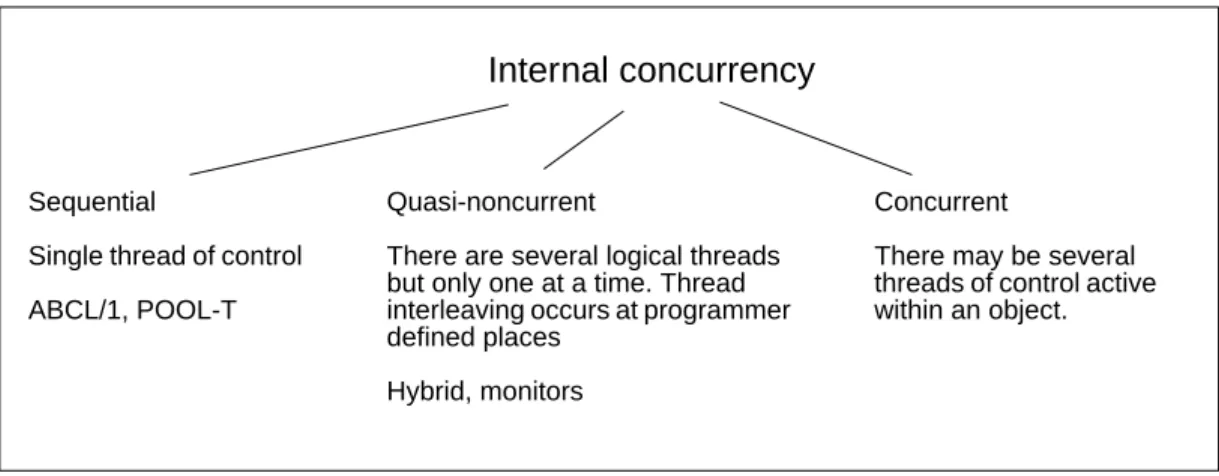
Wegner [87] classifies concurrent object-based languages according to whether objects are internally sequential, quasi-concurrent or concurrent:
• Sequential objects possess a single active thread of control. Objects in ABCL/1 [94] and POOL-T and Ada tasks [9] are examples of sequential objects.
• Quasi-concurrent objects have multiple threads but only one thread may be active at a time. Control must be explicitly released to allow interleaving of threads. Hybrid domains [47][70][71][72] and monitors [42] are examples of such objects.
Design Space 35
• Concurrent objects do not restrict the number of internal threads. New threads are created freely when accepting requests. Ada packages and POOL-T units resemble concurrent objects (though they are not first-class objects). Languages like Small-talk-80 that adopt the orthogonal object model also support concurrent objects. From the point of view of the called objects, a new local thread is effectively created when-ever a method is activated in response to a message.
According to the above classification, the threads of concurrent objects are created free-ly when an object receives a message. However, there are languages where objects may have internally concurrent threads that are not freely created by message reception. In or-der to include these languages in the classification and to capture more information about the way that threads are created, we generalize the concurrent object category to include any language in which objects have concurrent threads, irrespective of the way they are created, and consider separately the issue of thread creation.
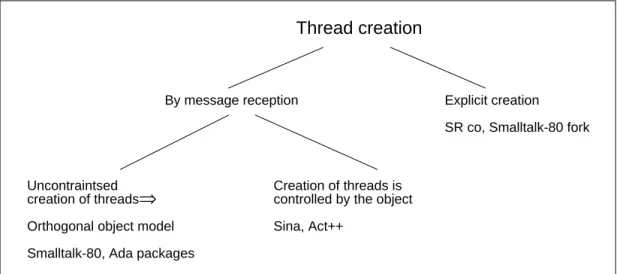
We identify three, non-exclusive ways for the creation of threads within objects as fol-lows:
• By message reception: Thread creation is triggered by reception of a message. An ob-ject cannot create a thread on its own unless it can arrange for a message to be sent to it without blocking the currently executing thread. Depending on whether objects may control the creation of threads, we have the following subcategories:
— Controlled by the object: The object may delay the creation of threads. For example, in the language Sina [84] a new concurrent thread may be created for the execution of a method belonging to a select subset of the object’s methods only if the currently active thread executes the detach primitive.
— Unconstrained creation: Threads are created automatically at message recep-tion. This is the default for languages with an orthogonal object model.
• Explicit creation: Thread creation is not triggered by message reception but the ob-ject itself initiates the creation of the new thread. For instance, in SR [12] there is a construct similar to a “cobegin” [11] to initiate the execution of concurrent threads.
Internal concurrency
Sequential
Single thread of control
ABCL/1, POOL-T
Quasi-noncurrent
There are several logical threads but only one at a time. Thread interleaving occurs at programmer defined places
Hybrid, monitors
Concurrent
There may be several threads of control active within an object.
Another way to create a new thread, in the absence of a special construct, is to call asynchronously an operation of the object. This requires, however, that such calls are not blocked at the object’s interface. This approach is used in a recent version of Sina. Such calls bypass the normal method synchronization constraints as well as the re-quest queue at the object’s interface. Finally, it would also be possible to create new independent objects to call the object methods in parallel. However, this is cumber-some and it also requires cumber-some means of bypassing the message queue at the object’s interface.
The next and become primitives in Rosette and ACT++ can be viewed as a controlled creation of threads, with the additional restriction that concurrent threads may not share the object’s state since they execute on different “versions” of the object.
In Guide [48], an object may be associated with a set of activation conditions that specify which methods may be executed in parallel by internally concurrent threads. In the default case, as with any language following an orthogonal approach for concurrency, ob-jects may be viewed as concurrent with unconstrained creation of threads triggered by ex-ternal messages.
The creation of threads by reception of external messages or by execution of a special construct are neither mutually exclusive design choices — as illustrated by SR, which supports both — nor redundant, as we will see in section 2.3.
2.2.4 Constructs for Object Interaction
We classify these constructs with respect to the degree of control that can be exercised by objects in the client and server roles. We specifically consider reply scheduling, which concerns the degree of flexibility the client has in accepting a reply, and request
schedul-ing, which concerns the control the server can exercise in accepting a request.
Thread creation
By message reception Explicit creation
SR co, Smalltalk-80 fork
Uncontraintsed creation of threads⇒ Orthogonal object model
Smalltalk-80, Ada packages
Creation of threads is controlled by the object
Sina, Act++
Design Space 37
2.2.4.1 Issuing Requests
The following important issues can be identified with respect to the constructs supported for issuing requests:
• Addressing: How are the recipients of a request specified and determined? How and where is the reply to be sent? Flexible control over the reply destination can reduce the amount of message passing required.
• Synchronization for requests and replies: Can the current thread continue after issu-ing the request? What mechanisms are supported for matchissu-ing replies to requests? How does the client synchronize itself with the computation and delivery of the re-ply?
• First-class representation of requests and replies: Do requests and replies have a first-class representation that permits them to be forged or changed dynamically? What aspects (e.g. destination, method name) can be changed dynamically?
We further discuss these issues below and present how they are addressed by different proposals.
Addressing
In most languages the recipient of a request is specified directly by using its object identi-fier. However, there are some proposals allowing for more flexible ways of addressing where the system determines the recipient of the request. We review some of these propos-al below.
Types as Recipients in PROCOL
In PROCOL [49] [85] an object type may be used to specify the recipient of a request. In this case the potential recipients are any instance of the type that is in a state such that it may accept the request. The system determines one recipient among the set of potential re-cipients and delivers the request. It is important to note that this feature does not support any form of multicast; exactly one message is exchanged with the chosen recipient in a point to point fashion.
ActorSpace
ActorSpace [2] is a general model providing a flexible and open-ended approach to object communication that has been developed in the context of the actor model.
In this mode, destination patterns may by used to designate the recipients of a request. Patterns are matched against attributes of actors in an specified actorspace — a passive container of actors — to determine a set of potential recipients. A message may be sent by either one of two primitives: send or broadcast.The former delivers exactly one message to a recipient chosen non-deterministic by the system. The latter provides a form of multi-cast by delivering the request to all potential recipients.
Extra flexibility is provided in this model by allowing the dynamic inclusion and removal of actors from ActorSpaces as well as by allowing the dynamic modification of actor attributes. Moreover, ActorSpaces may be nested.
Synchronization for Requests and Replies
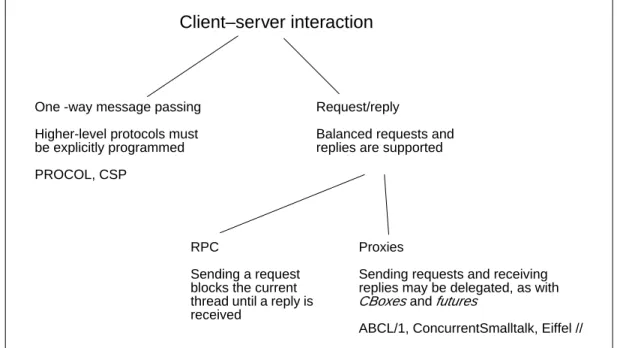
We initially distinguish between one-way message passing communication primitives and constructs supporting a request/reply protocol. The latter provide support for object interactions where requests will be eventually matched by replies. These mechanisms vary in flexibility when sending requests and receiving replies. Strict RPC approaches en-force that requests will be matched by a reply and delay the calling thread until the reply is available. Further flexibility is provided by “proxy” objects which disassociate the sending or receiving of messages from the current thread of control. Examples of built-in proxy objects are future variables [94] and CBoxes [92].
One-Way Message Passing
Whether communication is synchronous with one-way message passing, as in CSP [43] or PROCOL [85], or asynchronous, as in actor languages, clients are free to interleave activities while there are pending requests. Similarly, replies can be directed to arbitrary addresses since the delivery of replies must be explicitly programmed.
Client–server interaction
One -way message passing
Higher-level protocols must be explicitly programmed
PROCOL, CSP
Request/reply
Balanced requests and replies are supported
Proxies
Sending requests and receiving replies may be delegated, as with
CBoxes and futures
ABCL/1, ConcurrentSmalltalk, Eiffel // RPC
Sending a request blocks the current thread until a reply is received
Design Space 39
The main difficulty with one-way message passing is getting the replies. The client and the server must cooperate to match replies to requests. As we shall see in section 2.3, the additional flexibility and control provided by one-way message passing over request/re-ply based approaches can only be properly exploited if objects (i.e. servers) are imple-mented in such a way that the reply destination can always be explicitly specified in a request.
Remote Procedure Call
With RPC the calling thread of the client is blocked until the server accepts the request, performs the requested service and returns a reply. Most object-oriented languages sup-port this form of interaction, though “message passing” is generally compiled into proce-dure calls.
Supporting RPC as the only means for object interaction may be a disadvantage when objects are sequential as we will see in the next section. Although it is trivial to obtain a reply, it is not possible to interleave activities or to specify reply addresses.
Proxies
An alternative approach that provides the client with more flexibility in sending and re-ceiving replies is to introduce proxies. The main idea is to delegate the responsibility of de-livering the request and obtaining the reply to a proxy. (The proxy need not be a first-class object, as is the case with future variables [94].) The actual client is therefore free to switch its attention to another activity while the proxy waits for the reply. The proxy itself may also perform additional computation or even call multiple servers.
If necessary, the reply is obtained by the original client by an ordinary (blocking) re-quest. This approach, variants of which are supported by several languages [27][94][92], maintains the benefits of an RPC interface and the flexibility of one-way message passing. In contrast to one-way message passing, however, there is no difficulty in matching replies to requests.
A closely related approach is to combine RPC with one-way message passing. In ABCL/1, for example, an object that externally has an RPC interface may internally use lower-level message-passing primitives to reply by sending an asynchronous message to the client or to its proxy. The use of such facilities is further discussed in section 2.4.2.
First-Class Representation of Requests and Replies
The ability to have a first-class representation of requests and replies may enhance sub-stantially the expressive power of a language. There is a range of aspects of requests and replies that may have a first-class representation in a language. This varies from (almost) no first-class representation at all to a full first-class representation of all aspects of re-quests and replies. Below we discuss how this issue is addressed in some languages that are characteristic of the various possibilities.
Minimal First-Class Representation
Apart from the method’s arguments and the target, all other aspects, such as the method name and the return address, cannot be specified dynamically. This the case for languages such as POOL-T, Hybrid and Trellis/Owl. One could argue that since the target and the ar-guments can be specified at run-time, there is a first-class representation of some aspects and that the categorization is not accurate. In fact, in older language proposals such as CSP [43] the targets of messages were determined statically. This, however, is uncommon in more recent languages since it makes it hard to develop software libraries: a server that must be statically bound to its potential callers has a low reuse potential. A first-class rep-resentation of the target and arguments can be considered as a minimum that one should expect to find in every language.
First-Class Representation of Method Names and Reply Addresses
PROCOL supports the first-class representation of method names. The name of the meth-od to call may be supplied as a string. This allows the methmeth-od names for a request to be passed in messages or computed at run-time.
With ABCL/1 it is possible to specify dynamically and explicitly the object that is to re-ceive the reply of a request. The benefits of the use of this feature are discussed in section 2.4.2.
Full First-Class Representation
As one would expect, full first-class representation of requests is provided in reflective languages such as ABCL/R. However, it is also provided in languages such as Smalltalk and Sina which are not fully reflective. In fact, the latter two illustrate the usefulness and the possibility of having such features in any concurrent language which is not fully reflective. Briot [23] has used the features of Smalltalk to build a several object-oriented programming models using the relative primitive concurrency features provided in the Smalltalk system. Aksit et al. [4] show how these features may be used to abstract and reuse several object coordination paradigms.
2.2.4.2 Accepting Requests
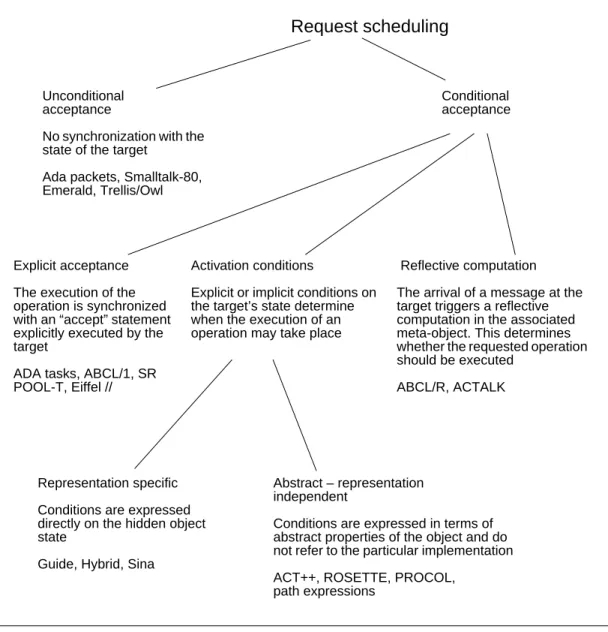
A main concern from the point of view of an object acting as a server is whether requests can be conditionally accepted.* When a request arrives, the server may be busy servicing a previous request, waiting itself for a reply to request it has issued, or idle, but in a state that requires certain requests to be delayed. We distinguish initially between conditional and unconditional acceptance of requests. Conditional acceptance can be further discrim-inated according to whether requests are scheduled by explicit acceptance, by activation conditions or by means of reflective computation (see figure 2.4).
* A secondary issue is whether further activity related to a request may continue after the reply has been sent as in the Send/Receive/Reply model [39], but this can also be seen as concern of internal concurrency where follow-up activity is viewed as belonging to a new thread.
Design Space 41
Unconditional Acceptance
Unconditional acceptance of requests is illustrated by monitors [42] and by Smalltalk-80
[40] objects. The mutual exclusion that is provided by monitors could be considered as an implicit condition for the acceptance of requests. However, the mutual exclusion property is captured by viewing monitors as quasi-concurrent objects so we consider request ac-ceptance to be unconditional. Note that message acac-ceptance for languages with an orthog-onal object model is by default unconditiorthog-onal.
Request scheduling
Unconditional acceptance
No synchronization with the state of the target
Ada packets, Smalltalk-80, Emerald, Trellis/Owl
Explicit acceptance
The execution of the operation is synchronized with an “accept” statement explicitly executed by the target
ADA tasks, ABCL/1, SR POOL-T, Eiffel //
Activation conditions
Explicit or implicit conditions on the target’s state determine when the execution of an operation may take place
Abstract – representation independent
Conditions are expressed in terms of abstract properties of the object and do not refer to the particular implementation
ACT++, ROSETTE, PROCOL, path expressions
Representation specific
Conditions are expressed directly on the hidden object state
Guide, Hybrid, Sina
Reflective computation
The arrival of a message at the target triggers a reflective computation in the associated meta-object. This determines whether the requested operation should be executed
ABCL/R, ACTALK Conditional acceptance
Explicit Acceptance
With explicit acceptance, requests are scheduled by means of an explicit “accept” state-ment executed in the body of the server. Accept statestate-ments vary in their power to specify which messages to accept next. Acceptance may be based on message contents (i.e. operation name and arguments) as well as the object’s state. Languages that use this approach are Ada, ABCL/1, Concurrent C, Eiffel//, POOL-T and SR. With this approach objects are typically single-threaded, though SR is an exception to this rule.
Activation Conditions
With activation conditions, requests are accepted on the basis of a predicate over the ob-ject’s state and, possibly, the message contents. The activation condition may be partly im-plicit, such as the precondition that there be no other threads currently active within the object. An important issue is whether the conditions are expressed directly over a particu-lar representation of the object’s state or if they are expressed in more abstract terms. In Guide, for example, each method is associated with a condition that directly references the object’s instance variables, whereas in ACT++ the condition for accepting a message is that the object be in an appropriate abstract state which abstracts from the state of a par-ticular implementation. Another approach is to specify the legal sequences of message ac-ceptance by means of a regular expression, as in path expressions [24] and PROCOL [85]. There are also some proposals such as synchronizers [38], separate method arguments [66] and state predicates [74], for activation conditions that depend on the state or the computation history of other objects.
A synchronizer [38] is a special object associated with a group of objects. When a meth-od of any of these objects is called a condition in the synchronizer is evaluated. Depending on the outcome, the execution of the method may proceed, or be delayed until the con-dition becomes true. Synchronizers may have their own variables that are used to store information about the computation history of a group of objects.
Separate method arguments [66] can be used to constraint the execution of a method by preconditions on the argument declared as “separate.” The execution of the method is de-layed until the preconditions are true and the separate objects are “reserved” for the dura-tion of the call. That is, they can only be used in the body of a method.
With state predicate notifiers [74], the execution of a method can be constrained by the notification that another object has reached a state that satisfies a state predicate.This fea-ture has synchronous and asynchronous forms. In the synchronous variant, the notifying object waits until the method is executed and the method gains exclusive access to the object. In the asynchronous variant the notifying object proceeds independently.
Reflective Computation
With reflective computation the arrival of a request triggers a method of the server’s
Criteria for Evaluating Language Design Choices 43
objects. This approach is followed by the language ABCL/R [86] and it is also illustrated in Actalk [23] where some reflective facilities of the Smalltalk-80 system are used to in-tercept messages sent to an object and synchronize their execution in a way that simulates message execution in actor-based languages.
2.3
Criteria for Evaluating Language Design Choices
So far we have presented a design space covering the most significant choices in the design of concurrency features for OOPLs, but we have said little about how the various ap-proaches compare. Since our goal is to arrive at COOPLs that provide the advantages of object-oriented programming for the development of concurrent systems, we must first formulate our requirements as precisely as possible, before beginning to compare the approaches. We first discuss the issue of developing object classes that have high reuse potential. Then, we turn our attention to the support for reuse at a finer granularity than objects and examine the issues related to the use of inheritance and the reuse of synchro-nization constraints.2.3.1 Object-Based Features — Support for Active Objects
The main issue for reuse at the object level is that concurrency in an object-oriented lan-guage should not diminish the benefits of object-based features with respect to reuse. For instance, encapsulation should still protect the internal state of objects from surrounding objects and it should still be possible to insulate objects’ clients from implementation choices. This should make it possible to change the implementations without affecting the clients provided that the interfaces are maintained and that changes are, in some sense, be-haviourally compatible.
Object-oriented and concurrent programming have different aims that incur different software structuring paradigms. Object-oriented programming aims at the decomposition of software into self-contained objects to achieve higher software quality and to promote reusability. Concurrent programming aims at expressing and controlling the execution, synchronization and communication of conceptually parallel activities. Its primary goal is to provide notations that are suitable for devising solutions to problems that involve the coordination of concurrent activities [11].
In order to compare language designs it is necessary to adopt a programming model for concurrent object-based programming and evaluate how well the various languages sup-port this model. Our view regarding the way the two programming paradigms should be combined is by structuring programs as cooperating objects that exchange messages. This is similar to the way sequential object-oriented programs are structured, however, in con-current programs objects may encapsulate one or more concon-current threads that implement their behaviour. Moreover, the operations of an object may be invoked by concurrently ex-ecuting objects.
We use the term active objects for this programming model to emphasize that objects themselves rather than the threads that invoke their operations have the responsibility to schedule concurrent requests. Requests should be scheduled in a way consistent with the object’s internal state and the possibly spontaneous execution of internal threads. The ob-jects developed following this model are independent self-contained entities. They can be reused across applications and they may be refined to support different scheduling poli-cies for invoked operations. The programs that use the objects should not be affected by such changes.
Although any language combining concurrent and object-oriented features could be used to develop software following this model, as will be illustrated in section 2.4, not all combinations of concurrent and object-oriented features are equally successful in sup-porting this programming model. Below we develop a number of requirements on the lan-guage features to adequately support programming following an active object model. In section 2.4 we will use these requirements to evaluate language design choices and iden-tify the shortcomings of some approaches.
2.3.1.1 Requirements
According to the active object model discussed above, we would like languages to support the development of self-contained objects with high reuse potential. A general principle for achieving this is that reusable object classes should make minimal assumptions about the behaviour of applications that will use them. Furthermore, the choice of constructs should not constrain the possible implementations of a class. We can formulate our re-quirements as follows:
1. Mutual exclusion — protecting the objects’ state: The internal state of objects should be automatically protected from concurrent invocations so that it will be possible to reuse existing objects in concurrent applications without modification. 2. Request scheduling transparency: An object should be able to delay the servicing
of requests based on its current state and on the nature of the request. This should be accomplished in a way that is transparent to the client. Solutions that require the co-operation of the client are not acceptable from the point of view of reusability since the client then cannot be written in a generic fashion.
3. Internal concurrency: The concurrency constructs should allow for the implemen-tation of objects that service several requests in parallel or that make use of parallelism in their implementation for increased execution speed in the processing of a single request. This could be done either by supporting concurrent threads within an object or by implementing an object as a collection of concurrently executing objects. Whatever approach is chosen, it is important that internal concurrency be transparent to the object’s clients so that sequential implementa-tions of objects may be replaced by parallel ones.
4. Reply scheduling transparency: A client should not be forced to wait until the serv-ing object replies. In the meantime it may itself accept further requests or call other objects in parallel. It may even want replies to be directly sent to a proxy. Request
Criteria for Evaluating Language Design Choices 45
scheduling by the client should not require the cooperation of the server since this would limit the ability to combine independently developed clients and servers.
2.3.1.2 An Example
In order to compare the design choices and their combinations with respect to the reuse re-quirements, we shall refer to an instance of a “generic” concurrent program structure: the
administrator inspired by [39]. The administrator is an object that uses a collection of
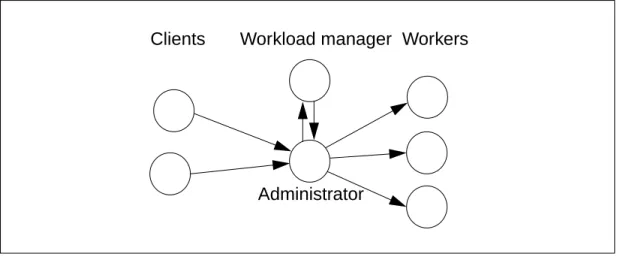
“worker” objects to service requests. An administrator application consists of four main kinds of components. The clients issue requests to the administrator and get back results. The administrator accepts requests from multiple concurrent clients and decomposes them into a number of subrequests. The workload manager maintains the status of work-ers and pending requests. Workwork-ers handle the subrequests and reply to the administrator. The administrator collects the intermediate replies and computes the final results to be re-turned to clients (see figure 2.5).
The administrator is a very general framework for structuring concurrent applications. For example, workers may be very specialized resources or they may be general-purpose compute servers. The workload manager may seek to maximize parallelism by load bal-ancing or it may allocate jobs to workers based on their individual capabilities.
The components described above identify functionally distinct parts of the application that could have been developed independently and reused as indicated above to construct a new application.These components do not have to be implemented as single objects, and indeed, as we see later, depending on the constructs provided by certain languages, several objects will be necessary for realizing the desired functionality. However, it should be pos-sible to modify the implementation of the above components without affecting the rest as if they were single objects.
The following points relate the language design requirements listed above to the reuse issues in the case of the example application:
Clients
Administrator
Workers Workload manager
• Mutual exclusion: (i) Workload manager reuse – the workload manager must be pro-tected from concurrent requests by the administrator. There may be cases where the administrator does not invoke the workload manager concurrently. Although in such cases no protection is needed, workload managers that are not protected could not be reused in different concurrent implementations of the administrator. In such a con-current implementation the administrator may use a collection of proxies that may invoke the workload manager concurrently. (ii) Worker reuse – workers should similarly be protected so that arbitrary objects may be used as workers with various implementations of the administrator, including concurrent ones.
• Request scheduling transparency: (iii) Genericity of clients, reusing the administra-tor with different clients — the administraadministra-tor must be able to interleave (or delay) multiple client requests, but the client should not be required to take special action. In fact it should be possible to implement any object as an administrator and it should not matter to the object’s clients if the serving object happens to be implemented as an administrator.
• Internal concurrency: (iv) Client/worker reuse — the administrator should be open to concurrent implementation (possibly using proxies) without constraining the in-terface of either clients or workers;
• Reply scheduling transparency: (v) Worker reuse —it must be possible for the ad-ministrator to issue requests to workers concurrently and to receive their replies when it chooses without special action by workers;
2.3.2 Inheritance and Synchronization
There are two main issues concerning reuse at a finer granularity than objects.
• The first is to maintain in concurrent languages the reuse potential offered by inher-itance in sequential languages. Several early papers have reported difficulties in us-ing class inheritance in COOPLs as well as in the design of languages that integrate class inheritance and concurrency constructs [19] [6] [22]. In some cases inheritance was left out as it was deemed difficult to integrate and of limited use. The need to syn-chronize the execution of inherited, overridden and newly defined methods, without breaking the encapsulation between classes, makes it more difficult to take advan-tage of class inheritance than in sequential languages. For instance, if mutexes are used for synchronizing method execution, a method defined in a subclass would have to access a mutex defined in a superclass in order to be synchronized with superclass methods. This would break encapsulation between classes. The design of concurren-cy constructs should be made in way to avoid such problems.
• The second is to make it possible to reuse algorithms, often called synchronization
constraints, for scheduling the execution of methods of a class. For instance, a class
may implement a synchronization algorithm that schedules its methods according to the readers and writers synchronization scheme. It would be desirable to be able to
Criteria for Evaluating Language Design Choices 47
reuse this algorithm in other classes taking into account the reader/writer property of its methods.
In most languages the reuse of synchronization constraints is achieved through class inheritance and the term inheritance of synchronization constraints is often used for this issue. We have chosen the term reuse of synchronization constraints since class inherit-ance is only one possible means to achieve reuse. Furthermore, it is questionable whether class inheritance should be used for this purpose. We will further elaborate on this point below. Then, we will discuss separately the requirements for supporting class inheritance and for reusing synchronization constraints.
Inheritance is often considered as the most prominent feature of object-oriented pro-gramming. The most widespread object-oriented languages such as C++, Smalltalk and Eiffel provide an inheritance mechanism that may be used for different purposes. These include: the reuse of the implementation of a class in the implementation of a new class; the specification of a type compatibility relation between a class and its parent classes, considering for type-checking purposes that instances of the class are of the same type as instances of its superclasses; finally, it may be used to express that the concept or entity modelled by the subclass is, in some sense, a refinement of the concepts or entities repre-sented by its parent classes.
The use of a single mechanism for all these purposes can, on one hand, be a source of confusion and on the other, limit the effectiveness of the mechanism for each of these dif-ferent purposes. For instance, subtypes have to be related to a class inheritance relation-ship even if they do not share any part of their implementation. In order to use part of the implementation of a class in a new class, all the methods have to be inherited to comply with the subtype relation that is also expressed by the inheritance link.Wegner and Zdonik [88] provide a general and in-depth discussion of inheritance as an incremental modifica-tion mechanism and illustrate its use for different purposes. Guide [48] and POOL-I [8] are concrete examples of languages with mechanisms that distinguish between the differ-ent uses of inheritance. Both languages distinguish between class inheritance as a code re-use mechanism and typing. POOL-I goes even further by also allowing the specification of behaviourally compatible classes.
In section 2.4.3 we will examine more closely the approaches for the reuse of synchro-nization constraints followed by different languages. This will illustrate the interactions that class inheritance may have with the reuse of synchronization constraints in these dif-ferent approaches.
2.3.2.1 Class Inheritance
The issues listed below have to be addressed in order to take advantage effectively of the reuse potential of inheritance. The first two are concerned with the reuse of superclass methods. The third one concerns the use of inheritance for providing generic algorithms through the definition and refinement of abstract classes [36] [44].
• Separate specification of the synchronization constraints: If the code that imple-ments the synchronization decisions related to the execution of methods is included
directly in methods, inherited methods typically will have to be modified to account for the synchronization constraints of the subclass [45].
• Interface between methods and the synchronization constraints: The separate speci-fication of synchronization control actions and method code does not necessarily mean that the execution of methods once started should be carried out without any further interaction with the synchronization constraints. Such an approach limits the expressive power of a language. Instead, there should be a well-defined interface be-tween methods and the synchronization constraints that allows several actions in the execution of the method to interact with the synchronization constraints associated with the various classes where it is reused.
• Consistency with other uses of inheritance for software composition: Apart from re-using individual methods, inheritance serves to facilitate sharing of algorithms and designs [36]. For this purpose, inheritance is paired with other features such as invo-cation of methods through pseudo-variables such as self or super in Smalltalk.
2.3.2.2 Reuse of Synchronization Constraints
The issues discussed below are important for evaluating and comparing the proposals for the specification and reuse of synchronization constraints:
• Flexibility of the binding mechanism: The mechanism that is used to apply con-straints to a particular class determines the flexibility with which concon-straints may be reused. Depending on the mechanism, constraints are bound to exactly one class (the class where they were introduced), or to any class that inherits from the class that introduced the constraints. Additionally, method names appearing in a constraint specification may be considered as variables to be substituted at binding time with method names defined in a particular class.
• Compositionality and extensibility: This concerns the support provided for reusing previously defined constraints in the definition of new ones. A related issue is extend-ing the application of constraints to methods that are introduced at a later stage. • Polymorphism: The potential applicability of constraints to different classes. This is
related to the binding mechanism and modularity; constraints could be specified in a way that would allow them to be applied to different classes. However, this may be impossible or inconvenient because of the absence of an appropriate binding mech-anism.
• Modifiability and locality of change: There are circumstances where it may be desir-able or necessary to change the implementation of a class or of just the synchroni-zation constraint. Depending on the approach, this may be achieved easily through some local modification or it may require a cascade of changes in synchronization constraints. In some cases it may even be needed to modify the inheritance hierarchy. Most of the other aspects discussed above come into play when considering this issue.
Exploring the Language Design Space 49
2.4
Exploring the Language Design Space
We now propose to compare the various approaches to the design of COOPLs by system-atically exploring the language design space and evaluating design choices against the re-quirements specified in the previous section. Since the various aspects of the design space are sometimes intertwined, we will find ourselves returning to common issues on occa-sion. Basically we will take the following course: first we briefly consider the three categories of object models; then we consider object interaction mechanisms in combina-tion with internal concurrency; finally we explore inheritance and synchronizacombina-tion con-straints as a topic worthy of separate study. We summarize our conclusions in section 2.4.4.
2.4.1 Object Models
By the requirement of mutual exclusion, we can immediately discount the orthogonal object model as it provides no default protection for objects in the presence of concurrent requests. The reusability of workers and workload managers is clearly enhanced if they will function correctly independently of assumptions of sequential access.
The heterogeneous model is similarly defective since one must explicitly distinguish between active and passive objects. A generic administrator would be less reusable if it would have to distinguish between active and passive workers. Similarly worker reusabil-ity is weakened if we can have different kinds of workers.
The homogeneous object model is the most reasonable choice with respect to reusabil-ity. No distinction is made between active and passive objects.
Note that it is not clear whether the performance gains one might expect of a hetero-geneous model are realizable since they depend on the programmer’s (static) assignment of objects to active or passive classes. With a homogeneous approach, the compiler could conceivably make such decisions based on local consideration — whether a component is shared by other concurrently executing objects is application specific and should be inde-pendent of the object type.
2.4.2 Object Interaction Mechanisms
Request-reply mechanisms such as an RPC-like interface provide more support for object reuse. Using our administrator example, we can see that one-way message passing has several disadvantages over RPC for reusing objects.
A concurrent client may issue several requests to the administrator before it gets a reply. In this case it is important for the client to know which reply corresponds to which request. Are replies returned in the same order as requests? In the case of synchronous message passing an additional difficulty is that the administrator may get blocked when it sends the reply until the client is willing to accept it. Requiring the client to accept the reply imposes
additional requirements on the client and makes reuse more difficult. Either a different mechanism has to be supported for sending replies or proxies have to be created.
One-way message passing is also inconvenient for coping with the interaction between the administrator and worker objects. A difficulty with using one-way messages is getting the replies from workers: as there will be several workers that are invoked in parallel, as well as potentially concurrent invocations of single worker, it can be difficult for the ad-ministrator to tell which reply is associated with which request.
A solution to this problem is to create a proxy for each request. The proxy would carry out the request and then send a message to the administrator containing the worker’s reply plus some extra information used for identifying the request. As with sequential RPC the administrator will also have to manage local queues for partially completed requests.
2.4.2.1 Sequential Objects
We argued that an RPC interface for objects provides better support for object reuse than one-way message passing. However, we quickly discover that if objects have a single thread of control and RPC is the only communication mechanism, the request and reply scheduling requirements of the administrator are not satisfied. We further discuss the lim-itation of this design choice combination below. Then we show additional mechanisms that may be used to overcome these limitations without giving up the RPC-interface or completely discarding sequential object design choice. The limitation of the combination of sequential objects (“modules” in their case) and RPC is discussed at length in [54]. However, they reach the conclusion that either the sequential object or the RPC choice should be discarded.
Limitations of the Sequential Object–RPC Combination
In particular, a sequential RPC administrator will not be able to interleave multiple clients’ requests as it will be forced to reply to a client before it can accept another request. The only “solution” under this assumption requires the cooperation of the client, for example: the administrator returns the name of a “request handler” proxy to the client, which the cli-ent must call to obtain the result. In this way the administrator is immediately free to ac-cept new requests after returning the name of the request handler. Such an approach is, however, incompatible with the requirement on request scheduling transparency since scheduling of requests by the administrator is not transparent to its clients.
Consider for instance that we would like to replace the sequential implementation of an existing object class by a parallel implementation where instances of the class act as ad-ministrators for a collection of appropriate worker objects. In accord with our require-ments we would like to take advantage of encapsulation and data abstraction to replace the old implementation without having to modify the programs that used it. This, however, is not possible since, as discussed above, in order to be able to process client requests con-currently, an object, implemented as an administrator, has to have a different interface than an object having a sequential implementation.
Exploring the Language Design Space 51
The sequential RPC combination also provides limited support for reply scheduling by the administrator. If the administrator invokes workers directly using RPC, its single thread will get blocked until the invoked worker computes the result and returns the reply. The sequential RPC combination prevents the administrator from invoking several work-ers in parallel, or accepting further client requests while a worker computes the result and receiving the workers’ replies at a later time.
It is also possible to have the workers cooperate with the administrator so that it does not block when delegating work to them, but such solutions require workers to be coded in a special way to implement the cooperation. This is incompatible with our requirement of request scheduling transparency, which would allow any object to be potentially used as a worker.
Using Proxies for Reply Scheduling
The limitation of the sequential RPC combination for reply scheduling can be overcome by the use of “courier” proxies used by the administrator to invoke workers. Each time the administrator needs to invoke a worker it creates an appropriate courier proxy that will in-voke the worker instead. To get a worker’s reply, the administrator could inin-voke a method of the corresponding courier or alternatively the courier could call an administrator’s method when the reply becomes available.
The former alternative has the disadvantage that the administrator may get blocked if it invokes the courier too early. This may never occur with the latter approach. However, the administrator has to manage local queues for replies that are sent to it and that it cannot use immediately. Furthermore, each time a reply is returned, it should check whether all the replies needed so far for handling a client’s request are available so that it may proceed with the client’s request.
The use of proxy objects for carrying out requests and for storing replies is also needed in the case of one-way message passing for allowing requests to be paired with replies.
Although proxies are a general programming approach, it is cumbersome to program and use them explicitly. In fact unless the language supports classes with type parameters and a flexible manipulation of method names, a new proxy class would have to be defined for each different worker class in an administrator application.
Future variables in ABCL/1 [94], the process type in PAL [18] and CBox objects in
ConcurrentSmalltalk [92] provide functionality which is somewhat similar to the courier proxies that were used by the administrator to call workers. These mechanisms could be used by the administrator to call workers without getting blocked and for collecting work-er replies at a latwork-er time.
The advantage of these mechanisms over program-defined proxies is that they can be used for calling workers of any class. Future variables, however, are not first-class objects and so are not as flexible. For instance, a future variable cannot be sent in a message allow-ing a different object than the one that made the request to receive the reply.
A difficulty with built-in proxies is that the administrator may at some point in time have to get blocked and wait for a further client request or the reply to a previous worker request. Unless there exists a synchronization mechanism that allows the administrator to wait on either of these events, the administrator may get blocked to obtain a reply or re-quest that is not available and will thus be unable to accept other rere-quests or replies. This problem could be circumvented either by polling if a non-blocking request acceptance mechanism is supported or by additional, explicitly programmed proxies that would re-turn the replies by invoking some administrator’s operation especially provided for that purpose. This way a synchronization mechanism for selectively accepting requests would allow the administrator to be woken up either for receiving the results of a previous re-quests or for accepting new rere-quests.
Still, the administrator’s code may get quite involved. If there is no way to prevent being woken up by messages containing client requests or worker replies that cannot be used right away, local message queues will have to be managed by the administrator. So, it ap-pears that built-in proxies combined with single-thread objects provide limited support for reply scheduling by the administrator since one should again rely on the use of explicitly programmed proxies.
Combining Request/Reply and One-Way Message Passing
It is also possible to relax the RPC style of communication without going all the way to supporting one-way message passing as the main communication primitive. This has the advantage that it is possible to present an RPC interface to clients and, at the same time, obtain more flexibility for processing requests by the administrator. This possibility is il-lustrated by ABCL/1 [94] which permits the pairing of an RPC interface at the client side with one-way asynchronous message passing at the administrator’s side. Moreover, the reply message does not have to be sent by the administrator object. This provides even more flexibility in the way that the administrator may handle requests since the replies may be directly returned to the client by proxies. The following segment of code shows how this is accomplished.
The RPC call at the client side looks like:
result := [ administrator <== :someRequest arg1 ... argn] ...
A message is sent to the administrator to execute the request someRequest with arguments arg1,...,argn. The client is blocked until the reply to the request is returned and the result is stored in the client’s local variable result.
At the administrator’s side the client’s request is accepted by matching the message pat-tern:
(=> :someRequest arg1 ... argn @ whereToReply .... actions executed in response to this request ... )
When the administrator accepts this request, the arguments are made available in the local variables arg1,...,argn and the reply destination of the request in the local variable
Exploring the Language Design Space 53
whereToReply. The reply destination may be used as the target of a “past type,” i.e. asyn-chronous, message for returning the reply to the client. As a reply destination may also be passed around in messages, it is possible for another object to send the reply message to the client. This action would look like:
[ whereToReply <== result ]
where whereToReply is a local variable containing the reply destination obtained by the message acceptance statement shown above, and result is the result of the client’s request. Another interesting way of using the possibility to combine one-way message passing with RPC is for flexible reply scheduling by the administrator. In the previous section, on built-in proxies, we mentioned that a difficulty was that the administrator should be able to wait to accept both returned replies and further requests. A way to circumvent this prob-lem was to use explicitly programmed proxies that would return results by invoking some operation provided by the administrator. In this way, replies were returned by requests so that a request acceptance mechanism was sufficient for allowing the administrator to wait for both requests and replies. A different approach is possible by pairing one-way messages to the RPC interface supported by workers. With this approach, the administrator may use a past type message, with itself as reply destination, for calling the workers which present an RPC interface. The replies from the workers can then be received by the administrator as any past-type message request. This allows the administrator to use the message acceptance mechanism for receiving both requests and replies.
This approach has, however, some of the drawbacks of one-way message passing: some extra work is needed in order to find out which reply message is related to what request and also that the administrator has to manage queues for replies that may not be used immedi-ately.
2.4.2.2 Multi-Threaded Objects
Another way for allowing the administrator to service several concurrent requests is by supporting multiple concurrent or quasi-concurrent threads. A separate concurrent thread may now be used for handling each client request. However, depending on the mecha-nisms provided for thread creation and scheduling, it may still be necessary to resort to the solutions discussed previously in order to achieve a satisfactory level of concurrency in the processing of client requests.
We consider in turn quasi-concurrent and concurrent approaches and examine the sup-port provided by the thread creation and scheduling mechanisms for programming admin-istrators.
Quasi-Concurrent Approaches
A traditional example of “objects” with quasi-concurrent thread structure is provided by monitors [42] [21]. However, monitors present some well-known difficulties such as “nested monitor calls,” and they unduly constrain parallelism [56] [77] [20] when used as
the main modular units of concurrent programs. These limitations are due to some extent to the quasi-concurrent structure of threads. However, an approach based on monitors would also constrain concurrency among different objects because of its limited support for reply scheduling. Assuming that the administrator is a monitor, then when calling a worker the monitor would remain blocked until the invoked operation would return. This situation, called remote delay [53], makes it impossible for the administrator to accept further client requests or to call a second worker.
Consequently, certain object-oriented languages have adopted more flexible varia-tions. For example, Emerald [19] uses monitors as defined by Hoare [42]. However, not all operations of an object have to be declared as monitor procedures and also several inde-pendent monitors may be used in the implementation of an object. Lock blocks and wait
queues in Trellis/Owl [68] also allow for more flexible implementation schemes than if
objects were identified to monitors. With this approach, however, objects in these lan-guages are not quasi-concurrent any more.
The restricted support for concurrency among objects by monitors is not due to the quasi-concurrent structure of objects, but rather to the limited flexibility for reply scheduling. This is illustrated by the second quasi-concurrent approach we examine which by providing a more flexible reply scheduling scheme does not restrict concurrency among objects.
Hybrid [71] is another language which adopts a quasi-concurrent thread structure for objects. However, in contrast to monitors, the delegated call mechanism provides a more flexible reply scheduling approach that does not restrain concurrency among objects. The administrator may use the delegated call mechanism to invoke workers. In such a case a new thread may be activated in the administrator for processing another client request in the meantime.
The delegated call mechanism is satisfactory for allowing the administrator to accept further client requests while a worker is executing a previous request, thus providing sup-port for concurrency among several client requests. However, it is of no help for allowing several workers to execute in parallel for a single client request.
This may only be done by using proxies for invoking the workers or by a construct for specifying the creation of a new quasi-concurrent thread. Such a construct was proposed in the original design of Hybrid. The newly created quasi-concurrent threads would resume each other by using delegated calls. This construct was not included in the proto-type because it substantially increased the complexity of the rules for message accept-ance.
Concurrent Objects
With concurrent threads it is straightforward to process several client requests concurrent-ly by creating a new thread for processing each client request. Provided that satisfactory mechanisms are supported for constraining the creation and activation of concurrent threads, this does not result in the mutual exclusion problems of languages with an
orthog-Exploring the Language Design Space 55
onal object model. The concurrent execution that may take place is explicitly specified by the programmer and the scope of the potential interference of the concurrent threads is re-stricted to the state of a single object.
Provided that there is some way to suspend the execution of a concurrent thread or avoid its creation, languages that support concurrent threads provide adequate support for re-quest scheduling and for internal concurrency to the extent that several client rere-quests may be processed concurrently.
A different issue that is not necessarily addressed by the support for concurrent threads is the possibility to use concurrency for processing a single request. Unless the creation of multiple threads can be initiated by the object, the support for reply scheduling of concur-rent threads is not sufficient for processing a request in parallel.
For example, the language Sina [84] makes it possible to use several concurrent threads within an object for processing requests; there is no direct means, however, for one of these threads to create more threads for calling the worker objects in parallel. This is done indirectly by creating a courier proxy, as described previously. It is therefore not necessar-ily redundant to support both multiple threads and non-blocking communication primi-tives.
A satisfactory way for calling workers in parallel without using proxies or asynchro-nous message passing is to support a construct by which more threads may be created in the object. In this case a worker can be called by each of these threads in an RPC fashion. With quasi-concurrent threads, a call to a worker should trigger the execution of another thread. In SR the code segment of the administrator that is used for issuing requests to workers in parallel would look like this:
co result1 := w1.doWork(...) -> loadManager.terminated(w1) // result2 := w2.doWork(...) -> loadManager.terminated(w2) oc
globalResult := computResult(result1,result2); ...
2.4.3 Inheritance and Reuse of Synchronization Constraints
A large body of research has concentrated on the issues of making effective use of inher-itance in COOPLs as well as on the related issue of reusing synchronization con-straints.We will provide a brief overview of this work. Then we will turn our attention to the issues discussed in section 2.3.2 and illustrate the issues and how they are addressed by various language designs putting particular emphasis on some points that have not received the attention they deserved in related work. More extensive presentations and systematic comparisons of the proposals for supporting inheritance and the reuse of synchronization constraints may be found in [63] [60] and [16].
2.4.3.1 A Brief Overview of Related Research
Eiffel// [26][27] and Guide [34][48] were two of the earliest proposals that attempted to combine inheritance and synchronization constraints by removing the constraints from the bodies of methods.
These approaches presented some shortcomings with respect to the ability to extend the synchronization constraints to account for new methods introduced by subclasses. The problems were independently identified by Kafura and Lee [45] and Tomlinson and Singh [83], who in turn proposed their own approaches for overcoming them. A common aspect of these proposals is that constraints are specified by associating sets of methods to ab-stractions of the object state in which they can be executed. The main idea was that the set of methods would be extended in subclasses with the additional methods.
Matsuoka et al. [62], however, showed that there existed certain cases, called
inherit-ance anomalies, where new state abstractions would have to be introduced in subclasses,
consequently requiring extensive redefinition of inherited methods. Matsuoka later pro-posed his own approach, where he retained the idea of sets of acceptable methods, and provided a combination of guards and accept sets allowing the best technique to be used for the problem at hand.
The issue of extending and combining inherited constraints was also addressed in var-ious other proposals, notably: Synchronizing Actions [69], Scheduling Predicates [59], Ceiffel [57], Frølund’s framework [37], PO [29], SINA [16] and SPN [74]. It is important to note that Synchronizing Actions and SPN are two of the very few proposals to consider the issue of suspending method execution, which is important for reply scheduling.
The language DRAGOON [13] [14] supports the specification of generic synchroniza-tion constraints and provides a special inheritance mechanism separate from class inher-itance of sequential aspects of classes for reusing these synchronization constraints.
Meseguer [67] has proposed a somewhat different approach for avoiding the problems related to the use of inheritance in COOPLs. He proposes to eliminate the synchronization code which causes inheritance anomalies. His language is based on a concurrent rewriting logic; the use of appropriate rewrite rules allows the specification of synchronization with-out introducing inheritance anomalies.
Synchronizers [38] is an approach for the specification of synchronization constraints that allows constraints to be associated to objects dynamically. An interesting point about this proposal is that constraints may depend on the state and computation history of sever-al other objects.
2.4.3.2 Binding Mechanisms for Synchronization Constraints
The most direct way to associate synchronization constraints to methods is to specify them together as part of a class definition. Constraints defined in a class are inherited by the ordinary class inheritance mechanism. Such an approach is followed by most COOPLs, such as Guide, PO, PROCOL and ACT++, to name a few. This approach, how-ever, has the shortcoming that it may be difficult to apply constraints to different classes. A first problem is with method names: if constraints refer to particular method names of the class in which they are defined, it will be difficult to apply them to classes where