A
A
S
S
T
T
E
E
P
P
-
-
B
B
Y
Y
-
-
S
S
T
T
E
E
P
P
A
A
P
P
P
P
R
R
O
O
A
A
C
C
H
H
O
O
N
N
H
H
O
O
W
W
T
T
O
O
S
S
E
E
T
T
U
U
P
P
A
A
C
C
S
S
I
I
R
R
T
T
Including examples and a checklist
in form of a project plan
Index
1 Management Summary ... 2
2 Legal Notice ... 2
3 Acknowledgements ... 2
4 Introduction ... 3
4.1 TARGET AUDIENCE ... 4
4.2 HOW TO USE THIS DOCUMENT ... 4
4.3 CONVENTIONS USED IN THIS DOCUMENT ... 5
5 Overall strategy for planning and setting up a CSIRT ... 6
5.1 WHAT IS A CSIRT? ... 6
5.2 POSSIBLE SERVICES THAT A CSIRT CAN DELIVER ... 10
5.3 ANALYSIS OF THE CONSTITUENCY AND MISSION STATEMENT ... 12
6 Developing the Business Plan ... 18
6.1 DEFINING THE FINANCIAL MODEL ... 18
6.2 DEFINING THE ORGANISATIONAL STRUCTURE... 20
6.3 HIRING THE RIGHT STAFF ... 24
6.4 UTILISATION AND EQUIPMENT OF THE OFFICE... 26
6.5 DEVELOPING AN INFORMATION SECURITY POLICY ... 28
6.6 SEARCH FOR COOPERATION BETWEEN OTHER CSIRTS AND POSSIBLE NATIONAL INITIATIVES ... 29
7 Promoting the Business Plan ... 31
7.1 DESCRIPTION OF BUSINESS PLANS AND MANAGEMENT TRIGGERS ... 33
8 Examples of operational and technical procedures (workflows) ... 36
8.1 ASSESS THE INSTALLATION BASE OF THE CONSTITUENCY ... 37
8.2 GENERATING ALERTS,WARNINGS AND ANNOUNCEMENTS ... 38
8.3 DOING INCIDENT HANDLING ... 45
8.4 EXAMPLE OF A RESPONSE TIMETABLE... 51
8.5 AVAILABLE CSIRT TOOLING ... 52
9 CSIRT training ... 54
9.1 TRANSITS ... 54
9.2 CERT/CC ... 55
10 Exercise: producing an advisory ... 56
11 Conclusion ... 61
12 Description of the Project Plan ... 62
APPENDIX ... 64
A.1 FURTHER READING ... 64
A.2 CSIRTSERVICES ... 65
A.3 THE EXAMPLES ... 74
1 Management Summary
The document at hand describes the process of setting up a Computer Security and Incident Response Team (CSIRT) from all relevant perspectives like business management, process management and technical perspective. This document implements two of the deliverables described in ENISAs Working Programme 2006, chapter 5.1:
This document: Written report on step-by-step approach on how to set up a CERT or similar facilities, including examples.(CERT-D1)
Chapter 12 and external files: Excerpt of roadmap in itemised form allowing an easy application of the roadmap in practice. (CERT-D2)
2 Legal Notice
Notice must be taken that this publication represents the views and interpretations of the authors and editors, unless it is stated otherwise. This publication should not be
construed to be an action of ENISA or the ENISA bodies unless adopted pursuant to the ENISA Regulation (EC) No 460/2004. This publication does not necessarily represent state-of the-art and it might be updated from time to time.
Third party sources are quoted as appropriate. ENISA is not responsible for the content of the external sources including external web sites referenced in this publication. This publication is intended for educational and information purposes only. Neither ENISA nor any person acting on its behalf is responsible for the use that might be made of the information contained in this publication.
All rights reserved. No part of this publication may be reproduced, stored in a retrieval system or transmitted in any form or by any means, electronic mechanical,
photocopying, recording, or otherwise without the prior written permission of ENISA, or as expressly permitted by Law or under terms agreed with the appropriate rights
organisations. Source must be acknowledged at all times. Enquiries for reproduction can be sent to the contact address quoted in this publication.
© European Network and information Security Agency (ENISA), 2006
3 Acknowledgements
ENISA wants to thank all institutions and persons who contributed to this document. A special ―Thank You‖ goes to the following contributors:
Henk Bronk, who as a consultant produced the first version of this document. The CERT/CC and especially the CSIRT development team, who contributed
4 Introduction
Communication networks and information systems have become an essential factor in economic and social development. Computing and networking are now becoming ubiquitous utilities in the same way electricity or water supply are.
The security of communication networks and information systems and their availability in particular, is therefore of increasing concern to society. This stems from the risk of problems to key information systems, due to system complexity, accidents, mistakes and attacks to the physical infrastructures that deliver services critical to the well-being of EU citizens.
On 10 March 2004 a European Network and Information Security Agency (ENISA) was
established1. Its purpose was to ensure a high and effective level of network and
information security within the community and to develop a culture of network and information security for the benefit of the citizens, consumers, enterprises and public sector organisations within the European Union, thus contributing to the smooth functioning of the internal market.
For several years now a number of security communities in Europe like CERT/CSIRTs, Abuse Teams and WARPs have collaborated for a more secure Internet. ENISA intends to support these communities in their endeavours by providing information about measures for assuring an appropriate level of service quality. Furthermore ENISA intends to enhance its ability to advise the EU member states and the EU bodies in questions of the coverage of specific groups of IT users with appropriate security services. Therefore, building on the findings of the ad-hoc Working Group CERT Cooperation and Support, established in 2005, this new Working Group will deal with questions that relate to the provision of adequate security services (―CERT services‖) to specific (categories or groups of) users.
ENISA supports the establishment of new CSIRTs by publishing this ENISA report ―A
step-by-step approach on how to set up a CSIRT with a supplementary checklist”, which
will help you establish your own CSIRT.
1
Regulation (EC) No 460/2004 of the European Parliament and of the Council of 10 March 2004 establishing the European Network and Information Security Agency. A "European Community agency" is a body set up by the EU to carry out a very specific technical, scientific or
Target audience
The primary target groups for this report are governmental and other institutions that decide to set up a CSIRT in order to protect their own IT infrastructure or that of their stakeholders.
How to use this document
This document will provide information on what a CSIRT is, what services it can provide and what the necessary steps are to get started. This should give the reader a good and pragmatic overview of the approach, structure and content on how to set up a CSIRT.
Chapter 4 “Introduction”
Introduction to this report
Chapter 5 “Overall strategy for planning and setting up a CSIRT”
The first sectiongives a description of what a CSIRT is. It will also provide information
about the different environments in which CSIRTs can work and what services they can deliver.
Chapter 6 “Developing the Business Plan”
This chapter describes the business management approach to the setting-up process.
Chapter 7 “Promoting the Business Plan”
This chapter deal with the business case and funding issues.
Chapter 8 “Examples of operational and technical procedures”
This chapter describes the procedure of gaining information and translating it into a security bulletin. This chapter also provides a description of an incident-handling workflow.
Chapter 9 “CSIRT training”
This chapter gives a summary of available CSIRT training. For illustration sample course material is provided in the annex.
Chapter 10 “Exercise: producing an advisory”
This chapter contains an exercise on how to carry out one of the basic (or core) CSIRT services: the production of a security bulletin (or advisory).
Chapter 12 “Description of the Project Plan”
This chapter points to the supplementary project plan (checklist) provided with this guide. This plan aims at being a simple to use tool for the implementation of this guide.
Conventions used in this document
To give guidance to the reader, each chapter starts with a summary of the steps taken so far in the process of setting up a CSIRT. These summaries are outlined in boxes like the following:
We have taken the first step
Each chapter will conclude with a practical example of the steps discussed. In this document the ―Fictitious CSIRT‖ will be a small independent CSIRT for a medium-sized company or institution. A summary can be found in the appendix.
Fictitious CSIRT
5 Overall strategy for planning and setting up a CSIRT
For a successful start of the process of setting up a CSIRT it is important to have a clearvision of the possible services the team can provide to its customers, in the ―CSIRT
world‖ better known as ‗constituents‘. Therefore it is necessary to understand what the constituents needs are to provide the appropriate services in the appropriate timeliness and quality.
What is a CSIRT?
CSIRT stands for Computer Security Incident Response Team. The term CSIRT is used predominantly in Europe for the protected term CERT, which is registered in the USA by the CERT Coordination Center (CERT/CC).
There exist various abbreviations used for the same sort of teams:
CERT or CERT/CC (Computer Emergency Response Team / Coordination Center) CSIRT (Computer Security Incident Response Team)
IRT (Incident Response Team)
CIRT (Computer Incident Response Team) SERT (Security Emergency Response Team)
The first major outbreak of a worm in the global IT infrastructure occurred in the late
1980s. The worm was named Morris2 and it spread swiftly, effectively infecting a great
number of IT systems around the world.
This incident acted as a wake-up call: suddenly people got aware of a strong need for cooperation and coordination between system administrators and IT managers in order to deal with cases like this. Due to the fact that time was a critical factor, a more organised and structural approach on handling IT security incidents had to be established. And so a few days after the ―Morris-incident‖ the Defence Advanced Research Projects Agency (DARPA) established the first CSIRT: the CERT Coordination
Center (CERT/CC3), located at the Carnegie Mellon University in Pittsburgh
(Pennsylvania).
This model was soon adopted within Europe, and 1992 the Dutch Academic provider
SURFnet launched the first CSIRT in Europe, named SURFnet-CERT4. Many teams
followed and at present ENISAs Inventory of CERT activities in Europe5 lists more than
100 known teams located in Europe.
Over the years CERTs extended their capacities from being a mere reaction force to a complete security service provider, including preventative services such as alerts, security advisories, training and security management services. The term ―CERT‖ was
end of the1990s. At the moment both terms (CERT and CSIRT) are used synonymously, with CSIRT being the more precise term.
5..1 The term
Constituency
From now on the (in the CSIRT communities) well established term ‗constituency‘ will be used to refer to the customer base of a CSIRT. A single customer will be addressed as ‗constituent‘, a group as ‗constituents‘.
5..2 Definition of a CSIRT
A CSIRT is a team of IT security experts whose main business is to respond to computer security incidents. It provides the necessary services to handle them and support their constituents to recover from breaches.
In order to mitigate risks and minimise the number of required responses, most CSIRTs also provide preventative and educational services for their constituency. They issue advisories on vulnerabilities in the soft and hardware in use, and also inform the users about exploits and viruses taking advantage of these flaws. So the constituents can
quickly patch and update their systems. See chapter 5.2 Possible services for a
complete list of possible services.
5..3 The benefits of having a CSIRT
Having a dedicated IT security team helps an organisation to mitigate and prevent major incidents and helps to protect its valuable assets.
Further possible benefits are:
Having a centralised coordination for IT security issues within the organisation (Point of Contact, PoC).
Centralised and specialised handling of and response to IT incidents.
Having the expertise at hand to support and assist the users to quickly recover from security incidents.
Dealing with legal issues and preserving evidence in the event of a lawsuit. Keeping track of developments in the security field.
Stimulating cooperation within the constituency on IT security (awareness building).
Fictitious CSIRT (step 0)
Understanding what a CSIRT is:
The sample CSIRT will have to serve a medium institution made up of 200 staff members. The institution has its own IT department and two other branch offices in the
same country. IT plays a key roll for the company because it‘s used for internal
communication, data network and a 24x7 e-business. The institution has its own network and disposes of a redundant connection to the internet via two different ISPs.
5..4 Description of the different kinds of CSIRT environments
We have taken the first step1. Understanding what a CSIRT is and what benefits it might provide.
>> The next step is to answer the question: ―To what sector will CSIRT services be delivered to?‖
When starting up a CSIRT (just like any other business) it is very important to very soon develop a clear view on who the constituents are and what kind of environment the CSIRT services will be developed for. At this moment we distinguish the following ‗sectors‘, listed alphabetically:
Academic Sector CSIRT Commercial CSIRT CIP/CIIP Sector CSIRT Governmental Sector CSIRT Internal CSIRT
Military Sector CSIRT National CSIRT
Small & Medium Enterprises (SME) Sector CSIRT Vendor CSIRT
Academic Sector CSIRT
Focus
An academic sector CSIRT provides CSIRT services to academic and educational institutions, such as universities or research facilities, and their campus Internet environments.
Constituents
Typical constituents of this type of CSIRT are staff and students of universities.
Commercial CSIRT
Focus
A commercial CSIRT provides CSIRT services commercially to their constituents. In the case of an ISP the CSIRT mostly provides abuse services to end-user customers (Dial-in, ADSL) and CSIRT services to their professional customers.
CIP/CIIP Sector CSIRT
Focus
CSIRTs in that sector mainly focus on Critical Information Protection and / or Critical Information and Infrastructure protection. In most cases this specialised CSIRT cooperates closely with a Governmental CIIP department. It covers all critical IT sectors in the country and protects that country‘s citizens.
Constituents
Government; critical IT businesses; citizens
Governmental Sector CSIRT
Focus
A governmental CSIRT provides services to government agencies and in some countries to the citizens.
Constituents
Government and governmental related agencies; in some countries alerting services are also provided to the citizens (for example in Belgium, Hungary, The Netherlands, United Kingdom or Germany).
Internal CSIRT
Focus
An internal CSIRT provides services to its hosting organisation only. This describes more the functioning rather than a sector. A lot of telecommunication organisations and banks for example run their own internal CSIRTs. They usually do not maintain a website for the public.
Constituents
Internal staff and IT department of the hosting organisation
Military Sector CSIRT
Focus
A CSIRT in that sector provides services to military organisations with responsibilities for IT infrastructure that is needed for defence purposes.
Constituents
Staff of military institutions or closely related entities, for example the Department of Defence
National CSIRT
Focus
A CSIRT with a national focus, considered as security point of contact for a country. In some cases the governmental CISRT also acts as national PoC (like UNIRAS in the UK).
Constituents
This type of CSIRT usually does not have direct constituents, as the national CSIRT only plays an intermediary role for the whole country
Small & Medium Enterprises (SME) Sector CSIRT
Focus
A self organised CSIRT that provides its services to its own business branch or similar user group.
Constituents
Constituents of these CSIRTs might be SMEs and their staff, or special interest groups like the ―Association of Towns and Municipalities‖ of a country.
Vendor CSIRT
Focus
A vendor CSIRT focuses on the support of the vendor-specific products. Its aim usually is to develop and provide solutions in order to remove vulnerabilities and to mitigate potential negative effects of flaws.
Constituents
Product owners
As described in the paragraph about national CSIRTS, it is possible that a team serves more than one sector. This has an impact for example on the analysis of the constituency and its needs.
Fictitious CSIRT (step 1) Starting phase
In the starting phase the new CSIRT is planned as an Internal CSIRT, providing its services for the hosting company, the local IT department and the staff. It also supports and coordinates the handling of IT security related incidents between the different branch offices.
Possible services that a CSIRT can deliver
We have taken the first two steps
1. Understanding what a CSIRT is and what benefits it might provide. 2. To what sector will the new team deliver its services to?
>> The next step is to answer the question, what services to provide to the constituents.
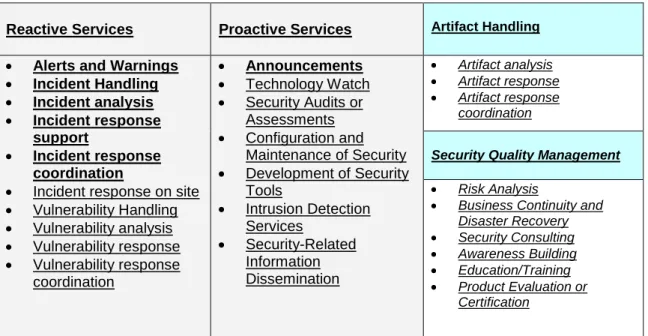
There are many services that a CSIRT can deliver, but so far no existing CSIRT provides all of them. So the selection of the appropriate set of services is a crucial decision. Below
Reactive Services Proactive Services Artifact Handling
Alerts and Warnings
Incident Handling
Incident analysis
Incident response support
Incident response coordination
Incident response on site
Vulnerability Handling
Vulnerability analysis
Vulnerability response
Vulnerability response coordination
Announcements
Technology Watch
Security Audits or Assessments
Configuration and Maintenance of Security
Development of Security Tools
Intrusion Detection Services
Security-Related Information Dissemination
Artifact analysis
Artifact response
Artifact response coordination
Security Quality Management
Risk Analysis
Business Continuity and Disaster Recovery
Security Consulting
Awareness Building
Education/Training
Product Evaluation or Certification
Fig. 1 CSIRT Services list from CERT/CC7
The core services (marked in bold letters): there is a distinction made between reactive and proactive services. Proactive services aim at prevention of incidents through awareness building and training, while reactive services aim at handling incidents and mitigating the resulting damage.
Artifact handling contains the analysis of any file or object found on a system that might be involved in malicious actions, like leftovers from viruses, worms, scripts, trojans, etc. It also contains the handling and distribution of resulting information to vendors and other interested parties, in order to prevent further spreading of malware and to mitigate the risks.
Security and Quality management services are services with longer term goals and include consultancy and educational measures.
See the appendix for a detailed explanation of CSIRT services.
Choosing the right services for your constituents is an important step and will be further
referred to in the chapter 6.1 Defining the Financial Model.
Most CSIRTs start with distributing ‗Alerts and Warnings‘, make ‗Announcements‘ and
providing ‗Incident Handling‘ for their constituents. These core-services usually give a
good profile and attention value with the constituency, and are mainly considered as real ―added value‖.
A good practice is to start with a small group of ‗pilot‘-constituents, deliver the
core-services for a pilot-period of time and request feedback afterwards.
Interested pilot-users usually provide constructive feedback and help to develop tailor-made services.
Fictitious CSIRT (step 2) Choosing the right services
In the starting phase it is decided that the new CSIRT will focus mainly on providing some of the core-services for the employees.
It‘s decided that after a pilot-phase the extension of the service portfolio might be
considered and some ‗Security Management Services‘ might be added. That decision
will be made based on the feedback from the pilot-constituents and in close cooperation with the Quality Assurance department.
Analysis of the constituency and mission statement
We have taken the first three steps:
1. Understanding what a CSIRT is and what benefits it might provide. 2. To what sector will the new team deliver its services to?
3. What kinds of services a CSIRT can provide to its constituency.
>> The next step is to answer the question, what kind of approach should be chosen to
start up the CSIRT?
The next step is a deeper look into the constituency with the main goal to choose the correct communication channels:
Defining the communication approach to the constituents
Defining the mission statement
Making a realistic implementation/project plan
Defining the CSIRT services
Defining the organisational structure
Defining the Information Security policy
Hiring the right staff
Utilisation of your CSIRT office
Looking for cooperation between other CSIRTs and possible national initiativesThese steps will be described more in detail in the following paragraphs and can be used as input for the business- and the project plan.
5..1 Communication approach to the constituency
As said before it‘s very important to know the needs of the constituency as well as your own strategy of communication, including the communication channels that are most appropriate to approach them with information.
Management theory knows several possible approaches to this problem of analysing a target group. In this document we describe two of them: the SWOT- and the PEST-analysis.
SWOT analysis
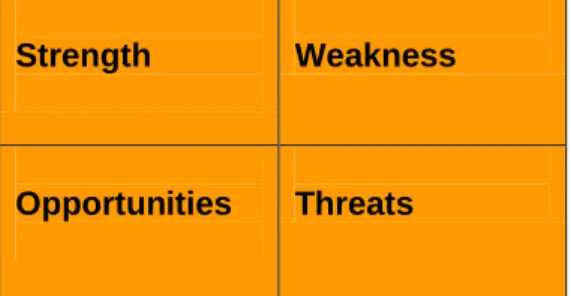
A SWOT Analysis is a strategic planning tool used to evaluate the Strengths,
Weaknesses, Opportunities, and Threats involved in a project or in a business venture or
in any other situation requiring a decision. The technique is credited to Albert Humphrey, who led a research project at Stanford University in the 1960s and '70s, using data from
the Fortune 500 companies.8
Fig. 2 SWOT analysis
8 SWOT analysis at Wikipedia: http://en.wikipedia.org/wiki/SWOT_analysis
Strength Weakness
PEST analysis
The PEST analysis is another important and widely used tool to analyse the constituency
with the goal to understand Political, Economic, Socio-cultural and Technological
circumstances of the environment a CSIRT is operating in. It will help to determine whether the planning is still in tune with the environment and probably helps to avoid actions taken out of wrong assumptions.
Political
Ecological/environmental issues Current legislation home market Future legislation
European/international legislation Regulatory bodies and processes Government policies
Government term and change Trading policies
Funding, grants and initiatives
Home market lobbying/pressure groups International pressure groups
Economic
Home economy situation Home economy trends
Overseas economies and trends General taxation issues
Taxation specific to product/services Seasonality/weather issues Market and trade cycles Specific industry factors
Market routes and distribution trends Customer/end-user drivers
Interest and exchange rates Social
Lifestyle trends Demographics
Consumer attitudes and opinions Media views
Law changes affecting social factors Brand, company, technology image Consumer buying patterns Fashion and role models Major events and influences Buying access and trends Ethnic/religious factors Advertising and publicity
Technological
Competing technology development Research funding
Associated/dependent technologies Replacement technology/solutions Maturity of technology
Manufacturing maturity and capacity Information and communications
Consumer buying mechanisms/technology Technology legislation
Innovation potential
Technology access, licensing, patents Intellectual property issues
Fig. 3 Pest analysis model
A detailed description of the PEST analysis can be found in Wikipedia9.
Both tools give a comprehensive and structured overview of what the need of the constituents are. The results will complement the business proposal and by this help to obtain funding for the setting up of the CSIRT.
Communication channels
An important topic to include in the analysis is possible communication and information distribution methods (―How to communicate with the constituency?‖)
Usually CSIRTs operate a set of communication channels. The following proved useful in practice and are worth to consider
Public website
Closed member area on the website Web-forms to report incidents Mailing lists
Personalised e-mail Phone / Fax
SMS
‗Old fashioned‘ paper letters
Monthly or annual reports
Besides using e-mail, web-forms, phone or fax to facilitate incident handling (to receive incident reports from the constituency, coordinate with other teams or give feedback and support to the victim) most CSIRTs publish their security advisories on a publicly available website and via a mailing lists.
!
If possible, information should be distributed in a secure manner. E-mail for examplecan be digitally signed with PGP, and sensitive incident data should always be sent encrypted.
For more information see the chapter 8.5 Available CSIRT Tooling. See also chapter 2.3
of the RFC235010.
Fictitious CSIRT (step 3a)
Making an analysis of the constituency and the appropriate communication channels
A brainstorming session with some key persons from management and the constituency generated enough input for a SWOT analysis. This lead to the conclusion that there is a need for the core-services:
Alerts and warnings
Incident handling (analysis, response support and response coordination) Announcements
It must be ensured that the information is distributed in a well-organised manner to reach a biggest possible part of the constituency. So the decision is made that alerts, warnings and announcements in the form of security advisories will be published on a dedicated website and distributed via a mailing list. The CSIRT facilitates e-mail, phone and fax for receiving of incident reports. A unified web-form is planned for the next step.
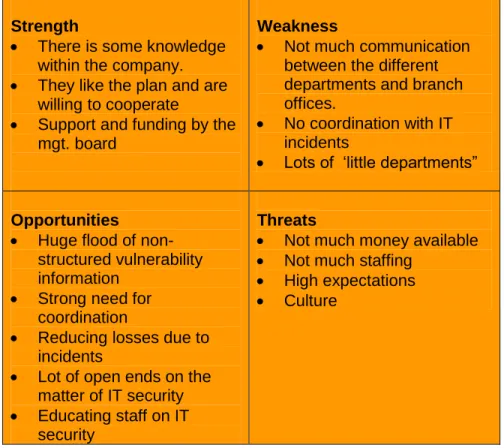
See next page for a sample SWOT analysis.
10 http://www.ietf.org/rfc/rfc2350.txt
Fig. 4 Sample SWOT analysis
5..2 Mission statement
After analysing the constituency needs and wishes concerning CSIRT services the next step should be the drafting of a mission statement.
A mission statement describes the organisations basic function in society, in terms of the products and services it provides for its constituents. It allows communicating clearly the existence and the function of the new CSIRT.
It‘s a good practice to make the mission statement compact but not too tight, because usually it will stay invariant for a couple of years.
Here are some examples for mission statements from operating CSIRTs:
“<Name of CSIRT> provides information and assistance to its <constituents (define your
Strength
There is some knowledge within the company. They like the plan and are
willing to cooperate
Support and funding by the mgt. board
Weakness
Not much communication between the different departments and branch offices.
No coordination with IT incidents
Lots of ‗little departments‖
Opportunities
Huge flood of non-structured vulnerability information
Strong need for coordination
Reducing losses due to incidents
Lot of open ends on the matter of IT security Educating staff on IT
security
Threats
Not much money available Not much staffing
High expectations Culture
The mission statement is a very important and necessary step to start with. Please refer
to chapter 2.1 of RFC235012 for a more detailed description of what information a CSIRT
should publish.
Fictitious CSIRT (step 3b)
The management of the fictitious CSIRT has made the following mission statement:
“Fictitious CSIRT provides information and assistance to the staff of its hosting company to reduce the risks of computer security incidents as well as responding to such incidents when they occur.”
By this fictitious CSIRT makes clear that it is an internal CSIRT and that its core business is to deal with IT security related issues.
12 http://www.ietf.org/rfc/rfc2350.txt
6 Developing the Business Plan
We have taken the following steps:1. Understanding what a CSIRT is and what benefits it might provide. 2. To what sector will the new team deliver its services to?
3. What kinds of services a CSIRT can provide to its constituency. 4. Analysis of the environment and constituents
5. Defining the mission statement
>> The next step is to define the business plan
The output from the analysis gives you a good overview of the needs and the (assumed) weaknesses of the constituency, so it is taken as input for the next step.
Defining the financial model
After the analysis a couple of core-services were picked to start with. The next step is to think about the financial model: what parameters of service provision are both suitable and payable.
In a perfect world the funding would be adapted to the needs of the constituency, but in reality the portfolio of services that can be provided must adapt to a given budget. So it‘s more realistic to start with the planning of monetary issues.
6..1 Cost model
The two main factors that influence the costs are the determination of service hours and the number (and quality) of staff to be employed. Is there a need for delivering 24x7 incident response and technical support or will these services only be provided during office hours?
Depending on the desired availability and the office equipment (is it for example possible to work from home?) it can be beneficial to work with an on-call duty roster or a scheduled duty roster.
A thinkable scenario is to deliver both proactive and reactive services during office hours. Outside office hours only limited services will be provided, for example in the case of major disasters and incidents only, by a staff member on call-duty.
among the teams around the globe. This does limit the costs, because teams always only work during normal office hours and also provide services for the ―sleeping part‖ of the world.
It is good practice to especially analyse the need for 24x7 services deeply with the constituency. Alerts and Warnings provided during night times do not make much sense when the recipient will only read it the next morning. There is a fine line between ―needing a service‖ and ―wanting a service‖, but especially the working hours make a huge difference in the number of staff and the needed facilities, and by this have a major impact on the cost model.
6..2 Revenue model
When knowing the cost it‘s a good next step to think about possible revenue models:
how can the planned services be financed. Here are some possible scenarios to evaluate:
Use of existing resources
It‘s always beneficial to assess the already present resources in other parts of the company. Is there already suitable staff employed (for example in the existing IT department) with the needed background and expertise? Probably arrangements can be found with the management to second this staff to the CSIRT for the starting phase, or they provide support for the CSIRT on an ad-hoc basis.
Membership fee
Another possibility is to sell your services to the constituency, by an annual/quarterly membership fee. Additional services could be paid for on a per-use basis, for example consultancy services or security audits.
Another thinkable scenario: services for the (internal) constituency are provided for free, but services delivered to external customers may have to be paid for. Another idea is to publish advisories and information bulletins on the public website and have a ―Members Only‖ section with special, more detailed or tailored information.
It has been proven in the practice that ―Subscription per CSIRT service‖ has only a limited use for providing enough funding, especially in the start-up phase. There are for example fixed basic costs for the team and equipment that have to be paid for in advance. The funding of these costs by selling CSIRT services is difficult and requires a very detailed financial analysis to find the ―break-even point‖.
Subsidy
Another possibility worth to consider might be to apply for project subsidy provided from the government or a governmental body, as nowadays most countries have funds available for IT security projects. Contacting the Ministry of the Interior might be a good start.
Defining the organisational structure
The suitable organisational structure of a CSIRT depends highly on the existing structure of the hosting organisation and the constituency. It also depends on the accessibility of skilled experts to be hired permanently or on an ad-hoc basis.
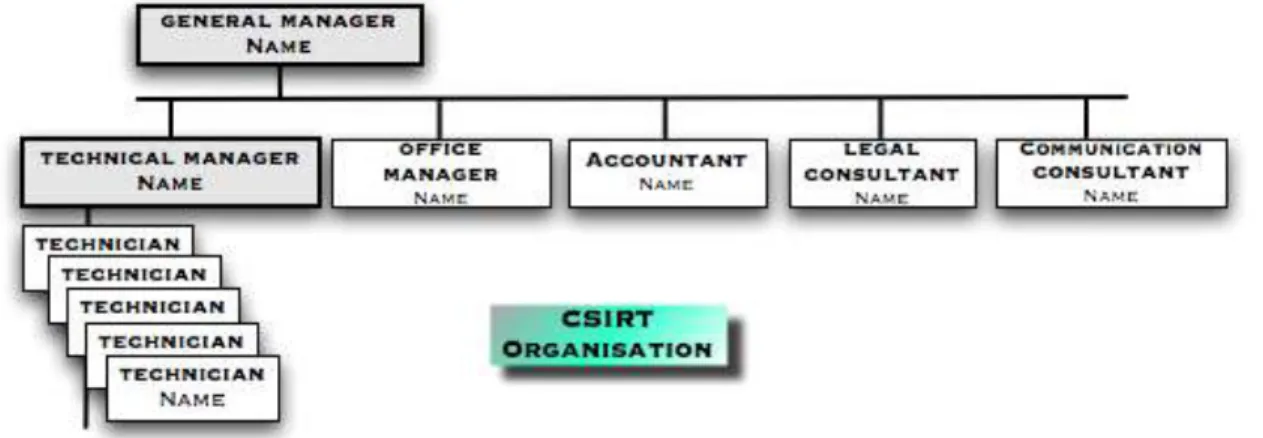
A typical CSIRT defines the following roles within the team:
General
General manager
Staff
Office manager Accountant
Communication consultant Legal consultant
Operational Technical team
Technical team leader
Technical CSIRT technicians, delivering the CSIRT services Researchers
External consultants
Hired when needed
It is extremely helpful to have a legal specialist on board especially during the starting phase of the CSIRT. It will raise the cost but at the end of the day will save time and legal troubles.
Depending on the variety of expertise inside the constituency, and also when the CSIRT has a high media profile, it proved very useful to also have a communication expert in the team. These experts can focus on translating difficult technical issues to more understandable messages for the constituents or media-partners. The communication expert also will provide feedback from the constituency to the technical experts, so he/she might act as a ―translator‖ and ―facilitator‖ between these two groups.
6..1 The independent business model
The CSIRT is rolled out and acts as an independent organisation, with its own management and employees.
6..2 The embedded model
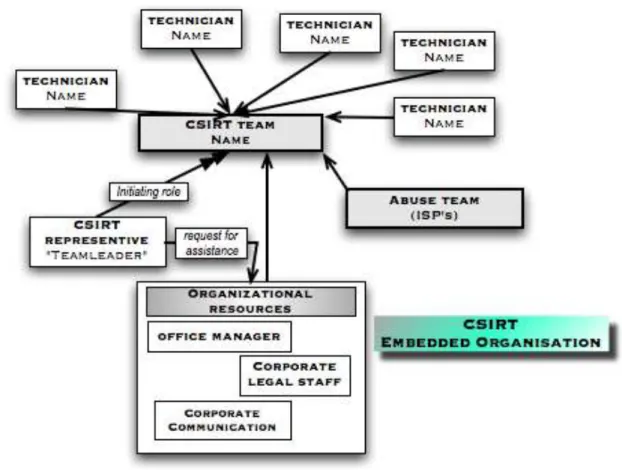
This model can be used if a CSIRT is to be established within an existing organisation, using an existing IT department for example. The CSIRT is headed up by a team leader and he or she is responsible for the CSIRT activities. The team leader gathers the necessary technicians when solving incidents or working on CSIRT activities. He or she can request assistance within the existing organisation for specialist support.
This model can also be adapted for specific situations as they arise. In this case, the team has a fixed number or Full Time Equivalent (FTE) allocated. The abuse desk at an ISP, for example, is certainly a fulltime job for one or (in most cases) more than one FTE.
6..3 The campus model
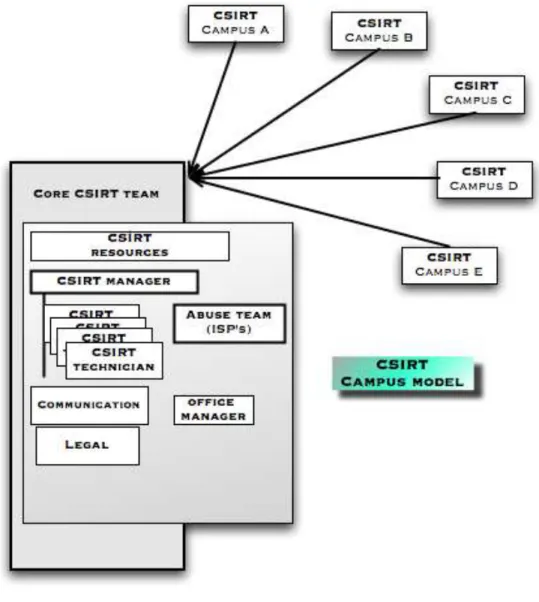
The campus model, as the name suggests, is adopted mostly by academic and research CSIRTs. Most academic and research organisations are comprised of various universities and campus facilities at different locations, spread over a region or even the whole country (like in the case of the NRENs, the National Research Networks). Usually these organisations are independent from each other, and they often run their own CSIRT. These CSIRTs are usually organised under the umbrella of the ‗mother‘ or core CSIRT. The core CSIRT coordinates and is the single point of contact for the outside world. In most cases the core CSIRT will also provide the core CSIRT services as well as distributing incident information to the appropriate campus CSIRT.
Some CSIRTs circulate their CSIRT core services with the other campus CSIRTs, which results in lower overhead for the Core CSIRT.
6..4 The voluntary model
This organisational model describes a group of people (specialists) that join together to provide advice and support to each other (and others) on a voluntary basis. It‘s a loosely fitted community and is highly dependant on the motivation of the participants.
This model is for example adopted by the WARP community13.
Hiring the right staff
Having decided on the services and the level of support to be delivered, and after choosing an organisational model, the next step is to find the right amount of skilled people for the job.
It‘s nearly impossible to provide hard figures on the amount of technical staff needed from this perspective, but the following key values have proven to be a good approach:
In order to deliver two core services of the distribution of advisory bulletins as
well as incident handling: a minimum of 4 FTE.
For a full service CSIRT during office hours, and maintaining systems: a
minimum of 6 to 8 FTE.
For a fully staffed 24x7 shift (2 shifts during out-of-office hours), the minimum is
about 12 FTE.
These numbers also include redundancies for cases of sickness, holidays, etc. It‘s also necessary to check the local collective labour agreements. If people work outside office hours this might result in extra costs in form of extra allowance that have to be paid.
Following a brief overview of key competencies for the technical experts for a CSIRT
General technical staff job description items: Personal competences
Flexible, creative and a good team spirit Strong analytical skills
Ability to explain difficult technical matters in easy wording
A good feeling for confidentiality and working in a procedural matter Good organisational skills
Stress durable
Strong communicative and writing skills Open minded and willing to learn
Technical competences
Broad knowledge of internet technology and protocols
Knowledge of Linux and Unix systems (depending on the equipment of the constituency)
Knowledge of Windows systems (depending on the equipment of the constituency) Knowledge of network infrastructure equipment (Router, switches, DNS, Proxy, Mail,
etc.)
Knowledge of Internet applications (SMTP, HTTP(s), FTP, telnet, SSH, etc.) Knowledge of Security threats (DDoS, Phishing, Defacing, sniffing, etc.) Knowledge of risk assessment and practical implementations
Additional competencies
Willing to work 24x7 or on call duty (depending on the service model)
Maximum of travelling distance (in case of emergency availability in the office; maximum travelling time)
Level of education
Experience in working in the field of IT security
Fictitious CSIRT (step 4)
Defining the Business Plan
Financial model
Due to the fact that the company has 24x7 e-business and also a 24x7 IT department it‘s decided to provide full service during office hours and an on call duty for outside office hours. The services for the constituency will be provided for free, but the possibility to deliver services for external customers will be assessed during the pilot- and evaluation phase.
Revenue model
During the starting- and pilot-phase the CSIRT will be financed through the hosting company. During the pilot- and the evaluation phase additional funding will be discussed, including the possibility to sell services to external customers.
Organisational model
The hosting organisation is a small company, so the embedded model is chosen.
During office hour a staff of three people will provide the core-services (distribution of security advisories and incident handling/coordination).
The company‘s IT department already employs people with suitable skills. An agreement with that department is made so that the new CSIRT can request support on an ad-hoc
basis when needed. Also the 2nd line of their on-call technicians can be used.
There will be a core CSIRT team with four full-time members and five additional CSIRT team members. One of those is also available on circulating shift.
Staff
The CSIRT team leader has a background in security and 1st and 2nd level support and
has done work in the resilience crisis management work field. The other three team members are security specialists. The part-time CSIRT team members from the IT department are specialists on their part of the company‘s infrastructure.
Utilisation and equipment of the office
The equipment and utilisation of office space and the physical security are very broad topics, therefore no exhausting description can be provided in this document. This chapter is meant to give a short overview of this topic.
More info about physical security can be found at:
http://en.wikipedia.org/wiki/Physical_security
http://www.sans.org/reading_room/whitepapers/physcial/ http://www.infosyssec.net/infosyssec/physfac1.htm
“Hardening the building”
Because CSIRTs usually handle very sensitive information it is a good practice to let the team take control of the physical security of the office. This will depend very much on the existing facilities and infrastructure and the existing information security policy of the hosting company.
Governments, for example, work with classification schemes and are very strict on how to handle confidential information. Check with your own company or institution about local rules and policies.
Usually a new CSIRT has to depend on the cooperation of its hosting organisation to learn about local rules, policies and other legal issues.
An exhaustive description of all equipment and security measures that will be needed is out of this document‘s scope. However below you will find a short list of the basic
General rules for the building
Use access controls
Make the CSIRT office, at least, only accessibly to CSIRT staff. Monitor the offices and entrances with cameras.
Archive confidential information in lockers or in a safe. Use secure IT systems.
General rules for IT equipment
Use equipment that the staff can support Harden all systems
Patch and update all your systems before connecting them to the internet
Use security software (Firewalls, multiple anti-virus scanners, anti-spyware, etc.)
Maintaining communication channels
Public Website
Closed member area on the Website Web-forms to report incidents
Email (PGP / GPG / S/MIME support) Mailing list software
Have a dedicated telephone number available for the constituency:
- Phone
- Fax
- SMS
Record tracking system(s)
Contact database with details of team members, other teams, etc. CRM tools
Incident handling ticket system
Use the “corporate style” from the beginning for
Standard email and advisory bulletin lay-out
‗Old fashioned‘ paper letters
Monthly or annual reports Incident report form
Other issues
Foresee out-of-band communication in case of attacks Foresee redundancy on internet connectivity
For more information about specific CSIRT tooling see the chapter 8.5 Available CSIRT
Developing an Information security policy
Depending on the kind of CSIRT, you will have a customised information security policy. Apart from describing the desired state of operational and administrative processes and procedures, such policy has to be in line with legislation and standards, in particular with regard to the liability of the CSIRT. The CSIRT is usually bound by national laws and regulations, which are often implemented in the context of European legislation (usually Directives) and other international agreements. Standards are not necessarily binding directly, but can be mandated or recommended by laws and regulations.
Below is a short list of possible laws and policies:
National
Various laws on information technology, telecommunication, media Laws on data protection and privacy
Laws and regulations on data retention
Legislation on finance, accounting, and corporate management Codes of conduct for corporate governance and IT governance
European
Directive on electronic signatures (1993/93/EC)
Directives on data protection (1995/46/EC) and privacy in electronic communications (2002/58/EC)
Directives on electronic communication networks and services (2002/19/EC – 2002/22/EC)
Directives on Company Law (e.g. 8th Company Law Directive)
International
Basel II agreement (especially with regard to management of operational risk)
Council of Europe‘s Convention on Cybercrime
Council of Europe‘s Convention on Human Rights (article 8 on privacy)
International Accounting Standards (IAS; they mandate to some extent IT controls)
Standards
British Standard BS 7799 (Information Security)
International Standards ISO2700x (Information Security Management Systems) German IT-Grundschutzbuch, French EBIOS and other national variations To determine if your CSIRT is acting in accordance with national and international legislation, please consult your legal advisor.
Are there legal considerations to take into account with regard to information handling?
Do you have a policy on the use of cryptography to protect exclusivity & integrity in archives and/or data communication, especially e-mail?
Does this policy include possible legal boundary conditions such as key escrow or enforceability of decryption in case of law suits.
Fictitious CSIRT (step 5) Office equipment and location
Due to the fact that the hosting company already has efficient physical security in place,
the new CSIRT is well covered in that aspect. A so called ―war room‖ is provided for
enabling coordination in the case of an emergency. A safe is purchased for the encryption material and sensitive documents. A separate telephone line was established
including a switchboard for facilitating the hotline during office hours and the ―on-call‖
duty mobile phone for the time outside office hours with the same phone number.
Existing equipment and the corporate website to announce CSIRT related information can also be used. A mailing-list is installed and maintained, with a restricted part for the communication among team members and with other teams. All contact details of the staff members is stored in a database, a print-out is kept in the safe.
Regulation
Due to the fact that the CSIRT is embedded in a company with existing information security policies the according policies for the CSIRT have been established with the help of the legal adviser of the company.
Search for cooperation between other CSIRTs and possible
national initiatives
The existence of other CSIRT initiatives and the strong need for cooperation between them has already been mentioned a couple of times in this document. It‘s good practice to contact other CSIRTs as early as possible to get the necessary contact with the CISRT communities. Usually other CSIRTs are very open to help newly built teams to get started.
ENISAs Inventory of CERT activities in Europe14 is a very good starting point for the
search for other CSIRTs in the country or for national CSIRT cooperation activities. To get support for finding a suitable source of CSIRT information contact ENISAs CSIRT experts:
Following is an overview of CSIRT community activities. Please refer to the Inventory for a more comprehensive description and further information.
European CSIRT initiative
TF-CSIRT15
The TF-CSIRT Task Force promotes the collaboration between Computer Security Incident Response Teams (CSIRTs) in Europe. The main goals of this Task Force is to provide a forum for exchanging experiences and knowledge, to establish pilot services for the European CSIRTs community and assist the establishment of new CSIRTs. The main goals of the Task Force are:
To provide a forum for exchanging experiences and knowledge To establish pilot services for the European CSIRTs community
To promote common standards and procedures for responding to security incidents To assist the establishment of new CSIRTs and the training of CSIRTs staff.
The activities of TF-CSIRT are focused on Europe and neighbouring countries, in compliance with the Terms of Reference approved by the TERENA Technical Committee on 15 September 2004.
Global CSIRT initiative
FIRST16
FIRST is the premier organisation and recognised global leader in incident response. Membership in FIRST enables incident response teams to more effectively respond to security incidents - reactive as well as proactive.
FIRST brings together a variety of computer security incident response teams from government, commercial, and educational organisations. FIRST aims to foster cooperation and coordination in incident prevention, to stimulate rapid reaction to incidents, and to promote information sharing among members and the community at large.
Apart from the trust network that FIRST forms in the global incident response community, FIRST also provides value added services.
Fictitious CSIRT (step 6) Looking for cooperation
By using ENISAs Inventory quickly some CSIRTs in the same country were found and contacted. A site visit was arranged with one of them for the newly hired team leader. He learned about national CSIRT activities and attended a meeting.
This meeting was more than helpful for collecting examples of working methods and get support by a couple of other teams.
7 Promoting the Business Plan
We have taken the following steps so far:1. Understanding what a CSIRT is and what benefits it might provide. 2. To what sector will the new team deliver its services to?
3. What kinds of services a CSIRT can provide to its constituency. 4. Analysis of the environment and constituents
5. Defining the mission statement 6. Developing the Business Plan
a. Defining the financial model
b. Defining the organisational structure c. Starting to hire staff
d. Utilising and equipping the office
e. Developing an Information security policy f. Looking for cooperation partners
>> The next step is to put the above in a project plan and get started!
A good start for defining your project is coming up with a business case. This business case will be used as basis for the project plan and will also be used to apply for management support and gain budget or other resources.
It proved useful to continuously report to the management to keep the awareness high for IT security problems and by this for continuously support for the own CSIRT.
Starting a business case begins with analysing the problems and opportunities by using
an analysis model, described in chapter 5.3 Analysis of the constituency, and search
close contact to the potential constituency.
As described earlier there are is a lot to think about when starting a CSIRT. It‘s best to adjust the above mentioned material to the CSIRTs needs as they develop.
Its good practice, when reporting to the management, to make the own case as up-to-date as possible by using recent articles from newspapers or the internet and explain why the CSIRT service and internal coordination of incidents are crucial for secure business assets. It‘s also necessary to make clear that only continuously support in matters of IT security lead to a stable business, especially for a company or an institution that is dependent on IT
(A prominent phrase by Bruce Schneier brings this to the point: ““SSeeccuurriittyyiissnnoottaapprroodduucctt b
buuttaapprroocceessss1177
!
!““))
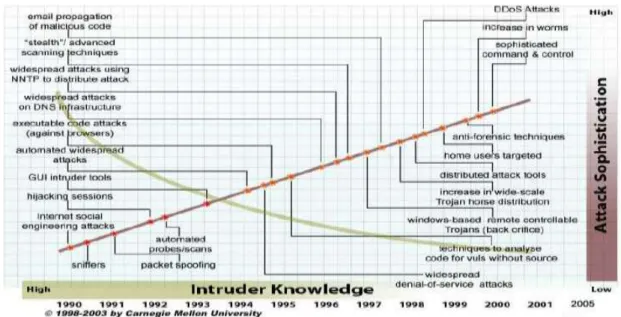
A famous tool for illustrating security problems is the following graph provided by the CERT/CC:
17 Bruce Schneier: http://www.schneier.com/
Fig. 8 Intruder knowledge versus attack sophistication (source CERT-CC18)
It visualises the trends in IT security, especially the decrease in the necessary skills to carry out increasingly sophisticated attacks.
Another point to mention is the continuously shrinking time window between the availability of software updates for vulnerabilities and the starting of attacks against them:
Patch -> Exploit Spreading rate
Nimda: 11 month Code red: Days
Slammer: 6 month Nimda: Hours
Nachi: 5 month Slammer: Minutes
Blaster: 3 weeks
Witty: 1 day (!)
Gathered incident data, potential improvements and lessons learned make also a good presentation.
Description of business plans and management triggers
A presentation for the management including the promotion of the CSIRT alone do not make a business case, but if carried out in an appropriate manner it will lead to support from the management for the CSIRT in most cases. The business case on the other hand should not only be seen merely as a management exercise but should also be used for the communication to the team and the constituency. The term business case might sound very commercial and far away from daily CSIRT practice, but it provides good focus and direction when setting up a CSIRT.
The answers to the following questions might be used to design a good business case (the given examples are hypothetical and used merely for illustration. The ―real‖ answers are highly dependent on the ―real‖ circumstances).
What is the problem?
What would you like to achieve with your constituents? What happens if you do nothing?
What happens if you take action? What is it going to cost?
What is going to gain?
When do you start and when is it finished?
What is the problem?
In most cases the idea to set up a CSIRT arises when IT security has become a vital part of the core-business of a company or institution and when IT security incidents become a business risk, making security mitigation a normal business operation.
The majority of companies or institutions have a regular support department or a helpdesk but in most cases security incidents are handled insufficiently and not as structured as they should be. In most cases the security incident work field needs special skills and attention. Having a more structured approach is also beneficial and will mitigate business risks and damage to the company.
The problem in most cases is that there is a lack of coordination and that existing knowledge is not used to handle incidents, which could prevent them from happening in the future and prevent possible financial losses and / or damage to an institution‘s reputation.
What would are the goals to be achieved with the constituency?
As explained earlier your CSIRT will serve its constituents and assist them in solving IT security incidents and problems. Raising the level of IT security knowledge and achieving a security aware culture are additional goals.
This culture endeavours proactive and preventative measures taken from the start and therefore reducing operational costs.
Introducing this culture of cooperation and assistance to a company or institution can in most cases stimulate efficiency in general.
What happens if nothing is done?
A non-structured way of handling IT security may lead to further damage, not least to the reputation of the institution. Financial losses and legal implications might be other results.
What happens if action is taken?
The awareness concerning the occurrence of security problems is raised. This helps to solve them more efficiently and prevent future losses.
What is it going to cost?
Depending on the organisational model it will cost the salaries of the CSIRT team members and organisation, equipment, tooling and software licences.
What is it going to gain?
Depending on the business and the losses in the past it will gain more transparency in procedures and security practices, therefore protecting essential business assets.
What is the timeline?
See chapter 12. Description of the Project plan for the description of a sample project
plan.
Examples of existing business cases and approaches
Here are some examples for CSIRT business cases that are worth to study:
http://www.cert.org/csirts/AFI_case-study.html
Creating a Financial Institution CSIRT: A Case Study
The purpose of this document is to share lessons learned by a financial institution (referred to in this document as AFI) as they developed and implemented both a plan to address security concerns and a Computer Security Incident Response Team (CSIRT).
http://www.terena.nl/activities/tf-csirt/meeting9/jaroszewski-assistance-csirt.pdf
Summary of the business case of CERT POLSKA (slideshow in PDF format).
http://www.auscert.org.au/render.html?it=2252
Forming an Incident Response Team (IRT) in the 1990s can be a daunting task. Many people forming an IRT have no experience with doing this. This paper examines the role an IRT may play in the community, and the issues that should be addressed both during the formation and after commencement of operations. It may be of benefit to existing IRTs as it may raise awareness of issues not previously addressed.
http://www.sans.org/reading_room/whitepapers/casestudies/1628.php
Case Study in Information Security, Securing the Enterprise, By: Roger Benton This practical is a case study of Insurance Company‘s migration to an enterprise-wide security system. It is the intent of this practical to provide a path to follow when creating or migrating to a security system. Initially, a primitive online security system was the only mechanism to control access to corporate data. The exposures were severe - there were no integrity controls outside of the online environment. Anyone with basic programming skills could add, change and/or delete production data.
http://www.esecurityplanet.com/trends/article.php/10751_688803
Marriott's e-security strategy: business-IT collaboration
The experience of Marriott International, Inc.'s Chris Zoladz, e-business security is a process, not a project. That was the message Zoladz delivered at the recent E-Security Conference and Expo in Boston, sponsored by the Intermedia Group. As vice president of information protection for Marriott, Zoladz reports through the legal department, although he is not a lawyer. His function is to identify where Marriott's most valuable business information is stored and how it moves within and outside the company. Marriott has a separate responsibility defined for the technical infrastructure supporting security, which is given to the IT security architect.
Fictitious CSIRT (step 7) Promoting the Business Plan
It‘s decided to collect facts and figures from the company‘s history. This is more than useful for a statistical overview of the IT security situation. This collection should be continued when the CSIRT is up and running, to keep the statistics up-to-date.
Other national CSIRTs were contacted and interviewed about their business cases. They provided support by compiling some slides with information about recent developments in IT security incidents and about costs of incidents.
In this example case of Fictious CSIRT there was no pressing need to convince the management about the importance of IT business, and so it was not hard to get the go-ahead for the first step. A business case and a project plan where prepared, including an estimation of the set-up costs and the cost of operation.
8 Examples of operational and technical procedures
(workflows)
We have taken the following steps so far:
1. Understanding what a CSIRT is and what benefits it might provide. 2. To what sector will the new team deliver its services to?
3. What kinds of services a CSIRT can provide to its constituency. 4. Analysis of the environment and constituents.
5. Defining the mission statement. 6. Developing the Business Plan.
a. Defining the financial model.
b. Defining the organisational structure. c. Starting to hire staff.
d. Utilising and equipping the office.
e. Developing an Information security policy f. Looking for cooperation partners.
7. Promoting the Business Plan.
a. Have the business case approved. b. Fit everything into a project plan.
>> The next step is: making the CSIRT operational
Having well defined workflows in place will improve the quality and the needed time per incident or vulnerability case.
As described in the example boxes, Fictitious CSIRT will offer the basic CSIRT core-services:
Alerts and Warnings Incident Handling Announcements
This chapter provides examples of workflows that describe the core-services of a CSIRT. This chapter also contains information about collecting information from different sources, checking it on relevance and authenticity and redistributing it to the constituency. And finally this chapter contains examples of the most basic procedures and specific CSIRT tooling.
Assess the installation base of the constituency
The first step is to gather an overview of the IT systems installed at your constituency. By this the CSIRT can evaluate the relevance of incoming information and filter it before redistribution, so the constituents will not get overwhelmed with information that is basically useless for them.
Its good practice to begin simple, for example by using an excel sheet like the following:
Category Application Software
product
Version OS OS
version
Constituent
Desktop Office Excel x-x-x Microsoft XP-prof A
Desktop Browser IE x-x- Microsoft XP-prof A
Network Router CISCO x-x-x CISCO x-x-x- B
Server Server Linux x-x-x L-distro x-x-x B
Services Web server Apache Unix x-x-x B
With the filter function in excel it‘s very easy to select the proper software and see which constituent is using which kind of software.
Generating Alerts, Warnings and Announcements
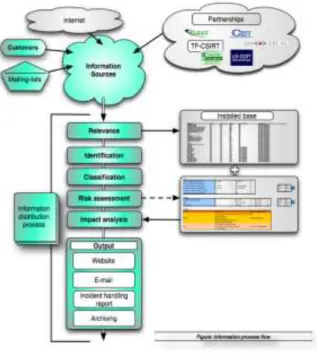
The generation of alerts, warnings and announcements all follow the same workflows: The collection of information
Evaluation of the information on relevance and source Risk assessment based on the gathered information Distribution of the information
Fig. 9 : Information process flow
Step 1: Collecting vulnerability information.
Usually there exist two main types of information sources that contribute information as input for the services:
Vulnerability information about (your) IT systems Incident reports
Depending of the kind of business and IT infrastructure there are many public and closed sources for vulnerability information:
Public and closed mailing lists
Vendor vulnerability product information Websites
Information on the Internet (Google, etc…)
Public and private partnerships that provide vulnerability information (FIRST, TF-CSIRT, CERT-CC, US-CERT….)