Google’s MapReduce Programming Model — Revisited
∗
Ralf L¨ammel
Data Programmability TeamMicrosoft Corp. Redmond, WA, USA
Abstract
Google’s MapReduce programming model serves for processing large data sets in a massively parallel manner. We deliver the first rigorous description of the model including its advancement as Google’s domain-specific language Sawzall. To this end, we reverse-engineer the seminal papers on MapReduce and Sawzall, and we capture our findings as an executable specification. We also identify and resolve some obscurities in the informal presentation given in the seminal papers. We use typed functional programming (specifically Haskell) as a tool for design recovery and executable specification. Our development comprises three com-ponents: (i) the basic program skeleton that underlies MapReduce computations; (ii) the opportunities for parallelism in executing MapReduce computations; (iii) the fundamental characteristics of Sawzall’s aggregators as an advancement of the MapReduce approach. Our development does not formalize the more implemen-tational aspects of an actual, distributed execution of MapReduce computations. Keywords: Data processing; Parallel programming; Distributed programming; Software design; Executable specification; Typed functional programming; MapRe-duce; Sawzall; Map; ReMapRe-duce; List homomorphism; Haskell.
Contents
1 Introduction 3
2 Basics of map & reduce 4
2.1 The MapReduce programming model . . . 4
2.2 Lisp’s map & reduce . . . 5
2.3 Haskell’s map & reduce . . . 6
2.4 MapReduce’s map & reduce . . . 8
3 The MapReduce abstraction 9 3.1 The power of ‘.’ . . . 9
3.2 The undefinedness idiom . . . 11
3.3 Type discovery from prose . . . 11
3.4 Type-driven reflection on designs . . . 12
3.5 Discovery of types . . . 15
3.6 Discovery of definitions . . . 16
3.7 Time to demo . . . 20
4 Parallel MapReduce computations 21 4.1 Opportunities for parallelism . . . 21
4.2 A distribution strategy . . . 22
4.3 The refined specification . . . 24
4.4 Implicit parallelization for reduction . . . 26
4.5 Correctness of distribution . . . 27
5 Sawzall’s aggregators 28 5.1 Sawzall’s map & reduce . . . 29
5.2 List homomorphisms . . . 29
5.3 Tuple aggregators . . . 33
5.4 Collection aggregators . . . 33
5.5 Indexed aggregators . . . 35
5.6 Generalized monoids . . . 36
5.7 Multi-set aggregators . . . 38
5.8 Correctness of distribution . . . 39
5.9 Sawzall vs. MapReduce . . . 39
1
Introduction
Google’s MapReduce programming model [10] serves for processing large data sets in a massively parallel manner (subject to a ‘MapReduce implementation’).1 The pro-gramming model is based on the following, simple concepts: (i)iteration over the input; (ii)computationof key/value pairs from each piece of input; (iii)groupingof all intermediate values by key; (iv)iterationover the resulting groups; (v)reductionof each group. For instance, consider a repository of documents from a web crawl as in-put, and a word-based index for web search as outin-put, where the intermediate key/value pairs are of the formhword,URLi.
The model is stunningly simple, and it effectively supports parallelism. The pro-grammer may abstract from the issues of distributed and parallel programming because it is the MapReduceimplementationthat takes care of load balancing, network perfor-mance, fault tolerance, etc. The seminal MapReduce paper [10] described one possi-ble implementation model based on large networked clusters of commodity machines with local store. The programming model may appear as restrictive, but it provides a good fit for many problems encountered in the practice of processing large data sets. Also, expressiveness limitations may be alleviated by decomposition of problems into multiple MapReduce computations, or by escaping to other (less restrictive, but more demanding) programming models for subproblems.
In the present paper, we deliver the first rigorous description of the model includ-ing its advancement as Google’s domain-specific language Sawzall [26]. To this end, we reverse-engineer the seminal MapReduce and Sawzall papers, and we capture our findings as an executable specification. We also identify and resolve some obscurities in the informal presentation given in the seminal papers. Our development comprises three components: (i) the basic program skeleton that underlies MapReduce compu-tations; (ii) the opportunities for parallelism in executing MapReduce compucompu-tations; (iii) the fundamental characteristics of Sawzall’s aggregators as an advancement of the MapReduce approach. Our development does not formalize the more implementational aspects of an actual, distributed execution of MapReduce computations (i.e., aspects such as fault tolerance, storage in a distributed file system, and task scheduling).
Our development uses typed functional programming, specifically Haskell, as a tool for design recovery and executable specification. (We tend to restrict ourselves to Haskell 98 [24], and point out deviations.) As a byproduct, we make another case for the utility of typed functional programming as part of a semi-formal design methodol-ogy. The use of Haskell is augmented by explanations targeted at readers without pro-ficiency in Haskell and functional programming. Some cursory background in declar-ative programming and typed programming languages is assumed, though.
The paper is organized as follows. Sec. 2 recalls the basics of the MapReduce pro-gramming model and the corresponding functional propro-gramming combinators. Sec. 3 develops a baseline specification for MapReduce computations with a typed, higher-order function capturing the key abstraction for such computations. Sec. 4 covers parallelism and distribution. Sec. 5 studies Sawzall’s aggregators in relation to the MapReduce programming model. Sec. 6 concludes the paper.
2
Basics of map & reduce
We will briefly recapitulate the MapReduce programming model. We quote: the MapRe-duce “abstraction is inspired by the map and reMapRe-duce primitives present in Lisp and many other functional languages” [10]. Therefore, we will also recapitulate the rel-evant list-processing combinators, map and reduce, known from functional program-ming. We aim to get three levels right: (i) higher-order combinators for mapping and reduction vs. (ii) the principledargumentsof these combinators vs. (iii) the actual applicationsof the former to the latter. (These levels are somewhat confused in the seminal MapReduce paper.)
2.1
The MapReduce programming model
The MapReduce programming model is clearly summarized in the following quote [10]:
“The computation takes a set of input key/value pairs, and produces a set of output key/value pairs. The user of the MapReduce library expresses the computation as two functions: map and reduce.
Map, written by the user, takes an input pair and produces a set of inter-mediate key/value pairs. The MapReduce library groups together all in-termediate values associated with the same inin-termediate key I and passes them to the reduce function.
The reduce function, also written by the user, accepts an intermediate key I and a set of values for that key. It merges together these values to form a possibly smaller set of values. Typically just zero or one output value is produced per reduce invocation. The intermediate values are supplied to the user’s reduce function via an iterator. This allows us to handle lists of values that are too large to fit in memory.”
We also quote an example including pseudo-code [10]:
”Consider the problem of counting the number of occurrences of each word in a large collection of documents. The user would write code similar to the following pseudo-code:
map(String key, String value): reduce(String key, Iterator values):
// key: document name // key: a word
// value: document contents // values: a list of counts
for each word w in value: int result = 0;
EmitIntermediate(w, "1"); for each v in values: result += ParseInt(v); Emit(AsString(result));
The map function emits each word plus an associated count of occurrences (just ‘1’ in this simple example). The reduce function sums together all counts emitted for a particular word.”
2.2
Lisp’s map & reduce
Functional programming stands out when designs can benefit from the employment of recursion schemes for list processing, and more generally data processing. Recur-sion schemes like map and reduce enable powerful forms of decomposition and reuse. Quite to the point, the schemes directly suggest parallel execution, say expression eval-uation — if the problem-specific ingredients are free of side effects and meet certain algebraic properties. Given the quoted reference to Lisp, let us recall the map and re-duce combinators of Lisp. The following two quotes stem from “Common Lisp, the Language” [30]:2
map result-type function sequence &rest more-sequences
“Thefunctionmust take as many arguments as there are sequences provided; at least one sequence must be provided. The result of map is a sequence such that element j is the result of applyingfunctionto element j of each of the argument sequences. The result sequence is as long as the shortest of the input sequences.” This kind of map combinator is known to compromise on orthogonality. That is, map-ping over asinglelist is sufficient — if we assume a separate notion of ‘zipping’ such thatnlists are zipped together to a single list ofn-tuples.
reduce function sequence &key :from-end :start :end :initial-value “The reduce function combines all the elements of a sequence using a binary op-eration; for example, using + one can add up all the elements.
The specified subsequence of the sequence is combined or “reduced” using the
function, which must accept two arguments. The reduction is left-associative, unless the:from-end argumentis true (it defaults to nil), in which case it is right-associative. If an:initial-valueargument is given, it is logically placed before the subsequence (after it if:from-endis true) and included in the reduction operation.
If the specified subsequence contains exactly one element and the keyword ar-gument :initial-value is not given, then that element is returned and the function is not called. If the specified subsequence is empty and an
:initial-valueis given, then the:initial-valueis returned and the
functionis not called.
If the specified subsequence is empty and no:initial-valueis given, then thefunctionis called with zero arguments, and reduce returns whatever the function does. (This is the only case where thefunctionis called with other than two arguments.)”
(We should note that this is not yet the most general definition of reduction in Common Lisp.) It is common to assume thatfunctionis free of side effects, and it is an associative (binary) operation with:initial-valueas its unit. In the remainder of the paper, we will be using the term ‘proper reduction’ in such a case.
2At the time of writing, the relevant quotes are available on-line: http://www.cs.cmu.edu/
2.3
Haskell’s map & reduce
The Haskell standard library (in fact, the so-called ‘prelude’) defines related combina-tors. Haskell’smapcombinator processes a single list as opposed to Lisp’s combinator for an arbitrary number of lists. The kind of left-associative reduction of Lisp is pro-vided by Haskell’s foldl combinator — except that the type of foldl is more general than necessary for reduction. We attach some Haskell illustrations that can be safely skipped by the reader with proficiency in typed functional programming.
Illustration ofmap: Let us double all numbers in a list:
Haskell-prompt> map ((∗) 2) [1,2,3] [2,4,6]
Here, the expression ‘((∗) 2)’ denotes multiplication by2.
In (Haskell’s) lambda notation, ‘((∗) 2)’ can also be rendered as ‘\x−>2∗x’.
Illustration offoldl: Let us compute the sum of all numbers in a list:
Haskell-prompt> foldl (+) 0 [1,2,3] 6
Here, the expression ‘(+)’ denotes addition and the constant ‘0’ is the default value. The left-associative bias of foldl should be apparent from the parenthesization in the following evaluation sequence:
foldl (+) 0 [1,2,3] ⇒ (((0 + 1) + 2) + 3)
⇒ 6
Definition ofmap
map :: (a−>b)−>[a]−>[b] −−type of map
map f [] = [] −−equation: the empty list case map f (x:xs) = f x : map f xs −−equation: the non−empty list case The (polymorphic) type of themapcombinator states that it takes two arguments: a function of typea−>b, and a list of type[a]. The result of mapping is a list of type [b]. The type variablesaandbcorrespond to the element types of the argument and result lists. The first equation states that mappingfover an empty list (denoted as []) returns the empty list. The second equation states that mapping f over a non-empty list, x:xs, returns a list whose head is f applied tox, and whose tail is obtained by recursively mapping overxs.
Haskell trivia
• Line comments start with ‘−−’.
• Function names start in lower case; cf.mapand foldl.
• In types, ’ [...] ’ denotes the type constructor for lists.
• Term variables start in lower case; cf.xandxs.
• Type variables start in lower case, too; cf.aandb.
• Type variables are implicitly universally quantified, but can be explicitly universally quan-tified. For instance, the type ofmapchanges as follows, when using explicit quantifica-tion:map :: forall a b. (a−>b)−>[a]−>[b]
• Terms of a list type can be of two forms: – The empty list: ’[]’
– The non-empty list consisting of head and tail: ’... :...’
3
Definition offoldl
foldl :: (b−>a−>b)−>b−>[a]−>b−−type of foldl
foldl f y [] = y −−equation: the empty list case foldl f y (x:xs) = foldl f ( f y x) xs −−equation: the non−empty list case The type of the foldl combinator states that it takes three arguments: a binary operation of typeb−>a−>b, a ‘default value’ of typeband a list of type[a]to fold over. The result of folding is of typeb. The first equation states that an empty list is mapped to the default value. The second equation states that folding over a non-empty list requires recursion into the tail and application of the binary operationfto the folding result so far and the head of the list. We can restrict foldl to what is normally called reduction by type specialization:
reduce :: (a−>a−>a)−>a−>[a]−>a reduce = foldl
Asides on folding
• For the record, we mention that the combinators map and foldl can actually be both defined in terms of the right-associative fold operation, foldr, [23,20]. Hence, foldr can be considered as the fundamental recursion scheme for list traversal. The functions that are expressible in terms of foldr are also known as ‘list catamorphisms’ or ‘bananas’. We include the definition of foldr for com-pleteness’ sake:
foldr :: (a−>b−>b)−>b−>[a]−>b−−type of foldr
foldr f y [] = y −−equation: the empty list case foldr f y (x:xs) = f x ( foldr f y xs) −−equation: the non−empty list case
• Haskell’s lazy semantics makes applications of foldl potentially inefficient due to unevaluated chunks of intermediate function applications. Hence, it is typically advisable to use a strict companion or the right-associative fold operator, foldr, but we neglect such details of Haskell in the present paper.
• Despite left-associative reduction as Lisp’s default, one could also take the po-sition that reduction should be right-associative. We follow Lisp for now and reconsider in Sec. 5, where we notice that monoidal reduction in Haskell is typi-cally defined in terms of foldr — the right-associative fold combinator.
2.4
MapReduce’s map & reduce
Here is the obvious question. How do MapReduce’s map and reduce correspond to standard map and reduce? For clarity, we use a designated font for MapReduce’s MAPandREDU CE, from here on. The following overview lists more detailed ques-tions and summarizes our findings:
Question Finding
IsMAPessentially themapcombinator? NO IsMAPessentially an application of themapcombinator? NO DoesMAPessentially serve as the argument ofmap? YES IsREDU CEessentially thereducecombinator? NO
IsREDU CEessentially an application of thereducecombinator? TYPICALLY DoesREDU CEessentially serve as the argument ofreduce? NO
DoesREDU CEessentially serve as the argument ofmap? YES
Hence, there is no trivial correspondence between MapReduce’sMAP &REDU CE and what is normally calledmap&reducein functional programming. Also, the re-lationships betweenMAP andmapare different from those betweenREDU CE and reduce. For clarification, let us consider again the sample code for the problem of counting occurrences of words:
map(String key, String value): reduce(String key, Iterator values):
// key: document name // key: a word
// value: document contents // values: a list of counts
for each word w in value: int result = 0;
EmitIntermediate(w, "1"); for each v in values: result += ParseInt(v); Emit(AsString(result));
Per programming model, both functions are applied to key/value pairs one by one. Naturally, our executable specification will use the standardmapcombinator to apply MAPandREDU CEto all input or intermediate data. Let us now focus on theinner workingsofMAP andREDU CE.
Internals ofREDU CE: The situation is straightforward at first sight. The above code performs imperative aggregation (say, reduction): take many values, and reduce them to a single value. This seems to be the case for most MapReduce examples that are listed in [10]. Hence, MapReduce’sREDU CEtypicallyperforms reduction, i.e., it can be seen as anapplicationof the standardreducecombinator.
However, it is important to notice that the MapReduce programmer is not encour-aged to identify theingredients of reduction, i.e., an associative operation with its unit.
Also, the assigned type ofREDU CE, just by itself, is slightly different from the type to be expected for reduction, as we will clarify in the next section. Both deviations from the functional programming letter may have been chosen by the MapReduce designers for reasons of flexibility. Here is actually one example from the MapReduce paper that goes beyond reduction in a narrow sense [10]:
“Inverted index: The map function parses each document, and emits a sequence ofhword,document IDipairs. The reduce function accepts all pairs for a given word, sorts the corresponding document IDs and emits a hword, list(document ID)ipair.”
In this example,REDU CEperforms sorting as opposed to the reduction of many values to one. The MapReduce paper also alludes to filtering in another case. We could attempt to provide a more general characterization forREDU CE. Indeed, our Sawzall investigation in Sec. 5 will lead to an appropriate generalization.
Internals ofMAP: We had already settled thatMAP is mapped over key/value pairs (just as much asREDU CE). So it remains to poke at the internal structure of MAPto see whether there is additional justification forMAP to be related to map-ping (other than the sort of mapmap-ping that also applies toREDU CE). In the above sample code,MAP splits up the input value into words; alike for the ‘inverted index’ example that we quoted. Hence,MAP seems to producelists, it does not seem to traverse lists, sayconsumelists. In different terms,MAP is meant to associate each given key/value pair of the input with potentiallymany intermediate key/value pairs. For the record, we mention that the typical kind ofMAPfunction could be character-ized as an instance ofunfolding(also known as anamorphisms or lenses [23,16,1]).3
3
The MapReduce abstraction
We will now enter reverse-engineering mode with the goal to extract an executable specification (in fact, a relatively simple Haskell function) that captures the abstraction for MapReduce computations. An intended byproduct is the detailed demonstration of Haskell as a tool for design recovery and executable specification.
3.1
The power of ‘.’
Let us discover the main blocks of a functionmapReduce, which is assumed to model the abstraction for MapReduce computations. We recall thatMAP is mapped over the key/value pairs of the input, while REDU CE is mapped over suitably grouped intermediate data. Grouping takes place in between the map and reduce phases [10]: “The MapReduce library groups together all intermediate values associated with the same intermediate key I and passes them to the reduce function”. Hence, we take for granted thatmapReducecan be decomposed as follows:
3The source-code distribution illustrates the use of unfolding (for thewordsfunction) in the map phase;
mapReduce mAP rEDUCE
= reducePerKey −−3. ApplyREDU CE to each group . groupByKey −−2. Group intermediate data per key . mapPerKey −−1. ApplyMAP to each key / value pair where
mapPerKey =⊥ −−to be discovered groupByKey =⊥ −−to be discovered reducePerKey =⊥ −−to be discovered
Here, the argumentsmAPandrEDUCEare placeholders for the problem-specific func-tionsMAPandREDU CE. The functionmapReduceis the straight function composi-tion over locally defined helper funccomposi-tionsmapPerKey,groupByKeyandreducePerKey, which we leave undefined — until further notice.
We defined themapReducefunction in terms offunction composition, which is denoted by Haskell’s infix operator ‘.’. (The dot ‘applies from right to left’, i.e.,
(g .f)x= g (f x).) The systematic use of function composition improves clarity. That is, the definition of themapReducefunction expresses very clearly that a MapRe-duce computation is composed from three phases.
More Haskell trivia: For comparison, we also illustrate other styles of composing together themapReducefunction from the three components. Here is a transcription that uses Haskell’s plain function application:
mapReduce mAP rEDUCE input =
reducePerKey (groupByKey (mapPerKey input)) where ...
Function application, when compared to function composition, slightly conceals the fact that a MapReduce computation is composed from three phases. Haskell’s plain function application, as exercised above, is left-associative and relies on juxtaposition (i.e., putting function and ar-gument simply next to each other). There is also an explicit operator, ‘$’ for right-associative function application, which may help reducing parenthesization. For instance, ‘f $ x y’ denotes ‘f (x y)’. Here is another version of themapReducefunction:
mapReduce mAP rEDUCE input = reducePerKey
$ groupByKey $ mapPerKey input where ...
3 For the record, the systematic use of function combinators like ‘.’ leads to ‘point-free’ style [3,14,15]. The term ‘point’ refers to explicit arguments, such as input in the illustrative code snippets, listed above. That is, a point-free definition basically only uses function combinators but captures no arguments explicitly. Backus, in his Turing Award lecture in 1978, also uses the term ‘functional forms’ [2].
3.2
The undefinedness idiom
In the first draft of themapReducefunction, we left all components undefined. (The textual representation for Haskell’s ‘⊥’ (say, bottom) is ‘undefined’.) Generally. ‘⊥’ is an extremely helpful instrument in specification development. By leaving functions ‘undefined’, we can defer discovering their types and definitions until later. Of course, we cannot evaluate an undefined expression in any useful way:
Haskell-prompt> undefined
∗∗∗Exception: Prelude.undefined
Taking into account laziness, we may evaluate partial specifications as long as we are not ‘strict’ in (say, dependent on) undefined parts. More importantly, a partial specifi-cation can be type-checked. Hence, the ‘undefinedness’ idiom can be said to support top-down steps in design. The convenient property of ‘⊥’ is that it has an extremely polymorphic type:
Haskell-prompt> : t undefined undefined :: a
Hence, ‘⊥’ may be used virtually everywhere. Functions that are undefined (i.e., whose definition equals ‘⊥’) are equally polymorphic and trivially participate in type infer-ence and checking. One should compare such expressiveness with the situation in state-of-the-art OO languages such as C# 3.0 or Java 1.6. That is, in these languages, methods must be associated with explicitly declared signatures, despite all progress with type inference. The effectiveness of Haskell’s ‘undefinedness’ idiom relies on full type inference so that ‘⊥’ can be used freely without requiring any annotations for types that are still to be discovered.
3.3
Type discovery from prose
The type of the scheme for MapReduce computations needs to be discovered. (It is not defined in the MapReduce paper.) We can leverage the types forMAPandREDU CE, which are defined as follows [10]:
”Conceptually the map and reduce functions [...] have associated types: map (k1,v1)−>list(k2,v2)
reduce (k2, list (v2)) −>list(v2)
I.e., the input keys and values are drawn from a different domain than the output keys and values. Furthermore, the intermediate keys and values are from the same domain as the output keys and values.”
The above types are easily expressed in Haskell — except that we must be careful to note that the following function signatures are somewhat informal because of the way we assume sharing among type variables of function signatures.
map :: k1−>v1−>[(k2,v2)] reduce :: k2−>[v2]−>[v2]
(Again, our reuse of the type variablesk2andv2should be viewed as an informal hint.) The type of a MapReduce computation was informally described as follows [10]: “the computation takes a set of input key/value pairs, and produces a set of output key/value pairs”. We will later discuss the tension between ‘list’ (in the earlier types) and ‘set’ (in the wording). For now, we just continue to use ‘list’, as suggested by the above types. So let us turn prose into a Haskell type:
computation :: [( k1,v1)] −>[(k2,v2)]
Hence, the following type is implied formapReduce:
−−To be amended!
mapReduce :: (k1−>v1−>[(k2,v2)]) −−TheMAPfunction
−>(k2−>[v2]−>[v2]) −−TheREDU CEfunction
−>[( k1,v1)] −−A set of input key / value pairs
−>[( k2,v2)] −−A set of output key / value pairs
Haskell sanity-checks this type for us, but this type is not the intended one. An applica-tion ofREDU CE is said to return alist(say, a group) of output values per output key. In contrast, the result of a MapReduce computation is a plain list of key/value pairs. This may mean that the grouping of values per key has been (accidentally) lost. (We note that this difference only matters if we arenottalking about the ‘typical case’ of zero or one value per key.) We propose the following amendment:
mapReduce :: (k1−>v1−>[(k2,v2)]) −−TheMAPfunction
−>(k2−>[v2]−>[v2]) −−TheREDU CEfunction
−>[( k1,v1)] −−A set of input key / value pairs
−>[( k2,[v2] )] −−A set of output key / value−list pairs
The development illustrates that types greatly help in capturing and communicating designs (in addition to plain prose with its higher chances of imprecision). Clearly, for types to serve this purpose effectively, we are in need of a type language that is powerful (so that types carry interesting information) as well as readable and succinct.
3.4
Type-driven reflection on designs
The readability and succinctness of types is also essential for making them useful in reflection on designs. In fact, how would we somehow systematically reflect on designs other than based on types? Design patterns [12] may come to mind. However, we contend that their actual utility for the problem at hand is non-obvious, but one may argue that we are in the process ofdiscoveringa design pattern, and we inform our proposal in atype-drivenmanner.
The so-far proposed type ofmapReducemay trigger the following questions: • Why do we need to require alisttype for output values?
• Why do the types of output and intermediate valuescoincide? • When do we needlistsof key/value pairs, orsets, or something else? These questions may pinpoint potential over-specifications.
Why do we need to require alisttype for output values?
Let us recall that the programming model was described such that “typically just zero or one output value is produced per reduce invocation” [10]. We need a type for REDU CEsuch that we cover the ‘general case’, but let us briefly look at a type for the ‘typical case’:
mapReduce :: (k1−>v1−>[(k2,v2)]) −−TheMAP function
−>(k2−>[v2]−>Maybe v2) −−TheREDU CEfunction
−>[( k1,v1)] −−A set of input key / value pairs
−>[( k2,v2 )] −−A set of output key / value pairs
The use ofMaybeallows theREDU CE function to express that “zero or one” output value is returned for the given intermediate values. Further, we assume that a key with the associated reduction resultNothing should not contribute to the final list of key/value pairs. Hence, we omitMaybein the result type ofmapReduce.
More Haskell trivia: We use theMaybetype constructor to model optional values. Values of this type can be constructed in two ways. The presence of a valuevis denoted by a term of the form ‘Justv’, whereas the absence of any value is denoted by ‘Nothing’. For completeness’ sake, here is the declaration of the parametric data typeMaybe:
dataMaybe v = Just v| Nothing
3
Why do the types of output and intermediate valuescoincide?
Reduction is normally understood to take many values and to return a single value (of the same type as the element type for the input). However, we recall that some MapRe-duce scenarios go beyond this typing scheme; recall sorting and filtering. Hence, let us experiment with the distinction of two types:
• v2for intermediate values; • v3for output values.
The generalized type for the typical case looks as follows:
mapReduce :: (k1−>v1−>[(k2,v2)]) −−TheMAP function
−>(k2−>[v2]−>Maybe v3) −−TheREDU CEfunction
−>[( k1,v1)] −−A set of input key / value pairs
−>[( k2,v3 )] −−A set of output key / value pairs
It turns out that we can re-enable the original option of multiple reduction results by instantiatingv3to a list type. For better assessment of the situation, let us consider a list of options forREDU CE’s type:
• k2−>[v2]−>[v2] (The original type from the MapReduce paper) • k2−>[v2]−>v2 (The type for Haskell/Lisp-like reduction) • k2−>[v2]−>v3 (With a type distinction as in folding) • k2−>[v2]−>Maybe v2 (The typical MapReduce case) • k2−>[v2]−>Maybe v3 (The proposed generalization)
We may instantiatev3as follows:
• v37→v2 We obtain the aforementioned typical case.
• v37→[v2] We obtain the original type — almost.
The generalized type admits two ‘empty’ values: Nothing andJust []. This slightly more complicated situation allows for more precision. That is, we do not need to assume an overloaded interpretation of the empty list to imply the omission of a corre-sponding key/value pair in the output.
When do we needlistsof key/value pairs, orsets, or something else?
Let us reconsider the sloppy use oflistsorsets of key/value pairs in some prose we had quoted. We want to modifymapReduce’s type one more time to gain in precision of typing. It is clear that saying ‘lists of key/value pairs’ does neither imply mutually distinct pairs nor mutually distinct keys. Likewise, saying ‘sets of key/value pairs’ only rules out the same key/value pair to be present multiple times. We contend that a stronger data invariant is needed at times — the one of a dictionary type (say, the type of an association map or a finite map). We revise the type ofmapReduceone more time, while we leverage an abstract data type,Data.Map.Map, for dictionaries:
importData.Map −−Library for dictionaries
mapReduce :: (k1−>v1−>[(k2,v2)]) −−TheMAP function
−>(k2−>[v2]−>Maybe v3) −−TheREDU CEfunction
−>Map k1 v1 −−A key to input−value mapping
−>Map k2 v3 −−A key to output−value mapping
It is important to note that we keep using the list-type constructor in the result position for the type ofMAP. Prose [10] tells us thatMAP “produces a set of intermediate key/value pairs”, but, this time, it is clear thatlistsof intermediate key/value pairs are meant. (Think of the running example where many pairs with the same word may appear, and they all should count.)
Haskell’s dictionary type: We will be using the following operations on dictionaries:
• toList —- export dictionary as list of pairs.
• fromList—- construct dictionary from list of pairs.
• empty— construct the empty dictionary.
• mapWithKey— list-like map over a dictionary: this operation operates on the key/value pairs of a dictionary (as opposed to lists of arbitrary values). Mapping preserves the key of each pair.
• filterWithKey — filter dictionary according to predicate: this operation is essentially the standard filter operation for lists, except that it operates on the key/value pairs of a dictionary. That is, the operation takes a predicate that determines all elements (key/value pairs) to remain in the dictionary.
• insertWith— insert with aggregating value domain: Consider an expression of the form ‘insertWitho k vdict’. The result of its evaluation is defined as follows. Ifdict does not hold any entry for the keyk, thendictis extended by an entry that maps the keykto the valuev. Ifdictreadily maps the keykto a valuev0, then this entry is updated with a combined value, which is obtained by applying the binary operationotov0andv.
• unionsWith— combine dictionaries with aggregating value domain.
3 The development illustrates that types may be effectively used to discover, identify and capture invariants and variation points in designs. Also, the development illustrates that type-level reflection on a problem may naturally trigger generalizations that simplify or normalize designs.
3.5
Discovery of types
We are now in the position to discover the types of the helper functionsmapPerKey, groupByKeyandreducePerKey. While there is no rule that says ‘discover types first, discover definitions second’, this order is convenient in the situation at hand.
We should clarify that Haskell’s type inference does not give us useful types for mapPerKeyand the other helper functions. The problem is that these functions are undefined, hence they carry the uninterestingly polymorphic type of ‘⊥’. We need to take into account problem-specific knowledge and the existingusesof the undefined functions.
We start from the ‘back’ ofmapReduce’s function definition — knowing that we can propagate the input type ofmapReducethrough the function composition. For ease of reference, we inline the definition ofmapReduceagain:
mapReduce mAP rEDUCE = reducePerKey . groupByKey . mapPerKeywhere...
The functionmapPerKeytakes the input ofmapReduce, which is of a known type. Hence, we can sketch the type ofmapPerKeyso far:
... where
mapPerKey :: Map k1 v1 −−A key to input−value mapping
More Haskell trivia: We must note that our specification relies on a Haskell 98 extension for lexically scoped type variables [25]. This extension allows us to reuse type variables from the signature of the top-level functionmapReducein the signatures of local helpers such as mapPerKey.4
3 The discovery ofmapPerKey’s result type requires domain knowledge. We know that mapPerKeymapsMAP over the input; the type ofMAPtells us the result type for each elementin the input: a list of intermediate key/value pairs. We contend that the full map phase over the entire input should return the same kind of list (as opposed to a nested list). Thus:
... where
mapPerKey :: Map k1 v1 −−A key to input−value mapping
−>[( k2,v2)] −−The intermediate key / value pairs
The result type ofmapPerKeyprovides the argument type forgroupByKey. We also know thatgroupByKey “groups together all intermediate values associated with the same intermediate key”, which suggests a dictionary type for the result. Thus:
... where
groupByKey :: [( k2,v2)] −−The intermediate key / value pairs
−>Map k2 [v2] −−The grouped intermediate values
The type ofreducePerKeyis now sufficiently constrained by its position in the chained function composition: its argument type coincides with the result type ofgroupByKey; its result type coincides with the result type ofmapReduce. Thus:
... where
reducePerKey :: Map k2 [v2] −−The grouped intermediate values
−>Map k2 v3 −−A key to output−value mapping
Starting from types or definitions: We have illustrated the use of ‘starting from types’ as opposed to ‘starting from definitions’ or any mix in between. When we start from types, an interesting (non-trivial) type may eventually suggest useful ways of populating the type. In contrast, when we start from definitions, less interesting or more complicated types may eventually be inferred from the (more interesting or less complicated) definitions. As an aside, one may compare the ‘start from definitions vs. types’ scale with another well-established design scale for software: top-down or bottom-up or mixed mode.
3.6
Discovery of definitions
It remains to definemapPerKey,groupByKeyandreducePerKey. The discovered types for these helpers are quite telling; we contend that the intended definitions could be found semi-automatically, if we were using an ‘informed’ type-driven search algorithm
4The source-code distribution for this paper also contains a pure Haskell 98 solution where we engage in
encoding efforts such that we use an auxiliary record type for imposing appropriately polymorphic types on mapReduceand all its ingredients; cf. moduleMapReduce.Haskell98.
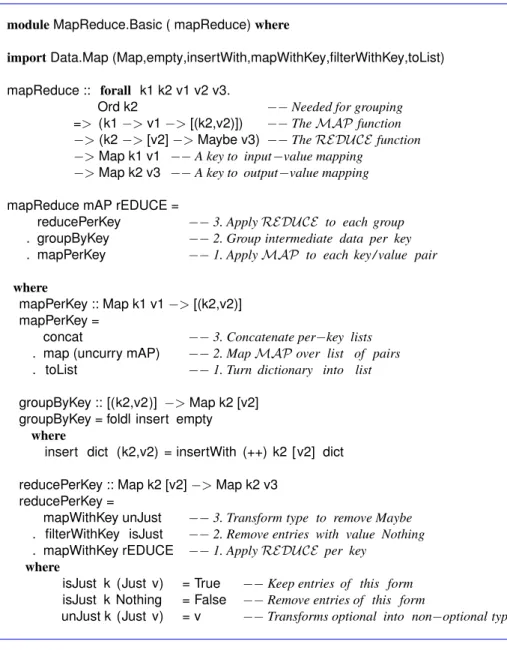
moduleMapReduce.Basic ( mapReduce)where
importData.Map (Map,empty,insertWith,mapWithKey,filterWithKey,toList)
mapReduce :: forall k1 k2 v1 v2 v3.
Ord k2 −−Needed for grouping => (k1−>v1−>[(k2,v2)]) −−TheMAP function
−>(k2−>[v2]−>Maybe v3) −−TheREDU CEfunction
−>Map k1 v1 −−A key to input−value mapping
−>Map k2 v3 −−A key to output−value mapping
mapReduce mAP rEDUCE =
reducePerKey −−3. ApplyREDU CE to each group . groupByKey −−2. Group intermediate data per key . mapPerKey −−1. ApplyMAP to each key / value pair
where
mapPerKey :: Map k1 v1−>[(k2,v2)] mapPerKey =
concat −−3. Concatenate per−key lists . map (uncurry mAP) −−2. MapMAPover list of pairs . toList −−1. Turn dictionary into list
groupByKey :: [(k2,v2)] −>Map k2 [v2] groupByKey = foldl insert empty
where
insert dict (k2,v2) = insertWith (++) k2 [v2] dict reducePerKey :: Map k2 [v2]−>Map k2 v3
reducePerKey =
mapWithKey unJust −−3. Transform type to remove Maybe . filterWithKey isJust −−2. Remove entries with value Nothing . mapWithKey rEDUCE −−1. ApplyREDU CE per key
where
isJust k (Just v) = True −−Keep entries of this form isJust k Nothing = False −−Remove entries of this form
unJust k (Just v) = v −−Transforms optional into non−optional type
Figure 1: The baseline specification for MapReduce
for expressions that populate a given type. We hope to prove this hypothesis some day. For now, we discover the definitions in a manual fashion. As a preview, and for ease of reference, the completemapReducefunction is summarized in Fig. 1.
The helpermapPerKeyis really just little more than the normal list map followed by concatenation. Weeitheruse the map function for dictionaries to first mapMAPover the input and then export to a list of pairs,orwe first export the dictionary to a list of
pairs and proceed with the standardmapfor lists. Here we opt for the latter:
... where mapPerKey
= concat −−3. Concatenate per−key lists . map (uncurry mAP) −−2. MapMAPover list of pairs . toList −−1. Turn dictionary into list
More Haskell trivia: In the code shown above, we use two more functions from the prelude. The functionconcatturns a list of lists into a flat list by appending them together; cf. the use of the (infix) operator ‘++’ for appending lists. The combinatoruncurrytransforms a given func-tion with two (curried) arguments into an equivalent funcfunc-tion that assumes a single argument, in fact, a pair of arguments. Here are the signatures and definitions for these functions (and two helpers):
concat :: [[ a ]] −>[a] concat xss = foldr (++) [] xss
uncurry :: (a−>b−>c)−>((a, b)−>c) uncurry f p = f ( fst p) (snd p)
fst (x,y) = x −−first projection for a pair snd (x,y) = y −−second projection for a pair
3
The helperreducePerKeyessentially mapsREDU CEover the groups of intermedi-ate data while preserving the key of each group; see the first step in the function com-position below. Some trivial post-processing is needed to eliminate entries for which reduction has computed the valueNothing.
... where
reducePerKey =
mapWithKey unJust −−3. Transform type to remove Maybe . filterWithKey isJust −−2. Remove entries with value Nothing . mapWithKey rEDUCE −−1. ApplyREDU CE per key
where
isJust k (Just v) = True −−Keep entries of this form isJust k Nothing = False −−Remove entries of this form
unJust k (Just v) = v −−Transforms optional into non−optional type Conceptually, the three steps may be accomplished by a simple fold over the dictio-nary — except that theData.Map.Maplibrary (as of writing) does not provide an oper-ation of that kind.
The helpergroupByKeyis meant to group intermediate values by intermediate key.
... where
groupByKey = foldl insert empty
whereinsert dict (k2,v2) = insertWith (++) k2 [v2] dict
Grouping is achieved by the construction of a dictionary which maps keys to its asso-ciated values. Each single intermediate key/value pair is ‘inserted’ into the dictionary; cf. the use ofData.Map.insertWith. A new entry with a singleton list is created, if the given key was not yet associated with any values. Otherwise the singleton is appended to the values known so far. The iteration over the key/value pairs is expressed as a fold.
Types bounds required by the definition: Now that we are starting to use some members of the abstract data type for dictionaries, we run into a limitation of the func-tion signatures, as discovered so far. In particular, the type ofgroupByKeyis too poly-morphic. The use ofinsertWithimplies that intermediate keys must becomparable. The Haskell type checker (here: GHC’s type checker) readily tells us what the problem is and how to fix it:
No instance for(Ord k2)arising from use of ‘insert’.
Probable fix: add(Ord k2)to the type signature(s) for ‘groupByKey’. So we constrain the signature ofmapReduceas follows:
mapReduce :: forall k1 k2 v1 v2 v3.
Ord k2 −−Needed for grouping => (k1−>v1−>[(k2,v2)]) −−TheMAPfunction
−>(k2−>[v2]−>Maybe v3) −−TheREDU CEfunction
−>Map k1 v1 −−A key to input−value mapping
−>Map k2 v3 −−A key to output−value mapping where ...
More Haskell trivia:
• In the type of the top-level function, we must use explicit universal quantification (see ‘forall’) in order to take advantage of the Haskell 98 extension for lexically scoped type variables. We have glanced over this detail before.
• Ordis Haskell’s standard type class for comparison. If we want to use comparison for a polymorphic type, then each explicit type signature over that type needs to put anOrd bound on the polymorphic type. In reality, the type classOrdcomprises several members, but, in essence, the type class is defined as follows:
class Ord a where compare :: a−>a−>Ordering
Hence, any ‘comparable type’ must implement thecompareoperation. In the type of compare, the data typeOrderingmodels the different options for comparison results:
data Ordering = LT| EQ|GT
3.7
Time to demo
Here is a MapReduce computation for counting occurrences of words in documents: wordOccurrenceCount = mapReduce mAP rEDUCE
where
mAP = const (map ( flip (,) 1) . words) −−each word counts as 1 rEDUCE = const (Just . sum) −−compute sum of all counts
Essentially, theMAP function is instantiated to extract allwordsfrom a given doc-ument, and then to couple up these words with ‘1’ in pairs; theREDU CE function is instantiated to simply reduce the various counts to theirsum. Both functions do not observe the key — as evident from the use ofconst.
More Haskell trivia: In the code shown above, we use a few more functions from the pre-lude. The expression ‘constx’ manufactures a constant function, i.e., ‘constx y’ equalsx, no matter they. The expression ‘flip f’ inverse the order of the first two arguments off, i.e., ‘flip f x y’ equals ‘f y x’. The expression ‘sumxs’ reducesxs(a list of numbers) to its sum. Here are the signatures and definitions for these functions:
const :: a−>b−>a const a b = a
flip :: (a−>b−>c)−>b−>a−>c flip f x y = f y x
sum :: (Num a) =>[a]−>a sum = foldl (+) 0
3 We can test themapReducefunction by feeding it with some documents.
main = print
$ wordOccurrenceCount
$ insert ”doc2” ” appreciate the unfold” $ insert ”doc1” ” fold the fold ” $ empty
Haskell-prompt> main
{” appreciate ”:=1,” fold ”:=2,”the”:=2,”unfold”:=1}
This test code constructs an input dictionary by adding two ‘documents’ to the initial, empty dictionary. Each document comprises a name (cf.”doc1”and”doc2”) and con-tent. Then, the test code invokeswordOccurrenceCounton the input dictionary and prints the resulting output dictionary.
4
Parallel MapReduce computations
The programmer can be mostly oblivious to parallelism and distribution; the program-ming model readily enables parallelism, and the MapReduce implementation takes care of the complex details of distribution such as load balancing, network performance and fault tolerance. The programmer has to provide parameters for controlling distribution and parallelism, such as the number of reduce tasks to be used. Defaults for the control parameters may be inferable.
In this section, we will first clarify the opportunities for parallelism in a distributed execution of MapReduce computations. We will then recall the strategy for distributed execution, as it was actually described in the seminal MapReduce paper. These prepa-rations ultimately enable us to refine the basic specification from the previous section so that parallelism is modeled.
4.1
Opportunities for parallelism
Parallel map over input: Input data is processed such that key/value pairs are pro-cessed one by one. It is well known that this pattern of a list map is amenable to total data parallelism [27,28,5,29]. That is, in principle, the list map may be executed in parallel at the granularity level of single elements. Clearly,MAP must be a pure function so that the order of processing key/value pairs does not affect the result of the map phase and communication between the different threads can be avoided.
Parallel grouping of intermediate data The grouping of intermediate data by key, as needed for the reduce phase, is essentially a sorting problem. Various parallel sorting models exist [18,6,32]. If we assume a distributed map phase, then it is reasonable to anticipate grouping to be aligned with distributed mapping. That is, grouping could be performed for any fraction of intermediate data and distributed grouping results could be merged centrally, just as in the case of a parallel-merge-all strategy [11].
Parallel map over groups: Reduction is performed for each group (which is a key with a list of values) separately. Again, the pattern of a list map applies here; total data parallelism is admitted for the reduce phase — just as much as for the map phase.
Parallel reduction per group: Let us assume thatREDU CE defines a proper re-duction; as defined in Sec. 2.2. That is, REDU CE reveals itself as an operation that collapses a list into a single value by means of an associative operation and its unit. Then, each application ofREDU CE can be massively parallelized by computing sub-reductions in a tree-like structure while applying the associative operation at the nodes [27,28,5,29]. If the binary operation is also commutative, then the order of combining results from sub-reductions can be arbitrary. Given that we already paral-lelize reduction at the granularity of groups, it is non-obvious that parallel reduction of thevalues per keycould be attractive.
partition 1
partition 1
partition R piece 1
piece M
map M
reduce 1
reduce R
Output data Intermediate data
Input data
map 1
partition R k2 [v2]
k2 v3 k1 v1
Figure 2: Map split input data and reduce partitioned intermediate data
4.2
A distribution strategy
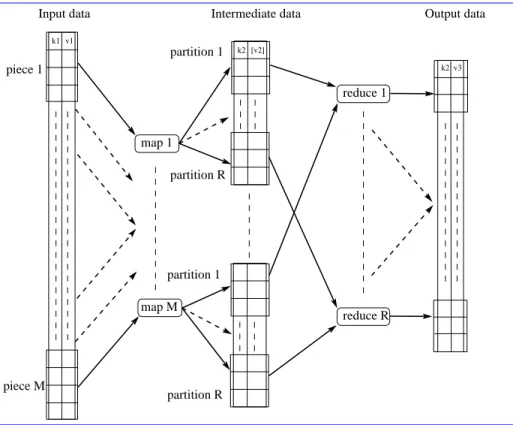
Let us recapitulate the particular distribution strategy from the seminal MapReduce paper, which is based on large networked clusters of commodity machines with local store while also exploiting other bits of Google infrastructure such as the Google file system [13]. The strategy reflects that the chief challenge is network performance in the view of the scarce resourcenetwork bandwidth. The main trick is to exploitlocality of data. That is, parallelism is aligned with the distributed storage of large data sets over the clusters so that the use of the network is limited (as much as possible) to steps for merging scattered results. Fig. 2 depicts the overall strategy. Basically, input data is split up into pieces and intermediate data is partitioned (by key) so that these different pieces and partitions can be processed in parallel.
• The input data is split up intoM pieces to be processed byM map tasks, which are eventually assigned to worker machines. (There can be more map tasks than simultaneously available machines.) The numberM may be computed from another parameter S — the limit for the size of a piece; S may be specified explicitly, but a reasonable default may be implied by file system and machine characteristics. By processing the input in pieces, we exploit data parallelism for list maps.
• The splitting step is optional. Subject to appropriate file-system support (such as the Google file system), one may assume ‘logical files’ (say for the input or the output of a MapReduce computation) to consist of ‘physical blocks’ that reside on different machines. Alternatively, a large data set may also be modeled as a setof files as opposed to a single file. Further, storage may beredundant, i.e., multiple machines may hold on the same block of a logical file. Distributed, redundant storage can be exploited by a scheduler for the parallel execution so that the principle of data locality is respected. That is, worker machines are assigned to pieces of data that readily reside on the chosen machines.
• There is a single master per MapReduce computation (not shown in the figure), which controls distribution such that worker machines are assigned to tasks and informed about the location of input and intermediate data. The master also manages fault tolerance by pinging worker machines, and by re-assigning tasks for crashed workers, as well as by speculatively assigning new workers to com-pete with ‘stragglers’ — machines that are very slow for some reason (such as hard-disk failures).
• Reduction is distributed overRtasks covering different ranges of the interme-diate key domain, where the numberRcan be specified explicitly. Again, data parallelism for list maps is put to work. Accordingly, the results of each map task are stored inRpartitions so that the reduce tasks can selectively fetch data from map tasks.
• When a map task completes, then the master may forward local file names from the map workers to the reduce workers so that the latter can fetch intermediate data of the appropriate partitions from the former. The map tasks may perform grouping of intermediate values by keys locally. A reduce worker needs to merge the scattered contributions for the assigned partition before REDU CE can be applied on a per-key basis, akin to a parallel-merge-all strategy.
• Finally, the results of the reduce tasks can be concatenated, if necessary. Alter-natively, the results may be left on the reduce workers for subsequent distributed data processing, e.g., as input for another MapReduce computation that may readily leverage the scattered status of the former result for the parallelism of its map phase.
There is one important refinement to take into account. To decrease the volume of intermediate data to be transmitted from map tasks to reduce tasks, we should aim to perform local reduction before even starting transmission. As an example, we consider counting word occurrences again. There are many words with a high frequency, e.g., ‘the’. These words would result in many intermediate key/value pairs such ash‘the’,1i. Transmitting all such intermediate data from a map task to a reduce task would be a considerable waste of network bandwidth. The map task may already combine all such pairs for each word.
The refinement relies on a new (optional) argument, COMBIN ER, which is a function “that does partial merging of this data before it is sent over the network.
[...] Typically the same code is used to implement both the combiner and reduce func-tions” [10]. When both functions implement the same proper reduction, then, concep-tually, this refinement leverages the opportunity for massive parallelism of reduction of groups per key, where the tree structure for parallel reduction is of depth 2, with the leafs corresponding to local reduction. It is worth emphasizing that this parallelism does not aim at a speedup on the grounds of additional processors; in fact, the number of workers remains unchanged. So the sole purpose of a distributed reduce phase is to decrease the amount of data to be transmitted over the network.
4.3
The refined specification
The following specification does not formalize task scheduling and the use of a dis-tributed file system (with redundant and disdis-tributed storage). Also, we assume that the input data is readily split and output data is not concatenated.5 Furthermore, let us start with ‘explicit parallelization’. That is, we assume user-defined parameters forthe number of reduce tasksandthe partitioning function for the intermediate key domain.
Here is the signature of the newmapReducefunction: mapReduce :: Ord k2 =>
Int −−Number of partitions
−>(k2−>Int) −−Partitioning for keys
−>(k1−>v1−>[(k2,v2)]) −−TheMAP function
−>(k2−>[v2]−>Maybe v3) −−TheCOMBIN ERfunction
−>(k2−>[v3]−>Maybe v4) −−TheREDU CEfunction
−>[Map k1 v1] −−Distributed input data
−>[Map k2 v4] −−Distributed output data mapReduce parts keycode mAP cOMBINER rEDUCE
= ... −−To be cont’d
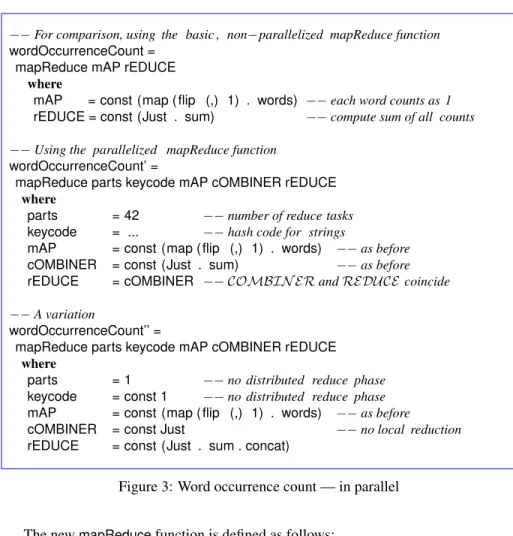
This new function takes a list of dictionaries for the input — corresponding to the pieces for the various map tasks, and it returns a list of dictionaries for the output — corresponding to the reduction results from the various reduce tasks. The argument partsdefines the number of partitions for intermediate data (which equals the number of reduce tasksR). The argumentkeycodedefines the partitioning function on the intermediate key domain; it is supposed to map keys to the range 1, . . . ,parts. The argumentcOMBINERdefines theCOMBIN ERfunction for reducing intermediate data per map task. We give it the same general type asREDU CE — modulo an ad-ditional type distinction for the sake of generality: the result type ofCOMBIN ER is the element type reduced byREDU CE. (The COMBIN ERargument is effec-tively optional since it can be trivially defined in such a way that it passes all values to REDU CE.) Fig. 3 illustrates the application of the newmapReducefunction.
5The source-code distribution for this paper exercises the trivial steps for splitting input and concatenating
−−For comparison, using the basic , non−parallelized mapReduce function wordOccurrenceCount =
mapReduce mAP rEDUCE where
mAP = const (map ( flip (,) 1) . words) −−each word counts as 1 rEDUCE = const (Just . sum) −−compute sum of all counts
−−Using the parallelized mapReduce function wordOccurrenceCount’ =
mapReduce parts keycode mAP cOMBINER rEDUCE where
parts = 42 −−number of reduce tasks keycode = ... −−hash code for strings
mAP = const (map ( flip (,) 1) . words) −−as before cOMBINER = const (Just . sum) −−as before rEDUCE = cOMBINER −− COMBIN ERandREDU CEcoincide
−−A variation
wordOccurrenceCount’’ =
mapReduce parts keycode mAP cOMBINER rEDUCE where
parts = 1 −−no distributed reduce phase keycode = const 1 −−no distributed reduce phase mAP = const (map ( flip (,) 1) . words) −−as before
cOMBINER = const Just −−no local reduction rEDUCE = const (Just . sum . concat)
Figure 3: Word occurrence count — in parallel
The newmapReducefunction is defined as follows:
mapReduce parts keycode mAP cOMBINER rEDUCE =
map (
reducePerKey rEDUCE −−7. ApplyREDU CE to each partition . mergeByKey ) −−6. Merge scattered intermediate data . transpose −−5. Transpose scattered partitions . map (
map (
reducePerKey cOMBINER −−4. ApplyCOMBIN ER locally . groupByKey ) −−3. Group local intermediate data . partition parts keycode −−2. Partition local intermediate data . mapPerKey mAP ) −−1. ApplyMAP locally to each piece
The outermost applications of list map (in bold face) correspond to the parallel map and reduce tasks including the grouping and merging activities on local data. In between, atranspositionis performed; it models the communication between map and reduce
tasks at a high level of abstraction. That is, for each given logical partition, the scattered physical contributions of the map tasks are united to form the input for the reduce task that is responsible for the partition. (The functiontransposetakes a nested list of lists where the sublists are of the same length, and transposes the list structure in the sense of matrices in mathematics. For instance, the list[[1,2,3],[4,5,6]]is transposed to
[[1,4],[2,5],[3,6]].)
The newmapReducefunction relies on the same functionsmapPerKey,groupByKey andreducePerKey as before, except that we assume top-level definitions for better reuse this time. (Hence, all parameters are passed explicitly.) The additional use of the COMBIN ERfunction implies that there are now two applications ofreducePerKey— one per map task; another per reduce task. There are two new helpers that need to be defined:
−−Partition intermediate data
partition :: Int −>(k2−>Int)−>[(k2,v2)]−>[[(k2,v2)]] partition parts keycode pairs = map select keys
where
keys = [1.. parts] −−the list 1, .., parts select part = filter pred pairs −−filter pairs by key
where
pred (k, ) = keycode k == part
−−Merge intermediate data
mergeByKey :: Ord k2 =>[Map k2 v3]−>Map k2 [v3] mergeByKey =
unionsWith (++) −−2. Merge dictionaries . map (mapWithKey (const singleton)) −−1. Migrate to list type where
singleton x = [x]
The partition function creates a nested lists, with the inner lists corresponding to the partitions of the input. (In an actual implementation, the initial list is perhaps never materialized, but each application ofMAP may immediately store each intermediate key/value pair in the appropriate partition slot.) ThemergeByKeyfunction essentially merges dictionaries by forming a list of values for each key. Clearly, merging is fun-damentally more efficient than a general grouping operation (say, a sorting operation) because all the incoming dictionaries for the merger are readily grouped and sorted.
4.4
Implicit parallelization for reduction
If we assume that the input data is readily stored in a distributed file system, then we may derive the number of map tasks from the existing segmentation, thereby making the parallelism of the map phase ‘implicit’. Let us also try to make implicit other con-trol parameters for parallel/distributed execution. Optimal values for the number of reduce tasks and the partitioning function for the intermediate key domain may require problem-specific insights. In the following, we sketch a generic (and potentially sub-optimal) method, which is based on a ‘quick scan’ over the result of the map phase and a generic hash-code function for the key domain.
mapReduce mAP cOMBINER rEDUCE hash x = map (
reducePerKey rEDUCE −−7. ApplyREDU CE to each partition . mergeByKey ) −−6. Merge intermediates per key $ transpose −−5. Transpose scattered partitions $ map (
map (
reducePerKey cOMBINER −−4. ApplyCOMBIN ER locally . groupByKey ) −−3. Group local intermediate data . partition parts keycode ) −−2. Partition local intermediate data $ y −−1. ApplyMAP locally to each piece where
y = map (mapPerKey mAP) x (parts,keycode) = quickScan hash y
This approach implies some synchronization costs; it assumes that all map tasks have been completed before the number of partitions is calculated, and the intermediate key/value pairs are associated with partitions, before, in turn, the reduce phase can be started. Here is a concrete proposal forquickScan:
quickScan :: (Data k2, Data v2) =>(k2−>Int)−>[[(k2,v2)]] −>(Int, k2−>Int) quickScan hash x = (parts, keycode)
where parts =
min maxParts −−Enforce bound
$ flip div maxSize −−Compute number of partitions
$ sum −−Combine sizes
$ map (sum . map gsize) x −−Total data parallelism for size keycode key =
(( hash key) ‘mod‘ parts) + 1
We leverage a generic size function,gsize, that is provided by Haskell’s generic pro-gramming libraryData.Generics(admittedly based on Haskell’98 extensions). This size function implies theDataconstraints for the intermediate key and value domains in the type ofquickScan. Further, this definition presumes two fixed limitsmaxSize, for the maximum size of each partition, andmaxParts, for a cut-off limit for the num-ber of partitions. For simplicity, the maximum size is not used as a strict bound for the size of partitions; it is rather used to determine the number of partitions under the idealizing assumption of uniform distribution over the intermediate key domain. As an aside, the definition ofquickScanis given in a format that clarifies the exploitable par-allelism. That is, sizes can be computed locally per map task, and summed up globally. It is interesting to notice that this scheme is reminiscent of the distributed reduce phase (without though any sort of key-based indexing).
4.5
Correctness of distribution
We speak ofcorrect distributionif the result of distributed execution is independent of any variables in the distribution strategy, such as numbers of map and reduce tasks,
and the semi-parallel schedule for task execution. Without the extraCOMBIN ER argument, a relatively obvious, sufficient condition for a correct distribution is this: (i) theREDU CE function is a proper reduction, and (ii) the order of intermediate values per key, as seen byREDU CE, is stable w.r.t. the order of the input, i.e., the order of intermediate values for the distributed execution is the same as for the non-distributed execution.
Instead of (ii) we may require (iii): commutativity for the reduction performed by REDU CE. We recall that the type ofREDU CE, as defined by the seminal MapReduce paper, goes beyond reduction in a narrow sense. As far as we can tell, there is no intuitive, sufficient condition for correct distribution once we give up on (i).
Now consider the case of an additionalCOMBIN ERargument. IfCOMBIN ER andREDU CE implement the same proper reduction, then the earlier correctness con-dition continues to apply. However, there is no point in having two arguments, if they were always identical. If they are different, then, again, as far as we can tell, there is no intuitive, sufficient condition for correct distribution.
As an experiment, we formalize the condition for correctness of distribution for arbitraryCOMBIN ERandREDU CEfunctions, while essentially generalizing (i) + (iii). We state that the distributed reduction of any possible segmentation of any pos-sible permutation of a listlof intermediate values must agree with the non-distributed reduction of the list.
For allk of typek2, for alllof type[v2],
for alll0of type[[v2]]such thatconcatl0is a permutation ofl REDU CEk(unJusts(COMBIN ERk l))
= REDU CEk(concat(map(unJusts.COMBIN ERk)l0))
where
unJusts (Just x) = [x] unJusts Nothing = []
We contend that the formal property is (too) complicated.
5
Sawzall’s aggregators
When we reflect again on the reverse-engineered programming model in the broader context of (parallel) data-processing, one obvious question pops up. Why would we want to restrict ourselves tokeyedinput and intermediate data? For instance, consider the computation of any sort of ‘size’ of a large data set (just as in the case of the quick scan that was discussed above). We would want to benefit from MapReduce’s parallelism, even for scenarios that do not involve any keys. One could argue that a degenerated key domain may be used when no keys are needed, but there may be a better way of abstracting from the possibility of keys. Also, MapReduce’s parallelism for reduction relies on the intermediate key domain. Hence, one may wonder how parallelism is to be achieved in the absence of a (non-trivial) key domain.
Further reflection on the reverse-engineered programming model suggests that the model is complicated, once two arguments,REDU CE andCOMBIN ER, are to be understood. The model is simple enough,if both arguments implement exactly the same function. If the two arguments differ, then the correctness criterion for distribu-tion is not obvious enough. This unclarity only increases once we distinguish types for intermediate and output data (and perhaps also for data used for the shake-hand betweenREDU CE andCOMBIN ER). Hence, one may wonder whether there is a simpler (but still general) programming model.
Google’s domain-specific language Sawzall [26], with its key abstraction, aggrega-tors, goes beyond MapReduce in related ways. Aggregators are described informally in the Sawzall paper — mainly from the perspective of a language user. In this section, we present the presumed, fundamental characteristics of aggregators.
We should not give the impression that Sawzall’s DSL power can be completely reduced to aggregators. In fact, Sawzall provides a rich library, powerful ways of dealing with slightly abnormal data, and other capabilities, which we skip here due to our focus on the schemes and key abstractions for parallel data-processing.
5.1
Sawzall’s map & reduce
Sawzall’s programming model relies on concepts that are very similar to those of MapReduce. A Sawzall program processes a record as input and emits values for ag-gregation. For instance, the problem of aggregating the size of a set of CVS submission records would be described as follows — using Sawzall-like notation:
proto“CVS.proto” −−Include types for CVS submission records cvsSize:table sum of int; −−Declare an aggregator to sum up ints record:CVS submission=input; −−Parse input as a CVS submission emitcvsSize←record.size; −−Aggregate the size of the submission The important thing to note about this programming style is that one processes one record at the time. That is, the semantics of a Sawzall program comprises the execution of a fresh copy of the program for each record; the per-record results are emitted to a shared aggregator. The identification ofthe kind of aggregatoris very much like the identification of aREDU CEfunction in the case of a MapReduce computation.
The relation between Sawzall and MapReduce has been described (in the Sawzall paper) as follows [26]: “The Sawzall interpreter runs in the map phase. [...] The Sawzall program executes once for each record of the data set. The output of this map phase is a set of data items to be accumulated in the aggregators. The aggregators run in the reduce phase to condense the results to the final output.” Interestingly, there is no mentioning of keys in this explanation, which suggests that the explanation is incomplete.
5.2
List homomorphisms
The Sawzall paper does not say so, but we contend that the essence of a Sawzall pro-gram is to identify the characteristic arguments of a list homomorphism [4,9,28,17,8]: a function to be mapped over the list elements as well as the monoid to be used for the
reduction. (A monoid is a simple algebraic structure: a set, an associative operation, and its unit.) List homomorphisms provide a folklore tool for parallel data processing; they are amenable to massive parallelism in a tree-like structure; element-wise mapping is performed at the leafs, and reduction is performed at all other nodes.
In the CVS example, given above, the conversion of the generically typedinputto record(which is of the CVS submission type), composed with the computation of the record’s size is essentially the mapping part of a list homomorphism and the declaration of the ‘sum’ aggregator, to which we emit, identifies the monoid for the reduction part of the list homomorphism. For comparison, let us translate the Sawzall-like code to Haskell. We aggregate the sizes of CVS submission records in the monoidSum— a monoid under addition:
importCVS −−Include types for CVS submission records importData.Monoid −−Haskell’s library for reduction
importData.Generics −−A module with a generic size function
cvsSize input = Sum (gsize x) where
x :: CvsSubmission x = read input
Here,Suminjects an Int into the monoid under addition. It is now trivial to apply cvsSizeto a list of CVS submission records and to reduce the resulting list of sizes to a single value (by using the associative operation of the monoid).
As an aside, Google’s Sawzall implementation uses a proprietary, generic record format from which to recover domain-specific data by means of ‘parsing’ (as opposed to ‘strongly typed’ input). In the above Haskell code, we approximate this overall style by assumingStringas generic representation type and invoking the normalread operation for parsing. In subsequent Haskell snippets, we take the liberty to neglect such type conversions, for simplicity.
Haskell’s monoids: There is the following designated type class:
class Monoid a where
mappend :: a −>a−>a −−An associative operation mempty :: a −−Identity of ’mappend’ mconcat :: [a] −>a −−Reduction
mconcat = foldr mappend mempty −−Default definition
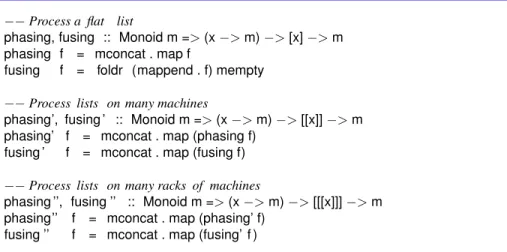
The essential methods aremappendandmempty, but the class also defines an over-loaded methods for reduction:mconcat. We note that this method, by default, is right-associative (as opposed to left associativity as Lisp’s default). For instance,Sum, the monoid under addition, which we used in the above example, is defined as follows:
![Figure 5: The above figure and the following quote is verbatim taken from [26]: “Five racks of 50-55 working computers each, with four disks per machine](https://thumb-us.123doks.com/thumbv2/123dok_us/8449971.2249582/32.918.202.717.188.498/figure-figure-following-quote-verbatim-working-computers-machine.webp)