American Time Use Survey
User’s Guide
Understanding ATUS 2003 to 2014
The American Time Use Survey (ATUS) is sponsored by the Bureau of
Labor Statistics and conducted by the U.S. Census Bureau
page 2
CHAPTER 1: SURVEY OBJECTIVES ...3
CHAPTER 2: HISTORY OF THE AMERICAN TIME USE SURVEY ...5
CHAPTER 3: SURVEY DESIGN ... 11
CHAPTER 4: DATA COLLECTION ... 15
CHAPTER 5: CODING THE DATA ... 21
Exhibit 5.1: Travel Codes
CHAPTER 6: DATA EDITING, IMPUTATION, AND ITEM NONRESPONSE ... 26
Exhibit 6.1: Imputation Methods
Exhibit 6.2: ATUS Data Files
CHAPTER 7: WEIGHTS, LINKING, AND ESTIMATION ... 34
CHAPTER 8: PUBLICATIONS AND DATA FILES ... 43
CHAPTER 9: SPECIAL TOPICS ... 45
CHAPTER 10: DATA QUALITY………46
CONCEPTS AND DEFINITIONS ... ..48
APPENDIX A: Advance letter to households with telephone numbers
APPENDIX B: Advance letter to households without telephone numbers
APPENDIX C: Advance letter to parents or guardians of minor respondents
APPENDIX D: Frequently asked questions (sent with advance letters)
APPENDIX E: Refusal conversion letter
APPENDIX F: Refusal conversion letter sent to parents or guardians of minor
Respondents
APPENDIX G: Link to the activity coding lexicon
APPENDIX H: Bridge between published tables major categories and ATUS coding
lexicon major categories
APPENDIX I: Link to the coding rules manual
APPENDIX J: Generating ATUS estimates—Examples
APPENDIX K: Linking ATUS files to CPS files
APPENDIX L: Basic CPS rotation
APPENDIX M: Statistical weights for merged data from the ATUS and a CPS supplement
APPENDIX N: Reliability Criteria for ATUS Published and Unpublished Tables
page 3
CHAPTER 1:
SURVEY OBJECTIVES
1.1
WHAT DO THE AMERICAN TIME USE SURVEY DATA MEASURE?
The American Time Use Survey (ATUS) is the Nation’s first federally administered, continuous survey on time use in the United States. The goal of the survey is to measure how people divide their time among life’s activities.
In ATUS, individuals are randomly selected from a subset of households that have completed their eighth and final month of interviews for the Current Population Survey (CPS). ATUS respondents are interviewed only one time about how they spent their time on the previous day, where they were, and whom they were with. The survey is sponsored by the Bureau of Labor Statistics and is conducted by the U.S. Census Bureau.
The major purpose of ATUS is to develop nationally representative estimates of how people spend their time. Many ATUS users are interested in the amount of time
Americans spend doing unpaid, nonmarket work, which could include unpaid childcare, eldercare, housework, and volunteering. The survey also provides information on the amount of time people spend in many other activities, such as religious activities, socializing, exercising, and relaxing. In addition to collecting data about what people did on the day before the interview, ATUS collects information about where and with whom each activity occurred, and whether the activities were done for one’s job or business. Demographic information—including sex, race, age, educational attainment, occupation, income, marital status, and the presence of children in the household—also is available for each respondent. Although some of these variables are updated during the ATUS interview, most of this information comes from earlier CPS interviews, as the ATUS sample is drawn from a subset of households that have completed month 8 of the CPS.
1.2
HOW CAN THE SURVEY RESULTS BE USED?
ATUS significantly furthers understanding about how Americans spend their time. Because ATUS data are collected on an ongoing, monthly basis, time-series data can be analyzed to identify any changes in how people spend their time.ATUS data can provide a wide range of applications for different users.
For example, many economists are interested in estimating the monetary value of nonmarket work. ATUS includes information about time spent doing both paid and unpaid activities. By using time-use data in conjunction with earnings data, economists are able to estimate the value of nonmarket production—such as housework, volunteer work, and childcare. Some efforts are being undertaken (outside BLS) to account for such measures when developing aggregate output estimates, including gross domestic product. ATUS data can also provide insight into the total number of hours people work—both at work and at other locations, such as home. Total hours of work can help economists more accurately measure productivity. Lawmakers may use the data to make more informed decisions, such as how a particular policy might affect people’s behavior
.
Likewise, businesses can use ATUS data on how people spend their time to determine what kinds of goods and services to develop or market to a particular group. ATUS data also include information on with whom and where respondents spend their time. From this, sociologists can determine, for example, the average amount of time fathers or mothers spend with their children, or how much time people spend with colleagues and friends. It also is possible to determine how much time people spend working outside of the office. All of this information can help researchers understandpage 4
how people in the United States are dividing their time among the duties of childcare; the demands of their jobs; their need to relax or exercise; and their religious,
volunteer, and other commitments.
Many other countries have done time-use surveys, and more are planning to conduct them in the future. Time-use data are currently collected in North America, South America, Europe, Australia, and New Zealand. ATUS was designed to ensure that time-use information in the United States can be compared, at broad levels, with
page 5
CHAPTER 2:
HISTORY OF THE AMERICAN TIME USE SURVEY
2.1
DEVELOPMENTAL PHASES
The development of ATUS began in 1991, when it was first discussed at BLS as a statistical policy issue, and continued to January 2003, when ATUS data collection officially began. Since then, the survey has been continuously improved. The 12–year period from 1991 to 2003 is described in four developmental phases, below.
Developmental phase 1: Early interest, 1991-1995
From 1991 to 1995, BLS began to develop an understanding of other countries’ collection of time-use data and the demands for such data in the United States. 1991: Unremunerated Work Act
This bill, which called on BLS to “conduct time-use surveys of unremunerated work performed in the United States,” did not make it out of congressional committee, but it acted as the catalyst for BLS to begin studying the issue of collecting time-use data.
1992: Statistics Canada conference
Statistics Canada held a conference on the value and measurement of unpaid work. This conference exposed BLS to a gap in the United States Federal Statistical System—there was no measure of time use to enable an estimate of the value of unpaid work.
1995: United Nations conference in Beijing, China
The U.N. International Conference on the Status of Women again raised the issue of measuring and valuing unremunerated work as a topic of international interest. The conference’s Platform for Action (item 206) stated that “national, regional and international statistical agencies should measure, in quantitative terms, unremunerated work that is outside national accounts and reflect its value in satellite or other official accounts that are separate from but consistent with core national accounts.”1
Developmental phase 2: Feasibility, 1997
In 1997, BLS recognized a growing interest in time-use data. Consequently, the agency began exploring how researchers had used data from prior studies and how BLS might conduct a time-use survey.
1997: BLS Pilot Survey and BLS-MacArthur Conference
BLS conducted this trial survey to examine the viability of conducting a time-use survey by telephone in the United States. (This is discussed further in section 2.2.1.)
To present the findings from the pilot study and to become acquainted with time-use data and researchers, BLS cosponsored a conference with the MacArthur Foundation entitled “Time Use, Nonmarket Work and Family Well-Being.” Three positive developments that arose from this conference included:
1. The introduction of BLS to the international community of time-use researchers and survey practitioners;
page 6
2. The presentation of evidence by researchers that time-use data were analytically very important and that the lack of a time-use survey was “the biggest single gap in the Federal Statistical System”2; and
3. The opportunity for the BLS time-use working group to receive critical feedback on the pilot study and advisement on the direction of work in the subsequent developmental phase.
Developmental phase 3: Development of specifications, 1998-1999
From 1998 to 1999, a small team of BLS researchers began to develop specifications for a BLS survey on time use.
1998: BLS working group
The BLS Commissioner asked the working group to develop a more detailed plan for the collection of time-use data. The report that resulted from this request became the blueprint for the American Time Use Survey (ATUS).
1999: National Academy of Science (NAS) Conference
As a followup to the BLS-MacArthur Conference, the NAS held a workshop that explored the importance of time-use surveys and the conceptual and design issues associated with them. The BLS was invited to present its ideas on how it would go about collecting time-use data.
1999: Request for funds
BLS made the first budget request for collecting time-use data to the Office of Management and Budget.
Developmental phase 4: Building the survey, 2000-2002
During 2000-2002, the survey specifications were turned into systems. This period included detailed testing, design work, software development, training, and other preparatory work for the survey.
2000: Budget for ATUS
The survey received official approval and funding in December 2000. At this time, joint BLS-Census Bureau teams were formed to oversee the management of the survey, and they began working to fully operationalize the survey.
2001–2002: Survey development, operations field test, and coding tests During 2001 and 2002, developments took place in several areas of the survey, including the building of ATUS data-collection and coding instruments, the development of an activity-coding classification scheme, and the drafting of procedures for the call center. In addition, several decisions about the survey and operations were made during these 2 years; these included decisions about the survey’s estimation objectives, the frequency of the survey, the survey reference period, how sampling would be done, what the questionnaire specifications would be, how the survey would be carried out operationally, and how the data would eventually be disseminated (discussed further in sections 2.2.2-2.2.6).
2003: Data collection
January 2003 marked the official beginning of data collection for ATUS.
2 Bureau of Labor Statistics and MacArthur Network on the Family and the Economy, “Time Use, Non-Market Work, and Family Well-Being,” Summaries of the Time Use Conference, Nov. 20-21 (Bureau of Labor Statistics and MacArthur Foundation, 1997).
page 7
2.2
FIELD STUDY
Prior to full production in 2003, several tests and field studies were conducted that helped in the development of ATUS. In addition to the 1997 BLS-Westat pilot test, several important tests occurred between funding in December 2000 and full production in January 2003.
2.2.1
1997 PILOT STUDY
In 1997, BLS hired a survey contractor, Westat, to conduct a pilot study of two versions of a time-use survey using a telephone methodology. The pilot study drew on other surveys (primarily efforts by Statistics Canada) and provided a foundation for the development of testing specifications for ATUS. The pilot yielded valuable insights on response rates, the collection of simultaneous activities, and how to probe for specific information. In addition, the study guided subsequent research on contact strategies.
2.2.2
OPERATIONS TEST
Between April and June 2001, three simultaneous field tests were conducted by BLS and the Census Bureau. Because the field tests were done only once, the agencies decided to use a paper-and-pencil questionnaire and control system rather than automating the survey. Six important operational decisions were made as a result of these three field tests.
1. Households with no telephone number would be mailed a $40 debit card to increase their likelihood of calling in to complete the survey. This debit card would not only give designated persons3 in these households an incentive to participate, but also reimburse them for the telephone call. No debit cards would be mailed to households with telephone numbers. 2. Cases that had not been completed after the 8-week calling period would
not be “recycled” to the field; that is, these households would not receive field visits from Census Bureau interviewers.
3. Designated persons would be eligible to report on only one specific day of the week; no other day of the week would be substituted for this day. 4. Designated persons would be called only on their designated interview day
and would not be called prior to this day to set an appointment.
5. Priority Mail would be used to send out the advance materials (ATUS letter and brochure) to designated ATUS persons.
6. All ATUS interviewing would be done using computer-assisted telephone interviewing (CATI); there would be no in-person interviews.
These decisions were made by examining the response rate gains (if any) and the costs of multiple operational approaches and then choosing options that were viable within the ATUS annual budget.
2.2.3
COGNITIVE TESTING
BLS engaged in a series of cognitive pretesting efforts designed to ensure that respondents understand survey questions in a manner that is consistent with
3 ATUS randomly selects one person from each household in the sample to respond to the survey. (See section 3.3 on sample design and selection procedures.) This document refers to this household member as the designated person when discussing operations that take place before interview contact is made. Designated persons who respond to the survey are referred to as respondents.
page 8
the survey developers’ intent. BLS requires that all survey questions undergo such testing and, if necessary, be revised until they solicit information consistent with research concepts.
Cognitive research was used to develop and improve ATUS summary questions on work and income-generating activities, secondary childcare, eldercare, and overnight trips of 2 or more days for a specific reference month.
These followup summary questions, asked after the respondent has completed the time diary, focus on getting additional information on important activities. For the childcare and eldercare questions, focus groups were used to develop a definition of secondary childcare and eldercare as well as wording for first-draft questions. For other questions, wording was first-drafted by ATUS staff and then tested. After drafting, questions were tested following a similar methodology: 20 to 30 people were recruited to participate in a mock ATUS interview followed by a face-to-face cognitive (debriefing) interview. The cognitive interviews were used to assess the ease or difficulty with which the respondents could recall the information required for the ATUS interview; the confidence with which they could report the information; omissions and errors in responses to summary questions; and other issues specific to each of the summary questions. The information gained from these tests was used to modify the summary questions so that they would better elicit the information desired by BLS and the Census Bureau.4
2.2.4
CODING LEXICON TESTING
After data collection, activities reported by respondents must be coded using a three-tier coding system. To ensure that coding could be done accurately and the analytical value of the data preserved or enhanced, several coding tests were conducted. BLS conducted three tests using coders at the Census Bureau’s National Processing Center in Jeffersonville, IN. Each test introduced a revised lexicon and more extensive coding rules and training than the previous one. The third test also evaluated the usability of new coding software. These tests led to numerous changes in the classification system.
An additional test was conducted by BLS and Westat in 2001 to measure coding accuracy and efficiency over time, to evaluate BLS coding training, and to assess the usability of the coding instrument. The tests showed that coding speed increased rapidly with experience, and coding accuracy increased as well, though not as quickly. BLS implemented several of Westat’s
recommendations to improve the classification system, the coding software, and the coding training.
Further progress was made in improving activity coding up to full production. These advancements include, but are not limited to, the development of rules and job aids for training purposes and the implementation of a coding
verification and adjudication process.
2.2.5
DRESS REHEARSAL
BLS and the Census Bureau conducted an ATUS dress rehearsal between April and August 2002. The purpose of this test was to conduct ATUS in a standard data production environment, incorporating most of the results from the 2001
page 9
operations field test. A sample of 7,000 designated persons was drawn from households that had completed the last month of CPS interviews, and these individuals were each assigned a day of the week about which they would be interviewed. Advance letters describing the time-use survey were sent to all designated persons, and those in households without a telephone number were offered a $40 debit card to complete the interview.
The dress rehearsal was important because some operational issues of ATUS required further testing before full production began in 2003. ATUS was the first Census Bureau survey to use conversational interviewing to collect data. This also marked the first time that data from real interviews would be coded using the new ATUS classification system. It also was the first CATI interview designed using Blaise software5 integrated into the Census Bureau’s case management system and conducted at the Jeffersonville telephone center. A large-scale field test was necessary to evaluate the effectiveness of ATUS training modules to adequately prepare interviewers and coders; to determine respondents’ reactions to a CATI time-use survey; and to determine whether case management, data collection, coding, and processing systems functioned as planned. The intent was to mirror full-production conditions as closely as possible to work out any operational problems that still remained. An interviewer debriefing after the dress rehearsal established that there were several areas of the training that needed improvement. In addition, various operational problems were fixed, operations management reports were developed, and the need to add a question clarifying volunteer activities was addressed during dress rehearsal.
2.2.6
PREFIELDING
From September to December 2002, BLS and the Census Bureau continued full-scale operations to refine the data-collection procedures, the CATI instrument, the calling strategy, and the coding lexicon. Refinements based on the results of the dress rehearsal and debriefing sessions were implemented and evaluated as the survey approached full production in January 2003.
2.3
Survey Changes
2.3.1 Eldercare Questions
Prior to 2011, the ATUS did not collect data on time spent providing eldercare. Recognizing the need for quality eldercare data, BLS had made many efforts over the years to develop questions to collect this information. In 2005, BLS hosted a subject matter expert panel to refine the concept of eldercare, to determine the most appropriate method for collecting the data within the ATUS design, and to obtain feedback on the kinds of measures that would best inform the eldercare research and policy communities.
The development process over the years also included a review of existing eldercare measures, focus groups with caregivers, reviews of draft questionnaires by subject matter experts and survey methods experts, internal testing and refinement of the questions, and cognitive testing of the questions.
Questions on eldercare were introduced to the ATUS in January 2011. The ATUS eldercare questions were designed specifically to identify eldercare
5 Blaise software was developed by Statistics Netherlands and is the standard for both survey and coding applications at the Census Bureau.
page 10
providers and to measure the time they spent providing eldercare. Additional information, such as the relationship between the care provider and care recipient, the age of the care recipient, and the types of care activities that care providers do also are collected. The eldercare questions replaced the trips questions (see section 3.5).
page 11
CHAPTER 3:
SURVEY DESIGN
3.1
UNIVERSE
ATUS covers all residents living in households in the United States that are at least 15 years of age, with the exception of active military personnel and people residing in institutions such as nursing homes and prisons.
3.2
SAMPLING FRAME
The ATUS sample is drawn from the CPS, so the ATUS universe is the same as the CPS universe. The universe for the CPS is composed of the civilian, noninstitutional population residing in occupied households in the United States. From this universe, the CPS selects approximately 60,000 households every month. About one-eighth (or about 7,500) of these retire permanently from the CPS sample each month after their eighth CPS interview attempt. Two months after households complete their eighth CPS interview, they become eligible for selection into the ATUS sample.
3.3
SAMPLE DESIGN AND SELECTION PROCEDURES
The ATUS sample is a stratified, three-stage sample. In the first stage of selection, the CPS oversample in the less-populous States is reduced. The CPS is designed to produce reliable estimates at the State and national level. Because of the CPS State reliability requirement, the less populous States are allocated a larger proportion of the national CPS sample than they would get with only a national reliability requirement. ATUS does not have a State reliability requirement. To improve the efficiency of the national estimates from the survey, the CPS sample is subsampled to obtain the ATUS sample, which is distributed across the States approximately equal to the proportion of the national population each one represents.
In the second stage of selection, households are stratified based on these characteristics: the race/ethnicity of the householder, the presence and age of children, and the number of adults in adults-only households. Sampling rates vary within each stratum. Eligible households with a Hispanic or non-Hispanic black householder are oversampled to improve the reliability of time-use data for these demographic groups. To ensure adequate measures of childcare, households with children are also oversampled. To compensate for this, households without children are undersampled.
In the third stage of selection, an eligible person from each household selected in the second stage is randomly selected to be the designated person for ATUS. An eligible person is a civilian household member at least 15 years of age. All eligible persons within a sample household have the same probability of being selected as the ATUS designated person.
3.4
SAMPLE SIZE
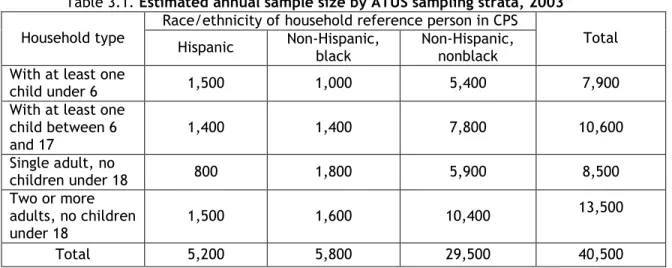
In 2003, 3,375 households leaving the CPS sample were selected for the ATUS sample each month (approximately 40,500 households annually). Based on the race/ethnicity of the householder and the presence and age of household children, households were classified into one of 12 possible strata. Table 3.1 lists the approximate number of households sampled each year in 2003 from each of the 12 strata.
page 12
Table 3.1. Estimated annual sample size by ATUS sampling strata, 2003 Household type
Race/ethnicity of household reference person in CPS
Total Hispanic Non-Hispanic, black Non-Hispanic, nonblack
With at least one
child under 6 1,500 1,000 5,400 7,900
With at least one child between 6 and 17
1,400 1,400 7,800 10,600
Single adult, no
children under 18 800 1,800 5,900 8,500
Two or more adults, no children
under 18 1,500 1,600 10,400
13,500
Total 5,200 5,800 29,500 40,500
Beginning with the sample introduced in December 2003, the monthly ATUS sample was reduced by 35 percent from 3,375 per month to about 2,190 per month. This sample reduction was necessary to bring ATUS costs in line with the annual survey budget. After consideration and statistical analysis, BLS opted to reduce the sample from each stratum by the same proportion. This step reduced the precision somewhat for each group but had less of an effect on the precision of the estimates for the larger groups. This finding, coupled with an understanding that time-use patterns do not generally vary a great deal by race and ethnicity and that the focus of time-use estimation and analyses is likely to be larger population groups (e.g., men and women, employed and unemployed), led BLS to choose this strategy. The approximate number of households sampled annually from each stratum after the sample reduction occurred is shown in table 3.2.
Table 3.2. Estimated annual sample size by ATUS sampling strata, 2004 and later Household type
Race/ethnicity of household reference person in CPS
Total Hispanic Non-Hispanic, black Non-Hispanic, nonblack
With at least one
child under 6 1,200 600 3,400 5,200
With at least one child between 6 and 17
1,200 900 4,900 7,000
Single adult, no
children under 18 700 1,600 4,300 6,600
Two or more adults, no children under 18
1,200 1,400 5,000 7,600
Total 4,300 4,500 17,600 26,400
3.5
SAMPLE ALLOCATION
The monthly sample is divided into four randomly selected panels, one for each week of the month. To ensure good measures of time spent on weekdays and weekend days, the sample also is split evenly between weekdays and weekend days. During the assignment of sample codes, 10 percent of the sample is allocated to each weekday, and 25 percent of the sample is allocated to each weekend day. The designated persons are then randomly assigned a day of the week about which to report and an
page 13
initial interview week code (the week of the interviewing period when the case is introduced).
Because the ATUS asks respondents only about “yesterday,” the survey may underestimate activities that occur on overnight trips away from home. Therefore, from 2005 to 2010, ATUS respondents were asked a series of questions about trips away from home for 2 or more nights in a row, during a specific reference month. Questions were asked about the number, duration, and purpose of overnight trips. This additional information may be used to adjust time-use estimates to correct for any bias
introduced by the reporting methodology. The reference period for trips data was either the month before the initial contact attempt or 2 months prior to the interview month, whichever is most recent. Because the trips data are underused, the trips questions were replaced with eldercare questions in 2011.
3.6 RESPONSE RATES
BLS uses the American Association for Public Opinion Research’s (AAPOR’s) Response Rate 2 formula6 for determining the ATUS response rates:
(C)/(C+R+NC+O+UE) Where:
C = Completes (complete or sufficient partial interview) R = Refusals
NC = Noncontact (uncompleted callbacks; never contacted)
O = Other (respondent absent, ill, or hospitalized; language barrier, etc.) UE = Unknown eligibility (phone number incorrect for household,
unconfirmed number, etc.)
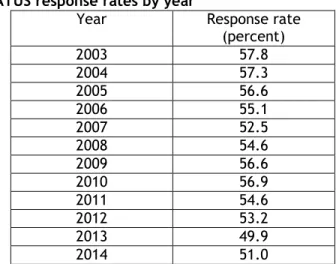
The ATUS overall response rates appear in table 3.3.7 The response rate for persons in households without a telephone number is lower than those shown in the table, averaging about 39.0 percent in 2014. A survey conducted by BLS and the Census Bureau in early 2004 analyzing responses and operations data indicated that the primary reason for refusal is survey fatigue: the designated persons are tired of participating in the CPS survey and do not want to respond to another survey.8
6 See AAPOR’s Standard Definitions—Final Dispositions of Case Codes and Outcome Rates for Surveys, 2004.
7 These are response rates calculated prior to final processing and editing. During processing, cases with poor-quality data are moved from a complete response category to a nonresponse category, thus lowering final annual average response rates by 1 to 3 percentage points. Cases with poor-quality data are those containing fewer than five activities, those for which refusals or “don’t remember” responses account for 3 or more hours of the 24-hour day, or both.
8 See 3.2 for information on how ATUS selects respondents from households that have completed their final CPS interview.
page 14
Table 3.3. ATUS response rates by year
Year Response rate
(percent)
2003 57.8
2004 57.3
2005 56.6
2006 55.1
2007 52.5
2008 54.6
2009 56.6
2010 56.9
2011 54.6
2012 53.2
2013 49.9
2014 51.0
page 15
CHAPTER 4:
DATA COLLECTION
4.1
ADVANCE MAILER
An advance mailer is sent to all ATUS designated persons to notify them that they have been selected for the ATUS sample. The advance mailer contains a letter and a
brochure, both of which are printed in English and Spanish. The letter explains the nature of the survey, notifies the designated person of the date on which he/she will be contacted for the interview, and provides ATUS telephone and Internet contact information (see appendices A and B). The brochure contains a list of frequently asked questions designed to help designated persons better understand the survey (see appendix D). Between 2003 and mid-2011, advance mailers to minor designated persons (those under the age of 18) also included an explanatory letter to the parent or
guardian (see appendix C). All advance mailers are sent by Priority Mail as described in chapter 2.
4.2
MODE OF DATA COLLECTION
All ATUS data are collected using computer-assisted telephone interviewing (CATI). The computerized interviewing instrument offers several benefits over a paper
questionnaire. First, CATI automatically inserts any answer that a respondent gives in the beginning of a survey, such as a child’s name, in corresponding later questions. Next, CATI verifies that all questions have been answered and that a respondent’s answers are consistent throughout the questionnaire. CATI alerts the interviewer if there is a problem so that it can be resolved during the course of the interview. Also, CATI allows complex skip patterns to be programmed into the questionnaire to ensure consistent data quality and minimize human error. CATI also uses pop-up text boxes to instruct the interviewer to probe for more information when necessary. Overall, CATI reduces interviewer burden and clerical errors, ensures consistency and better data quality, and makes the interview experience more pleasant for respondents.
When the interview is complete, the tasks of processing, editing, coding, and analyzing the data are expedited because all of the collectedinformation is already stored in the computer. CATI greatly reduces the amount of data entry that is necessary, as well as the errors associated with it.
4.3
CALL STRATEGY
The ATUS sample is randomized by day, with 50 percent of the sample reporting about weekdays, Monday through Friday, and 50 percent reporting about Saturday and Sunday. Designated persons must report about their activities on their designated day, without any substitution of days.
A designated person age 15 or older is selected randomly from each household to participate in the interview. No substitutes or proxy responses are allowed. All responses must be obtained directly from this designated respondent.
All ATUS interviews are conducted from the U.S. Census Bureau’s telephone center at the National Processing Center in Jeffersonville, IN. The interviewers attempt calls in six call blocks throughout the day and are required to make at least one call in each call block until contact is made with each household. The call blocks vary according to the interview attempt day. The center uses an automated call scheduler, which tells
page 16
the interviewers when each household should be called. Once a household is contacted and the designated person agrees to complete the interview, the interviewer conducts the interview using CATI.
4.3.1
HOUSEHOLDS WITH A TELEPHONE NUMBER
If a telephone number is available from the CPS, an interviewer at the
telephone center calls the household on the designated interview day to obtain a report about the designated person’s activities on the previous (diary) day. When the interviewer enters the CATI system to conduct an interview, the first few screens that appear provide helpful information that was obtained during the CPS interview, such as the household roster and any notes recorded by the last CPS interviewer. For example, the CPS interviewer may note the best time to contact someone in the household. The interviewer attempts to contact the designated person after reviewing this information. When that person is reached, the interviewer introduces him or herself. Once the interviewer verifies that the designated person received the advance mailer explaining ATUS, the interview begins.
4.3.2
HOUSEHOLDS WITHOUT A TELEPHONE NUMBER
Approximately 5 percent of the ATUS sample consists of households that did not provide a telephone number in their final CPS interview, or the phone number on record has an improbable string of numbers (such as all 0s).9 In order to be a nationally representative survey, ATUS includes these households in its sample. These households also receive an advance mailer, but instead of providing a date when the designated person will be called, the letter asks the designated person to call the telephone center on a specified day to complete the interview. In addition to the letter and the brochure, the advance mailer for households that lack a telephone number includes an incentive in the form of an inactivated debit card for $40. The debit card can be activated only with a PIN number provided to the respondent by the interviewer at the completion of the interview.
Since mid-2008, incentives are also sent to a limited number of households with telephone numbers that do not work, specifically those with telephone
numbers assigned call outcome codes of “could not be completed as dialed” and “number changed, no new number given.” In mid-2011, the ATUS expanded incentive-eligible households to include additional households with telephone numbers that do not work; specifically, those with telephone
numbers that are “not in service” or “temporarily not in service.” An incentive letter and a debit card are sent to each household assigned these call outcome codes after the household’s first of 8 weeks in the sample.
4.4
THE INTERVIEW
The ATUS questionnaire contains both English and Spanish text. The telephone center has several bilingual interviewers who conduct interviews in English but can interview in Spanish when the designated respondent speaks only Spanish or is more comfortable responding in that language.
9 CPS interviews may be conducted either by telephone or in person. If the final CPS interview is conducted in person, the respondent may or may not have provided a valid telephone number for the household. The ATUS interview is conducted only by telephone.
page 17
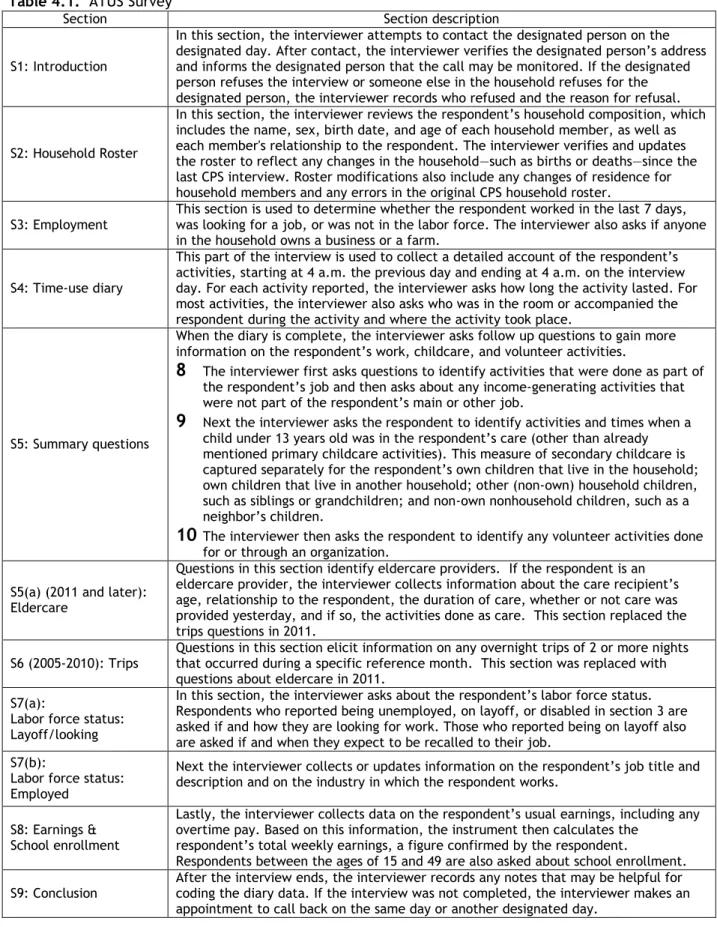
The ATUS interview is a combination of structured questions and conversational interviewing. It consists of five major topics: the household roster, the time diary, the summary questions, eldercare, and a section related to information collected in the eighth CPS interview. The portion of the interview relating to the CPS is divided into four sections: labor force status, looking for work, industry and occupation, and earnings and school enrollment. These questions are used to update or confirm time-sensitive CPS data or to fill in missing CPS data.
For all parts of the interview except the collection of the time-use diary data (in section 4), interviewers read scripted text on the CATI screen and enter the reported responses.
For the time-use diary, the interviewer uses conversational interviewing rather than asking scripted questions. This is a flexible interviewing technique designed to allow the respondent to report on his or her activities comfortably and accurately. This technique also allows interviewers to use methods to guide respondents through memory lapses, to probe in a nonleading way for the level of detail required to code activities, and to redirect respondents who are providing unnecessary information. As each activity is reported, the interviewer records the verbatim responses on a new activity line. The interviewers are trained to ensure respondents report activities (and activity durations) actually done on the previous (diary) day, not activities done on a “usual” day. One technique interviewers use to do this involves emphasizing the word “yesterday” throughout the interview.10
The ATUS questionnaire is available online at www.bls.gov/tus/questionnaires.htm. Each section is described below in more detail.
10 For more information on conversational interviewing, see Michael F. Schober and Frederick G. Conrad, “Does Conversational Interviewing Reduce Survey Measurement Error?” Public Opinion Quarterly 61(December 1997):576-602.
page 18
Table 4.1. ATUS Survey
Section Section description
S1: Introduction
In this section, the interviewer attempts to contact the designated person on the designated day. After contact, the interviewer verifies the designated person’s address and informs the designated person that the call may be monitored. If the designated person refuses the interview or someone else in the household refuses for the designated person, the interviewer records who refused and the reason for refusal.
S2: Household Roster
In this section, the interviewer reviews the respondent’s household composition, which includes the name, sex, birth date, and age of each household member, as well as each member's relationship to the respondent. The interviewer verifies and updates the roster to reflect any changes in the household—such as births or deaths—since the last CPS interview. Roster modifications also include any changes of residence for household members and any errors in the original CPS household roster.
S3: Employment
This section is used to determine whether the respondent worked in the last 7 days, was looking for a job, or was not in the labor force. The interviewer also asks if anyone in the household owns a business or a farm.
S4: Time-use diary
This part of the interview is used to collect a detailed account of the respondent’s activities, starting at 4 a.m. the previous day and ending at 4 a.m. on the interview day. For each activity reported, the interviewer asks how long the activity lasted. For most activities, the interviewer also asks who was in the room or accompanied the respondent during the activity and where the activity took place.
S5: Summary questions
When the diary is complete, the interviewer asks follow up questions to gain more information on the respondent’s work, childcare, and volunteer activities.
8
The interviewer first asks questions to identify activities that were done as part of the respondent’s job and then asks about any income-generating activities that were not part of the respondent’s main or other job.9
Next the interviewer asks the respondent to identify activities and times when a child under 13 years old was in the respondent’s care (other than already mentioned primary childcare activities). This measure of secondary childcare is captured separately for the respondent’s own children that live in the household; own children that live in another household; other (non-own) household children, such as siblings or grandchildren; and non-own nonhousehold children, such as a neighbor’s children.10
The interviewer then asks the respondent to identify any volunteer activities done for or through an organization.S5(a) (2011 and later): Eldercare
Questions in this section identify eldercare providers. If the respondent is an eldercare provider, the interviewer collects information about the care recipient’s age, relationship to the respondent, the duration of care, whether or not care was provided yesterday, and if so, the activities done as care. This section replaced the trips questions in 2011.
S6 (2005-2010): Trips Questions in this section elicit information on any overnight trips of 2 or more nights that occurred during a specific reference month. This section was replaced with questions about eldercare in 2011.
S7(a):
Labor force status: Layoff/looking
In this section, the interviewer asks about the respondent’s labor force status. Respondents who reported being unemployed, on layoff, or disabled in section 3 are asked if and how they are looking for work. Those who reported being on layoff also are asked if and when they expect to be recalled to their job.
S7(b):
Labor force status: Employed
Next the interviewer collects or updates information on the respondent’s job title and description and on the industry in which the respondent works.
S8: Earnings & School enrollment
Lastly, the interviewer collects data on the respondent’s usual earnings, including any overtime pay. Based on this information, the instrument then calculates the
respondent’s total weekly earnings, a figure confirmed by the respondent.
Respondents between the ages of 15 and 49 are also asked about school enrollment. S9: Conclusion
After the interview ends, the interviewer records any notes that may be helpful for coding the diary data. If the interview was not completed, the interviewer makes an appointment to call back on the same day or another designated day.
page 19
4.5
ATUS MODULES
The ATUS was designed so that government agencies can sponsor a module, or series of questions on a special topic usually related to time use, at the end of the survey. An ATUS module lasts no longer than five minutes and is designed to supplement data from the core ATUS.
4.5.1
EATING AND HEALTH MODULE
The Eating and Health (EH) Module was added to the ATUS in January 2006 and was fielded through December 2008. The U.S. Department of Agriculture’s Economic Research Service and the National Institutes of Health’s National Cancer Institute sponsored the module. This module consisted of questions designed to examine relationships between time use; purchasing, preparing, and consuming food; and obesity. It contained questions on secondary eating (eating while doing other activities); secondary drinking (drinking beverages other than water while doing other activities); grocery shopping and meal preparation; participation in food and nutrition assistance programs; height and weight; and household income. The EH Module was fielded again in the ATUS in 2014. Most of the questions from the 2006-08 version appear on the 2014 module, with a few changes. More information about the EH Module is available online at www.bls.gov/tus/ehdatafiles.htm.
4.5.2
Well-Being Module
A Well-Being (WB) Module, sponsored by the National Institute on Aging (NIA), was added to the ATUS and fielded for three full years, in 2010, 2012, and 2013. This module used the ATUS diary to capture how people felt during selected activities; specifically, how happy, tired, sad, stressed, and in pain respondents felt. The module also captured how meaningful the activity was and whether the respondent was interacting with anyone during the activity. These questions were not asked for sleeping, grooming, and personal activities. Respondents also were asked a few questions about their general health. The 2012 and 2013 WB Modules included all of the questions from the 2010 WB Module as well as two additional questions that collected data about individuals' life satisfaction and their emotional experience yesterday. Such information can be used to better understand the quality of life in the United States and to develop a measure of society's well-being. More information about the WB Module is available online at www.bls.gov/tus/wbdatafiles.htm.
4.5.3
Leave Module
The Leave Module, sponsored by the Department of Labor Women’s Bureau, was added to the ATUS and fielded from January through December 2011. This module asked wage and salary workers about their use and access to paid and unpaid leave and the flexibility of their work schedules. The data provide a richer description of work, including information about the types of leave available to workers, the reasons for which workers are able to take leave, leave activity, and information about whether workers can adjust their schedules to balance personal and work obligations instead of taking leave. More information about the Leave Module, including data files and the Leave Module questionnaire, is available online at www.bls.gov/tus/lvdatafiles.htm.
page 20
Tables with estimates from the Leave Module were released in August 2012 and are also available online at http://www.bls.gov/tus/news.htm.
4.6 FOLLOWUP PROCEDURES
ATUS interviewers are trained to use all of their skills and knowledge to complete the interview at the time of first contact with the household. If an interview is not completed, the interviewer attempts to set an appointment with the respondent to complete the interview later that day or on the next eligible reporting day. If a respondent refuses to complete the interview, a refusal conversion letter (see appendices E and F) is mailed to reemphasize the importance of ATUS and to request that the respondent reconsider participating in the survey. The interviewer attempts to contact the respondent againduring the 8-week period when his or her household remains in the ATUS sample.
4.7
CONFIDENTIALITY
ATUS data are collected by the Census Bureau under the authority of Title 13, United States Code, Section 8. Section 9 of the law requires that all information about respondents be kept strictly confidential and that the information be used only for statistical purposes. Designated persons are informed of their right to confidentiality under Title 13 in the ATUS advance letter and brochure, mailed approximately 10 days before the interview date. The ATUS advance letter also advises designated persons that this is a voluntary survey.
All Census Bureau security safeguards regarding the protection of data files containing confidential information against unauthorized use, including data collected through CATI, apply to ATUS data collection.
The BLS processing system design requires that ATUS data be securely transferred from the Census Bureau server to the BLS server.
page 21
CHAPTER 5:
CODING THE DATA
5.1
THE CODING LEXICON
The ATUS coding lexicon, or activity classification system, was originally based on the one used for the Australian Bureau of Statistics 1997 time-use survey. During a lengthy developmental phase, which included several coding and usability tests before the start of official ATUS data collection, the ATUS lexicon underwent many revisions. The result is a 3-tiered system, with 17 major, or first-tier, categories, each having 2 additional levels of detail (see appendix G). Each third-tier activity category also contains a list of examples of activities that fall into that category. Codes are periodically evaluated and updated prior to the start of each year’s data collection. A document showing how the ATUS coding lexicons changed each year can be found at
www.bls.gov/tus/lexicons.htm.
Coders at the telephone center assign a 6-digit classification code to each diary activity. The first two digits represent the major activity category; the next two digits represent the second-tier level of detail; and the final two digits represent the third, most detailed level of activity. For example, the ATUS code for “making the bed” is 020101. “Making the bed” is an example under the third-tier category, Interior cleaning, which is part of the second-tier category, Housework, which falls under the major activity category Household Activities:
02 Household Activities 01 Housework
01 Interior cleaning 02 Laundry
03 Sewing, repairing, and maintaining textiles 04 Storing interior household items, including food 99 Housework, n.e.c.
The final code in every tier is 99, which represents an activity not elsewhere classified (n.e.c.).
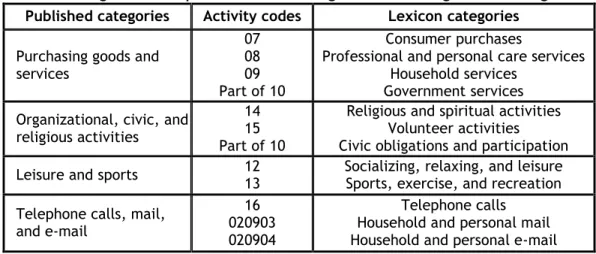
Four of the activity categories in published tables are composites of several coding-lexicon categories. For example, the two major coding-coding-lexicon categories of
Socializing, Relaxing, and Leisure and Sports, Exercise, and Recreation are combined into one category called Leisure and Sports. (See table 5.1.) See appendix H for a more detailed table linking the ATUS coding lexicon categories and major categories on the published tables.
page 22
Table 5.1.Bridge between published table categories and coding lexicon categories Published categories Activity codes Lexicon categories
Purchasing goods and services
07 08 09 Part of 10
Consumer purchases
Professional and personal care services Household services
Government services Organizational, civic, and
religious activities
14 15 Part of 10
Religious and spiritual activities Volunteer activities Civic obligations and participation Leisure and sports 12 13 Socializing, relaxing, and leisure Sports, exercise, and recreation Telephone calls, mail,
and e-mail
16 020903 020904
Telephone calls Household and personal mail Household and personal e-mail
5.2
CODING RULES AND DESK AIDS
Because of the complexity of coding everyday activities reported in many different ways into fairly narrowly defined lexicon categories, coders use a comprehensive set of rules to guide their decisions. Rules applicable to each major lexicon category are available in a rules manual, as are miscellaneous rules—such as how to code passive, waiting, or watching activities—that apply to many categories. The miscellaneous rules also address conceptual issues in some detail, such as how to know when an activity is a helping one as opposed to the actual activity itself (e.g. how to determine if “feeding my neighbor’s dog” is a helping activity or pet care).
Numerous activities can conceivably be coded in more than one place in the lexicon, depending on several factors. For example, computer or Internet use may be coded as work, education, volunteering, or relaxing, depending on how the respondent
identified the activity during data collection. For ambiguous activities, coders use flow charts that walk them through the logic required to make the correct activity code assignments. (See appendix I for coding rules.)
5.3
CODER QUALIFICATION
ATUS is unique in that it is the only survey conducted by the Census Bureau that uses the same personnel to do interviewing and coding, rather than referring collected data to coding specialists. Interviewers code one another’s cases, though never their own. This process is used because having knowledge of the coding lexicon categories gives interviewers a better understanding of the importance of probing for helpful
information and recording activities properly, both of which make coding easier. The telephone center uses a qualification process to prepare and certify coders for full production coding. New coders must pass a test panel within 30 days of completing training to be qualified for coding production panels. Formal coding evaluations and follow-ups occur quarterly for all coders.
All ATUS coders are expected to attain an average coding error rate of under 10
percent each month. If any qualified coder has an average coding error rate between 7 and 9.9 percent for the previous quarter, he is counseled by an ATUS supervisor. Qualified coders with production panel error rates equal to or exceeding 10 percent (even if previous panel error rates met qualification standards) are removed from both ATUS interviewing and coding production and placed in a re-qualification cycle.
page 23
5.4
ACTIVITY CODING
Data from completed cases are loaded into the ATUS coding application, which has multiple windows that let coders simultaneously view the activity being coded, the coding categories, and the respondent’s time diary. In the time diary window, the following information is included for each activity: start time; duration; person(s) in the room with or accompanying the respondent; location; and whether or not the respondent identified the activity done as part of one’s job, another income-generating activity, or volunteering through an organization. Tabs across the top of the screen can be accessed for further information on the respondent’s industry and occupation, the ages and relationships of household members, and any notes about the case that the interviewer added for assistance with coding. The coding software also includes a search feature that helps coders find the correct code for ambiguous activities and increases coding speed.
Some activities are coded automatically before the coders see them. During data collection, interviewers have the option of using one of 12 precodes for commonly reported activities (such as sleeping or grooming) rather than typing the activity verbatim into the activity line of the time diary. Activities entered in this way are automatically assigned the correct corresponding six-digit lexicon activity codes before the diary data are loaded into the coding instrument. Although the autocoded activities show up in proper sequence in the coding instrument’s diary, they cannot be changed by the coder.
Exhibit 5.1.
TRAVEL CODES
Travel activities are a special case, and they have more complicated coding rules than other activities captured in the ATUS. In order to capture useful and detailed information, travel activities are coded according to the purpose of the travel. Travel codes are very specific, and they are named according to the purpose (e.g. Travel related to working, Travel related to work-related activities, and Travel related to job-search activities). While in reality a travel activity might be associated with many different purposes, the ATUS activity coding lexicon only allows one purpose to be assigned to each episode of travel. In most cases, this purpose is determined by the activity that immediately follows the travel activity. Homebound trips are an exception; in this case, the purpose of travel home usually is determined by the activity that preceded the travel episodes. These rules hold for single destination trips as well as multiple destination trips. Following are four examples that demonstrate the main ATUS travel coding rules.
Example 1. Respondent reports the following series of activities: Driving to the mall (20 minutes) Eating dinner Going shopping
ATUS coding rules are designed to identify a purpose for the travel that might not be indicated in the respondent’s verbatim answer. There could be a number of reasons why someone would drive to the mall. She might be going shopping, going out to eat, going for a job interview, going to see a movie, or doing any number of activities. We cannot assign a code for this travel activity ("Driving to the mall") without first identifying a purpose; therefore, we look to the first activity done at the mall (“Eating dinner”) and assign a code of Travel related to eating and drinking.
Example 2. Respondent reports the following series of activities:
page 24
The correct code for the activity “Driving home” is Travel related to working, because with few exceptions all homebound trips are coded according to the activity that precedes the trip rather than the one that follows.
Example 3. Respondent reports the following series of activities:
Driving to work (5 minutes)Stopped to buy gasDriving to work (45 minutes)
Stopped at drive-thru to buy breakfastDriving to work (10 minutes)Work—main job Example 4. Respondent reports the following series of activities:
Driving (5 minutes)Stopped to buy gasDriving (45 minutes)Stopped at drive-thru to buy breakfastDriving (10 minutes)Work—main job
Examples 3 and 4 are both examples of trips with multiple destinations, which is sometimes called “trip-chaining.” These examples show two respondents with identical sequences of activities and only slight differences in the way they reported their travel. The ATUS coding rules ensure these activity sequences are coded the same way even though the respondents reported varying degrees of detail about their travel. As specified in the ATUS travel coding rules, each of these travel activities is assigned a purpose according to the activity that
immediately follows the travel episode. Here, the first “driving to work” or “driving” activity is coded as Travel related to purchasing gas, the second travel episode is coded as Travel related to purchasing food (not groceries), and the final travel episode is coded as Travel related to working.
Members of the ATUS staff occasionally receive questions about data on commute times. Researchers interested in commute times or other travel times must consider the complexities of travel behaviors and the way travel episodes are coded in the ATUS while performing analyses. Such research will require an examination of respondents' time diaries and it may involve recoding the purpose of some travel episodes.
For more detailed information, see the ATUS Coding Rules Manual and ATUS Coding Lexicons, both available here: http://www.bls.gov/tus/documents.htm.
5.5
VERIFICATION AND ADJUDICATION
The accuracy and consistency of coded ATUS data are critical to the usefulness and validity of the survey. For quality assurance purposes, the telephone center uses a verification and adjudication system. All cases are 100-percent verified, meaning that two different coders code each case. First, a coder assigns six-digit activity codes to all time-use data from a completed case (although not a case that he or she completed as an interviewer). Second, a different coder (the “verifier”) recodes the same case without seeing the original coder’s assigned codes. If the original coder and the verifier agree on all activity codes, the case is closed, and the data are ready for processing. If any activities have mismatching activity codes, the entire case is transferred to an adjudicator, who is a supervisor or coach with ATUS coding experience. The
adjudicator assigns a correct code for any disputed activities then closes the case. The adjudicator also assigns an error code to the coder or verifier (or both) who assigned the incorrect code. Through coding error reports and informal discussions, supervisors or coaches give coders and verifiers feedback on why any activities were recoded.
5.6
INDUSTRY AND OCCUPATION CODING
Activity coding is of primary importance to the survey. But ATUS also collects or updates demographic and labor force data that were first collected when the respondent’s household participated in the CPS, some of which must also be coded.
page 25
Information on the respondent’s industry and occupation must be coded to the Census Bureau’s industry and occupation (I&O) classification schemes.
The Census Bureau's Industry Classification System is based on the North American Industry Classification System. Beginning with the January 2014 ATUS, industry data were classified using the 2012 Census Industry Classification System. This system replaced the 2007 Census Industry Classification System. The 2007 Census Industry Classification System was incorporated beginning in the 2009 CPS and 2010 ATUS; it replaced the 2002 Census Industry Classification System, which was used by ATUS and CPS from 2003 until the 2007 classification scheme was implemented. There were only minor differences between the 2002, 2007, and 2012 Census Industry Classification Systems.
ATUS occupation codes use the Census Bureau's Occupation Classification System which is based on the Standard Occupational Classification. From 2003-10, ATUS and CPS used the Census Bureau's 2002 Occupation Classification System; starting in 2011, ATUS and CPS began using the Census Bureau's 2010 Occupation Classification System. There are numerous differences between the 2002 and 2010 Census Occupation Classification Systems and as a result, occupational data beginning in 2011 are not strictly
comparable with earlier years.
If the respondent’s industry and occupation have not changed since the final CPS interview, and the respondent provided adequate information in the CPS to accurately assign I&O codes, the four-digit Census Bureau industry and occupation codes are retrieved from the data obtained from the last CPS interview and entered into the ATUS data file. No further industry and occupation coding is required for these cases. However, if coders were not able to accurately assign I&O codes after the last CPS interview, or if respondents have changed jobs since the final CPS interview, meaning their industry of employment or occupation has changed, the I&O codes must be
recoded at the National Processing Center (NPC) according to the updated information. NPC coding specialists use a computer-assisted coding system specially designed for I&O coding. Computer terminals display the industry and occupation descriptions recorded by the interviewers from the respondents at the time of the ATUS interview. Both an industry code and an occupation code are assigned for each record; each code is determined at a four-digit level of detail.
I&O coding also involves 100-percent verification, with two coders coding each record. If the first and second coders do not agree on a specific code, the second coder reconciles the discrepancy and assigns the final code. A supervisor provides feedback on production and quality to the coding staff.
page 26
CHAPTER 6:
DATA EDITING, IMPUTATION, AND ITEM
NONRESPONSE
6.1
DATA PROCESSING AND EDITING
The goal of ATUS data processing is to transform a raw data file, as collected by the interviewers, into microdata files that can be used to produce estimates of time spent in daily activities. Data processing is done at the Census Bureau in Suitland, MD. Several SAS data sets are created from the main input file during data processing. Once these files are created, a verification/reformat program determines initial data quality before any editing or other processing takes place. A report is generated for each case based on the item being checked and the associated variables. Even though some editing takes place in the instrument at the time of the interview—such as corrections to the household roster and checks for missing diary activities—further editing is required once all the data are received.
6.2
DATA IMPUTATION PROCEDURES AND ITEM NONRESPONSE
Many of the edits performed on ATUS data deal with item nonresponse. Item nonresponse refers to a missing variable in an otherwise completed questionnaire. Generally, this occurs when respondents either don’t know the answer to a question or they refuse to answer, but it can occur for other reasons as well. For example, a variable may not be recorded due to an interviewer or computer error. Item
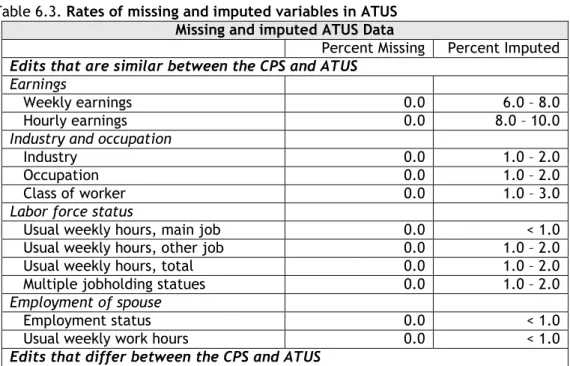
nonresponse should not be ignored because it is unlikely to occur at random. Ignoring missing data and restricting analysis to records with reported values relies on the implicit (and possibly inaccurate) assumption that all respondents are equally likely or unlikely to respond to the item and that estimates are approximately unbiased. Imputation is a very common way of dealing with item nonresponse, and many ATUS variables are imputed if missing (please refer to the ATUS data dictionaries at http://www.bls.gov/tus/dictionaries.htm for further information on how to identify edited variables and their allocated values). A description of three imputation methods used on ATUS data is given in exhibit 6.1 below. Imputation fills in values for missing data, allowing analysts to work with “complete” cases. However, treating imputed cases as actual responses may overstate the precision of the estimates. The remainder of this chapter describes the different types of data edits and imputation procedures used on ATUS variables, and calculates the percent of variables that are missing and imputed.
page 27
Exhibit 6.1.
ATUS IMPUTATION METHODS
Relational imputation. Relational imputation infers the missing value from other
characteristics on the person’s record or from records of others in the same household. For instance, if race is missing, it is assigned based on the race of another household member or, failing that, taken from the previous record in the file. Missing occupation codes are sometimes assigned a code by viewing the industry codes and vice versa. If missing values cannot be assigned a code using this technique, they are assigned codes using one of the two following methods.
Longitudinal assignments. Longitudinal assignments are used primarily in the labor force edits. If a question is blank, the ATUS labor force module examines the final month of CPS data to determine whether there was an entry for that item. If so, the CPS value is assigned; otherwise, the item is assigned a value using the appropriate hot deck, as described next.
Hot-deck allocation. This method assigns a code to a missing value by copying the code of a record with similar characteristics. Hot decks are defined by characteristics depending on the nature of the question being referenced. For instance, most labor force
questions use only age, race, sex, and occasionally another labor force item such as full- or part-time employment status, in defining the hot deck.
6.3
EDITS AND IMPUTATION OF CPS VARIABLES IN THE ATUS
Because the ATUS was designed with the CPS as a sample frame, many variables collected in the CPS are used when analyzing ATUS data, such as race and educational attainment. The ATUS is conducted two to five months after the CPS, and certain information that may have changed and could affect time use, such as employment status, is updated in the ATUS. Table 6.1 summarizes the lag time between the CPS and ATUS interviews. These CPS variables that are updated in the ATUS follow CPS edit and imputation procedures to varying degrees.11 This section discusses which CPS variables are updated in the ATUS and how imputation procedures differ between the CPS and the ATUS for certain variables. It also discusses missing data for CPS variables that are not updated in the ATUS.
Table 6.1. Lag time between CPS and ATUS interviews
11 For a complete description of CPS edit and imputation methodology, see Technical Paper 66 at
http://www.census.gov/prod/2006pubs/tp-66.pdf.
Elapsed time between CPS and ATUS Interviews Time between CPS and ATUS
interviews Percent of ATUS interviews
2 months 14.0
3 months 71.0
4 months 14.1